|
FAQs about Marine
Funguses
Related Articles: Marine Mycology,
Marine
Bacteria, Marine Microbes, Marine Virology, Marine Protozoans, Invertebrates, Marine Plankton, Taxonomy & Biological Classification
Related FAQs: Marine
Microbes, Marine Virus,
Marine Bacteria, Marine Protozoans, Marine Plankton, Phytoplankton, Live
Rock,
|
 |
|
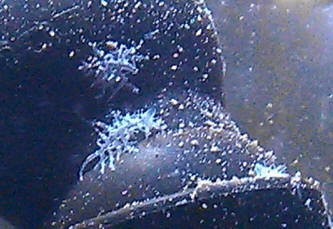
Aggressive fungus? 2/14/11
Hi Crew member,
I've scoured the internet and posted on ReefCentral and
Bostonreefers with this question ...so far not even a guess.
<Surprising>
I'm having trouble with an aggressive white slime/fungus that
"attacks" at night! Sounds like fiction, right?
<Mmm, not really>
Details:
It grows in the dark, high flow area under some live rock.
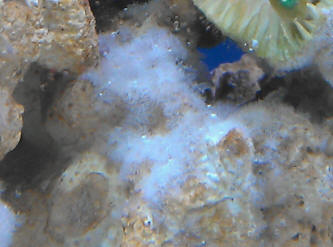
Its structure appears to be lots of fine white "hairs"
in a slime-like fuzz
Nothing grows where the fungus is.
Lately it has been damaging nearby corals ...LPS, softies and
SPS, but not every nearby coral.
Corals affected so far ...Orange cap, Green Slimer, Blue Cloves
and the latest ...Australomussa rowleyensis!!! Each suffered a
"slime" attack that damage part of the coral. So far no
re-occurrence of the fungus after attack.
The "slime" is probably the coral's defensive
mucous, but the whitish fungus is the common denominator in each
of the events.
The latest ...I moved an echinata that has the fungus under the
rock it is on. I placed the echinata/rock/fungus on the sand bed
hoping to smother the fungus. The next morning I discovered that
the Australomussa had a mucous/slime/damaged flesh nearest to the
echinata ( approx 1.5"). The distance is greater than the
echinata can expand its feeder tentacles.
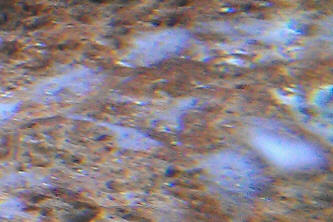
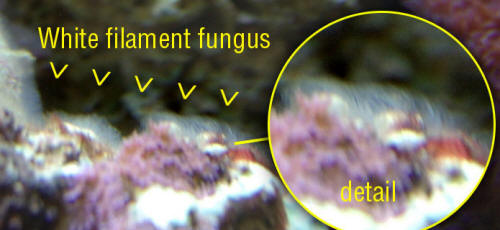
The best images I could take are attached.
Any ideas on ID and course of action?
<Is apparently decomposing food/s of some sort. Are you
applying types of sinking flakes, frozen, the placebo
"Snow"?>
NOTE: Tank is a stable 1.5 yr old mixed reef, DSB, approx 90 G
total.
My lighting period is a bit long (11 hours) and I have a high
bio-load.
Thx for your thoughts.
David
<I'd modify your feeding protocol... switch PM food/s to
AM... Bob Fenner>
|
|
|
|
Re: Aggressive fungus?
2/14/11
Hi Bob,
No "Placebo snow", but love the description : )
LOLOL
<Heeeee!>
I do "Turkey Blast" ( read turkey baster) the low flow
areas of my tank and I do encourage "particulates"
originating from the sump/refugium to circulate through the
display by Turkey Blasting the dark corners of the sump.
<Mmm, well... could be that there is some sort of nutrient
source on/in the rock itself... These filaments do look
mycological... Do you have a 'scope?>
Perhaps I should reduce this activity? The corals seem to enjoy
the suspended matter - but it is probably settling on my rock
and, if your guess is correct, would encourage the mold/fungus
growth.
<Maybe>
Since it seems to be so aggressive - should I manually brush it
off the rock or am I just dispersing the bastards?
<I'd kick up the circulation period... do you use, measure
RedOx/O3?>
As always - thank you for your thoughts and suggestions.
Regards,
David
<Happy to assist you, BobF>
|
White fungus? Not likely... 4/14/07 Hello,
<Hi Jared, Mich here.> I have a 75 gallon FOWLR and I have some
white stuff spreading over some of my rock. <OK.> It looks like
fungus. <A photo would be helpful. It is
highly unlikely that it is a fungus, perhaps a sponge, perhaps just
some detritus build up on your LR, difficult to say without a
picture.> If so what can I do to rid my tank of this?
<I can't say, there is not enough info. It is
possible that this is a beneficial growth.> Thanks,
<Welcome, Mich> Jared
Marine Fungus? 12/8/05 Mr. Fenner & Crew, I'm looking
for some information concerning a situation that has recently appeared
in my 120g reef tank. Three or four weeks ago, I observed what appeared
to be fungal mycelium? emerging from the plenum substrate in my tank.
It was growing on the inside of the glass, cream to light green-brown
in color and looked like a 'tree' in that it starts as a flat,
wider mass at the bottom and meanders upwards and horizontally,
branching into smaller and smaller 'limbs' until it terminates
in spider web like 'feeder roots'. <Hmmm... there are
very few marine fungi and no reports that I know of that they make
appearances in our tanks.> The growth is quite rapid as it will
cover 25-30% of the side or front glass over night (7-8 hrs.). It only
grows when the lights are out and once the tank starts to brighten
(daylight & lighting) it begins to degrade and is all but gone by
mid afternoon. It happens three to four days in a row and then it may
be three or four days until I see it again. <Wow! That is
rapid growth! Fungi don't need light, but many Cyanobacteria and
dinoflagellates do. Based on the rarity of marine fungi and the fact
that Cyano and dinos bloom and then wane as you describe makes fungi
very unlikely.> It emerges from different areas in the tank and when
it is visible, there seems to be an active layer of the organism about
1-1.5" below the top of the substrate growing horizontally within
the substrate. I have had a reef tank of varying sizes for over 7 hrs
(plenum system for 5 yrs.) and have never observed this before. It
doesn't seem to have any visible effect on the inhabitants as the
SPS, LPS and all of my soft critters are going gangbusters. There are 4
fish (Tomato clown, Sailfin Tang, Purple Dottyback and an Algae Blenny)
along with numerous 'cleanup guys' that are all healthy and
growing. Water parameters: Alkalinity: 9-11 dKh Ca++: 400-420 Nitrates:
< 5ppm pH: 8.2-8.3 Salinity: 1.022-1.023 I haven't checked the
phosphate level lately but I don't have any algae problems, so I
assume it is low. The tank is set up with a plenum system, 30g refugium
sump w/fine sand bed and macroalgae & +/- 130 lbs live rock. I do a
30g water change once/month and vacuum the substrate when I do the
water change. I use Mark Weiss products 2-3 times/week and as I said
before, the tank is doing great. Except for this 'tree' thing
that has appeared. I would greatly appreciate any info or insight you
may have and if there is a need for concern? Thanks, Craig Larsen
<I am semi-stumped. What you describe is most likely Cyano or dinos,
but it doesn't sound totally typical of them either. If you would
like to get rid of it, I would suggest trying to siphon out as much as
you can when it is at it's greatest mass. Usually, with patience,
this will eliminate the "stuff" and also accomplishes some
nutrient export. You may also consider raising the ORP via ozone. This
often helps with Cyano and dinos, and on the off chance that it is
fungal, it should help there also (fungi are generally very sensitive
to oxidizers). Best Regards. AdamC.>
|
|