|
Related FAQs: Coris Wrasses, Coris
gaimard, Wrasses, Wrasse Selection, Wrasse Behavior, Wrasse Compatibility, Wrasse Feeding, Wrasse
Diseases,
Related Articles: The Diversity of Wrasses, Family Labridae,
Coris gaimard, Cook Islands
Wrasses,
/The Best Livestock for
Your Marine Aquarium
Wrasses of the Genus Coris
|

|
| Bob Fenner |
Coris juveniles in
captivity
|
The tough fishes of this genus are largely misunderstood,
and therefore largely mis-used. The two dozen or so Coris species range
in size, but mainly are bigger than hobbyists realize. Some get to more
than two feet in length. All species are tough to the point of being
mean, and predators of many invertebrate groups, making them really
only suitable for fish-only systems. Males, females and juveniles are
often strikingly differently colored and marked. Only small individuals
(a few inches) of the smaller species ought to be tried, and those
provided with a soft substrate to bury and sleep within and a solid top
to prevent loss from jumping. We'll list the most common few Coris
that are regularly available, but all follow the same general rules for
selection and care... just remember to adjust for their ultimate
size.
| Coris auricularis (Valenciennes 1839), the
Western King Wrasse. Eastern Indian Ocean; Australia. |
|
|
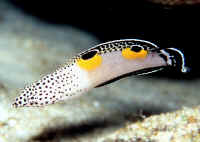
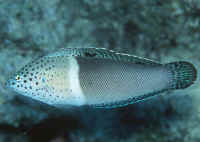
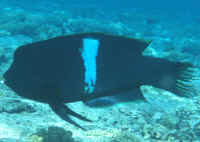
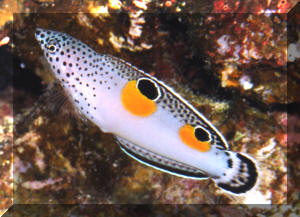
Coris aygula Lacepede 1801, the Twinspot or
Clown Coris (2), is oh-so-cute when little; at about 3-5 inches
it starts to transform into a light in the front, dark in the
back female. But as they say on late night TV, "Wait,
there's more". At a foot or so in length females change
again to darkish green with a white body band males that grow to
three plus feet in length! Indo-Pacific, including the Red Sea to
the Line Islands in distribution. Below are a three inch
juvenile, a six inch female and two foot male in the Red Sea.
|
|
|
|
|
Bigger PIX:
The images in this table are linked
to large (desktop size) copies. Click on "framed" images
to go to the larger size. |
.JPG)
%20MD.JPG)
.JPG)
.JPG)
%20MD.JPG) |
| Coris ballieui Vaillant & Sauvage 1875,
the Sand Wrasse. Known from Hawaii's islands in the central
Pacific. To thirteen inches. Rarely imported and this is a great
shame. A good-looking smaller member of the genus that would
probably do well for aquarists. This one photographed at the
Waikiki Aquarium. |

|
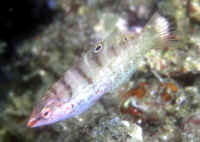
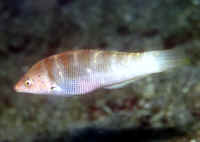
| Coris batuensis (Bleeker 1856), the Batu
Coris. Indo-Pacific, but not the Red Sea, to Tonga. Another
mid-size species, to seven inches in length, that would do well for
aquarists. Rarely collected for the trade. At right, initial and
terminal individuals in N. Sulawesi. Below: One in the Maldives,
and Australian waters. |
|
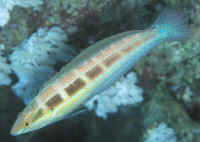
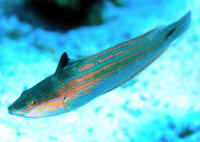
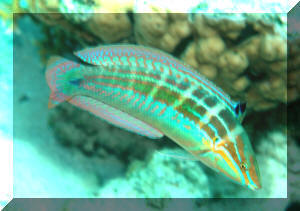
| Coris caudimacula (Quoy & Gaimard 1834),
the Spottail Coris. Indian Ocean, including Red Sea, to Australia.
To eight inches in length. A female and male in the upper Red
Sea's Gulf of Aqaba. |
|
Bigger PIX:
The images in this table are linked
to large (desktop size) copies. Click on "framed" images
to go to the larger size. |
.JPG)
 |
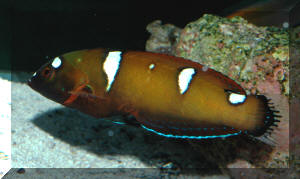
| Coris cuvieri (Bennett 1829), Cuvier's
Coris Wrasse. Western and central Indian Ocean, including the Red
Sea. Another "Coris gaimard" look-alike. Rarely
seen in the west. To eleven inches in length. Shown below,
juvenile, initial/female and terminal/male phases in the Red
Sea. |
Bigger PIX:
The images in this table are
linked to large (desktop size) copies. Click on "framed"
images to go to the larger size. |
%20MD.JPG) |
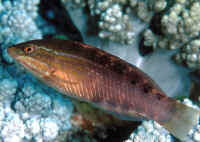
| Coris dorsomacula Fowler 1908, the
Pale-Barred Coris. Western Pacific. To eight inches in length.
This one off of Queensland, Australia. |
|
Bigger PIX:
The images in this table are linked
to large (desktop size) copies. Click on "framed" images
to go to the larger size. |
|
|
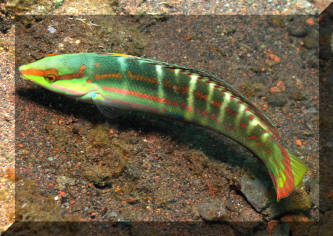
| Coris flavovittata (Bennett 1828), the
Yellowstriped Coris. Eastern-Central Pacific; Hawaiian
endemic. To 50 cm, 20 inches in length. A large female off of
Kailua Kona. |

|
|
Coris formosa (Bennett 1830) , is most often sold as the
Formosa Wrasse in the west, but as the Queen or Indian Sand
Wrasse (2) elsewhere (in reference to it's Indian Ocean
distribution). In the wild this fish grows to two feet in length.
Below are a juvenile of three inches length, initial/female phase
individuals in captivity, and an eight inch long adult/terminal
phase male in the Red Sea.
|
Bigger PIX:
The images in this table are linked
to large (desktop size) copies. Click on "framed" images
to go to the larger size. |
|
%20MD.JPG)
|
|
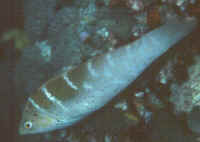
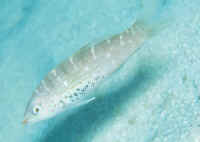
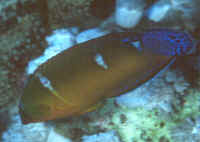
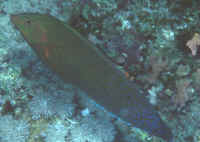
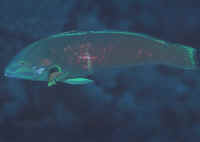
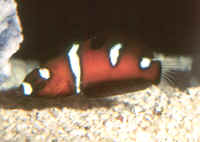
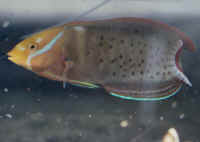
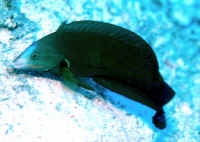
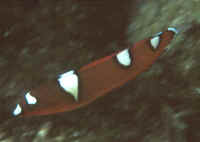
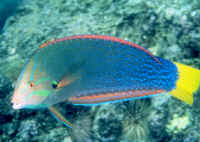
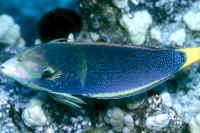
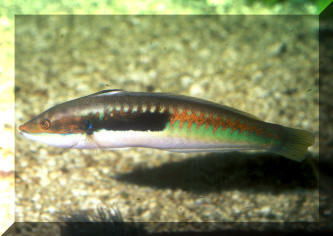
Coris gaimard
(Quoy & Gaimard 1824), the Yellowtail Coris or Gaimard's
Wrasse is THE Coris Wrasse to most hobbyists (1). Depending on
life stage this fish also goes by the common appellations as the
Red (as young) and Yellowtail Coris. To a mere sixteen inches in
length. Indo-Pacific out to Hawai'i. where these images of a
juvenile, female and male were made.
|
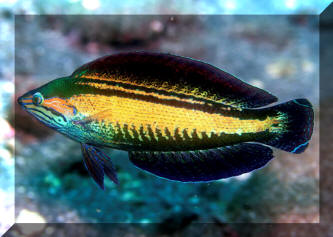
| Coris hewitti Randall 1999. Eastern Central
Pacific; Marquesas endemic. Found over rock and sand bottoms. To 14
cm. Male/terminal phase individual Nuku Hiva pix. |
|
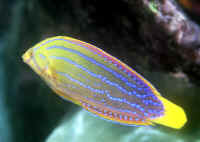
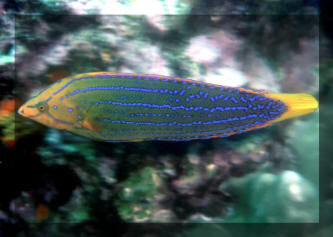
| Coris marquesensis Randall 1999. Eastern
Central Pacific; Marquesas endemic. Found over rock and sand
bottoms. To 23 cm. Initial phase Nuku Hiva pix. |
|
Bigger PIX:
The images in this table are linked
to large (desktop size) copies. Click on "framed" images
to go to the larger size. |
|
|
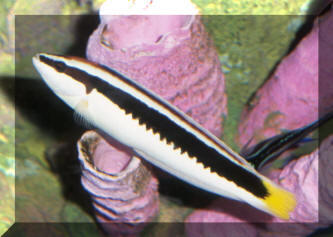
| Coris picta (Bloch & Schneider 1801),
the Comb Wrasse. Western Pacific. To ten inches in length. An
occasional import to the hobby, generally from Australia. Typically
hardy and gluttonous as other Coris species. This one in an
aquarium. |
|
| Coris roseoviridis Randall 1999. Eastern
Central Pacific; French Polynesia and Cook Islands. To eight inches
in length. |
No pic (yet!) |
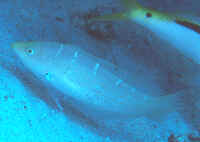
| Coris variegata (Ruppell 1835),
the Dappled Wrasse. Red Sea endemic. To eight inches in length. One
off of Hurghada, another a bit further north in Nuweiba. |
|
Bigger PIX:
The images in this table are linked to large (desktop size) copies.
Click on "framed" images to go to the larger size. |
 |
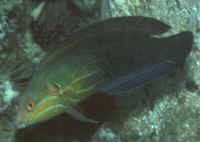
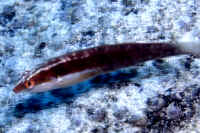
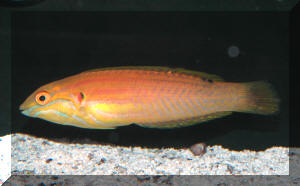
| Coris venusta Vaillant &
Sauvage 1875, the Elegant Coris. Hawaiian endemic. To about seven
inches in length. Yet another Hawaiian Coris that could/should be
used in our interest. A hardy beauty that can be found in good
numbers in shallow rocky settings. A terminal/male one in
Shark's Bay in Oahu and a juvenile off of the Big Island. |
|
Bigger PIX:
The images in this table are
linked to large (desktop size) copies. Click on "framed"
images to go to the larger size. |
%20MD.JPG) |
There are, as previously stated, several other Coris
species, and a few of these make it into the trade from time to time.
All are great diggers, flippers of decor, and only moderate in their
average survival, (2's), even the three endemic species coming out
of Hawai'i.
Bibliography/Further Reading:
Campbell, Douglas. 1980. Marines: their
care and keeping; wrasses: part one. FAMA
12/80.
Debelius, Helmut & Hans A. Baensch. Marine Atlas.
MERGUS, Germany. 1215pp.
Hoover, John P. 1995. Hawaii's wrasses, part II.
FAMA 6/95.
Nelson, Joseph S. 1996. Fishes of the
World. John Wiley & Sons, Inc. NY.
600pp.
Randall, John E. 1996. Shore Fishes of Hawai'i.
Natural World Press, OR. 216pp.
Randall, John E. 1999. Revision of the Indo-Pacific
Labrid fishes of the genus Coris, with descriptions of five new
species. Indo-Pacific Fishes, Bernice P. Bishop Museum, Honolulu,
Hawai'i.
Stratton, Richard F. 1989. The red wrasse: Coris
gaimard. TFH 11/89.
Tinker, Spencer W. 1978. Fishes of Hawaii; A Handbook of
the Marine Fishes of Hawaii and the Central Pacific Ocean. Hawaiian
Service, Inc. Honolulu, HI. 532pp.