|
|
| Home | Marine Aquariums |
Freshwater Aquariums |
Planted Aquariums |
Brackish Systems |
Ponds,
lakes & fountains |
Turtles & Amphibians |
Aquatic Business |
Aquatic Science |
Ask the WWM Crew a Question |
| Please visit our Sponsors | ||||
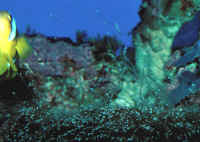
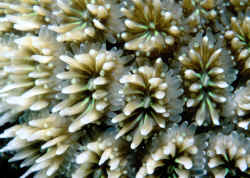
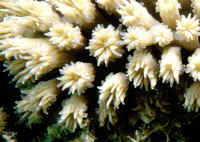
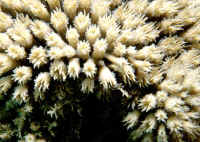
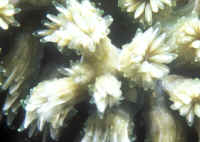
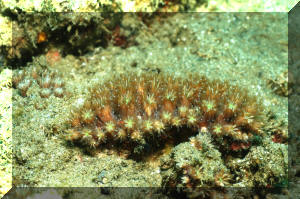
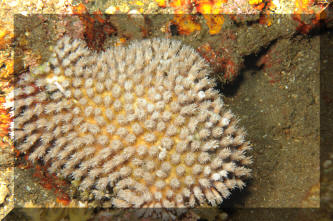
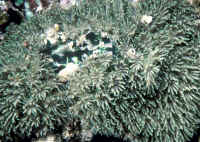
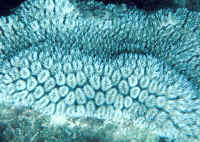
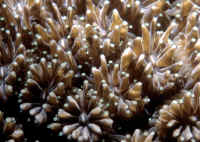
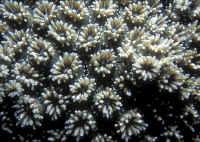
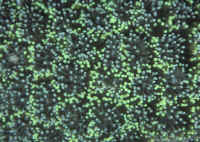
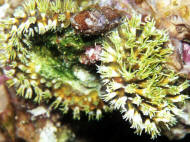
This distinctive family (erected by Gray in 1847) is characterized by its corallites being composed of walls of solid tubes connected by smooth skeleton (coenosteum). Polyp partitions (septa) are very exsert (pronouncedly outward extending). The oculinids include zooxanthellate and azooxanthellate members. Range: Occur in the Indo-Pacific; Red Sea, eastern Africa out to the mid-Pacific, Mediterranean, the west African Coast and the tropical West Atlantic. Species of Interest/Use to Aquarists: There are a few azooxanthellate genera of oculinids as mentioned above, but these very rarely make their way into the trade. Almost exclusively encountered are the beautiful Galaxy Corals, genus Galaxea. Genus Galaxea, Oken 1815. Galaxy, Crystal, Starry, Brittle
Coral. A gorgeous species group, whose skeletons are unfortunately
easily broken due to their flamboyant architecture. Dick Perrin,
Tropicorium has had tremendous success at culturing forms of this
genus/species whose colonies are more columnar. These captive
propagated (frags) individuals are far more consistently easy to care
for.
Captive Care:
Bibliography/Further Reading: Borneman, Eric H. 2001. Aquarium Corals; Selection, Husbandry and Natural History. Microcosm-TFH NJ, USA. 464 pp. Fossa, Svein A. & Alf Jacob Nilsen. 1998 (1st ed.). The Modern Coral Reef Aquarium, v.2 (Cnidarians). Bergit Schmettkamp Verlag, Borhheim, Germany. 479pp. Hoover, John. 1998. Hawai'i's Sea Creatures. A Guide to Hawai'i's Marine Invertebrates. Mutual Publishing, Honolulu HI. 366pp. Humann, Paul. 1993. Reef Coral Identification; Florida, Caribbean, Bahamas. New World Publications, Inc. Jacksonville, FL. 239pp. Veron, J.E.N. 1986. Corals of Australia and the Indo-Pacific. U. of HI press, Honolulu. 644 pp. |
|

|
Features: |
|
| Featured Sponsors: |
.JPG)
%20MD.JPG)
%20MD.JPG)
%20MD.JPG)
MS.JPG)
%20MD.JPG)