 |
|
| Home | Marine Aquariums |
Freshwater Aquariums |
Planted Aquariums |
Brackish Systems |
Ponds,
lakes & fountains |
Turtles & Amphibians |
Aquatic Business |
Aquatic Science |
Ask the WWM Crew a Question |
| Please visit our Sponsors | ||||
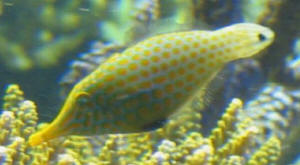
Longnose filefish... Mr. Fenner, I recently made a foolish, impulsive purchase of a Longnose filefish (Oxymonacanthus longirostris) from FFExpress. I saw how beautiful the animal was, and at an attractive price of $11, it was a sealed deal. I saw the "restricted" logo next to the name on the web site, but for some reason I assumed this was because it was a delicate shipper. The strange thing is, I am very particular to what I put in my tank. I have researched it all out and have put together what I consider to be a very healthy and enjoyable system. This is ironic because I learned almost everything I know from reading your most recent book, but I failed to peruse the section on filefishes closely enough to see that you strongly dissuade us from purchasing the Longnose filefish. <Ah, a "slip", not a "fall"... we all make them.> Is there anything else that this fish might consider eating? I visited wetwebmedia.com and saw that it eats specifically "Acroporid" coral. <Yes, almost exclusively> What if I purchase Acroporid coral polyps on a medium-sized rock and let the fish eat. Will it strip the rock clean before anything has a chance to grow back? <Hmm, depends on size of both... predator/prey... but most Oxymonacanthus die "mysteriously within a week or two regardless.> You may be shaking your head at my irresponsibility on this move, but at this point, I just can't stand the thought of watching my fish wither away. What a waste. I would greatly appreciate any extra information you may be able to divulge. Thank you. <To continue in your quest for more suitable species, specimens and further your efforts at informing others (as you have done here) in avoiding them... so that appropriate ones will be provided, others left in place.. Bob Fenner> Re: My Gray bellied Regal Angel... (actually Harlequin Filefish? Oxymonacanthus?) Hi, Thanks for the response. In reading a lot of literature out there I was under the impression that O. longirostris simply will refuse food. What I did not know is that it will eat, but will not assimilate the nutrients. I was told by a person in the Waikiki aquarium years ago that they feed their specimen with a special gel type food they make in-house. Perhaps someday a fish food manufacturer will figure out a mix of stuff that it will eat, digest, and assimilate. Until then... sigh. <<Thanks for the additional info. Cheers, J -- >> Longnosed Filefish Hi, <Hello> I know this fish is hard to keep, and usually dies within a week. But, if this fish is provided with its exact needs would it live a much longer life? Yours Faithfully Aaron. <Of a certainty yes. There are a myriad of factors that go into an equation of likelihood of survival/mortality... species specific, size, sometimes sex influenced aspects... for relative resistance to capture, holding, moving... feeding response to whatever (if anything) folks are offering... In this case, this species does hold up pretty well to being caught, held and shipped, but most often is "stuck" in situations/circumstances of too small a space, not enough maturity to the system, too many more-aggressive feeding tankmates... and most especially a lack of appropriate foodstuffs. Improving on all these aspects/factors and more definitely improves ones chances of keeping this fish longer, healthier... even to and through reproduction. Bob Fenner> Formalin & Orangespot Filefish <Hi, MikeD here> I have a few questions about a couple of subject matters. The first concerns formalin.<OK> I live in California and can no longer find formalin for sale.<California's standards are stricter than many, and formalin is a known and proved carcinogen, or cancer causing agent> I have heard two things. The first is that it is illegal to sell here, and the other is that the pharmaceutical company that makes it is no longer in business. What is the truth behind it?<Since there always was more than one company that manufactured it, I seriously doubt that THE company went out of business, unless of course "they" are referring to a California company, which is quite possible> I depend on this medication to get rid of the various external parasites found on marine angels and butterflyfish before introducing them to my aquarium. It is part of the reason I'm able to keep the Eight Banded Butterflyfish (Chaetodon octofasciatus) alive and eating well for a long time now.<I seriously doubt it's the formalin enabling you to keep the fish alive, but rather your husbandry and feeding regimens instead.> How do I get a hold of it, or are there other safe alternatives to ridding fish of their parasites?<There are several other chemicals that are effective against external parasites, the choice of which is often dependent on what type of parasite it is to begin with> The other concerns the Orangespot filefish (Oxymonacanthus longirostris). I have kept this fish before in a tank filled with thriving Acropora colonies.<That's highly commendable and a much greater length than many are willing to go in the attempt> One day it mysteriously disappeared.<Which is usually the end met by most in captivity> All my other fish at the time were healthy and still alive. I believe I had a couple of Red Margin Fairy Wrasses (Cirrhilabrus rubrimarginatus), a Blue Tang (Paracanthurus hepatus), and a Golden Pygmy Angel (Centropyge aurantius). I suspect the possibility of parasites killing this fish<No offense, but I think you've got a parasite fixation>, for it pecked at the corals all day long.<Meaning what?> What's even weirder is that I have been seeing pictures of these fish fat as a pig in nature. But my fish never got that friggin' big in the aquarium feeding off of Acropora colonies alone.<That's likely because it was never healthy and was lacking in a critical element in its diet it needed to survive.> This to me seems contrary to what is being written everywhere in books magazines, as well as articles on the internet about them being exclusive corallivores.<OK, I'll agree a little with that statement.> Is it possible they are just as undemanding in the variety of food they eat as other filefish, but are rather just shy behaviorally and very slow to adapt to rapid changes in diet and environments?<Possible, but that's not likely the entire explanation, with the real answer being that there's something in their wild diet you weren't able to meet, perhaps something as simple as not enough different species of corals. In the wild they're on the move all day long and probably include much in their diet in addition to the coral, which provides the bulk of it.> I have read accounts from certain aquarists training this fish to regularly accept normal aquarium foods.<Me too and I'm always suspicious of these reports, with many people thinking 6 months or a year is "success" while in actuality it's just slow starvation.> I've also noticed in pet stores and wholesale warehouses, that these fish peck at the sides of the glass and the bottom of the tank a lot.<Logical. they are starving to death and trying to find ANYTHING to help fill the gap.> The pecking seems very deliberate.<It probably is, with their vision attuned to things we can't even see.> What are they doing?<Eating> Could the possibility of parasites I've seen commonly attached to angels and butterflies affect the health of these fish drastically to the point of no return?<By the hundreds? Not likely. I don't know you but you really do seem obsessed with parasites.> Would it be proper to assume that if I tried a similar mini-reef Acropora set up in the distant future, to purchase the smallest juvenile filefish possible for the purposes of adaptability, much like butterflyfish?<Not a bad idea, but if I were to try it I'd add more than just Acropora, as nature rarely has anything found singly by species. I wouldn't be surprised to find that small anemones, cnidarians and such are also a vital part of their diet.> Are these fish also commonly found in groups rather than singly in nature?<Actually, no. Adults have been found to go through a very elaborate pairing ritual, not unlike many of the other filefish.> They seem to be very peaceful towards specimens of the same species.<Seem is a dangerous word. Indications are that males can be highly territorial and combative, another trait often found in other filefish.> Could they possibly suffer from severe loneliness as Anthias do if they're kept alone?<Possible, but highly unlikely, as the family as a whole tends to regard each other with antagonism, particularly in the confines of an aquarium.> Any well informed and current information about them would be greatly appreciated. Thank you.<You have to keep several things in mind. Even with the best equipment available, humans can only spend a few hours underwater at any given time, thus any and all information, even based on wild animals, is at best extremely sketchy and 95% guesswork and assumption. To make matters worse, it's not possible to follow them into areas where they regularly travel as we are simply too large, with the final kicker being that the human eye, as you pointed out, may not be able to discern something that's blatantly visible to them. While I commend your dogged determination and the steps to which you are willing to go to solve the dilemma we currently face with the species, I'm forced to agree with the commonly accepted statement that, for now, a LOT more natural observation needs to be done before they are suitable as candidates for a home tank. With luck, the answer will be found before we wipe them out as a species, either by over collecting, or, more likely, the destruction of the entire reef ecosystem they need to survive. At present, the human race is the greatest single extinction factor since the asteroid/comet that likely eliminated the dinosaurs.> Philip Formalin & Orangespot filefish (continued) <Hi, Mike D again> Thank you for the info. It was very informative.<You're very welcome, and I try as best I can.> Although I may seem paranoid about parasite infestations, I assure you from the stores I get some of my fish there definitely is a reason to.<THAT I can believe> Many of the pygmy angels and a good 98% of the butterflyfish I've ever purchased in any store down here come up with some sort of clear parasitic crustacean that feeds on the host fish.<This sounds like most or all of the local stores are getting their fish from a local "jobber", rather than purchasing from a good importer, not at all unusual.> The only exception to this rule is usually when I purchase them from excellent and well noted mail order stores from out of state. What exactly the creature is eating, whether blood or tissue is not clear. But when they go undetected for some time, (a matter of a few days), the damage they do to their hosts becomes very evident. Trust me, they're extremely difficult to detect to a novice aquarist.<It sounds like it. I live in Florida and catch my own aquarium fish on a regular basis, so this is not a common parasite.> I didn't know about this until someone working at a pet store showed them to me. Weird lesions and raised bumps begin to appear. Then the fish seem to mysteriously die. I have treated against these little monstrosities using freshwater baths, but they're too stressful for the fish, hence asking about formalin.<The formalin IS much quicker, although it's likely if your fish live for years, as mine do, that some unexplained deaths may be tumors, as formalin IS a known carcinogen.> What the heck are they?<Honestly, they sound like some sort of a fluke.> They're clear. Round in shape. Seem to have a very short tail. And they have tiny round sucker like appendages for mouths, with no readily visible eyes and no antennae. When they die, they flake off looking like dead fish scales. On occasion I also see a tiny mottled crustacean on butterflyfish. It looks like a grain of black pepper at first glance. Could you please try to identify that for me as well?<Both sound extremely difficult and may well be larval stages of an isopod, but without microscopic examination it would be impossible to tell. fish lice look something like a wood louse or "rolly polly" and are often easily removed with tweezers. For what you're describing, I'd suggest keep using the formalin and avoid buying fish from there whenever possible.> Thank you Philip Delicate File Fish, Orange Spotted Filefish Question <HI, MikeD here> Hello, From the first day I began my salt water hobby I always wanted to keep the orange spotted filefish.<Neat fish, very common here> <<Umm, there is an identification difference going on here. MikeD is referring to a species in the tropical West Atlantic, and the querior is speaking of a Pacific... Cantherhines macrocerus and Oxymonacanthus longirostris respectively. See http://www.wetwebmedia.com/filefish.htm. RMF>> But after researching I found that this was a very difficult animal to care for.<Not really, just not often offered for sale> One year into my hobby my want for it has risen and I have decided to make a commitment to getting at least one.<OK. They are another personality fish> For the tank that it would live in this what I plan to have. Tank. 10 gallon<Problem #1...too small for all but a tiny juvenile. These are active, like little "mini-triggers" Lighting. Fluorescent compacts. at least 200 watts)<not a problem> Rock and Sand. 5- 10 pounds of Vanuatu rock. 10- 15 pounds of live sand.<That part's good> Water Circulation. A couple of small pumps<OK> Heating. Brand which I have forgotten the name of.<As long as it works> Filtration. I plan to get a skimmer so that will be in the next month or so. Also here is where I will need your help. What kind of filter would you recommend for such a small tank.<One that holds less water than the tank!**grin**> Corals. A mixture of Acropora corals. I plan to grow the Acropora in my refugium on my 75 gallon tank along with the coral in the ten gallon.<AND here's problem #2. Many filefish just love SPS almost as much as they do anemones!> SO how does this sound and am I leaving out anything? Please tell me if I am because I would like this to be a challenging yet not a killing change of path.<My suggestion is at least a 55 gal. tank w/o corals unless they are planned as live food. Sorry, but those are the facts. Just the facts. Badge #714> Re: Delicate File Fish <Hi, MikeD here again> I only plan to keep on filefish would that be okay in the small space. And yes the corals are for live food.<Sorry about the previous mix up, but I'd JUST seen the Atlantic OS Filefish offered for sale for the first time just before reading your earlier questions. In regards to O. longirostris, sadly these are another little beauty that is best left on the reef, and can be difficult even for public aquariums willing to spend thousands to house them. Even though small I doubt that you could supply enough live SPS to last very long as their hummingbird movements belie a similar metabolism to the little bird counterparts as well. I can truly understand their appeal, but it's usually one that always has the same outcome in a home tank, with another living gem snuffed out in the process.>
One day ich, bloated filefish Hi, Is there a disease that looks like ich but only lasts 24 hours or less? <Mmm, there are such possibilities, but likely this is crypt/ich> Appears about once a month, usually on one fish at a time, 2-4 lesions which are larger than ich seen at the LFS. I need to find a new home for some of the fish exposed but don't want to spread it, whatever it is. I have a 20 and can move all fish to it, treat, and let the system go fallow, but am not sure what I am treating. <Most all external parasites of marine fishes can be treated about the same... See WWM re> During a recent heat wave had another episode of the 1 day "ich" followed by severe disruption of the skin of a yellow clown goby. <Touchy to treatment...> An orange spot filefish had 2 white spots on the dorsal, one of which left a Bullseye shape in hazy white the next day, no red. Following day it did not eat, kept the file up, got pale, bloated, and laid on its side. Both fish had 2 spots which disappeared for 2 days, then they got seriously ill. Am thinking secondary infection of the parasite <Possibly> wound so moved both fish to a 10 and dosed Maracyn 2. After 24 hours did a large water change and re-did the first day dose of 2 pills plus a tbsp Epsom salts for the bulging eyes (water looked milky and nasty). Plan on doing the next 4 days with single pill dose/no water changes/no more Epsom salts till the end as the package suggests. Both fish are already better in appearance. Should I continue or switch direction, if it doesn't cure or kill what would be the next action? Assuming if I get the secondary infections wrapped up still need to deal with the alleged ich. <I would dose as you list, keep changing water out, monitor ammonia, nitrite... hope> Do you feed a fish recovering from bloat and what/when would you suggest? I have live daphnia, brine shrimp, pods, worms, Mysid shrimp live or frozen and the usual array of frozen foods. <Feed sparingly, whatever the fish will take> Bloat may be food related, LFS stores here often thaw and refreeze so have mail-ordered all new frozen food for the future... the wholesalers deliver it thawed and warm in the summer. Ugh. I did quarantine all these fish but suspect I carried a pathogen from a QT tank on hands or clothes or from when I worked at an LFS. (that's how I know about the frozen food) <You have a good mind for all this...> This is what I get for announcing my success with keeping an orange spot filefish. <... a very difficult aquarium species> I got him as a rescue and he's been here for months, doing well till recently. Right about when I started telling people of my alleged success. I guess I am half Murphy and here comes the law. Suggestions? File is actively hunting despite his bloated appearance... <Do you have a "sacrificial" small polyped stony coral?> I have no idea if he's on a long term effective diet as he should be eating Acropora polyps. He did like Condylactis anemone at the store, could get him one of those... Does not eat tulip, Aiptasia or majano unfortunately. (: I will probably never get another of these as they shouldn't be in the trade, he was a rescue, and I really don't want to lose him. Thanks, Kate <I wish folks in the trade would leave this species in the ocean, stores wouldn't buy it, hobbyists would refuse to purchase... Bob Fenner> Long Nose Filefish...NOT! For Captive Keeping - 02/13/06 Hi there! <<Hello!>> I am just curious if someone could answer a question about a long nose filefish? <<Ah yes, Oxymonacanthus longirostris...beautiful and interesting little fish...and completely unsuitable for captive keeping.>> I recently bought one and yes I knew that they would be hard to feed. <<(sigh)... More like impossible.>> The one I have seems to be doing great, <<Doubtful my friend.>> I have many different foods both frozen and liquid form <<!!!>> that I was told it would eat, and that simulate what it would eat in the ocean. <<Someone is sadly misinformed...or lying to you. Either way, no excuse for you not doing your own research BEFORE buying this fish. Oxymonacanthus longirostris feeds almost exclusively on Acropora polyps...unless you are prepared to buy live corals for this fish to feed upon, it is doomed.>> Anyways, since he has a long snout with a hole on the end of it and his mouth does not move, how can I tell if he is eating it? <<Mmm...you state the fish "seems to be doing great" yet you don't know if it is feeding...I assure you it is not likely at all.>> Also, what would you suggest to feed it? <<As already stated, live Acropora polyps. Your best hope is to return this fish to the store that sold it to you...perhaps you can inform them of its unsuitability to the aquarium trade... Regards, EricR >> Long Nose Filefish...NOT! For Captive Keeping II -- 02/14/06 Thank you for the reply, as I said I knew that it was a hard fish to feed, and sorry for not doing my research before buying it. I just wanted to know if you had any additional information on the fish, because what I have read in the site from a few other owners of the long nose filefish, they have had luck with feeding. <<But what constitutes a "few"? One in fifty?...a hundred?...a thousand?>> And to make you aware I think that it is feeding due to its activity when the food is in the tank and it swims from one side to the other very fast which I thought meant that maybe it was swooping it in to its mouth. <<Why would you think this? Have you actually seen this fish ingest food? (apparently not, according to your previous email) Have you done any research on the feeding habits of this fish?>> And on a side note I do know that you guys know a lot about the fish and that is why I contacted you, I did not need your response to be so rude, <<No, wasn't meant to be rude, but 'was' meant to be matter of fact/to make a point.>> by saying it was my fault for not doing research, and that when I said my fish was healthy looking you replied that I must not know that because I do not even know if it was eating. <<Please keep your facts straight... You didn't say your fish was "healthy looking", you said your fish "seems to be doing great"...and you did also say "how can I tell if he is eating it?". A fish that is not eating is not "doing great"...and this fish specie is notorious for "not eating". And...if it is not your fault for not doing research beforehand, whose fault should it be?>> It actually seems that you do not know the information to tell me because you did not answer my questions you just had a smart remark to give me about every sentence. NOT INFORMATION. Thanks for the help but for the curiosity of the others needing your help you might not want to be so rude when responding to people just seeking your assistance. <<Is unfortunate you view it that way/that I wasn't able to tell you what you 'wanted' to hear. Regards, EricR >> Orange spotted filefish... Alive! 2/7/06 Dear Bob, <Terri> I am a long time reader but a first time emailer so please be gentle! I have had a success where many others fail, so this is my one and only chance to brag; plus I thought that you and others might be interested in this. I am the proud owner of an orange spotted filefish that has just past the 18 month mark. <Congratulations!> He, (well I assume he is a 'he'), lives in my 75 gallon seahorse tank with 8 horses and a long nosed hawk fish. I know that you are not going to believe this, but he consists solely on a diet of frozen foods. <Have seen this> This includes Hikari Mysis, Marine Green, Marine Dinner, Frozen Squid and occasionally as a treat, live brine. Additional to this, he picks at a strip of Nori I hang in the tank. Attached are a couple of pictures showing how healthy he is. I keep meaning to borrow a video camera so that I can make a short film of him eating the frozen food and send it to you (if you are interested). It is amazing watching him eat the Mysis through his long tubular snout. I am religious with my water changes, tank maintenance and have a skimmer, chiller and U.V. sterilizer. I am not encouraging novice reefers to try to keep this fish, but I just letting people out there know that it is possible. This is my first filefish and he is definitely my pride and joy! I love him more than my seahorses and that is saying something! Hope you found this interesting, Terri Rennie - (Sydney, Australia) <Thank you for this input. I do suspect that your success is due to the peaceful setting, good care you've provided... and the initial good health of your specimen. Cheers, Bob Fenner> _______________________________________ I don't care what you say... ASCII art is still cool! http://www.seahorse.org (SilverSeahorse) \ \__ , " "-. o , ---. ` , / . " / . / / / , " . . | / / . . / / / / / . . . / - - | | . . . | \ \ \ | | . . / \ \ . / , " . \_ " - , ___ `_/ " _ . , . - " Gwen the Seahorse by Terri, 2005 |
|
|||||||||||||

|
Features: |
|
| Featured Sponsors: |