|
FAQs on Pest Anemones other than
Aiptasia, Anemonia
Related FAQs:
Aiptasia Identification, Anemone
Identification, Anemonia, Eradication by: Peppermint
Shrimp, Butterflyfishes,
Filefishes,
Chemical/Physical
Injection, Hypo/Hyper-Salinity.
Related Articles: Aiptasia/Glass
Anemones, Anemones,
Cnidarians
|
|
 |
New Print and
eBook on Amazon:
Anemone Success
Doing what it takes to keep Anemones healthy long-term
by Robert (Bob) Fenner
|
|
ID Please, Pest Anemones, not
Aiptasiids 7/5/11
Hello Crew,
<Howsit>
How are we all today?
<Fine, thanks>
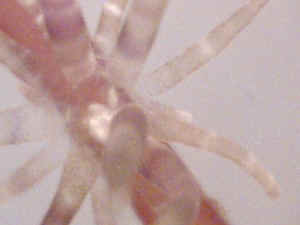
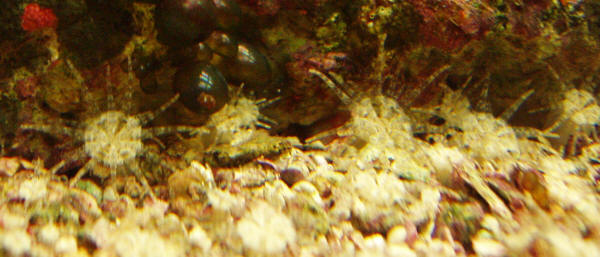
Could you help me ID the animals in the attached photo
please?
<Mmm, yes... Aiptasiids, Glass Anemones>
This is just the tops of them, most of the animal is buried in
the sand and they act like traps, anything touches them, food
etc, they snap shut and disappear into the sand.
I have hundreds of them carpeting the sand at one end of one of
my small tanks.
<Mmm, well... may be/come problematical in time.
Read here:
http://wetwebmedia.com/marine/inverts/cnidaria/anthozoa/aiptasia/aiptasia.htm
and the linked files above. Bob Fenner>
Cheers,
Campbell
|
|
|
Re: ID Please 7/5/11
Thanks Bob,
<Cam>
I did think of Aiptasia at first but in all the info I have found,
including your infopage, there is no mention of them burrowing into
the sand.
<Mmm, some species do... the reason I used the family name, not
the genus; but I could be wrong... might be another
Actinarian>
I have checked thoroughly and they are none on any rocks. Also, the
behaviour seems different from Aiptasia where Aiptasia, in typical
Anemone fashion, captures food in one or more tentacles and then
moves it to the mouth these guys close up and disappear in to the
sand to feed.
Is there anything else I should be looking at?
<Not that I know...>
Cheers,
Campbell
<And you, BobF>
Re: ID Please 7/5/11
Thanks again Bob,
<Thank you>
Have been doing some more digging and what do you reckon about them
being a species of Halcampidae (Class Anthozoa) ?
<Just looked up and yes; quite likely so>
Have you encountered these before at all? Are they a pest?
<Mmm, have no first hand experience with, but I don't think
most folks would want to have too many about... Stinging other
livestock, eating foods>
Powerful stings?
<Again, I don't know>
Can't seem to get much in depth info on them. As I said none
the rocks so I'd say not a threat the corals but I was planning
on adding a Bi-Color Blenny to that tank, he's in QT at the
moment, but not if these guys are going to sting him to death.
<I share your concern here>
Cheers,
Campbell
<And you, B> |
|
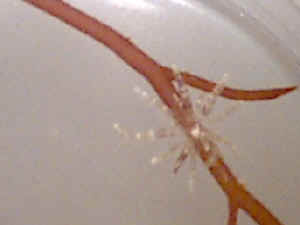
Yikes! The sacred human presence 6/16/10
Greetings, oh wise ones of the salt water world,
<Okay>
Please see attached photo and this brown anemone thing. I started
cycling my 14 gallon tank with five pieces of live rock last
Saturday.
After reading all sorts of stuff on your site, I presume it is a
bad one. It is the only piece of rock that had one of these
things on it. I took the particular piece of rock out of the tank
last night and tossed it in the garbage. Please tell me it was
the right decision.
Thanks, Celia.
<Mmm, I wouldn't have done this... the universe is likely
not as 'discrete' as you currently hold it to be...
Time/experience, and your pet fishing, will very likely aid you
in this 'discovery'. Bob Fenner>
|
 |
|
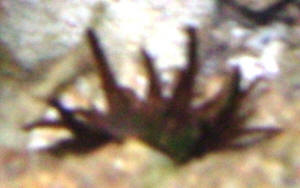
mini carpet anemones, ID, pests?
2/23/2010
Hello WWM,
<Hi Erika>
After Googling many pictures, I think I got what appears to be a
mini carpet anemone as a hitchhiker on a rock about 1 year ago,
but now they have multiplied like crazy.
<Really? Unusual. Can you provide pictures of these? I doubt
if these are Carpet Anemones, which are quite large animals:
http://www.wetwebmedia.com/carpetanemones.htm>
I have about 10 or 12 on all different pieces of rocks, they are
very small, maybe the largest one measures
about 1 inch in diameter. Are they pests?
<Depends on what they actually are, and your point of view.
Are you sure they are not Aiptasia?
http://www.wetwebmedia.com/marine/inverts/cnidaria/anthozoa/aiptasia/aiptasia.htm>
Should I get rid of them or are they OK to have?
<If they are a pest Anemone, then no. They will sting your
other sessile invertebrates>
I have a 75 gallon tank with live rock, different soft corals and
some fish. I did a search on your page but it did not say
anything about them multiplying.
Thank you for your help,
<No Problem!>
Erika
<Simon>
Re: mini carpet anemones 2/24/10
Hi Simon,
<Hi Erika!>
When I looked it up, it said it was a "Stichodactyla
tapetum",
<Really? And these are multiplying? That's great, really
interesting!
Please send us a photo/s so we can post it in our
FAQ's><<We have such. RMF>>
I don't have a camera but I found a picture of one in
google
<Yes, can't use this I'm afraid>
and I also read another person asking about them, but I don't
know if I should just let them be in my tank or if I should get
rid of them.
<It's up to you Erika. With such a great little hitchhiker
I would be temped to let be and remove other cnidarians if
necessary. Are they causing a problem? If not, then just leave
them>
Here is a link with info about them, do you know them and why do
they multiply so fast?
https://www.westcoastcorals.com/default/catalog/product/view/id/763
<Thank you for this reference, Erika. As far as 'why',
you are obviously providing them with what they need. I believe
they are easier to care for than most Carpet Anemones, which are
quite demanding, and this is good (or
bad!) news.>
Thank you for your help.
<No problem Erika, thank you for writing, and do try to get us
a couple of shots of these!>
Erika
<Simon>
Re: mini carpet anemones 3/1/10
Hi Simon,
<Hello Erika!>
I am attaching several pictures of the mini Carpets, I'm
afraid the pics are not that great, but the Anemones are quite
beautiful.
<Yes, I can see and thank you for these!>
So you don't think they will be harmful?
<Yes, they can be.. they have powerful nematocysts like all
Anemones.. but like many things it is a trade-off as to what you
prefer to have. I do think that they are far more beautiful and
interesting than the brown Zoanthids you have in the same
picture, so if I had to choose between these for example, then
I'd pick the Anemones>
I don't feed them anything specifically for them, so I guess
they get their food from the system. <Yes> I have other
"soft" corals so that is why I thought they could harm
them, but so far they don't seem to be causing problems, I
just got a little nervous b/c they started to pop up all over my
live rock.
<Mmm, they might do in the future>
I did notice they started to multiply after my Fluval canister
died. I had read about systems w/out the canisters and was afraid
to risk running my 75 gallon without one, I do have live rock and
live sand, a large hob refugium with macro algae and a Remora Pro
protein skimmer. So when my canister died I decided to try it
out, its been about 3 months since then and the water parameters
are very good and the water is very crystal clear so I guess all
that "read" is right. Do you think I should worry about
this?
<No, I only use canister filters on quarantine systems myself,
not on my main system>
My only concern is that I am not running any carbon to get rid of
some of the "chemicals" from the corals, what do you
think?
<I would, but if it ain't broke...>
Thank you so much for all your help and for the wonderful
books.
<No problem, but I've not written any books myself! Mr.
Fenner is the one for that, and I believe he is writing a new one
as we speak... about small systems and being serialised in
Ultramarine Magazine at the moment>
Many blessings to you,
<And to you and your Anemones, Erika, and thank you for your
photographs!>
Erika
<Simon>
|
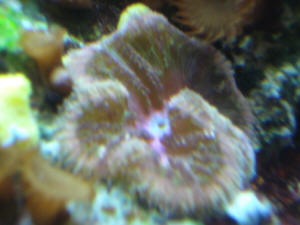 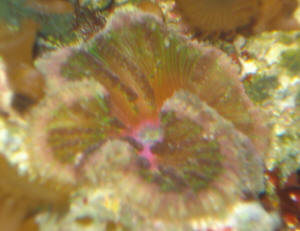
 Stichodactyla tapetum. RMF Stichodactyla tapetum. RMF |
|
mystery item in my reef! -- 02/08/10
Hello... might I start by saying I love your website?...Ok, I
LOVE YOUR WEB...oh ok I'll stop sucking up now. Anyhow, to
get right to the point.
<Heee!>
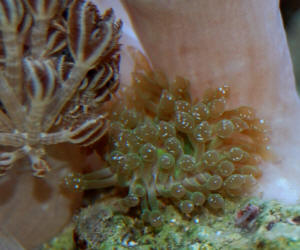
I have this lovely little thingy (actually there are two of them)
growing next to my group of pulsing Xenia at the bottom of my
tank. I think it kind of looks like a bubble anemone. But I'm
not sure what it is.. it doesn't really look like an Aiptasia
to me either though. There is the large one in the pictures you
can see visibly, and another about a third of the size next to it
behind one of the Xenia stalks. I would say the size is about as
big as the diameter of a small marble. It is greenish in color
and has bubble tips at the end of it's tentacles. It's
structure seems to be jelly
like and will contract when irritated. It also seems to have a
mouth at the center and today I tried target feeding it and it
seems to have liked it, as it closed in around the food. Of
course it could have just been reacting to a foreign object, but
it seemed to hold onto the food and act like and anemone working
its tentacles holding the food in place (at least it seemed so),
it was hard to tell it is so small. I am attaching a couple pics
for you to look at. Hope you can help me identify this thing
whether it is something I should keep.. or worry about... thanks
in advance..
Brett.
<I do think this/these may be Stichodactyla tapetum, but might
be Anemonia. Please see here re:
http://wetwebmedia.com/otherpstanemfaqs.htm
and http://www.wetwebmedia.com/anemoniafaqs.htm
Not uncommon w/ imported Xeniids; should be removed. Bob
Fenner>
|
  |
|
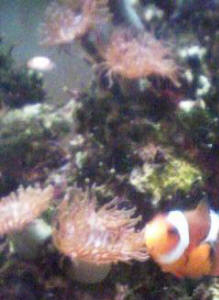
Aiptasia ?? 10/29/09
Hello,
I am in process of moving a 55 gallon salt water tank. A friend
just purchased a house and the previous owner left the tank
behind. I would like to know if the these are the dreaded
aiptasia.
<Heee! Not to be dreaded>
Also in the tank are a nice blue hippo tang, 2 clown fish, blue
damsel, 2 crabs, and starfish. The fish appear to be healthy and
active and feed well. The tank has also had recent increase in
algae I believe from over feeding. Any help or advice would be
appreciated. Bob Noury
<A bit of reading, plan for long-term improvement is in
order... A review of filtration, algal avoidance strategies...
Happily, are archived on WWM.
These anemones may be Glass/Aiptasiidae... but look more like
what folks broadly label as Anemonia... Which are less prone to
reproduce/displace other life... and can be removed by the same
techniques... again, posted on our site. Enjoy the tank, process,
yourself. Bob Fenner>
|
 |
|
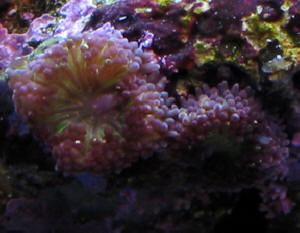
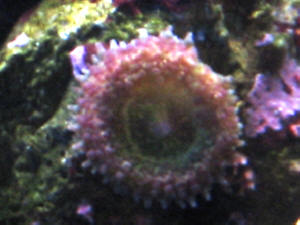
Query Regarding Strange Specimen -
10/01/2009
Dear WetWebMedia,
<Dear Writer! Crewmember Sabrina with you today.>
I have been browsing Wet Web Media for some time, and find it to
be wonderful and informative.
<Thank you very much for these kind words.>
Unfortunately, I have been unable to find any information
regarding a creature I found in my 10-gallon nano tank. This tank
has about twelve pounds of live rock, and a red crab who
hitchhiked in on a rock. Among other inhabitants, it has had a
bizarre netted flatworm, a bright green mantis shrimp, and
several other strange, but interesting, animals. I have managed
to locate information on these other creatures, but not this
anemone. The specimen has just divided, leaving me two half-inch
anemones.
Considering that I first saw it at one half inch in diameter, I
thought it might perhaps grow larger before dividing as it did.
It has short tentacles that do not appear to sting, but adhere to
fingers when presented.
<The main knee-jerk reaction that I took this question is the
preceding statement. I feel compelled to mention that not all
critters in reef tanks are safe to touch! PLEASE be cautious
about poking about or intentionally touching cnidarians and other
reef life. For one, it's not very good for the Cnidarian. For
two.... Well, do a search on palytoxin and understand that there
are good reasons to be cautious about unknown - and even
well-known - animals in reef tanks. Blanket statement: wear
gloves when working in fish tanks. I'll be the first to admit
that I don't always do so myself in my own tanks, but I
should.>
It is fluorescent under actinic lighting.
I had fed the anemone mysis shrimp and other meaty goods before,
but the other day it got a hold of one of my young Bettas that
had escaped into the marine tank.
<Yee-ikes!>
The Betta was retrieved, but did not survive.
<I'm so sorry to hear this. It may have been the saltwater
more than the brush with the Cnidarian in question. Please
consider lids for any of those Betta tanks that don't have
one, eh?>
While I do not believe it is a Majano or Aiptasia,
<It is neither an Aiptasia, nor an Anemonia majano. Of that I
am certain.>
I could not say for certain. Finally, I note that I do not intend
on populating the tank with fish. I find it interesting to
discover new and interesting creatures almost weekly.
<Neat! I have to say, that can be more fun than a tank full of
fish.>
Attached Images:
Anemone 1: Creature shortly after I had found it.
Anemone 2: Creature about three months after discovery.
Anemone 3: Immediately after it divided.
Anemone 4: One day after it divided and relocated.
<I think.... and that is to say, I'm not sure.... this
might be a Stichodactyla tapetum, "mini carpet
anemone". My first thought was that it's a Ricordea of
some sort, and that may be the case, but the smooth center with
radiating lines seems more consistent with Stichodactyla tapetum.
Take a look at images of this and also of Ricordea. Hopefully Bob
will provide further input if I am completely in error.>
Thank you for your time, Sunstar
<Glad to be of service. Thanks for the very nicely taken
photos! Wishing you well, -Sabrina>
|
  |
|
colorful Aiptasia 9/23/09
I have what looks to be 3 Aiptasia in my tank, except they are a
dark green color and the tentacles have red tips. I know what
Aiptasia and majano anemones look like, and this isn't them.
Attached are very poor pictures of
them. Please identify and let me know if I need to get rid of
them.
http://s120.photobucket.com/albums/o195/garrettjrkp/Mobile%20Uploads/?action
=view¤t=0922092015a.jpg
http://s120.photobucket.com/albums/o195/garrettjrkp/Mobile%20Uploads/?action=view¤t=0922092017a.jpg
http://s120.photobucket.com/albums/o195/garrettjrkp/Mobile%20Uploads/?action=view¤t=0922092019a.jpg
Thanks,
Ken Garrett
<... your pix are exceeding poor, but these do appear to be
Glass Anemones.
Read here:
http://wetwebmedia.com/marine/inverts/cnidaria/anthozoa/aiptasia/aiptasia.htm
and the linked files above. Bob Fenner>
|
 |
Re: colorful Aiptasia
9/23/09
Bob, thank you for your response. Yes, my pictures are exceedingly
poor, sorry about that. They are very pretty for being glass
anemones, with the dark green coloring and red tips.
<Red tips? These may be Anemonia then... or... there are
actually several, well, at least a handful of "pest
anemones" in circulation... And as you say, they're not
necessarily bad to evil...>
Do you think they will become pests and I should get rid of them,
or let 'em go for a while and see. (Or sell them as a new rare
Tyree LE anemone at $100/polyp?)
Thanks,
Ken Garrett
<Heeee! Good idea! BobF> |
|
Anemone identification, pests, reading --
4/17/09
Hi, I have 5 (that I can count) anemones in a established tank I
recently bought. The old owner said they were sold to him as rock
anemones, weren't pests,
<Define "pest">
and hadn't hurt anything so he left them in there. I've
been trying to id them but haven't been able to yet,
<Are posted over and over on WWM...>
they look to me a little like some pictures of majano, but the
coloring and tapered shape of the tendrils seem to be
different.
<There is variety in the genus, the species that hobbyists
lump as such... hence the use of the term "cf" in their
oft-naming>
I've attached a picture of two of them next to some star
polyps, could you tell me what they are, and if I should remove
them?
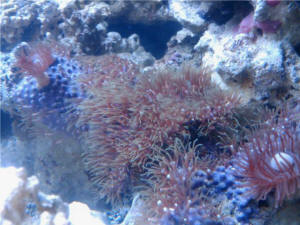
Thank you,
Mike
<Up to you. Read here:
http://wetwebmedia.com/otherpstanemfaqs.htm
and the linked files above. Bob Fenner>
|
 |
Re: Can you help me id this? Pest anemone chemical treatment
report 1/5/09 Marco, Wanted you to know that the Red Sea
Aiptasia-X does indeed kill Thalassianthus species. Regards, Gene
McLoud. <Ah, very good. Thanks for the update Gene!>
|
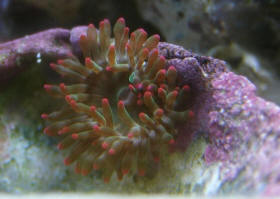
Anemone ID, Friend Or Foe 12/18/08 Hello
Crew, <Hi Sandra.> Thanks for taking the time to give your
input. <You're welcome.> Can you please tell me if the
attached picture is a Majano or a Tulip Anemone? I have no real
knowledge of anemones and need to know if this hitchhiker should
stay or go. If it is neither, a heads up as to what it is would
be appreciated. <Sure looks like a Tulip Anemone to me, nice
looking also.> Thanks again, <You're welcome. James
(Salty Dog)> Sandra
|
 |
|
Another questions :) ID...No pic - 6/4/08 Hi
<Hi Patrick, Mich here.> I was wondering if I could pick
your brain again. <Heehee! As long as it's my brain and
not my nose!> You have helped me out before :) <Glad to
hear you have found us helpful> I found 2 of these little guys
in my tank, they look like some kind of anemone to me. <You
seem to have forgotten to attach the picture.> they are about
the size of a pencil eraser. <Again a photo would be most
helpful.> If you touch them they pull their sock/foot around
their tentacles just like my RBTA when it wants to hide. I have
posted these pics on nano-reef and reef central with no
answers... <How about a link?> have you seen these before?
<Maybe...> They don't look like the common aiptasia or
the green Majanos from what I have been able to see on WWM.
<Ok.> They are very white and one hasn't moved since I
noticed it and the other seems to move almost daily. <A
picture would be most helpful!> Thanks <Cheers, Mich>
Patrick
Re: Another questions :) ATTN Mich - 6/5/08
Here are the pics!, sorry! <Ahh, very good Is a pest anemone
for sure. Is in the family Aiptasiidae, perhaps a small
Bartholomea annulata. A similar images here:
http://www.peteducation.com/article.cfm?cls=16&cat=1897&articleid=3125
I would remove from your system. Cheers, Mich>
Re: Another questions :) ATTN Mich Another
questions :) ID...No pic... Pest anem. f' 6/5/08 Thanks,
<Welcome Patrick.> removal will begin tonight.
<Good.> I have had pretty good success with removing the
normal aiptasia using dental picks. I chip off a thin piece of
rock under the aiptasia and use a siphon to suck it up, no damage
to the anemone and you get the whole thing! <Excellent
technique!> You do end up with white spots on your rock, but
it covers over quickly enough. <Very good.> You guys are an
awesome resource! <Glad you have found us helpful!
Mich>
|
|
|
Help Condy Killing Spree - 2/15/2006 Hello, thanks for the
wonderful site! I have a Condylactis anemone, recently the Condy
attached itself to one of my clams. I can't seem to get the anemone
to release to separate them at opposite ends of the tank. Is there any
tricks out there to get Condys to release? <I would just get a
butter knife and try to pry it away from the clam! IanB> Best, Bryan
Re: Help Condy Killing Spree - 2/15/2006 Someone suggested a
thin credit card, I found an old hotel room key, cleaned it up and it
worked great. Thank you Bryan <Ah! "VISA, everywhere you want
to be". Bob Fenner> Beadlet Anemone control My tank is
being taken over by actinia and I was wondering if there is a way to
kill them off? Thanks, Gord <See WWM re Aiptasia, other pest anemone
controls. Bob Fenner>
Unknown Anemone (?) 6/7/03 Hi, I am a relatively new marine
hobbyist, and I have been trying to identify some of the free critters
that have been showing up in my tank. I recently learned that all of
these new guys aren't necessarily desirable. I have what I think is
an anemone that popped out of a rock I purchased...its about 1 inch
high, grows rather fast too. The base is like a stem, and its a clear
purplish color with some white spots. At the top is a bunch of
tentacles that are a brownish purplish color, semi-transparent, with
brighter purple tips. Is this thing good or bad, and if its bad should
i try to fish it out (pardon the pun)? Any advice would be appreciated
- sorry, i don't have a pic <we really cannot ID the creature
easily without a pic, my friend. Instead... do a web search for
"Anemonia majano" or "Aiptasia" to see if pics of
either pest genus are similar to yours. Also review the FAQs and pics
in our archives on anemones at wetwebmedia.com Best regards,
Anthony>
Mystery Anemone? Hey Gang, How ya doin'? Anthony, (or
anyone that may answer!), do you know what this is? <tough to say
without a clearer pic... sight/color of base would help a little
(red/orange, yes?)... could be a small Heteractis anemone (like H.
aurora... have seen color morphs akin to this photo> Reef safe?
<I do not believe any motile anemone should be kept with other
sessile stinging cnidarians (coral). Most will kill or be killed in the
long run> Problematic? Just curious! <it does not look like a
pest species at this point to me, bud. Still... isolation in a refugium
would be strongly recommended if not a separate tank altogether. If its
a pest, it needs to be removed... and if its a baby Heteractis... it
still does> Have a great day! Stormbringer (woo hoo, going camping
today!) <kind regards, Anthony... PS- roast some marshmallows for me
<G>>
Nuisance anemone Is there a safe way to eliminate
nuisance anemone in my aquarium. Thanks so much! <What type of
anemone? I use peppermint shrimp for Aiptasia. Check out the following
link.
http://wetwebmedia.com/marine/inverts/cnidaria/anthozoa/aiptasia/aiptasia.htm
> Wishing you tons of smiles and laughter today! Karen!!!
<Thanks!!!, Gage>
|
Aiptasia ID Hello there, Can you give me a positive ID
on this stranger? About 1cm across. Many thanks. <Not
exactly... nice picture of what appears to be an anemone...
please see here:
http://www.wetwebmedia.com/marine/inverts/cnidaria/anthozoa/anemones.htm
and on to the links on "Pest Anemones",
"Aiptasia"... you may be facing the question of whether
this is a pest species that wants reacting to... I would leave it
be for now... see if it reproduces quickly for now. Bob
Fenner>
|
|

|
|
Re: Aiptasia ID Bob, Thanks for the comment.
There's already two (this one and another) on the one piece
of rock. <Oh...> Should it be removed to quarantine for
observation or is it's reproduction already underway (if it
is a pest species)? <Good question... I would pull the rock
out that they're on and thoroughly (THOROUGHLY) scrub the
areas they're attached to, rinsing under the sink... if any
bits are left, they will regenerate... and spread. Bob
Fenner>
|
|
Re: Anemone ID (and war) My little anemone has grown
greatly since we last spoke. He is now almost 2 inches when he
fans himself out, and has bright pink tips on the ends of his
tentacles. He feeds voraciously if I let him, and I'm wonder
how much, if it all, should I feed him? <Not much... this
appears to be an Anemonia sp... and may reproduce quite quickly
if supplied sufficient food> I started to feed him about once
a week a month ago while I was trying to nurse my sebae back to
health yet again. Just some brine shrimp mixed with Kent's
MicroVert and tank water gentle blown on the anemone with a large
syringe. The sebae has degraded itself to the extent that I have
moved him to the quarantine tank in case he doesn't make it.
<You may be experiencing a "chemical and physical war
between these species"... they don't have to be in close
proximity... just in the same bit of water... It would be best if
they were completely separated> Attached are better pics of
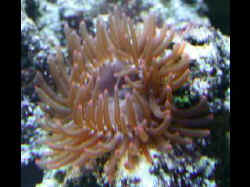
the ever growing little anemone. Why would one be doing so well,
while the other struggles to survive? <Competitive
strategies...> As for the rest of the tank, I still don't
have a fish load. Only 1 damsel and 1 yellow tang. The tank is 75
gallons. I have added another 40 lbs of sand and another 20lbs of
live rock giving me a good 3 inch bed of fine aragonite and over
70lbs of rock. I have a few colonies of spaghetti worms, various
fan worms, some with bright red fans, some green, some white. I
am constantly finding something I have never seen before. I have
2 cucumbers and 2 brittle stars. <Sounds nice> I may have 2
emerald crabs in there too, I just haven't seen them in quite
a while. I intend to add some shrimp shortly, but still
haven't decided what else. Any livestock suggestions? <The
genus Lysmata... covered on WetWebMedia.com> I want to let the
tank age probably another year before I try corals and such. As
always, your advice is greatly appreciated. <Good ideas...
though many corals are best placed as first organisms...> Oh
yeah, the pics. <Be chatting, Bob Fenner>
|
|
|
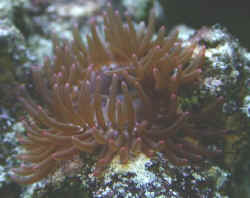
|
Majano? Hey there, I've got a problem identifying what
looks to be a pest anemone that has infiltrated my 54 gal. reef. I
haven't got pics, so I'll try to describe it as best as I can.
It has a longer tube like Aiptasia and a bright green center. The
tentacles are green with red tips. Every time I've done a search
here or on other boards I can't find anything that looks like this.
I even looked thru all my books (lots) and came up empty. Can you give
me a hand without a pic? Hope so. Have at it!!! thanks, Charlie
<Yes, we can. Take a look at our pix:
http://www.wetwebmedia.com/otherpstanemfaqs.htm and on the links
beyond. Bob Fenner>
Controlling Pest Anemones Anthony, Thanks for the input, and
quick response. <my pleasure, bud> Just wanted to let you know
that your original advice (clean up my nutrient rich environment) was
taken seriously. I have substantially reduced my feeding habits, and
have noticed my fish load actually more active as they hunt for food in
and around their live rock aquascape. <exactly... as it should be. A
more balanced cycle of nutrients (fish eating algae, passing waste,
which grows algae, that fish eat etc) rather than a dramatic weight of
influence on nutrient import> They're all still real fat, and I
believe they even look more healthy. <I do as well> In addition,
2 weeks ago I dumped my AE Tech Reef Devil 3 (running for over 2 years
and never quite worked up to it's advertised performance), and
bolted up a brand new Aqua C EV180 - WOW!!- an amazing difference. This
thing is pulling out more gunk on a daily basis than the AE did in a
week! <heehee... it is amazing once you see a skimmer that really
works. Its too easy to have a skimmer that collects a cup or two per
week and think that's all your tank produces...sheesh! I'm glad
your got a great skimmer now> My main objective is to still
eradicate the pests, but with your input I now realize that without
solving the problem, they would just keep coming back. Hopefully these
new steps will make certain I realize my goal. Thanks again, Dave G.
<best regards, Anthony>
Anemone or Polyp? A real nuisance either
way Greetings WWMCrew, I hope this finds you well. <and you
as well my friend> A few months ago, I acquired a piece of
established live rock from another tank. The rock contained several
mushrooms and a Dampia (Sinularia Dura), <a very nice coral in
my opinion!> which has tripled in size and started a new bud
recently. Also, on this rock, were several (50-60) small (1/8 -
1/4") polyps. Over the past 3 months these polyps have taken
up residence on every rock in the tank, the sand, and the glass.
They now number in the hundreds. They are easily removed from the
glass and sandbed, but I have not found a way to remove them from
the rock as they shrink up to the size of a pinhead or vanish into
a small hole in the rock. They are starting to disturb the corals
in the tank, <they can indeed kill corals> and I am getting
quite concerned they are going to get the better of the tank (not
to mention, the better of me). <agreed... but know that they
feed organismally and do not usually become a plague or nuisance in
many/most tanks. This creature thrives plain and simply from
overfeeding. You tank either has messy feeding fish, it is overfed,
under skimmed and/or lacks current (some combination of the
previous)> I have attached a picture of these polyps. First,
have you ever seen these "wonderful" forms of life, and
second, is there a way to remove them from the tank without
disrupting everything else? I can move the rocks one at a time to
my quarantine tank, if necessary, to facilitate easier removal.
<and if so... there are several natural predators to control
such pest anemones... Raccoon butterflies trained in a quarantine
tank have often worked nicely> As always, thanks again for your
words of wisdom. -Jim
<best regards> |
|
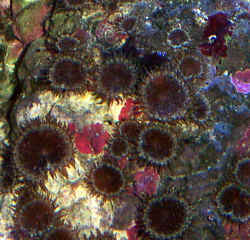
|
Anemonia Outbreak Dear WWM Crew, I am desperately seeking
help, I'm a long time WWM visitor, first time writer. <welcome
my friend> Several months ago my 2 year old 100 gallon Reef sprouted
a couple of bright green, bulb tipped anemones. From past experience, I
knew they were not Aiptasia, so I was curious, not concerned. BIG
MISTAKE!! These guys are now everywhere, and have killed several
corals, including a small brain, Galaxea and various others. I was able
to identify them in Julian Sprung's Reef Aquarium, Volume 2, as
Anemonia cf. Majano, and their recommendation for eradication is the
Nudibranch spurilla neapolitana. Every one I have spoken to regarding
this Nudibranch has no idea what they are or where to get some.
<agreed> My LFS suggested I try several peppermint shrimp.
<dubious... better with small Aiptasia> I did. They have not been
seen in the tank since shortly after I placed them in their new home
(not sure, but I think the anemones ate them!). <heehee...> I
have tried the various Aiptasia tricks, injection of high concentration
of Kalkwasser, etc. but they just keep coming back to life and
multiplying. On the rocks that are accessible and removable, I have
been able to blast them off with a water pik, but this is not possible
with the majority of my live rock. <agreed> All required
parameters are excellent, fish and corals not close to anemones are
fine, but these guys are on the move and I fear my beautiful little eco
system is doomed if I can't find a solution. <I have
solutions... but read on first. Know that killing these creatures is
treating the symptom and not the problem. Such pest anemones only grow
when there are available nutrients. Specifically... food particles.
They feed organismally and will only thrive in high nutrient
environments. In underfed, understocked, aggressively skimmed (etc)
tanks.. a few will stay in place and not spread divide for years! So,
you either have a messy fish (sloppy feeder), weak water movement, a
skimmer that does not produce every day, a heavy hand at feeding or
some combination of the aforementioned. Do consider> Any suggestions
on eliminating these pests would be greatly appreciated. Thank you in
advance for your help, both presently and in the past. Dave G. <it
is our pleasure to share and advise. For your immediate solution, there
aren't many common and reef safe solutions. Mechanical removal is
tedious and just not effective. I have seen Raccoon butterflies (C.
lunula) trained in QT tanks to eat them (bring Anemonia covered rocks
in for the first month of Qt and then the fish is often "reef
safe" long enough in the reef display to eradicate the pest
anemones). know that there are certainly risks to corals with this
fish. Other aquarists with deep pockets have enjoyed juvenile Emperor
angels with mostly to very reef safe results (under 4" specimens
usually). Alas... there is no magic wand short of nutrient control to
limit their growth. My advice is that if the bio-load allows it...
perhaps experiment with a raccoon butterfly, but it must be quarantined
for one month (disease screening and food training) and you must be
willing/prepared to trap out of the display later if necessary. Best
regards, Anthony Calfo>
Re: Anemonia Outbreak Anthony and WWM Crew, Thank you so much
for your fast response - you guys are exactly what this most rewarding
hobby needs! <well we can't sit around and drink beer ALL day
long :) > In response to your suggestions, I have fired up the QT
and will be placing several infested rocks in it in preparation of the
arrival of my new Raccoon Butterfly, which will be ready for pick up on
Sunday. <excellent... and a fine, beautiful and hardy butterflyfish.
Should me easy to find another home for it if the need should ever
arise. A great fish> My question this time is regarding the
quarantine/food training procedure. As is pointed out in the
butterflyfish chapter in Mr. Fenner's Conscientious Book,
butterflies may be quite picky and should be offered a variety of foods
while in quarantine. <true of most butterflies indeed. But Raccoons
in general are VERY hardy and adaptable. If the one you buy at your LFS
is eating at the shop (as it should be) then don't be afraid to
fast it after the first few days to a week to encourage the feeding on
anemones. Keep in QT for about one month> Because my new addition
will purpose specific (hitman/hired gun), should I follow the
guidelines outlined in the book or let nature take its course and wait
for Sammy "THE BULL" Butterflyfish to figure out that these
pest anemones are breakfast, lunch and dinner? <thoughtful... but
may not be necessary. Still... lets assume that the butterfly will be
shy or stressed at first and do pamper/follow protocol. After 5-7 days
of good behavior and feeding, let the games begin :)!> Thanks and
best regards, Dave G. <do let us know how it works out.
Anthony>
| Anemone ID Attached is a pic of the little
Anemone that popped up outta nowhere a few weeks ago. <yes...
thank you for the pic... clearly and Anemonia cf. Majano. Not at
all a baby... nearly adult at this small size> Must have been a
hitchhiker on my live rock from a few months back. <yes...
commonly from Indonesian imports (live rock, coral, etc. This
little bugger is quite mobile and reproduces easily. Regarded as a
pest by some as it spreads... can burn some coral and other
cnidarians. If it doesn't reproduce to plague
proportions...enjoy it. It fluoresces very nicely under
actinics> It is only about the size of my thumbnail, and I have
no idea what kind of Anemone he is. I haven't been able to find
many pics on the net of very young ones, so I ask for your
assistance. Thanks. <now you have a name to go with the
tentacled face <smile>. Keep reading, searching and learning
my friend. Anthony Calfo> |
|
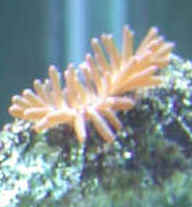
|
Re: Query on query > Bob... I did reply to that gent
promptly (the little buggers are Anemonia "majano"... a mild
nuisance). > My fault... I have a habit of moving the mail with pics
to the draft folder for whoever does the pasting and > forgot to
follow up (to see if the pics went with it or if the "paster"
forgot to clear it so that I would). > <Mmm, nice pix too...
don't see under the "marine pests" areas... or Anemone
FAQs... rats!> Actually yes... they are becoming and ever more
common problem... in some cases reaching "Aiptasia" like
plague problems and requiring/resisting similar treatments. As a rule
though they are not so bad. <Agreed. My experiences have been the
same, second hand> There is not much to say about these little
buggers that hasn't been covered with Aiptasia control. They are
Pacific (through Indonesian imports of coral)... can be controlled
inexpensively with larger angels (Ha!) like Emperor's... heehee.
Perhaps writing a little blurb on them will be faster/easier than
finding the reply to this post <G> <Will ask that Barb move
your input here to new "Other Pest Anemone" FAQs section
I'll create tomorrow> > I hope your spinning stops soon...
heehee. You should be able to recuperate in just enough time for your
> next flight out to an aquarium society meeting or next dive trip!
> <Just my plan! Where would you like to go next? Steve, Deb
sound like Cozumel... Bob F> > Antoine Awwww...shucks! Beggers
can't be choosers. I will happily go with the flow if the sun
shines and and I am guided so. The Caribbean sounds nice although
hurricane season doesn't. If you believe the forecasters 40%
accurate predictions, this summer is supposed to be a real pisser.
Given to vote on an alternate... Fiji is the cost is reasonable enough
us. <Actually, Fiji is about the same price... Let's keep
chatting, saving. Bob F> Antoine
Anemonia cf. Majano ("little green
polyps/anemones") Hello everyone, <whasssup, Rob?
Anthony> Hope all is going well! I have a polyp problem, what
started as a couple pretty polyps on a rock are now everywhere and
stinging my expensive corals. I'm not sure what type polyps they
are, although I have included a picture of them. I don't think they
are Aiptasia, as these are very colorful green to dark green with pink
tips. <thank you for the pics... they are Anemonia cf. Majano. A
minor pest anemone from Indonesia> My question is how do I
stop/remove them? A couple of them attached to the base of a hard coral
and were stinging so much that the coral stopped opening. <yes, they
are very irritating> I tried to remove them with forceps, but as
soon as you touch them the shrink up. <and by lacerating them you
may cause fission. Yikes!> I had to pull the coral out and brush the
polyps off using a toothbrush and it literally took five or so minutes
before the base of the polyp finally came off. Is there an easier way
to rid these polyps, like injecting them with something/an predator?
<aquarists are just now exploring the possibilities of natural
predators for this pest. Until know all of the laborious applications
used on Aiptasia (read WWM archives on these anemones) have been
tried...no less laborious...Ha! One interesting predator that I have
heard is a juvenile Emperor angel! Hardly an inexpensive solution.
Generally not very reef safe unless under 5" too. If you ever
wanted one, perhaps consider it... but that is hardly practical. The
best bet with this pest is controlled feeding (sloppy foods for other
fishes and corals in the tank help Anemonia thrive) and nutrient
control (aggressive skimming). Such will temper the spread of this
little beast. In time, I'm sure someone will discover a less
expensive/more reliable natural predator. Best regards, Anthony>
Thank you, Rob
Re: What is this anemone? Bob: I put the pictures out on the
internet if you are curious as to what these things look like... you
can click on the following link: http://www.softresc.com/anemone.asp
Thanks again for your help....
Jim
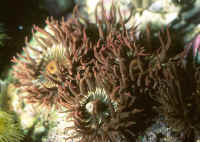
| Hmm, do look like... Actinia equina... and not
really an undesirable sort of animal really... I wouldn't
necessarily go out of my way to get rid of them. Here's my fave
pic of this species. Bob Fenner |
|
Re: What is this anemone? Bob: Appreciate the identification.
Looks very much like the picture you provided. Not a bad looking
anemone - but to go from 1 to 20 in five years makes one concerned
about the next five years. <You'd be shocked (maybe) to
experience those pesky Aiptasia... have seen them go from undetected to
literally hundreds in a few months!> They are a nuisance in that
they grow on the underside of hard corals and interfere with other
organisms by their close proximity. Tried getting one out by grabbing
the stem with needle nose pliers - but boy they retract fast. Also
tried the hot water trick - thought I killed it, but was back in a few
days. Could try a butterfly but don't know why it wouldn't eat
the good stuff as well. Could remove the rocks and scrub them - but
most have polyps and macro-algae that I want to keep. <Try the
Peppermint Shrimp, Lysmata wurdemanni trick first... two individuals,
and keep your eyes on them> Anyway, have read your articles - if you
come up with any ideas please pass them along... Thanks, Jim
>>
<Be chatting, Bob Fenner>
|
|