|
|
| Home | Marine Aquariums |
Freshwater Aquariums |
Planted Aquariums |
Brackish Systems |
Ponds,
lakes & fountains |
Turtles & Amphibians |
Aquatic Business |
Aquatic Science |
Ask the WWM Crew a Question |
| Please visit our Sponsors | ||||
Majano Pest Anemone, Methods of Eliminating - 2/03/08 <Hello Eric, Brenda here> I have a problem with Majanos that has reached a plague level. <Yikes!> Thanks to your site I've realized the cause was poor skimming and I think I've fixed that problem. But now I'm trying to rid my aquarium of these pests. I'm thinking about getting a Raccoon Butterfly and I'm wondering if I should bite the bullet and put him directly in my aquarium and risk him wiping out my corals (mostly LPS, leathers, mushrooms, and some green star polyps) and my 2 bubble-tip anemones. <That is a huge risk! This is not one that I will recommend.> My other option is to put him in a tank I will be using for a refugium and rotate the plagued rocks in and out of the refugium. <This fish needs a minimum of a 70 gallon tank.> Any advice? <I would try the boiling water method to remove. See further information here: http://www.melevsreef.com/pics/bta/not/majano.html > Thank you, Eric <You're welcome! Brenda> Anemonia Greetings to the Lords of All Things Fishy! <Not Lords> I have a pest elimination and stocking question. I own a 65 gallon Semi-Reef (just some soft coral frags that are getting squeezed out) tank with a nasty Anemonia and Aiptasia problem. Actually the Anemonia is worse so the Aiptasia can't really get a foothold. Peppermint shrimp aren't working against these guys so I need to bring out the big guns, preferably some death-dealing fish that will destroy these pests. Right now I've got 4 Chrysiptera hemicyanea (a lovely fish), a Maroon Clown, a Cirrhilabrus cyanopleura, a Pygmy Flame Angel and an Amblygobius Goby. Everything is in the 2-3" size range and they get along well. The hardware is as follows: I got about 110 lbs of live rock in the tank and sump and about 4" of live sand. I'm skimming with an AquaC Urchin. Question #1: What can I add to this mix to swat these evil anemones? Question #2: I love triggers. Is there a trigger I can add to this mix that won't screw everything up? <Never heard of any triggers eating pest anemones. I've heard some pygmy angels help control these, but then when the pests are gone what will they go after then?> What about a small Blue-chin (that I could return when it got too big) or a Picasso? I want to add that I have an awesome relationship with my LFS. I'm willing to experiment with the trigger because if it doesn't work, I can always bring it back. He's also affordable and honest. My favorite quote of his, when a couple was inquiring about buying an expensive Tang. "Sure, I'll sell it to you. It'll die, but I'll sell it to you." <Pest Anemonia usually populate with a higher than normal food source. Try to control this. The Anemonia aren't nearly the pests that Aiptasia are. Here is some further reading. http://www.wetwebmedia.com/anemoniafaqs.htm. James (Salty Dog)> - Pygmy Angels Controlling Majano
Anemones - Dear WWM My name is Joey Conti. I am 13 and I have a
120g reef tank. I had an out break of majano anemones. I have heard
many sources say you can control these pests with pygmy angels. I am
wondering if you have heard this theory before and if the fallowing
pigmy angels would be reef safe: Flame Angel Pigmy Angel Lemonpeel
Angel <I have not heard this directly, but it makes sense that the
stories would come about. These fish are constant "nippers",
mostly at algae and fauna directly on live rock, but I have no
definitive proof that these fish would control nuisance anemones. The
other problem is, that if they do eat the anemones, what will they nip
at once the anemones are consumed? Quite likely they will turn their
attention to other things which could include your corals and clams. As
for "reef safe", these fish sometimes do very well in reef
tanks, other times not at all. Very hard to predict, but something you
can hold off to an extent by making sure they have their primary
choices for food and plenty of it. Please read up on pygmy angels here:
http://www.wetwebmedia.com/marine/fishes/angels/centropyge/index.htm
> (I have many soft, SPS and LPS corals and a maxima clam. I know
some angels will pick at them) Young Aquarist, Joey C.
Majanos I purchased a used 180 gallon tank last December, it has 200 lbs of live rock in it. The bad thing is they are covered with majanos. I have not set up the tank due to having a room remodel and floor support job. I have the rock outside in Rubbermaid containers with heaters and a powerhead in them. I have tried Joe's Juice on them and it seemed to work very well on them, but I find that they keep popping up every now and then. I don't have nearly as many after using the Juice not nearly as many but I am afraid to start my 180 gallon tank up with this rock due to possibly having another outbreak of majanos. If I take the live rock out of the water and let sit out in the sun (I know this will kill all life) do you think this will finally end their reign of terror? Then I could put in water say after a month or so, and let the cycle begin. Or should I just throw it all away and start over? <I would just dry it out in the sun for a few days...let it all dry out and then re- cycle your aquarium and maybe add fish in a couple months. There is no need for you to throw that rock away. Live rock is very expensive these days. Good luck, IanB>
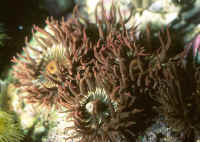
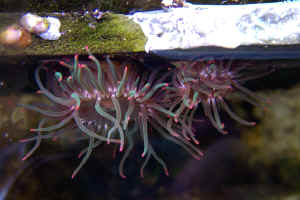
Colony anemone outbreak 12/30/03 Hello~ <Hi Sherry!> I hope everyone had a great holiday and definitely have a wonderful new year. <You Too!> Here's my concern I have a 75 gal reef tank setup with a killer explosion of these (olive green with pink tentacle tips maximum size is one inch) anemones everywhere. It started out as a what I thought was a cute little hitchhiker on some live rock but, now there are many many many. Is there a natural predator for these nuisance anemones. I read that the Copperbanded butterfly eats Aiptasia. Would this type of hitchhiker be in the Aiptasia family. I am very sorry as I don't have a camera to download a picture of these pest so, I know that identification on your part from my description would be hard. <This is one case where a verbal description may be adequate. It is a pretty safe bet that you have Anemonia Majano. A web search should yield plenty of pics for verification. These pest are about the size and tenacity of Aiptasia, but are in some regards easier and in some regards more difficult to control. The usual Aiptasia predators will show not interest in A. Majano. The only reliable predators are large angels (Blueface, Majestic, and Emperors) and a few decidedly non-reef-safe butterflies. The upside is that they are much more leathery than Aiptasia and if you can get to the base, they can be cleanly plucked from the rock. For those imbedded in a hole, a couple of days of darkness will stimulate them to climb up seeking light. This not only makes their bases accessible, but loosens their grip making them easier to remove. This approach is tedious but works. You can also use underwater epoxy to trap them in their holes, but for a large outbreak, you may end up with a giant mound of epoxy! Good luck eradicating these monsters! Adam> Regards, Sherry S. Anemonia majano sp. 12/3/03 Hey guys, <"heeeeey, Joe... where you goin' with that gun in your hand?" Oh, sorry... I just had a Hendrix flashback. Sorry, like you've never had anyone sing that song line to your before <G>> It's been a while since I've had a problem with my tank, though I have been keeping up with all great advice you guy's give to everyone else. Here's my problem. Recently my 180 gal. started to develop an outbreak of Anemonia majano sp. It's now covering an area of about 5"x5" and still growing. <do recall/know that such outbreaks of pest anemones occur only when there is available food. They of course cannot grow from thin air... or water as it were. As such, yours have fared because of accumulated dissolved organics (poor protein skimming, weak water changes, inadequate chemical filtration/carbon, etc)... or excess particulates (heavy feeding, overstocked fishes, less than 10-20X water flow in the tank, etc)> I've lost a piece of Favia sp. to it and it shows no sign of letting up. Unfortunately everything I read about it says there are no effective cures for them, not even the traditional Aiptasia ones. How do you stop this insidious menace? Once again, great website, and thanks for your help. Joe G. Pgh. Pa. <beyond improving husbandry as stated above, there are some natural predators that will treat the symptom until your correct the problem. Indonesian (be specific here) Copperband butterflies, Emperor angles, possible Florida peppermint shrimp. Be sure to test any of the above first in QT tank first before just throwing one in your display. There is some experimentation too with Berghia nudibranchs... mixed opinions. Best of luck, Anthony>
RE: Pest or beauty? Thanks again Bob for all your help - and the WWM crew of too, of course. You said Anemonia spp - will a clownfish go to these things and hang out in them? How big will they get? Just curious!! <Mmm, might go in, but might not come back out (!)... Actually, not likely to interact with... and most get to be about an inch in all dimensions> Thanks Bob!! Dude <Welcome. Bob Fenner> Pest anemones 11/2/03 I've got a gigantic infestation of majano in my 180 gallon eco-wheel system tank. <like most nuisance organisms, Anemonia majano do not grow from thin air, but are instead a symptom of a flaw in nutrient export mechanisms in the display... in short, the system is overfed, overstocked and/or under filtered (poor water flow, weak skimmer production, etc)> Too many to inject with anything. Scrubbed them off once, but they came back. <indeed a waste of time and treating the symptom (the anemones) and not the problem (nutrients)> Finally I've removed half the rock and put it into a 55 gallon tub with a pump and protein skimmer. Covered it so that it got no light. After about a week it stunk to high heaven but the rock looks clean. Coralline algae still on the rock. I'm going to do a water change today and keep the protein skimmer and pump in it for another week, or until the water is clear and the ammonia levels are zero. Then put it back into the tank and switch out the rest of the rock for the same treatment. Do you think this will work? - thanks. Dan Wheeler <I honestly do not believe this will work. I'm fairly certain that they will return. Do try to figure out their food source in the system and limit that to easily control them my friend. Best of luck. Anthony> Pest Anemone ID - 8/21/03 Hi Again, I have taken some better photos, I hope these are easier for you to identify. The anemone was a hitchhiker on some live rock and I am worried that my tank isn't suitable for his needs. <no worries... this is Anemonia majano... a very hardy species that takes low light and heavy feeding/nutrients. It grows so well as to be considered a nuisance in overfed reef tanks (or others with nutrient export flaws). I find it beautiful and easy to manage by limiting nutrients> I only have 3 NO fluorescents (2 white 1 blue ) on a 48x18x12 tank and I had no intention of keeping an anemone under these lights. I fed the anemone some Mysis last night and he has really perked up now! Do you think I should return him to my LFS or will he adapt to the low lighting in my tank? <he will acclimate just fine with regular feedings> So far I have had him just over a week and he seems very happy and his colour appears better than when he arrived ( I have positioned him near the top of the tank. Thanks again for your help! Sonya <no worries... do enjoy. Best regards, Anthony> Anemone ID 7/3/03 I have some small anemones that seem to have come in on some live rock from Harbor Aquatics. I don't think it is Aiptasia or majano, but I can't identify it. It doesn't seem to have the long foot of an Aiptasia, <Good/good enough images... but the cnidarian is still so small/young as to be not reliably identified. Agreed that it does not look like Anemonia majano...> .. in fact it doesn't seem to have any trunk at all. <perhaps only because of its size/youth so to speak> It is almost transparent with white rings around the tentacles. <indeed... almost reminds me of a young corkscrew anemone (bartholomae)> I am concerned because it seems to be able to swim, or at least to drift like a baby spider until it finds somewhere it likes. <yes... the latter> I found this one in my refugium, which means that it can survive a trip through a powerhead. <Most amazingly can. I honestly suspect it is/could be a pest species... but only a problem if the tank is overstocked or overfed... no worries with good nutrient export. Can be enjoyed like any other. Best regards, Anthony>
Clown/Goby Feeding and Majano questions Greetings! Three days ago, I added my first fish tenants to their new 30g home after five long weeks of cycling. The True Percula and Citron Goby appear to be doing well, although the goby has adopted the upper heater suction cup as its perch, causing my wife to question the wisdom of my fish choice. The only anomalous reading thus far was a brief ammonia spike of 0.2 after 24 hours, which was remedied by a 3g water change. I was unable to get either fish to eat flakes or pellets, and they let the Formula 1 frozen food sink to the bottom. The LFS has brine shrimp, but I now know they are bereft of nutrition. I did, however, seem to hit pay dirt with Sweetwater Zooplankton. Both fish have nibbled at this (and my peppermint shrimp happily eat the rest). My question is this: is zooplankton a sufficient nutrient source for these fish? I would still like to try Mysis shrimp, but have not yet purchased them. I am more concerned about the goby, since I have seen it attempt to eat much less than the clown. < The plankton alone will not be sufficient although it is a very good food. Try to give them a varied diet with as many different foods as possible. They should take flakes after awhile but just be patient.> Next question: I have a majano problem that is primarily located on one piece of LR (about 2-3 pounds out of about 30 pounds total). In addition to the majano, I have noticed some tiny Aiptasia growing, as well. Unfortunately, my shrimp are altogether uninterested in helping me with the Aiptasia. Would it be feasible to pull the piece of rock, nuke the small polyp majanos and Aiptasia with the hot Kalk mixture, rinse with my heated/aerated change water, and return to the tank? Any idea how long it would take for those suckers to drop off? Would the ensuing die-off be too great a bioload for my new inhabitants? Should I just chuck the piece of rock in question? There are about 3-4 of each type of pest located elsewhere in the tank, but at least 30 majanos on this rock and about a dozen Aiptasia. <Make sure your shrimp are actual peppermints and not camels which are peppermint look-alikes. If these are peppermints they should eat the Aiptasia in time. You can find everything you need to know in the majanos here: http://www.wetwebmedia.com/otherpstanemfaqs.htm Best regards, Cody.> Anemonia majano and stocking questions Greetings once again! Brief system recap: 30 gal Eclipse 3, FOWLR (no fish as of yet), <Good man John...planning ahead gets big points here!> 30 lb LR, 3/4" Fiji pink sand, Berlin Airlift 90 skimmer, temp 80F, pH 8.2, Ammonia .25-.5ppm, CA 360 <Yep, wait for the thing to cycle! Ammonia and nitrites should be zero when done.> Thank you for identifying the Anemonia majano hitchhikers from my LR. In addition to identifying the anemones as 'sponges' (granted, their tentacles were not showing much), they told me that the two dozen green polyp-looking things were feather dusters (actually baby majanos). Now that I have done my research, I cannot fathom how anyone with a modicum of saltwater experience could mistake these for feather dusters and sponges. <Oh, that's nothing! You will certainly hear more!> Once again, I turn to the only source not looking to sell me something for assistance! <That's us! Although...have you seen our T-shirts? LOL!> My question is this: Sometime after the tank cycle is complete (and maybe a month or two after that), I plan to add fish. <You are killing me with the points now dude! Good on Ya!> Given the large number of majanos, and after reading Bob's take on them in TCMA, would it be permissible in this system to stock one raccoon butterfly (as the only inhabitant)? You told me that watching my water quality is paramount to halting the spread of these, but, barring the use of the raccoon, is there any other hardy predator of majanos of which you are aware? <Yes, an adult human with a syringe of Kalkwasser to inject them and kill them that way, a few at a time. Your choice of fish should match your tank size....surf over to WWM and look up the Raccoon to see what size tank is required, and any other husbandry needs for this fish. You have a perfect record, so I know you'll check it out first. Gee, I love this kind of post!> My daughter would be sad if I didn't get her percula, but if the raccoon would work, I would make the sacrifice. <Get the syringe and needle (local feed store) and go on a search and destroy mission. When done, get your daughter her dream fish, a good choice for a 30.> One more question: After constantly reading about the importance of maintaining a constant salinity level, I recently acquired a salinity refractometer. My intention was to adjust the salinity to the required level, wait one week, then test again. <Not necessary. Get it right first, then top-off the water to that desired level (any water that evaporates) and you will be back where you started, salt doesn't evaporate, only water does. Replacing the water reconstitutes the previous correct SG. Replace evaporated water daily and you have a constant SG. It won't hurt to test between water changes to be sure. This is like leaving a glass of colored water in the sun. The water will evap. leaving the dye. Add the same amount of water and the color should return to it's previous dilution/color.> After measuring the water required to bring the level back to its desired state, I could use that to calculate the amount of top off water required per day. <Already done. Anything that evaporates is the amount.> I was thinking that if I go on vacation (I am planning ten days in December), my dog-sitter can not only add the pre-measured food, but pre-measured doses of RO top off water. Is this something that is feasible? <Sure! Try; "Use one of these per day to feed, *no more*, and use this water to keep the tank filled to "here". Do it daily so you don't add too much all at once." When you get back, better do a water change ASAP to replenish alkalinity, calcium, etc. because you won't be there to supplement.> Thank you again for all of your help thus far. Also, tell Bob that my 4 and 7 year old kids love his book, too (mostly the pictures at this point, but you gotta start somewhere!) JPM <Does it have print in it? I don't read books without lots of pictures! LOL! I'm with your kids on this one! Craig> Anemone ID - Anemonia majano - 2/17/03 Dear WWM Wise Ones: <cheers> Well, my first saltwater tank is officially underway. To recap: 29g Eclipse3 Set up 02/07/03 Berlin Airlift 90 skimmer (cup almost fills with medium green tea about every two days) 2 x 20W (PowerGlo x 1, Marine Glo actinic x1)30 pounds LR/.75inch Fiji pink sand Temp: 78-80 (stable since beginning) pH: 8.2 (also stable) Current ammonia: .25/ppm Calcium: 360-380Nitrate/Nitrite: Unknown - son lost color chip for test kit - will have new very soon Water changes: 2-3 gal approximately every 2-3 days, changed with Instant Ocean mixed, mixed with tap water, aerated for about a week and heated to 80degrees.Supplements: SeaChem Reef Carbonate, Reef Complete and Reef Vitamins, dosed slightly under directed amounts, timing as recommended (twice per week), and at least 24 hours between each different application. I was beginning to relax, thinking the tank was cycling fine, when I saw a denizen on my LR that made me take notice. Two of them, as a matter of fact. I have attached a picture for your viewing pleasure. <They are the potential pest species Anemonia majano... read more in the archives about these and the other common pest Aiptasia. No worries though... they will not take the tank over or reproduce if you run a healthy system. They only flourish in tanks with poor nutrient control (poor skimming, overfeeding, etc)> These critters looked rather different when I purchased the rock. The LFS told me that they were sponges, <Sponges!... what are you smoking, dude?!? And can I get some of it?> but recently they have 'opened up', and they look very much like some type of anemone. <Ahhh...ya. <G>> I have been unable to locate a picture of a sponge that looks like this. They have also started to entrench themselves into the rock further, making extraction virtually impossible without killing them. <No worries... leave them alone. They are in fact beautiful under actinic light (green)> If these are sponges, should I let nature take its course? If they are anemones, and they do not come out of the rock any further, should I move this rock to the top 6" of my tank? (very doable). Do I scrap the one Marine Glo for another PowerGlo? I am able to do just about anything short of getting MH lighting (not to mention I'm afraid I'd cook the tank due to its size!) I would really hate to see these creatures die, but I am unsure how to properly care for them in this rather limited setup, much less extract them to let them live in happier climes. I am so excited about all of the activity I've seen so far in my tank - I can't bear the thought of killing the most beautiful thing to yet show its face/tentacles! <and you don't have too. Their "pest" status only applies to flawed/neglected systems like nuisance algae growth> Thank you again for your immeasurable assistance, and for turning me onto the most valuable tool mankind has seen since the Holy Hand Grenade (TCMA, of course!) <our great pleasure... the Knights who say... Nee! Anthony> Pest Anemone - 2/14/03 Hi
Robert, Do you or any of your crew members know what this is a pic of?
the picture isn't very good, but neither is the
camera. Tim. <the creature is an Anemonia
"majano". Use this scientific name to do a keyword search of
our archives for much that has been written on controlling this pest
anemone. Ultimately, if you control nutrients in the aquarium, they
will not spread significantly or at all and can be enjoyed. Best
regards, Anthony> Re: Anemonia control Greetings WWM crew! It's Bob, from The Aquarium, in rainy California, with some cool news about Anemonia eradication. I have a client whom I've worked with for many years. We brought in an Anemonia some 2 years back, and it exploded into the numbers one would expect in a well-fed reef tank.( against my advice...the feeding, that is.) I tried all the standard methods; Inject with boiling water...cried...had a beer ...Injected with Kalkwasser...cried some more. had another beer... All to no avail. Seems like these guys can even take straight Lugol's down the hatch! I doubt I could. I finally got desperate enough to get mean. I am now using hemostats to remove these pesky little monsters. If you grab them fast around the sides of the foot, before they have time to close, you can gently wiggle them off the rock intact and then feed them to a puffer! ( Actually, I love my Puffs and wouldn't risk having these things grow out of their heads...) I waited a month to contact you to be sure this was working, and it is indeed. Please pass this on ASAP to all who need it. Anemonia must die! Sometimes killing stuff is ok, right? Or do we wanna set up an Anemonia rescue tank. Foolproof reefs, fer sure. Next victim... Bob the Barbarian <Thanks for this. Bob Fenner> Is this Aiptasia? or... Anemonia majano Please look at the attached photo. I have noticed several of these little brown things on the LR in the refugium of my FOWLR set-up. Are they Aiptasia? <nope... the Indonesian Anemonia majano: but still a potential pest species if you overstock, overfeed or otherwise have excess particulate food in the tank> If so, what should I do? If not, what are they. Thanks in advance for your help on this matter! Steve. <much has been written on these polyps as pest organisms. Please search wetwebmedia.com archives and beyond on the web with a keyword search using the species name given above. Please do begin on our home page and use the google search tool of WWM. Best regards, Anthony> Pest Anemones I have a 125 gallon saltwater reef, four years old, mainly SPS, some LPS, Xenia, and the likes. About a year ago I noticed some small Rosie brown colored anemones about the maximum size of a nickel. They are NOT Aiptasia. They don't sting corals, they only intrude upon mainly the SPS corals and winds up killing parts of them. They are prolific multipliers. They love small cracks on coral rocks and when touched trying to remove) they recede into the cracks of the rocks. I have tried Aiptasia eating shrimps, they don't work. Any suggestions are appreciated! <It sounds like you have what are referred to as a colony of Anemonia "majano". They have some of the same control techniques. Please begin your education here http://www.wetwebmedia.com/otherpstanemfaqs.htm and follow on through the linked FAQ files.> Thanks, Ben Grimes <Good luck! -Steven Pro> Anemonia Outbreak Dear WWM Crew, I am desperately seeking help, I'm a long time WWM visitor, first time writer. <welcome my friend> Several months ago my 2 year old 100 gallon Reef sprouted a couple of bright green, bulb tipped anemones. From past experience, I knew they were not Aiptasia, so I was curious, not concerned. BIG MISTAKE!! These guys are now everywhere, and have killed several corals, including a small brain, Galaxea and various others. I was able to identify them in Julian Sprung's Reef Aquarium, Volume 2, as Anemonia cf. Majano, and their recommendation for eradication is the Nudibranch spurilla neapolitana. Every one I have spoken to regarding this Nudibranch has no idea what they are or where to get some. <agreed> My LFS suggested I try several peppermint shrimp. <dubious... better with small Aiptasia> I did. They have not been seen in the tank since shortly after I placed them in their new home (not sure, but I think the anemones ate them!). <heehee...> I have tried the various Aiptasia tricks, injection of high concentration of Kalkwasser, etc. but they just keep coming back to life and multiplying. On the rocks that are accessible and removable, I have been able to blast them off with a water pik, but this is not possible with the majority of my live rock. <agreed> All required parameters are excellent, fish and corals not close to anemones are fine, but these guys are on the move and I fear my beautiful little eco system is doomed if I can't find a solution. <I have solutions... but read on first. Know that killing these creatures is treating the symptom and not the problem. Such pest anemones only grow when there are available nutrients. Specifically... food particles. They feed organismally and will only thrive in high nutrient environments. In underfed, understocked, aggressively skimmed (etc) tanks.. a few will stay in place and not spread divide for years! So, you either have a messy fish (sloppy feeder), weak water movement, a skimmer that does not produce every day, a heavy hand at feeding or some combination of the aforementioned. Do consider> Any suggestions on eliminating these pests would be greatly appreciated. Thank you in advance for your help, both presently and in the past. Dave G. <it is our pleasure to share and advise. For your immediate solution, there aren't many common and reef safe solutions. Mechanical removal is tedious and just not effective. I have seen Raccoon butterflies (C. lunula) trained in QT tanks to eat them (bring Anemonia covered rocks in for the first month of Qt and then the fish is often "reef safe" long enough in the reef display to eradicate the pest anemones). know that there are certainly risks to corals with this fish. Other aquarists with deep pockets have enjoyed juvenile Emperor angels with mostly to very reef safe results (under 4" specimens usually). Alas... there is no magic wand short of nutrient control to limit their growth. My advice is that if the bio-load allows it... perhaps experiment with a raccoon butterfly, but it must be quarantined for one month (disease screening and food training) and you must be willing/prepared to trap out of the display later if necessary. Best regards, Anthony Calfo> Re: Anemonia Outbreak Anthony and WWM Crew, Thank you so much for your fast response - you guys are exactly what this most rewarding hobby needs! <well we can't sit around and drink beer ALL day long :) > In response to your suggestions, I have fired up the QT and will be placing several infested rocks in it in preparation of the arrival of my new Raccoon Butterfly, which will be ready for pick up on Sunday. <excellent... and a fine, beautiful and hardy butterflyfish. Should me easy to find another home for it if the need should ever arise. A great fish> My question this time is regarding the quarantine/food training procedure. As is pointed out in the butterflyfish chapter in Mr. Fenner's Conscientious Book, butterflies may be quite picky and should be offered a variety of foods while in quarantine. <true of most butterflies indeed. But Raccoons in general are VERY hardy and adaptable. If the one you buy at your LFS is eating at the shop (as it should be) then don't be afraid to fast it after the first few days to a week to encourage the feeding on anemones. Keep in QT for about one month> Because my new addition will purpose specific (hitman/hired gun), should I follow the guidelines outlined in the book or let nature take its course and wait for Sammy "THE BULL" Butterflyfish to figure out that these pest anemones are breakfast, lunch and dinner? <thoughtful... but may not be necessary. Still... lets assume that the butterfly will be shy or stressed at first and do pamper/follow protocol. After 5-7 days of good behavior and feeding, let the games begin :)!> Thanks and best regards, Dave G. <do let us know how it works out. Anthony> |
|
||||||||||||||||||||||

|
Features: |
|
| Featured Sponsors: |