|
|
| Home | Marine Aquariums |
Freshwater Aquariums |
Planted Aquariums |
Brackish Systems |
Ponds,
lakes & fountains |
Turtles & Amphibians |
Aquatic Business |
Aquatic Science |
Ask the WWM Crew a Question |
| Please visit our Sponsors | ||||
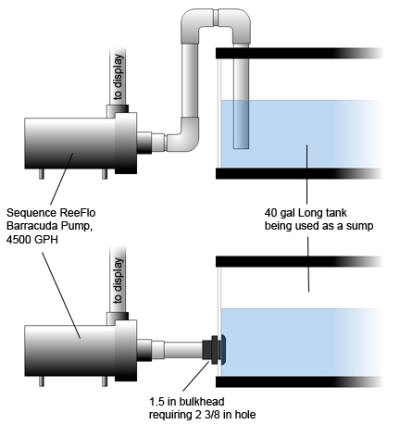
New Tank'¦Pump Size/Plumbing Options -- 01/02/08 Good Evening, <<Afternoon now>> I am working on setting up a new tank and would appreciate your thoughts on the appropriate size/type of pumps. <<Hmm, will depend largely on their specified purpose, plumbing design/restrictions, etc.>> I have an 80gl tank with a 1" overflow and 3/4" return. <<This alone restricts your return pump to no more than 300 gph after head-loss>> I intend to use a 22gl sump and a separate refugium. <<Excellent>> I expect that the refugium would be fed from the final compartment of the sump and that it would also return water (gravity) back to the same compartment. <<My preference is to feed raw water to a refugium directly from the display, but what you describe is also a possibility>> I will also have a separate closed-loop system to generate additional flow in the tank. <<Ahh'¦very good>> My questions: 1) Can/should I use one pump to feed water to both the tank and the refugium (using a T)? <<This can be done, yes. Do be sure to plumb a gate-valve on the output side of the pump 'after' the 'Tee' to allow for adjustment of water flow to the display. With a properly sized pump it wouldn't be a 'necessity' to plumb a valve on the line going to the refugium, but the added flexibility/ability to adjust flow makes it worthwhile in my mind>> a) If yes, what gph rating should I consider? I had one person suggest I use at least a 1,200gph pump. <<Not even close'¦ As already stated, the 1' drain/overflow limits the return to the tank to 300 gph or less. To supply the tank and refugium as discussed, a pump with a rated flow of 500-600 gph 'after' figuring head-loss should do it (don't forget/neglect to plumb-in those valves!)>> b) If not, what gph ratings should I consider for the resulting 2 pumps? <<As stated for the display'¦ A couple to a few hundred gph for the refugium>> 2) Should I use in-sump or external pumps? <<Considering size/needed flow rate'¦I would use a submerged pump>> Why? <<Ease of installation, quiet operation>> 3) Should I pump the refugium directly up to the tank? <<I wouldn't'¦ Best to situate and drill (1.5' bulkhead'¦minimum) the refugium to allow it to 'gravity drain' back in to the pump chamber of the sump. Using multiple feed and return pumps, and trying to balance flow between all, just doesn't work out'¦you 'will' have problems>> a) What size pump would this require? <<Not recommended>> 3) What pumps would you recommend that are also quiet? <<Eheim pumps are exceptional performers, though Mag-Drive will also serve well here. Or if not too large for the space, Ocean Runner is a good choice>> I am setting this tank up in the family room and want to minimize noise. <<Indeed'¦and all the more reason to use submersible pumps here>> 4) I am considering installing soundproofing material inside the tank. <<'¦?>> Have you heard of anyone doing this? <<Not inside the 'tank''¦ But is plausible to soundproof the 'tank stand/cabinet' to some extent>> What concerns would you have doing this? <<I would not do this in the tank'¦.period>> Thanks <<Happy to share. EricR>> Re: New Tank'¦Pump Size/Plumbing Options -- 01/03/08 Eric, <<Jason>> Thank you for your detailed response. <<Quite welcome>> It was very helpful. <<Ah'¦good to know>> In reference to item 4 below, I did mean to write that I was considering lining the tank stand with some sort of sound proofing. <<Oh!'¦very good then>> In car electronics, you can line the sheet metal behind the interior with matting called Dynamat that helps reduce vibrations and blocks the sound from going external. <<Mmm, yes'¦have seen this used in aftermarket speaker installations>> Was just wondering if something like this has been done in a fish tank and if so what kind of material would be used. Thanks, Jason. <<I've never seen it done, though I have heard discussions re. An acoustical tile or even foam-board insulation might do the trick'¦though you may find it's more effective to simply locate any offending pieces of gear and isolate/dampen vibration at the source (as in placing a piece of 'mousepad' under a vibrating pump). But do feel free to give 'sound-proofing the stand' a go, and let me/us know how it works out. Regards, Eric Russell>> Re: Lighting and pump selection questions 12/3/07 Okay. Thanks for the help and insight. <You are welcome.> Regarding pumps, if you throttle down (via a gate valve would be my method) the return off an external mag drive pump, will you cause it any damage (including early failure). I know that I may end up using set up for reef system in a few years, so a part of me says buy the nice Iwaki with 1200 or so gph at 4' head, and just turn it down for a few years. <Good plan. Pumps tend to be counterintuitive. Throttling the pump back will make it work less and use less energy. No problem here. Have fun, Scott V.> Thanks Paul
Return Pump / Plumbing 11/5/07 Good Afternoon WWM Crew, <Hello, Scott V. with you today.> I am in the design phase of a home aquarium that will have a remote sump location. The total developed length of the plumbing lines from the main tank to the sump will be approximately 25' with 17' of head pressure. Can you make any suggestions on return pumps or reading material? Thank you for your time and response. Best regards, Robert Rovegno <You should look into Reeflopumps.com . They have many different pumps with different flow capabilities. The site has charts with flow vs. head pressure for each pump, just depends on the amount of flow you are looking for. Scott V.> Re: Return Pump / Plumbing 11/6/07 Hello Scott, Thank you for your quick response and guidance. Best regards, Robert <You are welcome, it sounds like a nice project. Have fun, Scott V.> SW pump sel., appl. 07/28/07 Thank you again for your time today. It was, as I said, a pleasure to speak with someone who is articulate and knowledgeable. <A great pleasure to meet you as well Jonathan.> > Here is the original e-mail of which we spoke and I'll give you a call early in the week to set a day and time. <Ah!> I'm not a fishead but my wife is and we're setting up her second 250 gallon tank today. We have now two, large, saltwater reef tanks in the home and she is very good at her hobby with little if any restrictions on her financially or area-wise. But, we have two different ways of thinking of things. I'm a numbers guy and she's not. In setting up the new aquarium, I asked her how she chose her pump, in this case a Dolphin 3000. She said it was appropriate for the tank size but this doesn't work for me and I would imagine a lot of other people whose better halves are FishHeads. Question 1: How do you know how large a pump is sufficient. <Mmm... well... there are a few ways to go about this "decision"... but, as we chatted on the phone, you're well aware of just how turbulent reef environments can be...> If your pump pushes 2700 gallons of water up a 1.5" column 3' in height every hour, it equates to a certain volume of water in and a certain amount of water out. Maintaining> this equilibrium is effected via gate valve but it would seem to me> that if you're reducing the amount of water pressure created by the pump and thus the volume that enters the tank to match that which> exits, it would be more cost-effective to reduce the pump size and> thus the power needed to run it electrically rather than mechanically. <Strictly speaking you're absolutely correct. In a practical sense though... what she proposes... Using a well-designed and engineered pump, and throttling it down a bit possibly... is about the best one can do> That would equate to a lower cost of operation. So, with that said, my second question is that with 2700 gallons of water moving through the system each hour, we're filtering the complete tank contents just over 10X an hour or more than 240 times a day. I understand it depends on the filtration system employed (in this instance, she has a complete live rock setup in- tank, a 100-gallon sump w/ live rock, CO2 unit, UV and virtually every other system which explains why our home is host to so many fish tours a month), but just how many water changes are required for a healthy reef tank. Any help you can provide is well-appreciated. Jonathan Ames <When all energy inputs re considered, buying/using a well-made product like Dolphin's pumps saves a great deal more power (yes, even if slightly oversized) than opting for a possibly smaller, though less energy-efficient centrifugal. I think you're both doing fine here. Cheers, Bob Fenner>> A Note Of Thanks 10/9/07 Wet Web Crew, <Hello Rip> I would like to thank you for keeping me in the hobby and saving me money! <You're welcome.> I started 8 years ago with a 90 gal FOWLR and now have 1500 net gallons flowing thru my home. I was so close to giving up that I tried to sell my original 90 gal tank. It was then that I decided to be my own "expert" and bought every book I could and found WWM. My biggest frustration was equipment failure. Pumps that leaked or impellers that disintegrated. Skimmers that did not skim or drove me crazy with constant adjustments. I upgraded from toy pumps to 3 commercial quality "energy miser" pumps. Too late did I learn on WWM that the seals failed on these pumps, so after replacing several seals, I always kept spare seals on hand. While away on business, my girl friend called in panic to tell me the garage floor was flooded [sump in garage]. Of course, she could not find the leak to shut off the valve to isolate the pump and I lost many pets that I had for years. The culprit was a failed seal. By using these efficient pumps I probably didn't save enough on my electric bill per month for a steak dinner, not to mention the cost of the replacement seals and aggravation and worry and sadness over the deaths of my pets. Now the Iwaki pumps I had heard so many good things about on WWM seemed cheap and I bought 3. That was 6 years ago and not one failure! I had replaced the junk skimmers with 2 large needle wheel types, each using 2 pumps each. They were in sump models and did a fantastic job, but the needle wheel pumps were a constant headache. They have been running for 6 years and I have a box of cannibalized pumps that I have parted out to keep them running. And the pumps and parts are expensive! After another burnt out needle wheel pump, I have purchased an Aqua C EV 2000 to run in conjunction with my other dual needle wheel skimmer still functioning. The jury is still out for me on the EV 2000, but I have peace of mind knowing the Iwaki 100 pump will run for years and no leaks. I am willing to give up some skimming efficiency to have a productive skimmer without fragile critical parts and pumps that require periodic disassembly and cleaning. My advice to fellow aquarists is to put your money in the best pumps up front and get the $100.00 dollar angelfish later. <Very well said.> By eliminating equipment failure, or giving up some skimming efficiency for long term dependability and ruggedness, you'll have less worries and headaches and will be able to devote your aquarium playtime to doing your water changes, which is more important to the health of your aquarium than the new whiz bang skimmer with 5 pumps. Thanks WW Crew, I learned this from you! <Thank you Rip, will post for others to see. James (Salty Dog)> Rip Limiting Pump Noise'¦Large External or Tunze Stream? -- 09/26/07 Hello Crew! <<Howdy Don!>> I am in the middle of setting up a new saltwater 210 AGA. <<Sweet>> I went out and bought a Via Aqua 8000 to use as the sump and buy another one for a closed-loop. <<Mmm, have you heard these pumps run? I find this brand of pump to be very noisy>> It's an o.k. pump but a little noisy. <<Indeed>> I might be expecting too much and pretty much have read all your articles on power heads and pumps. <<Okay>> Do I go and buy either a Dolphin 7500/6500 for a closed-loop (or tell me what pump is awesome at being very quiet) <<The Japanese-motored Iwaki's, some of the Pan-World pumps, and those from Gorman-Rupp Industries are a few examples that will offer a good balance of quality and power vs. noise'¦but none are truly 'silent'>> or scrap the closed-loop and stick about 4 Tunze in the tank. I would love to run a closed-loop but much rather have a real quiet tank running. <<Then go with the Tunze Stream Pumps, mate. If you can live with the look there's absolutely no comparison re efficiency and flow volume, with virtually no 'noise'>> Thank you for your time. Don V. <<Happy to assist. Eric Russell>> Lots of odd 180 gal Skimmer, Pump, and Sump Questions 8/26/07 Hello! As always, thank you for this incredible service you provide, it's the best help I've ever found. <Ah, good> I've acquired my 180gal tank and stand for my new reef (YAY!) and I've purchased a Coralife AquaLight Pro lighting system. I'm now beginning the process of purchasing sump/pump/skimmer equipment. I have a few questions though. The tank will have these main residents, plus a couple more if I can find them. All these animals are in normal 55 gallon tank size-ranges, nothing is "huge"... yet: Galaxea, Pagoda Cup, T. Crocea, T. Derasa, Finger Leather, Mushrooms, Zoanthids, 3inch Yellow Tang, 6-line Wrasse, Lawnmower Blenny, Diamond Watchman Goby, Scribbled Rabbitfish (2 if I can find them) <Yikes... they'll all appreciate the new digs for sure> *Skimmers: I'm essentially sold on a Euro-Reef RS-180 skimmer. While perusing the FAQ's on your site I've read questions on this skimmer with other 180gal setups to which you guys have used descriptors like "plenty" and "more than enough". <Is a good unit, choice here> 1.) What is the most comparable Tunze model to the RS-180 and is there any reason to go that route instead? <Mmm, not really IMO...> 2.) Are there any other brands/models out there that I should consider looking at in the same price range ($500 or less). Coralife maybe? <Again... I would go with the Euro-Reef here> 3.) I'm "in" pretty good with the owners of one of my LFS's. They had a used Red Sea Berlin skimmer (no idea what model) that they were willing to sell me really cheap (doesn't seem to be broken, and I'd need to get a pump). Does Red Sea even make a model worth looking at if I'm thinking in the range of the ER? <Not in my estimation, no> 4.) Are ratings on skimmers to be trusted? Euro-Reef confused me by putting a "comparative rating" and a "realistic rating" on their skimmers. Should I compare the RS-180 to other skimmers based on the "up to 450gal" rating or the "135gal to 180gal" rating? <Some of them... to be sure, yes... Folks "mileage will vary" and all depends on definitions of suitability, what is being measured...> *Return Pumps: I have an in-sump Eheim 900gph pump (don't remember the model number) on my 55 that I was considering transferring to the new tank and adding another exactly like it (one for each of the two return lines). <Good brand, choice> 1.) Would one Mag Drive 24 (2400gph) be a better route to take? <Not IMO, no> 2.) Any other recommendations on brands/models? <Mmm, posted... in a size, shape system as this 180, you're encouraged to look into internal pumps, possibly with controllers (Tunze, Hydor...) or better, a contained "closed loop" arrangement... Please read here: http://www.wetwebmedia.com/marsetupindex2.htm the light blue tray> 3.) Are the "Pond Master" Mag drives the same thing (LFS says they are and I'm skeptical)? <Mmm, quite... but... have seen where at least the screws holding the volute on were different... rusted> 4.) Is there any reason to use hard PVC as opposed to a strong tubing on either the drains or the returns? <Some... as posted...> Sorry for all the questions, but I don't have a Reef Club or anyone knowledgeable enough locally to ask these questions to so the questions build up... and then I turn to you guys. Thanks again, Eric <I/we're very glad to assist you in your plans to design, build, stock, operate your system. Bob Fenner> New Custom 120g...Wanting A 'Quiet' 2400gph Turnover Rate! -- 08/17/07 Wet web media crew, <<Hello Matt>> I have been reading nonstop for a couple days (there is a staggering amount of data on your website) <<Indeed>> and am trying to get the best configuration. I know I want the 48' wide tank; most likely 24' x 24' for the other two dimensions. <<A standard 120-gallon tank then>> The Lee Mar guys are the ones making the tank. The standard 48x24x24 has one 2' drilled drain then two 1 ½' return holes in the back center overflow. <<Better than most...>> I do not think this is adequate so I must have them customize the tank. (Any suggestions here would be great, I want to get it right the first time instead of regretting a choice and be stuck with it.) <<Mmm, well...I need to know what your 'goals' are with this system to be able to afford much help>> I want to make sure that I have a big enough drain that it will be quiet and able to easily handle 2400gph, then add a second one as a backup and to supplement draining. <<Ah, okay...then I would have 'three more' of the 2' drains installed. This will give you about 4800gph 'maximum' capacity. This is a bout half what some folks/most drain calculators will tell you...but is a more practical number/expectation in my opinion. Even though four 2' drains will make your goal of 2400gph quieter/easier to plumb, processing this much flow through a sump just below the display will be anything but 'quiet'>> I think both drains could be in same overflow box. <<If you are considering a maximum of only two drains your goal of 2400gph of quiet flow 'may' still be attainable, but will require much tweaking/tuning to achieve. Perhaps you should consider a closed-loop to boost the water flow within the display and utilize a much smaller 'return' pump>> If I have read correctly a 2' bulkhead would be the appropriate size (making the drill holes ~3'). <<Not in my opinion...as stated earlier, I would plan on about 1200gph per 2' drain>> Would there be any advantage to drilling the holes in the back glass (still in the overflow) instead, or in addition to, the bottom glass? <<This is my preference...if only to limit the amount of water lost should a bulkhead fail>> Are my dimensions correct for drain sizes? <<Do consider my statements re>> With drains this size, would a stand pipe, such as the infamous Durso standpipe still be required to decrease noise. <<Likely, yes...and would need to be constructed of pipe of the same diameter as the drains to prevent loss of flow capacity>> Not sure about the whole closed-loop system. <<Is the 'better' option here I think...or some Tunze Stream pumps>> Given a big enough sump, any problem with that much flow through a sump? <<I think you will be surprised at how much noise 2400gph of water volume dumping in to a sump can make. Even if the sump is large (100+ gallons), it will be a challenge to quiet the noise and control the turbulence/bubbles>> Is there any disadvantage to having 3-4 extra holes (in each of the corners of the tank) in the bottom to have available for return flow and cap any not in use? <<Of course (NOW is the time to drill these)...and I would not 'cap' these but rather utilize them without increasing the flow rate to help reduce noise/plumbing issues. The more drains available...means fewer gph per drain...means fewer hassles all around>> I would like to use as few powerheads as possible for adequate flow and still be able to keep SPS. <<Can be done, though I find the Tunze Stream pumps to be very quiet, very efficient, very flexible in their application, and quite worth the 'intrusion'>> I appreciate your time and will be purchasing the tank in the next month. If you have any suggestions or ideas for this tank, please feel free to add any suggestions. <<I suggest you chat with/seek other's opinions re pumping this much water through your sump...research other options and base a decision on your own good judgment>> Thank you, Matt <<Happy to assist. EricR>> Poseidon PS3 external pumps 7/27/07 Hi there, <Howdy> Thank you so much for all your answers. I am thinking of the Poseidon Pumps PS3 and are they quiet? I am thinking of two Poseidon PS3 pumps with two ocean clear canister for 170 gallon tanks? <Mmm, reported to be amongst the quietest: http://www.google.com/search?hl=en&rls=com.microsoft%3Aen-US&q=Poseidon+Pumps+&btnG=Search> Will it be better having two pumps and two canister? or having one Poseidon PS4 with one ocean clear canister? <Most applications I'd go with two in a tank of this size...> I am having live rocks without skimmer. Your help is much appreciated. Thank you so much. <I'd also use a skimmer in most set-ups... Try it... Bob Fenner> Mag 24 Pump Noise 7/16/07 Hey guys, <And gals> Quick question. The noise from my Mag 24 is driving us nuts at home. In you opinion which pump(s) in the market are the quietest? I heard that the Dolphin pump is very quiet. <I'm guessing this pump is externally mounted, so... Have you checked for debris/buildup of calcium in the impeller housing? Is the pump sitting on rubber/foam to help minimize vibration? The pump may be cavitating from lack of inlet flow, this would also create noise. As far as which pumps are quieter, I would log on to our chat forum and post this question there. Here is where you will get actual user responses. Go here my friend. http://wetwebfotos.com/talk/ James (Salty Dog)> Pump head vs. distance. Figuring Straight Runs Of Pipe For Head-Loss -- 06/19/07 Quick question. <<Alrighty>> I have been searching for this answer. <<Hopefully I can provide some illumination>> I know I have seen it places but can't come across it. <<Likely so...let's hear it...>> When sizing a pump and taking in to account head and pressure, how many feet of head do you account for when going in a straight/level line? ex...Is 10-foot distance equal to 10-foot of head? Thanks Bryan <<A very good question Bryan, and one, yes, I'm sure has been asked and archived. But no worries mate, we'll create another 'Google-hit' right here. The answer is yes, you do need to take any 'straight' runs of pipe in to account when figuring pressure/head-loss. A good rule-of-thumb is to add an 'extra' foot of head-pressure for every ten-feet of 'straight' pipe run. So to use your example... A 10-foot run of 'horizontal' pipe would constitute 1-foot of head-loss...but a 10-foot run of 'vertical' pipe would constitute 11-feet of head-loss...Understanzee? Always best to buy a pump BIGGER than you think you will need, and install a gate-valve on the output side to temper flow if necessary...in my humble opinion. Regards, Eric Russell>> New AGA 75 Gallon RR Tank, pump... through-puts... 6/16/07Greetings! <Salutations!> I am very new to salt water hobby. I have an AGA 75G RR tank & I am trying to pick out an external return pump. <Okay... for?> The return is rated for 600gph <Uhh, no... is "rated" for this volume/flow rate per hour, but will only do about half this... Plus there's only one overflow... dangerous. I would NOT set this aquarium as it is currently drilled...> & the head ht will be about 4 feet w/ future chiller. I am looking at the Iwaki pumps <Good units> but don't know which to get. WMD-30RLXT maybe to much & the WMD-20RLXT to little? Please help. Thanks Scott <Please read here: http://www.wetwebmedia.com/pbholessizeplace.htm and the linked files above... and here: http://www.wetwebmedia.com/marsetupindex2.htm scroll down to the light blue line... re Pumps... Selection. Read on my friend... decisions to be made. Bob Fenner> Pressure Rated Pump for DIY Skimmer 4/26/07 I am trying to find the right pump to use for a DIY skimmer that I built. <Neat.> The skimmer uses a ¾' Kent Marine venturi at the inlet, and puts too much back pressure on the Mag 9.5 I bought for it, to produce good flow through. <A pressure rated pump is in order here.> I am thinking that I should go with an external pump that is pressure rated, <Bingo.> and am thinking of going with the Gen-x PCX-40 or PCX-55 as they seem to be the most economical. <In price yes, but not in noise or life...from my experience. I would prefer Iwaki.. My first question is, what exactly is the difference between the two pumps, as they are both 'comparable to the Iwaki 55RLT'? <One is rated for more pressure/head than the other I believe.> My second question is, how noisy are these pumps? <At least the sound of a normal conversation, IME.> I have read some reviews saying that they are quiet, and some that compare them to having a lawn mower in the room. <I'd say in-between those two, Adam J.> Custom Sea Life Pump 4/4/07 I purchased a used Custom SeaLife external pump but the characteristics (gph) are not on the pump. The model number is 77340, part number is 65799, serial number is 5584845, max fluid temp is 140degrees F, HP is 1/15, RPM is 3450, Watt is 140, Amp is 1.3 (115V, 1P, 60 HZ). Can you point me in the right direction or if you know please let me know for I am setting up my tank tonight and do not know if this pump will be satisfactory. I have a 75 gallon, drilled with corner overflow. <Rich, Custom Sea Life went out of business some time ago. These pumps are now available as Poseidon and Blue Line. Marine Depot carries the Poseidon and if you send them an email with the pumps specifications, I'm sure they can help you. www.marinedepot.com James (Salty Dog)> Rich Re: Custom Sea Life Pump 4/5/07 I set up a new 75 gallon tank yesterday and the pump which is equivalent to a Poseidon PS4 External Pump "pumps 480 gallons per hour at 16 foot head pressure to 1080 gallons per hour at 3 foot head pressure through 1 inch hose barb." My tank has a corner overflow, filtration system is a wet dry which I have a 3/4" bulkhead that transitions to a 1" clear (flexible) tube that connects to the Poseidon PS4 pump. Another 1" clear (flexible) tube connect to the out side of the pump and then transitions to a 3/4" clear (flexible) tube that connects to the bulkhead on the tank. From the bulkhead a 3/4" PVC pipe brings the water to the top of the tank. Now to my problem, the pump is pumping the water out of the wet dry too fast thus creating "sucking of air" through the bulkhead in the wet dry. I need to slow the pump down and I am assuming the only way to do that is by utilizing a valve of some sorts. What type of valve should I use and where should I locate the valve (from the bulkhead on the wet dry to the pump (1") or from the pump to the bulkhead on the tank (3/4")) obviously depending where the valve is located would depend on the size of the valve, either a 1" or 3/4". <The valve should be located on the outlet of the pump, and a gate valve would be my choice, much easier to control than a ball valve. Information such as this is easily found on our site. Do search/read first before sending a query.> Thank you for you assistance. <You're welcome. James (Salty Dog)> Strong Enough Pump? 4/2/07 Hi there Crew, <Aldwin> I have a 20 gallon tank, and want good wave circulation. So I've read your FAQs and have decided to make a closed-loop system. I will have 10 elbows and 1 SCWD. I will have two PVC "arms", one arm out of each side of the SCWD. Each arm has 4 elbows, and 1 output valve/elbow. <In a twenty (20) gallon system?> I'm estimating 10 ft head-loss (8 90-degree elbows and 2 90-degree output elbows) after reading your FAQ. I also have a SCWD - estimating 3 ft head loss. Then I've got about 3 ft of piping. Total head loss is 16 ft. Right/Wrong so far? <Likely more like eight-ten in actuality... The "given rules of thumb" are just that/this> I read about the Eheim 1260, it has a delivery head of 12'1, 635 Gallons/hour. Since I have negative head (12-16 = -4 feet) , does this mean I need a bigger pump? <Mmm, no... this pump will be more than too much for a twenty gallon system...> I was planning on using 3/4" PVC, but the outlet for the Eheim is 1". I assume that I would either need the same 1" or larger piping. <Mmm, no... can be readily bushed down to lower... most anywhere on the discharge side> I can't wait to get my circulation system up and running! You guys have been so great in helping out. I've gotta send you pictures with my happy system when it's up. I'm very thankful for your help! <Thank you for this... but a twenty gallon system...? Bob Fenner> Jason Pump Size - 03/29/07 Crew, <<Chris>> I have a 135-gallon tank with 2 overflows. 2 2-inch drain holes and 2 1-inch returns. <<Outstanding, looks like someone has been listening to Bob's/the Crew's incessant rant on adequate throughput diameter!>> <Yay! And 'bout time! Now, where's that IPA? B> A 4-inch DSB, and over 100 lbs. of live rock, a 55-gallon sump, and a 10-gallon refugium. <<Very nice...though would like to see a larger 'fuge>> Will a Mag-36 provide enough current for my reef tank (Approx 4-5 feet of head)? <<Indeed it should...though processing this much water through a 55g sump may well prove problematic...and if this sump is located within a living space (living/TV room, bedroom, etc.) you may find the noise to be quite distracting>> Thanks and love the website, Chris Harris <<Happy to share. Eric Russell>> Re: Pump Size - 03/30/07 A bigger refugium it is. <<Yay!>> I have a 20-gallon I can use. <<Much better>> I read and value the information I've read from Bob and crew very seriously, so if they suggest it, I'll do it. <<Ah...feel the power...[grin]>> The noise won't bother me. I love the noise I hear from the sump on my other 55. It's a 20-gallon sump. It's in my bedroom. <<Oh...a white-noise sleeper eh!>> As Bob and crew say...the more water and rock, the better. <<More water?...yes. More rock?...not so simple...in my humble opinion>> Thanks for the great advice from all of you. <<We are all happy to share>> I'll go ahead and order the mag-36 pump. Chris Harris <<Sounds like you have a plan. Regards, Eric Russell>> Pump For 72 Gal Bow Front? - 03/27/06 Hello Crew. <<Howdy Steve>> I just purchased an All-Glass 72 gal bow front that will be used for a FOWLR set up. <<cool>> The tank came with the predrilled MegaFlow Overflow. <<Mmm...is hardly 'mega'>> The overflow has a 1-inch drain, ¾-inch return, and max flow rate of 600 gph. <<More like half that actually. You 'might' get the drain to flow close to the 600gph rating, but not without much fiddling/tuning/modification of the plumbing to handle the associated surge and noise issues>> I am shopping for a return pump to be used in the sump of my wet/dry, and I am currently looking at these brands: 1) Eheim Hobby Pump 1260 @634 gph or Eheim 1262 @898 gph 2) Mag Drive 7 @700 gph or Mag 9.5 @950 gph 3) Quiet One 3000 @780 gph Which pump would you recommend in terms of durability, ease of maintenance, and quietness? <<The Eheim...hands down the best of the three. And do plumb with a gate-valve between the pump and the return to moderate flow as necessary>> Are there other brands that I should consider? <<You could, but not necessary in my opinion>> Any assistance that you can provide is greatly appreciated. Thanks for such a great site. Keep up the good work. Steve <<Thank you for your participation. Regards, EricR>> Re: Pump for 72 Gal Bow Front? - 03/27/06 Eric, <<Steve>> Thank you for your recommendation on the pump. <<Quite welcome>> Can a gate-valve be used if I wanted to use flexible tubing for the return? <<It can...you will need to thread barb-fittings in to the threaded valve to accommodate the flexible tubing...or...get a valve with slip-fittings and use "flexible" PVC...a much better alternative to the vinyl tubing in my opinion>> Or will I need to plumb the return with pvc? <<Not necessary as stated>> What can I do to address the surge and noise issues that you refer to? <<Mostly a matter of experimentation and trial and error my friend. Adjusting run lengths/angles/bends, aspirating, terminating above/below the water-line, etc., etc.... Do read through our info on plumbing marine systems>> Thanks, Steve <<Be chatting, EricR>> Re: Pump & Stocking Advice, Pb and pump sel. 3/11/07 Bob and Crew! Thanking you in advance for your assistance. I don't know what I would do without this forum. I would like to ask a question that I have researched thoroughly but I still don't feel that I've located an answer that makes me feel comfortable. I have a 180 gallon reef with a 16" x 5" center overflow. The overflow has dual 1 1/2" bulkheads for the drain and dual 3/4" return bulkheads. <Mmm... I wish these last were 1" inside diameter... I bet you do as well... as most of the pumps I'd suggest have this size volute discharge...> I need to accurately determine the gph drain rate. <Mmmm> I checked the calculator at reefcentral.com and it asks me to submit gph under the "recommended minimum drain/overflow size calculator". For example, I selected 1,200 gph. The calculator provided the following calculations: Recommended minimum drain pipe diameter = 1.43 inches <About right> Recommended minimum linear overflow size = 18 inches <What is this...?> How can I accurately determine this? <The former is sort of easy... it's the inside diameter of the two fittings (or 600 gph per) of the opening/s of your drains... and you have two 1 1/2"... which should do. The second bit, I don't know what they're referring to> I'm not the smartest guy when it comes to determining this, but it appears to me that I need to determine the gph flow rate of my return pump, <Mmm, and factor in losses due to head, induced drag (from plumbing, turns...> then determine what my drain pipe and minimum linear overflow size are. Is this accurate or am I completely missing the boat? <Agree with the drains... don't know what MLO is... is this some sort of term for quesstimating the "drop" of water through drains... that supposedly will draw/suck water through horizontal runs of plumbing?> I feel extremely comfortable with all my other decisions, but this is an extremely important one, as I really don't think my wife would appreciate a small "beach" on the living room floor. In addition, I have one more question that I'm not sure can be accurately answered at this point. How much differential can there be between the drainage gph and return gph before serious problems could occur? <Mmm, the drainage MUST equal or exceed the return GPH...> I assume the optimum situation would be to have the drainage and return rates be as close to identical as possible. <Actually... trust me... you want the drainage capacity to be MUCH more than near equal to the return... Think on this... should one of the two drain lines fail...> My wife sincerely thanks you for your continued patience and willingness to help me.....help her. I can't thank you enough. Your expert advise is priceless. Sincerely, Scott <Am glad to be your co-hort in your aquarium adventures... I would not be concerned here re the drains or whatever this MLO is... your two 1 1/2" ID fittings, coupled with tubing (hard or flexible) of the same diameter WILL accommodate 1,200 actual GPH flow. Bob Fenner> Re: Pump & Stocking Advice, Pb and pump sel. 3/11/07 Crew, <Scott> I forwarded an earlier email to you. If you choose not to answer that one and instead would prefer to answer this one, I'm not looking for an answer to both. I believe my question to be a rather simple one. Based upon my have a 16" x 5" center overflow with dual 1 1/2" bulkheads for the drain and dual 3/4" bulkheads for the returns, would the Iwaki 100 RLT be too much pump? <It would not IMO... but there is a bit more to my response... I would like to point out that this make and the 70 RLT have 1" discharges... you will need to bush either one down to 3/4" ID (use a schedule 80 (grey) PVC threaded coupler... with a smear of Silastic on the threads... secure the pump down on a piece of board... And though this pump is rated for some 2,000 gph, I suspect it will not produce any more than the desired 1,200 gph going through this reducer AND the rest of the plumbing return/discharges... WHICH I suggest you arrange in this 180 (most are nominally six feet wide, through a (Am feeling like Bob Barker now... "Come on down"...) a discharge manifold like here: http://www.wetwebmedia.com/pbh2oret.htm Please read through the above files linked in blue...> would you recommend the 70RLT instead? <Mmm, no... I don't think going from the rated 1,500 gph to and through the plumbing, you'll get any more than 1,000 gph... which is really insufficient for the purposes you'll likely... You could make up some of the circulation, aeration aspect with spiffy internal pumps... like the fab Tunzes or new, far-less-expensive Hydors...> Based up the calculations at reefcentral.com, with pipe diameter of .75" (I assume they are referring to the return pipe) <Yes> and with the # of elbows, vertical and horizontal heights, the 100 RLT returns approximately 1,378 gph <You will never get this... I assure you... the "model" presented on RC is fallacious... is at best an example of "best guess scenarios"... In the real world... My advice, really... if truly curious, rig all this up, avail yourself of a flow meter and see for yourself> which I believe would be appropriate for the gph drainage. Your thoughts are welcome . Thanks once again for your patience. Scott <There are a couple of standard works on "aquarium" engineering... Again, if you really want to know... I would go with the 100 RLT... You'll see. BobF> Re: Pump & Stocking Advice 3/11/07 WOW! What an awesome forum!!! Thanks so much for the prompt reply. <<We do our best.>> I was leaning towards the 100RLT for a while now, but had almost talked myself out of it. Thank you for reassuring me that I was initially on the right track, because I did research this thoroughly. I will be incorporating 2 Tunze Turbelle Streams as well. I can't wait to get started. I guess that sometimes we can out think ourselves and make things more complicated than they really are. Thanks again! Scott <<You're quite welcome, on behalf of the Crew. Lisa Brown.>> Pump Advice 3/9/07 Bob, <Scott> Thanks for quick reply and info. I would like to ask you an additional question concerning Iwaki pumps. I have conducted research on the MD70 & MD100s. What I have found is that the majority of reef keepers seem to be running MD70s. In your opinion, is the MD100 too powerful a pump for a 180? <No... as long as you have the capacity to adequately drain the higher volume...> I know that I can slow down the flow rate with a ball valve. I was contemplating the MD100 for a couple of reasons: 1. I don't want to skimp and although I am intrigued by the reports that Dolphin Amp Masters are among the quietest pumps out there, I want reliability and EVERYONE recommends Iwakis. 2. I felt that the extra gph would be beneficial if I were to ever add a calcium reactor, I could "tee" it off and run the reactor off the same pump. <Can, easily, yes... takes some modicum of pressure, but very little flow> 3. I may have the opportunity to purchase a used one (supposedly less than 1 hour for $99). Thanks and have a great weekend. Scott <You as well my friend. Bob Fenner> Help! I Need a Quiet External Return Pump! -- 03/09/07 Hello crew. <<Howdy Joe>> I am a big fan of Wet Web Media. <<Thank you...me too!>> I have been reading on your site for a few years but have never asked a question. I need help selecting a quiet external return pump. <<Mmm, depending on your definition of 'quiet' this could be tough...but let's see if I can help>> The tank I am setting up is a 95-gallon AGA wavefront tank. It has a MegaFlow overflow rated at 600 GPH. <<Ah yes, the 'single 1' drain line' seemingly touted as the 'end-all' solution for manufactured reef tanks...but I digress...>> I am using an AGA sump which I drilled and placed a bulkhead so I can use an external pump. <<Ok>> I have 1" PVC going to a Coralife Turbo-Sea 1740P pump, rated at 1700 GPH. <<Why so large a pump? Considering your drain will have trouble handling even the 'rated' 600 gph>> The outflow from the pump is 1" PVC which is split using a "T" to the return to the tank and to the skimmer. <<A difficult balancing act to maintain (I see water on your floor in the future at some point)...best to feed the skimmer from a separate dedicated pump>> The skimmer is an ETSS Reef Devil down-draft skimmer which is in the sump. The problem is the pump is insanely loud! <<Not uncommon, and is often due much to vibration. Using soft tubing at the inlet/outlet connections and placing the pump on a soft pad (mousepad) can sometimes be a big improvement. If the noise is from the fan attached to/cooling the pump, well, that's more difficult to deal with>> In search of a quieter pump I purchased a Velocity T4 from Blueline Aquatics. It is rated at 1225 GPH at only 30dB. This pump was supposed to have 1" hose-barb fittings but they are only 7/8". I think with the restricted inflow and outflow together with the smaller pump it may not be enough to run the skimmer and give a decent GPH through the return. <<Shouldn't be an issue...just 'bush-up' the fittings to fit the 1' pipe. But I have other concerns here as well. To avoid even more noise issues and other associated plumbing hassles, you will need to restrict flow to the return line to 300-350 gph...in my opinion/experience. The fact that you plan to tee/share the return with the skimmer gives me no comfort as the water will take the path of least resistance...which will be to your tank...ultimately overwhelming your overflow and finding its way to your floor. Even with valves plumbed to the skimmer/tank return to 'set' the flow rate, this only works until there is a change in resistance/pressure one way or the other. It is ultimately up to you, but I highly recommend using separate pumps here>> Before I hook it up do you think this pump will work or what do you recommend for my third pump! <<The Velocity pump should work...though I think it is rated too high as already indicated. As for other 'quiet' choices the smaller Japanese-motored Iwaki pumps, as well as GRI pumps are 'relatively' quiet and give great value for service. But truly, in my opinion, your best choice is to go submersible with either Eheim or Mag-Drive pumps if you really want 'quiet'>> It must be very quiet as this tank is in a basement and the sound bounces off the walls. <<Mmm, indeed>> Thanks, Joe. <<Happy to share. EricR>> Plumbing a Mag-5 Pump and Calculating Head-Height -- 03/05/07 WWM- <<Adam>> I have a 65g. AGA tank with built in overflow rated at 600gph, <<Mmm...a single 1" drain likely...600 gph is "optimistic" and downright problematic...in my estimation>> and a Mag5 return pump. <<A decent enough make of pump>> The Mag5 is rated at 500gph, and 310gph at 4ft. <<Yes>> Is head-height determined by total distance between pump outlet and tank return outlet or simply height from return pump to top of tank? <<Is a bit more 'involved' than either statement. Head-height/head-loss is figured based on a combination of factors to include length of horizontal and vertical pipe runs (though these are not 'calculated' the same...I'll explain in a moment), plus the type and number of ells/tees/fittings/et al, and even the diameter of the pipe/tubing used. Calculating vertical pipe/tubing installations is simple...one foot of rise equals one-foot of head-height, and it is generally universally agreed that every ten-foot run of horizontal pipe is equal to a one-foot rise, as is each 90-degree ell and each tee fitting in the run. So, as an example...if you have a return line that rises two feet above the pump, makes a 90-degree turn, runs horizontally for 5-feet, makes another 90-degree turn, rises another two feet in to the tank, and terminates in a tee...you are imposing a resistance on the pump roughly equal to 7 ½-feet of head-height. Does this make sense to you? As for the diameter of the pipe/tubing, it is often advised to match pipe-tubing diameter to the output diameter of the pump...but in my experience; especially with the Mag-Drive pumps, I have found that 'upsizing' the pipe often yields better results/flow rates. For the pumps with ¾' outputs and smaller, I have found 1' pipe/tubing to work very well>> Is this pump vastly underpowered for my setup? <<That depends on what you want the pump to do. If the only purpose is for filtration/processing water through your sump and your head-height is equal to 4-feet providing 300 gph of flow then yes, I would consider this about ideal for a single 1' drain>> It seems a fine line between maximizing overflow flow capacity and overflowing the tank. <<Yes indeed...and that's even assuming the accompanying noise/surge aren't an issue>> If so what would you recommend? I am in the process of converting from Wet/dry to sump, so many possibilities. <<My recommendation would be to utilize a pump that; based on your plumbing configuration, provides about 300-350 gph to the sump...and utilize powerheads/closed-loop/etc for additional flow within the display tank>> Thanks for all the help! <<Happy to share. Eric Russell>> Return Pump... sel... SW... 3/4/07 Hello Crew, <Hello, Brandon here today.> I have searched but have not been able to find the answer: I am setting up my first sump, despite 6 years of reef success, but for an SPS tank this time. The overflow on the AGA 54 corner is rated at 400 GPH. I want to use the Eheim 1260, rated at 630 gph for the return pump. <Head is defined as the maximum vertical lift of the pump. When you measure the head height, measure from the surface of the sump water, to the surface of the tank's water. The Eheim 1260 is rated at 630 gph with a head height of zero feet. You have not listed your head height, so I will direct you to a flow chart for Eheim pumps. http://a1272.g.akamai.net/7/1272/1121/20031026073738/www.drsfostersmith.com/images/Eheim.GIF. As you can see here, if your head height is six feet, then you will be right on the money. A head height of four feet, might cause some problems. Ideally for a simple system, you want the pump at a head height that will match your over flow.> I don't want a flood. Does the return have to be lower volume? <The return usually needs to be higher volume due to head pressure.> Do you think this will work? <Please read above.> Thanks so much for your help. <You are welcome. I hope that this is of use to you. Brandon> New Hydor Koralia 3 pump - 03/02/07 Can anyone shed some light on this new pump? http://www.marinedepot.com/md_searchitem.asp. I currently have 2 Seio 820's in the tank. I'm not happy with the way they mount, I have an acrylic tank and have to use the suction cups. Magnets for the Seio's would cost an additional $25 each totaling $70 each. The Koralia is $40 with the magnet and uses less electricity. Does anyone have any experience with these regarding durability, noise, water movement etc? Thanks, Frank <Mmm, that link doesn't seem to be working... see below. Don't have any personal experience with this product, but am familiar with the company... and they have many nice, innovative products... http://www.hydor.it/ As usual, I would use the larger sphere of BB's boards here... AquariumFrontiers. com is a fave... knowledgeable, friendly folks... for actual users input. Cheers, Bob Fenner> Losing My Mind Trying to Pick an External Pump for 150G -- 02/26/07 Hello - and I'll repeat the chorus of the amazing info your site brings. <<Greetings...and many thanks, we're glad to be of service>> I only wish someone had all of the answers for raising 3 year old twin boys!! <<Yikes...a double handful! I'll take plumbing issues over that any day [grin]>> I am setting up a 150G FOWLR tank - made by Perfecto - 48x24x30H with a single center overflow on one of the 24" walls (it will be a see through style tank). <<Ok>> The tank will have one overflow - a 1" drain I believe. <<Mmm, yes...will limit you to about 350 gph before problems start to arise>> The issue is with the return pump. Getting lots of mixed advise. <<Everyone has a different opinion, I'm sure>> Tank will drain to an All-Glass Model4 (36x18x18) sump right below the tank (think, your traditional tank/cabinet set up) and will then return to the same overflow area. <<Sounds like a perfect job for a Mag-Drive Mag5 pump to me>> Thinking of an Iwaki MD40RLXT or perhaps a Velocity T4. <<These are way too much pump (1200+gph) for a single 1' overflow. Best to look for something in the 500gph range...and then also be sure to plumb a gate-valve on the discharge side of the pump to temper flow as necessary>> I've ever heard good things about the Coralife Turbo Sea 1090. <<Still 'too much'>> The issue is with flow. <<Yes indeed>> I've heard that a single 1" overflow can only handle 600gph. <<Best to expect about half this without excessive noise/surge, and the associated plumbing hassle to reduce same...in my experience>> So, if I buy a pump rated for 1100 gph at 4' head (slightly less than I'll pump), am I purchasing too large of a pump? <<Oh yes! Better to get a pump rated for a 'maximum' of 600 gph, and even then you may find it easier/best to reduce flow to the 350 gph range I mentioned earlier>> Also, any comments on the noise of the Iwaki? Or the Velocity's -- are they really that quiet? <<Depends on what you are measuring against I suppose...and what, if any, ambient room noise is present. The Iwaki's can be very quiet though they are not 'silent.' The Velocity pumps lack a cooling fan and are therefore 'more' quiet than the Iwaki pumps. Personally, I really do think a submerged Mag-Drive pump would work very well here, and will also be very 'quiet' as well Thanks in advance! Jeff <<Happy to assist. Eric Russell>> Re: Losing My Mind Trying to Pick an External Pump for 150G -- 02/26/07 Hi Eric, <<Hey Jeff!>> Thanks for the help. <<Hope it was of use>> One follow-up question. <<Shoot>> Is there a reason you are recommending a submersible vs. external pump? <<Yep...considering your tank configuration, the Mag-Drive would be the most simple and most economical installation. And while not the 'best' pump on the market, they do provide good service for value...in my opinion>> Sure, submersible is easier (no drilling/etc), but I like the idea of an external due to longer life and less having to deal with dropping water levels in the sump as externals can run with much less water in the sump. <<Hmm, not sure I completely agree with this last statement...but will concede a 'quality' external pump will likely outlast the Mag-Drive (have heard tales of Japanese-motored Iwaki pumps running 10+ years). Though I will state that with reasonable care (semi-annual inspection/cleaning as a minimum), I think it possible to get 3-5 years out of the Mag-Drive pumps...and possibly more with impellor replacement. I have a Mag12 on my reef system that has been running for almost 3 ½ years now and a Mag5 in my pond that is approaching 3 years>> I've run both (Iwaki on a 90g reef) and Mag7 on a 72g FOWLR. For some reason, my brain can't comprehend going with only a Mag5 for a 150g Tank. <<Has nothing to do with the tank size mate...the limiting factor is the fact you have a single 1' overflow for this system>> Perhaps I need to get past my pre-defined notions, but I gave less thought when I bought my last car! <<Hee-hee! The problems/ponderings of fluid-dynamics has caused more than a few hobbyists to stop and scratch their heads>> Are you really thinking that I might only get 350gph on a 150G tank? <<No...but I think you may only get that 1' drain to flow at 350 gph before you begin to have issues with noise/gurgling/surge/et al.>> By my math, that's only 2x turnover. <<Indeed...you will need to supplement flow with alternative methods (powerheads, closed-loop, etc.)>> Will that be enough for adequate filtration for a FOWLR tank? <<You really don't have a choice here unless you can re-drill for a larger bulkhead or add additional throughputs. But if you can't, the 350 gph through the sump will be adequate for filtration purposes...though I suggest supplying some 'additional' flow within the display tank as stated>> I suppose it's enough since all of the major manufacturers use only a single 1" overflow hole on their 48" long reef ready tanks. <<Mmm, no...and a bit of a peeve here. Don't assume the manufacturers have 'done it right'...these tanks are hardly 'reef ready' re their overflow/return systems>> Thanks again! Jeff Franzen <<Happy to help. Eric Russell>> Pump & Stocking Advice; skimmer op., reef stkg., circ., spray-on foam inside backgrd.s - 02/21/07 Dear Crew, <Scott> I sent the basics of this email on Saturday and didn't receive a reply, so I thought I'd send it again. If you received it previously, I apologize. <I don't recall seeing this. Thanks for re-sending> Thanks again for this forum. I can't tell you how invaluable your advice has been. You offer great advice that saves hobbyists a lot of grief and heartache, not to mention $. Unfortunately I got overly excited when I saw what I thought was a great sump/refugium. I ordered it prior to measuring it and prior to receiving my Euro Reef RS-180, which I can't wait to set up. The front compartment is too small for the skimmer. I am going to attempt to modify it, however, if I can't I may be forced to house the skimmer in the final compartment which is where I housed it when my 150 gallon reef was set up 8 years ago but times have certainly changed since then. <Not that big of a deal...> How much of an added benefit due you feel there is to housing the skimmer in the 1st compartment versus with the return? <A few (single digit) percent> I sincerely appreciate your passion and responsiveness. I'm establishing a 180 gallon reef which will house Acropora, Galaxea (I need to provide room for growth and to account for their 'stingers'), <Oh yes> a torch, a yellow Sarco, zoos, and another group of soft corals such as polyps or Ricordea. I'll also have Tridacna clams. My fish choices are: Pr of BT Triggerfish (or Sargassum Triggers) (1) Sohal Tang (my preference, but also considering Powder Blue, Palette, or Purple) <The Sohal will be "king" here if placed> (1) 6-Line Wrasse Small school of Chrysiptera (Flavipinnis, Hemicyanea, Caeruleolineata, Cymatilis, or Chromis (Scotti or Viridis)...as these seem to be among the least aggressive (1)Yellow Assessor (1) Pseudochromis Fridmani (1) Oblique-lined Dottyback (Cypho Purpurascens) Pr of Clowns (Undecided on type) (1) Flame Angel (Unsure if this is a good choice due to the clams) <Likely okay in a setting of this size, type> (2) Shrimp Gobies (preferably Amblyeleotris Yanoi or Stonogobiops Yasha, but welcome recommendations based on the other inhabitants) with commensurate shrimp <Mmm, your triggers may consume the shrimp... best to place these ahead of the Balistids> (1) Mandarin (last fish WELL after the tank is established) <Mmm, may likely starve... hopefully can be moved to the refugium...> I will be including a school of either Scott's Fairy Wrasses (1 male -- 3/4 females) or school of Anthias (preferably Pseudanthias Bimaculatus, Fasciatus, Rubrizonatus, or Squamipinnis, '¦.recommendations? <Any of these, or even two species would work... one male...> What are your thoughts/concerns about including both the Anthias and the harem of the Scott's? <Can be done in a six foot long system...> If I were to go that route, what fish, if any, would you eliminate? <Mmm, none stick out from what is listed> The last thing I want to do is overcrowd the tank. If I go with the Anthias, I will still be adding a male Scott's. I would appreciate your recommendations. The tank details are: 180 gallon acrylic w/ 60 gallon sump w/refugium Euro Reef RS-180 Skimmer I am contemplating adding a Calcium Reactor at a later date. <A worthwhile piece of gear> 3 MH (I don't remember the wattage'¦ still have the ballasts from a 150 reef I ran 8 years ago) and 2 Actinics (aesthetics) <I see> I haven't decided on the pump yet. I'm leaning towards an Iwaki 70RLT (1500 gph @ 4' head) or 100RLT 2000 gph @ 4' head), although I am reconsidering the Dolphin line as well. I need to determine what the drainage (gph) of my overflows is in order to choose the correct pump (the calculator on reefcentral.com (I believe) can help me determine the drainage flow rate. <Roughly, yes> I have one additional question concerning the Iwakis. Although the Japanese motors are preferred, it appears that the better choice in wet/dry return pumps is the RLXT which is only available up to the 40RLXT. Is there a significant difference in the RLXT versus RLT models? <Not IMO> I believe that I'm better off running a larger RLT than (2) smaller RLXTs. <Agreed> My preference would be a single larger pump (with a 2nd as an emergency back-up). I am also planning on installing a Turbelle Stream Pump on both sides of the tank pointed towards the center front. <Nice units> I also have the option of running a single unit on the center overflow (5' x 16'). If I did this, what would be the best direction to direct the flow? <The two... at either end... perhaps with Tunze's timer...> I guess the more turnover, the better, so I expect that the better option would be (2) streams, one on each end of the tank. <Yes> My LFS has been spraying black expanding foam on their tanks. It looks great in their 180 display. The overflows are hidden by this foam and it creates a nice 'wall'. <Mmm... am concerned about this material in the long haul...> They've also attached frags to it. Although it looks great, I have long-term concerns about the product's safety. <Me too> Apparently Foster & Smith were the first to offer it for aquatic use, but they didn't recommend it for saltwater use when I called them. They stated it was created for pond use. I know that Julian Sprung has mentioned the use of similar products in Europe for years, but he was unsure of the long term effects of its use as well. Are you aware of these products? <Am... and I expect to see Jule's "Completely revisited and revised" opinion/spiel here as well... I wouldn't use it> Thanks once again for your expert advice. Having this wealth of experience a mouse click away is invaluable. Scott <Glad to share, proffer my input. Bob Fenner> Inline-Pump noise. Submersible Pump sufficient/practical? 2/4/07 Greetings, hope your day is going well. <Thank you, Debi. (Ed?) Same to you.> I could use some guidance and recommendations, but first a little information about my set up. I have a 180 gallon fish only salt tank. <Put the water inside the tank, NO! *IN*side the tank! ;) > My cycle pump is a Little Giant #4 MDQXSC. The pump performs well, but the noise is unbearable. <Familiar complaint with the brand. Some quieter pumps include Blue-line, Iwaki... for starters..> I can't put all the blame on the pump, a lot has to do with the location of my tank and cabinet. The tank sits as a central display piece also acting as a room divider. Also, one side of the cabinet has no doors or panels. A couch backs up to hide equipment from view but does allow most all of the noise to escape. I tried rubber under the pump and adding panels to help sound proof the cabinet but the rubber did nothing, and the panels sealed off too much air circulation. <Have you ever heard of Dynamat (Not dynomat, different product)? It can be found in most higher-end mobile audio retailer/installer locations.> Ok, so I'm back to square one. Not running a reef system may allow a submersible pump to be a good option. <Not sure I understand...> I understand a submersible will contribute a little more heat than the Little Giant. <Not really a big issue here. The inline pump may let a lot of the heat it generates off into the air, but a portion does bleed into he water, too.> It is my understanding the pump by itself should not generate enough to be concerned about, <Right...> so my common sense tells me it's the combination with other equipment that may prohibit the use of a submersible. I began testing heat output of my current equipment by shutting off the heater and monitoring temperature. In each 24 hours the tank has dropped one full degree. <Careful here.> Oddly, my area is not having a typical winter, but I would still want to factor heat output to ascertain if I could anticipate a rising heat problem during summer. You guys have been great and well respected by everyone in this hobby. Any thoughts? <Without more specific system info to rely on, I can't say whether it should be ruled out, but there are viable alternatives that allow you to keep your existing configuration. Research here or on the WWW re quiet inline pumps and also availability of Dynamat. This product is amazing in how much sound it can cancel. -GrahamT> Thanks Ed Viloria (Debi? Hmm...> <<RMF would definitely look into a more quiet make/model pump here>> 65g Pump Size 1/16/07 Hello, I have a 65g reef tank and I am wondering what size return pump is the best to use (GPH). I am currently using a Mag Drive 5 (500gph). Would it be better to have a larger pump? Thanks in advance. - Jimmy <Mmm... depends on how this is arranged... and what life you're keeping... but the present pump is likely adequate. Please read here: http://wetwebmedia.com/pumpselmar.htm and the linked files above. Bob Fenner> Will a MagDrive-24 Overheat My System? - 01/03/06 I would like to put a Mag-24 inside the main tank hidden in back running to an internal manifold with 6 outlets around the internal rim of the tank (120G) to provide only internal flow much like the one described in WetWeb. <<This is feasible, though placing the pump "in the tank" does make for more difficult maintenance...and you will also find it likely that six outlets are too many for this size pump after head-loss>> The actual question is two fold. <<Ok>> 1. Is a Mag-24 too much pump for an average aquarium with assorted corals and fish? <<I guess that depends on your definition of "average"...but in this instance/with this size tank, no, not in my opinion>> According to most charts with all the tees and 90's I will be adding about 10 ft of head to the pump leaving approx 1100 gph running for flow. I believe you address this with about 350 or so at each outlet, I should be ok?... <<Mmm, no...using these figures you will only be able to provide sufficient flow for three outlets (these are 1/2"?). But, you may well find three outlets to be enough>> 2. I have heard they run hot, do you know just how many degrees I may be adding to the tank or will I be ok in this area. This is of great concern to me. <<Adding any make/type pump will usually result in a rise in temperature...and yes, the big MagDrive pumps can get pretty warm. Just how warm? Hmm, I think on a tank this size with this pump you could see a 2- to 4-degree increase in temperature. How "hot" does your tank run now? If you are at the upper limits already (83F-84F) then yes, this pump will probably push you beyond the "recommended" limits. But don't discount the effects of evaporative cooling...the addition of a small fan or two to increase evaporative cooling can normally compensate for this small increase>> The reason to add it to the tank is to make the tank as problem proof as possible. <<I see...and of little consequence re "heat" issues as adding the pump to the sump would have the same effect>> No hoses running to and from the tank just for flow. It would be all internal. <<Can be/has been done, though as stated it does make servicing the pump/loop a bit more hassle>> You guys are great by the way. <<Thank you...tis a pleasure to assist>> Sometimes I get information overload on here just reading to learn.....wow. <<Hee-hee...indeed!>> r/ Kevin <<Kevin, unless you're already "maxed-out" on heat in your system you can probably add the pump and deal with the heating issue without having to employ a chiller. Regards, EricR>> Eheim or Aqua Medic Pump? 12/20/06 <Hi Matthew, JustinN with you today> I have a Turboflotor 1000 Multi protein skimmer. The Ocean Runner 2500 pump that is included with the skimmer is not operating correctly. Despite cleaning it per the manufacturer suggestions, the pump remains noisy and is not moving water like it should. Thus, I believe that I need a new pump. <Is this skimmer still under factory warranty? A noisy, ineffective pump is likely a defect.> Due to several glowing reviews from the WWW Media crew, I am considering purchasing a Eheim 1260 Pump. It has 634 gph max with a 12.1' head. Since the Ocean Runner 2500 has a 650 gph max with a 8.4', I thought that the Eheim 1260 would be an adequate replacement in terms of gph. Is this correct? <I would think they would be very close, yes> Another concern is that the Turboflotor skimmer uses a needle wheel. How does this work if I purchase another brand of pump? <Contact the manufacturer for information on this.> Will the Eheim 1260 be an good replacement for the Ocean Runner 2500 for use with the Turboflotor 1000 Multi? Is there anything special I need to do to make it compatible? <Again, you should contact the manufacturer in reference to these questions. They will know their hardware better than anyone, and will be able to tell you compatibilities with other pumps.> Thanks for your help. Sincerely, Matthew <No problems, Matthew. Happy holidays! -JustinN> Turboflotor T1000 Skimmer and appropriate gph return pump 12/18/06 Hi! <Hello there> I have a 150 gallon tank and recently purchased a Turboflotor T1000 skimmer with a RIO 2100 pump. I plan to use the skimmer in sump and I have a couple of questions: The directions for the skimmer said that it included a needle wheel to convert the RIO 2100 pump + powerhead. However, no needlewheel was included in the box. <Mmm, do look inside the pump volute itself (screwdriver...)... is likely already installed... looks like a bunch of plastic spikes coming from the central spindle...> I looked at the pump (which I purchased separately) and I see a needle wheel already installed. <Oh!> Do you think that will work or should I contact the manufacturer? <I would use the needle-wheel one if available... though I do want to make a comment re the Rio line, the 2100 model in particular, and its application here (on/with skimmers)... This pump "suffers" from this application... "spinning" too quickly w/o the engineered resistance it might otherwise encounter... and often "burns out" prematurely... if/when yours does, I would replace it w/ another brand... See WWM re...> I'm not sure if AquaMedic didn't update their directions or if I still need a part. <Me neither... they have had some big changes in the West the last couple of years...> I also intend to use an overflow box to feed water into the skimmer. It appears they have a T-valve that connects the overflow input to the protein skimmer input. It looks like the purpose of the RIO pump is to agitate the water in the skimmer. <Yes... to mix air and water, deliver this to the contactor...> Do I need a pump to return water to the tank? <Mmm... how do you have this skimmer arranged? Can be placed to "dump" back into a tank, but many folks situate with their sump/refugium> And if so, how many gph should it be capable of handling? <... is rated... but a good "upper number" would be a hundred gallons or so... for the system itself... depending on other gear, livestock, feeding...> Thank you for any assistance you can provide. Laura <Please read here: http://www.wetwebmedia.com/turboskimfaqs.htm and here: http://www.wetwebmedia.com/pumpselmar.htm and the files linked at top. Bob Fenner> Marine Set-Up...Pump Location/Selection Questions 12/14/06 Hello! <Hi Brian> I have been reading on your site for hours and am just amazed at the amount of information available! In the process, I've found a lot of "related information" about my question, but haven't found a solution yet, so I'm hoping you can help. <Will try.> I currently have a 110 gal reef tank which I bought used. It was a fish only tank which I converted to a reef tank (I seem to enjoy inverts even more than the fish!). <Can be very interesting.> I've made a lot of mistakes along the way and learned a lot of things I don't want to do again, but I've also discovered many of the things I find desirable in the tank so next time I can hopefully avoid many of the pitfalls I stumbled on with this first tank. Well, after the initial learning curve and blunders, my tank has been nice and stable with happy inhabitants for 6 months or so now. I think I've got the basics of reef-keeping covered well enough now that I'm starting to think ahead to my next project, and it's a bit ambitious. I have side by side coat closets in the main hallway of my house which we don't use (not a lot of need for winter wear in Phoenix), so I am planning on using this space to make a built-in 300 gal. acrylic reef tank (72"x33"x33") which will be visible both in the hallway and in the office on the other side of the wall (open on 2 faces). <Sounds nice, especially the width of the tank.> I'm planning on running a chiller, very large protein skimmer (dual skimmers?), a large sump and refugium (100 gal OK?), <More than enough.> and a manifold system like I read about on your site in place of power heads. Maybe a tall trickle canister of aragonite media for denitrifying bacteria. <With the appropriate amount of live rock doing the job, I'd forget about the canister...something else to take care of/maintain.> It sounds like any other filtration, ozone, UV, etc is not needed and may be harmful in a reef system (please correct me if I'm in error on any of this!) <I would not use personally.> The challenge this creates for me is noise control. I already find the noise level from my 110 gallon tank equipment unacceptable, so I can only guess how much of a problem that may be for a 300 gallon tank. Given the required pumping and chiller capacity I anticipate, keeping noise down looks like it will be a major challenge. Also, being open on 2 faces means my equipment will all have to fit above or below the tank, and there are likely to be cooling\air circulation issues. However, I have what I hope is a good solution. My house is a single story with a flat roof, so I'm thinking of putting the noisy equipment up there. There's a 5' high facade at the front of the roof, so I could easily build an enclosure to house the pumps and chiller which wouldn't be visible from the ground. <I'm thinking about the heat that would be present up there making the chiller less efficient. If you keep your home at 72, you many not need a chiller if you mount a exhaust fan above the tank vented through the roof. There are some quiet units available.> Besides the noise, this also has the advantage of allowing more space under the tank for sump, water change reservoir, etc. The main problem I see here is all the aquarium pluming I've seen is under the tank and the pumps are either immersible or gravity fed- I haven't seen aquarium pumps designed to lift the 8-10' I would need for my idea. <Have you ever thought of a power/pump failure? I'm thinking the amount of water you would have in that 100 gallon sump would easily overfill the 300 gallon tank if this every occurred. A leak proof electrically operated valve, saltwater safe, would be needed to take care of a possible power failure along with a water level detector mounted in the tank sensing a pump failure. I don't think I'd want to go down this street.> I seems most aquarium pumps aren't rated for that kind of lift, and the lift is supposed to be on the output side of the pump, not input (at least I think so, am I wrong?). <Correct. Head pressure is measured on the output side.> So- that got me thinking about swimming pool pumps- my pool pump lifts almost as much as I'd need, and it's just a small one. I called a pool supply store in town and they said most pool pumps are all-plastic so are salt water safe, and recommended Hayward pumps. They didn't have any useful input on my scenario, but did say there would be no problem achieving the lift I need and the pump would even be self priming. <This would work, but pool pumps are not on the quiet side and not that efficient.> This sounded great, but now that I've done more reading I'm not so sure. In searching your site, I read that aquarium pumps are low pressure, high volume, and pool pumps are the opposite. <There are pressure pumps available along with flow pumps. One that comes to mind is the Pentair Aquatics pumps (formerly Lifeguard). They have a 1/2 horse model that has a maximum head of 38 feet. But, keep in mind this baby draws close to 800 watts.> I've read lots of opinions on the ideal water turnover rate in a reef tank, but it sounds like if I assume a 300 gallon tank and 100 gallon sump\refugium I'd want an absolute bare minimum of 4000 GPH flow and would really like to have more like 16000+ GPH. <Wowsie, 16,000gph, that's 53 times tank volume and not necessary.> After reading about the differences of a pool pump I worry about what might happen if the pressure through the recirculation manifold is super high- 300 gallons of clam chowder? Is a pool pump a bad choice? <I wouldn't go that route. Your tank isn't large enough to think along those terms. There are other options which a much more efficient. For one, I'd consider a Tunze Wave making set-up. The Turbelle Stream Pumps that are incorporated in this set-up have a very wide output flow, virtually moving water throughout the entire tank. There are magnetic holders available for these pumps which would allow you to discretely place them behind rocks, out of view. The magnetic holders make the pumps easy to remove for servicing. These systems are available with flow rates of up to 5,000+ gph and are extremely energy efficient. To see what is available in this regard, go to www.tunze.com. Keep in mind, this is one option that would eliminate the extra plumbing of a manifold and work equally well, if not better.> Another thought I've had is to have a pool pump do the lifting, but discharge into a large reservoir (I guess this could serve as my sump, but I'd still want a refugium under the tank), then use standard aquarium pumps to return the water to the tank at a lower pressure. I'd prefer to avoid this approach- too many pumps and whatnot for my liking, and I'm not really comfortable putting a sump out of sight on the roof- but will if I have to. <I'd get the pool pump idea out of my head if I were you. Go with something like I mentioned. It will also help much in heat control. A pool pump is going to generate lots of heat which will transfer into your tank.> So, do you have any suggestions? Are there aquarium pumps or another type which would be suitable for this (somebody else suggested a hydraulic pump, <Hydraulic pumps??? I've never saw one that could operate much below 350psi. Another idea to sweep under the bed.> I haven't read up on those yet)? Is my approach to this problem unrealistic? <Yes, for the size tank you have, and also, not very energy efficient.> Maybe there's a much better way I just haven't thought of? I feel like I'm re-inventing the wheel, any input would be greatly appreciated! <I'd have a look at the Tunze system keeping in mind other brand pumps will work if there is a budget limit on your system. I've viewed a 450 gallon reef system using this set-up and the results are amazing. The corals continually sway from one direction to another along with doing a good job of keeping sediment suspended for more efficient removal from the system. I would also want to incorporate a water return system that skims from the surface of the water. In your case, a box in the center of the tank would work well. Your return to tank outputs can also be fitted into this skimmer box so plumbing can be hid from view. I would have this incorporated into the system by whomever will be making your tank. This is just one way it can be done. Do more research/planning, get ideas from others before making that final decision.> Thanks!!! <You're welcome. James (Salty Dog)> Brian Which Tunze Pump? - 11/28/06 Hey! <<Hey!>> Once again with a stupid question! <<Never!>> I have a 36 x 30 x 30 (Approx 140G) reef. <<Ok>> I am currently using an AZOO 2500Ltr/Hr and an EHEIM 1000Ltr/Hr powerhead for water circulation. Was planning to buy a Tunze pump for circulation. <<Tunze Stream pump? Excellent! I use these pumps myself...excellent quality/function>> Please let me know which one would you guys <<and gals>> suggest? <<A pair of model 6000 or 6100 pumps with controller. Either will do, with the model 6100 pumps providing a bit more leeway/range. Just depends on how much you have/want to spend>> Is there harm if I use more water flow in the tank? <<If misapplied, yes...but most any reef system will benefit from additional water flow...and the "controllable" Tunze Stream pumps make application a snap>> Thanks in advance! <<Quite welcome. EricR>> Pump Recommendation ... for closed-loop 11/28/06 Hey Crew, <<Hello!>> Ok these are my last two questions for a bit, I promise!!! *Fingers crossed* <<No worries mate...is what we do>> I need a recommendation on what to do about my water flow pump on my 55-gallon tank. Right now I have a Mag 9.5 running my water flow within a closed-circuit. <<Closed-Loop?>> It works great. <<Ok>> The problem is that the pump is in the wet dry to prevent any problems due to dripping water. The pump is so loud and causes so much vibration that I can hardly be in the same room, not to mention the fish stress that I am sure the vibrations are going to cause. <<Hmm...strange. I utilize a Mag 12 for my return pump...and it is pretty quiet. Based on your previous comment I'm guessing your pump is hard-plumbed? Perhaps using a short length of 'soft' tubing at each pump connection, and setting the pump itself on something cushy (a mouse pad) will alleviate much of the vibration and noise>> Any recommendations on an exterior pump that is much quieter? <<Iwaki pumps are extremely quiet in my experience (Japanese motors), but it's hard to beat a good 'submersible' installation>> Any recommendations on how to quiet this pump down? <<As already stated>> The noise is coming from three things; a) the pump rests against the plastic of the wet dry and it acts like a drum. <<Indeed...hence the need to isolate/insulate the pump re with a cushiony material>> a) There is really very little room to correct this due to the size of the pump and the PVC coming out of it but I was thinking about wrapping the PVC in insulation to create a cushion. <<Now you're getting it>> b) The pump is suspended in mid-air resting on some spare PVC so as not to affect the water level or the pump in the wet dry. <<Mmm...then perhaps you can 'wrap' the pump with mouse pads or similar material (secured with nylon zip-ties)>> c) The pump makes a clicking noise like a power head that is out of water. I am thinking that I never noticed this noise before because I have never heard the pump operate outside of water. <<Might want to check/replace the impeller>> 2) I am running a wet dry that uses a Cap 1800 to pump water in to a 10 gallon fuge. The fuge then uses a Cap 1800 to pump water up 5 feet to the tank. <<This is not a good idea/configuration...balancing the two pumps to preclude an overflow is nigh on impossible>> Since one Cap 1800 is losing flow due to having to push water up. I am having trouble controlling the flow of water from the wet dry that is really not losing much water flow pumping up 18 inches to the fuge. <<My point exactly...much better to drill/plumb the wet/dry to drain via 'gravity' in to the 'fuge...using a single pump for the return from the refugium>> The pumps come with a CHEAP ball valve to "control" water flow but it does not seem to want to stay in one place and finding the perfect balance as to where it should be set has taken me 48 hours and counting. <<The 'best valve in the world' won't save you from eventual calamity...do rethink this strategy>> The lines on the pumps are 1/2" (interior diameter) plastic tubes. Any ideas on how to fine tune adjustments to water flow? <<Can't be done...reliably>> If set too high, the wet dry will run DRY and that is not good on the pump. If set too low, the wet dry is going to turn into a 10 gallon FULL wet dry which only hold 8 gallons. (Do the math 8 gallons - 10 Gallons = 2 Gallons on the floor + me sleeping outside to hide from my wife! "Honey, YOUR dog must have peed on the carpet A LOT. Don't worry honey, I will clean it up for you!! Bad puppy!") <<Hee-hee...indeed! Reconfigure the plumbing to gravity drain the one vessel in to the other or set up each with its 'own drain and pump'...but don't use your current configuration>> Any help from these two problems would be great. <<Am trying>> I asked my LFS but they suggested a few auto shut off systems to control each pump and cycle them on and off when the flow got too high. <<(sigh) That's ridiculous...and I'm sure they would have been happy to sell them to you...>> Expensive solution in my book and not too good on the pumps I assume. <<A stupid and impractical recommendation...in my opinion. Are you certain they understood the situation?>> My local Home Depot was not much help and I know Bob Fenner has his honorary orange vest from there so I assume he might know a bit more then most of the people at the store! <<No argument there...but rest assured that my recommendations are good/in your best interest. Please let me know if you need/wish to discuss either option further>> Thanks in advance! Brandon <<Happy to share. EricR>> Re: Closed-Loop Confusion (Maybe Just Me...ER) -- 11/28/06 Eric, <<Brandon>> To clarify for you. I have a wet-dry and a fuge, two separate things. <<Ok>> The wet-dry is just used to house carbon and other media with no bio-balls and the fuge is 10 gallons with a 4" DSB that is going to be used to house a cleaning crew and macro algae. <<Excellent...though I would be cautious with the choice of 'cleaning crew' as many (crabs primarily) will prey upon the organisms you want to propagate in the refugium>> I wrote you another e-email but forgot to clarify the points in this one. In that e-mail I explained the wet-dry and the fuge are run with Cap 1800's and I am having some problems with that plumbing as well. <<Ah yes...I just replied to that query (and forgot to add a title/date...sorry Bob!)>> <No worries... add these everyday... B> The Mag 9.5 is ONLY for water movement. <<I understand...now <grin> >> Thanks for your recommendations. <<Always happy to share an opinion or two>> Will three outlets be enough to create water flow and future coral keeping? <<Quite probable...if the flow is strong enough to reach end-to-end of the tank>> From what you say, looks like if I want to run 5 outlets I need a 1,250 to 1,500 GPH pump. <<Yes...and still only use ½' nozzles>> Can you make any recommendations of a QUIET pump able to produce this much flow? <<Iwaki and GRI make quality pressure-rated pumps that work well for closed-loop systems and are also very quite (considering). You will know they are there if out in the open, but based on your other email, I think they would be a more quiet solution than what you have (with the current configuration)>> Thanks for all your help, Brandon <<Quite welcome. Eric Russell>> Closed Loop Pump - 10/15/06 I am wanting to add a closed loop to my 120 gallon reef tank to get rid of my power heads and I was wondering what size pump would I need to use for this. <??? Too many pumps and possibilities to answer this question. Time to start doing some math with plumbing and see which pump will do the job for you.> I am only using a 600 gallon per hour pump for my main circulation so my flow through my refugium isn't chaotic and to stop micro bubbles. So I need more power I was thinking about using a mag drive 24 that pumps out about 2400 gallons an hour is this to much. <Sure, why not?> I am just going to be keeping softies and LPS. Thanks. <Cheers, J -- > Increase in Pump Size? 10/15/06 Greetings Bob & Crew <Greetings.> Got a question for you. In my 125 reef with 40 sump, I need to replace my return pump. It is a QuietOne 3000. It has performed flawlessly for over 3 years now. <I am amazed.> Lately, it has jammed by itself several times requiring a disassembly and reassembly to restart. <This sounds more like a QuietOne to me... not a big fan of these pumps.> During my last routine cleaning, I noticed that the magnetic shaft looks slightly scored. It also took 45 minutes of tinkering to get it running again. <Sounds familiar.> In addition, the black plastic shield on the power cord is cracked and I can see the two power wires (their shielding is intact). No electrical short though (I measured).......yet. <Time to toss it, don't wait to get shocked.> So, I have determined it is time to replace it. <Ahh, good.> I am very happy with the performance of the 3000. In addition, it is hard plumbed into my system with a 1" MPT, something similar sized pumps don't have (usually 3/4"). But, I am wondering. Would I benefit any by upping to a 4000? It has the same 1" MPT output. Would it increase the overall water flow? <I'm not remembering the flow rates of these pumps... keep in mind that the most you can push through 1" PVC is roughly 900 GPH so any money spent to get higher flow rates than this could be wasted on both the pump and the electricity to run it. Of course, head pressure is a factor here as well so I'd just do the math and see if it makes sense.> I have a Durso standpipe for my return. Would the increased return by countered by a slightly higher water level (can afford about 1/2" before my overflow is sunk) and thus a larger outflow? <Perhaps a slightly higher water level and a tweak or two on the standpipe.> Or would all I achieve is a higher energy consuming pump with a partially closed return line (ball valve) to balance the intake/outflow? <Also a possibility.> I know the old phrase "if it ain't broke..." but I can't help wonder if I could make it better. <Well... do understand the issues here... especially the hard plumbing. I'm a big fan of replacing same with same... except that I hate Quiet Ones so much... no worries, if they work for you then as I said, do the math on expected flow rates and give it a shot if it pencils out.> Sorry for the long question, but want to get all the info to you. Thanks again -Ray <Cheers, J -- > Plumbing/Overflow And Pump Size 10/6/06 Hello, <Hello Wayne> I am setting up a 35 gallon marine tank with a 20g sump. My question is what size overflow should I use since the tank is not drilled. I was planning on connecting a 1/10 hp chiller to the sump with the return to the main tank. The chiller recommends a flow of 200-300 gph with 5/8in tube fittings. Would a CS50 overflow box be o.k. or should I go with the CS90. Also, what pump flow would you recommend. <First, I would recommend nothing lower than a 400gph pump. You will lose some gph through the chiller and the return line. A flow control can always be put on the pump outlet to regulate flow. The CS50 is only rated at 300gph flow rate, so I'd go with the CS90. For additional info on subject, read here and linked files above. http://www.wetwebmedia.com/plumbingmarart.htm> Thanks in advance. <You're welcome. James (Salty Dog)> Wayne Pump Selection/Flow Rates - 06/26/06 Howdy! <<Hello!>> I have a hopefully simple and quick question (fingers crossed). <<Okay>> My new tank is a 4'x18" deep x 2ft high with 40kgs of live rock a few leathers and some nice morphs<<...?>>, my sump is 3ft x 1ft deep x 15" high. The majority of the sump is a plenum and a 6" DSB with a fuge on top of the DSB. There is a 10" baffle chamber for Seachem Matrix (I think I will still use this media from an existing setup just until the tank matures a little) and this houses my Remora Pro skimmer with Aquaclear 70 pump. This is the pump that came with the skimmer from the supplier here in Australia. <<I see>> However can I go for a slightly larger pump? Will this be helpful? <<Possibly>> My display tank (still dry at the moment) has a weir in the right with a 50mm drain and a dorso <<Durso>> standpipe. There are 2 x 30mm return holes drilled in the weir as well. I currently have one Ocean Runner OR2500 and am debating to simply purchase another one of these pumps (OR2500), or go slightly larger like the OR3500. What are your thoughts? <<If these pumps are rated at lph (liters per hour...2500 lph and 3500 lph respectively) I think two OR2500 pumps will about max-out your drain whereas the OR 3500 will give you good flow through your sump while keeping the plumbing/noise issues to a minimum>> I will have 3 1200-1500 l/h power heads and one 2500 l/h powerhead (just doesn't do very well with head height). I am leaning towards going with the OR2500 (that will then give me my current OR2500 plus the new OR2500 i.e. two of them @ 5000 l/h turnover though the sump) and placing the large 2500l/h power head at the rear of the tank to circulate the length of the tank behind all the live rock wall, as I do not want any static areas. <<A good plan if the drain will handle the flow adequately>> And the other 3 smaller power heads will basically be scattered around the tank hopefully mixing up the linear flow from the return pumps and generally causing a nice little bit of turbidity. <<Agreed>> Hmm not as quick as I thought. <<No worries mate>> I appreciate your kind help and your great website. <<A pleasure to assist>> Everyone I have dealt with is a pleasure to talk with, and I owe the success of my tanks to you guys! <<Hee-hee! And Gals too!>> Big Cheers and take care! Garth <<Same to you my friend. EricR>> Overflow And Pump Size 9/26/06 Hello, <Hello Wayne> I am planning on upgrading my 15 gallon tank to a 35g with a 20g sump. My tank is not drilled so I'll have to use an overflow to bring water to the sump. What type of overflow do you recommend (gph flow) for this size of tank and what gph pump do you suggest. I am thinking about using a SCWD wavemaker connected from the return pump. I will be connecting a 9w sterilizer and a 1/10 chiller into the sump as well. Each will have its own pump because of the differing water flow. The chiller and sterilizer will be pumped from the pumps in the sump back into the sump ( if that makes any sense). Only the return pump will be returning water back to the tank. Is this method of circulation o.k. or should I try it another way. I will have a skimmer, but due to the limited space in the sump it will have to be hung on the back of the tank. Keep up the good work. <Wayne, not a very good way to do is. First off, the chiller will be turning on/off constantly as it will be looking at water already cooled for the most part. Same goes for the UV, you want it to look at as much tank water as possible. I'd select at least a 500gph pump and connect everything in-line. Pump through the chiller, then the UV, then back to tank. Multiple pumps in a small system will use more energy and create more heat, and the chiller will run more often, adding to the bill. Overflows should be selected so that it's total flow rate is close to the pumps capability. Oversized overflows create problems in this regard, often leading to constantly removing air trapped in the "U" tube due to the slower flow rate through the tube. I'd probably go with the CPR CS-90 overflow, which will give you a maximum of 600gph flow rate. This still puts you in between a rock and a hard spot. The CPR CS-50 is a little shy on flow rate for your tank (300 gph), and the CS-90 is a little high at 600gph. Your other option is to have the tank drilled, which would be the way I'd go. It would still be cheaper than buying the overflow and eliminate the hassles of such, and less clutter in/on the tank. The 20 gallon sump would still be fine in this system.> Thanks in advance. <You're welcome. James (Salty Dog)> Wayne Re: Overflow And Pump Size 9/27/06 Hello again James, Thank you for the quick response. <You're welcome.> In regards to connecting the sterilizer and chiller on the same pump, I had posed this question earlier on WWM. The chiller I have has a flow rate of 250-350 gph and the sterilizer a 100-200gph flow rate. EricR (who responded quickly as well) said that I should use separate pumps for each since trying to adjust proper flow would be difficult. Do you still think I should connect them all together, if not, do you still recommend a return pump of 500gph. <You gave no flow rates on the equipment in your query to me, so I assumed they were sized for somewhere in the 300-350gph range.> (I am adding EricR's response so you can see it in total.) <Should have replied with Eric's suggestions, since he answered your original query and was aware of the equipment being used. Much better for the same person to do the follow-up.> I value everyone's opinion at WWM so any suggestion on which method to use will be greatly appreciated. I want to try and avoid the whole "trial and error" process as much as possible. <Now knowing the equipment you have, I would go with Eric's suggestion on the UV, and, if it were me, I'd go with a pump in the 400gph range and pump water from the sump, into the chiller, and back to the tank. With the head pressure loss, you will be around 275-325 gph on the return, well within range of the chiller recommendation. Additional flow rates can be increased in the tank by use of a powerhead. This will give you flow in the tank from more than one direction. Based on Eric and myself's suggestions, you will have to decide which method will work best in your situation.> Once again thank you in advance. <James (Salty Dog)> Wayne Pump Selection 9/26/06 Howdy all! <Garth> I am about to buy a second return pump, and can not decide between these two seemingly good brands and am hoping for your greatly appreciated input and information. Ocean Runner: OR3500 http://thereefshop.com.au/index.php?main_page=product_info&cPath=14&products_id=227&zenid=e247e49ec0c020eb2b012927bc6bd107 Aquaclear: 901 http://www.aquariumproducts.com.au/prod867.htm So what do you recommend :) ? <Garth, personally, I think a 122 bucks is a little pricey for the Aquaclear. Both pumps draw the same wattage +/- 3 watts, and close to the same gph. The Ocean Runner has a maximum head of 10.5 feet, no info is given on this for the Aquaclear. Based on your info, I'd choose the Ocean Runner, which is close to half the cost of the Aquaclear...65 bucks through Foster & Smith.> Thanks for the input. <You're welcome. James (Salty Dog)> Garth Plumbing a Sterilizer and Chiller...Separate Pumps? - 09/20/06 Hello, <<Howdy>> I have a 15 gallon marine tank and am planning on upgrading it to a 35 gallon tank with a 20 gallon sump (still a small set-up I know, but it is all I have space for). <<Cool!>> Anyway, I am wondering about the best possible way to connect a UV sterilizer and chiller to the sump? <<Mmm..."best" would be with dedicated pumps for each. It is too difficult/unreliable to try to balance differing water flow requirements for the different pieces of equipment on a single pump. And, if a pump goes down for maintenance/replacement you don't lose functionality of all the equipment>> Could I connect the return pump in the sump to the sterilizer and then to the chiller or should I use separate pumps for each? <<Could...but I recommend separate pumps>> The chiller recommends a 250-350 gph pump and the sterilizer recommends a 100-200gph pump. Are these gph the minimum flow needed or is that all of the gph that can be used? <<That is the recommended "range"...flow needs to be "within" those numbers, speaking of which...with these relatively low flow rates, adding a couple small submersible pumps should be quite simple>> Would it be alright to use a pump that has a greater gph flow than recommended? <<Can/will decrease efficiency of the unit>> Any help you can give will be greatly appreciated. Keep up the good work. <<We're trying>> Wayne <<Regards, EricR>> Pump Flow vs. Pipe Diameter - 09/13/06 Hello WWM Crew, <<Howdy Mark>> I need some assistance with plumbing my new 65gal tank. <<Let's see if I can help>> For my return I'm using a MAG-7. <<Okay>> I have about 4.5' head, 3\4" PVC, then goes to a SCWD and out to the tank. Using REEFCENTRAL'S head-loss calculator it says I should get about 368gph and then the SCWD (-20%) will reduce that to 298gph. <<Mmm, thereabouts I suppose...many factors can affect flow (number of turns, 'type' of pipe, etc.)>> If I use 1" PVC it says I should get 417gph (375gph after -10% loss to SCWD). <<The "percentage" of loss due to the SCWD shouldn't change (would still be 20%)...and I doubt going from 3/4" to 1" pipe will cause a "marked" increase in flow as the MAG7 pump only has a 1/2" outlet>> But that is assuming its 1" throughout. I don't have any idea how to determine the loss going from 1" PVC to 3\4" PVC. Your help would be greatly appreciated <<The Mag-Drive pumps "reportedly" work better with plumbing that is larger in diameter than the pump outlet, but I wouldn't bank on this making much difference. Most all pumps are limited by their design/the size of their output opening...the 3/4" plumbing for the MAG7 is quite suitable in my estimation. Keep in mind the flow calculator is just a tool for "approximating"...if you "need to know the actual flow rate", the only way to be sure is to set up and run a test (time the filling of a container with a known volume)>> Thanks and keep up the great work you do. <<Welcome...we are trying>> Mark <<Regards, EricR>> Dual-Pump Skimmer Mod - 09/01/06 I would like to use both of my little giant pumps to increase the flow rate into my protein skimmer. <<Mmm, unless the skimmer is designed with throughputs for accommodating multiple pumps this may be difficult>> The skimmer can handle 2000 gallons per hour rate and each pump is rated at 1100gph. Can I "add" the pumps together to get a higher flow rate. <<Not likely "efficiently">> There are two ways I know to add them... One pumping from the sump and then another in the line pushing it again. (This is a bush league way of pumping over longer distances I think). <<Indeed, but not in this situation/with the short run involved. Nor do I think it will work well with magnetic-drive pumps>> I don't think this would be helpful. <<Agreed>> The other way, and the way I plan on doing this, is to pull each pump from the sump and then right before the skimmer have each going into a 'T'. This should increase the flow significantly right? <<Mmm no, not "significantly"...you may even experience a decrease in flow over allowing just one pump to operate unhindered. The discharge from each pump will meet/work against each other and decrease flow in the same manner head loss does. Using a 'Y' rather than a 'T' where the single discharge opening is significantly larger than the two input openings "might" yield a higher flow rate than a single pump discharge...but were this me, considering the hassle, extra space/heat/operating expense, and the probability for little flow increase, I would simply opt for a larger single pump to get the job done>> Please advise. Eric Alspaugh <<Regards, Eric Russell>> SW Pump choices 8/28/06 Afternoon Bob, You know a lot about pumps. I need one with a flow between 3000 gph and 4000gph. I would like to save some money on electricity so efficiency is most important. This pump will be in a closed loop running two wavy seas and two other outlets. I have a dolphin AmpMaster 3000 on the main and am somewhat happy with it. It's rated at 1.2 amps which is great for the amount of flow(3000 gph). In the past I have had to manually start this pump when the power has gone out so I do have a trust issue with it. Is there a pump that would give me what I need but of better quality? Any Ideas? Thanks for your help. Marc <Ah, yes my friend. Look to the Sequence series of pumps... can likely get one at Quality Marine... Dependable, quiet, long-lasting, and near the zenith in energy use. Bob Fenner> Re: Epaulette sharks/Pink Bellies/New tank on the way, sys. Pump sel. 8/23/06 Bob, I have read though the linked page and now I am more confused than before. <Let's see if we can clear this up> Sometimes you <That is as in "you, plural?"> say Iwaki are better )except the 400 series), <Sometimes this line is> other times Eheim, other times a reference to a German pump, (assuming GRI??) <Don't know what this acronym refers to> I have a 150 gallon tank with an overflow and a glass refugium for this tank. Everyone seems to say you prefer Eheim pumps. Would this be a good pump for a shark tank? <Yes> I am wanting to rule out the MagDrive for now in case your theory of the magnetic and electrical pumps are the source of my sharks pink bellies. <Stray current, dipole moment does adversely effect elasmobranch fishes...> (Right now they have a submerged Mag 9.5 running their tank). If so would the Eheim 1260 or 1262 be best for this 150 tank with about 4' head? <The bigger the better> I was thinking on putting a SCWD and spitting the water so it would rotate from one end of the tank to the other. <I would not use such a device here... Better for shark species in small volumes (tens of thousands of gallons or less) to have continuous "high" water movement that is unidirectional... to "swim against", provide for "ram jet ventilation" in addition to their buccal suction efforts at respiration... Is this understood?> Would this affect the backpressure of the pump? <Yes... drops off to zip during the changes in direction> My overall concern is for the sharks longevity and to have a quiet quality pump. <Understood, and agreed> The current and new tank both have sand as substrate. <Smooth sand... carbonaceous in composition... Not siliceous> Thank you in advance -Michael <Keep reading. Bob Fenner> Re: Epaulette sharks/Pink Bellies/New tank on the way, pump sel. 8/24/06 Thank you so very much for your response and time! I will go with the larger Eheim then. The sand was originally Caribbean sea live sand. The kind they sell in the bag with water. It is fine sand and nothing like crushed coral or aragonite was ever mixed with it. I was going to have 2 returns, one on either end of the tank but from your message it sounds like 1 return on one end is a better idea. <... is it siliceous? Is it two dimensional, sharp... Read on WWM re> I have a turbo twist UV that was on the current tank that I wanted to incorporate into the new tank. It was running off a small MaxiJet powerhead but since i removed all powerheads based on your previous responses I am not afraid to run it that way. I also assume a Y split on the main retune line to go thought he UV would be recommended either. Would the return volume from the Eheim going through the UV be too much/too fast? <I would divert just some of the flow to/here> I'm off to price compare the Eheims . . . . -Michael <BobF> Pump choice for sump 8/19/06 Hello Crew, I am setting up a 180 gallon FOWLR system. The tank has two internal overflows each capable of handling 2000gph. <... really? These would have to be a minimum of two inch internal diameter...> I will be running the plumbing into the wall at the base of the wall, running it across my basement ceiling aprox. 50 feet, and dropping it down aprox 3 feet into a 50 gallon sump by a sink in the washroom. <Mmm... trouble with the "run" here horizontally, and the transit volume/sump ratio... need a larger reservoir, big plumbing for allowing for water in play> My question is, if this were your setup, would you go with 1 or 2 pumps, I am a little concerned about the noise level of two, and what would be your choice of pump ? Thanks. <One good pump... if you have funds for this, a back-up copy should there be trouble with the first. Please read here: http://www.wetwebmedia.com/ca/volume_3/cav3i2/External_Pumps/External_Pumps.htm and the linked files below. I'd go with a Baldor-motored Sequence series pump here. I've installed hundreds of these around the world... dependable. Bob Fenner> Re: pump choice for sump 8/20/06 Hello Bob, <Devin... scape> I guess that the manufacturer was exaggerating a little bit. The bulk heads that they supplied are 1 1/4 and 3/4 ID. <... not surprising> So now I am wondering what exactly the overflows can handle . <A few hundred GPH maximum... there are a few factors to take into account, but likely 2-300 per... you can/could "bench test"...> This obviously will also change the sump size required. Is a 50 gallon still too small ? <Yes... the transit volume, the water in play... will overwhelm this should the power, pump fail... Can/should be tested for as well, and the sump marked with a "Maximum" water line... not filled beyond this mark.> And I was estimating the run at 50 feet, rounding up for "good measure" . After reading your reply I took out the tape measure and it is actually 35 feet. Is the run still too long ? Thank God you guys are here to help us amateurs. <Please read here: http://www.wetwebmedia.com/plumbingmarart.htm and here: http://www.wetwebmedia.com/overfloboxfaqs.htm and the linked files above... Educate yourself... you'll soon know... Bob Fenner> Euro-Reef Skimmer Pump Options - 07/25/06 Hi- <<Hello>> My approximate 5 year old Euro-Reef skimmer (8 inch diameter, 20 height...no 'model numbers' back then :-)) recently died. <<I'll bet it can be resurrected>> After talking with the Euro-Reef tech support they said I would need to replace it with the Sedra SP3 for $180. <<Mmm, search around...you can find a Sedra 3500 (w/needle wheel) replacement pump for less than half that price (Champion Lighting & Supply)>> I was never crazy about the old pump (put a lot of heat into the sump, often had start up problems) and wanted to consider alternative pumps. <<Okay>> Any way I can use the needle wheel impeller/venture volute from the Sedra on another brand of pump? <<Not likely>> The Euro-Reef tech was obviously a little reluctant to discuss 'unofficial' configurations. <<Indeed>> Suggestions or any other info on alternate pump configurations with Euro-Reef skimmers? Btw, this is on a 180 gal Oceanic Reef tank, external sump configuration. <<H&S skimmers utilize modified (fitted with a venturi and needle-wheel impeller) Eheim pumps which in my mind would be an excellent alternative to the Sedra pumps. Aquarium Specialty carries two models (http://www.aquariumspecialty.com/catalog/advanced_search_result.php?keywords=eheim&categories_id=&inc_subcat=1&manufacturers_id=&pfrom=&pto=&dfrom=&dto=&x=56&y=9) the 1260 and 1261. I would love to replace the Sedra pumps on my CS12-3 with a trio of the 1260s, but they come dear at $300 a pop!>> Thanks, Jim <<Regards, Eric Russell>> p.s. I did browse thru your archives first... lots of very good references to Euro-Reef skimmers just nothing specific to this! <<No worries mate, not much really available (in the U.S.) in the way of alternative pump choices till recently. EricR>> Euro-Reef Skimmer Pump 7/25/06 Hi- My approximate 5 year old Euro-Reef skimmer (8 inch diameter, 20 height... no 'model numbers' back then :-)) recently died. After talking with the Euro-Reef tech support they said I would need to replace it with the Sedra SP3 for $180. I was never crazy about the old pump (put a lot of heat into the sump, often had start up problems) and wanted to consider alternative pumps. Any way I can use the needle wheel impeller from the Sedra on another brand of pump? The Euro-Reef tech was obviously a little reluctant to discuss 'unofficial' configurations. Suggestions or any other info on alternate pump configurations with Euro-Reef skimmers? Btw, this is on a 180 gal Oceanic Reef tank, external sump configuration. Thks, jim PS I did browse thru your archives... lots of very good references to Euro-Reef skimmers just nothing specific to this! <<Jim: Euro Reef makes a good skimmer and I have one. That said, when my Sedra 3500 crapped out a few months ago, I was shocked at the price they quoted me as a registered owner for a replacement part. I shopped around and picked up one from saltycritter.com with a brand new Sedra 3500 with a needle wheel included for about half the price. Everything works fine and I don't see a difference between the 2 units. Other reefers have shared similar replacement part stories with me and they have successfully used other vendors. Best of luck, Roy>> Re: Euro-Reef Skimmer Pump 7/31/06 Roy (FAQ Crew)- Thanks for the helpful reply. I notice the CS180 (which is equivalent to my skimmer) now comes with a SP4 which is a GenX4100 at about 1000 gal/hr. Looks like I can pick up a Sedra 9000 with needlewheel (I'm assuming that also includes the volute/venturi) for about $100 at salt critter which seems to have about equivalent capacity as the GenX. Should I be ok just moving 'up' to the Sedra 9000 with the CS180 skimmer body? Else I can just pickup the direct replacement for my current Sedra 5000 (which crapped out) but would prefer to go with the bigger pump since EuroReef now seems to configure that way. I'm a bit concerned with height mismatch between the bigger pump and the drilled hole in the side of the skimmer body. Can I use a bit of flex pipe to navigate or will the extra length between the pump and skimmer body greatly diminish the efficiency (i.e. too many bubbles sheared in the pipe transit)? Other suggestions for transition between pump output and skimmer body input? Thanks again for your insight... jim <<Jim: I'm not enough of an equipment expert to recommend a Do It Yourself "DIY" modification. There is a pretty extensive DIY forum on www.reefcentral.com I'll bet that others have tried the same modifications you're thinking about. Another option would be to talk to the vendor and see if they can recommend, or walk you through, the modification. Best of luck, Roy>> Wet-dry, overflow, pump... how do it work altogether? 7/13/06 I currently own an Amiracle Wet Dry filter that sits by the side of my 75 gallon aquarium and takes up space. I unplugged it about a year ago because every time I turned it on, I either had water that overflowed the sump or that overflowed the aquarium. When I called the manufacturer, they advised that if I installed the right return pump, I should never have this problem, and they recommended that I purchase a particular pump. However, the pump that they recommended had been discontinued. What do you recommend? Murray Meeker <Mmm, reading here: http://www.wetwebmedia.com/overfloboxfaqs.htm and the linked files above to gain a "good-enough" understanding of what you're up to here. There needs to be a balance twixt the total volume of water present and what is "in play" in terms of flow rate through the device/s used to get water from the main tank and back... Not a guessing or blind game of "who said what". Understand what you're doing, then act. Bob Fenner> Replacement Pump for Coralife Skimmer - 05/24/2006 Hello there, <Hi! Sabrina here, with Bob's input/assistance.> I have been searching your site for a replacement needle wheel pump to fit a Coralife super skimmer 125. I am not sure the make or model of the pump that came with the skimmer, I believe it may be a MaxiJet from the looks of it. The pump has not been running properly, for some reason if pump is not sitting just right, it will not produce foam like it should. I took the skimmer and pump apart for a thorough cleaning, which did not solve the problem. I did notice when cleaning the pump, after removing the back cover and the numerous feather dusters that called the pump home a bit of corrosion. Looks to me like a piece of stainless steel is protruding from the plastic seal around the windings of the motor. <I suspect cavitation from blockage on the intake side has caused the impeller drive shaft to extend. Not uncommon.> At the base of the metal was quite a bit of corrosion, that was cleaned off as well. <This motor/pump should be removed.... not really possible to repair.> I placed the pump back in service hoping that it will cause no ill effects until I can find a good replacement pump. The Coralife super skimmer 125 was working well producing dark, stinky skimmate in the sump of 90 gallon reef tank. I am satisfied with skimmer and it works much better than the SeaClown that was previously used on another tank. I would like to try to salvage the skimmer and just replace the pump, be a lot cheaper than buying a new skimmer. I see that WWM highly recommends the Eheim pump. I searched the Eheim site and found the Eheim compact pump 1001(150-600gpm) and the Eheim universal 1048 pump (600gpm) are comparable to the 500 gpm needle wheel pump for the Coralife super skimmer. Will either of these pumps work as a needle wheel pump? <The latter, the universal, can be more easily modified.... There are some after market options available, so do please look into this and perhaps contact Eheim for ideas as well. Another high-end option would be a Sedra pump, and a cheap option would be a Rio 2100.> The Eheim compact pump can be throttled back to reduce flow if needed? <The compact really isn't as good an option as the universal.> Are there any modifications that need to be made to the pumps impeller make it a needle wheel? <Bingo. You can try it with the "regular" impeller, but you should try to locate a needle wheel for it. Problem is, modifying it to use a needle wheel instead will reduce its efficiency.... Might want to look to a Sedra for this application instead of using the Eheim. Or, again, the "cheap" option, a Rio 2100.> I understand that air needs to be introduced to the suction side of the pump, and another modification may be needed here. Could you recommend another pump that will work as a 500 gpm needle wheel if Eheim is not right for the application? <Again, Sedra for a high-end option, Rio for the less expensive route.> Thanks for your time. <Glad to be of service.> Peter <Wishing you well, -Sabrina and Bob> One pump or two? 5/15/06 Hi Crew < Hello Adlai! > I am trying to plumb my new 120 gallon and wanted some advice before going down this path. Taking your advice I swore that my next tank would be reef ready - no more dinking saltwater for me via J tubes. < I cant say I blame you a bit! > The tank has 2 overflows rated at 600 gph each so I expect 1200 gph approx into my sump. In ADDITION to sending water through the 2 returns which come with tank setup I also plan to draw water from the sump via a SCWD using a ViaAqua 2600 rated at 740 gph. This means I will have 4 returns (2 with the overflows and 2 with the SCWD) using the sump water. So I figured I needed approx a 1200 gph submersible to make allowances for head loss pressure etc. Since the drains are only rated at 1200 gph that is the maximum amount of water that will be coming in to the sump which is 12X24X14. The 2 returns can be powered by either 1 pump (any recommendations) or 2 separate pumps ( I have an Eheim 1260 and a ViaAqua 2600). In addition, another ViaAqua 2600 which is also in my sump, will be shooting water through a SCWD and 2 separate returns. In regards to the SCWD return, my thinking is that since the ViaAqua is rated at 740 gph, I expect about 50% of water flow because of the SCWD and the returns i.e. approx 370-400 gph of flow. < You are correct, the SCWD reduce the gph significantly. You may want to employ a larger pump to enjoy the benefits of the SCWD. 400-500 gph will be almost unnoticeable. Think about running the SCWD on a closed loop, with a pump rated for 1000-1200 gph. This can be done without drilling any more holes in the tank. When plumbing the SCWD, consider installing true union ball valves. This will allow you to shut off the water completely, and service the SCWD without losing too much water. Some people will have a secondary SCWD to switch out, while cleaning the first. > In regards to the regular returns , the Eheim I currently have is rated at 635 gph will give me about 50% water flow at a 5 foot head approx 320-400 gph. The other ViaAqua 2600 will give me about 350 gph at 5 ft head So when I add all 3 pumps in the sump I will be getting approx the 1200 gph which the returns are rated at. Are there any flaws to this logic? < Three pumps in the sump may generate too much heat! > Am I not considering any potential challenges. Should I just use 1 submersible pump to send water back the 2 tank returns so that I will only have 2 pumps in the sump. < Think about running one pump for the return, rated at or near 800- 1000 gph. With the build-up of detritus and biological waste over time, the maximum water handling of the overflows will be reduced. It is better to be slightly underpowered in that regard. Also, if contact time is crucial in the effectiveness of the filtration methods employed in the sump, slower is better. Think of it this way... Let's say your job is to steal hubcaps. Would you be more successful on the freeway, or in a parking lot? > I hope this makes sense. < Makes sense to me! It is good to see planning and consideration! > Thanks in advance < You are very welcome. RichardB > Re: One pump or two? 5/24/06 Hi Richard B - Thanks for the prompt reply. < Sorry it took so long to reply this time. Work and computer problems are bogging me down. > I am going to take your advice and not put the 3rd pump in the sump- I knew that was overkill. < And it may avoid a potential heat problem! > However I have a 3 brief follow up questions 1) To create some redundancy I am leaning towards using 2 pumps to handle the 2 returns (the Eheim 1260 and the ViaAqua 2600) instead of using one pump teed off. Both pumps are pretty efficient and it is similar to my old setup where I had the Eheim as my main return and the ViaAqua powering my SCWD from my sump. < I like the idea! If one fails, the other should still be able to keep the tank going until repairs can be made. > My only concern are bubbles and ideas for this setup. The FAQs do not provide an answer for this setup. < Can you describe the sump you are dealing with, or maybe provide a picture? > 2) I will go with a closed loop as you suggested - my initial calculations are 4ft vertical height and 4 elbows giving me about 8 feet of head. Given my tank is a 120 gallon what should I be looking for in a pump for the closed loop system e.g. gph at 8' feet etc( it will not have a manifold) ? < I feel inadequate, can you explain the manifold concept? > You did say that this should be my main circulation not my sump. < Very good idea! Not originally mine. > 3) Finally based upon your answer to 2) can I use flexible PVC for the closed loop < I would try to use hard piping wherever possible. Look into true unions around the pump. This will allow you to service the pump, without having to tear everything down. > and what if any specific pumps should I do research on < I have Iwaki pumps that are over twelve years old, still running well! > Thanks again for all that you and the crew do - what a resource!!! < I only hope I wasn't too slow in my response, as to have changed your opinion! > < RichardB > Set-Up 2/Pumps/Circulation - 05/05/2006 Hey everyone, <Hello Marc> I am looking to get an Iwaki pump to power a closed loop circulation system for my reef tank. I am looking at either the MD70 or MD40 pump for the job. The tank is 120 gallons and I have set the system up to return to the pump in the cabinet and back up to a manifold with four outlets ¾ inch each (I could plumb more in) approx 5 feet above the pump. My question is that there are two types of pumps that seem to be sold, a pressure pump and a circulation pump. What is the difference and is it as simple as picking the circulation model for this task or should I consider the pressure model for other benefits? <The circulation pump will be just fine. The pressure models are used for protein skimmers and pressure filters where the water has to have some pressure behind it to operate these systems properly.> I am considering dropping some outlets down at the back and forcing water through various low flow areas to get the most complete flow. In doing this I assume it would generate more friction (increased pipe work) therefore more head and a higher pressure requirement? <Not enough where you would need a pressure pump.> Thanks for your time <You're welcome. James (Salty Dog)> Marc Choosing a Skimmer and Circulation Pumps - 05/02/06 Good Evening..... <<Good Evening>> I have a 150 gallon (48"x30") tank, Mag Drive 24 , 250 lbs. live rock , and 4" live sand, and am wondering of your thoughts on the following... <<Okay...I like this game/spending your money <grin>>> The size of skimmer from Aqua-C, or E.T.S.S., which you would prefer, and the Tunze power heads...one or two, and which model? <<Hmm...skimmer would be the Aqua-C EV180...powerheads would be a minimum of two (four if you can afford it) Tunze Turbelle Stream 6060s arranged for random turbulent flow>> I am now getting red algae on the bottom of my tank, and am sure that this is from not a lot of water flow...am I right? <<A common cause, yes>> The sump is an ALL-Glass Model 4, so I think I would have to go outside the sump, as the water goes through the filter first, am I right there? <<Outside the sump for increased flow? Yes, I would...as in a closed-loop, or the Tunze Stream pumps>> I thank you for your reply, as I will spend the money on your recommendations!! <<Ooooh, I could get to like this! But seriously my friend, the Aqua-C skimmer and Tunze pumps are good gear>> Regards...... Ted <<Cheers, EricR>> Equipment/Pumps/Circulation - 4/24/2006 Hello to all, <Hello Elvis> Elvis here, trying to mentally prepare myself for the investment. As I have never been a killer of life I surely don't want to start now. I've read for months and will continue to do so. This site is simply an incredible display of benefaction. Thank you all. <Thank you.> I'm setting up a 150 gallon tall; 48x24x30. Gear I'm planning on purchasing are the Outer Orbit MH lighting system for the 48", an Aqua C EV180, the Typhoon III RO/DI unit, a fully set-up quarantine tank (10-15 gallon). Now to the question; pumps. I'm tracking down information on the Oase Aquarius 4000/5000 ES pumps. I seen the incredible performance/watt curves of these pumps. But hard to find ones rated for saltwater. If I go this direction I'll need to split the flow between the skimmer and the overflow returns. With a gate valve between the pump and the skimmer should I be able to tune the flow for proper skimmer function? Or should I have separate pumps? <I don't believe Oase makes a saltwater safe pump. Their pumps are geared for koi ponds/water gardens, etc. It is better to have a separate pump for the skimmer and sump.> What I was planning on doing was running two smaller pumps, maybe Oase, Eheim, Dolphin DP800. Since the skimmer can only handle 600 - 700 gph, I was only planning on having a pump that would return that much from the sump. The rest of the tank circulation would come from two Turbelles. Logic was lower power consumption, lower heat imparted to the aquarium water, and about 3500 gph of circulation not including the sump return. <The Turbelles are an excellent choice and a trouble free, long lasting pump. I think 3500gph is a little overkill in your system. Somewhere between 1600-2000gph would work well.> I've read the wonderful things about the Tunze Turbelles. I've read the wonderful things about closed loops. Is it simply consumer preference that dictates why one get's used and the other doesn't? <Aesthetics is one reason for using closed loop circulation, no pumps are in the viewing window. Another reason is tank depth. With the powerheads placed at water level, not much circulation will take place at the lower levels. I personally do not like bulkhead fittings that far below the water level, always a slight chance for a leak. In your case, with a 30" deep tank, one pump should be placed in the bottom third of the tank. I think you would be better off with four smaller Turbelles and run the system with a wavemaker.> The Turbelles are expensive, but not so much more that a Dart/Sequence pump. The energy consumption, or lack of it, is swaying me to the Turbelles. I've been in the chat rooms and everyone seems to like them. <They are a good pump.> The same everyone also seems to be running closed loops with monster pumps. I'm getting confused about the "best" circulation method. <It really doesn't matter how you circulate as long as you are circulating 15-20X tank volume. My suggestion, two Turbelles in the lower level and two at the upper level controlled by a wavemaker. Aquarium Systems makes a very affordable wavemaker somewhere in the $50-60 range. If you decide on a wavemaker, pump size can be increased as no more than two pumps will be on at the same time. I use one and it works great.> A lot of what I keep seeing is people drilling huge holes in their tanks to run thousands of gallons of water through there sumps with huge, loud, power hog pumps and I can't figure out why. What is in the sumps that's helping the water? <A sump is an excellent place for gas/air exchange with the water, and oxygen is at near saturation levels, but overkill isn't necessary, just adding more heat and power usage for unnecessary circulation.> Thank you again for all your time and effort. <You're welcome. James (Salty Dog)> Elvis Re: Equipment/Pumps/Circulation ... 4/25/06 James, <Elvis> Thanks for the quick response. <You're welcome.> After a little more research, going back over what I thought I knew, I realized the Turbelle Stream pumps are quite large. One big drawback!! <Yes. Do consider the Aquarium Systems Power Heads. Inexpensive and work very well with wave makers. Most power heads will not.> I think I'm trying to accomplish too much at one time in my head. I'm going to the store and I'm going to buy several pads of paper and I'm going to write down everything that I want to accomplish. Then I'm going to work each one of those out individually. After all is done, I'll check for any unnecessary overlaps, necessary redundancies. I'll consult you wizards later when I feel I have a better handle on things. <Your careful planning/reading indicates you will be a successful marine aquarist.> Thank you, <You're welcome. James (Salty Dog)> |
|

|
Features: |
|
| Featured Sponsors: |

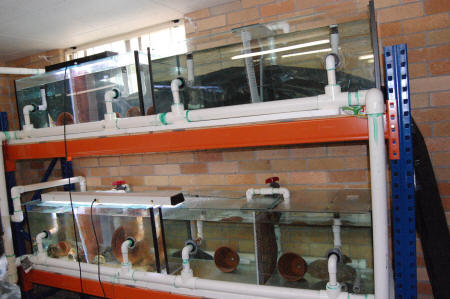 Very nice. RMF