Back to: Red Sea Reef Slope 1 of 5,
On to: Red Sea Reef Slope 3 of 5
Stinging-Celled Life, Phylum Cnidaria: Corals, Soft and Hard,
Gorgonians (Sea Fans), Anemones, Clavulariid Polyps, Organ Pipe
"Coral", even Black Coral and Tube-Anemones are found
throughout the Red Sea. Here are the most hardy, readily available
forms.
Soft Corals, Order Alcyonacea: Thirteen genera are listed
from here. Some are hobby "standards", others you rarely see
in the trade or the wild. Other species recorded from here include
Parethropodium fulvum, Cladiella pachyclados, five species of
Sinularia, Dendronephthyas (mentioned above), Stereonephthya
cundabiluensis, Umbellifera oreni and Siphonogorgia
spp.
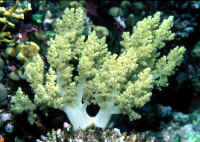
| Litophyton arboreum Red Sea. Variable in
color depending where growing, season. Red Sea image. |
|
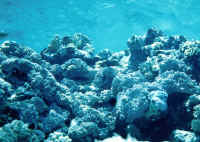
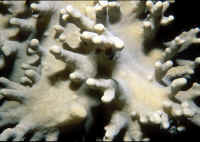
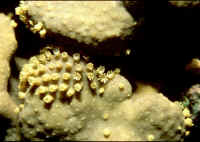
| Lobophytum spp. Common throughout its range
in the Indo-Pacific. Feed via photosynthesis and plankton. Grow in
folds or finger-like projections by folding coenenchyme. Pictured,
an usually large "patch" of colonies on the reef lip (at
the top of the slope), and two close-ups in the Red Sea. |
| Parerythropodium fulvum (Forsskal 1775),
Sulfur Coral, Yellow Encrusting Leather Coral. So tough, it can be
found creeping onto the reef flat in places. A typical creeping
colony and close-up in the Red Sea. |
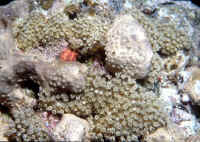 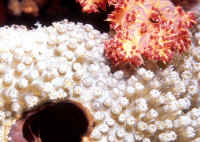
|
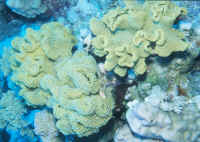
| Sarcophyton trocheliophorum Marenzeller
1886, Elephant Ear Soft Coral. A large alcyoniid with symbiotic
zooxanthellae. This and fine plankton, dissolved organics are
nutritive. To two feet across. A popular aquarium species that
loses easily to stinging anemones, large polyp stony corals. Likes
bright light, moderate current. Red Sea images. S.
ehrenbergi and S. glaucum also occur in the Red
Sea. |
|
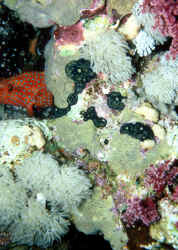
| Pulsing Corals, family Xeniidae occur here in good
numbers, at times covering more than half the hard surface. Most
often encountered are one of at least ten species of Xenia
spp. Shown: a typical setting on a reef slope with pulsing corals,
encrusting sponges and a skulking bass, Cephalopholis
miniata in view. |
|
Stony Corals, Order Scleractinia, are more
abundant and diverse than the reef flat above. Most of what you'll
find are members of the following families, listed in order by
preponderance by family, then genus within family, then species within
genus.
Family Acroporidae: There are three genera of
Staghorn Corals in the Red Sea; Acropora, Montipora and Astreopora. The
first two are the predominant life forms on the reef flat. These genera
and occasional colonies of Astreopora occur, though generally in less
abundance down the reef slopes.
|
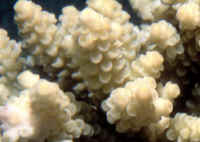
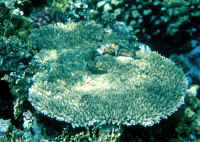
Acropora hyacinthus (Dana 1846). Colonies as
wide, flat plates, possibly tiered. Branches fine in low wave
action environments, fused in brisk ones. Branchlets are fine,
upward facing. Axial corallites not exsert, but distinct; radial
corallites are cup-shaped. Found on outer reef flats (shown) and
reef slopes. Red Sea images.
|
|
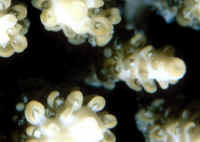
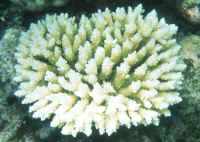
| Acropora tenuis (formerly eurystoma)
(Dana 1846). Colonies as corymbose clumps. Often with their
fine branches evenly spaced. Corallites: Axial ones are long,
tubular. Radial ones in neat rosettes often with flaring colored
lips. Common on Res Sea Rocky Reef Slopes. |
|
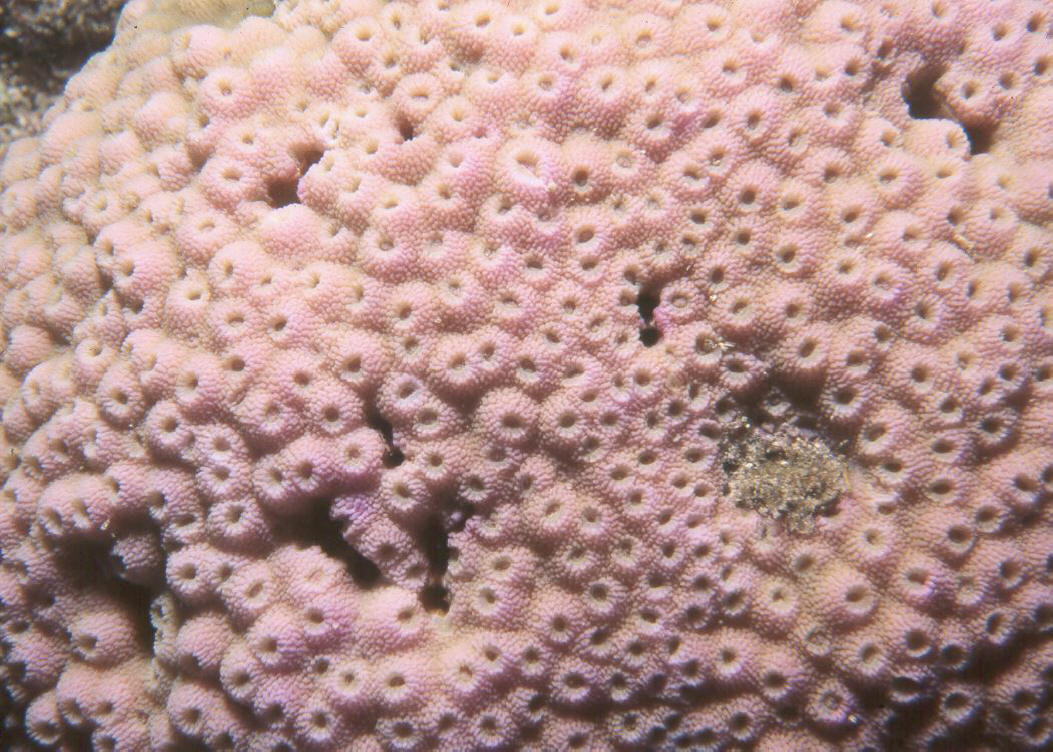
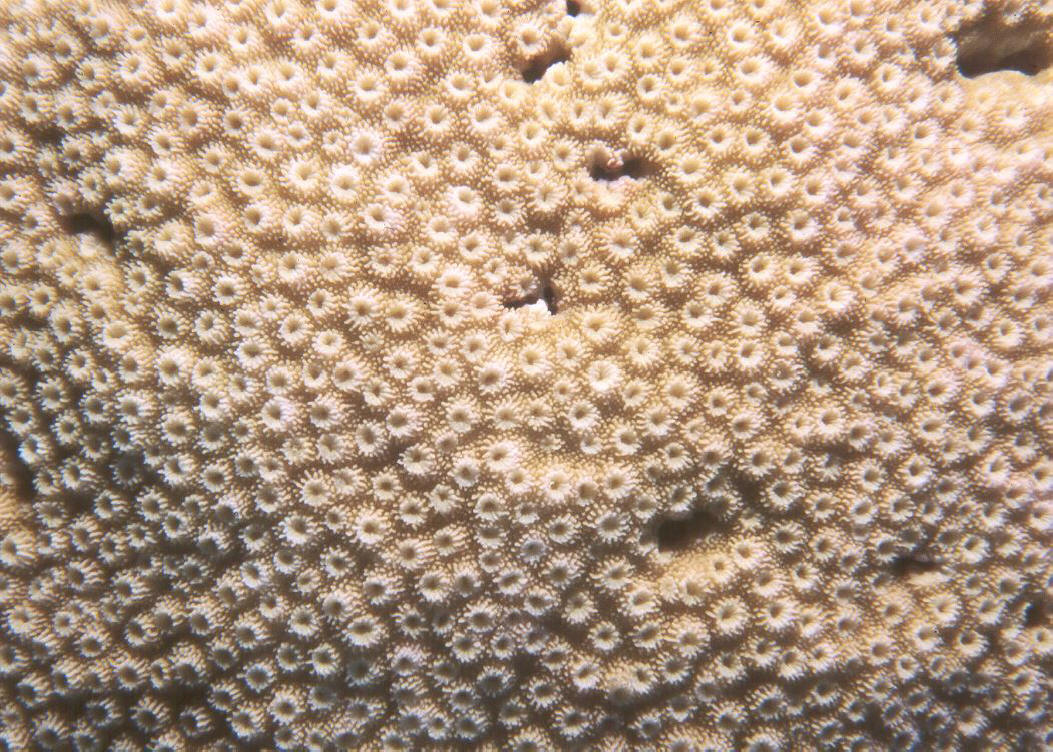
| Astreopora myriophthalma (Lamarck
1816). Smooth, hemispherical colonies. Corallites, conical,
even-spaced. Coenosteum with rippled ridges. Most common species.
Red Sea images. |
|
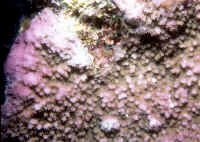
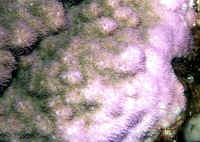
| Montipora tuberculosa (Lamarck 1816).
Colonies submassive or laminar. Small corallites occur as both
exsert and embedded, separated by papillae, tuberculae of a
corallite width. Found in most reef environments. Red Sea
pix. |
|
Family Pocilloporidae: All of the four genera of
pocilloporids of the Red Sea are to be found here on the rocky reef
slope; Stylophora, Seriatopora, Pocillopora and Madracis.
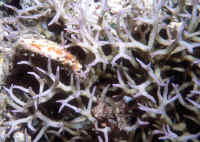
| Seriatopora hystrix Dana 1846, the most
common Bird's Nest Coral. Needle like endings on variably
thick, twisted branches. Here is a Bird's Nest Coral colony in
the Red Sea. This species is often encountered on the reef flat in
other oceans; not here. Other members of the genus in the Red Sea
are S. caliendrum and S. octoptera. They're less
common by far. |
|
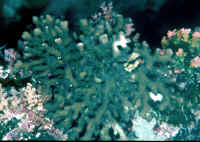
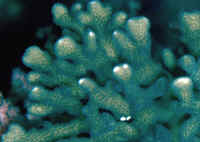
| Genus Stylophora. S. pistillata (shown on
the reef flat) which occurs down the slope to about 25m. and is
most common. S. danae (shown) prefers sheltered habitats,
and S. subseriata, similar to S. pistillata are
secondarily common. |
|
Family Poritidae: Porites, Goniopora (seven
species) and Alveopora (five species) occur here, especially the
first genus as a principal reef builder. The other two genera are
found more toward the middle to bottom of the rocky reef slope on down
to the sandy reef slope.
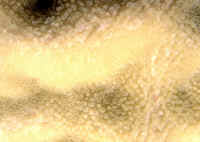
| Porites lichen Dana 1846. Colonies as flat
plates with fused nodules, columns. Corallites in irregular rows
with slightly raised ridges between. Typically yellow in color.
Common to dominant species on reef slopes. Red Sea
image. |
|
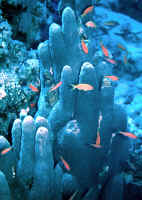
| Alveopora daedalea (Forsskal 1775). Colonies
as thick plates or columns (up to a meter tall). Corallites with
alternating short, long septa. Tentacles appear squared off, six
each tall, short in number. Occur on protected upper reef slopes.
Red Sea image. |
|
Family Fungiidae: Mushroom Corals. Do occur in the Red Sea in
the genera Cycloseris (six species), Fungia (ten
species), Ctenactis (two species, both common), Podabacia
(one species) and Herpolitha (one species here), but
sporadically as a rule. Some Fungia spp. are found on the reef flat,
but most species occur lower on the reef slope out to the sandy reef
slope.
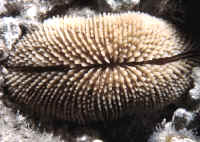
| Ctenactis crassa (Dana 1846). Axial furrow
extends apparently to both ends of the polyp. Multiple mouths, all
within the furrow. Juvenile and older polyp in the Red Sea. |
|
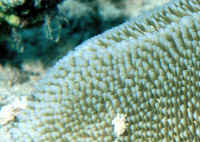
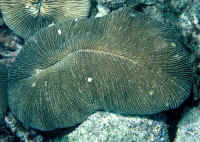
| Ctenactis echinata (Pallas 1776). Both septa
and costal (top and bottom skeletal lines) bear teeth. One mouth.
Close-up and adult in Fiji. Occurs in the Red Sea from the
Reef Flat to 25 meters. |
|
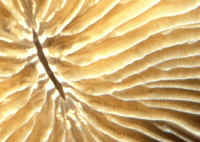
| Cycloseris sp. skeleton in the Red Sea, top
view. This genus is distinguished from Fungia by its
finely serrated costal edges (vs. denticular in Fungia), and
lack of perforations of said walls. |
|
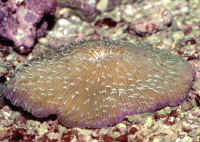
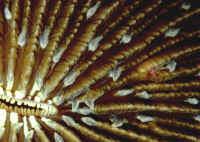
| Fungia fungites (Linnaeus 1758). Polyps
irregularly circular to round in appearance. Regular, saw like,
triangular septal teeth. Often with tentacular lobes
showing. Aquarium and Pulau Redang, Malaysia photos. |
  |
Family Agariciidae: Cactus, Elephant Skin,
Plate, Lettuce Corals; sporadically abundant in places. Four genera are
found here: Pavona (seven species), Leptoseris (seven
species), Gardineoseris (monotypic), Pachyseris (two
species). Most are found in deeper water here, near the lower rocky
reef slope, onto rocky bommies on the lower sandy slope. Most common
species shown.
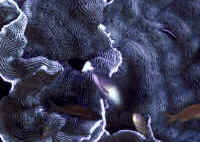
| Pachyseris speciosa (Dana 1846). One sided
colony faces, with regular ridging. Most common member of the
genus. Red Sea image. |
|
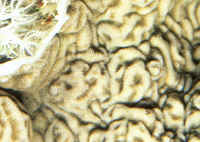
| Pavona varians Verrill 1864. Colonies
encrusting to laminar, showing short, irregular valleys. Red Sea
image. |
|
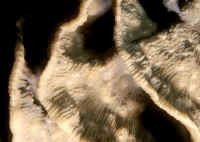
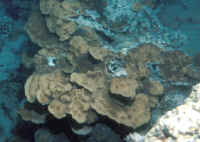
| Leptoseris explanata Yabe & Sugiyama
1941. Colonies made up of one-sided blades. Corallites expand as
they grow toward end of blades. Red Sea colony and close-up. |
|
Back to: Red Sea Reef Slope 1 of 5,
On to: Red Sea Reef Slope 3 of 5