|
FAQs about Snappers, Family
Lutjanidae
Related Articles: Snappers
Related FAQs: Fusiliers
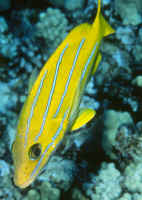
A Bluestripe Snapper, Lutjanus kasmira off
Maui, Hawai'i.
|
|
|
fish ID? 10/24/13
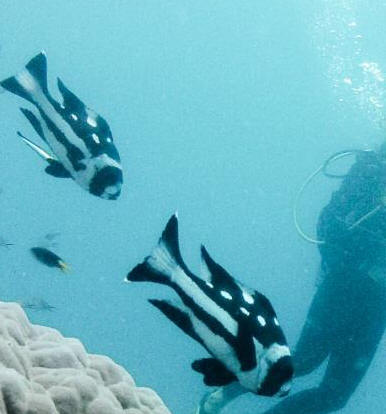
having a little trouble identifying this fish, photo taken off the great
barrier reef. would appreciate any help you could give me. thanks a lot
WWM team. been using this site for years.
<One of the few Lutjanids that grace pet-fish aquariums... as young. See
here:
http://www.wetwebmedia.com/snappers.htm
Bob Fenner>
|
 |
|
Eel with white coating on tail--what
disease? 7/28/11
I have an eel (moray I guess).
<...>
See picture. I reduced the size so it may be hard to see the eel
clearly, but his tail is still there, it's just coated in
white slime? and he also has white dots higher up. The eel is
still breathing
<... what other livestock is in with this fish?>
It's about 2 feet long and has been doing well for about a
year. It is fed Formula 1 and 2 cubes and silversides, typically
eating several cubes/fish every five days or so. It's always
looked well fed.
Suddenly, in the past 24 hours or less, a strange white slime has
started to cover the lower third of the eel. It is very sluggish
sitting out in the open on the sand.
The same thing happened to another eel that was in the tank 6
months ago or so. That eel was dead within a day or so.
None of the other fish seem to be experiencing any problems.
Water change was just done two days ago. Water parameters look
good, my nitrates are generally a little high at 30-40 but this
is FOWLR tank, 400 gallons so not overstocks even with 5 other
big fish in it.
Has anyone heard of a disease that manifests itself with this
white coating.
There are little spots also visible higher up the eel.
Any advice or does it look hopeless and I should get him out
before the other fish starting picking at him. The other fish are
red snapper, grouper, lion fish, blue tang,
raccoon butterfly, Porkfish-all medium to large fish.
<I suspect the bass/grouper has picked on this fish... The
Muraenid is likely doomed from the damage.
Bob Fenner>
|
|
[1].jpg)
|
re: Eel with white coating on
tail--what disease? 7/28/11
Thanks Bob. You are correct the eel died and I removed it
from the tank.
<Ahhh>
So you think the white slime is a physical condition or
reaction to trauma from assaults?
<Indeed; almost assuredly... the "white dots"
more proximal are little doubt from this Moray trying to
escape its tormentor... dashing itself against rock>
The Red Snapper is huge, probably at least 12" and the
Panther Grouper is not quite that large--both are
aggressive and I have seen the Snapper fight with the eel
over food.
<Yes... Chromileptis can "turn"
abruptly>
I had another eel that died back in October 2010 that had
exactly the same white slime on the body.
<Acknowledged. Saw your comment re previously>
That eel was 3' and this one was 2'. Could such
large eels really be beat up that badly by a Snapper or
Grouper?
<Yes; for sure. BobF>
re: Eel with white coating on tail--what disease?
7/29/11
Thanks Bob.
<Welcome Jeff>
While I have your attention, let me ask you whether you
think any eels might be able to "handle" these
tankmates?
<I don't think so. I would not try again>
Also, I'm surprised it is the grouper who is the
culprit because by far the most aggressive acting fish in
the tank is the big snapper. He routinely chases the
grouper and the other fish away from food. He does seem to
show a cautious respect for the Lion Fish however. LOL.
<Could be the Lutjanus sebae... is my "second
guess">
I am sending a picture of it. He looks like an Emperor Red
Snapper.
<Indeed>
The thing is I have had him since January 2010 and he was
already quite large when I got him, so maybe six months or
more old then. Outgrew former owner's tank. But he
still has the distinctive markings of a juvenile. Is that
possible given he must be at least 2 years old by now?
<Likely so>
Or have I misidentified the fish?
<Don't think so>
Sorry if I started a new thread.
<No worries. All useful information. Bob Fenner>
|
|
%20L.%20sebae.jpg)
|
|
Heavy breathing emperor snapper
-- 12/28/10
Hi
<John>
We exchanged e-mails recently about a misidentified "eel".
Now I have another issue. Same LFS source that sold my wife the
engineer blenny also gave
<?>
her a small Emperor Snapper (the colors matched the blenny!). He's
now breathing very rapidly. He's swimming normally but only near
the surface of the QT. The blenny with him is fine. Should I dip him in
freshwater?
They've been in there for over 24 hours.
JZ
<... I'd leave this fish be... Too much stress to be
manipulating it... B>
Mangrove jack purchases online
4/9/10
Hi there
I am an aquaculture student in South Africa and have been trying to
purchase some juvenile Lutjanus argentimaculatus, we call it mangrove
red river snapper, I think you call it mangrove jack. Anyways I was
wondering if you know of any stores I can order this species online as
this species is endangered in South Africa and is very difficult to
come by. I intend to conduct studies on this species in brackish
environments and keep them for brood stock in saltwater environments
upon maturity.
Thanks Gary
<The best outfit to contact is Dynasty Marine:
http://www.dynastymarine.net/
Ask for Forrest Young: sales@dynastymarine.net
Bob Fenner>
Re: Mangrove jack purchases
online 4/11/10
Dear Bob
Thanks very much for your help! Mr. Young was definitely the best man
to speak to. It turns out I will owe him a beer and if I ever meet you
at a conference, I will owe you one as well.
Best regards
Gary
<Ahh, I look forward to meeting you, and the beer!
BobF>
Re: Sel. your snappers. Forrest
Young, Dynasty Marine 4/9/2010
Dear Gary,
I am sorry I cannot help you. We do not import South African fishes,
and we would avoid any species that is protected for all the right
reasons. I do not know of a source for juvenile Lutjanus
argentimaculatus .If you ever need western Atlantic snappers you are at
the right place.
I suggest you contact your local center for Aquatic Diversity or
Natural Resources and see about acquiring a permit as opposed to
looking on the black market or online. In the U.S. and Europe it is
relatively easy to get a permit to work with restricted species.
I can refer you to reputable people in the public aquarium in Capetown
and elsewhere; perhaps they can assist you or direct you to a better
source. Pat is the director at Two Oceans Aquarium and is a great
guy.
Maybe he can assist you. His e-mail: pat.garratt@aquarium.co.za.
Gerhard Beukes, the curator of the Istanbul Aquarium, who grew up in
South Africa may also know of someone, his e mail is:
gbeukes@istanbulakvaryum.com.
Finally you can also ask Tony McEwan at Bay World. His e-mail is:
tonym@bayworld.co.za
I hope this helps you if you ever see me at a conference after you
finish your studies you owe me a beer.
Best Regards,
Forrest
<Thank you much Forrest for your prompt and useful reply. Bob
Fenner>
Re: your snappers 4/9/2010
Hi Bob,
<Forrest>
You are welcome; I hope it helps.
<Am sure it has this gentleman, as well as many folks who will
become familiar with you, your fine business there in FLA, and the
contacts you have provided>
Best Regards,
F.
<Oh, and BTW, have enjoyed the recent write-ups of your deepwater
collecting expeditions. Cheers, BobF>
|
Lutjanus, mis-id, placement on WWM --
1/28/10
Hi Wet Web crew,
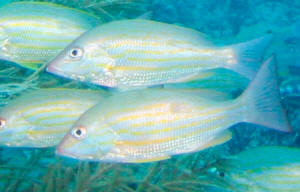
I was searching for images of Lutjanus synagris, Lane snapper and
Google images sent me to your site. Unfortunately, it sent me to
a L. mahogani image instead. I was intrigued, so I investigated
it a bit more. Your photo is labeled as synagris, but it is
clearly identical to the mahogani photo immediately above it.
http://www.wetwebmedia.com/SnapperPIX/Lutjanus%20synagris%20BON%20(1)%20MD.jpg
and
http://www.wetwebmedia.com/SnapperPIX/Lutjanus%20mahogoni%20BON%20(3)%20MD.JPG
You may like to update your text to indicate this, maybe another
photo of a Lane instead.
<Bizarre... It is my work/photos and ID, mistake and will
fix...>
I have one you are welcome to use which displays very clearly
spot and no spot phases and the yellow dorsal fin margins.
Sorry about the quality, it is cropped from a very large
image.
<http://www.wetwebmedia.com/SnapperPIX/Lutjanus%20synagris%20BON%20(1)%20MD.jpg>
Sincerely,
Rex Baumberger
<Thank you for this Rex. Bob Fenner>
|
 |
Snapper Removal Problems
10/17/09
Hello WWM Crew! Hope all of you are doing well and thank you in advance
for reading this email.
<Welcome Cory>
I was hoping you could help my father with a predicament he is in. I am
writing this email on his behalf.
<Will try>
Tank is currently a 90 Gallon Reef Tank, not going to include water
parameters because they are not relevant to the issue. Anyway, the
problem is for years I have been unable to convince him to switch to
synthetic water, and he still swears natural sea water is the best and
he collects it for his water changes.
<Mmm, too much work... not cost-effective period in this day of high
fuel et al. related costs... and too much risk of introducing pests,
parasites and pollution... And a bunch of other negatives... But there
are ancillary benefits (e.g. exercise, fun...) to gathering your
own>
However, apparently he managed to
scoop up a tiny mangrove snapper during his last water change, and it
has grown to about 2 inches so far.
<Neat!>
His stocking list (besides the snapper) is:
1 - Juvenile Blueface Angelfish (~7 Inches)
3 - Blue Reef Chromis (Between 1 and 2 inches)
1 - Yellow Damselfish (1 Inch)
1 - Yellow Watchman Goby
1 - Flame Dartfish (missing last two weeks, probably jumped out)
<Very common>
1 - Neon Goby
2 - False Percula Clownfish (~ 2.5/3 Inches)
2 - Sand Sifting Stars (over two years old each)
20-25 Turbo Snails
12 - Hermit Crabs (Nasty/Big ones often removed)
1 - Scarlet Skunk Cleaner Shrimp
3 - Peppermint Shrimps
Corals: Red, Green, Orange Mushrooms, Xenia Coral, Pink Sea Polyps I am
petrified that this snapper is going to munch down on first, the neon
goby,
<Not this fish... likely will recognize as a purposeful cleaner...
But the small crustaceans for sure in time, and the other smaller
fishes as well>
then probably the damsel, and work his way up. We have tried to remove
it via the following methods (none have worked, obviously)
1 - Drinking Glass Trick - Angelfish found how to remove bait using his
tail
<They are smart>
1 - Hook and Line with Cooked Shrimp (No other fish besides snapper
will touch it, unfortunately, he shook off hook when pulled above tank
and fell back in, now won't go near a hook)
<Wait a few weeks... they forget>
1 - Converted Freshwater Breeder Box (you know the ones that hang on
the side), but fish won't go anywhere near the thing
We are at the point where we might need to break down the whole tank to
get him out, but we don't want to because our corals are starting
to propagate and we don't want to disturb them, as we have been
waiting over a year for the mushrooms to start to divide.
Is there anything else we should try first? I would really appreciate
any advice you would have on the matter. Thank you very much!
CD, Miami
<Two nets, two netters are likely the most assured method... besides
waiting to re-try the hook and line. Bob Fenner>
Re: Snapper Removal Problems
01/18/09
Thanks for the reply Bob. Will take your advice and try the hook again
<Look for very small size, no barb, light clear line... some
retailers sell such rigs>
in a few weeks - we simply want to remove him to a more aggressive
tank, or possibly trade him. We know it is not safe to return him to
the ocean at this point (being exposed to store bought fish). The two
nets with some tickle sticks might work but I forgot to mention there
is quite a lot of rockwork so it could be tricky.
Thanks again!
CD
<Good fishing! RMF>
|
Please help me identify this cichlid! (It's not a
cichlid, it's a brackish water snapper... oops!) --
09/08/09
I have some problems recognizing this cichlid....
<Isn't a cichlid.>
I have tried searching its name but with no success. It would be
a great help if you would help me identify this.
<It is a fish called a Mangrove Jack, Lutjanus
argentimaculatus, a brackish water to marine snapper found across
the Indo-West Pacific from the Red Sea to Australia. The species
spawns in estuaries and the juveniles are commonly found in
freshwater rivers close to the sea. Adults will sometimes swim
into freshwater rivers, but they don't live permanently in
freshwater.
Basic care similar to other brackish water fish; you'll need
around SG 1.005 for juveniles up to about 6 inches/15 cm, but
after that, half-strength to full-strength seawater is required,
SG 1.010 to 1.025 at
25 degrees C. The main problem is its size: adults can reach 100
cm/39 inches in length and weight 15 kg/33 lb, but most are
somewhat smaller.
Still, expect a fish some 50 cm/20 inches in length within a
couple of years.>
I bought two of these cichlids named as "African
cichlids" but when I saw them closely in my tank, I saw
sharp teeth like Piranhas.
<They are snappers. They snap!>
They are two of them around 3" placed with a Green Terror
and Blood Parrot Cichlid.
<Both of these fish will, eventually, become food.>
And sorry for the bad picture quality (Its added as an
attachment)
<Good enough! These are really a food fish, with little/no
value as aquarium fish. Hope you have a big, and I mean BIG
aquarium for them! These are super-aggressive, extremely predator
fish that need lots of robust seafood (squid, cockles, lancefish)
to do well, though they should also take quality pellets such as
Cichlid Gold. Very likely will eventually need to be kept alone.
Hardy, can become very tame. Overall, similar to other large
snappers, such as Lutjanus sebae. Cheers, Neale.>
|
  |
Brackish to totally fresh water?
5/14/09
Dear WWM crew,
Hi, i live in Indonesia.
<Ahh! Am on my way next week to Sulawesi>
I have a question, i bought a Caranx spp which is a Giant Trevally and
a mangrove jack. As far as i
know, this both fish are a brackish when juvenile and move to saltwater
in adult.
When i look at the fish store, they said that this fish are already
convert to fresh water and put together with other fresh water fishes.
So i bought 7 giant Trevally and 2 mangrove jack about a month ago, i
put them in my Koi's pond. Until now they are still alive and eat
very greedy with blood worm or frozen shrimp. Their grow bigger now. My
question is, will this fish really convert to fresh water, because i
just afraid that this fish will dead in certain size if not move to
salt water. Thanks.
<These fishes cannot stay in freshwater indefinitely as far as I
know... their kidneys will fail in time... Bob Fenner>
Re: Brackish to totally fresh
water? 5/14/2009
<<Yes, as Bob says, I doubt that either of these fish will adapt
permanently to freshwater conditions. Both will need to be kept in at
least strongly brackish conditions (50% seawater, around SG 1.012 at 25
C). In the case of Lutjanus argentimaculatus, it is the juveniles that
are brackish water (or freshwater) fish; the adults live offshore, on
the deep reef, down to 100 metre depths. That said, Lutjanus
argentimaculatus does quite well in strongly brackish water for long
periods of time, probably permanently, though their sheer size (above
100 cm) has meant that few specimens have been kept in brackish water
aquaria for any length of time.
It is also an extremely aggressive and highly predatory species. Caranx
ignobilis is a bit more complicated. Most populations are marine fish
as adults, though juveniles are found in estuaries commonly enough.
However, there are some populations where adults will enter brackish
and even freshwater bodies of water. That said, I'm not aware of
any populations that spend their entire life cycle in freshwater
habitats. Besides, at up to 170 cm in length and highly predatory as
well, even in a pond, these fish surely have limited usefulness.
Cheers, Neale.>>
<Thanks much Neale... BobF, even more punctuated in
replying...>
| Fishbase not helping. can you help identify
please? 8/6/08 Hello there! I Hope this finds all of you well.
I have spent a week and many hours pouring over fishbase trying to
determine exactly what I have here. I scuba dive in the Gulf of
Mexico and got these guys about a month ago. They seem to be doing
very well in my quarantine tank but before I think about keeping
them or moving them to one of my display tanks I really need to
find out exactly what they are. The first guy was found in grass
beds and I think I have determined he is from the Combtooth blenny
family. Perhaps a Florida Blenny ? Would you agree ? <Mmm, this
is/was a bit of a teaser... am out in HI, away from in-print ref.
works... thinking that I could see a bit more of the vomer, I
thought maybe this was/is a Lutjanid... taking a look on Fishbase,
sorting by the family info, species... I do think this is
Hoplopagrus guentherii... a juvenile Mexican Barred Snapper
http://fishbase.org/summary/SpeciesSummary.php?id=1393> This one
however I have NO idea. He was found in some fairly strong waves
amongst some rocks. They were quite plentiful and seemed to share
hiding spots. And should you be able to help with those two above
there was another guy that I was unable to catch in my slurp gun. I
am hoping a description may be able to help in figuring out what he
was. The elusive guy looked to me very much like a 6 line wrasse.
He did have a bit more yellow on his fins and seemed a bit wider in
his body. I would say his body looked more like a grouper or
perhaps a mis-shaped Hawaiian Wrasse. <Mmm, there are several
species...> I realize that it could not be that since I was in
the Gulf of Mexico off the coast of Florida. Any ideas on what he
might have been ? <Not from this description, sorry> I will
be going back to the same area and hope to have better luck next
time. Thanks in Advance for any help you can give. I fear I am
going cross eyed from looking at all of the pictures online. Thanks
So Much ! Ralph Port Charlotte, Florida <Thank you for sharing!
Bob Fenner> |
|
|
|
Mystery Snapper - Marine or Freshwater?
4/7/08 Hello folks! <Hi Neale!> I recently saw this
fish in a *freshwater* aquarium. It's apparently a snapper or
porgy of some kind, but not being an expert on marine fish,
I'm not sure which one. Any ideas? <My careful guess (!)
simply by comparing pictures would be a seabream Acanthopagrus
berda. They do occasionally occur in freshwater, especially the
young. However, they get much bigger than indicated by the
picture. Maturity at about 20 cm and maximum length reported
around 90 cm. The dorsal spine number from your picture also
seems to match, but all together I am not perfectly convinced by
the ID and will leave the email for others to see. In the
meantime here's a nice picture of A. berda: http://fishpix.kahaku.go.jp/fishimage-e/detail?START=27&FAMILY=Sparidae&SPECIES=&LOCALITY=&FISH_Y=&FISH_
M=&FISH_D=&PERSON=&PHOTO_ID=&JPN_FAMILY_
OPT=1&FAMILY_OPT=0&JPN_NAME_OPT=1&SPECIES_OPT=1&
LOCALITY_OPT=1&PERSON_OPT=1&PHOTO_ID_OPT=2> It's
apparently been in freshwater tanks for the last couple of years
at least, and appeared to be in perfect health. Cheers, Neale
<We've kept seabreams from the black sea in brackish water
tanks, but I've never encountered them in freshwater. The
ones from the black sea were pretty much euryhaline, but stayed
significantly smaller than in nature, which wasn't
surprising. Cheers, Marco.>
Re: Mystery Snapper - Marine or Freshwater?
4/7/08 Hello Marco, <Hi Neale.> Thanks for the name! I
agree with you 100% about the genus at least, though I'm
wondering about Acanthopagrus latus as well. <Very well
possible. Fin colours can be used for differentiation, but its
better to see the fish in person or have it in front of a white
background to do that. A. latus is supposed to have a yellow
caudal (vs. grey at A. berda) as far as I know.> In any case,
you are quite right about the fact this fish is a porgy rather
than a snapper. The aquarium store manager called it a snapper,
so I was going along with that! Rather a cool fish, anyway.
Cheers, Neale <For an ID guide to the mentioned and other
similar species see
ftp://ftp.fao.org/docrep/fao/009/ad468e/AD468eMJ.pdf .
Photographs are in
ftp://ftp.fao.org/docrep/fao/009/y0770e/y0770e63.pdf. Cheers,
Marco.>
|
|

|
Red Emperor Snapper, beh., reading, data 1/31/08
hey, <?> I've had a red emperor snapper for about 4 months
and it has pretty much doubled his size since I got him but recently
his been getting red blotches when I turn off the lights in the tank
and seems to just stop swimming and floats there. <Mmm, could be
"normal" night time behavior... sort of behavioral and
marking camouflage against predators... but... what other fish species
are present?> In the mornings he's better but it kinda worries
me that one morning I'll wake up to a dead fish. He's been
worse since we added a powder blue tang to our tank. <Mmm, may feel
threatened by this Acanthurus> He did not have this problem with our
damsel. Well hope to hear back thank you. <How large a tank?
Lutjanus sebae gets very large... please... read re these fishes
care... systems, compatibility... at least on WWM. BobF>
Snappers 9/20/06 I am have been looking for information on
blue line snappers. but I can not find much information on them could
you give me some information on the species Lutjanus kasmira? <
http://www.wetwebmedia.com/snappers.htm ; read this and the
linked FAQs in blue at the top...Adam J.>
About blue line snappers 8/30/06 could you tell me how big
they get and what size of tank they would require? I looked at the
article and couldn't find this information. What should I be
looking for when if I purchase one? <Mmm, Lutjanus viridis? Please
read here: http://www.wetwebmedia.com/snappers.htm There are at
least three such lutjanids with this common nomen... Once you know the
species, take a look/see on fishbase.org Bob Fenner>
Snapper
compatibility Dear Bob, <Hi there> I used to have a snapper
living together with my golden maroon clown in harmony... the snapper,
emperor, though larger in size, does not attack my clown... it got a
little active and big, so I transferred it to another tank. it has been
hand feeding well for a month. <Neat> I introduced a new baby
snapper to my tank w my current golden maroon, both of which are very
similar in size. I understand from your site (highly recommended by my
uncle who's been rearing marines for a decade) that the snapper
will not attack fishes big in size it cannot digest... <Usually
not> however, this new baby snapper, 3 days in my tank, has been
biting the fins of my maroon occasionally... unlike the other one that
leaves harmoniously w my clown. Is there a way I can salvage the
situation?? <Possibly. I'd try isolating the snapper in a
"floating jail"... a plastic colander (ask if you can use
one... for straining spaghetti, other noodles usually) in the tank for
a few days... often "takes the spunk" out of fighting
fishes> I thought maroon's are rather strong and aggressive
fishes... <Usually> I don't understand the reason why but
please note that my maroon's fins have been bitten by the old
snapper (by accident I'm quite sure) during feeding time while they
were rushing for food... Some friends say its the size of the snapper
same as clown) while others claim different emperor snappers have
different characteristics... what should I do?? <Try the
separation> I've thought of keeping the maroon in a separate
under tank till its fins heal before moving it back w my snapper...
<Better to remove the snapper instead> it seems a little scared
of the baby snapper now, and doesn't look as happy and active as
before... lastly, my friend has a black beauty snapper (very healthy)
in his tank for weeks already...can I include it in my tank?
<I'd wait till the current situation is resolved. Bob
Fenner>
Re: Symphorichthys spilurus Dear Jason
<<Hello...>> Thank you very much for your rapid answer.
<<You are quite welcome.>> Fortunately for his life, my
Symphorichthys is about 20cm and the miniata 10cm. I removed the
miniata this morning and tonight I plan to remove the sympho in the aim
of rearing him alone in a 300l tank as long as he gets again his
magnificent dorsals rays. <<Glad to hear it.>> You'll
find attached to this email 3 pictures of it taken one month ago. Thank
you very much again Cheers Pascal <<And cheers to you. J --
>>
Lutjanid/Snapper Input (brackish too!) hello Robert, I've
been keeping fish for over 15 years. and I've always been
fascinated by the salt water species that are found or can live in
freshwater. which some I and wondering. do you have pictures of, the
following :Lutjanus fuscescens, Lutjanus goldiei, Lutjanus maxweberi
<Wow, struck out... Have pix of about twenty five species in this
genus, but none of these three. There are some drawings, one pic of
them on fishbase.org> I've kept and caught L. argentimaculatus
many times, and they are awesome. now I'm wondering about the rest
in the genera. <Have some coverage under the family name on our site
here: http://www.wetwebmedia.com/snappers.htm and the associated FAQs
beyond... Do agree with you re these fishes. Much under-utilized,
under-appreciated. Bob Fenner> much appreciated. Wes
Re: Lutjanid/Snapper Input (brackish too!) hello
Robert, thanks for the prompt reply. I did find one picture of l.
goldiei. here it is. let me know what you think of it. <Good
looking... and probably delicious barbecued! Bob Fenner> Wes
about yellowtail snapper How do I raise yellowtail snapper in
open water cages? I'm not sure what to feed them in order to make
them grow. I also have trouble keeping them alive. Is there any advice
you can give me? James >> Is this a commercial (size, type)
operation, trying to rear lutjanids for food? Or a hobby, speculative
small scale venture? From what size to what size do you want to raise
them? What other fin fish do you have aquaculture experience with? Bob
Fenner
Re: about yellowtail snapper This is a test to see if
yellowtail can be grown in captivity. the snapper are caught by hook
and line in the normal way, chumming over the reef. they are not baby
fish but are not full grown. I want to see if I can get them to grow
over the legal limit which I believe is 13 inches. They have been fed
raw fish twice a day but are not growing. I don't have any other
fin fish experience. I need to show up at the school with ideas on how
to make the project work. I will be there for 1 semester but I have to
present my findings to the Bahamian Government in December. >>
>> I see. Have you tried different diets? What sort of literature
search(es) have you done to look into Lutjanid culture? Which species
of Lutjanus is this? Have you looked through the resources of FishBase?
Bob Fenner
Re: about yellowtail snapper I haven't tried different
diets because I haven't been to the school yet. I am trying to get
an idea of what to do when I get there. I have been sent some
information but not in great detail. I would like to know if there are
any supplements that would help increase fish size. Also what type of
cage do you recommend for housing the snapper. The species is
Yellowtail Snapper. >> >> Okay... pls cut and paste the
following link to fishbase:
http://www.fishbase.org/Summary/SpeciesSummary.cfm?genusname=Ocyurus&speciesname=chrysurus
for Ocyurus chrysurus... and click on the references section there, and
look on our website for articles on how to search the literature to
find what is currently known re this species, family... and its
aquaculture: Home Page Bob Fenner
Red emperor snapper Bob, What is the largest Red Emperor
Snapper You have in stock? Or, In the next two weeks? I would like to
know the growth rate of this species also. Thanks , Ed Noble >>
Gosh... am down in sunny southern California... and
FFExpress/Petstore.com are in Emeryville, near San Fran... and their
liveholding/shipping facility is around LAX... but will send this note
along, as my direct liaison, John Caskie... who sorts through my feeble
response attempts and edits (thank goodness) and posts a few will know
how to get the answer to your query... The snapper in question,
Lutjanus sebae, gets to about a foot in length... and can do so
within a year... if its fed (even starting tiny... most are imported at
3/4 to one inch) like it wants to be (i.e. all the time, a lot!) Bob
Fenner
Shy red emperor snapper Delicious on a bed of rice and a
lemon wedge! Actually, these beauties (Lutjanus sebae) are typically
shy when new to a system or small... but they don't stay either
with age and rapid growth. Take care to only keep larger-than-mouth
size tankmates with this gulper. Bob Fenner

