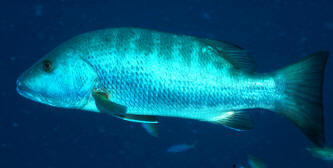
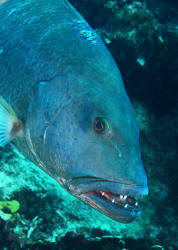
Amongst the "personality" fishes for marine
aquariums, few can match some of the snapper family. These animals can
be hand tamed, and kept for a very long time... if you have the
space.
The snappers and their allies, the fusiliers are good
additions for "fish-only" marine systems, who, though bold
eaters, only require a darkened space to call their own.
Classification, Favored
Species:
All told there are twenty one genera and some hundred
seven described species of snappers. The family Lutjanidae is further
split up by some taxonomists into five subfamilies; in recent schemes
including the planktivorous family/subfamily of fusiliers,
Caesionidae/Caesioninae.
Take a look at a "typical" snapper; they all
have a similar body plan; a continuous (or shallowly notched) dorsal
fin with 9-12 spines and 9-18 soft rays; an anal fin of three spines
and 7-11 soft rays. Notice the origin of the pelvic fins; they're
inserted just behind the pectoral base, granting the fish good turning
and hovering control.
How 'bout the mouth? With a common name like
snapper, you'd assume theirs would be large, and you'd be
right. Snapper mouths are easy to spot, being terminal, most with
enlarged canine teeth, and a distinctive arrangement of jaw-bones.
Technically the maxilla slips beneath the preorbital bone when the
mouth is closed and the supramaxilla is absent; it must appear like a
landing ramp to other aquatics as well, right up to the time
they're inhaled.
Natural and Introduced
Range
Snappers are tropical and subtropical in the Pacific,
Atlantic and Indian oceans; a few are estuarine to entirely freshwater
(Lutjanus fuscescens, Lutjanus goldiei, Lutjanus maxweberi),
though these aren't the ones typically sold as "freshwater
snappers". Snappers are important food and game fishes, and
several species have been introduced into non-native waters.
Size:
Small species get to about half a foot, largest
ones attain a yard in length. Small species get to about half a foot,
largest ones attain a yard in length.
Favorite Aquarium Snapper
Species:
The following Lutjanids are amongst those most often
encountered in the pet-fish hobby, but except for the one warned
against below, the whole family does well in "standard"
aquarium conditions; as long as their tank is big enough. Do look for
the smaller species if your aquarium volume is limited.
|
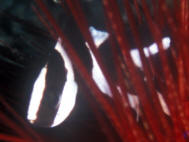
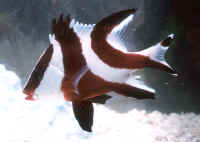
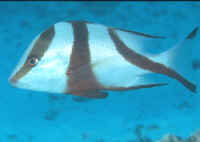
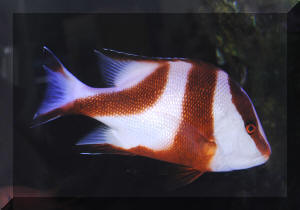
The Emperor Snapper, Lutjanus sebae (Cuvier
1816), is a real beauty as a juvenile, but beware; it gets to be
a real honker... more than three feet long in the wild! Another
good reason to under- and infrequently feed an emperor is that
their gorgeous color fades with growing size. Here is a juvenile
in an urchin in N. Sulawesi, one of four inches in captivity, and
an adult in Australian waters.
|
|
Bigger PIX:
The images in this table are linked to large (desktop size) copies.
Click on "framed" images to go to the larger size. |
|
%20MD.jpg)
|
|
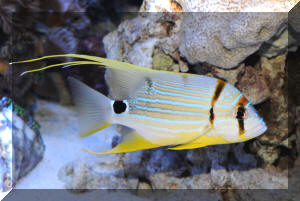
In good stead with the Emperor and catch all
"miscellaneous" snappers from the Indo-Pacific are the
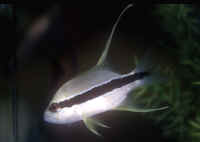
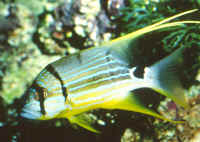
threadfin snappers, Symphorichthys spilurus (Gunther 1874)
(aka the Majestic Snapper) and Symphorus nematophorus
(Bleeker 1860) (the Blue-Lined Snapper) which must be seen in
person to be fully appreciated. These two have golden yellow
bodies flanked by bright blue horizontal bars, two vertical black
head bands and a dark caudal spot. They look touchy but are as
tough as the best snappers. To two and three feet maximum length
respectively. Here are gorgeous juvenile and adult Majestics in
captivity.
|
|
Bigger PIX:
The images in this table are linked to large (desktop size) copies.
Click on "framed" images to go to the larger size. |
|
%20MD.JPG)
|
Standard offerings from the Caribbean include the Dog
Snapper, Lutjanus jocu (Bloch & Schneider 1801), the
appropriate color-named Mahogany Snapper, Lutjanus mahogoni, and
yellow-tailed snapper, Ocyurus chrysurus; the last being one of
the most popular snappers for aquarium use for its beauty, more
peaceful nature, and slower growth. Less often seen from the western
Atlantic are the Mutton Snapper, Lutjanus analis, and
Schoolmaster, Lutjanus apodus; feed these last two sparingly,
they get big, fast.
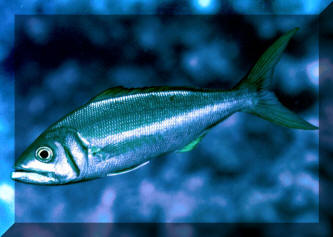
| Aphareus furca (Lacepede 1802), the
Small-Toothed Jobfish. East Africa to Polynesia in distribution. To
sixteen inches in length. This one off of Queensland,
Australia. |
|
Bigger PIX:
The images in this table are linked
to large (desktop size) copies. Click on "framed" images
to go to the larger size. |
|
%20MD.JPG)
|
Genus Lutjanus:
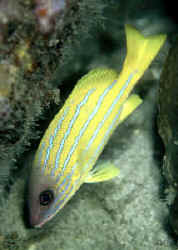
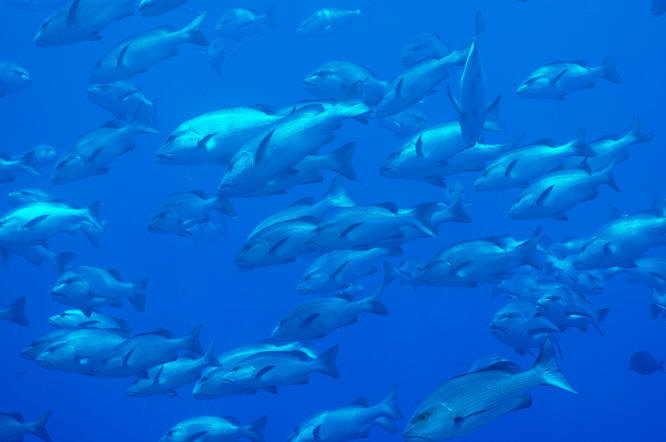
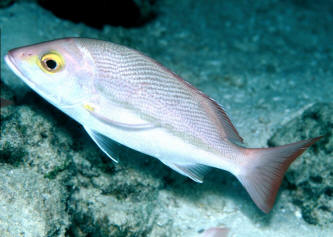
| Lutjanus adetii (Castelnau 1873), the
Yellow-Banded Snapper or Hussar. Western Pacific; east coast of
Australia and New Caledonia. To twenty inches maximum length.
This one of many in a school off Heron Island in
Australian waters, |
|
|
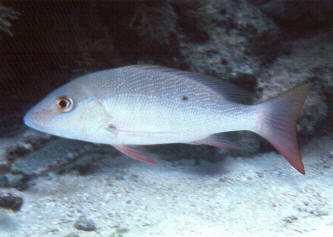
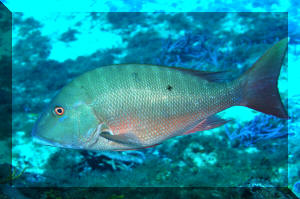
Lutjanus analis (Cuvier 1828), (Cuvier
1828), the Mutton Snapper. Western Atlantic; Massachusetts to
Brazil, Gulf of Mexico. To 26 inches maximum length. This one off
of Belize.
|
|
Bigger PIX:
The images in this table are linked to large
(desktop size) copies. Click on "framed" images to go to
the larger size. |
|
%20MD.JPG)
|
|
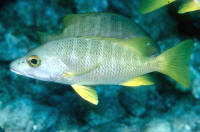
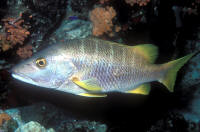
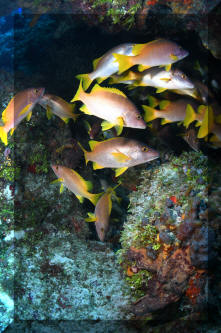
Lutjanus apodus (Walbaum 1792), the
Schoolmaster Snapper. Silver to pinkish to gray body color, bars apparent
or no; yellow fins. Western Atlantic; Massachusetts to Brazil
and the Eastern Atlantic; Core d'Ivoire to Guinea. To nearly
twenty seven inches total length. Here in the Bonaire, seven and
twelve inch individuals.
|
|
Bigger PIX:
The images in this table are linked
to large (desktop size) copies. Click on "framed" images
to go to the larger size. |
|
%20MD.JPG)
|
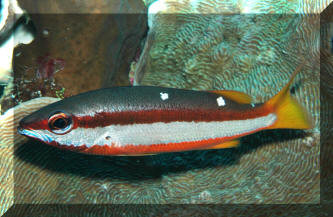
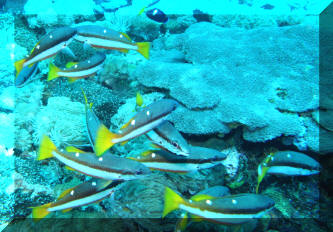
| Lutjanus bengalensis (Bloch 1790), the
Bengal Snapper. Indian Ocean to Ambon, W. Pacific. To 30 cm./1 foot in
length. Similar to other golden blue/white striped snappers but white
underneath and no marks on the snout. Mauritius 2016. |
%20MD.JPG)
|
Bigger PIX:
The images in this table are linked
to large (desktop size) copies. Click on "framed" images
to go to the larger size. |
|
|
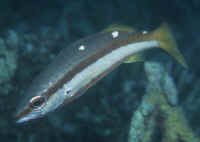
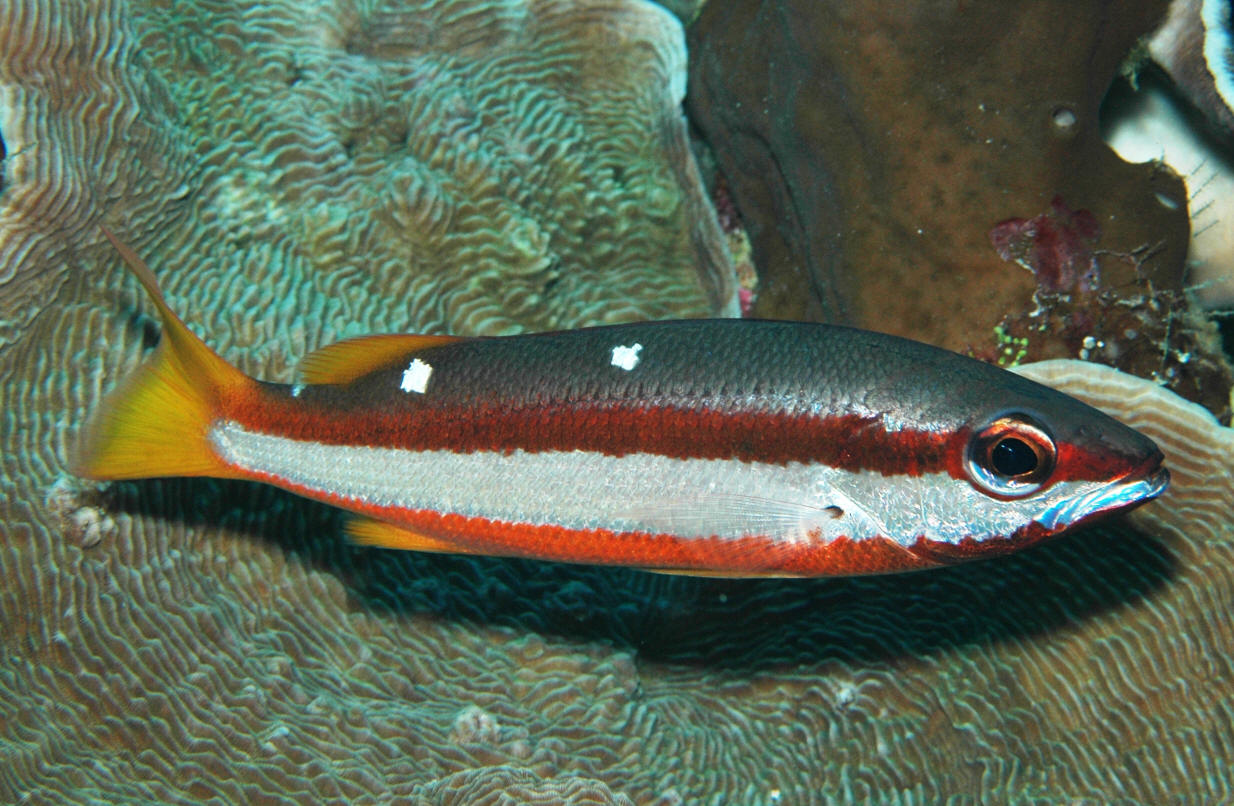
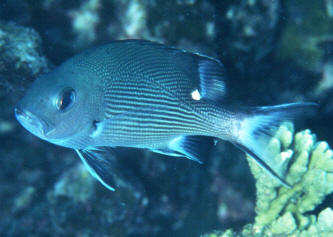
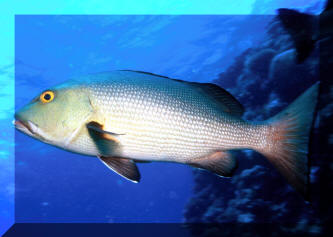
| Lutjanus bohar (Forsskal 1775), the
Two-Spot Red Snapper. Indo-West Pacific; Eastern Africa to the
Marquesas, south to Australia. To a maximum length of three feet.
Shown, a juvenile in Fiji, an adult off of Queensland, Australia,
and an aggregating, reproductive school off of Ras Mohamed,
Egypt's Sinai, Red Sea. |
 |
Bigger PIX:
The images in this table are linked
to large (desktop size) copies. Click on "framed" images
to go to the larger size. |
|
|
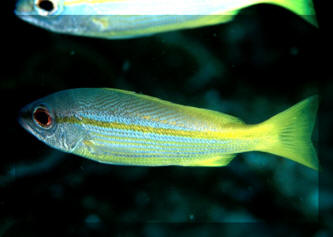
| Lutjanus boutton (Lacepede 1802), the Moluccan Snapper.
Western Pacific; Sumatra to Samoa. To a foot in
length. Here in Pulau, Redang, Malaysia. |
|
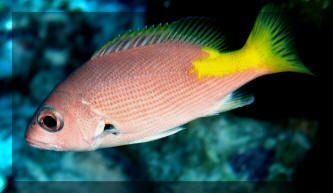
| Lutjanus buccanella, the Blackfin Snapper. Trop. W.
Atlantic. To two feet in
length. A six inch juvenile in Cozumel 2017 |
|
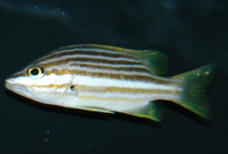
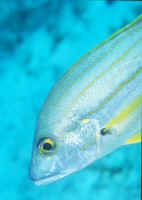
| Lutjanus carponotatus (Richardson 1842), the
Spanish Flag Snapper. Northeastern Indian Ocean and Western
Pacific. This one off of Heron Island, Australia. To sixteen inches
maximum length. Not used in the aquarium interest, but could
definitely be. Good looking, hardy, stays small enough... numerous
and easy to catch... A juvenile in captivity and an adult off Heron
Island, GBR. |
|
To: part II,
part III