|
|
| Home | Marine Aquariums |
Freshwater Aquariums |
Planted Aquariums |
Brackish Systems |
Ponds,
lakes & fountains |
Turtles & Amphibians |
Aquatic Business |
Aquatic Science |
Ask the WWM Crew a Question |
| Please visit our Sponsors | ||||
Yuma and Sponge Compatibility? 12/5/19 Sponge Allelopathy 6/8/16
White sponge like thing growing in my saltwater tank; using WWM
5/28/15
Sponge
2/25/15 Re: Sponge 2/26/15
Zoanthids exposure to air; sponge control
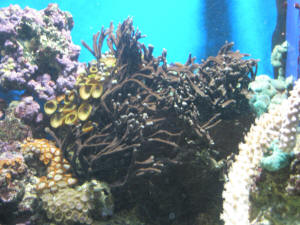
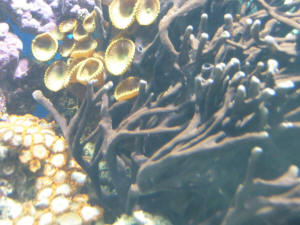
8/12/13 Orange Tree Sponge Coincidence? 11/18/12
To<o> Much Live sponge?
3/27/12
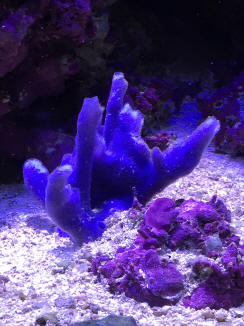
Blue Photo Sponge, Collospongia auris, incomp.
5/6/11
Sponge question 01/23/09 Does the presence of sponges indicate good water chemistry? <They don't necessarily indicate anything. They might indicate that your water is at least "livable" for sponges... but it might also indicate that you have plenty of spare nutrients to support them.> I've got quite a population of small whites ones that have been growing in colonies, even in my refugium and syphon overflow! <Congrats, sponges are fun. But they can clog up siphons and such... so you might want to scrub them out from time to time if they get too dense.> Thanks Pat <De nada, Sara M.> Sponges, ID, control 9/29/08 <Hi Wesley, Mich with you today.> My aquarium is being over run with stringy white and black organisms I think they are sponges. <A picture, even a blurry one, would be helpful.> Is there anything that can be safely added to remove or eat them. <There are creatures that eat sponges, but they are typically obligate sponge eaters, so they are not suitable for long term captive care. The better route here would be improved husbandry. If what you have is sponges, they are likely flourishing due to high nutrients in the water. Larger and more frequent water changes would likely limit their proliferation. More here: http://www.wetwebmedia.com/scottsh2ochgart.htm http://www.wetwebmedia.com/watchgantart.htm http://www.wetwebmedia.com/water.htm http://www.wetwebmedia.com/marine/maintenance/marineMaint.htm http://www.wetwebmedia.com/nutrientcontrol.htm > Wesley T Stokes @ Yahoo <Cheers, Mich>
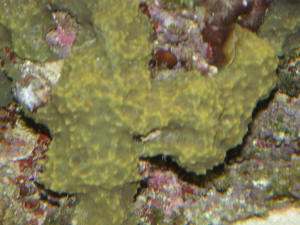
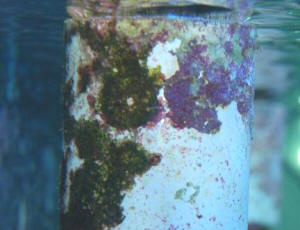
Clathrina, spg. contr. -01/29/2008 can anyone tell me what eats or what I can do to get rid of this Leather Latticework Sponge as it is becoming a problem in my reef tank, it has spread on to my Tubastrea and killed two heads, I have tried cleaning it of with a soft toothbrush which does the job to an extent but it soon returns, I cant move my Tubastrea as it is stuck fast with Aquascape. <Hmmm... any way you can lower the water level to expose the sponge to air for an hour or so? This might help. Also, you might try a change in water flow to the area (more or less, either might change the "balance of power" here).> Looking forward to hearing from you, Glen. <Good luck, Sara M.> Problem with recent outbreak of Syconoid and need help with my puffer, Please 1/10/08 Hi and thank you for being there! I spent Sunday afternoon reading your site as I have done many, many times over the past years but couldn't really find an answer... There is so much info for new folks but where do we with the established aquarium go? I need some serious help! <I do wish... that the world itself, or at least the tiny bit that is WWM could be/was more "intuitive"... have tried to think of ways to improve accessibility, arrangement... but the indices, Google search tool thus far are the best I/we have... Would you/others rather some sort of Boolean tool with exclusion/inclusionary possibilities with terms like "established, marine, aquarium"... bringing up whatever included such chronologically mostly I guess?> In brief: My aquarium is a 150 gallon FOWLR and is six+ years old. The inhabitants are my original 6 year old dog- face puffer, original 6 year Foxface ( I truly love this gentle fish), a 3 year old hippo tang and a 3 year old Picasso trigger. I have the original Euro-reef protein skimmer ( model ES8-2). A small sump that holds maybe 15 -18 gallons of water. I have bio balls , 1/2 removed several years ago. I use Boyd's Chemi-pure ( 1/4 the recommended amount and rinse it 2 x week , change it monthly. My puffer and Picasso trigger share ( well kinda share) one mussel every am and 2-3 dime size algae wafers in pm. My fox face and hippo eat formula 2 (about a quarters worth) 2 times a day. Everyone is always starving! My ph hovers around 8.0 sometimes 7.8 ( my puffer always looks stressed when ph drops to 7.8 so I do my best to keep at least 8.0. My nitrates are sky high at about 80. They have been for years , I've tried nitrate sponges , more live rock, less food , more water changes etc over the years and finally decided after a month of daily water changes and readings still in 40's that if I were to cont' with this huge investment and love, I would just have to accept the readings and possible illnesses/ deaths that might result.( My sump is too small to add light and plants as EuroReef takes up all available room.) <Well stated, and done> About 2 years ago when my puffer was 4 , I really realized this was going to be one big fish! I was dealing with huge amounts of puffer detritus. (puffer poop). I mean he left gooey puddles in his favorite corner . Also his space for swimming (which he loved to do) was limited. I know this is incorrect but I removed about 1/3 of the sand bed on the side where he sleeps and always poops.( leaving bare glass). I took out lots of the live rock ( like 50%) so he could happily swim side to side and up and down. I left the middle third of the aquarium with about 1/2 inch of sand, and large pile of live rock, the last 1/3 with 2 inches of sandbed because he loves to blow through and root for food and sea creatures. The ph held at 8.0 with 5 gallon water changes every other day. I chose 5 gallons because I can do them in about 10 minutes without turning off the pump system ( other than the skimmer). I buy my salt water from a LFS several miles away as my townhouse doesn't allow for R/O, water wastage etc. Any way, 2 questions. My puffer has always swam with a blue neon goby. They live about 2 years , clean his surface skin frequently. I have read that puffers have sensitive skin and you should not let cleaner fish do this to them , but I have to tell you, it has always been amazing to watch. My last one even went completely inside Puffers gill. Puffer" taught " him to be gentle. It has been an amazing thing for me to watch. My neon died 6 months ago. I found him lying in sand. No one tried to eat him, and I was amazed by that. Anyway, I have no longer been able to buy these gobies. Do you know why they are no longer available? ( I live near San Francisco). I even tried Marine Depot. <Are a bit of a seasonal item (Gobiosoma, Elacatinus spp.)... the captive-produced ones had some real trouble with supply... with the largest producers basically getting blown off the planet by the hurricane series a few years back...> My puffers health seems to be declining. Quarter size pieces of his film float off occasionally. Each piece will have one little salt grain size of ich on it. Can you suggest a cleaner fish that will not be too aggressive for my puffer? <Really only the little gobies... but I do have another suggestion. See below> I am not really afraid of anyone eating small fish, there seems to be fish Language spoke in this aquarium, I swear! <Yes... this "arrangement" has been remarked on many times in the literature... Purposeful cleaners... even from disparate geographies... being "recognized" by otherwise predatory fishes... calming them, doing them a great deal of good... Sort of like Androcles and the Lion (man, I am dating myself)> My other concern , I started adding Kent's Zoecon to their food about 3 months ago. I admit I was not careful and let 3-4 drops fall on food frequently instead of the recommended 1drop. <Mmm, no worries> After several months I seem to have a proliferation of Sponges all over my live rock. I have seen my puffer and trigger try to eat the ones they can access but they are everywhere. I even see them growing in the water intake lines. I am afraid they will get massive and clog my system.( Actually they already are huge ) I read on your site my high organics , mussel juices, etc are causing this plaque.( a little Omega 3 and they were off!) <Ahh!> I also have never seen such large bristle worms till I started this lipid. (have always been very small - like 1/10th of any inch. The other day I had 2 an inch long! I have tried to clean puffers poop but it won't vacuum and sticks to net. Ugh.. <I have the same suggestion...> I have stopped Zoecon, Are there nitrate sponges that work? <Mmm, not worthwhile IMO... better to employ other means... Please read here re options: http://wetwebmedia.com/marine/maintenance/index.htm scroll down to the yellow line/tray> Why can't I find Neons? <Keep looking... should be around... Maybe the Marine Center (.com), Dr.s Foster and Smith (.com)> How can I eradicate sponges in the drain system? <Depriving them of food is best> I understand you may not want to answer this as it is so long <Heeeee! No my friend... not a factor> but any help would truly be appreciated. I feel I have always taken care of my pals and until recently they have flourished. My personal goal is to get my puffer to 10 years. Thanks again Leslie <A worthy goal. To reduce waste presence, boost your puffers health in toto, I strongly suggest your going to using Spectrum pelleted food... this will indeed "do it"... Please read here: http://wetwebmedia.com/foodsppt1.htm For a ppt presentation of the main ideas here. Cheers, Bob Fenner> Yellow Sponge Question? - 5/4/07 Hello, <Hi there! Mich here.> How are ya? <I'm mighty fine, yourself?> I discovered a bright canary yellow sponge growing across 2 large pieces of liverock in my 125 gallon reef. I was wondering if I should add anything to my reef to keep it happy and healthy? <Sounds like it already is happy and healthy, don't think I'd change a thing.> I also noticed a purple sponge that looks like vines and are almost translucent. I noticed it growing under a large piece of liverock and it is attaching itself to the skeleton of my Torch coral. Should I be concerned about this? <Mmm, no, not overly, though if it is easily done, you may want to shift the Torch away from the sponge.> Can you tell me what these might be? <Mmm, what species of sponge? Mmm, no, sorry, there are over 5000 species of sponges. Microscopy work is often needed to identify sponges.> As always thank you in advance... <Welcome! Mich> Sponge Dilemma - 04/23/07 Hello Crew! <<Hiya Debbie!>> I have searched your site, but I am not finding a lot of information on sponges. <<Really? There is actually quite a bit of info re sponges...did you look here (http://www.wetwebmedia.com/sponges.htm) and among the links in blue at the top of the pages? I have a blue Haliclona that is attached to a piece of hard coral (that came with it). <<Ah yes, a very nice and attractive "photosynthetic" sponge>> I have had it for a couple of months and it has actually grown a bit. <<Neat>> Now, for the question(s)... I came home tonight and to my dismay, found my powerhead spewing out tons of air bubbles into my tank. I fixed the powerhead problem and then tried to vacuum, with a small siphon, the air bubbles that were stuck to the side of the sponge. A small piece of one of the fingers (about 1 cm) broke off. Before I could get it, it wound up somewhere under the rocks where I can't find it. <<Shouldn't be a problem>> Will this small piece become toxic to my tank? <<I doubt it>> Will the remaining sponge be damaged by all of the air bubbles that were attached to it? <<Not as long as the bubbles did not enter the sponge's vascular system...only time will tell>> I have an 80 gallon reef tank with a protein skimmer. It also has some Chemi-Pure in it that is a couple of months (3) old. I have four fish: Copperband Butterfly, Atlantic Tang, Coral Beauty and a Fridmani, along with some crabs and snails. <<The tang needs a larger system>> I am not sure whether I need to tear apart the tank to find the piece or not and what I can do to save the rest of the sponge. <<I would not tear the tank apart looking for the fragment of sponge...is of little/no concern. As for the remainder of the colony, just keep providing intense lighting and strong water flow>> Thanks for your help. Debbie <<Happy to assist. EricR>> Clam Sponge? 4/17/04 I just got a Crocea Clam (my first) yesterday. With so many beautiful specimens at the store, I found it hard to pick one that I liked. Finally, I settled on one, mostly because of its beautiful orange parts of it's shell. It has bright orange sections with holes in the orange. After rereading the NMA reef book section on clams on WWM, I saw a part that talked about boring sponges. I never really heard about these while doing my research on clams. I think it may be a boring sponge on my clam and it covers quit a bit of the shell. I read that if left alone, it can kill the clam. My question is am I able to get rid of the sponge and how dangerous is it? <Mmm, well, first off... this may not be a sponge (many other organism groups, possibilities), but... could be. If really concerned, a thorough, and I mean a bunch of scrubbing, of the shell can be done... in a pan of water that you'll need to keep changing, outside the tank... with an old toothbrush...>> Is it contagious? <Mmm, as in can/could it spread? Yes> I can send a picture later today if you need one. My tank is a 75 gallon reef tank and everything is in parameters. Thanks. <Okay. Bob Fenner> Re: Red Fromia star has hole in its head! Help! 4/4/07 Mich, Thanks for the reply. <Welcome!> The star ended up dying. <I'm sorry for your loss.> I believe it to either be an acclimation issue OR the teddy bear crab. <Either are possibilities.> I went back to the shop where I had acquired the star and there was a star from the same batch that disintegrated also. <Unfortunately this is not terribly surprising.> But, to my horror, I caught the teddy bear crab eating my sand-sifting star the next day! It ate a whole arm before I knew what was happening. <Yikes! I would not recommend the sand-sifting star (Astropecten spp.). These stars decimate your sand bed removing beneficial organisms and typically starve after a few months in captivity.> Needless to say I have removed the teddy bear crab from the tank. <Mmm, hopefully to a suitable home and not an untimely demise.> I had searched online about the teddy bear and various sites said it was reef safe and a detritus eater so I thought it was safe, thanks for the info that says otherwise....wish I would have known. <Not every source hold equal value.> Hopefully the star will live and regenerate a new arm. <It may.> Unfortunately, none of my corals are happy since adding the sponges. The tank at the store that one of the sponges was in was being cleaned when I bought it (water was really cloudy). I'm starting to think that I introduced a lot of toxins since I had to introduce that water into my tank. <Yikes!> I am going to do a few water changes daily for the next few days to get any toxins out. <Do watch this carefully. Dying sponges can really do a lot of damage.> Green mushroom won't open up, gorgonian won't come out and my torch is losing tentacles! <Ho buoy! Not good!> I'm about to do a water change right now. <Good!> I changed it yesterday and the gorgonian came out for a while. <You may need to do several large changes here!> Wish me luck! <Good luck my friend!> Thanks again for the info, <You are most welcome! -Mich> Luis Red Phorbas sponge 7/7/06 Have you ever heard of a red Phorbas sponge encrusting a red fire coral? <Yes, have seen this> I was snorkeling in Bermuda recently and as a novice didn't know not to touch, <Yeeowch> so I picked up what looked to me like a sponge, it was red, sort of cone shaped but with holes in the top that made it look like a sponge. I carried it around for a few minutes while snorkeling and showed my son. He also picked one up. When we got out of the water our hands began to burn. The locals told us it was red fire coral. Our hands burned and itched for 24-48 hours but then resolved. My reaction has come back and my hands all swelled up. I am now on prednisone. I told the doctors that I picked up red fire coral. In researching this on your site the red fire corals seem to be fan shaped. <Mmm, commonly, but come in all shapes> In looking at pictures of sponges I came across the red Phorbas sponge and that looks like what I picked up. It says that they encrust dead or live corals. Or do you know if this is one of the "fire" sponges. And where I might find more info about fire sponges? I am still searching. Thanks for any help you can provide Typing with sore fingers, Katie McDonald <I'll bet, and unfortunately I'm fresh out of time as well. Please read through this search listing: http://www.google.com/search?q=are+phorbas+sponges+toxic%3f Bob Fenner, off to finish cooking dinner for 500> Little Sponges in the Dark 12/2/05 Thanks in advance. <You are welcome in advance…hehe.> I had a few nice sponges on my LR. Left them alone because of all the benefits they are proclaimed to possess. I run a JBJ 12dx nc and went to do my monthly maintenance on the pump when I discovered to my dismay/surprise/shock that there are about a hundred of these things attached to the 3rd chamber walls. <Quite normal in the dark of a moderate flow area where the nutrients pass through.> All are the same white color and narrow down at the end w/ small nubs around the "mouth". Question is leave 'em be? <I would, though an overabundance of them may indicate a nutrient problem.> they are not in the display area so.... <Yes that's expected, see above. Adam J.> Sponge questions 8/16/05 Dear Bob [or his stunt
double]: <Brad Pitt isn't available, so you're stuck with
me> In my 75 gallon tank, I have two tree sponges, attached to a
single piece of substrate. I have had them in place for about five
months. They are 15" and 12" tall, and have appeared to be
doing well up until recently. When they first arrived, I was initially
fearful that they might have been exposed to air in shipping, <Mmm,
would be long-since dead if so> in as much as the bag had what
seemed to be less than enough water. I thought that this would kill
them rather rapidly, but they appeared to persevere. Within the last
days, however, the tips of both have turned a pale white. I am thinking
that this is an early sign of an imminent demise. [If it could be
something else, please advise.] <Is not a good sign... something not
agreeing... likely environmental... water quality largest category to
check> For what it's worth, they occupy a 'canyon'
between two principal mounds of live rock. I also have a 5" high
blue Haliclona, which is thriving in the same location. [I have seen
noticeable, significant growth over six months, including the addition
of several new osculae.] A couple of rotating oscillators provide
non-laminar currents, while a couple of asymmetrically-placed power
heads assist. In addition, I have a spray bar across the back of the
tank on the bottom, which provides additional flow through the
'canyon'. <Interesting> I direct-feed DT's
phytoplankton every other day to my scallops, a couple of gorgonians,
and feather dusters, and in the process I shut off most of the flow
devices, leaving only enough current to move the plankton past the
sponges. I also toss in a couple of millilitres of oyster eggs a couple
of times a week. [My ammonia is zero, as are nitrites. Nitrates
occasionally get up to the 20 to 40 ppm range. <I'd keep these
below twenty ppm... perhaps a DSB, refugium...> I do 15% water
changes weekly, and am pretty religious about monthly media changes in
my canister filter.] The cast of characters in the tank has been stable
for the last three months, with no surprises. <Ah, good> If my
suspicion is correct, and the ends of the sponges are dying, does this
mean doom for the entire organism, or can I cut away the white parts
and hope for the best? <Better for now to check your alkalinity, pH,
reduce the NO3 concentration... and see if this "does it">
Also, I have read of dying/dead sponges dumping toxins into a tank with
dire consequences, but only in general, anecdotal terms. Do I need to
be concerned about this with Ptilocaulis, or will the demise, if it
happens, simply be a nitrate-spiking event? <Mmm, very likely you
will see indications of any such pending crash, and have plenty of time
to react> Separately, I have a thorny oyster which has become
encrusted by what appears to be a chicken liver sponge. The sponge has
grown over the boundary between the two shell halves, but I still see a
siphon peeking out. Do I need to be concerned that the sponge will keep
the oyster from opening, in effect suffocating or starving it? I would
gladly do away with the encrustation to save the oyster. <I am
concerned period re this sponge... it may well be the cause of all your
troubles here... I would (gingerly) remove the oyster, and brush (with
an old toothbrush, or your roommates...) all of this sponge away...
rinse thoroughly and replace the bivalve> As always, thanks for your
patient guidance. Rick Walters <Thank you for sharing. Bob
Fenner> Spreading sponge 7/31/05 Hi Crew, <Hello there> I have a beautiful warm blue Indo Pacific sponge in my tank which is spreading in all directions. I had it placed in a clear area so that it wouldn't easily attach itself to any of my live rock. However, it is managing to breach all gaps and is extending itself so far that it has already attached to a rock several inches away. It seems to be trying to attach onto some mushrooms as well. When I bought it the sponge was growing on a dead stony coral skeleton which it has now completely covered. Should I try cut it back as it extends or risk letting it take hold on some of the rock? Many thanks for your help. Sharon <I would try to keep this sponge controlled by cutting... a bit at a time... like one corner... Bob Fenner> Re: ID troublesome encrusting algae, sponge predators Can you give me any ideas on predators of sponges? <The probable list is very long... can try various "reef safe" Hermits for your first round... Bob Fenner> Sponge control Forgive my tenacity, but allow me one more follow-up question. I've already got reef-safe hermits. Haven't seen them touch it. What's #2 and #3 on the list? Thanks, John <Mmm, perhaps reading here: http://www.wetwebmedia.com/marinvind1.htm at the bottom... Bob Fenner> Classic Knee-Jerk Reaction, Possible soft coral poisoning Hi again, sorry to bother you wonderful people with another one of my classic but asinine mistakes, but I like sponges (here's where you say OH NOOOO!!!!) <Oh oh> Anyway, I obtained a hard blue sponge that I believed was in good health, difficult to tell at the LFS, but no obvious white patches, open vents, and no algae. They did have it under pc's which I questioned them about, and they said it was fine - HAHA! Anyway, I QT'd him (blue is always a boy) for a month, almost 5 weeks in a little set-up I keep running just for that. I have a skimmer on it, but it's only 20 gallons - only some drop- offs in the tank, buttons, mushrooms. Anyway, 2 days ago I transferred him - he only had about 150 watts of pc's on him in QT, but I fed heavy with DTs... <This algae mix may be of use here or not> ...looked him over I thought really well - nice color, firm - so I acclimated to the display by starting the overflow on the qt, that evening. The display has 2x 400 watt 20k halides, 2x 140 watt VHOs at 10k, 2x 65 watt 50/50's, 2x 65 watt actinics. The fuge has a lot less light, 1 HQI pendant and 2x 65 watt pc actinics. I didn't think the display had too much light, I just put the sponge at the bottom. The next morning, my colt coral, my baby, I've been growing her for 3 years from a little pimple of skin on a rock - she was spectacular, almost a foot across and at least 8 inches tall - she don't look so hot now. I immediately thought sponge toxins, only too late - my toadstool shriveled, but recovered quickly when I put the sponge back in qt. My colt did not - she's never looked so horrible, deflated. There are some open polyps, and she doesn't stink, so I put her in a 70 gallon FO tank right now - the QT now has the sponge in it, did 2x 20 gallon water changes yesterday and 1 30 gallon today, turned the skimmer way up and added about 4 dry quarts of carbon. <Wowzah... this is a bunch> I definitely do not have enough light in my FO tank for the colt, but I figure it's better to get her away, completely, from whatever made that happen. <Agreed> What other species of Octocorals are susceptible to this toxin? <Most all> The fish seem fine, and all LPS and SPS corals are fine as well (I know you're not supposed to mix them, but I only have 2 soft corals, and the water volume is quite large, about 250 gallons, perhaps I should move them anyway). I've not noticed any reaction among colonial polyps either, if everything looks healthy I should leave it alone right? I've read several books that had information pertaining to sponges, particularly the hard blue ones, killing softies - I think Mr. Fenner has made mention of it several times as well, and I'm so sorry this happened, when I knew perfectly well that it could! Anyway, I could kick myself, I know better! Anything I can do for my colt? <You've... actually done it... all I would do... I'd wait a few weeks, move it back to the approximate position it was in> Are they somewhat hardy in this respect? I could frag the colony, I know there are parts that I can save, but I don't want to stress it further- with the low light in the FO tank, you think it will be ok for a few days, long enough to eliminate the toxins, or is keeping it in lower light stressing it further? How do I know if it's too far south to save? If it is, should I cut any pieces from it, or should I keep up the water changes and put it back in the display with more light and risk it getting worse? Thanks again, and sorry. Thanks, Aaron <Do wait a couple more weeks before re-moving this soft coral. Likely it will rally. Bob Fenner> Green " Sponge" growing on my Zoanthid Hi, <Hello there> I have some type of green sponge or algae growing taller and taller on my Zoanthid, should it be removed? <Maybe... can you cut a bit off... take a close look to see what/which it is?> If so, how would I remove it without killing my Zoanthid? <Best by working at the conditions that favor this material over your mat polyp: Please read here re Algae Control: http://www.wetwebmedia.com/marine/maintenance/index.htm > I have read the following paragraph but I'm not too sure how to removed it and how to know if this is the type that should be removed. Thanks for any help. Annie-Martine from Toronto Canada Symbioses: Many Zoanthids live in close association, either commensal or mutualistic with other species, particularly sponges and algae; and they "get along" with most other kinds of sessile marine life as well; neither quickly overgrowing them or being supplanted by true corals, other Zoanthids, Corallimorpharians or even some anemones. Regardless of their innocuous nature, Zoanthids should be purchased without their symbionts. Die offs from specimens purchased with sponges and algae are way too common. To repeat; the exception to the rule of Zoanthid hardiness is the ones that come attached to commensal sponges and algae. Many of these perish easily. <Do take care if you're going to try cutting the pest material away... the Zoanthid itself is quite toxic to humans... wear gloves, and wash these thoroughly afterwards. Bob Fenner> Strange Encrusting/Smothering sponge 7/25/04 The sponge in the attached photo has slowly been covering this zoo frag, and seems to be smothering it. I have asked on a forum but no one had seen anything like it. Any identification info or what I should do about it would be appreciated. thanks, Rusty <no pic or attachment came through my friend... but we can still chat about it. Sponges are commonly associated with Zoanthids. Some are harmless or beneficial, some are parasitic and others are indeed simply another reef invert in competition for space. I'd suggest that you do remove (screwdriver or sharp chisel will be fine) some of the polyps from the sponge (use latex gloves to protect yourself from palytoxin). Clean the polyps off with a toothbrush (no worries) and pat the Zoanthids dry before super gluing them to a rock (see more info in my "Book of Coral Propagation" and elsewhere on the Internet). We also describe and illustrate some of these species in our "Reef Invertebrates" book. Anthony Calfo> Dried Sponges For Food? Hello there, <Hey there! Scott F. with you today> I am the proud owner of a Majestic angel who is doing very well as the sole inhabitant of a 120 gallon tank. Unfortunately in the UK few people have heard of Angel Formula type foods based on sponges and as far as I know there is no retailer stocking any. I spoke to the main wholesaler in the country and they told me that there are restrictions re the import of such foods, therefore I can't have it imported, particularly in its frozen form. I want to try and give my angel some sponges and I read somewhere that I can get dried sponges/tunicates from an oriental food store. Questions: Is it worth my trying? Are dried sponges good enough? Do they make an adequate substitute? <Honestly, I don't think that it is necessary or worth the effort to secure dried sponges for this fish. Number one, I'm not sure what types of sponges they would be, and, number two- I'm questioning what, if any, nutritional value dried sponges would have. Also, P. navarchus does not eat a great deal of sponge material in nature, when compared to say, the Rock Beauty or Regal Angel, so it should be very easy to get this fish to eat other prepared foods. Hikari makes an excellent "Angel" food, which seems to be more "tubeworm based" (although it does include sponge in the ingredient list), and is a great food that may also be available in the UK. Also, Gamma frozen mysis is one of the best foods you can feed to angels, IMO, and is eagerly accepted> Do they (the sponges) have a special name, in other words can I be sure that they have not been treated for human consumption? <Honestly cannot say- which is yet another reason to pass on these items, IMO> Thanks for your help, Massimo, Brighton UK <And thank you for stopping by, Massimo! Enjoy your wonderful Majestic Angel! Regards, Scott F> Look Out, Sponge Bob! Could I buy live sponge and cut it up and freeze it then thaw little pieces for feeding for my Regal Angel? <Yikes! I sure wouldn't! First, it would be a shame to slice up a living sponge that basically went through hell just to get to the LFS! Second, some sponges may be toxic, so you'd have a hard time knowing which one to chose. Finally, I think it would just be cost-prohibitive. Much better idea to purchase a supply of a frozen food containing sponge, like Ocean Nutrition's "Angel Formula". It's readily available at most aquarium shops, or can be ordered on line from some of our WWM advertisers> I was thinking of taking the little pieces and placing them in a veggie clip mounted on the side of the tank. Do you think he would feed off it? Would I gain success? Please respond back soon. <Well, I really think that your fish would be better served (no pun intended!) with one of the prepared frozen foods, as mentioned above...You certainly could place it in a clip, but it may be easier just to chop up the cube of food and feed it carefully with a toothpick...> P.S. I am the guy with the Philippine Regal which is already starting to feed on frozen food. Sincerely, Chris Faiola <Ahh, yes- I remember! If this guy is eating frozen food already- then you're almost home free...Definitely, try the "Angel Formula"-I think it's a great food! Bon Appétit! Regards, Scott F> Sponge Muncher? Hello, <Hi there! Scott F. with you today!> I have a quick question about my flame angel. I am interested in buying a piece of live rock with some blue sponge on it (I believe that it is encrusting sponge). Would my flame angel eat it? I have included a picture. Thanks so much. Sincerely, Andrew Powell <Well Andrew, it's a really tough call. Just like with corals- the fish may show no interest at all in the sponge, or it may decide to snack on it continuously...Centropyge angels are not heavy sponge eaters, like Pomacanthus and other "full-sized" angels are. They do nibble on some sponge materials, but you're more likely to see them nibble on algae and detritus. You'll just have to make the decision and go for it! Try a small piece of rock first to see if the fish shows any interest in the sponge...It's probably the best way to find out, unfortunately! Good luck with this combination! My personal, gut level feeling? I'll bet that it will work out (but don't hate me if it doesn't!) Regards, Scott F> Sponges vs. Shrooms? WWM Dudes (-bob), <Steven pro
this evening.> After reading the pages here, Tullock's book,
CMA, sections of Anthony's book (my newest acquisition, so the
least read of the 3 -- much info there) I still have some questions re:
sponges and soft corals. I am thinking of adding some of these way cool
creatures to my 55g FOWLR (at least at present... ) I have CSL PC
lighting (2x65 10000K mix of full spectrum daylight and actinic)
lighting. Having some trouble finding out much about sponges -- notice
in both CMA and the sponge section here that Bob mentions that sponges
can engage in allelopathy (sp?) as seriously as corals, but no
additional details. What can I mix given my current lighting without
WWIII breaking out? <Very little is known about most sponges. The
one of the most popular ones that people actually buy (verses
hitchhikers on liverock) is the blue sponge, Haliclona. This
unfortunately would not last with your current lighting.> Can I mix
mushrooms and sponges? <Possibly/probably> How about the leathers
(I know I have lighting too weak for some of these, but again, cool
animals)? <Again, probably but no guarantees as too little is
known.> Is there a book out that gives more detail on caring for
these interesting animals? <Steve Tyree wrote a book on sponges. You
can also get a small amount of information in Sprung's Invert guide
book.> Have searched the sponsors pages, Amazon, etc and am not
finding much... I was also reading w interest (and cutting and pasting
into my own running WWM FAQ doc) Anthony's comments yesterday re
the guy who was initially mixing LPS and SPS. What caught me was the
clam discussion, and his comment that some would be appropriate in his
current lighting as long as they were in the top 1/3 of the tank. I
would love to add a clam after caring for sponges/'Shrooms for some
months. Again, am I trying to throw too much in the mix? <Possibly
with the mushroom and the clams being the biggest problem.> Do I
have enough light for one of the lower intensity demanding clams?
<No> Thanks as always for the straightforward comments/advice.
Rebecca <You are welcome. -Steven Pro> |
|

|
Features: |
|
| Featured Sponsors: |
.jpg)
.jpg)
.jpg)
 crop
crop