|
FAQs about Stony Coral, Cnidarian
Identification 5
Related FAQs: Stony Coral ID 1, Stony Coral ID 2, Stony Coral ID
3, Stony
Coral ID 4, Stony Coral ID 6,
Stony Coral ID 7, Stony Coral ID 8, Stony Coral ID 9, Stony Coral ID 10, Stony Coral ID 12, Stony Coral ID 13, Stony Coral ID 14, Stony Coral ID 15, & Cnidarian
Identification, Stony FAQs 1, Stony
FAQs 2, Foods/Feeding/Nutrition, Disease/Health, Propagation, Coral Compatibility, Stony Coral Behavior,
Related Articles: Stony
Corals,
|
|
|
Identification of lps/sps unknown to LFS owner
3/12/10
Hello,
<Hello Travis>
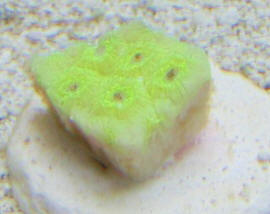
I am looking to identify this bright lime green type of coral,
and after a few hours of fruitless research I thought I'd ask
the capable WWM crew.
<Ok>
LFS owner received a 3-4 inch diameter parent colony, from this
he placed 1/4 in a display tank and sliced the remainder into
frags to be sold,
<I would not have done this with this particular coral>
but the genus and species are unknown to owner and employees.
<Species unknown, yes, but I do think this is a Faviid,
possibly a Favia. See each corallite has it's own, not a
shared wall? This is a clue. Try here:
http://www.wetwebmedia.com/faviidae2.htm>.
I have attached three pictures of this coral: two from outside
the aquarium, and one taken from above with an underwater camera.
Note: these pictures were taken shortly after acclimation and the
coral appears slightly more withdrawn than it did in my LFS.
<This coral appears bleached -- hence the unusual colour, and
why I would not have fragged it -- puts unnecessary stress on an
already stressed coral>
Information to help the identification: total colony is
approximately 1/4 inch across with a 1/4 inch tall stony
skeleton, each polyp is slightly larger than 1/16 inch wide;
<Very small>
it appears to have miniscule feeding tentacles(about 20/polyp,
not seen in pictures) that are out during the day (exposed 10
minutes after placed in tank), these tentacles also have tiny
white spherical nematocyst looking tips.
<Excellent observations, first class>
The colony looks like mini-Favia,
<Yes! The nail hitteth the head!>
if there is such a thing, except that each polyp is nearly a
perfect circle. Coloration is highly fluorescent monochromatic
lime green(picture makes it appear more yellow).
<Bleached>
Cool pic note: in pictures 1 and 2 you can see some zooxanthellae
goo that appeared seconds after turning the lights on for the
pictures.
<You mean the brown spots?>
The colony currently looks more like picture 3, just add some
tiny tentacles.
Thank you for the many answers over the last few months,
<And thank you as well!>
Travis
<Simon>
|
 |
|
Coral Identification? -- 02/12/10
Hi Crew!
>Big J<
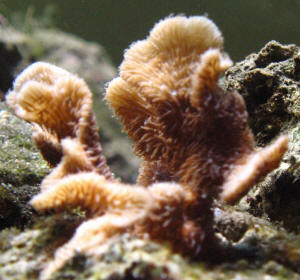
Any thoughts on what I might have in the attached photo?
<Mmm, maybe a Hydnophora. Read here:
http://wetwebmedia.com/merulinidae.htm>
It seems to me
like some sort of SPS based on how it has grown in the past 4
months that I've had it. What is interesting about it though
is that where I'm used to the star shaped polyps of many of
my other SPS, this has more like "worms" for what I
assume are its polyps. Reminds me somewhat of photos of
Millepora. Occasionally (usually at night) translucent tubes come
out of it in a few spots and extend to a length of perhaps 2
inches or more. Usually only a few of these, whereas the coral is
covered in the shorter wormlike and colored "polyps" as
seen in the photo.
Also, any new or interesting thoughts on getting rid of hair
algae?
<Just what's posted/archived on WWM. Need to know at least
the Division...>
I have a few "fields" of it in between some SPS and
higher in the tank where my Tomini Tang, Foxface Rabbitfish,
Pacific Blue Tang, and Flame Angel can't seem to get to it. I
have a Sally Lightfoot, a few random snails, and a couple of
Emerald Crabs, but none of these seem to be taking to the fields
of hair algae. Nitrates, Nitrites, Ammonia and Phosphates are all
zero. Hardness is around 6/7. Calcium is up around 500.
<[Mg]?>
Temp is 77 and salinity is 1.024. I use RO water and have not
been overfeeding (from what I can tell). The hair algae I'm
most worried about is the very thick bush of it growing in the
middle of some SPS.
Thanks in advance,
Jon Hoover
<Keep reading. Bob Fenner>
|
 |
|
ID hitchhiker anemones -- 09/26/09
On Sunday (it is now Friday) we added 200 lbs of live rock to our
new system. The LR had been in a tank for 4 years and in a large
trash can with power heads for a month. We picked up RODI water
on the way home and
showed the rock to the LFS owner. He said the rock was in
excellent condition and the tank would have little or no cycle
time. All water readings have been 0 nitrates, 0 ammonia (both by
our kit and the store's).
While we were at the store we noticed some anemones on the rocks
at the top. The LFS owner looked at them and said he did not
think they were Aiptasia. He stuck his finger in one and was not
stung. My husband was
also not stung. There was another experienced hobbyist there and
he could not ID them as well. I emailed the original owner of the
LR and he was not very helpful. He said he had aiptasia in the
past, but they had been under
control. He did not tell me if there had been other kinds of
anemones in the tank.
We have done hours of searching, but can not find a picture or
description that matched these exactly.
- They don't appear to sting.
- They have a fairly wide base compared to height.
- The base is a brownish/yellow color.
- The tentacles are clear with small white stripes and spots.
- The tips have a very small white ball.
They seem to like the tank and appear to be growing larger. We
have not added any food to the tank yet since only what came on
the LR is in the tank (snail, brittle stars, other stars, sponge,
etc). We do not have the good lights on the tank yet. That will
happen this weekend.
We would like to know what these are before we kill them off and
then find out they were something someone else might have
wanted.
Thanks for your help,
Nicki
<These appear to have an underlying (calcareous) skeleton... I
suspect they are either single polyp Dendrophylliids or
Rhizangiids... Please see the Net and WWM re. Please see here:
http://wetwebmedia.com/dendroidfaqs.htm
Bob Fenner>
|
[1].JPG) |
Re: ID hitchhiker anemones --
09/26/09
Thanks so much. No one else had any idea what they were. On the
link page (for Bridget 11/2007) that is them! Except hers look
orange. Do they change color?
<Yes, can>
Ours our clear, except for the base. They have been in a dark
circulating tub for about a month before we got them. We are new to
the hobby so I hope we can keep them happy.
You are awesome!~
Nicki
<Mmm... Okay! Cheers, BobF> |
Australian Coral Identification 9/17/08
Good Afternoon! Great website, has helped me plenty to advance in the
excellent hobby of reefkeeping. Just a quick question this time. I am
starting to get into the Australian corals now in the market. I try my
best to avoid corals harvested illegally (I hear many are being
harvested off the coast of Japan) and I am trying to better educate
myself. How can you tell the difference between Lord Acans, Micromussas
and Blastomussa? <Mmm, most of these Mussids can be distinguished
from gross examination... do you have J.E.N. Veron's in-print works
on Scleractinians? These are the paramount guides for ID here.
Otherwise, free on-line work can be found by our own Sara Mavinkurve
(Asira.com) and Jake Adams (Coralidea.com)> I bought frags off a
local reefer and cannot identify them. Would pictures help? <Oh
yes> Are there any characteristics that can be used to identify
them? <... yes> From what I hear, Micromussas are just a smaller
version (8mm or less) of Lord Acans. Any help is greatly appreciated!
<Do see the ref.s above. Bob Fenner>
|
ID Assistance Needed for SPS Encrusting Coral Coral Id
challenge - Need more info 10/9/07 <Hi there> So... I
am on a mission. <I can relate to that!> I want to
determine what an otherwise unknown species of coral in my SPS
prop tank is. Unfortunately, I don't have much information to
go on, and the photos I have taken are just about as good. Sorry,
I need a macro lens. <Very helpful, indeed.> When I
originally acquired this species, the person who sold it to me
broke a chunk off of a rock. He was trying very hard to keep it
intact, with little luck. It pretty much shattered. He told me he
didn't know what it was, but he was told that it was
supposedly rare. <Okay> I have scoured the Eric Borneman
and Julian Sprung corals books. I have come up with nothing. Same
for the web. Well, not quite nothing, but pretty darn close.
Here's what I can tell you. This SPS coral is very much like
Montipora. <My first impression as well...second guess -
Porites.> So I am totally guessing it is some kind of
Acroporidae. <Unless it's Porites (Poritidae), etc.> Of
course, that doesn't mean much, and even if I am right,
we're talking about thousands of possible species. <Yes,
it's quite a daunting task. Distinguishing differences
between corals usually involves heavy duty magnification of the
skeleton/individual septa, not to mention some taxonomic
nightmares.> How is it similar? Well... it's an encrusting
coral with extruding polyps. The polyps are much denser and
smaller than any Montipora I have personal experience with.
<Have seen such before -- can vary greatly.> It grows the
same way as Montipora, but possibly quicker. <Given favorable
conditions, can grow very quickly.> It seems to layer itself.
What does this mean? I glued a small chunk to a frag disc. The
way it is growing now looks almost like the chunk melted.
<Typical encrusting growth pattern.> There is clear growth
on the disk, but it is very thin. As time goes by, it gets
thicker. <Yep> This may also be a result of the small polyp
size. <Mmmm> I also believe that the coral being so brittle
is also a result of small polyp size. If you imagine the coral
skeleton generated by this thing, the more polyps, the more
holes. The more holes, the more porous it is. The more porous,
the less structural integrity there is. <Yes, makes for
lightweight/porous structure.> I took five nickel-sized chunks
and glued them to a rock. The growth has really been good. The
pieces no longer look like they have jagged edges. They have
grown out so that the frags are all smooth on the rock and they
are quickly moving toward each other. <Good growth
rate/favorable conditions.> I really believe that within 30-60
days (sooner if I get my calcium reactor up and cooking) all the
pieces will have fused together. <Happy corals!> Okay, so
earlier I said I had found "pretty darn close" to
nothing in my research. Here's what I found...I found a coral
called "Leptoseris mycetoseroides":
http://www2.aims.gov.au/coralsearch/html/201-300/Species%20pages/228.htm
<Don't see the typical ridges/anatomy of this species in
your photos.> A lot of the descriptions, of course, are
meaningless because they are working on the macro, but I am
working with the micro. <The great thing about the Whelk/Aims
site is that it usually includes a skeletal photo - critical for
identification.> Unless I let this thing grow out for years, I
might never see some of the described growth patterns. <Or
they might differ from what's shown due to variable such as
current, light, etc.> This photo, however, seems to be have
some similarities to me:
http://www2.aims.gov.au/coralsearch/images/201-300/Large/228-05.jpg
<Note the way, though, that the corallites in the photo are
aimed out towards the perimeter.> Now, I did say this seems to
be an encrusting coral, and in this photo, it looks like the
coral is more of a plating variety. However, I have several
plating Montiporas that, when they run out of something to grow
on, they plate outward. Just a thought. <Montipora often show
a combination of growth forms. I have several colonies of M.
digitata that seem to grow/spread equally through branching, as
well as encrusting/covering the rockwork.> I also saw a coral
in the Borneman book.... Pavona clavus, on page 251. The guy I
got the coral from agreed that this has some striking
similarities. <Other than growth pattern, I'm not really
seeing it -- again, need more detailed photo. See this link for
comparison:
http://whelk.aims.gov.au/coralsearch/html/201-300/Species%20pages/290.htm
> OK, so let's talk about my crappy photos. <LOL
They're not that bad...they show basic growth form - just
need to see a lot more detail to refine search.> In
unknown-1sm.jpg you can see the rock with all the frags glued to
it. Not much good for anything but possibly the color and shape
of the coral. In unknown-2sm.jpg there are two things to look at
(you can see the larger colonies in the background) First, in the
foreground there is a rock with two additional frags glued to it.
You can see how the sides are all nice and rounded off now with
new growth. <Yes> You can also see a good example of what
these critters look like with full polyp extension. In the
background is a ceramic frag disc that I glued one little chunk
to. You can clearly see the "melted" look of this coral
as it grows out onto the disk. <Typical> Nothing
substantial, but growth regardless. <What I can see is
consistent with a Montipora spp, but trying to identify these
specimens by photo alone is a fairly insurmountable task. Here
are several interesting/helpful links for coral identification:
http://reefkeeping.com/issues/2002-04/eb/index.php,
http://home2.pacific.net.ph/~sweetyummy42/CoralGenus.html, and
http://www.advancedaquarist.com/2007/9/aafeature2#h4 Good luck!
-Lynn>
Re: ID Assistance Needed for SPS Encrusting Coral Re: Coral
Id challenge - 10/9/07 WWM (Lynn): <Hi there, JW - Lynn
here again.> Forwarded your response to my original source of
the frags, who responded: "Very interesting. One thing that
I can recall of the coral is that the polyp structure did not
resemble any Monti or Porites that I had ever seen. Monti and
Porites are distinctively round where as the polyps on the
mystery coral are more like tentacles than polyps.
<Interesting. In cases like this, every clue helps.> I
almost can predict what you will say, especially after reading
the Borneman article, but just wanted to see if this rang any
bells. <Like Quasimodo? <G> Well, what comes to mind are
the more tapered, or needle-like, polyps of Pavona. I think your
best bet at this point, however, is to ask Eric Borneman. He has
a forum over at Marine Depot and is a heck of a nice guy. By the
way, please let me know if/when you Id this coral!> JW
<LZ>
Re: Coral Id challenge, follow-up 10/9/07 Lynn, <Hi
JW!> I have emailed Eric Borneman, but not posted on the
forums. I will do so tomorrow. <Sounds great> Thank you for
all of your insights. <You're very welcome -- good luck!
-Lynn>
|
|
 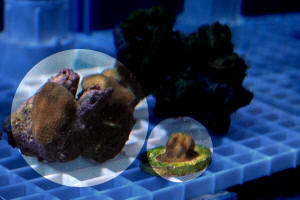
|
Coral Identification 8/10/07 Dear WWM crew:
<Hi Julie, Mich here.> Thank you for all the information your
website provides. <On behalf of Bob and the rest of the crew,
you're welcome!> I am new to saltwater, and have literally
learned almost everything I know from your site. <Much of how I
learned as well!> However, I do have an identification question
that I have been having some trouble with. My LFS sells their live
rock in a big tub with some stray corals mixed in at the bottom at
live rock prices. We picked up some of these corals last weekend
and to our amazement the corals still had some live polyps growing
on them. Please inform us of what types of corals these are so that
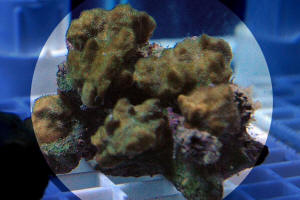
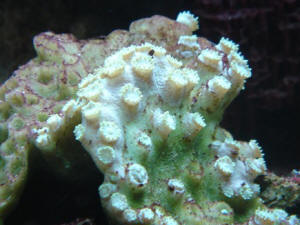
we can best care for them. <Coral1 looks to be a of the Family
Faviidae, genus Favia. Coral2 looks to be of the family
Dendrophylliidae, genus Turbinaria. These corals may be helped by
target feeding with finely chopped fresh/frozen foods like mysis
shrimp soaked in the vitamin supplement Selcon. Will take some
dedication to get these to possibly recover. If you're
seriously committed to rehabbing these corals you may want to
employ the method sent in by one our readers. Please see here:
http://www.wetwebmedia.com/dendroreprofaqs.htm The query titled for
feeding specifics.... Re: Feeding of Tubastrea.. Follow up to Baby
Tubastrea Timeline 8/7/07 and the ones directly above for some
results. Quite impressive!> Thanks again,
<Welcome! Julie |
|
|
Coral ID, Acroporids sans pix? 7/13/07 Hi Guys,
another question from a beginner. After much internet searching I am
unable to find my little coral frag. The LFS guy I purchased the frag
from didn't know anything about it. Any way it looks like acropora
except for its top polyp. Instead of a polyp there is stringy hair
algae type stuff growing out of it. I was tempted to pull it off but
thought better of it. After days of observation it seems that this hair
stuff is part of the feeding strategy of the animal. During the day it
gets filled with debris and micro bubbles and in the morning its clean
and floating. The coral itself is thickening, its flesh is encrusting
the plug its on so I know the algae stuff isn't harming it. The
corals top center seems hollow and the clump of algae is growing rather
long, it has grown now as long as the frag itself. Its funny looking.
Like a biker with long hair blowing in the wind. If this seems like a
unfamiliar coral to you I will send a pic. <Bob, definitely need a
pic. James (Salty Dog)> Thanks All Bob Carter
|
Id...Possibly Merulina ampliata -- 07/03/07 I can't
find the following in any of my books, any ideas? <Hi Brian, I
actually replied to this last night on your web site after
listening to Bob's pod cast, which was quite good by the way!
I tried to post this response but the site only allowed 300
characters. So I sent the second response.>
http://bp0.blogger.com/_Saa3csugMNM/RogAXQq9gGI/AAAAAAAAABk/mJwEj4Tqbzs/s1600-h/2007+Jul+02+004.JPG
<Greeting! Mich here from www.wetwebmedia.com> Anyone know
what type of coral this is? <Hard to tell from just one
picture. My best guess is Merulina ampliata> I checked all my
books and cannot identify it. <I am glad to read that you have
reference books! Good for you, and the creatures for which you
care!> I was a bad reefkeeper and bought it without being sure
what it was. <Not a good practice or the actions of a
conscientious aquarist. 40 lashes with a wet noodle for you!>
I highly recommend not doing this. <Me too!> Do your
research ahead of time. <Sage advise! Life to you! Michelle
Lemech> ===== Greeting! Mich here from www.wetwebmedia.com It
is difficult to tell from just one picture. My best guess is
coral may be Merulina ampliata. A little more info here:
http://www.wetwebmedia.com/merulinidae.htm Hope that helps.
Michelle Lemech
Id...Possibly Merulina ampliata 7/4/07 <Hi Brian,
Mich here.> Hmm...I looked at some pictures of the Merulina,
looks different. <Could be. Multiple growth forms are
possible, often within the same colony. Some pic's I thought
resembled yours:
http://www.aquarium-design.fr/Img/ImgTelecharge/Pt/1192.jpg
http://www.meerwasser-lexikon.de/images/1375.jpg
http://www.mailordercorals.com/displayPict.asp?cartID=1154
http://www.reefaholics.org/Sale/reefaholicsimages/images/PIC00088.JPG
http://www.atlantisaquarium.net/images/merilina.jpg.JPG The
corallites in this species tend to form ridges and valleys which
radiate from the center, which is why I though this genus was a
possibility.> I did stumble across Agaricia agaricites. Could
that be it? <Unlikely, Agaricia is an Atlantic species and
generally not available in the trade. Initially, I was think this
might be part of the Family Agaricidae, along the lines of a
Pachyseris, but the ridges and valleys tend to be more
concentric. It is difficult to identify a coral by one photo
alone, and for some corals it is outright impossible without
skeletal examination. So perhaps it is a Merulina, but it may be
something else too. Wish Mich>
|
|
|
| Rock Anemones and Breaking Rocks to Separate
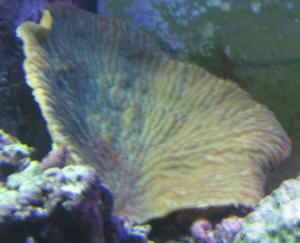
Corals 4/21/07 Hi Guys, <Hi Jim, Mich here.> Here are two
pictures that I would like your thoughts on. The first I believe is
a small group of rock anemones. <Looks like a pest to me.>
They are about 1/2 inches high. The aquarium is about 4 months old.
I have two small groups of these, which don't seem to be doing
much. Do you think that I should go out and get a couple of
peppermint shrimp and try to stem it now or is it possible that
they won't expand? <Depends.> I enjoy watching the micro
fauna but don't want to risk all. I think of them as a
weed-just a thing that is not growing where someone wants it but
otherwise interesting. <If it were me/mine I would remove from
the system. If you allow to remain in the system, I would watch
carefully, and be prepared to take action. More here: http://www.wetwebmedia.com/ca/cav1i3/aiptasia_impressions/aiptaisia_impressions.htm
http://www.wetwebmedia.com/marine/inverts/cnidaria/anthozoa/aiptasia/aiptasia.htm
> Anyway the second picture there are two colonies of different
creatures. Both colonies are expanding. <A good thing.> I
keep reading that they may beat on each other and kill one or both
colonies. <Is possible.> I wouldn't want that. <Me
neither.> These just came on the live rock and started to grow.
<Ooo! A nice gift from the sea.> I would have to break the
rock to keep them apart. Is this a viable solution or is there
another? <It looks like the rock could be easily removed from
your system. If this is so, I think I would remove and use a chisel
or better yet a Dremel, and remove and relocate one of these
corals. <As far as ID's go I think this is Galaxea
fascicularis, http://www.wetwebmedia.com/oculinidae.htm though
Turbinaria http://www.wetwebmedia.com/dendrophylliidae.htm or
Goniopora http://www.wetwebmedia.com/gonioporapix.htm could
be possibilities, it is difficult to tell from the photo.>
Thanks for your help as always. Lots of great reading!!
<Welcome! Glad you enjoy! -Mich> Jim |
|
|
|
|

