|
|
| Home | Marine Aquariums |
Freshwater Aquariums |
Planted Aquariums |
Brackish Systems |
Ponds,
lakes & fountains |
Turtles & Amphibians |
Aquatic Business |
Aquatic Science |
Ask the WWM Crew a Question |
| Please visit our Sponsors | ||||
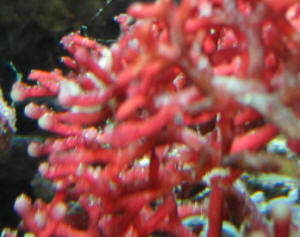
Stylaster Hello, I recently had a friend break down theIr tank and purchased his rock and a few corals he had. One was what he called Stylaster, looks like a sea fan shape and is a mustard color. He really did not know much about it and had not had it very long so I am hoping you can tell me what this corals needs are. << As with most corals I suggest phytoplankton and rotifers. >> He had it under a ledge were it did not get direct light but had good flow. << If it is indeed what you think it is, then the high water motion was important for feeding. This coral may not be as photosynthetically driven as other corals, so I would simply try to match the lighting of the tank it came from. >> Any reference to this would be appreciated. << Please check the Borneman or Sprung coral books and see if you can find the coral in there. >> << Adam Blundell >> Thanks Mike Winston Looking for information on Stylaster elegans for school project - 2/ 9/03 Hello, <Cheers> I was looking online for information on Stylaster elegans for a school project and came across your web site at http://www.wetwebmedia.com/sylasterina.htm. I was hoping you might be able to tell me something about this species' habitat, size, where in the world it's found and anything unique/especially interesting about its biology or behavior. I'd be very grateful for any help you could give! <There is more to be said about this coral than a simple e-mail can provide. Its distribution is enormous and it is found in both temperate and tropical waters. My advice would be to discover the history and biology of this delightful hydrocoral through the many sites and archives abroad. Begin by doing a keyword search using the generic name "Stylaster" on google or yahoo or any search engine that you might favor.> Thank you so much! Regards, Kristin in New York <best of luck! Anthony> Looking for information on Stylaster elegans for school project - 2/13/03 Anthony, thank you so much for your response, you are very kind to get back to me. I appreciate your suggestion and did find some info on Stylaster, but my concern is that I haven't found elegans in particular, and because this is info that will be exhibited to the public, I don't want to make a huge error if I say something that is true of Stylaster in general but not of elegans, <Ahhh... understood. Alas, we specialize in aquaristics and as such have little address or experience with this hydrocoral... it is rarely imported and does not yet fare well in captivity. Thus, the lack of product and popularity in the trade preclude common habitat or historical data from circulating. I regret that I cannot offer an support beyond references like Borneman's Aquarium Corals (p. 104-105). I would like to make a dive trip to Papua New Guinea to research it for you though <G>> e.g. found on http://www.cautiouscoral.com/salt/coral/hard/default.asp?SpeciesID=157 "This coral is generally restricted to caves, so keep it out of direct light." <Correct on this point for most Stylaster including elegans... but the citation on size is not consistent for all at 10 cm> Unfortunately I am no coral expert, so I would just assume this is true... but is it so for elegans? <Yes> Just wondering if you could tip me off whether most Stylaster are similar or whether elegans has something I should watch out for... <I believe that it is very typical of the genus> don't want to take up your time of course! I appreciate your help. Thanks so much, Kristin <No worries my friend... best of luck in your research. Anthony> |
|

|
Features: |
|
| Featured Sponsors: |