|
|
| Home | Marine Aquariums |
Freshwater Aquariums |
Planted Aquariums |
Brackish Systems |
Ponds,
lakes & fountains |
Turtles & Amphibians |
Aquatic Business |
Aquatic Science |
Ask the WWM Crew a Question |
| Please visit our Sponsors | ||||
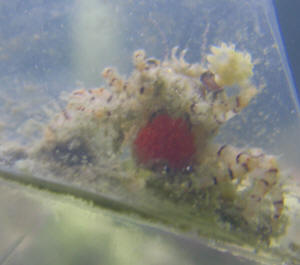
Pregnant Pom Pom Crab? Stocking errors in small SW volume 4/13/08 Hello, You guys (and girls) rock! I just bought a Pom Pom Crab. I have done a lot of research about them on the web and they looked like a great addition to my nano ten gallon tank, which is currently holding my fire/dart fish, a black Brittlestar, and a sexy anemone shrimp, with a few coral frags. He (or she?) is acclimating right now as I type. When I placed the bag into the tank I could see the little guy a lot better and I noticed a mass of red eggs on the stomach. They look just like the eggs of a glass shrimp, but they are red and a little smaller. I was wondering if indeed they are eggs and if so is there any possibility of me being able to hatch and raise these awesome little guys? <Mmm, yes> I know a lot of crabs go through a free floating "zooplankton"-like phase. <A few actually> Is it the same with the Pom Pom Crab? <A variation on the theme, yes> Also I was wondering about my fire dart fish. <Microdesmids need more room than this... Nemateleotris is a social species...> He used to be in my larger tank with a yellow tang, an ocellaris clown, and a starry dragonet. The ocellaris clown fish picked on him mercilessly over the past week to the point that I pulled him out into my nano tank. It was my belief that the ocellaris clown fish was more peaceful then others in the clown fish family. Is this not true? <Are territorial...> Im I not feeding enough or maybe not the right food (Formula 1 from ocean nutrition)? Thank you for all your help! Sincerely, Michael J. <Mmm, please see WWM re the care of the species you list... you've got some errors to correct. Bob Fenner> Emerald Crab Spawning Event 5/7/07 I happened to see one of my emerald crabs releasing a large number of tiny little white "things." I'm thinking they were eggs but I've never seen this before. All of the fish were gathered around and wildly eating them as the crab released them. Were these actually eggs? Is that normal for the crab to release them that way? <Yes sounds like a spawning event, a good natural food source for your aquariums denizens, enjoy.> TCP <Adam J.> Decorator crab with eggs 03/26/07 Hi, I recently read on your forum where a person had small free swimming crustaceans in his tank and he thought they were baby somethings and not copepods (Question of reef babies and Follow up on... were the titles). I was doing this research because my wife believes our own decorator crab to be pregnant. How do I know for sure she is pregnant? She is carrying a pouch inside her folded under tail area with very small red balls in it. <Sounds pregnant to me.> She seems to spend a lot of time 'nursing' them. Are there known breeding techniques for spider crabs. <Not for spider crabs. I'd try breeding them like any other crab. Have a look at http://www.aquahoito.info/sesarma/index.html (thanks to Neale). Different species, but probably similar care, although your crabs will need marine water all the time. > I'm sure that many will be eaten by the tank inhabitants. <They probably all will.> Is there any type of breeding system set up for such occurrences (such as the breeding nets in freshwater setups)? <No, larvae are too small. You need a small extra tank with an air driven sponge filter.> While I do not want a hundred baby spider crabs, seeing a few grow to adult hood would be fascinating. <Not more than a few will likely survive, if at all. Crab larvae are cannibalistic. If you are propagating crabs for the first time, chances for failure are high. I'd try it anyway, you'd learn a lot.> My wife is curious as to how the crab became pregnant as well, we have had her nearly a year and there have been no other decorator crabs coming over to visit. <Some crabs possibly can store sperm for a long time. Had similar experience with a fiddler crab, who was alone for 8 months.> Thanks for your time. I read your forums frequently. Jon. <Enjoy! Cheers, Marco.> Asian/Japanese crabs in tank 4/4/06 We have had 4 Asian/Japanese crabs (Hemigrapsus sanguineus) in our "natural habitat salt water tank": A tank filled with water and creatures collected from Long Island sound: Approx. 7 periwinkles, 3 young striped bass, <Yikes... get way big... quick> and of course the crabs, for the last 6 months. We have noticed eggs on the underbelly of the female crab for the past 2 weeks and her underside continues to swell. Have these crabs mated? <Likely so> Do they molt in captivity? <Yes> We have not seen any evidence of molting and it seems through our research that molting is related to mating in the wild. Will the crab release her "eggs" as larvae? <Yes... and have likely molted and consumed their old exoskeletons... natural> Will they survive? <Not likely... have longish pelagic planktonic stages...> Should we remove them from the tank or will the fish eat them? Thanks for any information you have. TC&D <Are likely being consumed, taken out by filtration, skimming. Need culture system, specialized foods... but can be done. Bob Fenner> Crab breeding Hello, I am a beginner marine aquarist. I've had my tank set up for about 4 months. It is lightly stocked with 2 percula clowns, 3 or 4 "pest anemones", serpent star, spiny urchin, 3 turbo snails, 2 xmas tree worms, some kind of red footed crab that I forget its name, 2 "regular old clams" from the beach, (told you I was a beginner), and probably 50 of some kind of hermit crab also from the beach, and a really cool mantis shrimp in my fuge that I also found on the beach between tides and rescued (found him right after I had been talking about how I wanted a mantis!). all the wild creatures were in quarantine for a month. I have a 75 gallon display and a 55 gallon refugium, skimmer, and too little LR, only about 25 lbs. Also, I started out with 3 emerald Mithrax crabs, of which 1 immediately died. I am certain of it's death. The question is: do these emerald crabs usually breed in captivity? Easily? b/c I was cleaning my tank just now, and I noticed that one of my emerald crabs was about half the size of what he was supposed to be. upon further inspection, I realized it was a 3rd crab, hence the size difference! I never noticed any larvae, but I haven't really been paying a whole lot of attention the past few weeks. Is it possible for the 2 crabs to have bred and the larvae hatched and grow to dime size w/o being eaten, or facing some other peril? Did I just get lucky, or do you think it was a hitchhiker? It just seems like a big coincidence that I would have a emerald hitchhiker. besides, I haven't had any additions to my in months except the "wild" clams and hermit crabs. how do they breed? <<James, how do they breed?>> do they protect the larvae or does it just float around in the tank? <<James?>> how would it have eaten? <<James?>> were the nutrients floating around in my tank the right size and type for the larvae to survive? seems pretty cool whatever happened! <I am sure it was a hitchhiker Brandon. The crab probably wedged himself into one of your rocks then showed up later. First off, if it did breed you wouldn't have the proper food in the tank to rear crabs as the young are planktonic and require plankton to survive. James (Salty Dog)> Thanks for your time, B. Robinson Raising Pom Pom crabs Hello, I would first like to thank you for compiling all of the information you have collected, it has been extremely helpful. < Big thanks to Bob on this one. > I have been in this hobby for ~ 3 years, saltwater (reef) for 2. I have two tanks a 58 gal. lionfish tank, and a 55 gal. reef, mostly soft corals (xenia, Shrooms, zoos, etc). My saltwater sweet tooth is unusual inverts. I have kept 3 Pom Pom crabs (Lybia tesselata, I believe) for some time. About every 3 months I will see one of them w/ a large pile of red eggs on her underside (similar to the picture on your site, http://www.wetwebmedia.com/swcrabreproduction.htm). I have wanted to try and attempt to raise them but could never catch her before she released her eggs. Yesterday I was at my LFS, and they had two Pom Pom crabs for sale which were carrying eggs. I couldn't resist and purchased them both ($10 a piece, unusually good price). I set them up in a 10g tank, w/ no substrate, a sponge filter, and some live rock. Tonight I noticed that there were free floating/swimming 'dots'. I captured a couple and took a look at them under a microscope. AMAZING. What I saw resembled the Zoeae stage. There is a good picture listed here, http://www.blue-crab.org/lifecycle1.htm, taken of a blue crab. The Pom Pom zoeae were similar except with a larger 'tassel' and had redder coloring. I was under the impression that some inverts hatch w/ an 'egg sack' to eat off of, maybe this is wrong? < That is correct. But it is certainly a good idea to keep green water growing in their tank and be adding small rotifers. > Either way I did not witness any such sack. Knowing that feeding would be the most difficult I had assembled a number of foods to attempt, including Kent Marine PhytoPlex, Two Little Fishes PhytoPlan, and Hikari First Bites (all appeared to be appropriate sized for the expected larvae and on hand from the reef tank). I am also culturing some live phyto I plan to use, and eventually live rotifers and baby brine shrimp. < This sounds perfect, just what I would be recommending. > I placed some food next to the larvae under the microscope and although I have not witnessed them eating anything I am seeing evidence of food being taken in through their translucent bodies. This amazed me as I have not yet fed any live food to them. I will keep this board posted. If you have any advice, or anyone has any experience please let me know. < May want to search breedersresgistry.com and see if there is more info there. Please do keep us all posted. Awesome! > Tony Krause < Blundell > Emerald crab larvae feeding 7/25/04 Hi, excellent web page - I read it very often... <Thanks! Good to hear!> I have noticed one of my 4 emerald crabs releasing larvae yesterday 1:00am night and I have collected some of them for further observation... I have no idea how to feed them so I would ask for your advice... Is it now more than 30 hours from the hatching moment and they are alive and kicking. <Many larval organisms feed on phytoplankton and then zooplankton (rotifers can be a fine substitute). Many have very specific requirements.> So far I tried dropping some "Coral & Clam Diet" (semi-live phytoplankton concentrate from Mariculture.com) I gave them a little of live rotifers and some of freshly hatched Artemia. <I suspect the Rotifers and BBS are too large at this point, and there is no way to be sure that they will feed on phyto.> I do not see any feeding under my 10x magnifier glass. Looks like the algae is to small particles and rotifers are too big, - not even mentioning Artemia nauplii... Any ideas how to feed them? Any hope they might benefit from the phytoplankton mixture? Any idea when to expect first molting and how many molts they go through 1st week? I looked into breeders registry but could not find any breeding reports for this crab... Do you have any experience? Greetings from very hot Chicago, Przemek <I have not heard of anyone breeding this crab. There are manuals for breeding and rearing Lysmata shrimp, and some of the techniques may be transferable. Keep in mind that some larval organisms live on their yolk sac and don't feed for some time. I am sorry for not having better info, and good luck with your pursuit! In the mean time, be grateful for the free coral food! Best Regards. AdamC.> Emerald Crab Larvae Unfortunately all larvae are dead. <So sorry to hear this.> I came from work about 6pm 7/23rd and saw them all dead. Last time I saw them alive and kicking was 1:00 am 7/23 - then I fed them with some drops of algae. The same morning, around 8:00 am I added other drops of algae and rushed to work little late without paying close attention to their health. There were rotifers and Artemia still alive in the container. <Really too big for the larvae at this point in their development I think.> Also, ammonia was almost not detectable, <If there was any ammonia at all it was too much for larvae.> no nitrites so I would say not the pollution was the fatal factor here. <Larvae are so delicate that you need to have pretty much pristine tanks with no signs of anything.> Since I have not seen them eat any food I have provided, (algae concentrate, rotifers L, Artemia nauplii) I would assume they all starved. <Very possibly. I would think they would need nutrients similar to that raised in green waters.> No idea what could be good diet for them - I would guess shellfish algal diet was sufficient but it looks like it was not... <I think what you tried to feed them was too large. I believe what they would begin to eat would be very very tiny foods. I know people producing some in refugiums. And other people that are raising several types of green water and cultivating things like DT's to get tiny foods.> Other explanation would be that I feed too little algae and after introducing live zoo-plankton concentration of algae decreased even more... Maybe rotifers/Artemia have eaten all algae crab larvae supposed to eat? <Definitely a possibility. But the big thing is that the rotifers and Artemia are just too large at this point in their development.> Next time I will have a chance to breed them I will hold with zooplankton until I will see some progress in larvae development fed on algae concentrate only. <You might talk to some of the companies developing these larval foods to see what's the smallest food you can find.> Any other thoughts/suggestions? <I may have missed it but what type of container did you put them into? I'm thinking that something that keeps the water moving gently would help them greatly. Just a thought, MacL> Re: Arrowhead crab FAQ article hi, I noticed this on your web site & may be able to offer an insight into the crabs unusual behaviour ................ Arrow Crab My fiancé© and I found quite a few fire-worms in our salt-water tank during a recent cleaning. After this, we purchased an arrowhead crab to "thin-out the heard" of worms. He has been great, leaving the fish alone (aside from stealing Mysis and other shrimp at feeding time) and earning his keep by eating the worms. More than once, we awoke to find him munching on a two inch work. He has grown very quickly (doubled in size). Yesterday, we noticed some unusual behavior. He appeared to open the bottom half of his shell like a hinge. He seemed to be sticking his claw in the opening and then eating what he found. He would do this on and off all day. We had never seen this before, despite hours of watching his antics. What would he be doing, as I couldn't find anything on the net regarding this hinged opening? Todd Aston <Interesting observation. Perhaps this animal is "cleaning" itself... maybe easing a break for the purpose of ecdysis (molting)... could this activity be part of reproduction? Bob Fenner> my arrowhead was displaying exactly the same actions as described here, upon closer inspection I could clearly see tiny eggs contained within the opening, the crab looked as though it was checking the eggs (perhaps removing bad ones!) & then eating any removed ones ! That's how I found your site ! I was looking for reproduction information on the arrowhead many thanks hope this helps mark <Thank you for this input, sharing. Bob Fenner> Emerald Crabs >Does the female die when the eggs are ready to be released? >>To the best of my knowledge, no. This, however, is usually the case with certain cephalopods (squids and octopi). Marina
About Sally Lightfoot crabs and La Bomba 9/29/03 I have been trying to find out some info on the Sally Light Foot. I was told that the two that I bought were male/female and that they do a mating dance. Which I believe that I have seen. If in fact that is what they are doing then how can you tell if they have mated and reproduced? Also is there any kind of care needed for the babies? Thank you for your time. <I am frankly doubtful that you could have been sold a sexed pair as these crabs do not exhibit any pair bonding or conspicuous dimorphism. They are rather territorial though... and I suspect the dances you have seen are skirmishes. As to rearing... larval development in crabs has proven to be very difficult for aquarists to navigate. There is no data reported on rearing Percnon species that I am aware of again. If you have an interest in spawning and rearing crustaceans... let me suggest you pursue the attractive ornamental Lysmata shrimp... there is even an inexpensive how-to book on the subject by April Kirkendall (How to Train and Raise Peppermint shrimp". Best regards, Anthony> Emerald crab laying eggs? Hi, I recently I saw my emerald crab attaching eggs to some live rock. <Check again, Mithrax crabs will hold the eggs inside of the flap on their bottom side until they hatch, afterwards releasing them in a planktonic state. So, it is likely not laying eggs, but it's a fun subject anyways.> I was wondering what are the chances of these eggs hatching. <Pretty good if there's a male around, it takes two to tango.> I also wanted to know if there is anything I can do to increase the chances of survival for some of the eggs. <Well, raising the baby crabs in the tank is near impossible because they will be so incredibly small. There has been recent success rearing peppermint shrimp so I would do a quick Google search and see what you come up with. Rearing them will likely involve at least another tank, growing green water, rotifers, who knows. It's work.> My reef has been setup for about 1 year and all the parameters have been stable for a long time. Thanks in advance for your help. Ray Crustacean/Crab Babies? 5/31/01 Hi and thanks for all the wonderful work on WWM! <our pleasure, my friend> This is a huge benefit to all the aquarists. So this was weird...I'm watching my toadstool leather with a red flashlight after lights out - it had been acting strange. All of a sudden, there is a scarlet reef crab climbing out of its shell next to the coral. Since I watched one of these guys do this and die 2 days ago, I figured another goner. All of a sudden, a swarm of critters come flooding out of the shell. Since my other crab died, I figured these were some scavenger type critters, until I looked closer and then watched the crab get back into its shell and walk away. I siphoned a bunch of the babies into a specimen container and took a few photos - included. They are about 2-3 mm long and I have no idea how to take care of them. Any thoughts? <not at all commonly reported in aquaria, but it does sound like a reproductive event. At least, it is consistent with known modes of reproduction> My initial instinct was DT's but they would be algae type eaters right? Maybe some Artemia food? Spirulina powder? <at this size, they are more likely to eat brine shrimp nauplii. In a separate bare-bottomed vessel (easy cleaning and feeding... perhaps a 10 gallon with a sponge filter) you may even try egg yolk based matter. Consider reading April Kirkendall's "How to Raise Peppermint Shrimp" for insight on the rearing of similar Crustacea> Thanks for any help you can offer! Tim <if you have any clearer pictures to share, Tim... I would be grateful to see them. Would like to ask your permission to use them in a future slide presentation too to share with others and encourage/educate. With kind regards, Anthony> Arrow Crab Spawn Hi folks, Martin here in the UK <cheers, mate :)> great site, it has been literally a life saver for me at times, well not me personally but for some of my reef inhabitants. <thanks kindly... it is our hope/purpose indeed> Any way I wonder if you can shed any light on the happenings in my tank, last night my arrow crab opened up the bottom half of its abdomen and spewed out what seemed like thousands of tiny white pinheads with very short wriggling tails. <yep... you might research the "zoeae larval stage of crabs" for more info/insight> the fish ate most of them, the shrimps ate more but this morning there are still about 20 or so scattered around the aquarium clinging to the algae on the side walls. Some I know disappeared into the substrate as well. <a delightful occurrence! None will survive in the display proper, but you may choose to work with the breeders in a separate aquarium> the guy at my local fish shop says he has never heard of this happening before and a brief internet search revealed little about the habits of this crab other than to say don't keep it with fish, shrimps corals or anything it can eat. <the reproductive activity is rather common... rearing the larvae successfully is what's rare (hard work indeed)> I have had it in my reef tank for some time without incident. I guess you could say watch this space, but so far so good. Any idea as to what I can do with this spawn, can I rear it, does it have to be kept separate or under special conditions or should I just let my fish eat it. cheers martin <definitely must be done in a separate vessel... do look into purchasing the book on rearing Peppermint Shrimp (Lysmata) by April Kirkendall... quite similar techniques with rearing such Decapod crustaceans (although the Lysmata are hermaphrodites). I think Midland Reefs in the UK carries this titles. You can e-mail a chap named Tim Hayes at midlandreefs@inverts.demon.co.uk kind regards, Anthony> |
|
|||||||||||||||

|
Features: |
|
| Featured Sponsors: |