|
FAQs about Health/Disease of Tangs
12
FAQs on: Tang Disease 1, Tang Disease 2, Tang
Disease 3, Tang Disease 4, Tang Disease 5, Tang Disease 6, Tang Disease 7, Tang Disease
8, Tang Health
9, Tang
Disease 10, Tang Disease 11,
Tang Disease 13, &
FAQs on Tang Disease by Category:
Diagnosis,
Environmental, Nutritional,
Social, Trauma,
Pathogenic (plus see below),
Genetic,
Treatments
FAQs by Tang Disease by Pathogen: Tangs/Rabbitfishes & Crypt, Tangs/Rabbits Crypt 2, Tangs/Rabbits Crypt 3, Tangs/Rabbits Crypt 4, & Paravortex/Black Spot Disease,
Related Articles: The
Surgeonfish family, Acanthurus, Ctenochaetus, Naso, Paracanthurus, Zebrasoma , Prionurus, Surgeonfishes of Hawai'i, Surgeonfishes for Reef
Systems,
Related FAQs: Tangs in
General, Tang ID, Selection, Tang Behavior, Compatibility, Systems, Feeding, Treating Marine Disease, Marine Diseases 2,
|
|
Surgeonfishes: Tangs for Marine Aquariums
Diversity, Selection & Care
New eBook on Amazon: Available here
New Print Book on Create Space: Available
here
by Robert (Bob) Fenner |
 |
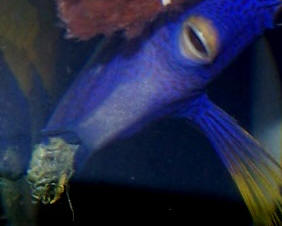
| ID - Please Can you tell me what is hanging
from my purple tangs rear end?? It's certainly not the usual
muck. Thank you, Julie. <Mmm, appears to be a good-sized mass of
worms... likely Nematodes... though it might be Acanthocephalans...
I would be treating this fish/system with a vermifuge... Likely
Levamisole... please see WWM re such. Bob Fenner> |
|
|
|
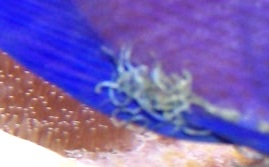
Unusual growth on Purple Tang (Zebrasoma xanthurum)
12/10/07 Hello Crew, <Ron> Thanks for taking the time
to review my query! For the first time today, I noticed a dark
fuzzy/hairy growth on my Purple Tang (Zebrasoma xanthurum) --
passengers side near the tail. ; ) I have searched the web and
WWM but can't seem to find anything that fits the profile of
a dark gray/black 'hairy' growth. <Could you send
along a well-resolved pic? Oh, I see the links below> Nobody
in my local Reef Club (RASOC) had any suggestion either. It seems
that most accounts of spots or growths on fish are white, unless
it involves black speckles or a generally discolored spot.
Perhaps my search query is lacking some keyword. However, I would
definitely have to describe this growth as hairy or fuzzy in
appearance since it appears to be a cluster of 'hairs'.
When I look back at earlier pictures that I have taken, I can see
that this spot was there in some form a month ago. It is
approximately 2 mm in diameter. It doesn't seem to bother the
Tang as far as I can tell. I have an active Cleaner Shrimp and he
doesn't seem to be concerned about it either. Here are the
best pics I can get of the growth. I am providing a couple of
Flickr links in lieu of sending pictures that may be too large
(hope that is ok). Feel free to upload and post if you desire.
http://farm3.static.flickr.com/2022/2098256828_b98c969b7d.jpg
http://farm3.static.flickr.com/2188/2097478823_335152a998.jpg Do
you have any idea what it could be?? If so, would you recommend
treatment or merely observation for now? Ron
<")))>< Charlotte, NC <Might be a crustacean
parasite... looks in outline like a pair/two copepods... A shame
to stress this animal by netting, but if the occasion presents
itself, I would use two nets, capture this fish and gently try
prising off this mark with blunt nose tongs (ask your wife re
maybe...). IF there is any sign of blood from doing so, do daub
(with a "Q tip") a bit of
mercurochrome/Merthiolate/Merbromin on to the spot. I see what
appears to be the antennae of a Lysmata sp. in the background...
In time, this cleaner may remove this mark... Otherwise, I doubt
if it is really debilitating, and strongly sense that it is not
"catching". Cheers, Bob Fenner>
Re: Unusual growth on Purple Tang (Zebrasoma xanthurum)
12/10/07 Bob, <RonF> Thank you for the information you
provided. The pictures closely represent the view one gets with
the naked eye. Perhaps I will try to use my digital zoom to get a
closer pic, in order to see if it is indeed some sort of
crustacean. I am hesitant to stress the Tang out by netting it,
as you alluded. For now, I will observe and hope that the Cleaner
ultimately resolves the issue. Ron <")))>< <Ahh!
This is what I would do as well. Cheers, BobF>
|
|
|
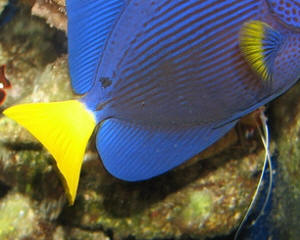
| Invincible Black Ich??? 12/10/07 Hi Bob,
<Lane> I purchased a Powder Brown Tang about 6 weeks ago. I
placed the tang in QT and treated with Cupramine for a week as
preventative for Ich. The fish also had a few black spots which I
thought might be black Ich. <Appears to be so> I hoped the
copper would help with this as well, <Ah, no. If anything, would
hurt the host...> but it did not appear to do anything. After
week one I replaced all the water in QT and did a FW dip. <For
how long?> I thought it may take a few days for the spots to go
away, but after several days of observation the tang appeared to be
getting a few more spots. I did another FW dip this time with
Methylene blue. Once again it did not seem to help. I then decided
to try Prazi Pro treatment. After about one week I still did not
see any improvement, <Wow!> so I decided to do another FW dip
and then try treating with Rid-Ich (malachite green and formalin)
in the QT. <Yikes> After several days the spots still
remained but the fish appeared to be getting fin rot and what
appeared to be stressed breathing. <I can imagine> I decided
to do a 100% water change and another FW dip with Methylene blue.
After several days the fish was healing nicely from the fin rot,
but still has the dreaded black spots. I decided once again to try
treating with Prazi again, but this time I increased the dosage
from 2.5 mg/l to around 4 mg/l. It has been a week and I am still
not seeing any signs of improvement. <Very strange indeed>
The spots seem a little more pronounced than before, but the fish
does not scratch or seem overly affected. The fish loves algae and
is eating tons. <Good> The biggest thing is the fish has a
very pale body (semi-transparent). Is this something other than
black Ich? <Can't tell w/o microscopic examination> How
can I get rid of this? <What you've done should have...>
I really want to save this fish and really want to get it into my
display tank. Your thoughts and suggestions are greatly
appreciated. I have attached a picture for you. Please disregard
the white spots as they are just bubbles. Thanks again. Lane
<Mmm, a decision (as in nothing is decided until it is done)
needs to be made... whether to try re-doing a treatment regimen (if
it were me, with another source of Praziquantel or other vermifuge,
see WWM) OR just placing the Acanthurus japonicus directly in your
display... in the hope that the (likely) Paravortex will cycle off
in time, not infest other fishes there (not all are susceptible)...
Which will you choose? Bob Fenner> |
|
|
Tangs Health 12/7/07 Dear Wet Web
Media Crew, First let me say thank you for taking the time to answer my
question. <You're welcome.> I have a 75 gallon saltwater
FOWLR aquarium and I'm having trouble with my Purple and Blue Hippo
(P. Hepatus) Tangs. Both tangs are losing or have lost their fins
(except for their pelvic fins) and losing skin all over their bodies.
At first I thought it was HLLE, but the tissue loss doesn't seem to
be confined to the lateral line. None of the other fish in the tank are
experiencing this problem. The tangs eat well everyday and don't
exhibit any behavioral problems or anomalies. <They are sure
exhibiting anomalies now.> The aquarium has been up and running for
4 1/2 years, and I have had the Purple Tang for 4 years and the Blue
Hippo Tang for 18 months. Both fish have had this problem for at least
a year. <Kind of late to be inquiring now.> Here are the
particulars... Specific gravity: 1.024 Temp: A constant 78 degrees
<I certainly do not want to sound rude, but the SG and temperature
isn't telling me very much about your water quality. There are many
more factors that can lead to the condition of your tangs such as high
nitrates, nitrites, low pH, etc. I'm pretty sure the problem was
caused by an environmental problem. Your tank is too small for these
fish and you did not state what your tank load is along with other
water parameters. It may be too late to do much for them, but for
starters I would change 50% of the water, discontinue the use of carbon
and go with a product like Chemi-Pure, which will do much more for
water quality than what carbon does.> Diet: 4 types of frozen food
(Formula 1 and 2, Angel formula, VHP formula) soaked in garlic and
Selcon, dried Nori sheets given everyday. <A good diet.>
Filtration: Rena Filstar XP-2 canister filter Skimmer: Coralife Super
skimmer Maintenance: 10% water changes every 2 weeks, fresh activated
carbon every 4 weeks. I spent 2 years as an aquarist at a public
aquarium and I have been in the hobby for 10 years, but I have never
seen anything like this. I have read (and enjoyed) my copy of A
Conscientious Marine Aquarist but haven't found anything relevant
to this problem in the text. Any help you could offer would be most
appreciated. <Danny, the best thing you can do for the tangs is get
them into larger quarters and/or reduce your fish load. I would
continue with a 50% water change every two weeks. After four or five
water changes, hopefully the fish will look much better. I believe
environmental stress and diet are one of the major contributors to poor
health. A friend of mine has a couple of tangs in an overcrowded tank
that were in poor health despite his efforts in maintaining high water
quality and diet. Since money prohibited him from buying a larger tank
at the time, I lent him a large Rubbermaid tub and suggested he
transfer the two tangs into this with a circulation pump, some live
rock for a bio-filter, a thin layer of coral sand for substrate, a
couple of inexpensive large ceramic hollow logs for security, and then
I suggested to maintain a good diet with food soaked in Selcon along
with a weekly water change. Lighting was provided by a nearby window.
Guess what? Within a month the tangs gained weight, showed excellent
color, and all fins looked good. Two weeks later they were sold to my
LFS for a fair price. It's been about three years now and they are
still alive and doing quite well in a customer's 450 gallon reef
tank. What I'm depicting here is that tangs just do much much
better in larger systems that offer little or no environmental stress.
I have a five foot long 85 gallon tank and as much as I'd like a
Purple Tang, I just won't do it...I know what lies ahead as the
fish grows.> Thank you very much! <You're welcome and sorry
for the lengthy reply, just got a little wound up.> Best regards,
<And to you. James (Salty Dog)> Danny
Distressed Tomini Tang... yes,
exposure to Malachite, Formalin 12/7/07 I appreciate the
time. I will try to keep as short as possible. I've had a Tomini
Tang that I got as a birthday gift 3 weeks ago. The first 2.5 weeks
went great, he was eating up everything in site. In the last couple
days, he has started to show some white spots on his fins and now on
his body. <... a pic?> I gave him a Furan-2 bath plus QuICK Cure
(LFS recommended) for about 2 hours <! I hope not too
concentrated... the "Cure" is toxic, very> with water from
the tank. I put him back in and after a few hours he is looking worse.
<Formalin burned little doubt> I also did a water change just in
case, but not sure what to do next. He is breathing fine, but his
appetite is nowhere what it once was. <Poisoned...> I'm not
sure if this is a parasite, Cryptocaryon or protozoan? <Me
neither... again, an image... Please try to put yourself in my/our
place... this is a bad guessing game> His mouth also is white (not
sure what that could be from). <Some specimens just are... others
from rubbing in bags, tanks...> There is no scratching at all, so
can I cancel out ick? <... how would I be able to tell?> All
other tank mates look fine. <This is a good sign... Likely nothing
contagious...> Any help would be much appreciated! Thanks, Neil
<Careful observation... only at this point. Please show this note to
whoever advised the hours long Malachite Green/formalin exposure...
NOT! Bob Fenner>
|
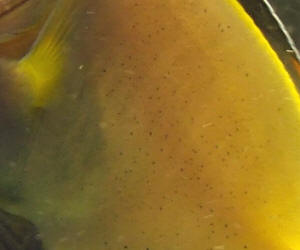
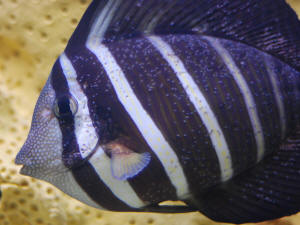
Sail Fin Tang... HLLE and Trematodes... -11/27/2007 I have
a Sail fin tang. He has small holes all over his body and fins.
<I see these in your photo> I thought it was Ick but have
not had any luck treating for Ick. <Are likely flukes... and
neuromast destruction...> The best way to describe is the
holes with something white in the middle of them. Something seems
to be eating away at the skin. I have attached a very large photo
so you can zoom in. Any help would be appreciated! Thanks, Brian
Safian <... I would treat... successively... with
Metronidazole... then Praziquantel... see WWM re the use of these
compounds... AND you need to address your water quality and
nutrition... Something is amiss here that has allowed the HLLE to
advance... see WWM re HLLE causes/cures... Write back with
specific issues... Bob Fenner>
Re: Sail Fin Tang... hlth. f'
11/27/2007 Bob, <Brian> I have been putting
Metronidazole in food regularly for about a month <This is
MUCH too long for exposure to this material> and I treated the
tank with PraziPro. <This... should have "done
it"> Some folks have suggested I do the formalin dip as
that is also effective against Flukes and Ich and maybe feed
Metronidazole while the fish are in QT after formalin dip.
Basically, setup QT tank, do Formalin dips and then put fish into
QT tank for a while. My next question is, "Does the eel need
treatment." <...? What eel?> I know most flukes and
worms can be fairly species specific and this one might only go
after tangs. <Likely so> I just do not know what the
resistance to flukes is by different fish or eels. <Many
species are almost commensals...> I know that in tank
treatment is not recommended by most, but having a fish only tank
might be able to get away with dosing Praziquantel in the tank?
<Is done... frequently. Often times with success... though the
issue of co-interactions is pertinent... may absorb the
medicant/s> If it is not recommended, what the life cycle of
the fluke is and that way you know how long your QT has to be
for. <What?> Thanks, Brian Safian <See WWM, the Net re
Trematode diseases of fishes... BobF>
Re: Sail Fin Tang... hlth. 11/29/07
OK....Let me clarify. The Sail Fin Tang is in a FO tank with a
Naso tang and a Snowflake Eel. The Naso and Eel have no signs
parasites what so ever. Last night I gave the Sail Fin a 45
Minute Formalin bath. <... depending on
strength/concentration, this is too long for formalin
exposure> It seems today that several, but not all the holes
are empty so it may have gotten some of the flukes off. Everyone
seems to think I should bring the tank into Hypo, which I may
begin stepping down today. Sorry for the confusion Brian <...
please, don't write; read instead... on WWM re
hyposalinity... RMF>
|
|
|
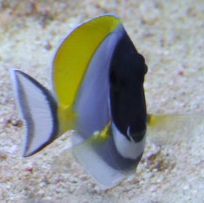
| Powder Blue with a white blob on fin
11/26/07 Hi there really appreciate all you guys do
<Welcome> Wondered if you could help me identify what if
wrong with my powder blue? <I think so> The blob is on his
fin near the base, looks like a small spider egg sack about 2mm in
diameter just wondered if you knew of a treatment or what it was
because it looks like its starting to bother him and affect his
swimming other than that he is eating just fine. Keep up the good
work Many thanks Luke, Hertfordshire, UK <This apparently is a
not-uncommon "reaction spot" from a tweaking of the soft
fin support and membrane in this area... Nothing to do other than
general good care. Will resolve on its own in a few days to weeks.
Bob Fenner> Ps levels are all fine tank is 150g all my other
fish are totally unaffected. |
|
|
Re: Anemone Lighting help!... Now...
no prev. corr., summat about tang hlth. 11/22/07 Thanks
for the prompt response! <Please... always send the prev. corr....
there are quite a few of us here, many incoming/outgoing messages...
and am feeble at remembering/finding...> One quick follow-up,
however: Will the lights make the aquarium's temperature rise?
<... possibly> Also, the tang, although very active and a hearty
eater, has developed some slight redness around his mouth and tail.
<Usually environmental> I did around a 35% water change today and
soaked his new algae food in Maracyn. <Mmm... I would not start/use
antibiotics in such an indiscriminate manner> If the problem
persists, I have a 5-gallon bucket that I use as a quarantine tank that
I will move him to, <Too small to be stable, useful here> but I
have no way to get any medications other than the ones I have (Maracyn
and QuICK Cure) until the weekend. I live around 50 miles from the
nearest LFS. Any tips? Again, thanks for the quick response, and keep
up the good work! <... I really have no idea what your situation is
other than what is offered here in this msg. I would NOT treat an
Acanthurid given what you list... with what you list... I would
continue reading on WWM re Tang Systems, Nutrition, Health. Bob
Fenner>
|
Disease Help, Paravortex? 11/15/07 Greetings
from Colorado Again! <Howdy back at you from very nice and
sunny San Diego> I have an LT. Tang that has started showing
signs that I thought were Black Ich and it looks as if it is
something else, I am including a picture of him, he went as far
as to letting the cleaner shrimp hitch a ride on him while he
cleaned. <The pic is not well-resolved enough to make anything
out> I have scoured the search engines and have not come up on
one thing it could be. My water perimeters are excellent. It
looks like black scratches and his tail looks greenish and
yellowish I hope that if you study the picture you can tell me
something. Ammonia- 0 Nitrite is at 0 Nitrate under 5ppm Ph at
8.4 Alkalinity is at 10 Gravity at 1022 Regards, Sharon
<I'd not be concerned here... if this is Paravortex (see
WWM) it is not very debilitating... and easily removed. Bob
Fenner>
Re: Disease Help... Paravortex... Tang
f's? 11/15/07 Hi Bob- thanks so much! <Welcome
Sharon> I am the one that wrote you the other day regarding my
Hippo and LT. Tang and when I removed the Hippo then the black
spot started to show up on my LT. It didn't look like it at
first because the Black spots seemed larger that what Black Ich
looked like maybe it is a strain that is bigger if there is such
a thing? <No, not as far as I'm aware> I know there is
a New bigger and bad white Ich out there that has to be treated
differently than white spot. I am scared to give him a freshwater
dip is there any way else to get rid of it other than fresh
water, I just don't want to start messing with chemistry of
my two tanks, I QT him last night to figure out what I am to do
or do I stick him back in my MD and treat him? I have inverts so
I am skeptical of all the reef safe products and advice that you
have would be so appreciative, would adding formalin to the QT
fix the problem and do Clown fish not get Paravortex they have
been unaffected so far and so no signs of disease. Respectfully,
Sharon <I would hold off period at this point. There is a very
good chance this is not pathogenic... BobF>
Re: Disease Help... Paravortex f'
11/16/07 Thanks, I don't think that I will be able to
save him. He is breathing rapidly after I moved him and he got
banged up trying to net him. <... I would not have bagged this
fish, moved it. I WOULD return it to the main display, stat!>
Although his mouth is okay he now has a scrape on his side. It
started to look elongated rather than Paravortex, it seems as if
it is a fungus his fins now have white on then and the rest of
his body looks as if someone has beat him up horribly I have
never seen a black fungus though have you by chance? <... most
"funguses" of marines are bacterial... some are
not-white, yes> My water chemistry is more than perfect and
ideal there is no mucus at all and this has just started in the
last two days and his top fin is still down and only goes up when
he is concerned is there anything that you might know.
Respectfully Devastated, Sharon <Sharon... please review our
prev. corr.... Why are you stressing this animal? BobF>
Re: Disease Help, tangs 11/19/07 Hi
Again, <Sharon> I wanted to let you know the status of my
LT. Tang... He is doing wonderfully. My LFS finally was open on
Friday and explained to me that this is a parasite that mainly
attacks the LT. Tangs <Interesting... perhaps a more rather
than less species specific trematode is speculated here> and I
on Friday put Revive in the Main Tank and I also treated for
Ich... <... Mmmm... with what?> I noticed a huge
improvement come Saturday and he is doing very well today he is
eating and swimming around and waits at the end of the tank for
me. I supplement with Selcon and Garlic and his immune system
seems to be up and running. None of my Inverts have been dazed by
this treatment and you can watch the parasite die off him and the
cleaner shrimp are lined up and ready to be at his service they
are cleaning the inside of his mouth as I write. Thank you and
when I get the name of the Parasite I will write you back Bob and
let you know. Happy Holidays. Gratefully, Sharon in Colorado
<Thank you my friend. BobF>
Re: Disease Help... "reef-safe"
med.s 11/19/07 Hi Bob, I treated with Revive and No Ich
from Fish Vet. <... am very leery of such products that claim
to leave only "beautiful" invertebrates intact, while
eliminating undesirables... AND further, don't list their
ingredients> It has worked so far <This is the operative
term> and treating him for bacterial as well as for parasite
infestation. He has mellowed out and is eating very hardy. This
stuff does not mess with your water Chemistry, I have tested
everyday and it has been clean. I had to take out the carbon and
the zeolite for five days than I will do a 20% water change I
slowed the skimmer down rather than turn it completely off I
turned it off the day I medicated than started it back up at
minimal the next day... So my method worked so far so good a very
happy person right now! thank you much. The stuff that I used is
Invert safe and reef safe and works well... Sharon <I do hope
it works for you... Instead of some natural remission, cycling
off... and returning of the causative organisms here. Bob
Fenner>
|
|
|
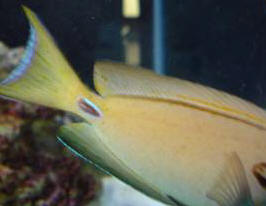
Tang Spots... reading on
WWM 11/1/07 Hey Guys, Happy Halloween, I have a few
questions for you today, and thank you for all your help in the past.
First off, I have a 125 gallon reef ready Saltwater tank, with 120#
live rock, and 140# live sand. I have a med tomato clown (tank raised),
2 baby hippo tangs (Had for about a month 1/2), and a med size Naso
Tang, small clam, and a med feather duster. My parameters are perfect
ammonia 0, nitrate 0, and nitrite less than 5 ppm., specific gravity
1.022, <This is a bit low...> ph 8.2, calcium 400, temp
76.5-77.5, with a 1000 watt metal halide lighting system, skimmer and
25 watt UV, 1000 watt titanium heater, in sump. My question is my Naso
has had white color spots on his bottom area, not welts like Ich, but
just small white color spots. <How large is this specimen? Nasos
can/do show such spotting when stressed, particularly when small/er>
He is eating algae sheets, seaweed salad, spinach, lettuce, <I would
not feed terrestrial greens> and picks at the rocks all day. He
swims all over, mostly across the front back and forth. His breathing
is normal and he acts normal. I know that Nasos will have color change
and some is normal, but I was just wandering if you had any other ideas
about it. <Mmm, no> Next my 2 baby regal tangs (about 1
1/2") have been having white spots on them lately, (sort of looks
like Ich) but then they will go away, and come back a few days later.
<You have a resident Crypt infestation... all three of these
comments are expanded on WWM...> They have always been very active,
eat seaweed salad, lettuce, spinach, pick at rocks, copepods in a
bottle (dead), flake food. Always willing to eat, and always active.
They never sit around and breath heavy like Ich will do. But it does
look like Ich spots. What can I do to get rid or prevent that from
coming again. Lastly, lately my feather duster "Feathers"
have seemed to "Slim down?" They don't seem as full and
thick as usual. <Yes. Good observation> None have fallen off but
just seemed to have thinned out. I feed it the same food I feed my
clam. He only seems to come out when the lights are off. I rarely see
him in the daytime. Again thanks for all your help, it is greatly
appreciated. Aaron <Keep reading. Bob Fenner>
|
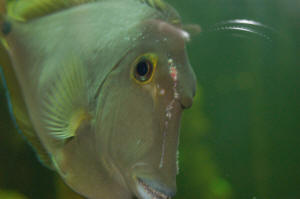
Unknown disease on Naso and Unicorn Tangs
10/25/07 Hello, <Hi there> I have had multiple Unicorn
and Naso tangs, both Hawaiian and Blonde, in my 500 gallon
aquarium which are dying of an unknown disease. No one in my area
can identify the problem. Water quality is excellent. First, they
get a white cotton-like grain around the face area. After about a
week, the grain opens and flesh is seen. The open wound can grow
to be 3" on a 10" Tang. More cotton-like material
develops in the open flesh area and the fish stops eating and
dies. I know it is not a parasite because copper (Cupramine) is
not effective. <Mmm... not really> Is it a fungus? If so,
what medication should I use? Please help...I would like to have
more of these tangs in the future. Thanks, Jeff <I would take
a scraping, look w/o staining under a low-power microscope. I
suspect this/these are flukes (monogenetic Trematodes), but could
possibly be copepods... treatment is either with a vermifuge
(e.g. Praziquantel) or an organophosphate... in the meanwhile, in
addition, I would bolster their immune systems with HUFA and
vitamin soaking on their algal diets. Bob Fenner>
Re: Unknown disease on Naso and Unicorn Tangs
10/25/07 Hello Bob, <Jeff> Thanks for your quick reply.
<Welcome> Which of the 2 remedies are more effective and
where can I get either Praziquantel or Organophosphate?
<Posted on WWM. BobF> Jeff
Re: Unknown disease on Naso and Unicorn Tangs --
10/30/2007 Hello Mr. Bob Fenner, <Jeff> I have been
using PraziPro for 3 days and it seems to be not working.
Attached is a picture of the fish and disease. Let me know if I
am using the right medication. If I'm not, please guide me in
the right direction. Again, thanks for all of your help. Jeff
<Mmm, this eruptive condition looks like HLLE... neuromast
destruction. Do you have these fishes under constant copper
exposure? Is it possible that there is a vitamin deficiency
syndrome here? Please read: http://wetwebmedia.com/hllefaqs3.htm
and the linked files above. Bob Fenner, who would still like to
see a micrograph... to exclude Hexamita here...>
Re: Unknown disease on Naso and Unicorn Tangs
10/30/07 Hello Rob, <Jeff> thanks for your reply. I
know for sure it is not HLLE. I have had the fish for about 2
months and eats a lot of Spirulina. Water quality is good.
<Mmm... well, the pattern of involvement closely matches the
arrangement of the lateralis system. Again, have these
Acanthurids been exposed to copper?> I will treat for Hexamita
and hope this is the problem. Thanks, Jeff <Okay. BobF>
Re Unknown disease on Naso and Unicorn Tangs...
still not reading, Cu poisoning 10/31/07 Yes, I had
Cupramine in the water at .05 ppm. <... Please see WWM re
Acanthuroids and copper exposure... This is very likely the root
cause of the neuromast destruction here> Possibly a fungus or
Bacterial infection? Furan 2 or Fungus Cure as a medication?
<... no, no, and no> Jeff
<Please... read. Bob Fenner>
|
|
|
Surgeonfishes: Tangs for Marine Aquariums
Diversity, Selection & Care
New eBook on Amazon: Available here
New Print Book on Create Space: Available
here
by Robert (Bob) Fenner |
|
|
|

