|
New Print and
eBook on Amazon
Marine Aquarium Algae Control
by Robert (Bob) Fenner
|
Sea Urchins and Sand Dollars, Class Echinoidea:
Friends and associates who know me to be an avid diver frequently ask
whether I'm concerned with potential encounters with sharks, rays,
giant squids and the like. My standard reply is that hour per hour
spent the most dangerous activity we all engage
in is driving on the freeway. In all honesty, in the way of moments
spent underwater, other than your dive buddy, Sea Urchins are the most
realistically harm/hurtful organisms.
Urchins are common fare in the marine aquarium trade.
They are useful and interesting scavengers and algae eaters, but just
as with underwater meetings, they present considerable risk.
Classification: Taxonomy, Relation With Other
Groups
Urchins and their allies the sand dollars and heart
urchins make up the Class Echinoidea in the phylum Echinodermata.
You're familiar with this phylum's other four living classes,
the Sea Stars, Brittle stars, Sea Cucumbers and Sea Lilies &
Feather Stars. Collectively the echinoderms or spiny-skinned animals
are grouped as radially symmetrical, with a water-vascular system
(ambulacral) responsible for their peculiar locomotory tube feet. They
have a true body cavity (coelom) supporting a calcareous internal
skeleton...
The class Echinoidea including the Urchins are discoidal,
ovate or globose echinoderms having bodies covered with spines and no
arms. The name Echinoidea is actually Greek for "like a
hedgehog" referring to these spines. Their mouths are aboral, that
is, directed against the substrate. Distributed between the spines are
pedicellariae, specialized tube feet used for
cleaning and defense. Some of these are termed globeriferous
pedicellariae (now that's a mouthful!) and contain poison
glands. About 800 species have been described.
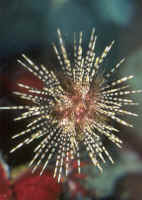
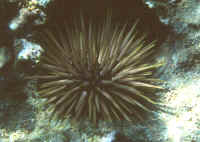
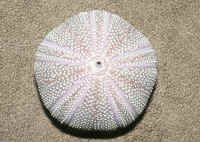
| Images showing typical echinoid body plans. They
are spherical to globose to flat in profile, radially symmetrical,
with their oral sides down against the substrate. Shown:
Echinometra mathaei in Hawai'i. and a
Strongylocentrotus test. |
|
|
They come in brown, black, purple, green, white, red and
multicolored. Most are 6-12 centimeters in diameter; some Indo-Pacific
species attain 36 cm. in diameter! Some have very sort spines, some in
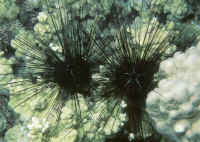
the genus Diadema on tropical reefs have spines
that may be more than 36 cm. in length (Ouch!).
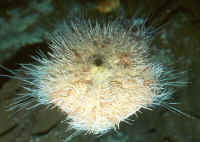
| Don't be fooled into thinking the length of an
Urchin's spines have any direct relation to their ability to
hurt you... Not to mention their poison tube feet! Use a net to
negotiate them into a container underwater. Short spined Urchin in
the Andaman Sea, Diadema in Hawai'i. |
|
|
|
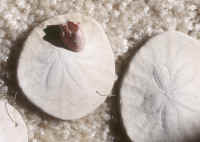
Irregularly shaped echinoids appear bilateral.
These include the Heart and Cake Urchins and Sand Dollars. All
are adapted for burrowing in sand, possess much smaller and more
numerous spines. Irregular urchins all feed on minute organic
particles in the sand in which they burrow. Our local common
Californian Sand Dollar Dendraster exocentricus feeds
almost exclusively on suspended particles, particularly diatoms.
Non-"regular" urchins are rarely offered in the
trade.
|
 |
Species Sometimes Seen/Used In the Aquarium
Interest & Not:
Family Diadematidae: Astropyga, Diadema,
Echinothrix.
Genus Astropyga:
| Astropyga pulvinata (Lamarck 1816) the Off
Costa Rica's NW coast in Guanacaste. |
%20MD.JPG)
|
Bigger PIX:
The images in this table are
linked to large (desktop size) copies. Click on "framed"
images to go to the larger size. |
%20MD.JPG) |
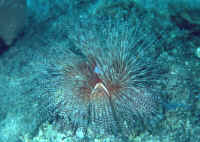
| Astropyga magnifica, the Magnificent Urchin.
Tropical West Atlantic. To nearly ten inches in diameter counting
the spines. Deeper water (65-130 ft.) This one off St. Lucia at
night. |
|
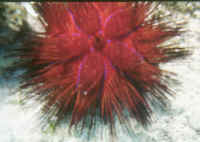
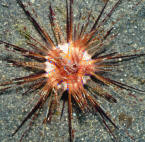
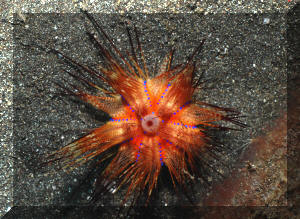
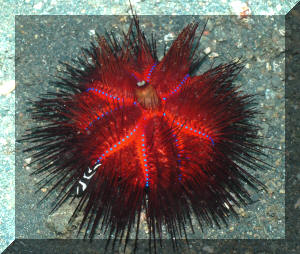
| Astropyga radiata (Leske 1778), the
Radiating Hatpin Urchin. Indo-Pacific; Africa to Hawai'i. Out
during both day and night. On sand to rubble substrates. Eat algae,
but will take invertebrates... best to feed meaty foods weekly. Not
as frequently imported as its congener from the TWA above. Photos:
Cebu, Philippines, and N. Sulawesi. |
|
Bigger PIX:
The images in this table are
linked to large (desktop size) copies. Click on "framed"
images to go to the larger size. |
 |
To: Part
2, Part 3,
Part 4, Part 5,
Part 6
|
|
New Print and
eBook on Amazon
Marine Aquarium Algae Control
by Robert (Bob) Fenner
|