 |
|
| Home | Marine Aquariums |
Freshwater Aquariums |
Planted Aquariums |
Brackish Systems |
Ponds,
lakes & fountains |
Turtles & Amphibians |
Aquatic Business |
Aquatic Science |
Ask the WWM Crew a Question |
| Please visit our Sponsors | ||||
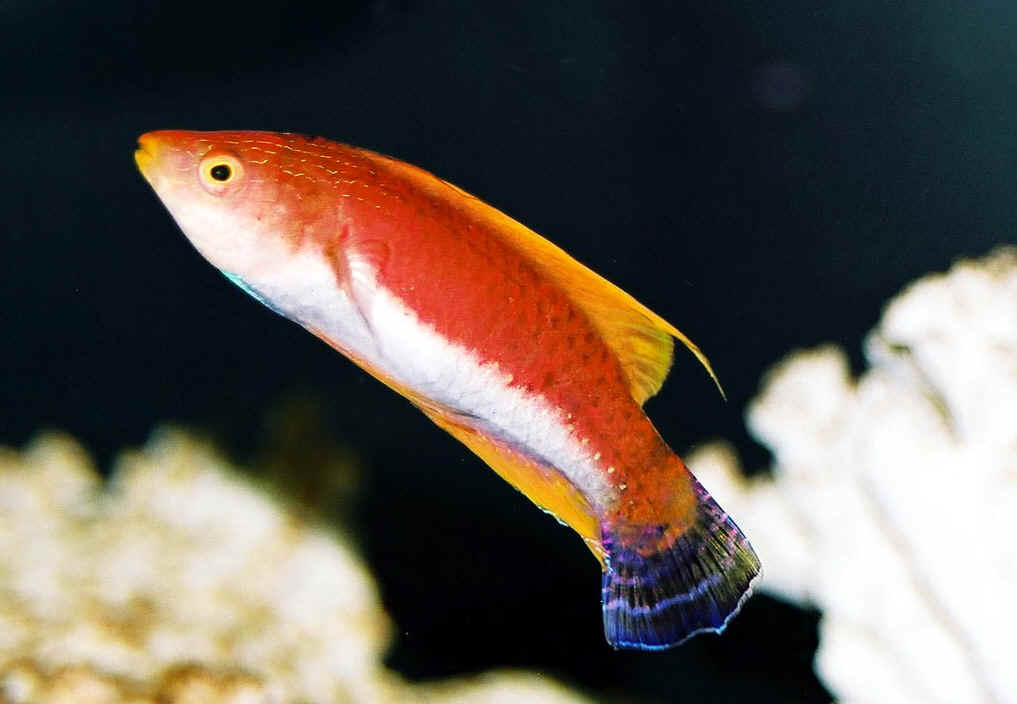
Wrasse Question, sys. 1/28/11 Sand For A Reef Aquarium 12/4/07 <Hi Bryan> Any good sand substrate recommendations for a reef aquarium 96x30x30? We want to keep sand sifting fish such as gobies, wrasse, and certain snails. The Carib Sea Aragamax talks about only using up to 1". I was thinking 4-6" depth for a substrate. thoughts? We will also use a mud based substrate in our refugium in the sump. <I'd go with fine sand, no more than 1mm, easier on burrowing wrasses, etc. Personally, I would go with no more than 2 1/2 inches in depth and mix with at least 20 lbs. of live sand. I'd let this develop before adding the sand sifting critters to insure a good population of beneficial critters. Read here for more info. http://www.wetwebmedia.com/livesand.htm James (Salty Dog)> Bryan Heitman Re: Stocking Suggestions for the 34g Red Sea Max... Flasher wrasse sys. – 07/26/07 Affect the wrasse psychologically? Please elaborate if possible. Thank you. <The labrids of this (and most genera) genus are accustomed to a quite large lek territory... where they "dance", display... and can get away from potential predators... RMF> Wrasse for a Bare-Bottom Tank? - 04/20/07 Hello all! <<Cheers Fred!>> I write in today for some advice on a wrasse. <<Okey-dokey>> I used to have a Radiant Wrasse (Halichoeres iridis) which was easily my favorite fish of all time. <<Ah yes, a gorgeous fish>> Tons of personality, great "sheriff" for my reef, constantly on the lookout for pests of all types and what great color. <<Indeed...traits indicative of this genus as a whole I think>> Unfortunately Radiant Wrasse need sand so I was unable to move him into my new BB tank. <<Mmm, ok...not a fan of bare-bottom tanks myself>> I gave him to a friend with a large DSB and he is quite happy there. <<No doubt>> In my current 90 gallon BB tank I would love to have a wrasse or two but I know a Radiant would be horribly miserable in a BB tank. <<Agreed...as would all the species of this genus>> Are there any reef safe wrasse that would be happy in my tank? <<A few, yes...though finding one to match the color/brilliance of H. iridis may not be possible. There are a few species that sleep in crevices/caves in the rock by "spinning" a cocoon of mucus. One such species is Cirrhilabrus rubrimarginatus, the Red Margin Wrasse. I have found this wrasse to be quite tolerant of other fishes (much like the Halichoeres species), eats well, is active, and attractive to boot. A purposeful keyword search of the Net will likely turn up other choices too>> What would you recommend that is comparable to the radiant in terms of personality, color and ability to defend the reef from the evils of hitchhikers? <<I don't think it likely you'll find anything that meets "all" these requirements as well as the Halichoeres species (in other words, you have been spoiled [grin]), but do look in to/research the fairy and flasher wrasses. These are beautiful fishes and there may be a few that come close to meeting your "requirements" (they are considered chronic "jumpers"...though no more than the Halichoeres species in my opinion/experience)>> Thanks for the library of information, easily the best on the net!<<Quite welcome...is a collaborative effort>> Fred <<Regards, Eric Russell>> Senorita Wrasse, keeping 10/5/06 Hey Crew, I just found your site while looking for some solutions to a problem I am having a with the species of fish I am keeping in my tanks. <Ahh, one of three labrid species found off our coast (BobF, in S. Cal.> Since this fish is generally not used by aquarists (I think its because they don't have flashy coloring like other wrasses) <This and the fact that the species isn't tropical... and the vast majority of aquarist systems are...> I have not had much success in finding any good information on them. First, if you have any background info you happen to know about this species, Oxyjulis californica, I would really appreciate anything that you have. <Have maintained them for times... years back, investigating their role as sources, non-obligate cleaners of caligoids...> Second, I have 25 of these fish individually housed in 10 gallon aquaria and the fish range in size from 6 to 10 inches. <Mmm, unless there are compelling reasons, would keep all in larger quarters... together. Social species, needs room and what goes with it> I have kept the smaller sized fish in these tanks for months at a time with no problem, but I received a new shipment a few weeks ago and while they were fine for the first week many of the larger fish have begun to sicken and die recently. <Could be a few things at play/fault here... improper prep., shipping... parasite load... Seasonally they just don't ship "worth a darn"... particularly during annual weather changes> I currently don't have any hides in the tank and that may be an issue, <Mmm, maybe> but I am more inclined to believe that the tanks are too small. <Me too> Could that be the issue? <Definitely yes> I have tested NO2, NO3 and NH3 levels and they are all within normal bounds, but the fish are often lethargic, some won't eat and fins appear to be rotting away while blood spots appear on their sides and near the base of the fins. <Environment... likely coupled with shipping/holding stress> I hope you can help, this problem is quite distressing and I don't want to lose any more of these fish. Thanks, Matt <Larger, chilled systems... would be/is my first and best suggestion here. Bob Fenner> To Cover or Not to Cover, That is the Question - Or Is It? Hello Crew or Eric R., <<Hello, Marina here.>> In Tuesday's (05/24/05) FAQ, someone posted a question "Wrasse Behavior - Jumping, Freaking And Hiding (Oh My!) - 05/23/05" and in the question the writer stated that he has the top 100% covered because the wrasse likes to jump. Eric R. then responded with <Mmm...not sealed I hope...possibly covered with egg-crate or similar?> <<Yes.>> My question is why not 100%? Why use the egg-crate? <<Actually, those are questionS, not one question. And the answer lies in a couple of areas of concern for reef aquarists. First being O2-CO2 exchange; this exchange is greatly hampered if the tank is covered in such a way as to create almost a seal. Using something that does not allow fresh air to come across the surface of the water means that this exchange won't take place here. If one is running a wet/dry trickle filter, then it's a non-issue. However, many folks have eschewed this technology in favor of that which does not encourage this exchange. The other issue has to do with heat gain, again a problem in closed reef systems. Glass not only does not allow heat to escape, it creates a greenhouse. Higher heat means lower O2 saturation. Why eggcrate? Because it is chemically inert (unlike aluminum or brass window screening), relatively inexpensive, and very easily cleaned and configured to fit any system. Neat stuff to work with, actually.>> I'm asking because I'm currently running a 100% glass covered 150gal Oceanic RR tank. What am I doing wrong now? <<Ha! You sound like my father-in-law ("Ron!" "What'd I do now?"), and I KNEW we'd catch you! Actually, not knowing anything else about your setup we cannot say that you're doing something wrong. But if I catch you then I will. <wink> >> Thanks in advance. Stan <<You're welcome Stan. Now don't let me catch you doing something wrong! Marina - The One Who WILL Catch You If You're Doing Something Wrong>> Jumpin' er...Wrasses! Hi <Hey there! Scott F. here today!> I want to get a Wrasse for my reef tank. I hear they are jumpers. <Yes, they are!> I have a 90 gal with a 650 total watt suspended halide light above the tank. The canopy is on it with the top removed so the light gets in, the edge of the canopy is approx 8" above the water. Can the wrasse fly over that?? <It really depends on so many different factors that it would be hard to generalize. To be safe, I'd say that you need to assume that they can!> The LFS has had the wrasse in their display tank for months and it hasn't flown the coop yet. Is the canopy tall enough to keep him in or should I choose some other type fish?? <Perhaps you can use some egg crate to create a barrier that will keep the wrasse(s) in, while not blocking out too much valuable light. If this is not an acceptable solution, then you may want to consider different fish, unfortunately. Good luck! Regards, Scott F.> Wrasse Bedding? Hey Bob and Anthony, <Scott F. here today...> I recently bought a Green Leaf Wrasse from Bali. He is about 6 inches long. He seems to be doing very well during the day and eating well, but not at night. He lays on the gravel breathing heavy. I know Wrasses like to bury themselves and I have 40 lbs. of CaribSea, Aragonite in my 40 Gallon tank (same footprint as a 30 long, but taller). Is this gravel to rough for him? <My wrasses like to bury themselves in this stuff. Yes, the "sugar fine" CaribSea "Aragamax" is the best stuff, but slightly more coarse substrates will work, too> He will bury himself at times, but usually his head is sticking out. I have only seem him completely buried once. I just got him 3 days ago and want him to survive. <No quarantine process? Do embrace this process in the future, okay?> Oh, I also bought a Dragon Eel Goby for my 29 Gallon Fish only and he is awesome. What a great fish! I have a Marine Beta and a Tomato Clown in with him. In my Live Rock tank with the Green Leaf I have a Chalk Bass and I intend to add either an Assasi, Huma or preferably a Blue Chin Trigger (but they are not common). <Please refrain from adding any Triggers...This tank is simply too small...> I will also add a Lizard fish to roam the bottom and then I am done. By the way, I get sick and tired of hearing people say small tanks are bad, so I set up a 10 gallon tank with a Candy Hog 6 months ago. I have a Penguin 170 crammed with one liter of Matrix as the main filtration. I rarely do water changes and the water conditions are perfect. I will keep you abreast of its success or failure. <My friend, I wish you luck on your endeavors, but I am one of "those people" who are not big fans of small systems. Small tanks are not "bad", but they require a complete understanding of the dynamic of nutrient import/export. Husbandry is everything! If lightly stocked, well-managed, and carefully fed, they can be successful for extended periods of time. I'm sure that your water conditions are okay...for now. I really don't think that "rarely" performing water changes is anything to be proud of! C'mon- would you keep a dog or cat in a run without removing their uneaten food and feces for months at a time? I think not! A closed aquatic system, even a carefully stocked, lightly fed one, cannot be sustained for an extended period of time with happy animals. Organic wastes have to be exported, and new trace elements have to be imported. The easiest way to accomplish this is with regular water changes. Water changes are so easy that I often wonder why people go out of their way to find ways to avoid them!> I also have 8 hermits in there I had to yank from the live rock tank because the Green Leaf was eating them. Thanks for the assistance with my Wrasse. Nathan <A pleasure, Nathan. I didn't want to jump on you about the small tanks. It's just that we have a responsibility to encourage responsible husbandry techniques, and I don't want to encourage less experienced aquarists to develop bad habits. I'm sure you are a very talented and dedicated hobbyist, so hang in there! Good luck! Regards, Scott F.> Wrasse Bedding (Pt. 2) Scott, <Hi there!> I agree 100% with Quarantining fish for reef tanks, but I don't have to worry about it because I can treat both of my tanks with copper so I don't have to worry about ick. If a new fish brings it in I just treat the whole system. I had this happen once in my 29 with a stupid yellow tang (my LFS discourages people from buying Tangs for this reason and I returned him and got the Tomato) and all the fish including the Tang all recovered after a week or so. <Glad to hear that this works for you!> You never answered (maybe because you were not sure) about why my Green Leaf Wrasse is not burying himself at night and if he will eventually die because of it? <Sorry- probably, I was too busy with my "small tank rant" and overlooked it! LOL! Actually, the fish will not die as a result of not being able to bury itself at night. Wrasses are quite resourceful, and will tend to lock themselves into rockwork at night as an alternative "sleeping area".> I am contemplating doing a complete gravel change to the softer stuff, but man that would be a lot of work and before I do that I might just return him to my LFS for a store credit. <I hear ya! I wouldn't sweat it...> Yea, I agree with the tank sizes and having them properly stocked. I also don't like having fish die and as you can tell with a Dragon Eel Blenny, Marine Betta, Tomato Clown, Green Leaf Wrasse and Chalk Bass I only by EXTREMELY hardy fish with big capacious mouths, lol. I hate chopping food up into little sizes. <Yep! Sure makes it easy to dispense the food!> I also hate feeding fish every day. I feed mine every other day. <Not a bad routine, and it will be easier on the water quality> I have only lost 3 fish in 3 years and that was due to an ick outbreak in a reef tank. I got tired of the reef tank (boring and expensive) and got rid of all the corals and made it a live rock tank so I can treat it with copper if need be (haven't had to yet). I had a gorgeous reef tank and everybody who came over liked my fish only 29 gallon tank with the fake corals and fish better and I found I did too, lol. <Yeah- those reef geeks are nuts, huh? LOL It's hard to have an awesome reef tank with awesome fishes, too, but worth the effort!> My Marine Betta is sooooooo gorgeous and the Tomato complements him well and the Green Dragon Blenny really rounds out that tank. Eventually, they will out grow it and I will move them to a 55, but that is a couple years down the line. I do gravel suck this tank every other month. <Good maintenance habits will benefit all of these fish!> Thanks for the advice. Talk to you soon. Nathan <Any time, Nathan! Just keep having fun and sharing your findings with others! Regards, Scott F> Wrasse Bedding (Pt. 3) Scott, <Hi there!> Great news! My Wrasse buried himself completely last night and it was up and at it today. Yes! I guess it just took him some time to adapt to the new gravel. Thanks for the advice. Nathan. <Glad to hear that, Nathan. Yep- those wrasses can be really adaptable fishes! Enjoy! Regards, Scott F.> Substrate Material For A Canary Wrasse I have read that a canary wrasse required a sandy bottom to hide in if needed. I have crushed coral and Puka shells. Should I not get this fish? James Hall <Good question, James. I've kept these guys in both fine and coarse substrates, and they seem to find a place to sleep or hide in regardless of substrate type, IME. As long as you have rocks with good nooks and crannies for the wrasse to retreat to when he feels the need, you should be fine. While we're on the subject of substrates with this fish, these fishes display an unusual behavior that can confuse the unwary hobbyist into thinking that his or her wrasse is sick: They tend to dive towards the substrate and dislodge some grains of material with their snouts. This looks for all the world like the fish is "scratching" itself to relieve a parasitic itch, but it is simply a normal "hunting" behavior, in which the wrasse is trying to unearth worms or other benthic creatures for a tasty treat. Just another wacky behavior by these very cool fish! Regards, Scott F> Disruptive Wrasses? Hi! I've been a regular visitor to your site for quite some time now and your daily FAQs section has been like the newspaper to me! Thanks! <You're quite welcome!> But this is the first time I'm writing in, and my question is, I'm planning a DSB for my 50gal FOWLR and the crew consists of a 3inch Halfmoon Trigger, a pair of Maroon Clowns(5inch female,2inch male) and 3 Banana wrasses (two 3inch and one 2inch). Everyone gets along great and although I've been tempted to add to this happy family, I'm more tempted to keep this family happy! <Absolutely. And do consider the need for a larger tank in the future...> My question is regarding the trio of wrasses (they gambol together so much it seems like their shoaling!), will they disrupt the DSB too much? <Wrasses do tend to bury themselves in the sand at night, and they often pick around in the sand bed while foraging. If you're talking about the Halichoeres species, I'd say that the disruption is relatively limited. Other genera of wrasses are much more disruptive> From what I've learned about DSBs (from your site!) is that they mustn't be disturbed to achieve NNR right? <They should not be disturbed much beyond the top inch or so> Well, won't the burrowing of my triplets create problems? Right now, the tank is bare bottomed with a tub of coral sand as their 'bedroom'. I've had the tank running for almost two years now with no problems but want a DSB for its obvious benefits. <As above> One more question, what is the minimum light requirements for macro algae? Or what macro algae has the least light requirements? <Well, you'd probably do better with the red species, such as Gracilaria, etc. Proper water movement is also an important factor> I have two NO fluorescents (one 10,000k and one actinic), would that be enough to support any macros? <Sure> I don't have hair algae, just some brown now and then on the front glass and my nitrates are at 15/20 never more, so is the lack of nutrients or light causing my lack of algae? <Could be. Nutrients are a big contributor to algae problems> I also have one mushroom which was a hitchhiker on my live rock (the live rock situation here in Malaysia is deplorable. At best, what you can get is good quality base rock with a few hitchhikers), he's been growing steadily but not multiplying and I'm wondering if that's due to the lack of light as well. <Light could definitely be a contributing factor here> Sorry for being so longwinded! Thanks in advance! Regards, Nicky <My pleasure, Nicky! Regards, Scott F> Wrasses in DSBs (1/21/04) Thanks for the advice Steve. I'll stay away from Hermit Crabs. I assume you mean "reef safe" hermits too. <"Reef safe" is a relative term. Some "reef safe" organisms will still wreak havoc on occasion. I'm not big on hermits because IME they don't really do a great job. If you like having some to watch, go ahead with some "safe" ones.> I just thought of another question. I have a Dragon Wrasse <Beautiful as a juvenile; less so as an adult.> and I'm sure you guys know they like to sleep under the sand. I imagine they don't go very deep, because they need to breath. Do they usually burrow more than two inches deep? <Not much deeper.> If so, will this cause problems with my DSB's ability to remove nitrates? <No worries. It will usually sleep in the same general area and will not go deep enough extensively enough to cause a problem.> Will he go after my detritivores. <A possibility.> BTW - Steven Pro helped me out a few years ago. I have not seen any postings from him in any of the FAQ's... Is he no longer part of the WWM group? <Still active on the WetWebFotos forum, but has a young child with another on the way, so not answering anymore FAQs.> Thanks Again, Glenn <Hope this helps. Steve Allen.> Filamented Flasher Wrasse Biotope Crew, I am looking for some information; I'd like to set up a filamented flasher wrasse biotope. I have a 90g tank (48x18x24) with 4x96w PC lights and a completely enclosed hood. I seem to recall that this wrasse lives at depths of 40 feet or so and that the appropriate lighting would therefore be 20k MH bulbs. Is this the case, and if so is there any way I can adapt my current lighting to approximate that without switching over to MH. <your pc are fine use a 20,000k bulb or something on the blue end> I'd also like some advice on how many wrasse are appropriate for this size tank. <if this is the only fish going to be in there you could put 1 male and 6-10 females> Everything I've read suggests one male to two females, but assuming more than three fish is appropriate for this size tank, I don't know if that formula should be strictly applied to larger groups. Do these wrasse sleep in the substrate or in rock (i.e. do I have the option of going with a bare bottom tank)? <they sleep in rock and you do have the opinion for going with out substrate but many little critters live in there that they can eat> I was planning on a fairly substantial amount of rock in the tank (at least 150 lbs). Also, the wrasse seems to have a fairly large geographic area that it's from, and I'm interested in perhaps one or two types of corals that would be consistent with the wrasse's biotope. Are there any you can recommend? Again, I've looked around a lot but I can't find the kind of specific information on this particular subject (ex. Many corals are listed as being from Fiji or the great barrier reef but I can't seem to find an appropriate depth listing). <try Vernon books he lists everything> Finally, is there any particular restriction on water flow rate for this wrasse? <lots of flow> Any additional recommendations or advice you have would be helpful and much appreciated. Your site has been quite a help thus far, and I look forward to hearing from you. <I would add the females first let them get settle down the add the male. Also make sure you have tops covering the tank they are jumpers thanks Mike H> Thank you. -Orion Disappearing Christmas Wrasse I also bought a small Christmas Wrasse and he always seems to disappear about 4 pm. Really weird and then I don't see him to the next day. Any info on him would be appreciated. <This is rather well documented. Many wrasses bury themselves at night for protection. You can begin further investigation/education here http://www.wetwebmedia.com/marine/fishes/wrasses/index.htm -Steven Pro> Re: Tank specs for the wrasse use. This is the setup I should have sent with last e-mail. You can also see it with links I've sent earlier today. The main 65gall Tank setup is as follows. We have a 55 gall. capacity wet dry, with a 40 gall Eheim canister that is pushing water through our 40 watt UV. We also have protein skimmer good for a 70 gall tank. Since the tank likes running a little warm at 82 we have a fan run at night and 2 during the day. we are stabilizing at 82-81.5 for temp. We have 2 green Chromis, a Huma Huma Trigger, a Flame Angel, a Snow Flake eel, and now an Annularis Angel. <Still too small a system for all this fish life> We would like to add in the future a yellow tang even though their ick prone, A dwarf lion, a sharp nose puffer, and a Royal Gramma I could take the Chromis out! <No! Really... you should either get a much larger system, or take out the trigger and Annularis... Bob Fenner> Thanks Again! JET Re: Tank specs for the wrasse use. Is this opinion based on the fact these fish will grow? <Yes and to some degree for how large they are now... crowding malaffects can be defined physiologically (like by how much gaseous exchange a system affords) and psychologically (as in "stress" from crowding)... Your system is already maxed out by the latter measure. Your fishes are far more likely to "break down", succumb to various types of diseases by virtue of how mentally-emotionally they're pushed together... This "over-crowding issue" is very, very common in the aquarium hobby. I do wish I had the opportunity to take sharp, upcoming go getters as yourself on dive trips... for among other things you would experience is just how large the "living places" are for your livestock, and witness up-front the negative interactions that occur in the wild when different types of life "come together". Bob Fenner> Re: Tank specs for the wrasse use. Well I have a 125-150 gall in storage and a 35 gall hex, it has just about everything I need. It was designed for a reef setup. <Ah! Fortunate> That is where I got the 40 watt UV. I have absolutely no room for it at the moment. <Behind the couch? Instead of the kitchen table?> I bought what cost this rich guy's 7000.00 setup for less than 1,000. It was a definite bargain! So I hope they won't grow fast anytime soon. I'll take the Chromis out after the treatments and add this wrasse. I realize This still won't decrease my bio load enough. I got to get this parasite thing under control. <What about the stress component? Please read through the pitch/presentation I gave at the most recent WMC posted on the www.WetWebMedia.com site, "The Three Sets of Factors that Determine Livestock Health"> Their is still itching and I'm 90% percent sure now the Annularis white spots are ick! (smaller than usual) He's still eating good. The spots have not moved for days and have grown ever so slightly. Still no dots on the other fish, but an occasional itch is seen. JET <Read the cited section and related FAQs files. Bob Fenner> Lost wrasse? Mr. Fenner I have a question about a Scott's Fairy wrasse. I purchased one 14 days ago. Put him in the tank he was eating and seem to be doing fine. No one else was bothering him. Two days after I put him in he disappeared! No trace. Couldn't have jumped cause I have a totally enclosed canopy. I have been told by a few experienced reef people that they have heard of this wrasse going into hiding for several days even a couple of weeks they all told me to be patient and wait sine I haven't seen any part of a carcass and no fish I was wondering if you know anything about this beautiful creature. Dave Brunsmann |
|

|
Features: |
|
| Featured Sponsors: |