 |
|
| Home | Marine Aquariums |
Freshwater Aquariums |
Planted Aquariums |
Brackish Systems |
Ponds,
lakes & fountains |
Turtles & Amphibians |
Aquatic Business |
Aquatic Science |
Ask the WWM Crew a Question |
| Please visit our Sponsors | ||||
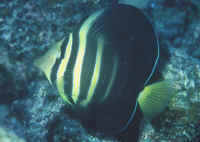
ADDING A FISH Are the tangs you mentioned less prone to ich than the yellow? <To be honest with you...it depends...how the fish came in, stress, if you Qt or not, water chemistry/quality. My personal favorite sp. of tang is a Zebrasoma Rostratum a.k.a. black tang...they command a high price tag.. but are well worth the $$$$, Good luck, IanB> Tang question The purple tang that I had for approximately 2 years recently died. One day it was fine--eating well, the next day it was lethargic, not eating and looked as though it was being vacuum packed throughout the day. It just kept getting thinner and thinner throughout the day until it died, all within 24 hours. <Very strange> Weird thing is the tang ate sand from the substrate. <Not unusual> The sand would completely run through the digestive system. I don't remember it ever not eating the sand and it seemed to run quite a bit of it through its system. I asked the LFS about this and was told it is not normal behavior. <Most I have watched pick it up in their mouths and blow it out their gills, after sorting out and eating the microalgae and other food items in the sand.> Well, I now have a juvenile orange-shoulder tang and it is eating the sand too. I'm sure it's not just picking at it because sand comes out the other end. I have slightly larger than sugar sized sand for the substrate. Is this something to be concerned about? <I would not be.> If so, what action can I take? Thanks in advance. Chad <You are welcome. -Steven Pro> Yellow Tang I need your help with a Yellow Tang. Nitrites 0, Ammonia 0, Nitrate 100, <Your nitrate levels are awfully high. While it is believed nitrate, in and of itself, is not harmful to fish, it is an indicator of associated dissolved organics, which are harmful. Ideally they should be near zero, but anything under 20 ppm is ok for fish only.> ph 8.4, all these were after a 20%+ water change. When I first got the Tang, over a year ago, it was bright yellow, healthy, etc. A few months later, he started to lose his coloring, so I started feeding him the sushi seaweed sheets and Selcon. <A good move, but you may still need a greater variety. I would add to this regimen some Formula Two or similar herbivore frozen food and a vitamin supplement.> He loved it, tore it up. But he never got his color back but it didn't get any worse. Recently he's not eating the seaweed sheets, but still picking on regular flake food and frozen brine shrimp. He is very, very pale yellow, almost white and his skin just doesn't look right. I recently lost a Blue Damsel. My other Blue Damsel basically all of a sudden started to harass it. I think because it was sick, not sure what it had couldn't tell because the other one really chased it. I don't think it was a parasite, maybe some fungus or bacteria, but it just stopped eating. By the time I got it out it was too late and was tore up. Should I take the Tang out and treat it separately or treat the whole tank. <Treat the whole tank by raising water quality and changing the diet a little. See notes above. This sounds like a reaction to the environment. If you correct, its color may return. Larger and/or more frequent water changes, aggressive protein skimming, use of activated carbon, etc. to clean the tank.> I have a couple of peppermint shrimp and hermits but I can put them in a small tank. Other tomato, royal Gramma and blue damsels look fine. Thanks <Good luck! -Steven Pro> Scopas Tang Hi Guys, <<Hello, Tracie...>> I need some help on my latest little guy/girl for my tank. I recently (3 days ago) purchased a small Scopas tang. He is a great little guy, and (brace yourself), thinks my yellow tang is his mom. <<Well, they are of similar shape and also same Genus.>> He follows the yellow tang around, and loves to eat the seaweed when she does. However, he won't eat anything else. I have tried plankton, live brine, and formula 1. Any suggestions? <<No worries. Zebrasoma tangs are pretty much vegetarians in the wild. For feeding in your tank meaty foods are also good, but I wouldn't sweat it at this point.>> I know the green seaweed isn't enough for him, but what can I do? I have grown considerably fond of him, and don't want anything to happen to him. The yellow tang and the Percula eat all the above mentioned and look for more. Any suggestions would be greatly appreciated. <<Patience.>> Love your website and find myself on it for hours. I just feel a sense of responsibility, in making them as happy as possible. Thanks. Tracie <<If you haven't scoped [pardon the pun] out this page, you should: http://www.wetwebmedia.com/zebrasom.htm Cheers, J -- >> Poor Scopas Tang Hi Bob, Well, I was inspired by Lenore. I have been watching a sad looking scopas tang at one of my LFS and it has looked terrible for well over 2 months. It has holes in its top fin and its coloring is really pale. It usually has its top fin laying down when I see it at the store. After Lenores post about rescuing fish, I decided it was worth a try. I left with the little guy for $9.98. (I wasn't as good as Lenore here, but maybe the fish isn't quite so bad). Anyway, I asked and they run copper in their holding tanks. Is there anything I can do for this little guy while he is in quarantine besides soak his food in Zoe? <No, not really> I did a freshwater Meth. dip when I got him home and I have fed him twice. He ate well both times which I found very encouraging. He also has his top fin up now and looks like he is relieved to be free of the tiny cubie he was in at the store. The Q tank is 44 gal. One more question, I have a yellow tang in the main tank. He is about 5 inches I would guess (92 gal tank). The scopas is about 3 in. Will I have a problem with these two Zebrasomas when (and if) I can get the little guy well enough to add to my main tank? <Probably okay... due to the great size difference... would place when you can be there for a few hours to watch... feed the tank at the time...> As always, thanks for your help now, before and in the future! :) Joyce <And you for yours. Bob Fenner> Tang Advice Mr. Fenner~ I thoroughly enjoyed your web page regarding the Tangs. I need help. I currently have a 55 gallon tank with about 15 different livebearers in it. I would like to expand my tank and fish species. I recently visited a local PetCo and the Purple and Yellow Tangs caught my attention. In the PetCo tank there were 3 Purple Tangs and 3 Yellow Tangs all together in the same tank with all the fish being approximately 3 inches in length. However, I have tried to research this species more and even your own site seems to suggests just one tang per tank. I'm confused!!! <Depending on size of the system, one per... to one per species... to many if your system is huge... In a fifty five, either one, or one of each species starting at about this size...> I thought about getting another 55 gallon tank and putting a mixture of Purple and Yellow Tangs in each along with a possible bunch of schooling fish in each or other type of tropical fish. This was my plan but now I'm unsure what to do? Could you give me some advice? If it is indeed true that only 1 tang per tank should be kept, does this change with tank size or species...say a purple and yellow together? and also, could you suggest some other colorful fish that co-habitat well with Tangs that could be incorporated within the same tank? <See the Fishwatcher's Guide parts of the WWM site. Bob Fenner> I thank you for your time and look forward to your response. Don Sailfin Tear Hi Bob, I had picked up a "small" Sailfin tang at the LFS. When he was added to the display tank, one of my three "medium" yellow tangs took after him when he came too close. <Typical> They did the playful sparing for a second (if you could call it playful), and then the yellow tang went back to grazing. I looked at the Sailfin tang, and I was surprised to see a decent size cut in his upper fin. Can I presume that it will grow back/fill back in over time? How much time? <Yes, a few weeks. Bob Fenner> Thanks, Dale Scopas Tang Hi Bob, I just wanted to make a comment to Joyce, the lady who rescued the Scopas Tang. I think it's great when people care enough to see an animal who is obviously not doing well, and taking upon themselves to do something about it. Joyce, I think your action should be an example for every one of us. I also think that tang will remember you as the one who saved it from certain destruction in some 10 x 10" holding tank -- and that the Yellow Tang will be grateful for a new friend. Well done! Dale M. <Totally agreed. Thank you for your positive comments. Joyce is a "regular" poster/part of our chatforum: http://talk.wetwebfotos.com/ I will be copying your encouraging note to there and WWM. Be chatting. Bob Fenner> Scopas v. Rostratum Hi Bob, Since the Scopas tang matter came up with Joyce, let me ask you a question I was wondering about. I've seen pictures where the Scopas was jet black. Is there any way to tell a $20 jet black Z. scopas from an equally-black $200 Z. rostratum -- other than nose length? <Mmm, they can appear quite similar when both are small and in good condition and the Scopas happens to be a darkish one. Most rostratums are significantly darker overall, have nice blue highlights on the top of the head... and the nose, long, longer with age, growth. You can see pix, descriptions of both on www.Fishbase.org oh and WWM! Bob Fenner> Thanks, Dale M. Re: Scopas v. Rostratum I know this isn't something you can necessarily pick up on at first site, but what about attitude? Scopas is reported to be one of the most aggressive z. and very territorial. Is not the rostratum a more easy going type, like the yellow tangs? <Hmm, I have found all the listed Zebrasoma to be about the same type and range of temperament. Z. veliferum, and some believe the same species in Z. desjardinii can be quite quarrelsome with growth. Bob Fenner> Dale M. Poor little Scopas Hi Bob, Well, Lenore inspired me. <I am pleased to see this, strongly suspect she would be too> There has been a poor little brown scopas tang at a LFS that has looked awful for well over two months. He has two holes in his top fin and has just looked pathetic and bedraggled. No one is going to buy a fish for that kind of money that looks so sick. So I talked to the manager in my best Lenore imitation and I left with the tang for $9.98. Okay, so I'm not quite as good as Lenore. <You are yourself. The best/only rendition> Anyway, I did the freshwater/Meth dip and put him in my 44 gal. Q tank. I fed him twice yesterday with Zoe soaked food and he ate well both times. He already is looking better. He is swimming and holding his fins open. I checked and the LFS does run copper in their holding tanks. <A shameful, but common practice> So that can't be good at all for the little guy. My questions: Is there anything else I need to be putting in the tank to help this little one recover? <No my friend. Your current caring will revive this specimen> Am I going to have trouble with my yellow Zebrasoma (about 5 inches) when I put the scopas in my main 92 gal. with live rock tank (he's about 3 inches)? <Likely not. There is sufficient size, color/markings between these two. Perhaps some half-hearted jousting that will settle down in hours to days> How long should I leave him in the Q tank? <A few days, then a freshwater dip over to the main system> As always, thanks for your help now, past and future!! Joyce <And you for sharing... your experiences, life. Bob Fenner> Black Tang Question I visited a saltwater livestock distributor near Washington DC this weekend, and was amazed to see five specimens of Zebrasoma rostratum. How do these guys compare to the yellow tang in terms of aggression, hardiness, and general ease in maintaining? <Mmm, a bit more aggressive, a little less hardy and less easy to maintain... but only a small fraction different as in "between species" variance. "Within species variance" is higher for sure. My take on the genus members is posted here: http://wetwebmedia.com/zebrasom.htm> I'd love to have one, but I already have a yellow tang and a hippo tang who get along very well, and I'd hate to "rock the boat", so I better start researching for saltwater tank #2. (Coming to my living room next summer!) <How exciting!> Thanks many times over for your help, Gina <Be chatting my friend. Bob Fenner> Mixing Zebrasoma Tangs Mr. Fenner, I hate to bother you again but I need to ask you one last question. I am purchasing a Sailfin and purple tang, is this a wise choice or would they fight and not be compatible. Currently I have a Naso tang as well. I feel really bad to email again, and I have look at your comments at you site, too. Again, I am sorry for asking this question. I can imagine you getting tons of email regarding similar questions. Thanks <If these animals are started small (three inches or so total length), AND the tank large enough, otherwise not already too crowded, these Zebrasoma should get along.... though with some ceremonial "jousting" for the first few days. Best to place at the same time/day. Bob Fenner> Tangs of the Zebrasoma genera getting along... I love Zebrasoma tangs. I really do. I would like nothing more than to have a yellow, a purple, a Sailfin, and a scopas all living in harmony. Unfortunately they would most likely do terrible things to each other. <No, in a large enough system, with plenty of food, physical habitat they would/will be fine> I have a barren tank (the only decorations are crushed coral / seashell gravel and 3 deceased small brain corals that are about the size of tennis balls). I'd be willing to settle for a purple and a yellow tang plus some damsels but I doubt they'd get along. <Why this doubt? Have seen these together many times> Can you give me a ray of hope that these two fish could get along? I read one of your replies stating that it was "worth a try" in a 125 gallon aquarium that was heavily "planted." <Do look into adding some live rock, macro-algae... and place these about the same time, size (smallish)... you can expect some "jousting" especially at first, but all will likely settle down within days. Bob Fenner> Thanks for your time, Blessings, Kevin Kocot Scopas Tang Hi Bob, hope all is well. I have two questions that I hope you can shed some light on. <Okay> First, I house my new arrivals in a quarantine tank for a two week period. During that time I monitor their progress and if all looks well after the two weeks they go into my display. Well after several months my scopas came down with ich. I don't know why, their was no change in water conditions or new tank mates, provided plenty of seaweed and algae to munch on which he did often. The ich was not severe, approximately five to seven spots. I referred to your book as well as WWM site for some help. I have a lawnmower blenny, 4 scarlet hermit crabs, 5 Chromis and the scopas. During this time the ich has only appeared on the scopas, the Chromis and blenny have not shown outward signs of the disease. I added a red headed goby (neon goby was unavailable) hoping it would help and raised the temperature to 83-84 degrees two weeks ago. I also began to lower the salinity which is now at 1.016. This did not work, the ich was still present on the scopas. I tried the garlic treatments (I know this is not a recommended practice of yours) along with the environmental manipulation for eight days know and by the sixth day no outward signs of ich, don't know if it is working or the ich is cycling. All this information, now for the payoff, why after nearly four months did the scopas come down with ich? <Maybe not ich... perhaps just "spots" from other cause/s> Second, day nine (yesterday 5/22) I get home and no sign of the scopas, I figure the garlic treatment did him in or the ich. I go looking through all of my live rock but there is no trace of him. I removed the lights and shut off the filters and pumps so I can look down into the tank. Low and behold there he is, mouth facing up, alive but breathing heavy pressed between the live rock and the glass. I was able to free him by pulling the rock so slightly away from the glass. Once freed I was able to examine the wreck that was once a beautiful fish. He was all scraped and indented over his lower body and top of the head. His right eye looked as if it was pressed in and very cloudy, the left eye only slightly cloudy. I added Aqua Plus Fin Care to help with the scratches and after an hour provided him with some food, which he eagerly accepted when he could locate it. After two hours the right eye seemed normal except for the cloudiness and the indentations evened out. My concern is in this weakened state, he is no doubt even more susceptible to the ich and I'm sure the environmental conditions are not the most favorable (high temps, low salinity). What if any suggestions do you have, for trying to save this specimen? <Optimized environment, careful feeding of vitamin soaked foods, time> Thanks in advance for your valuable time. Nick <My thoughts are with you. Bob Fenner> Sick Scopas Tang and Clout? Hello Bob! I've been reading the information on your website and really appreciate the detail you provide on the various species. I'm hoping you can advise me on how to improve the health of my Tang. Her problems are two-fold; She's become malnourished since I brought home a Striped Sweetlips 2 months ago that will only eat PE Mysis. The tang loves the Mysis so much that she stopped (from what I can tell) eating the Dried Algae I've been hanging up for her every day. Well, she had a fin turn red and acquired red blotches on her sides, and her back end is reddish in color. Thanks to helpful posters in newsgroups I have been getting her to eat Spirulina flakes for the past week and the red fin is no longer red, and the blotches are faded though her back end is still reddish. Hopefully by continually feeding the Spirulina she will get better? <Yes... and do add a vitamin preparation (Selcon, Zoecon...) to the food ahead of offering and directly to the water once a week as well...> The main problem is that for the past 3 weeks or so she has been breathing rapidly/heavily, darts her gills against the rocks, is reclusive (hiding between rocks) and today she is skittish. Based on my questions on the news groups she may have gill disease. <Or these may be more manifestations of malnutrition...> There are no white spots so I know it is not the ICK, which I've suffered with in the past. My tank parameters are as follows: 55 G SW FO/LR (only 6 lbs so far), UG Filter, Penguin Biowheel and Hot Magnum 250 which will replace the undergravel, and a Belkin internal Protein Skimmer. SPG is 1.020, <I would raise this (slowly, no more than a thousandth per day) to near seawater, 1.025... this is a contributing mal-influence> Temp is about 78 F, 0 Nitrites, 8.2 PH, very minimal Nitrates (can't seem to get rid of them) 0-.25 ammonia (in the safe zone). <S/b and stay at zero...> Other tank mates are Coral Beauty Angel, 6 line wrasse, 2 Percula clowns (all show no symptoms) and a Sweetlips that keeps scratching himself against the rocks - seems to breath normally though just has abrasions on his side - where colors have faded from scratching. <Very difficult species to keep in the long run...> Some people on the newsgroups suggested to use "Clout" by Aquarium Products to kill off the gill disease. This would require moving the live rock into a bucket during treatment, and I understand it is harmful to host and parasite, but shouldn't make things worse. I am on a very limited budget and picked up the Clout for a great price. My question after my long-winded story is; would you suggest treating the tank with "Clout"? <No... there is small likelihood that this "medication" will help in any way... and doubtful your Tang has "gill flukes" or other such parasitic disease... I would spend the same money on Selcon, maybe some more live rock, raise your spg back to NSW as mentioned... and leave all else as is...> I am unable to have a quarantine tank (I know, I know, it is a very good idea - limited budget here). I've had this tang for over a year now and she was the sole survivor last summer when a horrible case of ICK destroyed my then-established tank. I hate to see her suffer. If you think "Clout" is a very bad idea, what else can I possibly do for her? Thank you for bearing with my long story here. Thank you in advance for your advice. regards, Wendy Preuss <I assure you, this fish does not have a wild-imported gill parasite... simply on the basis of how long you've had it... It's behavior is likely resultant from avitaminoses and prolonged exposure to low spg... All of which you can correct... the results will be slow in coming, but will come. Bob Fenner> Philippine Sailfin Yellow Tang Bob, we have a yellow Philippine Sailfin Tang that has began getting darker and darker (brownish tint). We were wondering if you have ever heard of this. He seems to be in very good health and eats well. Any assistance you might be able to offer will be appreciated. <<Hmm, well, about the only Zebrasoma (Sailfin tang genus) members that are shipped out of the P.I. are Z. scopas (likely the species here) or Z. veliferum... (though occasional "errant" species are found there...)... And, no problem with the Scopas changing color as you describe... this is natural... with this variable species. Bob Fenner>> Zebrasoma rostratum? I am in the process of setting up a 90 gallon reef tank and have been researching possible fish inhabitants for this tank. Have noticed Black Tangs on the market, and would like to know more about them (besides the fact that they are expensive). For example, is the scientific name for these "Zebrasoma rostratum" or "Zebrasoma scopas"? How large do "Black Tangs" typically get in an aquarium? Do they display characteristics similar to the Yellow Tang as far as what they eat and how they behave toward other species and to their own kind? From what part of the world do they come? Thank you in advance for any information you can give me. I have found your column on this website to be extremely helpful, and apologize if I missed an earlier discussing of Black Tangs. Patricia <<Almost all of the "Black Tangs" on the market are Z. scopas. This species has a few distinct, though variable color themes, some tan to brown, others quite blackish. Z. rostratum have very pronounced long "snouts"; they are unmistakable once you've seen one or its picture. Scopas get about hand size in captivity, let's say about 5 inches long overall (up to twice that in the wild). And yes, they are very similar to Yellow Tangs (Z. flavescens) in diet and behavior. Scopas are found throughout the mid to western Pacific and Indian Ocean. Please see the articles on the genus of Sailfin Tangs and Surgeonfish family at wetwebmedia.com for more.
|
|

|
Features: |
|
| Featured Sponsors: |