|
FAQs on Acclimation of Livestock in the
Business of Ornamental Aquatics
Related Articles:
Acclimation, Quarantine ppt., pt.s 1,
2, 3,
4, 5,
6, 7 by
Bob Fenner,
Acclimation in the
Business, Acclimation
Articles by Bob Fenner, Acclimation in the Business by Bob
Fenner, Acclimating Photosynthetic Reef
Invertebrates to Captive Lighting, Methylene Blue,
Related FAQs: Acclimation of Livestock,
|
|
Lowering pH for acclimation; commercial
12/13/18
Dear Bob,
<Hey Branko>
We have used vinegar to lower pH so far. It worked fairly well however
recently we have created acclimation system where we plan to keep fish
for observation for first week before releasing them into holding system
that's dosed up with medication.
<Okay>
We used our same old practice of reducing pH with vinegar on the whole
system rather than reducing in acclimation tanks and simply release the
fish straight into the system and let pH go up on its on over next few
hours.
<? I would NOT do this. Vinegar/CH3COOH has other properties, potential
side effects. I WOULD only use it (or hydrochloric/muriatic acid, CO2...
DURING acclimation, flushing any acid/s out ahead of placement of the
livestock in your tanks>
This worked wonders in first few days and we lowered fish loss to below
1% (after doa), however when bacterial bloom sets that's where problems
with insufficient oxygen appear and fish begin to suffocate.
<Aye, yes>
This lead us to consider changing to something else rather than using
vinegar which causes bacterial bloom.
We need to lower pH in our system from 8.1-8.3 to 6.3-6.6 I have read up
our old E-mails and have seen us mentioning CO2 and diluted HCl.
<Oh! Yes>
Would you recon these two methods would be better and would not cause a
bacterial bloom afterwards in the same system setup we used vinegar in?
<Likely so; yes; though AGAIN, I would NOT add them to your tanks. ONLY
in whatever system/tubs... you're using for initial acclimation>
Would pumping all that CO2 required to lower pH to desired level still
be safe for the fish?
<Yes>
What concentration of HCl should be used and does it have any side
effects like bacterial bloom or other danger to fish if used in our
system as planned?
<Please BE CAREFUL here; inorganic acids are "quicker" and often MORE
concentrated than organics like vinegars. You NEED to practice,
PRE-mixing a quantity of known concentration (I'd get 3 molar... aka
Muriatic... pool acid and CAREFULLY measure and CAREFULLY mix (acid to
water) a given quantity TO YOUR ACCLIMATION WATER that is premixed, AND
after an hour or so, MEASURE the pH of the solution for use in dripping.
ADJUST IT before use, NOT during>
We have 8% and 30% available at chemical stores.
What would the correct dose be for each of the mentioned methods per
liter/gallon of water?
<USE the lower concentration (the 8%), the correct dose determination is
a function of the alkalinity of your source water, the salt/s you're
using.... BEST BY FAR to experiment as stated above; MEASURE the
pre-mixed water volume (Mark it on the tank), AND MEASURE the amount/s
of acid you're adding to lower the pH of the mixing/acclimation water;
and ALWAYS measure pH of the solution before actual use>
Looking forward to your response.
Kind regards,
B.
<PLEASE be careful Branko. Splashed concentrate acids are dangerous...
Bob Fenner>
Re: Lowering pH for acclimation 12/18/18
Dear Bob,
<Ave Branko>
Thank you for your reply.
<Welcome>
Having read all this, I assume it's best to use CO2 instead of acids, it
will be safe for fish and it will evaporate out of the water and pH will
go back to normal in desired time frame.
It should have no side effects like vinegar right, bacterial bloom etc?
<Correct>
Additionally, I have no FW experience so this may sound dumb. Would
saltwater biofilter die if it was placed in freshwater or it would
continue to work as intended?
<Too much change (saltiness and reverse) in too little time will kill
off nitrifying bacteria. See Neale Monk's references on WWM re>
Im asking this, because I want to run my acclimation system with
freshwater for a few days to kill off potential pests that aren't FW
resistant. Idea is to sort of nuke it before each import without killing
biofilter in the process.
<BEST to have some NEW filter media being cultured for such use all the
time. GROWN in a tank or sump in your established marine system>
Looking forward to hearing from you.
Kind regards,
B.
<I do hope this is clear; that you understand. Cheers, BobF>
Importing live wild corals
11/27/18
Dear Bob,
<Hey Branko!>
Your help was crucial to us being able to successfully acclimate
imported fish and helped us to minimize the lose of life. Lately we lose
less than 1% per shipment!
<Ahh, excellent>
However its time for us to start importing live corals from the wild. I
did keep hard corals for years however i have never imported any, and i
do remember how different things were with fish when
we started out. So i am hoping you have words of wisdom to help me with
this matter as well.
Do you have an acclimating procedure for live corals and clams?
<Yes... there is a bit of variation for both, depending on where they've
shipped from (mainly how long in the bags, amount of water... quality on
arrival). Without knowing the condition of the animals, I'm a fan of
matching shipping water pH, temperature (or a little warmer) and doing
what you do for fishes drip acclimation wise, using all new or system
water with a bit of freshwater added (lowering the spg a thousandth or
two), throwing away all shipping water... AND for all cnidarians, ADDING
a 3-4 or so times dose of iodide-ate to the drip. IF the animals don't
look good, I'd add (for both cnidarians and clams), a teaspoon per
gallon (or so) of hexose sugar (glucose is best)... to the drip as well.
Do you have concerns re photoadaptation? I'd keep all under low light
the first few days; otherwise, please read here:
http://www.wetwebmedia.com/PhotoAcclimGasta.htm>
What would you suggest for us to do.
Desperate for your advice.
Kind regards,
B.
<DO write me w/ specific concerns if this isn't clear, complete to you.
Bob Fenner>
Halichoeres melanurus acting paralyzed. Comm. acclim.
f' 6/7/17
I recently got a male/female pair of Halichoeres melanurus. Both were swimming
well when I received them. Within a few days, the male started swimming not
using its tail. Each day it has gotten worse to the point now
where it is not swimming at all. It tries to but it can barely move its head. It
was eating all the way until yesterday and now fully immobile I fear it's going
to die. It is in quarantine along with all the other fish that came in, none of
the other fish are showing sizes like this. My quarantine tank is a 40 breeder
(30-g filled) and I use Chloroquine. I did read on a forum, not to used
Chloroquine with Anthias, Pacific Blue Tang and Wrasses but I also read where
other had no issue.
<CP can cause issues at times... I would move this one fish (now) into the
main/display, running it through a pH adjusted freshwater bath as detailed here:
http://www.wetwebmedia.com/acclimat.htm
And take the risk instead of waiting>
The only other issue is with the Blue Spotted Jawfish
<Mmmm; not really a tropical fish. See here:
http://www.wetwebmedia.com/BlueSptJawArt.htm
which I think might be getting picked on or it's got fin rot which I am treating
it with Kanaplex, yesterday. I did a 100% water change before switching to the
new medication.
Kirk
<The readings, ASAPractical; action and/or write back if your path is not clear.
Bob Fenner>
Re: Halichoeres melanurus acting paralyzed
6/7/17
I have 2 gallon of RODI AT 8.2 pH and same temp.
<NEEDS to be aerated if used as a dip/bath medium. Has NO DISSOLVED OXYGEN>
Downside is the display has a BTA. I would hate to see this "swim" into it.
<Me too>
These are for clients, so I don't have much display. I decided to quarantine and
medicate since the last wholesale livestock order came down with Ick and lost
over half.
Kirk
<Understood; understandable. Our service co. had a new arrivals,
acclimation/holding system very similar to what I saw in a "Living Color" TV
show recently. We ran nearly all fish stock through this. Bob Fenner>
Re: Halichoeres melanurus acting paralyzed
6/7/17
That definitely didn't work. Doing the freshwater dip finished it. At least it
didn't suffer long, 2 minutes.
<Ahh; B>
Re: Halichoeres melanurus acting paralyzed
6/7/17
In the quarantine tank I have: Cockerel Wrasse Pteragogus enneacanthus 3.75"
which was a mix-up, they had the wrong name (Pseudocheilinops ataenia), this
fish is much bigger than a pink-streaked wrasse.
Swallow (lamarcki) Genicanthus lamarcki 2.5"-2.75, "Black Blenny Atrosalarias
fuscus 2"Jawfish: Blue Dot Opistognathus rosenblatti 3.5" finally moved from the
bare corner to a corner with a 45 degree elbow. Ward's or Tiger Sleeper Goby
Valenciennea wardii 2.5"-2.75"Chocolate Juv Sm Acanthurus pyroferus
2.75"Hoeven's Wrasse Halichoeres melanurus, Female - a bit larger than the six
line. Male three times the size, now dead. Six Line Lg Pseudocheilinus
hexataenia LOL! they called this large, it is 1.25" long. There are many places
to hide, I took black egg crate and created a table 4" off the bottom and zip
tired many T's, elbows and straight PVC (.75" to 1.5") under this egg crate
table.
<Okay... BobF>
Acclimation Method When Fish In Transit for 80 Hours-
5/20/17
Good Evening Crew,
<Tricia>
Since there is not very much (thankfully) out there about acclimation
for extreme situations I thought I would share my experience for others
and your critique.
<Ahh; thank you for sharing>
First, props out to the folks over at Fosters & Smith/LiveAquaria for
their packing procedures. Second, shame on the entire UPS company for
their horrible customer service both locally and nationally.
<Thanks; and yikes>
I had a colony of mushrooms and a latticed butterfly shipped for
Saturday delivery. Unfortunately, although the UPS system shows my
address has Saturday delivery, my local depot does not make Saturday
deliveries. My
package arrived at 9:10 pm on Monday night- the inside packing looking
as though it had been shaken, the bags tipped at odd angles and the
heating pack away from the bags.
So I start with livestock in bags for at least 80 hours which sat over
the weekend in the warehouse while we were have nighttime temps in the
high 20s.
Having never had experienced this sort of thing before I worked off one
assumption: the livestock needed to be removed from the bags ASAP. This
was my procedure---
1) Immediately opened the bags. I tended to the BF first, assuming the
low oxygen was a greater concern for the fish. BF was alive, but
breathing so slow, shallow and irregularly it was hard to see.
2) Took temperature (58 degrees), ph (6.4) specific gravity, and ammonia
(over 8ppm) readings of bag water.
<Not atypical>
3) Placed bags and two ice packs (careful to make sure the ice packs did
not touch the bag) in acclimation bucket w/ room temperature water. My
rational was to create water that matched the bag as quickly as possible
and it would take too long for the 72 degree "clean" water and the 58
degree bag water to equalize.
4) Adjusted the acclimation bucket water ph to 6.6. Specific gravity was
already the same and I had previously added an airstone.
<Good>
5) Adjusted the water in my quarantine tank to 7.6 ph. My rational was
to get the fish in something semi-close to "normal" ph that night, but
that getting into the 8.0 range wasn't doable in a few hours given the
stress already.
6) When the temperature in the bag and the acclimation bucket were
within 2 degrees of each other (happen at 64/66 degrees after about 20
minutes) I discarded the bag water and slipped the fish in the
acclimation bucket.
7) Began a slow drip from my quarantine.
8) After 30 minutes checked temperature. It hadn't really changed so I
added a small heater, which I monitored, plugging and unplugging so that
over the next hour the temperature in the acclimation bucket came to 78
degrees.
9) Dripped for 45 minutes removed 1/4 of the water
10) Dripped for 45 minutes, removed 1/3 of the water and increased to a
drip-drip-drip. Around this point the BF started to come around,
righting herself and leaning against the bucket.
11) Dripped for 45 minutes, removed 1/2 of the water and increased to
dripdripdrip. BF gently swimming around bucket.
12) Over the 1.5 hours I removed water every 20 minutes or so, testing
ph as I did so.
13) Around 1:15 am the ph in the acclimation bucket matched the tank and
I discarded the bucket water and slipped BF into the tank.
Around 24 hours after delivery I brought the ph of the quarantine up to
8.0 and the BF started to eat grated shrimp soaked in Selcon. I has now
been 1 week since shipment and four days since delivery and the BF
continues to eat the shrimp but refuses everything else. She exhibits
stress color except when "begging" for food or eating- then she turns
almost "normal" color. Also, she has a several areas of raised scales
that can be seen
from overhead and a white injury spot on her tail fin (although no signs
of velvet or Ich). I have not dipped her or treated with any medication
due to the extreme stress of shipment. Do you have any other advice as
to increase her chance of making it to my display tank?
<Really; just time going by; patience on your part>
Many thanks for all that all of you do,
Tricia
PS- Similar procedure with the mushrooms, but they did not make it. Most
of the colony was dissolving when I opened the bag so I wasn't
surprised.
<Me neither. Again, thank you for sharing. Bob Fenner>
Re: Acclimation Method When Fish In Transit for 80 Hours-
5/20/17
Thank you for the quick response. I will keep my fingers crossed. Have a
lovely weekend,
Tricia
<Thank you Tricia. You as well. B>
Re: Acclimation Method When Fish In Transit for 80 Hours-
5/27/17
Hello again,
<Hey Trish>
I have increasing concerns about my BF in quarantine-- she is still
eating well and seems to have adjusted from the trauma of her 80 hours
in transit.
However, the areas of raised scales are developing a faint brownish
color.
<Mmm; may be residual... but could be sign of "Vibrio" or related
bacteria involvement. VERY common w/ damaged and stressed BFs>
I'm concerned that she may be developing a fungal or bacterial
infection.
I've had readings as high as .25 ammonia and ph as low as 7.8 in
quarantine prior to water changes, so I'm thinking water quality is a
contributing factor.
<Agreed>
I am on day 11 of quarantine and two weeks since shipment and she has no
other signs of illness.
At this point would it be better to place in the display or to try to
treat in quarantine?
<I would very likely move this fish to the main/display system>
I have two cleaner gobies in the display tank, which may help the BF
recover, but I don't want to risk their health either.
Many thanks,
Tricia
<Commensurate welcomes. Bob Fenner>
Re: Acclimation Method When Fish In Transit for 80 Hours-
6/15/17
Just a quick email to say thank you and that the butterfly seems to have
made a full recovery.
<Ah, good>
She has some irregular scales in those areas, but otherwise looks good
and has settled in well.
Best,
Tricia
<Thank you for your follow up input. Bob Fenner>
Question from Facebook. Commercial marine acclimation
5/16/17
Dear Mr. Fenner, I want to thank you for your site
http://www.wetwebmedia.com/ and for all information for commercial trade
of fish. We have a marine store in Kiev, Ukraine. I try to use your
advices about fish but I have a couple questions about acclimation after
delivery.
<Ahh! Let's see...>
I know that you are very busy but I want to write our plan and I hope
that you will find 2 minutes to say YES or NO in every my step. In next
delivery from Sri Lanka (9 hours of flying + 6 hours on the customs) I
want to try
to do next steps: 1. I'll prepare 2-3 buckets with saltwater (~30ppt as
in Sri Lanka) and CO2 balloon with PH-electrode. I will add Methylene
blue to this water.
<Okay>
2. All new fish I sort in different buckets by type and install low
aeration in every bucket with fish
<With you so far>
3. I measure PH in fishes water and make the same value in water what
was prepare early through CO2
<Good>
4. From every bucket with new fish I drain excess water, so that very
little water remains from delivery.
5. After that I add saltwater with Methylene blue drop by drop as usual
and sometimes drain excess water
6. An hour later I take all fish to quarantine tanks Is everything
correct and will be good for fish?
<Yes; this should work out well>
Thank you very much, I'll be waiting the answer from you. -- Kind
regards, Viktoria Moryak
<Please do send along your observations, results. Bob Fenner>
Re: Question from Facebook. Comm. acclim.
5/17/17
Dear Mr. Fenner, Thank you very much for your answers! I'll write you
all results after delivery (~ at June 5th-10th) Have a nice day.
<You as well Vik. BobF>
Re: Question from Facebook. Comm. acclim.
6/15/17
Dear Mr. Fenner,
<Vik>
I made 2 deliveries with this method. The both deliveries was more than
32 hours on the way.
Everything is OK, almost all fish stood up in buckets after the long
way.
<Good>
I want to thank you for your attention and advice. Also I want to ask a
couple question, if you have a time to answer to me:
1. Is the good idea to use ammonia Remover (for example this one:
https://www.microbelift.com/products/home-aquarium/salt-and-freshwater-conditioners/ammonia-remover/
during dropping in buckets with new fish?
<Better instead to flush out ammonia with the water dripping method, BUT
if time is short, there are many organisms to process, they can be used>
2. Is metilene blue good for all fish? For example for mandarin dragonet
or eels?
<Yes; Methylene Blue is very safe and effective; not harsh to touchy
fishes>
3. Could you recommend company in Sri Lanka and in Indonesia with fish
of good quality?
<Please read here:
http://www.wetwebmedia.com/aqbizsubwebindex/swfishlvstk.htm
Thank you very much again.
<Certainly welcome. Bob Fenner>
Re: Question from Facebook 6/15/17
Thank you again and have a nice day!
Viktoria
<Thank you Vik; you as well. BobF>
Re: Quarantine for fish shipments; actually corals
2/26/16
Hi Bob!
<Howdy>
I just wanted your opinion on acclimating corals.
<Sure>
Currently we are utilizing this method with good success but wanted to know if
there is anything we can improve on.
1. Lights off,
<Red fluorescents... are what I'd use>
open boxes and place bags into water for 20 - 30 minutes to temperature
acclimate
<IF the organisms appear in good shape... otherwise, if the temp. is close,
particularly if warmer than shipping water; I'd expedite>
2. Open bags and place corals into large bin with holding tank water for 5
minutes
<Whoa! What water? I'd match the pH and drip to flush out ammonia...>
3. place into bayers dip for 10 minutes (Is very effective in removing most
pests in our experience)
<Is a good choice>
4. Rinse corals in a bucket with holding tank water to remove any residual
dip/dead pests and place into holding system
Anything you think we can improve?
<Yes; the addition of a hexose sugar.... Too much to re-state, re-key...
archived on WWM. Let's have you READ here:
http://www.wetwebmedia.com/acclimat.htm
and the linked files above...>
Should we add erythromyocin in dip session as well to help prevent possible
bacterial infection?
<I would not; not effective>
Thanks
<Welcome. Bob Fenner>
Re: Quarantine for fish shipments 2/26/16
Thanks for the quick response.
Yes. I forgot to mention in regard to point 2. We dump the water from the bag
into the bins and then drip the holding tank water into the bins until pH
matches.
<Ah... need to match the pH first, to that of the shipping water. The purpose
here is to flush metabolites, principally ammonia, from the tissues of the stock
BEFORE subjecting them to a higher pH... this is all gone over... IF you'll just
read where I've referred you>
Also dose Amquel to detoxify ammonia during this process.
<... doesn't work to neutralize nitrogenous wastes inside tissues>
I wanted to clarify in regard to dosing the glucose powder. I've been searching
around and have not found much in regards to this.
What benefits does it serve and are you using just simple table sugar
<Mmm; no.... akin to the use of simple six carbon monomers in human intravenous
fluids...>
at 1 teaspoon per 5 gallons of water? (As per your response in one of the
links).
<This dosage is about right... glucose is best>
Also for iodine dip, do you recommend using this during the bayers dip or while
they are acclimating pH to the holding tank water?
<Anytime is fine. In actual practice I/we flush the incoming livestock out of
their shipping water, into a receiving table/trough of matched pH new water (or
system); and massively overdose w/ iodide-ate. In reality, I don't even measure
the I2 solution for concentration... as this is an immersion bath of short
duration. Bob Fenner>
Thanks!
Re: Quarantine for fish shipments 2/26/16
Hi Bob,
<Howsit? Sorry for the delay in responding. Am/was in transit out to give a
pitch in Denver>
So just to clarify, what you suggest is.
1, Open the boxes and temperature acclimate (if needed)
2, Have holding water pH matched in troughs ready
3, Open bags and dump bag water down the drain
<Mmm; no. You'll likely have to use all or most of it as the starting fluid to
add the no-metabolite, pH matched new water to... Drip this, overflow or pour
off periodically till ammonia is barely or undetectable>
and place corals into pH matched troughs
<No; see above>
and begin dripping with Holding tank water (not pH matched) which will give time
for corals to detoxify and slowly adjust back to regular pH (over an hour or how
long should this take?)
<... Am sorry you're not reading where I've sent you... Please do.... YOU NEED
TO only start dripping system water (high pH) AFTER ALL ammonia is rinsed out
via the addition of matched pH water. PLEASE READ>
4, Then Dip corals into pest solution with bayers, Iodine (which product would
you recommend and at what dosage?
<Am a huge fan of SeaChem's lines>
I'm leaning towards Kent's lugols at 40 drops per gallon or is there a more
economic product that I can use)
<There are; esp. when buying in large/r sizes. I use gallons, carboys>
and 1 teaspoon of Glucose (same as dextrose per my grocery store) per 5 gallons
for about 5 ~ 10 minutes depending on coral
5, rinse in bucket with holding tank water and place into holding tank.
Just to make sure I understand everything as I've read the link you sent me a
few times already and I apologize in advance if I had misunderstood anything.
<Ahh!>
I've also heard from many suppliers stating that it is not as beneficial for
corals to be pH adjusted or rather can tolerate the fluctuation much better than
fish
<In general this is so; however, it is near impossible to judge/discern the
initial health of incoming livestock. I WOULD definitely go through the pH
adjustment... after handling hundreds of thousands of specimens over
decades time, from MANY places in the world, I assure you the time, expense is
WELL WORTH it>
which is why some do not recommend pH adjusting and is better to just iodine dip
to move them into the holding tank asap to reduce acclimation stress?
<Try a few shipments, w/ and w/o; and believe what you will till experience
changes your mind>
Thanks!
<Welcome. Bob Fenner>
About commercial acclimation 2/17/16
Hello Bob and WWM crew
<Mr. A>
I have a couple of questions about commercial acclimation of marine fishes.
<Go ahead>
I get fishes from Indo or Philippines and they arrive here after around 40 hours
travel. The water at arrival has a ph of about 6,5-6,8 and huge amounts of
ammonia.
<Par for the course>
I have checked your guerrilla method and here's is what I do, please can you say
me if it's correct?
<Sure>
1. When the fishes arrive I check Ph from some bags and I prepare some fresh
saltwater with co2 to down the ph at the same of the bags.
<Yes; CO2 is one way to go (some folks use in/organic acid prep.s>
2. I put the fishes with the shipping water in to the Styrofoam boxes and I
start a drip ( about 2 drops per second) with the fresh saltwater on to the
Styro box and i discard some "mixed water" every few minutes.
<Okay>
3. When the test say that in the box there is no ammonia I start to drip (about
2 drops per second) water from my system (at 8,3 ph aprox) to the styro boxes.
<Yes>
4. After some time, I put the fishes direct in the system.
<Correct>
What do you think about that? It's correct?
<Yes; UNLESS there is obviously... something very dire... lots of flukes let's
say... that call for a dip/bath at this juncture, OR quarantine; keeping the new
livestock apart from the established>
Also some other questions:
- To adjust the ph of the fresh saltwater, what it's better... co2 or hci?
<Mmm; both can/will work; am a bigger fan of HCl; simply because I've worked w/
it more>
- How many time I need in the 2-3 steps to get all the ammonia out of fish and
water?
<Tens of min.s to a few hours. >
I think that I have problems with this, because when I check the ammonia after
around 30-40 minutes of dripping at 2 drops per second, I have ammonia in the
water....
<You may well have... a good idea to reduce the volume of water down as much as
practical; per your step 2 above. Having less volume to mix will speed up the
process>
- I have to put any aireation (with air compressor and diffuser) in any step?
<I would NOT; instead increase the rate of drip. Aerating the water, esp. when
using CO2 can drive up pH dangerously>
Maybe If I do that... the ph raises up so quickly and the ammonia affects the
fish?
<Ah, yes>
- How many times I have to check the ammonia in the water during this steps?
<As often as it takes... IF batch processing many fishes, spot checking just a
few is fine>
- How many time it's recommendable to make all the process since the animals
arrive at shop to I release them in our system? Is the faster the better?
<? Don't follow you here. Can you restate this in English?>
- I see other methods that says to put fishes (without the travel water)
straight from bag to a container with fresh saltwater (with the same ph in the
arrival bag). Then adjust the ph of the main system with the same ph with hci
and after about 10 minutes put the fishes from the container with fresh
saltwater direct to the system and the ph will be up within the next hours. What
do you think about that?
<IF the shipment is in great shape (not just good); short hauls (under ten
hours), little (a few tenths ppm) of ammonia... you might be fine here>
Sorry for to much questions, but I have some problems with death on my fishes
and I'm afraid that we do something wrong during the acclimation process.
<No worries. PLEASE DO ask away, make me be clear (am daft nowayears)... I DO
WANT TO help you>
Hope you can help me
Thanks!!!
<Welcome. Bob Fenner>
Commercial Quarantine 11/25/15
I am the Manager of Operations at a public facility. We have 5 440G salt
water display tanks.
<440 gallon? I take it these are sub-divided sub-systems>
We have an outside aquarist the we employ on a part time basis. That is to say
that I am not the expert but I am not sure I trust our aquarist completely.
<Mmm; still better that all are knowledgeable>
I am trying to educate myself and eventually bring all of our aquarium care in
house.
<Good>
Your site has been a great resource. I am trying to design a large Quarantine
tank rack and would like your thoughts. We get 75% of our aquarium stock
directly from the ocean. These fish are usually in Quarantine within hours of
being in the ocean. The other 25% comes from commercial sources. We have an
unlimited supply of sand filtered sea water. We currently have a 30G and a 55G
Quarantine tank. We currently cannot Quarantine every new fish and treat every
sick fish with that limited space. I think we need two separate and complete
quarantine systems.
<The more completely separate (including, nets, specimen containers.... all else
that gets wet), the better. You'll need others perhaps if you're dealing in
invertebrates and macro-algae... as these need to be kept in full-concentration
seawater and don't tolerate most fish medicines>
That way we could (if keeping incoming fish in Quarantine for four weeks) have
fish coming out of Quarantine every two weeks. Once we are fully populated we
would only need to replace fish that have outgrown our tanks or in a worse case
died because of an outbreak. For each system I was going to put one 30G on top
with six 10G tanks below all plumbed into a
sump with only filter media and Bio Balls in the sump.
<Okay; and bleach the filter media, the entire system between uses/shipments>
If any fish in any tank during a four week period of Quarantine shows signs of
illness I thought I would plumb the ability to isolate (close off) any tank from
the system and use only a air pump and a sponge filter on the tank containing
the fish showing signs of illness. That individual tank could then be medically
treated in isolation with daily water changes. My
issue is that if any one fish shows signs of illness would it always be
necessary to treat that whole system and all the fish in that system because the
water is shared in that system?
<Mmm; well; up to a very large point, ALL fishes kept in any given number of
shared-water tanks will "have" shared pathogenic issues by the time any one fish
seems afflicted. I'd plan on treating per sub-system (the 30 and six tens)>
In our experience incoming stock from the ocean has been mostly disease free.
<Not always I assure you>
Do you think that the best way to Quarantine that many incoming fish at one
time? Bill Parker
<I do consider your plan to have merit. Providing healthy livestock is the
absolute best way to grow your customer base, and assure success for your
business. Bob Fenner>
|
Quarantine for fish shipments; comm. set up design help sought
11/21/15
Heyo!
<Howsit?>
I have a question about creating a quarantine system for our store.
<Oh; am an olde timer re such designs and SOPs>
Our shipments average around 400 marine fish so I wanted to know what
would be a good setup in terms of number of tanks, and if we should keep a
constant chelated copper concentration of 0.25 in the QT tanks?
<Wowzah! What great but general questions. Let's see; re the first: Ideally you
would have a completely separate system.... some folks even have this
acclimation/quarantine system OUTSIDE their principal location... See WWM re my
singing the praises of these stores... where you could/would sterilize (likely
chlorine bleach) the systems, media.... every week, two... whatever cycle of
buying/import.... moving all into via dip/bath protocol. Am not such a big fan
of having tanks on site... as these are expensive to have on the floor and way
too easily get "fooled with"; with staff mis-moving nets, specimen containers...
even livestock! Resulting in contamination issues.
But; there are better designs.... large, flat tanks with various size cubicles
above for isolating territorial specimens.... These are also gone over on WWM;
which you can search when you have the time and real interest.
Constant copper exposure? These wouldn't be quarantine, but treatment tanks.
Old-fashioned but can work... would rather use quinine/s.... Need twice plus
daily testing for concentration.... I'd use a good commercial chelated brand.
Gone over.... WWM. Read a while and write back w/ specific questions, concerns.
Bob Fenner>
RE: Quarantine for fish shipments 11/21/15
Hey Bob,
<Big J!>
Sorry about the general questions. I will try to be more specific.
<No worries; just general responses in turn.... not very satisfying or useful>
The Quarantine area and the main tanks are separated by a room so they will be
in different areas.
<Ah, great>
Questions:
1) How many gallons and size of tanks as well as number of tanks would you think
is a good ballpark for my size of shipments, averaging every 2 weeks.
<I'd have at least four four by eights.... divided in half lengthwise.... with
three sets (two then one on top) of cubes.... two separate sub systems.... for
fishes and non-fishes.... IF you do a bunch of invert. and macroalgae biz, half
and half on each subsystem... UVs, smallish micron cartridge filtration, likely
fluidized beds.... about ten turns per hour circ.>
2)Should each ~ 20 gallon tank
<? Too small; look on WWM at pix of wholesale businesses. Maybe Quality Marine
or TMC.... >
be separate with individual heaters or can I run larger system with dividers
with a single heater?
<?.... separate subsystems.... with in-line heaters....>
Filtration will be provided by sponge filters
<.... no>
3) Is Tapwater suitable for fish only quarantine systems with Amquel plus since
they will be sterilized every shipment?
<.... Umm; no need to use dechloraminators with synthetic water>
4) Do you have any quarantine designs or photos that you could link to me for
store use? I currently have my acclimation stations set up to best utilize your
guerilla style acclimation.
<They're all over WWM. See the search tool, indices?>
5) I used Chloroquine Phosphate previously but it is much more expensive than
Seachem Cupramine which is what I am using now.
<I see; well, both can/will work.... and have their other up and down-sides>
6) How often and for how long should I freshwater dip with Methylene blue and at
what dosage?
<.... please read on WWM Re... no need for me to re-key>
I have read many different dosages online so which has worked best for you?
7) Should I constantly have Praziquantel as well in QT?
<I would use this likely as a one time dosing on arrival of new shipments;
adding it to foods for very worm-susceptible fishes (e.g. Acanthuroids,
Pomacanthids....)>
Thanks in advance
< John, have you been in the trade for long? You'd do well to make a pilgrimage
to one of the US towns w/ large marine wholesalers for a few days.... Do you
want me to meet you, take you around LA? Bob Fenner>
RE: Quarantine for fish shipments 11/21/15
Hey Bob,
<John-O!>
I've been in the trade for about a year. Will definitely see if I can come down
for a visit sometime.
<Ah good. Am very glad to help you be successful.>
Up in Canada, there aren't too many wholesalers that are transparent of their
operations so to speak.
<Ah yes>
As for the 4x four by eights, those are for quarantine only or do you mean main
systems because that is a lot of tanks for just quarantine and changing the
water out every shipment will be very expensive.
<Four foot by eight foot.... maybe 14" deep... I see in your pic that someone
there has facility w/ glass and Silastic. These tanks can be made of such;
though acrylic will hold up longer... I'd buy used if you can find them
thereabouts>
I attached a photo of the front of the store where we sell and the back is where
we do our QT and acclimation.
<Very nice and clean! Yikes, being a shortish person, am cringing at the top
rows. Cheers! BobF>
|
|
RE: Quarantine for fish shipments
12/11/15
Hi Bob,
Would you mind removing he image I sent to you off the WetWebMedia
website?
Thanks!
<Will look for on the morrow. B>
|
|
Acclimation & Quarantine; SW; commercial
9/4/15
Hello WWM,
<Branko>
I'm a reefer from Serbia, and recently I've decided to open up a LFS here in
Serbia.
<Ahh, congratulations on your adventure>
First import from Indonesia is scheduled to arrive in 30ish
days, and I need some help with preparation.
<Okay; I worked for decades in the trade; have studied many years...>
I've been doing a lot of online & offline reading, and this is what my
conclusion on Acclimation & Quarantine is. I would appreciate if you would
correct me where I'm wrong and/or expand my procedure.
Acclimation: Preparing water with 1020 salinity (that's what they ship it in)
and 7ph.
(Used for first acclimation. Prepare water with 1010 salinity and normal PH
(will be used in QT tanks)
<Mmm; not for all... NOT invertebrates of algae of course. And NOT fishes that
live in close association with them (e.g. Clownfishes); keep these at near full
strength (concentration) sea water. IF/WHEN you import Red Sea marine life we'll
chat re that separately>
Acclimation is done in low light condition:
1) Temperature acclimation - Bags in our tanks
2) open bags and drip acclimate with prepared 7ph, water 1020 salinity, to
neutralize ammonia in the bags
<Better to measure the pH of the water IN the shipping bags and match that more
closely>
3) Acclimate to normal 8.2-8.3 PH and release to QT tanks.
<Slowly here... drip... AFTER all ammonia is flushed out>
Question: How long should step 3 take? Raising PH from 7~ to 8.2?
<A few tens of minutes to hours... can't tell w/o measuring pH AND ammonia. DO
NOT raise pH while there is ANY measurable ammonia present... That is KEEP
FLUSHING with matched pH water till there is 0.0 ammonia>
QT:
From the day 1:
Heavy aeration in QTs.
Dose the QT with Chloroquine Diphosphate (don't have CP available, only
diphosphate),
<This is actually the same>
10 MG / L For prevention (15mg/l for treatment), and shock drop salinity to
1010-1013 According to Bob Goemans book this has no negative affect on Fish but
neutralizes parasites (ick, velvet, brook, Uronema) quite effectively.
<Can; yes>
Feed the fish with food mixed with Praziquantel and/or Metronidazole - Feed in
cycles for 3 days and then make 3 days break and repeat. (Used to deworm the
fish)
During the 3 days break, I'd dose the food with Seachem Vitality or a similar
other brand product to help the fish immune system go up.
<Good>
Keep QT dosed with Chloroquine diphosphate for 5 weeks to make sure all
parasites go through their life cycle and get wiped by the medicine in free
swimming stage.
On a sign of bacterial infections, remove the fish from QT and place into
hospital tank for Antibiotic treatment. Should I dose HT with CP or just
Antibiotics?
<Leave off with antibiotic use.... much more trouble than benefit in general in
the marine trade>
What else am I missing? When re-administering the dose of CP, how much should I
add only the dose for new water when doing water change or should I run carbon
to remove all CP and put full dose again?
<I would just be doing water changes; the CP will "go" on its own>
My goal is to provide healthy specimens to our local community and will go above
and beyond to do so.
Looking forward to your valued input.
Kind regards,
Branko Djuragin
<Do stay in close contact (write us); re your progress, observations; should you
have further questions, concerns.
Bob Fenner>
Re: Acclimation & Quarantine 9/5/15
Dear Bob,
<Branko>
Thank you very much for the swift reply on my questions. I am really grateful
that you took the time to do it.
<Your success... is very important to me>
Definitely I'd like to keep in touch and will let you know how things will go
eventually. After your approval of selected method I have sent the official
order to the exporter,
thanks for that confidence boost as well! :)
<Glad to be here for you>
I really didn't know Clownfish wouldn't tolerate hypo-salinity. You mentioned
there are others, could you say which ones or point me towards an article?
<Mmm; some Apogonids, other tube-mouthed fishes. Again, their life-style,
association with invertebrates is the best guide here>
Also I was unable to find if any fish are intolerable to CP, do you know if
there are such fish and if yes, what do they require lower dose or an
alternative approach?
<A very good question. Rather than individual fishes, or families... smaller
specimens and weakened ones are more easily challenged. However, ALL can take a
full dose when in good shape>
This will be my first import - So I really don't know a lot, except for the
generally available info, and have zero first hand experience.
<DO find some help there... with others who have import experience. On receipt
of shipments, a condition of "medical triage" ensues; with MUCH to do
immediately. Having others to aid your efforts, even just simply opening bags et
al. is of tremendous benefit>
Kind regards,
Branko
<Welcome. Bob Fenner>
Re: Acclimation & Quarantine 10/1/15
Dear Bob,
<Bran>
Just to update you, preparations are going well and quarantine is almost
finished.
Due to unforeseen circumstances import is delayed for another few weeks.
(Chloroquine is out of stock at the local chemical supply company).
<Ahh>
While going over details, one issue has shown up. That's lowering pH for water
that will be used for acclimation. Idea is to use co2 to lower the pH, is there
any better method?
<Mmm; not really... IF you have the gear, folks who can/will monitor closely...
Otherwise organic (dilute HCl is what many wholesale outfits use) or simple
organic acids (not fast nor concentrated of course)>
Also how can I control kH, if kH is normal pH will go up on it's own rather
quickly. What do you suggest I do here?
<Not to worry. In practical terms, in actual practice, the rise of pH through
alkalinity works fine timing wise in most cases>
While acclimating the pH, we planned to increase it with aeration and by
dripping water that already has normal pH.
<Normal? The initial drip water pH should be THE SAME as ambient (the received
shipping water)>
Also while dosing CP, are there any fish that are specifically intolerant to
this treatment?
<Some groups have shown sensitivity. These few accounts are recorded/archived on
WWM under "Quinine Use">
I'm planning to spice the food with Praziquantel and Metronidazole. Can I put
both of these medicine in same food batch?
<Yes you can; they can be used simultaneously>
Also what dose should I put in Artemia / Granulated food for each of these
medicine?
<About ten mg per gram of food>
looking forward to your response.
Kind regards,
Branko
<Welcome. Bob Fenner>
Re: Acclimation & Quarantine 10/12/15
Hi Bob,
<Bran>
I'm hoping you had a nice weekend! Mine was a bit stressful and here is why:
Time for a new, not so successful update. Anyhow, friend of mine jumped the gun
and ordered 2 boxes of marine fish (63fish and 2 reef lobsters and 3 cleaner
shrimps). Even though this was very irresponsible on his side, I went over to
help out with acclimation by implementing what I've learned on WWM and while
exchanging email with you.
<Good>
Some fish came in really really bad shape, 2/4 Moorish idols looked dead in the
bag(not moving in the bottom of the bag with dark skin color), but we noticed
some gill movement and decided to try to save them.
<Always worthwhile>
First mistake made, bags were not temperature acclimated, we put the fish into
empty salt buckets, measured pH, kH, ammonia and temperature.
<Okay>
pH was 6.3-6.8 depending of the size of the Fish, Moorish idols were in 6.3~
while gobies were at 6.8~
Temperature was about 20.5 Celsius
kH was about 6.8
salinity 1022
ammonia was tested using Sera test, only available at the time. It showed max
values for most fish.
http://i1115.photobucket.com/albums/k548/TomK59/Ammonia/NH4NH3.jpg
<All readings are typical thus far>
Secondly we started rinsing out Ammonia using premade water at 1022 salinity, ph
6.5 (lowered with apple vinegar)
We didn't use airstones, thinking it will raise the PH. Next time should we do
it, and just increase the drip rate of 6.5 ph water?
<Can be done; yes>
Conditions were really bad, and we weren't able to setup dripping method, rather
than that we added water manually every few minutes. Each time we poured the new
water in, fish would "come alive" even those in bad shape would start swimming.
Was this a good thing or a shock reaction to new water that would lead to their
demise?
<Can't tell.>
With some fish, lowering Ammonia was easy while with others not so much. Perhaps
we placed too many fish in one bucket..
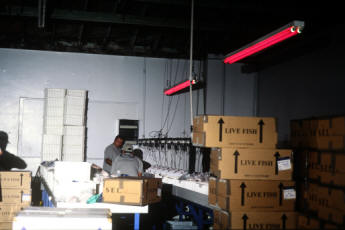
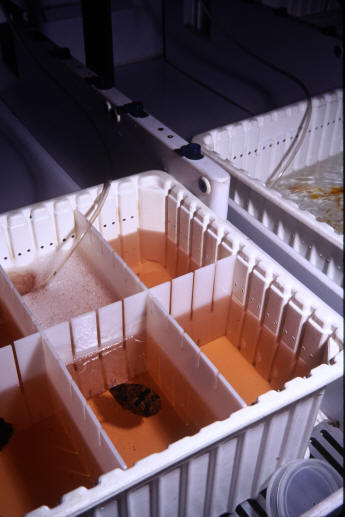
<Am enclosing a couple of olde (twenty years back) photos of a
wholesalers (Quality Marine), acclimation/receiving station area: Note the use
of red fluorescent lighting (regular lights are turned off during), the
individual tanks, and red (mixed acidified) and blue (regular) seawater valves
per tank>
4 Moorish idols in 25kg
salt bucket, is it too much for acclimation or our water exchange wasn't fast
enough?
<Again, can't tell from here; with the information (lack of) presented.
Would have to be there; seeing the animals on arrival, their reactions>
About 30 minutes in, even those in worst shape started swimming as ammonia was
going down and pH kept at 6.5.When fish started looking better we added heaters
to normalize the temperature. Since ammonia wasn't going down fast enough, and
our water supply was running low (had only 100 liters available for acclimation)
We decided to increase water changes, removing water from the bucket more
aggressively and adding more new water in. After ammonia was lowered to
1mg / l we started raising pH from 6.5 to 7 in all buckets.
<NO!.... NEED more pre-made water, NOT raising pH till ALL measurable ammonia is
gone>
Somewhere here things turned for the worse, fish that were swimming in the
buckets (blue trout triggers, clown trigger, Moorish idols) dropped down to the
bottom of the bucket. it only went downhill from here. Whole acclimation took
about 2 hours or so, were we to slow?
<BURNED. See the nomograph on WWM of pH vs. Ammonia toxicity>
After 24h, summary is 3/4 Moorish idols 2/2 Bluethroat triggers,3/3 lions 10/10
clownfish, 2/30 gobies died. Some of these fish managed out of acclimation to
die shortly after in QT tanks. I also noticed what i think is Uronema, and some
fin rot on Uronema infected fish.
<Is simple "shipping stress" from the too-quick raised pH mostly>
While observing the fish in buckets, only Moorish idols showed clear signs of
poisoning (swimming in dart like movements, gasping for air at the surface etc.)
On the bright side, 4/4 blue tangs survived, 1/1 veliferum and 1/1 Naso, most of
the gobies did, all blennies made it too, and one clown trigger but he is in
really bad shape. Fish had a very long flight here + some issues at the airport
and were held additional 6 hours on top of 30 hours flight.
I feel that disaster was inevitable, since fish were ordered and my friend
hadn't had any medications to ensure fish would live. Im attaching couple of
images of dead trigger so you can try to make a diagnose.
<No pix attached>
Again, I highly value your input and am hoping for a reply!
Ps. Would it be possible to arrange a Skype call perhaps?
I feel like it would much easier for us to speak rather than to bother you with
long emails like this one?
<Better by far for us to communicate in writing. The ONLY accountable way to
assure that we understand each other>
Kind regards,
Branko
<Bob Fenner>
|
 |
|
Re: Acclimation & Quarantine
10/13/15
Hello again,
<Big B!>
Thanks for answer. Somehow pic didn't get attached, I'm sending them now.
<See>
As for your comment that fish got burned, while reading the sera test kit
it indicated that if pH is at about 7 having 1 mg/l is not toxic,
<.... wrong; the higher the pH, the more toxic. Please just READ on WWM re.
Don't have time, interest in rekeying>
so we
figured we could raise it up to 7 and stop there, to continue rinsing
ammonia further.
<WRONG>
Since mostly bigger fish were affected, smaller specimens were and still
are totally fine. Some affected big fish shared the acclimation water with
smaller fish that went out of the acclimation process totally fine. So I
figured they affected fish suffered ammonia poisoning during the shipping,
rather than being burned by raising pH.
<Both>
You stated that most likely reason for fish dying after acclimation is
from
raising pH to <too> quickly. If that's the case, how long should the
process
take?
<Not a matter of time>
We raised pH by aeration, started raising after 30 minutes, using toxicity
guideline provided by sera test. As ammonia was dropping we adjusted pH
accordingly to still keep it in "safe zone". Whole process took about 90
minutes (after initial 30 min.s of rinsing ammonia out of the water) If you
need more information I would be glad to provide.
How many points of pH can be raised per hour? For instance if pH is 6.5
and we rinsed out the ammonia. Over the course how much time should we
take
it up to 8~?
Also how quickly can we rinse out the ammonia if it's showing maximum
value?
<READ: NEED to keep flushing, AS STATED OVER AND OVER, TILL THERE IS NO,
ZERO, ZIP AMMONIA DETECTABLE; BEFORE raising pH>
I guess we cant just take the fish out of the bag and put it in the
new water which is ammonia free, with same pH as the bag water?
What is the purpose of red lights? we had normal light bulbs in the room,
while aquariums didn't have any lighting on them selves. Also what's the
red
in the water from?
Would you consider the option of us flying you over to Serbia, for a
teaching session. Perhaps you could supervise an import and give us the
clues on where to improve and what to do? If not, would you take the time
to write step by step guide, with as much details as possible, and if yes
what fee would you have in mind for doing so?
Kind regards,
Branko
|
.jpg) |
|
Re: Acclimation & Quarantine; and some WWM repairs
10/13/15
Hello Bob,
<hey Bran>
I'm horribly sorry if I sounded rude & ignorant, that was never my
intention.
<Not taken as such>
I've been reading a lot on WWM, however sometimes people don't
see what's right there in front of their eyes. Somehow I managed to
overlook articles and was reading only through FAQs, and now I feel like a
complete idiot.
<No need>
Again, I'm really sorry for wasting your time. Most of the stuff I was
asking about is already included in those articles, not sure how I managed
to overlook it.
Ps. Hope this helps:
While browsing your site again, I stumbled up on this link
http://wetwebmedia.com/WWMAdminSubWebIndex/general_links_pg.htm just
wanted
to let you know that both links under *Livestock Sources: Marine *are not
working. One says forbidden access, while other one points to a kinky
website.
<Ah thank you; "the process of fixing continues".... the site/WWM was
originated, built upon the free version (included w/ MS Office) of
FrontPage (in 95); there have been MANY issues w/ redundant code
generation; somehow mysterious loss of integrity issues...>
Hoping you'll pardon my ignorance.
<And my terseness. DO send along specific questions. I DO want to help
assure your success. Am hopeful you DO understand that any ammonia present
at ANY elevated or raising pH is dangerous; potentially lethal>
Regards,
Branko
<And you, BobF>
Re: Acclimation & Quarantine; commercial
11/20/15
Hey Bob,
<Hey Bran>
I'm hoping you are doing well!
<Thank you; yes>
It's been some weeks and on my end everything is in "ready set go" phase.
Shipment of fish is arriving next week.
<Ahh>
I think I have figured out most of it based on your posts and our emails.
But few things remain unclear and here they are:
1. How do I know "metabolic nitrogenous wastes" are flushed out of the fish? I
can test water for ammonia, but how do I "test" the fish it self?
Or perhaps there is "standardized" time spent in ammonia free water, after which
fish is clean on the "inside" too?
<When the measurable wastes are gone from the water itself; this indicates most
all are gone from inside the fishes>
2. After all ammonia is gone from the water and fish by dripping matched pH
water. I am supposed to drip QT System water to raise pH. I have made the
automatic system, I can leave it to drip for as much time is needed, also can
speed it up/down just i need the reference point to base the speed on. How do I
determine what's the proper tempo for this?
<In most all cases, a few tens of minutes is optimal>
3. Fish come in water that has 6.3-6.8 pH (depending on the size of the fish) -
I will be making a huge batch of water for acclimation with one value pH, I was
thinking 6.5 and use that water for acclimating all fish.
If this is a No Can Do. Should i do 6.3 (or what ever will be lowest value this
time)?
<Match the lowest value in the receiving water>
Please find the time, yet again, for my numerous questions :)
<No worries>
I'll keep you updated about QT progress.
<Ah, thank you>
Kind regards,
Branko
<And you, Bob Fenner>
Re: Acclimation & Quarantine 11/27/15
Hey Bob,
<Bran>
I hope you are doing fine, fish are coming in tomorrow and i just realized that
there is one more question haha :)
<Let's get to it!>
I've read that temperature fluctuation or a sudden rise can be lethal.
<Mmm; not really.... a change of a few (2-3 C) degrees is acceptable in almost
all legit. fisheries and fish physiology works.... There are times, places where
even the coastal oceans fluctuate in temp.>
While fish come in at about 20 degrees Celsius in the shipping bags (possibly
lower since its much colder than last time). Whats the suggested temperature for
acclimation water and holding tanks water.
<Bring it up slowly along with the pH adjusted water at the temperature of your
holding system/s>
My idea was to use 22 degrees for holding tanks and acclimation, where i would
increase temperature every 24hours by 1 degree.
<Okay...>
Is this ok or should i do it differently?
<Just the temp. of the holding system will be fine. IF this difference was
very/dangerously warm (lower 30's C) there might be concerns, but not to worry.
Bob Fenner>
Kind regards,
Branko
Re: Acclimation & Quarantine 11/30/15
Hi Bob,
<Greetings Branko>
Im hoping you are having a nice weekend, mine got a little better too and
disaster seem to be avoided thanks to everything I've learned on wwm so far!
I greatly value your time and all the help I've got from you.
As promised, here's the report.
<Ahh!>
Fish spent additional 24h on the Qatar airport due to load being misplaced and
missed the scheduled flight. Taking the shipping time up to 60ish hours.
<Yeeikes! Well beyond the usual danger zone.... of a day, day and a half in
bags>
However out 220 fish and inverts only 10ish were dead in shipping bags.
<I'd still be filing a claim w/ the shipper>
Since i haven't got a reply from you
<? Do please see here:
http://www.wetwebmedia.com/AqBizSubWebIndex/bizacclimfaqs.htm
Do you see the accumulated archive of our correspondence? Is anything missing?>
i decided to follow guerilla method for majority of the livestock, while I made
a small batch of water with fixed ph and temperature so its the same as shipping
water. Into this batch i poured the dose of Methylene blue you advised for
baths. Took several fish out of the bags and put them directly in it without
ammonia rinse.
<Mmm; I would have followed the SOP; done the ammonia rinse>
We lost about 30ish fish so far, some were taking the turn for the worse today
so i guess number is not final, while none of the dead ones came out of the
batch with Methylene blue, all those are feeling good today. After seeing how
great the fish are doing in the blue we took some fish that were being guerilla
acclimated and put them into the blue batch (we did this for
the fish who seemed close to being dead and we felt there is nothing to lose so
we tried). I must say that within couple of hours fish started getting better
and are alive now. Some better than others but all are alive.
I haven't put cp into the system yet, i plan to do it tomorrow. Since there were
no visible signs of parasites i decided to give the fish 1 day to regroup before
submitting them to the stress of being medicated.
However all fish did go through 5 min freshwater+MB bath prior to being released
to qt tanks.
I have wrasses, gobies, blennies, Acanthurids, Zebrasomas, triggers,
butterflies, damsels dwarf and large angels and finally lions. Plan is to run
10mg / l of cp. Is there any group of fish out of those listed that shouldn't be
subjected to cp?
<I'd hold off on any medicine exposure for now. These fishes have been exposed
to too much stress as it is>
Kind regards
Branko
Hi again, 11/30/15
<Ahh, had not seen this correspondence>
I've got bad news, somehow our shipment was misplaced in Qatar and it wasn't
loaded onto the plane, they said it will be delayed 24h and shipped tomorrow on
the same flight.
Exporter said 30-70% will die... any piece of advice on what to do with the
survivors? Same guerilla acclimation or something radical? If yes what?
<The same Standard Operating Procedure. BobF>
Sorry for all the questions lately. I was really hoping today's mail will be a
cheerful report of a success story :/
Regards
Branko
Re: Acclimation & Quarantine 12/5/15
Hey Bob! Just want to let you know, this page is empty.
http://www.wetwebmedia.com/ammoniamarart.htm
<Ahh; thank you. This file is a "place holder"; will have to look to see if
there's a reason... Likely either unwritten, or awaiting sale of an article on
the topic>
Btw, I'm encountering ammonia problem. Acclimation did the great job, managed to
save some fish that were almost dead (only gills were moving, not even fins).
Thanks a bunch for everything so far I owe you BIG time. I did follow your
method I thought its called Guerilla (ammonium rinse etc).
<Amazing to me how tough some animals (and plants, and...) are. Sixty plus hours
in transit!!!>
About the ammonia issue, since I managed to deal with parasites/acclimation.
Ammonia is the only problem that makes me hesitant about next shipment. Ok, yes
system is fairly new and with time it will settle in.
<Good>
However, how do I keep my bacteria nuked with ammonia while fish are not present
in the system so system is ready to take on the next big shipment?
<I'd place good-sized "foam" filters (like Jungle:
http://www.jehmco.com/html/hydro-sponge_filters.html
Put frozen brine shrimp that will dissolve in water and pollute it?
<Mmm; no.... IF anything to feed, just a bit of flake food every few days (a
couple flakes) is all I'd use>
Kind regards,
B.
<W. B>
Re: Acclimation & Quarantine 12/5/15
Ok, I'll go buy sponge filters tomorrow then. I don't have particular brand
available here, but I'll find something else.
<Real good.... can even be home-made. But these are best by far for sustaining
nitrification long-term; with periodic absence, varying bioloads>
My idea was to take about 500 fish next time around. Would couple of flakes
really be enough to develop and support bacteria needed for 500 fish?
<Mmmm; depends.... but likely so.... I would NOT be feeding newly arrived
livestock much>
(sorry for repeated questions, I want to avoid possible misunderstanding
regarding the size of the shipment)
<Fine.... you have more than one tank I take it.... ten fishes per filter of
size is about right. Maybe two filters per tank?>
Kind regards,
B.
<Cheers, BF>
Re: Acclimation & Quarantine 12/5/15
I have 4 systems connected to sumps systems have 2x550l 1x710l and 1x1100l of
water in them. Big system is made for tangs and has 4 130cm long tanks.
Other systems are divided into boxes 60x30x30 cm boxes are divided so water can
go through but fish cant.
<Ahh; I see; thank you. I would run multiple larger size/d foam filters in each.
Bob Fenner>
Regards
B.
|
|
Re: Acclimation & Quarantine; commercial...
2/12/16
Hi Bob,
<Hey Bran>
It's been a while since our last email, but I'm following your posts on Facebook
on regular basis! :)
<Ahh; do you find me too humorous, sarcastic?>
After first import, came the second, few days ago actually. On Tuesday we
received a shipment of fish from the same source.
After 26 hours of flight and 6-7 hours post landing delay on customs etc...
we finally took the fish into quarantine, followed your procedure of acclimation
with adjusted PH and ammonia rinse. After acclimation we put all the fish in 15
minute bath in MB (with saltwater).
<Ok>
This time around fish were doing a lot better and only about 4-5% died within
first 12 hours.
<About par for the course for most good shipments>
It's exactly 72hours since we took the fish in and we are facing outbreak of
bacterial infection or Uronema,
<I see something like this on the blue damsel pictured... trouble>
I'll attach pictures perhaps your expert eye might see something mine cant.
IN past 72h we acted using this logic:
First 24h - Acclimation and letting fish rest and establish them selves in our
tanks.
Days 2 - Checking ammonia, if 0 feed fish and add CP. (ammonia was slightly
higher than 0 but lower than 0.5 using sera test (color was closer to 0 than to
0.5) so we decided to change water to make sure its 0. Decided to postpone first
feeding for day 3. CP was added on day 2.
Day 3, Chromis have open wounds on them and are perishing.
<Once they get to the "cut mark" (on any individual/s) they are almost for sure
all going to perish. I fully suspect they were and are bunk on the shipper's end
as well. I would seek credit/replacement for these PLUS the part of shipping et
al. costs>
Not all are infected, we have them in 2 separate systems both having issues.
Decided to put all fish in MB as it can kill bacteria so that's where the fish
are now while im writing the email.
<We'll see; again... let me see if I mention this on WWM: Yes; please put the
string "cut marks on damsels Uronema"
in the search tool on any page on WWM>
Over the course of 72h we lost about 50 out of 220 fish total. During first 48
hours dead fish didn't have any open wounds or any other signs of parasites
(Whitespot etc) so I figured those that died were too stressed and couldn't make
it. But today is different story. Some fish have problems with Fins as if fin
rot is destroying it.
<Again; likely problems on the supply side; PLUS the added stress of shipping,
handling>
Could you advise on where did we make a mistake.
<I suspect (again) you were shipped most of these issues>
Also please check images in attachment and let me know whether it looks like a
Uronema infection or bacterial.
<The damsel, likely protozoan, poss. Uronema; can only really tell via sampling
and microscopic inspection. Do you have a 'scope?>
I suspect it being Bacterial because blood marks are only visible on dead
Chromis and one Chelmon. Only 2 species that suffered any aggression from their
tank mates. Others that didn't, however died, have some issues with their fins
as if its fin rot, which points me towards bacterial infection again.
Should I do anything else besides putting them into MB, In our first emails I
think you said that i shouldn't pay much attention on using antibiotics in
saltwater.
<This is my firm belief still; for the last few decades... do too little good
too slowly to have much/any beneficial effect>
Desperate for advice.
B.
<I'd be contacting the shipper; AND other folks they buy from re
incidental mortalities, AND looking about for another supplier/source.
Bob Fenner>
|
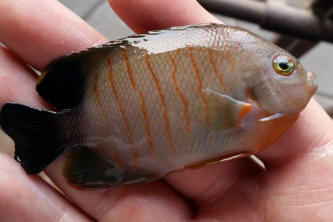
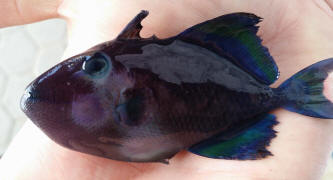
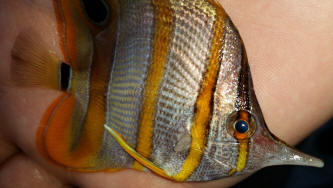
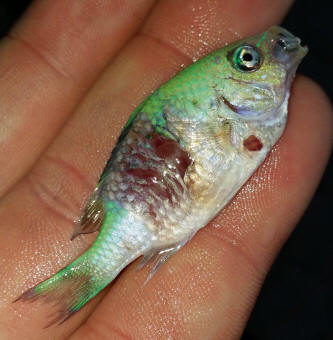 |
Re: Acclimation & Quarantine 2/13/16
I suspected it could be Uronema, we had issue with it last shipment too.
Any thoughts if CP can prevent rest Chromis from being infected I used 10mg/l
dose yesterday.
<My experience w/ Damsels and this "cut" issue; not likely to stop>
All fish came from http://aquatics.com.my/home/ - next shipment will come from
Different source one that supposedly supplies top notch businesses in aquatic
trade. Could you recommend a reliable source?
<Do please see/read my input here:
http://www.wetwebmedia.com/AqBizSubWebIndex/swfishlvstk.htm
Anyhow what else can I do for current fish, I'd like to save some if possible.
<What you're doing is what I'd do>
What I have to add is this, fish that came in really bad shape we instantly put
in Low Ph + MB and left them there for a few hours. Those that lives (only 2-3
didn't) are now doing mighty fine in different system than the ones Chromis are
in.
<Good>
Also one Forcipiger flavissimus had red dots all over his beak, he was one of
the really bad shape fish and after few hours in MB he recovered fully, and is
free of the red dots that's why I had the idea of putting all fish from affected
systems in MB.
<Methylene Blue is VERY safe. Can be added anytime, where>
They are in it for about 2 and half hours now.
I'll keep them for 2 hours more and try to put them back in their tanks.
Should I increase dose of CP?
<Yes I would. See WWM Re>
As far as FB is concerned, I really like seeing new posts about corals so I keep
a close eye on your posts :)
<Ahh! Bob Fenner>
Re: Acclimation & Quarantine 2/16/16
Hi,
I increased the dose of CP to 15 / mg l, Chromis are still perishing
about 10 per day.
<As I've keyed over and over.... they are all most likely to perish. In some
wholesale settings, we toss them...>
Other fish seem fine, some are eating some are not. apart from Chromis in past
3-4 days we lost 1 lion fish all others seem fine. Even though some are in the
same infected system with Chromis. (Lion fish that died wasn't in that system)
<The syndrome, symptom that kills Damsels in this way doesn't often (mal) affect
other fish groups. Again; the stress factor is HUGE here>
I'll be having a new import at the end of February / early March. I'll move
surviving fish out of the QT and make place for new stock.
<Ah yes; for sure>
What do you suggest to do with infected systems to get them ready for new fish?
Bleach it out and start over or just increase the dose of CP for a few days and
then change water?
<Bleach (chlorine) and IF you need to save the water (as opposed to dumping,
throwing it away), dechlorinate... cheapest w/ sodium sulfite...>
If we go for bleach, what should be done in terms of bio filter?
<Bleach it; all nets, buckets, specimen containers. USE some clean media from
elsewhere and an exogenous source of ammonia to re-start the bio-filter>
Is there a way I can save that and not having to start over or its best to buy
new sponges and put them in my home system to seed with bacteria?
<You want/NEED to use a bio-cide (kills all life) each time a new shipment comes
in. Is this clear, complete? Bob Fenner>
Regards
Branko
|
Re: Acclimation & Quarantine 2/18/16
Hi again,
<Big B>
Was in a bit of a rush today, some more fish died, another copperband and a
foxface. Foxfaces body was dark in color. I tested ammonia, it wasn't 0 but it
color was closer to 0 than to first measurable point.
I inspected gills they didn't look inflamed, no wounds/white spots nor anything
else my rookie eye could relate with a problem.
Since my yesterdays email, Zebrasoma Desjardini that is in the picture died as
well. It had that white marking on his belly on both sides.
Original Message:
Short update:
I decided to test things out a bit, i pulled out of medicated water 1 Zebrasoma
Desjardini and 1 Chelmon rostratus. Zebrasoma died within 12 hours, while
Chelmon died within 48hours. Only Chelmon had visible symptoms on it so im
attaching pictures. It looks like bacterial infection... what do you think?
<Possibly; or just stress>
Meanwhile today one of the Zebrasomas that is still in quarantine developed a
white patch on its body. Water has 15mg / l of cp and nothing else. All fish did
go through MB bath 3 days ago. What do you suspect the problem is?
<Can't say>
One angelfish developed a fin rot so im going to give it a bath in MB again.
Anything else besides it?
<Nope. B>
Best regards,
B.
|
.jpeg) |
|
Saltwater Fish Only holding systems; dis. control, set up.... MUCH to
consider 8/14/15
Hi there,
<John>
We own an aquarium store and we have 2 main 2000g fish only systems.
Both are running the following:
Fluidized Kaldness media
Protein Skimmer
Air driven sponge filters to keep tanks clean
<Mmm; what re discounting spread of pathogenic disease? I'd at minimum have a
serious UV for each (sub) system; possibly a set of cartridges (though a pain to
switch out, keep clean)>
Each tank is plumbed into a central sump and each system is divided into 84
individual tanks.
What my question is that we have been experience some deaths and mainly
due to disease we believe and we are trying to keep it to a minimum.
<Ahh!>
Here are my questions:
1) Should we always run medication in our systems such as Cupramine at ~ 0.25 -
0.4 and Praziquantel
<There are many stores, wholesale livestock suppliers and collector/distributors
who continuously run copper... and this is a good brand. The Prazi.... I'd
rather administer an Anthelminthic via foods/feeding... do you have a SOP for
dipping incoming fishes? Have you read mine? It's posted on WWM>
2) Put regular aquarium gravel to cover bottom of tank that collects a lot of
detritus
<Yes; worthwhile to use substrates with Labrids, Gobioids, Blennioids, other
fishes... smaller grades (crushed coral or Aragonite); but/though calcareous
materials will hasten loss of copper (this will have to be tested and added to
at least once daily)>
3) What can we do about algae constantly growing on our tanks from lights on 8
hours a day
<The copper will do this>
4) Is a UV sterilizer crucial and if so, what wattage or model would you
recommend for a 2000g system?
5) If we find ich in our holding system, should we treat the entire system since
they all share the same water?
<All? You state above there are two systems... the configuration and amount of
UV depend on your flow rate. This is also gone over on WWM. Where, when in
doubt, over-size>
6) Any other equipment list you would recommend?
<Oh yes; an ozonizer... DO read on WWM Re and please write me back with specific
questions>
Thanks!
John
Re: Saltwater Fish Only holding systems
8/15/15
Thanks for the fast reply!
<Welcome>
I have been reading through your website and I will definitely try the guerrilla
method. We have 30 boxes coming from Philippines in 2 weeks.
<Ahh; DO please read over and over... (am so olde that I'd make "index cards" of
the steps involved.); make sure you have adequate supplies on hand; including
staff that know the procedure to help you>
Just one question though. Is it possible that instead of a drip method to just
scoop a cup of water into the foam boxes every 10 minutes instead of running 30
drip lines?
<It is; yes>
And for aeration, do you suggest using a manifold or how would you aerate every
box without running 30 airlines?
<Aeration is nice; but if you have enough help... water movement (to dilute
waste, ultimately bring pH back up) will do. IF you have air, a manifold, DO use
it>
Thanks!
<Certainly welcome. BobF>
Re: Saltwater Fish Only holding systems
8/15/15
Gotcha! Oh and one more thing.
Do you recommend Prime or Nova+ and Amquel? And should I always dose it when
receiving new shipments?
<All three are fine products; and include some of the same ingredients.
None will continuously absorb/neutralize ammonia however. B>
Thanks!
Acclimating and Treating fish, comm.
7/7/15
Hello
<Hola!>
My name is Dani and I have an aquarium shop in Barcelona. I want to ask you a
couple of questions:
First of all is about how to acclimate fishes arriving from a transshipping
order (more than 48 h packed in the bags). I see your Guerrilla method but I'm
not sure if I understand it completely.
<Let's see>
What I have to do is:
1. When the fishes arrives open boxes and float the bags to compensate
temperature. Also check ph and ammonia in the shipping water.
2. Get some saltwater and adjust with the same PH in the shipping water 3. Put
the fishes with shipping water in a container and drip the adjusted ph new
saltwater and check ammonia until it disappear.
4. When the ammonia in the container is 0 I have to drip water from my system to
the container until the ph in the container raises to the same ph in the system.
5. When the container has the same PH in the system we can make a freshwater
(with adjusted ph and Methylene blue) bath and after the bath the fishes will be
ready to go to main system.
<Yes! Well done. IF the fishes appear too weak to do step 5, place them in a
marine system, and come back a day or two later to effect the pH adjusted
freshwater dips/baths>
It is correct? I get new fishes on Friday so I can use this method for the first
time with this shipment.
<Good>
The other question is about treating fish. I have a system of about 2500 liters
connected to a sump with 2x39w UV, ozonizer, a large skimmer and a fluidised
sand bed filter. Actually the water parameters are perfect (in my opinion)
Ammonia and Nitrite undetectable, Nitrate under 5 and salinity at 1020.
The problem is that when I introduce new fishes... some of they get Whitespot
very quickly and dies within days.
<The reason for 1) Selecting the best species, 2) Selecting the best
specimens... from the best locations and dealers... and 3) Expediting their
processing.... and 4 onward; providing the best, most stable, optimized
conditions; good nutrition....>
I don't know what to do.... maybe threat the entire system with Cupramine?
<I would try avoiding keeping copper in the water permanently. Do you have
access to Quinine compounds?>
Put more ozone and raise the RedOx?
<Yes; up to about 400 micro Siemens per cm.>
Maybe the fishes are in bad condition because I make bad acclimation?
<Possibly; or not from a good dealer....>
(I don't use the guerrilla method yet.... I usually acclimate the fishes
just dropping system water to the shipping bags).
<Ah, no... bad. Too easily to burn them this way>
I'm afraid because it's very bad to display a system with fishes with white
spot, but I don't know what to do in this case ^^
<The above acclimation SOP>
Thank you so much for the fantastic site, it's very helpful! And sorry for my
bad English, I hope you can understand me :)
<I understand you perfectly.>
Regards from the sunny Barcelona!
<Nos vemos as we say here in S. California (next to Mexico). Bob Fenner>
Re: Acclimating and Treating fish 7/7/15
Hi Bob
<Hey Mas>
Thank you for your quick reply.
<De nada>
About the SOP, all ok, I will try it with our next shipment.
<Good... I will tell you that amongst all my written efforts, getting
folks in the trade to adapt/adopt this procedure is likely my most important. If
and when we can and will provide better livestock, the business WILL grow.
Alternatively, all these years, losing a huge part of the hobbyists due to
"anomalous" losses has kept all back>
About the white spot, I think that my vet can prepare a solution with quinine...
can you tell me more about that?
<Yes; though it will take too long. Instead I would have you, they read here:
http://wetwebmedia.com/QuinDosingF.htm
and the linked files above, AND elsewhere on the Net... look for Chloroquine
(di)Phosphate>
For the good nutrition on the fishes, I feed 2xday with varied diet (mysis,
Artemia, Krill, ... mixed items from Gamma frozen foods, also mixed Fauna Marin
pellets food and flakes for herbivores, and live copepods for Synchiropus and
other finicky eaters) I hope that this is correct?
<Yes; good products, choices>
I also enrich the food 1xday with ESHa Minaroll (a polivitaminic and minerals
solution)
<Outstanding>
My major worry today is to kill the existent white spot that I have in the
system... If you think that quinine will be better than Cupramine I will try it.
<Well; we should talk regarding this. IF the entrenched infestation is
"very bad"; I/we in the collection side REALLY do at times "nuke" the system
(bleach it most often.... hypochlorite, chlorine bleach) and start again.... IF
not so bad... and fish only (no algae, invert.s, plants, nor sensitive fishes...
like clowns, tube-mouths...) chelated copper at full strength, checked twice
daily for concentration and topped off; is the route I would go... All incoming
dipped/bathed to prevent introduction. Comprende?>
Thanks!
<Welcome. Bob Fenner>
Re: Acclimating and Treating fish 7/18/15
Hi Bob, it's Dani again
<Howsit?>
I spend all the week reading lot of information about treating ich with
"Chloroquine Phosphate" but there is a lot of info around the web I see that
this product will be ok for treating ich and also for use as prophylactic
method, what do you think about that?
<Tis so>
If I understand I have to use 15-20 mg/L of Chloroquine Phosphate in our system
every 10 days and always do a 10-15% water change prior to a new dosage.
<Yes>
Do you think that this will help? Are this dosages and times correct?
<About>
Thank you!!
P.D. I use the SOP acclimation in our two last shipments without any problems,
buy I still having Whitespot in our system :(
<Dang! Entrenched infestations can be VERY hard to eradicate. Bob Fenner>
Re: Acclimating and Treating fish
7/21/15
Hi Again
<Mes>
Just a little question:
I get some Chloroquine from pharmacy, they're pills that contain 250 mg of
Chloroquine diphosphate ( equivalent to 155 mg of "base Chloroquine") and also
each pill contain some excipients like cornstarch, talc, magnesium esstearatum,
hipromelosa, macrogol 400 and titanium dioxide.
<Ah yes>
This excipients will harm any of the fishes?
<They are not>
Or can I use without problem?
About the dosage... I have to calculate with 250 mg of Chloroquine diphosphate
or like 150 mg of Chloroquine base? I think that with the 250 Chloroquine
diphosphate, but I'm not sure
<This is about right; though considering the whole 250 mg.s as useful will not
be problematical... There's a bunch of displacement and miscalculation of volume
of treated water....>
Thank you!!
<Welcome. Bob Fenner>
Re: Filtration recommendations and Dechlorinator reaction with Copper
4/1/15
Hi again, I'm just reviewing your Commercial Acclimation procedure again.
For Invertebrates it's basically the same steps as the fish without the use of
Methylene Blue, but should we also employ the use of a PVP dechlorinator with
tap water as well, in order to flush out the old shipping water?
Thanks again.
<Mmm; however it is done, you want to make sure any chlorine or chloramine is
removed. In actual practice this is rarely an issue; given the means most
facilities employ initially treating source water (contactors mostly)... and
most sanitizer IS complexed in the process of mixing with synthetic salt mix...
We are still talking marines correct?
Bob Fenner>
Re: Filtration recommendations and Dechlorinator reaction with Copper
4/1/15
Hello Bob,
<Kevin>
Thank you for the information. Yes marine invertebrates, more specifically SPS
and LPS corals.
<... Okay; a carbon contactor for removing the sanitizer; or for a smaller
facility/volume, pre-mixing and storing new water. BobF>
Quarantining copper sensitive fish; commercial
3/16/15
Hello Crew,
<Howsit Frank?>
I had a question about quarantining copper sensitive fish. I have a fairly small
operation importing fish as a wholesaler and I run Cupramine in my quarantine
tanks.
<Have used MANY gallons, car-boys of this product over the years>
I wanted to know what your suggestions were for fishes such as wrasses and
butterfly fishes since they are more sensitive to copper.
<Mmm; is posted on WWM>
Would you suggest a freshwater dip and placing them in the main system?
<IF in apparently very good shape on arrival, yes... I definitely WOULD do the
SOP acclimation for commerce archived>
Or putting them in a separate quarantine system using a different medication?
<Mmm; nah. Have seen around the world where some (smaller) Labrids, even
Chaetodontids were placed in invert. systems (along w/ tube-mouthed fishes and
Amphiprionines..., but if it were me/mine, I'd stick with the same dosage for
all>
If so what would be a good overall medication to use for those fishes sensitive
to copper if there is any.
<Also posted. CP. Bob Fenner>
Re: Quarantining copper sensitive fish; pH adjustment interval post ammonia
flush in comm. acclim. 3/16/15
Thanks for the reply. I do currently use your SOP acclimation, but I wanted to
check your recommendation on one thing.
<Do so>
After I flush out the ammonia with matched treated and matched PH water, what is
your suggested time frame to bring the PH back up to normal levels?
<Can be done; going upward, rather quickly... Unless there are other extenuating
circumstances (apparent poor livestock health mostly), my usual practice was an
hour or so to match the holding system... Holding the livestock in small volumes
is VERY stressful... and there are trade-offs as usual. Life is a series of
compromises>
I have heard of a wholesaler who do this step over a 24-36 hr period.
<Way too long. Have never seen folks utilize more than an hour or two...
Bob Fenner>
|
Retailer w/ induced livestock issues
3/10/15
<Otay!>
Hey Bob, Was great to take them few minute to talk with you on what I have going
on. Here is the message I sent to National Fish Pharm and heard nothing back.
Date sent was 12/10/14 Back when I was dealing with livestock from Quality
Marine. -
<Mmmm; will read>
National Fish Pharm.,
I'm interested in using your product at my retail store. I have been doing
maintenance since October 2012 and just opened a retail saltwater store in July
of this year. I have used your Praziquantel powder in the past that I received
from Grant Anderson, curator at Sertoma Butterfly House and Marine Cove here in
Sioux Falls, SD. I'm looking to decrease my fish lost and have quality
livestock. Lately been dealing with flukes and film coats on scales from a
emperor angel and white-tail tangs, which have now pasted. When introducing new
fish they tend to get a parasite/cloudy on the eyes and some loose there color
looking pale.
<Flukes/Trematodes are VERY common on wild-collected marine fishes. BEST to deal
with external ones with a pH adjusted freshwater bath that is laced with
Formalin, per the SOP here:
http://wetwebmedia.com/dips_baths.htm
Benefit or disadvantage I have is running each tank separate with their own
system with MarineLand bio wheels for filtration and heater
<We've spoken re... I would definitely be linking two sets of your individual
tanks (one for fishes, the other for non-fishes) to sumps; with UVs....>
. 6 - 40BR and 2
- 55 gallon aquariums. I've upgraded the carbon cartridges to Cermedia Marine
Pure cartridges for more biological surface area to help bio loads of the tanks
of fish going in and out. I don't have huge pH swings all stay in the 8-8.2
range. I've had some fish for no reason die, they look healthy one day
then the next they are flopped over dead at the bottom.
<Happens to all, everyone>
I had Grant Anderson over to test DO and CO2 levels in the store. The lowest
oxygen level was 84.5% many were at 90%. CO2 level he measured was 375-400 I
want to say. Ammonia and nitrite 0 nitrate 5-10. I try to do 5-10g water change
on each tank once a week. Lately it's been every other week.
Acclimation process I have been floating bags for around 20mins. Sort
the shipment out with what's compatible in 8 buckets. Cut bag and release into
bucket once sorted then are moved near tanks to start acclimating with air
tubing with a knot at the bottom to get a fast paced drip that's not quite a
stream. pH of receiving them in a bag is 7.4.
<... I would NOT do this. Instead review here:
http://wetwebmedia.com/acclimat.htm
and the ppt. linked above>
They are acclimated till the bucket has filled and I've drain quite a bit of
water out and restart.
So they get around 5-8 gallons of tank water to there 1-1.5 gallon of shipment
water. Time is around 2.5 hrs for drip acclimation. Before hand I had my
salinity at 1.020-22, now when a order comes in I'm dropping it to 1.018 the
night before as the supplier is around 1.016-1.018. Customers here like to see
higher salinity so when I top off tanks I add salt water
to get it to 1.020-22.
<Good>
Since I have changed suppliers he mentioned to add something that detoxifies
ammonia, some fish from a previous shipment showed signs of ammonia burn
to the gills.
<VERY common>
Been doing that now and having better success so far. Also says to do
freshwater dips when fish are breathing heavily or acting odd.
<I'd always do them>
Things I've considered were to add a air system with a air stone to each tank
and possibly UV sterilizers.
<Again... put them on a (two) combined system/s>
Pending costs and such. UV choice may be hard as some may not be so sufficient
for my application and need decrease
flow for more contact time in the UV. Some one advised me to put a sump on a few
tanks to help with pH swings but don't think it's that bad. In order for me to
put sumps on the tanks I would have to tear down the current operation and
rebuild.
<I would do this... As we spoke on the phone; either drill, have the tanks you
have already drilled, or sell them and have your tank supplier drill new ones
ahead of their assembling... an inch and a half hole either in the back corner
or a rear corner of the tank bottom... for a minimum 1.25" ID schedule forty
bulkhead fitting>
What recommendations/products do you have to offer for my scenario?
Products I've been looking at are Chloroquine Phosphate, De-Los, Nitrofuracin
Green, and Praziquantel Powder.
<FIRST and foremost the prophylactic dip/bath, NEXT a cheapy microscope and a
few reference works. NO SENSE simply exposing your livestock to med.s if
unneeded. They ALL have their downsides; most are toxic to degrees; some are
costly, most interfere w/ water quality....>
Let me know if I need to fill anything out or if you just need my tax
certificate.
Thank You for Your Time,
Matt Wichers
Sioux Falls Aquatics, LLC
605.759.7100
<Mmmm; do you have a partner, someone who helps you as well Matt? I'd like to
speak w/ all involved. Bob Fenner>
Re: 3/10/15
Bob,
<Matt>
Only partner I have is my wife (Trista). She is a great supporter and comes with
me to MACNAs.
<Ah, good>
I have one guy (Rick) that helps out when needed, just to watch the store for me
when I'm going to events like meeting you in IA.
He has been in the hobby longer than me. He had thought separate systems
would be beneficial as well.
<Mmm; no; not w/o more gallons, other means; as you've listed... to keep them
stable and optimized>
We both knew it would be more work but if one fish got sick the whole system
would be on the bad side and then treat the
whole system.
<Sigh.... again; most all issues of health are a matter of initial state
(handling mostly), and environment... to lesser degrees nutrition... and even
less (really) due to pathogens. Read here:
http://wetwebmedia.com/mardisease.htm >
I have been to LiveAquaria for a tour of the place.
<Their marines almost all come from Quality Marine>
I will go back and look at the photos I took. I hope theses photos work this
time.
Give you a little feel on my store area and fish mishaps.
<Very nice lay-out... the fish livestock... burned... by ammonia, the poor
acclimation SOP... VERY common.
BobF> |
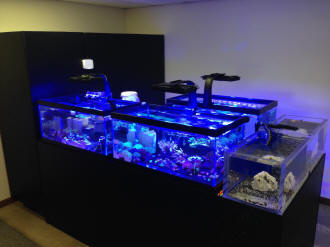
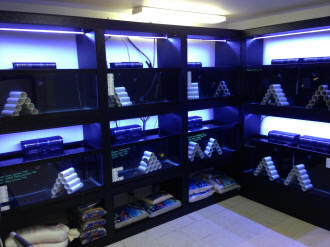
 |
Guerrilla Acclimation procedure
2/21/15
Hello,
<Hi there Heng>
I wanted to know if you could help answer a few questions.
<I will try>
I have been
reading your articles for a while now and I wanted to know if you could help
clarify the Guerrilla acclimation procedure.
<Ahh; likely so. I've written and spoken about this technique many times over
several years>
We're new fish wholesalers and we're bringing in our first shipment of fish and
corals from Indonesia. I am planning on using your Guerrilla acclimation method
and we're developing our SOP for the marine fish.
I wanted to clarify your procedure.
1. Float bags in Quarantine tank to adjust the temp for 10-15 minutes.
<Or bring up to temperature by simply opening the boxes>
2. Transfer livestock and shipping water to Trays with aeration
<After measuring for at least pH and free ammonia; yes>
3. Drip treated aerated RO water or treated tap water
<Not RO; just the tap>
into the trays (treated with PVP dechlorinator and Methylene blue ) - This
mixing water is PH adjusted to between 6.5-7.2 depending on what the PH in the
shipping water is.
<Yes; match this>
4. Do this until Ammonia is flushed out - usually double of water that's in the
trays.
<Can't tell how much volume it will take... sometimes several times...
flushing mixed water to waste>
5. Now start dripping water from quarantine tank (which has PH of 8.2) into the
trays to bring the PH back up - Quarantine tanks water is from system water.
<Yes>
6. Dip the fish in freshwater baths
<IF they're in good enough shape... otherwise, defer this step till later (a few
days)>
7. Transfer to quarantine tank which has PH of 8.2
8. Dump out shipping water.
<All mixed water; yes>
Or do you skip step 5? If so does this mean that the quarantine tank PH is at
the same as the shipping water PH (for example 6.5) and you bring this back up
to the system PH over 2 weeks? (for example over 2 weeks you bring it back up to
8.2)
<No to skipping step 5; it is absolutely critical>
Do you have a SOP for acclimating corals?
<It is the same; except no freshwater dipping, bathing... And adding a good deal
of iodide-ate during step 5... a few times the "regular dose"; not important
just how much is used>
I was looking at doing the following which is similar to the one for the fish.
1. Float bags in system tank to adjust the temp for 10-15 minutes.
2. Transfer livestock and shipping water to Trays with aeration
3. Drip aerated RO water or tap water into the trays - This mixing water is PH
adjusted to between 6.5-7.2 depending on what the PH in the shipping water is.
4. Do this until Ammonia is flushed out.
5. Drip water from system tank (which has PH of 8.2) into the trays over several
hours to bring the PH back up
6. Dip the corals in Revive
<Ahh; or Revive if you prefer. I don't use, nor endorse "plant extracts" per se>
7. Transfer to system
Since this is our first shipment, should we just transfer the corals into our
main system and monitor from there?
<... I would do all that you have time for through the SOP detailed above>
Thank you
Heng Te
<Do write back w/ your observations... this process is time consuming and will
be very trying... Shipped livestock looks like it is going through triage often.
Bob Fenner>
Re: Guerrilla Acclimation procedure
2/22/15
Hello Bob
<Heng>
Thank you so much for writing back so quickly. I will definitely keep you
informed about how it goes. Your work has been an inspiration to many of us and
I applaud you for that.
<A pleasure to conspire w/ you, aid your success. Bob Fenner> Acclimation Question, comm., SW
1/28/15
Hi Bob,
<Matt>
I have a retail store stock acclimation
question. I've been using the guerilla acclimation technique in all
aspects other than instead of flushing out the shipping water right away
I've just been treating it with prime.
<Mmm; can be done; but I wouldn't use this... better to slowly flush the
ammoniated et al. water out>
We are shipping from Quality Marine
<The "A" player in the trade in the US>
generally in LA from
<to I'll take it>
Portland
<Oh! I'll be back up visiting the marine club there in a few months>
and fish are usually well packed and in boxes for about 14 to 18 hours.
I've had semi high mortality rates
<... unusual>
and I've been chatting a lot with the husbandry team at quality marine
and they think I'm making the acclimation too long and too complicated
given the time the fish are in the bags.
<Interesting... as the acclim. SOP I detail is largely adopted, adapted
to that of QM from many years back... when Phil Shane and Mike Ibaraki
owned and ran the place>
The pH is generally around 7.2-7.4 in the bag on arrival. And usually a
couple hours before it's up to tank. They recommend the following
method:
"We recommend that boxes should be opened and fish be acclimated in low
light to reduce fish stress. For most species, bags should be floated
for 20 -30 minutes in the tanks that will house them to compensate for
water temperature differences. However, if there is any indication that
the water has fouled, it is recommended that the bag is floated for no
more than 15 minutes and the inhabitant should immediately be released
to clean water.
It is always recommended that you have an idea of the Salinity and pH of
the water used for shipping. This will allow you to adjust your system
as necessary. Drastic changes in water quality greatly reduce
survivability.
For sensitive species, such as starfish and ornamental shrimp we
recommend drip acclimation; a process in which water from the system is
slowly dripped into the bag. This precaution allows the organism to
slowly adjust
to the change in water conditions."
<Mmm; well; am going to stick w/ my protocol. IF there's
detectable ammonia in the shipping water (there is assuredly; even IF
the organism/s have been shipped w/ the very best technique), I would
match the flush water pH to it, and drip/acclimate the organisms with
the new matched water till there was NO ammonia present, THEN I would
drip/acclimate them with system water (of 8. whatever pH yours
is)>
This seems, well, like it would be awesome, but definitely different
than what I've ever done or researched. What are your thoughts.
Thanks,
Matt
<This is such a VERY important topic/subject that we should go over and
over it till we are very sure of everyone's input. THEN you must decide.
Quality handles more pieces/individual organisms in a week than most
retailers will handle in a life time in the trade; but I too have
processed hundreds of thousands of fishes and non-fishes. They
themselves (QM) use
the identical SOP as the acclimation protocols archived on WWM; which
are very tried/tested and of use. Bob Fenner> Re: saltwater import 4/27/14
Dear Mr. Bob
<Hello Andre!>
I m very thankful to you for your fast reply. It s great to see that
people like You exist.
Thanks
Andre
<Am glad to assist your efforts. Cheers, BobF>
Re: saltwater import, comm. acclim.
4/27/14
Dear Bob
<Andre>
if the shipment takes more than 30 hours should I adjust the quarantine
system PH and just add the fish directly there with no shipping
water, or should I drip?
<Drip my friend... per the Acclimation protocol on WWM... pH adjusted to
that of the shipping water>
Thanks
Andre
<Welcome. BobF>
Re: saltwater import 4/28/14
Salinity...
Dear Bob
What should I do with the salinity should I drop it like to1.010 or
should I keep it natural for fish like
1.020?(in the system).
Thanks for all your time and sharing.
<Read here:
http://wetwebmedia.com/spg_salinity.htm
and the linked files above. B>
Re: saltwater import 4/28/14
Thank You Bob.
<Welcome Andre. B>
Bob Fenner ( Quarentining SW Fish); commercial/LFS
3/7/14
Hi Bob,
<Colin>
I am the owner of a LFS called Crystal Reef Aquatics in
Bellingham Washington and I am seeking some advice on
quarantineing saltwater fish.
I've been in the hobby for almost 6 years so I'm very familiar with
standard qt procedures such as no sand or rock, use PVC for hide outs
and a sponge filter to break down your waste. The biggest issue
I'm running into is picking a medication that is both cost effective and
does not effective the fishes health negatively.
<Ah yes>
I've used copper and had success but I've seen fish go downhill from lack
of apatite. I've also used Chloroquine phosphate and had good results
with that but I'm sure you are aware that you cannot test for it so it
can be hard to guarantee is potency.
<Yes>
And of course PraziPro for your flukes and worms. What is your qt
procedure?
<Posted here:
http://www.wetwebmedia.com/mardisindex.htm
Medications of choice?
<This too... use the indices or search tool on WWM>
Also keep in mind the most cost effective( price of salt in water
exchanges and in cost of the medication) as we'll as the
duration of time that the fish has to be exposed to the medication?
<Oh yes... I was in the trade, and a content provider... for more years
than you've been on the planet>
Unlike most stores that are of the mentality for quantity over quality our
goal here at Crystal Reef Aquatics to supply the hobby with disease free
fish so it is an enjoyable experience for the customer and of course a
better survival rate on our incoming fish.
<Ah yes; a good; actually, the only reasonable path to building the
industry, trade, your business>
Any knowledge or insight on the matter would be greatly appreciated.
Thank you for your time and I look forward
to hearing from you soon!
Best regards,
Colin Apt
<Do write back w/ specific questions after you've read. Bob Fenner>
Re: Bob Fenner ( Quarentining SW Fish) 3/7/14
Thanks for your prompt response!
<Ok>
Do you prefer Chloroquine phosphate or copper for qt? And why?
<... Most often have used copper cpd.s; quinines in my time were too
expensive>
Have you used PraziPro with copper or Chloroquine phosphate? If so any
negative side effects? Oxygen depletion?
<... have not; but read of others doing so>
How long do you medicate with copper or Chloroquine phosphate? Is one
faster then the other?
<This is posted>
How long do you medicate with Prazi pro?
<As is this>
I've heard of people moving a batch of fish to a sterile environment
every 3 day to help eradicate Ich. Have you done this method? If
so how successful is it?
<Ditto>
Have you ever used hydrogen peroxide to sterilize a quarantine tank
after it's been used to reuse the saltwater?
<Not reliably>
Are there any medications that I didn't mention that you would
recommend?
<... read. B>
Thanks again for your time!
More loss; personal to commercial Marine fish dip/bath
odyssey of discovery 2/12/14
I lost one of the two blue remaining tangs overnight. They
were both active and eating last night in a proper temp, proper SG
quarantine tank. I tested Ammonia at .025ppm and nitrite at zero
last night, but I didn't have the resources to so a 20% water change, so
I added 2 caps of Amquel and went to bed. This morning the
medium blue tang was dead Starting with 2 small blue, 1
medium blue, 1 yellow, 2 Flame Angels and a Goby, I have just one small
blue tang left and I can't tell if I'm more angry than sad. And
worse, I have no reason to believe I'm not on a death watch for him as
well - I certainly can't put him in the main tank.
My first attempt was much better. I had the group in a 35
gallon hex tank and the blue tangs got massive Crypt, so I immediately
went to hypo salinity. I lost the sickest of the small blue tangs,
but every other fish survived and thrived and 4 weeks later I gradually
brought the SG back to normal - and two days before I was going to
transport them to my son (for his Christmas present) the Tetra heater
thermostat stuck and cooked the whole tank. Lost all of them.
<Argh>
This second batch was an exercise in personal pain as I lost each fish
individually with no obvious reason. I tell you if I could pay for
an autopsy on the tang and get the results today, I'd do it.
{sigh}
Anyway the 37% Formalin arrived and completely coincidently the fish
store's first direct shipment of 16 purple tangs<Wowzah!> will
arrive sometime today so I'm going to go down to help/advise them but
honestly my heart just won't be in it. Yesterday, in
preparation, they were on the net doing research and - as I always fear
- came up with other, equally plausible dip/treatment options and are
asking questions that I can't answer. So of course, I turn
to you -as if you have nothing better to do.
By The By... in talking to people and hearing their questions... have
you ever had the urge to blurt out "here-just give them to me and let me
kill them for you right here and now rather than draw it out over 6
weeks!"?
<All the ding dang time>
ahem
1) The dose seems to be 3.75ml of Formalin (37% formaldehyde) to 5
gallons of temp & pH adjusted, aerated water regardless of below
<Ok>
A) FRESH water dip is 1 minute ... maybe 1Min 15sec but remove the fish
at first sign of stress... but no longer.
<Right>
B) SALT water dip is 30 minutes, maybe 60 if they seem to tolerate it.
<If you'd like/prefer>
My advice to them as that the Fresh water dip adds the osmotic imbalance
to help destroy the parasite cysts, whereas a salt water dip would only
attack free swimming bugs or, at least, non encapsulated ones.
Might help with gill flukes, etc. From what you've taught me, a
marine/formalin dip is a lot like washing ones hands where a fresh water
dip is like sticking them in acetone. If you have real bugs,
use the real treatment.
<Yes; assuredly>
Mark then asked about long term weaker formalin in the quarantine tank<I
wouldn't do this. Too toxic for long-term exposure, and no "residual"
benefit>
as his previous employer did. My weeks of experience in tropical
fish keeping tell me that exposing your fish to a poison for a long
term, even at a lower dose, is going to debilitate the fish and the only
time I'd do that is when/if a specific course of treatment for a
specific malady required it.
So anyway that's today's questions. When I get the answers
I'll trot off to help kill OTHER people's fish today
D
<Again; I have "done" the SOP posted on WWM, elsewhere for hundreds of
thousands of marine fishes, instigated, instituted the practice with
others, facilities at dozens of locations around the world. I DO have
high confidence in it being worthwhile. B>
update. Commercial (LFS) SW import of livestock... processing
2/14/14
Hey RMF...
<Big D!>
Just to update you ... they weren't as ready as I thought for doing dips
on incoming fish, so we acclimated overnight and did it at noon today.
They lost two wrasses last night and by noon most of the stock looked
more alert and active, although they tell me that a wrasse laying on
it's side isn't a grave condition that say, a yellow tang might be.
<Sort of so> So we did the dip and placed them in an observation
tank with the idea that the fish has to be eating and active and acting
normal for 2 days before putting it on the floor.
<More time would be better; but...>
Peter explained the economics of his plan - and if he can keep his
losses down it probably makes sense, but I explained that, to do this on
any schedule and at any volume they're going to have to set up a
dedicated intake station to accomplish this. The intake an
acclimation has to be better than opening the bags into a plastic tub
and dripping water. I'm almost thinking that they have to match
the temp/ pH of the incoming fish into a 40 gallon tank (with dividers)
so that if the incoming is 6.4 at 72 then we have a 40 gallon 6.4 at 72
in order to A) Dilute the Ammonia present immediately and
B) take perhaps 12 hours to then acclimate to 8.2 & 82 and THEN DIP
them?
After you explained it last night it seems clear that JUST raising the
pH without quadrupling the water volume was adding stress, not relieving
stress.
<Better to use something standard... on a dedicated table... with the
top having a rim and a drain to keep all neat and clean... AND use
containers as detailed in my writings presentations: Kitty litter
trays... poly, clean, smooth sided, softer AND stackable>
While we were waiting, Peter explained that he thinks they have a long
term problem in their sale system, because if they have virtually any
fish over 6 weeks it seems then whither and die.
<This IS trouble... What do they consider the reason/s here? Something
lacking... in the species or specimens/source? Something amiss w/ their
water quality? Nutrition?>
Taking a page from the "do as Bob says and not as Darrel does" book -- I
suggested that they need to get a microscope and learn how to examine a
dead fish - because we certainly can't treat an entire system for "we
don't know what it is."
<That would be ideal.... FOR all stores, wholesalers, shippers to STUDY;
KNOW what they're doing, what they're looking at/for>
Which brings me to a point that I'd like you to consider and we'll talk
about later (but soon).
Pete and Doug are struggling, but they're not doing this for free.
Even the work I do for them I take out in free water-change water and an
occasional fish.
<Good>
I think we should suggest that they either pay you in cash for two solid
days of being here, teaching, showing and futzing ... say ... $700
+ lodging
or in the alternative, I suggest that Doug buy 3 months of ad space on
WWM. Not as a quid pro quo but more of a "It's what I'd do if it
was me"
<IF they can afford it; fine. If not, am glad to help them for what it's
worth to me... A great deal to aid folks, friends as you, in being
successful in the trade; in turn providing good/better services,
products to "customers".
could you live with either of those options?
D
<Sure. B>
Re: acclimatization; biz. and hobbyist? 1/31/14
Thanks Bob,
<Welcome Tomas>
I would like to know Your opinion.
What is Your opinion about keep the fish in quarantine/store tank for
few months.
<Mmm; two weeks is "about right". Stores won't get "more value"
than running most all new fishes through a prophylactic/preventative
dip/bath, and isolating invertebrates, algae... more than 10-14
days. Longer costs more (too much), and disimproves health from
being in small volumes etc.>
You prefer keep in large tank with couple fish together (the
same species or mixing ?)
<Some species; like most Tangs, yes>
or in the small tank with one fish?
<For expensive, solitary species, like Angels, yes>
How is the best for the fishes?
<Depends on species, sizes, sexes often>
Thanks for informations,
All the best
Tomas
<Have you read here:
http://www.wetwebmedia.com/mardisindex.htm
The first tray? Bob Fenner>
Re: acclimatization; commercial 2/8/14
Hello Bob,
<Tomasz>
Sorry for bother You,
Dip baths in freshwater.
<Yes>
Never do this solution at acclimatization, but i read in Your web site
is very good.
<For many fishes, circumstances; yes. Not all however>
And question is, how long keep fish in freshwater before put them in the
aquarium?
<Depends... on the species, their apparent condition; how they're
reacting.
YOU must be present, observing at all time>
All the Fishes from long trip (Indonesia).
I always do; prepare water in correct pH, add air stone, add Methylene
blue, them rise the pH, after that when pH is the same in the aquarium i
put fishes in the tank. ok...
<Yes; a good summary>
Before them put the fishes in the aquarium i wondering to put the fishes
in to the fresh water on the few minutes. But i don't know how long,
that was safe for the fish? Or the was necessary when I use the
Methylene blue.
it will not be an additional stress to the fish?
<Usually a minute or two is about ideal... again; you should be there
watching all; removing the fish/es if they're too stressed by the
dip/bath>
I know You can help me.
<Am glad>
... great interview which prepared Jim Stime with You . :) very
interesting.
<Ahh, yes>
Thank You and i wish You nice weekend
Tom
<And you my friend. BobF>
|
For Anthony or Bob: Commercial Acclimation & Quarantine
8/4/13
Greetings,
<Salutations. BobF here>
I'm writing to ask your opinion/guidance regarding commercial
acclimation & Q systems. I would ask that this communication be
kept in confidence. >Changed<
Perhaps if you feel it would be helpful to others we could discuss
sharing the info/pics later on.
<... will sadly not post... As you hint above. Your efforts could help
many others>
Anthony visited me about 7.5 years ago when I had just moved into my new
reef facility. I am primarily a soft coral aquaculture facility,
secondly a reef only retail store & visitor center third. I have
been in the biz since 1996.
<I see>
I have 3 separate livestock systems that I sell out of consisting of
15g, 20g & 40g long tanks connected to a sump. Their first
function is to house the baby soft corals I grow. Fish I bring in
to sell are also housed in with the corals. This has worked very
well for me except. though I normally experience a low DOP, any fish
losses are unacceptable & my desire to reduce/eliminate them is what
prompts me to write you.
<Ok>
This year I incorporated a new acclimation system, concerned I was
losing a fish here & there from ammonia poisoning.
<Historically and no doubt presently the single largest source,
contributor to incidental mortality...>
Recently I experienced a massive outbreak of velvet which in the 17
years of commercial operation I've only had this happen once or twice
before & not nearly as bad as this time.
<Can be... devastating>
I believe this event was different because I used to individually float
& acclimate each bag then release into it's sale tank.
<Ah yes; roulette>
If a fish was infected it would normally only affect the tank it went
in. I am concerned that my new acclimation system exposes/infects
other healthy fish from a shipment since they are acclimated in the same
pans so instead of one infected,
<Mmm; well... the process itself should rid external parasite issues
(unless they are deeply embedded; which Velvet generally is not)>
I now have many. I do not at this time have a Q system in place
though after this experience, I'm considering one - details below.
I honestly never have Ick issues but Velvet. rarely comes in but when it
does..
Would you be so kind as to look at my acclimation & quarantine system
outlines below & provide me feedback?
<Sure; in fact these topics are added this time through as my second
presentation at next weeks UNE Fish Health Conf.>
My acclimation system: 5g pails gravity feed system water to acclimation
pans as shown right.
<Yes>
RO feed line mounted on high end of pan creates aeration to the water.
Not sure if this is enough to disburse ammonia.
<It is in time>
The elevated 5 gal pails contain treated system water - (lowered PH &
Meth Blue) - gravity feed to the acclimation pans. RO bulkheads
installed in the bottom of the pails with RO ball valves allow me to
control the rate of treated water flow into the pans. Each pan has
an RO bulkhead installed & ball valve to control the gravity outflow to
a drain.
<With you so far>
Some of my fish are bagged in water already medicated from the supplier.
Is there any risk from combining medicated bag water to the Meth Blue?
<There is not>
My Acclimation Process - feel free to tell me if I'm doing anything
wrong or could do something better.
Fish bags are opened & fish gently poured into a pan along with their
bag water - making sure to put compatible fish together. Once all
the fish are in the pans I start the treated water flow/flush into the
pans. The RO lines going into the pans are installed on the higher
end of the tilted pans so that the treated water gently drops into the
water generating
agitation/aeration. I tried using an airstone in each pan but they
seemed to stress the fish.
<Yes; shouldn't be used, as this can/does too rapidly raise up pH,
changing ammonium (NH4+) into MUCH more toxic ammonia (NH3); poisoning
(burning) the livestock (internally)>
Do you think I should or do you think the agitation from the flush line
is enough?
<Am almost certain it is... you could check w/ a DO meter>
Once the treated water flush is done I start a second flush with
normal/untreated system water to bring the PH back up.
<STOP! The newly mixed water MUST be pH matched w/ the bag/shipping
water... You need to measure a sample of incoming bags to ascertain
their pH>
When complete I gently net a fish & place into one of the rack tanks.
Total acclimation time is approx 1 hour start to finish. Any
thoughts to improve what I'm doing or is this ok?
<Yes.... READ here:
http://www.wetwebmedia.com/AqBizSubWebIndex/bizacclimfaqs.htm
and the linked files above>
If a fish comes in with Velvet is it safe to assume it infects all other
fish in the same acclimation pan?
<... Mmm, well... there is this potential... I want you to carefully
read where I've just referred you to... and consider adding a further
dip/short term bath of reduce spg with formalin and Methylene Blue
likely... AFTER the quarantine/rest procedure (for fishes; not invert.s,
algae....>
Proposed fish quarantine/observation system:
6 - 15g tanks - all drilled with 1" bulkheads dumping into one common
sump - approx 115g total system including sump gallons). A 40 watt
UV sterilizer installed on the return from the pump. The sump
would have a skimmer, heater, live rock for bio & auto top off from my
RO system. Each tank would have it's own ball valve so I can shut
it off/isolate any tank from the system to medicate etc. if necessary.
An isolated tank would receive a biologically active power or sponge
filter for bio. Which do you think would be better to use?
<A bunch to (overly simply) state here: I would definitely switch out
(and bleach the olde) filter media, WITH new/recycled from your
known-clean system... And... oh, I see this below>
Do you feel a 15g tank is large enough to comfortably house a 3-4" Tang
or similar fish?
<Better to have several (M.E. for many) cubicles on half, one, two
gallon size.... AND larger tanks for mixable life>
I do have a 40g long drilled as well but don't want to use it as I find
pathogens are fairly contained in it's own tank on this type system.
Is it better to go with this type setup with multiple small tanks or
should I incorporate the 40g as well for larger fish?
<I'd have both; as stated above... the cubes for disagreeable species
like dwarf angels; the larger for more social, like Chromis>
Should I add substrate to a section of the sump to stabilize PH or
would the rock & daily water changes be enough?
<I'd get/use a simple/r monitor/controller (a fave, Neptune's "Apex")...
Not have substrate unless in removable trays... only for fishes like
some Labrids...>
I thank you in advance for any direction you can afford me. I
truly do care about my animals.
<Ahh! Am very glad to find this is so; and am pleased to aid your
efforts, success>
Sincerely,
<Be seeing you, Bob Fenner>
|
Re: For Bob: Commercial Acclimation & Quarantine
8/5/13
Greetings Bob,
Thank you very much for taking the time to respond...& so quickly.
Sadly I was not notified of the UNE Conference (poor promotion on the
organizer's part) though to be fair, even if I had been aware I would not be
able to attend in part due to my facility being open at that time & I have
no employees to cover my absence. I am disappointed I will not have the
pleasure of meeting & thanking you in person.
<Ahh, some other occasion>
I do have a couple more questions based on your responses & after much
reading at the link you provided. I have marked my questions with *** so
you can easily find them below.
Again, many thanks & well wishes!
Penny
----------------------------------------
NOW for posting
<<I will resp., but am asking if I/we drop ref. to you, your biz, that you
allow us to post this interchange on WWM, the bus. acclim. FAQs>>
For Anthony or Bob: Commercial Acclimation & Quarantine Greetings,
<Salutations. BobF here>
I'm writing to ask your opinion/guidance regarding commercial acclimation &
Q systems. I would ask that this communication be kept in confidence.
Perhaps if you feel it would be helpful to others we could discuss sharing
the info/pics later on.
<... will sadly not post... As you hint above. Your efforts could help many
others>
Anthony visited me about 7.5 years ago when I had just moved into my new
reef facility. I am primarily a soft coral aquaculture facility, secondly a
reef only retail store & visitor center third. I have been in the biz since
1996.
<I see>
I have 3 separate livestock systems that I sell out of consisting of 15g,
20g & 40g long tanks connected to a sump. Their first function is to house
the baby soft corals I grow. Fish I bring in to sell are also housed in
with the corals. This has worked very well for me except. though I normally
experience a low DOP, any fish losses are unacceptable & my desire to
reduce/eliminate them is what prompts me to write you.
<Ok>
This year I incorporated a new acclimation system, concerned I was losing a
fish here & there from ammonia poisoning.
<Historically and no doubt presently the single largest source, contributor
to incidental mortality...>
Recently I experienced a massive
outbreak of velvet which in the 17 years of commercial operation I've only
had this happen once or twice before & not nearly as bad as this time.
<Can be... devastating>
I believe this event was different because I used to individually float &
acclimate each bag then release into it's sale tank.
<Ah yes; roulette>
If a fish was infected it would normally only affect the tank it went in. I
am concerned that my new acclimation system exposes/infects other healthy
fish from a shipment since they are acclimated in the same pans so instead
of one infected,
<Mmm; well... the process itself should rid external parasite issues (unless
they are deeply embedded; which Velvet generally is not)>
I now have many. I do not at this time have a Q system in place though
after this experience, I'm considering one - details below. I honestly
never have Ick issues but Velvet. rarely comes in but when it does..
Would you be so kind as to look at my acclimation & quarantine system
outlines below & provide me feedback?
<Sure; in fact these topics are added this time through as my second
presentation at next weeks UNE Fish Health Conf.>
My acclimation system: 5g pails gravity feed system water to acclimation
pans as shown right.
<Yes>
RO feed line mounted on high end of pan creates aeration to the water.
Not sure if this is enough to disburse ammonia.
<It is in time>
***Is a one hour flush/acclimation "enough time" to disburse ammonia?***
<< Best (by far) to simply use a test kit to make sure there is no
measurable ammonia in the water itself; and if there is not; most likely
most all has been flushed from the life in this time>>
The elevated 5 gal pails contain treated system water - (lowered PH & Meth
Blue) - gravity feed to the acclimation pans. RO bulkheads installed in the
bottom of the pails with RO ball valves allow me to control the rate of
treated water flow into the pans. Each pan has an RO bulkhead installed &
ball valve to control the gravity outflow to a drain.
<With you so far>
Some of my fish are bagged in water already medicated from the supplier.
Is there any risk from combining medicated bag water to the Meth Blue?
<There is not>
My Acclimation Process - feel free to tell me if I'm doing anything wrong or
could do something better.
Fish bags are opened & fish gently poured into a pan along with their bag
water - making sure to put compatible fish together. Once all the fish are
in the pans I start the treated water flow/flush into the pans. The RO
lines going into the pans are installed on the higher end of the tilted pans
so that the treated water gently drops into the water generating
agitation/aeration. I tried using an airstone in each pan but they seemed
to stress the fish.
<Yes; shouldn't be used, as this can/does too rapidly raise up pH, changing
ammonium (NH4+) into MUCH more toxic ammonia (NH3); poisoning (burning) the
livestock (internally)>
Do you think I should or do you think the agitation from the flush line is
enough?
<Am almost certain it is... you could check w/ a DO meter>
Once the treated water flush is done I start a second flush with
normal/untreated system water to bring the PH back up.
<STOP! The newly mixed water MUST be pH matched w/ the bag/shipping water...
You need to measure a sample of incoming bags to ascertain their pH>
*** "Newly mixed water..." I'm not sure what you mean here? My
understanding of "newly mixed" would be recently salted water. I do test
the bag PH & lower my PH to match (using AP PH Down) as well as add Meth
Blue to the first 5g flush pail of "system" water. This treated first flush
takes about 30 minutes. Then I start the second flush that is untreated
normal PH system water - again a 30 minute flush. Is this ok?***
<<Ahh! Yes; just checking/making sure we are "on the same page". IF there's
more than 1/one ppm of ammonia (let's say two or more ppm) I would extend
the pH adjusted flush to an hour itself>>
When complete I gently net a fish & place into one of the rack tanks.
Total acclimation time is approx 1 hour start to finish. Any thoughts to
improve what I'm doing or is this ok?
<Yes.... READ here:
http://www.wetwebmedia.com/AqBizSubWebIndex/bizacclimfaqs.htm
and the linked files above>
If a fish comes in with Velvet is it safe to assume it infects all other
fish in the same acclimation pan?
<... Mmm, well... there is this potential... I want you to carefully read
where I've just referred you to... and consider adding a further dip/short
term bath of reduce spg with formalin and Methylene Blue likely... AFTER the
quarantine/rest procedure (for fishes; not invert.s, algae....>
***I did read & I'm sure I missed it but...To be sure I'm reading you
correctly, dip "after" being in the Q system - not before adding them to the
Q system?
<<Yes; best that fishes have days to recover from shipping BEFORE exposure
to harsh chemical dips/baths>>
To add - I failed to mention previously that after acclimation I would net
a fish then dip them (literally a couple seconds to rinse them & the net) in
temp adjusted freshwater. The idea was to rinse external parasites & mostly
to remove any meds from them/the net as I fear the meds would hurt my reef
systems.
<<Not to worry re... The amount "moved over" via the wet net/s is very
small>>
Should I worry & should I do this at all?
<<A value call; IF the fishes look in "good enough shape" I WOULD do the pH
adjusted freshwater dip... IF they looked superlative I might add the
formalin even at this point>>
Given what I did find on your website I believe a "true" dip with
formalin/meth blue would be a few (2-3?) minute process - time determined by
the stress level of the fish in the dip?
<<Yes... aerated; the formalin reaction by the fishes (excess body slime
production) makes it much harder for them to respire) ONLY with you in
attendance>>
Again, should I rinse the netted fish in freshwater to remove the
chemicals?
<<No; I would/do not>>
Also, I read there are fish that you recommend not be quarantined like
gobies, blennies (quote you "
<Mmm, If you can afford "it" between a week and two is about maximum in
benefit for most species... Not to be or even appear slippery here, there
are ranges in time frames by species, apparent condition... Some, like small
Blennioids, Gobioids are best exempted from quarantine by and large for
example... Expedited/placed in the main system following simple dip/bathing
acclimation procedure>" Could/should Dragonets be added to this list?
,<Yes; Callionymids are almost always so slimy that they're external issue
free>>
The writer also asked if you had a list of fish species that should not be
treated with copper. I would ask if there are some like Naso tangs,
Dragonets we should NOT dip with formalin? Is Meth blue ok to use on
them?***
<<Yes to your assertion (along w/ Blennioids, Gobioids, dwarf Angels... the
usual copper sensitive fish groups ARE more formalin sensitive (should only
get/be exposed to short term dips; NOT extended baths... and Methylene Blue
is VERY safe; can be used on/w/ all fishes; most invertebrates, algae,
plants. I WOULD have you read re the (more modern) use of Quinine Compounds
for external protozoan parasites, particularly CP; in place of copper>>
Proposed fish quarantine/observation system:
6 - 15g tanks - all drilled with 1" bulkheads dumping into one common sump -
approx 115g total system including sump gallons). A 40 watt UV sterilizer
installed on the return from the pump. The sump would have a skimmer,
heater, live rock for bio & auto top off from my RO system. Each tank would
have it's own ball valve so I can shut it off/isolate any tank from the
system to medicate etc. if necessary. An isolated tank would receive a
biologically active power or sponge filter for bio. Which do you think
would be better to use?
<A bunch to (overly simply) state here: I would definitely switch out (and
bleach the olde) filter media, WITH new/recycled from your known-clean
system... And... oh, I see this below>
***Would sponge filters or hang-on power filters work better/be healthier
for the fish in an isolated tank? I understand the need to bleach/sterilize
the filter afterwards.***
<<More auxiliary, redundant biological filtration, water movement IS
decidedly better>>
Do you feel a 15g tank is large enough to comfortably house a 3-4" Tang or
similar fish?
<Better to have several (M.E. for many) cubicles on half, one, two gallon
size.... AND larger tanks for mixable life>
***I do understand what you're saying re different size tanks for aggression
etc.
<<Mostly on their given size... e.g. small anti-social (male) wrasses can be
fitted into half gallons or even smaller; Centropyge angels may need a
gallon...>>
but I am specifically concerned about Tangs as I find that if they are in
too small a tank it can stress them = defeats efforts by a lowered immune
system. Would one alone in a 15g tank be ok?
<<Mmm, for small species, specimens, yes; Social ones (e.g. Zebrasoma) are
better placed in a group in as large a system as you have (even a/the
sump)>>
I am also concerned that putting multiple Tangs in the larger 40g tank to
give them room would expose all of them if one came in with Velvet.
Observation for Velvet is the largest reason I'm building a Q system.***
<<In practical terms... IF you experience/import a hyperinfective Protozoan
Parasite, it IS likely to spread via simple contamination... THE most
important/critical stage is NOT to import/buy "very" infested specimens in
the first place. TO buy from collectors, transhippers, jobbers, wholesalers
who KNOW and DO what they can to secure already healthy specimens. It DOES
happen to everyone I've known who has been in the trade for years and years
that fishes DO have said problems... DIRECTLY caught/captured from the sea.
People who know, care... HOLD onto their fishes a few to several days (to
"poop" them out mostly) and WILL NOT ship fishes w/ troubles. I've helped
return large numbers to the ocean... w/ the hope they will cure there.
Simple dips/baths can/will prevent MOST Amyloodinium spreads; CP prophylaxis
administration (one time per shipment) may well exclude most all others>>
I do have a 40g long drilled as well but don't want to use it as I find
pathogens are fairly contained in it's own tank on this type system. Is it
better to go with this type setup with multiple small tanks or should I
incorporate the 40g as well for larger fish?
<I'd have both; as stated above... the cubes for disagreeable species like
dwarf angels; the larger for more social, like Chromis>
Should I add substrate to a section of the sump to stabilize PH or would
the rock & daily water changes be enough?
<I'd get/use a simple/r monitor/controller (a fave, Neptune's "Apex")...
Not have substrate unless in removable trays... only for fishes like some
Labrids...>
I thank you in advance for any direction you can afford me. I truly do care
about my animals.
<Ahh! Am very glad to find this is so; and am pleased to aid your efforts,
success>
Sincerely,
P |
Re: For Bob: Commercial Acclimation & Quarantine
8/5/13
Hi Bob,
<Ms. P>
If reference to me & my location are not shared you have my permission to
use our communication in hopes of helping others.
<Ahh, I thank you>
One last question - Your comment: "People who know, care... HOLD onto
their fishes a few to several days (to "poop" them out mostly) and WILL NOT
ship fishes w/ troubles."
I have no way to know who cares & handles their livestock appropriately
except through experiences with them.
<Mmm, yes; "reputations" in our interest/industry are valuable here. There
are what I label/term "A" players... I count myself amongst them; and from
our brief interactions you are likely an example as well: Deal only w/ such
"A" players on your supply end... Folks who apparently know and do the job/s
well/at hand>
My Velvet arrived in an SDC shipment.
<The Cohen brothers are friends; they do have some troubles in turn w/ their
suppliers at times>
I have also used Quality Marine
<A paragon of excellence... I count Chris Buerner/QM amongst the top four,
five such businesses at their level in our trade. Under the former owners
Mike Ibaraki and Phil Shane they, along w/ TMC in the UK modernized our
industry>
& A&M Aquatics.
<Also a good company>
I would ask your opinion as to what companies do care. I would keep
any recommendations/names confidential.
<Understood; and/but I have "no hesitation" in naming names; I am not and
have never been beholding to any outfit... and am shamelessly pro-industry
improvement, sophistication. I so wish our trade had a better mechanism; ala
the diamond business" to identify/acknowledge excellence, legitimacy... B>
P |
Atten Bob Fenner -Acclimation Follow-up, FW, comm.
Bob-
<Ray>
It’s been a couple of years since I updated you on my project to study
and hopefully standardize a methodology for freshwater retail fish
stores to acclimate new arrivals to their holding facilities. The
process of experimentation and observation during the last four years at
our retail store has helped me understand a number of issues related to
stress management and acclimation.
<Ahh>
The process is still ongoing, but I would like to share a couple of key
findings. Some observations reinforce already well-known protocols, such
as those used widely in the import/wholesale aquatic trade, and others
will perhaps challenge the conventional wisdom at the aquatic retail
level.
My original hypothesis was stress associated with the differences in
osmotic gradients (measured in TDS, total dissolved solids) between
transport water and tank water might be underestimated among the many
stress challenges fish undergo during transportation. Along the
way I attempted to isolate this variable and demonstrated in a
controlled experiment that sudden osmotic change produced increased
delayed mortalities in fish. In general I found that the species, which
have evolved in low mineral concentrations, such as Amazonian fish, were
the most susceptible to this stress challenge. No surprise here.
<No; agreed>
It would take a much longer letter to you to go over each stress
challenge I isolated (perhaps I can send you a document later for your
personal review, off the forum),
<Yes; simply state it is for this purpose>
but in summary I would like to state that I have so far determined that no
one single stressor (besides temperature stress), unless extreme, will
produce an immediate lethal result. Instead, delayed mortality
occurs because fish cannot further mitigate and adjust to further stress
challenges after transportation.
Stress from transportation is cumulative.
<A verity>
The greater the number of stressful challenges fish are subjected to in a
given time period, the more physiological processes are needed to
compensate from the stressors. Fish in transport water need to be
gradually acclimated (transitioned) to the new environment water.
Without proper gradual acclimation, the additional acute stress
challenge from a rapid change may result in exhaustion of the fish’s
ability to compensate, leaving a repressed immune system, unable to
further mitigate any additional stress challenges. With a
repressed immune system, fish are more subject to disease from
pathogens, which may ultimately result immortality.
<So goes the present best description>
I cannot underscore enough that the effects of accumulated stress are
responsible for delayed mortality.
<Yes>
After reading numerous publications, I have found that many in the
aquaculture trade believe this is caused by the consequences of
osmoregulatory dysfunction and disease due to a repressed immune system.
The release of fish into the aquarium is the most critical stage of the
transport process. A further sudden exposure to water of different
characteristics will further provoke a stress response from fish, to the
point of exhaustion or delayed mortality. It is a simple case of the
fish running out of resources to fight off disease.
<Yes; and for folks who will see this, the "delay" we're speaking of is
several hours to a few days>
The most successful acclimation technique is very much as you have
endorsed over the years. What I now employ is the following:
1) Transport bags are cut open and slowly poured into
a acclimation vessel (dark or translucent material) and pH and
temperature are measured. We do NOT first float the bags in the
aquarium, as this would raise the temperature, causing the percent of
toxic NH3 (ammonia) to increase. Aquarium water that has been first pH
and temperature-matched is slowly introduced (approx 30-45 minutes) to
triple the original volume of transport water. Thus, if TAN (total
Ammonia-Nitrogen) is 3 mg/l in the transport water, afterwards it should
be diluted to 1 mg/l. This step must be repeated by removing 2/3 of the
water and flushing again with the pH and temperature matched water,
thereby diluting the TAN to .33 mg/l (from the original 3 mg/l).
You will never get it absolute zero this way
<Not this way; but with continuous drip... very much lower>
(look up Zeno’s Paradox), but you can reduce immeasurable levels. This
is by far the most important step. As you have stated to the question,
how long should it take – as long as is necessary. During this process
the temperature and pH will stay low and therefore prevent the
conversion of NH4+ ammonium to toxic NH3 ammonia (see earlier post for
details). As a general rule, for every 1 unit rise in pH, toxic ammonia
rises10 times, and for every 10 degrees F, toxic NH3 ammonia will
double. Reference the many charts and calculators on the Internet
available to determine percentage of toxic ammonia NH3 at any given pH
and temperature. Try to keep this level at under .02 mg/l or less.
2) After ammonia is diluted, remove the acclimation
water back again to the original level and now you can safely flush
through tank water. The pH and temperature will now elevate to
that of the tank system. Flush as many times as necessary to get
the pH (within .2 units) and temperature (within 2 degrees F).
3) Some further steps - we now pour off almost all the
water from the acclimation vessel until it just covers the fish before
pouring the fish directly into the tank with the remaining water. This
water is so diluted at this point from the original transport water that
it appears to be a non-factor for any contamination. The point here is
to further prevent stress from netting and exposing the fish to the air
or pouring the fish over a net, which are both very stressful.
4) We also employ sodium chloride NaCl to elevate the
TDS, as is now the standard in the aquaculture trade today (only during
transport, acclimation, and following in the main aquarium systems for a
one week period of time necessary to allow for homeostasis to occur).
In addition, lights are left off for a period of time after fish are
released. We also work closely with our suppliers and know ahead of time
what the chemistry of their holding tanks are (usually pH 6.8-7.1, TDS
1.0 to 3.0 ppt) Yes, salt is added even with tetras and Cory cats, if
slowly acclimated and temporary, it appears to help them reach stability
without any apparent adverse effects. The aquaculture trade has
documented this very well over the years in numerous publications.
<Yes>
I understand that many retailers and hobbyists will think this technique
may be extreme and unnecessary,
<They'd be wrong>
I say losing fish is extreme and unnecessary! Our fish mortality
is drastically reduced when this acclimation protocol is followed.
I can now keep cardinal tetras, dwarf cichlids, and many other species
that had substantial losses without acclimation. It does work.
Nothing groundbreaking learned --I just demonstrated to take all the
stress factors into consideration, not just one or a few.
I am now focusing on acclimation for marine fish and invertebrates,
which I suspect will benefit equally.
Ray Meyers
Monterey, CA
<I look forward to your journeying and relating re. Bob Fenner>
Update: Freshwater Acclimation Project; comm.
7/27/13
Bob-
<Ray>
I would like to go over with you a few areas in the acclimation
procedure I outlined in our last correspondence in comparison to other
methods commonly used and described by others. Most of the issues
of acclimation are coming into focus now and precipitous drop in our
fish mortality rates in the store reflect this fact. With each
week we fine-tune the methodology, we come to better understand the
underlying reasons that fish need to be acclimated. Here are some of the
issues we are faced with regarding the general perception of
acclimation:
Continual slow flushing and overflow of acclimation trays (used now by
most progressive importers of tropical fish) vs. slow fill and dilution
( a suggested method for retailers)
<All "real" freshwater and marine aquatic livestock wholesalers utilize
drip/flushing on a continuous basis>
On the surface these two methods appear to be the same, but after
experimentation I found that the overflow method produces a more rapid
change to the water chemistry than the slow fill and dilution method.
<Yes; with concomitant larger challenges>
The overflow method has water continually exchanging and replacing the
transport water in the acclimation vessels - the slow fill method
dilutes the transport water and changes the chemistry much slower. You
can slow down the rate of change by adjusting the drip rate, but for
each drip in, a drip goes out, whereas, in the dilution method, one drip
in simply reduces the overall concentration by that amount.
<Yes; some wholesalers have dual sets of "new water" valves... One with
pH adjusted water (per the shipping bags match), the other with
system-standard water... The first; pH-matched new water is dripped in
to flush ammonia and other metabolites out of the shipping water AND
inside livestock... and the non-pH adjusted water dripped in
later/after>
I believe this only makes a difference if the volume of the
acclimation vessel is very small and a drip per second adds up to 3600
drips per 60 minutes, which calculates to about 6 ounces (using drops to
US fluid ounce calculator).
http://www.unitconversion.org/volume/drops-to-fluid-ounces-us-conversion.html
<I agree re the calculation>
Many people set their drip rates to 2 drips per second, then it becomes
a very significant 12 ounces exchanged in the vessel. If you start
out with only 16 ounces of acclimation water, that is a 75 percent
exchange in one hour (the original transport water at 25 percent of its
concentration).
By comparison, using the same drip rate and starting volume with the
fill and dilute method, 16 ounces of transport water, with 12ounces
added in one hour, the original transport water will be at 57 percent of
its concentration (16 ounces/28 total ounces).
<Ok>
This disparity in the rate of change may be less important than the
practical applications of overflows required by one method.
<Mmm, well; both are "within spec." in my experience... There are "means
and extremes" of about right and too little, too much change... w/
practical limitations on time...>
Most retail stores do not have the facility to direct the overflow to a
waste line.
<Woe to them. Stores we built out and all we owned and operated had
floor drains, ala the dry-cleaning business... two inch minimum inside
diameter, and below grade lips, troughs to facilitate draining, clean
out (and materials seamed onto the floor walls, but that's another
issue/story). ALL stores should have such provisions/capability>
They are, however able to add water to a larger vessel, siphon out the
water, and repeat the process.
<Arduous... and contrary to human nature; which "I never fight"... cut
the floor and put in drain/s, or rent a space/building where someone
already has. Period>
This is why I am leaning on this method for retail stores. I suggest
that utility carts be used with multiple acclimation vessels, as we now
use in our store.
<A good idea; and I'll toss in that the carts metal parts need to be
coated/sealed>
It is practical and easy, vs. figuring out how to exhaust an overflow
drain. We can only dream that retail stores set up back room acclimation
stations like importers rely upon with overflow drains. I have much more
to add on the practical application of acclimation in a follow-up email.
<We'll go over then/there>
The use of ammonia neutralizing products during shipping and acclimation
(a temptation and perhaps panacea?):
<... not reliable; nor practical IMO/E, from long and wide experience>
Sodium hydroxymethanesulfonate CH3NaO4S, the active ingredient in
products like Amquel separates into sodium and hydroxymethanesulfonate
in water, which allows the hydroxymethanesulfonate to bind with ammonia
NH3. I found two studies on the use of this product related to
shipping marine life: Bentley, C.D., Carroll, P.M., Watanabe, W.O.,
Riedel, A.M.: J. World Aquacult. Soc., 2008; 39: 625- 635., and Riche,
M., Pfeiffer, T.J., Garcia, J.: Evaluation of a sodium
hydroxymethanesulfonate product for reducing total ammonia nitrogen in
rotifer cultures;
<Oh! Useful in this application. Warranted>
. N. Am. J. Aquacult., 2006; 68: 199-205. Both publications reported
that TAN (NH4+ and NH3 total ammonia nitrogen) and UIA ( NH3 unionized
ammonia) were reduced when sodium hydroxymethanesulfonate was
added, however pH in both studies showed a decline.
<Yes; look at the name (IUPAC) of the compound and derivative
involved... reductive (acidic)>
The authors stated this was remedied by adding a buffer such as sodium
bicarbonate.
<Sigh... this isn't going to happen effectively in a retail setting>
Perhaps that is one of the “pluses” in Amquel+?
<Am not at liberty to say; but no>
Interesting though, both studies were uncertain if they could contribute
the increase in populations of rotifers to the use of the product or
another factor. But, they DID conclude that Sodium
hydroxymethanesulfonate reduced TAN (total ammonia nitrogen).
<Oh yes>
Hydrosulfite and sodium bisulfate (Sea Chem Prime uses bisulfate
complexes) – these molecules can bind with ammonia in water and reduce
its toxicity, but they also can react as an acid and reduce pH
significantly without a buffer to counteract. The website for Prime
states it will not lower pH – again, does the complexing of bisulfates
(only listed ingredient on the MSDS report) keep pH stable?
<To a large extent; yes>
Bottom line is these products may aid in the prevention of NH4+
converting to toxic NH3 as pH increases during acclimation,
<Mmm, let's stop here for a moment. AGAIN, pH MUST be measured in a
sample of shipping bags on receiving... AND the initial
flush/acclimation waters pH matched to this... THIS will prevent overt
raising of pH, burn by conversion of ionized ammonia to unionized>
but should not be relied upon in lieu of the proven pH matched dilution
flush method as described in your articles on acclimation and used as a
standard procedure throughout the import/wholesale aquatic trade.
<Ah yes; thank you>
My intuition tells me that if it were that easy to control ammonia by
simply adding one of these products, then all shippers would use them
regularly, which is not the case from my research.
<More expense, time/labor, and chances for error; however, I have on
occasion used the active ingredient (mainly in Kuhn's formulation/s for
Kordon Corp.) in commercial acclimation (on the receiving end); with
mixed results admittedly; and no accumulation of data>
Another case for more time in acclimation-- ammonia diffusion across the
gill epithelium (a little known variable):
<Mmm; nah; well-known amongst fish physiologists>
Toxic free ammonia NH3 will diffuse across tissue barriers where a
concentration gradient exists, such as the gill epithelium in fish.
If there is more free ammonia in the plasma than in the water, it will
move outwardly and away from the fish. Freshwater fish have a
mechanism to control total plasma ammonia concentration in both plasma
pH and in the gill boundary layer water in order to keep ammonia moving
outward. The current belief is that freshwater fish excrete
ammonia due to the acidification of the gill water boundary layer, which
adds a H+ to the ammonia NH3 at the layer to form ammonium NH4+, thus
keeping the ammonia gradient in this boundary layer low.
<... I believe an active transport mechanism is also at play here>
Bagged transport water becomes low in pH due to CO2 accumulation
<And paucity, diminishment of alkaline reserve in the water>
and the conversion of NH3 to NH4+ and a gradient is further created
outwardly. If the pH is raised in the transport water, the NH4+
will be converted to NH3 and the gradient may reverse. The
flushing of pH lowered water to dilute the ammonia in the transport
water will allow time to flush the ammonia in the plasma of the fish.
Most methods call for adding tank water,
<An exceedingly poor idea; UNLESS there is very little ammonia present
(<0.01 ppm) AND no great difference in pH in the shipping and system
waters>
which has a higher pH directly to the acclimation vessel, before ammonia
can be effectively diluted. Google search drip line methods or look at
the few acclimation devices now being sold in the aquarium trade and you
will see that they all call for adding tank water to the acclimation
vessel. We have some work to do to change this paradigm.
<Oh! This IS part of my (two weeks from now) new presentation material
for the third UNE Fish Health Conference:
http://neaquatech.org/uneconference/
as well as some other regional hobbyist groups... ReefAPalooza, Aquatic
Experience... There are quite a few general topics that require
clarification in our interest>
Removing fish directly from the transport bag and placing in an
acclimation vessel that is pH matched or not (We don’t need any stinkin’
acclimation!):
<Heeeee! Nor to show you our badges!>
On the surface the method of removing fish and putting them in low pH
matched water sounds good – get the fish out of the bags and the ammonia
laden water right away. I reality believe this somewhat defeats
the principle of acclimation. Yes, you would accomplish the first
step of the flushing pH balanced water through the transport water to
dilute the ammonia, but other factors such as salinity, water hardness,
and dissolved gases (oxygen and carbon dioxide) would be rapidly
changed. Fish in bags are usually surrounded by an atmosphere of
either air (short term transport) or oxygen (over night or longer
transport). The fish also expel carbon dioxide in such large
amounts that it builds up in their blood after they are unable to
further provide buffers, the pH changes and the fish develop hypercapnia
(excess carbon dioxide). Look up Bohr/Root effect, although this extreme
is more common in coldwater species than tropical. My point is
that ANY big and rapid change to the fish’s chemistry is
counterproductive to good acclimation. Fish must expend energy
(stress response) in order to reach a new balance, and this adds to the
accumulation of stress and a weakened immune system.
<Agreed on all counts>
One author suggests (and swears by it) opening the transport bags,
adding an ammonia neutralizing product, Amquel, then netting the fish
and dumping them directly into the new environment – acclimation be
damned! I don’t know where to start with this one. Since this
method, called “squirt and dump”, was recommended by the patent holder
of Amquel, can we all agree that this method was at minimum
self-serving, and at worst a disservice to the hobby?
<I'd really like to see a good deal of "blind" accumulated data re the
later incidental mortality of such "squirted" trials, vs. those
pH-matched, drip/flushed...>
Bob, please share your thoughts on whether there are any appreciable
differences to the overflow vs. dilution and drain method (both are very
similar),
<Better by far to drip/overflow>
the role of ammonia neutralizers during shipping and acclimation,
<Nah to both incoming/outgoing... not enough benefit has been
demonstrated to persuade me of their value in marine or freshwater use>
and the method of removing the fish from bagged water to get them away
from the ammonia, with or sans acclimation.
<Again: two basic scenarios:
1) Short term time in transit; lots of shipping water, little biomass
that's been "pooped out" and is in good shape, metabolite
accumulation... THIS set of conditions lends itself to rapid, flush
acclimation (sans pH matching). This is likely the situation for most
local hobbyist purchases from LFSs
2) The typical scenario of a good deal of biomass, small volume of
polluted shipping water, precipitous pH drop, CO2/carbonic acid
accumulation, HIGH ammonia... THIS set of conditions calls for pH
matching/flushing over time (several minutes to possibly hours), with
consequent acclimation w/ system water>
I will update you on our progress at the store as I come across new
insights.
<I thank you>
With much respect,
Ray Meyers
Monterey, CA
<Cheers! Bob Fenner>
Commercial fish losses, SW 5/14/13
Hello Mr. Fenner,
My name is Tom and I come from Poland (Eastern Europe).
Already looked through Your web page several times, inspired on it to
acclimate. I have a question. I have a marine aquarium shop and I import
animals from Indonesia (travel time of fish around 27 - 30 hours).The
whole process of acclimatization is as follows;
- Check the pH and temperature of the water transport of fish
- Preparing the water from system with the appropriate pH.
- I am adding Methylene blue to the water
.- I give the water droplet method
- I add air stones
- The acclimatization process takes approximately 10 - 11h
<!>
So in a nutshell. I would like to ask you about the chemical changes in
the body of fish, especially of ammonia. All fish live about 10 - 14
days without any loss at this time begin to die, not all but some have
on your body staining red. I would like to make my acclimatization was
brought to perfection. I understand that this is the cause of action of
ammonia, but if there is the possibility of the extension of
acclimatization to say 15 - 20h or other factors, to avoid the health of
the fish (ammonia poisoning)? If I have the poisoned fish in the
transport bag, this process is not reversible, and ends with the death
of the fish?
Despite a long acclimatization?
I would my cause all the animals were healthy and enjoyed the
owner for a long time. I would be very grateful for all information /
guidance.
Sorry for my language i hope You understand.
Best Regards
Tom
<Mmm, well the red body markings and "incubation" time bring to mind
Vibrio... Not likely due, or very related to your exhaustive acclimation
procedure. This process should take no more than a few hours. Do you
have a ORP/RedOx means of measure? Use Ozone in your facility?>
Thanks for quick answer, what is Vibrio ? Is bacteria? No, i don't
use ozone, I do not have the meter ORP/REDOX in an aquarium fish. A good
solution would be a longer acclimatization 20 - 24h ?This could help
prevent the occurrence the red body of the fish? Thanks for your
help.
<Vibrio is a genus of bacteria... sometimes important (very) in marine
fish culture. I do encourage you to delve/read re Ozone use, the measure
of ORP... a very useful tool for monitoring water quality. Longer
acclimation won't help. BobF.>
I am writing as requested. 5/15/13
<From FB, good>
How do I get rid of the bacteria? Is there a way?
<Yes... the best is through prevention: in turn from optimizing water
quality. DO search WetWebMedia.com re Bacterial Disease>
How long do you propose to acclimate the fish with 30-hour stay in the
bag?
<Should only take a few hours maximum. See Commercial Acclimation on
WWM>
I'm using the UV sterilizer fish. the use of ozone can help?
<Yes; though the UV does produce O3... I'd measure RedOx first here>
I'm sorry that it takes up your time
<Why I'm here>
Best Regards
Tom
<Cheers, Bob Fenner>
--
/Pozdrawiam Tomasz Burkat/
Ocean Life-Akwarystyka Morska
Re: acclimatization 5/16/13
Hi,
Thank You very much, for any advice.
If I have any questions I can write? you do not mind?
All the best
Tom
<Please do write me Tom. There are a few ideas I'd like to introduce to
you... the use of microscopes, perhaps you developing a liaison with a
local college and veterinary practice there. Cheers, Bob Fenner>
Re: acclimatization, ongoing dis. troubleshooting, comm.
5/17/13
Thanks,
<Welcome Tom>
I have a question, if I may ask.
<Sure>
You write about acclimatization for few hours, and if pH in bag is
7 pH or mostly lower,
This few hours acclimatization with raising the pH to 8.2 pH value, will
not adversely affect the health of the fish?
<Oh, indeed it will... hence the need to raise... back up, to your
systems pH, over time...>
how does it affect the health of the fish few hours acclimatization? For
example, a slowly acclimate for 15 -20 hours? I'm very curious.
<There is a "trade off" here, with the stress/strain in the balance in
exchange for more rapid adjustment. Better to do all this in a few
hours, versus a few tens of hours>
during the acclimatization of fish I use Methylene blue, I was wondering
about the use of antibiotics during acclimatization what do you think?
<I do like the use of Methylene Blue. Have never used Antibiotics, nor
heard of folks employing during acclimation>
you are my mentor in this field. :)
<Am glad to share what I know, suspect and have heard/read from others
with you>
Thank You and I wish You a nice weekend.
<Thank you my friend. Bob Fenner>
All the Best
Tom
Commercial acclimation, long hauls
10/17/11
Hi Bob,
<Frank>
I have been a frequent visitor to your site and met you in person about
5 years ago at a LFS in Florida. I am a wholesaler of saltwater fish
and import out of Philippines ,my question is based on acclimation and
would appreciate your advise.
<Glad to share>
Currently I use the drip method with overflows and Seachem's prime
and aerate the water during acclimation, however I still am losing fish
within 2-3 hrs and cant seem to figure out where the problem is,
<Do you match the acclimating water to the shipping/bag water pH?
VERY important... Else the ammonia inside the livestock (typically VERY
high in long hauls) can easily poison/weaken the animals>
I am using airline tubes to drip with a knot at the end to control the
flow of water and drip the fish for approximately 3-4 hours, flow rate
is a steady running drip where the water in the drip container changes
about twice during acclimation, on average I put anywhere from 15-20
fish per container about 1"-2" size dimension of the
containers is 24x16x12 and they have an 8" high overflow ,these
fish come in alive and actually stress out even further during
acclimation , I tried to drip slower but with same results and faster
drip with similar results I notice the bigger fish when dead in the
drip containers die with mouth and gills wide open,
<Common symptomology... of ammonia burn, loss of oxygen carrying
capacity... hemolysis>
PH is often 6.5 in the bags and after 2-3 hrs of acclimation it is up
to system water.
<Again... you need to match the pHs here for maybe an hour... just
aerating and mixing the acclimation water (of about, 6.5) pH with that
of the bag water...>
I am considering lowering PH in system water to bag water ,floating for
40mins and transferring fish into system,
<Ahh, good. I would make this an hour or so if the animals appear
very stressed>
can you suggest best and practical way to lower PH
<Yes... some folks use inorganic acids (e.g. 3 molar HCl, diluted of
course), others carbon dioxide (in solution as carbonic acid)... A
practical approach to work out how much volume water needs to be mixed
to render the desired pH. Is this clear?>
and how to raise the PH after fish are in the system and time duration
for this process to be effective.
<Less acid...>
Appreciate your time and advise
Thanks
Frank
<Please read here Frank:
http://wetwebmedia.com/AqBizSubWebIndex/bizacclimfaqs.htm
AND the linked articles above. All will be clear, and you'll cut
your losses tremendously. Cheers, Bob Fenner>
How to Acclimate After a Long Shipping Time
10/12/11
Hello Crew, hope you are all well. I recently purchased some marine
fish from a mail order vendor. The specimens took a long time to
arrive; they were in the carton for about 42 hours.
When they arrived, the ammonia reading in the bags was about
0.7 and the pH had crashed to about 7.0 or
maybe a bit lower. The vendor's acclimation instructions advise to
get the fish into their aquarium within 30 minutes,
<... not advised w/o matching the new water's pH and likely
temperature>
since low pH ionizes ammonia to nontoxic ammonium. The reasoning is
that raising the pH through water exchanges raises the pH and causes
ammonia poisoning.
<Yes... Read here: http://wetwebmedia.com/acclimat.htm
the second piece, and: http://wetwebmedia.com/mardisindex.htm
But because the pH was so low, I extended the acclimation to two hours,
and now one of the fish is not doing well.
My philosophy is that, even at a pH of 8.0, this much ammonia should
not cause serious damage in an exposure of about 1 hour.
<IF the ammonia in whatever state is gone, yes... as in gone out of
the mixed acclimation water AND the organisms themselves>
After all, at this pH the fraction of ammonia is only about 0.047, so
the concentration (with a Red Sea ammonia kit reading of 0.7) is about
0.7 x 0.047 = 0.033. This doesn't seem like enough ammonia to cause
a severe problem in short-term exposure.
<It actually is, and likely has been for several hours in
transit>
(The references say that 0.01 can be toxic
<Any IS toxic... reduces Hemoglobin to Methemoglobin... Dire
consequences>
to "some" fish, but I assume this is over a time longer than
an hour or so.)
<Not so... any period of time is debilitating>
And of course, the water changes do remove some of the ammonia,
<And time needs to go by to flush the NH3/NH4OH out of the organisms
metabolically>
so this calculation overestimates the ammonia toxicity. Am I
misunderstanding something here?
<Mmm, just not understanding, appreciating the no-zero risk for
exposure>
The fish that is displaying symptoms of lethargy was fine for the first
24 hours in the tank. The symptoms appeared after about a day. My
understanding is that pH shock can show a delayed reaction, so I'm
wondering if what I'm seeing is due to the change in pH from 7 to
8.2 in 2 hours. What do you think?
<What do you mean?>
And what would be your advice when receiving fish in shipment water
with these parameters? Obviously, neither rapid pH changes nor ammonia
is good for fish. In this situation, where would you draw the line:
sudden (30 minute) acclimation or not?
Thanks,
Jerry
<The time/duration for acclimation is totally unimportant... If it
takes hours, so be it... One MUST match the ambient (bag water) pH with
new water to prevent further burn damage (ammonia and nitrite
principally). Depending on the size, condition of the specimens, it may
take hours to flush out metabolic nitrogenous wastes. Bob Fenner>
Re: How to Acclimate After a Long Shipping Time
10/12/11
Bob,
<Jer>
Thanks for the prompt reply. Regarding your asking of what I meant by
one of my questions, I was trying to say:
(1) the pH the specimens were exposed to went from 6.8 to 8.2 in 2
hours. I assume this is not good for them and might cause pH shock.
<Might>
(2) the ammonia content of the water was quite low initially when the
specimens were received, because of the low pH. I know ammonia is never
a good thing, but there must be some concentration that does relatively
little damage, especially in short-duration exposure. The ammonia went
up when I exchanged the acidic water with tank water (I didn't
match pH). It probably never got up to my estimated value of 0.033
since I don't think the pH in the bags got above 7.5. So, maybe for
30 minutes or so, the animals were exposed to a level of ammonia that
is sort of borderline in terms of being dangerous.
<Is not borderline. The very circumstances you list are what kills
and prematurely kills almost all marine specimens>
(3) The distressed fish was OK for about 24 hours, then showed signs of
distress.
<Poikilotherms "do this"... much different than tetrapods
that folks are familiar w/>
This is a seahorse that now doesn't swim, but shows no signs of
disorientation; it just hitches itself to one spot and stays there.
Very different from when I first put it in the tank, or the current
behavior of its tankmates. It never showed any signs of respiratory
distress, and still eats when target-fed.
(4) So the seahorse was exposed to a very large pH change and some
ammonia.
I'm curious about which of these might be a more likely source of
the trouble I'm seeing. The normal breathing and delayed onset of
symptoms tends to push my speculation in the direction of pH shock,
<How to put this: There are folks who contend there isn't
actually anything such as "pH shock"... I differ in that the
related effects of sometimes loss of vitality are pH related...>
rather than ammonia; that's what I was asking. Or could this
relatively limited ammonia exposure cause neurological damage that is
responsible for these lasting symptoms?
<Easily, yes>
The problem has been going on for three days now.
<The loss of hematocrit, O2 carrying capacity is paramount
here>
I was asking because there is a tradeoff between lengthening the time
needed for pH adjustment and getting the fish out of the ammonia
quickly.
<Mmm, no; not really... again, w/ some water being dripped in, the
ammonia flushed out of the system AND organisms over time (tens of
minutes to a few hours), then the pH slowly raised (in the absence of
metabolite)... this is the essence of good acclimation SOP>
Your suggestion to do the water exchanges with acidic water (to match
the water in the bag) is obvious in retrospect and is undoubtedly the
solution to this tradeoff, but didn't occur to me at the time!
<... is standard practice in all wholesale facilities, public
aquariums, aquaculture businesses of size... Some folks still use
inorganic acid/s, others CO2 gas/carbonic...>
Thanks again for your response to my question.
Jerry
<Welcome. BobF>
Freshwater Fish Acclimation, commercial... TDS element in
incidental mortality? 4/16/10
Attention- Bob Fenner
Bob-
<Ray>
I am a retail tropical fish store owner in California that has been in
the trade for over thirty-five years. In that time I've endeavored
to help other stores along the way through pet trade organization
publications and seminars dealing primarily with tropical fish
husbandry at the retail level.
<I salute your efforts>
In the last two years I have been working on better understanding and
perhaps developing a strategy to improve tropical fish acclimation at
both the retail and consumer levels.
I strongly believe that much of the fish loss suffered by retailers and
hobbyists is avoidable through the use of better acclimation, and after
reading many of your posts on this forum see that you agree.
<This is so>
Many importer/wholesalers of marine fish do a good job acclimating and
I have visited several in southern California to see first hand how
they go to great lengths to "double acclimate" (flush ammonia
first with pH adjusted water) to prevent the exposure of unionized
ammonia as the pH raises to that approaching their holding tanks. As
you know virtually no retailers acclimate their fish properly.
<Unfortunately>
Bags arriving at retail fish stores are simply floated to adjust
temperature and then cut open and the fish are released. Some of the
elite retailers follow the proven methods of many importers, but these
stores are very rare. I think more conscientious hobbyists are apt to
acclimate before retailers do.?
At first I set out to measure bag chemistry from numerous suppliers and
varying durations of time spent in the bags. Not surprising, the pH
levels measured anywhere from 6.5 to 7.3 in the bags for marine.
However, for freshwater it was a shock to see pH values dipping to a
shocking 5.7!?
<Yes>
I understand that these low pH values are in many cases keeping the
fish alive by preventing the accumulated ammonia from containing a
higher percentage of the toxic unionized form.
<Yes>
Being our store is in central California, our freshwater supply of
water comes mostly from aquifers, which pick up high levels of calcium
carbonate, magnesium, etc., resulting in a high pH (from 8.2-8.8) as
well as a high KH and GH. This is quite a distance for the fish to
adjust to in virtually no time! Double acclimation reduces this problem
greatly. In addition we mitigate the problem by diluting the tap water
with a reservoir of RO water above each system to lower the pH and KH
to tailor the chemistry closer to the species requirements.
Recently my attention has been directed to another potential source of
shock for freshwater fish and the potential cause for much of the loss
we now encounter -- I have measured a sharp difference in the
importers' TDS (total dissolved solids) in their system water and
that of our systems.
Our retail store has three main freshwater systems --
Temperate freshwater fish
(primarily goldfish) pH 7.5, KH 3.5, TDS 700 ppm
<Wow. Liquid rock... like we have as source water here in San
Diego>
Low pH, soft water species
(tetras, SA cichlids, etc.) pH 6.8, KH 1.0, TDS 185 ppm
Higher pH and hardness fish
(African cichlids, live bearers, gouramis, etc.) pH 7.8, KH 6.5 TDS 500
ppm?
<Sometimes even a bit higher>
The importer has many systems as well, but the bulk of the freshwater
species are kept in the following water -
pH 6.3
KH 1.0 or less
TDS 1600 ppm or 1.6 ppt ( I believe this is so high because they are
adding sodium chloride)
<May well be... this practice is very long established... though of
dubious utility>
In addition the pH can go as low as 5.7 within the shipping bags due to
carbonic acid accumulation.
<Yes, mostly>
My question to you is thus... how significant is the TDS disparity from
the suppliers 1600 ppm to our low of 185 ppm?? Is this enough to cause
osmotic shock??
<I do not know, but would not be overly surprised if this were to
degrees a factor in overall stress>
Could this be the real smoking gun behind fish loss due to improper
acclimation??
<Easy enough to test this hypothesis. I suspect the ammonia
ionization at lower to raised pH is more important though>
It is well documented that a change in osmotic pressure due to a
lowering of the concentration of the water can cause osmotic loading
(water rapidly entering the cells in large amounts, causing them to
swell and burst).
Going from low TDS to high TDS will?
<Even just hemolysis alone could be important here>
not result in such a stress, but the other direction -- look out!? How
many retail store owners or hobbyists own a TDS meter and know about
this potentially fatal problem? ?
<I suspect very few indeed>
There have been a few references to this problem addressed at various
Internet sites, but little in the trade is mentioned about fish going
from high TDS levels to low TDS levels (Charles Nunziata and Mike
Jacobs, Killie
fish breeders most notably have written about this). I am particularly
worried about many retail stores (such as PetSmart and Petco using salt
in their main systems and not advising the hobbyist about this sudden
pressure
change, as they take their fish home and put them in water
presumably
unsalted.
<Yes and hopefully so>
Also, many Koi importers add salt to their stock of fish upon arrival
(up to 5.0 ppt) and a unsuspecting hobbyist may put the new Koi in the
pond directly without proper acclimation.
<This is so as well>
Is there any data out there that you have come across as to tolerances
to TDS changes??
<None that I'm aware of>
I have heard that anything beyond twice the TDS level is dangerous --
do you have any numbers?
<I do not>
Thanks for your life-long efforts to improve this trade. I appreciate
and value your input on this subject.
Ray Meyers
Owner, Pet Fun
Monterey, CA
<Ray, I am going to post this on WWM... and hope others will chime
in, add to this discussion. Cheers, Bob Fenner>
Follow-up Acclimation Project -- 7/14/10
Bob-
<Ray>
I wanted to keep you in the loop of my efforts to improve acclimation
at the retail aquarium level with a follow up to my letter to you a
couple of months back.
<Please do>
The following is a exert of my letter to old friend George Blasiola,
author and speaker in the aquarium trade for years, who I 'm sure
you have met.
<Yes... and have seen some writing from him recently. Thank
goodness, thought we'd lost him forever to the body-building
addiction>
I have cut out the personal parts of the letter.
After reading, please give me your thoughts. By the way, were there any
comments from your group when you posted my last letter to you on
acclimation? I do not know where on your web site to look back.
Thanks,
Ray Meyers
<Should be here: http://wetwebmedia.com/mardisindex.htm
the first tray>
George-
<I have been hoping some time now to get your thoughts on a very
exciting project I have been working on that may potentially help
the
retail aquarium trade. For the last two years I have been studying the
effects of acclimation on a fresh and saltwater fish and invertebrates.
Having a retail tropical fish store is the perfect testing grounds for
a number of methods and devices. Without going into too great a detail
(I could talk all day on the subject), here is a summary of what's
going on:
Pet store tropical fish loss has always been tragically high, and my
theory is that it is in a large part due to poor acclimation. Petstores
notoriously do not properly acclimate their new arrivals. They
typically float a fish bag for 15-20 minutes for temperature adjustment
and then pour the contents of the bag through a net and release the
fish in their aquarium. I believe the shock from the chemistry changes
to be the cause for, at minimum, a reduction of the fish immune system,
resulting in higher susceptibility to a myriad of disease causing
agents; and at worst osmotic loading, causing the cells to swell and
either burst or undergo apoptosis --high TDS levels in the bags going
to low TDS levels in the aquariums.
I started by measuring samples of freshwater from pet store aquarium
system water from all over northern California and a few from the LA
area, as well as numerous fish suppliers. I found that the disparity
was shocking! For example, one supplier maintains a freshwater fish
system with pH 5.9, GH 4ppm, KH <1ppm, and TDS 1800 ppm (the high
TDS I confirmed was the result of salt addition). The average pet store
(over 30 samples) was pH 7.8, GH 7ppm, KH 6, TDS 500. When tests are
done of the bagged water the pH can be as low as 5.3 due to the
accumulation of carbonic acid. Some stores have pH levels in their
systems in the mid 8's, and some bags from suppliers have TDS
levels over 2000 ppm and stores as low as 185 ppm. Big differences.
I started acclimation for the two obviously extreme disparities, pH and
TDS, knowing that significant levels of accumulated ammonia in the fish
bags was almost all ionized at the low pH and the raise in pH would
represent more of a threat as the ammonia changed to the toxic
unionized form. I set as my limit (Spotte tables) to prevent exposure
greater than .1 percent unionized ammonia during the acclimation
process. For this I needed to dilute the ammonia first before raising
the pH beyond 7.1. This called for a double acclimation of one hour
each cycle. The ratio of new tank water to bag water was3 to 1.
The initial results on a number of sensitive freshwater species
(cardinal tetra, Rummynose , etc.) in our store system is very
intriguing. I'm now setting out to try to demonstrate acclimation
makes a measurable difference by conducting a small experiment. I set
up three 20 gallon tanks, one that I change the water chemistry to
match the bag chemistry of the new fish (control), and the other two
tanks with chemistry matching the average pet store system water. After
they all get temperature acclimation, the control group goes straight
in, the second group of fish (same quantity and all from the same
supplier and species) receive various acclimation times, and the last
goes straight in without any acclimation. Hypothesis: non-acclimation
losses will be higher than acclimation fish and the control group.
The cardinal tetras in the non-acclimation tank developed ich and all
perished within 5 days! They went suddenly form a pH of 5.3 to a pH of
7.5. The other two tank's occupants had losses amounting to less
than 10 percent during this time. This was very interesting, but five
days later the remaining two tanks developed ich too and all died the
following week. Did the cardinals in the last two tanks get
contaminated by the first group, or did the cardinals all get exposed
to ich much earlier before we received them? If so, did the acclimation
process delay the symptoms and subsequent death in the second and third
tanks? Very provocative results in the first run of this experiment. I
can't wait to start the tests on marine fish as well. Koi are
another concern, as they frequently go from high TDS (salted water) to
low TDS and low pH to high pH all the time from suppliers to hobbyists
without any acclimation.
In the next test we will choose Rummynose tetras and the supplier has
agreed to give a sample of the water from the initial bags from the
trans-shipper before he adds them to his system so we can see what
shock they are receiving before we get them. He will also hold 100
Rummynose for one week to 'weed out' the most stressed fish
before they get to us.
Ray Meyers
Owner, Pet Fun
1780 North Main Street
Salinas, CA 93906
<Much to speculate on Ray... and definitely worthwhile developing
and adhering to a useful acclimation protocol, for all aquatic life.
Bob Fenner>
Acclimation Protocol Commercial 7/20/10
Bob-
<Ray>
Just a quick follow up this week on my acclimation project...
I read all the post on your web site regarding commercial acclimation
and two struck me as worth going over with you.
1) The use of an airstone in the acclimation process seems on the
surface to be counterintuitive. I would also think the removal of CO2
and the reduction of carbonic acid to raise the pH preternaturally, and
thus elevate the percentage of unionized ammonia in the water. I see
that you addressed this in one of the points, stating that it did not
make a significant difference and to try it yourself.
<Yes>
Have you, and what kind of raises do you get, say from pH of 6.0 after
thirty minutes or so?
<... depends on "extant water quality"... pH can be/is
"stabilized" ("buffered") by a few compounds, at
any given "point">
I'm going to try to get some hard numbers this week with an
airstone added to
the acclimation of a large group of feeder goldfish (pH is usually down
to 6.0 or so, and the total ammonia can be well over 3.0 ppm. If the
airstone does not jump the pH to over 7.0 the percentage of unionized
ammonia should be within the range they (feeders) can handle, and the
increase of O2 and removal of CO2 (causing hypercapnia) will be a great
immediate benefit.
<Yes... and w/o [O2] near saturation, all will die in short order
anyway...>
2) You made reference in a couple of posts regarding the need to
"double flush" the fish to first remove the ammonia from the
water AND from the fish themselves. Like you also said, this is
standard operating procedure for good importers such as Quality Marine
in Los Angeles, but I was not aware
the first flush (pH matched to the bagged water) was also to allow the
ammonia in the fish to escape.
<It is>
I did some reading in Spotte's "Captive Seawater Fishes"
and found a reference to how environmental ammonia might enter across
the gills of freshwater fish.
<It does>
He states that the "...ammonia movement across the gill is
proportional to the NH3 diffusion gradient, and only diffusion of NH3
occurs during periods of low environmental ammonia concentrations. When
ammonia concentrations in the water are low and adequate Na+ is
available, NH3 diffuses from the blood across the serosal surface and
is lost ultimately by diffusion across the apical surface to the
environment... when ammonia concentrations in the water are high, NH3
diffuses into the fish across the apical surface and enters the blood
through the serosal surface." Is this the rationale you were
referring to when you mentioned first flushing out the ammonia in the
fish and in the water?
<Yes>
This is a very significant (and unknown and unreported to the general
fish hobbyist) additional reason to double acclimate!
<Indeed>
I'll check out the pH raise when the airstone is added to the
goldfish feeder acclimation tests today and give you some hard numbers
later. I hope the increase in aeration will not elevate the pH enough
to increase significantly the percentage of NH3 in the water, defeating
the acclimation process.
<Again... this all depends on how much of the low pH is due to
simple carbonic acid concentration...>
Thanks again for the interest in my acclimation protocol project.
Ray Meyers
Owner, Pet Fun
<Thank you for sharing. BobF>
Re Freshwater Commercial Acclimation
8/14/10
Bob-
<Ray>
Follow-up on my commercial acclimation project:
Regarding the airstone usage we last discussed in the acclimation
process - After checking the chemistry in a few incoming bags from our
northern California supplier, I have
found it may not be wise to add an airstone to the process of
acclimation, at least in my applications. Most of the fish bagged water
had been buffered to a pH
greater than 7.2. A sample of the water in the bags before aeration
came out at pH 6.2, dKH 2.0 ppm (a calculated CO2 of 37ppm),
but after aeration it shot up to pH 7.4 (CO2 approx. 2.5 ppm). Since
these bags had total ammonia greater than 5 ppm, I did not want to
expose the fish to a higher percentage
of unionized ammonia than necessary.
<Good>
At pH 6.2 the concentration of unionized ammonia is about .1 percent
(25 degrees C), and at a pH of 7.4 the unionized
ammonia would be 1.4 percent (fourteen times higher).
<Mmm, yes... am showing/using a fave nomograph showing this
relationship (and temperature) for one of my talks at a fish health
conference am on my way to this AM in Maine>
In general, I think the airstone may be safer to use in acclimation if
the initial water is not buffered at a
point beyond 7.0, where the percentage of unionized ammonia is far
greater. And, since we are headed for a pH of 7.5 or so in our holding
tanks, I would like to see the ammonia greatly
reduced before we start the pH climb.
<Best through slow, initially pH-matched drip/acclimation... slowly
(tens of minutes) diluting the ammonia laden water, then slowly raising
pH>
Maybe the best rule of thumb for a retailer or hobbyist trying to
acclimate fish that have been hours in the bags is to first aerate a
sample of
the bag water and see where the pH ends up before using an airstone in
the process.
<Mmm, if you can get folks to adopt/adapt this practice, you're
a far better pet-fish man than I>
If it heads above 7.0 or so, best to flush out the ammonia with a lower
pH water source.
I do agree that it would be an advantage to get the high CO2 out of the
water fast, but not at the expense of exposure to high unionized
ammonia. What are your thoughts?
<As stated... I would not be, am not concerned with the high
carbonic acid content, its effects, but just the relative pH and
ammonia concentration. No need to drive off the CO2, nor really add
oxygen in any way other than the addition of the new/mixed acclimation
water of pH matched new water... Wakarimasu?>
I completed the sampling of a broad range of retail operation's
system water in California and now have my efforts directed on the
wholesale /importer
chain of distribution. I'm not sure I fully understand the role of
both the bagged water and new tank water's buffer has on the
acclimation process. If the process involves
multiple flushes it should ultimately come out to the new tank water,
but if the acclimation is merely the addition of new tank water to the
bagged water, then
the two waters have simple mixed and predicting the final chemistry may
be more difficult.
<Again... I strongly encourage folks to measure the pH of some
sample bags of incoming livestock water... MATCH the pH (with organic,
inorganic (careful) acids (most folks use dilute HCl), or CO2... and
use this pH matched mix water to slowly dilute out measurable ammonia
in the mix/ed water... NOT incidental existing tank water... BEST done
outside of tanks... on receiving (can be the same as shipping)
tables/area... where all mixed water is vented to waste... Comprende
vous?>
In cooperation with a northern California wholesale tropical fish
supplier (they supplied me with some bagged water from a sample of
swordtails they received
directly from Singapore (over 48 hours in bags?).
<May be>
The Singapore water chemistry was a bit baffling and not what I
expected after supposedly being in transit for so long.
The water to the sight was appalling -- it had a yellow cast and when
aerated would produce foam, an indication of high DOC (dissolved
organic carbons). I expected the pH to be in the 5's
and the CO2 off the charts. The tested pH was 7.7-- seriously! I
calibrated the meter again, as I could not believe it. The dKH was 2
and the TDS was a whopping
4680 ppm! Since the dGH was only 5, this super high TDS must be a
result of salt additions. I have heard of some countries adding salt to
their stock before shipment, that was
not the surprise - the low calculated CO2 and high pH were not
expected. Why did the pH not drop with a high volume of fish in a bag
for so long?
<Do come out with us next May to Aquarama... I'd like to state a
good deal more than I feel comfortable stating here, and having all see
on the Net... re ambient water quality, practices in Sing..>
The calculated CO2
with those numbers is only 5 ppm! I read some where the CO2 calculation
formulas are not valid if phosphate buffer solutions are used. Could
this by why?
<Yes>
If they are buffering at such a high pH, isn't that
counterproductive to expose the fish to unionized ammonia?
<Compromise/s>
Most of the bagged fish samples I see are in the low 6's.
heading
to mid 7's after acclimation. Do you simply think the wholesale
supplier allowed the CO2 to de-gas before he sent me the sample?
<Perhaps the fishes were rebagged... w/ or w/o water change. This is
a pretty standard practice in the transshipping biz. You'd do well
to call/write Steve Limbaugh at Dolphin Intl. (their LA office);
you're welcome to mention my name, our association>
That makes more sense. I'm not aware of
any buffer preventing the accumulation of CO2 leading to carbonic
acid.. Can some buffers prevent carbonic acid from lowering pH?
<Yes>
Anyway, as to the protocol of freshwater acclimation, I'm leaning
towards trying to find out first what experiences (acclimation or lack
of acclimation and the extreme differences) the
fish were exposed to prior to the arrival at our retail operation. For
example, proper acclimation at the retail level to those swordtails
from
Singapore that were already seriously shocked from rapidly descending
from 4680 TDS level to the supplier's 500 TDS level (not to mention
the exposure to extraordinarily high levels of
unionized ammonia) without acclimation at that point might be a bit
like putting a band-aid on a terminal cancer patient.
<I too am interested in whatever results AND discussion you produce.
It has been my long-standing position that TDS directly (though
definitely not indirectly) is of little importance in
shipping/acclimation issues>
I suppose what it may boil down to is, if that information is
unknown(able), it wouldn't hurt to at least acclimate the species
that the retail store is having repeated trouble keeping.
<Again, for emphasis, I STRONGLY recommend a S.O.P. acclimation
procedure for ALL inbound be strictly adhered to... to reduce overall
stress, resultant mortality>
In fact, that
is where we stand at our store today. We acclimate all the livebearers,
wild-caught and trans-shipped fish (fish in bags for long periods of a
time). And, I very happy to report losses have
dramatically improved.
<Ah, yes... IF only you and I could have (had) pervasive effect in
distributing such info./techniques... There is a huge negative effect
on the industry and retention of our client base (aquarist consumers)
from the ill effects of less-than ideal (and simple) acclimation
procedures>
My goal is to produce a methodology for acclimation (with your input
and others) that is practical for both the retailer and the hobbyist.
Perhaps a simple flow chart
a user can reference that will relate how long and what method to use
to best acclimate, based on a few tests (pH, dKH, dGH, TDS and NH3+NH4)
of the bagged water and the new tank water.
With the exception of TDS meters, most test kits are common at every
pet store.
Your thoughts?
<To beat the proverbial dead horse, am looking forward to what
data/support there is for TDS as a factor... and dissemination of this
information, its popularization in the trade>
Kind regards,
Ray Meyers
Monterey, CA
<Bob Fenner, Lindbergh Airport>
Acclimation Experiments- Follow up
9/3/10
Bob-
<Ray>
Latest update to my freshwater commercial acclimation project:
After three experiments to determine pH sensitivity I am going to move
in a new direction and look specifically at TDS (total dissolved
solids). There were some interesting results from the pH tests and I
will share the data, video and my thoughts of the pH acclimation
experiments later.
In the meantime, I have set up a new experiment that will attempt to
suggest any possible patterns related to the sensitivity of rapid
changes to TDS, without changes to pH being a factor during the
acclimation process. I am using the same 20 gallon tanks I used in the
pH experiments, all factored to eliminate as many variables as
reasonably possible (same systems, conditioning, fish from same
supplier, etc.). I find this area (TDS) to most interesting, as I have
found so few individuals have any input on it.
In theory the physical damage from osmotic shock resulting from going
from a high TDS to a low TDS rapidly should be a factor adding to the
stress that leads to way too many losses of fish. Of course it may turn
out to be insignificant by itself and only another cumulative factor in
a long line of stress factors, but who knows at this point? I have
queried many in the fields of aqua culture and tropical fish husbandry,
and with the exception of Dr. Gratzek in the seventies, nobody may have
looked at this area, at least nobody that I am aware of yet.
I understand you are skeptical of the TDS issue, and so am I -- This is
why I'm doing the experiments. Something that troubles me on this
issue -- freshwater dips are frequently suggested to remove parasites
from marine fish, which is an enormously rapid downward TDS shift.
Maybe the fact that the fish are exposed for such a short period of
time is why they are able to tolerate this change (although I have seen
many marine fish drop to their sides as soon as they hit the freshwater
ph balanced water -- that can not be good.) Having parasites, stressing
fish -- lesser of two evils?
<Yes... a judgment call in each case>
Here's how the TDS test will go: Swordtails that have been
acclimated (one week) to a high TDS 4.5 ppt (such as I have measured
from a direct shipment from Singapore) will be put in tanks with all
the same chemistry except TDS, which will be much lower at .5 ppt. Half
of the fish will be non-acclimated (floated for temperature only and
bag water poured through a net and the fish placed directly in the new
tank) and half will be slowly acclimated (two flushes over a two hour
period to match the new low TDS level of .5 ppt, which is typical of
many retail stores system water). I will then monitor the two groups
for two weeks to see if any significant difference in the condition of
the fish is demonstrated. And, like the pH experiments, I will repeat
the tests with different species at least three times.
As to the retail acclimation protocol we have been discussing, I
believe you are spot on with the pH adjusted first flush followed by
the flush of the store system water. I have been aware of this method
for years after visiting several commercial importer operations in
southern California. However, there may be an exception where two
flushes from the store system water may be alright without the pH
balanced step. If the target water (store system water) is low in pH,
such as a system for South American fish 6.4 -6.7 pH, and if the fish
have been in the bags a very short time from a supplier and the ammonia
is very low. Most of the ammonia is ionized at this low pH and the
degree of toxic unionized ammonia in the shipping bags will be in the
acceptable range (less than.1 percent).
I'm still a bit fuzzy on the benefits and effectiveness of products
that claim to tie up the ammonia and render it non toxic, such as
Amquel in the acclimation process. I suppose it can not hurt to add it,
but I would not use theses products in lieu of the proven pH balanced
flush method to significantly dilute or remove the ammonia.
One potential problem with these products is their interference with
organics from the reagents in Nessler method ammonia test kits, such as
the popular Tetra kit. Nessler method kits will incorrectly register
extremely high pH readings after adding products such as Amquel,
confusing the test results. Dr. Rofan <Rofen> from Novalek
(Kordon brand, distributors of Amquel) suggests using salicylate method
ammonia kits (many such as Aquarium Pharm use this method) when Amquel
is used.
When flushing ammonia at high levels, it is my experience that it may
take more than the addition of pH matched water (such as tripling the
shipping bag water) as this will only dilute the ammonia level. After
diluting it, you may also need to remove the water back to the original
level in the acclimation container(typically one quart on most retail
shipment bags) and add again the pH matched water. This second step
will significantly dilute the ammonia levels to acceptable ranges
(again, depending on the target pH of the retailers tanks). Think of it
like topping off a tank vs. doing a water change --Big difference.
How many additional flushes to raise the pH to the store target water
will depend on the buffers between the two waters.
<Mmm, no>
But the best method is to continue adding target water and removing it
back to the original quart level until the difference of the desired pH
is within .1 to .2 units.
I understand (wakarimasu) that the ideal method for acclimation would
involve trays set to overflow to a floor drain, but this is unlikely to
be practical to the average retail aquarium/pet store. The overflow
method is precisely how importers get around this issue, as they
have
large pH matched storage tanks that flow slowly into low profile trays
for the new arrivals, until the ammonia is diluted to next to nothing,
and then a new line of tank system water is flushed through to bring
the pH up. I do not see too many retailers who would be set up for this
effort (although it would be nice if a new store could design an area
of the back room for this process). While dreaming, they would also
benefit from the longer and proven quarantine method, but that's
asking way too much'¦...
I'll keep you posted with the new TDS experiment.
<Real good>
By the way, I would be interested in that trip to the Singapore
Aquarama in May. Are you planning to go?
<I am. Rob Bray/House of Fins and some other friend/s may well be
going... doing a bit of diving... ahead, maybe in PNG or the
Maldives.>
Kind regards,
Ray Meyers
Monterey, CA
<BobF, down in FL at MACNA>
Salt-water fish Acclimation Procedures
7/6/09
I would appreciate some help with acclimation procedures for our store.
I have read your salt-water acclimation steps to completion and I do
not understand them. Sorry. You loose me on item D.
<Let's see....>
We received transship. It is my understanding that we need to remove
the ammonia from the bag water
<Mmm, no... the ammonia needs to be ameliorated, met with mixing
acclimation water of matched pH.... else the ammonia in the shipping
water AND livestock will poison the latter>
before we acclimate, or the new high ph water will kill the fish.
<Again... pH (and spg, temp.) need to be matched. You test the
shipping water on arrival... lower the pH with inorganic acid,
CO2...>
My questions are:
1.. Why do you use an airstone to aerate the water on step C? Won't
this work against you to raise the ph and make ammonia toxic?
<Not much or quickly, no. Try it and see>
2.. Item D says without the salt. Please clarify. Are you dripping
fresh or salt-water for the salt-water fish?
<Sorry for this confusion... I am making a note to delete these
words...
they are in reference to commercial preparations (vs. stock, DIY ones
of PVP and Methylene Blue, that include salts...)>
3.. Are you dripping low ph water (ph adjusted) to remove the
ammonia?
<Mmm, no... but to begin diluting other metabolites, adding
oxygen... The "new" water is slowly elevated in pH, allowing
time to "flush out" ammonium from the new livestocks'
tissues>
4.. Why not just add an ammonia neutralizer to the water instead? Then
you can add high ph water!
<Mainly because these neutralizers really "don't
work"... and/or are complexed by other chemicals often present, in
an unpredictable fashion.
But also, the concept/reality of the ammonia IN the livestock needing
time for release>
5.. Why use a PVP dechlorinator?
<Is the safest, most dependable compound for the job. Others are not
as much so to being scams outright>
6.. What PVP dechlorinator do you use?
<Mmm, Novaqua, Amquel, Stresscoat... there are several; see the list
of ingredients on the bottles>
7.. Why do you use an acid to lower the ph when the holding system
water used is already at a low ph?
<Mmmm, I am very dubious re the pH of any holding system being near
as low as that of shipping water in the majority of cases... Again,
experience here (testing) will change your mind>
What did I miss?
<Not much... You have good, valid questions>
8.. When in this process do you raise up the PH to equal the quarantine
system level?
<Over time... depending on "what" the livestock looks
like, is behaving...
Often the time frame from opening bags to moving livestock to holding
is about an hour... but, there are some organisms, shipments, that can
take a few... Might I ask, where are you located? There are friends in
the trade (Quality Marine in LA, TMC in the UK, others) who have very
nice facilities, employ these techniques... that will gladly "show
you about" on request>
This is what we do for fish and Inverts. Is this ok? (It was a big
improvement and works pretty well)
We open the bag with the fish and empty it into a salt bucket. We place
multiple compatible fish in the same bucket.
We remove excess water from the bucket, leaving enough to cover the
fish (usually 2- 3 inches of water in the bucket)
We add Amquel+ to neutralize the ammonia and gently mix.
We allow 5-7 minutes for the Amquel+ to work.
We then drip (2-3 drips per second) the quarantine tank regular 8.3 ph
water into the bucket, allowing the water in the bucket to double.
We then remove half the water.
We then continue to drip (6 drips per second) the 8.3 ph water until
double again.
We remove the water and double again.
We then add the fish to the quarantine system.
If we wish to use Methylene blue in our process, should we add it with
the Amquel+?
<Yes... add it first, ahead of the conditioner/s>
If not, when? Will adding it in the bucket all at once harm the fish or
inverts?
<No>
We have had problems after acclimation with fish breaking out in three
days with ich, and within 24-48 hours with gill disease (clowns,
angels, etc).
How can we stop this? What procedure/medication should we use and
when?
<I would match the pH of the acclimation water initially... going
with your protocol otherwise... And "experiment" with
formalin/formaldehyde (see WWM re) as an added dip/short bath at the
end of the acclimation procedure IF the animals appear to be able to
sustain the further stress... Otherwise, IF I could "wave the
magic wand"... I'd encourage your developing, having an entire
(separate) quarantine system (apart from the stores), where you might
routinely treat livestock (where appropriate) prophylactically for
protozoans and worms of all sorts (see WWM re Levamisole,
Metronidazole, Anthelminthics...).
Questions, problems, a perceived lack of clarity, completeness, please
write back. Bob Fenner>
Will using an antibiotic medication help? If so, what should we use and
when?
I am not a big fan of copper, as it seems to kill the fish or do
nothing.
I have used different brands with no success. What do you recommend
regarding using copper? Does it work and to what degree of success?
What brand do I use and how and when do I use it?
Thank You
Mal Smith
Reef and tails
Transship acclimation 3/1/09 Hey
Bob I was reading some of your post's and I was concerned about
acclimation from a transhipper .. when I receive fish my method was to
cut bags open add fish and there water they came in to the Styrofoam
box, then drip , I'm aware this could be wrong because of the O2
and ph difference .My question is if you can help me . lets say the
fish that came in the bags after opening is 7.2 my system is 8.2 I need
to buffer up what the water the fish came in ? <?! Yes... one REALLY
needs to address this process carefully... dilute the
acclimation/shipping water ammonia out... matching pH... raising this
slowly...> do I have separate water to acclimate and if so when I
add my fish to my system my system's ph is 8.2 . <Are you
joking? I take it not... Please read here:
http://wetwebmedia.com/acclimat.htm and the linked files above... Bob
Fenner> can you help me out here thank you so much John Hartson.
Re: Transship acclimation I am sorry to bother you
I did read those article's and I am trying to follow them and
understand them completely. <... Am wondering, what is so incomplete
re this protocol... I just re-read it> On my first order I had lost
about half of my stock, what I had done was float the bags <... I
would NOT do this... too stressful, takes too long, the animals are in
need of more immediate acclimation> in my water but I didn't
have enough surface room to float all so process took to long, Need to
figure out better way to temp acclimate. <This is BEST done by
dripping the pH-matched water...> I thought dripping from my
system's water would be correct, <?!! No!> but after reading
those articles I know the ph and ammonia act up ect. <No such word
as ect> So if you could help explain to me would be helpful. Ok if I
receive the fish and add the fish in the Styro boxes what should i do
from there? <What? Read where you were referred to> add what
chemicals to ph up? <... idiocy... the pH will be lower...> drip
or don't drip? i will use air pumps . I do not have a separate qT
tanks only display tanks. <Then you should NOT be transhipping> .
My systems have a ph of 8.2 salinity of 1.024 which is the same as the
fish in the bags from the exporters <... not on arrival> , I ask
my exporter for his SG. 1.024, my temp of my tanks are 77 degrees. I
did buy ammonia destroyer but I read somewhere else that if there's
a high ammonia just add fish to main system as it better than leaving
in toxic water, so why add ammonia destroyer as some say? I sorry for
my lack of knowledge on this but would like to understand proper way of
acclimating ..thanks for you time John Hartson <Please... don't
waste y/our time... If you're unwilling to read, please quit our
trade and take up something that doesn't involve livestock. Really.
BobF>
Salt water fish... umm, acclimation... English?
Transshipping... not yet. HI, I need to know how can we acclimate
salt water fish which we get in transship as it dies after few days
also when we put fish in tank it start swimming in circles. <What?
Please read here: http://wetwebmedia.com/acclimat.htm and the linked
files above. Bob Fenner> Thank You Maq
Prob.s concerning bio cycle... new to commercial, SW... parasitic
disease, prevention, re-establishing sys. 4/26/06 To
whoever picks this up: Dear Sir, I have been gathering too much info
from your site the past few months while I was trying to establish a
wholesale point for marine fish and I am grateful to you for this. I ve
seen that you help a lot of people with the problems they have and I
was wondering if you can help me too. I have a commercial system with
the power of handling 5 tons (currently use it at its one 1/3 capacity)
<For other readers, often systems are measured elsewhere in their
weight in water> (TMC Marine system) and 25 kg.s of biomass. It has
a 440W UV bio tower sand filter big skimmer... I had it working for a
month boosted with the Abil package for a quick 10 day cycle
establishment. <Theoretically... that is, under some standard...>
The water parameters were monitored and the cycle seemed to be working
fine. The NO2s went up and the then down after increasing the NO3s
(Strangely a white dusty byproduct was left down on the bottom of my
tanks??) <Not uncommon> After that I had my first order coming
from Indonesia. At the first 5-6 days everything was good all the 150
fish (2-3 kg.s biomass) came to balance and got back their beautiful
colors. The nest few days they started showing stress they developed
whitespot and started dying. <Very common that wild fish are
infested... you don't (yet) mention acclimation or treatment
procedures... these are extremely important, and detailed on WWM for
commercial and residential applications> Until I realize what's
going on half of my stock was dead my ammonia went to the sky and my
NO2s as well <This is to be expected... from the dead, dying source
of protein...> the remaining of my stock I gave it to many of my
friend because I couldn't watch them die slowly any more. <...
are you sure you're suited to this/our industry?> Now I am
trying to get things going again and this is where I need your advice.
Should I keep the water I have in the system (artificial) or should I
sterilize everything and start from the beginning using sea water and
wait for the cycle to run again? Thank you in advance for the help
Yiannis Christodoulou <Having been in this situation before, and
done both, I would bleach (sodium hypochlorite likely) the system and
start again... with the same water if it is otherwise in "good
shape". Please, do read here: http://www.wetwebmedia.com/acclimat.htm and the
many articles/FAQs files on Marine parasitic disease... Bob
Fenner>
System for Fish at new facility... another satisfied customer
Hi Bob and Crew <Evening> Since our last correspondence a month
ago, my holding facility has been cycling well....6 weeks in fact
(system details below) I had my first shipment from overseas come in 2
days ago, and applied the Guerilla Acclimation technique....I lost no
fish from 160....BUT, some things alarmed me, and I would like to
outline these to you...please tell me if something is not right. I
prepared some mixing water...approximately twice the volume of the
shipping water....I added Stresscoat from Aq Pharmaceuticals, and some
Methylene Blue ( but not a huge amount)...I added a whole bunch of
airstones and put the chiller to work....I lowered the pH to 7.5 as a
preliminary, so I could fine tune it a few hours later when the fish
came in. When the fish came, we opened a few of the bags and tested
pH.....down in the mid to low 6's.....was a bit of a shock !!
<Heeeee! Happens> ....so we did the Kitty Litter thing with
larger plastic containers, and poured the fish and shipping water into
these....put in the airstones and waited 30 min.s....The fish generally
seemed OK......Tested the Ammonia during this time and the result was
deep Green ....quite high..... <Typical> Tested the pH again
after this 30 min.s and it was 7.2.......we then fine-tuned the mixing
water...... <Good> My 1st question is...is this normal?...
<Very> and with the pH rising 0.7 in 30 min.s on it's own
drastic enough for the NH3 to change and become nasty? <Can be>
We then proceeded to slowly ladle in mixing water....took 1 hour or
more to add double the amount than the shipping water, with the excess
draining of through holes drilled in the trays.....tested Ammonia
again, and it was still high, but not quite as high.......but the pH
had risen again by a little. <Ahh... yes> I started to worry a
little, but the fish seemed to be generally OK.........My system water
was then slowly added......parameters for system water as
follows, Ph 8.3, dKH 8, Salinity 1.023, Ammonia, Nitrite,
Nitrate, Phosphate all Nil....calcium 380..D.O 6+, and temp
24.5 Celsius....... Over the next 2 hours, we slowly added system water
until the pH was 8.2 (pH was monitored constantly throughout this
process)....... We prepared a freshwater dip to 8.2 also, and added a
few drops of Formalin....in your article it said an ounce per gallon,
but the bottle said a couple of drops per gallon...so I was really
confused and went with a few drops........added 2 Yellow Tangs to
try.....and they went ape in the Freshwater Bath......needless to say
we then dispensed the rest of the fish into the system
without the dip.... Within a few minutes 3 Yellow
Tangs and a Declivis started to swim crazy loop the loop
configurations...... <Again... par for the course> However....no
dead fish !!!! <Amazing, eh?> Please read through what I did and
let me know if there is anything I did wrong, or need to do better, as
I have a Shipment from Brazil coming in 2 days, and these guys will
have been in bags for 50 hours.....albeit in a damn sight more water
than the Hawaii shipment...... Thanks in advance for your valuable
advice. JD <More and more valuable as you consider... Bob Fenner>
Acclimating New Fish Hello, At the pet shop I work at we are
having a problem with the freshwater angel fish we bring in. Commonly
experience loss of about 50% or more of the first few days. Having
tried various things, I wonder if there is some point in your guerilla
acclimating procedure I could mimic and get more headway. First how we
do it. Fish arrive as shipments from a company called Coast. The old
box with Styrofoam surrounding it. Fish in bags of bluish water, which
I take is Methylene blue. < Maybe Start Right by Jungle that is a
combination of Meth. blue and salt.> We float the bags for 20 - 30
minutes. Cut off top of bag with scissors, and gently pour into a
specimen container, then using a net put them directly into the
aquarium. {don't have the facility to quarantine, really} Yes,
sometimes we've tried introducing tank water into the shipping bag.
I do have concerns of raising the ph of the shipping water, thus making
the ammonium more toxic as ammonia. Might that only be a valid concern
if the ph of the shipping water is below 7? 7.4 o.k.? < Two things
going on. If the fish have been in the bags for a long time then there
may be a build up of CO2 in the bag which is an
acid and lowers the pH of the water. You are right in the sense that
the lower pH has made the ammonia less toxic to the fish. Check the Ph
of the newly opened bag with a pH meter. Add an airstone for 20 minutes
and check the pH again. If the pH has risen then the CO2 has been aerated out of the water and the pH should be
closer to your tanks at the store. The second is a build up of
ammonia in the bag. Check the ammonia levels in the bag. The ammonia
levels in the water can be quickly neutralized with chemicals and
resins. Neutralize the ammonia then volatize the CO2. In the 20 minutes that the CO2
is being given off, the fish will lose some of the ammonia back into
the water as a waste product. So there should be less of a pH shock and
stress from ammonia.> Since at work the fish are shipped with
'blue water' already in the bag, should I still make a mix of
Methylene blue in the 'holding water'? < No, waste of time.
> Shipping in 'blue water' may make testing for ph harder,
we use the questionable accuracy of strips from jungle to do it. I
could always bring in a digital ph pen to give me a more accurate
number. Is that the best choice? < Absolutely. Make sure it is
calibrated with a standard solution.> So from the guerilla's
mouth I should change the way I acclimate at least my angels to;
Floating the bag for temperature < Waste of time unless extremely
hot or cold> Remove a portion of holding tank water to a kitty
litter bin scissor off the fish bag and test the ph add enough ph-down
to the holding water in the litter bin to match the ph (does that take
long?) < Extreme pH changes should be avoided. Aerate to drive off
the CO2, Neutralize the ammonia.> 8 drops of
Methylene blue, tablespoon aquarium salt, band-aid in a bottle nova
aqua maybe some Maracide and Maracyn and an air stone So in essence we
have given a medicative dip to a fish at the same time as acclimation,
which does indeed eliminate many of the nasties in shipping bag water.
The salt is purely to help the stressed fish, you apply to this to
tetras and S. American catfish? < No way. They hate salt!!> These
fish are known to be salt intolerant, but in this instance the salt is
short term. Probably best to avoid with elephant nose fish, though.
< Absolutely.> Novaqua would be helpful - for physical injury and
slime coat damage < I do like the Kordon products.> For my work
I'm thinking angel fish from Coast, for myself I'm thinking
wild caught zebra Plecos or queen Plecos. Any difference in procedure?
< You are talking captive bred angels with wild caught pleco's.
If the pleco's are coming from the same guy then they should be in
the same water and the same procedures will apply. Wild pleco's
from South America are a different story.> Thank you for your help.
I know I have to chew the fat of the guide for awhile. The airstone
contradiction.. the combining of medicating and acclimating in the same
step... but I do see it as working, and perhaps a better way. I should
ask to view the acclimation of sensitive S. American catfish at my LFS,
if they don't think I'm stealing their secrets for the
competition. Thank you, again < If your fish are dying after a few
days then there may be something wrong with your tanks too. Baby
angelfish are usually at the wholesalers for awhile and get little or
no food at all. Once they are in the tank they should get lots of
aeration and at least one feeding of live food live worms. Check the
nitrates. They should be under 25 ppm, the lower the
better.-Chuck>
Quarantine Systems For A Retail Store Hey Bob/Crew <Scott
F. here today!> I am operating a fish dept. at a new pet store in
Newberg Oregon. Basically I have been browsing around trying to figure
out the best way to acclimate my new fish with out having to take up
half of my day. We have been having a problem with ich in our systems
(mostly marine- little freshwater) and I was wondering If that could be
a result of bad acclimation. Do you recommend the use of Stresszyme or
a similar product? <I personally do not use such products during
acclimation, but they are certainly a help if used properly> I was
also wondering about quarantine tanks -- SW and FW. What size of tank
do you recommend if it is being used for a store? We currently have
about 1200 gallons of SW and 1500 gallons of FW We have been using a
fish vet product for ich, but don't treat for much else. Do you
recommend regular feeding in the QT? Thanks in advance, Andrew Bellamy
Partner/Aquarium Guy Critter Cabana, LLC <Well, Andrew, as a big fan
of quarantine, I would highly recommend several tanks devoted to the
process. It would be great to have several tanks of 20-40 gallons each
to quarantine your fishes. If you are receiving/selling larger fishes,
then you might even choose to go with a 60-75 gallon tank or two. Since
these are not permanent systems, you might even be able to use large
Rubbermaid or other container to do the trick more economically.
Aquatic Eco Systems has a nice selection of these types of vessels in a
variety of sizes. As far as feeding in quarantine is concerned, I
certainly do recommend regular feedings. Do conduct frequent small
water changes for fishes being quarantined as well. We have a lot of
good resources on the Wetwebmedia site on the acclimation and
quarantine process, all of which can be equally applicable to retail
operations, so check 'em out! Regards, Scott F>
www.crittercabana.com Aquariumguy@crittercabana.com
Acclimation/dip procedure for marine importer We're a
freshwater fish importer/wholesaler about to bring in our first batch
of marine fish. The success of this shipment from Indonesia
will help test whether we should invest in expanding to a marine
operation (for this trial shipment we're leasing tank space in the
quarantine area of a large retail shop). Although
constrained by the time and money pressures inherent in a competitive
business, we want to do this right, or as close to right as we can
get. <Yes... know that marine arrivals are more
variable, volatile than fresh> Since we don't have the luxury of
isolating and holding all specimens for 3 weeks of quarantine,
we've decided to use a dip method to remove parasites on arrival.
<Worthwhile> Since the fish will have been in the bag for 30 to
40 hours by the time they get here, with pH somewhere between 7.2 and
6.5, we're trying to figure out a compromise between allowing them
to gradually re-adjust to normal marine pH and getting them out of
their ammonia-laden bag water quickly...complicated by the need to
process several hundred fish in a few hours'
time. We'd appreciate your comments and suggestions on
our proposed procedure. <The best ("A" players like
Quality Marine in L.A. and Tropic Marine Centre in London,
"meet" the arrival pH with artificial seawater that has been
pH adjusted (with dilute HCL, aka Muriatic Acid) to that of the
shipping water... flushing out the existing water and mixed till there
is no detectable ammonia present... then flushing with new near
seawater synthetic...> Here's our plan: set up three 5-gallon
buckets (actually several sets of 3). Bucket #1 is salt
water with pH reduced to some intermediate level between the fish's
bag water and the target pH of 8.3. We're thinking
around 7.6? <Should be near or at the shipping water pH> Bucket
#2 is water from the destination system. <Where are you going to get
this? I suspect you mean water of 8.3 from your system... which
you'll use then dump> Bucket #3 is a freshwater dip, also at pH
8.3. <Okay> All 3 buckets will be aerated for a couple of hours
by the time the fish arrive. 1) sealed bags are floated in destination
system, if needed, to match temperature. 2) a group of 6 to 10 bags are
cut open, bag water discarded, and fish placed in bucket #1 for 7
minutes. <As long as it takes to slowly (over several minutes) flush
out the ammonia... i.e. run new water (ala bucket #2 into the container
(#1) till there is no ammonia. Better to use smaller volumes, less
steep-sided containers like plastic kitty-litter trays with holes in
side or tilted at angle here> 3) the fish are then moved to bucket
#2 for 7 minutes, and the next batch of 6 to 10 fish go into bucket #1.
4) the first fish go into the freshwater dip, #3, for 7 minutes, the
2nd batch is moved, and a 3rd batch is started in bucket
#1. The time in bucket #3 may be altered if a fish starts
flipping out. <Do add aeration to all "buckets"> 5)
after freshwater dip, each batch is moved to the destination system.
Aside from just "what do you think of this?", our questions
are: 1) What should the pH be in bucket #1? <That of the shipping
water> Do we need a bucket #1.5? <Maybe, unless you
change #2 as noted above> Is seven minutes enough here?
<Should be... but the transition between 1 and 2 (or 1.5) needs to
be made with a test kit rather than a timer. You want to remove the
ammonia from inside the specimens... no matter how long this takes...
drip or run water from #2 (or 1.5) into each batch of #1 until there is
no NH3> (we picked that time because it was appropriate for the FW
dip, but if it's wrong for acclimation we can alter the procedure).
2) Should we use methylene blue? In which
bucket(s)? Is there any fish group we should NOT use it
with? <This is fine... depending on the state of health of the
fishes it may help some or not much at all. You want to observe all,
continuously> 3) Which inverts should be FW dipped? which
ones should not? (I assume no methylene blue for inverts?)
<I would NOT freshwater dip any of the invertebrates... nor expose
them to the air... need to use flushes of just near seawater specific
gravity (measure what is in their bags and match it) here>
4) We are still looking for an affordable source of tank
raised clowns, but in the meantime we do have some wild clowns coming
on this order. <... Where are you folks located? What sort of volume
do you do? Have you contacted ORA re?> Due to the pervasiveness of
Brooklynella (or "perconella" as some around here call it),
we're considering adding formalin to the FW bucket for clowns
only. Good idea or bad? How much 37% formaldehyde
to 5 gallons? <Very insightful... very common... and yes to being
worthwhile to use formalin in a dip/bath here. Please see here:
http://www.wetwebmedia.com/brooklynellosisart.htm
About one cc. per gallon> 5) Speaking of T/R clowns, can you refer
us to a producer who sells to wholesalers (and not at the same price
they sell to retailers)? <Are you in the U.S.? I would try ORA:
http://www.orafarm.com/ if you
want to look into importing from the UK, TMC: http://www.tmc-ltd.co.uk/aquariumproducts/tropicmarintestkits.asp>
We're also looking for other T/R fish, especially seahorses since
after reading the Conscientious Marine Aquarist we won't buy wild
seahorses at all. <These can be had from the above> Any help you
can give would be greatly appreciated. Sincerely, Keith Langley
Nautilus Wholesale Aquatics Denver, Colorado <Hope to run into you
at the industry shows (was just out giving a pitch at "Marine
Showcase"... would have come by for a visit...). Bob
Fenner>
Quarantine Setup Hello Bob, If you have time I would
appreciate any input you have on setting up saltwater quarantine tanks
for my store. I've been selling saltwater fish in my store for
about 4 months and up until this week have not had disease problems,
well luck has run out and we finally received fish with obvious
problems so time for quarantine tanks in the back. Here are my
questions: 1.) Filtration - My budget is limited so I was planning to
just use Hydrosponges here. The location for the tanks already has
access to our air supply and is next to a floor drain and our saltwater
mixer so maintenance should be relatively painless. Do you foresee any
problems going this route? <As long as there is not too total
bio-load or changes in same... could work out. I would have a
"back-up" plan... perhaps some ongoing pads, media in your
display systems sumps that you can/could move over to the quarantine
tanks> 2.) Tanks - not sure if I should go with few larger (75 gal)
tanks and use dividers or smaller individual tanks. Any thoughts?
<Better to have both... some smaller for isolating big, mean
organisms (e.g. triggers), and/or easygoing ones (e.g. grammas)... And
a good idea to have at least two subsystems... one you can run copper,
formaldehyde, what have you, along with differing spg, the other/s to
keep near seawater conditions... for instance, for use with just
isolating/observing invertebrates.> 3.) Substrate - Type? I
can't stand bare bottom tanks. <Get used to them... unless you
are keeping burrowing animals (e.g. some wrasses), better to not have
to compensate for the chemical changes the substrates present. These
are working holding units, no focus of them being pretty. Do place
chemically inert materials in them (polyethylene plants, PVC pipe,
fittings) for psychological benefit (for the stock, not you)> 4.)
Time - Seems most stores that quarantine their fish do anywhere from a
few days to 2 weeks. What would you recommend? <The same... a few
days to "check out" what appear to be shaky animals... and a
couple of weeks as routine, treatment for the general external parasite
problems of tropical marines> For some unknown reason most of our
customers will not quarantine/dip their livestock despite my advise so
I would like to give them the best chance for success. <I hear that
song refrain in the back of my head, "Same as it ever was",
"Same as it ever... was". Some few, excellent stores, e.g.
Aqua Touch in Phoenix, AZ, have lived through acculturating their
customers to paying a bit more for their strict quarantine
services/practices... You may be able to do the same... A few approach
ideas here: flyers to put in all customers bags at checkout, post
explaining your philosophy and institution there as to what your store
does acclimation/quarantine wise... Steps to completion on how they
might do the same and the rationale for it... Please do read through
our site (WetWebMedia.com) both on the marine hobbyist root web and
business Subweb re these issues... VERY important to understand what
your options are, and make a clear, consistent distinction re your
business practices.> Any other comments/suggestions would be
appreciated. Thanks for your input, Richard <We'll be chatting,
Bob Fenner>
RE: Fish Wholesalers Hello again, Sorry, this is a bit long.
<No worries, take your time> First some store info. CB Pets, is a
2600 sq/ft full line pet store located in Bulverde, TX. just north of
San Antonio. Although a full line store our emphasis is on fish and
reptiles. Within those two categories we are trying to specialize
primarily in African cichlids and snakes although we do offer a very
good selection of community freshwater fish, other reptiles and
amphibians, and saltwater fish (no inverts due to our current
setup). <I would add the latter with growing expertise,
development of your customer base> We also offer dog & cat
supplies, small animal supplies and a limited selection of small
animals( hamsters, gerbils, ferrets etc.). We have an unofficial
website at http://gvtc.com/~mao/cbpets/ . <Very nice... that is a
lot of Starbucks cups... and you folks own the building? Great!>
This is not our public site and is really just something we played
around with during store build out. Our current sales after 7 months
are ~20k per month and increasing about 1K each month.
<Outstanding> I feel this is pretty good considering we have done
limited advertising and are not yet listed in any phone books. <Do
plan on at least "some" listing in these... not excessively
large, expensive ones, but at least "this is who we are, what we
do, where we're located, how to call us..."> The store is
pretty well stocked now and we are gaining new customers daily,
primarily from word of mouth. <This is always best... and the only
"real" way of building a retail trade in our interest> So
far our advertising attempts (newspaper ads/coupons, none mailers etc.)
have produced little return and most new customers say "My friend
told me about you...". We also get many compliments on the
cleanliness of the store and the health of our animals. We are now also
beginning to completely win over quite a few customers who now say they
refuse to shop anywhere else. So we are doing a few things right,
although there is much room for improvement. <The reality is that in
helping/aiding "end-users", you're assuring their
success... this is what drives your and our business... rest assured
this is the case> Our freshwater aquarium setup consists of 48 - 15
gal., 6 - 55gal. , and 54 - 20 gallon aquariums. Filtration is provided
with blower and hydro sponges as well as various power filters on some
tanks (freebies from reps.). This arrangement works well but is
obviously time consuming from a maintenance perspective, a more central
system is on the wish list. <I'll bet! My arms are a good two
inches longer from hauling water, hoses about for years...>
Saltwater tanks are setup with Emperor power filters and UV sterilizers
and aragonite substrate. These tanks were originally intended to be
primarily for live plants but we went the saltwater route due to
customer requests. Not an ideal setup I know but has been working well.
<I would add a few plant systems... for display and retail... as
time, money, space allows... always need, want to be "aiming"
for future trends... as well as keeping yourself and other staff
interested in what's new, novel> As far as personal info, both
my partner and myself have been hobbyists for some 25 years each and I
have always successfully kept a number of aquariums, always African
cichlids, SW Fish only, and full blown reef systems. I also have kept
and bred some 30 species of reptiles over the years and currently
maintain a collection of 42 reptiles. Professionally, both my business
partner and I come from the tech industry doing computer
programming/support work. Both got laid off at the same time so decided
to give this a try. We are definitely newbies to the industry. <But
thankfully are mature and have other and related field business
experience...> Okay back to fish losses: Yes, I agree our
acclimation procedures, or lack of them, for freshwater fish may be the
source of the problems with some fish. Currently, we just open the fish
boxes and let the bags sit unopened for 30 - 45 min then as each bag is
opened the fish are netted and placed into the tanks.
<Yikes.... no... I do wish I could "wave a magic wand" and
have what we all know collectively as part of everyone's'
awareness... Perhaps you can/should visit with some other retailers
(maybe by way of attending a trade show?) and gain knowledge of their
practices here...> Actually this was recommended by Ekkwill when we
made our initial fish order. They did not recommend drips or slowly
acclimating animals due to ph spikes, increasing ammonia levels etc. We
then add Quick Cure at 1 drop per 2 gallons for 2 days. This has worked
very well for most types of fish and we have few if any losses on
cichlids, tetras, cats, Gouramis( with the exception of dwarf Gouramis)
and virtually no occurrence of ich, fungus, or other visible parasitic
type of problems. The problem fish from Ekkwill and our current
suppliers to a lesser extent) are always the same. <Please
detail what "these" are.> I would like to point out first
that with the exception of some of the Ekkwill shipments I am not
talking about massive losses. I realize that zero losses is probably
unrealistic, but I would like to try and get there anyway. Also, many
of these symptoms sound like water quality issues but we are very
diligent in our water changes and not overcrowding tanks. The problem
fish are: 1.)Livebearers(all types)- become generally weak looking,
sometimes followed by fin rot. Have tried adding salt to the water and
treating with various antifugals with no results. 2.)Goldfish - these
usually look fine and are eating. Just find a dead one or two every
other day or so. 3.)dwarf Gouramis - these tend to eat well but will
gradually become thinner and die. 3.)rainbowfishes - no clue here -
active, feeding, beautiful then dead. 4.)tiger & cherry barbs -
several bouts with dropsy here, have not been successful in treating
with various antibiotics. Also have had a couple of shipments where the
tiger barbs have inflamed mouths and their mouths are "stuck"
wide open, I have no clue what this is but these always die quickly.
<Not uncommon occurrences... and I do have some suggestions for
each/all: 1 and 2) for Livebearers and Goldfish, very often there are
substantial losses going from pond breeding/rearing facilities to
tanked conditions... particularly, declining, wildly vacillating water
quality... you have mentioned having sponge filtration and no central
(open, semi-open, recirculating) type of system... you need one with
these fishes... at least during a week or two (sometimes more)
quarantine, acclimation period (alternatively you should pay a
"good" wholesaler/distributor for these fishes and NOT try to
"bring them in" yourself... To "harden" them to
their new captive conditions... by dripping in clean, new water, and
flush out the crowded, polluted water they're housed in... I will
make a specific product recommendation here as well: Jungle Shimmy
Blocks... have these at recommended dosage in the systems at all
times... feed sparingly, low-protein (high carbohydrate) foods during
this time... Build and operate these subsystems in a back room where
the fishes are not "spooked" by folks going by all the
time... leave some low light on in the room at all times. 3) Dwarf
Gouramis (and imported Far East Guppies if you deal in them), should be
kept in soft, acidic water on arrival... and treated (in their food if
they'll eat, in the water at 250 mg/10 gal. if not) with Neomycin
Sulfate, replaced with a 50% water change every three days for three
times... gradually adapted from then to your "normal" tap
conditions. If they're "breaking down" (have cut marks,
DOA's out of the bag, do a ten minute (with aeration) dip in
Furacyn or furanace (one capsule per two gallons) dip/bath, then on to
the previous protocol. 4) For Rainbows, run them in the "open
system" for a week or two with heavy aeration, a drip-replacement
rate of about the system per day being flushed out, AND attach
automatic feeders to their tanks to provide them small amounts of food
ten, fifteen times a day... in addition to your checking on, feeding
them by hand. 5) The barbs (and Danios, Razors, sharks which likely
have the same difficulties at times) need to be "flushed out"
in a semi-open system... and "shipped better". Do contact
whoever you are getting these fishes from and inform the people of the
symptoms you list... and on arrival, do your best to match (within 0.1
pH "point") the acidity of the shipping water... and
gradually (no more than 0.1 per day) allow this to rise to your tap
reading/condition. I have read your Guerilla Acclimation Procedures and
will give them a try. Thank you in advance for your
comments/suggestions. Richard <Sorry this is a bit long. And likely
not too clear. Do write back for clarification, expansion on any point.
I do encourage you to convert your store to recirculating, semi-open
systems (independent for marine inverts., fishes....) and to EITHER
build out and adopt the isolation, treatment protocols suggested above
(ones that you work out for your setting) OR to skip bringing in your
own livestock and buy from more local suppliers... Similar to the
reasons you have for producing much of your own herp.s... Quality,
determinate quantity, control over parasite, feeding, other health
issues... Be chatting my friends, Bob Fenner>
|
|