 |
|
| Home | Marine Aquariums |
Freshwater Aquariums |
Planted Aquariums |
Brackish Systems |
Ponds,
lakes & fountains |
Turtles & Amphibians |
Aquatic Business |
Aquatic Science |
Ask the WWM Crew a Question |
| Please visit our Sponsors | ||||
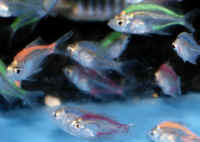
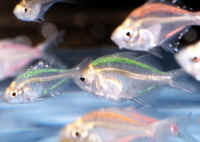
Indian Glass Fish; sources
11/26/14 Diagnosing disease (FW, glass
fish), Lymph. 2/2/09 Crew, I've checked your website
(used Neale's diagnosis chart) as well as Googled and can't
come up with something that fits. I need your help. I have a 20-gal
tall sparsely populated at the moment (2 glass fish and 1 dwarf Pleco).
I had a cross-species kill off about a 1 to 2 months ago (1 dwarf
Gourami, 1 molly, 1 dwarf African frog, and two other glass fish). I
was watching water conditions and waiting until things settled before
adding more fish. Water conditions have consistently now been stable (0
nitrite, 0 ammonia, 10 nitrate) and higher ph (7.8+) due to municipal
water source, and I do scheduled 50-60% water changes every two weeks.
But now this. One glass fish now has white/cream colored spots that
first appeared where the side fins attached to its body. Now it's
on both side fins and at the base of the tail. There are no lesions at
its mouth (so not cotton-wool disease) and the fins are not rotting
away (so no fin rot). I've dealt w/ ick before - this isn't it.
And I wouldn't say the spots are cauliflower or raspberry like.
There are no other symptoms except to say that the sick one is being
bullied by the second remaining glass fish. Oh - and we moved the tank
from one room to the another about three weeks ago (yes. a stressor for
sure). I was going to add about 6 - 10 more glass fish (as I know they
do better in numbers) but now I don't know if that is such a good
idea. I tried to get pictures but my camera and fish isn't
cooperating. Any thoughts on what I am dealing with? And any thoughts
on treatment? I can't imagine a lone glassfish would do well in a
QT. Given this, would it be wise to add the other glass fish at this
point? I go back and forth between adding the community that makes the
remaining two feel more comfortable (lessening stress) w/ possibility
of these white/yellowish spots being contagious. Hmmmm. Thanks! Kristi
<Hi Kristi. This is almost certainly Lymphocystis, a viral disease
that Glassfish are rather prone to. On the plus side, it isn't
fatal, it's not contagious to other types of fish, and all else
being good, they do recover in time. The down side is that it takes a
while to get better, if it does at all. Here's my thoughts about
Lympho and Glassfish. I've never had to deal with it, but I keep my
specimens in soft to moderately hard water. The people who know that do
get it, tend to be keeping them in hard freshwater. It's also very
common on painted Glassfish. So my gut feeling is that it's more or
less likely to appear (or go away) depending on what we might consider
"environmental" stresses. This isn't to say Glassfish
can't be kept in hard water, or even brackish water, as old books
used to suggest, but I suspect that for whatever reason, doing so tips
the balance in favour of the virus. In any case, there isn't much
you can do, and with luck it'll go away in a few months. Check
water quality, optimise (vary!) diet, and generally do anything you can
to help this fish feel happy. Adding some more specimens might be
entirely appropriate, if that dissipates some of the aggression. I do
agree that Glassfish are semi-aggressive in small numbers. Hope this
helps, Neale.> Questions about stocking with glassfish and guppies -- 06/26/08 Hello, my name is Jean. <Hi Jean!> Your site is a font of wonderful information! Keep up the good work! <Thanks.> I have a 20 gallon tall freshwater tank. I currently have 3 guppies and 3 (formerly painted) glassfish in it. I know I should keep my glassfish in larger schools, so I do plan on getting more (unpainted!) glassfish soon. Additionally, I think all 3 of my guppies are male (I think what I see is a gonopodium on each, and no one has ever gotten pregnant), but they do not seem to be bothering each other too much, no nipping at all. I had another psycho guppy previously who was a killing machine, I returned him. <Fairly common for male Guppies to be highly aggressive. Does rather depend on the number of fish, size of the tank.> My questions are: What additional fish can I add to this tank that will get along with my glassfish and guppies? Should I do anything about having all male guppies, if they seem to be doing alright? I'm not itching for fry right now! I would like any additions to my tank to be peaceful, as I don't want another psycho killer fish. <Glassfish will mix with anything that doesn't actually eat them. I keep mine in a tank with South American puffers, Corydoras, halfbeaks, Limia nigrofasciata, and various catfish and tetras.> Further, I add about 1 tablespoon of aquarium salt per 5 gallons to my tank, for the sake of the glassfish and general health. The guppies don't mind. <Neither Glassfish nor Guppies need salt. In fact the Glassfish traded in the hobby are all freshwater fish. The idea they NEED salt is likely down to misidentification, with the fish being sold (Parambassis spp.) being mistake for brackish water Ambassis spp.> My hardness (GH) is a constant 120 ppm, and my pH is currently at 6.8. <Ideal for Glassfish and indeed most other soft water fish. Tetras and Corydoras would be excellent options. Guppies do tend to be sickly in soft water and at acidic pH levels, and your addition of salt is certainly helping here somewhat. Still, I'd tend to phase out livebearers in favour of true soft water fish.> What other fish can I add considering the salt level? I've considered mollies but can't they be aggressive, especially with the guppies? <Mollies and Guppies can fight, so not a good combo. Besides, your tank is WAY too small for Mollies.> Further, are there any bottom feeders that would be o.k. in this environment? (I love exotic little Plecos, like Bristlenoses, but heard they can't stand the salt). <Ancistrus and hardy Corydoras species can easily tolerate low salt levels such as those you are using. Anything measured in spoons is inaccurate, so forgive me for not using such methods. But normal seawater has 35 grammes of marine salt mix per litre. One-tenth salinity would be easily tolerated by Corydoras and Ancistrus, and works out at 3.5 grammes per litre. But to be honest, I'd bin the Guppies, or rather ignore salt and instead harden the water in a more effective way using Malawi Salt mixes, such as: Per 5 gallons/20 litres 1 teaspoon baking soda (sodium bicarbonate) 1 tablespoon Epsom salt (magnesium sulfate) 1 teaspoon marine salt mix (sodium chloride + trace elements) This is easy to make up using stuff from drug stores, grocery stores and/or pet stores and costs pennies per water change. For the fish you're keeping, one-quarter to one-half the dose described above would be ample. For guppies, you're after pH 7.5, 10-20 degrees dH.> Thanks so much! <Cheers, Neale.> Questions about stocking with glassfish and guppies -- 06/26/08 Hello, my name is Jean. <Hi Jean!> Your site is a font of wonderful information! Keep up the good work! <Thanks.> I have a 20 gallon tall freshwater tank. I currently have 3 guppies and 3 (formerly painted) glassfish in it. I know I should keep my glassfish in larger schools, so I do plan on getting more (unpainted!) glassfish soon. Additionally, I think all 3 of my guppies are male (I think what I see is a gonopodium on each, and no one has ever gotten pregnant), but they do not seem to be bothering each other too much, no nipping at all. I had another psycho guppy previously who was a killing machine, I returned him. <Fairly common for male Guppies to be highly aggressive. Does rather depend on the number of fish, size of the tank.> My questions are: What additional fish can I add to this tank that will get along with my glassfish and guppies? Should I do anything about having all male guppies, if they seem to be doing alright? I'm not itching for fry right now! I would like any additions to my tank to be peaceful, as I don't want another psycho killer fish. <Glassfish will mix with anything that doesn't actually eat them. I keep mine in a tank with South American puffers, Corydoras, halfbeaks, Limia nigrofasciata, and various catfish and tetras.> Further, I add about 1 tablespoon of aquarium salt per 5 gallons to my tank, for the sake of the glassfish and general health. The guppies don't mind. <Neither Glassfish nor Guppies need salt. In fact the Glassfish traded in the hobby are all freshwater fish. The idea they NEED salt is likely down to misidentification, with the fish being sold (Parambassis spp.) being mistake for brackish water Ambassis spp.> My hardness (GH) is a constant 120 ppm, and my pH is currently at 6.8. <Ideal for Glassfish and indeed most other soft water fish. Tetras and Corydoras would be excellent options. Guppies do tend to be sickly in soft water and at acidic pH levels, and your addition of salt is certainly helping here somewhat. Still, I'd tend to phase out livebearers in favour of true soft water fish.> What other fish can I add considering the salt level? I've considered mollies but can't they be aggressive, especially with the guppies? <Mollies and Guppies can fight, so not a good combo. Besides, your tank is WAY too small for Mollies.> Further, are there any bottom feeders that would be o.k. in this environment? (I love exotic little Plecos, like Bristlenoses, but heard they can't stand the salt). <Ancistrus and hardy Corydoras species can easily tolerate low salt levels such as those you are using. Anything measured in spoons is inaccurate, so forgive me for not using such methods. But normal seawater has 35 grammes of marine salt mix per litre. One-tenth salinity would be easily tolerated by Corydoras and Ancistrus, and works out at 3.5 grammes per litre. But to be honest, I'd bin the Guppies, or rather ignore salt and instead harden the water in a more effective way using Malawi Salt mixes, such as: Per 5 gallons/20 litres 1 teaspoon baking soda (sodium bicarbonate) 1 tablespoon Epsom salt (magnesium sulfate) 1 teaspoon marine salt mix (sodium chloride + trace elements) This is easy to make up using stuff from drug stores, grocery stores and/or pet stores and costs pennies per water change. For the fish you're keeping, one-quarter to one-half the dose described above would be ample. For guppies, you're after pH 7.5, 10-20 degrees dH.> Thanks so much! <Cheers, Neale.>Old Discussion on Dragon Goby, New Discussion on Glassfish, BW plt.s 2/22/07 On 2/20/07, crew <crew@mail.wetwebmedia.com> wrote: Dragon Gobies Stuck in Aquarium Ornaments 2/20/07 [...]<Actually, that's exactly where my Dragon lives. The fake mangrove root I have in my BW tank, has an end of one of the roots broken off & he slips inside it & lives in there. He has no problem turning around inside the ornament & comes out often, to eat.> LOL how cool :) I'm such a worry-wart (my girls call him "Mama's little bog monster.") - just had this vision of the poor little guy getting stuck in something like that. < [...]<Sounds like a happy life for your Dragon!> So far so good! I've bought 2 glassfish (au naturale, no ink thanks) - Chanda ranga, for the brackish tank They are still in quarantine, but for all I've read, they should be good tankmates for him. I know that they were eating flake food in the store but I can't seem to get them to eat anything so far (have tried flake food, frozen brine shrimp, frozen AND freeze-dried bloodworms, freeze-dried plankton). I've read varying accounts of glassfish, some say they are good eaters, others say they need live food. They are very timid, I'm wondering if they would eat better if there were more of them in my tank (5 or 6 total)? <<A school of them would be nice. They may just be adjusting to their new home.>> I don't even know where to get live food - I tried to grow my own brine shrimp for my livebearer fry but I'm filing that one under "failed experiment." <<I get blackworms from my LFS. Rinsed well in a brine shrimp net & stored in a shallow container with a little water, in the refrigerator. My dragon's favorite food!>> Seems like I read that you have a planted brackish tank? <Nope, I have a 90g planted discus tank. No surviving plants in my BW tank. ~PP> Heheh well that might be us pretty soon too, I have read it's very hard to keep plants in salty water. What about marine plants though? Do you think any of them could do well in BW? <Marine plants won't fair well till a SG of around 1.018. There are many BW plants that folks have success with, just not worth the trouble for me, since I already have a FW planted tank I'm happy with. Here's a great thread on BW plants: http://www.thepufferforum.com/forum/viewtopic.php?t=4792&highlight=brackish+plants ~PP> Thanks again, Cathy Sick glass fish, ich, insufficient info.
1/19/07 My glass fish have what appears to be ich. However when I
treated for it, it didn't work. I then just as a last ditch effort
(I'm a fish novice) used a anti bacterial powder and now it seems
to be getting better. Any clue what it could be??? <Likely is Ich...
but not treated "thoroughly"... in a carbonate-free setting,
with elevated temperature, a lack of chemical filtration... Please read
here: http://wetwebmedia.com/FWSubWebIndex/fwich.htm
and the linked files above. Bob Fenner> Stocking with glassfish and guppies 5/27/06 Hello, my name is Jean. <<Hello, Jean. Mine's Tom.>> Your site is a font of wonderful information! Keep up the good work! <<Thank you kindly and I'll do my best for you.>> I have a 20 gallon tall freshwater tank. <<Okay. (I'll make a little "mental note" that it's "tall".>> I currently have 3 guppies and 3 (formerly painted) glassfish in it. I know I should keep my glassfish in larger schools, so I do plan on getting more (unpainted!) glassfish soon. Additionally, I think all 3 of my guppies are males (I think what I see is a gonopodium on each, and no one has ever gotten pregnant), but they do not seem to be bothering each other too much, no nipping at all. I had another psycho guppy previously who was a killing machine, I returned him. <<Hmmm...a psycho Guppy. I understand what you're saying but, you must admit, it sounds a little humorous.>> My questions are: What additional fish can I add to this tank that will get along with my glassfish and guppies? <<Provided you quarantine first, any of the smaller varieties of Tetras should be fine. Cardinals, Neons, Black Neons, et. al. A "tall" tank doesn't have the surface area for a great deal of gas/oxygen exchange so you're better off with small fish. I, additionally, would stress quarantine with the Neons. 'Neon Tetra Disease' isn't isolated to these fish only. There's no known treatment and it's virtually 100% fatal to any fish that contracts it. Bad news? I know of this first-hand. Good news? They were quarantined when it killed 11 out of 12 of my Black Neons. As you might surmise, I can't stress 'quarantine' enough.>> Should I do anything about having all male guppies, if they seem to be doing alright? <<If you don't see any problems arising I wouldn't worry.>> I'm not itching for fry right now! <<Understood.>> I would like any additions to my tank to be peaceful, as I don't want another psycho killer fish. <<I'll leave Piranhas out of the equation then... :)>> Further, I add about 1 tablespoon of aquarium salt per 5 gallons to my tank, for the sake of the glassfish and general health. The guppies don't mind. My hardness (gH) is a constant 120 ppm, and my pH is currently at 6.8. What other fish can I add considering the salt level? <<Just about any.>> I've considered mollies but can't they be aggressive, especially with the guppies? <<Depends on the fish, Jean. I can't tell you that a lot of this isn't a 'crap shoot'. Mollies are great fish and typically mild-mannered and peaceful. Can you wind up with a "rogue"? Sure you can. I've heard of fish that should never get along becoming "buddies". We try to advise based on "likelihoods", not certainties. Anyone who tells you differently hasn't done his/her research.>> Further, are there any bottom feeders that would be o.k. in this environment? (I love exotic little Plecos, like bristlenoses, but heard they can't stand the salt). <<It's true that Catfish, generally, don't appreciate salt in the water but one tablespoon per five gallons isn't likely to be a problem at all. A lot of times, when salt 'treatment' is recommended - at much higher dosages than you have - we advise against such when Catfish are living in the aquarium. If I had one admonition here it would be to return back to the size of your tank. Bristlenose Plecos tend to stay small but get large enough that oxygenation might be an issue. If it were a long tank, with a larger "footprint", I'd tell you to go for it.>> Thanks so much! <<Hopefully, I've been of some help, Jean. Tom>> Glassfish... not all brackish... Very useful input re husbandry of Ambassids/Chandids - 2/11/2006 Dear Robert, <Neale> I hope you're keeping well. <Trying... intermittently> I wanted to drop you a line about glassfish. While the idea that these fish need salty water has been around for years (and I certainly believed it to be true) this does seem to be a myth. http://www.wetwebmedia.com/BrackishSubWebIndex/glassfishes.htm <Ah, yes> Currently, there are at least 8 species traded more or less regularly in the UK, and I'd imagine this holds true for the United States as well. <Most places, just two...> The 'dwarf' species sold as Indian or common glassfish are Parambassis ranga, Parambassis siamensis, and Parambassis lala, in that order of frequency. They are quite tricky to distinguish when small, though as adults P. ranga at 7 cm is almost twice as big as the smallest species, P. lala. Essentially, P. ranga has a vague dark spot behind the eye, P. lala has three vertical bands, and P. siamensis has no markings at all. P. siamensis is also distinctly elongate compared with the others. Male P. ranga can have whitish edges to the pelvic fins while P. lala have white-blue edges to the anal and dorsal fins. Two other species of Parambassis are traded, these are the 'giant' Glassfishes, P. wolffii and P. pulcinella. The later needs no description -- its common name of hump-headed glassfish describes it pretty well. The other species has only recently reappeared in the marketplace. The last time I saw them was twenty years ago. These are large fish, around 20 cm long, and highly predatory, schooling predators. One final glassfish that has also reappeared in UK shops is Gymnochanda filamentosa. This is a small species (4 cm at most) notable for the greatly extended dorsal and anal fin rays on the males. According to Frank Schäfer in the recent Aqualog 'Brackish Water Fishes' book, all species of Parambassis and Gymnochanda are found either primarily or exclusively in freshwater habitats. <This is also stated on fishbase.org> Of the list species mentioned above, the ones he says are sometimes found in slightly brackish water are P. ranga and P. lala. All the others, he insists, are freshwater fish, some even from blackwater habits. For the last year I have been keeping P. ranga in a soft, acid aquarium (pH 6.5, DH < 7) with no problems at all. In fact, quite the reverse: these fish have grown very rapidly, and have proved to be aggressive at feeding time and exceptionally hardy, in particular showing a marked resistance to Whitespot. <Well-stated> In my brackish water book due out later this year, I say as much, and suggest that most glassfish are freshwater species and only some are salt tolerant, and I have tried to clarify this issue in an article in Practical Fishkeeping (Crystal clear: keeping glassfish, February, 2006). <Very good> My experience with P. ranga also suggests that live foods are not required. Mine admittedly only show moderate interest in frozen bloodworms, but they greedily take frozen lobster eggs and small pieces of cooking shrimps. The lobster eggs can be obtained from aquarium stores dealing with marine invertebrates and make an excellent staple. Live foods such as Daphnia and mosquito larvae are, of course, very readily eaten, and I would imagine that they would eat small livebearer fry, too. These glassfish have proved to be robust community fish, and have coexisted happily with Celebes halfbeaks, a South American puffer, cardinal tetras, and a variety of other small to medium sized fish. They are exceptionally fast swimmers, and seem perfectly able to avoid trouble from things like territorial dwarf cichlids. One surprise has been how readily they school with Hatchetfish, and oddly enough, how happy the Hatchetfish seem to be with glassfish. They make a nice combination. Finally, Schäfer also suggests that the species of glassfish most commonly dyed is P. siamensis. <I have/had thought they were P. ranga> I cannot verify this: very few, if any, aquarium stores in England still offer painted glassfish. <Good for them> But certainly the image on your web site reminds me more of that species than P. ranga. To my eye at least, P. siamensis is about 3 times as long as it is deep, while the other two dwarf glassfish are only 2 times as long as they are deep. http://www.wetwebmedia.com/MiscFishPIX/Parambassis_rangaLymph.jpg <I see> It is, I suppose, possible that there are populations of P. ranga and P. lala that come from brackish water and need salt added to the aquarium; all I can say is that adding salt should be thought of more as a supplement for glassfish that are obviously not healthy rather than as a staple required by all of them. I hope that this is useful, and wish you all the very best. Sincerely, Neale <Thank you for this valuable input Neale. Will post/share. Look forward to your new book. Bob Fenner> Painted Glass[fish] AKA "Tetras" Parambassis (Chanda) ranga 5/23/03 WWM Crew, <cheers, Andy> As I have recently found out my Painted Glass Tetras are actually a type of perch - http://www.bellaonline.com/articles/art7686.asp, I would like to know what kind of conditions are good for them and what other fish can I put with them? <we have an FAQ page dedicated to them here, my friend: http://www.wetwebmedia.com/BrackishSubWebIndex/chandidfaqs.htm and much more info on fishbase.org here: http://www.fishbase.org/Summary/SpeciesSummary.cfm?ID=10130&genusname=Parambassis&speciesname=ranga P.S. I would like to commend you on your website and the information it contains. I have learned quite a bit from reading your site and I have put it in my web browser favorites. <thanks kindly! It is redeeming for us to hear. Best regards, Anthony> Painted Glass tetras (Ambassids) We recently purchased some Painted Glass Tetras. They look really nice. But when I was doing some research on them (something I will do BEFORE I buy anymore fish), I found that they may not be real tetras and their coloring is injected. Is this true? Andy Barnes <Unfortunately this is true. The fish aren't true 'Tetras', they are actually a member of the Perch family. And their bright colors are nothing more than a dye that is injected into them and it often leads to early deaths and illnesses. For more information there's a good article at http://www.bellaonline.com/articles/art7686.asp Ronni> Use of Glassfish images on/from WWM Mr. Fenner, Before the weekend i was contacted by the largest newspaper in Norway. They are doing an article on aquarium fish manipulated by man. I have been asked to supply them with pictures of different fish and have found most of the pictures they need, but i have no good pictures of Chanda ranga with colour injections. I found pictures on http://www.wetwebmedia.com/BrackishSubWebIndex/glassfishes.htm and i am now looking for the right man to ask for permission to use these pictures in the paper. I would be happy if you could help me with this, and i must also say that the reporter wanted the pictures "yesterday". Please let me know if or if not you can help. PC <As the newspaper is borderline commercial/educational I'll side with allowing these images use. Are you able to use the size, resolution of the images on our site? Do you need larger scans? Bob Fenner> Per Christian Hasselgreen Oslo Akvarieklub Karl Staafs vei 1 0665 Oslo Oslo, Norway tlf +47 22 65 05 69 mob +47 98 61 05 82 pch@chello.no Use of Glassfish images on/from WWM Hi, I am very happy that you will let us use the photos. I agree that the newspaper is borderline, but it is after all the intention to bring light on the problems in the aquarium hobby. Therefore I have not charged them for the other photos we have delivered. <Ah, good> I feel that it is important that we get this in the papers now that they are interested in us. Norway may actually get a change from the government hearings that are happening right now. We (three aquarium organizations) were actually asked to have an extra meeting with the government committee after the first hearing to discuss what measurements can be taken. <Are Sven Fossa and Alf Nilsen involved? I do hope so... they are Norwegians and very much at the forefront of the (marine) aquarium interest. Are you, your organizations familiar with John Dawes? the OFI? I am cc'ing them here as an introduction.> If you could please send the Fotos and name of who took it and granted permissions me I shall pass it on to the paper. I'll keep you posted on the development. <I am the photographer. What size, format are you looking for? We can (re)scan and send them to you over the Internet> I am not the one to answer what resolution is needed in the paper, so i would be happy if I could have a picture with higher resolution to send to the reporter so they can choose. Gratefully, PC Hasselgreen <Tiff's? Of what output size? 300 dpi? Bob Fenner> Re: SV: SV: Oslo, Norway Hi Mr. Fenner, As I said, i
don't know what format or resolution is best for them. Cant we just
give them a large tiff file and then let them shrink it if
they want? <I will contact the person whose email you've sent
along and ask specifically> I think that it will be rather big in
the paper, as she was most very keen on getting this picture. I really
have no idea. The pictures go to the Journalist
called line.dugstad@vg.no Svein Fossa is the
representative for "Norsk Zoobransje Forening" which is the
organization for shops here in Norway. He was therefore involved in the
same hearing as us. He has contributed with some photos, too. Those
were of colour-bathed fish. Alf Nilsen i must admit, i don't know,
but then again I am not into salt water, except when diving, which is
not often, as I live in cold, cold Norway. <Mmm, he is a partner in
writing with Svein, both are very knowledgeable about issues in the
hobby, trade, science of ornamental aquatics. Svein has contacted me re
our correspondence. Bob Fenner> PC Re: SV: SV: Oslo, Norway
Mr. Fenner. I am off to Sweden to buy some fish today. I'll be
leaving in 20 minutes. I will not be able to use my phone after 2 hours
from now, and of course unable to read mail. If you are able to send
the pictures today, please send them to line.dugstad@vg.no She is the
reporter who is covering this. <No worries. I will wait on her
response to re-scan, send> Thank you very much for all your trouble
so far, Gratefully PC <Be chatting, Bob Fenner> Re: glass fish Hi Bob~ I just wanted to let you know that I
really enjoyed your book "The Conscientious Marine Aquarist",
and it definitely influenced my decision to study Aquarium Science at
Michigan State University next fall. Thanks for all the
great information that you have passed along both on the site and in
your book. <Glad to be a positive influence> I was on the Wet Web
Media site, and noticed that you have glassfish in the brackish section
stating that they need both salt in the aquarium and live foods to
survive. I have had three of these fish for the past couple
of years in my community tank with no salt, and only flake
foods. They are about 1 1/2 inches long currently, and I was
wondering if I should make some changes to my tank or move these
fish. When I bought these fish, I was never told that they
needed to be moved into brackish conditions. <Interesting... Chanda
ranga? Well, our experiences definitely differ here. This is a stock
item (unfortunately "colored" too often) in the aquarium
trade... and so have sold over many years time (in the past). Please
see here for someone else's input: http://216.239.37.100/search?q=cache:OfDbbS4T-VsC:perso.club-internet.fr/vmillat/tropical
fish/fish/chanda_ranga.htm+chanda+ranga &hl=en&i.e=UTF-8
fishbase.org was running too slow...> Any information that you could
pass along I would greatly appreciate. Thank you, Melody Scott
<Thank you for the input. Bob Fenner> |
|

|
Features: |
|
| Featured Sponsors: |