FAQs on
Colisa lalia, C. chuna... "Dwarf"
Gouramis of Many Names, Honey, Flames, Neon Blue, Sunset
Fire... Disease/Health 2
FAQs on Dwarf Gourami Disease:
Dwarf Gourami Disease
1, Dwarf
Gourami Disease 3, Dwarf Gourami Disease 4,
FAQs on Dwarf Gourami Disease by Category:
Diagnosis,
Environmental,
Nutritional,
Genetic,
Infectious
(Virus, Bacterial, Fungal),
Parasitic,
Social,
Treatments,
Related Articles:
Anabantoids/Gouramis &
Relatives, Genera Ctenopoma
& Microctenopoma, Betta
splendens/Siamese Fighting Fish,
Related FAQs: Dwarf Gouramis,
Dwarf Gourami Identification,
Dwarf Gourami Behavior, Dwarf Gourami Compatibility, Dwarf Gourami Selection, Dwarf Gourami Systems, Dwarf Gourami Feeding, Dwarf Gourami Reproduction, & FAQs on:
Gouramis 1, Gouramis 2, Gourami Identification, Gourami Behavior, Gourami Compatibility, Gourami Selection, Gourami Systems, Gourami Feeding, Gourami Disease, Gourami Reproduction,
Betta splendens/Siamese
Fighting Fish,
|
|
|
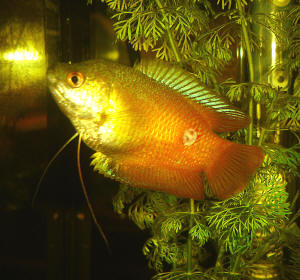
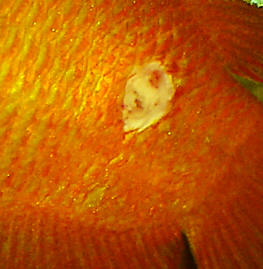
Dwarf Gourami with sore on side 10/16/08
Hi Guys,
Congrats on having such a great site. I have learnt a lot from
reading the Q&A's but still can't find what I'm
after.
I have got 3 Dwarf Gouramis which I have had for about 3 months.
About 4 weeks ago I noticed one of them had 1 or 2 scales missing
from the side of him. The colour of the flesh didn't change.
Everything looked fine.
<It's an ulcer, and will need to be treated with a
suitable antibacterial or antibiotic to prevent secondary
infections. With luck, the fish will heal just fine. I say
"with luck" because Colisa lalia is a very sensitive
species, partly because of inbreeding and partly because
commercially bred fish are routinely exposed to viral infections
for which there is no cure. I do not recommend aquarists keep
this species.>
About 7 days ago I got home from work to find it had turned into
a patch that looked like raw flesh that was white in colour but
looked red from inflammation or infection. It was also raised
from the body a few mm's. I put the Gourami into my 40l tank
and started treating it with Furan-2. After 2 days the redness
had gone away. I continued treating as
the sore is still an open. Today I have noticed 2 holes in the
white flesh area that are red. The sore is still raised from the
surface and looks worse in real life, than in the photos. The
fish is still eating normally and looks fine, he is sitting down
by the heater a fair bit but I think it is because he is the shy
one of the lot and its a good hiding spot. What else can I
try?
<Very, very difficult to say. The problem with ulcers is that
they are not only infected wounds that need healing, but also
gateways through which infections can travel into the body of the
fish. Small fish like yours are particularly at risk because even
a relatively small ulcer will "dig" quite a distance
through the body, well into the major blood vessels, muscles and
nerves.>
My tank details are:
190l tank, 26deg, I top up the salt after every few water
changes, Ammonia 0, Nitrites 0, Nitrates 5, PH 7.2, lots of real
plants, big bits of bogwood, Fluval 405 filter, tank has been
running for about 5 months
<In theory all sounds fine, though adding the salt
shouldn't be necessary when the fish are healthy, and long
term we really have no idea what harm constant exposure to salt
does to freshwater fish. At least some react very badly, as is
the case with Malawi cichlids, so broadly speaking salt should
only be used therapeutically, not as a routine additive.>
Fish are:
Guppies x 10 (about 14 babies as well), rummy nose x 9, Danios x
3, Bristlenose x 1, Corys x 2, Neons x 7, Gouramis x 3, pretty
tetras x 2, bleeding heart x 2, harlequins x 6
<Should be fine with Colisa lalia.>
The Gourami has been moved to a 40l tank, internal filter, 27
deg, salt added, ph 7.2, amm 0, nitrites 0, nitrates 5
Thanks for your help,
Tracey
<All you can really do is carry on treating for ulcers and
Finrot, and hoping for the best. To be honest, this species is so
weak I can be especially confident of a positive result, but who
knows? Cheers, Neale.>
|
 Bite? RMF
 |
|
Fish inquiry... Tetra, small Characin sel., comp.
7/15/08 Dear Crew, I'm pretty new to the fish keeping
hobby but I have been researching online. Here is my dilemma. I
have a tank with serpae tetras who keep to themselves (thank
god), zebra danios, a rubber lip Pleco, and platys. <A
"courageous" combination to say the least. Serpae
tetras aren't my recommendation for the community tank, as
you seem to realise.> I need a somewhat larger fish to be the
so-called "attraction" fish but I don't know which
kinds will live peacefully with my other fish. <With Serpae
tetras, not much! The obvious choices -- Angelfish, Gouramis,
etc. -- will simply be pecked to death.> I have a 26 gallon
tank, its pretty tall and its a bowfront. I've been deciding
between some kind(s) of gouramis, freshwater angels, or silver
dollars. <No, no and no respectively. The Gouramis and Angels
will be nibbled to pieces, and the Silver Dollars get far too
large for a tank this size.> Which species is best suited for
my tank and well get along with the tankmates; and if you have
any other suggestions about other species please let me know.
<To be honest, I'd not bother. I'd either up the
numbers of the species you already have, or perhaps add an
interesting catfish of some sort that can keep out of trouble.
Serpae tetras for example look their best in big swarms of dozens
of specimens, when their feeding frenzy behaviour becomes quite
something to watch. Of course any catfish that avoids trouble,
like a Synodontis, isn't going to be showpiece fish
you're after.> Also, ever since I transferred a red wag
platy over to the bigger tank, it has constantly been hiding even
though none of the other fish harass it. <Almost certainly it
has been nipped by the Serpae tetras and is keeping a low
profile. Serpae tetras don't just bite the fins from other
fish but also the scales, and such damage can be difficult to
see.> Is there any way I can solve this problem? <Not
really, no.> Thank you, Pierre <Hope this helps, Neale.>
Re: fish inquiry 7/15/08 Thank you for that info.
Do you think there are any tetras that I could replace the
Serpaes with that would get along with angels or gouramis? I
might decide to take them back to the pet store. Pierre
<Angelfish will simply view very small tetras, such as Neons,
as food, so you have to be careful. Certain other tetras, can be
just as nippy as Serpae tetras and will nibble on the Angels and
Gouramis. Black Widows (Gymnocorymbus ternetzi) and some of the
other Hyphessobrycon species fall into this category. My honest
recommendation would be to replace the Serpae tetras with more
Zebra Danios. Here's the thing: if you have one big school of
a schooling fish, it looks so much better than two small schools
of different schooling fish. You would then have one species at
the top (the Danios), one in the middle (perhaps a pair of Angels
or a pair of Lace Gouramis) and then your catfish at the bottom.
Instead of a jumble, you'll have an nice ordered arrangement.
Otherwise, consider X-Ray tetras (Pristella maxillaris), Diamond
tetras (Moenkhausia pittieri), or Lemon tetras (Hyphessobrycon
pulchripinnis) are excellent community tank tetras and the right
size for your aquarium. But as I say, better to have twelve
schooling fish of one type than six of two different types.
Cheers, Neale.>
Re: fish inquiry (Dwarf Gouramis, Angelfish, selection)
7/15/08 I'm going to exchange my Serpaes this
evening. I think I will most likely go with the large school or
danios and either dwarf gouramis or angelfish. I'll let my
little brother pick. Thanks so much for all your help! Pierre
<My advise to anyone is don't get Dwarf Gouramis (Colisa
lalia, including fancy forms like "neon gouramis",
"robin gouramis", and so on). Unless wild-caught or
locally bred, which the ones in shops most certainly are not,
these fish are extremely likely to carry an incurable viral
disease known as Dwarf Gourami Iridovirus. One estimate by vets
puts the incidence at 22% for Dwarf Gouramis exported from
Singapore. Because the virus is extremely contagious, you only
need one infected fish in a batch to ensure all the others get
sick too. The number of Dwarf Gourami e-mails we get would
astonish you, and they really are a complete waste of money.
Almost every retailer I know dislikes stocking them because so
many die in their tanks, but there is sufficient demand among
newbie aquarists who don't know better that they remain
profitable. It's a shame, because twenty years ago they were
quite good little fish. Nowadays, you're better off with the
hardier (if slightly bigger) Colisa fasciata and Colisa labiosus.
http://www.wetwebmedia.com/FWsubwebindex/dwfgdis.htm If you buy
Angelfish, do remember these are territorial cichlids. You cannot
sex them. But if you have two males, in a small aquarium they are
very likely to become aggressive towards one another. If you buy
a singleton, then there's an increased chance that Angelfish
will "go rogue" and attack other fish in the tank, so
that approach is not without risks. The standard way to keep
Angels is to buy six specimens, let them pair off as they mature,
and remove the four surplus fish when the time comes. Because
Angels are such popular fish, rehoming adults is not difficult
and any half-decent aquarium shop will take them off your hands.
Cheers, Neale.>
Re: fish inquiry (Dwarf Gouramis, Angelfish, selection)
7/17/2008 Can the dwarf Gourami virus spread to other
species of fish or only the ones in the Gourami family? <This
is a complex question. The short answer is yes, the virus can
spread to other species in other families. But so far as I know,
the only scientifically documented example is where Dwarf
Gouramis Iridovirus appears to have infected Maccullochella
peelii, and Australian perch-like fish belonging to the
Percichthyidae family. There are no reports that I am aware of
where the virus has caused problems in other species of Gourami
though. Hence my recommendation that Colisa fasciata and Colisa
labiosus are safe, reliable alternatives. Yes, they aren't
quite as colourful, but they are still lovely fish and much, much
more likely to live long and happy lives. If you want a small,
non-aggressive Gourami for the community tank, these are the ones
to go for. Cheers, Neale.>
|
Sick dwarf Gourami 7/12/08 Hi We have 2 dwarf
Gouramis. The male died yesterday and the female is now in our
quarantine tank. We have had them one month in a tank along with
platys, neon tetras, silvertip tetras and zebra Danios. We noticed
discolouration around the mouth a week ago. They both also had/have a
white patch on the side. It looks like a wound but there are no signs
of aggression from the other fish. Water quality- NO2 25mg/l NO3 0mg/l
ph 7.6 temp 25C. Can you offer any suggestions before we lose the
female too? Thanks. Grace <Hello Grace. If the fish has patches of
fluffy or slimy stuff around the mouth and on the body, the chances are
you're dealing with Finrot, Fungus, or "Mouth Fungus"
(actually a bacterial infection). These can only be treated using
antibacterial or antibiotic medications. In the UK, I recommend a
product called eSHa 2000; in the US the antibiotic Maracyn seems to be
preferred. As with any medication, remember to remove carbon from the
filter if you are using it (and I don't recommend freshwater
aquarists bother with it, to be honest). Now, with this said, there is
a major problem with a viral infection known as Dwarf Gourami
Iridovirus. This is untreatable, 100% fatal, and highly contagious.
Because it is so common, I do not recommend aquarists bother with
Colisa lalia, and instead suggest they go with other, unaffected
species like Colisa labiosus and Colisa fasciata.
http://www.wetwebmedia.com/FWsubwebindex/dwfgdis.htm The symptoms are
very consistent: first the fish becomes shy and loses its appetite,
then it loses its colour, then discoloured patches and sores develop,
and finally the fish swells up with dropsy and dies. It's a shame
aquarium shops still stock Colisa lalia, and I've talked to
managers of many shops over the years. They all say the same thing --
as much as they'd like to stop trading these fish (which die just
as quickly in their tanks!), less expert fishkeepers just keep buying
them, so they keep stocking them! It's a vicious circle really, and
until aquarists stop buying them, the mass producers in the Far East
will keep cranking out low quality, widely infected, Dwarf Gouramis.
Anyway, I do hope you have your "NO2" and "NO3"
readings back to front, by the way -- 25 mg/l nitrite (NO2) would be
deadly to any fish! Hope this helps, Neale.>
Gourami with a bloated abdomen. - 7/2/08 Hello there.
I have a dwarf Gourami with a bloated abdomen. It looks pregnant
however, it also looks as though it is bruised. The area in front of
the bulging abdomen is dark purple/blue like a skin bruise on a human.
Half of the lower fin is this color too. The only tank mate is a giant
golden snail. I clean the take regularly and change the filter as
recommended. Please help. Thanks. Sincerely, Glenda <Glenda, your
Dwarf Gourami almost certainly has Dwarf Gourami Iridovirus; an
untreatable, highly contagious to other Dwarf Gouramis, apparently 100%
fatal viral disease. The symptoms are very consistent: loss of appetite
and shyness; loss of colour; appearance of blisters on the body and
fins; swelling of the abdomen; death. Your mistake was buying this
species at all -- in my opinion the prevalence of the disease amongst
mass-produced Dwarf Gouramis is so high that spending money on them is
a waste. My recommendation is to painlessly destroy this fish and then
switch to a reliable small Gourami species such as Colisa labiosus or
Colisa fasciata. http://www.wetwebmedia.com/FWsubwebindex/dwfgdis.htm
http://www.wetwebmedia.com/euthanasiafaqs.htm Cheers, Neale.>
Emerald Green Corys and Dwarf Gourami Disease
5/26/08 I have two Gouramis and two Emerald Green Catfish in a
10 gallon tank. If I suspect one Gourami has Gourami Disease swollen
abdomen, long stringy elimination and discoloration), I have read in
your posts that I should assume the other one, while healthy looking,
has it too (correct?). <It isn't a certainty, but you should
certainly remove in infected fish immediately. I'd painlessly
destroy it. Various methods, but Clove Oil is perhaps the easiest on
you and the fish. http://www.wetwebmedia.com/euthanasiafaqs.htm> I
have done 10% and 50% water changes adding aquarium salt and
conditioner. My question is, if my Gourami's are "doomed"
and I let them live out their disease, or take them back to the store
since they are only a week old, will my Corys stay healthy or be
affected? <The virus doesn't affect catfish, so your Corydoras
will be fine. Most other fish are likely immune, though I'd perhaps
avoid Honey and Dwarf Gouramis as well as their hybrids.> Thank you
for you time! <Cheers, Neale.>
|
Blue Gourami black spots and swollen
5/26/08 Hi. I have recently started up a 10 gallon tank.
<Do understand that this tank is too small for Blue Gouramis,
and indeed for virtually all tropical fish. There's no reason
to buy a 10 gallon tank unless you're an expert fishkeeper
with a view to a breeding project or some other specific usage.
20 gallon tanks are the minimum sized ones that work reliably for
casual aquarists and standard community fish species. The price
difference between 10 and 20 gallon tanks is negligible,
especially when set against how much longer your fish will live
in the one compared to the other.> 2 weeks ago, I bought a
powder blue dwarf Gourami and a red dwarf Gourami. <Both
Colisa lalia varieties. Extremely prone to disease; I simply
don't recommend them to fishkeepers. Scarily high prevalence
of viral disease; inbreeding and casual use of antibiotics means
their lifespan once purchased is not high. A lot of retailers I
know would sooner not stock them at all. Best avoided, in favour
of hardy species like Colisa labiosus and Colisa fasciata.>
All seemed fine, but the red Gourami hangs out at the bottom of
the tank and sometimes pushes the blue one around. <The tank
is too small. These fish are territorial, and if they're both
males, as is highly likely if they're brightly coloured
(females are greyish green) the dominant one will eventually kill
the weaker one.> Two days ago, I purchased two emerald green
Corys that are very active, racing around. <Too many fish in a
10 gallon tank! Corydoras aeneus need to be kept in groups of six
or more (they're schooling fish) and that means a 20 gallon
tank, at least. I'm not saying this stuff to be awkward: if
you try to cram fish into too-small a tank, you're going to
have problems with water quality, and that means disease. Your
fish aren't going to be happy either, and if you don't
care about their happiness, then why bother keeping fish at
all?> I noticed a few days ago that the blue Gourami seems
maybe swollen just under the gills. Today, I noticed he has some
black dots on his face, like he's dirty. I have done a few
partial water changes this past week. Also, last night, I noticed
when he was eliminating it was not releasing and grew to a few
inches long before it even dropped, or came off. <Difficult to
know precisely what this is, but instinctively I'd be
guessing Dwarf Gourami Iridovirus. This is very very common among
Colisa lalia, and currently impossible to treat. It's 100%
fatal, and highly contagious. This is why I tell people not to
waste their money on this species. A photo would help ID the
disease more precisely.> The red Gourami is a big eater,
eating most of the food, including the catfish pellets. The water
temperature is between 78 and 80 degrees. I think the red Gourami
may like the bottom of the tank because I have the thickest
planting there (all artificial). I bought some tall
"grass" decor, but it is sparse. I have read it's
recommended that I buy some floating plants. <Yes, floating
plants are appreciated by Gouramis.> Thank you in advance for
your time. These fish were purchased for my kids that just lost a
Betta and I would hate to lose my younger son's Gourami.
<I fear you're going to lose the fish anyway.> Thanks
again. <You're welcome.> Beth <Cheers,
Neale.>
Re: Blue Gourami black spots and
swollen 5/26/08 Thank you for your response. I am
obviously a beginner and went into the store not knowing much at
all. <Fair enough.> I went by the suggestion of the clerk
in regard to size of tank and the fish to put in them. <Do
always remember the guys in the store are there to make sales. In
a perfect world, they'd also hand out expert advice and would
stop you from making unwise purchases. But we live in an
imperfect world, and not every store clerk is an expert
fishkeeper. Many are essentially salespeople with little to no
personal experience of keeping fish.> He informed me that the
Dwarf Gouramis are hearty, obviously misinformed. <Do see
here, for example:
http://www.practicalfishkeeping.co.uk/pfk/pages/show_article.php?article_id=428
Something like 22% of the Singaporean fish are infected with the
Iridovirus, so right out the bag over one-fifth are doomed.
Couple this with the fact the virus is extremely contagious, and
you have a real problem. It goes without saying that intensive
farming methods to keep the price down and serious inbreeding to
create the all-red and all-blue varieties has done nothing to
improve the hardiness of the species.> I also went by his
suggestion with the catfish that he told me to come back for
after 7 days when purchasing the Dwarf Gouramis. <In a bigger
tank, not a bad idea. But in a 10 gallon tank, overkill.> I
may not know much, but I even mentioned that the two Gouramis and
two Catfish were going to create too many inches per gallon, but
he insisted this was fine and that two catfish were good enough
for them socially. <Ah, I see. So in this instance you should
have trusted your instinct. I suspect that you have the makings
of an expert fishkeeper even if you're only just starting
out! Keep reading, keep being critical, and keep raising your
game.> Thank you for your help. I will go back to the store
with this knowledge. <Happy to help, Neale.>
Re: Blue Gourami black spots
and swollen 5/27/2008
Neale, Thank you so much answering all of my questions. I have
attached photos for you. If you believe this is what it is, I
will be bringing both of the Gouramis back tomorrow since I have
had them such a short time. ("<Difficult to know
precisely what this is, but instinctively I'd be guessing
Dwarf Gourami Iridovirus. This is very very common among Colisa
lalia, and currently impossible to treat. It's 100% fatal,
and highly contagious. This is why I tell people not to waste
their money on this species. A photo would help ID the disease
more precisely.>") <Photos aren't quite sharp
enough to make a good diagnosis. When looking for Dwarf Gourami
Disease, the order of symptoms is typically this: shyness; loss
of appetite; stringy faeces; appearance of discoloured (usually
pale) patches on the body; open bloody sores on the body; oedema;
death. Obviously not every sick Gourami has Dwarf Gourami
Disease, so it's as well to consider the options too,
including things like Finrot and Constipation that can cause at
least some of these symptoms. Do see here:
http://www.wetwebmedia.com/FWSubWebIndex/fwdistrbshtart.htm Dark
patches can simply be signs of physical damage, specifically to
the nerves that control the colour cells (effectively similar to
"stuck" pixels on an LCD screen. So as I say, don't
destroy the fish out of hand; review the possible alternatives
and treat appropriately. In any case keeping two specimens in the
one tank isn't a good idea, so you'll need to return or
rehome one of them.> Thank you, again. I hope you can see well
enough with these pictures. They don't depict the signs as
well as I wish: <Indeed.> Again, I appreciate your time
with this. The information invaluable! <Cheers, Neale.>
Re: Blue Gourami black spots
and swollen 5/27/2008
Do you have advice if I wanted two more fish,
after bringing the Gouramis back that might be smaller and okay
in the tank? <There's an art to stocking 10 gallon tanks.
Essentially look for small (2.5 cm/1") fish that don't
move about much and aren't territorial. This approach will
maximise your chances of success. In the "Gourami"
field, you might consider Sparkling Gouramis (Trichopsis pumila),
tiny little fish that work well in groups provided there are lots
of plants at the surface of the tank for them to hide among.
They're wonderfully coloured and make strange little sounds
from time to time. If you live in a hard water area, you might
also consider a "shell dweller" from Lake Tanganyika
such as Lamprologus ocellatus. These fish rarely stray far from
their shells (ideally empty apple snail shells or
"escargot" shells from a boutique food store) and
aren't aggressive to mid- or upper-level fish. Livebearers
offer some interesting options, like the darling Least Killifish
(Heterandria formosa), one of the smallest vertebrates known and
native to the Southern United States. Gobies offer lots of
potential, but you do need to review issues like feeding and
water chemistry because some species will not last long if not
kept correctly. Bumblebee Gobies for example do best in hard
water with a little salt added (though this isn't essential)
and will only eat ((wet) frozen bloodworms and small live foods
like brine shrimp. As for catfish, the smallest Callichthyidae
are perhaps the ideal, including things like Aspidoras
pauciradiatus and Corydoras habrosus. Small Whiptails like
Hemiloricaria parva also work nicely and add a quirky look to the
system. I'm also keeping Cherry Shrimps and snails such as
Nerites and snail-eating snails (Clea helena) in my mini tanks,
and they're thriving, the shrimps in particular breeding like
rabbits. So there's lots of potential with small tanks,
provided you research your options and make good choices. Cheers,
Neale.>
Re: Blue Gourami black spots
and swollen 5/27/2008
Follow Up: Thank you for all of your help. I
returned the fish today and they, indeed, said the Powder Blue
Dwarf Gourami did not look well at all. I followed your advice
and decided that the fish were all going to be too big to be
happy in the tank and brought the other Gourami and 2 Cory's
back. <Very good.> I will say that the pet stores do seem
more into turn around than into the happiness of the fish as the
Emerald Green Cory tank said that a 10 gallon tank is suitable
and some fish that grow to be 3 inches were labeled for 5 gallon
tanks! <Unfortunately not an uncommon way to keep fish.> I
purchased 4 guppies, figuring that they will grow no more than
1.5-2 inches and should remain happy. I would like to add 1 or 2
catfish after the Guppies stabilize. I saw online that there are
small species that only grow to be 1.5 to 2 inches. Would these
fish all be okay in the tank as it would equal about 7.5 to 10
inches of fish in a 10 gallon tank? <In theory, Guppies can
work in a 10 gallon tank. But in practise, the males often become
aggressive towards one another. They also pester the females.
It's not much fun to watch your male Guppies chasing one
another and harassing the females. So while a single male and two
or more females might be viable, I don't personally recommend
Guppies in very small tanks. That said, many people keep Endler's
Guppies in small tanks, and their smaller size perhaps makes them
a better bet. I've also found Humpbacked Limia (Limia
nigrofasciata) and Wrestling Halfbeaks (Dermogenys spp.) work
well in 10 gallon tanks.> Thank you, again. <Cheers,
Neale.>
Re: Blue Gourami black spots
and swollen 5/27/2008
Dear Neale, I'm sorry for all of the emails.
I just want to get this right. <Understandable!> As it is
(background), under advice from a first pet store, we bought a
tank, let it run for a week and then went to a second store (the
one we ultimately bought from) and found out it was the wrong
kind of tank, needed a heater and all the rest and had to start
over again. Now, the problems we've discussed. <Hence our
usual advice to buy/borrow an aquarium book *before* you spend
any money.> The more I research, the more I'm concerned
that the Emerald Green Corys are not right for the tank. I love
them and how active they are. However, when we bring back the
Gouramis, they may not only grow too big for the 10 gallon tank,
but be too big for the fish we will get as replacements.
<Green Corydoras (Corydoras aeneus) is an excellent catfish;
it is peaceful, completely harmless towards even livebearer fry,
and long-lived when kept properly. I keep a related species,
Corydoras paleatus in my 180 litre aquarium and watching them
plough through sand, spewing it out of their gills, is a real
treat. Both these catfish spawn readily, and if they're happy
you will eventually find their eggs on the glass. Raising the
babies isn't difficult, but that's a story for another
day. But these catfish are potentially too large for a 10 gallon
system, at least once mature. Female Corydoras aeneus will get to
at least 5 cm/2" and potentially 7.5 cm/3". They are
not just long but deep-bodied as well. You also need at least 4,
and ideally 6, specimens to see them at their best. So I agree
with your analysis.> I know you are not big on 10 gallon tanks
anyhow, but unfortunately it's what works best for our space.
<Often the case.> I have found that there are smaller
catfish. <There are several Dwarf Corydoras species, all
reasonably hardy and easy to keep. Corydoras hastatus swims in
the midwater when kept in reasonable numbers and not scared.
Watching the flutter about like silvery bugs is lots of fun.>
I was thinking that Platys might be a good choice for our tank?
<A bit on the large size. Some varieties of Platy stay quite
small, but in good health most varieties can top 5 cm/2".
Personally I'd not recommend them, though some people do keep
them in 10 gallon systems.> For my boys, we're looking for
one fish each that will be characteristic enough to tell them
apart, or maybe two each- space dependent. <The
Catfish/Livebearer combo will work well. Catfish look strange and
usually scoot about the bottom in a very purposeful way;
livebearers are friendly and quickly become tame, rising to the
top at feeding time. I have an 10 gallon system with Aspidoras
pauciradiatus (a miniature, black-and-white Corydoras) and
juvenile Limia nigrofasciata. The tank is filled with live
plants, snails and Cherry Shrimps. The result is an aquarium
that's very rewarding and fun to watch.> They really like
the idea of catfish as well, and I have found online that there
are catfish that stay smaller than the Emerald Green Corys.
<Provided you avoid "Otos" (Otocinclus spp.) many of
the smaller catfish are quite hardy. There are also some lovely
small loaches, most notably Kuhli Loaches. Kuhli Loaches are
gregarious and rather shy, but they work well in small tanks.>
I am returning to the store to make an exchange for the Gouramis
as the Powder Blue became sick right away. Would you suggest,
while we are somewhat starting over, that we bring the catfish
back as well as they may be too big to share the aquarium with
fish much smaller than them? <I would, but it's your call.
You always have the choice of hanging on to them for the next
year or two, because Corydoras don't grow particularly fast.
By Christmas time say, you might decide to upgrade the tank to a
20 gallon one. The "footprint" between a 10- and a
20-gallon tank isn't that great, and you can re-use the
heater and filter.> I hate to do so, but like I said, I want
to do this right this time before we get even more attached. Any
advice on the new fish as to what would be best is greatly
appreciated. Thank you! <Do read these articles for ideas on
choosing livestock:
http://www.wetwebmedia.com/FWSubWebIndex/fwlivestk.htm
http://www.wetwebmedia.com/FWSubWebIndex/fwlvstksel.htm
http://www.wetwebmedia.com/FWSubWebIndex/fwlivestocking.htm Take
the kids down to the library/bookstore and have look through the
encyclopaedias of freshwater fish. There are literally hundreds
of species on the market, and even if they aren't in stock in
your local store, they can order them or you can go mail order.
Cheers, Neale.>
|
|
|
Gourami disease, eggs? -03/28/08 hi,
I have just got 4 dwarf Gouramis and 2 are the opalescent blue and the
other 2 are orange with stripes. my one striped one has a dark brown
appearance on its head and at the top to,? and appears to be dull and
slimy. and the other one appears to have this too along with a dark
blue almost navy stripe near the end of its belly. is this normal or a
disease. <Not normal, and yes, likely a disease. In particular check
your symptoms against 'Dwarf Gourami Disease', an extremely
common and contagious problem among Colisa lalia imports from Singapore
especially. http://208.112.95.51/FWSubWebIndex/dwfgdis.htm There is no
cure. I would simply advise people NEVER to buy these fish unless from
a local breeder.> and finally the last question I have is my blue
Gourami is larger than the rest of the tank mates and has been hanging
out at the top of the tank. but I have noticed very small,? white
circular things near my heater and every now and then the swollen fish
will go up near that part of the tank. what is wrong with my fish and
what are these things, are they eggs? <Impossible to say. Quite
possibly eggs, through whether from the Gouramis or something else,
e.g., snails, is difficult to say. Gouramis are bubble-nest builders
and don't normally stick their eggs to the glass. On the other hand
Corydoras catfish and some snails do this all the time. If you think
they're eggs, then by all means carefully remove them to a breeding
trap and see what happens! Fish eggs tend to be about 1 mm across and
small round spheres; snail eggs are usually laid in clumps, often in
blobs of jelly about 5 mm or so across.> thank you <Next time,
please send messages with proper capitalization of sentences! Makes
e-mails easier to read, share. Cheers, Neale.>
|
Dwarf Gourami problem --
03/18/08 Hi. I have 3 dwarf Gourami's, I took one of them
out and put it in a small 1.5 gallon tank as it had a swollen
upper body and seems to spend a lot of time at the bottom
<Dwarf Gourami Disease; caused by a virus. Incurable. See
here: http://www.wetwebmedia.com/FWSubWebIndex/dwfgdis.htm I
cannot state this more clearly: People, stop buying these
fish!> The other tank is all out of whack chemically .75ppm
No2, 20 ppm No3, 1.00 ammonia and 7.5 PH. I am really new at this
and can't figure out what to do. <Buy a book, read about
fishkeeping. Obviously you've added a bunch of fish to an
immature aquarium. Nitrite and ammonia at these levels will
quickly kill your fish. Start here:
http://www.wetwebmedia.com/FWSubWebIndex/fwlivestk.htm > The
small tank I set up is 00ppm No2, 5 No3, .15 Ammonia and 7.6 PH.
The temp in both is 78. I tried putting in RidIch+
which is supposed to help with a variety of problems. <Yes,
but doesn't "cure" bad fishkeeping. Nor does it
help deal with viral infections. The ammonia in here will kill
this Gourami even before the virus. Go here to see how to
painlessly destroy this fish:
http://www.wetwebmedia.com/euthanasiafaqs.htm > I hope I'm
not to late as he looks worse and is staying at the bottom. I
noticed while in the other tank he did not eat anytime I was
watching. <Doomed.> Sorry for the anxiety. I just hope to
be able to be better at this whole thing. <You can be, but you
have to read. You also need to make sensible decisions. For
beginners, buying tanks smaller than 20 gallons is stupid.
They're too difficult to maintain and choose stock for. So
I'm hoping you have a tank 20 gallons or larger. Next up, you
choose hardy fish, not "pretty" fish you pick without
research. Dwarf Gouramis for example are among the WORST choices
for beginners because they are plagued with disease and
weren't even all that hardy in the first place. Danios and
peppered Corydoras for example would make much better
choices.> Please help. <Have done so.> Thanks. Tina
<Cheers, Neale.>
Re: Dwarf Gourami problem 03/19/2008 Thank
you Neale <You're welcome.> I really was not properly
informed when I was given the tank (70 gallon) I should never
have taken it without doing more reading. The people who had it
wanted it gone. I have however been reading instead of taking
anymore advice from the tank donors. <Very good!> The fish
that were in it were not my choice. <I see.> I am very
thankful for the information that you have given. I am glad I
came to you for help. I hope that no more fish die because of my
lack of knowledge. <So do I!> Thanks again and I'm
hoping the readings on the tank will clear up soon as I do more
water changes. Tina <Good luck, and happy fishkeeping!
Neale.>
|
Sick Flame Dwarf Gourami 2/28/08 Hey guys, I
found your site when I was researching how to care for my two new green
spotted puffers, but I've found your help so invaluable with them
that I was hoping you'd be able to help me with one of my other
tanks. I have a 20 gallon freshwater tank, and in it live 3 dwarf
Gouramis (the normal, red with blue striped variety -- all male), 3
dwarf flame Gouramis (also all male), 3 balloon body mollies, and 3
Danios (2 leopard, 1 zebra). I've had this tank for probably about
two months, and it's completely cycled, but I'm going through a
bit of an ammonia spike right now -- <?> exact numbers to follow
below. The Gouramis were the last fish I added, and they've been in
there for several weeks now. Recently (within the last 2 days) I've
noticed that one of my dwarf flame Gouramis looks rather ill. He's
laying on the bottom of the tank, gulping air. He's more or less
propped himself up against the side of the tank. He's not
interested in food, though he is still responsive to stimuli (including
the other fish coming over and checking him out. I've had no
aggression problems at all, and my tank is filled with lots of plants
(floating and rooted) in addition to various other forms of cover.
Something isn't right with him, but I don't know what. Water
temperature is 78.2 degrees. There's a bit of salt in the water for
the mollies (following the recommendations on the API Aquarium Salt
box), though I wouldn't call it salty enough to be brackish...just
enough salt to keep the mollies happy (which they certainly seem to
be... piggy little buggers). Readings are as follows: 0 ppm Nitrites.
20 ppm Nitrates (holy crap...I just did a 20% water change
yesterday...how did that happen?) <Accumulates easily...) The
ammonia levels are reading somewhere between 0 and .25 ppm, but it
looks much closer to 0 (sorry, my ability to distinguish colors is just
not what I wish it was...) <Mine neither...> pH is around 7.6
(it's usually between 7.6 and 7.8). What's going on with my
tank??? <Something perhaps amiss with the test kit...> No one
else in there seems to be having problems, though with nitrate levels
like that I fear they soon will be. What do I do? Thanks for any help!
Micah <Add some biological filtration (an "auxiliary"
filter...)... For the Colisa Gouramis... they're notorious for
being imported with persistent Hexamita/Octomita et al. protozoan
infestations... and a particularly nasty virus... Please read here re:
http://wetwebmedia.com/FWSubWebIndex/dwfgdis.htm Bob Fenner>
Dwarf Gourami Disease 2/25/08 Hello
again! <Ave,> Okay, I read up on the links, and now I am worried
for the rest of my Gouramis (dwarf and regular). <It's only
Colisa lalia and Colisa hybrids you need to worry about; other Colisa
and all Trichogaster seem resistant or immune to the Dwarf Gourami
Disease pathogen.> If I remove the sick fish, are the rest of them
going to catch it? <See above.> I just did a water test: my
nitrates are about 30ppm (I am due for a water change), nitrites are
0ppm, the water is testing at 150 (hard), 120 alkalinity and pH at 7.2
(neutral). Should I be adjusting anything? <Nope.> if Yes, how do
you advise as the best way? <Broad advice for water chemistry is
this: if you don't know how/why to adjust the water chemistry, you
probably shouldn't do it. It is easier to mess things up
completely. In fact, your water chemistry is just about perfect for a
broad range of community fish.> Sorry to keep asking, I do
appreciate the assistance! Cheryl <Happy to help, Neale.>
More of a comment, really....Dwarf Gourami
disease 2/10/08 Having found a sore on the lip of my male
dwarf Gourami early last month, I looked for info on the internet and
found Neale Monks' material as posted on your webpage (below):
http://www.wetwebmedia.com/FWSubWebIndex/dwfgdis.htm (FAQs on Colisa
lalia, C. chuna... "Dwarf" Gouramis of Many Names, Honey,
Flames, Neon Blue, Sunset Fire... Disease/Health) I was horrified to
hear about Dwarf Gourami disease as described in these pages, as I -
perhaps naively - believed the breeding of tropical fish for the pet
market to be 'all right' (ecologically, in animal welfare
terms, ethically) and having purchased the fish from a reputable
supplier, I assumed he would be in good health. My despondency deepened
the more I read of the webpage....after some time I was convinced that
my Gourami was doomed to a painful, wasting death, and was considering
euthanising him to prevent further suffering. My husband suggested that
I was perhaps being a bit too hasty about all this, and that we give
the fish a chance since he seemed to be alert and happy (feeding well,
obsessed with his bubble-nest). The sore lip slowly healed and now
(touch wood) he is OK. The information you provide on your site is an
invaluable resource, and Dwarf Gourami disease certainly seems to be a
terrible problem that needs to be eradicated at source. Neale Monks
obviously - and rightly - feels very strongly about this disease, but
my point is that perhaps his opinions on the Dwarf gouramis (the ones
that have already been bred and exported by disreputable suppliers, and
are pets currently living in peoples' homes) are at times a little
too pessimistic - my very limited experience (this far at any rate)
shows that gouramis can recover from slight abrasions and do not always
succumb to bacterial infections immediately. Of course I don't know
that my fish isn't affected and can only hope that he survives to a
good age. This is a minor comment on an excellent web-based resource,
and I hope it hasn't caused offence. With all best wishes, Katrina
<Hi Katrina. No offence at all taken. It's always good to get
comments about things I write, even when people disagree. Yes, I do
feel strongly about Dwarf Gourami Disease. And it isn't me saying
these things are disease-ridden. Australian vets looked at Dwarf
Gouramis closely because the virus they carry is very similar to one
that's suddenly appeared among populations of a native fish, the
Murray Cod. The vets found that 22% of the Dwarf Gouramis exported from
Singapore carried the Dwarf Gourami Iridovirus, and they believe the
virus at some point mutated and then started infecting the Murray Cod.
Furthermore, the quality of Dwarf Gouramis has been declining for at
least ten years. Wholesalers in the UK have been attempting to source
Dwarf Gouramis from better suppliers.
http://www.practicalfishkeeping.co.uk/pfk/pages/item.php?news=1139 As I
hope my comments in those Dwarf Gourami articles implies -- Dwarf
Gourami Disease (DGD) has a very specific pathology. Not all Dwarf
Gouramis with scratches or sores are infected with DGD any more than
not every human who coughs has Bubonic Plague. But if you have a Dwarf
Gourami that loses colour, hides away, stops feeding, has stringy
faeces, develops bloody sores on the body and ultimately keels over and
dies, then there's a pretty good case to believe this fish has DGD.
If all your Dwarf Gourami has is a small blister or something, then by
all means isolate the fish (always a good call with any sick fish) and
monitor for other symptoms. If the fish swims and feeds normally, then
precisely as you've reported, the damage could be something as
simple to treat as Finrot or plain mechanical damage that needs time to
heal. But if the fish subsequently develops the full set of DGD
symptoms, then isolating that fish is critical, because infected fish
rarely (if ever) get better, and the viruses can spread very easily
through the water. In other words, not all sick Dwarf Gouramis have
DGD, but some do, and the aquarist should *aggressively* isolated
suspected cases, particularly if the tank contains other Dwarf Gouramis
(and potentially other Gouramis I suppose). Hope this helps, and thanks
for writing! Neale.>
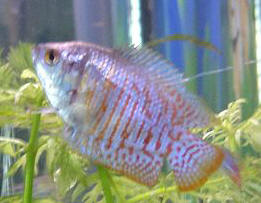
| Dwarf Gourami, hlth. 1/29/08 Hi. I
have been going though your WWM website. Thank you very much for
your support, help and lots of information. I have a question about
one of my dwarf Gouramis. He has been attacked by the male Platy
2-3 weeks ago and since that doesn't look right to me. He looks
as if his scales are gone on one side and some of scales stick out
like a pinecone, and color around that area getting darkish. He
hides in the corner of the tank, always head up position. I noticed
stringy white poop and bloat, slightly swollen around gills. Also
his top fin has a crack ( you can see it on the photo) Today he
wasn't interesting in the food. I checked the water parameters
- they are good. My community tank is 55 gal. Not overstocked. I
did 30% water changes, just in case. I usually do a weekly. I
started to add a MelaFix. Could you help me to advise with the name
of medication I can use to treat my guy? Thanks Larissa <Hello
Larissa. If you're lucky, this is mere Finrot. Treat with a
proper Finrot medication of your choice, but not Melafix which
doesn't really work reliably. Maracyn is popular in the US, but
here in the UK I prefer to use eSHa 2000. Use whatever you want
really. If you're unlucky, this is an early stage of Dwarf
Gourami Disease. This causes swellings and blisters on the body, as
well as lethargy, loss of colour, loss of appetite, and eventually
death. It's incurable. It is caused by a virus, and is so
common among Dwarf Gouramis that I simply WILL NOT recommend anyone
keep them. It is highly contagious, and will affect all Dwarf
Gouramis including the "fancy" sorts like Neon Gouramis
and Robin Gouramis. If you have any of these in the tank, assume
they are infected, and likely doomed to a premature death. The
reason Dwarf Gourami Disease is so common is that people keep
buying the things, and so the breeders out in Singapore make no
effort to stop the virus. There are much better Gouramis out there,
such as Colisa fasciata and Colisa labiosus. Cheers,
Neale.> |
|
|
|
Gouramis disease, Colisa lalia... 1/18/08 Hi, I have
a 130lt aquarium and it hosts 9 fish (6 gouramis, 2 goldfish, 1
angel and 1 neon tetra). 4 days ago all of a sudden my 2nd angel
died (didn't show any symptoms before that) and ever since I
have the one problem after the other in the aquarium. I did
partial change of the water but the next day one of my gouramis
(red in colour) stayed at the bottom of the tank swimming only to
go up and grasp some oxygen and then come down to the bottom of
the tank again. I decided to get my water tested, so I took a
sample to the pet shop that showed a small rise of nitrates in
the tank and he gave me a liquid to change the nitrate levels
that I used in conjunction with sera Nitrivec, after another
partial change of the water. The day before yesterday my sick
Gourami got a swollen belly and I decided to look for a cure. It
seemed like an internal infection and I found a treatment with
sera BACTOPUR direct that I used today. Yesterday, after the med
for the nitrates a few other gouramis started showing weird
behavior. They swim like crazy up and down, and one of them seems
like it's fainting for a while, then getting up and swimming
normally. Today, nearly none of my gouramis ate, and the sick one
cannot swim at all, it has the swollen belly, the colour of the
Gourami becomes darker and it seems like he is peeling off at a
small part of her body. I went to the pet shop and bought sera
BACTOPUR direct today, and added 2 tablets to the tank. I took
out the sick Gourami and put it in 2 litres of water 1 tablet of
sera BACTOPUR direct for a more drastic treatment, left it for 30
minutes and put it back in the tank. I didn't see any change
yet, and I really do not know what to do. I only have the
aquarium for a month, I do not have any live plants, and
they're the first fish I introduced in it. I also rose the
temp to 28 Celsius degrees. Please help me, if I can save their
life. Thank you Elena <Hello Elena. Are these Dwarf Gouramis
(Colisa lalia) by any chance? If they are, then the problem is
almost certainly "Dwarf Gourami Disease". This is not
curable, at least, not at the point where the fish display
symptoms. Typical symptoms are: first shyness and loss of
appetite, then the colour fades, then ulcers and lesions appear
on the body, then the abdomen swells, and then the fish dies. The
best you can do is painlessly destroy sick fish, because they
won't get better. (Or at lest, I've yet to hear of any
Dwarf Gourami with Dwarf Gourami Disease get better.) Dwarf
Gouramis are simply not worth keeping any more. Avoid, and never
keep them again. If you must keep a small Gourami, then look to
hardier species such as Colisa fasciata and Colisa labiosus. Do
also understand that a "new" aquarium (which yours is)
doesn't have a fully mature filter. Many fish will become
sick when kept in such a tank. Use a nitrite (with an
"I", as opposed to nitrate-with-an-"a") test
kit to measure the nitrite level; if you detect nitrite, the tank
is still immature and potentially deadly to your fish. Do lots of
water changes! I'd suggest 10-25% per day for the next week
or two. Stick with a few, very hardy fish to begin with.
Corydoras paleatus for example, or Danio species. Only keep
things like Gouramis and Angelfish after 2-3 months. Cheers,
Neale.>
Re: Gouramis disease 1/18/08 Hi Neale. Thanks for the
quick response. Yes, I checked now on Google, I have the dwarf
gouramis (Colisa lalia). Ok, so I will take back to the pet shop
the gouramis that don't look sick and the angel. I will only
keep goldfish in for a couple of months. Do you think that this
disease will affect goldfish now it exists in the tank? I have to
admit I am new in the aqua world and I hardly know anything about
fish. I am constantly trying to read and learn now though. Ever
since I set up the aquarium I change the water every week. I
didn't know gouramis were so sensitive, but I got really
upset not being able to help them. When I take gouramis out, do I
have to change the water? Because the medication is still in the
water. I am supposed to change it in 3 days. I live in Cyprus and
in pet shops I couldn't find a huge variety of species but I
will do exactly what you said if I am to avoid having them
suffering again. Thanks again, you have a wonderful website.
<Hello Elena. Goldfish will be fine, provided you keep on top
of water changes. No, Goldfish don't catch Dwarf Gourami
Disease (as far as we know!). Not much is known about the virus
that causes the disease, except that it is VERY widespread.
http://www.practicalfishkeeping.co.uk/pfk/pages/item.php?news=1139
Yes, change some of the water after you remove the Gouramis, but
not because of the disease, but because that's a good thing
to do. Water changes are GOOD! They're the cheapest and
easiest way to have healthy fish. 50% per week is what I
recommend. But finish to coarse of medicine first. So if it says
no water changes for 3 days, then don't do water changes for
3 days. Wow, Cyprus would be a GREAT place to keep fish. If I was
there, I'd spend all my time at the beach, collecting cool
gobies and blennies. The Mediterranean is just packed with
excellent fish that do really well in aquaria. But if you want
FRESHWATER fish, then you'll have to work with what's
available! Dwarf Gouramis just aren't worth it in my
experience. Lots of better gouramis. Avoid MALE blue or gold
gouramis though (Trichogaster trichopterus), as they can be very
aggressive. Cheers, Neale.>
Re: Gouramis disease 1/18/08 Hello Neale. Thanks for
that. I will do as you told me. Thanks again. <Very good.
Enjoy your fish! Neale.>
|
|
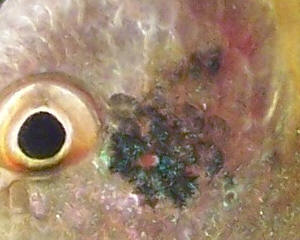
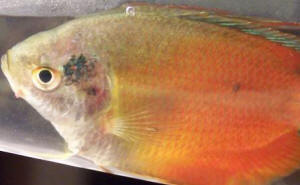
Colisa lalia/chuna (?) with sickness/discoloration.
1/17/08 I have a dwarf Gourami, Colisa lalia (I think), which
I believe is sick. <Yes, this is Colisa lalia, but an
artificial morph.> I say *believe* because behaviorally there
don't appear to be any problems. <Not yet, anyway. But the
sore does look troubling.> However, he's developed the
coloring/marking shown in these pictures in the last week,
week-and-a-half, and it doesn't appear to be going away. It
also doesn't seem to be growing/changing 'it was
just 'there' one morning. He's been in quarantine
since Dec. 26 (along with the other fish I got at the same time)
and none of the other fish have developed this'¦
problem. <Good.> The whole batch had Ich when we picked
them up (I got them for pennies on the dollar) but that cleared
up nicely and we only lost a clown loach (out of $120+ worth of
fish and the one we wanted most kicks the bucket ;-().
<Hmm...> Treatment was QuickCure (at half the dose--group
includes tetras), salt (2 tbsp/ 10 gal), and Melafix (don't
knock it'¦ it's helped me many times) for 12 days.
I've since put him into his own quarantine (3 gal Eclipse)
and am at a loss. <Not a fan of Melafix. Yes it works
sometimes, but not always; the alternative medications may be
more expensive, but at least they work consistently.> My first
thoughts were DGD or some kind of tumor, but the coloration
doesn't seem right to me and it doesn't seem elevated so
I haven't considered it a growth. <I'd go with Dwarf
Gourami Disease as well. Only time will tell... Regardless,
don't mix with any other Gouramis, and certainly don't
place in a tank you intend to add Dwarf Gouramis to any time
soon.> Nitrates/Nitrites/Ammonia are all easily within
allowable limits (15 ppm/ 0 ppm/ 0 ppm). Temps were on the high
end to clear up the Ich (82 F). <Fine.> Hardness is 4 dH,
pH is 7.4, and water changes are weekly with treated tap-water of
the same hardness and pH. Do you have any thoughts? Thanks!
<None really. You're doing/thinking what I would. It's
possibly physical trauma that's damaged some nerves, and so
what you're seeing are the "colour cells"
(chromatophores) stuck in an odd position (think: broken pixels
on an LCD screen). There certainly seems to be a puncture at the
centre, but whether that's a puncture inwards (i.e., a cut)
or a puncture outwards (i.e., a burst cyst) I cannot say. If this
is DGD, the fish 'll be dead in a few weeks, so you may as
well maintain in a quarantine tank (or at least a tank without
labyrinth fish) and see how things go. If nothing happens after a
month or six weeks, at the very least you should see the central
wound heal up, in which case keep the fish in a community tank
without labyrinth fish are accept it as just being odd. Please
get back in touch as and when you see things change or improve;
I'd like to know more. Cheers, Neale.>
Re: Colisa lalia/chuna (?) with
sickness/discoloration. - 1/17/08 Neale (and WWM Crew),
<Branon,> Thank you for the quick response! It looks like
we're on the same sheet of music on this one. <Cool.>
I'm concerned when you say not to put him into a system with
Anabantoids...I have a Betta (which is currently in a separate
QT) I'm planning on including in the system (150 gal
community tank) and I was thinking these two are far enough
distant in relation to rule out susceptibility to DRD...?
<I'd guess that'd be a fair comment, but I'm just
not 100% sure.> I may also not be familiar enough with DRD...
is this an infection which can/will remain in the tank for
months/years even if there aren't viable hosts (i.e.
non-resistant labyrinth fish)? <Likely yes. It's caused by
a virus -- Dwarf Gourami Iridovirus -- and as far as I'm
aware, no-one knows how to kill it, how long it can survive in an
aquarium, if it can be carried by other fish without causing
symptoms, or really much of anything at all!> Is there an
all-clear time-frame? <Not aware of one, no.> If it
doesn't clear up and he isn't dead by the end of the
additional 4-6 wk. QT, do I assume it isn't DRD? <Sounds
reasonable to me.> Thanks for all your wonderful assistance!
<Happy to help!> <Cheers, Neale.>
|
|
|
|
|

