FAQs on
Colisa lalia, C. chuna...
"Dwarf" Gouramis of Many Names, Honey, Flames, Neon
Blue, Sunset Fire... Disease/Health 3
FAQs on Dwarf Gourami Disease:
Dwarf Gourami Disease
1, Dwarf Gourami
Disease 2, Dwarf Gourami Disease 4,
FAQs on Dwarf Gourami Disease by Category:
Diagnosis,
Environmental,
Nutritional,
Genetic,
Infectious
(Virus, Bacterial, Fungal),
Parasitic,
Social,
Treatments,
Related Articles: Anabantoids/Gouramis & Relatives,
Genera Ctenopoma &
Microctenopoma, Betta splendens/Siamese
Fighting Fish,
Related FAQs: Dwarf Gouramis,
Dwarf Gourami Identification,
Dwarf Gourami Behavior, Dwarf Gourami Compatibility, Dwarf Gourami Selection, Dwarf Gourami Systems, Dwarf Gourami Feeding, Dwarf Gourami Reproduction, & FAQs on:
Gouramis 1, Gouramis 2, Gourami Identification, Gourami Behavior, Gourami Compatibility, Gourami Selection, Gourami Systems, Gourami Feeding, Gourami Disease, Gourami Reproduction, Betta splendens/Siamese Fighting
Fish,
|
|
|
URGENT: Dying Gourami? 1/29/10
So one of my dwarf flame gouramis has been hiding alot
<When did this become a single word? We seem to see it a lot
around here!>
<<RMF would bet "dollars to donuts" that this
word will become part of American English in short order... plan
to see it in proscriptive lexicons w/in a decade>>
lately, and when I got home from work today, he was still hiding
in plants.
I tried to flush him out, and he barely moved. Got out the net
and pulled him out the plants, he floats upright and makes no
attempt to move. The fish is still breathing, but I think its on
its last legs. Should I just take him out and flush him?
Picture is attached.
<Indeed. Well, do start reading here:
http://www.wetwebmedia.com/FWsubwebindex/dwfgdis.htm
The thing with Colisa lalia is that it is a difficult fish to
keep at the best of times, and relatively prone to both
Mycobacteria and Dwarf Gourami Iridovirus. Now, Colisa lalia was,
maybe 50 years ago, quite a hardy fish.
But at some point inbreeding and overuse of antibiotics on fish
farms meant that the fish sent to shops had less and less innate
resistance to disease.
Shoppers aren't as discerning as they could be, and look for
things like new colour varieties (including Flame Gouramis)
rather than hardiness, and worst of all, instead of ignoring
tanks with one or two sick fish, they simply pick out the
best-looking one and hope for the best. Writers since at least
the 1980s have been warning aquarists to be careful when buying
this species, and also have stressed their need for precise water
conditions: 0 ammonia, 0 nitrite, a pH between 6 and 7, and low
hardness, under 10 degrees dH. Water temperature must be quite
high, around 28-30 C, 82-86 F, which is well above the tolerances
of things like Danios, Neons, Platies and Corydoras, so these
aren't community fish by any standards. In short, your fish
is dying and probably does need to be euthanised.
"Flushing" as you so delicately put it isn't an
option. I hope you're just pulling my leg! Use a humane
method of destruction, as outlined here:
http://www.wetwebmedia.com/euthanasia.htm
Cheers, Neale.>
|
 |
re: URGENT: Dying Gourami?
1/29/10
Thanks Neale, yes, "flush" was just an easier way to type
euthanasia(sp?).
<Fair enough.>
The fish past away on his own, and I figured that the fish was
dying of DGD.
<Or Mycobacteria. It's really difficult to tell the two
apart since the symptoms are similar.>
I assume it just a matter of time before the other dwarf Gourami I
have dies?
<Mycobacteria infections occur primarily when a fish is exposed
to poor conditions or otherwise stressed. A healthy Dwarf Gourami
given the conditions I outlined earlier should be fairly resistant.
But yes, Dwarf Gourami Iridovirus is highly contagious, and I would
never buy a Dwarf Gourami from a tank of specimens containing some
I suspect had DGIV.>
It is just a normal morph, and is quite the healthy fish,
constantly swimming around and looking for food.
<You may be just fine. Keep an eye on it, and in future, I would
recommend Colisa fasciata or Colisa labiosa as two similar, but
much hardier, fish.>
Thanks again,
Andrew
<Good luck, Neale.> |
Not A Question, Just A Pat On The Back
For All The Crew 1/21/10
Good Afternoon (well, it's the afternoon for me at the moment, so
"Good Whatever-it-is-wherever-you-are"!) all.
<It's about 8:30am Katherine, and I'm on my second cup of
java, still developing into a human looking form.>
Panic not, I haven't got a question that you're probably sick
to the back teeth of answering.
<Nah, is what we enjoy doing, benefiting others from our
experience/mistakes.>
I just wanted to say a heartfelt thank you for having such an
informative, reliable and literally life-saving website.
<Why thank you, and it is much appreciated.>
I took the first tentative steps to becoming a proud fish parent (!) in
October last year, when I invested in a 10g tropical tank setup. I
didn't want to be one of those naive folks (I'd
use a more derogatory term, as IMHO there's no excuse for ignorance
where life is involved...sorry, will climb out of the pulpit now!) who,
in their impatience, overstocked their brand new uncycled tank and then
suddenly wondered why their fish all keeled over on them. So I did my
research. A lot of it. To the point my friends and family were
wondering whether I'd ever actually put any fish in my
still-cycling tank. But I just thought I'd let you know that my
bible throughout that first month (and, let's face it, probably for
the next few years as my hobby evolves) was your website. From
considering the quandary of fishless versus fishful (?!) cycling, right
down to choosing my community, you guys had it covered. And I'm
delighted to say in the three months that I've had the tank, not
one fish has died on me. In case you're interested, I have 9 little
Neons, a neon blue dwarf Gourami, and three guppies. One had a little
hiccup, but having taken the approach recommended by Bob on one of the
FAQ pages, he pulled through. Yet another testimony to my faith in your
site over other advice pages! Other friends of mine have not been so
fortunate (they're my friends, so I reserve judgment on their
aquatic and/or piscine husbandry) and in a desperate attempt to prevent
more unnecessary suffering I've sat them down and made them look at
your website. Time will tell, but at least I feel I've given them
the tools they need to make a decent attempt this time around. So once
again, my fishy friends, and my friends' future (hopefully happy
and healthy) fishy friends both salute and thank you! Please keep doing
what you're doing :)
<Again, a heartfelt thank you and I'm sure Bob has no future
plans to shut down this site, enjoy. James (Salty Dog)>
Kind regards,
Kat
Oooh - I tell a lie, I do have one question that I can't seem to
find an answer to yet. Could you please tell me how long it
takes for a Neon Blue Dwarf Gourami to develop his mature
colours? He's definitely male, and they "told"
me he was a neon blue. He's currently a pale iridescent orange with
faint blue stripes, but no one at the LFS could tell me how long before
he'd start to look like an adult....
<It's been a while since I've been into freshwater and I
took this query based on the subject line, but I will do my best to
answer this for you. The Neon Blue Dwarf Gourami, also called the
Rainbow Dwarf Gourami is a color morph of the Dwarf Gourami. This color
variety may be referred to as the Rainbow Gourami when the blue
coloring has a shiny metallic cast to it. Other than the more intense
blue coloration, the Neon Blue Dwarf Gourami or the Rainbow Gourami are
the same as the Dwarf Gourami. Not only are they hardy but they stay
fairly small, rarely exceeding two inches in length. There is no
guarantee just how much color your specimen is going to have since it
is a morph and the coloration can/may vary. But at the adult stage
(2" in length), the fish should have it's full coloration. Bob
may also input here and I will leave this query in my inbox should
Neale (one of our resident freshwater gurus) want to respond to you.
>
Thanks :)
<You're very welcome. James (Salty Dog)>
Re: Colisa lalia, colouration; Was: Not
a question, just a pat on the back for all the crew. --
1/21/10
Oooh - I tell a lie, I do have one question that I can't seem to
find an answer to yet. Could you please tell me how long it takes for a
Neon Blue Dwarf Gourami to develop his mature colours? He's
definitely male, and they "told" me he was a neon blue.
He's currently a pale iridescent orange with faint blue stripes,
but no one at the LFS could tell me how long before he'd start to
look like an adult....
<It's been a while since I've been into freshwater and I
took this query based on the subject line, but I will do my best to
answer this for you. The Neon Blue Dwarf Gourami, also called the
Rainbow Dwarf Gourami is a color morph of the Dwarf Gourami. This color
variety may be referred to as the Rainbow Gourami when the blue
coloring has a shiny metallic cast to it.
Other than the more intense blue coloration, the Neon Blue Dwarf
Gourami or the Rainbow Gourami are the same as the Dwarf Gourami. Not
only are they hardy but they stay fairly small, rarely exceeding two
inches in length.
There is no guarantee just how much color your specimen is going to
have since it is a morph and the coloration can/may vary. But at the
adult stage (2" in length), the fish should have it's full
coloration. Bob may also input here and I will leave this query in my
inbox should Neale (one of our resident freshwater gurus) want to
respond to you. >
Thanks :)
<You're very welcome. James (Salty Dog)>
<<Hello Kat and James. I'm going to disagree with James on
the nature of Neon Blue Dwarf Gouramis. They are absolutely NOT hardy,
and haven't been for many years. They are very prone to
Mycobacteria infections when kept under less than ideal conditions, and
a new threat has been something called Dwarf Gourami Iridovirus. This
virus causes a sort of wasting disease, and according to one study by
Australian vets (if I recall correctly) some 22% of the Dwarf Gouramis
exported from Singapore carried the virus. Furthermore, DGIV is highly
contagious and invariably fatal. There's limited evidence about
whether it affects other species, but at least one native Australian
fish can catch the disease, which is why the vets were so worried.
Anyway, the symptoms are similar to Mycobacteria infections: lethargy,
loss of colour, wasting, ulcers on the body, and eventually death. I
strongly -- and I mean STRONGLY -- recommend people don't touch any
form of Colisa lalia with a bargepole. These include not just the
standard Dwarf Gourami, but also artificial forms such as Neon
Gouramis, Red Robin Gouramis, Sunset Gouramis, Cobalt Gouramis, among
others. Even if your Dwarf Gourami doesn't have DGIV, Mycobacteria
infections remain a real threat. Unlike, say, Blue Gouramis, these
Dwarf Gouramis are quite picky about water conditions. You need soft to
moderately hard, slightly acidic to neutral water; aim for pH 6.5-7,
5-10
degrees dH. Don't bother keeping them if you have hard, basic
water. The odds aren't in your favour. They also need to be very
warm, 28-30 C, 82-86 F. That's MUCH hotter than Neons, Danios,
Corydoras, Platies and many other community fish will enjoy.
Essentially, keep them in their own system rather than a community
tank. Obviously zero ammonia and zero nitrite are a must. There are
much better Gouramis out there for community tanks; I recommend both
Colisa fasciata and Colisa labiosa as being similar in size and colour,
but orders of magnitude hardier and easy to keep. As for colours, the
artificial forms should have their right colours when on sale, though
females are less coloured (usually silvery) than the males. Under
suboptimal conditions they may lose their best colours, but these fish
have limited abilities to dim their colours when stressed, so they
aren't like cichlids. Signs of stress tend to be behavioural:
hiding away, loss of appetite, clamped fins. Cheers, Neale.>>
RE: Colisa lalia, colouration; Was: Not a question, just a pat on
the back for all the crew.
Re: Colisa lalia, colouration; Was: Not a question, just a pat
on the back for all the crew.
Disturbing stuff. I don't have another tank to keep him in the
conditions he's best suited for (I keep temperature at constant 25
degrees, Ph neutral, ammonia and nitrite zero when tested last week).
In the circumstances, it's probably kindest to take him back to the
LFS. I wondered whether you'd mind if I printed your comments to
forward to the General Manager there? I certainly wouldn't have
bought him knowing what I know now, and I don't think they should
be stocking them to sell to others either. I can't guarantee
they'd be prepared to do anything about it, but short of setting up
camp and picketing the front doors, I'd have done my best...
Thanks,
Kat
<By all means pass my message onto the manager of the pet store. But
he/she probably already knows about how crummy Dwarf Gouramis are. Had
many conversations about this species with pet store managers. So why
do they
bother trading them? Because they sell. A goodly portion of their
customers will happily replace a fish that dies after a few months.
Indeed, some view a dead fish as a good thing because it's an
opportunity to buy new stuff!
Since a Dwarf Gourami costs about the same as a pint of beer, who cares
if it's dead within three months? So, for the pet shop, all that
matters is that they sell enough of them quickly enough that they
don't die in the store's display tanks. As for what to do with
your specimen, feel free to keep him. There's little evidence Dwarf
Gouramis infect other ornamental fish, and certainly most other
Gouramis seem immune to the virus. Lots of people have managed to keep
their specimens happy, so you might be fine. My advice isn't to
suggest you take him back, but rather not to buy Colisa lalia in the
first place, and if you do, to be alert to the shortcomings of the
species and what it needs to remain healthy. Fifty years ago it was
actually considered quite a tough little fish! Just goes to show what
inbreeding and overuse of antibiotics can do to even the best of
evolution's handiwork. Cheers, Neale.>
Re: Colisa lalia, colouration; Was: Not a question, just a pat
on the back for all the crew.
Thank you Neale, and is why I opened this up for your comments. As I
mentioned in the query, I answered based on the subject line and should
have returned this to the inbox/freshwater queries.
Goes to show you I certainly wouldn't be too much help to you in
the freshwater department. My experience in freshwater goes back to a
time when their were no morphs and dwarf Gouramis were relatively
hardy. At one time (30 years ago) I raised angelfish, Tiger Barbs,
kribensis, and White Cloud Mountain Minnows to supplement funds for my
marine aquarium. Once I got hooked on saltwater, my interest in
freshwater was soon departed.
James
<Hi James. Not a problem. Indeed, I just mentioned in another reply
back to the querier that these were once quite hardy fish. Saltwater
never really hooked me, I'm afraid. I've set up reef tanks for
others, and kept coldwater marine tanks at university, but the ability
to observer social behaviour and breeding keeps me coming back to
freshwater stuff. That, and the insane amount of money and time you
need to keep marines properly! I do think there's a difference
between the North American hobby and the European hobby too. When I
lived in the US, and when I go back on trips, I'm never impressed
with the selection of freshwater stock. Getting good quality,
wild-caught cichlids is more difficult, and the range of oddball fish
is miniscule. The whole Amano planted tank thing is changing the US
market somewhat, but it seems to me that before that there wasn't
much "advanced" freshwater fishkeeping at all: first you kept
community fish, then you kept African cichlids, and then you kept
marines!
Cheers, Neale.>
Re: Colisa lalia, colouration; Was: Not a question, just a pat
on the back for all the crew. -- 1/21/10
Neale,
<James,>
I certainly agree with you on the cost of keeping marines/reef tanks.
I'm now on a fixed income and time will soon tell me whether
I'll stay with that or go back to freshwater. My freshwater dream
tank would be a nicely planted tank with assorted tetras and a few
catfish for cleanup.
<Yes; this Amano type thing, or at least a Dutch type aquarium, does
seem to appeal very strongly to marine fishkeepers. Perhaps it's
3-dimensional structure of the decoration, or the combination of plants
and animals instead of corals and animals. Definitely ex-marine
fishkeepers are better at keeping big tanks with just a few fish,
rather than cramming "one of everything" into a glass box,
like many freshwater fishkeepers seem wont to do!>
My tank size of 60"x18"x18" would provide a nice
display. You certainly can buy quite a few tetras for the cost of one
average priced marine fish.
<Depends on the tetra! There are some barbs, like Red Torpedo Barbs,
that sell for more than the average Clownfish. Once you start keeping
the hardcore stuff like some of the recently described dwarf
snakeheads, you're spending $100 a fish, or more!>
With my metal halide system I feel a healthy planted freshwater tank
would be feasible.
<Easily. Plants are very good at adapting to ex-marine lighting
systems.>
I've seen systems such as I've described and they are truly
beautiful with driftwood and all.
<Yes, but very labour intensive. If you think keeping Green Star
Polyps in check is hard work, wait until you meet Hygrophila!>
Should that day come, I will be one of the queriors of freshwater
planted tanks.
<Can't wait! And who knows, maybe I'll ask you about deep
sand beds and phosphate removal, just for the sheer fun of it!>
James
<Good chatting to you. Seems our paths don't cross all that
often, but it's always fun to read your stuff in the Daily FAQs.
Cheers, Neale.>
My dwarf Gourami has a very big stomach
1/12/10
Dear Crew,
My dwarf Gourami has a very big stomach, though he barely eats, nipping
at the food and then a fish eats the whole flake.
<The question here is whether the fish is fat but otherwise healthy,
or is he fat and lethargic? If he's swimming about normally and
shows his proper colours and liveliness, then constipation may be the
issue. Treat as per Goldfish, skipping dried foods entirely, and
offering just cooked peas and live (or wet-frozen) brine shrimp and
daphnia. Adding Epsom salt to the water can help speed up the cure.
http://www.wetwebmedia.com/FWsubwebindex/gldfshmalnut.htm
But if the fish is swollen and not behaving or looking as it should,
then an infection of some sort is probable. Abdominal worms such as
Camallanus are a possibility, and these can cause fish to swell up.
Treat using an
anti-helminth medication such as Praziquantel.
http://www.wetwebmedia.com/FWSubWebIndex/fwwormdisid.htm
http://www.wetwebmedia.com/FWSubWebIndex/fwfishmeds.htm
Abdominal swelling can also go along with systemic bacterial
infections, the symptom aquarists often called Dropsy. In this case,
the scales typically become erect, so that viewed from above the fish
has a pine-cone appearance. There's no real cure because the damage
is too far gone by the time this happens, so euthanasia is the only
practical approach.
http://www.wetwebmedia.com/FWSubWebIndex/dropsyfaqs.htm
http://www.wetwebmedia.com/euthanasia.htm
>
Is this overeating or a bacterial infection if so how do I treat it if
I can? For more help this is a new fish, only had it about two
weeks.
<The modern farmed Colisa lalia is a feeble species, and extremely
prone to disease. These include Mycobacteria infections and a viral
disease known as Dwarf Gourami Iridovirus. In either case the fish
becomes lethargic, loses
its colour, exhibits odd sores or patches of dead skin, and eventually
dies. Abdominal swelling can certainly be among the symptoms of either
disease. While not all sick Colisa lalia have either a Mycobacteria or
DGIV infections, many do, so it's well to be aware of these two
diseases.
Neither is curable, and both are highly contagious. Affected fish
should be removed and euthanised.
http://www.wetwebmedia.com/ca/volume_6/volume_6_2/mycobactera.htm
http://www.wetwebmedia.com/fwsubwebindex/anabantoids.htm
http://www.wetwebmedia.com/fwsubwebindex/dwfgid.htm
Personally, I don't recommend Colisa lalia, and don't know many
expert aquarists who rate them at all highly. For casual aquarists,
Colisa labiosa and Colisa fasciata are infinitely better choices, and
well worth keeping.
If you must keep Colisa lalia, then try to acquire locally bred, rather
than farmed, specimens, perhaps through your local fish club.
Quarantine all new specimens for at least 6 weeks. Because it is such a
feeble fish, make sure Colisa lalia is exposed only to optimal
conditions: 0 ammonia, 0 nitrite, pH 6.5-7.5, low hardness (5-10
degrees dH), and relatively warm water, 28-30 degrees C. Feed a
balanced, vitamin-rich diet. Cheers, Neale.>
Re Colisa lalias --
01/12/2010
Thank you very much Neale, I figured he had an infection. Sadly, he
died sometime today and I found him dead after I came home.
<Sorry to hear this. Of course, now you know better, and you'll
be able to make more informed choices when shopping. Avoid Colisa lalia
in all its forms (Flame Gouramis, Neon Gouramis, etc.). Cheers,
Neale.>
Red Dwarf Gourami illness?
12/31/09
Hello WWM,
<Hello,>
Today both my Red Dwarf Gouramis dropped to the bottom on my tanks and
are just lying there on their sides. Every now and again they will rise
up and swim around for a while before dropping again.
<Colisa lalia are an extremely poor investment for most community
tanks because they are so disease prone. Dwarf Gourami Iridovirus and
Mycobacteria infections are both common. Without stringent quarantining
first, and then very careful control of their environment, they often
die from these two diseases. One study by vets found 22% of the Dwarf
Gouramis exported from Singapore carrying DGIV, and since this is
highly contagious as well as invariably fatal, it doesn't take much
for a whole batch of fish to end up sick or dead.
http://www.wetwebmedia.com/fwsubwebindex/anabantoids.htm
http://www.wetwebmedia.com/fwsubwebindex/dwfgid.htm
>
I have noticed over the last week up to today that they were swimming
strangely i.e. pointing mouth upwards and kind of bobbing along the
tank rather than swimming like a fish usually does.
<More likely the orientation is simply a reflection of reduced
swimming ability than anything else.>
I notice a slight darkening of the skin tone around the head (bright
red when purchased 4 weeks ago).
<By definition, artificial forms of Colisa lalia are *even* more
disease prone than the natural type, simply because of the inbreeding
required to produce them. It's always better to choose wild-type
colours over artificial colours.>
PH, Nitrite and Nitrate look fine.
<Do check water quality, temperature and water chemistry. Colisa
lalia needs soft, slightly acidic to neutral water (pH 6.5-7.0, less
than 10 degrees hardness dH). Temperature should be towards the high
end, 28-30 C (82-86 F) but note that this is MUCH too warm for most
community fish, which is why they do badly in community tanks (i.e., if
your Gouramis are happy, your Corydoras and Neons are suffering
heatstroke!).>
Any ideas?
<For now, observation. But if there's no sign of improvement,
humane destruction.
http://www.wetwebmedia.com/euthanasia.htm
>
It doesn't look good at the moment.
<Unless you're prepared to buy locally bred specimens, or else
quarantine new Colisa lalia for 6+ weeks, stick with Colisa fasciata
and Colisa labiosa.>
Thanks
James
<Cheers, Neale.>
RE: Red Dwarf Gourami illness?
Thanks very much for the reply.
I'll see what happens in the next day or two.
James
<Happy to help. Cheers, Neale.>
Pet store -- dwarf gouramis dying, Dwarf
Gouramis Disease (Comments Neale and Bob?) 12/29/09
Howdy,
<Hello>
I work in the fish department of a large chain pet store. When I first
started there a few months ago, the fish system was in pretty sad shape
-- the UV sterilizer bulbs hadn't been replaced for god only knows
how long, and other basic maintenance had not been kept up (changing
out carbon, cleaning valves and flow meters, etc.). They had recently
hired a new manager for that department, and since then we have
dramatically improved the system's performance by replacing UV
sterilizer bulbs, cleaning valves/pumps/meters/etc, and doing lots and
lots of water changes and gravel vacuuming. Disease has been
dramatically reduced, with only occasional instances of ich and
bacterial infections, usually in the most crowded tanks.
<Good to hear that you are taking the right steps here, good for
business to I bet, successful customers are more likely to
return.>
The one thing that has really confounded me, however, is our problem
with dwarf gouramis, Colisa lalia. We carry the three common varieties,
the "regular" striped kind, the "red flame," and
the "powder blue." The latter two are kept in the same tank,
usually with some small 1-2" common Plecostomus. The tank itself
is around 20 gallons, though it's connected to the approximately
1700 gallon system. The regular variety is kept in a different tank
along with zebra Danios, black skirt tetras, and guppies -- that tank
is around 30-40 gallons (I haven't taken precise dimensions).
Water chemistry is very consistent and is generally as follows: Nitrate
- 20 ppm; nitrite and ammonia - 0; general hardness - 150 ppm;
carbonate hardness - 80 ppm; pH - 7.2; temperature - 76 degrees F.
The problem is that we have an extremely high loss of all varieties of
dwarf gouramis. The only symptoms I've noticed until recently are
slightly discolored, grayish patches on some of them before they die.
The other day,
however, I noticed what appears to be bacterial infections on several
-- the patches look as if someone took coarse sand paper to the fish.
The skin/scales are eroded, with the top layer looking
yellowish/whitish, and red inflammation underneath. The odd thing is
that none of the other kinds of fish are having any problems quite like
this, even the ones that are in the same tanks as the gouramis. We only
have a 29 gallon quarantine tank,
and right now it has about 10 small goldfish in it, and since
they're nearing the end of their treatment period, I really
don't want to put any other fish in there at the moment, especially
when I don't know what the gouramis have.
Generally when we have severe bacterial infections that are not brought
on by wounds, stress, or otherwise poor environmental conditions, it
affects more than one type of fish. In fact, the first ones to start
showing problems with bacterial infections are usually the livebearers,
and ours have been doing quite well. Could this be the infamous Dwarf
Gourami Disease? I've worked at other commercial pet stores and
have not experienced a problem on this scale before. Because we're
a chain, we have zero control over what fish corporate sends to us (for
instance, we carry Pacu and iridescent sharks... but that's a whole
other rant in itself), so we can't stop them from coming in. My
manager is very good about working to find solutions, and I might be
able to arrange to have any incoming shipments of dwarf gouramis
quarantined in the 29 gallon, after the goldfish are removed of course,
but this keeps us from being able to use that tank to isolate any sick
fish, and we simply do not have the space for another quarantine
tank.
Any ideas? Other stores in the same chain in our region do not seem to
be having the same problem, so I'm inclined to believe that there
is something going on in our system, though I can't figure out what
it is. Any help would be appreciated.
<Sounds like Dwarf Gourami Disease to me, caused by the dwarf
Gourami Iridovirus, which virtually all commercially available dwarf
gouramis (Colisa lalia specifically) are exposed to. Not much can be
done to treat
this disease, which is most often fatal. Best bet is to just not carry
them at all, even though they are a high demand fish. Perhaps offering
Colisa labiosus and Colisa fasciata in place of the Colisa lalia is
economically viable as these fish are similar but not susceptible to
the dwarf Gourami Iridovirus. I'll copy Neale and Bob on here to
see if they
have anything to add. See here
http://www.wetwebmedia.com/FWSubWebIndex/dwfgdis.htm for more. >
<Chris>
Pet store -- dwarf gouramis dying 12/29/09
<<As Chris said, this is most likely, though not certainly, Dwarf
Gourami Iridovirus (DGIV). The reason why you can't be 100% certain
is that Mycobacteria infections can be extremely similar. Mycobacteria
infections include those called "Fish TB" and like and like
DGIV are essentially incurable.
http://www.wetwebmedia.com/ca/volume_6/volume_6_2/mycobactera.htm
So in either case, we're talking about avoiding the problem rather
than curing it. DGIV has been demonstrated to be present in 22% of the
Colisa lalia exported from Singapore. Whether similar infection rates
exist in stocks from other exporters I cannot say, but because the DGIV
virus is extremely contagious, even one or two infected Colisa lalia
can subsequently infect other, healthy, fish in the same batch or the
same aquarium. There is therefore a very good case of quarantining all
Colisa lalia in their own tank for an extended period, and taking great
care not to cross infect other tanks by using separate nets, buckets,
etc. UV sterilisers have zero impact on viruses, so even if UV is used,
there's nothing to stop the virus moving from one tank to another
via water circulation. If you must stock Colisa lalia, then try to find
a local breeder. But I agree with Chris that both Colisa labiosa and
Colisa fasciata make dramatically better investments. They are slightly
larger and a shade more boisterous, but are still excellent community
fish, and certainly less aggressive than, for example, Three Spot
"Blue" and "Golden" Gouramis (Trichogaster
trichopterus). If you need to offer artificial forms, both come in
albino and all-red "Sunset" forms. Even if exposed to DGIV
they do not seem to suffer any symptoms (though whether they can carry
the virus and so infect Colisa lalia is a good point for discussion and
perhaps action). They are extremely hardy, and provided not exposed to
seriously bad water conditions, shouldn't come down with bacterial
infections. In this regard they are infinitely better than Honey
Gouramis (Colisa chuna), a species that doesn't suffer from DGIV so
far as I know, but is so delicate that unless kept in soft, acidic
water with zero ammonia and nitrite tends to be short lived. When all
is said and done, my impression from talking with British retailers is
that Colisa lalia are simply worthless fish in terms of longevity,
though most suppliers keep them in because they sell quickly. So even
though half the batch may die, and those sold on may only last a few
months, retailers still find them profitable. This makes them a
quandary for responsible retailers wanting to sell good quality fish
that can do well in most community tanks. Hope this helps. Cheers,
Neale.>>
Re: Pet store -- dwarf gouramis dying,
Dwarf Gouramis Disease 12/29/09
Thank you, that's what I was worried about. Like I said, we have no
control over what fish we get in -- every week our inventory of fish is
automatically sent out to the vendor, and they restock whatever
we're low on, regardless of why we're low on those fish.
<Unfortunate that they don't give you guys more input on what
your individual store carries, but is the normal way for big box stores
to manage inventories, supply chain.>
I did talk to my manager about performing an "experiment" to
possibly rule out the disease. I was thinking that we would divide our
next shipment of dwarf gouramis in half, and put one half in
quarantine, making sure the water quality is excellent and the tank is
cycled, and put the other half in the main system as usual. We would
observe them for no less than one week (the average amount of time it
takes a shipment to completely die off), providing the best possible
care to the quarantined fish. If the quarantined fish are thriving and
showing no signs of disease, and the ones in the main system are dying
like usual, I think it would be safe to assume that it is most likely
not Dwarf Gourami Disease. I understand there is still the possibility
that the improved living conditions could cause the virus to lie
dormant, allowing the gouramis to be asymptomatic carriers, so my other
question is this: Is there any data on how quickly the virus normally
kills, or how long the fish can be asymptomatic carriers? I'm aware
that this experiment isn't exactly based on sound scientific
methods, and the results I get from it would not be conclusive, but I
figure it's a starting point... any thoughts or suggestions?
<Generally in good conditions it may take a few months to present
itself, depending on previous conditions, viral load, and many other
factors, so I'm not sure if this experiment will help much, but may
be interesting just to see what happens. All in all unfortunately dwarf
gouramis just generally are not healthy fish.>
I also have a few questions that don't really have any effect on
the store's problem, but I just want to satisfy my own curiosity.
I've been reading more of the FAQs on DGD, and it's constantly
being mentioned that dwarf gouramis commercially bred in Asia are
almost guaranteed to carry the disease, and that if you really want
dwarf gouramis you should buy from a local breeder. My question is
this: would locally-bred gouramis be resistant to the disease, thus
allowing you to put one in a tank that previously housed a diseased
gourami? Or are they a better choice simply because they aren't
exposed to the virus and aren't likely to carry it?
<The latter, just a matter of exposure, not of resistance. The
problem is that wholesaler and to a lesser extent local fish
store's systems are generally infected, so even fish that are not
exposed before shipping from the breeders are infected along the supply
chain. In a way similar to the way ich is so often present in the
supply chain, small volumes of water, large quantities of fish, and
only take 1 infected fish to contaminate the whole lot of them.>
If it's a matter of resistance, is it some sort of genetic
resistance? Or just better immune systems due to better overall
husbandry?
<As above, just a matter of exposure.>
I'm also curious about how all this applies to wild Colisa
lalia.
<Is present in wild populations obviously, but due to large water
quantities, separated populations, and the fact that any prey animal
even slightly sick tends to become someone's dinner rather quickly
keeps this disease in check.>
Thanks for your time, this website is a fantastic resource!
<Welcome>
<Chris>
|
75 gallon community; all sorts of selection and
compatibility "issues" - 11/07/09
Dear WWM,
<Hello John,>
I currently have a 75 gallon FW aquarium with a canister filter,
heater, and bubbler running for the past month. This tank is a
direct upgrade from a 30 gallon tank I had been running and only
has 2 additions in the past month. The tank currently is stocked
with a
1 Tinfoil barb
<Schooling fish, will get very big eventually.>
1 Plecostomus
<Gets big, very quickly, and is incredibly messy; usually
recommend Ancistrus (Bristlenose cats) instead.>
1 Dalmatian Molly
<Does best in brackish water; tend to be delicate in
freshwater.>
1 Kissing Gourami
1 Red Tailed Shark
<Aggressive, but this tank should be adequate to avoid serious
problems.>
1 Albino Rainbow Shark
<Ditto; in fact, be surprised if these two Shark-Minnows
don't spend all the time chasing each other.>
1 Eclipse Catfish
<Also known as the Sun Catfish, Horabagrus brachysoma; gets
very big (45 cm!) and is a schooling, non-territorial predator;
will eat many of these fishes.>
1 Pictus Catfish
<Also a schooling predator.>
1 Albino Cory Catfish
<A schooling fish; likely terrified kept on its own.>
1 Snail
1 Dragon Goby
<Gobioides sp., I take it? Definitely a brackish water fish,
and will not live long in freshwater.>
and had had 1 Powder Blue dwarf Gourami.
<Dead, I take it; no surprise, these are garbage fish in my
opinion. Avoid.>
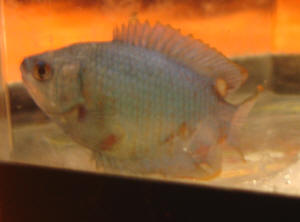
Now that you know about me let me tell you my problem. Attached
is a picture of my Dwarf Gourami, note the perforations in his
tail and odd spots on his side.
<Could be bite marks, to be honest. In a tank with these
animals, a Dwarf Gourami is at best a sitting target for
aggression, and at worst, live food.>
I believe this to be Dwarf Gourami Disease or perhaps a bacterial
infection like fin rot but I do not know.
<Could be either.>
The problem is that I had a fire red Dwarf Gourami about 2.5
months back that came down with a very similar disease, that fish
died. I am wondering if all my other fish are at risk or if this
is simply a manifestation of DGD and I should not worry for the
rest of my aquarium?
<I'd write of Colisa lalia and be done with them. So, do
you have problems with the aquarium? Yes indeed! The mix of fish
is, let us say, adventurous, and the Dragon Goby at the very
least has a limited lifespan without being moved to a brackish
water aquarium.
http://homepage.mac.com/nmonks/Projects/FAQ/6b.html
There are schooling fish in there that need to be kept in groups,
and some of the fish get extremely large and/or are predatory.
Time to pick up a book about aquarium fish, read up on what they
need, and concentrate on keeping fish that you are prepared to
provide for properly. Keeping single specimens of schooling fish
isn't fair, and keeping brackish water fish in a freshwater
aquarium is doomed.>
Thank you for your time
<Always happy to help.>
Sincerely,
John
<Cheers, Neale.>
|
 Iridovirus
 |
Dwarf Gourami Question, hlth.
9/17/09
Hi Gang!
First off, thanks for the informative website and straight to the point
answers.
<Thank you.>
Tank info: 29g Established for 6 months. 0 ammonia, 0 nitrites, 10
nitrates, pH 7.6 I recently lost a DG to what I believe was DG Disease.
As much as I didn't want to believe he had it and searched
exhaustedly for any other answer, he had all the classic symptoms as
described on your site.
<Do bear in mind Mycobacterium infections can look very similar, and
unless you're a microbiologist, telling them apart is, ultimately,
impossible.>
I finally put him down in a peaceful manner. I only had him a few
months, but I loved the little guy.
<They are nice fish, but with infection rates as high as 22% (from
Singapore) I simply don't recommend people keep them *unless* you
can source a locally bred supply of them.>
I also lost a cardinal and a guppy around the same time. They
didn't show any outward signs of illness. I can't help think
they were related.
<Deeply unlikely. DGIV only effects gouramis, and primarily Colisa
lalia.
While it might affect the odd Gourami from other species now and again,
the chances of its killing Guppies and Tetras is exceedingly low. On
the other hand, conditions that lower the immune response of Dwarf
Gouramis and thereby allow them to die from Mycobacterium infections
can also allow similar problems with other species. A good general rule
is this: if three specimens of the same species die from something
mysterious, it may well be something viral particular to that kind of
fish; if three completely different species die, then the problem is
almost certainly environmental.>
What are the chances of 3 fish dying and it not being related?
<If the aquarium has a problem, the chances are very high
indeed.>
Anyway on to my question. I stupidly went out and bought a Powder Blue
Dwarf Gourami. Thinking I asked the store the smartest question, Are
they tank bred? When he said yes, I was pretty excited that this would
decrease the chances he had been exposed to DGD.
<Eh? It's the tank-bred, i.e., farmed, specimens that have
DGIV.
Wild-caught specimens -- which are virtually absent from the trade and
very expensive when they do appear -- should be DGIV-free.>
On the drive home two light bulbs went off in my head. The first being
Tank Bred could mean he was still imported. Duh!
<Indeed.>
I should have asked if he was locally bred. (smacking myself) The other
light bulb moment is that I read (can't remember where) that this
virus can be transferred through the water.
<Yes. I'd allow a tank to be 6 months Gourami-free before
risking it. That said, I don't think that's the issue here.
I'd suspect Mycobacterium or even a simple case of opportunistic
bacterial infection (Aeromonas,
Pseudomonas, etc.).>
I thoroughly sanitized the quarantine tank (20g) and anything that came
in contact with it and my new DG is in there now. My concern is after
quarantine time, can he go into the 29g tank that the original DG
was
living in when he got sick?
<If the tank with the dead Dwarf Gourami has been Gourami-free for
six months, then you should be fine. If not, then yes, there's a
risk of contamination.>
There are tetras, cories and a snail in there and I don't see a way
to thoroughly sanitize it without cross contamination through nets,
water on the fish etc. Is this tank destined never to see a DG
again?
<Would be my recommendation, insofar as Colisa lalia is largely
worthless as an aquarium fish anymore. But as I said earlier, I
don't suspect DGIV is the issue here, and would strongly recommend
you keep an open mind here, and review other potential sources of
trouble.>
Oh, and will I received an e-mailed answer?
<Yes.>
Your website is so huge, I don't know If I'll ever find your
answer, should you choose to answer. :)
Thank you for taking the time to read this. Alice
<Cheers, Neale.>
re: Dwarf Gourami Question
9/17/09
Thank you for your quick response, it's much appreciated.
<My pleasure.>
I called the store I purchased the DG from, he was bred in Florida, not
imported, if that means anything.
<Not much. To be fair, we don't know how the farms in Florida
compare to those in Singapore in terms of DGIV prevalence, since the
scientific study was specifically on Singapore. Colisa lalia from
Florida might be fine for all I know.>
At any rate the DG that I lost was from a chain store, they have no
idea where they get their fish.
I have another established 20g tank my new DG can live in.
<Cool.>
No other fish in the 29g appear to be ill. I don't want to treat
healthy fish but your mentioning other bacterial infections are
concerning. Would you recommended treating the tank with a gram
pos/gram neg anti-bacterial medication or wait it out?
<Wait. Don't treat the fish unless there's sign of disease.
Instead, watch the fish, optimise water chemistry and temperature for
the species being kept, ensure good water quality, and provide a
balanced diet. All the usual stuff, really.>
Thanks again. :)
<Cheers, Neale.>
re: Dwarf Gourami Question
Will do, thanks again for your help and such a great website :)
<Thanks for the kind words. Cheers, Neale.>
Question for the crew/ dwarf powder blue
Gourami hlth. 8/26/2009
I am new to the world of keeping aquariums, and I have spent many hours
reading through your website and have learned a great deal about
providing the best care for our fish.
<Very good.>
I am writing for guidance about a dwarf powder blue Gourami I recently
(9-10 days ago) purchased from a LFS. Unfortunately it was after this
purchase that I read all of the warnings about avoiding this
particular
fish because of the susceptibility to diseases. Nonetheless, here I am
with a problem.
<Indeed, not a fish recommended for beginners. While once a good,
reliable fish, this is certainly not the case any more.>
The tank: The fish is in a quarantine tank that was our original
aquarium before upsizing (he was placed in there for planned period of
quarantine after we purchased him, prior to introducing him to our main
tank). It is an Eclipse 6 with a thin layer of rocks, a few artificial
plants, and an air stone.
<This tank is only 6 gallons in size, and even as a quarantine tank,
of marginal value.>
It was well cycled prior to introducing the fish, using substrate from
our main tank and a filter I kept in the main tank. There are no other
inhabitants of the tank currently, since I removed 2 female platies the
other day to put in the main tank and to isolate the Gourami. I check
the chemical parameters almost daily since putting him in quarantine,
with the following results: ammonia 0 ppm, nitrite 0 ppm, pH 7.0. The
nitrate did
increase up to 20ppm but is now about 5-10 after a 25% water changes
(which I am doing every 4 days or so), vacuuming the gravel, and
removal of the BioWheel (I read somewhere that BioWheels may contribute
to high nitrate levels). For the record, there was little in the way of
uneaten food when I vacuumed, though I will admit I am probably guilty
of overfeeding my fish. Tap water for water changes is prepped with
Tetra AquaSafe and Proper pH 7.0. He is fed TetraColor flakes and
occasionally freeze-dried blood worms or peas.
<All sounds fine.>
The problem: We first noticed a couple of wart-looking growths on his
left side just below the dorsal fin line. Initially they appeared more
rust-like in color, sort of like his stripes and other markings. They
are unchanged in size but now more tan in color with nothing protruding
and nothing looking like ulcers.
<If the "warts" are off-white to cafe-au-lait in colour,
there's a good chance you're dealing with Lymphocystis. While
related to environmental problems, and so a sign to review tank
conditions carefully, it is not normally fatal. It isn't treatable
as such, but given good water and a varied diet, most fish recover in
time, typically several months.>
Over the past several days, we have noticed increasing number of
"holes" in his fins - first his anal fin, then his caudal fin
and now his dorsal fin.
The "holes" have increased in number over the past 4-5 days
since I first noticed them. The edges of the fins appear normal and not
frayed or torn.
<Ah, now, this is more serious. When holes appear, there is usually
one of three things going on. Firstly, there's physical damage,
e.g., when a Betta gets sucked by a strong filter and only gets away
after losing a bit of fin material. Secondly, there's biting, e.g.,
when fish are nipped by tiger barbs. Finally, there's bacterial
infection, though this is usually associated with obvious signs of
death and decay, typically things like
spots of bloody inflammation on the fin membrane. So, review these
possibilities and act accordingly.>
The Gourami is feeding vigorously and is not appearing to be gasping or
in respiratory distress (at least as far as I can tell and I am a
pulmonologist!).
<Heavy breathing can be a sign of a variety of problems, but the
converse, regular and steady breathing, does not necessarily imply good
health.>
He is swimming in a normal fashion in all areas of the tank - not
erratic, tilted, darting or rocking. He is not bloated and he does not
appear to have dropsy. He has no white spots or red streaks. His eyes
appear normal and not bulging or discolored. His stools look normal in
color, and are not pale.
<OK.>
I have not started any medication, though I have Maracyn and Maracyn 2,
which I could use for fin rot.
<Does not seem warranted yet; would observe, consider the options
first. Over-medicating fish can cause problems.>
I was not thinking this was fin rot initially since the edges of the
fins are not frayed or torn, and I had not seen any photos that looked
similar to what we have seen. I was also hoping frequent water changes
and ensuring good quality water would help clear things up, especially
since he does not appear ill in any other way. However, the number of
holes appears to be increasing more quickly over the past day or
two.
I appreciate any guidance.
Regards, Laura
<It sounds vaguely as if this fish is being physically damaged
somehow, perhaps by another fish, or over-strong filtration, or rough
handling, or something abrasive in the tank. A mild antiseptic like
tea-tree oil
("Melafix") might be appropriate to avoid secondary
infections. Hope this helps, Neale.>
Sick Gourami 7/15/2009
Hi there, i have come across your site as really concerned about our
dwarf Gourami!
<Oh dear. As I write repeatedly on these pages, Colisa lalia is a
very weak, inbred, badly farmed species highly prone to viral
infections that are incurable as well as various bacterial infections.
Unless you can
source locally bred specimens, avoid them, and instead choose Colisa
fasciata or Colisa labiosus; not quite as small or pretty perhaps, but
ten times easier to keep alive.>
The tank has been setup for 5 mths and the water is spot on verified by
3 sources.
<You'll forgive me for being skeptical. The thing is that pet
shops will often call 0.5 mg/l nitrite "acceptable" whereas I
will not; so I want numbers, not interpretations! To remind you, these
delicate gouramis need 0
ammonia, 0 nitrite, a pH between 6 and 7.5, and 5-15 degrees dH
hardness.
No salt! The tank should be fairly warm, around 28 C, which will
severely stress some community fish, notably Neons and Corydoras, so
choose tankmates accordingly.>
2 days ago one of our 2 gouramis started bloating and having clear
stringy faeces.
<Can be caused by a variety of things, but if the faeces are
unusually long and pale, that means there's a lot of mucous being
produced by the gut.
That it turn implies some sort of irritation or infection, possibly
bacterial, but often protozoal (the classic example being
Hexamita).>
He is unable to stay stable and is floating on his side at the o of the
tank. not interested in food but doesn't seem to be breathing
heavily.
After reading your site think it may be a parasite (scales not looking
like pine cone so hope it isn't dropsy).
<"Parasite" covers a lot of ground, and for the average
aquarist is barely more helpful than a shrug of the shoulders! In this
case, Hexamita may well be the causative agent, in which case
Metronidazole (Flagyl) is the only cure, coupled with optimal
environmental conditions and a healthy, varied diet. Otherwise,
euthanise the fish to prevent further suffering; it won't get
better by itself if this really is Hexamita. Do also be aware of the
symptoms of Dwarf Gourami Iridovirus and Mycobacterial infections and
act accordingly when shopping.
http://www.wetwebmedia.com/euthanasia.htm
http://www.wetwebmedia.com/fwsubwebindex/dwfgdis.htm
http://www.wetwebmedia.com/ca/volume_6/volume_6_2/mycobactera.htm
>
within the 78 litre tank we also have one other dwarf Gourami, 6
leopard Danios, 1 leopard Pleco and one red tail shark.
<Far too small for all these fish; a Red-tail Shark will dominant a
250-litre tank once mature, and a Leopard Plec (Glyptopterichthys
gibbiceps) will require even more space once it's mature, given its
adult size of some
50 cm within 2-3 years.>
Can you please shed some light on possible cause, if you think it may
be a parasite can i treat the whole tank?
<Unless you have a hospital tank 45 litres in size or larger,
you'll have to treat the whole tank. Metronidazole is available
from pet shops in the US, or from vets in most other parts of the
world.>
we do not have a hospital tank so if not what can i do?
Any advise would be hugely appreciated.
<Do read; your choices of fish are pretty bad so far!>
Many Thanks
<Cheers, Neale.>
|
Yet Another Question about a (Potentially) Sick Dwarf
Gourami 5/30/2009
Dear WWM Crew,
I'm sure you get sick of the seemingly never-ending string of
questions about Dwarf Gourami problems.
<Yes, I do. If I could, I'd ban these fish from the hobby.
The farmed stock is simply diabolical in terms of quality, and
retailers sell them far too
frequently to inexperienced aquarists. By all means keep locally
bred fish, but farmed Colisa lalia make about as useful pets as
rabid dogs.>
Nevertheless, I have a concern that I cannot find a solid answer
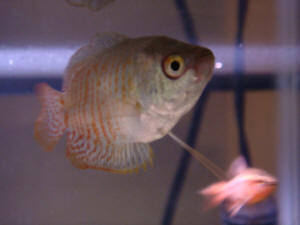
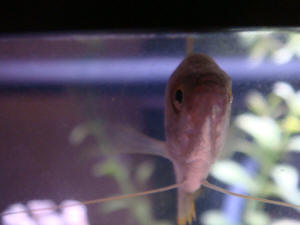
for anywhere on the web. The only abnormality I see in the fish
is that his eyes seem quite sunken into his head. Otherwise, he
behaves healthily: he is active and he eats eagerly.
<Seemingly a secondary bacterial infection, likely some type
of Mycobacteria, but possibly something easier to treat.>
He is in a tank I set up about a month and a half to two months
ago. I bought him recently--within the last week. I realize now I
should have held him in a quarantined tank prior to introducing
him into the main tank.
Here's what I have:
A 10 gallon tank with a Marineland Bio-Wheel Power Filter 100
<Too small for this species; 15-20 gallons, minimum. Sure,
it's a small fish, but it's also a feeble one, and the
more space, the less water quality becomes an issue. Do
understand that water quality isn't all about what ammonia
and nitrite is at the instant you measure it, but also how
diluted the ammonia and nitrite are during those periods when
levels rise, e.g., after feeding.>
Red Sea's Plant Success Flora Base as the substrate 4 Cherry
Barbs - 2 males, 2 females A few snails The Dwarf Gourami - Male.
I do 20% changes each week with water run through Aquarium
Pharmaceutical's Tap Water Purifier. When I returned another
Dwarf Gourami that I was suspicious about (head holes), the Petco
people that tested my water told me that the sample's quality
was excellent. Ammonia was at 0.
This was about a week and a half ago.
<Good.>
Any ideas about the odd eyes? I don't know if it is just an
quirky characteristic, or is indicative of something worse. The
latter wouldn't surprise me, given what I've read about
Colisa lalia.
<Would treat with an antibiotic like Maracyn, while optimizing
water conditions (pH 6.5-7, 5-10 degrees dH, around 26-28 degrees
C) and offering as varied a diet as possible. If there's any
sign of swelling, dosing with Epsom salt at 1-3 teaspoons per
gallon is also helpful, but there's no need for this if there
isn't any swelling. If one antibiotic doesn't work, try
another: each uses different antibiotics (Erythromycin,
Minocycline, etc) and each of these work best on particular types
of bacteria. Do read this excellent review, taking note of Table
1 when shopping:
http://www.wetwebmedia.com/ca/volume_6/volume_6_2/mycobactera.htm
>
By the way, the pictures shown make the visible socket area
surrounding the eye look very dark or black. In actuality, it is
more of a fleshy color.
<I see.>
Thanks for your help,
Joey E.
<Cheers, Neale.>
|
  |
|
Re: Yet Another Question about a
(Potentially) Sick Dwarf Gourami 5/30/2009
Thanks for the help.
<Happy to help.>
One more question then: do you have other suitable suggestions
for fish that can be adequately kept in 10 gallon tanks?
<Seek and ye will find:
http://www.wetwebmedia.com/ca/volume_5/volume_5_3/stocking.htm
>
Joey E.
<Cheers, Neale.>
|
Sick Gourami 05/27/09
Hello,
I did read through all of your articles and the disease chart, but
nothing fit perfectly...
<And yet somehow I have a feeling it's going to be the usual
Dwarf Gourami Iridovirus problem. When will people stop buying these
fish?>
I just started up my tank about a week ago. I used the tetra cycle
stuff to get the nitrate cycle going. I'm thinking I may have
overstocked my tank for just starting one up. I have 2 molly's, 2
small gold gouramis, and 2 dwarf gouramis in a 20 gallon tank.
<Mollies do need different water chemistry to Gouramis, so you
shouldn't keep them together. If your water is hard and alkaline,
you might be okay, but it's always best to keep Mollies with fish
that tolerate small amounts of salt: other livebearers, rainbowfish,
halfbeaks, glassfish, etc.>
They all seem to be doing fine except the one dwarf Gourami. Now, I got
the two dwarf Gouramis from a friend, who I don't think had had the
fish for long. I'm aware that a lot of the problem is probably due
to stress from moving these poor fish twice in a short period of time.
She did not notice any symptoms prior to giving them to me. The
Gouramis symptoms include a reddish wound/bump on its lip, and a group
of light pinkish bumps by its one gill. Also, he swims to the surface
to get air, then releases air bubbles, then swims to the bottom and
hides. He then repeats this over and over about every minute or two. He
is swimming okay; slowly, but normally.
<Might be an opportunistic bacterial infection, in which case
antibiotics can help. But Dwarf Gouramis are peculiarly prone to
Mycobacteria-type infections (often called, inaccurately, Fish TB) when
stressed, and a good proportion of them also carry the Dwarf Gourami
Iridovirus. Neither of these diseases is curable, so euthanasia is the
only option; see here:
http://www.wetwebmedia.com/euthanasia.htm
>
He hasn't been eating much mostly because he's so slow and not
able to compete with the other fish to get any I think. One of my
mollies has
really started beating up on him too... Is this because he is sick?
<Yes.>
I treated my tank just once today with Melafix (before reading your
website haha).
<Indeed, "ha ha"; doesn't cure much of
anything.>
I don't really have any other tank for isolation, would any sort of
container do for a temporary fix?
<No.>
Thank you very much. I hope you have some ideas :(
<Do review the needs/hardiness of fish prior to purchase.
http://www.wetwebmedia.com/FWSubWebIndex/fwlivestk.htm
Cheers, Neale.>
New Gourami 05/23/09
New Gourami Adjusting To New Tank
Hi! I have read through your FAQ page and Google, and cant find the
exact answer I'm looking for. Basically I just bought a new blue
dwarf Gourami, and I have never had one before. I have brought the pH
of tank down to 6.5 and it is set to 26 degrees Celsius. There is no
nitrate, nitrite or ammonia in the tank. Basically the fish is swimming
fine half the time, but then will stop and float randomly. or tilt to
the side. is this normal behaviour? To me it looks strange/odd for a
fish to do this if it is well...
Other fish in the tank:
2 platies, 2 guppies (its pretty quiet at the moment!)
I would really appreciate a reply, I love the look of these fish but I
have only ever had livebearers and catfish previously!
Kind regards, Georgina
<The fish store probably had hard alkaline water. You Gourami
probably is having some difficultly adjusting to the lowered pH. Much
of the country has hard alkaline water. When you add new fish that are
not adjusted to the new water then there may be problems. Try to keep
the water consistent at the present levels for awhile and see if his
behaviour improves.-Chuck>
Re: new Gourami -New Gourami Adjusting.
pH Question 05/23/09
Thanks so much for the fast reply Chuck, The Gourami is doing better!!
no more floating anyway! I just have one more quick question - when I
tried to lower the pH of the tank - it was jumping around too much for
it to be healthy.... how would you suggest lowering the tank to 6.5
safely (it is currently at 7)? I have bought pH down, and also a
container of proper pH 6.5. My tap water is around 7.5 so I cant really
just keep it at that.
Kind regards, Georgina
< Adjusting the pH can be a very dangerous game to play. Your tap
water is 7.5 and probably the tap water at the local fish store is
probably 7.5 too. If you change the pH of your aquarium then all the
new fish may have
problems adjusting like your Gourami. Most fish will do OK at a pH of
7.5 once they are use to it but the soft water varieties probably
won't breed. Wild South American fish seem to have the most
problems like cardinal tetras. If you do want to lower the pH there is
an OK way and a very good way. The OK way is to take a 5 gallon bucket
and fill it with your tap water. Add the pH down as per the directions
on the package. Check it after 24 hours. Add more pH down if needed.
Check every day until the pH you want is stable for 24 hours. Then use
this water for water changes changing no more than 10% of the water at
a time. Slowly over a few weeks the acidified water will be at the pH
you desired. The best way is to take R/O water and add a buffer to set
the pH where you want it. Follow the same procedure in a 5 gallon
bucket. I would not recommend messing with the pH for the fish species
you currently have.-Chuck>
I have a sick red flame Gourami. As
usual, no reading... and am worried re losing NealeM.
04/23/09
<Colisa lalia... a very inbred, badly reared species. Not worth
keeping.
Plagued with bacterial and viral diseases. For any degree of success
you need to start with a healthy specimen and then provide it with very
good conditions; specifically, soft, acidic water, warmth, and good
water quality.>
Not exactly sure if it's a male or female. Would guess it is male.
I noticed that it started sitting in the top corner of our 30 gallon
fish tank. The tank includes 1platy, 1 gold Gourami, 1 red flame
Gourami, 1
knife fish, 2 algae fish.
<What's an "Algae Fish"? Do be aware that
Pterygoplichthys and Gyrinocheilus spp. are all huge fish, and the
latter genus is incredibly mean, both towards its own kind and anything
else the aquarist has been
silly enough to keep with them. Gold Gouramis (Trichogaster
trichopterus) is another doubtful choice; males are very
aggressive.>
The tank maintains a temp. between 74-76 degrees.
<Perfect temperature for Platies, but a little cool for Gouramis,
which would like things a degree or two warmer. Do research the needs
of your fish *before* purchase. If you keep fish together that have
different
requirements, then at least some of them will get sick.>
There are live plants planted within the tank. There are two carbon
filters.
<What? What's a "carbon filter"? Do understand carbon
is largely useless, and all it does is remove dissolved organic acids
and the like. Provided you're doing 25% water changes every week,
it's redundant. You need biological media and some mechanical
media.>
Water changes are 50-75% every three months.
<Insane. Honestly. Who suggested this? Please read a book!>
The rocks are changed every few weeks for enrichment.
<For what...? Fish don't need "enrichment" as such,
though I understand you've perhaps come across this idea from TV
shows about zoos and whatnot.
Fish need a healthy, stable environment. If you have more than one
specimen and/or multiple species in the tank, then there's plenty
of stimuli in the tank already. Moving the rocks about will merely
annoy those fish that hold territories, potentially leading to new
struggles as fish fight over territories and hierarchies.>
I feed them tropical fish food twice a day and blood worms and brine
shrimp for treats.
As I continued to watch I noticed that he was slightly bloated. It is
just his abdomen that is swollen. When I look at him from the top he
looks sort of pineconed but not as bad as the pics I have seen on
dropsy. I QT him in a one gallon tank and immediately started Googling
for answers.
<A one gallon tank is a pickle jar. It's not a quarantine tank.
No fish transferred to such a ridiculously small container will get
better. Please, stop and think about what you're doing! How could
you possibly provide good water quality, temperature stability in such
a small container?>
The QT tank is at 76 degrees. I am in the process of trying to get the
water temp higher, but do not know how successful I will be at that, bc
the heater is not reaching a higher temp than 76.
<If it can't make the tank any warmer than this, is obviously
too small. That's a bad thing: a heater that "struggles"
and has to stay on for extended periods is more likely to fail.>
I came to the conclusion that he had dropsy.
<Dropsy is a symptom, not a disease; it merely means abdominal
bloating.>
So I treated the QT tank with Epsom salt treatment.
<You'll notice we talk about using medication alongside Epsom
salt; by itself, why would Epsom salt help with a systematic bacterial
infection?
Always think about what you're doing!>
Soon after being QT he started obtaining a fungus like spot. I assume
it is fungus bc it is fuzzy and white.
<Oh dear...>
So I treated him with fungus clear. A day later I noticed a white
substance stringing out of his anus.
<Dismal...>
The things I read about internal parasites says look for red spikes
sticking out of anus. Could not see any. He is moving about more than
what he was. Has no appetite. I am stuck on a diagnosis. I am
considering egg bound in case he is a she, dropsy, or internal
parasites.
<Not egg bound.>
I have treated him for all, but he is not getting better or worse.
<You've actually treating him for nothing relevant.>
His abdomen has not gotten much bigger.
<Dropsy is usually fatal with fish this small simply because
it's a sign of systemic infection and organ failure. Dropsy is
"cured" by preventing it. My feeling here is that your tank
is badly managed, and anything half-way delicate simply won't
survive the way you keep fish. Sorry to be harsh, but at least I'm
honest.>
What do I do?
<Do read here for basics of care:
http://www.wetwebmedia.com/FWSubWebIndex/fwmaint.htm
Then look up some ideas about suitable fish for different skill levels,
water chemistry, and aquarium sizes:
http://www.wetwebmedia.com/FWSubWebIndex/fwlivestk.htm
http://www.wetwebmedia.com/ca/volume_5/volume_5_3/stocking.htm>
I am trying to keep the water clean. I am adding a drop of Quik cure
daily.
<Why?>
I think I am going to try and fast him for a couple of days.
<And that would help how...>
It isn't like he is eating much anyways. I did add 1/8 tsp of Epsom
salt to the tank one day ago.
<Read about Euthanasia; this fish is doomed:
http://www.wetwebmedia.com/euthanasia.htm
Cheers, Neale.>
Re: sick red flame Gourami --
4/30/09
To whom it may concern,
<That would be me, Neale Monks, BSc, PhD and general all-around fish
expert by appointment to the sensible and open-minded.>
I did not ask you how to care for a community tank. I strictly asked
for advice about my Gourami.
<These two things are related, and you can't separate them. To
give an analogy, it's like trying to deal with drug crime strictly
through law enforcement without also considering issues such as
addiction treatment and
urban development. There's an interconnection between things, and
those of us who know something about the subject try to explain that to
those who don't. Once you understand the situation, you'll be
in a better position to make sensible decisions, solve existing
problems and prevent new problems.>
Obviously you have no customer service skills, because the way this was
handled was very unprofessional and uncalled for.
<I'm sorry you see things that way. But remember, you're not
a customer.
I'm not paid anything. You're a person who's making
mistakes, and I'm an expert who, because I care about animals, is
willing to spend time helping you. If you don't want the right
advice and intelligent exposition, then feel free to do whatever else
you want. It's a shame for your fish, but I'll sleep well
knowing I tried my best to help you and help your animals.>
I realize that I did not fully supply you with the correct information
concerning my tank. The tank is my husbands thing and he has been
working out of town for the past few months so I have been maintaining
it for him.
I know just enough to keep it maintained. So, as a concerned person for
my fish, I turned to you and you harshly put me down.
<I don't see my response as harsh at all. I think you're
mistaking honesty and reality for harshness. Just because I didn't
tell you what you wanted to hear, then you're seeing that as
criticism. It's really not. Your
aquarium has a series of fundamental problems, all potentially
interconnected and without me standing next to the tank and looking at
it, I have to assume that at least some of them are related to your
immediate
crisis.>
All I wanted was advice on how to hopefully cure my fish and that I did
not get.
<You said you'd read our article on Dropsy, but then only
mentioned Epsom salt. I reminded you that you MUST use an antibiotic
alongside the Epsom salt, and also that unless you fix the
environmental issues that caused the Dropsy, treatment is pointless. So
if you read my message, you'll see I gave you precisely the three
things needed to cure Dropsy (if it's going to be cured) --
medication, Epsom salt, environmental improvement.>
We have had this tank and most of the same fish for almost two years
and have never had any severe problems until now.
<Big deal. Two years. Your Dwarf Gourami is likely going to be dead
in a few days, when it should have a lifespan on 5 years. More
importantly, as fish get bigger (and your algae eaters will do, if
they're the species I mentioned) they produce more waste. So as
time passes, the aquarium steadily becomes more and more heavily
stocked, and a crisis point can be reached if your aquarium and filter
aren't of adequate size. None of this is personal bias. It's
out there in any aquarium book.>
So obviously we do know how to maintain an aquarium.
<I didn't say that; I said you'd made some questionable
choices, and if my suspicions are correct about the algae eaters, some
very serious problems are waiting around the corner.>
Some of the irrelevant information you supplied me with is false.
<Which bits. Show me. I write for most of the English language
aquarium magazines, lots of websites, I've written the first
brackish water fish encyclopaedia, I have a BSc and a PhD, I worked at
the Natural History
Museum in London and as a marine biologist in Scotland, and I've
been keeping freshwater, brackish water and marine fish for 25 years.
I'm hands-down the most expert fishkeeper you're ever going to
talk to. I gave
you the best possible advice I could given the information I was
working with. If you feel short changed, remember: you paid nothing, I
promised nothing. I gave you 20 minutes of my time, time I'll never
get back. If you want to pay for a vet, then go ahead. Otherwise,
you're not going to get better advice anywhere, and certainly not
for free.>
Next time someone comes to you for advice, think twice on how you
answer.
<I think not. I'll carry on being honest. I don't really
feel the need to candy-coat stuff just because some people don't
want to hear that they've made mistakes. If you wanted someone to
lie to you, to sugar coat their lack of understanding, or just
generally advise out of ignorance, then please, feel free to go
elsewhere.>
Eventually you will receive a bad rep if this type of customer service
continues.
<Quite the reverse in fact. We have an enviable reputation and
plenty of site visitors. Most people "get" what we're
offering. We're not selling anything; we're sharing hard-earned
experience with aquarists all around the world. We get plenty of
thank-you notes. "Customer service" doesn't really come
into the equation; I dare say the guy at your local big-box pet store
will offer plenty of customer service because he's making a sale --
but he'll also be offering dubious advice and will happily sell you
fish you can't keep and equipment you don't need. Over here, we
trade in honesty and reality. I'm sorry that neither of these
appealed to you. Cheers, Neale.> <<Well done Neale!
RMF>>
|
Sick Dwarf Gourami 3/23/09
Hi,
I have spent the last couple days reading everything I could find
on the web about Gourami diseases, but cannot find anything that
addresses the issue my Gourami seems to be having.
I have sent a couple pics (not great, still learning to take pics
of fish) to hopefully help in diagnosis.
It started as a small red spot/area in his anus fin, it turned
white and seemed to be "healing" or going away. Over
the last month or so I lost two other dwarf gouramis to what
appeared to be dropsy. I medicated my entire tank with
Maracyn-two, losing the first fish.
Shortly after (maybe two weeks) the second Gourami had dropsy. I
medicated again with Maracyn-Two, losing the second fish only a
couple days into the medication. During this second medication
the red sore on the third Gourami came back and started eating
away his fin and now it is eating into his body. He is eating,
his poop looks normal. It looks much worse than fin rot, it
doesn't appear to be Hexamita.
<Agreed>
Is it just a bacterial infection?
<Does appear as such>
Should I try medicating with Maracyn?
<Mmm, no... I'd try a Furan compound here... will
"dirty" your water...>
I have been medicating the whole tank because I figured I need to
in order to stop the other fish from getting sick as well, but
not sure how all this medication is affecting all the other
fish.
Don't have a quarantine tank, but can get one if needed.
<I would move this fish to such a treatment tank for sure...
ten gallons would be fine>
Some info on my tank:
55 gallon
80 degrees
7.0 ph (has recently been up to 7.5, got it down to 7.0 with this
last water change)
<Not a worry>
Ammonia 0
nitrites 0
nitrates 0
20% water change monthly
<I'd change more frequently>
5 dwarf gouramis (4 male, 1 female)
2 gold gouramis (male)
6 glass catfish
1 Indian glass fish
1 Pleco
I would appreciate any help you can give me!
Thanks,
Cat
<Unfortunately, Colisa lalia are very prone to disease
issues... Please read here:
http://wetwebmedia.com/FWSubWebIndex/dwfgdis.htm
and here: http://wetwebmedia.com/FWSubWebIndex/fwantibiofaqs.htm
Bob Fenner>
|
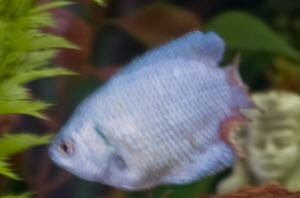
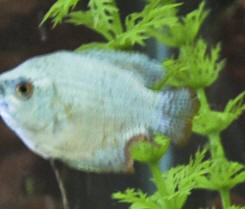
Mmm, RMF is unable to copy, move from root web... try on ret. |
Re: Sick Dwarf Gourami 3/23/09
"Should I try medicating with Maracyn?
<Mmm, no... I'd try a Furan compound here... will
"dirty" your water...>"
I've not heard of Furan before, is it sold under that name?
Thanks,
Cat
<Yes they are. Please read where you were referred to Re.
B> |
|
Sick Gourami 3/18/09
I have 2 male gouramis in my tank along with a few male guppies,
some sucker fish & tetras. The smaller of the 2 males seemed
to always get picked on by the bigger one. Just this morning I
noticed that the smaller
one is now lying on his side on the bottom of the tank & his
eyes look kinda weird. He's still breathing although whenever
other fish go near him does not move. Is he sick?
<Hello. What kind of Gouramis are these? Dwarf Gouramis
(Colisa lalia) are particularly prone to bacterial infections as
well as a viral infection called Dwarf Gourami Iridovirus. Do
review here:
http://www.wetwebmedia.com/FWSubWebIndex/fwdistrbshtart.htm It's
also worth mentioning that male Gouramis are territorial, and
unless the tank is fairly big, they will not coexist. Dwarf
Gourami males will
need at least 90 litres (20 gallons) each, while bigger species
such as Three-spot Gouramis will need at least 50% more space
than that.
Cheers, Neale.>
Re: Sick Gourami 3/18/09
He's a Dwarf Gourami, the tank is about 120cm X 60cm X 50cm
roughly. Now that I've taken him outta the tank & had a
good look at him I think you may be right about having a virus;
he tried to swim out of the net when I was having a look so at
least I know he still has a bit of kick in him. Can you tell me
what I can do for him please?
~Merissa
<Certainly is a Dwarf Gourami. By the looks of him, he seems
to have sustained eye damage. While seriously damaged eyes
don't grow back (obviously) they tend to heal over pretty
well and the loss of one eye doesn't cause the fish any
problems. If the only problem is damage to the outer surface of
the eye, and the eye itself is okay, you may be lucky and
it'll clear up completely, and his eye will recover. Either
way, damage to the eyes is a very common sign of fighting: fish
deliberately peck at each other's faces when fighting, and
sometimes the eyes do get damaged. So rather than a virus, I
think this is simply a beat-up fish that needs rehoming. The
viral infection causes very specific things: loss of colour,
weight loss, and most distinctively of all, the appearance of
bloody sores on the body. I don't see any of that going on
here. Apart from the damage to the eye, this fish actually looks
in pretty good condition, and has lovely colours. If possible,
rehome him in another tank, otherwise confine the more aggressive
specimen to a large breeding net (not the smaller plastic
breeding traps) for a few weeks while this fish recovers. Your
existing tank should be big enough for two males, but perhaps not
in this case. Adding more rocks and especially plants to break up
the territories could help. Oddly enough, adding 2-3 more males
might also work, by making
it impossible for any one fish to either claim a territory or
bully all the other fish at the same time. Cheers, Neale.>
|
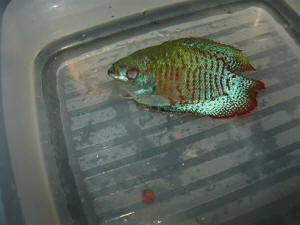 |
|
Re: Sick Gourami 3/18/09
Wow thanks heaps for that =D I have a smaller tank with an adult
female guppy & her 6 daughters that's about 40cm X 30cm X
30cm with 5 plants & a bell shaped hidey-hole. Is this tank
too small to put him in?
<It's on the small side, yes. As a hospital tank though
while he gets better, you should be fine though. Just keep up
with water changes! Once he's healthier, he'll probably
need a new home though.>
If so Ill put more plants in the bigger tank.
<Good idea. Plastic plants are just as good as real plants, so
feel free to get creative with anything weird and wonderful that
takes your fancy. Fish couldn't care less what we decorate
our aquaria with: plastic plants, ceramic skulls, rocks, caves,
whatever. So long as there are hiding places and shade, your fish
will stake their territories. A bit of trial and error may be
required though to find locations for hiding places that keep
each fish out of the other's way.>
Thanks again, Merissa
<Cheers, Neale.>
|
Re: Sick Gourami
4/1/2009
He doesn't seem to be getting better any time in the
near future; is there anything I can do for him aside from
water changes?
<Have you treated with an antibacterial or antibiotic?
In the US, I'd recommend Maracyn, in the UK, eSHa 2000.
In other countries, look for something that treats Finrot
and Fungus. The main thing is to get the lost
eye to heal over. It will heal, and fish function fine with
one eye; I think because in the wild many live in murky
water where eyesight doesn't matter much anyway. So
they use their "radar" system (lateral line)
instead.>
He doesn't seem to be eating as much either - Im not
sure if that's because of loss of appetite or not but i
drop food near his good eye, sometimes he'll go for it
& sometimes he doesn't. =(
<Exactly; if he can't see the food, he won't
eat. I have a halfbeak that lost an eye in a fight, and I
use forceps (tweezers) to feed him a few bloodworms by hand
every few days. I also make a point of dropping the
dried foods he eat by his good eye. His eye healed over
quickly, and he's basically fine now. Good luck,
Neale.>
|
|
|
Poorly Gourami (Red Robins; taxonomy,
health) 2/11/09 Hello Crew! I've had a look all over the
internet and at your recently answered question but haven't found
anything that really applies to the problem my Gourami has, so i hope
you don't mind me emailing! He's is a 'red robin' honey
Gourami who i have had for about 6 months and always been well.
Yesterday i came home to find him sitting at the bottom of the tank
with a slightly rounded underside - just around where i assume his swim
bladder is, at the base of his feelers. He was moved about a week ago
from my previous 30 litre tank to a new 120 litre. I have given the
tank a water change and the water results are still within the normal
parameters (I'm going to test again this evening). I've also
put some peeled peas into the tank but he doesn't seem to be
interested in them. He is currently sitting at the bottom of the tank
and taking the occasional trip to the surface for a quick gulp of air,
then sinking slowly back to the bottom. Also, when he's swimming he
seems to be finding it difficult and his lips look a bit greyer than
usual. The only other thing apart from the new tank, that has changed,
is that i bought 3 small Corys at the weekend, one of which died within
48 hours after barely moving. My second honey Gourami is still behaving
absolutely normal and the 2 remaining Corys are perfectly fine. Can you
give me any advice? Should i quarantine him? I've also been reading
about some antibiotics that aren't compatible with gouramis and
others that shouldn't be used when Corys are in the tank! Any info
you could send would be great - i can't get to my local fish shop
until tomorrow evening. Many thanks for your time Jess <Hello Jess.
Red Robin Gouramis are curious fish because nobody really knows what
they are! Several different fish are sold under the name, most commonly
a hybrid between Trichogaster chuna and Colisa lalia, often, though not
always, fed with colour-enhancing foods to make their colours brighter
than they actually are. Quality is extremely variable, and like a lot
of fish mass produced in Southeast Asia, bacterial infections can be a
real problem because of the widespread use of antibiotics on the fish
farms. Whilst they don't seem to get the dreaded Dwarf Gourami
Iridovirus (DGIV) they aren't the hardiest of fish and lifespan is
often rather short. Sometimes Red Robins are merely red-coloured Colisa
lalia, in which case DGIV is a risk, as well as all the usual bacterial
problems Dwarf Gouramis are prone to. Inbreeding is an issue here, and
indeed with almost any fish that doesn't have its wild-type
colouration. That's a point worth reiterating: when you shop for
tropical fish and you decide to get a "fancy" form,
you're doing a trade-off between genetics and physical appearance.
Finally, some Red Robins are fancy Honey Gouramis. Again, inbreeding is
an issue, but on top of that you have the problem that Trichogaster
chuna is simply not a fish that does well in hard water, so unless you
have soft, slightly acidic water conditions, it's a species to
avoid. Having laid out the problems identifying the fish, treatment is
somewhat difficult to suggest. DGIV is impossible to cure, so if
that's the case, there's nothing much to do beyond painless
destruction of the fish. Internal bacterial infections are extremely
common among these fish, and only reliably treated with antibiotics. In
the UK, these have to be obtained from a vet, and the so-called
"anti-internal bacteria" treatments sold in fish shops in the
UK are, frankly, useless. Never once heard of a fish cured of anything
by using them. Antibiotics used properly (i.e., as per your vet's
instructions) will be perfectly safe with your Gourami. Internal
bacterial infections often caused abdominal swelling followed by
distinctive raising of the scales along the flank, so that viewed from
above the fish looks like a pine cone. At that stage a cure is unlikely
and again, painless destruction is the only humane option.
http://www.wetwebmedia.com/euthanasia.htm Constipation is a problem
with Gouramis since most are partially herbivorous in the wild, and
careless aquarists often forget this essential fact. If squashed tinned
(or cooked) peas aren't accepted, then Daphnia may be, and these
are almost as good. Obviously Gouramis are slow feeders, and if there
are tetras or barbs in there, the Daphnia will be eaten long before the
Gourami gets a therapeutic "dose", so you'll have to work
around that using a hospital tank of some sort. If the Gourami is
healthy-looking apart from the swollen abdomen, then constipation may
be the issue. Adding Epsom salt at 1 to 3 teaspoons per 5 gallons can
help with constipation alongside the high-fibre foods, but remember to
stop adding Epsom salt once the fish is better. Hope this helps,
Neale.>
Dwarf Gourami sickness, and FW stkg.
01/23/09 At Christmas we got a 10 gallon tank with a dwarf
Gourami, a silver dollar (who is the size of a 50 cent piece now but I
understand will need a much larger tank). These two are buddies and
have followed each other around since arriving the same day. I also
have six Rummynose tetras, a bamboo shrimp and a vampire shrimp.
<The tank is seriously over-stocked.> The tank has cycled (with
the fish in it since we didn't know the right way to do it) and all
these fish survived! I got a Eco Bio-Rock awhile ago because I heard it
was good and it seems to have finished off the remaining nitrate in the
tank. It has a few real plants in it, and one fake one. Everyone seemed
happy until yesterday when the Gourami started getting glassy eyed and
sitting in the water barely moving, his head seems to have darkened,
his belly swollen. With a heavy heart I read about Iridovirus in
gouramis and I remember when I bought him at Petco, a week later I
returned and half the gouramis in the tank looked just like he did now.
I think he has this virus. I am sad because he was a lovely curious
fish with a good personality and a hearty eater. I am also sad my
silver dollar will lose his buddy - and am worried this virus will
spread to the other fish or invertebrates. What can I do to stop this
from happening? I will not buy anymore dwarf gouramis :( <If it is a
virus, there's likely nothing you can do except try to build the
natural immune/defense systems of these fish by caring for them as well
as possible. For one thing, the silver dollar fish needs a bigger tank
and is a schooling fish that does best in groups. Clean the tank
well... feed them high quality food and do everything you can to keep
the water quality as high as possible, etc.> Melissa <Best, Sara
M.>
Re: Dwarf Gourami sickness
01/23/09 Hello Sara, You know, we are new fish owners and
trusted the people at Petco to advise us on appropriate fish and tank
size. Initially, they told us a Bala shark and pictus cat were good
"community fish" for our 10 gallon tank and told us nothing
about cycling the tank. Of course we returned these two fish the second
day, realizing they were not compatible. <Ah, first rule of
fish-keeping... don't assume the people selling the fish know
anything about keeping them.> After this disaster, I bought several
books on the subject including this one:
http://en.microcosmaquariumexplorer.com/wiki/101_Best_Tropical_Fishes
by someone who seemed to be a good resource. I chose our remaining
tankmates based on this book's advice for a 10 gallon "model
tank". One of the recommendations was: 3 Hatchetfish, 12 Neon
Tetras and 3 Panda Corys for a 10 gallon tank - but even *I* felt that
was too many. <Um, yeah... that is a bit much, geez.> All the
people at Petco told us was "one inch of fish per gallon".
Here I thought we were being relatively restrained. <I understand
the confusion. The "problem" is that the fish you have
aren't going to stay the size they are. For example, silver dollar
fish get to be at least the size of your palm.> I just really just
wanted to know if this virus will spread to other fish outside the
Betta and Gourami species, but I can't find any more info about it
on the web, read through all your questions but couldn't get a
definitive answer. <That's because it's a virus. Like human
viruses, they're very difficult to battle. There's a reason
there's still no cure for the "common cold"-- it's a
virus.> Yes, I know I haven't done everything perfectly with our
new fish, but we are trying and I do care about them a lot and worry
about them. Yes, I will get a bigger tank and research more before any
more purchases. <I'm sorry the people at Petco didn't advise
you well... and especially sorry the book you bought didn't help
much more. Sometimes it's a struggle to find good information.>
Thanks anyway for responding, Melissa <Cheers, Sara M.> Btw,
I'm sorry if I failed to mention that if the Gourami really did
have Iridovirus (which I can't say for sure), it's not likely
the other fish will get it. It tends to be highly contagious only among
other Gouramis. Sara
| Sick dwarf Gourami 11/28/08 Hi My Blue dwarf
Gourami got sick. He has some pimple like bumps on him. I sent you
a picture. We have a 70 gallon planted tank. I have a lot of young
guppies , red and blue dwarf gouramis and a pearl Gourami. None of
my other fish has those bumps and the Blue Gourami is acting normal
, he is eating and swimming normally. The bumps only appeared
today. Thank you! Julia <I can't tell from your photo much
about the Gourami in question. Too blurry. But do run through the
options listed in this article:
http://www.wetwebmedia.com/FWSubWebIndex/fwdistrbshtart.htm In
particular, be aware Colisa lalia (your Gourami species) is very
prone to a viral infection that is incurable. It is extremely
common among Colisa lalia exported from Southeast Asia. Not all
sick Colisa lalia have this disease though! So do consider other
things that can cause "white pimples" -- Ick/Whitespot,
Finrot, Fungus, Velvet, Lymphocystis, to name just a few. Cheers,
Neale.> |
| Man! That's blurry! RMF. |
|
|

