FAQs on
Colisa lalia, C. chuna... "Dwarf" Gouramis of Many
Names, Honey, Flames, Neon Blue, Sunset, Fire...
Disease/Health 1
FAQs on Dwarf Gourami Disease:
Dwarf Gourami Disease
1, Dwarf Gourami
Disease 2, Dwarf
Gourami Disease 3, Dwarf Gourami Disease 4,
FAQs on Dwarf Gourami Disease by Category:
Diagnosis,
Environmental,
Nutritional,
Genetic,
Infectious
(Virus, Bacterial, Fungal),
Parasitic,
Social,
Treatments,
Related Articles: Anabantoids/Gouramis & Relatives,
Genera Ctenopoma &
Microctenopoma,
Betta splendens/Siamese
Fighting Fish
Related FAQs:
Dwarf Gouramis, Dwarf Gourami Identification, Dwarf Gourami Behavior, Dwarf Gourami Compatibility, Dwarf Gourami Selection, Dwarf Gourami Systems, Dwarf Gourami Feeding, Dwarf Gourami Reproduction, & FAQs on:
Gouramis 1, Gouramis 2, Gourami Identification, Gourami Behavior, Gourami Compatibility, Gourami Selection, Gourami Systems, Gourami Feeding, Gourami Disease, Gourami Reproduction, Betta splendens/Siamese Fighting
Fish,
|
|
|
Excerpted
from:
Five Almost Perfect Fishes; Great fish for the
community aquarium, except for one little thing
by Neale Monks
2
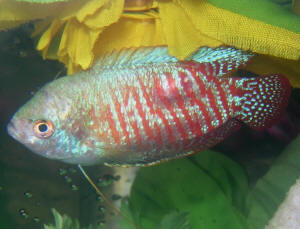
Dwarf Gourami, Colisa
lalia
The
good:
Friendly, colourful, and just the right size for the community
tank
The
bad:
Peculiarly sensitive to bacterial infections
Few aquarists
haven't tried keeping these fish at some point, and they remain
staples of the hobby thanks to their wide availability, bright
colours, sweet dispositions, and willingness to take a range of
foods including flake and pellets. Numerous artificial forms
exist, such as the red dwarf Gourami that lacks the blue strips
typical of the wild morph. However, being widely sold doesn't mean
that are easy to keep, and these fish all too frequently sicken
and die within a few months of being purchased. Dwarf gouramis
appear to be among the fish most likely to contract bacterial
infections if water quality or water chemistry isn't exactly
right. The symptoms are bloody sores on the body and a loss of
appetite, and short of veterinarian help (i.e.,
antibiotics), nothing much seems to help.
Even with
antibiotics, the prognosis isn't particularly good, and you should
definitely never buy dwarf gouramis from a tank containing
specimens showing any signs of this type of infection. But even
starting off with healthy fish might not help, as some aquarists
believe that virtually all commercially-bred dwarf gouramis (and
probably other gouramis as well) carry the bacteria, so the issue
isn't keeping the bacteria out of the tank but making sure it
doesn't become a problem. The best approach is to quarantine dwarf
gouramis for a few weeks before being adding them to a tank that
already contains other, hardier, gouramis.
It is just as
important to make sure that water conditions and filtration are
optimal. For the dwarf Gourami that means soft, acidic water
conditions, preferably filtered through peat and zero levels of
nitrite and ammonium. Frequent water changes to keep the nitrates
down is a good idea, and using a hood or cover glass at the top
of the tank to keep the humidity of the air just above the water
level high is also to be recommended. Feeding presents few
problems, but what you don't want to do is introduce anything that
might make the fish sick, such as live Tubifex worms. In
short, these are quite demanding fish that need a lot of care if
they are to succeed in a community tank.
|
Blue Gourami black spots and swollen
5/26/08 Hi. I have recently started up a 10 gallon tank.
<Do understand that this tank is too small for Blue Gouramis,
and indeed for virtually all tropical fish. There's no reason
to buy a 10 gallon tank unless you're an expert fishkeeper
with a view to a breeding project or some other specific usage.
20 gallon tanks are the minimum sized ones that work reliably for
casual aquarists and standard community fish species. The price
difference between 10 and 20 gallon tanks is negligible,
especially when set against how much longer your fish will live
in the one compared to the other.> 2 weeks ago, I bought a
powder blue dwarf Gourami and a red dwarf Gourami. <Both
Colisa lalia varieties. Extremely prone to disease; I simply
don't recommend them to fishkeepers. Scarily high prevalence
of viral disease; inbreeding and casual use of antibiotics means
their lifespan once purchased is not high. A lot of retailers I
know would sooner not stock them at all. Best avoided, in favour
of hardy species like Colisa labiosus and Colisa fasciata.>
All seemed fine, but the red Gourami hangs out at the bottom of
the tank and sometimes pushes the blue one around. <The tank
is too small. These fish are territorial, and if they're both
males, as is highly likely if they're brightly coloured
(females are greyish green) the dominant one will eventually kill
the weaker one.> Two days ago, I purchased two emerald green
Corys that are very active, racing around. <Too many fish in a
10 gallon tank! Corydoras aeneus need to be kept in groups of six
or more (they're schooling fish) and that means a 20 gallon
tank, at least. I'm not saying this stuff to be awkward: if
you try to cram fish into too-small a tank, you're going to
have problems with water quality, and that means disease. Your
fish aren't going to be happy either, and if you don't
care about their happiness, then why bother keeping fish at
all?> I noticed a few days ago that the blue Gourami seems
maybe swollen just under the gills. Today, I noticed he has some
black dots on his face, like he's dirty. I have done a few
partial water changes this past week. Also, last night, I noticed
when he was eliminating it was not releasing and grew to a few
inches long before it even dropped, or came off. <Difficult to
know precisely what this is, but instinctively I'd be
guessing Dwarf Gourami Iridovirus. This is very very common among
Colisa lalia, and currently impossible to treat. It's 100%
fatal, and highly contagious. This is why I tell people not to
waste their money on this species. A photo would help ID the
disease more precisely.> The red Gourami is a big eater,
eating most of the food, including the catfish pellets. The water
temperature is between 78 and 80 degrees. I think the red Gourami
may like the bottom of the tank because I have the thickest
planting there (all artificial). I bought some tall
"grass" decor, but it is sparse. I have read it's
recommended that I buy some floating plants. <Yes, floating
plants are appreciated by Gouramis.> Thank you in advance for
your time. These fish were purchased for my kids that just lost a
Betta and I would hate to lose my younger son's Gourami.
<I fear you're going to lose the fish anyway.> Thanks
again. <You're welcome.> Beth <Cheers, Neale.>
Re: Blue Gourami black spots and swollen 5/26/08 Thank
you for your response. I am obviously a beginner and went into
the store not knowing much at all. <Fair enough.> I went by
the suggestion of the clerk in regard to size of tank and the
fish to put in them. <Do always remember the guys in the store
are there to make sales. In a perfect world, they'd also hand
out expert advice and would stop you from making unwise
purchases. But we live in an imperfect world, and not every store
clerk is an expert fishkeeper. Many are essentially salespeople
with little to no personal experience of keeping fish.> He
informed me that the Dwarf Gouramis are hearty, obviously
misinformed. <Do see here, for example:
http://www.practicalfishkeeping.co.uk/pfk/pages/show_article.php?article_id=428
Something like 22% of the Singaporean fish are infected with the
Iridovirus, so right out the bag over one-fifth are doomed.
Couple this with the fact the virus is extremely contagious, and
you have a real problem. It goes without saying that intensive
farming methods to keep the price down and serious inbreeding to
create the all-red and all-blue varieties has done nothing to
improve the hardiness of the species.> I also went by his
suggestion with the catfish that he told me to come back for
after 7 days when purchasing the Dwarf Gouramis. <In a bigger
tank, not a bad idea. But in a 10 gallon tank, overkill.> I
may not know much, but I even mentioned that the two Gouramis and
two Catfish were going to create too many inches per gallon, but
he insisted this was fine and that two catfish were good enough
for them socially. <Ah, I see. So in this instance you should
have trusted your instinct. I suspect that you have the makings
of an expert fishkeeper even if you're only just starting
out! Keep reading, keep being critical, and keep raising your
game.> Thank you for your help. I will go back to the store
with this knowledge. <Happy to help, Neale.>
Re: Blue Gourami black spots and swollen
5/27/2008 Do you have advice if I wanted two more
fish, after bringing the Gouramis back that might be smaller and
okay in the tank? <There's an art to stocking 10 gallon
tanks. Essentially look for small (2.5 cm/1") fish that
don't move about much and aren't territorial. This
approach will maximise your chances of success. In the
"Gourami" field, you might consider Sparkling Gouramis
(Trichopsis pumila), tiny little fish that work well in groups
provided there are lots of plants at the surface of the tank for
them to hide among. They're wonderfully coloured and make
strange little sounds from time to time. If you live in a hard
water area, you might also consider a "shell dweller"
from Lake Tanganyika such as Lamprologus ocellatus. These fish
rarely stray far from their shells (ideally empty apple snail
shells or "escargot" shells from a boutique food store)
and aren't aggressive to mid- or upper-level fish.
Livebearers offer some interesting options, like the darling
Least Killifish (Heterandria formosa), one of the smallest
vertebrates known and native to the Southern United States.
Gobies offer lots of potential, but you do need to review issues
like feeding and water chemistry because some species will not
last long if not kept correctly. Bumblebee Gobies for example do
best in hard water with a little salt added (though this
isn't essential) and will only eat ((wet) frozen bloodworms
and small live foods like brine shrimp. As for catfish, the
smallest Callichthyidae are perhaps the ideal, including things
like Aspidoras pauciradiatus and Corydoras habrosus. Small
Whiptails like Hemiloricaria parva also work nicely and add a
quirky look to the system. I'm also keeping Cherry Shrimps
and snails such as Nerites and snail-eating snails (Clea helena)
in my mini tanks, and they're thriving, the shrimps in
particular breeding like rabbits. So there's lots of
potential with small tanks, provided you research your options
and make good choices. Cheers, Neale.>
Re: Blue Gourami black spots and swollen 5/27/2008 Follow Up: Thank you for all of your help.
I returned the fish today and they, indeed, said the Powder Blue
Dwarf Gourami did not look well at all. I followed your advice
and decided that the fish were all going to be too big to be
happy in the tank and brought the other Gourami and 2 Cory's
back. <Very good.> I will say that the pet stores do seem
more into turn around than into the happiness of the fish as the
Emerald Green Cory tank said that a 10 gallon tank is suitable
and some fish that grow to be 3 inches were labeled for 5 gallon
tanks! <Unfortunately not an uncommon way to keep fish.> I
purchased 4 guppies, figuring that they will grow no more than
1.5-2 inches and should remain happy. I would like to add 1 or 2
catfish after the Guppies stabilize. I saw online that there are
small species that only grow to be 1.5 to 2 inches. Would these
fish all be okay in the tank as it would equal about 7.5 to 10
inches of fish in a 10 gallon tank? <In theory, Guppies can
work in a 10 gallon tank. But in practise, the males often become
aggressive towards one another. They also pester the females.
It's not much fun to watch your male Guppies chasing one
another and harassing the females. So while a single male and two
or more females might be viable, I don't personally recommend
Guppies in very small tanks. That said, many people keep Endler's
Guppies in small tanks, and their smaller size perhaps makes them
a better bet. I've also found Humpbacked Limia (Limia
nigrofasciata) and Wrestling Halfbeaks (Dermogenys spp.) work
well in 10 gallon tanks.> Thank you, again. <Cheers,
Neale.>Re: Blue Gourami black spots
and swollen 5/27/2008 Dear
Neale, I'm sorry for all of the emails. I just want to get
this right. <Understandable!> As it is (background), under
advice from a first pet store, we bought a tank, let it run for a
week and then went to a second store (the one we ultimately
bought from) and found out it was the wrong kind of tank, needed
a heater and all the rest and had to start over again. Now, the
problems we've discussed. <Hence our usual advice to
buy/borrow an aquarium book *before* you spend any money.> The
more I research, the more I'm concerned that the Emerald
Green Corys are not right for the tank. I love them and how
active they are. However, when we bring back the Gouramis, they
may not only grow too big for the 10 gallon tank, but be too big
for the fish we will get as replacements. <Green Corydoras
(Corydoras aeneus) is an excellent catfish; it is peaceful,
completely harmless towards even livebearer fry, and long-lived
when kept properly. I keep a related species, Corydoras paleatus
in my 180 litre aquarium and watching them plough through sand,
spewing it out of their gills, is a real treat. Both these
catfish spawn readily, and if they're happy you will
eventually find their eggs on the glass. Raising the babies
isn't difficult, but that's a story for another day. But
these catfish are potentially too large for a 10 gallon system,
at least once mature. Female Corydoras aeneus will get to at
least 5 cm/2" and potentially 7.5 cm/3". They are not
just long but deep-bodied as well. You also need at least 4, and
ideally 6, specimens to see them at their best. So I agree with
your analysis.> I know you are not big on 10 gallon tanks
anyhow, but unfortunately it's what works best for our space.
<Often the case.> I have found that there are smaller
catfish. <There are several Dwarf Corydoras species, all
reasonably hardy and easy to keep. Corydoras hastatus swims in
the midwater when kept in reasonable numbers and not scared.
Watching the flutter about like silvery bugs is lots of fun.>
I was thinking that Platys might be a good choice for our tank?
<A bit on the large size. Some varieties of Platy stay quite
small, but in good health most varieties can top 5 cm/2".
Personally I'd not recommend them, though some people do keep
them in 10 gallon systems.> For my boys, we're looking for
one fish each that will be characteristic enough to tell them
apart, or maybe two each- space dependent. <The
Catfish/Livebearer combo will work well. Catfish look strange and
usually scoot about the bottom in a very purposeful way;
livebearers are friendly and quickly become tame, rising to the
top at feeding time. I have an 10 gallon system with Aspidoras
pauciradiatus (a miniature, black-and-white Corydoras) and
juvenile Limia nigrofasciata. The tank is filled with live
plants, snails and Cherry Shrimps. The result is an aquarium
that's very rewarding and fun to watch.> They really like
the idea of catfish as well, and I have found online that there
are catfish that stay smaller than the Emerald Green Corys.
<Provided you avoid "Otos" (Otocinclus spp.) many of
the smaller catfish are quite hardy. There are also some lovely
small loaches, most notably Kuhli Loaches. Kuhli Loaches are
gregarious and rather shy, but they work well in small tanks.>
I am returning to the store to make an exchange for the Gouramis
as the Powder Blue became sick right away. Would you suggest,
while we are somewhat starting over, that we bring the catfish
back as well as they may be too big to share the aquarium with
fish much smaller than them? <I would, but it's your call.
You always have the choice of hanging on to them for the next
year or two, because Corydoras don't grow particularly fast.
By Christmas time say, you might decide to upgrade the tank to a
20 gallon one. The "footprint" between a 10- and a
20-gallon tank isn't that great, and you can re-use the
heater and filter.> I hate to do so, but like I said, I want
to do this right this time before we get even more attached. Any
advice on the new fish as to what would be best is greatly
appreciated. Thank you! <Do read these articles for ideas on
choosing livestock: http://www.wetwebmedia.com/FWSubWebIndex/fwlivestk.htm
http://www.wetwebmedia.com/FWSubWebIndex/fwlvstksel.htm
http://www.wetwebmedia.com/FWSubWebIndex/fwlivestocking.htm
Take the kids down to the library/bookstore and have look through
the encyclopaedias of freshwater fish. There are literally
hundreds of species on the market, and even if they aren't in
stock in your local store, they can order them or you can go mail
order. Cheers, Neale.>
|
|
|
Sick Gourami 11/14/07
Help!!! I need to see if
you folks can help me figure out what could be my problem- before
losing any fish? I have a pair of Powder Blue Dwarf Gouramis and
a pair of Paradise Gouramis.... One of my Powder Blues seems to
be acting ill in many ways- Hangs to the top or bottom, labored
swimming and breathing, swimming at an angle rather than
vertical, also eats/acts normal for short periods of time hit and
miss, also on both sides of the fish is a small bulge (equal on
both sides) which none of the other 3 have.... This recently
happened just before a water change and after the water change, 3
days past now, and nothing has changed- which my water checks out
fine.... What could be wrong/ What can I do???
<Sorry to be
the bearer of bad news but this fish will die. And so will the
other one, even if it is healthy now, because it is almost
certainly infected by now. This is Dwarf Gourami Disease, a viral
infection without a cure that infects a large proportion of
commercially bred Colisa lalia (including all the varieties:
powder blues, reds, Neons, etc.). The only "cure" is to
get people to stop buying the damn things so the breeders stop
producing them. But capitalism being what it is, there are always
enough people out there who haven't heard about Dwarf Gourami
Disease, so our friends on the fish farms crank out more of these
disease-ridden animals. Your Paradise Gourami (presumably
Macropodus opercularis, the Paradisefish) should be immune to
this virus. But do not, under any circumstances, either transfer
livestock from this tank to another with Dwarf Gouramis, or else
add more Dwarf Gouramis hoping to "try again". They
will die, as sure as God made little green apples. I really
can't say this strongly enough: DO NOT BUY DWARF GOURAMIS!!!!
Remove and humanely destroy the infected fish. Praying to the
Fish Gods is about all you do to save the other one. Nothing else
helps. The symptoms are consistent: first a loss of vitality and
appetite, then shyness, then bumps, then sores, then obviously
bleeding on the skin, then death. If you want a small Gourami
species, my recommendations are Colisa labiosus and Colisa
fasciata. Both are hardy and long-lived, and generally peaceful
(though your Paradisefish, if males, will become incredibly
aggressive as them mature and will certainly harass any Gouramis
kept with them). Cheers, Neale.>
Re: Sick Gourami, Colisa lalia
11/16/07
One more question, I don't know that this
affects the prognosis, or the future of my other dwarf- but this
Gourami that is ill now, was fine until I let the tank go too
long without cleaning or a water change- so the ammonia rose, as
well as poor water quality came.
<Possibly a triggering
factor, but the virus would make its presence known eventually,
regardless.>
This was fixed after a 30% water change and some
ammonia reducer/stress coat. I have numerous other fish in my
tank as well that all tolerated this fine (zebras, algae eaters,
and a guppy)... does it still seem as if this is really the case?
<Yes. Trust me, I have seen so many sick Gouramis that I
have no doubt in my mind about this.>
What are some Gouramis
that I can still expect to be able to keep?
<Many, in fact
most Gouramis on sale are excellent value and can be expected to
live a long time. Pearl Gouramis and Moonlight Gouramis are among
my favourites. Banded and Thick-lipped Gouramis are also
excellent fish, and quite similar to Dwarfs in shape and colour.
Three-spot Gouramis (including the blue and yellow varieties,
among others) are also good, but the males tend to be aggressive.
Honey Gouramis tend to be somewhat delicate unless kept in soft,
acidic water, but that aside, they don't seem to be troubled
by the Dwarf Gourami virus. Cheers, Neale.>
|
|
|
Dwarf Gourami couple, dis.... and a turtle?
Incomp. 10/23/07
Hi, I just populated my 60l tank about
a week ago, I have 10 neon tetras, 3 kuhli loaches and a male and
female dwarf gourami. I also have a tiny turtle, roughly 4cm. About a
week ago, the female gourami had a white patch on her back, I assumed
it was a bite from the male since he seemed to follow her around. It
appeared to heal, and two days ago had turned somewhat dark. But then
yesterday morning, I found the fish dead, missing the entire tail. I
assumed it was the turtle, but I can't help wondering why he
didn't eat more than the tailfin. Also the width of the tail is
quite large, so I suppose it could have been gnawed off after the fish
perished. Throughout the day I watched the dead fish to see if someone
tried to eat it, and while I didn't see any culprits, around dinner
time it did have a hole in the abdomen roughly the size of the turtle
beak. I then took the body out, but unfortunately didn't take
pictures. It's hard for me to tell if the fish have acted unusual
since I only had them for a week, but the female did seem particularly
shy, and the male chased her on occasion. The male had a period of very
energetic swimming in bursts yesterday evening. Is it likely the turtle
killed this fish? I was told in the petstore a turtle this size should
pose no problems, and he does rest along with the small loaches and has
not appeared to bother them. -Magnus
<Magnus, whatever the fish
store guys are saying, turtles will nip at fish. Red Ear Sliders for
example are primarily omnivores that feed mostly on plant matter and
invertebrates, but in the limited space of an aquarium, they will
definitely go for fish. Move the turtle to its own enclosure ASAP. The
other issue is "Dwarf Gourami Disease". This is an epidemic
among Dwarf Gouramis from Southeast Asia especially. It is an
untreatable viral disease and usually ends in death. The symptoms are
consistent: shyness, loss of appetite, lethargy, loss of weight, red
sores on the skin, dead patches of skin, and then death. Be on the
lookout for these. Buying Dwarf Gouramis that have NOT been locally
bred is, in my opinion, a very risky gamble. Hope this helps,
Neale>
Dwarf
Gourami, Spawning, and Disease - 10/06/2007
Hi, I have a pair of
dwarf gouramis in a 260L tank which has been set up for about 3 months
with no problems. About 2 weeks ago the pair had a failed breeding
attempt (all the eggs got eaten) and since then the male has not eaten,
he hides in the top corner of the tank, hardly moving and his feelers
have started to disintegrate, they are now only about a third of their
original length. Advice would be greatly appreciated as I am going on
holiday next week and wondering whether his illness could be treated
before then or if it likely to spread to other tank inhabitants: pearl
gouramis Columbian tetras, clown loaches, rainbow fish, algae eaters,
silver sharks. Thanks Gayle
<Gayle, while it is possible that your
gourami has Finrot (in which case treat for Finrot using some
appropriate medication such as Mardel Maracyn or eSHa 2000), the odds
are 9 to 10 that your fish has Dwarf Gourami Disease (DGD). This starts
off with lethargy and shyness, then loss of appetite, then blisters or
sores on the body, and then death. There is no cure, and the best you
can do is isolate the fish, provide optimal water conditions, and hope
for the best. If the fish doesn't improve, then painlessly destroy
it. DGD is apparently caused by a virus, so antibiotics do not help.
DGD is practically ubiquitous in shipments of Dwarf Gouramis from
Southeast Asia. One scientific study found almost 1 in 4 Dwarf Gouramis
were infected with it. It is also EXTREMELY contagious, and as soon as
one fish dies, the disease WILL spread, so that the entire batch of
fish will be infected. For this reason, I personally recommend people
NEVER buy Dwarf Gouramis from anywhere other than a local breeder.
Truly, it just isn't worth it. If you want to keep a small gourami,
skip Dwarf Gouramis (and their hybrids and variants, such as neon,
robin, and sunset gouramis). Instead go for Colisa labiosus and Colisa
fasciata (Thick-lipped Gourami and Banded Gourami respectively). These
fish are similar but not affected by the disease. Your female gourami
is, more than likely, infected and so doomed unless you separate the
fish immediately and are extremely lucky. But the other fishes
(including the pearl gouramis) should be fine. There's no sign that
DGD spreads to fishes other than Dwarf Gouramis. Sorry to be the bearer
of bad news, Neale>
Dwarf Gourami/Colisa Lalia, dis...
09/29/07
Hello. I have a problem that I hope you will help me
with. One of my dwarf Gouramis has developed a swelling on his
upper back, near the dorsal fin. I first noticed it Sunday. He is
in good color, eating like a pig, swimming fine, clear eyed, fins
erect, etc. My concern is the rate of growth and changes in the
swelling. From the first sign of swelling, Sunday, through today,
it has grown a little in size, but of more concern to me, is the
'pimple' like heads developing on the swelling. The
swelling appears equal on both sides of the fish (size and shape).
However, one side has a single 'pimple', the other side had
one, and then yesterday a second one developed. It doesn't
match anything in my fish books, and I couldn't find anything
on your site (although I'm sure it's there somewhere). Can
you please tell me what it is?
<Gone over and over here:
http://www.wetwebmedia.com/FWSubWebIndex/dwfgdis.htm >
What can I
do about it? Is it contagious? Etc.
<Read the link/citation and
the linked files above>
I've attached a picture and I'm
hoping the size, 386 kb, is suitably small enough. It's not a
great picture, but it is the best of the ones we were able to take
tonight. He's slightly twisting in it, because he was starting
his dash for cover. He's afraid of my husband, especially with
the camera in his hands. I hope it helps. The tank is a standard 20
long. Temp. is in the range of 78 to 81, depending on time of day,
how long the lights on, etc. Filtration is an Aqua Clear 30 and a
Whisper 10i. Until last month, I had a second 10i in the tank, but
it stopped working, and I didn't think it needed to be
replaced. The tank is separated into three sections. The two ends
are each less than 1/3 of the whole tank, but over 1/4 of it. In
other words, the center area is larger than each of the separate
ends, but the two ends added together are larger than the center
area. I have a standard dwarf Gourami (Colisa lalia/pictured) on
one end, which is the fish in question. I have a powder blue dwarf
Gourami (Colisa lalia) on the other end. In the center I have four
adult female bronze Cory cats (Corydoras aeneus). I also had one
large golden mystery snail (Pomacea bridgessii) in the tank, until
yesterday. Ammonia is 0, Nitrite is 0, and Ph is 8. My normal GH is
1 - 3, so I use vitamin/mineral supplements. I put in one of the 10
gallon dose/sized pyramids (standard LFS/lps type) every week or
so, basically adding one when the old one is almost gone. I also
use Boyd's liquid freshwater vita-chem with their water
changes. Altogether, it makes the GH closer to 'medium'
hardness. I usually don't try and alter water chemistry, but
the snail's shell was starting to show some erosion before I
began adding the supplements. The tank is cycled and has been
running over a year with it's current filters. I also have
extra bio in the filters. I have an extra bag of AC's BioMax in
the AC 30 and I use a replacement insert that has it's own
frame, carbon/pad, and bio sponge in the 10i, along with the stock
bio frame. The tank has standard lighting (florescent tube), three
kinds of standard aquarium gravel, an ornament (cave for my Cory
cats), and a lot of cloth plants, including floating lilies. There
is a bubble wall in each end section, and an air-stone bar in the
center section. The dividers are standard LFS/lps variety. One is
about a year old and the other I replaced a few months ago. I
replace them when they start to fray. I use the center like a DMZ
between the two gourami. They started out in a 30 together, but the
addition of a third dwarf Gourami set it, and the standard, against
the powder. I've kept them separated ever since. The third
Gourami was in the 20 long as well, but he died about three months
ago. I think/believe he died from old age, as he was full grown
when we got him. He was huge compared to the other two. He also
didn't show any signs of ill health, but had developed a bit of
a hunch-backed look. We've had the two remaining Gouramis
almost 2 years now. Two of the bronze Cory cats are also almost 2
years old, and the other two are the offspring of one or both of
the other two (separated Mom(s) and daughter(s) from the males).
The apple snail was born in the tank, and lived in it her whole
life (a little over a year). She was bigger than a golf ball, and
surprisingly heavy. I have no idea if she died from anything
related to Frack's swelling, or if she died due to age. I'm
not sure how long mystery snails are supposed to live? Frick
(powder blue) does not show any signs of the swelling/pimples, so
far. Lastly, water changes average out to about every 2 or 3 weeks.
When the Nitrate reading is around 30 ppm, I do an 80-85% water
change and vacuum the gravel at that time. I service the filters
every 4 to 6 weeks, and they usually don't have a lot of
junk/gunk in them. I only rinse the bio medias in discard tank
water. I replace the 10i's carbon pads, and rinse out the AC
30's mechanical sponge in tap water during servicing. The
Gouramis eat a mix of flake food twice a day, and I use a feeding
ring with each of them. I mix several brands (Tetra, Omega, LFS
brands, etc) of tropical flakes and crisps, along with Hikari's
freeze dried brine shrimp (with and without algae) and daphnia,
into one container, along with one container of algae flakes. I use
small containers since I'm mixing around 5 of them together.
The Hikari comes from whatever size I already have open, for the
other tanks, at mixing time. I occasionally feed the Gouramis'
mix to some of the other tanks as well, to help use it up quicker.
It ends up being around 3 fresh mixed batches a year. I also give
them Hikari frozen (defrosted) bloodworms a few times a month,
which I feed by hand (large plastic tweezers). The Cory cats get
(again, a mix of brands) sinking wafers, sinking pellets, and the
bloodworms. The snail had access to the Cory cats' food and
also had her own mix of sinking algae wafers. She would also let me
feed her a few of the defrosted bloodworms, every once in a while.
I would appreciate any/all the help and advice you can spare. Thank
you!
<Colisa lalia used to be one of my fave species... but the
incidence of these diseases... Bob Fenner> |
|
|
Dwarf gouramis? hlth.
08/26/07
Hi! i was will be getting a pair of flame dwarf gouramis
fo my 10 gallon. I have done a lot of research and know that gouramis
catch disease very quickly. i was just wondering what medication would
be good to use when i first get them. I know they can have internal
diseases and want to get rid/prevent it.)
<Greetings. Dwarf gouramis
-- Colisa lalia -- are indeed extremely prone to bacterial and viral
diseases collectively known as "Dwarf Gourami Disease" (DGD).
These are a problem because of how the fish are farmed. The odds on a
standard, store-bought dwarf gourami getting DGD is better than 50%
unless the fish is kept in soft, acidic water at slightly higher than
average temperature (~5 degrees GH, pH 6.0-6.5, 25-28 degrees C). Even
under these optimal conditions, there's no guarantees your fish
won't come down with DGD. It's really as simple as this. Now,
as for treatment -- there isn't any. None. Zilch. Nada. When a
dwarf gourami is infected, particularly with the viral form, well,
that's it. The best you can do is destroy the fish painlessly.
There's no recovery, and antibiotics (naturally, this being a viral
disease) have no effect whatsoever. Nor does adding salt to the tank,
prayer, or sacrificing a cock at the altar of Asklepios.
Commercially-bred dwarf gouramis are, in my opinion, a total waste of
time and money. Far, FAR better to buy one of the similar but
infinitely more robust species like Colisa labiosus or Colisa fasciata.
These have the same basic colour but are about a third to a half as big
as the Dwarf gourami. Obviously they are not really suitable for a 10
gallon tank, though a mated pair might be OK if the tank was a
"long" design with plenty of floating plants. If you really
want to use a 10 gallon tank for some labyrinth fish, consider one of
the smaller Betta species (perhaps the delightful "peaceful
Betta" Betta imbellis) or one of the droll little
"talking" gouramis, Trichopsis spp. Hope this helps,
Neale>
Re: dwarf gouramis? Now Trichogaster leeri...
08/26/07
thanks so much! i might try though... what about pearl
gourami?
<"Trying" Dwarf gouramis is how the Southeast
Asian fish farmers get away with mass producing disease-ridden
livestock. Inexperienced aquarists think their next attempt will be
successful, so retailers keep buying them from their wholesalers, and
their wholesalers keep ordering them from the fish farmers. If the
newbie aquarists stopped buying dwarf gouramis (except from local
breeders) then the demand would vanish and the Southeast Asian fish
farmers would have no choice but to change their farming methods. At
the moment, one recent scientific study (J Go and R Whittington, 2006)
found the incidence of Dwarf gourami Iridovirus in dwarf gouramis
exported from Singapore to be a staggering 22%! Since the disease is
EXTREMELY contagious, once an infected fish is in a wholesaler's,
retailer's, or hobbyist's aquarium, that infected gourami will
infect all the other dwarf gouramis. Just imagine if 22% of the people
around you were infected with TB or Smallpox... how long do you think
you'd be healthy? That's why I am so adamant that the demand
for Dwarf gouramis dry up, so that this rotten aspect of the ornamental
fish trade can be eliminated. Anyway, as for the Pearl gourami --
Trichogaster leeri -- this is an excellent gourami. It is peaceful,
attractive, and very hardy. Because it is a medium-sized fish (around
12-14 cm when mature) its minimum space requirement is for a
"long" 20 gallon tank (i.e., a tank at least 60 cm long).
Obviously more is better. While it naturally comes from soft/acid water
environments, in the aquarium it does not seem to be at all fussy, and
here in Southern England it does very well in hard/alkaline water. Long
lived, i.e., 5-10 years. Doesn't get "dwarf gourami
disease" and basically hardy. Hope this helps, Neale>
Re: dwarf gouramis? Now Honeys... Gourami sel....
what's next? 08/26/07
wow. feel bad for those poor little
dwarfs! what about honey gouramis? (i would like to stick with my 10
gallon) and also, what if the dwarf gouramis don't come from Asia?
If i ask my LFS (awesome store, very friendly, fish look great!) if
they come from Asia, they say no, the fish look good....? (i love dwarf
gouramis!!!=)so funny!) sorry for all my questions! I want to be a good
fish ''mommy''!
<Greetings. If the Dwarf gouramis
don't come from Southeast Asia, then there's less change that
they suffer from Dwarf gourami disease. The ideal is if they're
locally bred (they aren't difficult to breed, so your local fish
club might be able to help you there). Tropical fish shops may be able
to tell you where their stock comes from. Many order directly from
exporters in Southeast Asia, South America, or wherever. But a lot of
stores get stuff through "middlemen", importers, and so the
store might not know precisely where their livestock comes from. If you
*do* want to try dwarf gouramis, then you need to know the signs of
Dwarf gourami disease. Fish suffering from this begin by being
lethargic, off their food, and shy. As things get worse they develop
ulcers and patches of white dead skin, often looking a lot like they
have Finrot. Then they die. If even one single fish shows these
symptoms, then assume they're all infected. I personally
wouldn't buy dwarf gouramis EVER except from a local breeder... but
it's your money. Honey gouramis are resistant to the disease (as
are most other gouramis) BUT they are intrinsically more delicate fish.
They need soft/acid water, period. If you don't have that,
they're likely to be short-lived. I honestly cannot recommend the
alternatives too highly: Colisa labiosus and Colisa fasciata. These are
easy fish that look like Dwarf gouramis but can be practically
guaranteed to last for years. Being a bit bigger they're also less
shy, and easier to tame. They're quite commonly traded, and not
difficult to find. Please look them up in your aquarium book. Hope this
helps, Neale>
Re: dwarf gouramis? Sel. 8/28/07
thank you so much! I'll ask and if the dwarfs are from Asia,
I'll get a different gourami. You guys rock!
<Sounds like you
have a plan. Good luck, and thanks for the kind words. Cheers,
Neale>
Dwarf Gourami problem 8/7/07
I have
two dwarf Gourami in a 60L tank together with 4 Neons, 2 loaches and 2
mollies.
<Not a good mix of livestock. The mollies will really want
brackish water eventually or they end up with Finrot or fungus (you
mark my words!) and Neons should really be kept in schools of 6 or
more. I have no idea what your "loaches" are, but clown
loaches at least (the most commonly traded species) grow into huge fish
that need a tank perhaps eight or ten times the size of what you
have!>
When I introduced the Gourami, everything was fine for a
week, but over the last 24 hours, one Gourami has suddenly become very
aggressive towards the other, to the point of chasing them around the
tank relentlessly.
<Entirely normal. You probably have two males. In
a small tank, males will also chase females, if the female doesn't
want to spawn with him right there and then.>
The one fish being
chased has also developed a small white lump on their side, between the
fin and the tail, but I can't establish whether it is a bite or
another problem.
<Quite possibly signs of physical trauma, in which
case treat immediately with combination anti-fungus/Finrot to prevent
things getting worse. Make sure you remove carbon from the filter
first. Dwarf Gouramis are also prone to something called Dwarf Gourami
Disease that starts off with lethargy but halfway to the fish dying it
develops tumour-like sores on the body. No cure, except in the long
term to stop people buying Dwarf Gouramis so that the breeders in
Southeast Asia will breed better stock and not pump them with
antibiotics on the farm (don't get me started on this...).>
What
would you suggest could be the problem, and what do I do!!!???
<Not
much you can do save (obviously) remove one of the gouramis to another
aquarium. They will never get on. Period. End of story. Once you're
done, please go buy or borrow an aquarium book and read up on social
behaviour and water chemistry requirements. This will make your future
purchases much more successful!>
Many thanks Pete Davis
<You're welcome, Neale>
Gourami/tank troubles 07/23/07
I have been reading your site to try to find out what to do for my tank, but I think that I have several problems going on, and I'm not sure what to do. I don't want to start dumping things in to fix everything, especially when I'm new at this.
<OK.>
1st problem. Overall alkalinity is high. I assume it is because of our extremely hard water. the pet store said that theirs is always high too.
<Almost never a problem. Freshwater fish are very adaptable. Provided you do water changes around 50% per week to keep the water chemistry stable, and use adequate filtration to keep the water quality high, the fish don't usually care. It's a mistake to get hung up on water chemistry unless you're keeping fishes that need specific environments, like Lake Malawi cichlids or blackwater
Rasboras. Most of the common stuff, barbs, gouramis, angelfish, etc., are very adaptable. Better still, choose species that *like* your water chemistry, so the "problem" becomes a virtue, and you have healthier fish that are easier to breed.>
2nd: pH tends to be high, always registers blue on my test kit (7.6, but it could be higher, as that is the highest this test registers). I'm not sure how to get it down. I've been doing regular changes (20%) at least weekly, but sometimes more often than that so that my fish will be okay with the high pH levels. I've also tried Proper pH 7.0, but it hasn't brought it to the correct level. Do I keep adding it until it is to 7.0 or 7.2 somewhere sufficient, or will that disrupt the nitrogen cycle I'm trying to establish?
<Again, don't bother. If you don't understand water chemistry, and you're finding it a struggle to master, don't try and change it. A pH of 7.6 is fine for most standard community tropicals. Far better you do big water changes each week to keep things stead (i.e., by diluting nitrate accumulation and the background acidification in aquaria that happens anyway) than you add potions that you don't understand. Once you're up to speed on the hobby, it's fun to set up another tank to experiment with. Get some Apistogramma dwarf cichlids or something and then play with water softeners and pH adjusters to get the chemistry those fish want and then watch them breed. For now, forget about it. You're more likely to stress the fish by bouncing the water chemistry about. Above all else, remember pH is only an indicator, and fish don't feel it. If the pH goes down to 7, but the total dissolved solids (the minerals in the water) stay high, you've achieved nothing at all. Invariably, fish want either acid + soft water, or alkaline + hard water. These things come in pairs. You can't focus on the easy one, pH, and ignore the difficult one, hardness.>
With our new tank, I'm trying to get the nitrogen cycle established, so I think that I need some alkalinity so it can be converted to nitrites to nitrates, but I don't want to damage my fish.
<No no no. Alkalinity is derived from hardness minerals, nitrates from ammonia produced by decay and metabolism. The two things are unrelated, except to say this: in very soft, acid water, biological filtration doesn't happen. But that's to do with the tolerances of the bacteria involved. For your purposes, there's no connection. Mature the aquarium using the method you prefer. Some folks like fishless cycling, others a few hardy fish like danios. Either way, proceed with care, and monitor ammonia and nitrites regularly until everything has settled down.>
It has been over a month now--should the nitrogen cycle be established by now? I haven't had any prob.s with high nitrites or nitrates.
<The ammonia to nitrite part of the cycle is usually done within a month of setting up, and the nitrite to nitrate part within 6 weeks of setting up, but that's if you're using a "with fish" cycling method. Things are different if you're adding bacteria cultures straight to the tank (e.g. Bio Spira or some filter media from another aquarium). But ultimately this is all theory: all that matters is the results from your ammonia and nitrite test kits.>
I have a ten gallon tank with 2 gouramis (one bright orange and one lighter orange--male and female of same species) and 1 cardinal tetra. Before the gouramis, I had seven cardinals, but they all died except one. (probably high pH?) The one left seems to be well adjusted and doing great.
<The cardinals will die off very quickly in immature aquaria. Water chemistry is largely irrelevant. I've kept them in "liquid rock" where the pH was around 8.0. But they are delicate fish in new tanks, and they are also sometimes sensitive to Neon Tetra Disease. The dwarf gouramis are nice fish but famous for being stricken by a viral and/or bacteria set of diseases called Dwarf Gourami Disease, so watch them carefully.>
Prob #3: Whitish cottony growth all over the tank--esp. on the artificial plants. Some on the glass. We had the problem before, and couldn't get rid of it, so we started over--disinfected the tank and everything in it, and started with new water (thus the nitrogen cycle issues) Is this a normal fungus? Should I try to get rid of it? How? With our old tank, my husband tried some things like Jungle Fungus Clear, but it didn't fix the problem.
<Not fungus, since fungus usually grows only on organic materials that are decaying, like dead fish or wood. This is likely bacteria, a sign of poor water quality and a lack of cleanliness. Check water quality values (nitrite and nitrate especially) and act accordingly. Siphon out any leftover food in the tank. Clean dirty objects like rocks and plastic plants under the hot tap, but avoid using soap, try to just scrub them clean. Do 50% water changes per week. Make sure you have adequate filtration: the filter should provide not less than 4x the volume of the tank in turnover per hour (you will see a litres- or gallons- per hour quote on the filter).>
I noticed just a little of it on one of our gouramis (orange one with deep orange fins) now.
<That's fungus or Finrot. Treat immediately. There are commercial preparations that deal with both, and that's perhaps best here.>
Every time I do a water change, I let the new water sit with Water conditioner in it before adding it to the tank. I was adding Top fin Bacteria supplement, but don't always add it with water changes now, since I am assuming that the tank already has bacteria introduced into it. should I be adding a little of it with each water change?
<No. Once the tank is cycled, the bacteria look after themselves. Adding "top up" doses of bacteria is a waste of time, and indeed many of these bacteria supplements seem to have to practical value at all anyway.>
Has it caused the cottony fungus?
<No.>
Should I add aquarium salt?
<No.>
My guess is that the Top Fin water conditioner already is replenishing electrolytes--does aquarium salt add other things?
<No.>
Would my water become too salty?
<Yes.>
We have a water softener in our house because of our hard water--does that have an effect on the fish?
<Arghhh!!!! No, don't use softened water from a domestic water softener. Use the drinking water tap, i.e., the unsoftened water. Domestic water softeners -- despite their name -- don't soften water. What they do is replace "temporary" hardness (carbonates for example) with "permanent" hardness (such as chlorides). The goal here is to switch the kind of hardness that furs up pipes and appliances with the kind of hardness that doesn't. While that's fine for washing and plumbing, it's terrible for the fishes because they get stuck with this bizarre and very unnatural set of water chemistry values. Have a read of this: http://www.wetwebmedia.com/FWSubWebIndex/fwh2oquality.htm >
Problem 4: Our gouramis were eating fine when we first purchased them, but now the bright orange one stays down in the back corner, and isn't eating. (The other is more active and eats fine.) It seems to have a long bulge near it's back fin. It also has had whitish stringy feces from the beginning, when we first got it. (I've read several people on your site mention that as a symptom) Does it have a bacterial infection? or a Parasite? Has the fungus affected it?
<Ah, this Dwarf Gourami Disease. This fish will die. And so will the other one. As I seem to write once a week, and as is pointed out in virtually every fishkeeping magazine on a regular basis, Dwarf Gouramis produced in Southeast Asia especially are exposed to a bacterial and/or viral set of diseases that cause the same symptoms: loss of colour, loss of appetite, lethargy, open sores, death. There's no treatment. It appears to be 100% contagious in small tanks. Remove the sick fish to another aquarium and try to provide optimal conditions if you want, but frankly you may as well destroy it painlessly now and hope the other fish isn't infected. Buying Dwarf Gouramis is a TOTAL WASTE OF MONEY in my opinion and the only reason the fish farmers get away with producing these sickly fish is that inexperienced aquarists (unfortunately) keep buying them. Until that stops, those farmers won't change their ways.>
Is it the pH level that is affecting it? it didn't seem to be affected by it before).
<No.>
I have been feeding them color-enhancing flake food, once or twice a day, and I try to not feed them more than they will eat in about 5 min.s.
<No, loss of appetite is a normal symptom. Nothing you can do.>
Thanks for your time in helping with our tank issues-- Angela
<Since you are almost certainly going to lose both gouramis, can I make a suggestion for the future? Since you have hard, alkaline water, why not choose fishes that prefer such conditions. Livebearers, gobies, glassfish, rainbowfish among others fit into this bracket. Have a read of this:
http://www.wetwebmedia.com/FWSubWebIndex/fwhardness.htm . Hope this helps, Neale>
Dwarf Gourami mouth problem
Hi, I have a 10 gallon tank with a dwarf powder blue Gourami, 2 fancy guppies, a halfbeak, and a small Pleco. I do water test 2x a week and water changes weekly. My Gourami has been fine until 2 days ago when I noticed a small
white growth near his mouth, kind of where the gills meet on the bottom, but a little to the left. Since it first appeared, it seems to have turned a bit reddish, but not gotten any larger. He eats fine, swims fine, acts fine in all other respects, can't think of anything I've done different of introduced into the tank that would have brought this on. Sure hoping you can help. Thanks much --Melanie
<Hello Melanie. Without a photo, impossible to be sure. But almost certainly the first stage of "Dwarf Gourami Disease". This has traditionally been blamed on a bacterial infection but recent research by vets suggests a virus may be to blame. Regardless, it is next to impossible to treat. The series of symptoms is very consistent: small blisters or reddish sores, loss of appetite, odd behaviour (hiding a lot), difficulty swimming, then death. The problem is that virtually all mass-produced dwarf gouramis are exposed to the disease because of the very low standards of hygiene used by the fish farmers in Southeast Asia. The more responsible shopkeepers here in the UK simply won't stock dwarf gouramis, or will only use locally bred ones. Less ethical retailers keep bringing them in, despite the fact that the vast majority of them die after a few weeks or months. All you can do is keep is isolate the fish to another tank or destroy it painlessly. Under no circumstances buy another dwarf Gourami unless you are 100% sure it is locally bred. Even then, it is possible the virus could remain in your aquarium and infect the new fish. The best thing to do is avoid the gouramis sensitive to this disease (dwarf gouramis plus the various hybrid/varieties like "robin" and "neon" gouramis). Instead stick with hardier, look-alike species such as Colisa labiosus and Colisa fasciata. Cheers, Neale>
Flame Gourami with 'ulcer' & other gouramis
Dear Crew, Thank you kindly for your efforts. I have a 2-year old 38 gallon tank: temp 75 F, ph 7, ammonia 0, nitrite 0. Its a community tank with several peaceful fish: gouramis,
Killies, Corys, Otos, rainbows & one baby whale (I'm overstocked by 2 inches).
Recently my flame dwarf Gourami (1- years old) developed a white raised pimple / ulcer on his side, the area around it is reddish, there's another reddish area further down without the pimple / ulcer. I'm treating him with Maracyn II & salt (tablespoon per 5 gallons) at 80 F in a hospital tank. My honey Gourami (1-year old) now has a few missing scales on different parts of the body (this is how it began with the flame) so I moved her to the hospital tank. The blue dwarf Gourami (1-years old) has one scale missing that seems strangely similar, but I left him in the main tank. Questions: (1) How should I treat the two gouramis now in the hospital tank?; (2) Should I move the dwarf blue Gourami into the hospital tank?; (3) Should I treat the main 38 gallon tank, if so, how? And would the baby whale survive the treatment? I read baby whales often perish with some medications and I'm quite fond of this nocturnal little guy who lives under the driftwood. Thank you very much, Michelle
<Hello Michelle. Second dwarf Gourami question of the morning, and second time to bear bad news. This is almost certainly "Dwarf Gourami Disease" an apparently viral disease that cannot be treated. The end result is almost always death. The problem for aquarists is that fish farmers in Southeast Asia are mass-producing these fish in ponds where the fish are exposed to the virus. So virtually all the cheap dwarf gouramis sold today carry the virus. It's usually just a matter of weeks or months before they show symptoms. It is extremely contagious, so sick fish have to be removed at once, otherwise other dwarf gouramis in the tank (plus hybrids/varieties like Neons and Robins) will come down with the disease as well. I simply can't say this often enough, but aquarists **just shouldn't, ever, buy dwarf gouramis**. Retailers should stop stocking them. Until the fish farmers lose a market, they'll carry on breeding these unhealthy animals. Anyway, to answer your questions. (1) No treatment exists. Isolation and euthanasia are really the only sensible options. (2) Yes, but don't expect it to get better. It might, under perfect conditions (soft/acid water, live food, excellent water quality). But don't bank on it. Since it's a viral disease, medications, even antibiotics, won't help. (3) Baby whales, like all Mormyridae, are extremely intolerant of medications and should never be exposed to them *unless* you have a guarantee from the manufacturer (or a vet) that said medication is harmless to them. Most are not at all harmless! Cheers, Neale>
Sick male Gourami & egg laden females 06/11/07
Hello Crew,
<Hello.>
I was hoping you can help me with my blue dwarf gouramis. We have a 180 litre community tank (not sure what it is in gallons sorry) and we had three male gouramis which were fighting, we removed two (took them back to the pet shop to find better homes we hope!) and got two females for the remaining male to make him happier or so we thought it would.
<Litres are fine with me!>
There are 10 tetras, 2 clown loaches, 2 catfish, and the three gouramis.
<All fine for now. Clown loaches, long term, will need a bigger tank but you have a few years to worry about that. Obviously "catfish" covers a lot of ground from 2 cm dwarf Corydoras to 3 metre Pangasiodon gigas, so whether your tank is the right size does rather depend on the species!>
We have recently had bacterial problems in the clown loaches and one catfish had red streaks which we treated with half doses of promenthysul and fungus-ade and cured them.
<Clown loaches are sensitive fish. Do be extremely careful using medications with them: they are notoriously sensitive. Ideally, don't use them at all, and instead do things like saltwater dips to treat external parasite infections, and quarantine new stock before adding them to the community.>
however, the male Gourami now has lumps with scales missing and red around his eyes. One of the lumps now looks like its growing sort of like the cotton wool type disease, so I'm assuming its a fungal disease. I was told it may be Costia by the pet store.
<It may be fungus or Costia, or even Finrot. I have no idea how your pet store can ID the disease without seeing the fish. Anyway, 99.99% certain that the infection you can see is secondary to lump/blistering that was caused by "Dwarf Gourami Disease". This disease is practically ubiquitous among dwarf gouramis shipped from Southeast Asia and perhaps elsewhere. Some reports link it to a virus. It is untreatable and HIGHLY contagious. Infected fish should be removed and destroyed at once. Assume that the aquarium is infected with the virus or bacteria involved, and do not add any more dwarf gouramis (or dwarf Gourami hybrids).>
I was treating him inside the community tank but the females look as though they are full of eggs and I'm not sure what to do as they have only been in there a couple of weeks, and the male has not built a nest presumably because he is sick.
<The male is dying, and the females sound as if they have the early stages, which resemble bloating or dropsy. Look for the other tell-tale signs: lack of appetite and lethargy, often the infected fishes hide away or behave in a manner other than normal.>
Any advice you could give would be greatly appreciated.
<Advice? Don't buy dwarf gouramis except from a local breeder. Period. End of discussion. I refuse to recommend them in the UK simply because of this, and consider them "junk fish" -- you buy them, and they die within a few months, so why bother? Until people stop buying them, retailers will keep bringing them in, and fish farmers won't attempt to maintain/breed higher quality stocks. If you want some nice alternatives, look at Colisa labiosus and Colisa fasciata; similar in looks but infinitely more robust.>
Thanks very much, Leigh
<Hope this helps, Neale>
Re: Sick male Gourami & egg laden females 6/12/07
Hi Neale,
<Hello Leigh,>
Thanks for your fast reply, Yep it looks like the females must have something too as they have very long poo and bloat which one of our earlier gouramis developed and died from. My dear partner Andrew euthanised him sadly which was hard to do.
<Too bad.>
Should we add Epsom salts and try to save the females?
<Won't make the least difference. Epsom salts are primarily used to fix constipation and act as a muscle relaxant. While that may be valuable if the only medical problem is poor diet, when a fish has a systemic bacterial or viral infection, as here, the Epsom salts will do little of any value.>
The catfish are peppered catfish.
<Ah, my favourites! First and only catfish I ever bred. Lovely beasts.>
I woke up this morning to find a plant on top of the water, I don't know if this is an attempt at a bubble nest?
<Unlikely if the male is actually sick. A Bubblenest is usually obvious because it looks like, well, a mound of bubbles.>
Also how would you recommend to treat the tank assuming the tank is infected.
<You can't, sadly. As of 2007, there's no reliable or even halfway effective cure for Dwarf Gourami Disease. This is one of those things where the market has to change, such that people stop buying these fishes forcing the fish farmers to produce healthier stock. In the meantime, try and provide optimal water conditions and diet for you remaining gouramis and hope for the best. If you're sensible, you will remove the sick fish at once and hope that the remaining gourami(s) are uninfected. That's really all you can do.>
Thanks again Leigh
<Cheers, Neale>
Sick Blue Dwarf Gouramis 5/18/07
I purchased a pair of blue dwarf gouramis two days ago.
<Your first mistake. I cannot recommend anyone buy dwarf gouramis. They are ridden with bacterial and/or viral diseases that eventually make them sick once as they leave the fish farm.>
One seems to be doing fine, but the other has developed a brown "area" from about the center of his body all the way back to his tail.
<It's going to die. Quarantine it if you want, try and optimise water conditions, and if you want to consult a vet. Given the disease appears to be viral (specifically, Dwarf Gourami
Iridovirus) in at least some cases, antibiotics can't even be relied upon.>
It seems to be getting progressively worse as the hours go by, in fact I have pulled him from the tank and put him in a separate tank. He seems to swim fine and has even been eating a little bit. The tank that I had him in is approx 3 months and I haven't had any problems with any of my other fish, in fact I have baby mollies and a pregnant guppy. Any help that you can provide would be greatly appreciated.
<Sorry to be the bearer of bad news. Chances are the other one will die. Dwarf gouramis aren't worth buying, period. They are raised in antibiotic laden ponds where they all infect one another but don't succumb to the symptoms just yet. Once moved to the pet store, the antibiotic effect fades away, and the bacteria start to take over. The symptoms are always the same: first lethargy and loss of appetite, then discoloured patches on the body, then open sores, and finally death. Horrible, but the result of a demand for cheap rather than good quality fish. Until people stop buying them, fish farmers aren't going to switch to producing healthier stock. Tell your friends about it.>
Thank-you JMS
<Once both fish have died, which they will quite soon because the one has already infect the other, opt for species of Gourami that don't get "dwarf Gourami disease". The thick-lipped Gourami (Colisa labiosus) and the banded Gourami (Colisa fasciata) are similar in pattern if slightly bigger, but altogether more hardy. Your tank is now infected with dwarf Gourami disease, so any new dwarf gouramis you buy will likely come down the disease even if healthy at point of sale. Cheers, Neale>
Re: Icky Ich and honey Gourami prob.s (to Jeni please!). Treating Ich & a "Fat" Fish 5/10/07
Hi Jeni, It's Anna here again. Hopefully you remember my situation, my boyfriend put 2 Firemouth cichlids in my community tank.
<How could I forget!>
Well, as it turns out, their aggressive ways are the least of my problems. I have just noticed the dreaded white spots on around 3/4 of my fish (probably due to the unquarantined cichlids!!)
<Yup, what did I say? I hope he feels really bad... That'll teach him.>
It is very mild at the moment and I'm thankful that I spend at least an hour every day CLOSELY examining every fish for problems.
<That's great--and relaxing too.>
It seems I have caught it before it has become a killer. I immediately changed 50% of the water, cranked the temp up a couple of degrees, with the intention of bringing it to a peak of 87*F over the course of the day, and then added 12 tbsps of sea salt that is free of anti-caking agents and iodine, diluted in some aquarium water and added gradually over 5 hrs. I do have Corys, and I know they do not tolerate salt well but they seem to be doing better than any of the others. I also added some Stress Coat to relieve the poor little things a bit. I will be changing 20% of the water every day and carefully monitoring the salt levels. Do you think I am doing the right thing?
<Bump that up to 80% every other day & be sure to clean the gravel well as you are doing it, to remove the free-swimming parasites. Don't forget to replace the salt you remove.>
I have read many horror stories regarding meds and would like to try the natural option first.
<Me too.>
I am really hoping the combination of salt and heat will kill the nasty little critters (Ich).
<It should. Watch for fish struggling to breathe & add an airstone if necessary.>
I have also just ordered a 9w (all I can afford) UV sterilizer http://www.fishlore.com/uv_sterilizer.htm (by Fish R Fun) from EBay, that will be delivered within the next couple of days. I have heard great things about them being used to combat Ich. It may be too late now but hopefully it will help prevent further outbreaks. Do you have any personal experience of using them?
<Sorry, I don't.>
I can't seem to find many people who have. All the fish seem to be tolerating the salt so far but it's early days. Upon checking up on them a couple of hours ago, I saw one of the Firemouths with something hanging from its lips. Upon closer inspection, it turned out to be the tail of one of my beloved WG Neons (ARGH!!!). The other is now searching everywhere for its best mate and seems at a loss. Poor little critter, they were constantly side by side and sooo cute together.
<Awww... so sad. I hope the boyfriend really feels bad!>
As you advised, I will be returning them to the store today (as soon as I can catch them with the net, as I'm sure you know, almost impossible!)
<Try luring them out with food.>
Anyway, there is one last problem that's getting me quite worried. My female honey Gourami has been getting fatter for about the past month. She seems happy and has no prob.s with mobility. I am HOPING (as she's my fave fish) that this is due to her being laden with eggs and the male not having anywhere to build a bubble nest. Could that happen? Do they get fat with eggs?
<Possibly>
If not, I'm guessing she may have internal parasites or worse, the onset of dropsy. Should I wait or treat with parasite medicine?
<Parasite meds need to be fed to the fish, by soaking their food in it. It can't hurt to treat everyone. Generally though, internal parasites leave fish skinny. Also, they have white, stringy poop.>
Anyway... Once again, sorry for the length! Thanks for your help last time and thanks in advance for any help with this!
<I hope they get better soon & you don't loose any more fish due to your boyfriend's "gifts". ~PP>
Anna
Sunken eyes and sick looking Gourami - 04/14/07
Hi, thanks for your help. I've had fish for five months now and I love the hobby! In my 55g tank I have: 3 black skirt tetras 3 dwarf gouramis 6 neon tetras 2 dwarf platies 2 angels (1 small, 1 medium) 1 guppy 1 Australian rainbow 1 small Pleco Within the last week, I've lost my 2 dwarf platies, a Gourami, and now another Gourami has big problems. My platies were dead within 15 hours of feeding frozen brine shrimp. This was the first time I've used this and I know I overfed!
<Fish don't die from being given too much food. They die from too much food being put in the aquarium, and the food decaying and producing more ammonia than the filter can deal with. The ammonia poisons the fish.>
My Gourami was lost a few days later after a night of the power fluctuating on and off for a few hours. Today I noticed another Gourami seems to be very lethargic (resting against leaves and lying completely motionless). His eyes are dark and appear to be sunken a little and the ends of his fins are brownish.
<Dwarf gouramis are incredibly prone to "mysterious" deaths that appear to be caused either by bacteria or, some recent research suggests, by viruses. Basically *all* commercially bred dwarf gouramis have a high probability of being infected. My advice is don't buy them. Opt for the similar (and apparently unaffected) species such as thick-lipped and banded gouramis, Colisa labiosus and Colisa fasciata.>
I'm beginning to wonder if my previous losses are related to my current problems with the Gourami.
<Can't think why.>
The last few weeks, my water has tested "perfect", no ammonia, ph averages between 7.0 and 7.4. I did a 10% change 2 days ago. Had water tested today with no ammonia, ph of 7.2, a little nitrates? (can't remember if he said nitrates or nitrites, he said it's what eats ammonia). He didn't give me a number, but suggested it's "a little" high and suggested a water change.
<Nitrates are not especially dangerous, but nitrites are very dangerous, so you do need to clarify this! You want zero nitrites, but nitrates are basically safe anywhere up to 50 mg/l if not more. Yes, zero nitrates are best, but with standard freshwater fish even the fairly high levels of nitrates in municipal water supplies aren't really a serious problem. Anyway, you shouldn't be relying on the guy in the store to test your water and provide advice. It is FAR better to have your own test kits. If you're cheap (like me) buy the dip-strip ones, and slice 'em along the middle to make two from every one strip. Some brands include pH, hardness, nitrite, and nitrate all on one strip -- very useful. You can then compare your results with what you've learned from your favourite aquarium magazines, books, or web sites.>
When I got home, I changed 20%, and now, several hours later, my Gourami seems to be on the verge of death!
<The dwarf Gourami is going to die anyway. At best, you can move it to a quarantine tank. Because the problem may be viral, even antibiotics aren't much help (antibiotics don't do anything to viruses).>
I typed in "sunken eyes" with "Gourami" and couldn't find any answer. Does this sound a water issue, or maybe a disease or sickness of some kind?
<If it's just the gouramis getting sick, there's not much you can do beyond optimizing water conditions and quality, providing the best diet possible, and hoping for the best.>
All my other fish appear to be healthy, including my neon tetras and both angels.
<You do realize angelfish eat Neons, don't you?>
One more thing...to try and give you a complete picture...about1.5 months ago, I used some water and all my decorations to quickly start my new 55g tank. (water tested normal in about 1 week) and I've added about 3-5 fish/week. I am no longer using my 29g tank.
<OK.>
Thanks for your response. I tried to find an answer in the forum, but it said it was temporarily unavailable.
<Cheers, Neale>
Sick Red Honey Gourami : ( 4/4/07
Hello!
<Hi there Krista>
I hope that you can answer my question. I have looked every where for the answer. I have a sick Red Honey Gourami.
<Sick? How?>
He is in a hospital tank. I have checked both pH and nitrate levels and both are normal.
<Think about what you have written here... This is not useful information... but your opinion re the facts that you should present...>
I just started giving him/her Melafix and will do this for another 6 days.
<This material is of little use>
One thing I am not too sure about is, should I leave the tank light on or off for the fish?
<Likely not important>
Would having it off have less stress on the fish?
<Perhaps>
If you have any other tips on helping my fish that would be much appreciated! Thank you! Have a good day! Krista
<... need more real data... Please read here:
http://wetwebmedia.com/FWSubWebIndex/GouramiDisFAQs.htm and the linked files above. Bob Fenner>
Damaged dwarf Gourami 1/24/07
I recently purchased a male dwarf Gourami and since he has been in my quarantine tank has done nothing but swim up and down one of the back corners.
<Likely reacting to its reflection...>
He is eating good
<Well>
but his mouth near his nostril looks like he has rubbed it until it made a sore.
<Common injury... likely occurred during shipping from the Far East...>
There also appears to be a couple of loose scales on the other side of his face near the edge of his mouth. It is reddish and a bit swollen.
<Bad>
The pH is slightly over 7.0 and the tank was filled with purified water when it was started.
<Mmm, do need some mineral content... I'd blend in a little tap...>
Does this sound like he has just injured himself or should I be leaning toward getting some antibiotic or anti fungal medicine?
<Furan compound likely here... Look on WWM re Nitrofuranace use in FW>
I only have one quarantine tank and I am getting new fish soon and have no place to put them till this little guy gets better. Please help. PS I rescued him from a college dorm room where a girl had him in a bowl with no filter or air. Stacey
<I do wish you and your Gourami health, long lives. Bob Fenner>
Sick Neon Blue Dwarf Gourami 1/21/07
Hello to whomever is reading this! I own a small (but good for a beginner like me)
10 gallon aquarium. I have had it for a week now. It is already cycled (thanks to the rock and driftwood that I purchased out of the tanks at the pet store) and seems to be doing well.
<A good technique>
My tank inhabitants include 1 veil angelfish (which I understand needs a bigger tank in about a year),
<Mmm, before this...>
3 fancy guppies,
<Whom the Angel will likely harass to worse>
2 Mickey mouse platies, 1 cherry barb, 1 bamboo shrimp, and finally, 1 neon blue dwarf Gourami. My dwarf Gourami seems to be getting aggressive and one of the Mickey mouse platies is missing a chunk of his tail.
<Mmm... much more likely due to the Angel>
When the dwarf Gourami goes after the other fish, he gets going really fast and then tips, but not totally on his side. The dwarf Gourami is in a 2 gallon tank now to make sure if he is somehow infected it does not spread to the rest of the bigger tank. I know that you have better things to do than read this so thanks a lot. Is there anything else you think I should do? Sincerely, Mike H.
<It may be that this little Gourami is indeed a "rogue"... I would trade it in for another at the fish store (maybe a pair... male and female... to have something for them to focus on) and continue to keep your eye on the Angel. Bob Fenner>
Re: Sick Neon Blue Dwarf Gourami 2 - 1/22/07
Hi Mr. Fenner Thank you very much for the quick response. I really appreciate it. In my last email I forgot to tell you what a great site you have! I got rid of the angel and am wondering with everything I have what other fish you would recommend. I'm looking for some schooling fish but really anything you recommend would be fine. The dwarf Gourami seems to be doing better. He is still in the 2 gal. tank I'll keep my eye on him. Thanks again! Mike H.
<Mmm, some of my fave small barbs (gold, checker, cherry) or small Danios (pearl, zebra...) or... Please peruse the site... for, as you know... much, much more. Bob Fenner>
Dwarf Gourami fins turning black - 02/09/2007
Hi,
<Melissa>
Love your site. I have 2 pair of dwarf gouramis in a 37 gal tank. Two of them (one male, one female)
have fins that are turning black. They are not torn or frayed, just "ink stained". This is not normal, but I don't know what to treat for. Any suggestions? Thank you, Nalo Meli
<Mmm... likely nothing amiss here... particularly if your other livestock appear fine... This is likely a behavioral change, expression... the two may well be engaged in a bit of breeding... Bob Fenner>
Sick dwarf Gourami
Hi
<Hello there>
Your site is very informative. I have a sick dwarf Gourami who has been head standing for a week.
<Yikes, not good>
I have a 30 gallon tank with 2 gourami's, 6 tetras. The water quality is normal.
<...?>
I've had these fish for a year with no issues. I noticed stringy white poop so I isolate the fish in a 5 gallon tank and treated with mashed peas first. No results. Then I tried Epsom salts, no result. I thought I may be a bacterial infection so I treated it with Maracyn for 3 days, did a 30% water change. The fish now has normal poop, however it is still head standing. I'm continuing to treat it with the Maracyn for 2 more days as prescribed, however, I don't know what else to do for this fish. Any help would be appreciated. Peggy
<Mmm, could be the actual treatment/s that have led to this behavior, but if you'll give the WWM site a read over again for Gourami Disease, you'll see reference to an all-too-common incidence of a protozoan and treatment for same. I would do this here... Bob Fenner>
Re: Sick dwarf Gourami 2/1/07
The head standing started BEFORE the treatments soooooooooooooo. I'll try the Flagyl
<Real good. BobF>
Gouramis help???? - 03/02/07 We have a red flamed gouramis and its little belly is now swollen looks like it might pop.. we tried putting it in some water with Epsom salt witch isn't helping, we were also told to try tonic water witch almost killed it. do you know what it could be and what can we do.....please help
<... the beginnings of sentences are capitalized... Tonic water? For the Quinine? No... Please see WWM... the Gourami Disease FAQs... BobF>
Dwarf Gourami disorder... and successful trtmt. 3/3/07
Hello BobF and crew,
<Brian>
I've seen a few reports of bloating in dwarf gouramis on the WWM Daily pages lately and wanted to report a cure of this using Metronidazole/Praziquantel medicated food and erythromycin in the water.
<Please do!>
One of two dwarf gouramis in a US 10 gal tank began showing symptoms. The tank is well planted, pH 7.0, 4*dKH, 8*dGH, 10mg/L nitrate and no detectable ammonia or nitrite (AP liquid test kits). Other inhabitants were four Brochis cats.
<Need more room when grown...>
The symptoms displayed (only the one male Gourami had symptoms) were: First, he hung out at the top of the tank, gulping air, and then seemingly almost floating himself out of the tank with each gulp of air. That lasted a day. The next day he began laying on the bottom on his side, at about a 20 degree angle from horizontal. This continued for a week during which I began a four week treatment with Jungle's anti-parasite food (Metronidazole/Praziquantel) consisting of three days feeding medicated food, then four days of regular food per week. Halfway through the treatment, the dwarf Gourami did not appear to be getting any better and had developed open sores on his side. After much frantic reading, I came to the conclusion he was experiencing "dwarf Gourami disease" a.k.a. "epizootic ulcerative syndrome", and expected to lose him very quickly. I performed seven days of dosing 200mg erythromycin/day into the tank, and by day six he was eating and defecating again. Completed the anti-parasite course, and he is looking very well -- no more lying on his side, very active and paying a lot of attention to the female dwarf Gourami. Through all of this, the female never displayed a single symptom that anything was wrong.
<Interesting>
Now, six months later, he is still doing well, only the slightest discoloration on his side where the sores were that I can only see in certain light. The Metronidazole/Praziquantel food plus erythromycin appears to be effective on this problem. He (Lazarus) went from nearly dead to a continued healthy life. Thank you for your efforts at WWM, -Brian
<Thank you for this important sharing, relating... You have very likely saved MANY Colisa lalia and hobbyists! Bob Fenner>
Re: Dwarf Gourami disorder 3/3/07
Hello again BobF,
<Brian>
I never meant for the Brochis to be in the 10gal for an extended period of time. It was a quarantine tank until the Gourami got sick and the 29 gal the Brochis were meant to go to lost nine Corydoras in a very short time, losing both new young ones and a beautiful six year old C. julii. Fearing a Corydoradinae-specific disorder the Brochis were never moved.
<Ah, thank you for this. Understand that I (sense that I should) respond to such open statements for the sake of others reading... on the Net... all goes on for quite a while, circuitously... Just wanting to make useful remark re the genus...>
Do you think the four fully-grown Brochis cats would be suitable tankmates for an 8" Chocolate Cichlid (H. temporalis) in a well-planted 75 gal tank?
<Yes, likely so... This species of Neotropical Cichlid can be a "wild card"... some becoming quite agonistic... but the Brochis are indeed tough.... and I do think having a school of them will be useful here>
The cichlid has been alone in the tank for 15 months, but seems friendly enough. I've had to move Corys in the past whose fins were being nipped by a territorial Blood Parrot cichlid they had lived with for years, so I want to make sure the cats will be safe with the big H. temporalis. I really do hope some dwarf gouramis can be saved with the Metronidazole/Praziquantel + erythromycin treatment -- this fish's recovery was nothing short of miraculous.
<I assure you... your observations will be of tremendous value to others>
I also found a very interesting reference while trying to sort this out - the American Society for Microbiology's 1974 "Evaluation of Aquarium Antibiotic Formulations" (Trust and Chipman, http://aac.asm.org/cgi/content/abstract/6/4/379). Reading through the concentrations required for effective inhibition of particular organisms helps in treatment selection. Thanks again to all the crew! -Brian
<Ah, yes... the industry has had this sort of "wake up" call before... the occasional challenge to prove the efficacy of such "med.s"... I do believe this (legislature) is due. BobF>
Dwarf Gourami fins turning black - 02/09/2007
Hi,
<Melissa>
Love your site. I have 2 pair of dwarf gouramis in a 37 gal tank. Two of them (one male, one female) have fins that are turning black. They are not torn or frayed, just "ink stained". This is not normal, but I don't know what to treat for. Any suggestions? Thank you, Nalo Meli
<Mmm... likely nothing amiss here... particularly if your other livestock appear fine... This is likely a behavioral change, expression... the two may well be engaged in a bit of breeding... Bob Fenner>
A Sick Red Gourami
Bob - hope you can provide some insight. I'll make this short. Two days ago, my Red Gourami came out from behind of his hiding plant (which was unusual.) In looking closely at him, I noticed a dark gray area behind each gill. This, obviously, was not normal and I had no idea what it was. The only thing I put in the tank (10 gal.) to assist him was a recommended dose of "Melafix" that I purchased at the pet store. The only other foreign matter I had put in the tank was about a week ago when I added some Epsom Salts to a small breeding tank that had a constipated Guppy in it. (The Guppy didn't make it.) Unfortunately, neither did my Gouramis. I had intended to totally change the water this morning, but when I arose, the Gourami had died. I'm just trying to figure out what possibly the gray areas could have been and what I should have done. I'd had the Gourami for about 6 months and he'd been very healthy. Between the time I noticed the gray around the gills and it's dying was very quick. - 2 days. Appreciate any insight. Riley
<Likely the damage about the gills was environmental in origin... perhaps the treatments you added had something to do with this... maybe not... Many imported Gouramis (and livebearers for that matter) from the Far East suffer such mortalities... mysteriously. The best one can do is to keep systems optimized, stable and offer good foods. Bob Fenner>
Flame Gourami Help!
My very 1st fish (purchased in May) was a Flame Gourami who lived happily until I got a 2nd Gourami (a Blue one). They lived together for about 2 months but the Blue Gourami was too aggressive and nipped at the fins of the Flame. Fearing this would be too stressful I have recently moved the Blue into another tank.
This 10 gallon tank also contains 3 Tetras, 3 small Ghost Catfish, and now 2 new Black Mollies. The Flame Gourami appeared to be getting stressed from the other Gourami and began hiding and evading most of his day. Now ever though the Blue Gourami was removed, the Flame Gourami continues to spend most of his day hiding and rather than coming to the surface at feeding time as he used to, now "runs" and hides as fast as he can when I approach the tank, sometimes running into the side of the tank in his hurry to get away. Yesterday I
found this Gourami laying on his side, seemingly gasping for air and I assumed he was dying. However he has moved around but now he is swimming around, but in odd ways, as if he is disoriented. He seems unable to stay right side up and even swims in corkscrews patterns to get around the tank. Looking at all your information about fish disease the only thing I can attribute this to is stress but other than staying away from the tank as much as possible so as not to care him, I do not know what else to do. He has no growths on his body nor are there any oddities about his general shape/appearance. He has some fins nips on his tail fin, which were from the other Gourami, but they have never affected his swimming before. His other fins appear fine. The blue stripe on his dorsal fin varies in brightness from day to day--but always has. The Ph level to the tank was a little acidic so I have fixed that and I increased the output to the filter to increase airflow into the water. None of the other fish appear to be bothered if it were a general tank condition issue. How can I de-stress my fish before it is too late or is there another explanation?
<The stress may have weakened you fish and caused an internal bacterial infection. Do a 30% water change and clean the filter. I would treat with Metronidazole and leave the light off for most of the day unless you have live plants.-Chuck>
Thanks for any help you can provide. KMR
Sick dwarf Gourami
I have a 30 gallon community tank with various types of Gouramis, some Plecos, Corys and mollies, plus a large apple snail and some small Danios. Everyone gets along beautifully. My
two dwarf Gouramis are acting peculiar. I think they're the same gender, but I don't know which. One hides all the time and rarely comes out from the driftwood, even for feeding time. The
other feeds well, but looks to have a swollen belly and swims in a slanted position. His swimming is labored and he often rests against plants. Also their color sometimes looks drab. There are no other visible signs of illness (i.e. no protruding scales, ich, fin rot or damage, wounds). My water parameters checked out normal. Any ideas?
< Could be an internal bacterial infection. Isolate the fish in a quarantine tank and treat with Metronidazole.-Chuck>
- Sara Injured Dwarf Gourami Hello. I have an injured Dwarf Gouramis. He was being attacked behind his eyes by a Platy.
<Unusual>
It looks as if its scales are gone and there are sores on both sides. I have it in a 10 gal. tank with a male Betta (with no problems. my Betta is mellow), 2 platies, 3 white clouds, 2 albino Corys, an angel fish, and a rams horn snail. My water is perfect condition. I took the aggressive platy out of the tank and have him in a bowl for the time being. The Gourami has been hanging out in the corner of the tank by the heater. Will he heal eventually heal and grow his scales back?
<Likely so>
I have started treating the tank with MelaFix. Will this help?
<Probably more than hurt>
Plus the angel has been hanging out on the bottom lately. Any Ideas what could help?
<Time going by. BTW, the plural of Gourami is gouramis, platy is platies. Bob Fenner>
Blue Dwarf Gourami with Swollen eye Hi WWM, I am fairly new to keeping tropical fish, so apologies if this is a dumb question. This morning when I checked on my fish I noticed that one of the Dwarf Gouramis (affectionately named Bleu) has a very swollen left eye (it's actually like it's been mounted on a washer and stuck to the side of his head). He definitely WASN'T like it yesterday.
< Probably a case of pop eye has started. Anaerobic bacteria has begun to grow behind the eye ball and the pressure that the bacteria have generated has begun to push the eye out of the socket. Treat with Metronidazole in a separate hospital tank.>
He doesn't appear to be in any distress, although he is slightly isolating himself from the other fish. He came out for food this morning and ate as normal. He's quite shy anyway, and sometimes gets chased by one of the other gouramis (Altogether we have 1 Indian Gourami, 2 dwarf Gourami, 1 golden Gourami, 2 leopard Plecos, 3 golden algae eaters, 10 assorted tetras and three zebra danios) but much less so than when they were all initially introduced to the tank. We have had a few problems with the tank since building it up. We did have two angels (with 3 zebras, 1 Pleco, 1 Gourami and 5 neon tetras) both of which died 10 days after joining the tank (one of which was never found - assumed eaten). More recently we bought a Betta that was very beautiful but incredibly shy. After his first night in the tank I found him lying in the shadow of a rock. Worried that he was trapped, I put my hand gently against the glass to see if he would react, and he swam away. He spent a lot of time hiding behind the thermometer stuck on the side of the tank. That evening I was looking for him everywhere, and after a 40 minute search discovered him UNDER an ornament. There was a small gap in the volcanic rock/gravel and I just assumed that he was ok. The next morning I woke to find him in shreds. Half his scales were missing and his tail was non-existent. I immediately isolated him (in a vase - after reading an FAQ here) with new water. He died within an hour. My girlfriend decided that perhaps he was unwell prior to joining the tank, and so we took the plunge and bought another Betta. This one was entirely different, chasing the other fish around and flaring at them. Two days later, he too became reclusive, hiding behind the thermometer. This time I isolated him as soon as I saw the warning signs. He had lost a few scales but nothing as severe as the first one. He died within a couple of hours of isolation.
< Bettas don't to too well in many community tank situations. Other fish that are faster continuously pick on the long flowing fins of the male Betta. Soon they have him herded into a corner and he doesn't come out to eat any more and the other fish become more bold and go after him.>
A few weeks ago we bought 3 dwarf gouramis and an Indian Gourami. After what appeared to be a fairly harmonious start to their life in the tank, overnight one of the dwarf gouramis developed a fairly serious case of fin rot and loss of colour/scales. Not trusting my own ability to save him, I transported him carefully back to the shop for treatment. He died later that day. I immediately removed the carbon from the filter and put some anti-fungal treatment in the water. 8 days on from this and now the other dwarf Gourami has this swollen eye. I have changed 25% of the water every ten days for the last 5 weeks (due to the water going brown after the introduction of a log to the tank - which has since been removed). A couple of weeks ago I added some Filter Aid, after replanting some foliage and clouding the water. I have had the water tested every week by the shop, and all of the levels are normal. The only other significant factor is that the first Pleco we introduced (affectionately known as Limpet) has not only grown very quickly, but is leaving long strings of waste everywhere. They dissolve fairly quickly, but we have now introduced another Pleco and 3 Algae eaters, as we assumed that he has too much food to eat. We used to drop a sinking tablet in once a day, but have stopped using them altogether.
< Find out what "Fine" means and what they are testing for. They should be testing for ammonia and nitrite (levels should be zero). And the nitrates should be under 25 ppm. Thing about how often you change the filter and try vacuuming the gravel next time you n\do a water change . You Pleco is probably one of the larger species that will take awhile to grow. The long stringy fecal matter is normal for and algae eating fish.>
Am I a complete muppet?
< NO just a beginner trying to figure out the art and science of keeping a freshwater aquarium. You are the exact reason that WWM exists. We try to keep new aquarists in the hobby one email at a time. Most of the crew has been in you same situation at one time or another. The best thing you can do is keep a log book on what you are doing and what fish you bought. Get a quarantine tank set up and going so you won't be introducing any new diseases into your tank once it is set and running right. You could get a book for quick references. The Barron's book series are very good books for the money and are a good place to start. Go to Marineland.com and look under Dr. Tim's library for info on filtration and water chemistry. These little things will help you understand why some things work and why some don't.-Chuck>
Regards, Danny James Tumor in Gourami I have a male neon blue Gourami (Colisa lalia) sharing a 5 US gallon hex tank with 8 neon tetras and 2 albino Corys.
<Maybe a little overstocked for a 5 gallon, but not bad>
The tank has been stocked for 8 days, after fishless cycling, although I had the Gourami in quarantine for a couple of weeks prior to that.
<Wow, a fishless cycle and QT! Your fish and I thank you.>
Water parameters are fine, pH 7.6, ammonia 0, nitrIte 0, nitrAte 20.
<Yep, All good>
The other fish are all healthy. I usually feed OSI Staple Granules (floating/sinking), with occasional flake food, frozen brine shrimp, freeze dried bloodworm, and, 2 days ago, cooked crushed de-shelled peas and carrot.
<A good varied diet. Outstanding! But I do wonder who is eating the vegetables. Corys and tetras are more carnivorous. The Gourami may take them. Be careful not to over feed.>
For the last 2 - 3 days, the Gourami, Ginger,
<A boy named 'Ginger'?>
has been very quiet and not eating. His belly seemed a bit swollen and I suspected constipation or just overeating. However, the swelling is now larger and markedly asymmetrical, mostly on his right side, behind and slightly below his right pectoral fin. Otherwise, his colour is normal, no sign of fungus, parasites, cloudy skin or eyes or raised scales. He's just hanging around near the top of the tank looking uncomfortable. Could it be constipation, or intestinal blockage, internal parasites, internal infection or even a tumour? Please, any suggestions on what the problem could be and anything I can do about it? It's all happened in the last couple of days. Thanks heaps!
<Hi Vicki, Don here. It could be any of the things you mention, but the fact it is asymmetrical points towards a tumor. If so there is really nothing you can do for him. I would put him back in the QT and try a Metronidazole based med for internal parasites and cross my fingers. Good luck> Vicki PS Queensland, Australia
Re: Tumor in Gourami
Hi again Don Thank you so much for replying so promptly.
<My pleasure>
It's just getting-up time here, and unfortunately I just found my Gourami Ginger dead.
<Sorry to hear>
I examined his internal organs (not fun, but I thought I owed it to him) and found what looked like a blood clot in his digestive tract. It was hard to tell, but I couldn't see any other signs of inflammation, white spots or whatever. His digestive tract was empty, so not constipation I guess. My concern now is whether an infection of some kind could have caused bleeding in his stomach.
<Maybe, could also have been an old blockage/damage or infection>
Is it best to just adopt a watch and wait approach with the rest of the tank?
<Yep>
I should mention that fish meds in Australia are fairly restricted for over-the-counter sales -- tri-sulfa and tetracycline seem to be the only ones easily obtainable, and I haven't seen medicated fish food at all. Thanks again for your help, and for the great web site. Vicki PS
<Yes, I would just watch for any other problems. Please resist the urge to replace him. Frankly, I think he was a problem in the 5 gallon. Add another Cory if anything. Watch your nitrates and do water changes to keep them below 20ppm. Good luck and welcome to the hobby. BTW have you joined us in the forum yet? If not, please do. I'm "Fish Soup" in the forum. Hope to see you there. Don>
Big Stomach Dwarf Gourami
Hi, I have a dwarf Gourami and it's stomach is expanded (looks abnormal), suspect she has eaten too much or gastric problem. It always float at bottom and doesn't show much activity since last 3 days, I have reduced the diet but still not sure how will it recover? Can you help me to give him some exercise to clean off his stomach. Please help, my another Gourami died last month with the same symptoms.
<<Hello there. You can try to find a medicated food at your local fish store, this might help. Also, make sure your water quality is good, do you do regular partial water changes? If so, how often, and do you test your water? Test for ammonia, nitrite, and nitrates. You may also feed some fibre, such as foods with Spirulina, or frozen daphnia. Do the scales stick out like a pinecone? If so, the infection is too far advanced to save the fish :( -Gwen>>
Lethargic Dwarf Gourami
I browsed through some of your FAQ and couldn't seem to find the specific problem I'm having. One of my dwarf gouramis (which we've had for around 6 mo.s and has always seemed quite healthy until recently) has begun to stay on the bottom of the tank or will wedge itself in a plant and lay there. It also doesn't seem to be eating. None of the other fish are showing symptoms of any illness. Its colour seems a bit dulled; however, I don't see any film/parasites/fungus on the fish. Any advice? It looks like it's dying and I don't know what to do.
<<Hello. You will need to test your water, and let me know the results of the following: ammonia, nitrites, and nitrates. You can get your water tested at most respectable tropical fish stores. Once we have established this, I can help you further with troubleshooting your problem, 90% of fish related illnesses are directly related to water quality issues. If you cannot get your water tested immediately, at least do a partial water change to help the fish until you can test it. In the meantime you may also add a bit of salt to the tank, aquarium salt is also found at your local fish store, add one teaspoon per gallon, gradually. Keep the salt in the tank for a few weeks. If you do water changes, the salt can be re-added to the new water. i.e. if you remove 5 gallons of water, replace it with 5 gallons of new water with 5 teaspoons of salt. Any top-off water (due to evaporation) should be freshwater only. Please let me know your test results as soon as you can. Thanks -Gwen>>
Fate of Gouramis hang in the balance
Hey, I have read through most of the postings and found some very useful information on what I thought was wrong with my fish. About three weeks ago one of my dwarf gourami's began laying around in the tank on its side, and then about a week later another one became twisted up, almost in the shape of a question mark and spends all of his time face down in the gravel. I double-checked all of the water requirements as you have suggested and everything is fine. I have a 20 gallon high, the ph is 6.8, the temperature is 82F, and there are no traces of ammonia or nitrates/nitrites. Is there anything I can do to help my fish?
< The fact that one fish had a problem and then a second has come down with something too makes me think that there may not be an environmental problem here but a pathological one. Dwarf gouramis as well as others seem to be prone to attacks by weird pathogens that come in with them from the fish farms in the orient. I would isolate that gouramis into a five gallon tank and treat them with a Nitrofurazone type drug as per the package directions. If the problem is internal then there is not to much that can be done for them.> It has been several weeks and every aquarium store I go to just tells me to flush them.
< The medications will probably cost more than the fish. if the drugs don't work then you will be out both the price of the fish as well as the cost of the drug.-Chuck> I just don't have the heart to do it, and since they still seem to get food they could probably live on in this sorry state for a very long time. HELP!!! Your site is a great resource and I appreciate the assistance. Thank you. Mario.
Listless Gourami - 06/01/2004
I have had a pair of dwarf gouramis for about 3 months and they have been fine & healthy. However, for the last 4 days the male appears to be unwell. He is either sitting on the bottom or hanging near the top looking totally disinterested. At feeding times he initially attempts to take a flake but usually ends up spitting it back out and therefore quickly loses interest! There is no obvious signs of disease other than his colours seem a little dull.
<Dull color, listlessness - anything else, at all, out of the norm? Even things that might not seem that big a deal can be good evidence to try and diagnose an illness.>
However today I noticed the swordtails & platys keep nudging him, he responds by moving away.
<So he's still responsive, at least.>
I have tried treating the water with anti-bacterial solution.
<Uhm, do you know what, precisely, you used? Did you complete the treatment as directed on the package, or stop after the initial dose?>
I have tested the water and all levels are okay.
<Mm, 'okay' is subjective. Can you please let us know the readings you have for ammonia, nitrite, nitrate, and pH? Also, how large is the tank, what are the other inhabitants, when was your last addition to the tank, how long ago did you last clean, and what is your maintenance schedule like? Have you changed anything lately? Food, dechlorinator, decor or plants, anything at all?>
Please can you give me any advice as to what to do next, as I think he may be dying!
<Unfortunately, with so little to go off, I can't give a lot of advice. It never hurts to do a rather sizeable water change; that ought to be the first thing on your list; after that, I really don't have much to suggest. Please do get back to us; I'd like to be able to help further.>
G. Smith
<Wishing your Gourami a swift recovery, -Sabrina>
Listless Gourami - II - 06/01/2004
Thanks for your reply, unfortunately the dwarf Gourami has since died! Gill
<I'm so sorry to hear that, Gill. Please let us know if we can be of any further assistance. Wishing you and your fishes well, -Sabrina>
Sick Gourami
Hello! I've been reading through your FAQs and articles and I have found them very useful. They have made my job a lot easier, because I just started fish keeping about a month and a half ago. Anyways, here is my question. I have a 10 gallon quarantine tank with two dwarf Gouramis in them for three weeks. The water quality is ammonia=0ppm, nitrites=0ppm, nitrates=10ppm, pH=7.6. I did a 30% water change last night and the nitrates dropped to about 5ppm. Back to the question... About four days after putting the Gouramis into the tank, I noticed brown splotches on their heads. That was the most obvious feature. The splotches are not regular or in any particular pattern. The splotches have been there ever since. Last night, everything changed because I found one Gourami lying nearly on its side on the tank's bottom. Its gills and mouth were flapping rapidly. Also, I noticed that their feces were awfully long and light colored. On the other hand, this morning, the healthier Gourami had a dark feces trail. The sicker Gourami looked even worse. What can I do about this? Thanks a lot.
<<Hello. Dwarf Gouramis are specifically prone to bacterial infections. You can try your LFS to see what meds they have in stock to combat external bacterial infections. Salt may help in early cases, as will Melafix, but if the disease has not been caught at the beginning, you may need something stronger. Good job on the testing, keep it up! -Gwen>>
Dwarf Gourami and Camallanus
Hi there,
<Hello! Sabrina, here.>
Thank you all for keeping such a wonderful and informative website.
<And thank you for the kind words!>
I have had two dwarf Gourami in a 5 gallon QT tank with an established sponge filter for approx 2 months. I plan on moving them to a much larger tank when I'm sure that they are disease/parasite free.
<Sounds like an excellent plan.>
About one month ago I noticed two tiny red threads (approx. 2mm long) poking out from the anus of each Gourami.
<Yikes, that does indeed sound like Camallanus.>
I ordered some Pepsofood and fed it for three days and then once per week as directed with no effect.
<Although Pepso food is very useful stuff, I do not believe it contains medicines effective against Camallanus.>
The fish still have a hearty appetite and do not display any unusual behavior or appearance.
<Always a good sign!>
Recently I was reading an article that suggested my fish were infected with the Camallanus nematode.
<Sounds like it. Though, is it possible what you're seeing is just feces? Some red-colored foods will give fish red poo, but the "threadlike" appearance you describe is classic of Camallanus.>
Many different medications were suggested on many websites like disco worm,
<Perhaps this was "Discomed"? Discomed, manufactured by Aquatronics, contains Levamisole, and should be effective against Camallanus.>
Trichlorofon, fluke tabs,
<Fluke tabs are/contain Trichlorofon. This substance should be avoided unless absolutely *nothing* else works; although it might be effective, it could be very toxic to the fish.>
Fenbendazole,
<Likely would be effective, but will be very hard to find, I imagine. Try looking for the proprietary name "Panacur". However, this will be difficult to dose, as it is usually found sold as a goat or horse worming medicine.>
and Levacide.
<Perhaps "Levamisole"?>
Levacide was touted as being the best cure for this problem.
<If you mean "Levamisole", as above, you can find that in Discomed, made by Aquatronics.>
I did some research on the web and could not find out where to buy this medication and whether or not it would harm the biological filter.
<Whether you use Piperazine or Levamisole (or even Fenbendazole), it should be administered via food, so it should not impact the nitrifying Ammonia is 0 nitrite 0 nitrate 10ppm temp 78F and 25% WC 2 times a week with dechlorinated water I keep heated and aerated in a bucket.
<Sounds great.>
Has anyone had experience with this kind of infestation? Which medication would be most effective and where can I get it
<Either Levamisole or Piperazine should work for you. Most small, non-chain fish stores do carry Discomed (Levamisole); however, you can also find it available for sale at many online stores. You can also look for Aquatronics' "Pipzine", which contains Piperazine, and should also be very effective against Camallanus. If you have trouble locating either of these, you might try contacting Aquatronics ( http://www.aquatronicsonline.com/ ). I believe there is a store locater on their 'site, as well.>
Can snails be a secondary host?
<I don't *think* so; it is usually spread through feces, I believe. It would certainly be a good idea to prevent moving any life from the sick tank to another.>
Also, Camallanus I read is highly infectious.
<It can be easily spread if an infected fish dies and is left in the tank to be nibbled on, or also again, through nibbling on feces (Mmmm, feces), so it'd be a really good idea to siphon off any poo and gunk very regularly, even daily.>
If it has reached my other planted freshwater community tank (18 gal, 5 neon tetra, 1 SAE, 2 Otto Cats), what medication could I use with the sensitive catfish?
<Certainly *not* Trichlorofon, that's for sure. Piperazine or Levamisole should be fine, though.>
Thank you in advance for your help. Michelle
<Sure thing. Wishing you and your Gourami well, Sabrina>
Unhealthy Gourami? (06/29/03)
<Hi! Ananda here tonight...>
Hi! I was just wondering if it is unhealthy that my blue dwarf gourami's poop is long and stringy (by long I mean about 4 times his length sometimes)? Weird question, I know.
<Not at all a weird question -- a sign that you're paying attention to your fish! It could indeed be a symptom of a problem. It might be some sort of intestinal parasite, especially if the feces are a whitish color (they should always be darkish).>
Also, if it IS unhealthy, what can I do about it?
<I tend to use Metronidazole for this purpose. You might also try Pepso food. I've heard Disco-med also works for this.>
I feed him flakes and he seems to be healthy otherwise.
<Do give him a bit of variety in his diet -- at least use a couple of different types of flake. An occasional treat of frozen food or freeze-dried "treats" won't hurt, either.>
Thanks for your help! Kelly
<You're quite welcome. --Ananda>
Gourami Problems
Hi. Two days ago I got four male neon blue dwarf Gouramis and put them in a 10g. tank by themselves and I have a few concerns. first of all, they are all males, will that pose a problem?
<they may fight... if it becomes a problem you will need to separate them>
second, 2-3 of them seem to not be eating,
<maybe they are stressed? did you check the water quality... were they eating when you purchased them?>
and the one that does eat doesn't seem to eat very much,
<some is better than nothing at all>
I feed them TetraMin flakes, but they just sit there hiding or on the bottom, should I just change the food or what?
<check the water quality>
and also, one of them seems mentally challenged. I've noticed him shaking, darting around the tank and running into things and that sort of behavior. what is the problem and how can I cure it?
<you can't they just have to adapt to their new living conditions>
I've been having a little trouble with my water heater so the temp has changed some, could this be a problem?<possibly>
please hurry back to me I am very concerned.
<just keep a close eye on the fish and check the water quality... and read more on WWM about these particular species of fish and acceptable ranges of water quality, good luck, IanB>
thank you, Drew
Disease of my Dwarf Gourami
Hi, I was wondering if you would be able to help me diagnose what my dwarf Gourami died of half an hour ago. I
have a 10 gallon tank with: 5 - Neon Tetra 5 - Fancy Guppies 1 - Male Dwarf Gourami Two days ago I noticed a small whitey patch, irregular in shape on the side of my gourami's head.
The patch wasn't smooth, more like cotton wool in water; waving in the current. I decided to put him in a breeding cage that you can put in the aquarium, just so that he wouldn't come in contact with my other fish. Yesterday (a day later) he looked worse. The white patch had increased in size slightly and there was a tiny bit of it on the top of one fin. I quarantined him in another tank that day.
<<It sounds like fungus. Im sorry to hear that he died. For future reference, one of the Mardel products (Maracyn, Maroxy, Maracide, etc) treats this but I cant remember which one exactly. Fungus Guard by Jungle will also treat this.
I've had the best luck with the one by Jungle.>>
This morning the white patch was larger and looked like a scab: I could see a little red patch in the middle of it. The white stuff was about 0.5 cm in diameter. The fin that previously had the white patch on it was completely opaque and shredded. His other fin was perfectly functional and clear. Over part of his body was a mucusy white, not quite as white as the initial patch. He no longer made that crest on his back stand up and it was coated thinly will mucus. His colour was duller and he mostly stayed sunken on the bottom of the tank, apart from making quick dashes to the surface now and then. In the end he lay horizontally on the bottom. The white patch protruded from his scale approx 1/3 of a centimeter and was a cloudy white.
<<Definitely sounds like fungus.>>
Well, that's everything. I know that I sound very concerned, it's just that I would like to know what I did wrong and hopefully save my other fish, so it won't happen again.
<<Watch your other fish very closely and if they show any symptoms, immediately quarantine them and treat with a medication for fungus. Sometimes they will get it, other times they wont so its hard to say.>>
Thanks Jess
<<You're welcome. Ronni>>
Ulcers on dwarf Gourami I have a 29 gallon tank that has been up and running for 4 years. I have 3 black widow tetras, 3 Serpae tetras, 2 hatchet fish, 2 red tailed
Rasboras, 4 lemon tetras, 1 swordtail, 3 Corys, 1 Pleco, 3 neon tetras, 1 dwarf Gourami. I recently had 2 dwarf gourami's but one just died. The water temp is 78, the ammonia is 0, the nitrite is 0, the ph is 7. Last week one of the
Gouramis had like a lump by it's mouth just under it's eye. He was acting normally. About 2 days later the lump turned into an ulcer. I treated the tank with penicillin. The ulcer got worse and small red blotches appeared near his tail more towards hi underside. He also developed a lump on his back just in front of hi fin. He just looked so bad last night that I put him out of his misery. Now one of my Serpae tetras has like a whit spot on his body and a white film towards his tail. I got some Quinsulfex Quinine Capsules Formula M13 and starting treating the tank last night. Could you tell me what was and is wrong with my fish and am I treating it correctly. I do not want to lose the whole tank. Also, do you think I have overloaded my tank with too many fish? Thank you. Patty
<It sounds like a parasite. Please check out
http://www/wetwebmedia.com/FWSubWebIndex/fwfshparasites.htm for info on the
different ones and their recommended treatments. You do have a few too many fish
in this tank. Not counting the Pleco you have between 35 & 40 inches and you
should have a max of 25-29 inches. Ronni>
Gourami whiskers
I have 4 Gouramis in a 30 gal planted tank with 15-20 freshwater plants and 2 big rocks with hiding holes and a loach cave for my 2 clown loaches. Also 2 Danios, 2 tetras, a Pleco to control algae and 2 rosy barbs. all are getting along great and life is good except that I noticed that
2 of the Gouramis 1 dwarf blue, and one honey, have had one of there whiskers nipped. Not completely off, but just shortened a little bit... like maybe a quarter of an inch from a 2 inch whisker. Has been several weeks and it
doesn't show any signs of infection as far as I can tell. My question is should this concern me as I
haven't seen any signs of other aggression or infection, and will these whiskers grow back and if so how long will it take to return to the size of the other whiskers. Thank you, Don Otey
<Its hard to say what the culprit is here. It could easily be one of your other fish (my first guess would be the Danios or one of the other Gouramis). Unless it continues to get worse I
wouldn't worry about it too much, just watch them to make sure they aren't getting picked on. The whiskers should grow back in time but its hard to say how long. Ronni>
Dwarf Gourami
Hi, My girlfriend has a pair of Dwarf Gouramis. She is concerned that one may be ill. They
symptoms include a darkening of the color to a darker shade of turquoise as well as much lower activity and labored breathing. The fish lies on its side on the bottom a lot and the movement of the gills is faster and deeper. There does not appear to be any fungus or worms or slime or anything like that on the fish. She did not mention weight loss or eating habits (I have not yet observed the fish). Any insight that you may be able to provide would be much appreciated. IT sounds odd to me that the color would deepen. Usually I would expect a sick fish to lose color. Maybe it is pregnant and about to release a bunch of eggs or something :) She has not had the fish long, maybe 6 months, but who knows how long the store had it. It was full grown when purchased. Thanks again, Josh Moninger
<Hi Josh, if there are no other outward signs of disease I would start by looking at the water quality. Pick up some test kits (ammonia, nitrate, nitrite, ph, etc) or have your LFS test the water for you. Also, what size tank are we dealing with, what type of filtration, and who are the other tank mates. Check out the link below for info on freshwater disease ID
http://www.wetwebmedia.com/FWSubWebIndex/fwfshparasites.htm Best of luck, Gage>
Urgent!!!!
Can you help me my male dwarf Gourami is sitting on the bottom of the tank and his breathing is heavy
do you know what is wrong with it and how to cure it. Could you please reply quickly as I am quite worried about it. Thank you
<Not a good sign... hopefully your fish is "just resting"... this species (Colisa lalia) can be hard to keep... Often imported with disease problems. You might want to look into feeding all your fishes in this tank/system an antibiotic-laced food for infectious disease (bacteria...). These are made by Tetra, HBH and others or you can "make your own"... as detailed here on our site:
http://WetWebMedia.com/holedispnd.htm Bob Fenner>
Dwarf Gourami concerns
I just bought a pair of dwarf Gouramis and the female seems to stay in the corner a lot what is the possible cause of this? Also are they easy to breed? thanks
<Not a good sign that the female is in the corner... but maybe doing so from shipping stress. Please read:
http://WetWebMedia.com/anabantoids.htm And get back to me if you have specific questions. Bob Fenner>
Furunculosis (likely Columnaris, as in Chondrococcus bacteria)
I have one remaining dwarf Gourami that has Furunculosis. I've had 3 die from it. Thanks to your website, I've finally determined what the problem was and have been treating him with fabulous results. My question is, how long can I treat him with the medicine? As of this date, he's had 4 doses, can I continue until he's completely healed?
<yes...and you should until the fish is clearly cured and then some. As with people, you will treat the condition with antibiotics for slightly longer than the malady is evidenced. Extra water changes just before each application of medicine will also be quite helpful>
Please respond soon, Thankfully, Heather
<with kind regards, Anthony>
heather
Neon Dwarf Gourami
Help My male Neon Dwarf Gourami seems sick. I have had him for maybe five weeks now he did fine and was really hardy ( I cycled my tank with him, my two female Gouramis, and a red tailed shark) but now he is just hanging out in the corner by my heater (the temp is fine its at 79 degrees) and doesn't get excited like he used to at feeding time (used to take Tubifex worms from my hand... also feed flake). Now he looks really skinny but his colors aren't fading or anything so I'm assuming he's not totally given up eating. What could be the matter with my fish? any ideas? Could it be my other fish I have 2 2.5' female gourami's, 2' red tail shark, a 4.5' Black Ghost Knife, 2 1.5' clown loaches (which I'm treating for ich... but none of the other fish have the white spots that would suggest ich), and a 6' Zig Zag eel.
<Ah ha! Either the medication (they're toxic to a degree to fishes) and/or a latent infestation of ich (the white spots are visible only in advanced cases... a reaction, mucus to irritation by the ich organism) is likely the root cause/s here. Please consult with the fine folks on our Chatforum as to how you might proceed: http://wetwebfotos.com/talk/ For me, I'd go with elevating the temperature of your system and leave off with any "medication" to treat your system. Bob Fenner>
Thanks for your help, Kevin
Sick Dwarf Gourami
Hello, I have a 5 gallon fresh water tank in addition to my 72 gallon brackish. This week one of two dwarf Gouramis in the freshwater tank has become sick with
Popeye. I have been treating the tank with Epson salts (as I read in the WWM Faq's for Popeye) and antibiotics.
<Good treatment protocol. One note, it is better to use an antibiotic food versus medicating the entire tank.>
The Popeye has effected one side terribly. The swelling has yet to go down. I've also been doing daily saltwater baths to try to draw out some of the fluid behind the eye.
<This would not be my course of action. Popeye is not a terrible disease. Rather minor affliction that I would not treat so aggressively.>
I've seen no improvement, it's only gotten worse. This morning I got up and he is leaning against the side of the tank, breathing with some difficulty. When I fed them however, he did make an effort to swim up to have a bite. I'm at a loss, I do not want him to be in any discomfort, but I have had other fish pull through with other conditions before, so I am not hugely sure about euthanasia. I am not sure what to do. Should I keep treating him or should I euthanize the poor soul.
<I would not give up the fight just yet. Epsom salt, medicated food, and a good water change/cleaning to ensure peak water quality would be what I would do.>
Any help would be great. Thank you so much for your help. Take good care, Amy
<You too. -Steven Pro>
Gourami Fry with White Spot
Hi, I really hope u can help, I have 60 dwarf Gourami fry 10 days old. They have been infected with white spot disease from my other tank which is being treated successfully but what about my poor fry, some are dying. Is normal treatment to harsh and will aquarium salt help? thank you for any response Sophia
<Morning Sophia. I checked with Bob on this one, regular Ich meds would be too harsh for these little guys. Try slowly raising the temperature up to around 85. The elevated temperature alone should do the trick. Best of luck, Gage>
Gage here, just drinkin, dreamin, and answerin emails.
<Sounds familiar>
I was wondering if I could enlist your help in a couple of matters, and was hoping that this would not get posted on the daily's. I've got a couple of emails in my box that I am not sure about.
<Okay.>
First off is regarding Gourami Fry with Ich. Will a regular dose of meds kill the youngans? I was thinking maybe a half dose, and some aquarium salt?
<Better to use/suggest elevated temperature (about 85 F.) alone... sans med.s. The higher average kinetic energy will do the trick.>
Sick Gourami
I have a 10 gallon tank, with 3 Red Dwarf Gouramis and 2 Neon Rosy Barbs (also 1 Pleco).
This is my first tank and I've had the same healthy fish in it for about 11 months. One of my Gouramis recently became sick. His mouth started to swell and now he can hardly close it. He seems to be staying close to the top and is breathing heavily, but is still trying to eat. My local pet store suggested drops that fight "internal infections and diseases" so I have started with the treatment.
<does not sound like an internal problem.>
I've never had a sick fish, so I'm not quite sure what to do. I've been doing research for a few days and haven't found much helpful information. Could you please let me know if there's anything else that I could try. Any info would be greatly appreciated.
<This sounds like it could be a fungal infection. If you are not already doing so I would be add salt to the water add about a tablespoon of aquarium salt per gallon. Make sure your temperature is in the upper seventies without any major swings. Also medicate with a medication that has both Nitrofurazone and Furazolidone in it. 3-5 days consecutively with small water changes daily just before the new dose. Best of luck, and please check out the article below.
http://www.wetwebmedia.com/AqBizSubWebIndex/fishdisho.htm -Gage>
Gouramis with multi symptoms? Colisa lalia import stock problem
Hi people,
<Susan>
I know you've heard this a million times before but here it goes anyway (HELP I'm a total newbie and I'm killing my fish!). Story goes like this.... After finally setting up and stabilizing a community of fish in a 100? gal tank for a couple of months (current tenants: 2 small angels, 2 neon blue gouramis, 2 tiger barbs, 5 black widow tetras, 1 sword and 1 Pleco) we decided to replace a couple of the original lost gouramis and add another Pleco to help control the algae. I had a second 'hospital tank' set up ready and waiting to QT these guys as recommended. Two days after QTing them, the water became pretty cloudy (whitish) and I admit that I panicked and put the gouramis into the general population. By morning the smallest of the two new ones had developed a red underbelly, approx. half the length of the belly and it extended upwards about 1/4th of the total depth of the body in a very elongated oval shape, and the discoloration extended into the lower fins. Not only just streaked but the color seemed to fully saturate the appendages. I assume (after doing some quick research) that this was some sort of hematoma or septicemia of some description. The other symptom exhibited was the rocking back and forth described as 'Gourami disease'. I transferred him late afternoon into my newly cleaned out hospital tank filled 2/3rds full of water from the big tank and 1/3 of dechlorinated water that I doctored with all that was available to me at the time "Tetra General Tonic". Well, I wasn't successful as by late that night he was found floating nose up but the top of his head was blackened. The 2nd new Gourami so far is fine, but day 3 one of the 'old' gouramis is showing the same red underbelly and has been transferred into the hospital tank (I'll know more when I get home from work - am hoping NOT to see that rocking motion or him nose up!!). I've been desperately searching for medications I can buy online as much of what is discussed on these forums aren't available in the middle east (where I am living currently). I've only found one water test for ammonia and one for ph which I've not had a chance yet to do so I know that the big tank surviving and thriving as it has been up to this point has been probably more due to dumb luck than anything but... what happened to the Gourami has made me very aware of getting hold of the appropriate treatments for these emergencies. I don't have any of the numbers to give as I'm writing you from work. But my main question is first 'by the description does anyone know what really killed the Gourami' and second 'what would be the best meds or treatments in your opinion'. I've been sifting through as much info on your site as possible but I think the fish's time is limited and I'm feeling like I need someone with experience to tell me what's what! Thanks for any insights or suggestions you can offer! Sue
<Thank you... for your concern, and writing so well. I want to impress on you that this "type" of Gourami, very hybridized Colisa lalia... sold variously as this and that dwarf gouramis are VERY likely to die in the sort of fashion you describe. They are raised under "exacting" circumstances (in filth really) in the Far East and seasonally "break down" badly as you describe... people in the trade actually use the term "time bomb"... What am I trying to impart, state emphatically here? That by and large their loss has very little to do with anything (other than buying them) that you did or CAN do. So, first off... DON'T buy any more of this species. Now, it may seem counterintuitive, but other Gourami species are fine.... very hardy, disease-resistant by comparison. Don't know how much you'd like to hear/read re the "arrival/acclimation/curing" of Colisa lalia by importers/wholesale distributors, but I'd like to state it here for others use. There have been successful protocols of administering Furan compounds... at ten-twenty five milligrams per gallon, with half or so water changes (off line centralized systems) every three days for a good ten days... but who knows what happens to this dwarf stock afterwards? Look to other species for stocking your system. Bob Fenner>
Help! Sick Blue Dwarf Gourami
Hi there--
<Hello>
Recently I've had nothing but trouble with my 3 gallon Eclipse tank--
<Very hard to keep such small volumes stable>
A bumblebee goby just died on me (had some kind of mouth fungus),
<This is a brackish water species...>
and now my Neon Blue dwarf Gourami has come down with something nasty-- the past 2 days I noticed his stomach started to bulge out, with his right side bigger than the left, and he suddenly became inactive, floating head up in the top corner of the tank. When he did start swimming around, he would swim like he had a twitch, and then occasionally slap his bulging left side of his stomach against the side of the tank, making a small *thud* sound.
<Not good>
I read up on your homepage and in the Gourami FAQ it sounded like a bacterial infection, so I searched local LFS's and bought the only medicated food I could find, called Anti-Bacteria, by Jungle. I gave that to him for two days, did a 33% water change, and he seemed to get better, even pooping more constantly (although it was a bit stringy).
<Good choices of action...>
I wake up this morning to see that his stomach is still bloated, more evenly, and now he is having trouble swimming. He seems to be weighed down by his stomach, struggling to swim over things and bumping into decor as if he was an over-weighted zeppelin. I just caught him resting on the aquarium floor, almost sideways(!!), breathing heavily. Other that the stomach, he appears to have no other external symptoms.
<It's likely you read re this genus' trouble seasonally... particularly this species (Colisa lalia) "falls apart" in the warming months...>
Please help quick! I don't wanna lose another fish... Terry
<Please take another read through the Gourami FAQs files... And search for the Bumblebee Goby on WWM... you could try using Epsom Salt here, but I do not give your fish good odds. Bob Fenner>
PS tank profile, Ammonia 0ppm, PH 7.2, Alkalinity 80ppm, Nitrite 0ppm, Nitrate 30ppm (after water change) Tank inhabitants-- Gold Dojo Loach, 2 glass shrimp, 1 Amano shrimp, 1 Oto (and the Gourami)
Dwarf Gourami not eating
Your site is great! Unfortunately I still have questions. I'm trying to save my little dwarf blue neon Gourami.
<Fire away!>
I think he may have internal parasites, and not sure how to administer medication, since he will not eat at ALL.
The last time I can remember seeing him eat was at least a couple of weeks ago. He was being bullied by a larger dwarf Gourami.. to the point that every feeding the bigger one would chase him and he may have stopped eating back then. Took the big one back and got a female hoping he would be happier. Now she is wonderful and eating voraciously, and he is ill. He has the long white thread hanging most of the time... swims little, and eats nothing that I can see. Other than that nothing visibly wrong with him. There is some green algae, could he be surviving on that? I don't see how he's alive.
<Is this fish exceedingly thin?>
Main question (assuming it is parasites): what med.s would you recommend feeding him, and any suggestions as to how to get him to eat it?
<Yes... Metronidazole/Flagyl. Please read here:
http://www.wetwebmedia.com/metranidazole.htm and the Related FAQs linked above>
I've heard there is a new anti-parasitic gel out that is good. Could I do a quarantine with the gel and hope some of it will get into him by way of him swimming in it??
<Mmm, no, needs to be ingested>
Today I got some anti-parasitic pellets, secluded him in a midsized net with the food, no dice. I even put a tiny piece of minced garlic in there with him (have been told it can help appetite)! Do you think I could continue secluding him in the big tank to treat him, or will this stress him further?
<Not likely beneficial>
Tank situation: 29 gal tall, 6 mo.s old, everything has been fine to this point. Have done irregular water changes every few weeks. Probably need to step it up, as nitrates have crept up to @30+. Nitrites are completely 0. Besides the two Gouramis there are: 4 zebra danios, 3 rosy barbs, and 1 Bristlenose catfish (@3-4"). (BTW I was sorry to read that the dwarfs are so disease-prone :-( ... tank is too small to get the bigger ones... and they are so sweet!)
<Mmm, actually... this tank could house some of the larger genera, species of Gouramis... more peaceful ones>
Help, please? Thank you in advance!!
<I would "lace" some of the more desirable foods (frozen/defrosted bloodworms, live brine shrimp, daphnia...) with the Flagyl... and keep offering, hoping this fish will take it. Bob Fenner>
Re: Dwarf Gourami not eating
<Is this fish exceedingly thin?>
No, he isn't. Wasn't. He died today! :-((( He was plenty full-looking, which is another reason I thought parasites. The last few days he not only wasn't eating, but was really lethargic (in the corner 24/7) and then this morning he was TAIL UP! Had also noticed some 'furriness' along one side, I think it might have been scales coming off? Poor guy. What do you think the chances are something spread to the others?
<Mmm, actually depends on how closely "related" the others are... if this is/was a tank of Colisa genus Gouramis, particularly this species (lalia) there would be real troubles...>
None of the others got a hold of him or anything, but I'd hate to have another one do the same. Should I treat the tank with anything?
<I would not>
Thanks, Jennifer
<Please hold off getting more Gouramis till later in the year (a few months). There is a seasonal pandemic... Bob Fenner>
|
|

