 |
Aquatic Gardens
Ponds, Streams, Waterfalls
& Fountains:
Volume 1. Design & Construction
Volume 2. Maintenance, Stocking, Examples
V. 1
Print and
eBook on Amazon
V. 2
Print and
eBook on Amazon
by Robert (Bob) Fenner |
 |
The single most important thing to
know about aquarium salt is that it isn't a cure-all. While salt
can fix some problems, it won't fix them all, and in some cases it
can actually create problems all its own. So before adding salt to a
freshwater aquarium or pond you need to be sure it'll do some
good.
In this article we'll start by
looking at why aquarists use salt so readily, even though it isn't
always an appropriate treatment or additive. We'll then look at
when salt is an appropriate treatment and how much to use. We'll
then round off this article with a look at the risks associated with
using salt, and why regularly adding salt to a freshwater aquarium or
pond isn't necessary.
Some history
To understand why aquarium salt is
widely sold, and why fishkeepers use salt so freely, you need to know
some aquarium history.
Up until the 1980s, most fishkeepers
believed that water changes should be minimised. 'Old water'
was thought to be good for the fish, so water changes were often
limited to around 20% per month. With such small water changes, nitrate
levels were often very high. At high concentrations, nitrate can be
toxic to fish, but sodium chloride reduces the toxicity of nitrate.
While aquarists didn't necessarily know this, what was observed was
that fish were often healthier in tanks with a bit of salt added to the
water.
From the 1980s onwards, the value of
'old water' was called into question. Compared to preceding
generations, aquarists were now keeping much more delicate fish
species, such as Malawian and Tanganyikan cichlids, and it was quickly
discovered that they were very sensitive to high nitrate
concentrations. It was soon realised that not just cichlids but all
fish benefitted from regular water changes, and now it is recommended
that aquarists change at least 20-25% of the water in an aquarium per
week.
Now that nitrate levels are kept low
through water changes, the usefulness of salt in reducing the toxicity
of nitrate is much diminished. Indeed, as we'll see later on, any
slight benefits it still has in this regard may be outweighed by the
stress it can cause fish that are intolerant of constant exposure to
salted water.
A note on concentrations and
doses
Vets and aquarium health experts
usually describe the amount of salt required in grammes per litre.
Rather conveniently, a level teaspoon contains about 6 grammes of salt,
so a dose of 2 g/l can be translated as 1 teaspoon per 3 litres. If you
don't know the capacity of your aquarium in litres, multiply by its
capacity in US gallons by 3.79. For example, a 55-gallon aquarium has a
capacity of 208 litres.
Baths versus dips
Salt is used in two different ways,
baths and dips. A 'bath' means the fish is constantly exposed
to the salt. In other words, the salt is added to the aquarium. A
'dip' is something the fish is briefly dipped into, typically a
bucket of aquarium or pond water into which some salt has been
added.
How to add salt to an aquarium
Don't add the salt directly to the
aquarium. Instead measure out the amount you need into a jug, add some
warm water, stir until its all dissolved, and then slowly pour the salt
solution into the aquarium. Low salinity solutions can be added to the
aquarium in one go, but if the required salinity is more than 2 g/l, it
is best to add the salty water in portions across several hours. This
will give the fish some time to adapt to the change in salinity.
Suppose you're treating whitespot
in an aquarium measuring 208 litres (55 US gallons). The required salt
concentration is 2 g/l, or 416 grammes for the whole aquarium. This
would be first measured out using kitchen scales, then tipped into a
jug, dissolved in warm water, and finally poured into the aquarium.
How to do a dip
Although they are very useful, dips
can be risky if not done carefully. Most fish find saltwater dips
intensely stressful, so the fishkeeper must watch the fish carefully
and remove it if it shows any signs of severe distress, such as rolling
over onto its side.
Start by putting some pond or aquarium
water into a bucket or some other suitable container large enough that
the net holding the fish can be submerged easily. Stir in the required
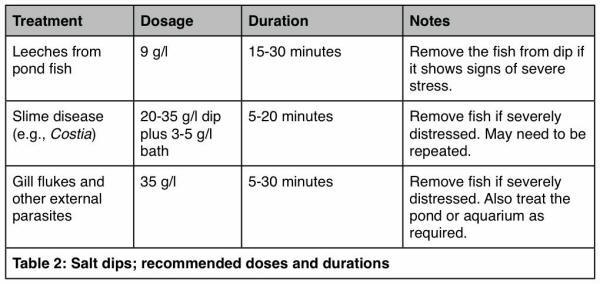
amount of salt. In the case of leech removal for example, a dosage of 9
grammes per litre would be required. So if the bucket used holds 15
litres of water, 135 grammes of salt would need to be added.
Once the salt is fully dissolved, the
fish will need to be netted out of the pond or aquarium, and then
lowered carefully into the saltwater dip. The fish will need to be
completely submerged, so it's important that the net being used is
large enough to hold the fish comfortably. While the fish is being
dipped, keep an eye on both the clock and on the fish. Depending on the
type of fish and its size, dips can last anything up to half an hour.
Generally, the longer the better, but the tolerance of the fish will
likely place an upper limit on how long it can be safely dipped
for.
After the dip is completed, take the
net back to the pond or aquarium, and rest the fish in the water until
it is fully recovered. Once it looks settled, release it from the net.
Discard the dip water after use.
What salt
treats
(1) Reducing
nitrite and nitrate toxicity
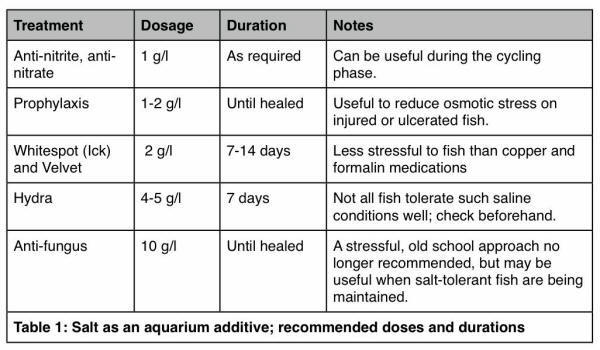
Salt reduces the toxicity of nitrite
and nitrate. While nitrate rarely reaches dangerous levels in a
properly maintained aquarium, nitrite levels above zero are commonly
seen in overcrowded or immature aquaria. As a short term measure, the
addition of 1 gramme of salt per litre of water will reduce
stress and minimise the problems caused by stress, such as finrot.
Note that the use of salt doesn't eliminate the need to fix
whatever problems are causing the non-zero nitrite level.
(2)Prophylaxis after injury
A prophylactic treatment is one
that prevents rather than cures disease. When fish are injured they
can succumb to secondary infections such as finrot and fungus. By
maintaining an injured fish is slightly salt water, osmotic stress is
reduced, and this prevents the fish from becoming weakened. This in
turn ensures its immune system works properly, and so the chances of
secondary infection are reduced. Add salt at a dose of 1-2 g/l.
Maintain this level of salinity until the wounds are healed.
(3) Against
whitespot and velvet
The free-living stages of ciliate
protozoans including whitespot (ick) and velvet are less tolerant of
salt than are fish. When the cysts burst and the free-living stages
enter the water, they are dehydrated by the salt and die. The
recommended concentration is 2 g/l, and this should be maintained for
at least 7 days, and preferably 14 days. To speed up the emergence of
the free-living stages, the water temperature should be raised to at
least 28 degrees C (82 degrees F) and ideally 30 degrees C (86
degrees F). Because warm water contains less oxygen than cool water,
increase aeration and/or water circulation if the fish show signs of
respiratory distress, such as gasping at the surface.
(4) Kill
hydra
Hydra is a tiny,
anemone-like animal that normally does little harm but can be a pest
in breeding tanks because its stinging tentacles can catch and eat
fry. A concentration of 4-5 g/l will kill Hydra within a week,
but note that soft water fish in particular may not tolerate such
salty water well. If necessary, remove the fish from the infested
aquarium while it is being treated.
(5) As a
fungicide
Fungi are mostly intolerant of
brackish and saltwater conditions, and moderately high concentration
of salt have been used to treat fungal infections. A concentration of
10 g/l is required, about 30% the salinity of normal seawater. This
is well above the tolerances of most freshwater fish. So while this
treatment can be effective, it is best reserved for those freshwater
fish with a high tolerance of brackish water: livebearers, gobies,
pufferfish, tilapiine cichlids, killifish, and so on.
(6) Against
leeches
Strongly saline water is useful
as a treatment for leeches. Rather than as an addition to the pond or
aquarium, the salt is used at a concentration of 9 g/l to create a
dip. The infected fish is dipped into this solution for up to 30
minutes, by which point the leeches will detach themselves from the
fish. The leeches can then be destroyed and the fish returned to the
pond or aquarium. Because leeches leave behind open wounds, some sort
of prophylactic treatment against secondary infections will probably
be required.
(7) Against
slime disease
Slime disease is caused by a
variety of parasitic protozoans such as Ichthyobodo
(Costia) spp. that cause the skin to produce unusually large
quantities of mucous. Salt needs to be used in two ways to treat
slime disease. Firstly, the salinity of the aquarium needs to be
raised to about 3-5 g/l, and the aquarium left this way for 7-14
days. Secondly, on the first day of treatment, the infected fish
should be dipped into a strongly saline solution containing 20-35
g/l. This will help clear up the mucous and speed up recovery, but
such salty dips are very stressful for most freshwater fish. While
dips of up to 20 minutes should be safe in most cases, if the fish
shows signs of severe stress, such as rolling onto its back, it
should be immediately returned to the aquarium.
(8) Against
anchor worms, lice and other external parasites
Exposing freshwater fish to
saltwater conditions for varying periods of time can be a good way to
shift external parasites such as fish lice and anchor worms. The
required concentration is 35 g/l. However, this is a risky treatment
because freshwater fish do not tolerate sudden and extreme increases
in salinity very well. Large fish (such as adult goldfish) and
salt-tolerant fish (such as tilapiine cichlids) tolerate saltwater
dips between than small fish and soft water fish. It's also worth
noting that removing parasites this way doesn't prevent
re-infection, so some treatment of the pond or aquarium will be
necessary.
What salt
won't do
(1) Salt
doesn't magically make an aquarium a better
place
There's absolutely no need to
add salt to freshwater aquaria except under the circumstances
described above. At best, it'll do nothing of any value at all.
At worst, it'll stress salt-intolerant fish, making them more
vulnerable to disease and less likely to live to a ripe old age.
(2) Salt
won't raise pH and hardness
By itself salt merely raises the
salinity, not the pH and hardness. Marine salt mix can be used to
raise pH and hardness since it contains not just salt but a variety
of other mineral salts as well, but only in aquaria where
salt-tolerant freshwater fish are being kept, such as guppies or
mollies.
(3) Salt
won't treat finrot (and isn't that useful against fungus
either)
While it has some preventative
value, as mentioned above, salt has little impact on opportunistic
bacterial infections once they are established. To treat these a
proper antibacterial or antibiotic medication will be required. Salt
will treat fungal infections, but as described earlier, the required
concentration is so high that it isn't a safe treatment for most
freshwater fish.
How salt can
cause problems
(1) Malawi
Bloat
Malawi Bloat is a Dropsy-like
syndrome typically observed among Malawian and Tanganyikan cichlids,
hence the name. Affected fish are bloated, have trouble breathing,
become lethargic, and eventually die. There is no reliable cure,
which is why prevention is so important.
Several causes of Malawi
Bloat have been identified, including the use of salt in Rift Valley
aquaria in the mistaken belief that salt hardens the water and raises
the pH. Salt does neither of these things. To create hard water
conditions a proper Rift Valley salt mix needs to be used, either
purchased ready made, or
mixed at home from Epsom salt, baking
soda and marine salt mix.
(2) Stresses
soft water fish
Fish and plants from
mineral-poor waters do not appreciate being kept in slightly saline
water conditions. One reason aquarists got away with adding salt to
freshwater tanks in the past was that the species being kept were
usually hard, adaptable species able to adjust to a range of water
conditions. But many of the most popular fish today, like cardinal
tetras and rasboras, come from soft water habitats. Short term exposure
to low salt concentrations across a few days or a couple of weeks
won't do them any harm, but constant use of salt in their aquaria
could cause problems.
(3) Stresses plants
Like freshwater fish,
plants tolerate salt to varying degrees. Low concentrations, up to 2
g/l, won't do them any harm, but above 5 g/l most freshwater plants
will be stressed and eventually killed.
Addendum: Epsom
Salt; usage
Epsom salt or magnesium
sulfate (or magnesium sulphate in British English) is a mineral salt
widely sold in places like drugstores as well as various vendors
online. It is used in two ways within the hobby:
1. To raise
general hardness.
Epsom salt may be used
on its own or as part of a Rift Valley Salt Mix of the sort useful in
tanks holding hard water fish such as Mbuna, Tanganyikan cichlids,
Central American cichlids and Central American livebearers. To create
very hard water around 20 degrees dH, a dosage of around 1 tablespoon
Epsom salt per 5 US gallons/20 litres. For more, read A
Practical Approach To Water Chemistry.
2. To treat
swelling, constipation, dropsy, pop-eye, etc.
Epsom salt is a mild
muscle relaxant that can be useful when treating swelling and
bloating. It works as a laxative, with a dosage of 1-3 teaspoons per
5 gallons/20 litresbeing recommended depending on the severity of the
case. Raising the temperature by a degree or two often helps by
speeding up the fish's metabolism, and the use of fibre-rich
foods such as cooked peas is extremely helpful.
Why Epsom salt helps
with dropsy and pop-eye is less clear, but it can be helpful and is
worth using alongside whatever antibiotic treatments are being used.
Possibly the Epsom salt helps to draw fluid out of the swelling. In
any case, the recommended dosage is again 1-3 teaspoons per 5
gallons/20 litres.
FW salt
article 2/5/10