|
FAQs on Characoids/Tetras & Relatives Disease/Health 3
FAQs on Characoid Disease:
Characoid Disease 1, Characoid Disease 2, Characoid Disease 3, Tetra Disease 4,
Tetra Disease 5,
Tetra Disease 6,
FAQs on Characoid Disease by Category:
Diagnosis,
Environmental,
Nutritional,
Infectious,
Parasitic,
Social,
Treatments
Related Articles:
Characoids/Tetras & Relatives,
Related FAQs: Characoids/Tetras &
Relatives, Characoid
Identification, Characoid
Behavior, Characoid
Compatibility, Characoid
Selection, Characoid Systems,
Characoid Feeding, Characoid Reproduction,
|
|
|
Mystery ember tetra illness 8/25/12
<Eight megs of poor pix... why don't people follow directions?>
Dear Wet Web Media Crew,
<Lea>
I'm a long time fish keeper, and run a small maintenance service business.
So I've seen my share of illness and have my own tools for dissection etc on
hand and can usually pin down most common illnesses and pests.
<Ah yes>
Yet, I've an issue with my ember tetras in my home display tank that has me
baffled. I have 9 embers, 3 panda Cory, 2 albino Cory and 4 three-line
Cory in a 60L (15G) planted tank. It's been running years with zero
issues and great plant growth.
However, i seem to loose <lose> an ember every few months. I've lost 3
so far. As they are somewhat transparent, I've notices the occasional
tetra with black masses in various points around the internal
organs. They sometimes occur behind the gill, sometimes above the swim
bladder, sometimes near the kidney etc, and once there seem to spread slowly
in the body. The affected fish is quite fine, active, eats
well, good colour for 2-3 months, and finally looses colour, begins
breathing rapidly, and at last keels over in about a week or so. It
seems like some sort of internal parasite which causes little trouble until
the load becomes too much, and then the fish succumbs. Most of the
other fish are disease free, and it seems usually one is affected at a time.
I've tried catching infected animals to remove them (and hopefully the
disease) from the tank, but in a heavily planted set up it's near
impossible.
I've not tried anything for treatment save excellent diet and water quality
as i dislike treating with meds unless I'm certain what I'm dealing with,
and often I've found good care often helps most fish resolve problems
themselves. Tank parameters are: nitrates at 10-20ppm, 0ppm ammonia &
nitrate, pH 7.2, GH 4 degrees, KH 3 degrees. Weekly 30% water changes.
Tank is dosed daily with Flourish Excel, and every 2nd day with liquid ferts
(AquaMaster brand).
I've attached a few pics of the latest case. They don't seem to be
nodules, flukes etc, so not sure if a very tiny helminth, bacterial or
protozoal mass.
Any help is greatly appreciated.
Kind regards
lea
<Sounds/reads like one of the many "mysterious" Microsporozoan,
Microsporidean infections; quite common w/ imported Characins from the wild.
Do see Ed Noga (the second ed. if you can... avail. as an e-book am given to
understand) re.
Bob Fenner>
Acumen Aquatics - Premium Fin Safe decor, aquarium installation,
aquascaping, assistance & service.
Canberra, Australia
|
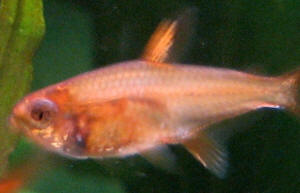
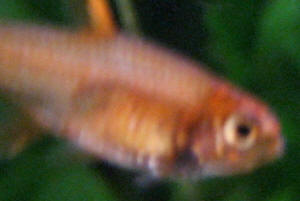 both cropped
 |
|
Re: Mystery ember tetra illness 8/25/12
Hello Bob,
<Lea>
Thank you for the very speedy reply - been researching around as just
found that book last night! I've got the worst case caught and now
in quarantine. When it passes (it's looking past the point of no
return) i will check it under the microscope and refer to the book.
I have The Manual of Fish Health by Chris Andrews et al and a
few others, but not too much
info on Microsporozoans etc.
<I wish I had more, better news to report. As far as I'm aware there
is/are no cure/s for...>
Thanks for the good book reference.
Kind regards
Lea
<And you, BobF>
Re: Mystery ember tetra illness 8/26/12
Hi Bob
<Salve Lea>
That's sad news, but again appreciate your expertise. I did find
one site pertaining to Microsporidea which suggested possibly
Metronidazole - though not specifically for fish.
<Mmm>
Here's the link if you are interested, it's from Stanford.
http://www.stanford.edu/class/humbio103/ParaSites2006/Microsporidiosis/microsporidia1.html
<I thank you for this; these infestations can be... persistent, and
heartbreaking... in slowly killing off all specimens. Providing "Ideal
Circumstances" environmentally, nutritionally... seems to help, slow
down the rate of incidence, attrition>
I will continue to keep water quality and diet excellent, and i can only
hope the shoal shakes it with their own immunity in time. I will
try adding garlic to boost immunity, and have also given a treatment of
a combo formalin, malachite green & Acriflavine to maybe assist in
interfering with any water-borne spores (i consider this combo a good
broad-spectrum against various gram positive, negative, Protozoans and
fungi, which Microsporideans are in the same family). A long shot but i
feel it can't hurt too much at this stage. I will see how this
goes after a week, and if no improvement i will discontinue and try
Metronidazole in a week or two after the former meds have cleared.
I am always wary of over-medicating and stressing my fish.
<You are wise here>
Thanks again
Lea
<Certainly welcome. BobF>
Re: Mystery ember tetra illness 8/27/12
My pleasure Bob - i hope it is of some use. I was a biologist in
my former iteration, and i enjoy research and problem solving to this
end.
<Ahh!>
Speaking of which, i euthanised my ill tetra last night and performed an
immediate autopsy. I found a large infestation of very tiny black
particles approx 0.5 mm (barely visible) which seemed slightly oval
under my 5x lit magnifying glass. They were not within nodules (like
presentations of nodular disease images shown in the Chris Andrews
book), but rather simply clustered together. They were present in
the stomach, around the liver, in the kidney, and up behind the brain to
the extent that pop-eye was a final symptom. I'm picking up a microscope
next week to investigate further and have saved samples of some of the
heavily infected sections in water in the freezer (hopefully the main
structures will not be ruined when i thaw).
<Better to use a preservative...>
I'm am wondering what else they could be, as they seem to infect like
Microsporideans, but these black specs are far to large (given i can see
them just with the naked eye). Maybe some internal protozoal
infection, or a very small internal fluke? I guess it may also be
possible that these are simply actual fish cells which have turned black
by engorgement of smaller parasites.
<Possibly>
If you wish I'll keep you posted and send some images once i collect my
microscope.
<I thank you for this>
As you say, it is heart-breaking as that last thing i wish to do is tear
down this beautiful planted tank. Several of the tetras seem
unaffected, but that's not to say they are not latent carriers.
Will monitor and let you know. Also just found that Metronidazole
is not available in Australia unless you seek out a vet, so it may take
a little time to find a specialist i can obtain some from.
<Yes; the case there is common around the world>
Have you much experience or success with mixing Metronidazole and food?
<A great deal. For freshwater this is by far the better application
mode>
I feel given it's an internal problem, that may be the way to go. Of
course,
will yield to greater experience.
Thank you again
Lea
<Glad to share. BobF>
|
|
Treatment options for fungus in Jellybean Tetra (wild
caught) 7/22/12
Hello again, crew!
<Chesh>
You may remember me writing in a short time ago seeing advice on how to
care for wild-caught Jellybean Tetra (Ladigesia roloffi).
I've had them (they're lovely) since Friday the 13th (O.o), and thus far
things have been going well - I thought - unfortunately, this morning I
noticed a cottony growth by the gill of one of them. I didn't want to
stress them further, but felt it was important to show you what I see,
so I'm attaching 3 images of the same fish, in the hopes that it will
help you help me!
(link to photo:
http://i677.photobucket.com/albums/vv135/HuginnMuninnandMe/SickJellyBean.jpg
)
This is the only obviously affected tetra at this time, though one of
the others *may* have it on his top fin (which appears to have been
damaged or nipped)
<Yes>
These two are among the smallest in a shoal of 20 - only about 1/2 inch
long, if that.
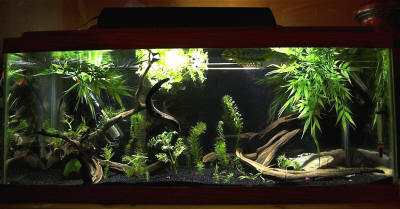
Here is more info on the tank:
This is a 20g long QT tank that I set up just for them. There are more
floaters now than there was when this image was taken (the day before
they arrived). Most of the plants are real, except for the 'bamboo'
floating - I didn't have enough floaters to provide adequate coverage,
so I added some plastic ones in the hopes of easing any stress on the
fish. Everything in this tank except the wood and plastic was taken from
my original QT/plant grow-out tank, which was only a 10g. I didn't want
to risk any fluctuation in the parameters, so moved everything over,
including the substrate, plants, and filter. Also put in a 20g filter
that has been on another tank for quite some time to ensure as stable of
an environment for them, considering the new set up.
Ph 7.4 (a little bit high for Jellybeans)
<Yes; I'd keep under 7.0; do you have some water of lower pH to blend
in? Peat or its extract to add?>
KH 2gtts
GH 6gtts
Nh4 - 0
No2 - 0
No3 - 5
Po43 - 0
Temp: 78-79 (also on the high side)
I've been trying to keep the temp low - I've read that 77 is their
optimum temperature, with 79 being the max. I can't keep the tank under
78-79ish - it's just where my room temperature gets the water. I've been
testing the water daily, and have seen no fluctuation in parameters
since adding these fish. They are under a 10g hood lamp, which I've
slowly been increasing in duration to reach 8 hours, with the intent of
slowly switching to the standard size hood lamp for this tank.
<Leave this off by day, on at night... to discount it as a heat source>
The idea is to slowly get them used to conditions in my 29g community,
which is where I hope they'll go eventually.
I've been doing a small water change and siphon the sand every 2-3 days.
I'm afraid to let them go a week because of the waste created by feeding
them, as they won't touch food if it lands on the substrate,
<Floating small pellets, and/or flake... a few times daily>
and it's been a learning period for all of us. I've been feeding them
lightly every day (I think - it's hard to tell because they're so small
and so MANY of them - I'm new at this!), and have been skipping every
3rd day.
At first, they stayed on the opposite side of the tank as I siphoned
(very gently and slowly, so as not to disturb them), but now they seem
to have gotten used to it, and confuse it with the syringe that I feed
them with and TRY to get to the siphon - so I kind of don't think I'm
stressing them out with water changes, though I could be wrong.
<Better this than pollution>
I've actually never dealt with any type of fungus (if that's even what
this is) in my tank(s) before, and am especially leery as they're very
small and wild-caught. I sincerely appreciate any information and
insight you can offer me in order to get my tank healthy again, and my
little Jellybeans safely through this!
Let me know if there is any other information that might help. . . thank
you very much!
Sincerely,
Jes
<Your water quality reads as otherwise excellent. I would not treat the
system for this one fish, nor remove it to treat elsewhere. I too think
this may be an opportunistic infection (bacterial but possibly fungal)
w/ the one fish being physically traumatized; and will heal of its own
accord w/ just good care, time going by. Bob Fenner>
|
 |
Disappearing tumor? 4/24/12
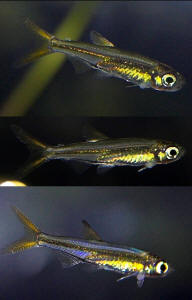
Hello, I apologize in advance for the lack of photographic evidence.
Four months ago I bought 6 X-ray tetras to start my 20 gallon tank. The
tank was fishless-cycled with ammonia 0, nitrite 0, nitrate 10, temp.
77F. Three weeks ago one of the tetras developed an inclusion in its
back---a pale sphere, about 1.5 mm in diameter, above the spine and
below the dorsal fin but attached to neither. There was no external sore
or swelling (if the fish weren't transparent, I wouldn't have been able
to see the thing.) The fish behaved and ate normally and showed good
coloration. Now, three weeks later, the "tumor" has shrunk and looks
like a grain of sand suspended in its back. The fish still seems healthy
and none of the others show any sign of this thing. Is this a parasite?
Have you seen or heard of this before?
Thank you for any insight you can give! -Julie
<Does read like a Microsporidean, Microsporozoan (colony) by colour,
size, shape... as far as I know there are no specific "treatments" for
such. Just good care, appropriate foods, water quality... Bob Fenner>
sick x-ray tetra, env. 12/6/11
today one of my 5 x-ray tetra is not swimming normal. kind of jerking
around. like it can't use its tail. All other fish are fine. I do
water changes once a week. .25 nitrates
<Do you mean nitrite... NO2?>
(I don't know why it doesn't come down...my tank has been
cycled for 3 months)
<Usually insufficient biofiltration, circulation... See WWM
re>
0 nitrites and 40 nitrates.
<Oh... maybe you mean/t Ammonia... toxic, as is your too-high
Nitrate. Do read here:
http://www.wetwebmedia.com/FWSubWebIndex/fwmaintindex.htm
scroll down to the yellow tray>
I just did a water change yesterday so I don't know why nitrates
are that high?
<Read where you've been referred>
I don't see anything wrong with the fish like I don't see any
disease or anything. could have just been sickly to begin with? but I
have had them for 2 months with no issues. so what do I do? is it
inevitable it will die? do I just let it die in the tank?
thanks! -Lauren
<Doubtful, read/act, and no and no. IF your water quality wasn't
off as indicated by your measures of nitrogenous metabolites, I might
suggest the one specimen had physically injured itself, had some sort
of genetic anomaly. But you've got to address the lack of complete
cycling here and cut the NO3 by at least half. Read on! Bob Fenner>
Re: sick x-ray tetra 12/6/11
Yes I did mean .25 ammonia. I have an Aqueon 30 quiet flow for my 20
gal tank. But I haven't changed the filter cartridge in a
while....maybe that's why my levels are high. Thanks!
-Lauren Jerry
<I'd add another filter... and read where you were previously
referred.
Your fishes are in imminent danger of poisoning by their own wastes.
BobF>
Tetra issue. Moenkhausia injured, living
solo 11/14/11
Hello!
<SP>
Well I'm not entirely sure what to do about this fish. Early
September, I was placed in charge of a 55 gallon tank here at my
school, first thing I did was get the water levels how they should
be.
<Good start>
There were small amounts of ammonia and nitrite (less than .5 ppm, but
I was not happy with that)
<Me neither>
and the KH was non existent while the GH was way over 30 (I stopped
counting is was so bad). This tank is stocked with tetras, patties,
barbs,
<Mmm, what species are these Barbs?>
mollies and Pleco. Everything seemed just fine, I started putting
AquaSafe in the tank (slowly to ensure the fish acclimated correctly,
they had been adding straight tap water for over a year and the Ammonia
and Nitrite levels here are insane).
<In the source water? This is bad... would not use for my potable
purposes w/o running through a reverse osmosis device first>
Everything was fine, we lost one fish (had been purchased from Wal-Mart
and it looked slightly discolored when I started). Well, about a week
ago now, I noticed that there was this huge blackish/brown spot on the
right side of the Lamp Eye Tetra. It was swollen, so I pulled the fish
and it has been in quarantine ever since. I watched it the first couple
days and smaller spots began to appear on other areas of the fish, so I
started adding Rid-Ich
<Mmm, I wouldn't do this. The active ingredients are too
harsh... Formalin and Malachite Green>
(which has worked on everything I've ever come across without
issues) and the smaller spots went away, but the swelling on that one
spot has continued. I've never had anything require treatment for
more than four days, so I stopped treating yesterday.
<Good>
This spot now has some slight red around the edges of it now.
<Healing>
The fish is eating and swimming fine, but I'm not sure what else to
do.
<Nothing... other than providing good care... water quality and
nutrition wise... Likely this Tetra has been bruised... perhaps from an
altercation w/ another fish here, maybe just a "bump" into
something hard. Will heal on its own in time>
Nothing has changed in the tank in a month and a half and I even added
a female Molly and a Dwarf Gourami to the tank (quarantined and added
after the tetra had been removed, so they did not cause this). This
fish is about 2 inches nose to tail and they are expecting me to
magically cure this fish, but I'm unsure what to do for it right
now. At this point, I don't think it's Black Spot. The only
time I seen something even close to this before was on a female guppy
who developed an internal tumor, was black and swollen, she died within
a month.
Current tank stats:
Ammonia: 0, Nitrite: 0, Nitrate: 5, KH: 2, GH: 29, pH: 7.0, Temp: 72-74
degrees (depends on if the lights are on).
<Mmm, given the mix of species, this water is fine>
Thank you!
Confused Student.
<And a note re this fish, Moenkhausia spp. are strongly schooling
species.
Really will do much better kept in a small group. I'd add a few
more. Bob Fenner>
Spiraling tetra
11/9/11
Good morning. I have a 15 gallon planted tank with three green
tiger barbs,
<Tiger Barbs are notoriously nippy in small groups.>
two rosy's,
<Rosy Barbs are subtropical fish; they also get much too big for
this tank.>
and two diamond tetras.
<A delicate species unless you have soft water.>
I initially had three rosy's, but one became stuck between a rock
and the tank wall and died. I can only guess he had grown too large
because he frequently swam through the rock formations in the tank.
Because of this, I thought it best to rearrange the tank.
<Or get a bigger tank>
I put the fish in a large plastic washbasin with an airstone and the
heater while I tended to the tank. Parameters before and after have
been consistent. Ammonia 0, nitrates 10-20, nitrites 0, GH 75, KH ~100,
pH 7.6 .
<Sounds pretty good water for tetras and barbs.>
Anyhow, after returning home and settling down, one diamond started to
list a tad. He seemed to swim ok, but whenever he swims fast, he
spirals. After some Google -itis on my part, I worried he may have
whirling disease and put him into quarantine that night.
<Whirling Disease is virtually impossible in aquaria, unless
you're feeding live Tubifex worms. Do understand that just because
your fish is "whirling" doesn't mean he has Whirling
Disease; it's a thousand times more likely his nervous system is
being shut down because of environmental stress, poisoning, shock, or
something else like that.>
He did fine in quarantine.... I treated him with extra stress coat and
wee bit of Melafix. He did well and stopped spiraling.
<Perhaps, but doubt either medication did much in this scenario.
Fish that are shocked, for example, can go doolally for a few hours,
but eventually settle down.>
So back home he goes and he promptly starts to spiral again. However,
he schools with the other diamond (and sometimes the barbs shoal with
them it's funny to see them plop down into formation. ) He eats
well, he doesn't appear ill, he just lists a wee bit and spirals.
He doesn't spiral during "normal" swimming, just when he
"power" swims.
Now I'm wondering if he has a swim bladder dysfunction.
<Again, another common misunderstanding. True infections of the swim
bladder are extremely rare, and virtually all diagnoses of "Swim
Bladder Disease" are wrong. When fish are sick or weakened, they
can't swim properly. Fish with swim bladders will find it difficult
to balance. Think of the last time you were giddy -- I bet it
wasn't because your legs were partially paralyzed! Far more likely
you had a fever, you were drunk, you'd had a bump to the head, or
some other thing like that. It's important to separate the symptom
from the problem.>
Since stress apparently makes it worse, I'm reluctant to move him
anymore. Should I try to treat him again? If so, with what?
<If the fish doesn't show signs of bacterial infection or
parasitism (i.e., white spots or similar), and you can rule out a
genetic problem because the fish was swimming normally when purchased,
then think about the environment. What might be stressing it?
Temperature? Oxygenation? Water chemistry stability? Water chemistry
after water changes? Social interactions? Poisons such as copper and
Chloramine? Check through these, and act accordingly.>
I'm of a mind to just let him be, keep up water changes per usual
(20-50% every 1-2 wks), and see how he does. I don't think he was
comfortable in quarantine as a solitary fish.
Any advice?
Thank you!!
<Cheers, Neale.>
parasitic worm infecting cardinal tetras?
(RMF, other ideas?)<<Sporozoans, Microsporideans?>>
2/19/11
Dear Crew,
<Hello,>
Hoping you can help me - I've scoured the site and can't find
anything that accurately describes the situation we currently have.
Last night I noticed that one of my cardinal tetras had a fluid filed
sac protruding from just underneath the gills on one side,
<Do occasionally happen, for no obvious reason I'm aware of,
though the usual culprits such as physical damage, stress, and
parasites of various sorts can be considered.>
the fish doesn't seem to be in any discomfort and we observed it
feeding ok, however on closer inspection of the other cardinals
we've noticed that three of them appear to be affected by some form
of worm - the fish are each showing one large 'blister' of
around 3mm on their sides which appear to have a thin white worm
inside, no more than 1mm in diameter. We tried unsuccessfully to remove
the affected individuals from the tank last night, when examining the
fish this morning one of the blisters appears to have ruptured as it
now resembles a wound rather than a blister, and I noticed one of the
worms attached to another tetra, but without the surrounding
blister.
<Indeed. My guess would be that the blister rather than the
"worm" will be the healthcare issue, because most worm-like
infections can't actually complete their life cycle under aquarium
conditions. They need intermediate hosts like birds or snails for that
to happen.>
The tank is a 500l (134 US gallons, or 110 UK gallons) tropical
freshwater system, heavily planted and is maintained at 25-26 Celsius
(77-78.8 F). Ammonia, nitrite and nitrate are all undetectable, and we
do 15% water changes weekly (including gravel siphoning). The current
stock are:
shoal of mixed tetras (15 cardinal,
<Angelfish food.>
5 lemon, 5 Pristellas, 3 Congo)
10 juvenile angelfish (1.5 inch body length)
6 Corydoras catfish
6 Bristlenose catfish
So far the only fish that seem affected are the cardinals but I suspect
if it is a parasite without a specific host then it will spread to the
other fish in the tank.
<Unlikely.>
Currently, the plan is to increase the number of water changes to
reduce parasite load in the tank
<Water changes are a good idea for other reasons, but won't
really dilute the concentration of parasites in any meaningful
way.>
however am not sure whether we should also treat the tank with an
anti-parasitic medication as well, and if so what would be best?
We've not been able to get a photo of the affected fish but hoping
you might be able to offer some advice without one
Here's hoping,
Carolyn
<Would recommend nothing more than acting as per physical damage for
now: observe the fish, and if they show signs of their wounds not
healing, medicate with something like the excellent eSHa 2000
Finrot/Fungus medication. Without a positive ID on the parasite,
medicating further would likely be pointless and could well stress the
fish still further. Cheers, Neale.>
Red Phantom Tetra can't open his mouth
12/18/10
Hi Crew,
<Chris>
I hope you can shed some light on this problem. Here's my
set-up:
20 gallon tank
Ammonia 0, Nitrites 0, Nitrates 10
8 red phantom tetras, 1 Farlowella, 1 dwarf Gourami, 6 peppered Cory
cats
live plants
temp 76
I've had this tetra in question for 2+ years. A bit of background
that may or may not be relevant - he was either born with a curved
spine, or he was injured on the trip to the LFS. From day one you could
see his spine was curved. However, he has been fine for 2+ years, could
swim just fine though perhaps he is tipped upward a little bit when he
is stationary but otherwise has been normal.
<I see>
I noticed a few days ago he seemed to be moving a lot more, constantly
swimming but not as he normally would. He is tipped upright more than
usual and never rests even for a second. He also seems to be a bit
stiff in part of his body but I can't quite put my finger on where
(possibly his upper body but hard to tell).
When I fed the fish he seemed to react and swim around the food, but
made no attempt to eat. I knew something else was off about him and
couldn't put my finger on it until tonight...he isn't opening
his mouth at all! Not to eat, or as fish normally open and close their
mouths. It is like his mouth is fused shut.
<Mmm, happens...>
I put a magnifying glass up to him and don't see any growth or
obstruction but he is so quick to move it is hard to tell.
Should I put him in a separate tank (and possibly treat with
something?).
Any idea what this is, and are my other tetras at risk?
<I'd leave this fish where it is. Not "catching"...
either developmental or a trauma (bump into something hard)... Will
cure of its own or this fish will perish in time from a lack of
nutrition>
Thanks so much for your time!
Chris
<Welcome. Bob Fenner>
|
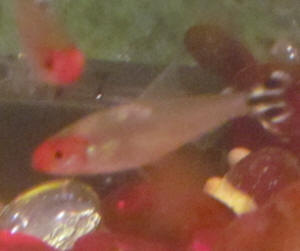
White patches spreading on fish 6/21/10
I am having a problem with my rummy nose tetras getting whitish
patches.
<I can see.>
This tank is cycled, 10 gal,
<Much too small for this species; Rummynose tetras are fairly
demanding fish, and suffer in small tanks -- anything less than
30 gallons, to be honest -- and cannot abide immature aquarium
conditions.>
I check the ammonia every week and after 3 weeks I had .50 so it
has had a recent water change.
<If the aquarium has had non-zero ammonia levels for three
weeks, that's very likely the cause of the problem here. Is
the tank actually a mature one? In other words, one more than 3
months old? Or is it a new aquarium?>
The pale patch on the fish was noticed soon after I bought the
school of four tetras about 4 weeks ago,
<Again, these tetras aren't forgiving of mistakes. Keeping
fewer than 6 tetras is always a bad idea, and with Rummynose
tetras your scope for mistakes is minimal. Social stress could
easily make worse any other problems.>
I did some treatment with Maroxy and Melafix assuming it was
fungus and it did nothing-didn't grow didn't shrink- so I
quit treatment after a week and decided it just had odd
coloring.
<Is not odd colouring; this is some type of bacterial
infection, Finrot-type thing. Needs to be treated with a suitable
antibiotic PLUS appropriate "fixes" to these
tetras' environment.>
Now the whitish patch is growing and one other tetra is showing a
small spot of it on its head. The fish still all have nice red
faces- they get pale if they are stressed or sickly or so I am
told.
<They can do, but pale heads aren't the only signs of
sickness, anymore than sneezes are the only signs that humans
aren't well.>
I have researched on line the only thing that seems to match is
Columnaris but the fish is still active and not acting sick. My
experience with Columnaris is that it is fast and deadly-had two
new betas die overnight from it in March and never bought fish
from Petco again- so I don't think it is Columnaris;
<Could be Columnaris, but you can't really be sure without
microscope work.
Certainly bacterial, so either way, treat with something that
treats Finrot and Columnaris.>
what do you think it is?
<Stress-induced opportunistic bacterial infection. You've
kept these fish badly, and now they're dying. Fixing the
environment -- better water quality, larger tank, more specimens
-- will save them, alongside appropriate medication.>
Thanks for any help.
<No problem.>
CR
<Cheers, Neale.>
|
  |
|
Bariatric Neon Tetra 5/4/10
Hi
<Hello,>
Thanks for the great site I have found it very helpful for both
marine and freshwater tanks
<Good to know.>
I have searched your FAQs and other pages but cannot find an
exact match for the problem.
<Oh?>
We have a neon tetra that is significantly larger than normal
i.e. at least twice the size of the tankmates While I have
managed to find numerous references to bloated or swollen
stomachs the associated pictures and
descriptions speak to very distended stomachs and bulging - this
fish is large all over.
<Are you sure he's a Neon? Cardinal tetras are similar but
a bit bigger all around. Conversely, Paracheirodon simulans, the
so-called Green Neon, is somewhat more slender than the Common
Neon Tetra, Paracheirodon innesi.
Also is he longer than the others, or just fatter? If the abdomen
is substantially bulkier, but the length of the fish is the same
as the others, that can imply a variety of things, including
dropsy, intestinal worms, even a female filled with eggs and
ready to spawn!>
My question is does dropsy sometimes produce this overall
swelling?
<Just the abdomen. By definition, oedema/dropsy is retention
of fluid within the body cavity. The head, back, tail should all
be the same as usual, since the muscles aren't much
affected.>
Could it be some sort of water exchange/retention issue? What
would you recommend as a treatment?
<For now, nothing. If the fish is happy and healthy, I
wouldn't worry too much.>
There is no signs of eyes popping or pine cone/fluffy scales
<Good.>
The fish has slowly increased in size over 4-5 weeks. Diet is a
mixture of flake and blood worms. We have tried a pea with no
success (in case of constipation)
<Hmm...>
The fish has now stopped eating - or eats very intermittently
<Again, the key thing is whether the fish is bigger around the
belly, or longer and the larger more generally, from head to
tail. If the belly alone is swollen, and this fish is the same
length as the other Neons, then you may well be dealing with
constipation, dropsy, Neon Tetra Disease or something.>
Water parameters are good -nitrate less than 10. Ph is 6.9 and
although a small tank it has good filtration, weekly 30% water
changes with a mix of RO/dechlorinated water (to maintain
hardness) and the substrate is vacuumed weekly. The remaining 6
tetras (the only other fish) are doing fine
Kelly
<Hope this helps. Cheers, Neale.>
|
|
Bariatric Neon Tetra 5/4/10
Hi
<Hello,>
Thanks for the great site I have found it very helpful for
both marine and freshwater tanks
<Good to know.>
I have searched your FAQs and other pages but cannot find
an exact match for the problem.
<Oh?>
We have a neon tetra that is significantly larger than
normal i.e. at least twice the size of the tankmates While
I have managed to find numerous references to bloated or
swollen stomachs the associated pictures and
descriptions speak to very distended stomachs and bulging -
this fish is large all over.
<Are you sure he's a Neon? Cardinal tetras are
similar but a bit bigger all around. Conversely,
Paracheirodon simulans, the so-called Green Neon, is
somewhat more slender than the Common Neon Tetra,
Paracheirodon innesi.
Also is he longer than the others, or just fatter? If the
abdomen is substantially bulkier, but the length of the
fish is the same as the others, that can imply a variety of
things, including dropsy, intestinal worms, even a female
filled with eggs and ready to spawn!>
My question is does dropsy sometimes produce this overall
swelling?
<Just the abdomen. By definition, oedema/dropsy is
retention of fluid within the body cavity. The head, back,
tail should all be the same as usual, since the muscles
aren't much affected.>
Could it be some sort of water exchange/retention issue?
What would you recommend as a treatment?
<For now, nothing. If the fish is happy and healthy, I
wouldn't worry too much.>
There is no signs of eyes popping or pine cone/fluffy
scales
<Good.>
The fish has slowly increased in size over 4-5 weeks. Diet
is a mixture of flake and blood worms. We have tried a pea
with no success (in case of constipation)
<Hmm...>
The fish has now stopped eating - or eats very
intermittently
<Again, the key thing is whether the fish is bigger
around the belly, or longer and the larger more generally,
from head to tail. If the belly alone is swollen, and this
fish is the same length as the other Neons, then you may
well be dealing with constipation, dropsy, Neon Tetra
Disease or something.>
Water parameters are good -nitrate less than 10. Ph is 6.9
and although a small tank it has good filtration, weekly
30% water changes with a mix of RO/dechlorinated water (to
maintain hardness) and the substrate is vacuumed weekly.
The remaining 6 tetras (the only other fish) are doing
fine
Kelly
<Hope this helps. Cheers, Neale.>
|
|
 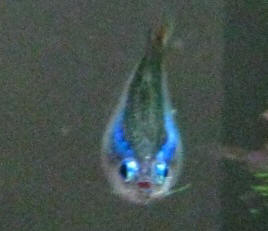 |
|
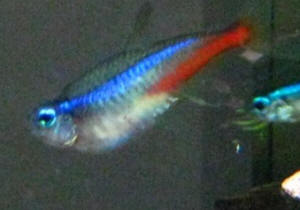
Re Rosy Tetra Following - Please Help (RMF, any better
guesses?)<<Mmm, no>> 11/28/09
Hi again,
<Hello Chris,>
Please see photo of my rosy tetra, attached. As a follow up to my
last email (below), I'd been having concerns about my Rosy
Tetras. Since then I've been watching and have seen no
bullying, the three have been hanging out together and eating
well, though still their colouring was lighter than usual.
<Usually a bad sign with these fish. Like a lot of South
American tetras, Rosy Tetras have colours that can change with
mood and health.>
Last night all 3 seemed okay, all ate and were swimming fine.
This morning one was dead, with a thick white band on its body. I
looked at my other two and am upset to find that a second looks
like he is in bad shape. He has a white band as well (see photo).
It is also protruding but that is hard to tell in the photo. He
is swimming but didn't eat today.
<Likely sick.>
I am also starting to see what looks like the start of a white
patch on my third though not as advanced. He is eating and
swimming fine. My other fish are showing no signs of this
thankfully.
<May be specific to the Rosy Tetras, e.g., a virus or
protozoan parasite. A parallel could be made with Pleistophora
hyphessobryconis, what we call Neon Tetra Disease although it can
affect related small characins as well.>
I have a 4 gallon quarantine...should I move both fish to it
using cycled water and filter medium, and if so, is there
anything you can suggest I do to help them (temperature,
medication?).
<If this is something analogous to Pleistophora
hyphessobryconis, there's no real cure beyond removing (and
euthanising) sick fish to prevent cross-infection. Typically
Pleistophora hyphessobryconis works its way through all the Neons
(or whatever) in the system, and then dies out without harming
unrelated fish (catfish, livebearers, etc.).>
Any idea what this is? And should I move both of the tetras
(concerned about bullying in such close quarters by the healthier
one).
<I'd destroy any sick fish that aren't feeding;
they're unlikely to get better.
http://www.wetwebmedia.com/euthanasia.htm
>
I do weekly water changes, Nitrite and Ammonia are 0 and Nitrates
are between 8 and 10. As below, it is a 20 gallon tank.
Thanks so much! Chris
P.S. One thing I noticed is that my tank temperature has gone
from the usual 78 to 75, though I would have thought this might
help since they like cooler water. I am trying to regulate the
temperature now, as this fluctuation has never happened
before.
<Can't see relatively small temperature changes like this
causing problems.
Sorry can't offer anything more helpful. Cheers,
Neale.>
|
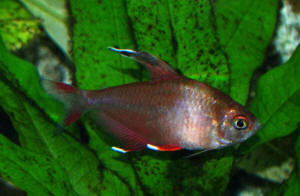 |
|
Follow up - It's wide-spread now - Please Help
12/2/09
Hi Neale/Crew:
<Hello,>
Well, things have gone from bad to worse. Since writing the email
below on Saturday, I've lost all 3 of my Rosy
Tetras but it doesn't stop there.
<Oh dear. This really does sound like some type of highly
contagious pathogen akin to Pleistophora
hyphessobryconis.>
When I came home yesterday one of my red phantom tetras seemed to
have pop eye in his right eye, just starting. I watched every
fish closely last night and everyone ate and was full of energy,
even him.
<Hmm...>
When I came home tonight I went to check on the red phantom with
pop eye and found another red phantom had died (had no pop eye,
no visible symptoms). He had appeared 100% normal last night. I
was then shocked to
also find a dead swordtail - again, 100% normal and pushing his
way around to get food last night as usual - very active and
nothing unusual on his body.
<Oh dear.>
Now two of the four remaining tetras appears to have pop eye. The
other two seem okay. I have two remaining black skirt tetras that
appear okay.
<Oddly, Pleistophora hyphessobryconis doesn't affect all
tetras, even while it *can* infect distantly related fish such as
Angels and Goldfish. So you can get some very odd situations were
Cardinal tetras don't get Pleistophora hyphessobryconis, but
Neons do. It may well be that your Black Widows are resistant,
unlike the Rosy tetras. I'm not 100% sure that you're
dealing with Pleistophora hyphessobryconis -- though the loss of
colours, swelling, and then death are consistent -- but there may
be some other, highly contagious Sporozoan at work here.>
Six Cory catfish appear fine, one (Elegans) is appearing sluggish
tonight.
My Farlowella and 5 little Oto cats seem okay.
<I would be surprised if your catfish succumb to the same
thing, but as stated above, distantly related species have been
infected with Pleistophora hyphessobryconis even though it's
normally considered a disease of Neons. That said, I've found
Corydoras elegans to be one of the more delicate species in its
genus.>
I did my weekly water change last night because I was concerned
about the pop eye, tested water levels an hour later and they are
still great.
Ammonia 0, Nitrite 0, Nitrates around 8. That is constant for my
tank.
Water temperature did not change, and I used chlorine remover in
the water as always.
<Cool.>
It hit me that a while ago I introduced 2 elegans Corys to my
tank. One was lethargic from the get-go, the other was very
active but died two days later. I had assumed at the time they
died from the stress of travel. I think what I've learned is
a very painful lesson in not quarantining, unless there is
something else in my water that I should test for. I also
introduced a plant about two weeks ago but not sure if that can
cause problems?
<Right... this may well be the issue. My experience of
Corydoras elegans was not dissimilar, having "rescued"
two lonely looking specimens sitting in a tank at my local garden
centre. A few days after buying them, they were both dead. I do
wonder if this species is a host for some type of microbe that,
under certain circumstances, can cause problems. I will add
though that even though they shared a tank with some Peppered
Corydoras, those Corydoras remained perfectly healthy; indeed, I
still have them and every year they present me with another batch
of baby catfish. So whatever it is that Corydoras elegans may or
may not carry, it doesn't necessarily affect other catfish.
As you say, quarantining is always important.>
Please help...I know that I will likely loose more fish by
tomorrow if not sooner. Should I medicate the tank, and if so
with what? I am very concerned that medication will hurt or kill
my catfish (Corys and Farlowella).
<So far as I know, Sporozoans are very difficult to cure. Your
best bet is to remove any infected fish on sight, and humanely
destroy them. Done ruthlessly, this can sometimes stop the cycle
of reinfection.>
Thanks as always for any help you can provide - I am at a
loss.
<These sorts of infections are rare but always frustrating. I
can't begin to tell you how many Neons I've lost (or seen
others lose) because of Pleistophora hyphessobryconis. For all my
(supposed) skills at fishkeeping, Neons are the one species
I've never been able to maintain. In other words, usually
what happens is you let the infection burn itself out, removing
any infected fish and adopting a wait-and-see approach towards
the others.
Typically, the fish that survive are resistant, so no medicating
is required. It's debatable whether the pathogen can remain
dormant in a tank with no suitable hosts, and if it can, for how
long. But I'd tend to err on the side of caution and not add
any more specimens of any species that succumbed in the
past.>
Chris
<Cheers, Neale.>
Re: Follow up - It's wide-spread now - Please Help
12/2/09
Sorry, a bit more info if this will help.
<Fire away.>
I checked PH just now and it is right where it has always been
(in the "ideal" range).
<Which is? For most community fish, around 7 to 7.5 is the
ideal. Below pH 7.5, biological filtration works less
effectively, and below pH 6.0 it doesn't work at all. So I
tend to recommend people keep the pH just above
7, even in situations where acid-loving species are being kept
*unless* acidic pH levels are critical to their health (as with
Ram cichlids for example).>
I don't know what else to test - everything is fine. I think
my Elegans is okay, as he is active now. I might have caught him
during a rest.
<Cool.>
My two red phantoms definitely have pop eye but are active. I
have noticed the one who had pop eye last night seems to have it
a bit worse today.
<Would isolate these in another tank, and realistically,
euthanise them.>
I've just examined every single fish and there is not a
single symptom I can see. No loss of colour, fins are not clamped
or torn, no white spots, no fungus. Nothing is visible other than
the two with pop eye. All are active and eating.
<For Pleistophora, and perhaps other Sporozoans, the main
transmission mode is when healthy fish peck at weak/dead fish, so
it's important to isolate sick fish from the healthy
ones.>
That is also how it was last night which is why I'm shocked
that my sword and tetra, who appeared in perfect condition and
were active and feeding were dead today.
<Oh.>
I should also mention that none of my fish was dead for very
long, in fact most of them that had died in a breeding trap.
<Would not use a trap. When isolating these fish, you
absolutely should isolate them: another tank, and with nothing
moving between this tank and the display tank. Euthanasia is
often more practical.>
If one looked bad in the evening I would place him in the trap so
the others couldn't consume the body in the event he died
overnight. I had hoped this precaution would prevent any further
contamination.
<It won't; circulation of water through the trap into the
tank will allow pathogens to spread.>
Finally, my tank is well established and I have had no real
problems with water quality or fish loss in the 2+ years it has
been running.
<Cool.>
I hope this additional can help you help me! Thanks again for
your thoughts.
Chris
<Cheers, Neale.>
Re: Follow up - It's wide-spread now - Please Help
12/2/09
Hi Neale,
<Chris,>
Thanks very much for the prompt response.
<Not a problem.>
As expected, when I checked the tank first thing this morning I
could barely tell apart the 4 remaining red phantoms from the 2
black skirted because all have lost all colour. They are
essentially transparent now. I have moved them to another
tank.
<Sad news.>
I've noticed that the tail of my remaining sword has a tiny
little bit of raggedness on the tip (barely visible) which
wasn't visible last night so I'm watching him
closely.
<Do so; while I'd be surprised if he caught the same
pathogen as the tetras, it's not impossible. The symptom you
describe sounds more like physical damage, or possibly Finrot,
though this latter isn't common in well run tanks.>
Otherwise he was happily devouring a catfish pellet this morning
and was active.
<Good.>
Thankfully all Corys, the Farlowella and the Oto cats seem great,
in fact they seem to be enjoying the new-found space.
<Also good news.>
The only positive in this is that the fish seem to be succumbing
very quickly - it doesn't appear to be a slow decline so
hopefully they aren't suffering too much.
<This is actually a typical characteristic of Sporozoan
infections: by the time symptoms are visible, the fish is days
away from death.>
One question - should I be doing 10% water changes more
frequently than once/week to try to remove the pathogens, or keep
to the weekly schedule?
<You aren't going to "dilute" the pathogens, so
for the sake of simplicity, I'd stick with the usual 25%
water changes per week.>
Thanks again, Neale!
Chris
<Sorry I can't offer anything more helpful. Cheers,
Neale.>
Re: Follow up - It's wide-spread now - Please Help
Thanks again, Neale.
Even though the news isn't great, your support is very
helpful. I'll focus now on hoping the remaining fish
survive.
Chris
<Good luck with it! Cheers, Neale.>
Re: Follow up - It's wide-spread now - Please Help
12/3/09
Hi Neale/Crew:
<Chris,>
I am probably taking a shot in the dark here but I'll ask
anyway, regarding my ongoing saga of fish dying (see below and
recent emails with Neale).
My six remaining tetras are still translucent with no colour
whatsoever but they are eating and otherwise seem okay. They are
in a separate tank. I don't hold out much hope but I see no
signs of distress at the moment.
<Indeed.>
But I just witnessed something in my 20 gallon tank (which was
the source of the significant fish loss recently - see past email
thread). I have 5 Oto cats in that tank that have been there for
roughly 4 weeks...not too long after I introduced them did I
discovered the rosy tetras starting to decline.
<Hmm...>
I have never seen them bother with the other fish...however just
now I put an algae wafer on the bottom and the Corys scurried
over to eat. I saw two of the Otos also go to the wafer. Then one
of the Otos tried to suction on to one of the Corys and was
successful for a moment! He then tried to do the same with my
sword who swam away. This is the first time I've ever seen
one of the Otos interact with the other fish. The other fish
seemed scared and went to hide.
<Unfortunately, this is very common behaviour. I have seen it
myself, and I've mentioned it repeatedly here at WWM. The
problem is that Otocinclus view the mucous on the flanks of fish
as potential food. Whether they do this only when starving, or do
it regardless, is not clear to me. But slow moving fish are
targets, and this is one reason I keep telling people to shy away
from Otocinclus, despite the sales pitch that they're
"ideal small algae eaters". They are nothing of the
sort!>
Wondering if this behaviour was just competition over the algae
tablet...or is it possibly that my fish have been dying because
of this?
<It can cause physical damage, and that should be obvious. I
my case, the poor Awaous flavus goby had its flanks torn up, and
a bacterial infection set in similar to Finrot.>
I know that there can be confusion between certain algae eaters,
some being more aggressive than others, but I didn't expect
that from Otos and hope they weren't the cause of my fish
loss!
<I wouldn't expect Otocinclus to parasitise
tetras.>
Again, a shot in the dark, I know, but thought I would ask.
Thanks again!
Chris
<Cheers, Neale.>
|
Help with Rosy Tetras, sys.... env. hlth.
11/20/09
Hi Crew,
<Hello Chris,>
Hoping you can give me advice on my Rosy Tetras.
<Will try.>
Tank set-up:
20 gallon planted tank
<20 US gallons? A bit on the small side of this species... will hide
a lot.>
Ammonia 0, Nitrites 0, Nitrates 8 -10
15-20% water change every week (diligent about water quality and
testing)
Temp 78
Community tank with Corys/Otos/2 swords/3 Rosy Tetras and 6 Serpae
tetras, and a Farlowella
<Serpae tetras are aggressive nippers, and not my first choice for
the community tank (English understatement... wouldn't let them
anywhere near community fish).>
I've had my 3 Rosies for 1-1/2 years and realize now that I should
be keeping them in larger groups, but I think I would be overstocking
if I added 3 more fish.
<Indeed... but my prime concerns are that some of these species, the
Rosy tetras and the Swordtails, really do need more swimming
space.>
Lately one has been hiding, and this fish, along with one of the other
Rosies, are losing colour and appear to have some blotchy
darkness/redness internally. It seems in the gill area as well as
toward the middle of the fish. It is very subtle as is the colour loss
(at first I thought I was overanalyzing), and I wonder if I'm
seeing the start of some sort of infection due to the stress of
bullying, as one of these Rosies has started harassing the other
two...no nipping, just swimming quickly at them until they hide. All 3
are eating normally, and all fins look good.
<Likely a symptom of general stress, though whether it's the
size of the tank, or nipping from the Serpae tetras, I can't say.
To be honest, if there were six of them in a 20 gallon tank without the
Serpae tetras, I think they'd be okay, but the Serpae tetras really
aren't good choices for keeping alongside Rosy tetras.>
If this is what the problem is:
(1) If I remove the "bully" (and hope that the other 2
recover) would he survive in a 10 gallon tank with 4 Corys and a dwarf
Gourami? Would the Gourami be bullied too? Or would it be better to
move the Gourami to the big tank and put the bully Rosy in the small
tank with the Corys which he doesn't seem to bother with (so
far).
<Not a good idea. Keeping these fish in a 10 gallon tank really
would be pushing your luck. Removing bullies rarely works in situations
like this, where the problem is the group is too small for normal
schooling behaviour.>
(2) If I remove the two Rosies in question and quarantine them, I would
have to put them in a small 5 gallon tank (heated and filtered). Would
this small tank stress then further?
<Yes.>
Should I medicate the water?
<Not unless you detect symptoms of a particular disease.>
Thanks in advance for your advice!
<You're welcome.>
Chris
<Cheers, Neale.>
Re: Help with Rosy Tetras 11/20/09
Hi Neale,
<Chris,>
Thanks for the quick response to my question re my Rosy Tetras that
look like they are losing colour and have some darkish/red internal
problems.
<See, this is the thing... all these tetras can change their colours
significantly depending on mood. Their colours can range from pale
salmon pink through to almost a fiery red. Further, the idea of
"internal
problems" is common parlance for "haven't a clue
what's wrong". It's actually pretty uncommon for fish to
genuinely have some mysterious bacterial or viral infection. (Some
exceptions though, like Dwarf Gouramis
and their viral and Mycobacteria infections.) Anyway, while it's
not impossible that your fish have some bizarre bacterial infection,
I'd tend to bet against it. Evaluate all the other possibilities.
Unless there are
obvious symptoms of a bacterial infection -- such as loss of appetite
--
I'd tend to assume this problem was more behavioural than anything
else.>
I did some more homework and the fish I identified as Serpae tetras are
actually red phantom tetras - sorry!
<Ah, now things become interesting. Red Phantom Tetras,
Hyphessobrycon sweglesi, formerly Megalamphodus sweglesi, are not a
tropical fish. They need fairly cool conditions, 20-22 C being ideal.
When kept too warm they never do well, and tend to be short lived. So
instead of 5+ years, you get a couple of years out of them. So while
ideal for other low-end tropicals like Danios, Neons and Peppered
Corydoras, you wouldn't keep them with, for example, Dwarf Gouramis
or Angelfish, both of which need above 25 C to be happy. It's a
very common mistake to assume tropical fish all like really warm water;
many of them don't.>
The receipt I had filed away only said "tetras" and I thought
Serpaes looked like them but it is in fact red phantoms. I've had
them for two years and they are extremely peaceful little guys.
<Yes, they are a nice species.>
Re the swords and the rosy tetras, I agree that a 20 gallon is too
small and if I were to do it over again I would make other choices.
<Cool.>
If you think I should add 3 more Rosies to try and help the 2 that are
being bullied I will but worry that I am going to be overstocked. What
do you think?
<Worth a shot.>
In my 20 gallon I have:
6 very small Oto cats
<These like cool water too.>
1 Farlowella
<As do these.>
6 Corys (3 are very small - I forget the name - and 3 are peppered so
are a little larger)
<And these too.>
2 swords (fairly large swords)
<Also should be kept below 25 C.>
3 rosy tetras
<These do need middling temperatures, around 24-26 C.>
6 red phantoms (very small)
<As we've seen, like things a little on the cool side.>
Would adding 3 more rosy tetras to this mix make it a dangerous
load?
<Assuming robust filtration, I don't think you'd be running
too much of a risk.>
As I mentioned I do weekly water changes and it is has been years since
I have had a water quality issue but am concerned.
<Great.>
I am concerned that the internal discolouration/redness and colour loss
of the two tetras will get worse if things remain status quo.
<I would be worried too.>
Thanks again!
Chris
<Good luck, Neale.>
Neotrop community tank; sickness, death, but no useful
data - 10/24/09
I have 55 gal freshwater tank with Black, Red, and Gold Tetras 1 Pleco
and 2 Cory cats.
<Hmm... not really sure what these "tetras" of yours might
be.>
The Tank has been going for about a year and I haven't lost a fish
in about 10 months until about 1 month ago. I lost 2 black Tetras in a
few days with no on obvious signs. One of my reds lost color and was
having labored breathing and died about 2 weeks later. Now one of my
Golds is showing signs of labored breathing and has raised scales on
his sides all others seem to be doing fine. NO2, NO3, KH, GH are all
within normal ranges
<What are "normal ranges"? The thing is, without knowing
the actual values, I can't say anything sensible. But let's
recap. For most South American tetras and catfish, you're aiming
for these values: Zero ammonia, zero nitrite, carbonate hardness around
5-10 degrees KH, and a general hardness around 5-15 degrees dH. The pH
should be around 6.5 to 7.5.>
I do about a 20% water change every two weeks and use AquaSafe and
Neutral Regulator by Seachem at changes
<Please, check the water chemistry/quality values are as stated
above.
Usually, when random species start dying for no obvious reason, and the
symptoms are nebulous things like dropsy and heavy breathing (as is the
case here) then environmental issues are to blame.>
What do you think is Killing my fish.
<Cheers, Neale.>
Re: Neotrop community tank; sickness, death, but no
useful data- 10/25/09
Thanks for your time and your response. I'm sorry I can't give
you a better name on the tetras but I only know them as Black, Gold and
Red long fin Tetras. The water chemistry is NO3 = 20ppm, NO2 = 0ppm, PH
= 7.0, KH = 40ppm, GH =60ppm, Ammonia = 0ppm.
<Sounds mostly okay. The water hardness is low, and while not in
itself a problem, do understand that in soft water the pH is prone to
dropping, so I tend to recommend people maintain freshwater communities
at slightly alkaline conditions, around 4-6 degrees KH (about 70-110
mg/l CaCO3).>
These values are reached using API test strips. There have been no new
fish added to the tank for at least six months. There are two filter
systems on the Tank. I know that without seeing the tank or fish that a
diagnosis difficult. I have rechecked the water values and they are as
stated I don't know the conversion for the KH and GH from ppm to
deg.
<Easy: 1 degree KH is 17.9 mg/l.>
however as I stated the API kit I use says these values are within the
normal range for tetras.
<Indeed, but what fish experience in the wild isn't necessarily
what's easiest to maintain in captivity. Do read here:
http://www.wetwebmedia.com/FWSubWebindex/fwsoftness.htm
http://www.wetwebmedia.com/FWSubWebindex/fwh2oquality.htm
>
I know that Tetras aren't the most exotic of fresh water fish but I
enjoy them and hate to loose any. The only fish that seems to be
exhibiting any symptoms at this time is a Gold Tetra about 3"long,
the symptoms are
labored breathing raised scales and I noticed 1 red spot about 1mm on
one side just below his dorsal fin and a lack of appetite, all the
other fish seem to be behaving normally and appear normal. I hope that
I have given you enough information to give me a suggested course of
action to save my fish. Thanks again for your help.
<Difficult to say what the problem is here. Heavy breathing tends to
imply changes in environmental conditions, typically to the worse. So
for example non-zero levels of nitrite and ammonia, or sudden changes
in pH, or poisoning of the tank with insect spray, paint fumes, or
whatever. Raised scales are associated with Dropsy, and that's a
symptom of organ failure, typically the "end game" of a
systemic bacterial infection or similar. Red spots on the body are
inflammations or open wounds. These can be caused by all kinds of
things, from physical damage through to certain viral and bacterial
infections. So there's nothing here that yells out the name of any
one problem. My instinct here would be to do a big water change to
flush out any potential toxins (say, 50% today, and another 50%
tomorrow) taking care that water chemistry of the new water was close
to the water chemistry of the old water. I'd give my filter a
clean, just to make sure it's working properly. I wouldn't feed
the fish. I'd check the heater was at the right temperature.
I'd look over the tank for signs of serious decomposition: dead
fish, uneaten food, dense clumps of algae, dead snails, etc. I
wouldn't treat the fish until I had a clear idea of what the
problem
might be; most medications are toxic to some degree, and a
"scattergun" approach rarely works out the way you'd
like. Cheers, Neale.>
Please help! Tetra hlth. 9/10/09
Hello,
I looked on your page to find out some info on my little fish. He is a
red eye tetra and for the past 3 days he has had something resembling
the shimmies and cannot swim. He lays on his side or back at the bottom
of the tank breathing very slowly and when he tries to swim or move he
looks like he is having a seizure. He is getting very small because he
can't eat and I'm not sure what I can do for him. He
doesn't have any discoloration and the other two fish in the tank
are normal. We have a few other neon tetras and I changed out 20% of
the water yesterday and the temperature is correct for the fish tank.
Please let me know if there's anything I can do.
Caroline
<Hello Caroline. With very small fish, symptoms such as these are
not promising. The first thing is to check the aquarium conditions. Do
a nitrite test and a pH test, just to make sure everything is okay.
Yes, it's
only one fish sick *now*, but if he's the smallest or weakest, he
might simply be the first of many. Next, see if you isolate the fish. A
quarantine tank is ideal, but otherwise, a floating breeding trap is
useful. Put the fish in there, and observe closely. Sometimes, fish go
"loopy" if exposed to a short-term shock; I've done this
to my fish one time adding freezing cold water (obviously, without
thinking what I was doing!). As they warmed up, they settled right down
again. So, if there's something amiss, perhaps water quality, a
sudden pH change, or the use of a pesticide spray in your house, water
changes will help, and you may see the
fish improve. All this said, with very small fish there's usually
little to be done. Do have a read of the best euthanasia methods, so
that you're prepared to relieve suffering if it doesn't look
like he'll get better.
http://www.wetwebmedia.com/euthanasia.htm
By the way, Red-eye Tetras (Moenkhausia sanctaefilomenae) are somewhat
hierarchical and can be nippy; keep in groups of 6 or more specimens to
prevent bullying. Some tetras will turn on one another if kept in too
small a group. Cheers, Neale.>
Black Phantom Tetra - Help Needed 8/22/09
Hoping someone can shed some light on a problem I'm having with one
of my Black Phantom Tetras. I'm afraid I'm losing him.
Here's my set-up:
20 gallon aquarium, live plants
1 Farlowella
3 swords
7 Corys
3 black phantom tetras
6 red phantom tetras
<Does prefer fairly cool conditions... not really a very good
community fish above 23 degrees C.>
I just tested my water levels:
Ammonia - 0
Nitrites - 0
Nitrates - 8
Temperature 78 degrees
<...>
I noticed a few days ago he was hiding underneath a plant and
wouldn't come out when I was feeding them. He seems to be resting
at first glance, but his black markings are fading and his top fin is a
little more limp than the other fish. I haven't seen him eat in a
few days. He seems to be able to swim fine if he is swimming along the
bottom, though I've only seen him swim a few inches at a time, and
not frequently.
About an hour ago I was watching him. He had emerged out from hiding
and was at the bottom, in the middle of the tank. He suddenly took off
like a shot upwards - I thought he was going after some food. But
instead of swimming in a straight line, his body was rolling and
tumbling at top speed as he swam upwards. It happened so fast that I
couldn't really tell quite what his body was doing. He is now back
at his resting spot under the plant.
<Variety of possibilities, but bullying is the one I'd think
about...
should be in groups of 6+, and in smaller groups, bullying will lead to
stress, and stress can cause the symptoms you're seeing.>
When he is resting his body appears normal, no "u' shape,
bloating, or moving in circles or going upside down.
<Stress, starvation, secondary infections all possibilities.>
Any idea what could be wrong? I was concerned about whirling but
I've never fed live food, and his back half is not darker, in fact
it is lighter since he's lost much of his black markings. I see no
lesions or anything else odd about him.
All other fish appear fine.
I do have a 10 gallon quarantine tank though it is not set up...should
I transfer some water from the larger tank so it will be cycled, and
then transfer him into that tank? Is there anything I can do to help
him?
<Maybe add a bunch more, and see what happens.>
Thanks so much for your time.
Chris
<Cheers, Neale.>
Black Phantom Tetra -Additional Info
8/20/09
Hi again,
<Chris>
I've been reading up on Whirling, and I saw that it can be caused
by eating a dead fish (?). Just wanted to mention that I lost a fish
last week, and suspect that it had been dead a couple of days before I
found it (I usually do a daily head count but didn't for a couple
of days). It looked like the fins had been nibbled.
This was one of my red phantom tetras. Approx. 8 months ago it
developed a tiny black dot inside it's body and over the last many
months this growth has slowly spread. Right up until the end he was
schooling and eating and energetic, but I guess the growth/disease took
its toll. He did not show any symptoms that the black phantom is
showing.
Just thought I would mention that, in case it was relevant.
Also, in doing further reading, I came across Neon Tetra Disease, and
False Neon Tetra Disease. Does the black phantom's condition sound
like either of these, and if so, can you explain the difference?
<Not likely Pleistophora... but quite likely a
Sporozoan/Microsporidean manifestation... common in wild-collected
Characoids of S. America... as small, discrete, black shiny dots,
raised against sides... Not usually fatal, unless other stressors are
at play>
I also read that one of the first symptoms is whitish patches, which I
don't see in my fish.
Thanks again!
Chris
<Welcome. Bob Fenner>
Re: Black Phantom Tetra -Additional Info
8/22/09
Thanks, Bob.
<Welcome Chris>
This morning I saw a new symptom...periodically the fish is in a
vertical position, with nose to the gravel and tail skyward. He is not
doing well at all.
<Bad>
Could you please expand on your note below - if it is
Sporozoan/Microsporidean as you suggest it could be below, what do I
do? I assume he should be quarantined. Is there any medication that can
help?
Note that I haven't seen any black shiny dots on him at all, he is
very pale and his formerly black markings are now very light grey.
<There are no known medications for such...>
Is Sporozoan/Microsporidean the same as Neon Tetra disease?
<"All newts are salamanders... not vice versa"... NTD is
in the same organismal class...>
Should I be concerned for my other tetras?
<Only if they ingest the present afflicted one (i.e. if it
dies)>
If you could provide more info, or direct me to a link, that would be
most helpful.
Thank you so much for your time.
Chris
<BobF>
|
Congo Tetra with red spot on his head.
4/17/09
Howdy, y'all rock!
<Modest forbids...>
I have a problem, well I have a bunch of them but that is a
different story :)
<Oh.>
My Congo Tetra has a red spot on his head, right at the top of
the gill.
Pictures are worth a thousand words so check out the attached
pictures. You can find the full size images at.
http://william1034.smugmug.com/gallery/7924389_EZwgy/1/514088658_phZj7
You really need to look at the full size images, the images I
attached don't have all the detail you need. I figured you
didn't want me sending multi-megabyte pictures.
<Correct.>
Oh boy, this history on this fish is too long. He has survived
cotton mouth and various other ailments in his 4 year life. Some
of our other fish were not so lucky with the cotton mouth. We
found some red spots on our Congo Tetras shortly after the cotton
mouth cleared up. It killed our other Congo Tetra. It spent over
2 weeks in a 10g quarantine tank before it got better.
We tried Maracyn, parasite killer and some food laced with
antibiotics (I can't remember the names of the treatments).
That was about 3 months ago.
Since then the tank has been stable and no problems.
<OK.>
Yesterday we found the spot. Any ideas?
<Very difficult to say; most likely physical damage and/or
secondary infection. An antibacterial treatment should help, but
double check water quality and relationships with other fish.
Congo Tetras are quite nervous animals, and apart from being
nipped, they can jump into the glass or hood when alarmed.
Anyway, assuming the water quality is good (0 ammonia/nitrite)
and water chemistry within the range for the species (pH 6-7.5,
5-15 degrees dH) I'd treat as you would Finrot, and hope for
the best.>
I am hesitant to move him to the quarantine tank, he just darts
around and beats himself up on the glass and we don't want to
get a bigger QT tank right now.
<Don't quarantine a single Tetra; as you say, he's not
going to like it.>
He is exhibiting no odd behaviors, his eating and activity are
normal. The other fish don't have any signs of damage. We
have just used some Melafix in the tank, our Yellow Spiny Eel dug
himself into a hole and lost some skin, used the Melafix as
preventative measure.
<Melafix pretty unreliable.>
The eel was 100% better after only a few days.
<Unfortunately these small Spiny Eels (Macrognathus spp.) do
get damaged by gravel, and in my opinion, should only be kept in
tanks with a soft, sand substrate.>
What the heck do we have, and don't tell me a tank full of
fish:) And what do we do about it.
<Some type of antibiotic or antibacterial; Maracyn is as good
as any place to start, but anything that combats Finrot should
work.>
Details:
Levels are good. Nitrate 0, Nitrite 0, Ammonia 0, Phosphate
trace.
CO2 is controlled at 7
Temp is a 79 degrees
Lots of plants
Lots of fish.
2 Eheim 2213 filters
1 UV Sterilizer.
Lots of lights.
2 cubes of blood worms every night. There are no leftovers.
Thanks for any, and all help.
William
<Hope this helps, Neale.>
|
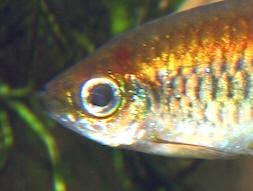 |
Extremely thin tetra - is she diseased?
9/5/08 Dear WetWebMedia Associate- <Ave,> I owe a nice
35 gallon freshwater tank with not that many fish (only 12, among them
8 tetras, 3 albino Corys, and 1 Pleco) but with plenty of aquatic
plants. In general, I do not have any problems in / with the tank, the
water is fine, the fish are healthy. I am a big fan of Bob Fenner's
"natural" treatment of water so the weekly changes of 1/3 of
my tank's water are a commonplace. <Sounds good.> I noticed
that one of my tetra fish is 1/3 of the size of other tetras. Indeed,
from the beginning it was smaller than the rest of the group. But, the
way I see it now - it is way too thin. It's fins are huge, its eyes
and head looks unnaturally big. This resembles me the pictures of a
starving human-being. <Ah, yes, does happen. It may be genetic, a
developmental problem, or physical damage such as damage to the jaws.
Could conceivably be a parasite; live Tubifex worms especially can
cause problems in this way. What kind of tetra are we talking about
here? My gut feeling is that this is simply a "runt" and
there's not very much you can do about it.> I was observing that
fish eating habits and noticed that it tries to eat but whatever it
takes to its mouth, it "puffs" back. Seeing this now, I am
afraid that my fish is dying from starvation :--(( I offer my fish a
variety of foods - krill, shrimp, Tubifex worms, blood warms, and all
kinds of flakes. But everything is dried - no "life" or
frozen food. <Good.> I mix the food before supplying. Also, I
feed them once a day, in the morning. The rest of the fish look big
:--) not to say "fat." This little tetra is the only one that
wants to eat but it cannot :--( <Could be damaged in some way, or
with a blockage caused by a tumour or cyst. With very small fish
there's not a lot you can do. Force-feeding such animals tends to
cause more damage.> I noticed that this tetra when it gets a piece
of food, holds to it firmly and swims around with it. But, it does not
eat it. Other fish bite everything and try to get as much as they can.
<Does sound like physical damage. You could try offering some
Liquifry (that's food sold for feeding baby fish). This is softer
and easier to slurp. Alternatively finely powdered flake food or hard
boiled egg yolk (sparingly!) can be offered. See if it is able to eat
these foods.> Do you know what is going on with my fish? I look over
its body - there are no signs of parasites or any outside diseases. The
only scary think is its extremely thin look. Is there anything I can do
for my fish? How can I help it? <Not sure you can.> Please, let
me know. Thank you very much for your help. Anna <Sorry to say, but
I suspect the outlook for this fish is grim. If the fish is big enough
to manhandle, then a plastic pipette to squirt in some minced prawn or
flake food suspension can work. But for that the fish needs to be above
a certain size, something about the size of an adult Platy. Anything
smaller would be too easily damaged. Putting the fish in a floating
breeding trap might offer some respite from competition, and you could
see if finely powdered or liquid food was accepted. But my gut feeling
is that nothing will help, and this fish will, eventually, die. I
suppose you could treat with an anti-helminth medication (e.g. Prazi
Pro) but the problem seems to be eating food, not digesting it, so I
don't think gut parasites are the issue. Sorry can't offer
better news, Neale.> Re: Extremely thin tetra - is she
disease? (RMF, thoughts?)<<Mmm, nope. RMF>> 9/5/08
Thank you very much for letting me know, Neale. I will try the liquid
food solution; hopefully my fish will get better. Anna <Fingers
crossed! Do hope this works out, and good luck! Neale.>
Neon Tetra with Ich and Pop/Cloudy eyes 8/30/08
<Ave,>
I have a neon tetra with 1-2 spots of Ich and pop and cloudy eyes.
<Treat promptly for Whitespot and Finrot/Fungus. Here in England
I'd be using eSHa 2000 and eSHa EXIT, medications for these
complaints that are safe to use together. In your country the range of
options may be different.>
I can also see white extended patches on his body.
<Well, if this is Neon Tetra Disease (Pleistophora) there isn't
much you can do, but a combination Finrot/Fungus medication like eSHa
2000 would be if something less else.>
The fish is pretty strong, eats normally, swims normally and does not
rub against rocks or plants. I isolated the fish in a hospital tank,
but I'm wondering how I should treat it. I bought Melafix and a
remedy for Ich,
<Melafix... largely useless.>
but I'm not sure which one I should use first. I'm also
planning to buy food with antibiotics so that I can treat the
intestines too. What do you suggest?
Thank you,
Giuseppe
<Not a big fan of randomly treating for internal parasites unless
there's evidence the fish is genuinely sick from them, and
that's very difficult to judge. Antibiotics obviously have ZERO
effect on the internal parasites that aren't bacteria, such as
Pleistophora (a protozoan) and Camallanus (a helminth) so again, you
need to know what you're dealing with rather than randomly pulling
stuff from the shelves and hoping for the best. Cheers,
Neale.>
| Glowlight tetras with constipation? 8/9/08
Dear crew, <Evan> I was looking at my aquarium tonight when I
noticed 3 of my Glowlight Tetras (Hemigrammus erythrozonus) were
displaying the same symptom. All three had some sort of stringy
clear/white excretion hanging from their anuses. I'm thinking
it could be constipation but worried it could be internal
infection/parasites. <or just...> I have never had this
problem with my Tetras before. There are 7 in a 10G tank
(parameters NH3=0, N02=0, NO3<5, pH=8.0, <Mmm, this is too
high... I'd "fix" in the change-out water ahead of
use> GH ~ 6, KH ~ 6, I change 30% water every 5-7 days).
<Great> I feed TetraMin tropical flakes, freeze-dried
bloodworms, occasionally sushi Nori. 6 days ago I added 5 Red
Cherry Shrimp to the tank. 2 days ago I added some blanched cabbage
to the tank for the shrimp to munch on. Last night I put some
pantyhose (stockings) material around the intake of my power filter
so any baby shrimp wouldn't get sucked into the filter. Could
chemicals from the pantyhose cause this sort of reaction? <Mmm,
not likely> Could the cabbage have done something to their
bowels? <Yes> All of the fish have good color and energy,
they have been eating well and otherwise show no symptoms of
disease. Should I take any action or just wait and see?
<Definitely the latter... Very easy in such a small volume, with
the shrimp present, to induce troubles> I have included a couple
pictures that tries to show the problem, they are a little blurry.
<These are excellent images!> Thank you for your help. Evan
<Bob Fenner, would just be patient here> |
|
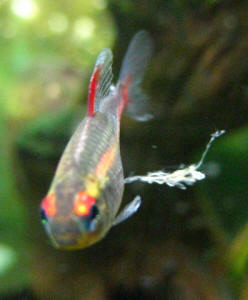
|
Tetras (Neons & cardinals) dying one by one in the dark
in a planted aq. 8/7/08 I hope you can help. Please forgive the
length, but I wanted to give you all the info I could think of.
<OK.> 30g L, been up for about 8 weeks (cycled with seed filter
from friends established tank), custom hood with AHsupply 96w CF bulb
(3.2W/gal), eco-complete substrate mixed with fine gravel. Fluval 205
filter. Stealth 100W heater. <All sounds good.> Tank has the
following plants (most of which are thriving): Cabomba (2 bunches of 5
stems each), Moneywort (4 bunches of 3 stems each), Melon Sword, Chain
sword (just a baby), Microsword (2sq in patch), Ruffle plant, Wisteria
(just finally establishing its fine submerged leaves - 1 bunch of 3-4
stems), Broad Ludwigia (1 bunch of 3-4 stems), small Java fern, small
Anubias nana, and a large bunch (about 15-20 long stems) of Anacharis
(from a friends established tank). Sounds crowded, but you'd be
surprised how open it really still is. <At least some get pretty big
-- Echinodorus osiris for example will quickly take over a 30 gallon
tank if it thrives; mature plants can be 50 cm tall and 30 cm across!
Echinodorus martii likewise.> To this there's the following
fish: 5 spotted Corys, 6 Otos, 3 "mystery" snails, 6 zebra
Danios, and originally 8 each Neons and cardinal tetras. <Right,
well one issue here will be temperature. To wit, Neons prefer cool
water, 20-24 degrees C; Cardinals need warm water, 25-28 C. There's
no "happy medium" at which both can be expected to do
perfectly well. Corydoras, Otocinclus and Danios are also cool-tropical
fish, and will thrive at 20-24 C (I'd go for 22 C). But that's
too low for the Cardinals. So one way or another, at least some fish
are going to be heat or cold stressed.> The light is on a timer to
cycle 6 hours on in the morning, followed by a 3 hour off break mid
afternoon, then another 6 hrs on in the evening. Then off for the
remaining 9hrs overnight. <OK.> All was well, the plants are
thriving, the fish too. <Good.> Then I added the Anacharis about
2 weeks ago. Suddenly I'm missing cardinals and Neons overnight,
just 1 or 2. at a time. Never noticed any trouble with the
actions/attitudes of the tank mates, everyone pretty much sticks to
their schools. But the losses continued. Everyone looked fine when the
lights are on... healthy, active, feeding. It was great. Well it's
a great mystery alright. <Well, Neons and to a lesser extent
Cardinals can be plagued with "Neon Tetra Disease" and will
drop off one by one until the cycle of infection is broken. But it is
also possible the new plants brought in a predator, such as a Dragonfly
nymph.> I finally started watching closer at night and I found that
after the lights been off for about 90 minutes (+/- 15 minutes) I
notice a gradual and frightening change. Both the cardinals and Neons
lose nearly all coloration going nearly white/clear. <Quite
normal.> Then one or two of them start going bonkers and lose their
equilibrium swimming upside down, backwards and on their sides,
barrel-rolls, tumbling end-over-end, etc., then death. <That is
odd.> Turn the lights back on and gradually (within 20-40 minutes)
all coloration has returned and activity resumes normally. <Ah, now,
this is curious. Have you checked how pH is affected by photosynthesis?
When plants photosynthesise they remove CO2 from the water, allowing
the pH to rise. When they stop, CO2 accumulates and pH goes down.
Alternatively, some (but only the minority) can perform "biogenic
decalcification", and I believe Anacharis is one of them. What
this means is that they remove carbonate and bicarbonate from the water
as the source of carbon for photosynthesis instead of CO2. This is why
these plants prefer hard water. Anyway, in the process the water loses
its carbonate hardness and consequently its pH buffering capacity. The
net result will be that pH will drop while these plants are
photosynthesising, and the water pH will also become less stable with
regard to other pH altering processes.> My water parameters have
been rock solid since the beginning: Nitrite 0; Ammonia 0; Nitrate
"nearly" 0; kH 5deg; GH 12deg; pH 7.6; chlor. 0. I've
even tested right before and after a light cycle and saw no appreciable
difference. Temp stays between 78.5 and 80.5F. <Do check the pH and
carbonate hardness through the day to test my hypotheses above.> My
thought were CO2 poisoning - but the zero change to pH leads me to
believe the CO2 isn't reaching toxic levels. Second thought - The
plants are using up all the available O2 (I'm not aerating) at
night thereby starving the smaller, more sensitive tetras. So I added a
small airstone to the corner of the tank and set a small air pump to
kick on when the lights go out (my timer has day/night outlets). It
didn't seem to help. <Leave CO2 off for a few days and see what
happens. Won't harm the plants.> Last Saturday night was the
worst, within 2-1/2 hours three tetras gone (down to 6 now, 2 cardinals
& 4 Neons left), and all the fish (except the 5 Corys, 2 largest
Danios, and 3 largest Otos) were pale. Even with nighttime aeration.
<Hmm...> So as a stopgap measure I retooled the timer to cycle
the light and dark to 3 hrs light, 2 hrs dark ('round the clock).
Two nights of success now with no casualties... but even though there
is the requisite "amount" of light and dark I cannot imagine
the rapid time cycles are any good for either the fish or plants
long-term. <It isn't good for the plants; they need a certain
length of time simply too start photosynthesising, and 3 hours
won't be enough.> My next attempt will be to get a larger air
pump and drive an 18" bubble wand across the back of the tank
rather than the small airstone driven by the smaller air pump. I know
this will drive out more CO2 to the detriment of the plants (though
probably not too much), but it should eliminate the worry of CO2
poisoning, and should add O2 in the dark for the plants and fish to
(hopefully) share. Also, I'll be raising the filter spout up closer
to the surface to provide a little more surface agitation (currently
its about 2in below with no agitation). <Not sure this is the
issue.> Finally, since this all started after adding the fastest
grower in the largest number/mass plant-wise (the Anacharis). It's
possible that plant addition might've pushed the balance over the
edge with respect to CO2 and O2 respiration. So I'll be pulling
that out and trimming it back to a more manageable (2-3 bunches of 4-5
"short" stems each) size. <Hmm...> Hopefully then I can
gradually return to slowly extending the light/dark cycles to a more
natural rhythm and keep my fish healthy and my plants growing. Any
thoughts? other suggestions? etc? Anything I missed? Mark <Cheers,
Neale.>
Ick/Whitespot 7/22/08 Hi Guys, I added five new baby
neon tetra's to my tank recently - it seems the neon's have all
developed Ick/Whitespot. I already had 6 Neon's 2 guppies and a
Sailfin Molly - these all appear to be fine. <So far at least...
http://www.wetwebmedia.com/FWSubWebIndex/mollies.htm Do review the
needs of Mollies, and also be warned Neons may nip the fins of fancy
male Guppies.> I have read your articles regarding ICK and just
wanted to confirm your recommendation for best way to treat.
<Promptly!> I was just going to buy meds and treat the tank with
meds and regular water changes. However from reading through your site
would you recommend increasing temperature and treating with Salt
instead? <Makes no odds either way. I tend to use commercial
medications such as eSHa EXIT (a brand I find works well even with
sensitive species like puffers) because it's easier. But if you
want to use salt/temperature, go ahead.> I have added salt before
but never with the neon's only with mollies/guppies can my
neon's tolerate salt? also my temp is at 80f already is it safe to
increase the temp further? <Neons should tolerate the very low salt
concentration required, particularly if you build up the salinity
across a few days. As for raising the temperature, I wouldn't.
Temperature is about speeding up the life cycle of the parasite; in
itself it isn't a "treatment" as such. The idea is that
the salt only kills the free living parasite, so the sooner that phase
begins, the better.> Thanks in advance Scott <Cheers,
Neale.>
How to keep bacteria alive in a fishless tank?
Pristella maxillaris; health (Bob, second opinion?) Mmm, nope.
RMF 7/19/08 Hello Neale, <Hello Giuseppe,> hope all is
well for you. One of my Pristella maxillaris is in distress showing a
dark area in the intestines at the bladder level. I always noticed a
small dark area in the same place in that fish, but now the dark area
is bigger and the fish tends to hide in a cave during the day, swimming
in circles almost horizontally. The Pristella doesn't eat almost
anything at this point. When I turn the lights off it gets out of the
cave and swims with the other fish. Is there any medicine you would
recommend? <This isn't something I recognise, I'm afraid.
X-ray Tetras are usually very robust but they are (I believe) wild
caught, so it is possible this one has an intestinal parasite of some
kind, and that's what you're seeing in these famously
transparent little fish. Because internal parasites usually have very
complex life cycles, the risk to your other fish is very small.
(Normally the small fish is eaten by a predator, like a bird, and then
the parasite leaves the bird to infest more fish somewhere else via the
bird's droppings.) If the fish is showing no signs of getting
better and all the signs of simply getting worse every day, I'd
make a judgment on its quality of life. If it was having a bad life
away from the school and generally not doing fun tetra things, I'd
painlessly destroy it. Small fish are difficult to treat when infected
with anything other than light cases of external
parasites/infections.> Thanks, Giuseppe <Cheers,
Neale.>
| Cardinal with
blister/worm? -05/07/08 Hello WWM Crew! First, I have to
thank you for the invaluable resource that you provide to all
aquarists. Your website is brilliant: a veritable mine of
information! That being said, I (of course) have a problem.
<Thanks for the kind words.> One of my cardinal tetras has me
stumped. At first, I thought he/she had mechanical damage from
running into something in their habitat. Later, a sizable white
spot developed inside of a large, clear blister. Additionally, on
this individual only, a large swatch of black has developed beneath
the eyes bilaterally, stretching from the mouth towards his/her
gills. The black "stripe" lies beneath the iridescent
blue scales that cover the cardinals body. For the time being (and
since the "blister" started to develop some time ago) the
cardinal is acting entirely normal, schooling with the 29 others,
eating extremely well, full cardinal colour, no scratching or
abnormal behaviour. A second cardinal has begun to show the
lighter/clear patch of discolouration that preceded the
"blister." <Ah, given the "syndrome" is
spreading, I'm obviously thinking about Pleistophora as a
possible cause. Whilst Cardinals do not seem quite as susceptible
as Neons, they can still catch the so-called "Neon Tetra
Disease". There's no known cure, beyond breaking the cycle
of infection, which seems to be sick/dead fish releasing infective
stages that get into healthy fish. Isolating symptomatic fish is
the preferred first step.> Tank specs: ammonia, nitrite, 0.
Nitrate, less than 5, more than 0. Soft water, pH 6.8, mixed
treated tap and RO. Fluorite substrate, heavily planted. Tankmates:
30 cardinals (two symptomatic), four M. altispinosus
(asymptomatic), one SAE (asymptomatic). The tank has been fully
cycled for about 6 months (fishlessly, so much easier! Why
doesn't everyone do it this way?). The tank is kept at 82
degrees F. Partial water changes are done at least weekly (often
times more often there is still sediment on all of the plants from
the Fluorite!) and the gravel is vacuumed each time (around the
plants). <All sounds ideal for tetras.> I found a reference
on WWM to worms growing in blisters on a Raphael Cat. Is this one
and the same? <Blisters can of course be caused by a variety of
things. People get blisters from things as diverse as badly fitting
shoes and Bubonic plague. So one should be very careful about
assigning causes to just one symptom of this type. What's more
specific to Pleistophora is changes in colouration, loss of
appetite, shyness, and then eventually death. Infected fish,
particularly species other than Neons, can last for many weeks even
months before death.> I found the reference here:
http://www.wetwebmedia.com/FWSubWebindex/catfshdisfaqs.htm .
However, the same individual got two different answers from two
different experts (you guys really are): "This is likely some
sort of "worm" parasite (more likely a digenean
trematode/fluke but maybe a nematode) The Paragon might help...
there are other vermicides... Levamisole, Fenbendazole,
Piperazine... that might be tried" and "The blisters are
really bacterial infections eating away the flesh of the fish.
Treat with Nitrofuranace after you do a 30% water change and
serviced the filter." <Blisters can indeed be caused by
both these things. Unless you're a microbiologist, it is really
impossible to know what the problem is. So the best you can do is
run through the likely causes one at a time, trying different
treatments.> There was also a reference to Dieter
Untergasser's "Handbook of Fish Diseases":
"There is one treatment method suggested in there that sounds
like it should work (method C6)." I am afraid that I do not
have this book, as I have never had any trouble with disease in any
of my tanks (well, I rehomed African Cichlids for someone else that
had been horribly abused, but that required nothing more than
better husbandry and a larger tank). I checked local libraries with
no success. I will purchase it now, but I'm afraid it will be a
couple weeks to arrive. May I enquire as to this "method
C6"? <No idea I'm afraid. In any case, with very small
fish, the fish often doesn't last long enough for the treatment
to work. It's simply a size issue. So while I'd certainly
consider isolating and treating infected fish as best as I could,
in this case if it *does* seem to be "catchy", I'd
perhaps painlessly destroy both fish to stop the problem
spreading.> If this is what is mal-affecting my cardinal(s), how
should I treat? Should I treat everyone in situ or should I remove
the affected individuals to the hospital tank? Do I need to tear
down the tank to stop everyone getting infected if this is a
parasite? Would they best be treated orally or as a bath? If I have
to treat in situ, is there a medication that is plant safe, or do I
have to remove the plants? I have attached a photograph of the
cardinal (and learned that cardinals are camera shy, and move
fast!) that shows the blister, white spot, and black under his/her
eyes. I just noticed that the photo makes the cardinal look like it
has Popeye, but I can assure you that it is only a trick of the
light. <Isolate the infected fish for sure; perhaps maintain
them for 2-3 weeks simply by providing good food and water and see
what happens. Treat with an antibiotic or antibacterial if you
want. It is possible the blister is nothing worse than a secondary
infection caused by (for example) fighting. In this case, you
should see some signs of improvement. But if the fish continue to
deteriorate, get back in touch. At worst, you've isolated the
potential source of infection and your other tetras should be fine.
I have long since given up keeping Neons because of the plethora of
mystery diseases they seem to come supplied with. Cardinals, though
more expensive, are tougher and better value in my experience. But
even so, you might be unlucky.> Sorry for the novel of an email,
but I wanted to provide you with all of the information I could.
Thank you for all of your help, and the excellent resource you have
compiled for all of us (it is becoming harder and harder to resist
that reef tank). <So they tell me.> To you and yours, a
wonderful day and weekend. Thanks, <Cheers,
Neale.> |
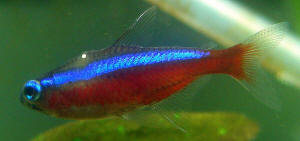 |
Re: FW Cardinal with blister/worm?
05/08/08 Hello Neale,
Thank you for your advice on my cardinal issue. I have isolated
him/her in a separate tank, and am working on catching the second.
I hadn't even thought of NTD! Urg! The possibility didn't
even cross my mind, since the fish is just as active as the rest of
the school, and still the first to food. <Which all sounds
positive, so fingers crossed the blisters heal by themselves.>
There is also no white necrotic tissue present- only a clear
blister (still with regular, bright colouration beneath, despite
how the picture appears), with an Ich like spot inside.
<Odd.> But...alarm bells ringing! When I took the cardinal
out of the tank, I noticed that it does have a "lumpy"
appearance. I hadn't noticed, because it is so subtle that you
can't see it except when looking at the cardinal from above.
<Well, keep an eye on things. Do provide the isolated fish with
shade and good clean water so it isn't too unhappy.> As far
as an anti-parasitic, do you have a recommendation that may work?
<Wish there was. So far as I know, nothing works reliably, or
even half the time.> I figure that if it is NTD, an
anti-parasitic won't do any more harm. I would rather not
sacrifice the fish if I do not have to, but in the event that they
do begin to suffer, I will certainly break out the microscope.
<I certainly hope the boffins at the "fish medication"
labs come up with something for Pleistophora; it's a real
plague and so depressing to watch. But breaking the cycle of
infection/re-infection is essential, which is what you've
done.> Thanks again, Tianna <Good luck, and keep us posted.
Neale.>
Re: Cardinal with
blister/worm? 5/10/08 Hello again Neale, I hope you are
enjoying your weekend! <Indeed I am! A lovely summery sort of
day here in England.> I think the mystery of the
white-sphere-filled-blisters on the cardinals has been solved. I
went to perform a water change on the hospital tank, and ARGH! What
appeared to be nematodes, of all different lengths, free swimming
in the tank. The white spot (which, I guess, is a mass of
subcutaneous parasites) in one of the cardinals had shrunk
considerably. <Never seen this, or even heard of it. Sounds
quite nasty. In any case, I'd immediately use some sort of
antibacterial/antibiotic to prevent secondary infections caused by
the burst cyst. An anti-helminth drug such as Prazi Pro should deal
with the nematodes. But that said, most worms have complex life
cycles that can't be completed under aquarium conditions (for
example, they need to go through a bird or snail before they can
back into a fish). So provided there were no secondary infections
and the Cardinal otherwise recovers, I'd actually be cautiously
optimistic.> This brings up another question that I will beg
your help with. <Indeed?> Since removing the two symptomatic
cardinals from the display tank, the "mystery illness"
had gone wild. Nearly half of the cardinals are now showing
symptoms. Clearly, there are nematodes in the tank that I can
neither see, nor remove. Would it be more beneficial to just treat
the entire display tank, and stop torturing the poor fish in a
"naked", uncycled hospital tank (especially if there are
parasites living in the display that will simply reinfect the fish
again)? <In an uncycled tank, you can use Zeolite to remove the
ammonia directly, and that's cost effective and reliable with
very small fish like Cardinals.> As my hospital tank is only 10
gal, I cannot realistically move all 30 cardinals plus the other
inhabitants to tear down the display to disinfect. I could be
wrong, but I think this would do more harm than good.
<Agreed.> Before the "big break" in this mystery, I
had purchased some of Seachem's Cupramine as a shot in the
dark. Would this be effective against the subcutaneous nematodes,
or would I be better served by exchanging it for something like
Praziquantel (if I can find it)? <Cupramine is certainly worth a
shot before trying anything else.> I always quarantine new
livestock, so seeing this now, after several months in the tank and
having been quarantined for a month prior to moving to this display
is mind numbing. I guess nothing is fool-proof! <Quite. As I
say, this disease is something I've never encountered. Possibly
Bob Fenner can offer more advice.><<Sorry to say, RMF is
out traveling and without sufficient internet access. -S.M.>>
Thank you so very much for all of your help (both on this mystery,
and the rest of this website!) <We appreciate your kind
words.> Have a great weekend, Tianna <Enjoy your weekend,
too. Cheers, Neale.> |
|
Question about spot on neon's mouth
3/26/08 Hi folks, I have a 10-gallon tank with a male Betta,
two neon tetras, a frog, and two algae eaters (the kind that stay
little, not sure of the name). They have all lived together for
several months. I clean the tank every other week, this usually
keeps the nitrates under 10. <Neons need to be in groups of 6
or more; in smaller groups they are stressed and unhappy. Please
note that fish couldn't care less about cute names. But what
they want is that you work around their biological needs. In the
case of Neons, that means company! Keeping them in too-small a
group is animal cruelty, however you choose to rationalise
it.> One of the Neons (Zippity) has a dark spot on his lower
lip. I recently had a problem with stringy algae and thought he
may have gotten some stuck on his mouth, but it hasn't come
off in a couple of days. He is able to eat. Should I put him in
the hospital tank in case he is sick and could pass it along to
the others? <No. It may simply be physical damage, in which
case it will heal. But do also be aware that things like Mouth
Fungus and Finrot can start as small blisters or sores. So as
ever, check your nitrite level before you do anything else.>
Also, should I be adding aquarium salt to the tank? <No.
Almost all fish diseases come down to water quality issues.
Almost none come down to not using salt!> I don't now
because I thought I read that Neons don't like salt, but did
read that it's good for disease prevention. <They
don't and it isn't.> Thank you! Alice <Cheers,
Neale.>
Re: question about spot on neon's mouth
Thank you for the advice. I will keep a close eye on the spot.
The two Neons are the last two from a school - I will make sure
they find a new home with other Neons as soon as he recovers.
<Very good. Good luck, Neale.>
|
Black Skirt Tetra Infection? Help! 2/29/08 Hi, I
have a 75 gallon well-established planted aquarium. The water
parameters are good and all the fish have been healthy for about 5
years now. Today I noticed that a black-skirt tetra is ill. It is
swimming abnormally - it's tail keeps falling and it makes brief
jolts forward to right himself. It looks stressed and on closer
inspection, it's torso area behind the operculum is red and
swollen. I will try to catch him and put him in a quarantine tank
tomorrow (not so easy in a planted aquarium) but what is wrong with
him? An infection? What is the best way to treat him? Are the other
fish in danger? Any help is appreciated. Thanks in advance. Kim
<Hello Kim. Difficult to say precisely what's happening here,
but it is certainly possible it has a bacterial infection of some sort.
I'd try something like Maracyn and see how things go. Do remember
to remove carbon from the filter, if you're using it. There are
some parasitic infections that cause the gills to inflame, most notably
Velvet, so do check for that (typically an off-white powder on the
body). But parasites don't normally get into tanks unless
you've added new fish. A photo might help pin things down. Cheers,
Neale.>
Dying Tetras 2/10/08 I have been reading through
your site and couldn't get a definite answer about my dying neon
tetras. So I was wondering about my neon tetras. I recently added 12
neon tetras to my old school of 5. So my school of 17 looked awesome,
but then I lost half of my school in a few days. <This seems to
happen quite often with Neons, and is one reason I have stopped keeping
them and don't recommend them. The quality of the mass produced
stock is fairly poor, and I suspect depends a lot on the use of
antibiotics. As soon as the fish arrive at the retailer, the
antibiotics wear off and the fish become increasingly sensitive to
opportunistic infections. This may be aggravated by the fact most
people keep Neons far too warm; in the wild their preferred temperature
range is 22-25 C, so compared with most other tropical fish, they need
something a little cooler. Failing in this regard may be stressing
them, leading to greater sensitivity to infections. Pleistophora
("Neon Tetra Disease") may also be prevalent. Although more
expensive, Cardinal tetras strike me as being better value.> The
aquarium is 55 gallons and my water parameters are fine except for pH
which may be a little high (7.6). <Well within their tolerances; if
acclimated, Neons have been know to do well at up to pH 8, 30 degrees
dH! Water quality and temperature are probably much more significant
issues.> Ammonia is 0ppm, nitrites are 0ppm, and nitrates are about
10-20ppm. My other fish in the aquarium are 1 dwarf Gourami, 2 blue
gouramis, 1 gold Gourami, 4 rainbow sharks. I also have 4 crayfish in
my tank, biggest on is about 3 inches long max. I am thinking maybe
they are catching my Neons and eating them. <Crayfish will indeed
eat small fish. Under no circumstances can crayfish be considered safe
additions to the community tank. While it is true crayfish are mostly
herbivores in the wild, in aquaria they can easily catch small fish.
Because Neons sleep close to the bottom of the tank, crayfishes could
easily catch and eat them.> I actually saw one snacking on a tetra
but not sure if he caught him. It might also explain why I only
actually see a few of my Neons dead while the other ones are just not
there. <Do check for signs of Pleistophora: Infected Neons lose
their colour, become shy, stay away from the group, and often hide
under plants. A few days later they're dead. Pleistophora is highly
contagious once the fish is moribund or dead because opening the body
cavity (e.g., as other fish eat the corpse) allows the parasites to
swim into the water. The only way to effective stop Pleistophora is to
remove infected fish on sight. They should be painlessly destroyed, as
there is no reliable cure, and certainly not once the disease because
sufficiently entrenched that you can tell the fish actually has it.>
They didn't jump out of the tank because I have a very tight
fitting canopy and there's no dried up tetras on the carpet. One
more thing too, if my pH is to high I was thinking about using water
from a local spring in which the pH is about 6.4, and no ammonia,
nitrite or nitrates. I would also run it through my deionization filter
to make sure any harmful things would be removed. I would greatly
appreciate your help and advise. <Mixing soft water with hard water
out the tap is fine. I do this by mixing rainwater with tap water to
good effect. Filtering the spring water or rainwater through carbon
will remove any nasties, but generally such water sources are at least
as safe for fish as tap water, perhaps more so. In any case, do always
remember to make water chemistry changes slowly, perhaps doing 25%
water changes each week until you reach the desired level of hardness
and acidity. Now, the crayfishes will not like soft water. They need to
be removed anyway, but just as a heads-up, in common with all
crustaceans, "the harder the better" in terms of healthcare.
Also remember that as hardness drops, so does pH stability, and many is
the aquarist who's softened the water in their tank only to
discover the pH suddenly drops between water changes. I'd not take
the hardness below 10 degrees dH. Remember: fish don't care about
pH, so long as its stable; what matters is *hardness*, as that directly
influences osmoregulation. Cheers, Neale.>
Black Tetra, hlth. 12/5/07 Hello, In my mothers
aquarium is a Black Tetra that has a small black growth below his lower
lip, he is listless and has a very faint red hue on it's body every
where except in the center. The fins are not red that I can see. He has
not eaten in a week that I have seen and he has a little bit of a clear
feces. I put in some furan 2 for 2 days, <... for what purpose?>
did a water change and added some more for 2 days and I see no
improvement. Can you help me. Thanks for any advice. thanks Sherri
<Could you send along a photo? I suspect this may be a genetic
issue... Many Gymnocorymbus have such difficulties nowadays... Do you
have other individuals of this species? What other livestock is
present? What re your water quality tests? Bob Fenner>
| Tetra illness question Oct 22, 2007 Crew,
<David> As I was feeding my son's fish yesterday, I
noticed one of his day Glo tetras was missing from the action. I
found it in the back of the tank and it looked awful. It was
bloated, opaque, had white spots on its sides, its face was
yellowish, and its tail fin was looking ragged. Any idea what is
wrong. <Mmm, yes... Likely the protozoan called
"Ich"... though could be some other... e.g.
Chilodonella...> Tank specifics 10 gallon tank 4 day Glo tetras
2 swordtails 1 male guppy The tank has fully cycled and has been
running for 5 months. The guppy and one tetra were recently added
(2 weeks ago), <Likely the vector/s here> but had gone
through a full 28 day quarantine with no signs of disease. <Oh!
Good for you> Tank also has a 15watt compact fluorescent bulb
and 3 plants as well as some algae eating shrimp who like spectrum
fish food and freeze-dried Tubifex worms a lot more than algae.
Water parameters Ammonia = 0 Nitrite = 0 Nitrate = ??? (can't
find my kit....Grrrr) <Maybe a factor, but not a definitive
one. That is, the infesting agent had to be borne from
somewhere> Temp = 80C General Hardness = 13 pH => 7.6 (top of
scale) Any ideas as to what might be happening? Thanks for you
help! David <I would treat as if this were Ich... unfortunately
the temperature cannot be manipulated upward... as the livebearers
don't tolerate this well. Please read:
http://www.wetwebmedia.com/FWSubWebIndex/fwich.htm and the linked
files above. Bob Fenner> |
|
|
|
HELP!!!! Massive Tetra deaths, need help
tonight! 10/23/07 Hey guys, <Hello,> sorry, I'm not
gonna spell check this, hopefully you can get back to me tonight,
and don't worry, I wont be offended if you don't post
this on the FAQ's.... <Hmm... not sure it works this
way.> I came home today to find 11 out of my school of 23
Glowlight tetras floating. they were all alive and fine as of 8
am this morning, and when I got home at 7 they were floating with
bulging bellies (some were gutted with their entrails hanging
out...) am at the north end of the san Diego fires right now (not
in the path, but we might be evacuated tonight) I'm not sure,
but I've heard of power outages in the area, so the tank
could have been un powered for quite some time... I did a 1/3
water change yesterday, the same way I always do, with the same
water treatments. I'm not sure what caused this, and I might
be evacuated tonight and unable to return for a day or so. please
let me know if there is anything I can do to protect the rest of
the tank residents when/if I am gone I'd appreciate it!
<Massive sudden deaths of fish can be caused by two different
things. The first is a crash in water quality. While filtration
is certainly one thing to check, the other is pH; tanks lacking
carbonate hardness are intrinsically "unstable". On top
of this, all tanks have a tendency to become acidic. So without a
carbonate hardness "reserve" in the water to mop up
those acidifying chemicals, it doesn't take much to tip a
tank over the edge into a sudden pH drop. I've seen tanks go
from pH 7 to below pH 6 within a couple of days. There's a
bit of a positive feedback too -- acid-hating plants, like
Vallisneria, will die off when the water becomes acidic, and as
they die, they decay and produce more organic acids, and that
speeds up the acidification process even further. This is why I
consider hard water a "blessing in disguise" despite
the fact it isn't ideal for many aquarium fish: for all its
shortcomings, hard, alkaline water is stable and resists water
chemistry changes. In the meantime, check for possible sources of
acidification: dead animals, rotting plants, etc. The second
thing that causes sudden fish deaths is toxins. Insecticide,
paint fumes, even tobacco fumes can cause real problems. Adding
non-aquarium safe objects to a tank, such as wood that's been
treated with pesticide, is also dangerous.> thanks, and be
safe Bob, I know you're right in the middle of this too.
<Anyway, if you are worried about possibly doing without power
for periods of time, then invest in some large lidded buckets. I
have 5 gallon buckets for this. Into each, put small groups of
fish. Partially fill with water, and replace the lids loosely so
air can get in. You can then move these to a warm part of the
house. Changing water in the buckets on a daily basis is
essential. Why do things this way? There reasons: water changes
will compensate for filtration; and secondly deaths of fish in
one bucket won't place any of the other buckets at risk, so
you can "micromanage" fatalities; and finally you
don't have to deal with dead/dying plants, snails or
whatever. You can easily replace those if you want, but should
the fish be in there when they die, the decay mops up oxygen and
stresses the fish. I've safely looked after fish this way for
days on end. Good luck, Neale>
Re: HELP!!!! Massive Tetra deaths, need help
tonight! 10/23/07 Hmmm, so it probably has something to do
with the peat I added to the filter about a week and a half ago
to help soften my very hard tap water. and then changing 12
gallons out of 36 with water not treated with peat? it looks like
I will have to just stick with stable, hard water. is it best to
just pull all of the peat out immediately or gradually? <This
sounds very likely to be the cause of the problem. Sudden changes
in hardness and pH, even from "bad" to "good"
values, can be lethal. I don't personally like adding peat to
aquaria as a softener. Peat is very unpredictable, and once the
water starts to soften, the pH can drop precipitously. Much
better to have the aquarium filled with chemically inert
materials (silica sand, gravel, etc) and then adjust the water
outside the tank, e.g., by mixing hard water with a certain
amount of rainwater or Reverse Osmosis (RO) softened water.
(Note: not water from a domestic water softener; while lacking in
carbonate, this has high levels of chloride, and simply isn't
"soft water" as aquarists mean it.) Once you have the
water you want, you can add this treated water to the tank in
increments, allowing the fish to slowly adjust to the new
conditions over a few days. Since there's no peat actually in
the tank, the pH and hardness in the tank should be basically
stable. For a standard community aquarium, you only need to
slightly soften hard water for good results. A pH around 7 and
hardness of 10 degrees dH and 5 degrees KH is just about perfect
for most community fish. There's no real benefit to softer,
more acidic conditions unless you're spawning exceptionally
sensitive fish such as Cardinal tetras, wild-caught Discus,
Chocolate gouramis, Rasboras, etc. For simple maintenance, the
above conditions are just fine. Indeed, some degree of
(carbonate) hardness is desirable because it inhibits the
background acidification that happens in all aquaria over time.
In the meantime, if your fish are alive and feeding, assume
they've adjusted, and make adjustments back up to your hard
water conditions by doing no more than 20% water changes per day.
Slowly but surely is the way to win the water chemistry game.
Either that, or don't play at all, and stick with your
baseline tap water conditions. Hope this helps, Neale.>
|
Tetra buoyancy 10/20/07 Dear Crew, <Hello
there! Andrea with you this afternoon.> Today after feeding my
Tetras I noticed that 1 of my Neons is floating toward the surface and
actively swimming to stay lower in the aquarium. I feed them tropical
flake food with the occasional freeze-dried bloodworms. <Sounds
delicious...> I hadn't noticed this behavior before today so my
theory is that he sucked in some air while eating. My water parameters
are as follows: Ammonia, Nitrite and Nitrate all 0, pH 7.8. <pH is a
little on the high side for Neons, but I wouldn't worry much. You
might add some driftwood as a decoration to the aquarium to soften the
water and bring it down. What does concern me is that the NitrAte is at
0. How long has the aquarium been up? Generally speaking, in the FW
world, we want to see a little nitrate, as it lets us know that the
tank isn't cycling. You should have something of a reading...5, 10,
15 ppm at least. What kind of test kits are you using? You might take a
sample to the local fish store and have them test it. Having zeros
across the board usually tells me that either the tank is brand
spanking new, or the test kits have gone bad.> I do a 40% water
change every 5 days. <Excellent regimen. Keep it up!> I don't
feel that it is a water quality issue, he's not listing around or
floating head up or down, but when he stops swimming he floats to the
surface. <Could be swim bladder dysfunction. It's not fatal,
just looks funny. Do a search on WWM for Swim Bladder for more
information.> Is there anything I can do or is this just a
"wait and see" type of thing? <If he is otherwise acting
healthy, stool looks normal, eating well, I'd just let him be.
Could be needing a good burp, could be the food is too fibrous, could
be swim bladder, could be something else. You might also try giving him
some mushed up blanched peas, in case he has a mild case of
constipation.> If it is air and he can't expel it, is that a
fatal condition? <No, the air will find a way out, one way or
another ;-). They are kind of like us in that way.> Also, how long
could it take for him to recover from this? <It really depends what
it is. If it is swim bladder damage, he might always be that way, and
it is just a quirk. If it is something else, it may pass, or it may
not. Worst case scenario is he has some problem that is affecting him
neurologically, such as a bacterial infection or parasite, but I'd
say the chances of that are relatively slim if he is eating and
otherwise well. Unless he shows other symptoms, I'd just call him
"Bobby" or "Floaty" or "Bouncy" or
something cute.> Thanks for your help, <Anytime!> Evan
<Andrea>
Re: Tetra buoyancy 10/29/07 Andrea, et al: <Hi
Evan, sorry for the delay. I have been out of town.> Thank you for
your help earlier. <Most welcome.> I wanted to update you on the
situation. After about 5 hours "Bob" seems to be back to
normal. <Glad to hear it.> I've only been keeping fish for 3
months, so when I saw his behavior I was surprised and alarmed. <It
happens to all of us. I've been keeping fish for years and years,
and still panic often. The same with my cats, frogs, lizards, toads,
nieces, nephews....call it human care instinct. =). It does ease up a
bit though.> And on the water tests: I'm using Jungle 5-in-1 and
Ammonia quick dip tests so the readings aren't super precise and
some of the tests have a large gap between values. On the Nitrate the
scale is 0 then 20 and it was definitely not 20. <The test strips
are good for getting a general feel of water conditions, but since you
are new to the hobby, I really suggest you get better test kits, with
liquid reagents. They really are an invaluable tool, especially early
in the hobby when you are just learning. The accuracy will help you
both learn and get a better feel for the conditions in your tank. API
makes good kits for freshwater that are reasonably priced and readily
available. You will want to have Ammonia, NitrIte, NitrAte, pH, kH, and
possibly Phosphate on hand. Salifert are also excellent, but more
expensive. It will serve you and your fish well to buy these and
familiarize yourself with them and their properties.> Again, thank
you all for your continuing help to all of us fish keeping novices and
experts. <Our pleasure.> -Evan
Mysterious repeated hatchet fish death
10/18/07 Hi, I hope you can have an answer. <We'll try.>
We have a 10 gallon tank with live plants, 3 platys and 3 hatchet fish.
two day after we introduced the hatchets, we found one of them dead.
Went to the store bought another one, next day dead. <Hatchets
aren't the easiest of fish. Which species are we talking about
here? There are two common types, Marble hatchets and Silver hatchets.
The Marble hatchet is Carnegiella strigata and it is small, mottled
brown, and quite delicate. It needs to be in groups of 6 or more to
have any chance of surviving. In ones and twos they just die. Not
recommended for your tank simply because they will feel trapped and get
stressed. When stressed, they jump at the glass lid or lamps, and
damage themselves. The Silver hatchet is Gasteropelecus sternicula. It
is larger, silver, with a blue horizontal band on the flanks. It is
basically hardy once settled in, but mortality during the first few
weeks can be very high. Given its adult size and high activity level,
not really an option for a 10 gallon tank.> The water is fine, Ph
between 7 and 7.2 temperature around 76-78. The community is fine and
the plant are thriving. We are feeding them with Spectrum the small
fish formula. We thought they might be jumping and hurting themselves
on the hood. <Happens.> The deaths happened during the day.
Thanks a lot Emanuela <Give up with Hatchets. Your tank is not
really suited to hatchets. While lovely fish (I keep Silver hatchets)
they are far from easy fish and best suited to expert fishkeepers or
aquarists prepared to set aside a large, quiet, thickly planted tank
where they can be kept in large numbers. If you want a surface dweller
of some type, look at something like Sparkling gouramis (Trichopsis
pumila) which are hardy, colourful, and do well in small tanks. Cheers,
Neale.>
Tetras with Ich 09/17/07 Dear crew, <<Hello,
Evan. Tom with you.>> I have a 10 gallon tank with 4 Glowlight
tetras and 3 neon tetras (I had 5 Neons originally but 2 died soon
after arriving home from the LFS). That raises a question; one of the
dead Neons was completely colorless when I found it. Could the cause of
death been NTD? <<Could be, Evan, but not very likely. Your other
Neon Tetras would have almost certainly contracted NTD by now and I
cant guarantee that the Glowlights wouldn't have been affected, as
well.>> If so: how long before any of my other fish exhibit
symptoms? Its been over 2 weeks and I haven't noticed the fish acting
sick. <<They have shown signs by now, Evan.>> Sorry for
the digression, back to my original question. <<No
problem.>> My tank has 0 Ammonia, 0 Nitrites and less than 20 ppm
Nitrates, temp 84F, pH 7.8. <<The pH levels are high for the
Neons in particular, Evan. Not necessarily a problem but might account
for some stress in these fish.>> 10 days ago I noticed the start
of Ich on a couple of the Glowlights and I started a treatment of
Aquarium Pharmaceuticals Super Ick Cure (Benzaldehyde Green and
Povidone/Colloid mixture). I have been treating at half dose but
following Doug Thamms recommendations found here:
http://fins.actwin.com/articles/disease/ick2.php. I have the
temperature at 84F and have performed 2 full administrations (5 ml.s
initial dose followed by 5mL more 48 hours later, followed by WC after
another 48 hours, and repeat) and I am in the middle of the 3rd
administration (10th day). I have done 50% WC in between each. The
treatment appeared to be working as the Glowlights had lost all of
their white spots. <<Glad to hear this. Nice description of your
regimen, by the way.>> Yesterday evening I noticed one of my
Neons with Ich spots on its tailfin and body. Is it normal for the Ich
to re-emerge during treatment? <<Not necessarily normal but
certainly possible. Difficult to determine the resistance the parasites
may have to the medication particularly at partial dosages.>>
Should I increase the dosage strength to 100% doses? <<I wouldn't
do this unless the problem looks like its getting the better of you and
the fish. As I alluded to earlier, your Neons prefer water that's
soft/acidic. Their preferred pH levels top out at about 7.0 which means
your water is much higher in pH than they really like. This alone can
contribute to diminished resistance to infestations such as Ich. Since
medications also lead to stress, the least effective dosage that you
can treat at will be far better in the long run.>> Should I just
continue my treatment until no spots are left? <<Yes.>>
Should I change medication to something like Quick Cure with Malachite
Green/Formaldehyde? <<Not unless the API medication just doesn't
do the job for you. The Malachite Green is highly effective but isn't
without problems of its own. Highly toxic and has been described as a
potential carcinogen. Not a treatment protocol to take lightly.>>
Besides the Ich, the fish seem healthy, they are active and eat well.
<<Very good signs, Evan.>> Thank you for your help. -Evan
<<Happy to be of assistance to you. Good luck to you.
Tom>>
Re: Ceramic media, air pumps... Actually Neon Tetra... dis.,
repro. 09/13/07 Hello Neale, <Hello Giuseppe,> as you know I
have 2 adult Neons in my tank. One of them has a larger abdomen
compared to the other one, so I assume I have a male and a female.
<Indeed. According to Baensch, the difference is also seen in the
shape of the blue line: on males it is straight, on females it is bent.
But I can't see any difference!> Now, I noticed that every 6-8
weeks the female becomes even larger and tends to eat much less and
spend most of the day in a quiet spot of the tank. This situation lasts
for about 10-15 days, after which her abdomen goes back to normal and
she starts eating normally. <Odd.> Do you think that she might
have eggs during the time she's more swollen and doesn't eat
much? <Sounds plausible enough. Do keep an eye out for Neon Tetra
Disease though: key symptoms are shyness, loss of appetite, and loss of
colour. Then they die! NTD is unfortunately very common.> If this is
the case I would be very fascinated in trying to breed the two Neons. I
read that it's pretty challenging, but that experience would be
extremely exciting for me, considering also that neon tetra is one of
my favorite fish. <I'm not sure it's "difficult"
per se, since these fish are bred in their millions on fish farms. The
problem for most aquarists is Neons only breed in very soft water. The
other big mistake people make with Neons is to keep them too warm;
while they aren't subtropical fish, 26C (79F) is the top of their
preferred thermal range, and for breeding they only want around 24C
(75F). When kept in hard, overly warm water they just won't spawn,
or if they do, the eggs become fungused.> Do you also have any good
web site where the breeding process for Neons is described in detail?
<Is there nothing here at WWM? Breeding Neons follows the same basic
pattern as most other tetras. Soft (<2 dH), acidic water (5-6); low
light levels (i.e., no lights, lots of shade); little to no water
movement; and benthic plants like Java moss to catch the eggs. Sunlight
can be a good spawning trigger. Eggs hatch in one day, free swimming
3-4 days later, when they take Artemia nauplii and the like. If
you're interested in fish breeding, there's an excellent book
by Chris Andrews called 'Fish Breeding'. It's my bible for
fish breeding. You can usually pick up used copies on Amazon and the
life for a dollar or two.> Thank you, Giuseppe <Good luck,
Neale>
Re: Ceramic media, air pumps... Actually Neon Tetra... dis.,
repro. 09/13/07 Neale, <Giuseppe,> I just bought that book. I
was thinking about what you said about the water conditions needed to
breed neon tetras and I have a couple of questions: 1 - Currently the
tank where they live has a temperature of 78F and PH at 7.0. If I setup
a second tank with lower temperature and acidic water, wouldn't the
Neons have a shock when I move them from one tank to the other one?
<Small water temperature changes don't harm freshwater fish;
indeed, they are often important spawning triggers. If you're
moving the fish from one tank to another, then doing the normal thing
of placing the fish in a bucket of "old" water and dribbling
in the "new" water over 30 minutes will not only adapt them
to the new water chemistry but the water temperature too. If you're
taking the fish across a dramatic water chemistry change, e.g., from
hard water to very soft water, you would probably be wise to fill the
breeding tank with hard water and then do soft water changes of around
20% each day until the water chemistry had changed over completely. Do
also remember that very acidic water doesn't support biological
filtration. You will need a small air-powered box filter filled with
ammonia-remover for such a tank. There's a good argument for not
filtering the tank while the parents are actually spawning and when the
eggs are sitting in the moss. Only start the filter back up once the
fry are free swimming.> 2 - If the Neons have to be kept in dark
conditions but with plants in the tank, wouldn't the plants die for
lack of light? <Yes, if you kept the lights off all the time. What
you're aiming for is to put the Neons in the tank for a week, and
once settled down, turn off the lights so the tank only gets natural
light, and once they've laid their eggs and the fry are free
swimming, turn the (subdued) lights back on. Regardless, the level of
lighting should be low, and the peat extract in the water will make it
quite murky. Java Moss will tolerate this regime fine. I have one tank
that simply receives natural light from a window and the Java Moss has
gone wild. Baby fish love the stuff, because it collects detritus and
micro-organisms that they can eat. There's obviously a balance
between having a nice rich microflora and a dirty tank though! Some
people skip plants and use synthetic mops of various types, home-made
(boiled dark-coloured yarn, teased into threads and then knotted) or
purchased. There are really many options.> 3 - How long does it
typically take from when the Neons are moved to the breeding tank to
when they actually spawn? <No idea, never done it myself. Typically
fish take a few days to settle into a spawning tank, but once there, if
they're mature enough to breed, they will do so almost at once. The
key thing is conditioning the female: lots of live foods so that she
gets nice and fat.> Thank you, <Cheers, Neale>
|
|


