|
FAQs on Colisa chuna, the Honey et al. Dwarf
Gourami
Related Articles:
Anabantoids/Gouramis &
Relatives, Genera Ctenopoma &
Microctenopoma, Betta splendens/Siamese
Fighting Fish,
Related FAQs: Dwarf
Gouramis, Dwarf Gourami
Identification, Dwarf Gourami
Behavior, Dwarf Gourami
Compatibility, Dwarf Gourami
Selection, Dwarf Gourami Systems,
Dwarf Gourami Feeding, Dwarf Gourami Disease, Dwarf Gourami Reproduction, & FAQs on:
Gouramis 1, Gouramis 2, Gourami Identification, Gourami Behavior, Gourami Compatibility, Gourami Selection, Gourami Systems, Gourami Feeding, Gourami Disease, Gourami Reproduction,
Betta splendens/Siamese
Fighting Fish,
|
|
honey gourami compatibility 1/16/16
Hello everyone,
<Hi Lauren>
Apologies if this question has been addressed elsewhere on your site; I did some
searches on Colisa fasciata and Colisa labiosa and could not find it.
<Not much on WWM re C. chuna; but I kept and even bred them many years back>
I am starting a new tank in a few months and I'm still in the research phase. I
would rather not stress or kill my fish by experimenting if I can help it, so I
am trying to figure out as much in advance as possible.
<Good move>
I am looking at getting a 46 gallon bowfront (although could go a little bigger
if there ends up being enough space; have to rearrange the furniture first). I
want to keep a colorful, heavily planted community tank, slightly on the
warmer/softer/more acidic side of neutral given the species I'm interested in. I
was thinking Cory cats, cardinal tetras, harlequin Rasboras, and some gouramis
for the top layer.
<Ok>
I really like the pretty little honey gouramis and I am wondering if it is
possible to keep a small female-heavy group of honeys (3 or 5) with a pair or
trio of one of the more peaceful larger gouramis.
<Yes; tis possible>
I have read that people have kept honeys successfully with pearls, and I do love
the pearls, but my husband would prefer something more flashy. Female pearls are
a hard sell on that front. Would a pair or M/F/F trio of the banded or
thick-lipped gouramis play nicely with the honeys in a 46-55 gallon tank?
<Very likely so>
I had planned on building the tank starting with the smallest fish and working
up slowly to the bigger ones, so I wouldn't add the (juvenile) bigger gouramis
until the honeys were at or near full-size. The final complication is that they
do not normally carry the banded or thick-lipped gouramis at my local store, so
I would most likely not have an opportunity to observe the fish interacting
before selecting them. Fortunately my local store takes "donations," so if
individuals don't get along I have an
option to easily rehome some.
It also looks like said local store may get their dwarf gouramis domestically -
<Super>
they have girls in with the boys, and their distributor is in Georgia, but they
said they could check into where the individual fish come from for me. They did
say they have not noticed problems with the dwarfs that they keep for a month or
so, but I don't think that's anything like proof that these are a good buy. I am
hesitant to try dwarfs given their reputation for being sickly as well as
aggressive, but there is a lot of conflicting information out there on both
points.
<Not very aggressive in the aggregate or individually, but absolutely terrible
health wise as far east imports>
Would a M/F pair of dwarfs work better with the honeys, being potentially more
aggressive than banded/thick-lipped but also closer to the same size?
<IF you can secure initially healthy specimens, yes>
Finally, if none of the bigger gouramis are recommended, would a larger
female-heavy group of the honeys be acceptable? They stock multiple color morphs
at my local store, so I could potentially have the red, gold, and natural
versions for variety.
<Again; most all of the sport mutations are imports....>
Thanks,
Lauren
<Please keep us abreast of your progress. Bob Fenner>
P.S. - are there particular species of Corydoras that you would recommend given
the companions and parameters I'm looking at? I never met a Cory cat I didn't
like.
<Me neither>
honey gourami compatibility /Neale's turn
1/19/16
Hello everyone,
Apologies if this question has been addressed elsewhere on your site; I did some
searches on Colisa fasciata and Colisa labiosa and could not find it.
I am starting a new tank in a few months and I'm still in the research phase. I
would rather not stress or kill my fish by experimenting if I can help it, so I
am trying to figure out as much in advance as possible.
I am looking at getting a 46 gallon bowfront (although could go a little bigger
if there ends up being enough space; have to rearrange the furniture first). I
want to keep a colorful, heavily planted community tank, slightly on the
warmer/softer/more acidic side of neutral given the species I'm interested in. I
was thinking Cory cats, cardinal tetras, harlequin Rasboras, and some gouramis
for the top layer.
<All sounds good, though the warmer water required by Cardinals and to some
degree gouramis will stress many Corydoras species. Exceptions are Corydoras
sterbai and any of the Brochis species, all of which will be fine at the 25-28
C/77-82 F temperature range you want for Cardinals.>
I really like the pretty little honey gouramis and I am wondering if it is
possible to keep a small female-heavy group of honeys (3 or 5) with a pair or
trio of one of the more peaceful larger gouramis.
<I would not mix radically different gourami species. Honeys are small, best
kept to themselves. Dwarfs, Thick-Lipped and Banded Gouramis are more or less
interchangeable and mix well. Finally, the bigger species like Pearls,
Moonlights, Three-Spots, Opalines, etc. are best kept among themselves (they mix
great together given space).>
I have read that people have kept honeys successfully with pearls, and I do love
the pearls, but my husband would prefer something more flashy. Female pearls are
a hard sell on that front. Would a pair or M/F/F trio of the banded or
thick-lipped gouramis play nicely with the honeys in a 46-55 gallon tank?
<Would not bank on it. The Thick-Lipped Gouramis are apt to be pushy, which is
fine with dissimilar fish like tetras and catfish, but a liability with much
smaller gourami species they'll see as rivals.>
I had planned on building the tank starting with the smallest fish and working
up slowly to the bigger ones, so I wouldn't add the (juvenile) bigger gouramis
until the honeys were at or near full-size. The final complication is that they
do not normally carry the banded or thick-lipped gouramis at my local store, so
I would most likely not have an opportunity to observe the fish interacting
before selecting them. Fortunately my local store takes "donations," so if
individuals don't get along I have an option to easily rehome some.
It also looks like said local store may get their dwarf gouramis domestically -
they have girls in with the boys, and their distributor is in Georgia, but they
said they could check into where the individual fish come from for me. They did
say they have not noticed problems with the dwarfs that they keep for a month or
so, but I don't think that's anything like proof that these are a good buy.
<Assuming price isn't wildly expensive, worth a flutter. While this species is
hopelessly tainted with viruses and other problems so far as the Asian farmed
fish go, domestic or hobbyist-bred Dwarf Gouramis can be good value.
Good specimens are outstanding aquarium fish, hence the demand for them that led
to the mass production in Singapore, etc.>
I am hesitant to try dwarfs given their reputation for being sickly as well as
aggressive, but there is a lot of conflicting information out there on both
points.
<Not aggressive by the standards of the family, though can cause trouble if kept
in ridiculously small tanks; 40, 50 gallons will provide so much space a
territorial male should be able to stake his claim without harming other fish.
Adding plenty of floating vegetation helps too.>
Would a M/F pair of dwarfs work better with the honeys, being potentially more
aggressive than banded/thick-lipped but also closer to the same size?
<See above; I don't recommend mixing Honeys with any other community gourami
species. They're well under half the mass of a Dwarf Gourami.>
Finally, if none of the bigger gouramis are recommended, would a larger
female-heavy group of the honeys be acceptable? They stock multiple color morphs
at my local store, so I could potentially have the red, gold, and natural
versions for variety.
<Sounds a good way forward. Allow say 10 gallons per male and you should be
laughing, even as pairs.>
Thanks,
Lauren
P.S. - are there particular species of Corydoras that you would recommend given
the companions and parameters I'm looking at? I never met a Cory cat I didn't
like.
<See above. Cheers, Neale.>
Re: honey gourami compatibility 1/29/16
Hello all,
Thanks for all your help. Another question for you: I got a test kit and
examined my tap water, and it looks like I've got a pH right around 7.5, even
after 24 hours resting (plus .5-1 ppm ammonia - thanks, local water authority).
Obviously this is not ideal cardinal/gourami territory!
<I would not be keeping demanding South American tetras in this, no. But there
are some very adaptable species out there. Emperor Tetras, Penguin Tetras and
X-Ray Tetras all spring to mind. Cherry Barbs are a good choice too if you have
medium hardness water.>
The ammonia I can handle, but the pH is a problem. Is it reasonable to try to
adjust the water down to 6.5 or even 7 with driftwood, peat, etc. in the tank?
<You shouldn't change pH directly. Fish don't feel pH. Within reason, they don't
care about it. What matters is the hardness, and if you have hard water (likely
so with a pH at or above 7.5) that rules out fish that need soft water. So
Cardinals, Chocolate Gouramis, Dwarf Rasboras, etc. would all be risky
propositions. That said, if you have a pH of 7.5 and you also
have soft water (say, below 10 degrees dH) then Cardinals can work.>
I don't mind some discoloration of the water if it means happy fish. I would
assume more frequent, smaller water changes would help keep the pH from swinging
around wildly, but is it even practicable to get water those fish will like
without finding another water source? I don't have access to rainwater,
unfortunately, as I live in a third-floor apartment in an urban area. The
rainwater is probably horribly polluted anyway. Distilled water or a home filter
would be the available alternatives.
<I would choose species adapted to your local water chemistry. If you have hard
water, then think about adaptable tetras as mentioned above, but also
livebearers and rainbowfish. Among the livebearers, things like Micropoecilia
parae and Limia nigrofasciata are much more worthwhile things to keep. Might
take some effort to track down, but being livebearers, you
only need a small starting colony to get yourself going! Even Endler's Guppies
are fairly widely traded now, and can make an excellent alternative to the
standard livebearers if you don't fancy them. Halfbeaks are another option,
though significantly more demanding.>
In the meantime, I suppose I'll start reading up on the smaller rainbowfish!
<Of which there are a fair few, but Melanotaenia praecox is an excellent (and
variable) default species. Threadfin Rainbowfish are more demanding so I'd skip
those. But Celebes Rainbows are nice and very pretty, with blue and yellow
colours that really stand out in the right aquarium.>
Thanks,
Lauren
<Welcome, Neale.>
Re: honey gourami compatibility
1/30/16
I ordered a test kit for hardness immediately after I did the PH test, but in
the meantime I located this on the water authority website:
http://www.fcwa.org/water/imar_files/2015/Distribution%20Site%20Representing%20Northern%20Treatment%20Facilities.pdf
If my attempts to interpret are correct, the water is on the hard side but not
extreme, is that right?
<Would seem so. But see what your test kits say.>
In that case, I am thinking of praecox and Celebes rainbowfish, cherry barbs,
emperor tetras, and paleatus Corys.
<Excellent choices, all of them.>
Maybe some cherry shrimp if they can keep out of the rainbows' way. Does that
seem practicable?
<All save the shrimps, which are unlikely to do well with fish bigger than they
are. I have kept and bred them with Ricefish, Dwarf Mosquitofish, that sort of
thing. With bigger fish they sort of fade away over time.>
Thanks for all your help! All the fish I am not killing with ignorance are I
would imagine grateful too.
- Lauren
<Cheers, Neale.>
Re: honey gourami compatibility 2/6/15
Hello all,
Test kit came back 10 GH and 6 KH. I think that's about what we were expecting,
yes?
<Certainly reasonable values for a general community tank.>
Also, do you have any opinions on silvertip tetras? I was thinking some more
yellow might complement the Celebes rainbowfish colors nicely but I've read
mixed things about their aggression/nippiness.
<Hardy fish, quite good with other barb/tetra-type things as well as small
catfish and loaches. They can be nippy though, primarily when kept in small
numbers (fewer than 8) and/or combined with very tempting targets (fancy Guppies
for example, or veil tail Angels). I would look at the X-Ray Tetra as an
alternative, Pristella maxillaris. There's a "gold" form as well as the standard
sort. Both are very peaceful and easy to keep.>
Thanks,
Lauren
<Cheers, Neale.>
Honey Gouramis turning gray?? - 1/25/13
Hi, I am a newbie to aquariums. I was trying to do research before
I purchase so I don't do anything stupid but this has me stumped. I have
a 46 gallon freshwater tank with a few platys, a Betta, 6 endless, and
two Honey Gouramis in it. I just purchased the Gouramis four days
ago. I got them from a tropical fish store that has a great
reputation. The fish were a
beautiful honey yellow but for the past two days they have a gray/black
coloration to the tops of their head, dorsal fin and fading onto the
body.
<Does happen. This species changes colours with mood, and when stressed,
especially if too cold or exposed to too much light, their colours won't
be "as seen on TV". Review the aquarium, fix things, and over a few days
they will recover their normal colours. Remember, females are basically
greyish with a dark longitudinal band, males yellow becoming
honey-orange with a black chest when spawning. Artificial versions exist
with different colours -- see Google for photos.>
They act fine, no rubbing on anything or loss of apatite. My tank
chemistry seems fine, with Ammonia and Nitrites at zero, Nitrates at 10,
pH at 7.2, and water reading as soft (75 ppm) on the strip. Do
they have velvet or is this just stress coloration?
<Latter, probably.>
I can't figure out how to attach video and can't get good pics of them.
Any thoughts would be appreciated. Your site has taught me so much
already, thanks!
<Hope this helps. Cheers, Neale.>
Gourami/Guppy Compatibility Fin Nip 9/6/12
Hi Neale, how are you? Hope all is well on your end. I have a 10
gal. tank with 6 Corydoras, 1 Honey Gourami (I believe
female) and 1 female Fancy Guppy. I acquired the Guppy in May as a
baby, and since she has grown into a very large, long and fat guppy.
I noticed what looks like a bite out of the Gourami's tail (I do not see
signs of infection, i.e. no redness, swelling, spots, seems to be acting
normal). I was observing the behavior of the Guppy and Gourami and
saw no signs of aggression. Does it seem plausible the Guppy
nipped the Gourami? I thought female Guppies were peaceful.
I read that at this juncture I should treat the tank for Finrot to head
off any possible infections; do you recommend this? I'm always
apprehensive about introducing medicine into the tank. If the
Guppy is the culprit, I guess I will have to separate the fish?
Parameters: Ammonia 0, Nitrite 0, Nitrate 10ppm. Thank you in
advance for your advice. -Lorie
<Hello Lorie. Thank you, yes, all good at my end. Anyway, it's pretty
rare for Guppies to be fin-nippers. They can be squabblers, but their
upward-turned mouths make it hard for them to take bites out of other
fish. I'm sure it happens very occasionally, but it isn't likely. In
general, occasional damage to the fins of fish is something you can turn
a blind eye to. It happens in the wild, and it happens in aquaria. Fish
brush past something jagged, or they fight, or there's some sort of
accident with a filter inlet perhaps. In good, clean water (meaning 0
ammonia and nitrite) then slight damage to fins clears up by itself with
no need for medicating.
What matters is persistent fin damage because that means serious
fighting, fin-nipping, or bacterial infection.
Cheers, Neale.>
Re: Gourami/Guppy Compatibility Fin Nip 9/6/12
Hi Neale; a little more information. There had been a spike in
Nitrates, 40ppm. Over the past 4 weeks, it has lowered to 10ppm,
as of the last testing on Thursday, 9/6/12. Also, as I observe
them eat right now, I am still seeing no signs of aggression. Not
sure if the guppy is involved at this point, but maybe I should treat
for Finrot? I am trying to identify
if the Gourami's bite mark in it's tail is edged with white, but I can't
tell. Thank you, Lorie
<I would not treat with Finrot medication unless the damage to the fin
is getting worse, the fin is cloudier than normal, or you see white or
pink gunk around the wound. Fins heal quickly in good water conditions
without any help from you. Your nitrate levels are low and not likely a
factor here. Cheers, Neale.>
Re: Gourami/Guppy Compatibility Fin Nip 9/6/12 9/9/12
Thanks a lot Neale. Much appreciated.  -Lorie
<Most welcome. Cheers, Neale.>
Urgent honey Gourami in trouble 8/12/12
Noticed it first thing this morning, my honey Gourami was having
difficulty swimming and looked a little fatter than usual. This evening
it was lying at the bottom of the tank, but still swimming to the
surface to breath.
<Not good.>
The water tests came back pretty good my water hardness is a little
higher than normal,
<Need the numbers here, not your interpretation. What is the water
chemistry? Honey Gouramis are poor choices for hard, alkaline water
conditions, and while this doesn't kill them overnight, it is a stress
factor that can shorten their lifespan.>
but I am due for a water change in a day or so and that usually adjusts
it accordingly.
<Always a good idea to do a substantial (25-50%) water change when fish
are "off colour". If the fish perks up, then the problem is most likely
environmental. Of course, you must ensure the new water has about the
same water chemistry and temperature as the aquarium normally has,
because a big change would be very stressful, potentially dangerous.>
I have move it to an isolation tank, it is just staying at the bottom
just on it's side…
<This isolation tank is of adequate size (8+ gallons) and heated and
equipped with a biological filter? If you answer "no" to any of these,
fix things; obviously moving a sick fish into an aquarium with WORSE
conditions than the main aquarium will simply make the fish sicker and
more likely do die.>
I have noticed that it is always the same side. It hasn't really eaten
all day either, I normally feed my tank in the morning and have my
lighting on rotation during the day, once a week they get blood worms,
and it was eating fine, again, until this morning.
<What size is this tank? What are the tankmates? Honey Gouramis are poor
community fish in the general sense because they're slightly delicate
and must have soft water; so while they do work fine with small, gentle
fish with similar requirements (such as Cardinal Tetras) they're bad
choices for use alongside rough-and-tumble species (like Tiger Barbs and
larger Gouramis) and species that need cool and/or hard water (such as
Danios or Guppies).>
I have treated the isolation tank with Myacin 2 for the bloating. Is
this all I should be doing?
<Do you mean Maracyn 2? This medication can work well, but I would use
alongside Epsom salt at a dose of 1 teaspoon per 5 to 10 gallons, whilst
also ensuring water temperature was relatively high, 28-30 C/82-86 F.
The prognosis isn't good to be honest, small fish in particular seem to
only become obviously bloated when serious damage is done, but treatment
is worth a shot.>
Thank you
Jasmine
<Most welcome, Neale.>
Re: Urgent honey Gourami in trouble 8/12/12
Hi Neale,
<Jasmine,>
The water chemistry is:
GH 30ppm
KH 0ppm
<Wow! That's extremely soft water. Is this plain tap water or something
else? Do you use water from a domestic water softener for example? These
latter create water with zero carbonate hardness (KH) but they add salt,
and this causes problems for many fish. If your water is simply very
soft, then how do you keep the pH steady?>
pH 7.0
NO2 0ppm
NO3 20ppm
The tank is a 22gal and gets a 50% water change every 2 weeks but the
color of the Gourami hasn't changed, it is still a really rich peach
color. There are 4 guppies, 2 neon tetras, 1 swordtail,
<Surprised the Guppies and Swordtail are happy…>
1 common Pleco, 4 platys.
<Too many fish… the Plec will need 55 gallons minimum, and realistically
75+ gallons given this beast will get to some 45 cm/18 inches within 2
years…>
The tank temperature is normally 80*F.
<Bit too warm for Neons and Swordtails; these are healthier kept around
22-24 C/72-75 F.>
The isolation tank is a 10 gal with a filter and heater... I will
increase the heater so that it is warmer than usual.
I will continue Maracyn 2 as instructed for 5 days, unless it doesn't
make it and add the Epsom salt. Are it's tank mates going to be okay? Or
should I dose the entire tank?
<Provided the hospital tank has a mature filter and heater, then by all
means treat in that tank… dropsy-type infections are rarely contagious,
usually caused by some problem/problems… environment, diet, wrong
temperature, inappropriate use of salt, etc.>
Thanks so much
Jasmine
<Cheers, Neale.>
Re: Urgent honey Gourami in trouble 8/12/12
Hi Neale,
<Jasmine,>
It's regular tap water and the pH is actually always steady at 7... I do
have pH plus on hand just incase, but it is still very new and unopened.
The guppies and the swordtail are extremely happy and breeding very,
very well.
<Truly surprising.>
My Pleco is only an inch and a half and has been so for 3 years, I was
told that she actually will never get any bigger, I was worried that I
stunted her growth, but the Pleco expert I contacted said she was
healthy and just small.
<Then cannot possibly be the Common Plec, Pterygoplichthys pardalis (or
similar). That fish always gets big, and quickly too! Are you sure this
isn't some sort of Otocinclus species?>
The isolation tank is used as my nursery tank usually so it is
established.
The Gourami is actually starting to swim better and looks a little
slimmer.
<Cool.>
Thank you
jasmine
<Welcome, Neale.>
Re: Urgent honey Gourami in troubled 8/12/12
Hi Neale,
I know this is way off topic from my original question... But I have
attached a picture of my little Pleco, she doesn't look like any from
the Otocinclus species. What species is she?
http://s114.photobucket.com/albums/n276/medieval_kitten/?action=view¤t=35ed341b.jpg
Thanks again
Jasmine
<Looks like an Ancistrus species to me. Why so small; cannot say. Should
get to about 10 cm/4 inches or so within a couple years. Nice fish.
Cheers, Neale.>
Flame Gourami lump inside stomach 7/2/12
Hi, we have lost two flame gourami's in the past week. The first
one started of listless, hiding behind the temperature control, was not
interested in eating and its belly was swollen. Next morning we found it
had died. A post-mortem revealed a 'stone' in its belly, blocking the
anus.
<Mmm, perhaps a tumor, cyst... biological in origin>
This morning the other one was found dead, though it looked ok
yesterday. It too had the same thing wrong with it, a 'stone' in its
belly right at the back near the anus. I have tried searching the web
for information but nothing came up matching my problem. Do you
have any idea what could have been wrong with them?
Ps. All the other fish (mollies, gold gourami, guppies, silver sharks,
clown loach etc) seem to be perfectly fine. Thanks, Cate.
<Well, this member of the genus Colisa has more than it's share of
troubles... Please peruse here:
http://www.wetwebmedia.com/FWSubWebIndex/AnabantoidPIX/dwfgdis4.htm
and the linked files in the series (above)... Yours could be in/directly
an issue of water quality change from (S.E. Asia) breeder to your local
conditions... perhaps a matter of pathogenic disease (were this a
commercial concern I would be suggesting treatment w/ a combo. of
anti-protozoal and anthelminthic compounds)... As you are an "end
consumer" w/ no further specimens, I would hold off on such. Likely your
other fishes are fine. Bob Fenner>
Re: Flame Gourami lump inside stomach 7/2/12
Thank you for this information. Have begun reading your links.
Nice to know the proper name of the fish also :-)
Cate
<Ah, welcome. BobF>
Trichogaster chuna Behavior 6/28/12
Dear Crew:
<Hey John>
First, the obligatory tank information. 20 gallon long (30" x 12" x
12"), 78 F, heavily planted with Rotala, Egeria Najas, Water Sprite, a
couple Hygrophila species, Sagittaria subulata, and various crypts.
NH3/4 0, NO2 0, NO3 5 ppm, dGH 6, dKH 8, and pH 7.8.
<A bit (too) high. I might mix in (more?) R.O. water here>
This has been a sometimes quarantine, sometimes plant grow-out tank for 6
months now. Nine days ago, we brought home five Trichogaster (Colisa?
<Old genus name,
http://www.fishbase.org/summary/Trichogaster-chuna.html> ) Chuna --
2 males, 3 females-- of the wild-type coloration from the LFS. They were
promptly acclimated and placed into the above mentioned tank for our
standard four week quarantine period.
Within 24 hours, both males were showing full breeding colors and had
begun building bubble nests in the floating Egeria
<Mmm, do check the species here: this is often another cool/cold water
species: Is this what you have?:
http://www.ecy.wa.gov/programs/wq/plants/weeds/egeria.html>
within about 4 inches of each
other. The normal courting ensued and we witnessed several "embraces"
over the next few days but never saw any eggs released. We didn't
witness much squabbling between the males, but one female was
particularly dominant and regularly chased the other two females
especially when they would approach the males. The only real aggression
seen from the males was when a female, apparently unwanted, would
venture too close to one of the male's "territory". The male would give
chase, the female would depart and that was that.
<Thank goodness (and you) for adequate room in this 20>
Two nights ago, however, the level of aggression between the females and
from the one male toward the females intensified. At one point, the male
had a female "cornered" and seemed to be doing his level best to take a
chunk out of her. We remedied the problem by removing the most
aggressive male and female to a nearby 20 gallon tall tank.
<Ahh! I wrote too soon>
It's been two days, and everyone is generally calmer now. There still
appears to be (mock?)
spawning activity with the three fish remaining in the 20 long, but
nothing out of the pair in the 20 tall (yet).
We honestly weren't intending to breed Gouramis, but the behavior was
certainly interesting to watch (at first). They are ultimately destined
for a 40 gallon display tank with Pristella and Glowlight tetras and a
single Bolivian Ram. We did quite a bit of online reading prior to our
purchase and believed this to be a particularly peaceful species of
Gourami, with the usual caveats about behavior changes during spawning.
<Yes>
What we didn't anticipate was the speed with which they'd begin to spawn
and the duration of said activity. At this point, it doesn't appear that
they will ever let up!
<Mmm, they may have been "juiced" by breeders (treated w/ gonadotropin
hormone/s; to raise colour)... and kept/raised as separated sexes...
"Primed" so to speak; to commence reproductive behavior. This will drop
off in time (weeks)>
So, did we get the male-to-female ratio wrong? QT tank too small? Were
we just mis/uninformed about their temperament? Does the spawning
behavior ever abate? Any chance of a change to a more easygoing
behavioral style in a bigger tank?
<Ah yes>
It's been fun, but the increased aggression wore thin pretty quickly for
us. Any advice would be most appreciated.
<Just time going by really>
And, of course, thanks for everything you have done / are doing for the
hobby. It's great to have a resource like this to turn to when you just
can't wade through the BS on the message boards any longer. :)
John
<Heeee! I never could. Thanks John. Bob Fenner>
Re: Trichogaster chuna Behavior 6/29/12
Bob:
<John>
Thanks for the input and prompt response. Regarding your query about the
Egeria, in my experience, you are correct that Egeria densa (aka Elodea,
Anacharis) doesn't fare well in warmer temps.
<Yes>
I've never had any luck with it above 75 F in my tanks. I tried Egeria
najas (aka "narrow leaf" Elodea, Anacharis) sourced via our LFS from
Florida Aquatic Nurseries a few months ago and it does very well at my
tank temps of 78 - 80 F. It works as a floater, grows just fine
anchored, and is quite prolific even in the absence of CO2 injection.
<Ahh, thank you for this input>
Back to the livestock, I specifically asked the LFS owner about the fact
that they were sexually dimorphic is his tank (though the males were not
as brightly colored as they eventually became), and he assured me that
they were not "juiced". Your point is well taken though considering that
the bulk of hobbyists, I suspect, are more attracted to the males than
the females.
<This is historically so>
For what it's worth, two days after the "separation", the males are as
feisty as they were before we split them up. I understand the male
behavior, and will wait it out for a few weeks and see if they calm down
on their own or after QT is up and they move to the larger tank.
<Good>
Can you comment at all on the aggression we were seeing between the
females? We have a half dozen of the "golden" -- and very mellow --
Trichogaster chuna in yet another 40 gallon long, but believe them all
to be female. This is my first experience with both sexes in a tank, and
my assumption is that the female-to-female aggression must be about
access to the males. Am I close?
<My guess (and this is all it is) would be the same. Many years back I
endeavored to breed, reproduce this species... and recall very little
female-female aggression, and post spawning, little attention males
paying to spent females.>
Thanks again.
John
<Cheers, BobF>
Mystery honey gourami deaths - would appreciate expert
advice 6/10/12
To the excellent crew at WWM,
Firstly, I am a big fan of your site and dedication to assisting other
aquarists. I'd like to give a big thank you to you all for your
dedicated service to the many fish keepers out there whom you selflessly
assist on a daily basis.
<Thanks for the kind words.>
I am an experienced aquarist myself (experience in fresh, planted and
basic LPS marine reef aquariums, member of the local club, several
forums etc), and also run my own maintenance business. I am also a
biologist by trade, and have an interest in fish pathology, to whit that
I am soon picking up my own microscope to perform necropsies myself (I
think I miss being in the lab).
<Real good.>
Among my various tanks I have a 10 gallon display tank in my study which
is heavily planted. It's been running 3 years. The stats:
Ammonia and nitrite are 0ppm, nitrates under 10ppm, pH 7.5 (no pH
chemicals), GH 6, KH 4. It is a constant 26 C. It is winter here
and cold at night, but the thermometer only shows a drop of 1-2 degrees
in the morning, which rapidly comes back up.
<All sounds fine.>
I use aquarium salt and a little bicarb to raise my GH & KH,
<Ah now, aquarium salt -- sodium chloride -- will neither raise nor
stabilise GH or KH. General hardness is primarily magnesium and calcium
salts, while carbonate hardness is primarily carbonate and
bicarbonate salts.
Sodium chloride falls into neither category.>
and use Prime at every water change. Everything is stable. Weekly
water changes of 30%. Daily dosed with Excel for carbon and every second
day a dose of Aquamaster plant food for nitrates and trace elements.
No algae and great plant growth.
<Good.>
Livestock are 5 cherry barbs, breeding colonies of RCS and CRS, and a
male honey gourami. All get fed with NLS and Hikari pellet food, and on
alternate days they get either thawed brine shrimp, Mysis shrimp,
bloodworms or live blackworms from my own culture. Once a week
they get cooked and skinned pea chunks to help with their digestion.
<Also good.>
The issue is with the honey gourami. Originally, I bought a yellow
variant from a LFS. It was well for a month. Then it got lethargic,
stopped eating, lay about in the leaves. It was put into my
quarantine tank and died after about 2-3 days. I bought two more
with the same effect. I put this down to possibly a mystery
Protozoal or other internal parasite infecting that stock. I went
to my (better) specialty LFS and they ordered honeys in just for
me. I got a lovely mature male with natural colour and he did well
for about 2 years, when he died of old age (just got pale over the
course of a few months, got a little slower, eventually just passed away
like old fish do).
<I see.>
As I am set on a honey as the 'feature' fish for this tank, i set out
for a new one (I'd get a Killie, but I worry it would eat my all
shrimp).
Again, I stuck with the good LFS, who had them in stock - though it was
the yellow variety again. They were still pretty and healthy
looking, and so I brought one home. He settled in straight away,
ate well and did well for a month, then died overnight. I did see
a bit of shrimp shell in his mouth the night before, so i thought he may
have choked on a shrimp.
<Unlikely, because of the way fish breathe. Choking really is something
particular to humans because of the position of our voice box as an
adaptation to speech. Most other animals can't choke, or it is at least
very rare; think about the way dogs wolf down their food!>
Water parameters were spot on and there was no other signs of illness in
him or any other livestock, so I bought a new one. Again, he was
great for a month, then just like the first lot, then mysteriously
stopped eating and started hiding over the course of a few days, go
pale, and passed away in my quarantine tank after laying on the bottom,
only occasionally swimming out to see me.
<I see.>
I am now becoming suspicious of this variety.
<I understand. One problem of course is the quality of these fish.
Farming techniques in Southeast Asia seem not to favour the smaller
Gouramis at all, and health problems are very common. You probably know
about the Dwarf Gourami Iridovirus already, but some of the other small
species, including the Honey Gourami, are less robust than they once
were.>
I talked to the staff at the store (who I know very well as I'm always
in there), and they have not had problems of complaints from other
buyers.
They quarantine all their fish and have found no issues either.
They are stumped. I am stumped.
Clutching at straws, I wonder if it could be an accumulated reaction to
plant alleochemicals in this tank. It is heavily planted and I
have heard of this from reading the Diana Walstad books, but given the
30% weekly water changes I doubt they would accumulate to dangerous
levels. I also figure that if anything is amiss, my CRS would be
the first to show it. As it is, they all are holding eggs and
grazing like they always do.
<Up to a point I agree, but my own Red Cherry Shrimps seem to thrive in
a small (30-odd litre) tank that doesn't seem to favour fish
particularly well, even hardy Ricefish. It has a filter that works in
bursts (something about the way it sucks in air over time) and the
heater is a bit flaky, and sometimes the water gets quite cold. The
Shrimps are breeding like mad, I have literally hundreds in there from a
starter group of about six bought a couple years back, and the Java Moss
forms massive clumps in between me cropping it back. But fish, well,
they don't do so well. My point is that yes, on paper Cherry Shrimps
should only thrive in conditions enjoyed by fish, but in practise, I
think the Shrimps can do well in conditions that fish won't tolerate
indefinitely.>
So, maybe something specific in this line? Genetics?
<Either. Can you source locally bred?>
A latent internal Protozoal parasite or virus brought on by stress of
being the only gourami in there?
<Unlikely.>
The cherry barbs have never shown any aggression the gouramis, they are
too busy chasing each other, and they are not that boisterous even then.
<Quite so; a lovely species, much underrated.>
So, gurus of WWM, any ideas to my mystery?
Thank you kindly, Lea
<Wish I could help more. Can you get a look at one of the good Gourami
books? Like Jorge Vierke's "Bettas Gouramis and Other Anabantoids
Labyrinth Fishes"? Do review the needs of this species; soft (1-2
degrees dH, ideally), slightly acidic water (pH 6-7) with a decent
amount of warmth (around 28-30 C). Keep water flow minimal; too much
current may stress the fish. Floating plants will be a real plus (Vierke
says a must!). What else?
Well, one thing about "delicate" labyrinth fish is that high pH values
seem to allow bacterial infections to become problematic. This is mostly
an issue with things like Liquorice Gouramis, Chocolate Gouramis and
Ctenops nobilis. In short, the opportunistic bacteria that cause
problems thrive at pH levels above 7, but these fish naturally occur in
water where the pH is below 6, so they don't have an immune system
evolved to deal with such bacteria (at least, not at the levels you find
in fish tanks). While I wouldn't lower the pH to below 6.5 without a
jolly good reason, you might want to think about softening and
acidifying the water a bit. Finally, deworming and treating for
intestinal Protozoans (as you would Discus) would be a very good idea.
Cheers, Neale.>
Re: Mystery honey gourami deaths - would appreciate expert
advice 6/10/12
Dear Neale,
<Lea,>
Thank you for the kind and fast response.
<No problem.>
Just to clarify, the aquarium salt I use is truly for aquariums, not
NaCl, but a mix of Mg, Ca and other trace salts made up by the specialty
LFS staff.
<My point still holds. If it's mostly sodium chloride, and it will be if
sold as "aquarium salt", it's unnecessary. The addition of sodium
chloride to a freshwater aquarium is at best pointless and at worst
stressful. Freshwater fish are freshwater fish are freshwater fish. If
you need to raise the pH and steady the hardness values above what you
have, then use general and carbonate hardness minerals -- which DOES NOT
include sodium chloride. I cannot stress this piece of basic science too
strongly. Sodium chloride does (virtually) nothing to pH and hardness.
All it does is add an additional stress to the osmoregulatory system of
freshwater fish. Now, to be fair, sodium chloride has some therapeutic
value, e.g., for treating white spot. And in the past (up to the late
70s, early 80s), sodium chloride was useful because it reduces the
toxicity of nitrate and nitrite, both more serious problems than slight
salinity, and both commonly above safe values in tanks with poor filters
and infrequent water changes (which were commonly the case in the past).
But nowadays the use of sodium chloride is utterly unnecessary, and if
you review the modern literature pertaining to Gouramis and other
"primary freshwater fish", you'll see that the use of salt is not
recommended or advised. In some cases a link has been drawn between
routine use of salt and serious diseases, most clearly with Malawi Bloat
in cichlids.>
Great stuff.
<Hmm…>
Plus the bicarb is used solely for the KH (I think I should have made
that more clear - I've studied chemistry in depth and well understand
harness).
<Good. So why not just use the sodium bicarbonate and the magnesium
sulphate on their own to regulate carbonate and general hardness
respectively?>
It also works to raise the KH and buffer the pH nicely.
<The sodium chloride does neither.>
Did review the species profile on many sites and most advised a GH of
5-10, well above that you recommend (1-2dH).
<Most sites are wrong. That's why most sites are write by people who
self-publish online, and why I write for aquarium books and magazines.
As I say, don't take my word for it; go read something by the likes of
Jorge Vierke or Horst Linke. These are the guys that really know about
these fish. To be sure, Honey Gouramis can and should do just fine at
general hardness levels up to 10 degrees dH, but they may not, and if
you're persistently having difficult keeping them at such conditions,
then keeping them in soft, slightly acidic water is surely the most
obvious step forward. As I stated in the earlier message, there is an
observable link between pH levels above 7 and the difficulty in keeping
some delicate gouramis alive. Honey Gouramis aren't normally placed in
that category of delicate gouramis, but they're not hardy gouramis
either, and if I was keeping them, I'd dial down the pH to around 6.5
through the use of soft water and an appropriate Discus buffer salt
mix.>
I find that extremely soft, and even at my current levels a GH of 5 and
4KH is still classed as very soft. Plus, I am very hesitant
to lower my GH and KH below this for the sake of the plants and the
danger of pH swings in heavily planted water with next to no buffering.
<For sure. These are definitely understandable concerns, and most of the
guys keeping delicate gouramis will be doing so with tanks lacking
plants other than floating plants, which are of course ideal plants for
bubble-nest builders. Such plants get their CO2 from the air, so pH
swings shouldn't be a major issue. Riccia is the classic species for
such applications.>
On your RCS point, yes I agree these guys are certainly very hardy, but
I was more pointing to the CRS which can be a very delicate shrimp to
raise.
<Perhaps. But mine don't seem to be! I find things like (farmed) Neons
infinitely more disease-prone.>
On to the other suggestions, the water flow is very soft (I use a small
HOB) and do have 2/3rd cover of floating lace fern and hornwort.
<All good.>
I agree about maybe warming up the tank, though again I have been
hesitant as CRS can be sensitive to higher temps. But maybe I will
just need to risk them for the sake of the gourami.
<Indeed. Your fundamental problem is you're keeping a subtropical
stream-dwelling shrimp with a high-end tropical swamp-dwelling fish.
There's little/no overlap in their requirements. I'm not saying they'd
be impossible to keep together, but they're not obviously easy
companions either.>
I agree that the pH is at the higher end of that recommended, but as
these are tank bred fish, not wild, I would have hoped they would be ok
and more adaptable provided the pH is stable.
<You would have thought so. But unfortunately the pattern with farmed
fish seems to be that initially the farmed specimens are tougher and
more adaptable than the wild ones, but over time inbreeding makes them
less robust and intensive farming leads to widespread diseases they seem
to carry with them straight from the farms. Neons, Guppies, Dwarf
Gouramis all seem to follow this pattern.>
I actually would have liked chocolate gouramis or similar, but avoided
them as they are less common and adaptable as honeys.
<Agreed.>
Many people keep this fish here and the city water about everywhere is
7.2-7.6.
<Here in England, too.>
I checked again with the staff about any client complaints and so far
none, and the staff that kept them at this pH have so far had no
issue either. Still, I agree it is worth lowing it to rule it out
properly as a stressor. Also, you provide a great point on the
fact that problematic bacteria can indeed cause problems at higher pH
values.
<Seems so, yes.>
On acidifying it a bit, what is the best way you recommend?
<See above. Soften the water, then use a commercial buffer as used in
Discus aquaria. Don't change the pH without softening the water; for a
start that'll be unstable, but it's also pointless -- why aim for 10
degrees dH but a pH of 6? Again, do see the published literature on the
preferences for this species. Baensch for example suggests up to 15
degrees dH, pH 6-7.5; while Vierke reports wild water chemistry is very
soft (1.4-2.8 degrees dH) but with a wide pH range (6.8-8.5). Fishbase
reports pH 6-8, hardness 5-20 degrees dH. I admit, on paper these fish
should be fairly adaptable, but the bias is towards the soft and
slightly acidic, so you may wish to adjust accordingly. I still don't
think the salt is doing any good, so review that, too.>
Peat is hard to find here and I am concerned that it may work too well
or allow fluctuations. Have you much experience with the Seachem
KH stability buffers and the like? Many will stabilize KH and keep the
pH near neutral, but I've always had the policy of buying fish to suit
my water rather than try tinkering with it - and have always been wary
of using pH chemicals.
<Likewise, and I find most fish thrive in a 50/50 mix of rainwater and
my local hard tap water, of a hardness level around 10 degrees dH and a
pH around 7.5. But if I was having repeated problems with a particular
species, I'd be trying to get closer to nature, and researching what
conditions it favours in the wild.>
Be happy to hear your recommendations though.
Thank you also for the book recommendation, always love more fish books
to read.
Thank you kindly again Lea
<Most welcome, Neale.>
Re: Mystery honey gourami deaths - would appreciate expert advice 6/11/12
Hi Neale
<Lea,>
Thanks again for the fast reply. Thanks again on the salt advice,
but I was trying to explain that there really is no NaCl in their
mix.
<Really? Then it isn't aquarium salt; it's something else. Boxed
aquarium salt (as opposed to marine salt mix or, say, Rift Valley salt
mix) is primarily sodium chloride. That this retailer produces a good,
NaCl-free aquarium mix is terrific, by the way.>
Just mainly Ca, Mg, K salts which are all vital for health as I'm sure
you'll agree. As you'll know, a salt is a metallic ion bound in
place of a H+ to an acid to it's conjugate base (e.g., NaCl for HCl,
MgSO4 for H2SO4).
So, as they make their mix of Ca, Mg, K etc, it is still able to be sold
as a salt mix despite the absence of NaCl.
<I see.>
I agree NaCl does nothing for pH and little for hardness, so I don't use
it.
I agree it is a redundant water additive (with exception sometimes for Ich
treatments). Given my low GH, I just add a touch to increase
dissolved Ca, Mg, K etc. Hope that clarifies things on that front.
<Yes.>
On the sites, I too mainly use FishBase and seriously fish, which lists
(usually) journal articles and the like to back their claims. That
said, I will certainly take the word of a specific species expert such
as Vierke and Linke first. Looking a the info from these authors
you've provided, there still does seem to be quite a range of wild
parameters, which I've seem often for some Asian fish species where
swamp/river chemistry can fluctuates through the year (rain season water
versus dry can vary dramatically in some places).
<Quite so. But putting aside fluctuations, the "average" water
conditions are usually soft and slightly acidic across Southeast Asia
except for a few notable exceptions.>
Given this, it would seem that wild fish would be more adaptable than
the over-bred fish - it does hold that tank bred has been hardier in the
past but i completely agree that there are problems with over-breeding
of neons, guppies, dwarf gouramis and the like.
<Sadly, I believe so.>
You may be right that this may start being a problem with the honeys I'm
getting too. I will ask the store where they source from.
This may also be the reason why my old boy who was naturally coloured
lived a nice long life while these yellow and most definitely
selectively bred fish fare less well.
<Makes sense.>
This display tank cant go too soft as it's a carefully aquascaped
display tank, but I will still dial it as soft as possible (maybe 3GH &
KH) take your advice on trying the Discus buffer. Hopefully this
will keep the whole tank healthy.
<Let's hope.>
Thank you very much again for the time and advice. All the best to
the WWM crew.
Lea
<Most welcome, Neale.>
Re: Mystery honey gourami deaths - would appreciate expert advice 6/11/12
Hi Neale,
<Lea,>
Again, thanks for the fast reply. Yes, my LFS is a true specialty
store, one of only two in town that stocks marine animals and it's run
by dedicated hobbyists and have some spectacular marine and fresh
displays.
I'm very lucky.
<Indeed so.>
Seems that I've got a good plan now for this - i was enticed by some
large healthy looking honeys in there yesterday and picked up a new boy
given the great condition.
<That's promising. If you can, get the fish feeding on its own before
putting alongside other fish. With "delicate" fish, expert fishkeepers
may want to grab newly imported fish the day they come in, instead of
waiting for the retailer to quarantine them and/or have them on display
a couple weeks, which is what we'd normally recommend. Given the fish
might starve,
get bullied or be exposed to pathogens, it's perhaps better for expert
fishkeepers to grab the fish right now and give it some TLC.>
Thank you again for your time and advice. I'll have a look about
for those 4 books too. I always like to learn more from properly
researched books/articles rather than old aquarium lore and hear-say.
<Very wise.>
Kind regards
Lea
<Likewise. Cheers, Neale.>
Honey Dwarf Gouramis and water hardness adjustments 4/15/12
Howdy Crew,
I was thrust into this wonderful hobby because a neighbor was being transferred
overseas and he convinced my kids that they needed his aquarium. As a result, I
now have an 80 gallon planted tank with 6 Honey Dwarf Gouramis - Colisa labiosa
(3 males and 3 females), a herd of eight angelfish, 1 bristle nose Pleco, and
despite the warmer than ideal temps an ever increasing population of Panda Cory
cats (last count 13). I have had the tank for almost a year. My question is with
water hardness. When I took over the aquarium I followed the previous owner's
instructions and performed weekly 25% water change outs using 50% rainwater and
50% tap water. That was also at the beginning of the Texas draught. When the
rainwater ran out, I bought RO water for a while and then due to budget
constraints, I slowly phased out the RO water and used 100% tap. After a year of
no rain, it has started to rain again and my rain barrel is beginning to fill
up. Here is my question, do I go back to mixing in the rain water or do I just
keep things the same using 100% tap water? The Honey Dwarf Gouramis seem fine;
the males are busy with their bubble nests and courting the females. The tank
has been on 100% tap water for about 5 months with the following parameters:
Ammonia: 0
Nitrate: 15 - 20
Nitrite: 0
Hardness: 150 - 200 ppm (dH 8 - 12)
PH: 7.8
Temp: 80 deg F
%25 water change outs - weekly or whenever the Panda Corys start repeatedly
swimming to the surface (sometime increasing water change out frequency to every
5 days).
Thanks for your insight and your wonderful website,
Elaine
<I wouldn't make any massive changes here, but if you can do water changes over
the next few weeks to lower the hardness a bit, that'd be a plus. The ideal
hardness for Colisa chuna is around 5-10 degrees dH. In other words, because
your tap water is only moderately hard, about one-third rainwater and two-thirds
tap should be about right. I use rainwater when I can, but yes, there are months
in summer where I have to ration rainwater carefully, and so long as the water
changes each weekend are not too big (say, 20%) then no harm seems to be done
using plain hard tap water for a few weeks.
Cheers, Neale.>
|
Gourami treatment recommendation
1/17/12
Hello,
<Hi there Steph>
I have had the below dwarf honey gourami for about 6
months. The tank is 6.6 gallons, all water
quality parameters are within normal ranges. Temp is
generally kept at 76 F with a weekly 15% water change.
Currently has 1 tank mate, a male swordtail.
<Mmm, the Sword really needs more room>
Two weeks ago I introduced 2 neon tetra that have since
succumbed to Ich - was treating the tank with
CopperSafe but it seemed to have little
effect.
<Too toxic for small Tetras... better to... Oh, I see this
below>
As of last Friday, I discontinued the copper and have been doing
daily 20% water changes and raised the temp to 84 F to help
combat any remaining Ich in the tank.
<I'd kick it up to 86 F>
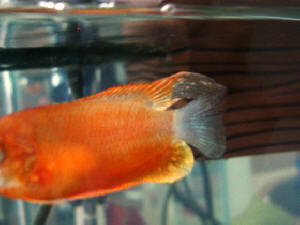
On Sunday I noticed the gourami's tail discoloration
had gotten bigger though he is swimming and eating fine.
Approximately 3 months ago the top edge of his dorsal fin turned
dark/lost color and seemed paralyzed. At that time, the
shop recommended I treat the entire tank with Maracyn,
<? For what?>
which I did. The fin did not improve after that
treatment but the discoloration did not progress any further
either.
I hesitate to dump more medicine into the tank without being sure
what I'm trying to treat.
<Really need a microscopic examination...>
Could the warmer water be causing this?
<No... but this may not be "Ich" or even
Protozoal... Could be Trematodes/flukes for instance>
Appreciate your recommendations on a course of action.
Thanks,
Stephanie
<Well, too long at high temp.s will kill your Sword... If it
were convenient, I might add Praziquantel to your treatment...
for the worm possibility. Bob Fenner>
|
|
 enlarged pic. enlarged pic.
|
Re: Gourami treatment recommendation
1/17/12
Bob,
<Stephanie>
Thank you for your quick response! The original treatment of
Maracyn was recommended by the fish store to treat the
gourami's tail discoloration.
<Of no use here>
He felt it was most likely fin rot though it wasn't
presenting typical symptoms. Based on the lack of
improvement, I don't think the original diagnosis was correct
and from the picture I sent you, it doesn't look like fin rot
to me either.
<No>
I will increase the tank temp to 86 and add some medication to
treat the possibility of Trematodes/flukes. Is there anything other
than Praziquantel you'd recommend?
<Yes... please read here: http://www.wetwebmedia.com/FWSubWebIndex/fwmaintindex.htm
scroll down to worm diseases, Anthelminthics...>
The dosage for the Praziquantel I found is 1/4 tsp per 40
gallons - converting that for a 6 gallon tank is going to be quite
a feat!
<Not really... easily dilutable and divided by measuring out a
liquid aliquot>
Also regarding the water temp for the swordtail...how long can I
keep the temp up without harming him?
<May already have>
Appreciate the clarifications,
Stephanie
<Welcome. BobF> |
|
Sick gouramis! Please help?
10/31/11
Hi, I have searched Google and your website and can't seem to
find anyone who has had the same symptoms as my two gouramis
currently have. We have a 250 litre tank with 2 gouramis, 5
mollies, 2 silver sharks and 1 angel fish. The water levels are
all fine.
<Meaning what? Mollies require water that is hard and
alkaline, and ideally brackish; such conditions are the opposite
of what Gouramis want. It's hard to create conditions that
both species enjoy.>
We have recently treated the tank for Ich (approx 3 weeks ago)
and now all the other fish seem fine, except the gouramis. Our
rainbow fish died today and when we removed it from the tank we
found that the gouramis had been hiding in the plants (plastic).
When we disturbed them by removing the rainbow fish they came out
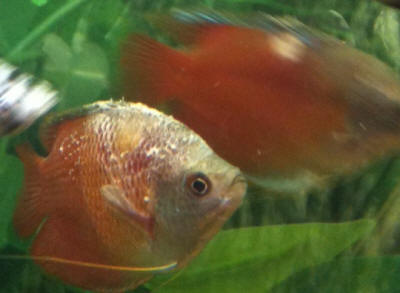
and we noticed a White patch on one of them and both of them
appear to have a rotting top fin and swelling on their heads.
<Not good. Does sound like Mycobacteria
infection. Quite common with gouramis, especially the
small Colisa species (e.g., Dwarf Gouramis) and the hybrids based
on them (Sunset Gouramis, Red Robin Gouramis, etc.).>
They seem to be clamping their side fins too.
<Indeed; a common trait among sickly fish.>
I can't see any problems with and of the other fish. I
haven't come across this before but they really don't
look well. I have attached a picture below.
<Does look like a bacterial infection. But the cause? Hard to
say.>
The big White area is on the fish behind and is quite blurred but
you can clearly see the White areas on the one at the front. This
also looks as if the skin is shedding/peeling. Do you have any
idea what this could be?
<Bacterial for sure. Antibiotic may help; Mycobacteria are
gram-positive, Finrot bacteria typically gram-positive, so choose
accordingly. Ideally, choose one or two antibiotics that allow
you to treat both sorts of bacteria at the same time.>
Thanks in advance for any help you can offer. Laura
<Cheers, Neale.>
|
 |
Filter Carbon Question / Honey
Gourami 9/15/11
Hi Neale.
<Lorie,>
I wrote you months back about my aquarium and the topic of filter media
came up. You seemed to strongly feel that carbon had no place in an
aquarium filter. I certainly respect your opinion, so I have changed
over to poly fiber inside a media bag and ceramic noodles, and it seems
to be working fine. Although I may slowly switch to a sponge, because
I'm afraid some of the fibers will get into my propeller. I've
done some research though regarding carbon and I haven't found any
adverse information about using it in a filter. So if you wouldn't
mind explaining; why do you feel carbon should not be used?
<Here's my take on carbon. Firstly, carbon wears out very
quickly. To do what it's advertised to do, you need to change it
every couple of weeks.
Very few freshwater aquarists do that, so the carbon they use ends up
coated with bacteria and/or saturated with organic chemicals. Secondly,
carbon removes medications. Countless aquarists have used medicines to
treat their fish, and then wondered why their fish still died, even
from otherwise easy to cure things like Whitespot. The culprit was the
carbon, removing the medication before it had a chance to work.
Finally, carbon doesn't really do anything useful in a freshwater
tank. Carbon is used to remove organic materials that lower pH and tint
the water yellow. That was useful when people did 10% water changes
monthly, which was the norm through the 70s and into the early 80s. But
since that time people have learned about doing bigger water changes,
25% a week, or even more, provided they can keep water chemistry
constant. In doing these big water changes the organic chemicals are
diluted anyway, so the carbon doesn't really have anything to
do.>
I've also read an article written by you about tropical fish that
would be suitable for beginners. A fish listed on there to avoid was
the Honey Gourami. I have a ten gallon tank that houses a Honey Gourami
and Corydoras. At the pet store, the Honey Gourami just kind of floated
around, not doing too much, so I wasn't sure if I wanted one. But
after mine became settled in the tank, she is very active and
inquisitive. She's really entertaining! I had a spike in Nitrate at
one point (over feeding), and she did not seem affected at all. I also
have hard water, but she seems quite happy and active. So I'm glad
I tried it and it's working out.
<Colisa chuna is an excellent species, but it doesn't always do
well in hard water. Soft, acidic water is usually recommended, though I
dare say the farmed specimens are a bit less fussy. Compared to the
Dwarf Gourami I'd certainly reckon them a better bet, but it
isn't a 100% sure-fire species for beginners.>
I was just curious on your thoughts. Thank you, Lorie
<Thanks for writing, Neale.>
Possible US source for domestic
bred Honey Dwarf Gourami (RMF?)
4/24/11
<<Would check w/ the FTFFA, the Int'l Anabantoid Association,
and for any more local breeders>>
Hello WWM Crew!
<Hello Nicole,>
I found your website quite some time ago, and I have spent countless
hours pouring over all the information. I wanted to thank you all for
putting so much work into this website that is so helpful to new
aquarium keepers.
Great job, keep up the good work! I hope it's okay, but I linked
out to you guys from my website.
<Sounds great!>
I did notice that there have been many issues with Dwarf Gourami
(Colisa Lalia), due to the deplorable conditions they are raised in by
the suppliers of most pet stores.
<Does seem to be the case, unfortunately.>
I have myself run into a few problems with my Dwarf Gourami in the
years past. I did however, recently find a supplier who breeds Honey
and Sunset Dwarf Gourami (Colisa Lalia) in Arizona. Arizona Aquatic
Gardens is the name of the supplier.
<Have heard of them, but never visited; possibly Bob knows
more!>
I have ordered 4 of them approximately a year ago for my 30 gallon
tank, and they are still going strong!
<Well above average result, that's for darn sure.>
Before I ordered, I called to ensure that the fish are domestic bred.
The only problem I ran into is that they don't allow you to choose
which sexes of fish you will get, so it is a good idea to have another
tank (besides the standard quarantine tank) to put any troublemakers
in.
<Ah, I see. Neophytes do tend to buy the males and skip the females,
with the net result many retailers in the US won't stock anything
other than males. I guess this particular retailer is trying to get
around that problem.>
I got lucky though, and got 1 male and 3 females,
<Ideal!>
and after a few weeks of establishing a pecking order everything has
been great! I couldn't be happier with my purchase, and since it is
domestic, I thought I would share.
<Thank you.>
This website would be a great addition to your freshwater links
page.
http://www.azgardens.com/default.aspx
Thank you for your time. I hope you all have a great weekend!
Nicole
www.bettabits.com (Also a shameless plug for my Betta fish blog)
<Thanks for writing, Nicole. Would be good to know that when we
write back to people and tell them to locally source their Dwarf
Gouramis, there actually is a viable option. Cheers,
Neale.>
Dwarf Honey Gourami ..
sick? 2/5/11
Hi folks,
My new Dwarf Honey Gourami seems ill.
<Presumably Colisa chuna.>
I did search your site but I'm uncertain if his behaviour is
related to the Anabantoids that you discuss in other posts when
Gouramis are "rocking".
He's "rocking", goes to surface for air, looks agitated,
antennae stuck close to body.
I took a couple of short videos (under 20 seconds each) so you can see
the behaviour if you want. Here are links to those videos
http://smg.photobucket.com/albums/v293/draftmolly/?action=view¤t=MVI_5138.mp4
http://smg.photobucket.com/albums/v293/draftmolly/?action=view¤t=MVI_5139.mp4
Tank is 10 gal, planted and 1 ornament
Ammonia = 0
NO2 = 0
NO3 = between 5 - 10
pH = 7.8 (local tap water without changing pH and same as store tank
that fish came from)
<If your pH is this hard, it's likely your water is hard.
Don't change the pH directly. But instead, mix each new batch of
water 50/50 with hard tap water and either RO water or clean rainwater.
Honey Gouramis need soft water to do best, but this sort of 50/50 mix
should produce something around 10 degrees dH hardness, and a pH
between 7 and 7.5, which will be well within their tolerances. Do
remember: fish don't care about pH much, but hardness is extremely
important. Unfortunately aquarists who are just starting out in this
hobby concentrate on pH far too much, and talk about "changing the
pH" which screams out very loudly to me "I don't know
anything about water chemistry and will probably kill my fish when I
try"!!! So be very careful here.
http://www.wetwebmedia.com/fwsubwebindex/fwh2oquality.htm
Either choose fish that suit your water chemistry, or else learn about
water chemistry, and use either a Reverse-Osmosis filter to make soft
water or collect clean rainwater with a suitable water butt in your
garden.>
temp = 23.7C
<Too cold for Dwarf and Honey Gouramis; should be 26-30 C.>
New inhabitant: 1 dwarf honey Gourami (sick?),
Old inhabitants: 3 white cloud mountain minnows, 1 apple snail and 4
cherry shrimp ... all seem fine.
<Yes, all these need quite cool water, 22-25 C is ideal, though the
Apple Snail will be dead in a year because they also need a
"resting phase". None of these can be kept with Honey
Gouramis. The high temperatures Dwarf and Honey Gouramis need to stay
healthy will cause severe heat stress to the Minnows in
particular.>
I feed at night and all food is usually gone in the morning, if not I
do a little vacuum to clean up any left overs.
I do 1/4 water change during middle of week. I do 50% water change on
weekend.
I use Nutrafin Cycle, and Nutrafin Aqua Plus as directed.
Gourami was only added yesterday, March 3. It was fine in the store and
seemed fine when first arrived. It was eating this morning and calmly
swimming around. This evening it is "rocking" and going to
surface for air.
I put in air stone to give O2 and added 1/2 tsp of Melafix
<Useless.>
because it was all I had on hand and didn't think it would hurt and
dimmed all lights. I'm afraid the air is stressing the fish in this
little tank because it's intended for a much bigger tank and
it's making a ton of noise and bubbles, so I put the stone close to
the surface.
Am I doing the right thing?
<No; you broke the first rule of fishkeeping -- you bought a fish
without checking if it needed the same thing as the fish you already
have.>
Wrong thing? Could I be doing anything else?
<Oh yes. Read about Colisa chuna and Colisa lalia (this latter the
Dwarf Gourami, a species I wouldn't touch with a ten-foot barge
pole), provide the right conditions, and choose appropriate tankmates
that share those requirements. Short term: choose whether to keep the
Minnows or the Honey Gourami; you can't keep both. If the Honey
Gourami, raise the heater to 28 C immediately, and over the next few
weeks, each time you take out 20% of the water, replace with water
that's 50/50 tap water and RO or rainwater.
Some stores sell RO water if you don't have the means to make it
yourself or collect rainwater. I do the latter, and it obviously has
the benefit of being free, though there are some minor hassles and
risks.>
All wisdom appreciated.
<Freely offered!>
Cynthia
<Good luck, Neale.>
Re: Dwarf Honey Gourami .. sick?/ reply to Neale
2/5/11
Thank you for this information.
<Glad to help.>
I did research this fish and thought I had chosen one to suit my water
chemistry and the current inhabitants. On the many websites where I
found information none of them mentioned soft or hard water, only
pH.
<That's because most of the websites about tropical fish are
written by enthusiastic beginners rather than experts. It also matters
than pH is something that's easy to understand, so people feel they
can write about it with confidence. But hardness is complicated and
difficult to explain, so people shy away from talking about it. The
problem is that hardness is far, FAR more important to fishkeeping than
pH. In most cases, anything between pH 6 and 8 will suit any and all
community fish, but the hardness, that's the bit that separates
soft water fish like Neons from hard water fish like Guppies.>
"Dwarf and Honey Gouramis; should be 26-30 C." -- Ok ... good
to know. The information I found on the internet states these fish are
ok at temps from 22.2 to 27C .. I felt it would ok at 24 C since that
was in the middle range.
<Again, you have the problem that most of the people writing about
fish are copying stuff from other websites. They don't actually
know very much about what they're writing. We're different here
at WWM in that we are experts and we do know what we're talking
about. In the case of something like a Honey Gourami, while water
temperature in the wild may vary somewhat from 22 C to more more than
30 C, the average will be something in the middle there, perhaps a
little on the warm side given they're living in shallow, still
habitats like rice paddies and ditches. Fish from fast flowing streams
typically prefer cooler temperatures, as is the case with
Danios.>
Actually I did research this fish quite heavily before buying it
because I wanted to make sure it would be ok in my current tank. I
spent WEEKS looking up information and carefully making this decision.
If the information I'm receiving from the internet and the store
itself is incorrect I am being misinformed ... but I am NOT uninformed.
Your suggestion that I am "reckless" is unwarranted and
deserves an apology.
<From whom? Not from me. I've given you sound advice and
explained where you've gone wrong. For my part, you'll see
I've published countless aquarium magazine articles as well as a
book on brackish water aquarium fishes. When I suggest something,
it's not because I'm trying to make a sale, it's me trying
to help you from a position of experience and knowledge. I don't
always get things right, but I try, and best of all from your point of
view, I'm accessible and I'm FREE. There are doubtless plenty
of other folks who'll give you advice in a way you might find more
palatable. Of course they could very well be wrong, behind the times,
or trying to sell you something. Your move.>
Thank you for all your suggestions and advice. I will return the
Gourami to the store before it expires.
<Hmm'¦>
Cynthia
<Cheers, Neale.>
Re: Dwarf Honey Gourami .. sick?/ reply to Neale
2/5/11
<From whom? Not from me. I've given you sound advice and
explained where you've gone wrong. >
Well, I feel I deserve one from you, whether you choose to give one or
not is entirely up to you.
<<I see.>>
You did give me sound advice and I appreciate it. You also however,
berated me saying, "No; you broke the first rule of fishkeeping --
you bought a fish without checking if it needed the same thing as the
fish you
already have.", before you asked if I had done any research.
<<I'm sorry that you feel this way. But no offence was meant.
E-mail is a flawed medium for subtle communication, and from the data
you sent me, my conclusion was that you'd added a Honey Gourami to
a system that likely wasn't suitable for its long-term care. If you
peruse the Daily FAQ page, you'll see I do a lot of these questions
every day, and promptly, and in depth. If occasionally my responses
aren't what the Querior expects, then I'm sorry about that. But
I do my best to help, and I help lots of people,
every day, for no money.>>
I was very careful about researching for the right fish to make sure it
would fit in properly. I am doing the best I can with the information
that is available. When things go wrong I am immediately looking for
solutions.
While I appreciate all the help I'm given I do not appreciate it
when "expert" fish keepers assume I am irresponsible.
<<Well, I am what I am. If you prefer to get your advice from
elsewhere, that's your choice.>>
Thank you again,
Cynthia
<<You're welcome, Neale.>>
Honey Dwarf Gourami swimming
frantically from side to side 1/23/11
Dear Crew
I refer to a question already posted here:
http://www.wetwebmedia.com/fwsubwebindex/dwfgbeh.htm
You state that it is not normal behaviour for a Dwarf Gourami to keep
swimming from side to side at the front of a tank. I recently moved my
Gourami to a similar tank (100 litres) as he was being very aggressive
to the other two male Gourami. It is not so well planted and he just
swims all day from side to side getting quite frantic about his
reflection. Is there anything wrong? What can I do to calm him down if
it isn't normal
behaviour? He has been in there now for a week.
Thanks, Patrick
<With luck your Gourami will calm down in time. There's not much
you can do beyond optimise his world -- provide shade and shelter,
install some dither fish to help him feel settled, and so on. Cheers,
Neale.>
Honey Dwarf Gourami tank advice
1/12/11
Dear crew
<Hello!>
Advise re honey dwarf Gourami and tank size
<Sure.>
I have a Reef One BiUbe measurements as below:
Height: 17.7 inches (45 cm)
Width: 13.3 inches (34 cm)
Volume: 9 Gallons (35L)
Would this be suitable for a single male honey dwarf Gourami?
<Not really, no. For one thing Gouramis are air-breathers and they
need wide, shallow tanks with lots of surface area. They also prefer
dense canopies of plants not far from the surface of the water where
they can hide in between rising to the surface to breathe. Floating
plants are ideal. The Reef One BiUbe is a tall, narrow cylinder. By
default, it doesn't come with a heater either, and Gouramis need at
25-28 C/77-82 F to stay healthy. The Reef One BiUbe is almost
completely pointless as an aquarium, though it might be okay for plants
that will grow under poor light (specifically Anubias and Java Ferns)
and brightly coloured shrimps, such as Cherry Shrimps. With a heater, a
single Betta should do okay, too.
But for anything else, honestly, I wouldn't bother.>
What other tank mates would be suitable?
<None. Don't buy this aquarium expecting to keep lots of fish in
it. It's an overpriced gimmick with almost no aquaristic value.
Unfortunately it also happens to be attractively designed, and that
hides the fact potential buyers are paying massively over the going
rate for an aquarium far inferior to a simple 10-gallon rectangular
glass aquarium.>
From reading your website I know the BiUbe is not one of your favourite
tanks
<With good reason. Difficult >
but was given this and rather than not use it however I currently have
a 3 in an AquaTropic 80 (110L) tank - however one is particularly
aggressive with the other 2 and a single female platy, there are also 7
neon tetras.
<The Gourami might live in it, but it isn't ideal. Can you not
change the aquarium for another, better one? I suppose you could try
and see what happens if the Gourami is kept in this tank. But I doubt
it will do well
for the reasons mentioned earlier. I assume your Honey Dwarf Gourami is
Colisa chuna -- properly called the Honey Gourami to distinguish it
from the "true" Dwarf Gourami Colisa lalia. Both are
difficult fish to keep but for different reasons. Colisa chuna needs
warm, soft, acidic water to do well, and males are aggressive towards
one another. As with other Gourami species, they're best kept alone
or one male alongside two or more females.>
Many thanks in advanced.
<Cheers, Neale.>
Re: Honey Dwarf Gourami tank advice 1/13/11
Hi Neale
Many thanks for your feedback just as I suspected.
<Glad to help.>
The BiUbe does have a heater but taking your advise will leave them in
the current tank which is heavily planted and has lots of surface
area.
<Sounds a better idea.>
Would I get away with a few Tetras?
<Lack of back-and-forth swimming space would mean they'd be like
a dog living its life locked up in a single room. So wouldn't be my
choice. As I say, Cherry Shrimps and a Betta are perhaps the only
obvious combination of animals for this.>
Else convert the to a hospital tank.
<Pointless. A hospital tank has to be at least as good as your main
tank.
If it isn't better than your main tank, the fish is likely to get
better more slowly, or even be sent along to its fishy grave even more
quickly!>
Best wishes.
BJ
<As I've stated, as have MANY other experienced aquarists, most
of these small "designer" tanks are of very VERY limited
value. Cheers, Neale.>
Re: Honey Dwarf Gourami tank advice 1/13/11
Hi Neale
Thank you for you invaluable advice - taken and heeded.
<Glad to help.>
Cherry shrimps here we come :-)
<Oh, and there are more besides: Crystal Red Shrimps, Blue Shrimps,
Bumblebee Shrimps, and more. Also Thai Swimming Crabs, Nerite Snails,
Clea helena "assassin snails" -- all would be good in this
tank, if you wanted to create a freshwater reef tank filled with
critters.>
Are guppies suitable in the same tank as Gourami?
<Can be, yes, though bear in mind Guppies need hard, basic water --
10-35 degrees dH, pH 7.5-8.5. Gouramis are generally best kept in soft
water, so the overlap between them is limited. Perhaps 10-15 degrees
dH, pH 7.5.>
Male or female?
<Shouldn't make much difference, but females tend to be less
likely to cause trouble, and if you keep a group, keep two females per
male.>
As always many thanks in advance.
BJ
<Cheers, Neale.>
Re: Honey Dwarf Gourami tank advice 1/13/11
Hi Neale
Please ignore previous email.
I have 3rd tank that is 97L tank about 65 cm wide and 36 cm front-to
back and 48cm high.
The tanks has been planted but is only 2 months old, plants are
settling but need time to establish as you can imagine.
It currently has 11 3 month old guppies male and female and now has the
platy from the other tank as she was being bullied by one of the
Gourami. I have noticed that dominant one is starting to build a bubble
nest even though there is no females in the tank which may be why he is
aggressive.
If I were to take one of the more passive male Gourami out of their
current tank into the 97L tank you this be wise?
<I'd move the more aggressive one. Aggression is linked with
holding a territory. Move the aggressor, and he has to establish a new
territory in a new tank, and that puts him at the disadvantage. It also
tends to take the "edge" off bully fish.>
Would they all swim happily side by sire as it were?
<A Gourami should get along with Platies and Guppies, assuming water
chemistry permitted, as stated in earlier e-mail.>
I can take plants from the main tank and put some into the 97L as
floating plants if this will help the Gourami.
<Cool.>
As always many thanks in advance.
BJ
<Cheers, Neale.>
Re: Honey Dwarf Gourami tank advice 1/30/11
HI Neale and crew
I trust you are all well and having a great time.
<Trying my best!>
I am after some more advice. Following all your great advice recently
as you may be aware I have moved the dominant Gourami.
<The one in the photo? Would appear to be the "Sunset"
variety of Colisa labiosa. An excellent species.>
He has finally managed to settle in now and seems more at home in the
new tank. In the past day I have noticed that his dorsal and caudal
fins have got some brown colouration to them.
<Yes, normal, I think.>
I have attached pictures hopefully you can see what I mean.
Not sure if this is normal or should I be worried.
Thanks in advance.
<Would not worry. If the fish doesn't show any odd behaviour,
would simply wait and see.
Cheers, Neale.>
Re: Dwarf Gourami tank advice 1/30/11
Hi Neale
Thank you so much for your excellent assistance once again the LFS I
got them from said they were honey dwarfs.
<Ah, do compare to photos of Colisa labiosa and Colisa lalia, and
decide what you have. The length to depth of the body is one clue, and
the shape of the snout. May even be a hybrid of some sort.>
Can now find more info about this variety. May even now try to breed
them.
<Well worth doing.>
Think my local LFS are useless. (Maidenhead Aquatics).
<Surprising. Most branches of MA are pretty good, and some are
exceptional.>
You may remember I asked you about an ill Panda Platy with white raised
caudal fin scales. Just to say we think she may have TB. She has got
thinner and is not eating as much as she used to (often spits food
out).
<Oh dear.>
Have moved her back to her original tank - she tends to hide in
background plant most of the time, comes out to eat but is slow in her
movements.
Will keep an eye on her and put her down if she is not better soon.
<Okay.>
Again thanks for all your invaluable help.
<Glad to help.>
You guys are great.
Have a great evening.
<Likewise. Cheers, Neale.>
Honey Gouramis,
sel./stkg. 8/10/10
Hello,
<Hello,>
I have a 20 gallon high tank. One of the fish I'm thinking of
adding in to the community is a Honey Gourami. I'm hoping you all
can shed some light on my questions regarding Honey Gouramis. How hardy
are they?
<Not. Well, compared to Dwarf Gouramis they are less likely to be
sick "out of the box", so in that regard they're a step
up. But they still need warm, soft, slightly acidic water with minimal
water current. Let's say 26-28 C, 3-10 degrees dH, pH 6-7, and an
air rather than electric filter. They are shy and easily bullied, so
tankmates need to be chosen extremely carefully.
If you're an expert fishkeeper or an ambitious beginner, Honey
Gouramis aren't difficult given the right tank. But if you're a
casual hobbyist after something you can pop into a community and then
forget about, these wouldn't be my recommendation. Much better
choices are Colisa labiosa and Colisa fasciata.>
With all the inbreeding going on with so many freshwater fish these
days, how do I know if my Gourami is going to be a healthy hardy
fish?
<Non-wild-type Honey Gouramis are more likely to be inbred than the
wild-type, so that's a start! Otherwise, as with Dwarf Gouramis,
choose specimens only from tanks that have NO sick or withdrawn
specimens, and ask
to see your specimens feeding before you pay any money.>
I'm looking for a nice centerpiece fish for my 20 gallon high.
<Honey Gouramis are a bit shy for centrepiece fish. Assuming this
tank is well planted, you won't see much of them.>
The only fish I have in there right now are 3 Glow Light Tetras.
I'm stocking slowly. Can you recommend another type of Gourami that
is hardier if the Honey Gouramis are not?
<See above. The Lace Gourami is also another very reliable, usually
non-aggressive species. Female Bettas can be surprisingly good
community fish. All male gouramis and Bettas tend to be a bit hard on
one another, so either keep females or keep a pair.>
Thanks,
LB
<Cheers, Neale.>
gold dwarf flame gouramis, sp.
ID 6/19/10
Hello WWM crew,
<Hello,>
I've been searching the web for pictures of my gouramis, gold dwarf
flame gouramis. All that I can find are honey gouramis. The fish that I
have are much more "golden" than honey gouramis, plus the
anal and caudal fins are
orangish-red. I live in Hawaii where I know we get a lot of fish from
breeders over in Asia. Could this be a hybrid of some sorts.
<Very likely. The two species of note here are Colisa lalia (the
Dwarf Gourami) and Colisa chuna (the Honey Gourami). These two species
have both been bred into artificial forms different to the wild types,
and they have
also been hybridised to produce fish with characteristics of both.
Neither is a "hardy" fish by any objective standards, and the
Dwarf Gourami especially is notorious for being disease-prone, both
because of its sensitivity to Mycobacteria infections and the
prevalence of an Iridovirus infection among farmed specimens. Neither
deserves a place in the average community tank, to be honest. There are
two other species of note, Colisa fasciata (the Banded Gourami) and
Colisa labiosa (the Thick-lipped Gourami) that are a bit larger but
dramatically easier to maintain. Both of these are available in
wild-type colours and in uniformly orange or yellowy types as
well.>
They are very small for gouramis, even for the dwarf species (I would
put them just under an inch).
<If adult these are smaller than Colisa species; to look at
Trichopsis species as well, e.g., Trichopsis pumila.>
They are a very hardy fish a have gone through a lot with me,
they've been move from one tank to another (progressively bigger),
and survived an outbreak of ich in my tank (didn't
"catch" it). I would like to get one or
two more, but with out finding any online, I'm afraid that I
won't be able to.
<Without a photo, I really can't say anything helpful.>
Much thanks for any info. about them.
Richard
<Cheers, Neale.>
P.S. Am I the only lucky guy around who doesn't have problems with
their aquarium, I don't check my Ph, or hardness, ammonia or
nitrite levels. All I do is ten to twenty percent water change every
week, and fifty percent
monthly.
<Indeed, you sound very lucky. But I can't recommend this
approach at all, as the number of sick fish -- especially sick
gouramis! -- will testify. To be sure, if the tank is well-filtered and
your tap water happens to be ideal for the species, then water tests
may well be redundant. But for most aquarists, at least determining
their water chemistry first, so they can choose the right fish, and
then using nitrite tests during the cycling phase, are important. Had
your water chemistry been wrong, doubtless you'd have lost more
fish.>
Sick honey Gourami!
4/15/10
Hi there! just like to compliment you on the awesome website!
<Thank you.>
Anyway! I have two honey Gourami in a 15g tank, with 6 Neons, 2 Danios,
3 panda Corys, 1 Pleco, 2 platys, 3 guppies and a lone white cloud
survivor.
I'm not sure what sex they are, one must be male as it keeps
building a bubblenest and seems to have slightly different coloured
patches on its cheeks.
<Whoa! That's a lot of fish in a very small tank. The Neons are
fine, and perhaps the Minnow and the Corydoras, but the Guppies will be
pretty snappy in a tank that small, and the Platies need more space.
The Danios really do
need a tank not less than 60 cm/2ft long, and the Plec is going to
outgrow this aquarium very rapidly. Do understand Pterygoplichthys
pardalis, the standard "Plec" of the US and UK trades, gets
to 45 cm/1.5 ft long within a year or two.>
I came home the other day, and one of them was (is) swimming Slightly
on it's side and looks like one of its fins is hard to use, and
almost swims in circles and generally looks like its effortful to swim.
it also looks like its "feelers" (I don't know what there
called) have gone!
<The "feelers" are its pelvic fins, and they are indeed
sensory organs a bit like fingertips. But like any long, thin fin,
they're very prone to Finrot, and I'm pretty sure what
you're dealing with is Finrot. Perhaps caused by poor water
quality, though aggression or fin-nipping might be part of the mix.
Because you have so many fish cooped up in a tank far too small for
them all, it's hard to be 100% sure.>
I thought it was going to die the other day, but today it looks a bit
better, but its still looking in a bad way. I was just wondering if you
might know what's up with it?
<Honey Gouramis, Colisa chuna, are quite delicate fish. You do need
very good water quality: 0 ammonia and 0 nitrite. You also need soft,
slightly acidic to neutral water; aim for pH 6.5-7, 5-10 degrees
dH.>
never had a problems with these two fighting, so don't know if its
that.
<Could easily be. Two males WILL NOT tolerate one another in a tank
this size.>
I also have 2 other problems if you can help me out, in the same tank,
a few weeks ago I lost 6 fish in the space of a week (I haven't
lost any for agggges before that) and some of my fish appear to be
"flashing" (rubbing themselves on rocks etc) I have a home
test kit and the nitrates were slightly high but after a water change
they are sweet again. they seem to be doing it less now but still
occasionally do it, I noticed the guppies do it a lot more then any of
the other fish, and it was 3 guppies and 2 Endler's that died in
the week.
<"Flashing" often occurs when you have non-zero ammonia
and nitrite levels.
The gills of the fishes are irritated, and they assume parasites
because they don't know any better. So the fish scratch themselves
on solid objects, hoping to knock off the parasite. To be fair, Ick and
Velvet both cause fish to flash as well. But because you haven't
told me what the ammonia and nitrite levels are, and because your tank
is so wildly overstocked, that's what I'd look into first.
Nitrate with an "A" is largely irrelevant to freshwater
fishkeeping, so I don't know why you're testing it. But you
should have a nitrite with an "I" test kit. Use it, and get
back to me. If either nitrite or ammonia are not zero, that's a
sign water quality is poor.>
and finally!! I have a small 8g with just a Betta in it, and the other
day I noticed that there was all these little white dots in the tank,
on closer inspection, I noticed they were "bugs" little white
balls with legs, crawling all over the place, I did a quick Google n
think they could be either water fleas or , is it, copepods? I thought
he'd just eat them, but there's 100s of them!!
<These are isopods or copepods, and in themselves harmless. But if
you have a lot of them, enough for them to be noticeable really, then
your tank is likely receiving too much food and not being cleaned often
enough. Review
feeding, filtration and water changes.>
any help would be greatly appreciated!!!!! (sorry about the bad
spelling and long email!!)
<We certainly like detail, and yes, a spell checker is your friend
when writing into WWM. Makes it much easier for Google to catalogue the
site for one thing, and thereby make the site more accessible to
everyone else who wants to find out about fishkeeping stuff.>
thank you very much. Sam
<Cheers, Neale.>
Re: Sick honey Gourami!
4/16/10
Hey! thanks for the lighting fast reply!
<No problems.>
unfortunately when I woke up today the Gourami was dead :(
<Too bad.>
but thank you very much for the help, I'll be reading your site a
lot more in the future.
<Cool.>
I'm pretty new to fish keeping to be honest, I thought my 15g was
an ok size for all those fish! it is 2 foot long, a foot and a half
tall and maybe a foot deep though?
<You can actually use Google for this. In the search box, enter 24 x
18 x 12 and hit "search"; you should get 5184. Now get Google
to convert that from cubic inches into gallons, i.e., with "5184
cubic inches in gallons".
You'll get 22.4 US gallons or 18.7 Imperial gallons, depending on
which Google site you're using.>
but obviously you know more than I do!!
<Yep.>
oh sorry, I forgot to mention the Pleco is a bristle nosed Pleco, my
granddad made the mistake of buying a common one and we had to give
that back to the store when it got pretty dang big!!!
<Right. Ancistrus can get to about 15 cm/6 inches, though
they're commonly a bit smaller.>
I had a hunch it might be Finrot, so last night I added some into the
tank (and removed the carbon from my filter)
and today I've cleaned the filter out, think I may need to buy some
new foam, some people (the company who makes them...) tell me I need to
replace it every month, but some people I know who have kept fish for
years say
they've hardly ever changed theirs.
<Like your friends, I hardly ever replace filter sponge or ceramic
noodles, though floss and carbon -- if used -- need to replaced
regularly. With this said, regularly rinsing sponges and ceramic
noodles in aquarium water is
important, ideally very 6-8 weeks.>
I've had everything in the tank for about 3 months, so I'm
pretty sure it wasn't fighting (although I struggle to sex the
gouramis) and the guppies have had looooooooooads of babies, so I kind
of presumed (rightly or wrongly) that they and the water was fine. but
so far, none of them have lived to adulthood, they've been eaten
:(
<Oh.>
as for the test kit, the levels are:
NO3 - 50
NO2 - 0
GH - 16od
KH - 8od
ph - 6.8
CL2 - 0
<Mostly fine, but the pH is a bit low for Guppies and other
livebearers. Wouldn't worry unduly because your carbonate and
general hardness seem okay, if you mean 16 degrees dH and 8 degrees KH.
These are quite high values, and a bit high for Honey Gouramis.>
as for the Betta, his tank is going to get a vigorous scrub and vacuum
tomorrow!!!
<Very good.>
thank you very much for the advice
Sam
<Cheers, Neale.>
Need your suggestion on my Gourami, hlth.,
gen. care... data 1/23/10
Hi Crew,
<Hello,>
I'm so happy to find your very helpful site!
<Good to hear.>
I have a male honey sunset Gourami.
<This is normally Colisa chuna, or a hybrid based
upon it. Now, Colisa chuna is a very delicate species, and problems
with this species are common if it isn't kept precisely the right
way. It needs very warm water, around 26-28 C (79-82 F) and the water
must be soft and slightly acidic to neutral (5-10 degrees dH, pH 6-7).
Hard water will not do! As you'd expect, it needs clean water: 0
ammonia and 0 nitrite. It does not like strong water currents, and must
not be kept with overactive fish. Usually, Colisa chuna is best treated
as a species for its own aquarium, but it can be kept with very
peaceful tankmates that like the same conditions, such as Harlequin
Rasboras.>
He is always peaceful and lovely. Several days ago, he suddenly got
sick that he seemed not be able to move his tail. He could still move
his pectoral fin. I've never been able to save any sick fish.
<Oh? Does rather depend on what the problem is. If your aquarium has
poor water quality or the wrong water chemistry, all the medications in
the world won't help.>
But this time he seems to struggle so hard to survive which makes me
feel so sad. He tries to keep balance which I think is a good sign. He
even jumped to the surface to eat food. I searched the internet and saw
someone said this might be some mechanical injury, because I did not
see any external injury on his body.
<Possibly, but seems unlikely.>
If so, would you please give some suggestion? What should I do? Really,
I'm in hope to your help.
Thank you,
Ke
<Really do need more information than this. How big is the aquarium?
What is the water chemistry? What is water quality like? At least give
me the pH and the nitrite concentration. What sort of tankmates?
Otherwise, review what is stated above for this species, and alter your
aquarium as required.
If you need to change water chemistry or temperature, do so slowly, in
stages across a day or two. Cheers, Neale.>
Re: Need your suggestion on my Gourami 1/23/10
Hi,
Thank you so much for replying so soon!!! Sure I should have described
my tank first. I was worried and incoherent. My tank is 20 gallon. I
current have four golden barb
<Puntius semifasciolatus? A subtropical, not tropical, fish.>
and four red-nose tetra
<Hemigrammus bleheri? These should be in a bigger group; six or
more. In fact both the tetra and the barb could "misbehave"
-- become nippy -- if kept in too small a group.>
who are very peaceful. Only exception is another male honey sunset
Gourami which always explores the whole tank.
<Male Colisa chuna are territorial and will be aggressive to each
other.>
All fishes are about 1 inch size. The two Gourami used to be really
matching each other. But a week after they arrived my home, one started
to dominate and the other one became timid and now sick.
<The dominant fish will acquire stronger colouration; the weaker
fish may be bullied and turn pale in an attempt to look less
threatening.>
I'm using the commercial test strip to monitor the water quality.
It's 0 ammonia, 0 nitrite, 10 ppm nitrate.
<Fine.>
The pH is about 6.8. Temperature is always kept 79 F.
<Fine.>
But the water is hard. I'm going to buy a water softener and maybe
pH decrease kit tomorrow.
<No, do not alter the pH. By all means reduce hardness to
"medium hardness", around 5-10 degrees dH being ideal. A
50/50 mix of hard tap water and RO water is ideal.
http://www.wetwebmedia.com/FWsubwebindex/fwh2oquality.htm
But don't mess around with either pH or hardness unless you know
what you're doing.>
Also, to decrease the water current, I'm decreasing the aeration
and filtration. I double checked the fish body. Still did not see any
wound.
But the color turned to pale and a little grey. The tail fin looked
much smaller than usual, but seemed not because of being bitten. I
heard if the fish still can keep upright position, then he still has
hope. Want to know if this is true. Also I've heard that slightly
increasing the temperature can help fish recover. Really not sure
...
<Suspect this is a social behaviour issue. Move the pale male to
another aquarium, and he will probably recover quickly.>
Thank you and have a good weekend,
Ke
<Cheers, Neale.>
Apistogramma double red breeding!? Umm,
Colisa input 1/4/2010
hello WetWebMedia crew! it's Michael again.
<Hello Michael Again>
Doubt you remember me. I had the "undead Gourami" e-mail that
my Bolivian Ram got strange mother hen protection syndrome over as it
became unable to swim. Sorry it's been so long but wanted to update
you. Sunshine never did recover and got worse and worse until she was
no longer able to eat. In the end I decided to euthanize her in the
freezer :( My Bolivian ram never did seem to recover emotionally in the
community tank. I know I know fish don't have emotions
<Actually, I suspect, sense that at least some do>
(I'm sure some science dude is determined to prove otherwise
somewhere) but I don't know how else to describe it. After sunshine
was removed (and put to rest) my Bolivian never was the same. She
became very aggressive and agitated overall. She got so aggressive as
to not let any fish swim around-attacking them, swimming hard into the
glass, would hardly eat, upturned all my fake plants endlessly (my
fiancé©' swears she was looking for sunshine lol), and
even started attacking the bubbles from my diffuser once the other fish
got smart and hid all day. I decided to move her to a 10 gallon breeder
tank I was building up (I removed the Platies I got that were building
up the tank bacteria and mulm out of sympathy). She still would hardly
eat and proceeded to ram the glass until I got her another sunset honey
hybrid for company. after a week she calmed down, hung close to the
sunset, and began to eat like a pig. I been talking to the owner of a
LFS to find her a home with a breeder, I think she really needs a mate
her own species.
Tank water parameters-
ammonia:0, Nitrite:0, Nitrate:10, moderately soft PH: 6.5, temperature
82 degrees Fahrenheit, Culligan filtered water- not the super
chlorinated home delivered stuff. 20% water change every 2 weeks. water
seems to hold steady with the PH buffer 6.5 with no ammonia or nitrite
spike what so ever even with lax water changes.
filter- Marineland penguin 350 with BioWheel.
Tank- 39 US gallon tall, established 8 months
plants- fake, some moss from a former moss ball, green algae on
ornaments, some diatoms on the back glass.
substrate- 3/4" of black and blue gravel.
Inhabitants- 1 Trichogaster chuna hybrid sunset, 10 neon tetra (6 were
previously in quarantine and added 2 months ago?), 2 celestial pearl
Danios/galaxy rasbora,1 Adolfo Cory cat.
<Mmm, like most Corydoras species, this fish lives in
groups...>
newly added (over time with quarantine in order added)-2 High Fin neon
gobies?(unsure exact species can't find much info on freshwater
gobies- got them for free, they were in with feeder fish!) about
2-2.5" long, 1 juvenile pearl Gourami, 3 Apisto cacatuoides double
red (2 male 1 female.
was suppose to be 2 female but one was a sneaker male) 4 pygmy cories
(about .5"), 4 dwarf neon rainbows (1 male) all about 1.5", 2
bumblebee gobies (was given to me-didn't know they need brackish.
Will they adapt?
<Not really, no>
I keep reading mixed messages-some say brackish only. Some say they
will be okay in fresh soft water-very confused). And lastly another
honey hybrid called a copperfire Gourami.
<Likely another Colisa lalia sport>
I'm sure you will start getting waves of e-mails about them asking
what they are. So here's what I can share about them. They seem
more close to original honeys.
<C. chuna? Perhaps>
They share the same shape and temperament as wild honeys and are
probably only a color morph. There <their> breeding male pigments
seem to have been brought out (reddish brown),compared to the oddball
sunset honey hybrid which does seem a lalia or labiosa hybrid.
Copperfire also have a more flowing and less spiky ventral fin
resembling the wild honey I had. The Sunset gouramis also seem
sterile
<Might well have been sterilized... a common practice in the far
east in the trade w/ valuable strains>
and display no signs of even trying to mate, I could be wrong on this
any conformation? Copperfires also seem even less aggressive than the
sunsets and more like a wild Honey-VERY timid.
<Thank you for this. Bob Fenner>
My undead Trichogaster chuna?
11/21/09
Greetings WetWebMedia crew
<Hello Michael,>
This is my first ever asking anyone for advice on fish and i apologize
if my grammar and spelling is not the best. I will try to conform to
your standards.
<Ah! Our reputations precede us...>
First off i will state i do a LOT of research on fish before i buy now
and never impulse buy. I know what fish i want and if i go to the pet
store i either leave with what i had in mind or empty handed. This
wasn't always the case as i started out trying to keep Colisa lalia
then ran into a bad bout with German blue rams.
<Neither of these species are among the ones I recommend.>
After gathering info and reading your advice i will not be getting
these species again.
<Wise.>
I have been in the hobby for only a year, though i did have a guppy
tank as a kid.
Tank water parameters-
ammonia:0, Nitrite:0, Nitrate:10, moderately soft PH: 6.5, temperature
82 degrees Fahrenheit, Culligan filtered water- not the super
chlorinated home delivered stuff.
<Oddly enough, tap water can be just fine for fishkeeping. A lot
depends on the hardness and the nitrate levels, but tap water isn't
something to develop a phobia over.>
15% water change every 2 weeks, i know it's kinda low but my tank
is lightly stocked right now and my parameters have always been good. I
will change more water as stock levels increase.
<Cool.>
filter- MarineLand penguin 350 with BioWheel.
Tank- 39 US gallon tall, established 6 months
plants- fake, some moss from a former moss ball, green algae on
ornaments, some diatoms on the back glass.
substrate- 3/4" of black and blue gravel (what do they coat these
stones with?)
<No idea. So long as it's sold as aquarium safe, I wouldn't
worry too much.>
Inhabitants- 1 Trichogaster chuna (other in hospital tank), 3 neon
tetra, 2 celestial pearl Danios/galaxy Rasbora, 1 Bolivian adult
female,1 Adolfo Cory cat, 2 ghost shrimp. Yeah my tank is basically
empty but im so picky and acquire fish slowly to give my bacteria time
to adapt.
<You do want to keep some of these species in bigger numbers...
I'd treble the numbers of Neons and Rasboras, and Corydoras should
be in groups of five or more. Better to have a few, happy species than
dozens of frantic, bewildered fish hiding all the time.>
lost 1 Adolfo, 2 ghost shrimp, and a neon to a malfunctioning heater
this week.
<Oh.>
No fish added in over a month but have 6 Neons in a quarantine tank to
be added in 2 more weeks, one week down.
<Great!>
My lone 3 should be happy soon.
<Indeed!>
I feed them all-natural flake food, small cichlid pellets, and
sometimes frozen brine shrimp. I only feed then every 2-3 days.
<You can probably up this a bit while they're still small. Many
small fish are adapted to daily meals.>
chemicals- API stable 6.5 PH. has buffers, chlorine remover,
electrolytes.
I know you don't recommend using such products but the Culligan
water PH varies from 6.8- 7.5. I also have all soft water fish and have
used this product from tank start-up. I have hard sulfur well
water.
<Right, I see. Now, here's my thing. I'd sooner have a 50/50
mix of soft water and hard water than just soft water. All your fish
will thrive in medium hard, pH 7-7.5 water, and in the case of Shrimps
and Galaxy Rasboras, such water is probably optimal. Water with
reasonably high levels of carbonate hardness will offer good pH
stability, and in the long term, that's a more sensible goal than
an acidic pH that bounces around between water changes.>
"Reader advice- You should only ever use ph buffers if used from
tank start-up and then only if you know you can always afford the
stuff. Listen to WWM, a stable ph is always better than a specific
value. If you insist on adding to an established tank (which people
will regardless of advice) NEVER pour such additives directly into the
tank no matter what the label says! ALWAYS add to a separate container
with your tank water and slowly pour into your tank over a diffuser or
the outlet of your filter. Fish will eat this stuff and get sick or
worse die if poured directly into the tank!
found this out with my quarantine tank.
<Learning the hard way, but learning well...>
Hope that is enough information so i do not waste your time. Now to the
issue at hand.
<Yes.>
I've poured over the search engine but have not found anything that
exactly matches my case, though i thought i was close a few times but
this seems different as my fish is still alive after a great deal of
time.
<Oh?>
The problem is with my civilized flame Trichogaster chuna (honey
Gourami), "her?" name is Sunshine. She prefers civilized over
color enhanced or genetically bred. I am not really sure if it is a she
or he, i just call it a her because its way lighter yellow than the
other Gourami and has very little red on its fins, where as Flame has
vibrant red fins and bright yellow body.
<Could be a hybrid with Colisa lalia... there are various
non-natural
Dwarf/Honey Gourami varieties/hybrids out there.>
About 5 weeks ago i turned my lights on as usual and noticed her on the
bottom of the tank dead and the other fish were sleeping. I figured i
should do a water change as i was not sure how long she was dead over
night. I decided to feed my fish first before the water change so i
could remove any uneaten food as well, and left Sunshine in there for
the time being. I gave the fish time to wake up and then proceeded to
feed them.
When i put the food in the tank to my surprise Sunshine quickly sprang
to life and darted to the top gobbling up food! i thought to myself
"ok that was freaking weird!". She seemed normal after that,
so i wasn't concerned.
The next day the same thing, and the following day as well. My
fiancé©' also noticed this about sunshine as well. After
about 3 weeks of this we just accepted that sunshine was just a little
different than other fish and just liked to sleep on her side.
Everything else about her while she was awake was normal.
<Does happen with some fish... likely genetic, or more specifically
a genetic deformity, perhaps an insufficiently developed swim bladder.
While not lethal, such fish may never learn to swim normally.>
It wasn't until 2 weeks ago i became concerned. Her color suddenly
began to get lighter and is now closer to white/silver in the middle
turning to pale yellow towards her fins. She began to hang around the
bottom, mostly around the edges of the tank were my fake plants are.
When Sunshine would venture to the middle or the top she seemed to get
tired easily and would lay sideways in a plant for a few minutes then
proceed back to the bottom.
I never seen her go to the surface to gulp air but my other Gourami
only does at feeding time, is this normal for either of them?
<Air breathing in Gouramis is generally obligate (i.e., they have to
do it) but the rate depends on water temperature and how well
oxygenated the water is. They also extend the period between gulps of
air the deep the body of water (i.e., if they have to swim further to
get to the top, they do less often). But even allowing for this, if a
Gourami can't gulp air, it will eventually suffocate. The risk may
vary with body size, since a bigger fish needs more oxygen, but I
don't know for sure.>
At first this seemed to agitate my Ram but the ram never got aggressive
as she prefers center stage of the tank, she only chases away fish that
get too close to her center territory. I know honey Gourami are
considered too timid a fish to keep with a ram but sunshine always
enjoyed my ram. When they were first put together it was Sunshine who
tormented my ram with games of cat and mouse! She knew the center was
the rams space and would make eye contact and slowly creep closer and
closer until the ram would chase her. She would do this several times a
day and sometimes even snatch a cichlid pellet from the rams space and
run with it, only to return and flaunt her stolen goods!
<Eventually Bolivian Rams will be so much bigger and aggressive than
a Honey Gourami any such games will be one-sided.>
During that week she took a turn for the worst and i was sure she would
die. She could no longer stay upright even at the bottom and no longer
seemed buoyant at all. Sometimes she would prop herself against the
gravel, glass, or a plant but most times she would just lay on her
side. I think it's also worth mentioning that she does not
"gasp" for air-she breathes normally, and she is not bloated
nor exceptionally thin. The only physical difference is her color. She
could still swim perfectly except it seemed to tire her quickly and
through this whole ordeal she has eaten at every feeding. And now the
story gets even more sad. My tetras seemed to sense her weakness and
began circling her ready to start picking at Sunshine like
vultures.
<As is their nature.>
My ram did not like this at all and aggressively attacked them! My ram
assumed the role of mother hen and abandoned her territory to take care
of sunshine. She dug a little impression in the gravel and kept
sunshine there and attacked the tetras if they even thought about
getting close.
<Interesting. While I find it hard to imagine any sort of altruism
here, Rams do form pairs, and it's just possible the Ram believes
the Gourami is its partner.>
She hovered over sunshine about an inch above her and when ever
sunshine would fall over my ram would gently nudge her upright, this
made my fiancé©' cry. i tried to get a picture but they
always come out really blurry. Have you ever seen or heard of this type
of behavior before?
<Not precisely like this, no.>
I figured that was enough though and decided to quarantine Sunshine to
alleviate some stress. This week she didn't seem to get any better.
She sits on the bottom but since there is no gravel she can keep
herself upright with her long feelers and keeps her tail curved. she
scoots with her feelers and tail like a goby to get to food. I fed her
a freshly dead ghost shrimp from my heater malfunction. The next day
she seemed to be able to stay buoyant a bit and would venture to the
middle for short bouts but seemed as if her fins was doing all the work
and tired easily. She still sleeps on her side and breathing is still
normal. In the meantime my ram has still not reclaimed her territory,
has become withdrawn, and hides in the back. At feeding time she hears
me open the top and investigates all around the tank to see if maybe
Sunshine was brought back. Once she's realized sunny is not there
she will go eat a few pellets but not as fast or as many as she used
too! I have not treated Sunny with anything as i don't know what to
even treat her for!
<Likely untreatable, if this is developmental.>
I've seen all the swim bladder illness posts and your response
"laughing" but dare i say this might actually be the
case?
<The thing is that Swim Bladder Disease isn't any one thing. I
dare say there are bacterial infections of the swim bladder, but at the
same time most aquarists never encounter this. Constipation is the
commonest reason why fish can't swim normally, and fish breeders
will quite often come across "belly sliders" that have
malformed swim bladders and so can never get off the substrate.
Systemic bacterial infections can of course affect any or all of the
internal organs, and as fluid collects inside the body cavity, buoyancy
can be lost; this is doubtless another common situation mistaken for
Swim Bladder Disease. So what I'm saying here is that there are
lots of reasons why a fish can't swim, and the most common ones
have nothing to do with the "Swim Bladder Disease".>
The only other thing i can think of is maybe some kind of nutrient
deficiency (she did seem a little better after the shrimp, genetic
defect, or nervous system disorder?
<Suspect genetics.>
I have considered a salt bath to maybe try and flush her swim bladder
out and replenish anew but without knowing what is wrong or even if it
would do that is beyond my expertise.
<Adding Epsom salt and feeding peas can help with constipation.
http://www.wetwebmedia.com/FWsubwebindex/gldfshmalnut.htm
http://www.wetwebmedia.com/fwsubwebindex/gasbladrdisf.htm
Treating as per Dropsy with an antibiotic like Maracyn 2 may be
helpful. But realistically, it's difficult to diagnose these sorts
of problems with small fish, and even more difficult to treat
them.>
I am just worried i will end up losing sunny and in the end my ram as
well.
sorry for such a long post but i just wanted to reward you and your
readers for you help with a heart warming story about how smart and
caring fish can actually be.
<Hmm... would be careful about being too sentimental about fish
behaviours.>
sincerely,
Michael
<Hope this helps. Cheers, Neale.>
|
Blackening Honey Gouramis 9/10/09
Hey there Crew! I've been frantically Googling everything
since I discovered my dwarf honey gouramis turning black/gray!
I'm not sure of the exact breed or species, as the pictures
don't really match a honey Gourami.
Nonetheless, the fish are eating (and excreting) properly and not
lethargic. Just an odd color change. I'm hoping it is pigment
getting picked off my wood (which they have been nibbling
nonstop) or the gravel,
which is black. Is this a possibility? Or is there some
underlying cause and an illness soon to come? I cannot see any
other physical or behavioral problems. The darkening, however,
did start when I introduced two dwarf (not honey) gouramis to the
tank- which were very aggressive and taken out 24 hours later.
Could it just be stress? By the way, tank parameters are running
fine with nitrates and nitrites at 0. Hardness is 50ppm,
buffering 80ppm, pH 7.2. Tankmates are some neon and black neon
tetras. Tank capacity, 29 gallons. I'm attaching a
not-so-good picture to help describe the problem and perhaps give
you an idea of the species.
Any help or advice would be appreciated!
Thanks!
Anitra
<Hello Anitra. Male Honey Gouramis change colour when
breeding. Are you sure this isn't what's happening here?
Females are pretty drab yellow-silver with a black band along the
midline of the fish, but males will develop a black
"breast" that runs from the snout past the pelvic fin
feelers right onto the anal fin. Your photo doesn't really
show me much of anything, so you'll need to send me a better
photo if you want
confirmation. I wouldn't mix this species, Colisa chuna, with
Dwarf Gouramis, Colisa lalia, for a variety of reasons, but not
least of which are the differences in size. Males of the Dwarf
Gouramis can bully Honey
Gouramis since they're that much bigger. Bullying can indeed
lead to colour changes as fish show their stress colouration
(typically an attempt to signal to the aggressor that they
aren't a threat). Dwarf Gouramis also tend to be very sickly,
and vast numbers carry viral diseases I wouldn't risk
spreading to fish as delicate as Honey Gouramis. As I'm sure
you know, Honey Gouramis are sensitive fish that need soft,
acidic water to do well; your other tankmates should be fine,
though Neons do, to be fair, prefer somewhat cooler water than
Gouramis. Cheers, Neale.>
Re: Blackening Honey Gouramis 9/10/09
Thanks for the reply! It doesn't seem to be a breeding thing
as my females are graying (full body) as well.
<Oh. Then assume stress of some sort, and review conditions.
I'd start by looking at how the two Gourami species interact.
Gouramis generally are intolerant of one another, and males will
be mutually antagonistic, and often tend to be fairly hard on
unreceptive females as well. Does vary, but observe and act
accordingly.>
The Neons and the gouramis, however, have begun to randomly
"itch" on plants.
<Typically a sign of irritation. Can be caused by Ick
(Whitespot) and Velvet, but things like ammonia, nitrite, and
rapid changes in pH will also cause similar behaviour, albeit for
different reasons.>
Could this be another symptom showing through?
<Yes.>
As for being true honey gouramis or not- I really am not sure.
PetSmart had them labeled as dwarf sunset gouramis.
<These are Colisa lalia, i.e., Dwarf Gouramis, not Honey
Gouramis.>
Not sure if that name is worth anything as I can't connect it
to a species name! I really hope it's not the dwarf Gourami
virus.
<Symptoms usually very specific: lethargy, loss of appetite,
swelling, appearance of bloody sores on the body, death. It goes
without saying that Dwarf Gouramis can get sick for all sorts of
other reasons too, this is just one more thing to worry about.
I've long given up on the species, and only recommend locally
bred specimens, not farmed specimens from Southeast Asia. At the
very least, quarantine all Dwarf Gouramis for at least 6 weeks
before adding them to your display tank.>
The water is being maintained at about 78F, and I'm hoping
the wood is able to naturally bring down the pH a bit.
<Bogwood acidifies water to a degree, but I wouldn't rely
on it, and certainly not without having some understanding of
water chemistry and how to regulate pH.
http://www.wetwebmedia.com/FWsubwebindex/fwh2oquality.htm
>
Thanks again for the help!
-Anitra
<Cheers, Neale.>
|
 |
|
Re: Blackening Honey Gouramis
9/11/09
Thanks Neale, for all the help.
<No problem.>
I've been working to stop the discoloration. Water parameters
are still testing at the same levels reported last time (0
nitrites, 0 nitrates, 7.2pH, I will go get ammonia tested today
at the LFS).
<All sounds good so far.>
Behaviors of the dwarf honey sunsets (I think I accidentally said
dwarf sunsets last email, they are "dwarf honey
sunsets" at the LFS) are normal, no pecking nipping or
biting, other than the casual "get out of my way" type
of behavior by annoying the other with their feelers.
<As you say, pretty normal.>
I have some "gold honey dwarf gouramis" which are a
lemony yellow, as well.
<All variations of Colisa lalia, though some might be hybrids,
it's really not altogether clear to those of us who study
such things.>
Same size (1.5inches) but a much shyer temperament. They are not
changing colors, yet eating the same stuff and living in the same
conditions. Back to the dwarf sunset honeys, their bellies are
still orange, yet the back and head is gray (male and females).
Also, the male randomly has a twitch when swimming sideways
against the filter current. Is this normal, or internal
parasites? He is the only male of his species, with 3 females of
his own. None of the others have the odd jerky twitch. He
basically swims, curls and straightens, all in one movement.
Nothing too frequent, but odd to watch and worrisome.
<Ah, now, sometimes when fish have nerve damage, their colours
change.
Unlike us, fish can control and change the colours on their
bodies. If the nerves are damaged, for example by injury or by
disease, their colour changes.>
I'm really sorry to ramble and go on and on, I just don't
want them to die.
I have the ability to take them back to the store, but I know
they won't treat him if he is coming down with anything.
Therefore, I would like to be responsible and do what I can for
the little guy.
<There's really very little you can do. A general
antibiotic might be used, ideally in his food, but otherwise
added to the water. Maracyn and Maracyn II each treat about half
the likely bacteria, so trying the first one
first, and then if that doesn't help, Maracyn II, gives you a
reasonably broad range of action. Optimising living conditions
will help, of course.
But that's really about it.>
Thanks again!
<Cheers, Neale.>
|
My friends fish. 8/6/09
Hi there!
My friend hasn't got a computer so I am just asking a quick
question for her. She has two male honey Gourami's. One of the
Gourami's barbell has started to fray, is this anything to worry
about?
Thanks a lot.
Sincerely Grace
<Quite possibly Finrot. Have your friend review conditions and act
accordingly. Honey Gouramis need 0 ammonia and 0 nitrite, and the pH
should be somewhere between 6 and 7.5. Finrot should be treated with a
suitable antibacterial; for UK aquarists, would recommend eSHa 2000.
Don't waste your time with salt or tea-tree oil medications.
Cheers, Neale.>
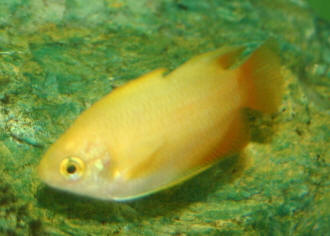 |
|
Re: Ancistrus help!
(selection; also Colisa chuna; toxic fumes)
3/26/09
Thank you Neale - your responses are always helpful and prompt
which is just great!
<Happy to help.>
I think the 'shark' will have to find a new home soon,
before he chases anyone or harasses them. My local pet shop has
some baby Ancistrus bred in the shop (very nice they are too) I
will see if he will do me a swap. Will also consider a few more
upside down catfish in a couple of weeks.
<Cool. Baby Ancistrus don't always travel well, or more
specifically, they can become starved in pet shop tanks, and so
lack the energy reserves to handle transportation and being
settled into a new home where they may have to compete for food.
If their specimens are clambering about on the glass, take a peek
at their bellies: they should not be concave. Some of the better
pet stores keep bits of cucumber in their tanks for the Ancistrus
to nibble on, in which case, so much the better.>
Sadly today I lost a little Gourami (I missed these off my list,
they are small golden or honey Gourami, also adopted from someone
just before Christmas) yesterday evening it did not feed, this
morning before school run it was struggling to swim against the
current of the filter - dead when I got back from school. No
external signs of any illness at all.
<Colisa chuna is not an easy species to keep, despite its wide
availability. Indeed, when I started keeping fish as a teenager
back in 1980s, they were considered quite "specialist"
fish because of their need for soft, acidic water. So when you
saw them, they were usually expensive. Nowadays they are mass
produced on farms, including some non-natural colour forms like
the one in your image. While they may be less expensive and
certainly easier to obtain, I'm not yet convinced they're
"easy" fish. I wouldn't really consider them
community fish, but rather better kept in either a single-species
aquarium or in a tank with very small, non-aggressive fish such
as Marbled Hatchetfish or Dwarf Corydoras.>
I tested the water again - it was as it was on Monday after the
water change, 0 ammonia, 0 nitrite, 10 nitrate.
<All sounds fine.>
Now I am a bit paranoid. Last weekend I varnished some wood
nearby, but I kept the doors to the room the tank is in shut, and
all the windows around the varnished area open. Other than this
nothing has changed.
<Ah, in theory, yes, paint and varnish fumes can kill fish.
Since Gouramis breathe air directly, they'd be especially at
risk; fish that breathe water will only be exposed to the smaller
percentage of the toxic chemical that dissolved in water. That
said, if you open windows, you certainly can paint rooms and
whatnot without expecting all your fish to die. I would recommend
leaving the windows open for at least 24 hours after using
paint/varnish though. If you were worried, this would be one of
those times where adding fresh carbon to the filter would make
sense; carbon removes organic chemicals, reducing the risk of
harm. As you may know, carbon is used for precisely this function
in gas masks for humans as well as in emergency medicine for
removing poisons.>
I am keeping a very close eye for signs of unusual behavior now.
At present everyone else is feeding well (flake and algae wafer
this morning) and all darting about merrily.
<Cool.>
Attached is a pic of my Gourami (pre death!) He had a big bit of
dorsal fin missing when I got him (he came from another local
person getting rid of fish), which did not seem to affect him at
all.
<Fins usually grow back in time, so unless there's Finrot
or Fungus, damage to the fins isn't something that I
personally worry about when selecting fish. If you look at photos
of wild fish from the Amazon, they've all got bloody great
chunks of fin missing thanks to the numerous fin-eating
characins!>
Thanks
Sarah
(enjoying my new subscription to PFK and spotted your name in
it..)
<Glad you're enjoying the magazine.
|
|
Sexing Honey Gourami 3/12/2009
Hi,
I recently bought a couple of beautiful Honey Gourami and cannot
figure out the sexes? As far as I've researched females and
males look the however the males are more brilliant in colour.
Mine are a beautiful honey colour and am thinking they are both
male???? I attached a picture of them, can you tell what they
are????? There are two of them and they look identical to me?
Thank you,
Sheri
<Sheri, you have the artificial form rather than the proper
wild-type fish, so advice on sexing these fish won't really
help. In proper Colisa chuna, the sexes look fairly similar
outside of spawning, basically honey brown,
but when sexually mature males become brighter, almost orangey,
and develop a large black patch across the face and down along
the ventral surface.
Females also tend to have a dark longitudinal band along the
midline of the body, but stressed males will show this feature as
well, so it isn't 100% reliable. The males of the artificial
forms don't seem to show much colour
variation, and if the females are traded at all, I have no idea
how to tell them apart. At least some retailers stock
colour-enhanced or dyed fish, further complicating the issue.
Your photos aren't sharp enough for me to hazard a guess, so
the best I can do is recommend you observe your fish closely for
behavioural differences. Only males build bubblenests, and only
males exhibit territoriality. Cheers, Neale.>
|
  |
Re: Sexing Honey Gourami 3/12/2009
Thank you very much for your help, I appreciate it! I had no idea
they were artificial or that that was possible. I am new to this
hobby and absolutely love it however I feel every store I go to
either gives me bad information
or no information. I thank you very much for this site and I
think what I'll do is call the store :)
Thanks again,
Sheri
<Hello Cheri. We're happy to help. Yes, these are an
artificial (in the sense of bred by humans) form deliberately
selected for these colours rather than their natural ones.
There's nothing wrong with them though, for all that! It does
seem a lot of stores, particularly the big chain pet stores,
stock male fish only. So obtaining females can be hard work. As
for information from your pet store, while some stores are good,
and some less
good, nothing beats doing your own research first. Visit your
public library and peruse the pet fish section. Find a book you
like, and settle down for a couple hours reviewing the types of
fish you want to keep,
checking their specific needs. Honey Gouramis for example are
small, a little on the delicate side, and easily bullied. Mixing
them with peaceful tetras such as Neons would be fine, but adding
something nippy like Black
Widow tetras or Serpae tetras wouldn't be at all wise. Since
Mollies need salt, whereas Honey Gouramis need soft water, this
would be another bad combination. And so on! It's much like
gardening: thousands of plants out there, but only a tenth would
work together in your garden considering size, soil type, winter
temperatures and so on. Cheers, Neale.>
Re: Sexing Honey Gourami 3/16/2009
Hi,
I called the store I purchased my Gourami from and he said they
were gold honey Gourami????
<Yes.>
He didn't mention anything about them being artificial, I
didn't ask, I'm not that concerned. However the other
night, and I've seen it a couple times since, I've seen
them do a little dance, they start circling while
turned into each from head to toe and spin around slowly.
<Do fish have toes? Heh, heh.>
They don't seem like their being aggressive or anything????
Is this a mating dance of some sort????
<Could be either. When fish fight, the head-to-tail display is
common: by swishing water at each others' faces, each fish
gets an idea of how strong the other fish is, so can make the
decision about whether to swim away or keeping fighting. At least
some male/female pairings are similar, probably for the same
reason, each fish sizing up the health of its potential
mate.>
Sheri
<Cheers, Neale.>
|
Poorly Gourami (Red Robins; taxonomy,
health) 2/11/09 Hello Crew! I've had a look
all over the internet and at your recently answered question but
haven't found anything that really applies to the problem my
Gourami has, so i hope you don't mind me emailing! He's is a
'red robin' honey Gourami who i have had for about 6 months and
always been well. Yesterday i came home to find him sitting at the
bottom of the tank with a slightly rounded underside - just around
where i assume his swim bladder is, at the base of his feelers. He was
moved about a week ago from my previous 30 litre tank to a new 120
litre. I have given the tank a water change and the water results are
still within the normal parameters (I'm going to test again this
evening). I've also put some peeled peas into the tank but he
doesn't seem to be interested in them. He is currently sitting at
the bottom of the tank and taking the occasional trip to the surface
for a quick gulp of air, then sinking slowly back to the bottom. Also,
when he's swimming he seems to be finding it difficult and his lips
look a bit greyer than usual. The only other thing apart from the new
tank, that has changed, is that i bought 3 small Corys at the weekend,
one of which died within 48 hours after barely moving. My second honey
Gourami is still behaving absolutely normal and the 2 remaining Corys
are perfectly fine. Can you give me any advice? Should i quarantine
him? I've also been reading about some antibiotics that aren't
compatible with gouramis and others that shouldn't be used when
Corys are in the tank! Any info you could send would be great - i
can't get to my local fish shop until tomorrow evening. Many thanks
for your time Jess <Hello Jess. Red Robin Gouramis are curious fish
because nobody really knows what they are! Several different fish are
sold under the name, most commonly a hybrid between Trichogaster chuna
and Colisa lalia, often, though not always, fed with colour-enhancing
foods to make their colours brighter than they actually are. Quality is
extremely variable, and like a lot of fish mass produced in Southeast
Asia, bacterial infections can be a real problem because of the
widespread use of antibiotics on the fish farms. Whilst they don't
seem to get the dreaded Dwarf Gourami Iridovirus (DGIV) they aren't
the hardiest of fish and lifespan is often rather short. Sometimes Red
Robins are merely red-coloured Colisa lalia, in which case DGIV is a
risk, as well as all the usual bacterial problems Dwarf Gouramis are
prone to. Inbreeding is an issue here, and indeed with almost any fish
that doesn't have its wild-type colouration. That's a point
worth reiterating: when you shop for tropical fish and you decide to
get a "fancy" form, you're doing a trade-off between
genetics and physical appearance. Finally, some Red Robins are fancy
Honey Gouramis. Again, inbreeding is an issue, but on top of that you
have the problem that Trichogaster chuna is simply not a fish that does
well in hard water, so unless you have soft, slightly acidic water
conditions, it's a species to avoid. Having laid out the problems
identifying the fish, treatment is somewhat difficult to suggest. DGIV
is impossible to cure, so if that's the case, there's nothing
much to do beyond painless destruction of the fish. Internal bacterial
infections are extremely common among these fish, and only reliably
treated with antibiotics. In the UK, these have to be obtained from a
vet, and the so-called "anti-internal bacteria" treatments
sold in fish shops in the UK are, frankly, useless. Never once heard of
a fish cured of anything by using them. Antibiotics used properly
(i.e., as per your vet's instructions) will be perfectly safe with
your Gourami. Internal bacterial infections often caused abdominal
swelling followed by distinctive raising of the scales along the flank,
so that viewed from above the fish looks like a pine cone. At that
stage a cure is unlikely and again, painless destruction is the only
humane option. http://www.wetwebmedia.com/euthanasia.htm Constipation
is a problem with Gouramis since most are partially herbivorous in the
wild, and careless aquarists often forget this essential fact. If
squashed tinned (or cooked) peas aren't accepted, then Daphnia may
be, and these are almost as good. Obviously Gouramis are slow feeders,
and if there are tetras or barbs in there, the Daphnia will be eaten
long before the Gourami gets a therapeutic "dose", so
you'll have to work around that using a hospital tank of some sort.
If the Gourami is healthy-looking apart from the swollen abdomen, then
constipation may be the issue. Adding Epsom salt at 1 to 3 teaspoons
per 5 gallons can help with constipation alongside the high-fibre
foods, but remember to stop adding Epsom salt once the fish is better.
Hope this helps, Neale.>
Honey Gourami ID 10/17/08 Hello
Crew, I had read great things about the Honey Gourami: small, peaceful,
reasonably hardy, and beautiful, so when I came across these at the
LFS, I sort of impulse bought this pair of fish. They were labeled as
'Honey Gourami, Colisa sota, but after bringing them home and doing
some more research, I don't think these are really Honey Gouramis.
I read on WWM and other sites that these bright red fish may be hybrids
or sports of another species. <Indeed; suspect that is the case
here. In any event, not a "wild-type" fish of any species.
Not pure Dwarf Gourami (Colisa lalia) or Honey Gourami (Trichogaster
chuna) either. There are fish sold as "red honey Gouramis"
and these are of unknown genetics and maybe even different fish in
different countries.> I've compared my fish to pictures of C.
lalia, fasciata, labiosa, and sota, and they look close but not exact.
<Agreed, certainly not the wild-type of any of them. They have a
too-long body (to my eyes) to be Colisa lalia or Trichogaster chuna.
Actually look like some sort of hybrid with Colisa fasciata because of
the length of the body.> My questions are: What species are they?
Are these hybrids? Will hybrids reproduce? <Some hybrids will breed
without problems. It's a case of "try it and see".>
One has a pointed spear-shaped dorsal tip, and the other's is
shorter and rounded. However, looking at them with a light behind, they
both have identically shaped viscera and swim bladders (at least to my
eyes, and I don't really know what to look for). How are they
sexed? <Likely the one with longer fins is the male.> Do I have a
pair? Are females generally not sold/available? <In some markets
(e.g., the US) female Dwarf Gouramis aren't sold, but certainly
here in England male and female Gouramis of all types are
available.> Their color did not fade in the bag on the way home, nor
in the white bucket that I put them in to acclimate. They remain as
bright red as they were at the LFS. Does that mean they are
artificially colored? <May be enhanced somewhat by using
colour-enhancing food, but the basic colouration has been bred into
them.> I hope I didn't buy injected, dipped or otherwise dyed
fish. <Nope.> Thank you, Nathan <Cheers, Neale.>
| Angelfish, Gourami, and
Compatibility - 02/07/2007 Hi my name is Sharon Goglin. <Hi
Sharon, my name is Sabrina Fullhart.> I am 10 years old and
pretty much a beginner with fish. <Wonderful!> I have a big
Marbled Angelfish and a Gourami with an orange-red tail.
<Uh-oh! The Gourami with the orange-red tail is
probably a very young Osphronemus laticlavius; this is the giant
red-tail Gourami. Here is a little bit of information
about them: http://www.fishbase.org/Summary/speciesSummary.php?ID=16572&genusname=Osphronemus&speciesname=laticlavius
. This is the only Gourami that I know of off the top of
my head that has an orange-red tail. This fish will get
HUGE - 50 centimeters (20 inches) long! Also, they are
notoriously aggressive.> I put these fish together and they keep
pecking at each other, and I don't know if they are really
hurt. <One or the other will be in time.> But every time I
look at them they keep going at each other. I don't have
another tank, and my mom or dad won't buy another one because I
have 5 (I'm an animal freak!). <Well, a tank big enough for
a 20 inch fish would need to be over a hundred gallons anyway - and
though your Gourami will take a long time to get that big, he will,
eventually.> And I want to put my Gourami in the other 4 tanks
but I don't know if they are compatible with Male Bettas,
Female Bettas, Guppies, or Goldfish. <If the goldfish are very
large, and in a very large tank, he might be okay with them, but
only for a while. I would really recommend trading him
back to the fish shop for something more compatible with your other
fishes.> Are Angelfish and Gourami even compatible? <Not
really, for the most part. Trichogaster leeri, the Pearl
Gourami, would be a much safer option. These are much
more "relaxed" and not as aggressive as some other
Gourami species. Dwarf Gourami are usually less
aggressive, as well, and some are very, very pretty.> How do I
stop the pecking? <They will only stop when one is removed from
the tank, unfortunately.> I NEED HELP! <Well, you're off
to a good start, looking here and researching!>
Thanks, -Sharon <Thank you for writing to us,
Sharon! All the best to
you, -Sabrina> |
|
|
| Angelfish, Gourami, and
Compatibility - 02/08/2007 Hi! It's me, Sharon again!
<Hi, Sharon!> Is this the kind of Gourami you had in mind?
<Nope, not at all! This is Trichogaster chuna,
usually called the Honey Gourami. This little fellah
should stay rather small - under three inches for sure, probably
closer to two. They're often great community fish,
but sometimes the males are very aggressive. If the tank
is large enough (say, 30 gallons or so), the angelfish and the
Gourami might eventually stake out their territories and stop
trying to fight, but if either of them seems to be getting hurt at
all, you really will need to take one or the other
out. The Gourami would not do well with goldfish, since
goldfish like cooler water, but female Bettas or guppies might make
good tankmates, IF the tank is big enough for him to not feel
"crowded." This is exactly what my fish looks like!
<They're very pretty, aren't they? One of my
favorites!> Thanks Again, -Sharon <Wishing you
well, -Sabrina> |
Red honey Gourami, Trichogaster
chuna, gen. care - 11/20/07 Hello Crew, <Hello
Mark.> Currently I have 20 gallon moderately planted tank with
following fish: 2 golden rams 6 harlequin Rasboras 4 Oto cats I'd
like to add 2 Gouramis, preferably honey. I've never kept Gourami
before and I'd like to ask few questions: Do I have space to add
any fish? <In terms of water quality, yes. But the Rams may take
exception to competition for space at the bottom, and will beat the
life out of small Gouramis.> Are Gouramis and rams compatible?
<In my opinion, no. I don't personally consider labyrinth fish
(climbing perch, Gouramis and Bettas) to be compatible with cichlids.
They demand similar resources, but cichlids tend to be more aggressive.
There are exceptions to this, but as a rule, I personally recommend
keeping one or the other except in really big tanks.> Will Gouramis
destroy my plants? <No.> What is red honey Gourami? <It's
a tank-bred variant of Trichogaster chuna, or maybe a hybrid between
Colisa lalia and Trichogaster chuna, or even a plain vanilla
Trichogaster chuna that's been "juiced" up with
colour-enhancing foods. Opinions vary. In any event, they're
cranked out of Southeast Asia and have a less than stellar reputation
of hardiness and longevity.> Are they hardy fish? <No. Even plain
vanilla Trichogaster chuna are delicate fish in anything other than
soft, acid water. Fancy varieties would be a notch or two down from
even that.> What kind of fish would you recommend for my tank if
Gourami is a bad choice? <I'd perhaps look for things to live at
the *top* of the tank, where the Rams won't be going. Small
livebearers, such as Endler's guppies, aren't an option because you
need soft, acid water for Rams. The high temperatures Rams need (26-30
C) cross Danios off the list, too. But certain killifish such as
Aplocheilichthys normani might be an option, as would Nomorhamphus spp.
halfbeaks. Hatchetfish can work very nicely in well-maintained tanks,
though they are somewhat delicate at first and tend to be nervous
unless kept in reasonable numbers (six at least).> Thank you for
your help, <Cheers, Neale.>
|
|


