 |
|
| Home | Marine Aquariums |
Freshwater Aquariums |
Planted Aquariums |
Brackish Systems |
Ponds,
lakes & fountains |
Turtles & Amphibians |
Aquatic Business |
Aquatic Science |
Ask the WWM Crew a Question |
| Please visit our Sponsors | ||||
Care on Thorichthys helleri? 10/16/17 Firemouth cichlid with whirling disease
2/12/15 Firemouth Cichlids, repro. 12/7/13 Firemouth bully 9/15/11 1/2 inch Firemouth and 3 1/2 inch Convict cichlid in 35
gallon, incomp. 1/21/11 Bloated Firemouth. 8/5/10 Firemouth pair hatched babies in community tank --
2/5/10 Firemouth Compatibility Firemouth Cichlid Having Trouble Breathing -
7/6/09 Cichlids (Thorichthys; colours, behaviour)
8/31/08 Re: cichlids (Thorichthys; colours, behaviour)
8/31/08 Re: cichlids (Thorichthys; colours, behaviour) 9/2/08 Thanks for your email. So what could I do over the lights? Thanks <What do you mean "over the lights"? In terms of providing shade, plastic/silk plants are available up to 90 cm/3 feet in length, and these can be trailed across the surface of the tank very effectively. Some types to catch a lot of silt, so choose varieties without really fine leaves so that you can clean them easily. You can also make sure that the substrate is nice and dark, so that the least amount of light is bouncing back up towards the fish. If you have plain vanilla gravel, mixing in a couple of bags of black gravel will take the overall reflectiveness of the substrate down a notch or two. Large pieces of bogwood will provide shade while tinting the water brown, and this tends to encourage fish to show their brightest colours. Do bear in mind that bogwood also has the potential to reduce pH, and that's something Central American cichlids do not necessarily appreciate. So check your carbonate hardness, and if it's low (below, say, 5 degrees KH) be careful about adding wood and periodically check the pH to make sure it remains stable at around 7.5. Finally, you could swap out existing lights for ones with a lower colour "temperature". Bright blue-white tubes (6500 K upwards) are great for corals and plants, but tend to encourage fish to fade their colours in an attempt to blend in. Pinkish tubes such as Gro Lux (3400 K) don't do this, and furthermore the pink light makes red colours on fish stand out much more. Overall colours will seem more intense and warm. Cheers, Neale.>
Sick Firemouth With Swim Bladder Problem 3/6/08 Hi, I am hoping some-one can help me. I have a sick Firemouth. She has, what i think is swim bladder (I came to this conclusion after hours of searching the internet). At first she was just on the bottom of the tank and would still swim up for food but then just sank to the bottom. Now after all treatments I can find to use, she is now on her side and doesn't seem to eat at all. She was in a tank with her partner and other fish such as green terror, rams and a few other cichlids which are all doing fine. I do regular water changes and run an external filter on an undergravel system and every thing is running fine. I have now moved her to another tank to be treated but nothing seems to be helping her. I really don't want to loose her as she is one half of my breeding pair and her partner is looking lost is there any thing else I can do. Many thanks Georgina < You did not mention which treatments you had tried. Now that you fish is in a hospital tank I would recommend using a combination of Nitrofuranace and Metronidazole. Keep the water clean with water changes and raise the water temp to 82 F. The rams only get a couple of inches long. The green terror will get very big and soon eat your rams.-Chuck>
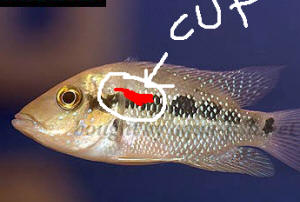
Cichlid cut/wound??? 2-05-08 Please help me. I have a Firemouth cichlid who has what looks like cuts, or wounds near his dorsal fins. It is right below his dorsal fins and not exactly on his dorsal fins. The "cuts" are a pink/whitish color. He still is very active and eats fine and has no discolorations. What is this "cut". I am not sure if it is fin/tail rot. His fins and tail do not seem ripped and seems perfectly fine. Is it normal for him to have "cuts" below his dorsal fins? Thanks for your help. <Yes, this sounds exactly like Finrot. Treat at once with a medication such as a Maracyn or eSHa 2000. Finrot doesn't cause fish to lose their appetite until it infects the body cavity, at which point the fish will likely die regardless of treatment. So treat now! Do also try an establish the cause: Finrot almost never comes out of nowhere, but is usually associated with poor water quality and/or physical damage. Firemouths are gentle (by cichlid standards, anyway) and easily damaged by more aggressive species like Convicts and Red Devils, so mixing these species isn't a good idea and often ends with the poor Firemouth getting hammered. As for water quality, at the very least do a nitrite test just to see what the situation is on that front, even if everything looks fine. Cheers, Neale.>
Convicts... repro.... no, Firemouth beh. 01/13/2008 Hello, I wanted to thank you guys for all your help. My convicts just laid tons of babies and I am so happy. Thanks for all your advice and help. However, I have a question for you, in general, about how long will it take for my blood parrot and Firemouth cichlid to reach full size? <Depends on many environmental factors as well as genetics, but most non-dwarf cichlids will reach sexual maturity within the first year, often within six months, but full size may take as long as two years to reach.> Also, my blood parrot has black spots but really little, not covering his whole body. I read that it was the black spot disease. I am not sure. <Black Spot Disease is typically caused by parasites that can't complete their life cycle in aquaria. So provided you don't have so bad an infestation that secondary infections are an issue, it usually clears up by itself once the parasites mature.> I did a 50 percent water change and it was still there is this normal? <Not normal, no.> Last, my Firemouth cichlid is very shy, no one is bullying him and he is always hiding. <Firemouth cichlids are easily bullied and relatively mild. Convict cichlids, particularly breeding pairs, can easily scare them. They also appreciate large tanks with lots of shade (floating plants especially). So environmental issues likely a factor here.> He eats shrimp pellets but that's all. He doesn't eat any flakes or brine shrimps I feed him. Is this normal? <Firemouth cichlids (in fact the whole Thorichthys genus) are "earth-eaters" and sift sand and mud to remover primarily algae, as well as (to a lesser extent) small invertebrates such as worms and insect larvae. So make sure your tank has a sandy substrate, and you are offering these sorts of food items and your Firemouth will do the rest. Too often these fish are kept in tanks with gravel, which frustrates them and inhibits their normal feeding mode, never a good idea.> He seems completely normal and healthy except for his shyness. What could be wrong with him? Once again, thanks for helping me with such great advice and thanks for all your help. <Hope this helps, Neale.> Firemouth Cichlid Not Eating 1/7/08 Please help. My Firemouth cichlid is not eating. He is always hiding and seems shy and scared. I have a blood parrot that doesn't fight with him and I have Danios and platies. The water parameters are all fine nitrite 0 nitrate 0 ammonia 0 and I recently did a water change. He isn't eating. He looks healthy though. However, I just got him yesterday. Could this be why he isn't eating? Is he adjusting to his environment? I usually feed my fishes brine shrimps, pellets, and flakes. Please help. I don't want my Firemouth cichlid to starve and die. < Fish can easily go a few days without eating, even a week. Once he gets the tank pecking order figured out he should be out and about in no time.-Chuck> Dead Firemouth 7/29/07 Hi Crew, <Hi Spyros, Paul here.> I am writing to ask your professional opinion on the possible causes of death of my Firemouth Cichlid. The tank specifications are the following: Volume: 100L pH=7.6 [NH_3]=0 [NO_2]=0 [NO_3]=0 T=33 deg Celsius Filtration: Rena Filstar (able to handle up to 200-250L tanks) Aeration: Air pump 250l/h Aeration and filtration set to maximum The tank was stocked with a 6cm Firemouth and a 5cm Leopard Pleco (G. joselimaianus). Their nutrition is based on cichlid and Pleco pellets, supplemented occasionally with frozen bloodworms. I am also using a multipurpose vitamin concentrate. Full water changes, filter and gravel cleaning are performed on a monthly basis and smaller water changes every two weeks. <Well, although you don't mention the Filstar model you employ, it is a safe bet that you have enough filtration if you are providing roughly twice that of the manufacturers suggested aquarium size for each particular model. This rule of thumb works for the smaller end of the spectrum of volume and breaks down once the volume begins o reach medium sized ponds and very large tanks. Don't ask me why this is, it's just an observation. However, 0ppm nitrAtes indicates that there is a discrepancy somewhere. Perhaps the test wasn't carried out correctly? Only the most heavily planted tanks with the smallest fish can maintain a nitrAte reading of 0ppm. Another way would be that you just did a total water change. Either that, or you perform massive water changes very regularly. Please reply with clarification. Also, try to elaborate on behaviors such as swimming patterns, appetite, feces and other stuff from recent history. -Paul> Firemouth death (follow-up letter) -- 07/30/07 <greeting Spyros> I am writing to ask for your professional opinion on the potential causes of death of my Firemouth. My system's specifications are the following: Volume: 100L Filtration: Mechanical & Biological (EhfiSubstrat) (filtering capacity up to 200-250L) Aeration: Mechanical Pump 250L/h Lighting: 1 natural daylight, 1 Gro Lux (red) 40W each Lighting Period: 7h pH=7.6 [NH_3]=0 [NO_2]=0 [NO_3]=0* Water Temperature= 33 deg Celsius <If my conversion is correct that is equivalent to 91.4F which is way too high. I keep my Firemouths at 76F/24C> *The tests were performed right after the death of my Firemouth. It seems odd that the concentration of nitric ions was minimal, although the last 50% water change I performed was 1 month ago. 50% water changes are performed once a month and smaller water changes (about 25%) every second week. I am feeding Cichlid pellets (Tetra Prima) and Pleco tablets, supplemented with frozen bloodworms. I am also using a multipurpose vitamin concentrate (sera fish vitamin). The tank was stocked with a 6cm Firemouth and a 5cm Leopard Pleco (Glyptopericthys Joselimaianus). <This is an acceptable water change schedule, feedings, and bio-load> I have to note that as I am living in a very hot climate (Greece) with temperatures rising to 40-45 degrees Celsius, I have always had trouble keeping my fish healthy during summer periods. I have noticed that every summer my Firemouths were changing their aggressive behaviour to a more passive one. They remained hidden almost all day long and decreased their food consumption but otherwise showed no health problems. This summer was no exception up until recently. My Firemouth displayed the behaviour I described above, but until its final day did not display any signs of deteriorating health. And this is how it died. A couple of hours after feeding the fish, I came to check things up and found out that it was stuck between two large pieces of lava rock. I tried to set it free and it seemed to me as though it had broken its right pectoral fin. It didn't seem to have any other external injuries. However, it displayed a very peculiar swimming pattern. It seemed as though it was unable to swim in an upright position, turning upside down and from side to side. It managed to get behind a large driftwood root and then it started to thrust its head towards the wood and the gravel as if trying to commit suicide. Then it opened its mouth widely and for a moment it seemed unable to close it, as if it had dislocated its jaws. However it managed to close its mouth and find its balance to swim to the surface. There it turned upside down again and started to swim around the tank. Finally it settled down on the gravel, turning to its right side and breathing slowly to its death. <I can only guess as to the actual cause of death, but I assume a bacterial infection and damaged swim bladder. The high temps proliferate harmful bacteria and reduce the water's ability to hold adequate oxygen levels. Aerating the water is an excellent idea. I would suggest a fan be blown across the surface of the tank to combat higher temps. This is known as evaporative cooling.> I have never seen anything like this before and that's the reason I would like to consult your opinion. I should note that I am the only person with access to the tank and so any causes of external threats (chemical poisoning, etc) are not to be considered. I think that either the fish was sick and I was not able to diagnose the symptoms or it didn't pull it off with the heat. The Pleco on the other hand seems very healthy and I have read that this kind of fish tend to be prone to parasites, which flourish in such high temperatures. So I think that the "heat shock" scenario is the least likely. <If your Pleco was hosting prolific numbers of parasites he too would be sick. I again believe the high heat in conjunction with low dissolved oxygen levels and ideal conditions for harmful bacteria such as Septicemia would more likely be the cause> Moreover, I am considering a radical redecoration of the tank and I would like to ask how it is possible to keep the Nitrosomonas population (in the filter) alive while minimizing any potential bacteria or virus transfer into the new tank. If the fish did die of parasites, would these infect the Nitrosomonas colonies also? And if this is the case wouldn't the Pleco have shown disease symptoms by now? <Again, parasites would be visible with signs of actually seeing them on the sides of the fish or in the gill plates or there would be reddening of the gills/hemorrhages, etc. I do not believe that parasites are the problem unless they were internal in which case you would see long white feces and the fish would not want to eat. You would have no problem keeping the bacterial colonies alive by just cooling the water to below 86F/30C and letting the filter to continue to run. I believe cooling the tank is paramount to long term survival of future stockings. The use of a 5-7watt Ultraviolet Sterilizer would also help> Thank you in advance for your help Spyros <hope I have helped you, Rich aka Mr. Firemouth> Firemouths in Peaceful, Community Tank/Overstocking 5/8/07 Hi there, <Hello Anna, Pufferpunk/Jeni here.> First of all, congrats on the brilliant advice you guys give. Keep up the good work! <We'll try. Thanks for the great compliment!> Now then, I have a 120L Juwel Rekord aquarium <For USA folks, that's around 30 gallons.> Here's some info on filter type and a pic; http://badmanstropicalfish.com/products/product_Juwel_Rekord%20_120.html It is 3 months old and fully cycled, nitrates at 18ppm, pH 7.5 and temp 78 degrees. The current residents are; 2 platy (F) 3 Glowlight tetra (2M 1F) 5 WC Mountain Minnow (1F 4M) 2 Honey Gourami (M&F) 4 Neon Tetra (not sure) 2 Wild Green Neon Tetra (not sure!) ps - these guys are only around 2cm fully grown) 3 phantom Tetra (2M 1F) - was mistakenly given 2 males when asked for 2 females 2 Peppered Cory (not sure) 1 Betta (M) I Know this totally breaks the into to gallon rule but they all seem happy enough and have their own territories. <That "rule" is only for small-massed 1-2" fish (mostly tetras). Anything larger, like gouramis, aren't included. That rule isn't necessary just so fish can have their own territories but mostly for controlling bioload (nitrates). Large weekly water changes will be necessary to keep this tank healthy.> The tetras and minnows all get along great and the gouramis, platys and Corys keep to themselves. The Betta is extremely placid and a friendly-natured little fish. <Bettas generally do not get along with other gourami species.> My tank is planted with assorted freshwater plants, around 10 of varying sizes, a very fine Dorset pebble substrate, 2 pieces of driftwood that form cave-like structures, a rock cave ornament and an ornamental rock. <Sounds like a nice tank.> Anyway... Here's the big problem. I arrived home from work a few days ago to find my idiotic boyfriend had added 2 fish to the tank as a surprise for me. <I hope you gave him a piece of your mind! That tank is overstocked as it is. Never mind, he didn't quarantine the new fish & they could have wiped out the entire population.> And WHAT a surprise it was! He's only gone and bought 2 Firemouth cichlids! <Oh no!> After preventing myself from strangling him, I observed the cichlids and they seem pretty content. Up till now, there has been no aggression. <For now... Just wait till they get comfortable with their surroundings. They are quite aggressive & will eat any fish they can fit in their mouths.> They are juveniles now but I know that they can grow to 15cm. <6"> Obviously it's out of the question for me to keep them. <Correct> I've read some reports that they can be good community fish and temperaments vary between each individual fish. Could this be true? <Cichlids are cichlids. All aggressive in some way & Firemouths especially.> I have grown quite fond of them, as they are beautiful and interesting. <Agreed, I have 2 stunning adults myself, in a 125g tank, along with several other large, aggressive fish.> I'm guessing I should get rid and pronto. <Absolutely!> What can I do with them? In your knowledge, do you know if pet stores will accept fish from a stranger? <What about the shop he got them from? I'd go in there & throw a stink about how they can sell these kind of fish to someone, not asking about the tank they're going into. He should have been told about their temperament & appetite for smaller fish. On the other hand, he should have asked!> Also, do you think my tank is over stocked? <By a few fish but if you do large weekly water changes, they may be OK. The live plants will help. No more fish though!> Any advice will be much appreciated. Sorry about the length of this essay (lol) and thanks in advance. <I'd give that boyfriend a good talking to about giving ANY pets as a surprise gift. ~PP> Anna Firemouth behaviour, normal? 1/6/07 Hello, <Hi there> I recently bought a pair of Firemouth Cichlids approximately 2 to 2 ½ inches long and placed them in a 36' x 15' x 18' aquarium on their own. Seven days after I bought them they spawned and the female was quite protective, the male not so. Now, three days after, the female has left the spawn site and sits in the corner of the tank beside the filter intake. The male spends most of his time at the other end of the tank. My question is, is this normal behaviour? <Mmm, is normal... or not unexpected with a new pair of neotropical Cichlids... they'll get "better" with more practice, spawnings> I was under the impression that they both, or at least one of them, protects the eggs/fry quite well. I believe that the eggs/fry have been removed from the rock and maybe put in a pit (which is out of view to me) but this is not where either parent now spends their time. If the spawn is successful, how long do you recommend I keep the fry with their parents (Firemouth only tank)? <The first batch... may not hatch out... or develop completely... You could leave them indefinitely with the parents... or move them in a few days, when the young, if viable, become free-swimming... I would leave all together this and maybe the next couple of times... Commercial breeders separate...> Also, after this spawn has taken place would it be advisable/workable to add more Firemouths? <Mmm, no... not in this small system/volume. I'd stick with just the pair> I saw another pair in the shop (the same age) and was wondering if adding more Firemouths would be ok and if so, how many (I read one opinion that in a 200 litre tank you could have eight Firemouths)? <This is too many IMO... too much stress, fighting to be expected> I would really love some assistance please. Thank you in advance for any help you can offer. Kindest Regards Michael. P.S. -- water parameters are -- pH: 7.4 - 7.6 ; GH: 5 ; KH: 3 ; Ammonia: 0 ; Nitrite: 0 ; Temp 27 degrees Celsius (all of which they spawned in) <Mmm, and do take a read on the WWM FW subweb re this species, Neotropical Cichlid Reproduction, Systems... the index, search tool... Bob Fenner> Re: Firemouth behaviour, normal? 1/7/07 Hi Bob, <Michael> Thank you so much for your prompt reply and assistance, it is greatly appreciated. If I may just add another point? <Sure> My male Firemouth (FM) has started showing aggressive behaviour toward the female. I haven't as yet noted any damage to her but this behaviour presents most often at feeding time. <Mmm, good that you're aware of this... and do be observant... many halves of cichlid pairs are lost during this familiarization period (If I may call it thus)... sometimes a good idea to place a physical barrier twixt the two for a week or so...> I understand this is likely to be expected (they are cichlids after all), however, I was wondering whether I should maybe add some dither/target fish to this set up or persevere with this one pair of FM? <Is another possibility, yes> If yes, what is best and how many? <Mmm, one or more... fast moving, smart, possibly armored... but I am a bigger fan of a partition...> I have quite a number of Bristlenose cat fish? <Good for the armored characteristic... though may consume eggs, young if present during spawning periods...> Once again, thank you very much for your assistance. Michael :) <Welcome... Do watch for overly-agonistic behavior... the chance of one partner "blaming" the other for lost spawns... Bob Fenner> Companions For A Firemouth Cichlid 12/23/06 Hi crew, I have a 100L tank running for almost 2 years. It is currently populated with one male Firemouth (4.5cm) and a leopard Pleco (4cm). I used to keep a group of 4 male Firemouths but the 3 of them died. I must note that as long as all 4 of them were alive, they seemed to get along quite well with one another. When the 1st of them died, their stress level increased and the biggest fish started chasing the other 2. Things got even worse when only 2 of them were left. I have read that cichlids in general tend to be aggressive especially towards their conspecifics (or similar species in size and coloration). I am thus thinking of adding a male blue Acara instead. What size should I search for? Should the Acara be bigger or smaller than the Firemouth? What other species is the Firemouth compatible with? Do you think that apart from the 2 cichlids I should add smaller community fish (or dither fish perhaps)? I am looking forward to your reply Thanks a lot Spyros <Firemouths are not the most aggressive cichlid but they can still be tough for other fish to get along with. Lower the water temp to 75 F. Get a blue Acara, Firemouth, convict, jewelfish or rainbow cichlid around the same size. Move all the rocks and ornaments to new locations, add the new fish and then turn out the lights for the night. In the morning they will be sorting out the pecking order and begin to establish their own territories. Add a group of giant danios or rainbows as dither fish to give the tank some movement.-Chuck> Firemouth Deaths 11/27/06 Hi Bob, I hope you could help me out with some problems I have with my aquarium. First of all I should mention that I own a 100L tank, with biological filtration, normal heating, lighting etc, decorated with 3 pieces of driftwood (about 30cm each) and lava rock. I also keep track of the water parameters on a regular basis and I have never experienced a sudden deterioration of the water quality so far. The tank is running for almost 2 years. My water parameters are pH=7.4, 0 ammonia, 0 nitrites, 5-10mg/L nitrates, and a temperature of about 25,5 deg Celsius. The tank was populated with 4 male Firemouths (sizes: 7,5,4 and 3 cm) and a leopard Pleco (4 cm in size). They all got along quite well, except for some occasional fights (none of them was severe). However, two months ago (24/9/2006) the smallest Firemouth died of no apparent reason. I checked the water parameters and found nothing alarming. The fish didn't seem to have external injury nor any parasitic infection (at least one that could be visible to the naked eye). On 21/11, a second Firemouth died. Having removed the dead fish I checked the water parameters and found 0.5mg/L ammonia (probably due to the dead fish), 0 nitrites and 20 mg/L nitrates. I have to mark that I noticed brown wool-like patches growing on the driftwood. I performed a water change, I vacuumed the gravel and removed the patches from the driftwood. Ammonia dropped to 0, and the nitrate concentration dropped to 10 mg/L. However, the brown patches started to grow again on the driftwood. Is it possible that the wood is rotting? (note: the wood is submerged in the aquarium water for 22 months, pH is 7.4) How often should I replace the driftwood? < The wood is actually rotting and the fuzzy growth is actually a fungus. Good hardwood does not do this. Softer woods are really not good in an aquarium.> In a week's time (26/11) another one of my Firemouths died. Like the previous case, the dead fish did not show any signs of severe injury (it did have tiny bites on its fins) or skin parasites. However the last two fishes died with their mouths widely open (the lower jaw was strikingly protruded). Is this any particular sign? As I didn't see any signs of infection I thought that the deaths were due to increased stress level, caused from the larger Firemouth (which after the death of my second largest Firemouth is claiming all the tank as his territory, bullying the other fish). What's your opinion? Are there any other parameters that I should check? What may have caused the deaths and why are the fish dying one after another? If they had an infection, wouldn't the dominant male also have the signs of a disease? What should I do next? I am planning to buy 3 new Firemouths and maybe get a pair out of them. How long should I wait for the situation to clear out (in order to see if all this is due to an infection)? Thank you in advance for your trouble answering all those questions Spyros Argyropoulos Athens, Greece < As far as Central American cichlids go, Firemouths are real pussycats. They are more sensitive than most of the other cichlids. There are external infections and internal infections. Both are caused by stressed induced by aggression from bigger meaner fish. Treat with Metronidazole for internal infections. Get a group of six fish and let them pair up. The other non paired fish will be pushed away and you will need to give them away or try and take them back to the store. The pair will lay eggs and raise a batch of babies that will need baby brine shrimp when they get free swimming. The pair may breed every couple of weeks. Lots of fun to watch.-Chuck> Firemouths Getting Ready To Spawn 9/26/06 Hello, I have a male and a female Firemouth and they have been acting different. I have got a 4 inch Uaru, an 2 inch green Severum and an blue Acara in a part of the tank and if they go out of that space they chase them back there. Can you tell why they are acting like this? thank u <Just before they spawn they pick and area to lay the eggs. They clean the area and guard it from all other fish. They will be spawning soon.-Chuck> Lumps on Firemouth Cichlid 9/27/06 I have a Firemouth that has two tiny lumps with a white center on it's back right where the top fin starts, and I noticed the same near it's left side fin. They look exactly like white-headed human pimples. I don't know if it is a coincidence or not, but a week before the bumps appeared someone ate my baby crawfish. I have a female Haplochromis who has a bump on her head, which looks exactly like the tip of a pencil eraser slightly sticking out of the back of her head. The lumps on these two different fish do not resemble each other. I thought since they were the culprits in eating the crawfish, they got parasites. I treated my 55 gallon with jungle clear parasite remover, but the lumps are still present. They both are acting perfectly normal, both eat and act normal, with the exception of the weird lumps that suddenly appeared. I don't know what to do, should I buy medicated food? I'm not even sure what the lumps are, I thankfully hope you will help me. < Since you have already treated the tank for parasite and the lumps are still there they are probably bacterial. Do a 50% water change, vacuum the gravel and clean the filter. Treat with Nitrofuranace as per the directions on the package.-Chuck> Firemouth cichlids, sexing 8/4/06 We have two Firemouth cichlids and are finding it impossible to sex them. <Mmm, not an easy cichlid to do so, particularly when small, of not-great genetic make-up, development> The smaller, darker one often does a vertical dance to attract the other which makes me think it might be male, while I've never seen the other one do anything but chase the smaller, and beaten up one, around. My brother tells me that one laid eggs at one point on the side of an aquarium decoration, but nothing hatched. <Might be two females...> Do only males do this little dance? Aside from unreliable things like color and fins, is there a better way to determine the sex of these cichlid? <Mmm, the unpaired finnage, color, size, behavior, anal vent appearance... is about it> Any help would be appreciated. We've exhausted our internet searches trying to find an answer. If we have two of the same, we'd like to get the opposite to try and breed these beautiful fish. Wendy <Have you read here: http://www.wetwebmedia.com/FWSubWebIndex/firemouths.htm and the linked files above? Bob Fenner> Aggressive Firemouths 3/20/06 Hi Crew, I have a 100 litres aquarium, originally stocked with 2 male Firemouths and 1 gibbiceps. One of the males was growing steadily, harassing the other inhabitants of the tank. The gibbiceps had quite large bites on his fins, but got away with it, without any problems. Unfortunately two days ago, I found it dead. I examined it thoroughly and found no external signs of disease. The gibbiceps did not display behavioral changes, loss of appetite or anything else that would indicate a disease. I think that it probably died because of excessive stress. I returned the large aggressive male Firemouth to my LFS and got a small gibbi and another male Firemouth (3cm). Now I have the older male Firemouth (4cm) chasing the newcomer all around the tank. He probably didn't like the addition. I am thinking of two alternatives for handling this aggression problem. 1) I should keep the two male Firemouths, adding a third one, to keep the older male busy with the new addition? 2/ I should return both Firemouths to my LFS and then restock from the beginning with two male Firemouths? Which one of them is best? Thanks, Spyros < Try to cool the tank down to 75 F. Move all the rocks and plants around. Add dither fish like rainbows or giant danios. If these don't work then start with two small Firemouths and let them grow up together.-Chuck> Stressed Firemouth Cichlid 1/30/06 Hello all, MITRA from INDIA here. My cousin has setup a new tank 36x12x14 inches) and he has added 2 small Oscars(1 inch),2 pairs of Firemouths(.75 inch) and 2 pairs of tiger loaches(1 inch each). The tank has been cycled for 1 month and all the fish are doing well except for one of the Firemouth breathing heavily. None of the other fish is doing so. He does 30% water change every week and the temperature is 28 c. We don't have the test kits and hence I can't give any more details. Please advise me why the fish is doing so. Thanking you in advance, MITRA < Heavy breathing is a sign of stress. It could be chased by all the other fish or the first signs of becoming sick. It could even be something like eating too much food. If nothing else changes then I would assume it is gill flukes and recommend treatment with Fluke-Tabs. If you can't get test kits then you probably won't be able to get any medication either. Add a teaspoon of rock salt per 5 gallons of water and see if that helps.-Chuck> Firemouth Female Worn Out After Breeding 12/28/05 Hi, I have a 420 litre freshwater tank with a pair of Firemouths and a pair of convicts. Recently the Firemouths have bred and the female has been guarding the fry, but she has not been eating. Today I found her lying prostrate on the bottom of the tank, having abandoned the fry, and only taking the occasional swim around the tank. I have moved her into a 170 litre quarantine tank because the convicts were beginning to attack her. The water quality is all fine, but she does appear to have symptoms similar to an intestinal obstruction. I was wondering if it is possible that she may have had an obstruction with the ovipositor when she was laying eggs, possibly leading to an infection? All the other fish are fine and healthy and showing no signs of illness or distress and as I said the water conditions are perfect. I am running a Sacem marathon 1500 canister filter @ 1600l/h and a UV sterilizer and a 2000l/h internal filter. This is also the first time she has bred, could this be a factor in that she was too attentive to her eggs/fry and neglected her own health by not coming out to eat ? Thanks for your help. < Breeding takes it toll on fish , especially the females. You are probably seeing a female that have lost a lot of body weight by laying eggs as well as guarding them to the very end. In her weakened state she may have come down with an internal bacterial infection. Separate her and treat her with Metronidazole. You might try and scatter some blackworms in the tank and get her back some body weight.-Chuck> Sexing Firemouth Cichlids 7/7/05 Hi, I recently purchased 4 young Firemouths from my local LFS all are between 2-3 inches in size. I'm hoping to get a pair out of the 4 so would return 2 back to LFS. Problem I am having is sexing the fish none are showing signs of pairing off (is it to early at their size?) < At this size you should start to see some pair off.> All flare at each other and whilst there isn't major aggression in the tank there is an obvious ruler! I initially think I may have 4 males! At what size will I be able to sex the fish and at what size are they likely to pair. < Look for differences in size and fin length. Females are smaller than males. Males have longer more pointed fins. Feed them well, give them plenty of good food and keep the water temp around 80 F.> If I have M/F out of the 4? < You have about a 75% chance of getting a pair out of these four fish.> All of the fish flare at each other do females do this? < All cichlids generally flair at each other independent of their sex.> Do females generally show aggression? < All cichlids show aggression.-Chuck> Thanks in advance for your answer Barry Sick Firemouth? Hi Crew, the last two days I have noticed that the starving Firemouth has undergone a color change! He became a little paler, not loosing completely his color though. Actually the typical grey coloration faded out, becoming almost white. Except for that, he developed four black stripes running the body from the dorsal fin down to its belly (resembling a convict). The fins also became paler and its eyes darkened. Sometimes he comes out to take a couple of pellets but then he hides out of view. What does this color change indicate? Should I move him to another tank if I were to treat him with medication? Thanks, Spyros < He is either sick or intimidated by fellow tank mates or disturbances outside the tank. If he is sick then you need to observe him for symptoms. Hiding all day allows you to see nothing so you can't determine what is wrong. If he is getting beat up or chased then rearrange the tank so that new territories can be established or add some dither fish like rainbows that will make him feel more at ease with some movement in the tank. The dither fish may also help with the fish getting use to traffic outside the tank.-Chuck> Firemouth Won't Eat Hi I am writing again about a male Firemouth that has lost it appetite. It stopped feeding 5 days ago. I have added some aquarium salt (to change the osmotic pressure a little) and a vitamin complex in the water. 2 days after I started the treatment, I managed to get him eat a couple of pellets. As he could not accept a lot of food at a time, I was feeding him 3-4 times daily. I tried to feed him with bloodworms, which seem to stimulate every Firemouth's appetite, but he did not accept them at all. The last two days now, he got back to his hunger strike, refusing to accept anything. Water parameters are fine: [NH3]=0, [NO2-]=0.05 mg/L , [NO3-]=12.5 mg/L, pH=7.5, T=28C What should I do? Would a higher temperature work? I think that raising the temperature to 30C would change his metabolism and maybe stimulate his appetite. Would this hurt the other tank mates (another Firemouth and a gibbiceps)? Thanks a lot Spyros < I always recommend that fish be fed once a day and only enough food so that all of it is gone in two minutes. I would recommend that you do not offer him any food at all for three days. After that feed him once and remove all the left over food after two minutes. If he still doesn't eat then he may have an internal bacterial infection and will need to be treated with Metronidazole.-Chuck> Firemouth Problems Hi Crew, my male Firemouth still refuses to eat anything. Moreover, the female (?!) started to bully him, chasing him all around the tank. He's now got some obvious bite marks on his belly! (By the way, this "female" has very striking coloration, not as pointed fins and genital papilla as the mail though and although she has about the same length as the male, she is "shorter". To my understanding, the characteristics mentioned above, except for the coloration, would suit to a female Firemouth. Can nonetheless a female Firemouth hunt down a male one?) < Sure it happens all the time.> My problem is that the male's conditions seems to be deteriorating constantly. At first he was doing great. He ate everything he was offered, he claimed all the tank as his territory and he was even chasing and biting the female all around. Then, when the weather started to heat up (and so did the water's temperature consequently), he turned his attention on trying to keep the female from getting to the food. During this phase, the female became more and more self-confident, claiming more and more space. The male on the other hand seemed to get weaker and weaker, unable to protect his territory and keep her from eating. Now it seems as though they have swapped roles! The male is hiding all the day round and the female doesn't let him come out to eat. Any suggestions? Should I return the female to my LFS until the male recovers? Is medical treatment necessary? Thank you very much for your help Spyros < The male has probably come down with an internal bacterial infection. I would do a30% water change, vacuum the gravel and clean the filter. Treat with Metronidazole as per the directions on the package.-Chuck> Firemouths nutritional problems Hi <Hello> my male Firemouth has been having feeding disturbances for the last 2 days and i can't find any apparent sign of disease. I feed him small pellets and bloodworms. Until now, he had accepted both foods. The last 2 days however, he seems as though he doesn't like them. He keeps chewing the food for quite some time and then he spits it out, either the whole pellet or small bits of it. I have also noticed that sometimes, after a lot of chewing, small food particles seem to come out of his gills. It seems as though he can not swallow the food. What does such kind of behaviour suggest? Is it due to intestinal parasites? <Most likely some sort of environmental decline... water quality. Other livestock is not similarly mal-affected?> What kind of diseases cause loss of appetite (or more precisely this type of behaviour that is not exactly loss of appetite but something like loss of digestive ability)? If you need more feedback, please let me know Thanks a lot Spyros <You have tested your water for...? I would institute a few successive, good-sized water changes... Twenty percent a day for three days... and see what happens here. Your fish will not starve in the meanwhile. Bob Fenner> FW Stocking questions Hi I have a 100-liters freshwater aquarium. I first introduced 2 male Firemouths, but they had quite a lot of trouble getting along with each other. I have read that 2 male Firemouths in an aquarium is a pure disaster, as they inevitably fight all the time. <Mmm, not in a large-enough volume> So I decided to remove the most aggressive and add in its place a female Firemouth. The female, was very shy at the beginning and the male bullied her a lot. Especially during feeding time, the male chases her all around the tank. Recently I have noticed that he started to display aggressive behaviour to my 5cm gibbiceps, <For others, this is a type/species of large Plecostomus> claiming his Spirulina tablet. The male Firemouth is now 4-5 centimeters long and the female is a little smaller. Apparently the two Firemouths have not (and will not?) formed a pair. Is this because the male has not reached sexual maturity yet or because the female was added later than the male? Would it be possible for the male to form a pair with a newly introduced female? <A number of possibilities here, but this tank needs a separator... barrier to keep these two apart for a while...> I am thinking of buying a male Nandopsis salvini. I have read that these fish are quite aggressive. Now, i understand that the male Firemouth that has settled in the tank for quite a long time will be aggressive to any new members of the tank. So, I am thinking that adding another aggressive male would turn the Firemouth's attention on protecting himself from the salvini and in that way would reduce the stress level of the female Firemouth. Is my thought correct? <Good ideas, but this system is too small for this addition> Would this help to minimize both the Firemouth's and the salvini's aggressiveness ? Would both males target the female? Would it be possible to end up with a dead fish, either one of the males or the female? What would your suggestion be? Should I add a female Firemouth instead? How would the male react in that case? Thanks for your trouble answering my long letter Spyros <Save up for a larger system... (If you were a native speaker/writer of English I'd have someone read over your messages... there is a lack of agreement in tense of your verbs/preterites, and number with some of your nouns...) Bob Fenner> Thorichthys meeki Query Hi I have a 25gal aquarium stocked with two Firemouths, a male and a female and a gibbiceps. At the beginning, I had two male Firemouths, but then I removed the most aggressive and kept the peaceful one. The male I kept, was very timid when at first but it has become rather bullying, when I introduced the female. I am now thinking of adding another fish, to give it more targets for its aggression. Is it better to add a Firemouth or a different species and would it be better to be a male or a female? Thanks Spyros <Rather than add, remove. Giving him more targets only INCREASES his stress level. A Firemouth, or Thorichthys meeki, can be considered a community fish only in larger aquariums (50 gallons and up). This fish grows to a very energetic 7 inches...Give him space. Ryan> Firemouth Bit Off More Than He Could Chew I tried throwing some Oto's to clean up in my cichlid tank. A few days, all was well, but yesterday morning I see a tail sticking out of my Firemouth's mouth. Nothing I hadn't seen before, except that the tail end was still sticking out last night, and this morning as well. I just got home from work and he still hasn't been able to swallow it down. I thought of netting the Firemouth and trying to pull it out, but I figure that I can end up tearing up his throat. He doesn't seem overly stressed about it, and has even kept up his harassment of a larger jack Dempsey in the tank. I believe he was even eating some of the flakes I threw in earlier. Having been at least 36 hours, what should I do? Keep waiting and hope he eventually gets it down, or try and pull it out even though I may do a lot of damage? Anyone else have this kind of problem before? < Unfortunately, Oto's like most catfish have stiff spines that they use for protection from predators. I would take him out and get a good look at the mouth. I would be tempted to take a pair of small scissors and cut the spines on the Oto and extract the body. Then use tweezers to extract the spines. If you can't pull them out then I would push them through and pull them out from the other side. Not often but it happens.-Chuck> Hot Firemouth Cichlids Hi, I have 2 male Firemouths in a 25 gal aquarium. The one constantly chases and bites on the other. The weaker one has 3-4 holes (bites) on its head now and a very long cut on his tail fin (it almost reaches the body). In the past, this fish has suffered similar injuries (torn fins, even bites on the head) but was healing very quickly. However, now it seems too weak, almost unable to recover, doesn't move around a lot. I am thinking of returning the stronger fish to my LFS (if I keep this one, it would be almost impossible to introduce new fish) and keeping the weaker one alone, for a week or two, until it heals completely. Then I will add a female Firemouth and probably a couple of blue Acaras. What's your opinion? Is my choice wise or should I be waiting for a probable loss of the weaker fish? Thank you very much for your help Spyros <The best way to start a tank is to get all the cichlids you want a small individuals of about an inch or so and let them grow up together. One or two fish in a tank is a sure disaster. I would recommend that you put the dominant Firemouth in a breeder net for awhile and add the rest of the fish into the tank (Acaras, etc...). I would add another Firemouth and at least three Acaras. Move all the rocks and ornaments around to different locations. At night before you turn off the lights you can reintroduce your feisty Firemouth. Turn down the water temp to 75 degrees F. The next day the fish will all be busy establishing territories. At around one to two inches they may start pairing up. The odd unpaired fish will be killed. I use lots of floating plastic plants to let the oddball fish hide in. The oddball fish can then be removed easily by placing a net under the plants and lifting them out. The remaining pairs will establish a territory at either end of the tank and guard the eggs and fry from the other fish. Males of both species get up to 6 inches so you better start thinking about a bigger tank soon.-Chuck> Aggressive Firemouth Hi, I have a 90 litres aquarium with 2 Firemouths and a T. gibbiceps. From the moment I introduced the Firemouths, one of them started to claim not a specific territory but the whole aquarium! The other fish is very shy, not trying to compete with the dominant over a territory and doesn't grow so fast as the dominant fish (although the 2 fishes have a very small difference in size). The dominant fish still after 1 month chases the other all around the tank. Recently, I have noticed that the weaker fish suffered an injury (a small cut) on its left gill, apparently from a bite. Yesterday, I saw another cut (not a very big one) on its head! What should I do? Should I return the weaker fish to the retailer and get another, more robust? Or should I return the dominant one and try to find a subtle companion, like a peaceful Blue Acara? What would you recommend? Thanks a lot for your help Spyros < Cichlids are territorial. If they are establishing a territory then they will pick on all the other fish and especially other cichlids. Blue Acaras will be the same. You need to add lots of rock work and more the decorations around every time you add a fish. No matter what kind of cichlids you get you are going to have to deal with some level of aggression. I would recommend that maybe you swap the fish for some barbs, tetras or livebearers. These fish may be somewhat temperamental but they will not inflict the damage that cichlids can.-Chuck> Will Firemouth Cichlids Go in My tank? I have had fish all my life, mostly guppies, and other cheap fish that I would buy at the local store. Now I am getting back into it, life in a big city where the fish are just WOW, and why not get some cool fish. I reacquainted myself a couple months ago and I currently have a 10 gallon, a 55 gallon, and getting a 20 gallon in a few days. In the 10 gallon hex tank, I use it for raising fry from Endler's Livebearers, and some Sword Tails. I am at the point now that when these grow up big enough I don't require any more fry. The 55 gallon houses some 30 Endler's, 5 Sword Tails, a Beta, 2 Rubber nose Pleco's, 2 Common Pleco's, 4 Black Kuhli Loaches, 4 Yo Yo Loaches, and 8 Zebra's. Here is where it gets trick. Want to get my Endler's, Swords, and Beta, 2 Rubber nose, and 4 Kuhli loaches into the 20 gallon when I get it. I know the Yo Yo's don't back down, and they have been a bit of a fin nipper at some Angels I had had. I am after relocating the Angels into my brother's apartment. I really want to get into cichlids, have had an Oscar when I was a kid in a 10 gallon when it was small, and luckily for it, I had to move away so I relocated it to the local pet store. Is it safe to put some Cichlids in the big tank with the Yo Yo loaches? I have been spending hours checking what to get what not to get. But unfortunately it's really hard to find what mingles with what. I know if I go to a pet store and ask, they will basically push what ever they can't sell. So here is what I would like to have in mind. I want to get fish that will max out about 6 inches. If the mate they mate if they don't they don't. I know it's a small tank for most cichlids. So far what I have found that would work in there is possibly getting 4 - 5 Fire mouths. I think I would really like to have a fish or two of different types. When I do find information on what I like there is always a site telling you not to mix it with others that you have your mind on. What is there in the cichlid family that would grow to that size, and can life in that small of a tank.? I know 207 liters is small potato's for them especially if they have to share with zebra's which can or cant be fish food) Yo-Yo's that might fight back and cause harm, or might not, I do need these fish though cause of some snail hitchhikers that I have received thanks to buying plants. And there will also be some 4 inch Plecos (for now till they get bigger). From experience with the Oscar, they might grab at a fin or so but will let go in a hurry cause of the course feel of the fins. (Like trying to lick grainy sandpaper). Do you think 4 fire mouths might life well in this environment? I don't really want to go to convicts. As easy as they are to breed and hearty, I don't care for there aggression. I am looking for something that I don't mind bullying but not carnage. I think as well the best bet for me is to stick in the American Cichlid family. Any ideas what might reach that size and are common enough to find in most Fish stores that get along with each other for the most part, I would really appreciate. Thanks for your time and effort. Paul. < There are a number of cichlids that will meet your requirements. The Firemouths aren't too bad but if you get 4 or 5 then you will have a pretty good chance of getting a pair. A spawning pair of central American cichlids would make life difficult for fellow tankmates. A better choice would be keyholes, curviceps or Kribensis. They are not nearly as aggressive as convicts or Firemouths and don't really require any special water either.-Chuck.> FIREMOUTH IS HOT Hi I've recently introduced two Firemouths in my 25 gal tank. At first they seemed a little shy, but now the one seems to be the dominant fish. They don't seem to claim any specific territory in the tank. The dominant chases the other fish all over the tank. Except a typical quarrel (both fishes were moving laterally, gills extended...). The weaker fish doesn't seem to answer back to the offensive behaviour of the dominant. One of its fins has been torn during an attack (not too much). Is this typical behaviour of Firemouths or should I remove the weaker fish from the tank? Thanks Spyros <Firemouths are Central American cichlids that can be somewhat scrappy amongst themselves. The dominant fish may be a male trying to get the female to breed. I would recommend that you rearrange the rock work and add some plastic plants for the weaker fish to hide in. It may come to a point that the weaker fish needs to be removed to heal up.-Chuck> FIREMOUTH EGGS Our Firemouth cichlid eggs have turned white and have been placed in a breeder net. How long before they hatch? <Unfortunately white eggs are bad or unfertilized and will not hatch. Normally cichlid eggs hatch in about 3 days at 80 degrees. They then turn into wigglers for another three days. When they become free swimming they need to be fed baby brine shrimp and crushed flake food.-Chuck> Firemouth Cichlids Hi, I just recently purchased a 29 gal tank. I was looking at adding two Firemouth cichlids and maybe 5-6 Danios and a Pleco. I was wondering if this would be overcrowding? I eventually plan on buying a 55 gallon tank but was wondering if this would work in the meantime. Thanks, Chris >>>Hey Chris, You should be fine for the moment. Try and get a pair of Firemouths if you can. Best of luck! Jim<<< Firemouth questions Hi, I have two practical questions. I have a 25 gallon (36 inch in length) tank in which I would like to keep a pair of Firemouth. Based on the information I read on the web, including your excellent webpage, my understanding is that the tank size would be small but adequate if I do not add any other fish. (Please let me know if you think that this is not a reasonable idea. Also, would it be possible/advisable to add a small Pleco? Or, would it get attacked by the Firemouth?) < Adding a few small Firemouths to a 25 gallon tank should pose no problems. Although they can get up to 6 inches long they will usually spawn around 2+ inches. A small Pleco with a few hiding places will be fine until the Firemouths spawn and the Pleco will attempt to eat the eggs and /or fry. They will guard their offspring but may have limited success depending on the type of Pleco and the size of all the fish concerned.> Now, you also advise that to end up with a pair the best strategy is to get 5 or 6 young individuals, wait until a pair is formed and then return the rest to the store. I am worried about two things. First, the tank is new - it has been standing empty with the water circulating for a while - so I thought it might be problematic to add 5 or 6 fish at once. Secondly, as the tank is relatively small, I was wondering whether it would be able to support 5 or 6 little Firemouth long enough so that real pairs are formed and I am sure to give back the right fish. <For getting the new tank started go to Marineland.com and go to the header titled Dr. Tim's library. Look at the article titled " The first 30 days". It is possible to get your tank started with the Firemouths if you are willing to some water changes. You will need a filter that pumps at least 75 gallon+ per hour for your 25 gallon tank. This may seem like overkill but cichlids will not spawn unless they are well fed, warm and are kept in clean water.-Chuck> Thanks in advance for your advice. Best, Johannes. PS: One more question. Two local fish shops which I checked do not look all that trustworthy (dead fish swimming in tanks, some fish seem to have some eye problem) is there an online source you could recommend? I am in California (LA area). <<Think Chuck missed this. RMF>> Cloudy Cichlid System Hi there, I have a 48" Hagen Fluval 1200 tank, approx 200L,currently I have convict and Firemouth cichlids in my tank, small pea gravel for substrate, and a Fluval 4+ and a Fluval 2+ internal filters in both back corners of the tank, I also have two bits of Mopani wood in my tank, and around 16 tufa rock clumps along the back and sides of my tank. My problem is that my water is really cloudy constantly, even if I do a 50% water chance the water becomes cloudy again shortly afterwards, I've tried to use carbon pads in my filters and also poly pads in my filters, however neither of these seem to help cure the cloudy water, to me it seems that all of the water has floating parts of the tufa rock, however I don't understand why the filters wouldn't be picking this up, as it seems to be just floating there in the water. Its getting to the stage where I'm thinking of taking out all of the tufa rock and replacing it with something along the lines of slate rock and then doing a water change to get rid of any leftover tufa rock suspended in the water also thinking of changing my light bulbs as they are 40w which might be too strong) Are there any suggestions you could have for me, as I've asked at four different stores as to how to cure this problem and also read at least four different books yet everything I ask and everything I try short of replacing the tufa rock) seems to have no effect. < Check the ammonia levels in the tank. A new tank could experience an ammonia spike that would make the tank look cloudy. If the ammonia levels are fine then something else could be a problem. Take a sample of the aquarium water and place it in a large clear jar or container. After a few days see if the water is clear and if there is any sediment in the bottom of the jar. I am not familiar with the tufa rock but I think that it may be the cause of the problem. The term "rock" can mean several things. Some of this rock can be very dusty and can cloud a tank if it is not thoroughly washed. The dust can be made up of extremely fine particles that typical aquarium filters will not pick up. The other possibility is that the rock is breaking down in the water into these fine particles. Take sample or piece of the rock and place it in the clear jar. Add an airstone to the water to keep it moving. After a few days discontinue the airstone and let the water settle for a few days. Once again look for sediment. If there is sediment then the rocks may indeed be the problem and will probably need changing. If the rock itself is not the cause then vacuum the gravel. Sediment or dust in the gravel may cause this too. -Chuck> Any advice would be most gratefully appreciated, thanks, Craig Pettigrew Firemouth help Thanks for your help, I've just done yet another 25% water change and changed the lights, although I don't think the lights were anything to do with the problem. < If you have had green water then that would be a different situation and the changing of the lights might had helped.> I've placed more poly filter wool into my filters and I've reduced the flow rate, hopefully to capture more of the particles, I'm going to let it run for a week and if there are still the particles in the water then I'll need to change my rock to slate. < Poly filter may actually be removing some of the minerals you are trying to add with your tufa rock.> Tufa rock is used to increase the ph level's, < The cichlids you indicated in your first question really don't need elevated pH levels. If you wanted to increase the pH levels for African rift lake cichlids then a buffer or buffering substrate would be better. -Chuck> believe that it crumbles to a certain degree to help do this, so as I have about 16 rocks in my tank it seems to point towards them as being the sole problem (I've even shredded my fingers washing the rock 2-3 times) thanks again for your advice. Say "Aah" Hi, <Hello.> I have a Firemouth Cichlid who for the past 2 days has had it's mouth open. Today I noticed that its open even wider and the skin right behind it's mouth looks very thin. It also isn't eating. Any thoughts? <Check closely to be sure that there is no obstruction in his mouth preventing him from closing it. Look for any visible growths or other abnormalities, as well. It is possible that his jaw is dislocated or injured, though, and there probably isn't much of anything you can do for him, aside from a trip to the vet to get the jaw relocated. Keep a close watch on your water parameters (ammonia, nitrite, nitrate, pH). If he is not alone in the tank, you may want to consider transferring him to a quarantine tank to ensure that he has the opportunity to rest without being harassed by tankmates. Try to coax him into eating with especially tasty foods like frozen bloodworms, or even small live earthworms. Perhaps stimulating him into wanting to eat will help him get his jaw back in place. It certainly wouldn't hurt to give your vet a call and ask him about dislocated fish jaws. Wishing you well, -Sabrina.> Thanks, Cheryl Say "Aah" again Thanks for the great response. I'm really worried now as he does have some visible large white cotton looking growths. <Can you describe in greater detail? This could be a fungus, columnaris, Lymphocystis.... do please look through this and articles/FAQs linked to it: http://www.wetwebmedia.com/FWSubWebIndex/fwfshparasites.htm and do some Google searches, especially on 'columnaris' and 'Lymphocystis' and see if you can find any similarities.> He is also just kinda floating but keeping his mouth at the top of the tank. His buddy also a Firemouth is starting to get what looks like ick. <Are the spots small, like grains of sugar, or tufty/fuzzy?> I have treated the tank <For what? With what medication?> and will have my water tested tomorrow. <Definitely crucial.> Any other info would be great. Thanks, Cheryl <As far as that jaw goes, I still think it might be a good idea to give your vet a call, ask him if he knows how to relocate dislocated fish jaws, and if it's something he can tell you how to do. Hope all goes well, -Sabrina.> Discus, Firemouths 6/1/03 Hello <cheers> A few questions as I complete my home aquarium setup. I have 2 koi ponds (2,000 and 1,500 g), a 55g African cichlid tank, a 120g reef system, and a 55g Shubunkin/goldfish tank. All are thriving terrifically. <very good to hear> I have two tanks left that I am planning to set up to complete my home aquaria. Unfortunately, neither is very large, a 20g and a 29g. I am interested in two South American cichlids about which I have not yet learned all I need to, Discus and Firemouth. I have started by reading FAQs and articles on WetWebMedia.com on each. <great to hear you researching first... for your best success> Is the 20g tank too small for a planted tank with a pair of discus? What about a pair of Firemouths? <better for the Firemouths... too small for adult discus> If I were to one tank for Discus and one for Firemouth, I presume the discuss should get the larger one? Is a 29g large enough for a pair of discus? <it can work... indeed not spacious, but adequate with frequent water changes. Discus are not active swimmers at all and this works in your favor> If I were to convert my 55g goldfish tank into something for these, how many discus could I fit in it, assuming I'd also have a batch of tetras or the like, for diversity. <3-4 discus would be nice here> What about Firemouths in the 55g, how many of those? <hard to say... a single bonded pair can be quite aggressive to others in the tank. Maybe just one pair> Would a peaceful anabantid like a pearl Gourami succeed in a tank with discus? with Firemouths? <not a likely welcome guest with either. It would suffer the Discus water quality (high temperatures and low pH) and would quite possibly just get mauled by the Firemouths> Thanks for your guidance... Jeff <best regards, Anthony> Re: Freshwater Pufferfish & Firemouth Cichlids Thank you again for the last email but I was wondering if I could put only 1 or 2 freshwater Pufferfish in 50 gal tank with the Firemouth cichlids. The particular puffer I was thinking about was Indian Dwarf Puffer mainly because they don't require any brackish water. <You might be able to get by with these but they will most likely become bite-sized morsels for your Cichlids because they reach a maximum size of only about 1' and your Cichlids are going to reach around 7'. Ronni> Re: Firemouth Compatibility I have 50 gal tank with 6
Firemouth cichlids in it and was wondering what other fish I could add
without them being killed by the Firemouths. <Really, you're
pretty close to the maximum fish load for this tank.> I was looking
at adding some Severums, <These require a much lower Ph than your
Firemouths> some black sharks <These can get over 3 feet long and
will be way too big for your tank> or jack Dempseys <These can
get close to 12' long and will be too big unless you had just one
or two of these and nothing else.> and need some advice on what type
of fish would work good in the tank. <Do some research at
www.WetWebMedia.com and also at www.fishbase.org but I really
wouldn't recommend adding anything else to this tank. Ronni> |
|

|
Features: |
|
| Featured Sponsors: |