|
| |
Large white Spots on Siamese Fighter Fish – 07/24/07
Hi,
<Hello, Elaine>
I have a problem with my female Siamese fighter fish.
<Betta splendens>
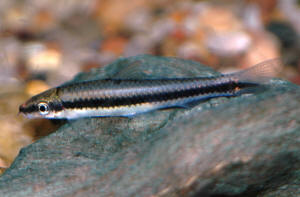
Please find an enclosed photo of the problem.
<Ack - that's not a well-looking fish!>
Around two weeks ago I noticed a few large white spots on the body of the fish,
around the size of her scales.
<Looks to me as though the scales have actually been torn off - in looking at
your stocking list below, I would surmise the flying fox, Epalzeorhynchos
kallopterus, is the cause. The latter is NOT a peaceful fish, and doesn't belong
together with any species that are...
Also, your Betta appears extremely swollen - how long has she appeared like
that? It could be constipation, or alternatively, a bacterial infection...worst
case scenario, a tumor. How is she eating? Is she regularly pooping? If not,
constipation may be the cause; try feeding a frozen, then thawed pea, or,
alternatively, fasting her for a couple of days. I'd start there...>
At this point I added a Melafix to the tank.
<How are the water parameters? Temp., ammonia, nitrite, nitrate, etc.? Melafix
can be helpful, but good water quality for healing wounds, scales injuries is
much more important...>
After a few days this appeared to have no effect.
<Not surprised; see above. Also, do keep in mind it takes quite some time for
injured/missing scales to heal and regenerate.>
After some research online I suspected a slime or bacterial infection so dosed
the tank with Methylene blue.
<What?! No quarantine/hospital tank? Well, sadly you killed off any of the
beneficial bacteria by medicating the entire tank; this is never a good idea.
You will need to keep a VERY close eye on the water parameters, as this tank
will need to re-cycle...
Aside from this, the only "treatment" your Betta really needed was to be
immediately separated from the Flying Fox and kept in pristine water conditions
so that her scales can heal, re-grow, etc.>
This appeared to stop any further progression of the problem and no other fish
in the tank were affected, so she was then isolated and dosed with Methylene
blue again.
<Unfortunately you didn't isolate her to begin with, so as explained above, your
main tank's nitrogen cycle is destroyed. Also, I'm not sure why you are treating
with Methylene blue - totally unnecessary and likely harmful...>
After almost a week in isolation she appears no better so we removed her from
isolation and took the attached photo in the hope you may be able to help ( as
Methylene blue you can't see her very well).
<Yes - all explained above.>
She is in a 180 litre tank...
<Just about 48 US gallons...>
...with the following other fish (who appear to not be affected) -
<Well, they will be affected by the buildup of harmful toxins caused by the
re-start of the nitrogen cycle; please keep a very close eye on ammonia, nitrite
and nitrate levels, performing water changes as necessary...>
15 cardinal tetras
a Bristlenose catfish
a whiptail catfish
4 clown loaches (2 medium 2 small)
4 Corydoras
1 Siamese flying fox
2 Kuhli loaches
<Again, the Flying Fox is a very territorial, highly aggressive fish who doesn't
belong anywhere near a peaceful Betta. Also, clown loaches - these fish can
reach up to 12" or better when full grown - do you have a plan for upgrading?
Fish stocking schemes really need to be well-researched, thought out. Do take a
look at www.fishbase.org for some extremely useful information on the species
you are keeping...>
My suggestion for your Betta is to setup a separate 3-5 gallon heated (80-82
degrees F), filtered tank for her to live in by herself. With proper water
quality and time, her scales will heal and this problem will resolve itself.
As for the stocking in the main tank, well, you've got a lot of bottom
dwellers...far too many...start making contingency plans now...>
Regards Elaine Bampton
<Best regards, Jorie>
Re: Large white Spots on Siamese Fighter Fish - likely cause is bullying by
Flying Fox 7/25/07
Thanks for the quick reply, I do however have a few issues with the
suggestions that you have given - please don't think I'm being picky, I am
merely trying to give my fish the best chance she has!
<I do understand, and I'll do my best to respond to your thoughts...>
Subject: Large white Spots on Siamese Fighter Fish
>Hi,
><Hello, Elaine>
>I have a problem with my female Siamese fighter fish.
><Betta splendens>
>Please find an enclosed photo of the problem.
><Ack - that's not a well-looking fish!>
>Around two weeks ago I noticed a few large white spots on the body of the fish,
around the size of her scales.
><Looks to me as though the scales have actually been torn off - in looking at
your stocking list below, I would surmise the flying fox, Epalzeorhynchos
kallopterus, is the cause. The latter is NOT a peaceful fish, and doesn't belong
together with any species that are...
>Also, your Betta appears extremely swollen - how long has she appeared like
that? It could be constipation, or alternatively, a bacterial infection...worst
case scenario, a tumor. How is she eating? Is she regularly pooping? If not,
constipation may be the cause; try feeding a frozen, then thawed pea, or,
alternatively, fasting her for a couple of days. I'd start there...>
<<<I've been keeping an eye on the Betta over the past two weeks and I have
definitely seen a slow melting of the scales rather than them being torn off
here and there. I should point out that we have a 'Siamese flying fox'
(Crossocheilus oblongus) rather than a normal 'flying fox' (Epalzeorhynchos
kallopterus).
<<<<This is the problem with common fish names; it's hard to know exactly what
fish someone is talking about with just this name. In any case, please take a
look here for some useful info. re: Crossocheilus oblongus and its compatibility
with other fish. Basically, this fish has the same aggressive tendencies as the
Epalzeorhynchos kallopterus - do see here:
http://www.thekrib.com/Fish/Algae-Eaters/ >>>>
<<<The former is a peaceful fish, and I can personally vouch for this having had
him in the tank with the female for over 4 months now.>>>
<<<<All I can do is make general suggestions based on the non-biased articles,
information and research I am familiar with. If it were me, I would still advise
separating the two (the Betta and the Siamese Flying Fox.>>>>
I've been keeping Bettas for a while now, so I am aware of how they can become
bloated for one reason or another. I should have perhaps mentioned before that
the bloatedness has come back during this week as the condition got worse. In
the past it appeared that she was constipated and using the aforementioned pea
trick sorted her out.
<<<<Ah, am glad you know about how to care for this condition. I do suggest
doing so.>>>>
<<<So if we could assume for the moment that it was NOT the SFF, what else could
this condition be? I'm 100% sure its not another fish causing this issue, as it
got worse even when in isolation.>>>
<<<<As with almost all fish injury/illness issues, there are usually several
things at play. I still believe that the Betta received some type of injury to
her scales, but if not, that's support for the environmental conditions being
even worse than I first imagined. Also, if the Betta's immune system is
compromised due to stress (being around overly aggressive fish can do this), her
resistance to less-than-ideal water conditions is lesser than her tankmates'. I
honestly think what you've got going on it a fish that was injured, stressed,
and then perhaps exposed to poor environmental conditions, thus causing the
slime coat and scales to "melt off" as you describe. What are the exact ammonia,
nitrite and nitrate readings? How often have you been doing water changes, and
in what amount?>>>>
>At this point I added a Melafix to the tank.
><How are the water parameters? Temp., ammonia, nitrite, nitrate, etc.? Melafix
can be helpful, but good water quality for healing wounds, scales injuries is
much more important...>
<<<Water parameters are all fine, I have a home testing keep and make sure that
they are all within acceptable levels>>>
<<<<Fine is not a useful term for this purpose. You need to make sure that
ammonia and nitrite are at ZERO, and nitrate only as high as 20 ppm.>>>>
>After a few days this appeared to have no effect.
><Not surprised; see above. Also, do keep in mind it takes quite some time for
injured/missing scales to heal and regenerate.>
>After some research online I suspected a slime or bacterial infection so dosed
the tank with Methylene blue.
><What?! No quarantine/hospital tank? Well, sadly you killed off any of the
beneficial bacteria by medicating the entire tank; this is never a good idea.
You will need to keep a VERY close eye on the water parameters, as this tank
will need to re-cycle...
>Aside from this, the only "treatment" your Betta really needed was to be
immediately separated from the Flying Fox and kept in pristine water conditions
so that her scales can heal, re-grow, etc.>
<<<She was put in a quarantine tank after a few days of staying in the main
tank. It looks like an external bacterial infection and we were unsure whether
it was contagious. Bearing this in mind, and that methylene blue treats this
condition we dosed the entire tank to make sure that none of the other fish
caught it. Your statement about killing friendly bacteria worries me though, as
I read off your own website that "<Provided you follow the instructions supplied
with the medication, Methylene Blue is harmless to filter bacteria. Cheers,
Neale.>"
<<<<First off, let me say that you are never going to get just one precise
answer in this hobby, as so much is, in all honestly, experimental. Many
variables/factors come into play when diagnosing fish illness, so you will
likely get different answers from people's different perspectives. I personally
would have isolated the sick/injured Betta just to be sure, but I do understand
it's a bit of a dilemma/decision. And as for the Methylene Blue, this is an
oxygenating agent, and there is a school of thought that it's safe to add to the
main tank. In any case, Methylene Blue would not have done anything beneficial
for your Betta (but probably nothing harmful, either). As to hospital tanks in
general, I am personally of the opinion that all sick fish should be isolated
ASAP; this is based on my own personal experience of not having done so quickly
enough in some circumstances.
(http://www.wetwebmedia.com/methbluefaqs.htm). If this really is the case then
perhaps that part of the website should be amended? My instructions with the
medication didn't mention such a side-effect.>>>
<<<<Many medications claim to be non-harmful to the nitrogen cycle, but this
just isn't the case. There's competing information out there as to whether
Methylene Blue, specifically, will destroy the "beneficial bacteria", and after
discussing with the guru Bob Fenner just this morning, it seems as though the
cycle should likely be OK. However, there are other people of the same opinion.
I guess what I'm trying to say is that it's just better practice to quarantine a
sick fish prior to using any treatment, that way you don't have to be
concerned...>>>>
>This appeared to stop any further progression of the problem and no other
>fish in the tank were affected, so she was then isolated and dosed with
>Methylene blue again.
><Unfortunately you didn't isolate her to begin with, so as explained above,
your main tank's nitrogen cycle is destroyed. Also, I'm not sure why you are
treating with Methylene blue - totally unnecessary and likely harmful...>
<<<see above>>>>
>After almost a week in isolation she appears no better so we removed her from
isolation and took the attached photo in the hope you may be able to help ( as
Methylene blue you can't see her very well).
><Yes - all explained above.>
>She is in a 180 litre tank...
><Just about 48 US gallons...>
<<<We use litres here in the UK :)>>>
<<<<Yes, I understand. Just trying to make the info. more user-friendly to a
wider-group of folk!>>>>
>...with the following other fish (who appear to not be affected) -
><Well, they will be affected by the buildup of harmful toxins caused by the
re-start of the nitrogen cycle; please keep a very close eye on ammonia, nitrite
and nitrate levels, performing water changes as necessary...>
<<<see above again>>>
>15 cardinal tetras
>a Bristlenose catfish
>a whiptail catfish
>4 clown loaches (2 medium 2 small)
>4 Corydoras
>1 Siamese flying fox
>2 Kuhli loaches
><Again, the Flying Fox is a very territorial, highly aggressive fish who
doesn't belong anywhere near a peaceful Betta. Also, clown loaches - these fish
can reach up to 12" or better when full grown - do you have a plan for
upgrading? Fish stocking schemes really need to be well-researched, thought out.
Do take a look at www.fishbase.org for some extremely useful information on the
species you are keeping...>
<<<see above once again about the flying fox. I am of course aware of what size
the clown loaches grow to and will be upgrading when it is required>>>
<<<<Again, I refer you to the article on algae eating Cyprinids. And, please do
not take offense at my suggestion that a tank upgrade will be neccessary; many
folks don't know this and have been shocked when I've previously made such
suggestions.>>>>
>My suggestion for your Betta is to setup a separate 3-5 gallon heated (80-82
degrees F), filtered tank for her to live in by herself. With proper water
quality and time, her scales will heal and this problem will resolve itself.
>As for the stocking in the main tank, well, you've got a lot of bottom
dwellers...far too many...start making contingency plans now...>
<<<they're doing just fine really, so I'm not to concerned at this moment in
time - I'm more worried about the ill female Betta!>>>
<<<<As for your Betta, I still suggest moving her to isolated quarters (again, a
3-5 filtered, heated aquarium is a great Betta setup. Keep the water quality
pristine, and you may want to add MelaFix once again (keep in mind that will
just aid in scale regeneration and keeping secondary bacterial infections at
bay, but it doesn't work quickly...) Do take a look at the article I've linked
you to, plus the many others out there regarding behavior of the Siamese Flying
Fox you insist is so "peaceful". Obviously, you can do what you want, but I
truly believe this is the likeliest cause. Given clean water and a peaceful
environment, the Betta should heal nicely, without any complications.>>>>
>Regards Elaine Bampton
><Best regards, Jorie>
<<<thanks once again>>>
<<<<You're welcome and good luck. Jorie>>>> SAEs, Foxes... sel. 4/24/07
I am also having trouble finding places that sell real Siamese algae
eaters. I've read a lot about how most fish advertised as SAEs are actually
flying foxes, and based on the descriptions, this seems to be the case.
<Often the case, but does it matter? They're all pretty similar, and none of
them are either [a] totally peaceful or [b] going to stop algae growing in your
tank. The flying fox is marginally more aggressive, but in your 55 gallon tank
this shouldn't be an issue. The main thing is you avoid the notorious "Chinese
algae eater" Gyrinocheilus as this is a very disruptive animal. Maybe even
consider something else entirely, like a Bristlenose Plec, which will graze
algae but otherwise keep entirely to itself (and mostly out of view).>
I live in Ann Arbor, do you know of any places that sell SAE's in that area?
<From my vantage point in Berkhamsted, England, I can't really offer any useful
advice on the variety of fishes sold in your area. If all else fails, talk with
your local mom-and-pop tropical fish store, and ask if they'll place a special
order. Many will, particularly if these are fish that they can easily sell once
you've take your pick from the batch. Cheers, Neale>
Planted tank algae, big mis-id'ed "eater"
Quite a bit of string algae building up in one of my tanks and the outdoor pots. The pH on these guys seems to always creep up as well.
<Related events.... the algae is rapidly photosynthesizing, using up alkaline
reserve, in the meanwhile poisoning/outcompeting its "higher" kin the
vascular plants. Neat eh?>
No string algae in the fireplace tank. The fireplace tank has a pH that is constantly
falling
<Use a little baking soda here>
and a large Siamese Algae eater.
<Large? This species doesn't get that large... are you sure you have the REAL
thing? Check here: http://www.wetwebmedia.com/saesagb.htm
Thought you had a stinky Chinese Algae Eater? Time to trade that bad boy in>
Question: is the string algae related to the increasing pH?
<Yes>
Note I don't see
the SAE eating it.
<It won't... likely a blue green, likely not a true SAE>
I have a bacterial product that is supposed to get rid of it called String
Algae Treatment, S.A.T., do you think it would help?
<Worth trying. Pls report back to me your results. Bob Fenner>
E. kalopterus longevity? (Lifespans of captive aquatics)
Hello Robert,
Sorry to bother you but I just read your article on SAE "Will the Real SAE
Please Swim Forward?" and I have a question that you might be able to
answer.
I have a Flying Fox, E. Kalopterus, that I bought in -93 or -94 (not sure
which). That makes him 8 years or so. Do you know how old these fish can get?
<Know of ones near a decade... bet some of the Public Aquariums in Europe
have had Flying Foxes this long or longer...>
He is now about 14cm (5.5 inches) and he hasn't grown much in years as far as I
can tell.
Thanks for your time,
Steve Danielsson
Stockholm
<Thank you for your input. As I say, many Public Aquariums do keep, even post
longevity records on their stocks. You might want to try perusing some of their
sites (links on the WWM Links Page) for more here. Bob Fenner>
Another Mean Epalzeorhynchus bicolor.... 02/02/2004
Hello I have recently bought a red tail black shark at about 1.5''. I also bought 2
Platies (one red, one yellow). I just found out that red tail sharks do not
tolerate other fish with red markings.
<Or many other fish, for that fact!>
Unfortunately enough, this is true! The shark has bitten some scales off the right side of my platy and most of it's tail too!!! It died about 3 days after but the yellow platy is doing fine.
<This aggression is not color-selective.... I suspect it is only a matter of time before you see
aggression toward the yellow fellow. As they grow, Redtail black sharks tend to become quite
aggressive.>
I was wondering just so this doesn't happen again what species would be compatible with a red tail black
shark? (if any)
<Well, tank size would be a good help in determining this. Provided it is large enough, some of the moderately sized
Gourami - Trichogaster trichopterus, in any of its color morphs (blue, gold, "three-spot", platinum....), Trichogaster microlepis (the "moonlight"
Gourami), perhaps paradise fish (Macropodus opercularis), other moderately sized
semi-aggressive fish would do nicely. Perhaps also giant Danios, or even the smaller
Danios - these are extremely
resilient fish.>
And would it bother a ghost shrimp or snail?
<Likely would eat ghost shrimp, but at the low cost, might be worth trying. Bite-sized snails will turn into snacks, but larger ones would probably be safe.>
Just one more thing, should I buy a school of neon tetras or 3 guppies (two female one male).
<To go in with the Redtail? Neither, IMO. If you must have one or the other, the guppies would fare much better than the very delicate
Neons.>
Thanx for any info, Joey.
<Glad to be of service! Wishing you and your finny pals well, -Sabrina>
| |

|