|
FAQs on Freshwater
Antibiotic, Antimicrobial Use
Related Articles: Choose Your
Weapon: Freshwater Fish Disease Treatment Options
by Neale Monks, Understanding
Bacterial Disease in Aquarium Fish; With a gallery of bacterial
infections, a discussion of 'Fish TB', and a listing of
major antimicrobial medications with examples available to
fishkeepers By Myron Roth, Ph.D., FW Disease Troubleshooting,
Freshwater Diseases, Nutritional Disease, Ich/White Spot Disease, Methylene Blue, Formalin/Formaldehyde, Malachite Green,
Related FAQs: Freshwater Medications, Salt/Use, Aquarium
Maintenance, Ich/White Spot
Disease, African Cichlid Disease
1, Cichlid Disease,
|
 |
Best Antibiotic for Fin Rot in Hard Water?
8/3/19
Dear Crew at WetWebMedia,
<Lynnie,>
A few days ago one of my silver dollars got a chunk of his dorsal fin
bitten or torn off, and shortly after the fin tissue started turning
grey and eroding, leaving behind the bony rays, and the scales at the
fin base might have peeled off as well. As such I suspect it might be
fin rot.
<Sounds likely.>
I’m not sure why it got infected as ammonia and nitrite are zero and I
am doing 50% water changes weekly, and the other silver dollars are
completely normal.
<Sometimes just back luck or bad genes.>
But it clearly seems to be, so what would be the best antibiotic to use?
<My medication of choice for clean Finrot is eSHa 2000, which works fine
in hard water.>
I don’t want to use nitrofurazone because in the past it made my fish
refuse to eat and I have heard tetracycline does not work well in hard
water.
<If you must use an antibiotic, then choose one advertised as safe in
both freshwater and marine aquaria, such as KanaPlex. If something works
in saltwater, it'll be fine in hard freshwater.>
Thank you,
Lynnie
<Cheers, Neale.>
Re: Best Antibiotic for Fin Rot in Hard Water?
12/23/19
Dear WetWebMedia Crew,
<Lynnie,>
Apologies for the late reply I have been out of town a long time.
<No problem.>
I chickened out on using Kanamycin because it once wiped out a newly established
bio filter in my experience, and used Erythromycin based on the advice of a
local fish store who swore it worked really well for them.
<Understood.>
Of course I did not read that it is only effective against gram-positive
bacteria and not gram-negative, which is most fin rot infections.
<Indeed.>
So now the silver dollar has lost most of his dorsal and anal fins, and his tail
fin has a big semicircular cut out of it with a black margin. There may also be
erosion of the skin on the base of the tail but it is hard to
tell. Another silver dollar has also acquired a semicircular cut out of his
tail, but otherwise none of the other fish have fin problems.
If I have a mature bio filter, would kanamycin wipe it out?
<It shouldn't, if used correctly, but there's always a risk with any antibiotic.
The ideal situation is to remove the filter media to a bucket of water, ideally
with a bubbler to keep it aerated. Then, use Zeolite in the filter for the
period while you're using the antibiotic. Zeolite removes ammonia directly. It's
inexpensive (often sold as "ammonia remover" in pet shops) and does the job
adequately well. Once the antibiotics are done, remove the Zeolite and put the
filter media back.>
I recently added a second canister filter to the aquarium with bio media from
another tank but the original one has had a biofilter for almost a year now.
<See above. If all else fails, isolate the media from one filter as described
above, but leave the other running. So long as ammonia levels stay at zero, the
antibiotic isn't doing any harm; but if there is a
crisis, you know what to do (i.e., use Zeolite) and the other filter will be
safe and ready to use when you're done. Normally, antibiotics are broken down
within a day or two of use, so waiting a day or so, and doing a 25-50% water
change, is all you need to do before connecting up the biological filter.>
Thank you for everything,
Lynnie
<Hope this helps. Cheers, Neale.>
Betta Finrot - 10/22/2012
Hi crew!
<Brittanie>
I have a Betta with a definite case of Finrot, caused by a forgotten
water change. I set him up in a hospital tank and treated with
API's fungus meds because I had it on hand and they claimed it can fix
Finrot. Sad to say it didn't.
<Finrot is generally bacterial, not fungal.>
He now really looks like a case of Finrot and has lost half his tail and
now has the pink spots indicating blood vessel damage.
<Not surprised. Needs proper treatment immediately, and very clean
water.
Keep the ammonia levels low in that hospital tank with plants or zeolite
crystals.>
My question is, which medicine would work best? API E. M. Erythromycin (
I'm assuming the active ingredient is in the name). Mardel Maracyn with
erythromycin as the active ingredient or T C Tetracycline with
tetracycline hydrochloride as its main ingredient?
<Both are antibiotics, but I'd probably try the tetracycline first. Be
aware that it will color the water.>
Id like to zap the bacterial infection this time instead of letting it
get worse like it did last time.
I did look over the website but it seems to be a bit of this or that
depending on who answers and everyone asks about MelaFix which I know to
be worthless.
<There can be more than one effective treatment for certain ailments.
Either antibiotic might work. Melafix is a naturopathic treatment and
may work on mild cases, but I wouldn't try it with Finrot this severe.
Hope that helps.>
thank you!!
<Welcome>
Brittanie
<Rick>
Re: Betta Finrot 10/25/12
Just wanted to say thanks to Rick for helping with my question!
<You are quite welcome.>
I bought the Tetracycline this afternoon and its been in the hospital
tank for less then 8 hours and already the inflamed blood vessels are
settling down.
<Excellent!>
Treatments going to take a full five days but I think this one is going
to work.
<If it is not cured in 5 days, do read the instructions on how to
properly do a second treatment.>
Thanks again for the wonderful advice and excellent site!
<Glad it's working. - Rick>
Brittanie
Re: Redness near pectoral
fins...
Antibiotics May Affect Biological Filtration
6/13/09
Hi WWW Crew, I checked the Internet and found that API (Aquarium
Pharmaceuticals) is an American company. After browsing their website,
I found that they too sell medications that are bio-filter safe.
Products like Furan-2, Melafix, Pimafix, Tetracycline and Triple Sulfa
does not hard bio-filter. So would you question the effectiveness of
these API products since they claim that these are bio-filter safe?
Have you had successful experiences with them? Regards, Roger
< Medications can say anything they want on the package. Bacteria
convert ammonia to nitrites and then nitrates. Different kinds of
bacteria attack the living tissues of aquarium fish. Is it possible for
some antibiotics to be selective enough to only kill the bacteria
attacking the fish? Sure it is. In your particular situation you have a
fish with some redness around the pectoral fins along with some other
symptoms. Are you satisfied with the results of treating with Interpet
#9? If you are, then continue to treat as per the directions on the
package. If not, then it hasn't worked.
I would recommend treating with a known antibiotic like Nitrofurazone
or Erythromycin. Regardless of what they say on the package I would
recommend treating in a hospital tank. If you have to treat in the main
tank then I would still caution you about ammonia and nitrite
spikes.-Chuck>
|
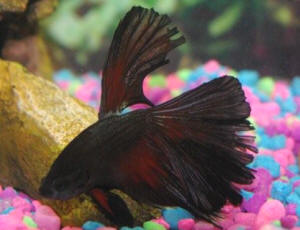
F/U Pics...Re: Fin rot...
(RMF, opinion please) 2/25/09 Gentlemen, I've
attached the some pictures, one of each fish. It may not be
readily apparent, but the spaces showing in the Betta's tail
aren't supposed to be there. So, I've also attached a
picture of what his tail looked like when he was healthy. I
appreciate all of the advice. Mr. Fenner recommended I use a
Furan compound and remove the carbon from my filter. This
prompted a question I've actually had for some time. I only
use sponge filters. When I treat a tank with medication, I
usually do a 25-30% water change at the end of the treatment, and
then resume the normal maintenance schedule. Most of the
instructions state to replace the carbon, which I know will pull
the remaining med out of the water. Am I overdosing the fish if I
don't have some sort of carbon removal system after a
treatment? Should I do a larger water change, since I'm only
using sponges? Again, thanks for the help. Laura <Hello Laura.
The short answer is no, you aren't overdosing medications if
you don't use carbon afterwards. Most medications are
metabolised by the bacteria in the aquarium within a day, which
is why most require a series of doses across a period of several
days. That's the only way to expose the fish to a continual
amount of medication. When you've finished treating with one
course of medications, doing a 25-50% water change is a good
idea, but by the next day, you should be good to go with a new
course of medications. Cheers, Neale.> <<Agreed.
RMF>>
Re: F/U Pics...RE: Fin rot... (RMF, opinion please)
2/25/09 Thanks. Were the pictures helpful to you in
trying to identify whatever's going on in my tanks? Laura
<Nope. Sorry. The reality is that most viral, bacterial
infections can only be identified under the microscope. Just as
with humans: if your doctor thinks you have an infection other
than one of the really common and obviously (and often, even
then) blood tests, urine samples and so on will all be required.
The same with fish. Most of the time I'm dealing with same
infections that plague virtually all tanks at some time or
another: Finrot, secondary Fungal infections, Lymphocystis, etc.
But if the symptoms fall outside that range, it's out of what
I can do. Cheers, Neale.> <<Nice pix, but indicated
nothing to me (hence I did not post ayer). RMF>>
|
 |
|
Re: Fin rot... (Bob, need your input
re: Furanace)-- 02/28/09 Sorry to be a bother, Furanace
says it will harm the bio-filter and a Q tank is recommended.
<Have not used this so can't comment myself. Have asked
Bob to chime in here.> <<Furan compounds can indeed
interrupt nitrification... Ammonia et al. need to be monitored,
freshwater prepped, stored for use... RMF>> So I've
moved the guppies to a Q tank and I'm treating there. I only
got the adults, not the fry. But I'm wondering if the
"disease" is in the water of the display tank, and if I
should assume the fry are infected? Because we think this spread
from my guppy tank to my Betta tank on "something wet and
unsterilized". Do I have to treat the main tank in order to
make sure everyone gets and stays better? <I would imagine
that this would be essential. <<Yes>>Treating the
adult Guppies in a quarantine while maintaining a reserve of
infectious bacteria in the fry in the display tank would defeat
the object of the exercise.> I REALLY don't want to
recycle this tank "fish in" if I can avoid it. Thanks
again for all the advice. Laura <Cheers, Neale.>
Re: Fin rot... (Bob, need your input
re: Furanace) 2/28/09 Thanks. So, if I remove all fish
from the display tank, I will remove the infectious bacteria
while preserving the bio-filter? Laura <Hi Laura. I'd
imagine that even if you treated the fish in a quarantine
aquarium, there'd be no guarantees that the infection cycle
would be broken in the display tank. The problem is that bacteria
*aren't* like protozoan parasites. If you're treating Ick
parasites and you remove the fish to another tank, then any
free-living Ick parasite "juveniles" in the display
tank will only have 24 hours (approximately) to find a host. If
they fail to do so, they die. Within a few days, you'll break
the infection/re-infection cycle. But bacteria are notoriously
good at going dormant. That's good in some ways: it's how
nitrification bacteria spores in the air and in water are able to
land in a new aquarium, set up home, and get your filter running.
But on the downside, disease-causing bacteria could potentially
do the same thing, resting up in the gravel or water column until
such time as a suitable host came along. So while treating your
fish in a quarantine tank with a zeolite
("ammonia-remover") based filtration system would be
wise, you'd still need to dose the main tank too. I'd
keep adding a bit of food to the display tank, so that as it
rotted, it would produce ammonia for the filter. If after X days
of treatment (where X is the recommendation on the Furanace
package) you found zero ammonia in the display tank, you would be
safe to assume the filter survived the antibiotic treatment, and
you could return your fish. Check the ammonia or nitrite levels
every couple of days, and put the fish on half-rations.
Essentially what you'd do if you were adding fish to a
recently-cycled aquarium. As for the quarantine tank, all
you'd need there is a box filter or similar filled with
zeolite. If you have two filters on the display tank, you can use
one of them here, emptying the biological media compartment and
filling it with zeolite. Don't feed the fish while treating
unless the course is 7+ days. Or if you must feed the fish, as
you might in the case of fry, use vegetable foods exclusively, as
these are much lower in protein. Sushi Nori would be ideal and is
readily consumed by poeciliids (and likely much healthier than
flake!)
Re: Fin rot... (Again Bob, comments
appreciated) <Zip to say. RMF> 2/28/09 Got it. I
was afraid of that. Any ideas on how this happened? You may
remember, I'm the one who's fairly Obsessive Compulsive
about regular tank maintenance. Thanks again. Laura <No idea.
Could be bad luck: introducing new fish for example, or the
infection could by a bacterium ubiquitous to aquaria (like
Aeromonas and Pseudomonas spp.) that only causes problems under
specific situations. Bacterial infections that resemble Fish-TB
are almost a problem in freshwater tanks where inbred fancy fish
are being kept: Guppies, Ram cichlids, Dwarf Gouramis, etc. So
genetics probably plays a role. Cheers, Neale.>
|
Mardel Tetracycline has filled my tank with foam
9/11/08
Hello
We have just finished treating two fan-tail calico fish for fin damage
with Mardel Tetracycline. We have treated for full five days, added
carbon filters back to the tank after a 25% water change,
<Mmm, you'll have to change out more water than this>
as the directions have stated. The fish look great, but now our tank
looks like a sewage plant. We have reddish brown nasty water with a
giant marshmallow-like foamy substance across the entire surface of our
tank. We have four (4) aeration devices, that is probably contributing
to this problem.
<Yes>
Long story short... we want to get rid of the foam. We do not
understand how the filters are suppose to help this if the foam is on
the surface and lingering. The color of the water has changed slightly
within the 24-hours since the filters were put back in. We believe that
the color will get better. But is there anyway to get rid of this
horribly disgusting foam??!!
<Yes... two things... clean/white (non colored) paper towels draped
along the top to absorb most, and dipping a pitcher in at an angle to
remove the surface material... And time going by otherwise>
Our return e-mail address is XXXX. Thank you very much for your time
and knowledge.
Sara and Jamie (humans), Pirate and Zombie (Our two calico fans)
<Happy to share. Bob Fenner>
Nitrofurazone... use, effect on nitrification
2/14/08 Looked all over your site for the answer? <You did?>
let me start at the beginning, I've seen collectors using
Nitrofurazone (yellow water) to store recently collected fish. In some
cases I've heard of wholesalers using it to fend off disease.
<Yes... not uncommon with FW...> Question Is this a good idea to
use constantly in a quarantine tanks for all new arrivals <Mmm, not
IMO/E> Will it affect the biological filter? (a little) (a Lot) Fred
<Furan compounds generally do not affect nitrification (directly),
but can do so in established, closed (e.g. hobbyist) systems. Bob
Fenner>
|
Maracyn medication and scaleless fish
2/3/08 Hiya, I have a 100 gallon tank with a jaguar cichlid
who recently got fin rot and body fungus. I was going to treat it
with Maracyn (powder form) And I wanted to know if it was a
effective medication. However I have loaches and scaleless fishes
and I didn't know if I could use it so I wanted to check with
you before using it. Does Maracyn contain any copper or harmful
materials to scaleless fish? Please help. Thanks a ton.
<Maracyn is generally safe with most types of fish. It's
an antibiotic, essentially a repackaged version of the
Erythromycin widely used in human medicine. Now, the bigger
question is *why* your Jaguar Cichlid (Parachromis managuensis)
has Finrot at all. Finrot is almost always associated with either
physical damage or poor/varying water quality. It very rarely
comes out of the blue. If you don't identify the cause, and
remedy it, then treating the cichlid will become a bit pointless
-- the fish will likely get sick again. Cheers, Neale.>
Re: Maracyn medication and scaleless fish
2/3/08 Yeah, I usually do 50 percent water changes every
week, but I had to skip a week because I was too busy with my
work and everything. I will be constant from now on. Thanks Neale
an everybody!!!! <So long as you know the problem, and
won't let it happen again, that's fine. Cichlids are
strangely sensitive to nitrate, and missed water changes cause
all kinds of problems. Compared with 'hole in the head'
you got off lightly this time. If you are busy, turn the
temperature down a tiny bit towards the low end of the tolerances
of your given species, and the feed half rations. This will slow
down metabolism and reduce the amount of ammonia in the system.
Good luck, Neale.>
Re: Maracyn medication and scale less fish
2-4-08 Hi again Neale, sorry to bother you. I just got
home from work and I my tank was cloudy. I did a water change
yesterday and I wasn't sure if the medication is supposed to
make the water cloudy. So my question is is Maracyn supposed to
make your water cloudy or is it not normal? Thanks for your time.
<I haven't personally used Maracyn (it isn't sold in
the UK) so can't comment from experience. But I have read
that this is sometimes a temporary side effect. Provided the
water quality remains good (do a quick nitrite test) and the fish
seem healthy (no gasping or heavy breathing), there's not too
much to worry about. Cheers, Neale.>
|
Hospital tank filtration with antibiotics
7/29/07 <<Hello, Geri. Tom here.>> I can't seem
to find an answer to the following dilemma: I understand that the
biological filtration should be established first when setting up the
hospital tank. However, as soon as antibiotics are added as a treatment
for a diseased fish, doesn't the biological filter get wiped out?
<<A valid question and a good one. Antibiotics can, and will,
damage/destroy the bio-colonies established in our hospital tanks and
their filters. These medications are indiscriminate about which
bacteria they go after. Bear in mind, though, that there are antibiotic
medications that 'kill' bacteria (bactericides) and others that
inhibit reproduction/growth of bacteria (bacteriostatics). It's
incumbent upon the hobbyist to make the appropriate choice based on the
disease the fish is/are being treated for.>> Then what happens to
the ammonia and nitrite that builds up in the tank? <<Let's
look at this one from a realistic viewpoint. How much ammonia is going
to be produced by a sick fish? (Not being sarcastic here at all, by the
way.) The amount it eats will be minimal, at best -- and you should
feed it with that in mind. Ammonia will be excreted through the gills
as the fish breathes but, alone, this shouldn't present a big
problem in terms of water toxicity as long as you practice the proper
maintenance of the tank. There are two points to keep in mind where
'hospital tanks' are concerned. First, you're, hopefully,
treating a single fish outside of the display tank, i.e. the remainder
of your livestock will remain unaffected by any adverse reactions to
the medication(s). Second, not all 'hospitalization' requires
antibiotics. Your pet apparently does but, there are many reasons for
treating fish in a separate aquarium that don't carry the same
'baggage' that you have to deal with now. In short, you're
concerns are specific to you, and rightly so, but they're not
common to the whole concept of 'hospitalization.'>> I
know partial water changes should be done daily or every other day in
this situation but even a little ammonia and/or nitrite is hazardous.
<<True enough but consider which 'condition' is primary
and which is secondary. Hazardous as the ammonia/nitrite toxins can be,
these can be controlled through water maintenance/changes. Concentrate
on treating your pet, first, and, with a proper regimen, the other
concerns will take care of themselves.>> Lastly, why even start
up the biological filtration to begin with if it just gets wiped out?
<<As I stated previously, not all hospitalization requires the
use of antibiotics. Many treatments in a hospital tank have no effect
on the beneficial bacteria whatsoever. I'm afraid you're
looking at the 'concept' from a narrow perspective. I
completely understand it, under the circumstances, but you have larger
issues to deal with right now.>> Help, my angel is dying and I
must get him to the hospital! Geri from Newton, MA <<Do it, Geri,
and stay on top of the water changes. Best of luck. Tom>>
Could Maracyn Make a Fish Sick/Red Streaks? Mmm, yes.
Goldfish misplaced in a ten gal. sewer 6/18/07 I have had my
goldfish for nearly 3 years. About 2 weeks ago, I noticed his fins have
been fraying on the edges, but no red streaks and good appetite.
<Likely environmental...> But it's true - he's about
6" long and in a ten gallon tank <... def. env.> with good
Marineland filter, but he needs more space. He's been in this tank
for 2 years and has been sick before - I brought him back from a bad
case of septicemia a year ago with Maracyn 2 and the homeopathic remedy
belladonna 30C potency. No other fish in the tank. <...> So
earlier this week, I did a 50% water change - readings were regular
"normal": before hand: <...> 7.9 PH, 0 ammonia, 0
nitrite and some what high nitrate of 40 <Toxic...> (the water
here is heavily buffered so PH is naturally high and the nitrate comes
out of the faucet at 10, so hard to get it lower.) <I would NOT
consume this source water myself... see WWM re> I added Maracyn.
<For?> The tank got cloudy after the 3rd dose and he seemed
lethargic. Fourth dose was yesterday evening, but today we noticed big
red streaks in his tail and that he was sitting on the bottom with his
fins closed. I did another 50% water change, put in a new filter, added
Cycle <Not worthwhile> to boost the beneficial bacteria, but the
last thing I expected when I decided to add the Maracyn was that he
would get worse. He is swimming around in his usual lively fashion
right now after the latest tank care, but I think the Maracyn did
something to bring on the streaks. When I used it last year (to no
effect) and then the Maracyn 2 to deal with the septicemia, it did not
turn the tank cloudy. I plan to try the homeopathics again after a
couple of hours for the tank to run. At the moment, I am loath to give
him more antibiotics. Suggestions welcome. <Good speculation... An
antibiotic can have such an effect... not-so-selectively killing off
microbes... But the real issue here is overall health... and your
system is just too small to accommodate this one large goldfish... as
evidenced by the hemorrhaging, the high accumulated Nitrate (and much
more)... What you really need to do is read and heed here:
http://www.wetwebmedia.com/FWSubWebIndex/gldfshsystems.htm and the
linked files above. Bob Fenner>
Getting Erythromycin For Infected Toad -- 2/25/07 Can you
tell me where I can find erythromycin? < Any good tropical fish
store will have this or a derivative.-Chuck>
Using Oxytetracycline Good day! Just thought I should say
your website has been a great help, and a good thing to browse through.
Also, I need to ask about a medication I'm using for my fish. I
have a thirty gallon tank with some angels, mollies, betta, snails,
live plants, and one platy. (Sounds a bit crowded, doesn't it?
I'm planning to get a larger tank for the angels very soon, so no
worries there.) Anyway, I had a few guppies in there, but just a few
days ago I noticed that the male had started to swell. I'd
previously had a female betta develop dropsy, (to my horror, of course)
so I knew what to look for, and how the symptoms played out. I
separated him into a small quarantine tank, added a bit of Melafix as a
buffer, and kept the water as clean as I could for the last two days.
Today I was asking my mother about going and getting some Epsom salts
or some fish meds (which are particularly hard to find in my town), and
I told her what I had read about for treating dropsy in guppies. She
said that we had some oxytetracycline I could use. We have a cattle
ranch, and use the medication as an injection for infections. So,
figuring out the dosage from 1/4 teaspoon per twenty gallons of water,
I treated him just a couple of hours ago. He's been swimming around
very well even though he's been infected, so I'm not too
worried about him. He's a tough little fish, and he's lived a
good life, and I'm doing what I can for him. If he's destined
to get better, then he will. Anyway, my real question is, if this
treatment works, (which I'm hoping desperately that it does), then
can you tell me a bit more about oxytetracycline and using it in my big
tank? Is there anything you'd suggest against? I'd like to keep
my plants and snails healthy and in the same tank, so I'd move the
fish if necessary. I've scoured the Internet for information on its
affects towards my thirty gallon's inhabitants, and found nothing.
So I was curious that if I were to add it into my large tank as a
buffer, or as a treatment as needed, would I need to do anything
special to the tank? (example, remove filters, remove plants, so on and
so forth.) Your help is greatly appreciated! Thanks, Kati < About
20-30 years ago this was the big antibiotic for South American fish
coming into Los Angeles. It turns the water blood red and is pretty
ineffective in hard alkaline waters. Now after saying this. Stuart
Grant who live on the shores of Lake Malawi in Africa use this
medication on his cichlids. He uses a dosage much higher than what is
recommended from the manufacturer. So I guess you can overmedicate to
get some curing effect but I would not try this around here. A better
way to treat your betta would be the following. Do a 50% water change,
clean the filter and vacuum the gravel. Organics affect the medications
ability to treat diseases. Treat with Metronidazole and Nitrofurazone
or Clout. Add some salt to the water and make sure the water temp is up
around 80 F. All medications will have an affect on the good bacteria
needed to break down fish waste so watch out for ammonia
spikes.-Chuck> Baths for freshwater fish? 9/18/06 Hi Bob,
Once again fighting tail rot in Betta Terrence. Doing my best to keep
the water quality good with frequent small water changes, gravel
vacuuming, the tedious process of wicking the dissolved solids off the
surface of the water with paper towels, light feeding, etc... He's
in a 2.5 gallon heated, filtered tank with 10 watts of fluorescent
lighting. As the tail rot has been persistent, I'm thinking of
treating him with an antibacterial. <Yes, this is what I would do.
Likely... Oh, I see this below> I was wondering if, instead of
treating the whole tank, I could give Terrence a bath in the
Nitrofurazone/Furazolidone/potassium dichromate medication that
I've used before. Same dosage/concentration as for a full tank
treatment? <Yes> (I read up on dips/baths on WWM, but only found
info about dips/baths for marine livestock. <Are more useful for
marines... as they "drink" their environment, but can be used
with good purpose on external complaints of freshwater aquatics> I
have heard from other sites of saltwater baths for FW fish... would
that be more gentle/any more effective than an antibacterial? <Mmm,
not as much here> He has Doc Wellfish's salt in his tank all the
time, 1 tbs/5gal.) If this would be ineffective or a bad idea, I can
certainly treat the tank. I have an extra sponge in there that I can
pull out and maintain in a Tupperware container to keep some good
bacteria going. Just wasn't looking forward to dying the tank green
and wiping out my filtration, <Yes... I would use the immersion bath
instead here as you state> plus I anticipate the gravel will absorb
some of the medication. <You are correct> Thanks for any insight
you can give! Rachel in NC, where it's finally cooling down a
little <BobF in sunny S. Cal., with a persistent cough/cold!>
Re: Baths for freshwater fish? 9/18/06 Bob, I just did what I
realized was the obvious thing to do... put Terrence in the 3/4 gallon
Tupperware with a heater and a proportionate amount of medicine.
Planning on doing large, possibly complete, water changes every day or
every other day. So never mind about the bath! Sorry to bother you. It
seemed like such a brilliant idea at the time! <Is a good idea.
BobF> Gar With Sores On His Head - 09/07/06 I have a spotted
gar that has developed some type of disease. It has white film and
ulcers, deterioration, on it's head. I have been treating it with
Maracyn-two. Following the directions for the 6 day treatment. Not much
improvement. Since their skin is not the typical fish type, would this
be the correct treatment? Also, by putting aquarium salt for freshwater
fish in the tank harmful to him? Could this cause a problem. Thanks.
< Gars are actually pretty tough critters. There could have been
some damage to his head as he tried to jump out and now they got
infected. I would try Nitrofuranace. It treats a wider range of
parasites and it also has some antifungal properties. Salt wouldn't
harm him unless it was an unusual amount. Do a 50% water change, vacuum
the gravel and clean the filter. This medication may harm the good
nitrifying bacteria so watch for ammonia spikes.-Chuck>
Maracyn Treated Tank 7/22/06 Hello...
<Hi> I have added Maracyn to cure a supposed gill disease in my
29 g fw tank. I pulled out the carbon, and noticed my water is getting
foggy. Is this common for this broad spectrum. antibiotic? Thanks! Jenn
Tony <The tank is getting cloudy because it is recycling. Most
likely the Maracyn nuked your biological filtration. The cloudiness
comes from the unprocessed biological materials and to some degree the
recolonizing bacteria.> <Chris> Furazone-green 6/4/06
On the advice of my local aquarium shop, all of my new fish are put in
a quarantine tank for 15 days. I put one fish only in a 10 gallon tank
at a time. I use the water from my 125 gallon tank to get it going.
There is plenty of aeration and I monitor the ammonia levels and do a
25% water change every other day. <Well done!> I put one capsule
of Furazone-green in for the first 7 days only then leave the fish
there for the next 8 days. Am I doing the proper thing for the fish
trying to be preventive with the medication or am I doing harm, or
better off doing nothing in reference to the medicine. Thank you, Tony
<This product is used by many folks in the freshwater livestock
trade as a standard practice. Is quite effective, non-toxic... In
businesses where it has been a matter of my discretion, I have used it
routinely... seems to act as a sort of gentle anti-microbial, dyes the
water a bit, providing a calming effect... Bob Fenner>
|
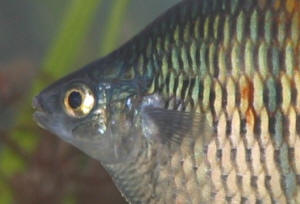
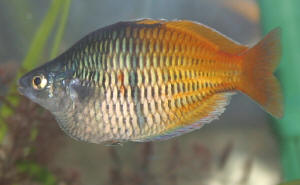
Elephantnose trtmt.... 3/24/06 I found some
Furan-2 Capsules, so do you think this is safe for my little
Elephantnose? Should use full dose as per directions? <Yes>
(Furan-2 Directions - Contains 2 furan based compounds to combat
a variety of gram positive and negative bacteria. Effective
against gill disease, mouth fungus, fin and tail rot, dropsy,
furunculosis and black molly disease. Use one tablet per 10 gal.
daily for up to four days.) <250 mg. per ten gallons of system
water, yes> Also, I have 4 DAY and 6 week old Boesemanni
Rainbow fry in the tank (waiting for their tank to finish
cycling) can I use this med or should I just wait until they are
moved out. <I'd move these first> (Mr. Elephantnose is
getting the spots --bacterial gray-wht spots- he started to break
out the other day, I use Melafix, which only held for a few days-
this morning it is back and bigger. And I think this all came
from one of my large Rainbows,- see pic - he has Gill Disease and
he has been treated 8x's just can't kill it all off. (any
ideas, already tried PP, but he just did more damage to himself
but trying to jump out out the holding tank and ramming into the
lid. FYI - My Tank:60 3 - Rummynose Tetra 2 - Cardinal Tetra 2
-Yoyo Loach 3 -4' Boesemanni Rainbowfish (1 female, 2 males)
1 -- 5' Elephantnose 1 -- Candy Striped Pleco 1 -- Golden
Algae eater Eheim pro 2026, 1-Ebo-Jager 250 watt heaters,1
Coralife Turbo Twist 6x 18w,1 Rena 400 air pump, sand/gravel mix
bottom, with live plants, drift wood, and stones. PH 8.0 No2 0
<Should be zip... this is way toxic> No3 0 - .05 NH4 0 KH
161 GH 35 I do a weekly water change of 1/3 or more water along
with cleaning filter. What am I doing wrong? <I would not use
the "Fix"... and you should investigate the water
quality needs/ranges, compatibility of these fishes... not a good
mix> Thank you again for all of your help. Lesley <Bob
Fenner>
|
|
|
Furan compounds - 03/14/2005 I must ask one question if I
may. Where does one fine Nitrofuranace? I have looked all over the
internet and I would love to have some on hand just in case it is
needed. I didn't know you had a post until just now, and I am not
sure how to post on it if/when need to ask for advice. Thank you again.
Lesley <Ahh, search for either Nitrofuran or Furanace... or even
"Furan compounds". Bob Fenner>
Getting Good Medication 9/7/05 Thanks for advice. You'll
find it pretty funny but our pet stores don't have any medicines
for treatment of disease. Can I use erythromycin that is used for
humans.? < No. Go online to DrsFosterSmith.com. You will find
everything you need there.> <<Actually... there is no
difference in "pet-fish" antibiotics and those for humans.
RMF>> If, yes then in what amount and for what time? Should I add
to tank or keep them in separate tub or container containing that
medicine. I shall be grateful to you if you solve my problems. <
Hospital tanks are always better than treating the main tank. Check out
articles and FAQ's about quarantine tanks too.-Chuck>
White slime coat What is a very fine white sheen that seems
to be in the slime coat and seems to only cover portions of body?
<Possibly a bacterial infection, perhaps a reaction to poor water
quality... rarely a true fungus> I know ich and it is not that. I
lost 20 cichlids in my 150 gallon tank with sump and gravel filtration.
It was stocked with electric blue, a variety of peacocks, and red
empress which were over a year old that I had raised together since
they were 1" fry. One day I noticed a white spot on the eye of a
female red empress. It grew larger the next day, so I checked with the
LFS and they gave me Amoxicillin for Popeye. I gave four treatments
every other day over seven days. The eye cleared up at the end of
treatment, but most of my cichlids developed a very fine white sheen
over parts of the body, mostly on the side of the body and some had it
around the head also. Ph was 8.0, Ammonia was .5 ... <This is
definitely a problem... toxic by itself at this concentration... the
antibiotic killed off your nitrifying/biological filter> ...and the
fish were hanging at the top of the tank and had a very poor appetite.
I put my carbon filter back, did a 30% water change and added Amquel to
remove ammonia. The next day the fish began eating and acting fine
again, but the white sheen continued. Two days later the Ammonia went
up to 1.0 <... yes, the fishes continued to produce/excrete
ammonia...> and the pH dropped from 8.0 to 7.8. I vacuumed the
gravel and added stress coat. The next morning all 20 of my 3-4"
beautiful cichlids were dead on the bottom of the tank. I checked the
ph and it was 7.4 with ammonia at .5. My tap water is 7.6 from a well.
I'm sure the pH change and obvious crash of the tank killed the
fish... <Yes, I agree> ...but I don't quite understand what
caused such a drastic pH change and would love to know what the fine
white sheen was? <All likely related... the pH drop was consequent
to general decomposition of the dying filter biota, fishes... the sheen
a chemical reaction of your fishes to the high ammonia, drop in pH...
bought on mainly by the antibiotic killing off your bio-filter> Side
note: They did extremely well all year with many females reproducing. I
cleaned out all the dead fish, rocks and plastic plants; surprise of
all there was one little peacock fry swimming at the surface. He is now
in another tank with all the fry produced from this tank of cichlids.
<Am sure you see the logic now of not treating ones livestock in
their main/display tanks, and the meaning of the word "anti"
(against) "biotic" (life). Bob Fenner>
|
|