|
FAQs on Freshwater Infectious (bacterial,
fungal) Diseases 5
Related Articles: Freshwater Fish Diseases, Freshwater Diseases, FW Disease Troubleshooting,
Choose
Your Weapon: Freshwater Fish Disease Treatment Options
by Neale Monks, Understanding
Bacterial Disease in Aquarium Fish; With a gallery of bacterial
infections, a discussion of 'Fish TB', and a listing of
major antimicrobial medications with examples available to
fishkeepers By Myron Roth, Ph.D.,
Related FAQs: Infectious FW Diseases 1, Infectious FW Diseases 2, Infectious FW Disease 3, Infectious FW Disease 4, & Finrot, Dropsy/Dropsical Conditions, Aquarium
Maintenance, FW Parasitic
Diseases, African Cichlid
Disease 1, Cichlid
Disease, Betta Disease
1,
|
|
Best Antibiotic for Fin Rot in Hard Water?
8/3/19
Dear Crew at WetWebMedia,
<Lynnie,>
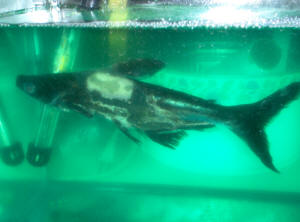
A few days ago one of my silver dollars got a chunk of his dorsal fin
bitten or torn off, and shortly after the fin tissue started turning
grey and eroding, leaving behind the bony rays, and the scales at the
fin base might have peeled off as well. As such I suspect it might be
fin rot.
<Sounds likely.>
I’m not sure why it got infected as ammonia and nitrite are zero and I
am doing 50% water changes weekly, and the other silver dollars are
completely normal.
<Sometimes just back luck or bad genes.>
But it clearly seems to be, so what would be the best antibiotic to use?
<My medication of choice for clean Finrot is eSHa 2000, which works fine
in hard water.>
I don’t want to use nitrofurazone because in the past it made my fish
refuse to eat and I have heard tetracycline does not work well in hard
water.
<If you must use an antibiotic, then choose one advertised as safe in
both freshwater and marine aquaria, such as KanaPlex. If something works
in saltwater, it'll be fine in hard freshwater.>
Thank you,
Lynnie
<Cheers, Neale.>
Re: Best Antibiotic for Fin Rot in Hard Water?
12/23/19
Dear WetWebMedia Crew,
<Lynnie,>
Apologies for the late reply I have been out of town a long time.
<No problem.>
I chickened out on using Kanamycin because it once wiped out a newly established
bio filter in my experience, and used Erythromycin based on the advice of a
local fish store who swore it worked really well for them.
<Understood.>
Of course I did not read that it is only effective against gram-positive
bacteria and not gram-negative, which is most fin rot infections.
<Indeed.>
So now the silver dollar has lost most of his dorsal and anal fins, and his tail
fin has a big semicircular cut out of it with a black margin. There may also be
erosion of the skin on the base of the tail but it is hard to
tell. Another silver dollar has also acquired a semicircular cut out of his
tail, but otherwise none of the other fish have fin problems.
If I have a mature bio filter, would kanamycin wipe it out?
<It shouldn't, if used correctly, but there's always a risk with any antibiotic.
The ideal situation is to remove the filter media to a bucket of water, ideally
with a bubbler to keep it aerated. Then, use Zeolite in the filter for the
period while you're using the antibiotic. Zeolite removes ammonia directly. It's
inexpensive (often sold as "ammonia remover" in pet shops) and does the job
adequately well. Once the antibiotics are done, remove the Zeolite and put the
filter media back.>
I recently added a second canister filter to the aquarium with bio media from
another tank but the original one has had a biofilter for almost a year now.
<See above. If all else fails, isolate the media from one filter as described
above, but leave the other running. So long as ammonia levels stay at zero, the
antibiotic isn't doing any harm; but if there is a
crisis, you know what to do (i.e., use Zeolite) and the other filter will be
safe and ready to use when you're done. Normally, antibiotics are broken down
within a day or two of use, so waiting a day or so, and doing a 25-50% water
change, is all you need to do before connecting up the biological filter.>
Thank you for everything,
Lynnie
<Hope this helps. Cheers, Neale.>
|
Might be tuberculosis or something else
7/18/19
I have a new tank since March. I have been keeping track of the parameters and
doing a weekly or biweekly water change as needed to keep ammonia down.
<Mmm, ammonia? It should be gone; your system should have long since cycled...
are you referring to nitrate accumulation?>
It is a planted tank with Fluval dirt
<? What is this?>
and slow growing but varied plants. When nitrates started to appear I slowly
added fish 4 cories in a
60 gallon tank. I waited, watched, tested, and water changed as needed.
At some points I did add bacteria in bottle (was trying to grow them naturally
but got impatient to set up) as tank stabilized I added more. Right now it's
July and I have my 4 Cories, some random amount of Ghost Shrimp, two Assassin
Snails (to deal with pest snails that came with plants) an Oto cat, and a
Bristlenose, 6 Cardinal Tetras, 7 Glofish, 6 Von Ryan <Rio?>Tetras, one Platinum
Gourami, one 2 Dot Gourami, and one Snakeskin Gourami. I had a Betta but he
died. He has the same symptoms as my Snakeskin Gourami is experiencing. Losing
weight, lesions, and the behavior is the one that has me puzzled. He bends and
straightens into an s shape. He was mostly gasping at the top and not really
moving but them would dart around like crazy. I was told by a couple of people
he might have tuberculosis among other possibilities. I'm trying to know what it
can be. Obviously the Betta had it so it is contagious or if it is a parasite
then goes top different hosts.
<A couple notes. Mycobacteria aren't parasites; this is a group of bacteria; and
Mycobacteria are pretty much omnipresent in captive biological aquatic
systems... becoming pathogenic (disease-inducing) under
conditions favoring them, disfavoring their hosts>
I did put now the Snakeskin into a hospital tank and started giving him curative
baths twice daily. I am dosing both the hospital bath and main tank with Melafix
and have added salt.
<Mmm; do search WWM re Melafix; not of any real use>
He seems to have perked up and swimming around more normal. He is still bending
into
an S and straightening still. His color is looking much better but it's only
been 2 days of treatment. The other fish right now look normal. Good color,
healthy find and normal behavior. Can you tell me what he has?
<Not based on the information provided, no. The issues with the Betta, Gourami
may be pre-existing (from the breeders, handlers before your acquisition), or
infectious as you state. IF the latter there are
anti-bacterial, antimicrobial approaches to try...>
Is tuberculosis the only possible disease that he would have or is there
something else he might have?
<Please search, read on WWM re Tuberculosis... and follow the references listed
there re identification, possible potential treatments. Bob Fenner>
Re: Might be tuberculosis or something else
7/18/19
I have a new tank since March. I have been keeping track of the parameters and
doing a weekly or biweekly water change as needed to keep ammonia down.
<Mmm, ammonia? It should be gone; your system should have long since cycled...
are you referring to nitrate accumulation?>
~Well to begin with when there was no fish and not fully cycled but plants I
would do some water changes so that the plants would not be burned by the
ammonia.
<<... this shouldn't happen. Some, most plants can utilize ammonia as a food
source>>
Once the nitrates started showing I knew that I had achieved a level of cycle
and added my cories and I'm trying to remember what else. Maybe it was hasty but
I had miss having fish. This did cause a bit of an overload of ammonia on my
bacteria and was why I did some water changes to keep happy fish. Always the
levels were low. Nitrates were always low but still did weekly water changes
just to make sure they had fresh water.
Still watching levels every week I would add a fish but sometimes a
school.~
It is a planted tank with Fluval dirt
<? What is this?>
~[image: image.png]
<<Ahh, a commercial substrate>>
and slow growing but varied
plants. When nitrates started to appear I slowly added fish 4 cories in a 60
gallon tank. I waited, watched, tested, and water changed as needed.
At some points I did add bacteria in bottle (was trying to grow them naturally
but got impatient to set up) as tank stabilized I added more. Right now it's
July and I have my 4 Cories, some random amount of Ghost Shrimp, two Assassin
Snails (to deal with pest snails that came with plants) an Oto cat, and a
Bristlenose, 6 Cardinal Tetras, 7 Glofish, 6 Von Ryan Tetras, one Platinum
Gourami, one 2 Dot Gourami, and one Snakeskin Gourami. I had a Betta but he
died. He has the same symptoms as my Snakeskin
Gourami is experiencing. Losing weight, lesions, and the behavior is the one
that has me puzzled. He bends and straightens into an s shape. He was mostly
gasping at the top and not really moving but them would dart around like crazy.
I was told by a couple of people he might have tuberculosis among other
possibilities. I'm trying to know what it can be. Obviously the Betta had it so
it is contagious or if it is a parasite then goes top different hosts.
<A couple notes. Mycobacteria aren't parasites; this is a group of bacteria; and
Mycobacteria are pretty much omnipresent in captive biological aquatic
systems... becoming pathogenic (disease-inducing) under
conditions favoring them, disfavoring their hosts>
~Yes I guess I was hoping for not tuberculosis. Everything I read about it
sounds awful and before I nuc my tank I want to make sure it is what people are
telling me it is. ~
<<Better to educate yourself rather than rely on hearsay opinions>>
I did put now the Snakeskin into a hospital tank and started giving him curative
baths twice daily. I am dosing both the hospital bath and main tank with Melafix
and have added salt.
<<Mmm; do search WWM re Melafix; not of any real use>>
~It was all I had on hand at time. I want to get what I need. I don't want to
buy random stuff until I know what exactly will help my tank. I don't like to
just jump and get everything everyone says I need. I have been told to get stuff
to treat fungus and stuff I know is low bacterial cure. I did not follow that
advise. I have some knowledge but have never experience with tuberculosis. This
is why I'm reaching out to others with more knowledge than me.~
<<Read where you've been referred to>>
He seems to have perked up and swimming around more normal. He is still bending
into an S and straightening still. His color is looking much better but it's
only been 2 days of treatment. The other fish right now look normal. Good color,
healthy find and normal behavior. Can you tell me what he has?
<Not based on the information provided, no. The issues with the Betta, Gourami
may be pre-existing (from the breeders, handlers before your acquisition), or
infectious as you state. IF the latter there are
anti-bacterial, antimicrobial approaches to try...>
~I do not know the breeder but I could find out. I buy all my fish from a mom
and pop store. Good store, fish always look good and customers come from miles
around because of the quality of stock. Would a video help? I was going to send
one but thought it would be too big of a file.~
<<If large files, do park them elsewhere and send a link>>
Is tuberculosis the only possible disease that he would have or is there
something else he might have?
<Please search, read on WWM re Tuberculosis... and follow the references listed
there re identification, possible potential treatments. Bob Fenner>
Ok I will look again on your site. I was just wanting to make sure that it was
tuberculosis before I start to destroy my beautiful tank.
<<Real good. BobF>>
|
 |
|
Might be tuberculosis or something else /Neale
7/19/19
I have a new tank since March. I have been keeping track of the parameters
and doing a weekly or biweekly water change as needed to keep ammonia down.
It is a planted tank with Fluval dirt and slow growing but varied plants.
<Adding some fast-growing plants will help control algae. Even floating
plants will do! Slow-growing plants have little impact on water quality.>
When nitrates started to appear I slowly added fish 4 cories in a 60 gallon
tank. I waited, watched, tested, and water changed as needed. At some points
I did add bacteria in bottle (was trying to grow them naturally but got
impatient to set up) as tank stabilized I added more. Right now it's July
and I have my 4 Cories, some random amount of Ghost Shrimp, two Assassin
Snails (to deal with pest snails that came with plants) an Oto cat,
<These are social and rarely last long kept singly. Indeed, they rarely last
long in most community tanks given their need for copious green algae or its
substitutes.>
and a Bristlenose, 6 Cardinal Tetras, 7 Glofish, 6 Von Ryan Tetras, one
Platinum Gourami, one 2 Dot Gourami, and one Snakeskin Gourami. I had a Beta
but he died. He has the same symptoms as my Snakeskin Gourami is
experiencing. Losing weight, lesions, and the behavior is the one that has
me puzzled. He bends and straightens into an s shape. He was mostly gasping
at the top and not really moving but them would dart around like crazy. I
was told by a couple of people he might have tuberculosis among other
possibilities.
<Really hard to say. You're quite right that Mycobacteria infections can
cause lesions, wasting, and spinal deformities. But so can a range of other
diseases, including simple exposure to non-zero ammonia and nitrite levels.>
I'm trying to know what it can be.
<Understood, and probably impossible outside of a fish pathology lab.>
Obviously the Betta had it so it is contagious or if it is a parasite then
goes top different hosts.
<Or both succumbed to similar stress factors in similar ways.>
I did put now the Snakeskin into a hospital tank and started giving him
curative baths twice daily. I am dosing both the hospital bath and main tank
with Melafix and have added salt
<Melafix likely not useful here, especially if the problem is bacterial.
Salt may help, though it's hard to say: salt can reduce the toxicity of
ammonia and nitrite, and might reduce osmotic stress where lesions occur,
but on the other hand it isn't even remotely a treatment for bacterial
infections.>
He seems to have perked up and swimming around more normal.
<Good. If the problem is environmental, simply optimising water quality
could do the trick.>
He is still bending into an S and straightening still. His color is looking
much better but it's only been 2 days of treatment. The other fish right now
look normal. Good color, healthy find and normal behavior. Can you tell me
what he has?
<Nope.>
Is tuberculosis the only possible disease that he would have or is there
something else he might have?
<See above. Time, luck probably the best things to rely on here. If
Mycobacteria, nothing short of the fish's own immune system will help. No
medications sold to aquarists have any impact. But if environmental, as I
say, optimise living conditions and things may improve. Cheers, Neale.>
|
|
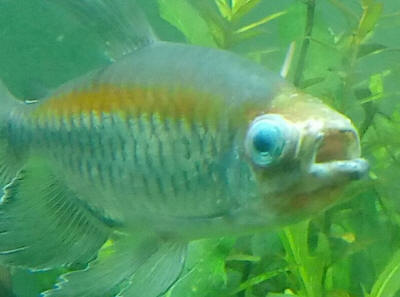
Congo tetra swollen. 3/30/18
Hello crew. Hope you are doing alright.
Today one of my Congo tetras, the biggest and dominant male appeared with a big
swollen and open mouth. His head looks very red and swollen. He is still
responding to stimulus but very weakly. His condition is worsening by the hour,
so this is a very aggressive ailment. He was not like this yesterday. Other
notable symptoms are an under jaw with marked veins, a small blood blotch near
the pectoral fins.
This looks horrible and I've never seen anything like this. He does fight a lot
with a certain other male to the point of pursuing each other across the whole
150 gallon aquarium they are in.
I've had my group of Congos for two years now. When i first got them they came
with a type of mouth fungus, something that looked like they are white gums and
no teeth (its the closest i can to describe it). It never got bad and it went
away once happy in my tank. Now all of a sudden this. I checked the other Congos
and there is one with the same white gum thing that i saw two years ago, but it
is not hindering in normal feeding or behavior. I conducted a large water change
(50%).
I have quarantined the sick fish into a 5 gal bucket with 1/2 Methylene blue and
will be waiting on response. Its 8 pm and i don't think i can go get anything
difficult right now and i don't think he will make the night if i don't do
something right now.
I have malachite green, Metronidazole, and Levamisole in my med box. Any
opinions crew?
<This does look like the infamous 'Mouth Fungus' to me, which despite its name,
is a bacterial infection nowadays more often called Columnaris after the
bacterium species responsible, Flavobacterium columnare. It can be extremely
aggressive, and while it can be treatable, you need to work promptly. A strong,
reliable antibiotic is necessary -- Kanaplex of example is known to be
reasonably effective. Outside the US, access to antibiotics can be limited, but
I have found eSHa 2000 to be quite effective as well, especially if the problem
is caught early on (it's less effective once the fish is really weak). Neither
Methylene Blue, Malachite green, Metronidazole, or Levamisole are useful here.
Do bear in mind Columnaris is opportunistic and to some degree caused by things
like fighting and less than perfect water quality, so reviewing the tank is
important as well. Cheers, Neale.>
|
 |
|
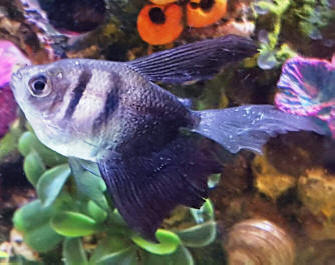
Ich and Fin Rot?
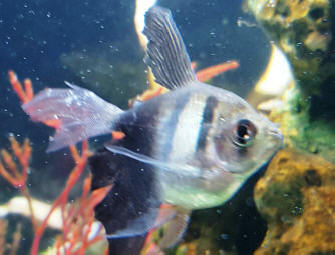
Hi crew, hope all is well on your end! I'm writing about a black skirt tetra in
my 29 gallon community tank. About a week ago I noticed some white spots on her
tail which caught my attention.
<I see these.... sand, air bubbles? Ich?>
When comparing her to the other tetras I realized her tail is not as full. I was
suspecting ich and fin rot, but I was able to find a photo of her that was taken
a month prior. I realized that she has looked this way for at least a month,
possibly since I got her. I guess I just never noticed it. In the tank are five
other tetras, 4 danios, a small school of kuhli loaches
<These don't like most ich med.s>
and a school of cories. All are free from spots, fin rot, etc. All are thriving,
including the fish in question. Ammonia and nitrites are 0. Nitrates are 40
ppm(have been experimenting with matrix and Nitrazorb during the slow process of
reducing this number with moderate results).
<Water changes in the meanwhile>
Please review the attached photos as your thoughts would be very much
appreciated. Thank you. Danielle
<IF anything (and after reading on WWM), simply raising water temp. to the mid
80's F.
The reading:
http://www.wetwebmedia.com/fwsubwebindex/fwich.htm
and some of the first files linked above.
Bob Fenner>
|
 |
|
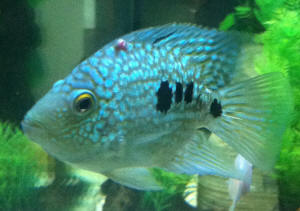
My Texas cichlid has a Lump 3/15/13
Hi,
I have a juvenile Texas cichlid who has been with me for around 6 months
now ... Goes along with all the other fish.. Since yesterday I have
noticed a small lump on both his sides where the fin starts.. The lump
on one side is bigger than the other and looks like it's an open sore..
I am worried..could you pls let me know what this is..
I am attaching a pic for a clearer understanding..
Thank you
<Mmm, well; likely this is a viral (or virally mediated) growth. At any
length, not generally deadly, and not treat-able. With your good care
(nutrition, water quality...) this growth may well disappear on its own
(ala warts in humans). Bob Fenner>
|
Re: My Texas cichlid has a Lump 3/18/13
Thank you !!!
<Ah, welcome. BobF>
|
|
possible prolapse? 8/14/12
The black skirt tetra in question developed the condition sometime
earlier today. After a little research, it appears to be a prolapse. She
(he?) is acting perfectly normal and is still eating. I tested the water
and it appears to be fine: 0 ammonia, 10ppm nitrate, 0 nitrite, GH
75ppm, KH 80ppm, pH 7.5. Is it a prolapse or something else? What should
I do? A
quick response would be greatly appreciated. Thank you in advance.
<Yes, you do seem to have a Black Widow Tetra with some sort of
intestinal infection. As the pathogens (often Protozoans rather than
bacteria) multiply, they cause the large intestine to become inflame and
emerge from the anus. Metronidazole ("Flagyl") is the medication of
choice here, and the only one that works reliably. The use of Epsom salt
can be helpful too,
at 1-3 teaspoons per 5 gallons/20 litres, alongside the Metronidazole.
Cheers, Neale.>
|
.JPG)
.JPG) Great pix. B
Great pix. B |
|
Possible Mouth Rot Photo Attached
7/26/12
Hi,
<Sarah>
I need guidance for my angelfish. They have been lip locking and
fighting and now his mouth looks like possible mouth rot,
<At least damaged>
but I'm not sure if he's injured or if it's more then that. In the photo,
you can see where his mouth looks like its separating and is almost see
through as you can see some red like its the inside of his mouth. I do
water changes every 4 to 5 days about 50% With his mouth
I've moved to 3 days.
<Good>
Temp is 78-80, he still eats
<Even better>
and they have a varied diet. Almost all silk plants in aquarium (20
gal tall) No ammonia or nitrites and nitrates never register to
20ppm, tank established for a year and my injured fish is almost a year
old (he's huge which I think gives testament to how well i take care of
them). They are the only two fish in the tank. The other
angel doesn't look like his mouth is bad, but I'll put a photo of him
too as it seems like his lips are puffy.
I'm not sure if he's just hurt or if it's something more then that. What
do you recommend I do?
<Mmm, likely nothing more than you already are doing>
I have been reading up on E.M. Erythromycin
<This or Sulfa... but again, I'd leave all as is for now>
and if this is something I should get and treat with as I've read Melafix
and Pimafix are worthless.
<They are worse than worthless>
What do you think I should do?
Thank you,
Sarah
<Keep up the good water quality maintenance and mixed diet. Bob Fenner>
Sarah
|
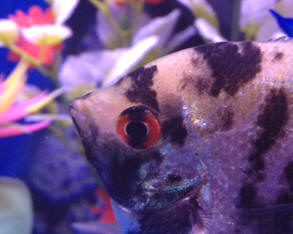
|
Re: Possible Mouth Rot Photo Attached – 07/26/12
Hi
<Sarah>
Thank you for your response. However I don't think the right photo was
attached. The silver marble has a "puffy" mouth, but it's my black
marble that I'm questioning with the injury/possible mouth rot. Photo
below & thanks again so much.
<Ahh, thank you for this correction... where did I/we get the other
pic...?
Would still not medicate.>
Sarah
<Cheers, BobF>
|
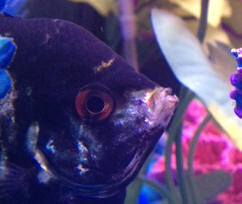 |
Re: Possible Mouth Rot Photo Attached – 07/26/12
I had attached both of them in the original email but I guess my system (or
I) did not attach properly.
<Ahh>
I wanted to show the black marble as he was the one with the injury and
show my silver marble as his lips seemed swollen. Since I will keep doing
what I'm doing with water changes, feeding varied foods etc, and not
medicate, what should I watch for in case I have to medicate?
<Signs of decomposition... Hyphae...>
I know a symptom is "cotton" like stuff by the mouth. I noticed he had a
string of one which is what made me think he had a bacteria infection.
<May be>
I just wanted to say thank you and I am very grateful for your website and
assistance. I have become somewhat of a geek with my fish as its my #1 hobby
Thanks again
Sarah
<Glad to share. B> |
|
Sick Black Ghost Fish too much
salt? 11/22/11
Hi! I have a sick Black Ghost Knife Fish and I have been doing research
and speaking with a few Aquarium shops for the past few days with no
help.
We have and angel fish who developed some fungus on it's tail.
After a few water changes there was no improvement so we did a salt
bath on the tank. I was not aware that Knife fish were so sensitive to
the salt though now since he is sick I know he is. The major problem
that I can identify is that not knowing I did a salt bath my boyfriend
also did one. That next morning the ghost was laying on the bottom of
the tank hardly breathing. We have a 55 gallon tank with an assortment
of angels, clown loaches, tetra's, catfish, a Danio...everyone else
seems OK though we have quarantined our angel in another tank and are
doing treatments on him. We changed about half of the water in the tank
to reduce salt levels but 2 days later the
Ghost is not eating and has been laying in the bottom of the log that
he usually hides in. No spots or ragged fins he looks of other than
that he is laying where he typically swims all day. Our water levels
are all pretty much perfect and I'm not sure what else to do to
help him???
I would love some ideas he is by far our favorite fish and I would hate
to see him go!
Thanks
Jess
<You shouldn't use salt at a higher concentration than 2
grammes/litre.
Contrary to popular misconception, salt isn't a cure-all. It's
good for Whitespot and Velvet at the concentration stated above, but
hopeless for Finrot and Fungus, and certainly not something to add to
your aquarium without a very good reason. If you do think salt is the
issue here, do a 50% water change now, and another 50% tomorrow. This
should flush out most of the salt.
http://www.wetwebmedia.com/fwsubwebindex/SaltUseFWArtNeale.htm
Cheers, Neale.>
Re: Sick Black Ghost Fish too much salt?
11/22/11
Thanks Neale! I will try that and see how he does.
<Good luck! Do also consider the presence of copper and low oxygen
concentration -- both critical issues when keeping Apteronotus. Cheers,
Neale.>
Danio with fish TB or merely bad water quality or old
age? 9/16/11
Hi,
first of all, I'd like to thank you guys for running this website
-- it's helped me out many times and it's always my first stop
when there is something wrong with my fish and I need an answer.
<Thanks for the kind words.>
I have a tropical fish tank with a mix of loaches, Platies, a Cory, and
four (or, as of yesterday, three) zebra Danios. I feed them mainly with
fish flakes and some additional sinking food for the loaches. I
can't recall how big the tank is, but from previous calculations I
know that it isn't overstocked (since I had a few deaths recently
it's rather a bit under-stocked, but more of that later). As for
food -- occasionally they get bloodworms or daphnia but they
haven't had much variety recently because we were on hold for a few
weeks and it's easier for the fish feeder to just give the
flakes.
<Sounds fine. Good quality flakes can make an adequate staple,
though offering occasional live or wet-frozen foods really can help
with constipation problems.>
Now, to give you the back-story. I have to admit that in recent months
I've been a very bad fish keeper indeed. I am pregnant and the
constant exhaustion and nausea has thrown me for a bit of a loop,
meaning that I've been less than diligent with cleaning out the
tank. Add to that that every time I clean it I seem to have to flush a
fish or two afterwards (is it the shock of all that clean water?) and
tank maintenance hasn't looked too appealing recently and the tank
has on occasion looked pretty bad.
<I see.>
Through this neglect I have lost a few fish recently, but there was
nothing in particular about those deaths that alerted me to anything
like an illness -- fish would stop eating, keep themselves separate,
and eventually die. There were no sores, discolouration or anything
else odd. Losses were varied -- an aquatic frog, a couple of guppies, a
Cory, and some Platies, but with many weeks in between). It's bad,
I know, and I feel rather guilty, but I attributed it to the bad water
quality and tank hygiene rather than any disease.
Now the Danio -- A while back (at least a month or so ago) he developed
a curved spine. Looked really odd, like he had a hunchback or something
like that. Initially this didn't seem to bother him much at all,
but during the past week or so he got slower and stopped swimming
around much. Eventually I found him at the bottom of the tank, kind of
crumpled up -- he looked almost paralysed, his spinal deformity looked
that bad. He wasn't moving and I thought he was dead, but when
touched he roused himself and swam off. The next morning I found him
floating at the top of the tank, dead, but get this -- by the time I
got round to fishing him out (had to get kids off to school, etc, so it
was a couple of hours later), he was gone! This was two days ago and
I've done two water changes since and I haven't found him.
Perhaps he was eaten?! Granted, I have a lot of plants in there, but I
did check through them and nothing!
<Could be a combination of things. Crooked spines typically appear
either at birth if genetic or in older fish as a result of
environmental stress and/or poor diet. Simply being old shouldn't
cause this problem, but it might I suppose.>
Since he died in such an odd way, today I sat down to Google the
hunchback syndrome and after reading about Fish TB for a couple of
hours I am more than a little freaked-out, in particular as it can be
passed to humans. As I said, I cleaned the tank twice in the past two
days and I did discover a little wound (cuticle) on my hand, so that
wound was definitely in contact with the water! In particular as I am
pregnant I'm rather worried that I may have contracted something...
Do you think it is likely the Danio died of Fish TB? He didn't
appear to have any sores, etc. that I could detect, but then, that
appears to be optional. He was quite big and I think I must have had
him for at least 1.5 years so perhaps it was just old age? Or it was
the dismal conditions that the tank was in for a while? I have today
discovered that another of the remaining Danios has a slightly curved
spine, although not nearly as bad as the one that died. He is also a
rather large (so I'm guessing one of the older) Danios. So far he
seems fine otherwise.
What is your opinion? Fish TB? Old age? Bad water and nutrition? Or
some other weird and not so wonderful fish problem? And should I go to
the doc to get this TB thing checked out?!
<If the aquarium is otherwise fine, and the fish all seem healthy
now, I wouldn't worry. The Mycobacteria infection aquarists call
Fish TB (probably erroneously) is likely latent in most tanks anyway,
but provided the fish are healthy and well cared for, there's no
particular reason to worry about it. Nonetheless, I would wait a good 6
weeks before adding any more fish. And if finding the time to maintain
the tank is likely to be hard, then understocking the tank will really
be a good idea.>
Any help would be much appreciated. Thank you!!
Best regards,
Iris
<Hope this helps. Cheers, Neale.>
Skinny Disease and Loaches 9/11/11
Hi Neale,
How are you doing today? I will soon post my pictures of my new 125
gallon on the forum for all to enjoy. Question, please! I have
purchased new fish, which are in quarantine. I have four new
clown loaches (to keep the one I have company), and three
Angelicas loaches (I plan on getting a couple more later). While I was
continuing my research on these fish, just to always learn more about
them, I came across many articles that say loaches are very susceptible
to "Skinny or Wasting Disease". Great, problem is these
specimen are so small, the clowns are about 1.5 inches, and the
Angelicas are about an inch. How on earth can I tell if they have this
disease when they are babies. They seem to have good muscle tone, and
they move so quickly I can't get a good view.
<Wasting Disease is difficult to pin down but likely some
sort of Mycobacteria infection. Fish with Wasting Disease
simply fail to thrive: over the weeks they get thinner and thinner, and
eventually die. Treatment is difficult, likely impossible, though the
right cocktail of antibiotics, administered by a vet for the weight of
the fish in question, could well work.>
I don't want to catch them individually and stress them out to get
a better look, I just got them in from mail yesterday. So, should I
assume they have parasites and treat them with PraziPro, or buy
Levamisole?
<Many loach-keepers do "worm" their loaches upon purchase.
By all means do so, but keep an eye out for abnormal reactions. Follow
instructions carefully, and remove carbon while medicating. Providing
extra oxygen is often helpful.>
I also have Jungle Bacteria Food, that says it treats wasting as well
as other bacteria, etc. Sites suggest using Maracyn I and II. However,
I don't want to mess up my good bacteria. What would you suggest?
Sometimes the more I read the more anxiety I get, and look at my fish
constantly trying to figure out if they are healthy. Thanks and have a
pleasant day. Lu
<You're welcome, Neale.>
|
Flower Horn Skin Condition
9/6/11
Hi Crew
Eric King here and I have a question about my Flower Horn.
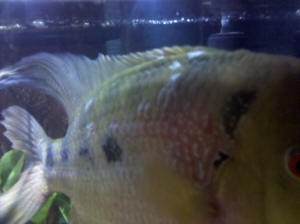
Yesterday I was feeding him and I noticed that he is starting to
develop some sort of skin condition (pics included).
<... 8 megs... What do we state we'll accept? Hundreds of
Kbytes. Back to go w/ you>
He has some patches on his skin that are milky in appearance and
starting to slough off. This started 2 days ago and the patches
look to be spreading across the length of his body. I am thinking
it is some sort of Fungal infection. My water parameters are all
good, Ammonia is 0ppm, Nitrites are 0ppm, Nitrates are 0ppm,
<... no... How?>
PH is 8.0-8.5
<Too high>
and the water temp is 78F, water volume is 100 gallons and I am
doing a 25 gallon change every week treated with API Stress Coat
fish and tap water conditioner, and adding API Aquarium Salt
<Why? Not needed or suggested>
at rate of one tablespoon per 5 gallons and adding API Stress
Zyme biological filtration booster.
<Ditto>
Tank has two Magnum 350Pro Canister filters and Bio wheels
filtering 700 gallons per hour total, filters are filled with
Marineland Activated Carbon and Zeolite.
P.S. I have been having a problem with him eating, He hasn't
eaten on a consistent basis in probably two months. I feed him
Hikari Cichlid Gold and Hikari Cichlid Staple twice a day but he
really doesn't eat all the time.
<... Likely environmental... the pH is too high; however
you're rendering the water NO3 is likely toxic... See WWM re
FH systems, chemical filtrants for nitrate poisoning. Bob
Fenner>
|
 |
|
Flower Horn Skin Condition
9/7/11
<... this has already been responded to>
Hi Crew
Eric King here and I have a question about my Flower Horn.
Yesterday I was feeding him and I noticed that he is starting to
develop some sort of skin condition (pics included). He has some
patches on his skin that are milky in appearance and starting to
slough off. This started 2 days ago and the patches look to be
spreading across the length of his body. I am thinking it is some
sort of Fungal infection. My water parameters are all good,
Ammonia is 0ppm, Nitrites are 0ppm, Nitrates are 5 ppm, PH is
8.2
<Too high>
and the water temp is 78F, water volume is 100 gallons and I am
doing a 25 gallon change every week treated with API Stress Coat
fish and tap water conditioner, and adding API Aquarium Salt at
rate of one tablespoon per 5 gallons and adding API Stress Zyme
biological filtration booster.
Tank has two Magnum 350Pro Canister filters and Bio wheels
filtering 700 gallons per hour total, filters are filled with
Marineland Activated Carbon and Zeolite.
P.S. I have been having a problem with him eating, He hasn't
eaten on a consistent basis in probably two months. I feed him
Hikari Cichlid Gold and Hikari Cichlid Staple twice a day but he
really doesn't eat all the time.
<Environmental. Read here:
http://wetwebmedia.com/FWSubWebIndex/FHParrotCichArtNeale.htm
and all the linked files above. BobF>
Re: BobF's wonderful customer
relation skills.... FH hlth., "good"
consumerism 9/7/11
<... Am sending this along to the gentler Neale for his
further input.
Cheers, B>
<<Hi Eric. When fish produce patches of slime the usual
explanation is that there is some sort of irritant on their skin.
Most of the time that irritant is chemical: perhaps ammonia
and/or nitrite, but potentially also
things like copper or even (improperly used) medication.
Sometimes external parasites are to blame, including
"Costia" (properly, Ichthyobodo spp.) and Trichodina
spp. Such infections are often called Slime Disease. Now, Slime
Disease appears to be latent on many fish, but becomes
problematic when
fish become stressed. You often see it on newly imported
livestock that don't adapt to the cramped conditions in
tropical fish shops, for example loaches and pufferfish. But it
can also appear on fish at home if they become stressed, so
reviewing water quality, water chemistry, temperature,
oxygenation and social behaviour (tankmates) are all critical.
There are commercial medications that treat Slime Disease; I find
these work best alongside saltwater dips. Cheers,
Neale.>>
FH hlth., Hospital Tank for a Flowerhorn suffering from
Ciliate Chilodonella infection 9/7/11
HI Crew, this is Eric and I was wondering, do you guys have an
article giving detailed instructions on setting up a hospital
tank? I have finally narrowed down what my Flowerhorn is
suffering from and now I need to get it treated but I have never
had to set up a hospital tank and I want to make darn sure I get
it perfect. Any info would be greatly appreciated!!!
<Hello Eric. Chilodonella is difficult to treat, and it's
also difficult (impossible?) for hobbyists to distinguish between
Chilodonella, Ichthyobodo (=Costia) and any of the other
so-called Slime Disease parasites. So you need to be open minded
here. Normally, a good, reliable Whitespot medication works
against them. Usually, salt at 3 g/l to as high as 5 g/l will
also eliminate early cases. One of the best things you can ALSO
do alongside either of these treatments is to do seawater baths,
i.e., dip the fish in water with a salinity of 35 g/l but the
same temperature as your aquarium. Dip the fish for at least 2
minutes and preferably as long as possible, 5, 10 or even 20
minutes being possible. Remove the fish before it becomes
obviously distressed, e.g., by rolling over. Saltwater dips kill
parasites on the skin, and the longer the dip, the more parasites
are killed. The saltwater also helps to clear up the irritation
and reduce the mucous. Do at least one dip, and I like to do
another after 2-3 days.
If your Flowerhorn lives by itself, there is no need to set up a
hospital tank. Flowerhorn cichlids are not sociable fish and
aren't usually kept with other fish. Details on quarantine
tanks are elsewhere on WWM; the rules for marine tanks hold here,
except, obviously, you don't use seawater but freshwater!
http://www.wetwebmedia.com/quaranti.htm
Cheers, Neale.>
re: Hospital Tank for a Flowerhorn suffering from Ciliate
Chilodonella infection 9/7/11
I have a medicine that contains Methylene blue, and formalin.
<Formalin can work. But it is EXTREMELY toxic to your fish,
your filter, and you! So use with extreme caution as instructed
on the packaging. I would not use it.>
Will that work and if I treat the entire tank what would I need
to do after the treatment, i.e. recycling the tank.
<I would use a safer medication, e.g., eSHa 2000 here in the
UK, that would not harm the filter. In your own region/country
there may be alternative medications available. Cheers,
Neale.>
Nitrates too high
(RMF?)<<Already wrote this fellow re the
root of his issue...>> 9/7/11
Hello Crew, this is Eric
I'm having a problem with Nitrate levels in my Flowerhorn
Cichlids tank. I have a 75 Gallon tank and my water parameters
are Ammonia 0, Nitrites 0, Ph is 8.2 which I know is high and I
am currently trying to lower it with Ph Down, tank temp is 77F. I
did a 50% water change today and vacuumed the gravel and my
Nitrates are at 40 ppm, ml/G. My question is should I keep doing
a large water change every day until that level drops down to
minimal?
<Yes, that's the easiest approach. Also cut down feeding,
and also make sure the aquarium is reasonable for the size of
your fish. An adult Flowerhorn can be 25 cm/10 inches long, and a
big, fat fish at that -- so 75 gallons isn't a huge amount of
water. What's the nitrate level of your tap water? If your
tap water contains 40 mg/l nitrate, then doing water changes will
NEVER take the nitrate level in the aquarium below that. For
cichlids, 40-50 mg/l is just about the maximum they tolerate
without long-term problems. They are, for example, much less
tolerant of nitrate than Goldfish. You really want 20 mg/l
nitrate or less. If you have 0 mg/l nitrate in your tap water,
and 40 mg/l nitrate in the aquarium, then changing 25% will lower
the nitrate to 30 mg/l, 50% to 20 mg/l, and so on. Obviously big
water changes expose fish to the risk of temperature and water
chemistry changes, so there's a balance to strike between
adding new water and your ability to keep temperature and water
changes nearly constant. Small, daily water changes of 10-20%
will be safer than changing 75% once a week, though some advanced
aquarists certainly take the second approach knowing that they
can keep temperature and water chemistry very steady.>
I have Bio Wheels on my tank with two Magnum 350 Pro Canister
Filters that are both filled with Activated Carbon and Zeolite. I
understand for reading on the site that Bio Wheels can add a lot
of Nitrates to the tank.
<Not sure this is true, but it's often stated. I think
it's perhaps better to say that a DIRTY canister filter can
cultivate its own "ecology" of microorganisms that may
contribute nitrate to the water, and certainly compared to sand
filters or live rock filters there's no active removal of
nitrate. But a well-maintained canister filter that's rinsed
regularly is a PERFECTLY good filter choice for cichlid
aquaria.>
I am also adding 1Tblsp per 5 gallons of water of Aquarium salt
to the replacement water when I do my water changes, could that
be contributing to the high nitrate levels.
<No, but salt isn't a magic bullet either.>
The only reason I am adding the salt is per my Veterinarians
recommendation.
<Salt reduces the toxicity of nitrite and nitrate, so in some
ways its useful. But it's also a potential stress on
freshwater fish, especially soft water fish. I doubt this
concentration of salt will have much negative harm on a Central
American hybrid cichlid, but do be aware that some hard water
cichlids from the Rift Valley of Africa are prone to "Malawi
Bloat" when kept in tanks where salt is added carelessly.
There isn't any compelling reason to use salt in the long
term, so once your fish is better, and once you've got
nitrate levels to 20 mg/l or less, I'd slowly phase out salt
usage by adding less and less over a few months. Cheers,
Neale.>
re: Hospital Tank for a Flowerhorn suffering from Ciliate
Chilodonella infection 9/7/11
Ok one last question, this white spot problem started about a
week after I introduced a large Pleco into the Flowerhorns tank,
would it be a good idea to just get rid of the Pleco?
<Any new fish has the risk of bringing in Whitespot, so in
that sense, the damage is already done. But in a 75-gallon system
an adult Pleco and an adult Flowerhorn will be producing a LOT of
waste, likely explaining your high nitrate levels. Furthermore,
there are lots of reports of Plecs "sucking" onto the
sides of big, slow-moving cichlids such as Oscars, so that's
another reason not to keep them together. Flowerhorn cichlids are
simply much easier kept alone, where you can very precisely
maintain the
right water chemistry and water quality. If you must keep them
with other livestock, you'd really want a tank bigger than 75
gallons. Cheers, Neale.>
Re: Hospital Tank for a Flowerhorn suffering from Ciliate
Chilodonella infection 9/7/11
Also, Neale, I have now way of checking salinity levels so any
idea how much aquarium salt I need to add to 16 gallons of water
to get 35g/l?
<You can use Google to convert grammes into ounces and litres
in gallons.
On my web site there's a program called "Brick
Calc" that will do this for you, converting g/l into
ounce/US gallon and comparing these to specific gravity and %
seawater. Cheers, Neale.>
Re: Hospital Tank for a Flowerhorn suffering from Ciliate
Chilodonella infection
ok Neale, I am trying to find something in the USA that is
equivalent to the eSHa 2000, any ideas, or maybe what types of
chemicals I should be looking for.
<Seachem Paraguard and Mardel Maracide are the sort of thing
I'd be looking at.>
I can get products from a company called Mardel that treats skin
problems.
I am really at a loss for what to do here cause my Flowerhorn has
had this problem for 4 days now and it just keeps regressing as
the days go on.
<Do try the salt dip; can clear up the mucous within hours,
and that's a good sign Costia or similar is the
problem.>
I've spent the last 4 days just trying to figure out what is
going on. Also I would need a product that I can treat the hole
tank with and after treatment just replace my carbon
<Remove these while medicating.>
and filter pads and do a water change.
<Cheers, Neale.>
Re: Hospital Tank for a Flowerhorn suffering from Ciliate
Chilodonella infection 9/7/11
Oh ok so I would actually add 35grams of aquarium salt per litre
of water.
Right?
<Yes. Do read:
http://www.wetwebmedia.com/fwsubwebindex/SaltUseFWArtNeale.htm
35 g/l looks A LOT. But it's actually how much there is in
seawater. Hold the fish in the water with a net. If it thrashes
about, or turns upside-down, then remove and return to the
aquarium. Be cautious, but don't
be frightened: this is one of the safest ways to treat fish. Do
read the section on salt in the aquarium fish health book of your
choice. Signing off for the next 48 hours! Cheers, Neale.>
Re: Hospital Tank for a Flowerhorn suffering from Ciliate
Chilodonella infection
Oh ok so I would actually add 35grams of aquarium salt per litre
of water.
Right?
<Yes. Do read:
http://www.wetwebmedia.com/fwsubwebindex/SaltUseFWArtNeale.htm
35 g/l looks A LOT. But it's actually how much there is in
seawater. Hold the fish in the water with a net. If it thrashes
about, or turns upside-down, then remove and return to the
aquarium. Be cautious, but don't
be frightened: this is one of the safest ways to treat fish. Do
read the section on salt in the aquarium fish health book of your
choice. Signing off for the next 48 hours! Cheers,
Neale.>
Re: Hospital Tank for a Flowerhorn suffering from Ciliate
Chilodonella infection 9/10/11
Before u go I picked up two medicines, Mardel Maroxy, and Mardel
biospheres.
Sound ok?
<Not familiar with them. Check with manufacturer (packaging or
website) to see if they treat Costia or Slime Disease. Cheers,
Neale.>
Salt Dips on my Flowerhorn Cichlid and
Maracide treatments 9/11/11
Hi Crew, Neale to be specific.
Neale I was wondering how many times I should do the salt dips on
my Flowerhorn Cichlid? I did one today (9/8/11) and I am going to
do another one on 9/10/11.
<Sounds fine. Do another a week later if you need to, but it
may not be necessary.>
The one I did today he only tolerated it for about 5 minutes
before he started showing serious signs of distress. Also with
the Maracide treatment the instructions state to do the treatment
for day one, day 3, and day five, should I stop after day five or
continue to do the treatments until everything clears up?
<Follow the instructions! If the Slime Disease is still there,
do a 25% water change, then the following day another 25% water
change, and then on that second day, start another treatment
(three doses across five days).>
Thanks to all of you at WWM for all the help, and the wealth of
knowledge!!
Thanks again
Eric
<You're welcome, Neale.>
Saltwater Dips 9/11/11
Hi Crew specifically Neale, Eric King here again and here is a
question about Saltwater Dips. I am making a dip for my
Flowerhorn Cichlid and am wondering if I can use Aquarium Salt
for this or if I need to be using a Marine Salt Mix?
<Either can work, but aquarium salt rather than marine salt
mix will be better and cheaper. Non-iodised cooking salt will
work, too. Cheers, Neale.>
Flowerhorn Cichlid with Slime Coat Disease and holes in Head and
Lateral Line... water quality
High Tank Nitrates and HITH
9/11/11
Hi Crew, This is Eric. I have been talking back and forth with
Neale about my problems and I know he is out of the office for
the next few days but I have an important question. My Nitrate
levels in my tanks are very high, 80 ppm ml/g and I am going to
do 50% water changes every day till the levels get back to
acceptable, but I need to know should I do these water changes
before I start treating the tank with Maracide or after I treat
with Maracide?
< Check your tap water for nitrate levels. In agricultural
areas the tap water nitrate readings may be very high so changing
water may not do too much good. Getting the nitrates down below
20 ppm would be a big help. If you fish is in a severe condition
I would still start treatment despite the nitrate levels.>
Also I am going to do Salt Water Dips, should I start these right
away or wait till the tanks water parameters are back to
acceptable?
< Check the condition of the fish. The disease already has the
fish stressed. If the salt bath stresses the fish out even more
then I would wait until the fish builds up it strength.>
Thanks a lot to everyone on this site for all the great help and
input.
< Thank you for your kind words.-Chuck>
Re: Salt Dips on my Flowerhorn Cichlid
and Maracide treatments 9/13/11
Hi Crew, Neale to be specific, I am treating my Flowerhorn
Cichlid for Slime Coat Disease and today is the last day of
treatment with Maracide. He looks to be getting a lot better,
activity has gone back to normal, his colors are coming back and
the Slime Coat Disease looks to be almost gone.
My question is, should I continue to do a second round of
treatment with the Maracide to be on the safe side, or could that
be detrimental to the fish. Thanks for all the help and wealth of
info, it is greatly
appreciated!!!
<Do finish off the course of treatment. That's usually the
best approach.
Glad all is working well. Cheers, Neale.>
|
|
Concerning possible wasting disease or other
microbacterial agent 3/12/11
I've had 2 Aquariums with crystal clear water and happy fish
for a couple of months now, a 20 gallon and 10 gallon (the latter
as quarantine now).
<I see.>
My setup includes airstones and plenty of hiding places with
plastic props and plants in both tanks, standard and 150 watt
adjustable heater, Aqua-Tech standard carbon-filter media for the
10 - Fluval 20 (3 tier media) for the 20 Gallon [They are both
unexceptional]
I've been using Nutrafin cycle and conditioner as well as
aquarium salt, seldom more than 1/4 tablespoon per 10 gal on
water changes.
<The addition of salt on a regular basis does no good and may
do some harm to soft water fish. Do, please, understand that
freshwater fish come from habitats without salt. The addition of
salt was something done during the 50s and 60s because it seemed
to help keep hardy fish alive in the poor conditions often
provided. Salt does indeed reduce nitrite and nitrate toxicity.
But we don't keep the same hardy fish any longer -- Acaras,
for example, and large barbs -- and instead you're keeping
far more delicate species for which the use of salt is merely one
more stress factor. Note that no, and I mean NO, modern aquarium
book recommends the routine addition of salt to freshwater
aquaria except under specific situations, e.g., for treating
Whitespot.>
My water parameters have roughly always been 7.7PH , 0.03 or less
Ammonia/Nitrite.
<So not zero, and non-zero levels of ammonia and nitrite are
bad. Despite what beginners think, there aren't
"good", "okay", and "bad" levels of
ammonia and nitrite. If you have zero levels, that's good,
and if you don't have zero levels, that's bad. Yes,
higher levels of ammonia and nitrite will kill your fish more
quickly than lower levels, but that's sort of like comparing
a slow-acting poison against a fast-acting poison -- neither is
actually safe!>
Been meaning to check water hardness.
<Hardness is crucial, and if anything, much more important
than pH.>
Substrate vacuum during water change every 5-7 Days. Food: freeze
dried blood worms as well as brine shrimp, I have cichlid
pellets, Pleco logs, and color enhancing and normal flakes.
<Okay.>
Casualties of my ineptitude: 6 Neon Tetras,
<Need cool, soft water to do well.>
1 Female Cherry Barb, 2 Rubber-Nose Pleco,
<Chaetostoma sp., requires a very specific cool, oxygen-rich
environment.>
1 Zebra Danio
<Oh dear.>
Currently Alive: 20 Gallon - 3 Blood Fin Tetras, 2 Corys, 2
Chinese Algae Eaters,
<These are aggressive and very large fish that need at least
55 gallons per specimen, and have NO place in this community
tank.>
2 Zebra Danios,, Male Cherry Barb, Red Finned Shark, Bala
Shark,
<A big, very active, schooling fish that needs a couple
hundred gallons for a healthy sized group of 5+ specimens; even a
singleton, which would be a cruel way to keep them, needs well
over 55 gallons.>
Yoyo loach, Male and female Swordtail,
<Swordtails need cool, oxygen-rich water much different to,
say, Gouramis or Bettas.>
2 Male Gouramis - (Red dwarf and Healthy Paradise) and 2 Male
Betas
<Bettas don't belong in community tanks, and certainly not
with Gouramis.>
10 Gallon - 2 Male Gourami's (Blue powder and sick paradise
fish)
<Paradisefish are not Gouramis and need a subtropical
aquarium; maintain at 18-22 C/64-72 F.>
I know these breeds are probably not optimal community members
and thus introduce stressor risk.
<"Probably not optimal" is an
understatement!>
They have rarely ever been seen fighting or exhibiting stressed
out behavior.
<Too busy getting sick, perhaps?>
Keep in mind the pet-store I got a bunch of these from has a lot
of issues, you guys would be appalled, the lady that works there
even speculated the Gourami tank had wasting disease I wish I
would have known so prior to this nightmare.
<While I sympathise to a degree, none of what I've said
above should be a surprise. A good aquarium book would cost you
$10, or nothing at all if you visited the public library. Most
aquarium web sites are variable in terms of information, there
are some excellent ones written by genuine experts, like this
one, PlanetCatfish, Loaches.com, SeriouslyFish.com, among
others.>
It all started about 3 weeks ago when I noticed Ich had developed
on 3 of my Neons tetras. I feel pretty terrible since I thought I
could just go ahead and use a product to solve this without doing
any research. I used Ich Guard which was pretty rough, since I
lost all my neon tetras within a couple days. This also probably
weakened all the fish by stressing them out with the daily water
changes, messing with the nitrogen cycle, etc. I did that for 7
days; At which point the first signs of what appears
microbacterial started to manifest on my brown paradise
Gourami.
<Hmm'¦ would say more stress-related than anything
else.>
I thought he had started getting picked on by some of the other
fish because his tailfin looked nipped and he started staying at
the bottom, had a loss of appetite. I moved some of the fish I
thought were aggressive to the 20. It kept getting worse and I
kept moving fish till he was all alone. His fins have degenerated
to an almost ridiculous point, he looks like he's been
attacked along the body but there wasn't any other fish to
have done so.
<I see.>
Then I made the mistake of using Melafix for 5 days, again
without research (consequently my two Plecos died shortly on the
first day, as well as the female cherry barb despite healthy
looking conditions during the Ich treatment). I recently read
Melafix is bad for labyrinth fish lungs.
<Read this where? Melafix is at worst useless, but I doubt
it's actually poisonous. Has been used widely to treat
Bettas, which are labyrinth fish. Since the labyrinth organ (in
the head, not the lungs) accepts air, not water, a labyrinth fish
is more likely to be damaged by fumes such as paint, cigarette
smoke, bug spray, etc.>
Furthermore kinda grasped from some of your organizations
faq's that it isn't strong enough as an anti-bacterial
agent for defeating most microbacteria.
<Is indeed more of an antiseptic ointment than a genuine cure
for systemic infections. At best, it weakens certain bacteria
making it easier for the fish's own immune system to work
quickly. Would have no problems using Melafix to treat a fish
that was damaged by transport or fighting, but would not use
Melafix once a fish had a visible infection.>
Basically he's been getting worse, he eats but lightly
compared to how he used to. One of the zebra Danios died
yesterday with signs of emaciation. I saw what appeared to be a
fuzz ball in the middle of one of my blue powder's feelers as
well. It looks a little frayed where the ball was and past that
the feeler is now missing, he had a lesion like the brown
paradise but that's healed up nicely, hopefully it
doesn't progress. All of the fish still alive came into
contact at one point with the brown paradise. I'm clueless as
to how to proceed, furthermore my 20 gallon has just had a
confirmed Ich sighting 3 days ago, at which point I bought an
adjustable heater which I've had at 86, 89 and now back at 86
for the past three days..
<Do bear in mind Paradisefish need cool conditions, as do some
of your other fish, so turning the heater up can, will stress
those species.>
Do you guys have any idea how I should proceed in getting this
under control?
<You need a much bigger aquarium for many of these fish, and
perhaps more than one aquarium, one for the cool water species
and one for the warm water species.>
I've read heat and salt could treat Ich, 10 days of 86, how
much salt is safe to use?
<Normally 2g/l is used.>
Should I adjust my PH to 7.0?
<If you're asking me about adjusting pH, you clearly
don't know enough to do this safely.>
Is water hardness important?
<Here's the thing: hardness is EXTREMELY important; pH
hardly at all. Beginners look at pH because it seems easy to
understand and you can buy cheap potions that claim the change
pH. But beginners end up killing their fish by following this
line of reasoning. The first thing is ALWAYS to lower hardness
using RO or rainwater, and then once you have the optimal
hardness for your collection of fish, you MAY use a pH potion to
STABILISE the pH at the chosen value.>
What sort of medicinal remedies should I try to make my tanks
safe.
<Least of your problems.>
How badly will said medicines affect beneficial bacteria in the
tank?
<Not if used properly.>
If you could provide any answers or input on these questions or
anything you've read so far I would forever be in your debt,
thank you for taking the time to read this.
<Happy to help.>
Yours truly, Guy
<The bottom line here, Guy, is that your tanks are overstocked
and badly stocked. What tends to happen when you do this is that
your fish popular "dies back" to the level the tank
will support. Yes, bacterial infections may be involved, and yes,
isolating sick fish in a well-maintained hospital tank and
treating accordingly could help them. But without fixing the
underlying problems with this aquarium you're unlikely to
turn things around. Nature ALWAYS wins. If you dump a whole bunch
of randomly selected fish into an aquarium, the ones worst
adapted to that tank and its water conditions will die, and
you'll be left with just a few species. Often these are the
ones you SHOULD have bought to start with. Do have a read
here:
http://www.wetwebmedia.com/ca/volume_5/volume_5_3/stocking.htm
http://www.wetwebmedia.com/FWSubWebIndex/fwlivestk.htm
http://www.wetwebmedia.com/fwsubwebindex/fwh2oquality.htm
If you tell me what your water chemistry is, I can suggest some
sensible species for 10 and 20 gallon tanks. For now though, your
main task is rehoming these fish and/or moving them to new,
better aquaria of your own. Cheers, Neale.>
|
|
|
Mycobacterium (RMF, my final paragraph, a second
opinion?)<<>> 1/27/11
Hello.
<Hello,>
I am having some trouble with a few of my fish tanks. I am well versed
in the hobby but everyone needs help at times. I am pretty sure I am
dealing with a Mycobacterium infection.
<Oh dear'¦>
Of which type I am unsure of .
<And realistically, we can't tell you either.>
No means at this time to do or get a pathology report. My tanks are 20
gallon high, 30 gallon standard, 10 gallon standard. 5 gallon hex, one
gallon I use as a quarantine tank with air driven filtration, one
gallon beta tank with air driven filtration . All my main tanks run
with at least two bio filters 30 gallon 2 power filters, lots of
circulation and air wands, stones. water changes of 25%to 50% every
second week. ph runs 7. 4-7. 6, high ph 7. 4-7. 8, ammonia 0, nitrite
0, KH 71. 6 ppm GH at 27. pH runs a little high but all with in range
of fish being able to adapt.
<Hmm'¦ actually, the fact you have quite a lot carbonate
hardness while also having quite a high pH is unusual and bears further
investigation. Remember, pH doesn't matter -- hardness does. Fish
"feel" hardness because it affects osmoregulation. By
contrast, provided pH is somewhere within the range 6-8, it hardly
matters at all, at least to fish. With that said, pH does affect
biological filtration, so the "ideal" pH for most aquaria is
around 7.5 because below 7, and certainly below 6, biological
filtration slows down.>
Since I do water changes often and watch my parameters, I do not worry
to much about nitrates. Also live plants in most of my tanks. So
here's the problem. I have lost fish in the 20 gallon tetra tank, 3
Sepia Tetras, 2 Blood fin Tetras, 1 x-ray Tetra recently. Just so you
know at one time I had 22 small neon tetras in this tank. I lost all
but 2 .
<Neons dying for no apparently reason is not that
uncommon'¦>
Those two still reside in the tank and school with my 5 glow-light
tetras. My guess is they had either problems from inbreeding (bad
gene's) or neon tetra disease, now I'm not so sure.
<Indeed.>
In my 30 gallon I have lost one (hybrid)rainbow fish recently. The
symptoms:( this is all from my 20 gallon tank. ) Blood fin tetra #1:
body turned a cloudy white. For about 2-3 weeks was still eating
normally. Then started going to the back of the tank, 1 inch below
water surface and would not eat. Soon after lost all color in the fins
and at this time the fish started to twitch and swim erratically,
keeping it's body almost diagonal with tail down and head up. At
this time I removed him from the tank and quarantined him in a bare
tank which I added meth. blue and Metronidazole too. Did water changes
and had him at room temp for 4-5 days. He would not eat but showed some
improvement. Then the fish died. Bloodfin tetra #2: On the same day
after finding the first Bloodfin tetra dead in quarantine. I soon found
in the main tank another Bloodfin that was eating and acting fine dead
. This fish still had all the color in it's fins and it's body
was of a normal color. Both fish were full-bodied not looking skinny at
all. The x-ray tetra: Had been showing signs of a problem for about the
same amount of time as the blood fin tetra. 2-3 weeks the fish tried to
eat but would spit out the food. The fish's body was elongated
(meaning not deep bodied as normal) Very thin and the fish swam weakly.
This is the same as one of the septra tetras I lost about 2 months
prior to this. As with the septra tetra fins were fully erect and no
real loss of color in body or on fins (only with the x-ray tetra I
could clearly see the back bone, it had a slight kink toward the tail
fin). I quarantined him at the same time as the first Bloodfin . In
separate tanks with the same treatment meth-blue and Metronidazole.
<As you're discovering, there are no medications for
Mycobacterium infections.>
The tanks used to quarantine these fish are 1/2 litter, put in a quit
area. After a few days at room temp (68-70 degrees). I decided to do a
new tank, not knowing how long treatment would be and after no success
with the blood fin at room temperature. So, I made a new tank 1/2 liter
with new gravel A small amount of clean peat moss and an air driven
filter I made (I make sure all materials used are fish safe). with only
filter floss in it's chamber and an incandescent lamp light to keep
tank warm at (74-76 degrees) at a constantly level temp. did water
changes every day or at least every 30 hours. Fish looked better then
developed a black spot on side just above the swim-bladder. Still would
not eat, tried everything flake, frozen, and cleaned black worms. It
tried but would not keep it down. I was still treating with same meds.
But then tried an anti-parasite as well. One of those fizz tablet ones.
Their low dose and well at this point what could it hurt. I Used the
right amount for the tank size just so you don't think I put a full
tablet in. Did only one treatment. No effect, so did a water change and
keep going with the other treatments . 2 days later he finally
succumbed to the illness and died. Today 01/25/2011: I found my bristle
nose Pleco dead. Why I do not know no symptoms and yes he had plenty to
eat. I feed my fish well, with many different foods flake, frozen
brine/blood worms, live clean black worms, algae wafers and bok-choy or
romaine lettuce. I washed them very well for the big apple snail and
the Pleco. I also use incandescents for lighting that tank, for algae
growth and subdued lighting. The tank temp runs from 72 to 76 degrees
Fahrenheit. When I saw the Pleco upside down this morning I removed it
form the tank immediately eyes were still clear. The underside was soft
with a worm on it. I examined the fish buy cutting it open to see if
there were more worms inside. WOW what a smell. I had seen him a day
ago cleaning the apple snails shell. He must have died and got behind
something. Inside I found nothing but soft liquefied organs my guess
the worm is a left over lucky black worm, scavenging. Looked at temp
(72 degrees) I did water tests. Ammonia 0, nitrites 0, PH 7. 4, high PH
7. 8. What ever this pathogen is it just killed a very hardy fish. Now
I am worried. Also just so you know with every water change I always
use a water conditioner. That removes chlorine, chloramines and heavy
metals. On to the 30 gallon Tank: The rainbow fish: He looked a Little
bullied buy other rainbows or giant Danios. So I put him in a tank net
breeder to get his legs (so to say) back up. He was doing fine, so
after a few day, I released him back in main tank. I started to shut
down the lights at night to save on energy costs and the next day found
him dead. I think it was from the bullying. Rainbow fish #2: (He died
because of a dumb mistake by me). A long time ago he got fin rot. I
treated it and he recovered, but the fish's fins never grew back to
there one time glory. Even after 8 months . At this time he looked a
little bullied as well, so I quarantined him and treated him with some
meth blue. It went well, after a week I stopped treatment. I kept up
water changes for another 4 days. Also at this time my wife was having
trouble, she has MS and then the trouble with the fish from the 20
gallon started. I needed his little tank and also felt he was okay to
go back in the main tank. Thinking the water temp was close and ph as
well. I netted him and placed him in the net breeder, so other fish
would not jump on him. I COULD SMACK MYSELF NOW!!!! I assumed wrong and
found him dead the next morning. I did this at night not watching him
long before going to bed. He most likely died from either temp or PH
shock. WHAT WAS I THINKING. Not accumulating correctly. my only defense
is I was worried about my wife (at least she's still kicking) and
the new sick fish. I have lost many fish being in the hobby and try to
learn from all my mistakes, but this problem in my 20 gallon has me
stumped. So these are my questions. #1 : if it's a Mycobacterium
infection would it be best to treat the fish in a separate bare bones
tank with Kanamycin Sulfate for 30 days?
<Must admit, I'd euthanise.>
While doing this, break down the tank treating it with bleach. (this is
from Wikipedia).
Chlorine bleach is another accepted liquid sterilizing agent. Household
bleach consists of 5. 25% sodium hypochlorite. It is usually diluted to
1/10 immediately before use; however to kill Mycobacterium tuberculosis
it should be diluted only 1/5, and 1/2. 5 (1 part bleach and 1. 5 parts
water) to inactivate prions. The dilution factor must take into account
the volume of any liquid waste that it is being used to sterilize. [23]
Bleach will kill many organisms immediately, but for full sterilization
it should be allowed to react for 20 minutes. Bleach will kill many,
but not all spores. It is also highly corrosive. Bleach decomposes over
time when exposed to air, so fresh solutions should be made daily. Will
this damage any of my equipment ? How many times should I rinse or how
long should I soak after to get out all the bleach? If I use bleach,
like it says I should. Should I boil it after to help remove any
remaining bacteria or bleach that avoided the rinse or treatment with
bleach? What about porous rocks or bog-wood? Would this work on them
and would they be safe after to use? #2: would it be safer to clean the
equipment and tank inside and out with Hibiclens (Chlorhexdine
gluconate). Some sites say it works and others say it dose not against
Mycobacterium. But the Hibiclens site says it's effective against
Mycobacterium bovis. (here's what they say).
<I would not use bleach myself; I'd use hydrogen peroxide, which
kills bacteria well, but breaks down to harmless water and oxygen
within a few hours.>
Mycobacterium bovis is a slow-growing (16 to 20 hour generation time),
aerobic bacterium and the causative agent of tuberculosis in cattle
(known as bovine TB). Related to M. tuberculosis--the bacteria which
causes tuberculosis in humans--M. bovis can also jump the species
barrier and cause tuberculosis in humans. Also sites say when dealing
with this pathogen, to wash after using Hibiclens. So, I would assume
it kills this pathogen on hands hence it would be good to clean your
fish tank with in this case? . I know, I know SOAP!!! But in this case
only harsh methods work. After cleaning it with Hibiclens and rinsing
very well and maybe also after, boiling the gravel , rocks and bog-wood
. Then setting up the tank and treating the tank and equipment and
whatever go's in tank. Gravel, bog-wood, rocks with out fish in it
of course, with Gentamycin Sulfate. Running filters and stirring gravel
at times, for 10 days. Then breaking down the tank again, rinsing
everything and resetting it up, and then recycling the tank for fish
with bacteria additive to help quicken cycling time. Then after cycle
time is over, adding fish. #3: I know antibacterial soap is very
poisonous to fish, due to it's main active ingredient Triclosan.
But in this case would it work? If used in A high concentration and
rinsed very, very well. I know in low concentrations it has no effect
and might even make bacteria resistant to medications.
<I would not do this.>
#4: The apple snail, are they carriers of this type bacteria? If
quarantined how long should it last to rid it of this type of bacteria?
Can they be reintroduced to the tank afterword and can I be sure they
will not reintroduce the pathogen? Can the apple snail be treated with
the same meds as fish(I know this is along shot just thought I ask)?
Are there any treatments the snail could have if it is a carrier or is
infected? Any suggestions would be helpful(please obi wan your my only
hope). Thanks Jason
<Jason, if this was me, I'd isolate all fish and snails I
currently have to one aquarium. Provide good conditions and see what
happens to them. I'd euthanise any that got sick. Realistically,
they won't get better. I'd then sterilise everything else, or
better yet, throw out stuff like gravel, filter media, plants, etc.
that are cheap to replace. I'd rebuild those tanks from as close to
scratch as possible so that there's NO cross-contamination from
whatever used to be in the old tanks. This includes buckets, hoses and
nets, though these can usually be bleached quite safely because
they're easily rinses and not in permanent contact with your fish
or aquarium water. Once up and running, I'd cycled the remaining
tanks using some sort of fish-less method, and then I'd stock them
slowly just as if they're new tanks. Yes, this'll take a while,
4+ weeks realistically, but I suspect this'll be less
time-consuming and a lot cheaper than messing about with medications.
Cheers, Neale.><<I'd take a look/see approach, not so
drastic at this point... Mycobacteria are a good deal more common than
many folks realize... and unless very potent, present with weakened
organisms, in "poor circumstances", not generally a problem.
I would however wear gloves, keep all cuts out of the systems involved,
not mouth-siphon their water. RMF>>
Re: Mycobacterium (RMF, my final paragraph, a second
opinion?) 1/28/11
<<I'd take a look/see approach, not so drastic at this
point...
Mycobacteria are a good deal more common than many folks realize... and
unless very potent, present with weakened organisms, in "poor
circumstances", not generally a problem. I would however wear
gloves, keep all cuts out of the systems involved, not mouth-siphon
their water. RMF>>
<<<Don't disagree Bob, but where there have been such
massive losses of livestock, I'd tend to confine all existing to
one tank, if possible, and assume they're all infected. Do think
starting again from a clean tank would be useful here. Cheers,
Neale.>>>
>Am of (obviously) a different mind. There is/was no definitive
testing for "whatever" the real cause of losses were here.
B<
|
Angel Fish
10/6/10
Hi,
<Ave,>
I looked around your website for information on angel fish
diseases and such, but nothing I found seemed exactly what I was
looking for. My brother has an angel fish that he had staying at
our tank at home. It started swimming sideways and developed
a white fuzz over his eye.
<Probably Finrot or Fungus, possibly a result of physical
damage to the eye, either through fighting or clumsy handling
when the fish was netted out.>
My brother thinks the eye was eaten by another fish (it used to
mingle with other angel fish), and that it's just a fuzz
growing over the wound.
<"Just" fuzz isn't the way I'd put; damage
to the eye is serious, and you can easily end up with a one-eyed
fish.>
He tried medicating it with something (I know, you probably need
more info than that), and the fuzz went down for a little while,
but it still swam sideways.
<Indeed. Fish use the direction of light to determine up and
down. Normally both eyes receive equal amounts of light from
above. But if one eye is damaged or blocked with
"fuzz", the fish might get the wrong signals, and
compensate by swimming off to one side.>
Now my brother is on vacation and I am house sitting. His angel
fish was moved back to his apartment into a tank by itself. When
I went to feed his fish this evening, the fuzz had developed into
a full on bubble of fuzz covering his eye.
<This is much, much more serious.>
I tried texting my brother to see if he knew of this change, but
he didn't respond. I don't want to kill his fish, but I
feel bad for the thing, it has to be suffering, right?
<"Suffering" is a difficult word to use here.
There's a tendency among some people to use
"suffering" as an excuse to kill a fish that's sick
so they can simply go buy another one. Such people have no
particular interest in the welfare of the fish and won't
spend money on medications; if a fish gets sick, it's like a
scratched CD or a leaky teapot -- you throw it out and buy
another one. Other people will medicate fish, but understand that
at some point euthanasia becomes the more humane option because
the fish can no longer be treated or even if it is treated,
it's quality of life will be very low. I can't make this
decision for you, but I will state this. Your fish could probably
be treated with an antibiotic; a good combination is using
Maracyn and Maracyn 2 at the same time, the two different drugs
generally treating a wide range of diseases. Epsom salt helps to
reduce swelling when used at a dose of 1 to 3 teaspoons per 5
gallons, but it is NOT a cure by itself, and shouldn't be
used as such. All it does is help the antibiotics work faster.
Since this infection is clearly a bacterial one, and the swelling
followed on from the initial fuzzy infection, the use of
antibiotics is doubly important here.>
Any ideas? I could send pictures if that would help.
<Yes. But do note we ask for pictures up to about 500 KB in
size, so don't send multi-megabyte files fresh from your
camera!>
Thanks,
Sarah
<Cheers, Neale.>
Re: Angel Fish 10/8/10
Thank you so much for your timely reply, I can't reach my
brother about his fish at all and I'm getting pretty
worried.
<As you should be. This fish is suffering from a fungal
infection. Treat as per fungus. Be sure to remove carbon from the
filter if you use it. Carbon removes medication.>
I checked on them after work again tonight and I noticed white
"fuzz" (as I've been calling it), starting to grow
on the rocks and such inside the tank.
<Fungus consumes organic matter. It doesn't matter if that
is damaged muscle and skin, uneaten fish food, or faeces. If
you're seeing fungus in the aquarium, it's very badly
looked after. I mean, filthy. Too many fish, or too much food, or
not properly cleaned. My guess is the tank is poorly filtered and
your brother doesn't make an effort to keep the tank
clean.>
I'm going to go back over and take some pictures to send to
you, then go and see if there is any place open selling the
medication you suggested.
Here are some photos of the eye that I took. I noted that the
temperature of the tank was about 78 degrees Fahrenheit, if that
matters.
<That's fine for Angelfish.>
I saw a bottle of QuickCure for Ick/Parasites near the old tank
that the fish was being treated in. I think my brother may have
been using that. My mom thinks that my brother was using Fungus
Guard, which claims to clear fungus and bacteria.
<Should certainly treat against Fungus, preferably with an
antibiotic as well.>
Whatever he used, it worked a little bit and I remember the white
"fuzz" on the eye went down, but now it's far worse
than before. I'm going to go out to look for the medication
you suggested, hopefully it will be a solution.
Thank you so much for all your help!
<I fear the eye is lost, but there's no reason the fish
should die.>
Thanks again!
Sarah
<Treat quickly, clean the tank, improve living conditions, and
you should be home free. Oh, and whack your brother with a
rolled-up copy of Tropical Fish Hobbyist when he gets back.
He's a very bad boy. Cheers, Neale.>
|
 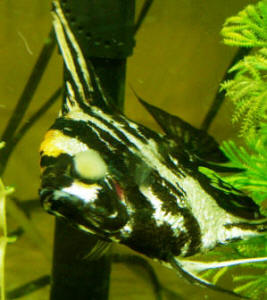 |
Fungus won't go away and is spreading. (RMF, do you
think tea-tree oil is to blame here?) <<I do>>
1/27/10
Hi again, folks,
<Hello,>
Please help me with a disease issue I am having! I have done tons of
research, talked to my lfs, and spoken to the makers of Mardel products
trying to figure out how to treat my fish. Other than water problems
being the consistent thread, no one treats the same problem the same
way, with the same med, and I am floundering, and my fish are getting
sicker.
<Indeed. Almost all fish disease comes down to water quality issues.
So that's a pretty safe approach to take when diagnosing and
solving problems.
But it doesn't explain all problems.>
I tested all of my water parameters today and everything is good. 4
month old, 75 gal, well planted tank with 2 hang on back filters,
pumping 750 gallons an hour. PH 8.0, 0 nitrites, 0 ammonia, GH 18-20,
KH 4-6, CO2 at
about 20, (I am using a yeast conductor) Iron at 0. I have used
Flourish once, 2-3 weeks ago and again this week, to fertilize, (per
instructions)and Flora24, a daily mineral supplement. I do a 30-40%
water change every week and vacuum the top layer of gravel. Of the 4
carbon filters, only one was older than a month. It is stocked with 60
inches of fish, Praecox and Boesemanni Rainbows, 5 Congo Tetras, 2
Golden Wonder Killifish, 1 SAE, 2 Bronze Corys, and 3 Blue Rams. I feed
a well mixed diet of high color flakes, Cichlid pellets, frozen
Daphnia, Brine Shrimp, Spirulina and Bloodworms, and the occasional
algae wafers, alternating daily. It's possible I overfeed.
<Not an ideal mix of fish, but unlikely the critical issue here. Why
not ideal? Because, for example, Bronze Corydoras want much cooler
water than Blue Rams, and again, Blue Rams need much softer and more
acidic water than most every other community fish on the market.
Picking fish suited to one set of environmental conditions is key to
avoiding problems.>
The tank was doing great, fish color was good, my Blue Rams had laid 3
batches of eggs in the tank and 1 batch had already hatched. They have
since been moved to my smaller tank to avoid medicating them, and 8 are
still alive and thriving. All fish were healthy. Then I went to my lfs
to get another pair of Corys, some snails and a Red Marble Pleco
because I still have some minor algae growth. This is a well trusted
source for fish, mostly raised in-store, or locally raised, and all
quarantined for two weeks before they will sell them. I have bought a
number of my fish from
them and never had a problem. They are not so good at sick fish,
though.
They say they rarely have sick fish.
<Fine.>
Within a day of adding the new fish and snails, 2 of my Congo Tetras
showed up with what appeared to be a whitehead on their sides. And one
of them had what looked like a white fat lip on the inside. That same
day one of the Corys died. The other Cory remains completely hidden and
I have to keep digging in the tank to chase it out to make sure
it's still alive. Also the Pleco looked like a chunk had been taken
out of his top fin. Research indicated either true fungus or
Columnaris. Since I couldn't accurately diagnose at that point, I
didn't do anything immediately, and watched them.
By the next day one of them was showing signs of white cottony growth
down his side. There had not been a visible injury prior to this so it
didn't fit the true fungus, but since Columnaris will decimate a
tank within days,
and all the other fish seemed fine, and it didn't fit those
symptoms either, I started treating with API Pimafix for fungus. I
continued treating the entire tank for 5 days and saw no signs of
improvement , but no signs of additional illness either.
<Pimafix and Melafix are only somewhat useful. Let's be clear
here.
Tea-tree oil has a mild antibacterial effect. There are no studies that
tell us which bacteria tea-tree oil kills, and which ones it
doesn't. So the manufacturers of these products can't give
cast-iron guarantees on the efficacy of their products or precisely
which diseases they treat.
Moreover, the antibacterial effect is mild, akin to an antiseptic
you'd use yourself to clean a wound you gave yourself while
gardening. They aren't antibiotics like you'd use to treat
gangrene or pneumonia! Tea-tree oil isn't systemic, so won't
treat internal infections. In short, it's a VERY limited
medication, and some would argue, so limited and unpredictable as to be
essentially useless.>
On the fifth day I started adding API Melafix to the treatment, and
treated for two more days. There was still no improvement so I knew it
was time to remove them from the population and moved the Congos to a 5
gal bucket as the Ram babies were in what would have been the hospital
tank. I put in an air bubbler and heater and thermometer, and started
treating with a stronger fungus med; Mardel's Maracyn-Oxy(brand new
on the market). I
continued treating for 3 more days but the fungus continued to worsen.
The folks at Mardel suggested an anti- bacterial addition to the
treatment so I have added API EM Erythromycin, a broad range
antibacterial med that treats both gram positive and some negative
bacterial infections, made for cotton mouth and fungus.
<The problem with Erythromycin is that many bacteria are resistant
to it.
Overuse and misuse of antibiotics has caused this. It's a classic
example of evolution in action! Anyway, it wouldn't be my first
choice. For early stage external bacterial infections formalin and
organic dye antibacterials are pretty reliable, if a bit harsh on the
fish. One brand I like is eSHa 2000, which works well against Finrot,
Columnaris, and true Fungus, all at the same time. For more serious
external infections and systemic infections, you often need to use a
combination of antibiotics (Maracyn 1 and Maracyn 2 for
example).>
It has been another two days and I still see no improvement in the
fungus
on one Congo, however the other never got as bad and he appears to be
fungus free. It's hard to tell in a bucket. Bad situation.
<Indeed.>
Unfortunately, I am now seeing fin rot on several of the fish in the
big tank, the Pleco being the worse, and I am at a loss as to how to
proceed.
Please, do you know what this might be or have any suggestions as to
how to proceed? It has been almost 2 weeks since the first sign of
illness. I can't believe the 2 Congos are even still alive, but I
don't want to lose my whole tank to this.
I so appreciate your knowledge. It is hard to find truly knowledgeable,
experienced folks to talk to about fish. And I still have many problems
as I am a new hobbyist. Thank you so much!
Sincerely,
D
I neglected some of the other fish observations that you would need in
order to help me. (duh) All fish in the big tank are eating well and
active. There is increased flashing and darting and some of them have
stringy, white feces. I'm concerned about adding penicillin to the
big tank for obvious reasons, so if that is necessary, any suggestions
to help protect from a recycle would also be welcome.
<Do read here:
http://www.wetwebmedia.com/ca/volume_6/volume_6_2/mycobactera.htm
I fear you've wasted time with the tea-tree oil treatment, and
that's the reason things are getting worse. Cheers, Neale.>
Re: Fungus won't go away and is spreading
-- 1/28/10
Hello Neale,
It seems like I always get you answering my questions. Thank you for
your patience.
<Happy to help.>
I read your link and it was very informative, although heavy reading
for a novice like myself.
<Unfortunately, microbiology is a difficult topic to
simplify!>
I do still have a few questions, if you don't mind. While I was
waiting, I began feeding the tank with Gel Tek tetracycline, (the only
bottle of Gel Tek I could find anywhere) and most of the fish are
eating it. No results yet as it has only been a day. The problem with
this is that my bottom feeders, the Pleco and Corys, aren't getting
it, nor can I accurately gauge who is getting how much.
<This is the value of hospital tanks.>
The Pleco, actually, doesn't eat anything I feed. Any suggestions
for him?
<Move him to his own tank.>
Should I also treat the water simultaneously? I thought I could soak
some cichlid pellets in the Gel Tek but usually my top feeders devour
those as well. I tried this method with the Congos in the bucket and
the pellets are being eaten when I'm not watching, so I don't
know if both fish are getting meds, or how much. Also, I am concerned
about overdosing as they are bathing in Maracyn-Oxy and Maracyn II.
Perhaps I should stop the Oxy, since it didn't seem to help, and
use Maracyn I and II only.
<This combination is quite widely used, with some success. But
treating internal bacterial infections is hit-and-miss, simply because
hobbyists can't diagnose the problem, and only if you know the
bacterium involved can you decide on the right medication to use and
the necessary concentration.
Here in the UK antibiotics aren't sold over the counter, and it
isn't obvious to me that this causes any great loss of fish. The
diseases like Finrot that can be treated reliably with most antibiotics
can be treated just as well with antibacterials, formalin, and organic
dyes. Conversely, the stuff you really do need antibiotics for, most of
the internal infections, are difficult for hobbyists to dose, so the
success rate isn't terribly high, especially with small
fish.>
At this point I am throwing a "hail Mary" pass with these
two. What your link didn't address is the issue of water changes
while medicating. If one med doesn't seem to be working, should the
water be changed between meds?
<In theory, yes. But in practice, organic chemicals like medications
will be metabolised by bacteria within 24 hours, so it's usually
not an issue either way.>
How much is sufficient. I don't want to waste time trying to draw
the meds out with carbon filters.
<Agreed, but waiting 24 hours, and then doing a 50% water change
should be sufficient.>
It's very difficult to figure out which meds can be used together,
when to switch, etc. I hate putting anything in my tank, let alone
adding what seem to me to be massive amounts of meds.
<Yes; mis- and over-use of medications can end up poisoning fish.
But that's more of an issue with organic dyes, formalin and copper.
Antibiotics shouldn't pose too much of a threat if used as
instructed.>
Finally, is it possible for a fish to carry a disease without showing
any signs until a stressor happens, and then infect a whole tank? Can
snails carry disease that won't affect them, but will affect
fish?
<A difficult question to answer. Aeromonas and Pseudomonas are
ubiquitous in all aquaria, and only cause problems when a fish's
immune system is weakened. They're the equivalent of E coli; mostly
harmless to us, but under some circumstances can cause major health
problems. On the other hand, Mycobacteria are "primary"
rather than "opportunistic" bacteria, and likely to jump from
one infected life form to the next. At least some Mycobacteria can
infect humans, albeit rarely, so it wouldn't surprise me if a sick
snail couldn't carry them too. But that said, most Mycobacteria
infections probably do jump from a sick fish to a healthy fish.>
I ask because I need to figure out what is basically wrong, not who to
blame. If my water conditions can suddenly turn sour and sicken my
fish, I need to know what to fix.
<The problem with Mycobacteria infections is that there's no
obvious reason why they cause problems except that connection between
stress and a suppressed immune system. "Wasting disease" and
"Fish TB" do seem to be a problem with certain species more
than others -- Dwarf Gouramis and Fancy Guppies, for example. So while
I would reflect on how the tank was maintained, what the fish was fed,
and so on, I'd also be open minded about sheer bad luck. Did the
sick fish come into the tank infected?>
Can the lead weights that are used to hold plants down cause a problem
if not removed?
<Generally no; water changes will keep the lead concentration very
low. At extremes of pH this may not be true, but ordinarily lead is
harmless because a coating of lead oxide around the lead gets between
the water and the lead.>
Can disease come in on frozen food?
<Now this is a VERY good question. Some retailers I have spoken to
believe so, having seen Discus, for example succumb to mystery diseases
after being fed wet-frozen bloodworms. So they no longer allow
wet-frozen foods into their Discus tanks. In theory frozen foods should
be relatively safe; while freezing doesn't kill bacteria, it does
prevent food going off, and slows down the loss of vitamins. At least
some wet-frozen foods are gamma irradiated, and these should be
near-100% safe. In short, I use wet-frozen foods all the time, and
their benefits likely outweigh the risks, but there may be a small risk
attached, especially with foods collected from less than sanitary
environments.>
I think that's all the questions I have for now. I can't thank
you enough.
Just the peace of mind of having someone who will point out obvious
problems that I may not recognize, helps.
<Always happy to chat.>
By the way...love your greeting...Cheers!
D
<It's very English, I think. But recently I've noticed a lot
of Americans using it too. Not sure what the opposite of an Americanism
is, a Britishism? Anyway, cheers! Neale.>
one of today's FAQs -- 1/28/10
> Hi Bob,
<Neale>
> There's a question today about (if I recall) wasting disease.
Some discussion re: antibiotics, Mycobacteria, and disease transfer
through frozen foods. I'd appreciate any comments you have on this,
as I'm speculating wildly I fear. Particularly the frozen foods
issue: is this something of concern, or merely me repeating illogical
speculations made by retailers I've chatted with.
> Cheers, Neale
<I saw this... and have re-read. I too believe that biological
disease (mainly infectious, not parasitic) can be/is at times conveyed
through foods, including frozen. I also am leery re too-generalized
statements re possible bacterial involvements, their treatments in
home/hobby systems. W/o culture, sensitivity testing (more time,
expertise, gear and livestock, facilities than most anyone has), there
is little good to be expected from random administration of
antibiotics, as you well know. BobF>
Growth on Gourami's mouth 09/15/09
Hi , I have a community tank with 2 Pearl Gourami fish and on the male
one he has a white cotton like growth on his mouth.
<Likely one of two things, a fungal infection, or else something
called Mouth Fungus that is, despite its name, a bacterial infection.
Now, both of these infections look similar, but there are clues that
tell them apart. True fungal infections are typically composed of
fluffy white threads, often likened to cotton wool. Mouth Fungus (also
known as Columnaris) tend to be more off-white to grey, somewhat
slimy-looking, and more like a lumpy growth than tufts. Some
medications treat both: for example Seachem Paraguard and eSHa 2000, in
which case there's no need to differentiate them. Avoid therapies
based on either salt or tea-tree oil (e.g., Melafix) as these tend to
be unreliable.>
He has been acting weird and not eating properly.
<Both Mouth Fungus and regular fungal infections are typically
caused by one of two things, often in combination. Physical damage,
such as fighting or careless handling allows secondary infections to
set in. Ordinarily the fish's immune system would deal with these,
but in tanks with poor water quality, the immune system is weakened,
and hence the infection gets out of hand.>
I am not sure what the growth could be or what I should do. I have a 23
gallon tank and all water levels are fine.
<Because this fish is clearly sick and suffering from either fungus
or Mouth Fungus, I honestly don't believe the "levels are
fine". If they were, your fish wouldn't be sick. To recap,
Pearl Gouramis will need water with a stable pH between 6 and 8,
hardness between 5-20 degrees dH, zero ammonia, and zero nitrite. Males
can be mutually aggressive, and in a 20 gallon tank shouldn't be
kept together.>
Thanks ,
Sonny
<Cheers, Neale.>
Treating Velvet and Mouth Fungus with Lace Synodontis in the
tank -- 09/08/09
Hi there,
<Hello,>
My son pushed too fast to set up his tank and now has problems with
velvet and mouth fungus, and possibly some ich. There are three Danios
that definitely show signs of both the velvet and mouth fungus.
<I see.>
The problem is complicated by the fact that he also has a very sweet
and lovely large lace Synodontis catfish who we have totally fallen in
love with and she seems very sensitive to medication.
<Yes, this species (genus, family) can be. Removing to a quarantine
tank would be one solution.>
The tank is 50 gallons and these are all the inhabitants: 5 small green
tiger barbs, 3 large Danios, the lace Synodontis, a small bristle nose
catfish, a small clown loach, an Ngara, a blue dwarf Gourami, and an
algae
eating shark. It is a planted tank, but the plants can be replaced if
they don't survive treatment.
<Bit of a mixed collection! Not entirely convinced this selection of
fish will work in the long term. Ngara, for example, are Aulonocara
cichlids, and semi-aggressive, as well as fussy about water chemistry.
Clown Loaches don't stay small for long; adults are some 11
inches/27 cm long. And so on.>
Do you have any suggestions for how we can eliminate the mouth fungus
and the velvet? We tried Rid Ich+, but the Synodontis seemed very
bothered by it.
<Various catfish are indeed sensitive to copper and formalin, so
that limits the range of options. Ordinarily, you'd treat Ick and
Velvet using a salt/heat method (raise temperature to around 82-86 F,
add 2-3 level
teaspoons of tonic salt per US gallon of water. Run thus for about two
weeks. Keeping the tank dark (cover with a blanket) also helps, since
the free-living stage needs light.>
We have also used Melafix, which keeps the mouth fungus down, but does
not seem strong enough to totally cure it (and doesn't seem to do
much, if anything, for the velvet).
<Mouth Fungus is bacterial, and Melafix is a weak bactericide, at
best. Use a proper antibiotic such as Maracyn if you can, or else an
antibacterial based on an organic dye if antibiotics aren't easily
available in your region. I happen to like eSHa 2000, but there are
numerous other brands, such as Seachem Paraguard that work well too.
Read the instructions, and don't forget to remove carbon (if used)
when necessary. Don't mix medications, although you can use *one*
medication alongside salt without problems.>
Thanks very much for any help you can provide.
<While Velvet comes in with new fish, Mouth Fungus is triggered by
environmental issues, and this is something you must review. You can
keep treating the fish as much as you want, but if the underlying
causes
(typically poor filtration, overfeeding, and/or overstocking) are
present, the problem will keep coming back. Cheers, Neale.>
Re: Treating Velvet and Mouth Fungus with Lace Synodontis in
the tank 9/9/09
Neale,
<Constance,>
Thank you so very much for your advice and for responding so
quickly.
<My pleasure.>
We'll get on it today. This is a fairly new project and my kid was
not properly changing the water and filter at first, which is a big
part of the problem we are dealing with now. We are on top of the water
quality now.
<Good stuff.>
We'll start cycling a sick tank, but in the meantime we'll try
the aquarium salt treatment and antibiotic. (And maybe we'll move
Ngara into the second tank after it is cycled and when it isn't
being used as a hospital because you are right that s/he is
aggressive.)
<Indeed; a nice species, a very nice species in fact, but does need
a Malawi community setting really, perhaps mixed with the superb
Labidochromis caeruleus "Yellow Lab" for a nice
contrast.>
I just want to double check that adding this much aquarium salt will
likely be tolerated by the lace Synodontis and bristle nose catfish. I
have read that some catfish cannot deal with salt.
<It's a misunderstanding about the salt. For a start, at least
two families of catfish live in the sea! Several other families have
species that enter brackish water. In any case, the amount of salt you
are adding is trivially low. Let's say you add 3 level tsp of salt.
It's a little under 0.25 oz per tsp, so that's about 0.75 tsp
per US gallon. Normal seawater contains about 4.75 ounces of salt per
US gallon, so what you're adding to your aquarium is actually about
one-twentieth the salinity of normal seawater. There's probably
more salt in a can of soda pop than that! It's really a very, very
harmless dosage. While you wouldn't want to use this addition of
salt on a permanent basis, for a couple of weeks it's a safer way
to treat against Ick and Velvet that copper- and formalin-based
medications.>
With gratitude,
Constance
<Good luck, Neale.>
Re: Treating Velvet and Mouth Fungus with Lace Synodontis in
the tank 9/9/09
great! any place I can order the eSHa 2000 in the US? Or should I just
settle for Seachem ParaGuard?
<So far as I know, eSHa products are exclusively sold in Europe.
Seachem Paraguard is at least as good, and while it doesn't contain
copper or formalin, it does contain malachite green, so if you do
decide to use it,
watch your catfish carefully. Malachite green isn't copper (despite
the name) but an organic dye, and while these should be harmless, you
never know.
http://www.seachem.com/Products/product_pages/ParaGuard.html
eSHa 2000 contains a different organic dye, and while my Synodontis
(and pufferfish) never complained, as always, your own mileage may
vary. You might decide to opt for Maracyn or a similar antibiotic
because of this.
Cheers, Neale.>
Bristlenose with fungus? -- 08/04/09
Hi,
<Hello Kate,>
I have a Bristlenose Pleco who has been sharing a 40-gallon aquarium
with a handful of African cichlids for the past 3 years. They normally
get along quite well; the cichlids ignore the Pleco (but maybe
there's a first time for everything...), and he usually stays out
of sight in a cave among the rocks during the day.
<Ancistrus are at risk of being harmed when kept with the more
aggressive African cichlids, particularly Mbuna.>
I had noticed that algae had been building up on the glass over the
past few days, but I assumed the Pleco was holding out for an algae
cookie, as he tends to do - he's a bit spoiled in that respect!
This evening, when I moved the rocks around to do my weekly water
change & vacuum the gravel, I was horrified to discover that the
Pleco's snout was a mottled pale colour, and that his bristles were
almost all gone. His snout also has a coating of some fuzzy white stuff
that looks like fungus. He usually scuttles out of the way when I clean
the tank, but this time he barely moved. He looks awful!
<Assuming it's fungus, which looks like white cotton wool
threads, treat accordingly.>
I had some Maracyn (about a year old - is this ok?) on hand, so I dosed
the tank with that,
<Unlikely to cure Fungus. The same goes for Melafix (tea-tree oil).
You do need a genuine anti-fungal medication.>
and I added a bit of extra aquarium salt as well.
<Don't. Salt won't help, and some African cichlids, such as
Mbuna, may develop bloating when exposed to saline conditions.>
All of the water parameters are normal.
<As in...? I need numbers, not judgments! Fungus is caused either by
poor water quality or physical damage. So, check firstly you have 0
ammonia and 0 nitrite. Secondly, think about the companions. Some
African cichlids are harmless enough when kept with Ancistrus, notably
Kribs. But Mbuna would be a very bad choice of tankmates, since
they'd persistently nip and buffet these poor catfish, causing
physical damage.>
I realize that a separate tank would probably be best, but my old
10-gallon tank is in storage and doesn't have a proper cover (and
with a new kitten in the house, this just spells disaster). Is it ok to
continue dosing the main tank? Is the treatment even worth it?
<Yes. Fungus clears up pretty well.>
The Pleco seems to be in really bad shape and I don't want him to
suffer needlessly if it's a lost cause.
<Well, the "suffer needlessly" bit assumes you're
going to euthanise a fish in a way that doesn't cause pain. See
here:
http://www.wetwebmedia.com/euthanasia.htm
>
Thanks for any advice you can provide,
KW
<Cheers, Neale.>
Platies and Gourami poorly 7/31/09
Hello,
<Hi,>
I have a problem with my tank and wonder if you can help.
<Let's see.>
My system is a rio180 with the internal filter as supplied, tank has 14
x pentazona barbs, 3 SAE's, 3 Danios, red tailed black shark (as
yet not harassing anyone), one upside down catfish, 3 Columbian tetras,
4 rosy tetras, 2 diamond tetras, about 10 platies, a Moonlight Gourami
and a Pearl Gourami.
<All sounds fine, though the Red-tailed Shark is a bit big (and a
bit aggressive) for this species. I'd also make the point that some
of these fish are fairly gregarious. Upside-down catfish for example
should be in groups of three or more, otherwise they'll be very
nervous and shy.>
About 6 weeks ago I had new platies, and the moonlight Gourami. In Qt
the platies had a bit of fin-rot, which took about 2-3 weeks to clear
up fully (treated with eHSA2000 in the end). The Gourami had a little
white lump on one feeler, but nothing else occurred, so after 3 weeks
in QT I transferred them to the main tank.
<OK.>
Shortly before they transferred I treated a platy in the QT from the
main tank which had some signs of fungus on her back (not on the fins,
just on her body). She responded well, and all fish went in to the main
tank together.
<I see.>
Unfortunately after about 2 weeks in the main tank, the platy I had
treated for fungus died. She got progressively thinner, and despite
showing an interest in food, wasted until I euthanized her as she was
sitting on the bottom for about 3 days straight.
<Does sometimes happen; may be the "wasting disease" that
sometimes affects livebearers.>
About 10 days ago I noticed that about 5 platies had varying amounts of
tufted white stuff on their bodies, and pale patches on their fins.
Rather than treating them for fungus in the QT, I read up and decided
that after removing the carbon I was OK to treat in the main tank. All
bar one platy is now looking a lot better, I treated them for 3 days,
observed, and as there was little improvement, continued for another
two days as directed on the instructions for eHSA2000. That was now
four days ago.
<Now, if you're finding all of your livebearers are getting
patches of fungus, that's something else. Platies are generally
hardy, but they do need hard water, and if your water is soft and
acidic, they will be persistently sickly.>
Now I have one platy with what looks like pale bits / almost
translucent patches, sitting on the bottom, and another with tufts of
white on the body coming back.
<Not good.>
To make matters worse my beautiful moonlight Gourami has what looks
like an ulcer on her mouth, about 1-2mm across, and is not feeding. The
ulcer is pinky-white with a reddish patch, no tufts of white or
anything.
<Sounds like incipient Finrot or similar.>
I carried out a 30% water change this morning after testing and finding
a nitrite spike of about 1ppm, ammonia 0, nitrate 20. Could the eSHa
have caused the spike? What can I do for my Gourami? And why are my
platies getting white tufty bits, despite repeated treatment with eSHa
(which suggests to me that this is the wrong treatment, or that I have
a pathogen I am not getting shot of)
<Given you have a variety of fish that are exhibiting bacterial and
fungal infections of an opportunistic type, I'd be thinking about
water quality and water chemistry issues, perhaps both. For the
selection of fish you have, you're after the following values: pH
7.5, hardness 10+ degrees dH.
This may require hardening the water a bit if you live in a soft water
area. Ammonia and nitrite should be 0, all of the time. If they're
not, review filtration, stocking density, and whether your filter is
adequate for the task (or properly maintained). The Rio 180 has a
competent filtration system, but the pump is a little on the weak side,
and water flow can easily diminish if the sponges are clogged.>
Any suggestions / treatment for the Gourami would be very much
appreciated.
I will test water again tomorrow - when I tested after the water change
there was no detectable nitrite or ammonia, and very low nitrate.
Thank you so much,
Regards
Sarah
<Cheers, Neale.>
Re: Platies and Gourami poorly
7/31/09
Hi
Thanks for the quick reply. I don't have test kits for PH and
hardness at present - we live in south Herts (Chorleywood) and the
water here is generally very hard; we use a water softener for the
majority of the house (not for the tap where the tank water comes from
though, I hasten to add).
<I see. I'm in Berkhamsted, so I imagine my water is much the
same as yours. I mix it 50/50 with rainwater, and find it works for
most things very well.>
I will see if I can get a kit when out today and test the water. I have
a spare hang on the back Fluval U2 filter I was given I think I will
plug this in as well, to see if it improves matters, and will give the
filter sponges a rinse out in tank water.
<Yes, do this. The Juwel 180 is a good tank -- there's one right
here next to me by the computer -- but the filter on these tanks
generally is not well suited to messy fish. Eventually, I ripped mine
out and instead use a pair of canisters, an Eheim 2217 and a Fluval
104. In any case, do check the sponges, and do look to see if any of
the inlet slots on the black filter module are blocked, clogged with
gravel, or otherwise restricting water flow.>
Is there anything you can suggest for the Gourami- he's not eating
and the ulcer on his lower lip is looking quite sore.
<To be honest, eSHa 2000 is by drug of choice for this sort of
thing. You might do a daily saltwater dip (35 grammes non-iodised salt
in one litre of aquarium water) for a couple of minutes, as this
sometimes helps to keep infections clean, a bit like saltwater gargles
for mouth ulcers. Dunk the fish only until it shows signs of severe
distress (like rolling over) and then return to the aquarium.>
Water chem. today was ammonia 0, nitrite 0, nitrate 5 - but I did do a
40% water change yesterday.
<Much better.>
Thanks
Sarah
<Cheers, Neale.>
|
Re: Brain damaged Flowerhorn? 7/2/09
Flowerhorn With Columnaris
He has been improving greatly, taking pellets, then this am I see
this.. I cannot find anything on your site and don't think it
is columnaris but I thought I would ask you. What is it and what
med should I use?
<In a hospital tank, I would treat with an antibiotic like
Nitrofurazone or Erythromycin type of antibiotics. The little
white columns are actually a characteristic of
columnaris.-Chuck>
Re: Brain damaged Flowerhorn? 7/2/09
Indication of Columnaris
Is it the larger white spot with the surrounding red or the
flaking white spiky things that indicate columnaris? (for my
forums understanding as I have posted pics) Thank you again so
much. Lisa
< The spiky white things are columnaris. The big hole could be
hole in the head /trauma/or a bacterial infection. Treat with the
antibiotics as recommended. Get the nitrates down to under 20 ppm
with water changes and gravel vacuuming.-Chuck>
|
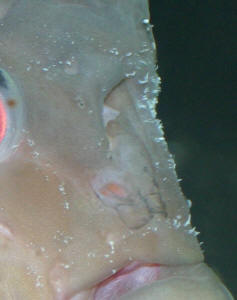 |
|
TB? 6/26/09
Hello,
I've attached a photo ( sorry about the quality but I believe
it shows what I am talking about) of my Rasbora trilineata. I
have had him for 1 month and slowly I have noticed his spine in
the caudal region has become bent.
Until now I believed it to be a birth defect that merely became
more noticeable as he grew.
<Indeed. Well, it's untreatable but unlikely to spread, so
would remove/euthanise this fish, but otherwise not worry
over-much.
http://www.wetwebmedia.com/euthanasia.htm
>
I have "trained" the fish to eat when I signal them so
I can observe them eat. For the past 3 days he has stopped eating
even though he comes when I signal, he does not eat. I have moved
him into a quarantine tank to isolate. He was in my 90 gallon
tank with 5 neon tetras and 2 other Rasbora trilineata. All added
without quarantine as they were held in the same tank together at
the store for me for one month while my tank fully finished off
cycling ( I don't add until Nitrates are low and or algae is
present).
Cycle was done using a fishless method with a grocery store
bought and rinsed shrimp in a rinsed stocking. I did not know
fish could carry TB until I came across a FAQ by Don and I am
alarmed by the symptoms similarities.
<Fish TB is actually extremely rare, particularly among
freshwater fish.
The vast majority of bacterial infections of fish are
opportunistic, meaning that they're caused by
otherwise-harmless bacteria in the aquarium that are *allowed* to
cause disease because the aquarist isn't doing something
right in terms of water quality, diet, or whatever.>
While his trunk does not appear to be swollen compared to the
others his sudden loss of appetite and elusiveness are setting
off alarms. If the most prudent plan of action would be to put
down the animals, what is the most humane way to do this and also
to dispose of the bodies without contaminating anything else. If
this does not seem to be TB what are my next steps. Ammonia and
Nitrite are 0 and Nitrate is 10 ppm. Lush bright green algae on
sides and back. I do 30 gallon water changes once a week.
Filtered with Aquaclear 110. The substrate is Eco-Complete plant
substrate one inch thick across entire bottom. Temp 76F pH 7. Two
Maxi-Jet 1200's for water movement. One bubble wand for
oxygen. No Co2 injection. For lighting I use Corallife 96 watt
6700k bulbs. Quarantine tank is a 12 gallon nano cube that has
been stripped down to have a sponge filter and is cycled.
<The tank sounds fine. In this case, I simply think you were
unlucky, and whether this fish has a birth defect, a viral
disease, or some type of obscure bacterial infection, I honestly
don't think the other fish are at major risk. So I'd
certainly euthanise him (if he's not eating, he's not
going to get better) and then simply observe the other fish to
see what happens.>
Long term plan for this tank is heavily planted without co2 only
using common low light plants. Any advice is welcome I work with
the public and can not risk carrying/having/spreading TB.
<While Fish TB certainly exists, it's very uncommon.
I'm not a medical practitioner, so if you need public health
advice, I have to recommend you consult a qualified MD or vet.
But in general, fish tanks are not a major health risk, hence
their wide use is hospitals, waiting rooms, shops, sushi bars and
the like.>
Thank you in advance.
<Cheers, Neale.>
|
 |
Re: TB?
6/26/09
Neale,
Thank you so much for your advice. I think I will take the fish to
a vet to be euthanized and possibly get them to run some tests on
it to make 100% sure.
<Hmm... would sooner you euthanised the fish yourself: I
wouldn't trust the average aquarium shop to make an effort to
euthanise the fish humanely; most simply feed sick fish to any
predatory fish or turtles they have in stock.>
Although I no longer believe TB is an issue I figure it can not
hurt to make certain. I feed TetraColor tropical flakes by Tetra
and have decided to include frozen bloodworms to mix up the
nutrition values.
<Good. While a good quality flake like Tetra Min should be
perfect, adding variety is always a good thing. I'd tend to
recommend against colour-enhancing foods as a staple; indeed,
unless you have red fish, they will have little/no impact on
colours at all, and they don't do anything that crustaceans
such as daphnia won't do just as well. Carotene is carotene,
wherever it comes from...>
While I have your ear I would like to run a short stock list to be
added no sooner then a month from now. Hopefully then I will be
sure there are no pathogens, odd chemistry or poor nutrition taking
place in this tank.
I want to add in this order.
3 Crossocheilus siamensis
3 (possibly more) Corydoras panda
5 Gasteropelecus sternicla
<All fine, though Gasteropelecus are flighty and prone to
throwing themselves at the hood if kept with boisterous fish or
tanks without floating plants.>
Do you think the TSAE will stress the hatchets out too much?
<Depends how deep the tank is; if the tank is something over 50
cm in depth, I'd expect that the two fish would barely meet,
since Crossocheilus tend to stay at the middle to lower levels. But
if the tank is very shallow, say 30 cm, then you might have
problems. Boosting the number of Hatchets would make a big positive
impact: they're a lot more reliable in swarms of ten or
more.>
My tank is covered with eggcrate but I still don't want them
freaking out.
<Floating plants help.>
I am unsure of what will come after but I believe I am pushing the
stocking limit of my tank. They will be added in family groups as
to keep the load on my quarantine tank low. Also how long should I
allow my quarantine tank to sit fallow before I can quarantine more
fish? In closing I have to thank all of you for the knowledge that
has accumulated on this site. Neale has helped me with other tanks
in the past that have absolutely flourished.
Another invaluable article on tap water preparation, storing and
polyvinyl has saved me oodles of money/livestock. I have even
earned a free True Siamese Algae eater through helping my LFS
separate their Flying Foxes, False Siamese Algae Eaters and their
True. Much of my success I owe to this site. I wish I could
remember all the authors of the various articles I have read that
have made me very skilled at aquatic husbandry.
<Thanks for your kind words!>
Also I would like to urge my fellow aquarist to get out there and
shop the local mom and pop fish stores. They do not seem to be
doing well with the economy, mega store and online competitors.
<All very true. But ultimately it does depend on the Mom &
Pop store being at least reasonably decent; too many of them had
dingy tanks, limited selections of fish, and questionable husbandry
practises. Competition is a good thing, and those family stores
that can meet the demands of modern aquarists can do rather well,
particularly if they gear themselves up to providing "value
added" services such as setting up tanks in offices and shops
(a real money earner!) or visit aquarists at their homes to help
with marine and jumbo freshwater tanks that can cause problems to
less experienced hobbyists.>
Thank you!
<Cheers, Neale.> |
|
Saprolegnia on shark (RMF, second
opinion?) <<Nada to add>> 4/26/09
Hi crew! Please help me! I am trying desperately to save my
iridescent shark.
<Yes, I can see from the photos he's in a bad way. A very
difficult species to maintain, and I fear the problem here is
more about his environment than anything else. Iridescent Sharks
are food fish, and they simply don't do well in home aquaria.
While they can be kept in aquaria if you have lots of space, 55
gallons isn't enough. Moreover, they are difficult fish to
mix with other species. Despite their size, they are
super-nervous, and perhaps surprisingly, should be kept in
schools of 3 or more specimens.>
He is 5 years old. Was staying in an established 5 year old tank,
55 gallon, with two kissing Gourami and a Pleco. Don't
exactly know how he got hurt, maybe fight with Pleco that is a
foot long.
<Not so much a fight, but I do wonder if [a] the Iridescent
Shark bruised himself or otherwise develop a light infection; and
then [b] the Plec took advantage of this and started rasping away
at the infected tissue. Plecs are notorious for
"latching" onto injured, moribund or otherwise
slow-moving fish that are exuding blood or mucous into the water.
While I'm not 100% sure, this is my guess here.>
My shark is 10 inches.
<Way too big for this aquarium. Even if the Plec exacerbated
the situation, the primary cause of the wound or infection was
surely some combination of water quality and/or physical damage,
e.g., jumping into the hood or bumping into ornaments. Heater
burns are another common cause of mortality and injury among
catfish.>
The next day noticed the patch of cottony fungus, identified as
saprolegnia. I set up a10 gallon hospital tank at 80 degrees.
<Can't possibly keep this fish in 10 gallons. I'm
surprised it even FITS into a 10 gallon tank!>
I treated water with 1 tsp water conditioner (Jungle Start Right
with Allantoin, a skin protectant), 1 tsp of Wardley Ick Away
(malachite green), 1 tsp. of Melafix and 1 tsp of Jungle Fungus
Clear Tank Buddies
(Nitrofurazone, Furazolidone, potassium dichromate).
<Random medicating is usually not a good idea. Remember, while
Fungus isn't especially difficult to treat, it's a
secondary infection that results from poor water conditions and
injury. In a case like this, you need the fish to be in optimal
water conditions, and even on his own, 55 gallons would barely
provide that, let along 10. You also need to treat with something
very specific for severe fungal infections; I'd recommend
something along the lines of Seachem KanaPlex. Melafix is useless
once fungal infections are established (I'll allow it might
have some preventative value) and Ick medication is clearly
irrelevant.>
The only other items in the tank are the heater and an air stone.
I have been feeding him Jungle Anti-Bacteria Medicated Fish Food,
but he does not seem to be eating anything.
<Don't feed him at all until he's in a tank offering
optimal water conditions: 0 ammonia, 0 nitrite, low nitrate, pH
stable around 6.5-7.5, and moderate hardness.>
I clean up the food that he does not eat each morning. His eyes
are clouded over, maybe he can't find his food.
<Not a good sign; usually implies (if both eyes are cloudy)
some type of secondary bacterial infection. Again, KanaPlex
should help.>
He has been in this treatment for 5 days, with no improvement,
seems worse.
His body is almost completely covered now.. I am sending you
pictures.
When will this treatment start to help?
<No.>
Or am I doing something wrong?
<Yes.>
Please help me!
<Done my best. While I've seen fish come back from worse
(they really are amazing sometimes) this does depend on optimal
environmental conditions, which I fear you're not providing.
Seriously, this is a fish that needs a tank twice the size of
what you have, if not more, and a whopping filter with massive
water turnover and plenty of supplemental aeration. Iridescent
Sharks are classic riverine fish with little tolerance for
stagnant water. Adults are routinely 60-70 cm long under aquarium
conditions, and wild specimens twice that, weighing about the
same as a family dog. Big fish.
Cheers, Neale.>
|
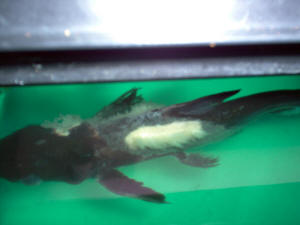
|
Establishing an optimum bacterial population --
4/17/09
Dear Crew
<Hello,>
I have a question about establishing a bacterial culture in an
aquarium.
<Not an issue; the bacterial population will expand and contract to
the biomass of fish in the tank. The only limiting factors are oxygen
availability and physical space, the two issues that determine whether
a filter is adequate for the task. More flow = more oxygen, and more
media = more physical space.>
Long, long ago (in the 1970s) I was taught that an aquarium performs
best if it goes through a crisis, in the sense that it undergoes a
large bioload early in its life.
<Yes and no; the filter bacteria population grows precisely at the
rate determined by the oxygen availability, the physical space for them
to inhabit, the availability of ammonia/nitrite, the temperature, and
the pH. If you have a lot of ammonia early on, yes, the bacterial
population can grow rapidly compared to an otherwise identical tank
with less ammonia. But unless that high ammonia concentration is
maintained, the population will quickly die back to a small population
maintained with less ammonia. They don't "hibernate" in
any meaningful sense waiting for ammonia spikes weeks or months apart.
Hence, you need to cycle a filter with an ammonia source equivalent to
the biomass of the fish being added, and when you do add further fish
on top of that amount, you add them in small, spaced apart batches so
the bacteria population can multiply upwards.>
To achieve this, when setting up a new aquarium I would get the filters
running, add some bacteria (usually sand from an established tank), and
throw in a few dead shrimps or a piece of fish fillet.
<As good a way as any.>
There would be no inhabitants in the tank except the bacteria. Over the
ensuing weeks, the meat would rot, the tank would stink, and when the
cycling process was finished, I'd do a large water change.
<Yep.>
The thinking behind this was that if you caused a crisis like this,
with a massive ammonia spike early in the piece, you would establish
colonies of bacteria in the filtering system that were at the maximum
potential that could be achieved.
<Sort of; what you're doing is creating a source of ammonia
equivalent to however much food you'd add if there was a fish in
that tank. It doesn't matter to the bacteria whether the ammonia
comes directly from a shrimp rotting on the sand or else a shrimp that
passed through the gut of a fish. Ammonia is ammonia is ammonia. But,
here's the thing: the art is in waiting for the ammonia to drop to
a safe level, and then adding a fish or two to keep "topping
up" that ammonia for those bacteria in the filter. Consider an
extreme example: say you waited three months. The ammonia produced by
the shrimp will have been all used up by then, and the bacteria in the
filter would have died back to some minimal value. Likely not zero,
because there'd be algae and other micro-organisms in the aquarium,
so there'd be some small amount of ammonia, but nothing like as
much as if there'd been a school of Guppies.>
The idea was that this optimum population of bacteria would occupy all
the available sites in the system, and they would work at nitrification
as need arose.
<There's no "optimum" level you can build into a
system; the bacteria numbers will be limited by whatever is in least
supply. This is called the Law of Limiting Factors and affects numerous
biological systems. If ammonia is at a low level because a fish tank is
empty, it doesn't matter how big the filter is, or how optimal the
pH, or how perfect the temperature -- the bacteria population will be
small.>
In other words, if you had a small bioload in the tank, the bacteria
numbers would remain constant but they would have to work less.
<No. Allowing for a certain lag for the bacteria to die back, the
population would be exactly proportional to whatever is in least
supply.>
If you gradually increased the bioload to the maximum appropriate for
the size of the tank, the bacteria would adjust their metabolism and
work harder to cause nitrification. It was thought that the population
of bacteria would remain constant, with fluctuations in activity
depending on the bioload.
<Not sure they adjust their metabolism; rather, you have X bacteria,
or 10X, or a 100X bacteria, depending on how much of whatever limiting
factor is available.>
The concurrent idea was that if you didn't cause a big crisis, but
cycled the tank by only placing in it a few hardy fish, the bacterial
population would establish only to meet that bioload, and the colonies
in the filters would not be as dense as it would have been if you'd
gone the 'full crisis' way.
<Yes, when you cycle with, say, 4 Guppies, you get sufficient
bacteria in the filter to consume the ammonia produced by 4 Guppies; no
more and no less.>
In other words, there would be less bacteria by using the slow
method.
<No, you get precisely the same. All depends on the limiting
factor.>
It was thought that this would constitute the bacterial population for
the life of the aquarium and that the numbers of bacteria would not
increase when you increased the bioload -- the bacteria would simply
work harder to handle nitrification, and the system would never be as
capable of handling a large bioload or a crisis in the way that a
'full crisis' system would..
<No; what limits the bacteria population isn't how you created
the tank, but what the conditions are at the moment. Double the amount
of ammonia in any aquarium and the bacterial population will (within a
certain period of time) double as well (assuming other factors, such as
oxygen or physical space, aren't limiting).
Therefore, it was taken for granted that, if you wanted an aquarium to
have its full potential for nitrification, the 'full crisis'
method was the way to go.
<No.>
Now, this may be 'old' thinking, and I'd be glad if you
would comment on what current thinking is. I'm setting up a large
freshwater system that will eventually be heavily stocked, and I'm
debating whether to go with the 'slow' method with a few fish
or to use the fishless ammonia method to cause an initial spike in the
hope that it will give me better long-term results. Is there an
advantage of one method over the other?
<Absolutely no advantage to creating a "crisis" if you
don't follow it up with an equal amount of ammonia day-in, day-out.
If you add some shrimp and the ammonia concentration goes to, let's
say, 10 mg/l, but then two weeks later has dropped to 1 mg/l, then the
number of filter bacteria in that aquarium will be precisely the same
as an aquarium given 1 mg/l every single day. Biological systems are
ALWAYS limited by whatever is in least supply at the time, and NEVER
expand to the potential of what might have been there in the past or
might happen again in the future.>
I'm sorry this is so wordy.
Les (Australia)
<Hope this helps, Neale.>
Re: Establishing an optimum bacterial
population 4/18/09
Neale, that helps more than you can imagine. Many thanks for this most
comprehensive collection of information. That has settled years of
wondering for me. At last I can approach what I'm doing in an
informed way.
Best regards to you.
Les
<G'day Les. Happy to have helped. Good luck cycling your new
tanks, however you choose to do it! Cheers, Neale.>
Mollies with Columnaris and Ich -- 03/22/09
Hello Crew,
<Hello Carla,>
I'm in a bit of a quandary. I purchased three mollies the day
before yesterday, and placed them in my cycled 10 gallon quarantine
tank (pH: 8.1, ammonia: 0, nitrites: 0, nitrates: 0 -- I had a bunch of
extra cuttings so
the tank is stuffed with live plants).
<Mollies don't do well in small tanks. They're very
sensitive to nitrate as well as ammonia/nitrite, and in small tanks it
is very difficult to keep them healthy for long. Minimum tank size for
small Mollies (Shortfin
mollies, black mollies, balloon mollies) is 20+ gallons, while large
Mollies (Sailfin mollies, liberty mollies) is over 30 gallons.>
Unfortunately yesterday I observed that one of the mollies had what we
used to call cotton mouth or mouth fungus.
<Very common with Mollies, especially when kept in freshwater
conditions.>
I understand, from researching your site, that this is likely
Columnaris (bacterial).
<Indeed. You will need a suitable antibiotic or antibacterial (as
opposed to a make-believe solution such as tea-tree oil or
salt.>
Today I also observed two Ich spots (sure glad I quarantined). I was
going to go the salt + heat route, but I learned (also from researching
your site), that Columnaris grows faster with higher heat.
<Your options are limited here, but in this case, I'd raise the
salinity to deal with the Ick, and treat with an
antibiotic/antibacterial at the same time. Since Mollies are best kept
at SG 1.003, I'd recommend 6 grammes of marine salt mix per litre
of water. There's not much point trying to keep Mollies in a
freshwater aquarium because they rarely (seemingly, less than 50% of
the time) do well. You're also fighting with one hand behind your
back because the tank is so small, so a difficult job is being made
twice as hard.>
My questions are: Should I raise the heat, and how I can treat both the
Columnaris and Ich concurrently? Also, should I remove my plants?
<Plants will not be affected by antibiotics or antibacterials used
correctly, and a salinity of SG 1.003 is fine for hardy, salt-tolerant
plants.>
Thanks very much for your help and your wonderful website.
Carla
<Cheers, Neale.>
Re: Mollies with Columnaris and Ich
3/23/09
Thanks very much for your help. The Mollies are currently in a ten
gallon tank because they are in quarantine (their permanent home will
be a 40-gallon heavily-planted breeder tank).
<Ah, that makes sense. A 40-gallon system will be perfect.>
The water parameters of that tank are:
Ammonia: 0
Nitrite: 0
Nitrate: 0
pH: 8.2
Carbonate hardness: approximately 200 mg/L CaCO3
<That's 200/17.8 = 11.2 degrees KH. That's extremely high,
and while perfect for Mbuna or Central American livebearers, a lot of
other fish will find that a bit on the hard side for their tastes. Do
be aware when choosing fish and plants.>
Their tankmates will be Wrestling Halfbeaks, Scarlet Badis, White
Clouds, and Threadfin Rainbows.
<Halfbeaks will thrive, the others should tolerate, but may not show
optimal colours or longevity.>
I was hoping the Mollies would do well without salt because of the high
pH and hardness, and I wasn't sure (aside from the Halfbeaks)
whether the plants and other residents would appreciate the salt.
<Plants that tolerate hard water generally do well in slightly
brackish water too; species such as Vallisneria, Hygrophila, Java
ferns, hardy Crypts, etc. If you have plants that need soft water,
chances are they
aren't going to thrive a this level of carbonate hardness either,
so it's a moot point. As for the fish: Halfbeaks tolerate salt
well, but the others are truly freshwater fish.>
But I will add salt and remove some of the other residents and non-salt
tolerant plants if necessary.
<Would be my recommendation. Mollies deserve a tank of their own:
they're spectacular fish, and wonderful pets. But they are finicky
in freshwater systems. They need perfect water quality. You might
decide to medicate them in the quarantine tank, and when they're
healthy again, try them out in a plain freshwater tank. With luck,
you'll be okay. But if you find you're constantly having to
deal with Fungus and Finrot, remove the Minnows, Rainbows and Badis,
add a little salt, and maintain the system at SG 1.002-1.003.>
I've started to slowly raise the salinity of the quarantine tank,
and I'm off to the LFS to pick up the antibiotic and a hydrometer.
I believe we have Maracyn and Maracyn II available here (Canada), so I
will purchase
both.
<Cool.>
A couple more questions, if you'll bear with me:
<Of course.>
Which Maracyn product would be most effective against Columnaris?
<Maracyn rather than Maracyn 2 is usually used first. It contains
Erythromycin, which should work on Flexibacter columnaris.>
If the Mollies recover, when would it be safe to place them into my
main tank (so that Columnaris does not contaminate that tank).
<Columnaris, like Finrot, is a disease latent in all tanks, and the
bacteria involved is presumably harmless most of the time. It appears
not because a fish "caught" the disease, but because the fish
was somehow
weakened, and its immune system overwhelmed. So provided the other fish
are healthy, you shouldn't worry about cross-contamination.>
Thanks again...
<No probs.>
Carla
<Cheers, Neale.>
Re: Mollies with Columnaris and Ich - Update
04/03/09
Thanks very much, Neale, for your advice. Just thought I would give you
an update on the Mollies. I used the salt + heat treatment for the ick,
and the ick has disappeared.
<Good.>
For the mouth rot, I couldn't find Maracyn at my LFS, so I used TC
capsules (tetracycline). The mouth rot hung around during the course of
the treatment (5 days), and then I had an ammonia spike (the packaging
on the TC capsules claims that they will not affect the biological
filter, but I suspect otherwise).
<Oh dear.>
Unfortunately one of the Mollies died (oddly, it was the healthiest,
dominant female).
<Sorry to hear that; I wonder why?>
I subsequently performed 75% water changes for the next several days to
control the ammonia, used activated carbon to remove the tetracycline,
then added some nice filthy filter media from my other tank to
repopulate the nitrifying bacteria. Over the next several days, the
mouth rot on the remaining Mollies disappeared, but I'm not sure if
I can attribute it to the tetracycline or the water changes.
<It's a combination: the antibiotic kills off the bacteria, but
improved water quality allows the fish's immune system to repair
the damage and prevent re-infection>
Anyway, the remaining Mollies have recovered, and in a week or so, I
will remove them from quarantine and place them in my 40-gallon
tank.
<Great.>
Also, you were right, the salt did not seem to affect my plants
(Hygrophila polysperma, Hygrophila corymbosa, Rotala rotundifolia, Java
Moss, and Bacopa monnieri).
<Not sure about Rotala, but certainly the others are happy in
brackish water, let alone slightly salty/warm water of the sort used to
treat Ick.>
Thanks again for your help,
Carla
<Thanks for the update, Neale.>
Treating illness with central filtration
3/28/09
I work at a retail store with fresh water tanks, where all the tanks
share a large single sump filter.
<Oh?>
I would like to know what the best way to treat ich and fungus in this
situation are, because quarantining is a not an option for me
unfortunately.
<Since the free-living Ick parasite moves for 24 hours or more
through the water column, you can reliably assume all the other fish
have been exposed to the parasite.>
Currently I turn the filter off
<No.>
and treat each tank with ich medication
<If you want, assuming all the livestock are
copper/formalin-tolerant; invertebrates and snails won't be, and
some fish, particularly loaches, puffers and some catfish are also
sensitive.>
aquarium salt
<Salt + heat can work.>
and Melafix for a while before turning the filter back on.
<You must leave the filter running. A dead filter will kill more
fish more quickly than Ick! The only precaution here is to remove
carbon prior to using medication.>
Would it be better to leave the filter on and add medication directly
to the sump?
-Kevin
<Hope this helps. Cheers, Neale>
Fungus 1/24/09 Hello Neale, I'm back with a new
issue this time. I have 1 Cory with fungus and 1 rosy tetra with a
small white fungus on its mouth. Other fish in the tank don't show
any evident sign of fungus. A couple of weeks ago I treated the entire
tank with Melafix and it seems to have improved things a lot. However
the fungus is not gone and today I noticed a lot of cotton like fungus
on one of the Cory's fins. I'd appreciate if you could give me
some advice on the following points: - Would you suggest isolating the
affected fish in a hospital tank or treat the entire tank where the
fish are now living with their friends? On one side I'm afraid that
treating the big tank would affect the nitrifying bacteria, on the
other side I think that if I don't treat a fish that seems to be
fine but is instead hosting the fungus would re-start things from
square 1 in a matter of time. - Is there any medication you would
recommend? Anything that you tried or heard works well and possibly
does not affect bacteria? Thank you, Giuseppe <Salutations! Hmm...
Melafix... what you're observing is precisely why most of us here
don't recommend this product. Sometimes it works, sometimes it
doesn't. Anyway, when treating Fungus, there's no point
isolating fish because it isn't "contagious" as such.
Fungal spores are in all aquaria, and mostly the fungi do good work
breaking down organic material. Only when fish are damaged or stressed
does the fungus attack the fish. The issue is this: a healthy fish has
an immune system that kills fungal spores 100% of the time. When a fish
is damaged or stressed by its environment, its immune system stops
working properly, and the fungal infection becomes established. This is
why when you see Fungus on a fish, you NOT ONLY treat the fish, but you
ALSO think about why the Fungal infection happened at all. In terms of
treating, I'd recommend eSHa 2000; this is a Dutch product widely
sold in the EU. It's the product I use for Fungus and Finrot, and
it's worked every single time, even on delicate species such as
Puffers. Elsewhere in the world you'll need to find some other
anti-Fungus medication based on copper and/or formalin. These tea-tree
oil medications are too unreliable. Cheers, Neale.>
Tuberculosis in a Well-Maintained Tank 11-5-08 Hi
Bob :-) This is Anna. <Hi Anna, this isn't Bob, but Merritt
today.> Before I start I wanted to let you know that I've
learned a lot from the WetWebMedia site, especially regarding fish tank
maintenance. I am a big fan of partial water changes (up to 1/3
of a tank) which I perform every single week. <That is quite a lot
of water changes; you should cut back on them due to the stress they
are causing on your fish.> My tank is freshwater, 35 gallon, with a
score of live plants and just 15 fish - mostly tetras, 1 Pleco, and 3
albino Cory fish. There are no real problems although this morning I
noted that one tetra had a few red wounds (?) along its nape region and
dorsal fin. The wounds are approx. of a size of a head of a needle.
There are approx. 10 of them. I studied Dr. Dieter
Untergasser's "Handbook of fish diseases" and concluded,
based on content and pictures, that my tetra may have tuberculosis or
be affected by a type of Sporozoan. Attached are some pictures of the
fish under the mentioned conditions. <The wounds do not look like
tuberculosis, watch them to see if they show more signs of
tuberculosis, like the bending of the spin, fish wasting, skeletal
deformities or loss of scales and coloration .> The description of
either illness suggests that bad water condition be a culprit. The
ammonia level in my tank is 0.00, the pH is 7.2-7.4. I run 2 Marineland
filters and take a good care of my tank. This is why I am a little
confused... <Like I said, your tank may have great conditions but
constant water changes stress fish out which lessens their immune
system allowing for disease.> Anyway, I transferred the infected
tetra to a 5-gallon hospital tank. <Great move!> Will you be able
to shed little light as for the cause of my fish's condition? Am I
able to help that fish? What should I do? I would not like to sacrifice
it. I hope there is a cure... Besides, do you think that my display
tank is in danger? I just changed 50% of the water and replaced all
filter pads. Is there anything else I should and could do? I will
appreciate any insights. Your experience is extremely valuable and
needed :-). <It would be best to treat your sick tetra for a
protozoan infection due to the wounds resembling protozoan infections
other than tuberculosis. I would watch the other fish for any signs of
sickness and cut down on the water changes. If the symptoms persist
after you medicate for the protozoan, then tuberculosis could be the
culprit. Tuberculosis is of bacterial origin and you will have to
switch the medication. Watch yourself if the symptoms for tuberculosis
do develop because you can catch it from your fish. Mainly persons of
low immune systems are susceptible but, just be careful. Here are some
links about disease and medication that should help you.
http://www.wetwebmedia.com/fwsubwebindex/fwfishmed
http://www.wetwebmedia.com/fwsubwebindex/fwdistrbshtart.htms.htm and
http://www.wetwebmedia.com/woundbactf.htm> Thanks in advance for
your help. ANNA <You are welcome and please email updates! Merritt
A.>
Fallow tank (and more!), FW infectious
disease... 8/6/08 Hi Crew! I have a few different
things to write in about, but if I remember correctly, you prefer them
all in one email. Sorry in advance for the length, but more info is
good, right? <Up to a point...> There's a previous reply from
Neale below this email, since unfortunately I'm writing in about
the same thing again. After the Betta and African dwarf frog died, my
tank was empty of fish (and frogs) for probably six weeks total. I
didn't end up adding any medication to the empty tank, on the idea
that, like Neale said, there will always be "harmful"
bacteria floating around at "non-harmful" levels until a fish
is injured or stressed enough to become susceptible to infection.
<Correct; Finrot (or Red-leg in the case of amphibians) is a
response to environmental problems rather than a disease that creeps
into the tank unseen.> I didn't want to wreck the good-bacteria
system, so instead I did large water changes and added three male
guppies. <Do remember fancy Guppies are NOT HARDY. They are very
delicate fish and should only be kept in clean, mature aquaria. Small
tanks aren't suitable because you can't keep water
chemistry/quality stable easily in them.> One of them died after a
run-in with the tank vacuum--my fault. I'd had the other two for
about six months when one of them started looking a little large in the
belly. He was more aggressive and usually got more of the food, so I
thought maybe he was just getting a little plump. After about a week
the swelling had only grown, and the other fish looked perfectly
healthy, so I separated the swollen one and put Epsom salt in his water
for a week, thinking maybe he was constipated. That didn't help, so
I treated him with two rounds of Jungle Fungus Clear (Nitrofurazone,
Furazolidone, potassium dichromate). That didn't help either, and
like the Betta he soon got the pinecone look and died. By then the
remaining guppy was looking swollen too. <That a succession of fish
are dying from fairly generic symptoms means just one thing:
environmental problems. This tank is, for whatever reason, not
conducive to the long term health of fish. Tanks 10 gallons in size are
not recommended for beginners, and anything smaller than, say, 8
gallons is not suitable for fish at all, except perhaps a single Betta.
These 2 and 5 gallon tanks you see on the market are essentially
worthless, being accountable for the deaths of VAST numbers of
fish.> I changed the filter and removed the carbon, and added the
medication and the Epsom salt right to the tank, hoping that if the
medication is capable of nuking whatever this is, I might as well add
it to the whole tank, as I probably should have in the first place, as
Neale suggested. I added the Epsom three days ago (1 tsp/5 gal), and
the medication two days ago. There's been no improvement. Today I
added more Epsom (1.5 tsp/5 gal) and a little more medication as the
water was looking lighter (the medication turns it blue). I figured the
fine gravel substrate might be absorbing some of it. <You really
can't "nuke" a tank hoping to get rid of all the problems
except by sterilizing it, and that will of course kill the biological
filter. This is why healthcare is a two-step process: first you ensure
ideal conditions, and second you identify and disease and only then
treat with an appropriate medication. Randomly adding stuff like salt,
Epsom salt, Methylene blue or whatever in the hope of killing whatever
is in the tank just doesn't work. Never has done, never will.
It's the same reason your doctor asks for your symptoms before
prescribing a treatment -- only the right medication will help, and the
wrong ones could cause more harm than good.> It's a 2.5 gallon
tank, 79 degrees, with aquarium salt at 1 TBSP/5 gal. 25-30% water
changes weekly, live plants, one painted acrylic tank decoration (the
paint is not wearing off), compact fluorescent lighting, in-tank Mini
Whisper filter. The guppies ate whatever algae they could find in the
tank, and flake food, as they rarely seemed to recognize anything else
(bloodworms, Tubifex worms, algae wafers) as food. <This tank is
just no good for fish. End of discussion, and no further treatment will
help. A tank this size simply isn't viable for fish. By all means
add some Cherry Shrimps and novelty snails that don't breed, such
as Nerites. But nothing else. The Cherry Shrimps will have babies and
provide lots of entertainment value as well as being brightly coloured.
Please, please trust me on this.> My best guess is that the same
thing happened to all three fish, and I'm assuming it's an
internal bacterial infection. <No; "internal bacterial
infection" is (in my book at least) the term most commonly used by
fishkeepers who don't want to face facts. It's really very
simple: in a tank this small the filter can't process waste fast
enough to keep the fish healthy. The water isn't sufficient to
dilute the ammonia and nitrite adequately that these don't poison
the fish. There isn't enough water to dilute the organic acids that
accumulate between water changes. The volume of water is too small to
keep temperature stable. The surface area is too small for oxygen to
diffuse in quickly enough to satisfy fish. There is really, HONESTLY no
way this tank will keep fish for anything more than a "death
row" sort of existence.> The medication that I have does not
seem to be making a difference. Do I need to try a different treatment?
<Nope; different tank.> Is it too late for treatment by the time
the swelling has gotten bad? <Likely, yes; with small fish by the
time abdominal swelling occurs the internal organs are damaged beyond
repair.> I certainly could've stepped in earlier with the
medication, but was hoping it was just constipation or too much food
until it was obviously a different problem. <"Hope" is
adequate for football games, but where animal welfare is at stake you
have to be a bit more proactive. Any book on Guppies would have told
you that they need a reasonably big tank (at least 10 gallons, and
I'd recommend at least 20 gallons because of their delicacy and
aggression). So your first mistake was not reviewing their needs and
then putting them into a tank woefully small.> Do I need to put the
little guy out of his misery at this point, or do you think he has a
chance? <I don't think any fish has a chance in this tank. I
honestly can't in good conscience recommend you add/buy any more
fish until you've bought at least a 10 gallon system and ideally a
20 gallon system.> He's behaving as though he's perfectly
fine--he's always been very active--but the swelling is very
noticeable and has not gone down at all. I skipped feeding him last
night because I was worried over putting anything else in his stomach
with all that swelling. He has a healthy appetite and there's no
pineconing. <OK.> In other news--my brother has a Betta in a
similar setup, with no salt. He's around three years old now and I
know that's quite old for a Betta. He's developed a lump under
his scales, about a third of the way down his body, on the left side
only, and the scales over it are protruding. His right side is
perfectly smooth. I added Epsom on the off chance it was a blockage or
that it was swelling that could be alleviated, but it hasn't
improved much if at all. My educated guess says it's a tumor, since
he's old and the lump is only on one side. I'm assuming
there's nothing to do for him, but I figured that while I was
writing in, I'd ask if there was. <Would tend to agree; 3 years
is about the going rate for a well cared for Betta. I notice (with
appreciation!) the lack of salt. As I have said MANY times, salt has no
place in freshwater fishkeeping except for specifically treating
certain diseases in the short term.> And, lastly, I'm
babysitting a roommate's goldfish for the summer. He came to me in
a quart-sized bowl. I don't have the resources to gift my roommate
with the 10+ gallon filtered tank the goldfish should be living in, but
we did get him an acrylic bucket-shaped (more surface area) container
of about 1.5 gallons. <Goldfish need more than 10 gallons, at least
30, and 1.5 gallons is simply cruel. This poor fish will be dead well
before its time. Make sure your friend understands that what she's
doing is animal abuse; if you can't have bigger tanks in your
apartments, then don't keep fish. If you want to own and care for
an animal, then meet its needs. There's no "in between"
situation that lets you rationalise away slowly poisoning a Goldfish
with its own filth, which is what's happening here. I find it
strange that people in the UK and US will be horrified at reports of
people in Korea eating dogs or the Spanish fighting bulls, and yet have
absolutely no qualms at all about exposing the poor Goldfish to years
and years of torture and poisoning. Quite bizarre.> I think he's
a comet--upper third is orange, the rest silver/light gold, just shy of
2" nose to caudal peduncle. <Ah, the Comet... one of the
varieties best kept outdoors. It's a fast, active variety,
apparently developed in the US of A. Deserves better treatment than
this.> She had the fish for about four months before I got him.
I'm hoping his growth hasn't been completely stunted and that
he'll get the benefit of a little more breathing room. <Hmm... a
marginal improvement at best, like getting to choose between the
arsenic or cyanide really.> In the meantime--his "bucket"
has the same fine gravel that I used for the guppy and Betta tanks.
It's definitely small enough to fit in his mouth, and he likes to
pick the pieces up and spit them back out, which as I understand it is
typical goldfish behavior. I've never seen him swallow one, but
I'm worried that if he did, it's large enough that he
wouldn't be able to pass it. Is he a gravel-swallowing case in the
making, or should I leave well enough alone? <Goldfish sometimes do
choke on coarse gravel, but pea gravel and better yet sand is
absolutely ideal for them. They sift the substrate with their teeth (in
their throats) and gills, and then spit the sand out. Any sand that
carries on into the gut comes out the other end just fine. It's
what they evolved to do.> Thanks, for the umpteenth time, for
everything you all do--I've been visiting, searching, and reading
the site for two and a half years now, and I don't know what
I'd do without such a great resource. It's like having a good
textbook that you can query! <I'm glad we're able to
help.> Look forward to hearing from you, Rachel <Hmm... not sure
you'll be too pleased with my analysis, but it's accurate and
honest. The best I can do in this situation. Your move. Cheers,
Neale.>
|
eSHa product info., link 7/23/08 Hi Bob & WWM
crew, Just wondering if any of you have the composition for
Isha2000; I cannot find it anywhere on the net. If you don't
have the info do you think it would it be safe to use with Nerite
snails? <Mmm, please see here:
http://www.eshalabs.eu/pages_engels/faqs_engels.html> It would
be used for columnaris & I am hoping my diagnosis is right:
White lips, cottony growth from the mouth, fin rot. I introduced
5 Tanichthys linni into a quarantine tank 54L with 4 existing
Tanichthys albonubes which had been there for 2 wks already - big
mistake!. One linni mysteriously died & was found half eaten,
another with a long stringy cotton substance hanging from
it's swollen mouth was euthanized with clove oil & the
remaining I took back to the shop annoyed after 8 weeks of
waiting. One of them had Finrot - another mistake - triple check
before purchase! The albonubes were hospitalized with
Nifurpirinol for 4 days (repeating treatment on the 7th day)
today they are back in the very clean quarantine tank which I
dosed with Pimafix (Pimenta 1.0%) 4 days ago. I stopped with this
product after 2 days only because my Nerite snails seemed to be
robbed of oxygen & I couldn't stand the smell; changed
the water at least 4 times. I feel that something nasty is
lurking about as I have just caught one of the albonubes banging
into the driftwood. I don't know if it was a good idea to put
them back before doing the second half of Nifurpirinol. I have
just added 1 flat teaspoon of rock salt. Two of the albonubes
have very pale white lips & one as I can make out red lips
with white spots, very difficult to judge as they move so
quickly. They are not eating very much either maybe because of
the treatment. I don't think the Nifurpirinol as worked very
much & over here ?France? they do not have medicated food.
Not allowed apparently! Water parameters: fine Another thing I am
worried about is that I may have contaminated the main tank 200L
by using the same equipment for cleaning purposes. If you could
advise me on the next steps to take and diagnosis that would be
great. I'm already attached to these cute little guys! So
sorry for this long letter. Cheers Jeanette <Bob Fenner,
sending to Neale for further input>
Re: Tanichthys spp.; Columnaris 7/23/08
Hi Bob & WWM crew, Just wondering if any of you have the
composition for Isha2000; I cannot find it anywhere on the net.
If you don't have the info do you think it would it be safe
to use with Nerite snails? <It's eSHa 2000, made by the
Dutch company eSHa Labs: http://www.eshalabs.com/esha2000.htm
> It would be used for columnaris & I am hoping my
diagnosis is right: White lips, cottony growth from the mouth,
fin rot. <Certainly sounds like it.> I introduced 5
Tanichthys linni into a quarantine tank 54L with 4 existing
Tanichthys albonubes which had been there for 2 wks already - big
mistake!. One linni mysteriously died & was found half eaten,
another with a long stringy cotton substance hanging from
it's swollen mouth was euthanized with clove oil & the
remaining I took back to the shop annoyed after 8 weeks of
waiting. One of them had Finrot - another mistake - triple check
before purchase! <Oh dear!> The albonubes were hospitalized
with Nifurpirinol for 4 days (repeating treatment on the 7th day)
today they are back in the very clean quarantine tank which I
dosed with Pimafix (Pimenta 1.0%) 4 days ago. I stopped with this
product after 2 days only because my Nerite snails seemed to be
robbed of oxygen & I couldn't stand the smell; changed
the water at least 4 times. <I'd probably remove Nerite
snails while treating the tank. Put the snails in a large plastic
carton or bucket, and put the lid on loosely to stop the snails
escaping. If you change 50% the water daily, they should be fine
during summer for a week like that.> I feel that something
nasty is lurking about as I have just caught one of the albonubes
banging into the driftwood. I don't know if it was a good
idea to put them back before doing the second half of
Nifurpirinol. <Diseases like Columnaris and Finrot don't
"lurk" as such -- the bacteria are latent in all
aquaria. Normally they do no harm provided the fish is healthy.
Think of them as being like E. coli on humans. It is when the
environment deteriorates for some reason they become trouble. So
if you (or the pet shop) have problems with them, you (they) need
to review issues such as nitrite, ammonia, and pH stability.>
I have just added 1 flat teaspoon of rock salt. <Won't
help at all, and could potentially stress these freshwater
fish.> Two of the albonubes have very pale white lips &
one as I can make out red lips with white spots, very difficult
to judge as they move so quickly. They are not eating very much
either maybe because of the treatment. I don't think the
Nifurpirinol as worked very much & over here ?France? they do
not have medicated food. Not allowed apparently! <Antibiotics
for treating fish aren't available over-the-counter, i.e.,
from aquarium shops. But vets can supply them.> Water
parameters: fine <Define "fine". It is really VERY
rare for Columnaris to "come out of the blue" for no
reason at all. So review conditions. It sounds like these fish
were sick in the aquarium store though.> Another thing I am
worried about is that I may have contaminated the main tank 200L
by using the same equipment for cleaning purposes. <Possible,
but as I say provided the 200 Litre tank contains healthy fish in
a healthy environment, I'd be very surprised if they got
sick.> If you could advise me on the next steps to take and
diagnosis that would be great. I'm already attached to these
cute little guys! So sorry for this long letter. Cheers Jeanette
<Hope this helps! Bon chance, Neale.>
Re: Tanichthys spp.; Columnaris
7/24/08 Selon Dear Neale, Thank-you for your advice &
indeed the grammar lessons!! <What grammar lesson? Nothing to
do with me...> I have already looked at WWW.eshalabs.com. They
state nowhere the composition for this product. I will contact
them. <Likely a "trade secret" so I wouldn't be
too hopeful!> Concerning the issue of antibiotics, sorry I did
not make myself clear, I was referring to the antibiotic
compounds readily available through the net and in the States
e.g. Minocycline (Maracyn 2), tetracycline (Mardel) &
Nitrofurazone (jungle labs) & maybe many many more. <These
are ONLY readily available in the US; in the UK and France, and
likely the European Union generally, they are not available (to
the best of my knowledge anyway). The US has relatively lax rules
on antibiotics compared with Europe, Canada and Australia. There
are pros and cons to both sets of laws, outside the scope of this
query!> These are prohibited in France for over-the-counter
sales and through the net. Of course I can go to a vet to get
these but I would be charged 50 Euros for the prescription.
<Not different here in England, though much less expensive
than 50 Euro. So I'd ring around your local vets. This is
beside the point. The point is you can buy antibiotics
over-the-counter! <No, I really can't!> Water
parameters as follows: ph 8 GH 12°d KH 10°d
No2 0 No3 13 Nh3 0 °C 26 <All sounds fine.> By
the way "don't" is the correct informal spelling
for "do not". <Indeed it is. This is apropos to
what?> Thanks Jeanette <Cheers, Neale.>
|
Bala shark and silver dollar fish, hlth., eyes are more than
mirrors of the soul... 7/3/08 Hi, I recently adopted 6
tropical fish. It was a long process. so the fish were without a filter
and pump for about 3-4 hrs, but before we got to them they were in a
large bucket with an air pump for about 2-3hrs. Anyways we got them
setup in a 55 gal tank. The following morning we notice the Bala shark
and silver dollar fish had cloudy eyes. All the other fish are fine. I
would like to know are the fishes just stressed or does it sound like a
parasite. We were told by the previous owners that they are all
healthy. please write me back. Thank you Annie <Cloudy eyes can be
caused by a variety of things, but by far the most probable are
physical damage and/or water quality issues. If multiple fish have
cloudy eyes, then I'd suggest water quality is the thing. So review
in particular the nitrite and/or ammonia levels, and also check that
the pH is stable (doesn't matter much what it is, just that it
doesn't change). Repair water quality, starting at the least with a
50% water change using a good water conditioner. I'd also treat
proactively with an anti-Finrot medication such as Maracyn or eSHa
2000. These medications will roll back any opportunistic bacterial
infections that left untreated will blind your fish. Melafix and salt
are largely worthless for this type of thing, so don't be conned
into those! Cheers, Neale.>
Fish parasites
05/14/08 Hilo, <Hiya, Darrel here tonight -- the
REALLY cool kids are off exploring the Red Sea and the inside of a
number of sleazy dock-side bars and cantinas around the world. Those of
us THAT DIDN'T GET INVITED are here filling in. Bitter? Me?
No way!> Situation: About 2 months ago I got 8 Cory cats into my new
(3 months established at that time) planted tank, didn't quarantine
and learned my lesson! <LIFE: LESSONS NOT INCLUDED!> 3 of the
cories came down with ick and fungus, first I treated the planted tank
with ick medicine and fungus medicine for 3 days and that didn't
work, so I moved them to a 5 gallon treatment tank and only treated
with increased temp to 82 C and salt for 1 week. They seemed ok after
one week, so put the 3 cories back and a few days later several of the
other cories got sick..so moved those ones to the medicine tank for
same treatment but for 3 weeks. Moved them back into main tank, seemed
ok for a few days and again one of the other cories now seems
sick...they (3 different cories) are flashing very severely and one of
them has reddened gills, but I cannot see ick spots. They are all
eating fine and very active otherwise. I'm very frustrated at this
musical chairs of some cories getting sick and some not and this
constant re-infection... <Stop ........ I'm getting dizzy just
reading about it> So today I moved all 8 cories (even though some of
them seemed fine) into the quarantine tank and pretty sure I am just
going to treat all of them for parasites tomorrow. How long should I
now quarantine I was thinking 2 weeks? <think 6 weeks> The only
other inhabitants of the main tank are 7 tetras. My question is: if I
treat all my cories with Jungle parasite clear, should I move the
tetras into the medicine tank and treat them too? The tetras have
seemed fine from the beginning and have not come down with ick, fungus
nor are they flashing. Are they harboring anything that they might then
cross transfer to my cories when I return the cories? Is it possible
for parasites to just infect certain species (i.e. Cory specific
parasites)? <Fish can harbor parasites, for which they are not yet
symptomatic, parasites for which they are essentially immune yet are
carriers ... the list goes on. Ick treatments are noted to be toxic to
Tetras. read here www.wetwebmedia.com/FWSubWebindex/ichfaqs.htm >
Does my main tank have the parasites in it? <Absolutely! Ick needs a
fish host in order to complete a life cycle. By leaving the planted
tank nice, planted and empty of fish during the time the Corys are
being treated and the Tetras isolated in yet another quarantine tank
(MORE LESSONS!) the ick will not find a fish host and it's life
cycle will be interrupted.> How do I treat the thank then because I
have a planted tank? (The first time I tried treating the cories I put
ick medicine and fungus medicine right in the tank and it was a
disaster..my plants practically died..) Tank: 33gallon planted peat
filtered Nitrates 5pmm nitrites 0 ammonia 0 ph 6.8 soft T 27 weekly
water changes 20% thanks very much for any advice, you guys are great..
<Well, yes and no, maybe we're not. There is information on this
one web site alone with more data, specifications, stories, anecdotes,
warnings, tales, cautions, articles, sidebars, FAQ's and FGA's
JUST ABOUT QUARANTINE ALONE ...... that there is no reason whatsoever
that we shouldn't have reached you and convinced you ....but we
didn't, did we? No matter how hard we try, we can't teach
"experience"> cheers Terri <On the bottom of this page,
Google Search Bar click WetWebMedia and type "Cory cat ick"
and "tetra ick" and read, read, read! Oh ... one last thing
... patience>
|
|

