|
FAQs about "Freshwater" Morays Eel
Disease
Related
FAQs: "FW"
Moray Eels,
FW Moray ID, FW Moray Behavior, FW Moray Compatibility, FW Moray Selection, FW Moray Systems, FW Moray Feeding, FW Moray Reproduction,
Marine Moray Eels,
Related Articles: Freshwater Moray Eels by Marco
Lichtenberger, Freshwater Moray
Eels, Moray Eels, Other Marine Eels,
|
|
|
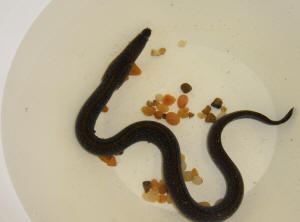
Gold dust eel... Non-FW moray
4/11/17
Hi there,
<Winnie>
I am very lost. My first time to have a gold dust eel. I'm not sure what's
happening to it. Pls help me.. what should I do..
<? Need data... is this fish being kept in brackish conditions? Water
quality test results? READ here:
http://www.wetwebmedia.com/fwsubwebindex/fwmorayart.htm
and the linked files above (FAQs); re systems, feeding... Disease. Bob
Fenner>
Gold dust eel /Neale
4/12/17
Hi there,
I am very lost. My first time to have a gold dust eel. I'm not sure what's
happening to it. Pls help me.. what should I do..
<Hello Winnie. Judging by the Stingray, your Gold Dust Eel is in a freshwater
aquarium. He WILL NOT LIVE in a freshwater aquarium. These are brackish
to marine species. Given your obvious expertise if you're keeping
Stingrays, let me immediately direct you to some reading:
http://www.wetwebmedia.com/fwsubwebindex/fwmorayart.htm
I'd also be dosing with an antibiotic, but once in brackish or marine
conditions, your Moray has a good chance of recovery. Unfortunately, in
freshwater tanks they INVARIABLY stop feeding eventually, and over time, lose
their vitality and energy, eventually dying from a bacterial infection, osmotic
stress, starvation, or some combination of these. The precise salinity doesn't
matter too much, but 25-50% normal marine is about right, i.e., about SG 1.005
to 1.010. Cheers, Neale.>
|
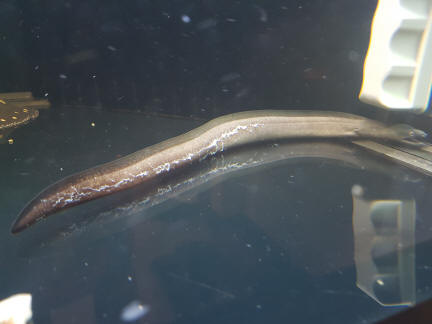 |
Moray eel... not FW
Hey there
So our eel has white longish fungus looking stuff growing from its gills
and face.
<Yeeikes!>
It's pretty bad, but only noticed it yesterday. I feel like we would have
noticed white stuff growing on it cuz we check on our tanks before and after
work everyday.
It's in a tank with a bunch of guppies and a small catfish and ghost
shrimp which we buy for it to eat.
<Oh! Sounds like you have a mis-placed "freshwater" moray. NOT FW.>
I was trying to figure out what it could be, can eels get aquarium mouth fungus?
Or ich?
<Improper env.>
Any help would be great, we just want to get this little eel healthy Thanks
<Learn to use WWM: READ here:
http://www.wetwebmedia.com/fwsubwebindex/fwmorayart.htm
and the linked files above. Bob Fenner>
Moray eel... not FW
Hey there
So our eel has white longish fungus looking stuff growing from its gills and
face.
<Yeeikes!>
It's pretty bad, but only noticed it yesterday. I feel like we would have
noticed white stuff growing on it cuz we check on our tanks before and after
work everyday.
It's in a tank with a bunch of guppies and a small catfish and ghost shrimp
which we buy for it to eat.
<Oh! Sounds like you have a mis-placed "freshwater" moray. NOT FW.>
I was trying to figure out what it could be, can eels get aquarium mouth fungus?
Or ich?
<Improper env.>
Any help would be great, we just want to get this little eel healthy
Thanks
<Learn to use WWM: READ here:
http://www.wetwebmedia.com/fwsubwebindex/fwmorayart.htm
and the linked files above. Bob Fenner>
<<Too little information to be useful. You should tell us more about your system
(size, water parameters, esp. nitrates and salinity), but I totally agree with
Bob. If you really have a "freshwater moray" get it into a proper system and
read. Good luck. Marco.>>
Gymnothorax tile acting ill 3/5/14
Hello
I recently bought a Gymnothorax tile from my local fish store. I was
excited because I have always loved eels. I took him home and placed him
in my cycled 50gal tank with live rock. He is the only fish as of now. I
noticed last night when he came out of his cave that he had white
stringy stuff around his head. This morning he's been breathing odd and
leaning to his side. I checked my water and 0 ammonia, 0 nitrates, ph8,
salinity is 1.020 and temp is 80°f. I found out the store kept him and
his tankmates in freshwater. Did I hurt him with the salt? I'm very
worried.
<Going from freshwater straight to marine is a little harsh. Usually
you'd want to do some drip acclimation over half an hour or better more
to avoid an osmotic shock. The white stringy stuff might be the slime
coat's reaction to the problem. Not much you can do right now I'm
afraid, but I hope the situation resolves itself in a positive way. Also
see the corresponding FAQs on Freshwater moray systems and diseases.
Good lick. Marco.>
|
Moray eel... BR, rdg. 1/26/14
Hey crew,
Hope this email reaches out to you guys! I'm in need of serious help. I
recently bought a moray eel and was told it's a freshwater eel. After
more research, I ended up putting the eel in brackish water. It's a
1 1/2 foot long Gymnothorax tile eel.
<... large for shipping... Often troubles>
Recently I noticed that the tail looks like it's dissolving or
coming apart. Please help me. Attached is the video of her
breathing rhythm as well as a few pics of her tail. Hope you can find
the end of the tail that looks like it's coming apart.
,,,, <Read here:
http://www.wetwebmedia.com/FWSubWebIndex/fwmoraydisfaqs.htm
and the linked files above. Bob Fenner>
|
 |
Re: Moray eel
1/26/14
Thanks Bob for responding back to my email. I looked on the link you
provided (thanks!) and it sounds like its nothing to worry about unless the
condition on the tail grows or get bigger right? I forgot to ask in the
original email. Will a 55gal tall tank be enough for one eel?
<Not large enough; and I would be concerned period. Perhaps a look/see into
Furan cpd.s. BobF>
Re: Moray eel
1/26/14
Sorry, I'm not familiar with Furan cod.s?
<... cpd.s: Compounds. Search, read. B> |
|
Snowflake eel... no data 11/14/13
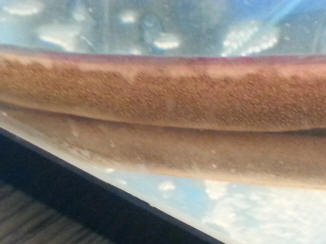
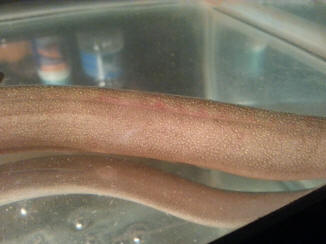
I need help I dont know what's wrong with my eel. I have him in a
medicine tank with tetra lifeguard all in one treatment but does seem to
be getting better. Here are some pictures of him please help.
<....? Is this Gymnothorax tile? Search WWM re the species, the health
of so-called freshwater morays... See the sorts of data we're looking
for... from others writing us. Bob Fenner>
|
 |
|
re: Snowflake eel
11/15/13
Yes I didn't know the proper name for him.
<Indeed. Now, as Bob implies, the so-called Freshwater Moray absolutely must
be kept in strongly brackish to marine conditions, SG 1.010 upwards, and
since you haven't said anything about your aquarium, we're assuming you're
trying to keep it in freshwater, WHICH WILL NOT WORK. Virtually all health
problems with this species come from keeping it in the wrong (i.e.,
freshwater) conditions. Since it isn't compatible with other fish (it
bites), its brackish to marine requirements don't normally pose any problems
to the (informed) aquarist. Do read here:
http://www.wetwebmedia.com/fwsubwebindex/fwmorayart.htm
There is a true marine Snowflake Moray, about which you can read here:
http://www.wetwebmedia.com/snowflakemoray.htm
Cheers, Neale.>
re: Snowflake, BR eel 11/17/13
Yes I do have some salt in my aquarium enough for him to be fine and not
too much for my other fish.
<Ah, reminds me of my Dad; he wanted a "happy medium" suitable for
Goldfish and Seahorses! But seriously, unless you have approximately
HALF STRENGTH seawater, you don't have enough salinity. In Americanese,
seawater is approximately 4 to 4.5 ounces of salt per gallon, or upwards
of 20 teaspoons of salt! If you have other tropical fish there, tetras
and cichlids and whatnot, I doubt you have anything like that salinity.
If you have other brackish or hardy marine fish (Monos, Scats,
Damselfish, etc.) then you already have a hydrometer and can tell me the
specific gravity of your aquarium.>
Secondly the eel in the picture is of the second one I have. I bought
him with I slight fungal infection and took care of it. About a week
later he started to look like the pictures. That infection is what I
don't know about.
<Bottom line, it's environmental. Move this Moray to a high-end brackish
or marine system and whatever skin infection it has now will go away.
Few/no skin parasites that affect freshwater fish can also live in
marine conditions. May not even be a parasite, but simply excess mucous
and/or necrosis of damaged skin tissue in suboptimal, stressful
conditions. So you have a really easy fix here. But if you don't want to
set up a brackish or marine system for the Moray (in which case why did
you buy it?) then you will need someone else to rehome it. This fish
WILL DIE in anything less than about SG 1.010 brackish water, and
arguably needs near marine (1.018+) conditions for optimal health. Hope
this is clear/helpful. It's not often we can be 100% clean and certain
about diagnosing problems, but when it comes to keeping marine fish like
Morays in freshwater tanks, the answer is obvious and easy to explain!
Cheers, Neale.>
|
|
Gymnothorax tile eel 10/25/13
Over the last week we have noticed that our eel is looking rough. He hasn't
eaten in over a month (I know they do this) but a few days ago we noticed a
huge bulge on him.
<Appears to be a (simple) goiter... Do you supplement iodide/ate? >
Today he is lying on his side looking like he is dying.
He is currently in a 135 gal tank, full saltwater (SG 1.024), water
parameters are all within normal standards.
<Use the search tool on WWM with the two words: "fish goiter" and read on!
Bob Fenner; who has also sent to MarcoL>
|
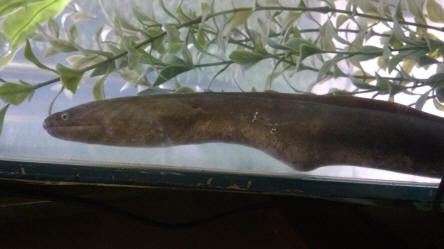 Gymnothorax tile eel Marco's
return 10/28/13
Over the last week we have noticed that our eel is looking
rough. He hasn't eaten in over a month (I know they do this)
but a few days ago we noticed a huge bulge on him.
Today he is lying on his side looking like he is dying.
He is currently in a 135 gal tank, full saltwater (SG 1.024), water
parameters are all within normal standards.
<Just arrived from a few offline days. The picture does not look good.
In case you haven't seen it yet, please see the first message on
http://www.wetwebmedia.com/fwsubwebindex/fwmoraydisfaqs.htm
for a very similar case. Good luck. Marco.>
|
Sick Eel 3/9/13
Hello,
<Hi Erin.>
I hope I am writing to the correct email address. Back in 2008 I spoke
to
Marco about a Gymnothorax tile that was not eating.
Anyways I converted him
to full salt and all was right in the world. I am having a massive issue
with him again but am at a major loss as to what it could be and what I
can
do. In the last week he has dropped weight dramatically! He is quite fat
around the gills and a spot behind his bum (which seems odd)
<This sounds strange.>
He has been eating fine.... So I can't explain the weight loss. This
morning he was active but nothing out of the ordinary and tonight he was
lying outside of his cave in his side. Not his usual caper so I knew
straight away something is up. I checked his water which is a little
saltier than normal and I'll have his water tested tomorrow
professionally.
For now as it's 12am here I have added some fresh water and an extra
filter
for more oxygen and treated the tank with easy life. He is in a 164
litre
tank on his own. If you can suggest anything or would have any
explanation
for the rapid weight loss I would greatly appreciate it. I have my
fingers
crossed he makes it through the night. Thank you.
Erin
<An ended constipation, endoparasites (internal parasites), some tumors
and
laying eggs can be related to a rapid weight loss. First the water
parameters should be checked (esp. pH, nitrates) to see if the
environment
is sufficient (relevant for tumors related to bacteria). A larger water
change won't hurt. If lumps occur on the fish it can be hard to
differentiate between parasites and tumors by only looking at the fish,
it
seems almost impossible from just a description. For internal parasites
a
number of meds is available (e.g. with the ingredient Praziquantel),
tumors
(e.g. related to bacteria or cancer) are hardly treated without the
proper
help of a vet. Also see WWM for morays with lumps. Let's hope for the
best.
Marco.>
Re: Sick Eel
3/10/13
Hi Marco,
<Hello Erin.>
nice to hear from you again. Bad news, Jim didn't make it through the
night.
<I'm very sorry for you.>
I took some photo's of him that I can send through to you if you like.
Do you know how long they live for? Maybe he was just old....
<This species can live for more than 10 or 15 years, but internal
parasites (which can be in a fish for several years) can shorten this
tremendously. Maybe this was the case here. To know the cause of death
one would have to examine the swollen areas.>
Thanks Erin
<Take care. Marco.>
Gymnothorax Tile: Slime coat and compatibility concern
12/25/12
Hello. About 3-4 weeks ago after much consideration I purchased a
Gymnothorax tile from the fish store I work at. We kept them at about
1.010-1.013 salinity, and had them for several months before I decided
to bring mine home.
He is currently in a 29 gallon tank, that will be upgraded within 2
months to at least a 50 breeder. He is roughly 8". Tank was running as a
freshwater tank for one year, and I converted it to brackish using
marine salt. Salinity is 1.014. Ph: 7.8, Ammonia: 0, Nitrite: 0,
Nitrate: 20. Temp is 78 degrees Fahrenheit, and is currently running on
an Eheim ECCO and a sponge filter. I do 20-25% water changes twice a
week. Considering running a Hydor circulation pump at the surface, but
not sure if it will be too much water flow.
<I've kept and keep various moray eel species (including G. tile) in
tanks with turnover rates of more than 30 times per hour. I don't think
the eels care at all. A strong surface current does increase gaseous
exchange, which will benefit the system in general. The fine sand,
however, might develop ripples.>
Fine sandy bottom with plenty of PVC caves, thinking of adding lace rock
and creating more natural caves. He has one tank mate, a Batrachomoeus
trispinosus, another so-called 'freshwater' fish.
<A very interesting species.>
These two were in the store tank together for approximately 4 months.
The eel gets fed 3 times a week. I have been feeding him krill, clam
strips, and lance fish so far. Thinking of adding ghost shrimp harvested
from my freshwater tanks and earthworms to his diet.
<Sounds good to me. I'd mostly replace krill with some other, larger
crustaceans in the future and add vitamins about once a week if mostly
frozen food is fed.>
He seems good appetite and activity wise (active at appropriate times),
but when he comes out to feed I've noticed what appears to be sand
sticking to the slime coat of his belly. If I stick my hand in the tank
and lightly touch him, it comes right off, but I'm curious if he could
be stressed and producing extra slime coat?
<I don't think so. I suppose this is due to an interaction of the
specific sand with slime. I have seen this happen mostly with relatively
new sand.
Maybe the sand has not developed proper biofilms since you brought the
salinity up.>
I didn't notice this in the store, but the sand I chose is very fine and
soft, and the sand we had in the store was, I believe, a denser sand
marketed for African Cichlids. Otherwise, his color is an even dark
grey, with some minor speckling if you look closely farther down his
body. No white or faded patches. Any idea what could be causing this? Is
there even reason for concern?
<I don't think so and believe this will cease with time.>
Also, is the Batrachomoeus trispinosus compatible long term? or even
short term for that matter? If yes, will he handle a full marine
conversion the eel requires in the future?
<Please note that Batrachomoeus trispinosus sometimes seems to be
confused with Potabatrachus trispinosus due to the same species name, a
similar genus name and a somewhat similar overall appearance.
Potabatrachus trispinosus is a tiny freshwater fish (2-3") while
Batrachomoeus trispinosus gets a foot long and can be caught offshore
and in reefs. It's basically a marine fish which also inhabits higher
salinity parts of river deltas. They can eat enormous prey items. I
believe it will depend on the size of the two fishes, their growth if
long term success is possible.>
Thank you for your time, Catherine
<Welcome. Marco.>
|
Help with Gymnothorax tile laying on back/abnormal breathing
7/11/12
I bought a 30 gallon tank about 2 weeks ago and bought a freshwater eel
(Gymnothorax tile) and a Pictus catfish. I know I made a major
mistake by not cycling the tank first (I added a Quickstart thinking
this would work). AFTER I bought everything and reading on
the internet I realized the eel should really be in brackish water and
also my tank was too small for the 18 inch eel and 5 inch catfish.
He was kept in freshwater at the pet store and they told me to put him
in freshwater and I made the mistake in believing they knew what they
were talking about. The water had high ammonia (between 1 and 3)
within days and the eel stopped eating. He was eating frozen
shrimp great and then one night it looked like he threw up his shrimp
and after that slowly stopped eating. I went 3 days ago and bought a 100
gallon hoping that would help the water. We added the new and old
filter together to help set up the bacteria and added better beneficial
bacteria. We are now using a cascade 1500 canister filter.
He has been in the water for 3 days now. He still has no interest
in food. Now since we moved him he is also laying upside down with
his mouth open and looks dead. Then if the catfish bumps him or we
give a tap on the tank he jolts upright and does very open mouth big
gulps of breath (he has been doing the big gulps of breath for about a
week now). The water test today says ammonia 0 (I think it's 0, yellow
with a tinge of brown not green on the test strip). Nitrate
between 0 and 20, nitrite 0, hardness .25, alkalinity we think is over
300 (it looks blue), and ph 8.2. Water temp is 80. We have been
adding a TBSP per 5 gallons of salt but just read it should have been
marine salt. Long term, I don't really want to set up this 100 gallon as
a brackish but would he be ok in a brackish 30?
<Yes, but that’s the absolute minimum. If you can go larger go larger.>
Or would he be ok if I tried to set the 100 up as full salt water and
move the catfish?
<The better option.>
A second local fish store that is the most knowledgeable said he would
also be ok in fresh since he was used to it.
<This is not true.>
My question is what is going on with his breathing and being upside down
and where do I go from here to keep him alive short term and long term.
<First decide in which tank you want to keep it. Both tanks are
basically uncycled, which is most likely the cause of your eels
condition, so you need to check for ammonia and nitrite daily and do
large water changes (50% and more) if any occurs (easy in the smaller
tank). Also, establish a sufficient oxygen supply e.g. by creating
enough surface movement with a filter outlet or a separate pump. In
addition, get a bucket of salt for marine aquariums and a araeometer or
hydrometer to measure the salt content (or density to be more precise).
Ensure that what you get can measure brackish to marine salinities.
Increase the density of your water by about 0.002 per week. In week 5-6
you should have reached 1.010 (you can go somewhat slower if you want
to), which should be the minimum for this eel species. In the long run
think about increasing slowly to marine salinity, because it's in my
opinion easier to maintain and offers for options for proper filtration
(live rock, skimmer). The catfish and the eel won't be able to live in
the same tank by the way, because they need different salinities in the
long run. For food see the following article and also read the moray eel
FAQs:
http://www.wetwebmedia.com/FWSubWebIndex/fwmorayart.htm >
Thank you so much for any advice you can give me.
<I hope it's useful. Good luck. Marco.>
Gymnothorax tile help
4/5/12
Hello, I have bought a Gymnothorax tile about 2 weeks ago from a private
listing. After getting to their house to pick up my new pet, I realized that
he/she was living in horrible conditions. It was in a 10 gallon tank half full,
with no salt, poor filtration, and horrible water conditions. After getting
him/her home, I did a major tank clean (I know not the best idea, but his/her
water was really that bad I had no other option), added water conditioner and
let him be for a couple days. I then slowly started adding Instant Ocean marine
salt, I do not know the exact measurements, I will be getting a hydrometer
tomorrow,
<Yes, you'll need that.>
but I have added about 1 cup less than a half of a box (I was told that I should
do half the recommended dose) that was specifically measured for a 10 gallon
tank, which is what he is still currently in.
<Much too small. You should also get a larger tank in the near future.>
I have upgraded his filtration system to 2 filters made for 10-30 gallons, and
added a heater. Right now his tank is about 28 degrees Celsius.
<24-26°C is enough. The water will carry more oxygen at lower temperatures,
which should help a little in this small, uncycled system.>
He is currently on a steady diet of shrimp, they were feeding him cubed ham
which after doing research I found was a big no-no, I will be introducing
silversides into his diet tomorrow.
<Silversides can be fed regularly, but should not be the main part of the diet.
It's important to get the diet mixed a lot. See
http://www.wetwebmedia.com/ca/volume_4/V4I2/Freshwater_eels/freshwater_eels.htm
>
Ok with all that being said, my Gymnothorax tile has been acting very strange
lately. He seems to be struggling to breathe on and off throughout the day,
flipping upside down and laying there for a few seconds, and then violently
thrashing his tail back and forth creating craters in his sandy bottom. I am new
to owning this species, and have done all the research that I can, but I just
can't figure out if his behavior is normal.
<Likely an environmental problem due to the small and probably still uncycled
system.>
Will he/she be ok, and is there something that I am doing wrong? Please help.
<The best for its survival would be to get it into a larger, well established
marine system until you can provide a sufficient one. If you instead of that
wish to use your current tank, get a test kit for ammonia and one for nitrates
in addition to a hydrometer and more salt. The test kits will show when you
should change water (basically you are cycling the tank with a fish in it now
due to the major tank clean). Any ammonia measurement >0 or nitrates above 20-25
ppm are a reason for a water change. Also, keep the water surface moved with
what filters you have available. When you reach marine salinity (check with the
hydrometer) you can add well cured live rock to help with the filtration. In the
mean time you should get a larger tank and start cycling it without fish. Later
you can transfer your moray and the live rock to the larger tank and get rid of
the small one or use it for something else.>
Thank you for your time, Stephanie
<Good luck. Marco.>
Re "Freshwater" Moray Eel Two Questions, fdg., sys. 4/9/12
Hi again, this is Alyson (the one with the "piggy"
Gymnothorax tile) Since we last spoke I have been
feeding him lesser and lesser each day to get him used to
eating every other day. He is doing fine, keeps "begging" but I just don't look
at him lol.
<Sounds good.>
I did have just two more additional questions....I was planning on purchasing
another Gymnothorax tile and I have read on your site that they can live
together and normally don't show any type of aggression towards one another.
<Yes, this works best if both (or more) are introduced to the tank
together, but adding another one generally works, too, with this species.>
I was just wondering if I do actually purchase an additional eel should I look
for any "hints" that two are being aggressive towards one another <There may be
an initial 'fight' at first contact, since one has established its territory,
but if there are enough caves it should be no problem.
Rearranging some rocks/caves (without turning the tank into a cloudy mess of
course) before adding the new one can also help.>
and also my specific gravity is already at 1.020-1.021....would this hurt the
"new eel" moving him into that high of a level so soon after purchasing him??
(that's assuming the idiotic pet store has him in full freshwater, which they
normally do)
<Acclimation can be rather quick. If you want to be on the safe side try this:
Put the new eel with the water it was transported in into a bucket (add a small
airstone if you have one at hand) with lid. Add tank water over about one or two
hours until about 70-90% of the water in the bucket is tank water. You can use a
cup or an air hose with a loose knot. Then, add the eel to the display or if
available quarantine tank. The acclimation procedure can be combined with a
small water change, since you have to replace the tank water you added to the
bucket if you wish to avoid adding water from the store to your tank.>
I appreciate all of your help and hope to hear from you soon! Thanks
<Welcome. Marco.>
Re: Another issue Marco :(, G. tile 4/29/12
Hi again Marco, it's once again Alyson.
<Hello there.>
I feel so bad for pestering you with my questions/concerns :( I
live in North Carolina, USA (do not know where you are located),
<Southern Germany, near Heidelberg.>
but I can not find vitamin supplements anywhere for my eel's food. There
are 6 pet stores and no one has them and don't even know what I'm talking about
(Haha I know right), so my question to you is there a brand/site that you can
recommend so that I can order it over the internet for my eel?
<Vita-Chem Marine is not bad. A few drops on the food once or twice per
week.>
Also, the only pet store in my city that has live rock is a very "dirty,
sick animal type place" so if you can also recommend a good, trustworthy site to
order live rock from? If so, that would be awesome.
<I don't have personal experience with online US live rock sellers, I
prefer to see the rocks in the store. But I will leave the email in the inbox if
someone else has a good online source.>
I know in previous emails you have advised me to get a skimmer, trust me
I am definitely saving up for one lol.
<Very good, this will help with waste removal and oxygen supply. Also
keep the water surface moved to help with the gaseous exchange.>
I still only have the one Gymnothorax tile, but I ordered another one
and it should be in Tuesday so wish me luck.
<Okay.>
Once again, thank you so much for all of your advice and help, although
my eel is still laying his head sideways I am going to take your advice and not
worry about.
<I guess as long as the water is ok, that's just some stress from the
move.>
Thank again and cheers to you too! :)
<Welcome. Marco.>
Hi Marco, another question 5/1/12
Hey again, hopefully this should be my last question for awhile ( I know you're
probably thinking thank goodness lol). Since I cannot locally get the vitamin
supplements for my eel's food, I was looking at your site and saw some things
about being able to add baby and/or human vitamins to fish food.
<Yes, this can be done, although personally I rather use products developed for
aquarium use.>
I spent all of today searching the site to see exactly (if so) what types of
things to look for if I choose to go that route. I definitely need to add
vitamins to Eely's food because although it's a variety, it is mostly frozen. If
it is ok and safe to add baby and/or human vitamins, what should I look for and
avoid when purchasing?
<Prefer sugar free liquid products high in thiamin.>
Also, how do I go about adding it to an individual feeding?
<Add a few drops after the thawing process and before feeding. If you feed
larger foods (little fishes such as silver sides or clams, mussels, shrimps) you
can also use a syringe to inject the vitamins into the food.>
And by the way, my new Gymnothorax tile should be in tomorrow (yay).
<Seems it's time to feed the old resident and rearrange some caves to avoid most
territorial behaviour.>
Anything you know on supplementing human vitamins for "fish" vitamins would be
awesome, if not I will have to order some online. Thanks again.
<Hope this helps. Marco.>
Re: Hi Marco, another question, BR 5/2/12
Hi again Marco, yeah I think I am just going to play it safe and order
some vita-chem. marine over the internet. As far as preparing for the new
eel
(still waiting for the pet store to call to say it came in) Yesterday I
bought some more "caves" and what not and rearranged the tank decor so I am
hoping that will help with the "new arrival" Thanks again for all of your
help!
<You're welcome and I hope everything went well. Marco.>
New issue with eel laying with head sideways
Sigh....I thought for sure the last email I sent you would be
the last lol.
<Oh... well.>
In previous emails I mentioned that my eel was laying his head sideways
out of his cave. Well today he was very active, swimming around, exploring the
new tank decor. That is when I noticed between his right eye and nostril, also
his lower jaw, was very pale. The patches were not white nor did they look like
a "fungus" of any kind. The patches are not on the other side of his face, but
the reason that I am concerned is that when he did finally go back into his
cave, he was rubbing against it on that same side.
<I guess this may occur due to the movement, stress, new and after only
5 days of cycling quite fresh tank... a skin irritation. Better check your water
parameters.>
I was searching your site and saw something about "white spot disease,"
but the pictures I saw didn't look like what is happening in my case. To be
safe, should I treat for Ich??
<No. Not until you know it is Ich (Cryptocaryon irritans). You would
notice heavy breathing and white, salt grain like spots. Healthy eels
practically never get it due to their toxic slime coat.>
Other than his "scratching" he seems perfectly fine, happy with his new
decor and such on, but once again any advice would be helpful. Thanks again!
<Check your water, ensure there is enough oxygen in the tank. Good luck.
Marco.>
Re: once again, another problem :( - 5/12/2012
|
|
Hi again Marco, I guess I had forgotten to mention that before placing the "sick
eel" in my community tank, I did put it in a quarantine tank 1.To get it used to
some salinity and 2. To watch how it was....It seemed relatively fine in the
quarantine tank. In regards to the "swollen throat" I either jumped to
conclusions thinking it was bacterial or was right. It was also very skinny (I
know it had probably not eaten in a while since he was in captivity maybe making
his throat seem slightly bigger?). After watching him in the quarantine tank
(not showing any signs of sickness) that’s when I decided to move him to the
community tank.
|
|
WWM:
Quarantine is rather a matter of weeks instead of days (or hours).
|
|
At first he was swimming around exploring for about 5-6 min and then he just
nose dived into the sand and laid side ways. He appeared to have stopped
breathing, that’s when my eel went up and nudged him. So, I immediately removed
him and put him into the hospital tank and treated him with (you're right I
misspelled) Maracyn. I believe it was just too late. He started getting paler
and paler and eventually died. Maybe it was bacterial or maybe it was that in
combination with stress and starvation I don't know and I'm sure him being kept
in freshwater for a long time at the LFS didn't help either. But in response to
"putting a sick eel into my tank" I believe I took every precaution before
adding him. I quarantined him first and he didn’t not show any signs of
"sickness".
|
|
WWM: You had
the suspicion and I think you were right for quarantining the eel. Won't argue
here, though, since this case is closed, all that can be stated is: If you think
a fish might be sick don't buy it and if you still do buy it quarantine for some
weeks it until you are sure it is healthy.
|
|
I was a veterinary technician for many years (we didn’t deal with fish though
lol) so I take great care of all of my animals.
|
|
WWM: See
above for proper times for quarantine. Here's also a good description of a
quarantine protocol: http://www.wetwebmedia.com/QuarMarFishes.htm
|
|
My eels are like my children and I would never do anything to intentionally hurt
them. They are in my home office, so I watch them all day, constantly checking
PH, ammonia etc. I just want to make sure I am doing everything I possibly can
to ensure they are healthy and have a healthy environment (I guess that’s why I
bother you so much with my concerns). As far as my baby eel goes, he has learned
not to go into a cave that Eely is in lol and I actually got him to eat 2hrs
after purchasing him. Another question is since he is a baby should I keep the
water brackish until he grows and then turn to full marine?
|
|
WWM: Can
perfectly live in marine water even at small sizes.
|
|
I read that the juveniles live in brackish and as adults they migrate to full
marine so if I could get your advice on that.
|
|
WWM: A
theory that to my knowledge never was substantiated by usable evidence.
|
|
I am still saving for a skimmer (boy, they aren't cheap), but not knowing much
about skimmers, can you use them in brackish or just strictly full salt?
|
|
WWM: Most
start working quite well at brackish salinities, but at higher salinity the
surface tension of the water will be higher, so it become easier for stable
bubbles and foam to form and more organic material will be removed.
|
Thanks again. Best wishes, Alyson
|
Once again, another problem :( - 5/11/2012
|
|
Hi Marco,
|
|
WWM: Hi
Alyson.
|
|
I dont know if you remember when I said I ordered a new Gymnothorax tile to add
to my tank. Well, it took until yesterday to show up. My local pet store had
three, one that was the same size as my G. tile and two babies....Well as I was
looking at the "bigger one" I wasn't happy about his throat. It seemed swollen
(which led me to believe maybe bacterial infection) and he was not hiding like
most eels do. Well, against my doubts I purchased the larger one so that there
wouldn't be a "size to size" issue.
|
|
WWM: The
best option would have been to purchase none of them, but the sick fish is
mostly the worst choice.
|
|
Needless to say, the eel lasted about 30 min. It was very sad to watch, even my
eel was nudging it trying to "wake it up". He was still breathing very shallow,
so I immediately moved him to my hospital tank and tried to treat him with
Maracyn
|
|
WWM: Don't
know this one. You probably mean Maracyn.
|
|
, but I believe it was too late. So (I know exactly what you are going to say
lol)
|
|
WWM: Like,
why did you buy a sick eel and put it in the display tank possibly introducing
pathogens instead of the hospital until it heals or dies.
|
|
I purchase one of the baby G. tile. Yes I am aware at the bullying that could
happen between my larger one and the new one. So far so good. There was an
initial fight when the baby tried to go in "Eely's" home and I broke it up.
There was no signs of damage to the new eel and in response to that, the baby
later on, went up and nipped the bigger eel's tail lol (once again no injuries).
|
|
WWM: Doesn't
sound too bad so far. Keep an eye on them.
|
|
My problem is that after removing the "original new eel who died" my nitrates
skyrocketed. I did a 50% water change, but still no change. PH is at 8.0 and
ammonia is at 0...Any ideas???
|
|
WWM: I don't
think this is directly connected to the new eel. The short term solution for
high nitrates is water changes, the long term solution is to improve filtration.
When you reach marine salinity, a skimmer would likely be a good investment.
Until then I think water changes are your best option. Also read here
http://www.wetwebmedia.com/nitratesmar.htm and in the linked FAQs.
|
|
Once again thanks a lot. Best wishes, Alyson
|
|
WWM: Good
luck. Marco.
|
|
Re: think i fixed nitrate prob. but still more questions
5/18/12
Thanks again Marco, I will monitor these "spots" on the baby eel and if
anything changes in regards to that I will definitely contact you (with
pics).
<Ok.>
Hope you have a good one.
<Will try.>
As always best wishes, Alyson
<Okay. Marco.>
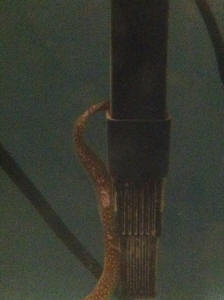
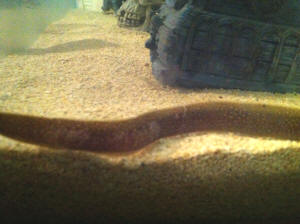
finally got pics 5/19/12
Hey Marco, I was finally able to pics.....they're not the best in the
world, but I tried. It seems to have spread. I know they are a little
dark, but it was the best I can do. If you can tell what these patches
may be, please let me know as soon as you can.
<Can't tell for sure from the pictures. Does almost look like healing
scratches from bite marks or sharp decorations, which would not need
treatment. I think with the fish in front of you you'll see if these are
possible scratches.>
He is still acting normal, but now since it seems to be spreading, I am
thinking it is more likely a disease. Please let me know your thoughts
on this.
<If this truly keeps spreading (and only then) I'd get the hospital tank
up running and treat with Maracyn (preferably Maracyn 2, since at higher
salinities many bacteria seem to be gram negative) suspecting a
bacterial infection of the skin.>
I have looked on the WetWebMedia site looking at diseases (especially on
eels), but I can't pinpoint what this is according to the pic on your
site. I will be waiting for any advice you may have. Thanks again.
<Also, keep the water quality high (tank looks still quite "fresh"),
have the surface of the water well moved and feed vitamin enriched food.
Good luck. Marco.>
|
 |
|
Re: finally got pics... G. tile, ongoing
chatting 5/20/12
Thanks for getting back to me Marco. I know those weren't the best
pictures in the world, but I don't know if you could tell by them, that
the spots didn't look granular like Ich, nor was is filmy like a fungus.
<Both would look completely different.>
The spots are just the same color the eel's belly is. So I'm with you
thinking the spots maybe scar tissue. Got a couple more questions
though, the same eel (the baby) loves to hang on the filter and on the
tops of the plants that I have in there. He acts normal and usually does
that after my big eel chases him. He just hangs there and watches
curiously as opposed to watching from a cave. I'm assuming he does that
to be on the safe side so he doesn't run into the big eel. Would that
make sense?
<Yes, I think you need more caves. Create narrow caves like properly
sized aquarium hoses covered with rocks, lots of rocks (prefer
calcareous material like limestone, dead reef rock). If caves are the
better option they will be used. If a cave has a much larger diameter
than the eel like many aquarium decoration products, it will not be
considered as a top notch living quarter.>
Also I purchased a baby vitamin supplement to add to the food and was
wondering if I provided you with the information if you could say if it
was safe to use or not? The product is Enfamil Poly-Vi-Sol
Vitamin A 1500 IU
Vitamin C 35 mg
Vitamin D 400 IU
Vitamin E 5 IU
Thiamin (B1) 0.5 mg
Riboflavin (B2) 0.6 mg
Niacin (B3) 8 mg
Vitamin B6 0.4 mg
Vitamin B12 2mcg
*Ingredients* Glycerin, Water, Ascorbic Acid, Polysorbate 80, Vitamin E
Succinate, Niacinamide, Ferrous Sulfate(as a stabilizer for Vitamin B12)
Natural and Artificial Flavor, Artificial Caramel Color, Vitamin A
Palmitate, Thiamin Hydrochloride, Riboflavin-5-Phosphate Sodium, Vitamin
B 6 Hydrochloride, Vitamin D3 Vitamin B12
<Not as ideal as a specific product for fishes, but according to its
composition I think it should do its job.>
This product says it is sugar free,
<Glycerin is a polyol compound.>
but I will wait to hear if this would be a good supplement to use or
not.
<I think a few drops can be added to the food after thawing and should
improve the vitamin supply and not cause problems.>
Thanks again for your time!
<Welcome. Marco.>
Re: finally got pics 6/3/12
Long time no email Marco lol. Last we spoke I had sent you some pictures
of the patches on my new little eel. I am just writing you to tell you
that I am almost 100% positive they are healing scratches.
Although it is "spreading" the eels get into a minor quarrel at least
once a day. The reason I am quite sure it is healing scratches/scar
tissue is because one time when they got into a scuffle my big eel
nipped at the top of the little one's head and the next day he had a
spot on the top of his head. I know you said in earlier emails that if
they are healing scratches that I do not need to treat it, I just want
to make sure that I don't need to get some kind of substance with aloe
in it to maybe help??
<No.>
I don't know lol. Even though my big eel is a bully, this little guy is
feisty and will sometimes go right up to my big eel and nip him in the
face and swim off. It's actually quite humorous because my big eel will
not even retaliate.
<I think this is territorial behaviour and would recommend to add more
or different caves as suggested in an earlier email, preferably pvc
pipes. This species (G. tile) usually does get along with its own kind
very well.>
I want to thank you again for your input on the pics I sent you
previously, and like always what you suggested "does almost look like
healing scratches from bite marks" was absolutely right. As for my
earlier nitrate problem, I'm thinking my tank maybe "established" now???
Because I have had 0 nitrates and 0 ammonia for a good almost 3 weeks
now so unless something major happens in my tank, you probably won't be
hearing from me.
<Sounds good... the water parameters of course. Nitrates probably will
rise again slowly with time.>
Once again, thanks for all of your help
<You are most welcome.>
and if you get paid for working for that site, then you need to get a
raise lol.
<We do this for free.>
Take care!
<You too. Marco.>
|
think i fixed nitrate prob. but still more questions, BR
5/17/12
Hey Marco, in previous emails I had mentioned about my nitrate rise
(thinking it may had been caused by the sick eel) and you reassured me
that was not the cause. I just want to let you know that you were right.
After another water change, with ammonia at 0, my nitrates were still
through the roof so I went to my LFS and talked to the girl (who
actually knows what she is talking about) and explained my situation.
She asked if I use city water (which I do) and if I had done/added water
to the tank after a heavy rain (which I did). She said that especially
after a heavy rain fall, our crummy city water is loaded with nitrates
and that the water conditioner only removes chlorine from the tap water
and nothing else. She referred me to a product called Prime made by
Seachem and said to remove nitrates, add three times the amount that you
would if you were establishing a new tank. Well it worked. Nitrates are
at 0 and now I know about my city's water. Have you ever heard of that
type of situation?
<Yes, heard of it. It's always a good idea to check the water you use
for water changes if strange water parameters occur. I think/hope this
was mentioned in earlier emails about water changes. Glad you found the
exact source. Don't think of Prime as more than a temporary solution
with regard to nitrates, though, I'd still recommend to upgrade your
filtration when you reach marine salinities. Too bad your water supply
does not deliver a constant quality product.>
The new baby eel that I had purchased after the "sick eel" is absolutely
doing great! He is eating and is a feisty little guy. My big eel used to
pick on him and I would have to break the up a few times, but now I
believe that my big eel knows that the little guy isn't going down
without a fight. I do have a question though, near the little eel's
tail, there are two small white patches the same look and color that his
belly is. Please do excuse me, I am trying to get a camera that can take
a good picture. It is not Ich, and does not resemble a fungal infection.
He is not scratching on anything and is acting completely normal.
<As long as it does not grow, don't worry.>
I was just wondering if they may go through different color
patterns/colorations during the growth cycle?
<Yes, but not such bright spots. Usually the golden speckles become less
with age, older G. tile are completely grey with a light grey belly.
I've seen such brighter spots on G. tile that never changed or in other
cases vanished and don't think this is a disease.>
Any advice you could give would be great and trust me I know it is hard
to diagnose with out a picture, but I am trying so hard to find a camera
to get a good picture. Once again thanks and take care, Alyson
<Cheers, Marco.>
|
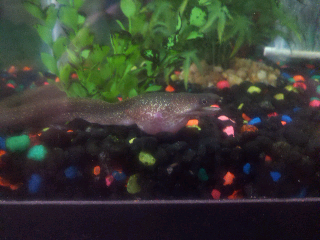
My eel looks like he is going to explode.-
10/18/10
I don't know what is wrong but he keeps getting bigger and
looks like he is
going to explode. Please help.
<This is a Gymnothorax tile with what seems to be a severe
infection. If this eel is being kept in freshwater, transfer it
into a marine tank or a brackish tank with at least 10g/l marine
salt mix. Provide a good water quality with low nitrates (<25
ppm) and high pH (8.0-8.4). Feed a varied diet (shrimps, mussels,
fish filet, octopus or squid) enriched with vitamins. This should
help the eel to heal. You could try treating the eel in a
hospital tank with an antibiotic such as Maracyn 2, but in this
case Id prefer the proper environment and diet route described
above since these infections are generally slow and the growth is
fully reversible in my experience. See here for more information
on this species:
http://www.wetwebmedia.com/ca/volume_4/V4I2/Freshwater_eels/freshwater_eels.htm
. Good luck. Marco.><<May be a "thyroid" goiter. RMF
would also suggest an iodide/ate addition to
foods.>>
|
 |
Brackish Water Snowflake Eel in Freshwater;
sick, starving... 01/10/10
I purchased a fresh water snowflake eel at a pet store about a month
ago.
<Gymnothorax tile, a brackish water species that doesn't live
long in freshwater.>
The eel was in a fresh water tank with other cichlids of which he is
with now.
<Not for long.>
I have a 55 gal fish tank and the water levels are good.
<What's the salinity? At minimum, you need at least one-quarter
seawater salinity, 9 grammes marine salt mix per litre or about SG
1.005 at 25 C/77 F.>
There are plenty of hiding spaces, surface tension, filtration and O2.
I haven't had much luck with feeding from what I have observed; I
have been feeding frozen shrimp and have fed feeder guppies.
<Brackish water morays notoriously starve when kept in freshwater.
Perhaps it's their way to tell the fishkeeper they're dying.
Whatever the case, once moved to a brackish or marine aquarium it will
start feeding.>
It is hard to get ghost shrimp where I live.
<You don't need live food. Feeder Guppies -- unless you're
breeding your own at home -- aren't a safe food, so stop using
those. You cannot use live fish bought in a pet store as food. It's
unsafe, and a good way to make your fish sick. In the right environment
these morays are quite greedy.
They hunt by smell, and small morsels of tilapia fillet and cockles
offered at night make excellent staples.>
I recently noticed the snowflake eel violently shaking while swimming
and kind of just hanging in some of the plants with his face in the
rocks; his body also appears to be more white and splotchy than when I
first got him.
He has also developed red spots along his body.
<An extremely bad sign. This fish is under intense environmental
stress. It needs brackish water conditions, immediately.>
I have tried feeding by hand and he doesn't seem to be interested
in anything. Any help you can give me is greatly appreciated. Thank you
for your time. Sincerely: Tamarie
<Do read here, Tamarie:
http://www.wetwebmedia.com/fwsubwebindex/fwmorayart.htm
Cheers, Neale.>
Freshwater Moray with mouth tumor
03/15/09
Hello WWM, I have seen several questions on your site about freshwater
morays with tumors but mine seems to be unique from the others. I have
checked off the other possible reasons such as water quality (waste
levels always less than 0.1ppm) salinity
<Even nitrates?.>
is Marine rather than brackish but I don't think this could cause a
tumor to form.
<No, marine salinity is beneficial.>
The tumor is the same color as the eels mouth lining and has filled in
the upper palate in the eels mouth, it is also beginning to show on the
eels upper "lips" as black/pink lumps. The only reason I can
personally think of is it's very unusual diet, the only food my eel
has ever been willing to eat is raw salmon fillet of all things, (I do
dunk the salmon in supplements though for nutrition).
<Vitamin addition is good, nonetheless you are right, the lump may
be related to a deficiency disease or a declining immune system due to
a lack of a nutrient. Salmon is generally a good choice, but still the
diet should be varied. It can take a while, up to a few weeks to train
a moray to a new type of food.>
I've had the eel for approximately two years now and the tumor has
been visible for a few months now, and in that period the eel has been
exposed to a few different anti-bacterial medications with no apparent
effect.
<You should specify what you used, real antibiotics or just some
often sold tea stuff.>
The eels appetite hasn't been affected yet but if the tumor gets
much larger it may threaten to block off the eels mouth entirely. Any
information you may have on this situation would be greatly
appreciated. Thanks for your help guys!
<From what you write I highly suspect the cauliflower disease, which
is caused by a virus (Orthomyoxovirus) and is abbreviated as EV2 (Eel
virus 2). It should not be confused with the harmless Lymphocystis
disease. It generally needs wounds and dirty water to infect an eel,
dont exchange any equipment or water with other fish tanks. The virus
is much less dangerous in high oxygen water, which means you should
increase your surface current with power heads (rated together with at
least 30 (thirty) times tank volume per hour) and use a large skimmer.
Inorganic di-phosphates have also been used by veterinarians to
successfully fight the Orthomyoxovirus, I do not think there is a
commonly available product sold for pet fish, so you may have to
consult a vet. In addition, tumors have been successfully removed by
veterinarians specialized on fish. I would start with the oxygen
therapy (skimmer, surface current) and keep the water pristine. If you
feel capable to deal with di-phosphates, this would be my second
measure, if not you should visit a vet. In the long term I'd try to
keep the diet more varied. Good luck.
Marco.>
Gymnothorax tile,
hlth./env. 9/25/08 alright, i got one of these guys out
of a freshwater tank, however he didn't seem to be doing so well.
<This species never does well in freshwater aquaria, at least not
for long.> then i researched and found that he was a brackish water
species. so i added sea salt, but added too much over a long long
period of time. my salinity is 1.025 as of now and let me tell you, he
has grown at least 6 inches and is doing great in full marine water.
<Not a problem for this species. Wild fish live in river estuaries,
and can tolerate rapid changes in salinity well. Maintenance at marine
salinities is not harmful, and in fact mid brackish (SG 1.010+) to full
marine conditions are perhaps the ideal.> is this eel actually a
marine eel? <He can be, without any harm at all. In the wild they
don't live permanently in the sea, but like most brackish water
fish, will do just fine in a marine tank.> he seems to be doing
better in the full marine than he was in the brackish water! he's
in a 12o gallon tank, FOWLR. <I'm sure he's very happy!
Enjoy your pet. Cheers, Neale.>
|
Gymnothorax tile 01/22/2008 I have had a Gymnothorax
tile for about two weeks. I bought it from a store who had him in
a freshwater tank and so I put him in my freshwater tank and has
shown no interest in eating at all. <Completely normal in both
regards: these eels are routinely sold as freshwater fish (which
they are not, at least not in captivity) and when the salinity is
too low they don't eat. Once the SG is above 1.005 they
normally pep right up.> After a few days of having him I saw
some flakey skin on him and thought it was a slime coat starting
so I put him in brackish water ( one tablespoon of instant ocean
to one gallon of water) and is still not eating. <No idea what
"one tablespoon" per gallon comes out is real terms. To
create brackish water you should be -- at the very least -- going
by weight. Brackish water for this Moray is about 9 grammes per
litre of water (or 1.2 ounces per US gallon). Ideally you'd
be using a hydrometer (which costs a mere $5 for a floating glass
model) so you can accurately assess the salinity using that. SG
1.005 is the minimum for this species, and long term you're
likely to need SG 1.010.> My eel now has a white fleshy hump
towards his head on his dorsal fin about a half inch long what
should I do? <That looks like Finrot of some sort. It needs to
be dealt with at once, otherwise a systemic bacterial will get
started, and at that point the fish will die. You will need an
antibiotic of some sort, such as Maracyn. Antibacterials (such as
eSHa 2000) would work as an alternative, but Morays tend to be
sensitive to Copper salts especially, so check the ingredients on
the package carefully.> Did I put him in too much salt at once
or is it because he is not eating? <No, raising the salinity
is more likely to be helping than harming. But if the salinity is
still too low, then you're not going to coax him into
feeding. Do also remember these fish are nocturnal and hunt by
smell. What they want is a nice little piece of seafood popped in
the tank each night. Squid, clam or prawn will do. The chunk
should be about 1 cm cube for a 30 cm eel. Adding too much food
at once makes it difficult for them to forage, oddly enough: the
smell gets all over the tank, and they can't home in on their
"prey".> I have to rosy red gold fish in their with
him along with 4 ghost shrimp and also tried frozen shrimp.
<Never, ever feed these fish live feeder fish unless you want
to kill them. And Rosy Red minnows are -- like Goldfish -- about
as healthy for fish as Happy Meals are to growing children. Bob
Fenner has discussed here and elsewhere the catastrophic damage
cyprinid fish (such as minnows and Goldfish) have on the
physiology of marine predators. The only safe and easy to get
live fish for use by aquarists are home-bred livebearer fry. Buy
some Mollies, put them in a tank, and then use the resulting fry
as food, if you really need to do this. But let's be 100%
clear about this -- Morays don't need live fish and don't
benefit from live fish. They hunt exclusively by smell, and are
almost as blind as bats. So provided the seafood is fresh and
smells good, they'll zoom in on it happily enough. Live river
shrimp are a good treat, but hardly essential every day. A bag of
mixed frozen seafood costs about £4 here in the UK and will
last you for several months. Cheap, safe, and easy to use. What
more could you want. Anyway, until you raise the salinity, you
aren't likely to save this fish, so that -- along with fixing
the Finrot -- is your priority. Do read Marco's excellent
piece on these fish, here:
http://www.wetwebmedia.com/FWSubWebIndex/fwmorayart.htm Cheers,
Neale.>
Re: Gymnothorax tile 1-22-08 Thanks for the information
I started the Maracyn and increased the salinity to 1.008.
<Very good.> He is still not interested in food I wiggled
squid on a skewer stick and then tried it on thread but I think
it is because I just started the Maracyn and has not begun to
heal yet what do you think? <Just give it time. Try and get
some live river shrimp if you can. These are ideal food for
unhappy Morays. Failing that, hunger! Don't add any more food
for a few days. Use the medication. Let the fish heal. When
it's ready, it'll feed. Morays are quite hardy animals,
but when stressed they can lose their appetite.> <Good
luck, Neale.>
|
|
| Re: Gymnothorax
tile - 1/24/08
Hi again just want to let you know that it
does not look any better or worse "as far as getting
bigger" except now the white lump on his back is growing
little transparent looking bubbles. <The bubbles are gases
from decomposition. This is now extremely serious, and likely
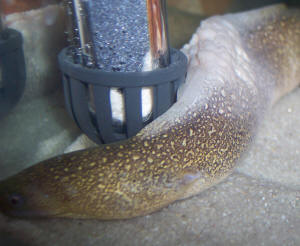
incurable short of a trip to the vet. The fish has a systemic
bacterial infection; while Maracyn (Erythromycin) might help
given a couple of weeks, to be honest I suspect you will need
to really to see a vet here.> The lump is not Cotton like,
it looks like a mound of white skin that is raw and little
bubbles are on it see pictures. Salinity 1.010, Meds: Maracyn
and MarOxy temp 76. has not eaten yet I can't find river
shrimp Have you seen this before? <Only on fish about to
die...> Thanks <Please see a vet soon! Neale.> |
|
Re: Gymnothorax tile 1/25/08
This sucks I can not find a vet that cares for fish with in
sixty miles of my house any other possibilities? maybe up a
dose or anything at all I am desperate. I feel so bad and
hate to se him suffer. Troy <Nope, nothing you can do
beyond finding a vet. Your fish is in such bad shape that
I'd be surprised if it recovers. Keep using the
Maracyn, if that doesn't help, switch to Maracyn-Two,
since the two treat different bacteria. But these
off-the-shelf medications might not be enough. Cheers,
Neale.>
|
|
|
Gymnothorax tile with possible tumors 09/04/07 Hello!
<Hi!> Sorry I must contact you with bad news. <No
problem.> Somehow one must guess most people who have
questions do. I believe that this is the fatal flaw for the moray
I have made. I trusted the staff at the LFS. I've been
feeding him shrimp for months and now that something has finally
gone wrong have I dug into the problem. I guess stuff happens but
I should have been able to prevent it with research, but the
sites I could find before I ran into yours mentioned morays
eating crustaceans. <They do, but not exclusively and not just
one type.> I've found your website incredibly reliable as
far as I can see. When I looked into the problem, I looked into
diet, and disease on your site. What worries me, is that even if
I correct the diet, he has what appears to be tumors on his
belly, the white portion. He's in a high brackish setup for
more info if you need that. <Okay, that's an important
information. I hope the specific gravity is above 1.010.> Say
the diet is corrected in the long term, will he be able to
survive what has happened to him? <Possible, if the diet was
the reason and apparent damage is reversible. Daily vitamin
additions will help you to correct the diet and find out.>
I'm concerned with the tumors. I doubt there is anything I
will be able to do except for do my best. <Yes, a vet would be
needed for a better diagnosis. What you can do is: check your
nitrates. Aside nutrition this problem might be caused by an
environmental issue, e.g. high nitrates or low salinity (which
you probably can exclude at least for the time you had it) for a
long time.> I thought it might have been an infection from the
substrate, which is smooth gravel. <Improbable.> I siphoned
every piece of filth I could from the gravel and did a 20% water
change of his 20 gallon tall. <Okay That tank is relatively
small, therefore it is well possible nitrates accumulated. You
may also want to check nitrites and ammonia to see if this system
is adequately filtered. Nitrates>20 and any reading of ammonia
and nitrites >0 can be a problem. You'd have to do large water
changes in that case (remember changing 50% will only decrease
any harmful substance by 50%) and keep those parameters down as
long as your fish is in this tank.> The eel is barely over a
foot, and I plan on buying him a fifty gallon aquarium as soon as
I can. I just noticed what happened today, and I sent this in
ASAP. <Good decision.> His diet will be corrected
immediately with variety <and vitamins> to ensure proper
nutrition. During the tank change I took a picture of him in a
holding container (plastic bowl). <I love this species.> He
stirred up a lot in the time it took to catch him hence the nasty
stuff in the bowl. I also disturbed a lot trying to capture
him... Other than the mysterious large bumps on him *three if I
remember correctly* he swims around and eats just fine. <I
hope he gets well again. Some types of tumors are reversible,
while others are not. Good luck and write back if further
questions or comments arise. Marco.>
Gymnothorax tile with possible tumors; follow up ?
09/09/07 Hi again. I must thank you for your quick response.
<No problem.> Sorry mine was not so swift. <Since you
did not include our correspondence it is difficult for us to
remember your problem. Dozens of e-mails arrive here every day.
But I do assume you are the one who had a problem with a brackish
Gymnothorax tile with possible tumors?> Shortly after sending
the e-mail I contacted a friend who also keeps saltwater fish. He
suggested a full water change. I did such even though I thought
it was risky but I'll try anything that might benefit the eel
as long as it seems rational. To keep the tank "aged" I
left the old filter in so the bacteria would be reintroduced. Now
I'm trying to get the eel to eat a wider variety of food. It
ate more shrimp immediately just an hour afterwards. The piece of
squid were ignored and are still laying on the bottom of the
tank. <Take them out if they are not eaten within a few hours.
You'll need some patience to train the eel. If he's a
little hungry his motivation to try something new will be
higher.> Mussel meat will be tried. I bought silversides from
the pet store as well as krill. <Okay.> So far all he
accepts is shrimp as always. With methods of keeping his body in
top shape, what could I do to make the shrimp more nutritious in
the meantime? I know that Walgreens sells hypodermic needles I
could use to inject the shrimp with vitamins. <Can do that.
You could also soak the thawed food in vitamins for about half an
hour.> Also, asking around, I have lights used for regular
freshwater fish. Should I get those intended to emit UVA to
simulate natural sunlight? More questions asked to people I know
suggest he'd need it so he could absorb calcium (I don't
think they need it very badly but it seems to be a basic need for
a lot of animals) and produce vitamin D to fight off cancer.
<Since G. tile moray eels are predominately nocturnal in
nature, I do not think the spectrum of the lights is connected to
the disease of your eel. In addition, vitamin D wont be a problem
for a moray, which naturally eat vitamin D rich sea food like
fish and crustaceans. However, I do prefer bulbs with the most
natural spectrum for my own tanks.> The eel showed a drastic
increase in activity after the water change before settling down
under his driftwood which is in there to simulate an estuary.
<May rot in the brackish water.> Is there anything I'm
doing wrong here beside the nutrition issue? <As suggested
monitor the nitrates. Anything higher than 20 ppm can be a
problem. What was the nitrate concentration before you did the
water change? It is well possible long term nitrogenous poisoning
was the source of your problem.> I suspect I am. I don't
know for sure though. There is something else I wish to ask you
in another e-mail. It has to do with the senior project at my
school and this will be sent very shortly after this. <Okay.
Be chatting. Marco.>
Re: Gymnothorax tile
tumors. Malnutrition? - 10/07/2007 The eel's tumors are
gone! I appreciate your advice very much. There has been a lot of
success with keeping him healthy, along with some noticeable
growth in size. His food has been injected with the appropriate
supplements as well. The need for a new tank is growing, and I
believe I could probably get him a new one in the next few
months. Adding another question, I found this little packet in
the LFS called "Phosphate-X" or "Phos-X."
Something like that name. The description on the label says it
absorbs phosphate, nitrates, and nitrites. I don't rely on
this little packet about the size of a sticky-note and still
perform water changes, I was only wondering if it helped. On a
different matter, the eel eats about twice a week based on the
information I found on your website. I used to offer krill that
was accepted from time to time but read that it wasn't good
for the eel and promptly stopped feeding that. Silversides have
been a new favorite alongside shrimp, and squid are accepted when
the eel feels like eating them. (the food is removed after a few
hours as you suggested as not to pollute the water) I'd like
him to live as long as possible, so I've done everything I
can, and will continue to do so. The brackish water isn't
rotting the wood so far, and the salinity is as you suggested.
While on that, is there anything better than a regular
hydrometer? Perhaps something electronic? <A hydrometer is
fine for brackish water fish. Any inaccuracy will be well within
the tolerances of the fish. In fact, most brackish water fish
like a bit of variation from time to time. But your filter
isn't quite so accommodating, so it's best not to vary
the SG more than a couple of points on the SG scale at any one
time (i.e., SG 1.010 to 1.012 is fine, but 1.010 to 1.018 not so
much).> Another question. My Gymnothorax tile lives in
high-end brackish but what is their environment like out where
they live if they're from Asia? <The problem here is that
they are almost certainly migratory, like most large brackish
water fish. So there's no "perfect" habitat. These
morays are found -- as adults -- in completely freshwater as well
as in the sea, and they seem to move about between the upper and
lower estuary. They're neither completely saltwater fish nor
true freshwater fish, but something in between. That said, like a
lot of eels, their main habitat is murky, muddy water where their
ability to burrow, negotiate rubble and locate food under poor
visibility conditions is useful. A typical environment would
probably be sticky mud at the bottom, murky water, large rocks
and waterlogged tree trunks, and rocky reefs. Hardly attractive
for an aquarium!> Will any aquatic plants survive in the
brackish water, and what kind of decoration should be used to
make it look like Gymnothorax tile habitat? <There are
brackish water plants, such as Cryptocoryne ciliata and Crinum
calamistratum in the trade, as well as the very hardy Java fern
that does well in brackish water, but there's little point to
using them. They aren't authentic for the sorts of habitats
these eels will be living in. Eels favour dark, murky places and
they don't like bright light. Much better to create something
with a tall, rocky reef-like structure so the eel can hide and
wind itself around. These eels don't so much swim as slither
through things, and the more 3D the aquarium, the better. Big
mounds of holey rocks would probably work very nicely. Something
like a reef tank arrangement. What you want to avoid is anything
too rough and definitely nothing unstable, as these fish are
quite powerful and excellent diggers. I'd personally be
looking at an oyster reef habitat. These are really important
environments in brackish water habitats and easy to replicate.
Simply gather lots of oyster shells (easy enough to buy as food,
if nothing else) and use silicone to cement them to some sort of
rock, such as tufa rock.> I'm thinking that if I make it
as naturalistic as possible he'll live longer than what is
usually achieved in captivity. <A good approach. The reason
these eels don't survive is not really a mystery. A few
things seem consistent. Keeping them in too-low a salinity
doesn't help, and usually leads to hunger strikes. So at
least SG 1.005 is required, and probably SG 1.010 for best
results. On the other hand, there's no evidence they
"swim out to sea" when mature, so keeping them in
saltwater tanks likely isn't required provided the salinity
is at least at or above SG 1.010. Diet is another factor. With
these eels, and indeed any other predatory fish, I'm a fan of
the "little but often" approach. Yes, you can feed them
a big prawn one day and skip the next. But the risk with
predatory fish is they regurgitate the food and pollute the tank.
I'd sooner give small morsels each night, so that there's
no risk of major pollution. At SG 1.010 upwards you can use a
protein skimmer with success. While not crucial, these devices to
help manage the nitrate by removing organic waste from meaty
foods before they decay. So in the long run, a skimmer can end up
saving you money by reducing the frequency of water changes. Of
course, you still need to aim for the same relatively low nitrate
level (I'd suggest <50 mg/l) but generally morays are
fairly tolerant of this. Hope this helps, Neale>
Re: Gymnothorax tile
tumors. Malnutrition? - 10/07/2007 The eel's tumors are
gone! I appreciate your advice very much. There has been a lot of
success with keeping him healthy, along with some noticeable
growth in size. His food has been injected with the appropriate
supplements as well. The need for a new tank is growing, and I
believe I could probably get him a new one in the next few
months. Adding another question, I found this little packet in
the LFS called "Phosphate-X" or "Phos-X."
Something like that name. The description on the label says it
absorbs phosphate, nitrates, and nitrites. I don't rely on
this little packet about the size of a sticky-note and still
perform water changes, I was only wondering if it helped. On a
different matter, the eel eats about twice a week based on the
information I found on your website. I used to offer krill that
was accepted from time to time but read that it wasn't good
for the eel and promptly stopped feeding that. Silversides have
been a new favorite alongside shrimp, and squid are accepted when
the eel feels like eating them. (the food is removed after a few
hours as you suggested as not to pollute the water) I'd like
him to live as long as possible, so I've done everything I
can, and will continue to do so. The brackish water isn't
rotting the wood so far, and the salinity is as you suggested.
While on that, is there anything better than a regular
hydrometer? Perhaps something electronic? <A hydrometer is
fine for brackish water fish. Any inaccuracy will be well within
the tolerances of the fish. In fact, most brackish water fish
like a bit of variation from time to time. But your filter
isn't quite so accommodating, so it's best not to vary
the SG more than a couple of points on the SG scale at any one
time (i.e., SG 1.010 to 1.012 is fine, but 1.010 to 1.018 not so
much).> Another question. My Gymnothorax tile lives in
high-end brackish but what is their environment like out where
they live if they're from Asia? <The problem here is that
they are almost certainly migratory, like most large brackish
water fish. So there's no "perfect" habitat. These
morays are found -- as adults -- in completely freshwater as well
as in the sea, and they seem to move about between the upper and
lower estuary. They're neither completely saltwater fish nor
true freshwater fish, but something in between. That said, like a
lot of eels, their main habitat is murky, muddy water where their
ability to burrow, negotiate rubble and locate food under poor
visibility conditions is useful. A typical environment would
probably be sticky mud at the bottom, murky water, large rocks
and waterlogged tree trunks, and rocky reefs. Hardly attractive
for an aquarium!> Will any aquatic plants survive in the
brackish water, and what kind of decoration should be used to
make it look like Gymnothorax tile habitat? <There are
brackish water plants, such as Cryptocoryne ciliata and Crinum
calamistratum in the trade, as well as the very hardy Java fern
that does well in brackish water, but there's little point to
using them. They aren't authentic for the sorts of habitats
these eels will be living in. Eels favour dark, murky places and
they don't like bright light. Much better to create something
with a tall, rocky reef-like structure so the eel can hide and
wind itself around. These eels don't so much swim as slither
through things, and the more 3D the aquarium, the better. Big
mounds of holey rocks would probably work very nicely. Something
like a reef tank arrangement. What you want to avoid is anything
too rough and definitely nothing unstable, as these fish are
quite powerful and excellent diggers. I'd personally be
looking at an oyster reef habitat. These are really important
environments in brackish water habitats and easy to replicate.
Simply gather lots of oyster shells (easy enough to buy as food,
if nothing else) and use silicone to cement them to some sort of
rock, such as tufa rock.> I'm thinking that if I make it
as naturalistic as possible he'll live longer than what is
usually achieved in captivity. <A good approach. The reason
these eels don't survive is not really a mystery. A few
things seem consistent. Keeping them in too-low a salinity
doesn't help, and usually leads to hunger strikes. So at
least SG 1.005 is required, and probably SG 1.010 for best
results. On the other hand, there's no evidence they
"swim out to sea" when mature, so keeping them in
saltwater tanks likely isn't required provided the salinity
is at least at or above SG 1.010. Diet is another factor. With
these eels, and indeed any other predatory fish, I'm a fan of
the "little but often" approach. Yes, you can feed them
a big prawn one day and skip the next. But the risk with
predatory fish is they regurgitate the food and pollute the tank.
I'd sooner give small morsels each night, so that there's
no risk of major pollution. At SG 1.010 upwards you can use a
protein skimmer with success. While not crucial, these devices to
help manage the nitrate by removing organic waste from meaty
foods before they decay. So in the long run, a skimmer can end up
saving you money by reducing the frequency of water changes. Of
course, you still need to aim for the same relatively low nitrate
level (I'd suggest <50 mg/l) but generally morays are
fairly tolerant of this. Hope this helps, Neale>
|
|
|
| Gymnothorax tile problems, no info on
setup 07/19/07 I bought a Gymnothorax tile a little over a
month ago and for the most part he stayed hidden and only out when
the lights were out he would flee back to hiding when the lights
came on. I have had others that acted a certain way before passing
on. <Why did they die? Some information on your system would
have been helpful.> This one is exhibiting similar behaviour but
the red scat does not bother him like it did with the others that
passed soon after acting this way (the way fish attack other fish
when sick), which seems to indicate he is not in immediate poor
health. I hope I am over reacting to what maybe normal but
seemingly long acclimating period. He also does not swim to the top
to poke his head out of the water which is probably another good
sign. Can you tell from the video if the breathing he is showing is
normal? <Its slightly elaborated. It can be elaborated during
searching for food, too, since the moray needs to increase the
water flow through its nostrils that way.> The main concern is
his lack of trying to hide like he does not care anymore. <They
are more or less nocturnal in nature and after acclimating will
keep this schedule until trained otherwise by feeding them during
day. The behaviour you observe is unusual. It seems stressed. What
is your salinity (specific gravity should be 1.01 or higher? Are
your nitrogenous compounds adequate (no ammonia/nitrite and
nitrates below 30)? Was copper used in this system? Any metal
parts, products not specifically designed for aquaria? Was this
animal fed feeder fish in the store for a long time? In general
this species is very hardy in brackish and marine water (I know
specimens of 10+ years), so loosing one (or more) and the strange
behaviour of this one indicate something is wrong with your system
or care. Check especially SG and nitrogenous waste.> I have not
actually seen him eat, but do not know how long they can survive
with out eating. <Several weeks to a few months, but it is
likely it wasn't fed adequately since getting into the trade, so
that adds to the time it has not eaten proper food. Not eating is
another typical sign of stress.> He maybe just out looking for
food but has paid no attention to the guppies swimming near him or
just decided to make his somewhat new home finally home and
swimming out after accepting the change from one location to
another. I was considering trying to get some bull minnows from a
bait shop to see if he would eat them. I also have a toad fish that
bull minnows would be better and more substantial than guppies and
ghost shrimp. <I hope this fish is in a separate tank. It can
sting and kill the moray.> Can you suggest some other types of
live food I may try for the G. tile? <Minnows, just as goldfish
generally have too much thiaminase, which can lead to a vitamin
deficiency and result in damage of the nerves. Mollies and shrimps
are better alternatives. They should not be too large.> Thank
you, Richard. <Hope that helps to find out what's wrong with the
system. See http://www.wetwebmedia.com/FWSubWebIndex/fwmorayart.htm
for an article on them and feel free to write with additional
information if further questions arise. Marco.> |
|
.jpg) .jpg) 
|
Gymnothorax
Tile - Seizures
4/5/07 I have a juvenile Gymnothorax
Tile in a freshwater tank until I get my second tank set up for
brackish. <Freshwater bad, brackish water good. These are brackish
water fish, and perfectly happy in marine tanks. Kept thus, like most
morays, they are hardy. In freshwater, they do not do so well.> I
haven't noticed him eating but have been witness to the carnage
that I can only assume is his (a pair of headless glass catfish). I
have also been consistently putting in small minnows such as danios
(which disappear quickly) and ghost shrimp (and the ghost shrimp have
gone untouched and are doing quite well), but recently against my
better judgment, added some goldfish minnows. <Unless you are
breeding your own livebearers and gut loading them with algae, you
should never, ever use feeder fish. The risks are too high and the
benefits too small. These morays will eat shrimps and earthworms. They
hunt by scent, and dead food is accepted once settled in: prawns,
squid, whitebait, etc. Once you have trained a predator to take dead
food, your hard work is over, and you can control nutrition much more
easily. Moray eels commonly lose their appetite in freshwater, and a
few weeks later die...> It may be unrelated, but a night or two
after I noticed one of the goldfish had died at the entrance to the
eel's cave and eventually disappeared, my eel started swimming
around erratically, as if in a seizure. <Absolutely possible. Two
problems. [a] Not in brackish water, and his blood chemistry is now
messed up; and [b] feeder fish can carry all kinds of diseases. You can
also add [c] thiamin-deficiency: goldfish and rosy red minnows contain
a substance called thiaminase that destroys the vitamin thiamin (B1);
when that goes, among the first things to be damaged are, surprise,
nerves and mussels. Well known among reptile keepers, less well known
(but should be) among aquarists. Say NO to goldfish and minnow feeders!
Only use livebearers *you have bred yourself* and *gut loaded*.> He
has been like this for a day now, twitching, darting to the surface,
and lying on his back with his head twitching, then darting back to his
cave. <Probably doomed unless you move to a brackish water tank
immediately and then start feeding thiamin-rich foods such as mussels
(contain lots of algae) and whitebait. Avoid prawns, as they also
contain thiaminase. Prawns are fine cycled with mussels, whitebait, and
squid but as the sole food they are not so good. Like everything in
life, take from everything in moderation.> I have tried to find any
information I can about this, but to no avail. <My 'Brackish
Water Fishes' book contains info on this species, as does the
Aqualog 'Brackish Water Fishes' book. So either of those will
set you up nicely. There's also an excellent article on them on
this web site, here: http://wetwebmedia.com/FWSubWebIndex/fwmorayart.htm
> I'm hoping he will hang on until I get the brackish and marine
tanks ready and come out of this epilepsy. <Don't bank on
it...> His tankmates are a Neon Blue Dwarf Gourami, a Bumblebee
Cichlid, an African Butterfly Fish, and apparently a group of Ghost
Shrimp. Any help would be greatly appreciated. <Also
don't forget these fish are nocturnal, so be sure and put the food
out at night.> -Jules <Cheers, Neale>
Re:
Gymnothorax Tile - Seizures
4/6/07 Thank you for the
quick reply. After a water change, ammonia treatment
and removing the goldfish, the eel seems to be doing much
better. <Not sure what "ammonia treatment" is.> I will
be picking up some the foods recommended immediately, and I
will have a large marine tank setup in a few days as well as two 30
gal. tanks. <Good.> So, I am curious, since he has been in
freshwater for a month (not considering how long he was in fresh before
I brought him home), should I ease him in to salinity by using another
tank, or would it be safe to immediately relocate him into my marine
tank? <Brackish water fish, by their very nature, can adapt quickly
to different salinities. Adapting brackish water fish from fresh to
salt over about an hour works well. Put the fish in a bucket of water,
and replace a bit of the water with salt water every 5-10 minutes until
the bucket of water has become completely saline. Don't forget to
put a lid on the bucket: these fish are notoriously good at escaping!
Also, if you have an airstone, add it to the bucket to keep the oxygen
levels in the water nice and high and also to circulate the water
better.> Thank you again for the very helpful information. -Jules
<No problems, Neale>
Freshwater eel? Not in this case? hello sir
<Greetings, Brian. Anthony Calfo in your service> I recently
purchased a snowflake eel and I'm getting worried about it it is
pale colored and it like to lie on its side, gasping for air it seems,
I have 3 African cichlids, a tiger Botia, and a blue crawfish, the eel
is about 1 foot long they all live in a 20 high he hasn't looked
healthy and I was wondering if you could give me your opinion of what
it is I need to do. thank you for you time. Brian Dillon
<Brian...your eel is most likely a brackish species. Fortunately,
it's tankmates will tolerate and even appreciate some aquarium
salt. Add 1 tablespoon per five gallons for starters and only replace
it at that dose when you do water changes (not evaporation top off).
And look for a picture on the Web (this site and www.fishbase.org) for
a picture to identify the species so that we can better help you. Let
us know if your eel breathers easier with the salt in the water. Also,
test your water quality for any low pH, high ammonia,
etc>
So-called Freshwater Snowflake eel Mr. Robert
Fenner, <Anthony Calfo, in your service, my friend> I have a
Snowflake Eel that's been swimming on its side erratically from one
end of the tank to the other and sometimes resting upside down.
I've noticed he's been breathing very rapidly, too. He's
about 28" long and lives in a 65 gallon tank, along with seven
2.5" African cichlids (variety) and a 22" white cheek
eel. <the first and most likely problem with your eel is that
it is suffering from the extended captivity in freshwater. These
so-called "freshwater eels" are only comfortable in
freshwater at best as juveniles. As they mature they migrate out to
brackish water and some eventually to the sea. This is a common
question and problem. The size of your eel and rapid gilling is a
giveaway. Do buy a hydrometer and begin a adding sea salt slowly to
bring the salinity up by .002 daily (not too fast!) until you reach at
least normal brackish water of 1.010 within two weeks. Since you have
Africans in the main display... I assume/hope that you are already
adding a little salty, eh?> I also keep the feeder gold fish, about
a dozen medium size gold fish, <really...goldfish are an
inadequate food item for crustacean feeding eels. Predators forced to
feed on such deficient prey often die of complications prematurely. The
aquarists often doesn't realize it because the fish seems to be
"fine" eating them for a couple of years (but still
doesn't reach a full lifespan). Be sure to mix up the diet with
great variety of shell-on creatures (krill, plankton, shrimp, crayfish,
etc)> in a floating container inside the 65 gallon tank. I changed
20% of the water last Tuesday and he's been eating 2-4 Gold Fishes
every other day. I've noticed this change of behavior Saturday
evening. Right now I have him isolated in a 20 gallon tank with seven
small gold fish (feeder fish). He's not very responsive and tends
to lay on its side, sometimes. His breathing tends to speed up at times
(average about 49-50 breaths per minute) and slows down (30-32 breaths
per minute). I'm a little worried about him. I've had him for
about 3 years and I about him when he was 17" long. Do you
know what might be wrong? I've enclosed a picture of him in the
sick tank. <yes... please add some salt promptly as prescribed
above. Anthony> v/r John Black
"Freshwater" moray eel (03/11/03)
Hi, my name is Nate and I've had a "freshwater" moray now
for about six or seven months. <Hi -- Ananda here, seeing those
quotes around "freshwater" and hoping you do indeed have it
in brackish water...> He ate very vigorously for about six and a
half months, now he will not eat. I read a lot on the
internet about them and their feeding habits, and it's has only
been about three weeks since he last ate. <Do also check our
articles/FAQs on these fish: http://www.wetwebmedia.com/fwmorayeels.htm
and http://www.wetwebmedia.com/fwmorayfaqs.htm>
That's not my main concern though; he now has developed white
splotches on one side of his body near his tail. The water
has been tested and seemed to be completely fine. If you
have any idea or advice it would be greatly appreciated.
Thank You. <Could be a number of things. Without specific numbers
for any of your water quality parameters, or more info about the tank,
it's impossible to be certain what the problem is. I would do a
water change on general principle, and perhaps change the tank salinity
a bit. Do look for photos of ich and compare to what's on your
fish. If you have ich, check the WetWebMedia site for treatment info.
If it isn't ich, a photo and detailed tank and water quality stats
would help us ID the problem. --Ananda>
Treating Parasites with Scaleless fishes
7/10/03 I just recently e-mailed you guys (and gals) about the
feeding of a freshwater moray eel (I found this in fact, it is
Gymnothorax tile). Now, I have another
problem. My tank came down with ICH. But, I
don't want my moray to die or have a reaction to the medication I
use, so which of the following would be better for me to use: QUICK
Cure, Ingredients: 25% Formaldehyde, 75% Malachite
Green or Maracide (ingredients: Tisaninomethane,
Dibromohydroxymercurifluorescein, Aniline green)? Or
something else that I don't have? <Neither are wholly safe for
this eel... it would be best to separate the eel from other fishes with
a hospital tank and treat accordingly> On your website, you said
that organic dyes were poisonous to morays, so is Malachite Green an
organic dye? What about Aniline green? Is that an
organic dye too? <yes to both> Thanx So much for your help, Adam
<use straight Formalin in a bare-bottomed tank if you must treat the
eel. Best regards, Anthony>
Re
"FW" Moray growth cycles... dead
7/20/06 Thank you for your help but I have some bad news the
snowflake died on me and I am assuming he died of starvation along with
a possible disease. <... not uncommon... You did (finally) read on
WWM re these so-called freshwater eels?> I kept track of the number
of ghost shrimp and guppies accounting for X amount to be eaten by my
albino and still had more than I should have had. I had a butterfly
goby that lived less than 2 weeks and followed similar patterns before
the final event and both had skin the same condition after death. I did
not see either one eat. The goby I have now has been with me a while.
<... this tank is too small... one more time> The albino is a 2nd
chance for me as I bought one prior and it died but due to water
quality as the aquarium was new and not enough bacteria to break down
the nitrate cycle. I tested the water 2 days ago and it tested really
well for very low levels of nitrite <Should be zero, zip,
non-existent> and I have an ammonia sensor that has not rose above
good levels. <I don't like these "sensors"... not
accurate> Is there anything else I need to check for? <...
read...> I am considering getting another snowflake if possible but
am thinking I should wait until I have a much larger tank for the shear
reason that I hear when they are moved they tend to stop eating.
<Bingo> I had this albino eating within a day of getting him, at
least upon visual verification. I feel comfortable with this guy to go
55 then up to larger as the albino is still small and thinner than my
pinky finger and he seems so easygoing that eating will not be one of
his problems. <Still... need more space> I will need 2 large
tanks since the albino is brackish because I also have an ornate Bichir
that is right around 2" <Wow! Tiny> now and want to get a
Ropefish for his tank mate and have recently moved and need to decide
if the 2 large tanks will be placed together or separately. If I leave
things as they are with the 3 fish in my brackish tank and 55 is good I
would have them together but if I need something bigger for the albino
I will have them placed in different places. I am planning on starting
on getting the 1st tank on the successful sale of the old house to have
money to get the best. I appreciate all your help. <Do investigate,
plan before purchasing livestock... Bob Fenner>
Hi My Name
is Britny I have a freshwater snow flake eel, 2/8/06
<... there isn't any such animal> I noticed that one of his
gills doesn't look like it is working properly, the one side looks
like it always has. working, the other side doesn't move at all.
Could this be from the water condition, or do you think it is because
he is sick?? Its weird he seemed to be fine then like I said I just
noticed that only one was working. If you can help by giving any reason
why this would happen it would be really helpful. Thanks <Please
read here: http://www.wetwebmedia.com/FWSubWebIndex/fwmorayeels.htm
and the Related FAQs linked at top. Bob Fenner>
|
|

