|
Related FAQs: Moray
Eels, Non-Moray Marine Eels,
Conger Eels, Moray Identification, Moray Selection, Moray Compatibility, Moray Systems, Moray Feeding, Moray Disease,
Related Articles: Non-Moray Marine Eels, Conger Eels, Snake & Worm
Eels, Morays: Moray Eels,
The Zebra Moray (Gymnomuraena zebra),
Snowflake Morays, The "Freshwater" Moray
Eels,
The Diversity of Aquatic
Life Series
Marine Eels
other than Morays
|
|
| Bob Fenner |
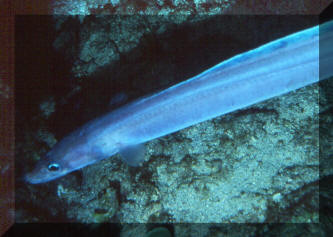
Conger triporiceps
|
The True Eels, Order Anguilliformes, lack pelvic fins and related
skeletal material. Some are also without pectoral finnage and
suspensory girdle. Many are scale-less, those with them are cycloid,
small, embedded. These "snake-like" fishes (many head-lengths
into body length) typically have small gill openings, and their gills
lack the rakers of advanced bony fishes. The group is missing a number
of head bones, pyloric caeca, and have a peculiar leptocephalus larval
stage in common. According to Nelson (3d ed.) there are some three
suborders, fifteen families, 141 genera and 738 described species of
true eels.
What's in a name? A bunch of Non-Eels though called
them:
| Family
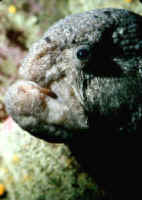
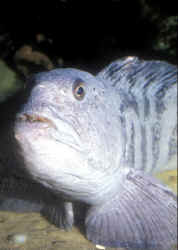
Anarhichadidae, Wolf fishes, Wolf Blennies, Wolf Eels; North
Atlantic, North Pacific. Two genera with four species. These neat,
hand-trainable fishes are mainly seen in public aquaria as they can
be enormous (up to 2.5 meters) in size. Gentle giants that are
favorites of Public Aquariums everywhere. An Anarrhichthys
ocellatus at the Birch Aquarium, San Diego, and Anarichas
lupus. |
|