|
|
|

|
|
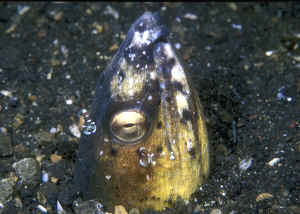
Myrichthys breviceps in the TWA
|
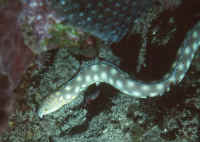
Taenioconger hassi in an Aquarium
|
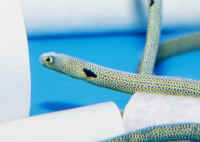
Heteroconger halis
|
|
Some Ophichthyids and Congrids sold as
"Snake" and "Garden Eels" occasionally in the
trade... short lived at best.
|
|
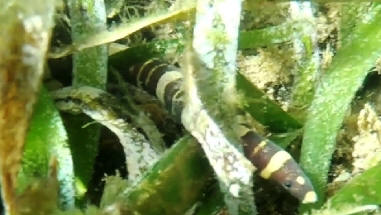
Eels, ID 2/9/19
Hi,
<Hi Charlie>
I was wondering if you can help me ID an eel in Indonesia?
<Ahh yes...it appears to be a Harlequin snake eel (Myrichthys colubrinus). >
Thanks, Charlie
<You’re welcome. Wil.>
|
 |
|
Eel ID
12/31/12
Hello all :)
<Hi.>
Happy New Year first of all :)
<And to you.>
Secondly, I have acquired a mystery eel today. The lfs I got him
from said that another customer brought him in because he was creating
havoc in his reef tank. The original customer said he was told it
is a white ribbon eel. I know this is NOT what he is. He is
only about 12-14 inches long, pale beige-yellow on the dorsal side,
paling to the underside. He does not have nostrum that I can see.
<I think on the picture where it is looking to the left you can see
nostrils?>
His dorsal fin starts about 2 inches down his length and connects with
his anal (?) fin. He also has pectoral fins after his gill pouch
(?).
<If it has pectoral fins we can rule out morays.>
All his fins are transparent. He looks a lot like a spaghetti eel
but doesn't have the paddle-like tail. Attached are two not very good
pictures of his face because he won't hold still :) The lfs said they
were feeding him chopped Silversides and krill. I would like to
know your opinion on what he is so I might have a clue what size he will
attain
<First we need to determine the family. Here's an overview
http://www.fishbase.org/identification/familieslist.php?spines=&fins=&ordnum
=26&areacode=&classnum=6&c_code= with some information. I think
our best chances are in the family Ophichthidae - (Snake eels) with eels
such as Ophichthus lithinus
(http://www.fishbase.org/summary/Ophichthus-lithinus.html ), but these
have specific nostrils, not all of the family do have pectoral fins.
Clearer pictures of the head, the gill area and the tail would likely be
of use here. I'm sorry but on the ones sent I can see no detail. Also
check the other matching families in the overview given above, e.g.
congers.>
and how best to care for him.
<I'd try to find out if it likes to burrow first. Many eels do. See if
it prefers caves (e.g. pvc-pipes) or sand. Maybe that's the reason it
created havoc in the other tank. With regard to anything else I'd try to
keep it like a small moray or a snake eel. For food I'd try various
fishes and crustaceans (or pieces of them), not only silversides and
krill. >
Thanks as always for everything you guys do for all of us :)
<Not much in this case, but you are welcome. Marco.>
|
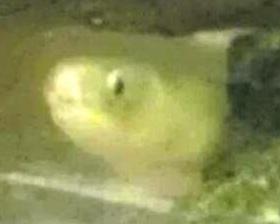 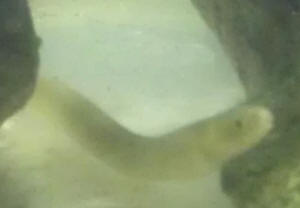
Re: Eel ID, now comp. 1/3/12
Thanks again Marco! Speaking of those 'boring everyday fish,' any ideas what
might be ok with him? My husband wants a magnificent Firefish. I was
thinking that might be ok.
<I think this could be possible eel prey, especially if it's a small
Firefish as they are usually sold.>
Also, with my previous experiences with eels, I assume any inverts or
crustaceans would be meals waiting to happen, yes?
<Not all inverts will be eaten, urchins and sea stars should be safe for
example. I don't know if I would risk Cleaner shrimps, although I have seen
them cleaning other Snake eel species. I have little information about your
setup or preferences, so it is more easy to state what should be avoided in
my opinion. Avoid predatory fishes which get large and could swallow a thin
Snake eel such as groupers, Lionfishes, puffers, morays and so on. Also
avoid fishes, which can be picking this thin eel such as triggers, larger
angels. With regard to possible eel prey, I think fishes more than twice the
diameter of the eel and at least a quarter to a third of its length should
be safe, since the more petite Snake eels aren't known to tear pieces out of
larger fishes as some morays do.>
Also, he is most definitely the escape artist kind :) When we first switched
him to the tank, we couldn't catch him with a net so had to 'pour' him in
from his drip bucket. This actually turned into his 'flying' leap into
the tank! :) He has a full lid with all holes plugged up :)
<Ah, good.>
I found it interesting that he's already acclimated to his new home and was
out 'begging' for food.
<Very good.>
Right now, 6am, he's languidly taking laps around his tank. :) Thanks for
help with my newest addition, named Squigglesworth! :)
<The name is a great choice. Have fun with Mr. Squigglesworth. Marco.>
|
|
Zoanthid ID & juvenile angel & eel ID
3/8/2010
Hey Crew !!!
<Hey Abdo!>
Abdo here, from the land of the pharaohs :D (AKA aquarium no
man's land!!!)
<Ahh, hope to be diving w/ friends in Sharm this coming
May>
First I just want to show my deeeeep gratitude for you guys being
there,
really makes the difference !!! from the bottom of my heart:
THAAAAAAANK YOUUUUUUUU
<Welcome>
now down to business
I have just ventured into invertebrates and I'm having a hard
time identifying that group of polyps I just bought, the tank
they were in at the retailer's was such a biohazard that a
military submarine wouldn't survive !!!
<Heeee!>
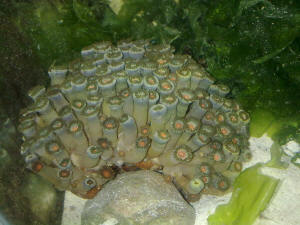
anyway I attached a picture, it was taken the day after I put
them in the tank, they were acclimated very slowly over 4 hours
and now I think 80% of them have opened completely :D Yay :D Hope
you guys could help me treat the polyps well :)
<Looks to be some species of Zoanthid; very nice>
Another question, hope I'm not being a pain in the neck
here......
I bought what I identified positively as a vermiculated angel, at
just under an inch long!!!, do you have any special
recommendations regarding such a fish, given its size and other
tank inhabitants ??? any advice ???
<Mmm, yes... keep it with small-ish, easygoing fishes,
non-predatory invertebrates and you should be fine. These angels
grow quite quickly when small, given good circumstances>
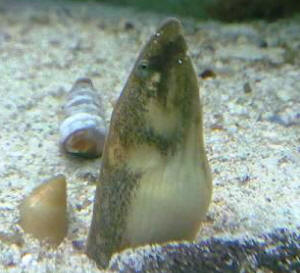
lastly (I promise), I had bought those 2 eels a while ago, and
I've been having such a hard time identifying them it drives
me crazy !! their looks are not special but their behavior amazes
me!! They are grey with white bellies, 30cm long with 1cm
diameter or so, small eyes, dotted lateral line near the head and
curved, burrow under the sand and they do it backwards, meaning
they stick their tails in and slip into the sand bed, and once
they grab a piece of food they quickly pull it down under the
sand to eat it, the retailer said they we're from the red
sea, but I wouldn't count on anything he says.
the closest matches I could find in Dr. Burgess's atlas of
marine aquarium fishes were "Pisodonophis cancrivorus"
and "Muraenichthys tasmaniensis" but I'm not so
sure..... I attached the best picture I could take, hope it
helps.
<Mmm, is an Ophichthid... a Snake Eel... looks a bunch like an
Apterichthys species... Unfortunately I don't see this
species in my in-print reference works, and Fishbase.org is
running VERY slowly currently. I would go there, and search
"By Country" (I did for Jordan), Marine fishes (which
will come out by default by species) and re-sort by family...
Look at the Ophichthids found there (the Red Sea)... and try to
find these species for photos, further descriptions>
I have a 110G + 20G sump, since August 2008, sandy bottom with
one pile of LR, some locally obtained Ulva, 2 four stripe
damsels, 1 domino, 1 silver moony, 1 Aidablenius sphynx, many
coastal shrimps, 1 vermiculated angel, 1 common goby, 1 red
tomato, 1 urchin with short sharp spines (red sea), several
mussels and oysters, some Nerites, the 2 eels and the clump of
Zoas.
<Sounds very nice indeed!>
Thank you in advance, and sorry for the long email :S
<Thank you for sharing! Bob Fenner>
|
  |
|
Need help on possible Anguilla anguilla; rather
Ariosoma balearicum (Congridae) 06/25/09
Hey Guys, I'm Abdo
<Hello, Im Marco.>
I just want to say that I really respect this site and every one
contributing to it, you've done an amazing job.
<Thanks for your kind words.>
I've been vacationing on the Mediterranean coast (I live in
Egypt) and I caught an eel using my hand net. It's around 12
inches long, has big round eyes and is greyish silvery to
transparent in colour. I caught it at night, chased it for a
while then scooped it up after it partially hid in the sand. I
took it home last Sunday, put it in my saltwater tank and it
seems ok, hiding under the sand during the day and coming out
only at night. I haven't seen it eat, not sure if it's
getting anything, doesn't look like it has any teeth.
<It probably does, but very small band teeth to be more exact.
You probably need live food, e.g. small shrimps of adequate size
or toxin free worms for the start and might only be able with
time to adapt it to frozen food, which is often easier to get by,
but needs regular vitamin additions.>
Did some research, it looks like a glass eel (Anguilla anguilla),
but I'm a bit puzzled..... I caught it in very shallow waters
almost 300KM from the nearest freshwater source (the Nile), and
from what I've found on the internet it's size is quite
unusual for Anguilla anguilla at this part of it's life
cycle, right ??
<Looks and sounds much more like the Congrid Ariosoma
balearicum (family Congridae), even though the picture shows
little detail. See here another Ariosoma balearicum
http://www.fishbase.org/Photos/PicturesSummary.php?StartRow=6&ID=1744&what=species&TotRec=8
.>
I've attached a picture and a Google earth place mark
indicating where it was captured.
Please tell me what I should do, should I transfer it to my
freshwater tank ? or keep it in saltwater for now ?? what to feed
it ????
<Saltwater for food items see above you might have a problem
with other fish eating its food away depending on what other fish
are in the tank. Id try feeding live food especially at night, or
dangling a small piece of food on a string before its eyes if
only dead food is available. Dont stress or harass it and the
chances it will eat in captivity will rise.>
I want to be responsible and do everything I can to ensure it
survives.
<Thats good to hear anyway it would be more responsible to
only take fish home of which you know what they are and can
ensure the knowledge and quarters to keep them properly.>
I have a 450L saltwater tank with 100L sump, sand bottom with
some live rocks, running for almost a year,
<Sounds sufficient in terms of size your eel is likely already
grown. It will enjoy deep sand, they usually burrow in the sand
in nature, too.>
an 80L freshwater tank, running for almost 2 years. Most of my
saltwater live stock is wild caught from the same area as the
eel. Thank you in advance :)))
<Good luck with your eel. I hope you will find a sufficient
food source. Marco.>
|
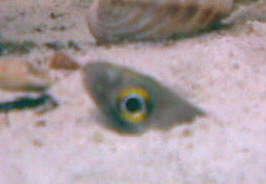 |
| White Ribbon Eel (Pseudechidna
brummeri)- 05/20/08 Hi crew. <Hi Jim.> Just wanted
to fire off an email concerning a fish I purchased a couple months
back, and to offer some info and pictures in case you were
interested. <Sure.> While browsing on nyaquatics.com, I
happened to see that he had a "white ribbon eel" listed.
Since he also had "blue ribbon eel" in stock, I figured
this was just a female Rhinomuraena quaesita, but when I checked
the picture, it definitely was not. I searched your website, but
didn't find anything in the informational section on morays. I
found a brief mention in the FAQ, but it wasn't much to go on.
<There are a few posts on this moray. A WWM search for brummeri
will bring them up.> It did give me the scientific name,
however, which led me to an article by Greg Schiemer on
advancedaquarist.com. Here's the link:
http://www.advancedaquarist.com/issues/sept2004/fish.htm After
reading the article, and talking to Michael Stern at nyaquatics,
who assured me he had kept the eel for two months and it was eating
Mysis greedily, I decided it was worth $20 plus shipping to give it
a try. Well, the eel has been wonderful ever since I opened the bag
from the shipping container. Miracle of miracles, he didn't
even try to get out of the acclimation bucket! He swam around the
tank a lot when I first put him in, including nosing around the top
of the tank, but I had done my best to "eel proof"
everything, and he settled in for the night. Next morning, I found
him in the internal overflow (I had thankfully placed a pvc
strainer over the drain before he arrived) and I rescued him with
some difficulty. He hasn't done it since, so I guess he
"learned!" He eventually hollowed out a small cavity
beneath the largest rock in the tank, and spends most of his
daytime hours there. <It may continue to dig. Ensure that the
rocks cannot fall over and crack the glass.> If he has recently
been fed, I rarely see him at all. But when he starts poking his
head out or swimming around the tank, especially during the day, I
figure he is looking for some food. He readily eats Mysis, plankton
and krill, though the krill are big and pretty hard for him to get
down, so I mostly stay away from those. I am concerned about how
much to feed and how often, because I am still a little nervous
about the whole ribbon eel and starvation thing, but right now I
feed him one cube of Mysis or plankton about every other day, and
it seems to be working. <Sounds okay. I?#8364;™d also use
vitamins once a week to replace anything that was lost during the
freezing/thawing process and maybe necessary for long term health
(e.g. vitamin B). When your eel grows it will hopefully also eat
larger food like shrimps, pieces of fish, silversides, mussel and
clam meat, squid. Adults are not always safe with small, elongate
tank mates like smaller gobies, blennies and sometimes shrimps.
Your surgeon and dwarf angel should be safe from him.> He lives
in a 72G bowfront soft coral tank, and hasn't bothered any of
the corals, nor the two fish (Centropyge nox and Paracanthurus
hepatus). I did add a yellow clown goby a couple weeks ago, which I
haven't seen lately, but I often couldn't find him in the
QT, either, and I think he's just too big for the little eel to
swallow! <May be eaten with time. Their mouth is large and
capable to swallow much larger prey than one might think when
looking at this thin creatures first.> All in all, my
Pseudechidna brummeri has been a model citizen, despite my initial
concerns. I know that one anecdotal case (or two, with Greg's)
doesn't mean everyone should rush right out and get one, but
compared to a blue ribbon eel, which I made the mistake of trying
ten years ago before I knew better, this little guy has been a cake
walk. Could this be one of those species you talk about on the
website that would make a good aquarium fish, but no one buys them
because they aren't collected, and no one collects them because
they aren't in demand? <They are regularly available in
Germany and most (not all!) come in good condition and start to
eat. The ones I know do fairly well in captivity. However, just as
with other ribbon eels (Rhinomuraena quaesita) it?#8364;™s
critical to only buy specimens which eat dead food unless you are
experienced with getting freshly imported fish to eat. As you know,
they are even better escape artists than other moray species due to
their small girth and need hermetically secured tanks. Given such a
tank with not too boisterous tank mates eating Pseudechidna
brummeri can make great pets.> I am attaching one picture I took
recently, cut down to size as requested on the website, which you
are free to use. I have a total of five larger, reasonably good
pictures (at least for me) that I will gladly send if you want
them. Keep up the great work! Jim Jensen <Thank you for your
report and picture. It will be posted and further pictures are
welcome. Have fun with your Pseudechidna. Cheers, Marco.> |
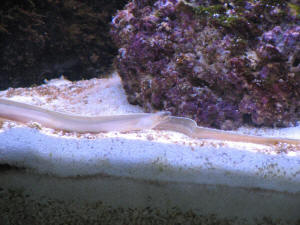 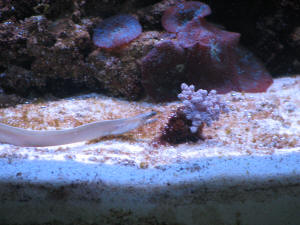 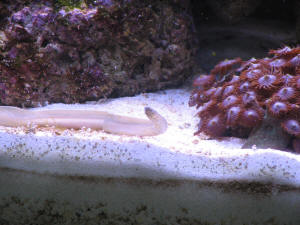 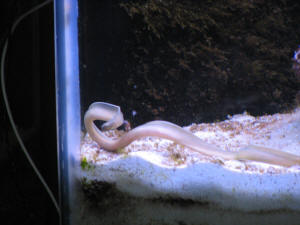 |
| Re: White Ribbon Eel (Pseudechidna brummeri) White
ribbon eel (Pseudechidna brummeri) follow up ?#8364;"
05/20/2008 Hi Marco. I guess I was under the impression
that he wouldn't get a whole lot bigger. He's currently in
the 28-30 inch range. Fish base lists their max size at 103cm,
which if my math is right works out to 40". And since fish
don't seem to reach their full max size in aquaria, I was
expecting at most another 6" of growth. Right now, his head is
about the diameter of a pencil, maybe a little less.
<He?#8364;™ll reach at least the 40?#8364;?,
I?#8364;™ve seen specimens of that length and
he?#8364;™ll also get a little bit more stout with the head
about half an inch high.> I am glad they are being utilized well
in another part of the world. I wonder what it would take to get
American consumers on board? Could save lots of blue ribbons and
huge morays from needless capture and death. They may not be as
spectacular as a blue ribbon, but surviving has always been a plus
in my book. <To be honest, I also have a number (at least a
dozen) of positive reports (personal ad written) on the
black/blue/yellow ribbon eel Rhinomuraena quaesita, which is also
found quite often over here. The oldest specimens are about 6+
years and I know of two, which have expelled eggs in captivity. In
one case the eggs were fertilized and larvae developed, although
they have not been raised due to a lack of adequate food. So, these
eels can do well in captivity, too. I am convinced how they do is
mostly due to how they were caught (poison?#8364;?) and how they
were treated by the catchers, wholesalers, pet shops and hobbyists.
That's where things have to change and ribbon eels not already
eating at the wholesalers should be put back into the sea and not
be shipped overseas. Those who eat in captivity have good chances
to live many years in adequate aquariums. Getting them to eat and
possible damage by questionable catching methods are the two
connected main problems with Rhinomuraena and Pseudechidna alike,
but if they are treated right the survivors will not be the
exception. I?#8364;™m very glad you found a healthy one and
do hope there will be more available to fellow hobbyists.> C.
meyeri and P. Pinnatus are two of my favorite fish to look at, in
photographs, or maybe someday in the wild. But at home I'll
settle for my raccoon b'fly (another tank) and my purple tang.
Here are 4 larger pictures of my eel. Hope they aren't too big.
Jim <It?#8364;™s a beauty, thank you very much Jim!
Cheers, Marco.> |
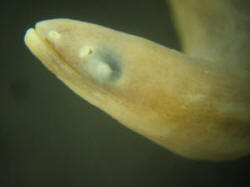
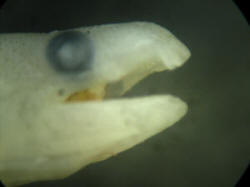
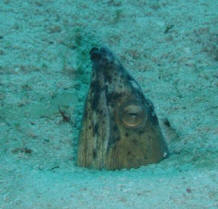
| eel posting and id
--05/14/08 Hi eel enthusiasts. I'm posting some of my
pics on eels and I hope this will be helpful...Please help me
identify these species.. Abner. <Hi Abner. Snake eels?#8364;?
about 300 species and some not yet described ones, most of them not
seen often?#8364;? you are giving us a difficult task here! Some
information on where these fish were caught/photographed and also
pictures of their bodies would have been useful, also if they are
dead (because of the clouded eyes) or alive. The one sticking out
of the sand probably is a Ophichthus altipennis (before 2002 often
IDd as Ophichthus melanochir like
http://www.starfish.ch/fishes-Fische/eels-Aale/Ophichthus-melanochir.html
compare to McCosker, J.E. and J.E. Randall, 2002. Ophichthys
melanochir Bleeker, 1865, a junior synonym of the highfin snake eel
Ophichthus altipennis (Kaup, 1856). Copeia (3):798-799). The other
two I cannot ID from these pictures. IMG 124 might be a Ophichthus
serpentinus with the few dark spots around the eyes, but
that?#8364;™s more a rough guess than a ID, and the one with
the protruding lower jaw I am not even convinced this is a snake
eel, it's possibly even a moray, but even that is hard to tell
from just this picture. Greetings, Marco.> |
   |
| Re: eel posting and
id Eel posting and ID ?#8364;"
05/19/08 Thanks Marco, <No problem, Abner.> you did
a good job. I appreciate your effort. I'll keep you posted when
I have photos of live ones, like other morays that I?#8364;™m
interested in. Cheers, Abner. <I?#8364;™m looking forward
to that. Morays are mostly easier to ID than snake/worm eels as
long as good shots of the head and body coloration are available.
Marco.> any help is appreciated..thanks <<Good luck, keep
reading ?#8364;" Adam J.>> Re: eel posting and
id Eel posting and ID ?#8364;" 05/19/08 Marco,
<Abner,> The photos on top are dead ones as they are very
rare and elusive and they resemble worm eels and I used a
microscope to shot them. They were captured near the mangrove swamp
in Siquijor Island, Philippines. <Thank you. This information
narrows it down to only 30 described species of snake/worm eels
(Ophichthidae) from the Philippines. You can use the key for
snake/worm eels for the Western Central Pacific for a more definite
ID for the two dead ones
http://www.fishbase.org/keys/description.cfm?keycode=131 .> The
snake eel that you said an Ophichthus altipennis was photographed
at 20 meters deep off Siquijor town on the same Island. <Good.
The species I suggest occurs in this area.> Thanks, Abner
<Welcome, Marco.> |
|
What was it - eel or sea snake? -03/13/08
This week while snorkeling in St. Kitts I saw an eel or sea snake
[I know there are supposed to be none in the Caribbean.]
<Correct> It was 11 inches long, checkered [perfectly] from
head to tail and I think the tail appeared pointy. The checkered
colors were bright white and jet black and perfect rectangles.
Each rectangle was sharp, about 8 mm long by 5 mm wide and the
long rectangles were oriented length wise. The design was a
perfect black rectangle next to a white rectangle on either side
as well as on top and bottom. Each of the four corners of the
black [or white rectangle] touched a black [or white] rectangle
about or below. It looked geometrically perfect. <Mmm, maybe
Muraena retifera. Bob Fenner>
What was it - eel or sea snake? -03/13/08
This week while snorkeling in St. Kitts I saw an eel or sea snake
[I know there are supposed to be none in the Caribbean.] It was
11 inches long, checkered [perfectly] from head to tail and I
think the tail appeared pointy. The checkered colors were bright
white and jet black and perfect rectangles. Each rectangle was
sharp, about 8 mm long by 5 mm wide and the long rectangles were
oriented length wise. The design was a perfect black rectangle
next to a white rectangle on either side as well as on top and
bottom. Each of the four corners of the black [or white
rectangle] touched a black [or white] rectangle about or below.
It looked geometrically perfect. Please email what you think it
was. Thank you, Dr. George Oremland <Possibly a Snake eel.
Have a look here:
http://www.robertosozzani.it/Bonaire/murena03.html ; here:
http://florent.us/reef/carib/sharptaileel.html and here: http://www.wetwebmedia.com/ophichthidae.htm. Cheers, Marco.>
Re: What was it - eel or sea snake? Follow up
?#8364;" 03/14/08 Thanks Marco. I checked all of those
sites and none of those eels were even close. <Too bad, one of
these species is pretty common in the Caribbean.> When I saw
it I was in 3 feet of clear water. I observed it for a few
minutes and was only a foot above it. It was swimming over the
sand about 20 feet from a pile of rocks. Sorry I didn't have
a camera and was afraid to touch it. <A picture would be
great, although it could still be difficult to ID, because there
may not be much material to compare it to. A number of
contrasting black/white snake eels is known from the Caribbean,
many are from shallow water, but nonetheless they are rarely seen
and live cryptic, often nocturnal lives, so the only
pictures/drawings available can be found in the first
descriptions. There are quite a few of the genus Ophichthus
(about 10 species), Callechelys and some others with various
color patterns, possibly one of them was your eel. You could try
Carpenter, K.E. (ed.): The living marine resources of the Western
Central Atlantic. Volume 2: Bony fishes part 1 (Acipenseridae to
Grammatidae). FAO Species Identification Guide for Fishery
Purposes and American Society of Ichthyologists and
Herpetologists Special Publication No. 5. Rome, FAO. 2002. pp.
601-1374, which is available online (at the FAO page), but often
details of the dentition or vertebral counts are needed for ID.
Cheers, Marco.>
|
|
Ultimate Live Rock Stowaway.. Eel Be Comin' Out the LR
When he Comes, When He Comes 9/1/07 Hi Crew, <Hi Barbara,
Mich with you today.> I have e-mailed you a few times
regarding a 72-gallon saltwater tank I am setting up. I put water
in it, and on Monday I put 100 lbs of live sand and 75 lbs of
live rock in it. Today (Thursday) my husband and I found some
sort of eel living in one of the rock's caves! I was
expecting maybe a snail or 2, some cool algae, maybe a coral if I
was lucky!! <One heck of a hitchhiker!> I searched all of
your marine eel pictures and I can't figure out exactly what
he is, the only one that looked close was the Zebra Moray. He is
brown with wide white bands (hopefully you can see the enclosed
picture!). I just want to be sure of what he is so I know if I
have to try to get him out and return him to LFS or if he can be
comfortable in my 72. <This may be a Banded Snake Eel
(Myrichthys colubrinus) He is a challenge to keep and you may
want to consider finding him a new home. More here:
http://www.wetwebmedia.com/ophichthidae.htm
http://fishbase.sinica.edu.tw/Summary/speciesSummary.php?ID=8053&genusname=Myrichthys&speciesname=colubrinus
http://fishbase.sinica.edu.tw/Photos/ThumbnailsSummary.php?ID=8053
If this is a correct ID, the material I am referencing suggests a
tank size of no smaller that 180 gallons, and generally this eel
is not well suited for the home aquarium. Reportedly this eel is
a challenge to feed and a very finicky eater. You might offer
glass shrimp if available or try fresh shrimp, scallops or marine
fish flesh impaled on a feeding stick. This eel should be fed
until it appears to be full, twice weekly. Careful consideration
should be given to tanks mates as well as many fish will nip at
the eel.> He was out of the water for close to 2 hours with
the drive home and me getting the sand in, then the rock, I have
no idea how he did it! <Is tenacious.> I will offer
defrosted meaty foods, hopefully he will eat. He is curious about
us when we come to the tank! <A good sign.> Thanks so much
for your help! <Welcome! Mich> Barbara
Re: Ultimate Live rock Stowaway... Marco chimes
in re Eel ID! ?#8364;" 09/01/07 Hi Crew, I have e-mailed
you a few times regarding a 72 gallon saltwater tank I am setting
up. I put water in it, and on Monday I put 100 lbs of live sand
and 75 lbs of live rock in it. Today (Thursday) my husband and I
found some sort of eel living in one of the rock's caves! I
was expecting maybe a snail or 2, some cool algae, maybe a coral
if I was lucky!! I searched all of your marine eel pictures and I
can't figure out exactly what he is, the only one that looked
close was the Zebra Moray. He is brown with wide white bands
(hopefully you can see the enclosed picture!). I just want to be
sure of what he is so I know if I have to try to get him out and
return him to LFS or if he can be comfortable in my 72. He was
out of the water for close to 2 hours with the drive home and me
getting the sand in, then the rock, I have no idea how he did it!
I will offer defrosted meaty foods, hopefully he will eat. He is
curious about us when we come to the tank! Thanks so much for
your help! Barbara <Just a second (or third) opinion: Looks
like a Echidna polyzona to me (bands and yellowish nostrils in
combination with the blunt head), but there are several other
banded eels and morays eels (e.g. Gymnothorax enigmaticus and
many more). If E. polyzona is the species, care and character are
similar to E. nebulosa (snowflake), it just stays a little
smaller. In my opinion you could keep it in that tank (bigger
tank would be better of course...), but it would eat smaller
fishes and crustaceans while growing. They can survive quite long
outside of the water and some of its relatives are known to leave
the water in nature to hunt for crabs between rocks outside of
tidal pools. Send a better picture and we?#8364;™ll get you
a better ID. What a give-away, I usually have to pay for eels...
am just coming back from such a shopping trip. Cheers,
Marco.>
Re: Ultimate Live Rock Stowaway.. Eel Be
Comin' Out the LR When he Comes, When He Comes... Mitch?
Miller? And a one and a two... ?#8364;" 09/01/07 Hi
Mitch, <Hi Barbara, Mich with you again.> Thanks so much
for your help. <Welcome!> Can the Banded Snake Eel be brown
w/ white stripes? <That was my understanding, but rechecking
fishbase they are describing as black and white though I though
it looked brown in some of the images and looked brown in another
book I referenced which had an up-close image. I could very well
be wrong. I am far from an eel expert. You've gotten three
different opinions. I suspect Marco's vote may be the most
likely winner. Do use the scientific names to do a Google image
search. You will likely be able to tell which of these three are
closest to what your little stowaway looks like. That's what
color this one is (I know it was hard to tell in the picture!).
<Yes, and not just in your picture either!> I offered
defrosted squid last night and he voraciously accepted it!
<That is wonderful! I'm very glad to hear.> That seems
to be a good sign. <Indeed it tis!> He is more than welcome
in the tank but if 180 gallons is suggested it is cruel to keep
him in my 72. He has only come out of the rock 1/2 way, any
suggestions on removing him from the tank? <I think it is more
important to determine who this stowaway is before you consider
removal, as Marco's vote would be suitable for your tank.>
I will continue to offer meaty foods every other day or so. <I
wish you much success! Mich> Barbara
Re: Ultimate Live rock Stowaway 9/3/07 Hi
Marco, <Hello Barbara.> I appreciate all the expert
opinions I can get! <No problem, but I?#8364;™m more a
fan than an expert. Reading your e-mail reminded me to a case we
had in a near life fish store, so I had to add Echidna polyzona
as a possible banded candidate.> I apologize for the blurry
picture, he is voraciously accepting defrosted squid and clam so
far. <That's good news. Be careful not to overfeed, if
it?#8364;™s a moray. Many appear to be hungry most of the
time.> My husband and I will try to get a better quality
picture while I am feeding him and send it along as soon as I
can. <Looking forward to it. See if you can get a good shot of
the head, since most banded morays can be differentiated by
characters of the head. A snake eel will also be easily
identified that way.> I'm getting attached to him now, so
I'd love to keep him, but only as long as he can be
comfortable and happy with us! <As soon as we know what it is,
I?#8364;™m confident we?#8364;™ll know how to care
for it.> Barbara
<Good luck with the camera. Marco.>
|
|
 Looks like Echidna nebulosa to RMF Looks like Echidna nebulosa to RMF
|
Eel ID, probably no moray eel 2/28/07 Are there any moray
species that stand on their tails and have their throats inflated? I
have heard of tulip eels doing this which are supposed to be very
aggressive. I do not have any good pictures of my fish to help
determine if he is a moray or not, but the LFS sold him as a moray.
<Moray eels rather hide instead of standing on their tails. They
inflate their throats while breathing. To get an idea of the ID a good
picture is necessary. Without a picture you should try looking at
http://www.wetwebmedia.com/congridae.htm
and http://www.wetwebmedia.com/ophichthidae.htm and
http://www.wetwebmedia.com/morays.htm for marine
eels. Have a look at http://www.wetwebmedia.com/FWSubWebIndex/anguillids.htm
and http://www.wetwebmedia.com/FWSubWebIndex/matacembelids.htm
for freshwater eels. Check the related FAQs, too. Also check FishBase
by entering the family names you found on WetWebMedia and selecting
?#8364;˜all fishes?#8364;™ to get a link to photos. For the
swamp eel check Monopterus alba. It has a very typical head much unlike
a real moray.> I do not know growth rates of the swamp eel but my
fish has not grown but little in length but he has gained some girth
and he has eaten quite a bit for a year now. He also no longer has a
pointed tail it is rounding out with possible fins can not see close
enough. Am I in a bad situation if mine is a swamp eel with my
Gymnothorax tile? <I would not recommend keeping any of them with
other fishes maybe except their own species. May work for years, but
even the scat is potential prey. Read the freshwater moray articles on
WWM.> So far they are both sharing the tree root ornament to hide in
peacefully. I have my toad fish and red scat and the G. tile has no
problems with them either and even lies on top the toad fish when out.
I have seen people with swamp eels on monsterfishkeepers.com, but they
are in fresh water. I have a brackish setup. The main question I have
if this is a swamp eel should I be looking into finding him a new home
at some point? <Yes. Swamp eels need fresh water to lower end
brackish water, the moray eel needs high end brackish or full strength
marine water, both are incompatible.> Thanks for your advice on
this. <You are welcome. Cheers, Marco.>
Unidentified Eel 10/7/06 Hi Guys <Hey Duane, How are
you?> I hope you can assist. I have an eel in a holding tank that
comes from a friend but I can't identify it. At the moment it is
about as thick straw and about 20cm long. It has alternating white and
brown blocks on either side of it's body, and has quite a sharp,
triangular head. <Duane rather than me make a guess here my
suggestion to you would be for you to go to www.fishbase.org and put
eel in where it suggest common name. There are thousands of different
eels on this site with information about them. You can narrow down your
search if you know where your eel is from. You also might check out the
excellent articles located on www.wetwebmedia.com at http://www.wetwebmedia.com/marine/fishes/index.htm. Good
luck, MacL> Any ideas on what it could be?
Fish ID...Garden Eels Hi Crew, <Hello Johnny> Wondering
if you can help me ID a fish I saw recently at the London Aquarium? I
have tried to email them, but no reply ... there was also no ID on the
display. There were a number of Eel type fish with a diameter of a
little less than 1cm. They constantly kept their tails in the sand
(almost like a Jawfish) but extended (7 - 8cm) to grab at particles
drifting in the current. A number were silvery - grey in colour with
two distinct dark spots on their flanks while others had an almost
clownfish colouration, orange with white bands separated with black.
Fascinating to watch! I did record a short vid of them but it would be
far too big to mail ... Any idea's? <Sure sounds like Garden
Eels to me, Johnny. Have a look here. http://www.wetwebmedia.com/congridae.htm>
Johnny, Sunny London ...<When?> <James (Salty Dog) in Tropical
Michigan> Live saltwater bait eels 3/10/06 We are a small
bait and tackle shop in Cape Canaveral Fl. I am hoping as a stretch
that you may be able to help me. I am looking to purchase in bulk, eels
as bait and I am at a loss as to where to find them. Is it possible
that you know where I can purchase bait eels? I am told that they are
farm raised but I can't seem to find them. I thank you in advance
for any help you can offer me XXXX <Mmm, don't know, but I'd
try asking the State Fish & Game folks about who they know that
offers these not in your general area, call them and ask where they get
them. Bob Fenner> Eel identification Hello Bob and crew, I
have been reading tons on your site for my cichlid tank and saltwater
tanks. The information I have found has been extremely helpful, thank
you. <Welcome> A few weeks ago my wife and I started setting up
our dwarf lionfish tank. We got some live rock from a LFS and started
the cycle. The cycle finished and two days ago we got our dwarf fuzzy
lion. This morning, while working on adjusting our dwarf lion to frozen
food I was surprised to see an eel come out of the biggest piece of
live rock. <Happens> I was quite shocked by this discovery. Now
with our hitchhiker we have the task of identifying the eel and seeing
if he is suited to our tank, and if so how to take care of him, not the
ideal way to figure out how to take care of an animal after the fact,
but we did not have a choice. OK, the eel is white and black striped,
with wider stripes, probably about 1/2 inch stripes. Since we only saw
the head and a little we could not tell more, but it looks like he
could be 6 inches to a foot in length, and he looks like he could be
close to 3/4 - 1 inch in diameter. His stripes seem more defined then
the snowflake eels we have seen. I did see a banded snake eel online,
but he does not quite look like this either. The first stripe starting
at the head is white. Any ideas what this might be? <Not from this
description> I will try to get a picture for identification if I can
find a time when it is out. <This would really help> Thank you in
advance for your help. Your site has already been a great help, and a
lot of fun to read. Thank you, Andrew Morgenegg <Am sure you've
looked at the few dozen species of eels we have pictured: http://www.wetwebmedia.com/marine/fishes/index.htm.
With a pic hopefully we can narrow down the possibilities here. Bob
Fenner>
Yellow brotula goby My LFS has a "yellow brotula
goby" for sale; I think it resembles "Gunterichthys
longipenis" but cannot find any information on feeding or habitat.
One source labeled it a brackish fish. <Can be kept in brackish to
marine circumstances> The store owner insists that it is marine.
Though it has been at the store for more than a month, no one there is
really certain that it eats or knows what it eats. Obviously, it is not
starving and still looks as plump as it did when I first saw it... but
I don't want to bring it home and slowly kill it. Can you tell me
anything more about this fish? Is it a goby? Is it brackish or marine?
What does it eat? Thank you for any assistance you can provide.
Sincerely, Kyn Un. <Not a goby... Please see here:
Gunterichthys longipenis. Not much known re its practical aquarium
husbandry. Bob Fenner>
Dwarf Lionfish Questions <MikeD here again> Wow thanks
a lot<You're more than welcome.>...You responded to all my
questions......I have nothing else to say <There will be more in the
future, trust me.>........I would love to have an eel but my wife
told me I could have what ever I wanted, even my 600 gallon tank next
year......but no eel <Sorry to hear that. It sounds like you're
another victim of the "Yuk, it looks like a snake" mind set,
which is unfortunate, but it's a small price to pay if she
tolerates and shares your passion in other areas.> .....Thanks again
for your great info... Derik
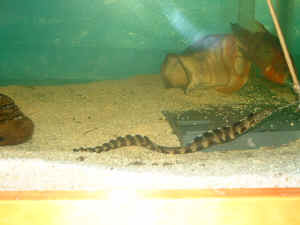
| Eel id to bob Fenner the photos are
attached can you tell me what sort of eel it is please
<Don't recognize this fish at all. Is it a synbranchid? This
is freshwater, yes? Please see fishbase.org and look through the
various species listed of this family for pix. Will post on WWM in
the hope someone can make out what this is. Bob Fenner> |
|
|
Eels Hi, <Good morning, PF here in the bright and early,
at least by my standards...> I am purchasing that book I have
already ordered it. <I'm assuming Michael's book on sharks
and rays.> I know a lot about epaulettes but no where can I find
information on how well they do with eels, in particular a Hawaiian
Dragon Eel or a Tessalata Eel. <Both eels are piscivorous, and if
there is a substantial size difference, I imagine one would eat the
other. That said, Tessalata eels reach almost 6' in length,
that's a lot of eel. Hawaiian Dragon eels reach about 32" -
1/2 the length. Don't forget the square/cube law: double the size,
4X the mass. > I have read everything on your website about sharks
and almost everything about eels but I didn't find any information
on Hawaiian Dragon Eels or Tessalata Eels. <I would recommend you
read Scott Michael's Reef Fishes Vol 1, there's an extensive
section on eels.> I also am looking into the blue dot stingrays. I
am not necessarily getting an eel or a stingray but I am definitely
getting the sharks. I have read numerous books on marine aquariums that
included information about sharks. I have also contacted the aquarium
about epaulettes. I am smart enough to know not to get any kind of
shark that is sharky-looking, like a nurse, lemon, white tip, leopard,
shovelnose, or hammerheads, which are available from time to time.
<Good for you, I can't believe someone would try to keep a
hammerhead, well, actually, sadly I can believe that.> I have read
lots of information about the sharks but I cannot find any information
on how they behave with the Hawaiian Dragon Eels or Tessalata Eels or
the blue dot stingrays. <The sting rays fair poorly in captivity,
and need a very different setup than either the Epaulette or the
Hawaiian Dragon eel - the ray needs a large, sandy area, while the
shark and eel need rock work. For the sake of the ray (not to mention
your wallet) leave it in the ocean, or go see one at a public
aquarium.> So I need to know if they can all be housed together or
with just an eel or just a stingray and sharks? <Think I already
answered that one.> I also need to know some information about the
Hawaiian Dragon Eel such as his behavior, what it eats, and if it is
hardy? <It's an aggressive piscivore, like all eels prone to
carpet surfing, and yes they are hardy animals. They are also known for
going on hunger strikes. Do pick up and read Michael's book.> I
also need to know if the sea life I listed above are compatible with a
woebegone? <Not in my opinion. The woebegone gets over 10' long
and is no more appropriate to keep than the hammerhead.> I know it
is compatible with an Epaulette but I don't know if it is
compatible with the other sea life I listed. Please help me. Thank you
very much. Sincerely, Versusdude320 <Well, I hope this helps. Please
do some more reading and research before making any final decisions.
Have a good day, PF
Concerned Eel Owner I had a very small chain eel (6")
which died. <almost newborn :p > After checking all parameters, I
could not figure out why the chain died. I have a bicolor angel which
is doing fine so I don't think water quality is a problem. Perhaps,
it was simply too small or too stressed. Consequently, I've just
purchased a large (1 foot) snowflake eel. I've noticed that it
seems to be breathing hard which leads me to wonder if I have an
aeration problem. <easy enough top confirm...O2 tests are cheap and
reliable. Increase aeration and get a test kit. tetra makes a fine
one> By breathing hard, I mean he is constantly gasping for breath
and the gill sacs (here I mean those air filled pouches behind the
eyes) are quite inflated. Is this normal? <is your salinity too low
or too high? Do check with another hydrometer especially if you are
using one of those hobbyist plastic swing arm jobs. Eels will show
salinity shock before many fishes. Aim for 1.022-1.025> He
didn't seem to be breathing as hard at the LFS. <diff
water/salinity> I have a 180 g closed lid system with two Hagen 802
powerheads, a trickle filter and an AquaMedic protein skimmer. <the
AquaMedic provides excellent aeration I'm sure... lets explore
water quality> I'm not using the tubes which attach to the
powerheads as they didn't seem to do anything and were constantly
falling off. Should I add an airstone? <helpful but may not be
necessary> Would this have any adverse effects on the tank?
<beneficial but increases salt creep> I really do not want to
lose this new eel especially since I've read they are among the
hardiest of aquarium specimens. Thank you for your help. <best
regards, Anthony>
Concerned Eel Owner, one more question Thank you for your
prompt reply regarding my heavily breathing eel. <my pleasure to
help> I think you're right that aeration isn't the problem.
My eel breathes about once every second or simply keeps his mouth
agape. <that sounds like rather typical respiratory behavior> I
read on one the FAQs that this was a normal breathing pattern.
Nonetheless, I'll test the O2 levels. As per salinity, it is at
1.025 when tested with the SeaTest hydrometer. I'll test with
another hydrometer. Could you recommend a brand? <no brand
preference... most glass hydrometers are more reliable because they are
not affected by air bubbles like the swing arm plastic models> I
have one more question. Periodically, the eel jerks its head. Is this
normal behavior? <occasionally yes... head nods and twitches are
normal. Not too excessive though> Sorry to take up more of your time
but I really value your expertise. Thanks again. <no worries... we
want you to happy and successful as an aquarists. Best regards,
Anthony>
Eels and Wiseguys Greetings O Kind Keepers of Free Assistance
& Wisdom, <that makes us kinda sound like the government
<G>> I have been actively searching for an e. pardalis
(Hawaiian Dragon Eel) to add to my 180. <really... I didn't know
you were rich...heehee> I figured the teeth would impress my buddy
the dentist! <please don't make me fly to where you live and
smack you> The price is steep though...Mt. Everest steep. <yep...
nature of the beast> While I am still leaning this way, I ran across
an old FAQ reply from Anthony in which he suggested that a hobbyist
should reconsider the eventually huge g. favagineus (tesselata) and
instead purchase a g. permistus, which is almost identical in
appearance but much smaller. This intrigued me enough to consider it,
but it is virtually impossible to find a good reference on g.
permistus--nor is it generally offered for sale. <try the Marine
Center... they even quarantine their livestock before selling it>
More importantly, can a web-order house reliably tell the difference
between two young individuals --one being permistus and the other
favagineus??? <some can... the better companies. Often it is a
matter of knowing their collectors reliably and the geographic
distribution of the species> If I were to ever order this less
expensive fish (relative to the wallet-emptying Dragon), I would feel
horrible if the specimen was growing out to be a monster favagineus.
<ahhh... ya :p> It would be inhumane to house an 5+(??) ft. adult
in a 180, <you wouldn't have to worry about that... it would
jump out of the tank, eat the dog, smack the kids and be found in the
kitchen making a pizza by that point> and I also know it can be
difficult to find a taker for a huge fish when you can't keep it
anymore. <beyond difficult... it is irresponsible to take on an
animal that you can't care for its life. They are completely
dependant on us> Can they accurately tell the difference???
<yep> Or is it a safer bet to just pick the Dragon with its 3 ft.
max. size and Colgate-look-Ma-no-cavities smile? <I'd advise
against the dragon... not all specimens look as pretty as the cover
girls you see in books. Many in fact don't. It would really suck to
buy an overpriced ugly eel> Thanks. You guys rock! Steve
w/Predators. <you are welcome... Anthony w/allergies>
Small Moray Tank Setup Hey WWM Crew, <Cheers, friend!>
I'm a dedicated 15 year old keeper of a 38 gallon reef, but I have
space in my room for another tank. <ahhh... you are a dedicated
aquarist!> I was thinking of 15-20 gallon setup dedicated to one
species, a small moray eel. Scott Michael's article in the latest
aquarium fish said that the morays that remain under 15 inches could be
successfully maintained in a 10-15 gallon tank. <yes...agreed,
although they are rare and can be expensive. The yellow dwarf eel from
Hawaii is a great choice...very hardy!> But even before this
article, I have always wanted a moray. I plan on using a PVC pipe
covered with Macroalgae encrusted live rock and rubble for the
aquascape. <excellent> I want the whole thing to be as simple and
inexpensive as possible, as I don't have that much money, but it
should be effective as well. What would be the best filtration to have
for a system like this? <have a very tight fitting cover first
<G>. Then a large Eheim canister filter would work nicely (double
foam blocks and a small foam block on the intake strainer in the tank
to greatly extend the life of the media in the Eheim> Should I use a
plenum like on my reef? <not necessary at all... even for reefs>
Is an undergravel filter good enough? <too labor intensive... not
good for water quality in the long run, plus the lift tubes are a
danger to the eel> Could you recommend a good protein skimmer model
for this sized system? <CPR Bak Pak would be just fine> Thanks
for any help -Andy <good luck, bud. Anthony>
Moray Changing colors Sorry about that, I am new at this..
<no worries... Anthony with the follow up> Well here I go, I have
a Leopard Moray he is about 2 feet long. I have 130 us gallon tank. I
have about 65lbs of live rock. I <do consider more live rock!>
also have Niger trigger and a blue spotted Grouper. <Hmm.. a bit
fast/greedy to keep with the eel in the long run> Some snails and 2
red scallops. <the above are called "food" for most such
predators.. heehee, fortunately your Niger Odonus trigger is one of the
few planktivores whereby most eat mollusks like you have mentioned>
I have a biological filter and protein skimmer and a U.V sterilizer. My
water levels are as follow. ammonia 0, nitrite 0, nitrate 10, ph 8.1
and those are the test that I run. <do get that pH up to 8.3 or
higher minimum> should I run other test?? Dose that help you answer
my question?? <yes...thank you for the specs... the basics offered
lend no cause for suspicion. And the length of the eel suggests a
maturity in which color changing from age would not be a surprise. If
the eel is alert and eating normally... I say it sounds fine until you
see otherwise. Many fishes take on a dark or dusky appearance with
age... like unshaven old men. Perhaps that is to keep both out of the
gene pool...heehee> Simon Doucette. Thanks <kindly,
Anthony>
Moray eels/Conger eels Dr. R. Fenner: I've been
considering the possibility of having at first a conger eel, since
besides my affinity to them, the cold waters of the Atlantic cost of
Portugal (North) wouldn't present such a difficult task in terms of
temperature balance. <I don't follow.. how will you keep the
water cool in a captive system?...generally expensive unless the animal
is to be tortured in warm water...hehe> The possibility of a moray
came later when I've heard from a friend, (although I'm still
not sure of the specie) that is being kept on an small aquarium, and so
i could maybe provide a better option to it. I have an aquarium of 1.50
mtsx40x40m and two more of 1.0x30x30, that could be used to amplify the
tank size. Even so, i find those dimensions two small for such species,
that is in my op., <agreed, leave it in the ocean where it
belongs> in terms of the conger eel, i could, when it got to a
bigger size, return it to the ocean that is at about 800 mts, of my
home, <Aaaaaaiieeeee! No, please> but even in that possibility, i
do have my doubts that it would survive, since it was raised on a tank,
and hand-fed. <more importantly it is irresponsible for aquarists to
release anything held captive including native species back into the
wild for fear of introducing exotic diseases (among many other reasons)
into the wild through fish foods used or exotic tankmates. Overall a
bad, if not unlawful idea> I read your article, at
http://www.wetwebmedia.com/morays.htm therefore i would like to ask
your opinion on what kind of tanks (glass in the first option that i
have, since i bought those three tanks at a bargain price) or pvc, or
any other material to were i could have them (one of the specie's
only! in spite, sometimes certain species share the same "hunting
grounds"), oxygen levels, temperature, the basic structure
required for these kind of fish; <no reference point for this
unusual captive> the use of the common aquarium filters?. or
biofilters?...nitrates levels, etc. Every possible information that you
could give, (a sketch of the hole structure would be excellent, if
that's not asking to much.!) <I'm sure that it would require
a standard set-up plus a chiller just as one would set up for a
tropical predator tank. You could expect to employ trickle filters,
protein skimmers, chemical filters (carbon, etc) and do frequent small
partial water changes> Thank you in advance, With my Best Regards,
Artur Santos <Best regards, Anthony>
Eel in a future tank Hello Bob! I recently discovered this
site and it probably will surpass even www.thekrib.com as "My
Favorite Website." (Does this make me a 'fish geek'?).
<High praise indeed! And... you're in good-geek company>
Well, I'm going saltwater, and I really wanted a 180(24x24x72), but
I felt too guilty spending my kids' college $ on that size setup,
so I settled on a 92 corner tank (besides, it matches my discus planted
setup.) <Let them work, builds character... I did, and most all who
know me will attest I'm a character> The species I want to house
are... an EEL! I have got to have an eel. an antennata lion (maybe) an
algae eating tang of some sort a filefish of some sort some starfish an
urchin maybe a giant clam (in future, after experience) also an
anemone/clown duo (again, in the future) (inverts someday...) finally,
some of those bright red fire shrimp <Might be eel food...> From
what I have read (incl. your book, even though the binding has
completely failed and the pages go flying onto the floor), this load
should work in that 92. <Mmm, mine too... supposedly the newer
printings hold together better.> So here is my question- in your
opinion, which is the better scenario- A) zebra moray vs. beautiful red
cleaner shrimp (I do love that red color) <Yikes, tough choice...
start with the eel, maybe trade out, or spend more of college
tuition/party funds on another "reef" tank...> B) Mexican
dragon moray vs. the other fish (and poss. my fingers) <Ultra
yikes... Hold off on this species... not that interesting, trust me>
The aquascape will include a nice cave @ the rear corner. Thank you,
Erik Nelson P.S. It is 8:10AM Monday and I should be working. <Super
ultra yikes, me too. Bob Fenner>
Regarding to get information about eel dear sir/ madam with
due respect , first of all let me introduce myself, that i am a senior
research fellow at central institute of fishery education, Mumbai,
India. now i came to know about you and your work on eels. i am in a
urgent need of some basic information like taxonomy, distribution,
worldwide species of eels . if you can send some material on these
aspects then it would be immense help of me by you. looking forward to
receive your favorable and quick reply with best regards Vishal <I
will help you in what ways I can. Have you searched through
fishbase.org on the Net yet? This is the best place to start your
search. Bob Fenner> my address is Vishal Saxena senior research
fellow 317,CIFE hostel, 7-Banglows Andheri (west), Versova Mumbai-61
Mahrashtra INDIA
Eel identification G'day from Downunder, I have a
question for you, I live 50 km (30 miles) south of Perth and one of my
hobbies is diving for the local crayfish. <These are spiny lobsters
to you/us Yanks> During these dives, I often see some kind of eel
with just it's head poking out of the sand. All the eels I have
seen in the sand seem to be quite small (heads 1-2 inches) and some of
the holes they are in are surrounded by empty small mussel like shells.
The eels themselves look to be a silvery white colour and the heads
(which is all I have ever seen) look a bit like the Dragon Moray I
found in your remarkable set of eel pages. Can you help me by
identifying or at least giving me your best guess on what type of eels
they are? I am not a collector, and have never dug one out of the sand,
I would just like to know what is down there! Thanks anyway, even if
you can't help me. John Rowe Safety Bay WA <Took a look through
my Rudie Kuiter, Roger Steene, Gerald Allen, John Randall... Aussie
fishes books... Might be a Worm Eel (family Moringuidae), perhaps a
Moray like Siderea thyrsoidea... even a Snake Eel (family Ophichthidae)
like the Slender Muraenichthys macropterus... or even some type of
Opistognathid, blennioid, gobioid... Sorry to not be able to direct you
more specifically, but do use these terms in the fabulous database:
www.fishbase.com and look through their many images associated with
these families, species... There's even a chance that you're
looking at an undescribed species! Bob Fenner, who would like to dive
around Perth someday (soon!)>
Acclimation of Anquilla Robert, any advice/instructions on
how to acclimate Anguilla angilla to tanks of 5 degrees Celsius and 30
degrees Celsius? help greatly appreciated, Brianna Fahey Trinity
College Dublin, Dept. of Zoology <Ah, wasn't it Henry the... who
is said to have died from a surfeit of these freshwater/anadromous
eels? Do take care here on a few counts... depending on the
"ambient" (or shall we say "most recent") thermal
regime these specimens have been kept at, (if only a few, as in two
degrees from a target moving temperature), simply placing them will
do... if it's several (from the Middle English meaning
"many") A few weeks ought to be set aside to slowly (two
degrees C per week maximum) in moving them to/from where they're
currently. A few provisos (sorry to overstate the case here, but all
this is posted to folks who are likely unfamiliar), DO make sure and
handle these eels as little as possible, in particular preserving their
ionic/osmotic integrity by not-wiping much of their body slime off. Do
provide copious aeration, circulation, and frequent partial water
changes... and of course, take care with their feedings (the best
overall indication/bioassay of the effects of temperature, overall
environmental adaptation). Lastly, should they perish in good numbers,
give me a call back, and we'll share recipes. Bob Fenner>
More Anquilla: thanks for the speedy reply bob. i just want
to ask for some clarifications - how exactly to increase the temp. by 2
degrees per week (any specific don't do's); and once
they've reached the required temp, how long before they're
acclimated and happy?! Brianna <Yes, a daily addition/removal of a
portion of the system water, replacement with similar volume of new
water of the desired target temperature, with a "nudging" of
room, thermostat temperature setting in that direction... Depending on
starting/finishing thermal differences a few weeks to a few months for
metabolic change and "happiness". Bob Fenner>
Re: ich :( thanks bob :) Does the eel count as a
"fish" that should be moved to treatment? >> Kind of...
most true eels really don't like copper... Arggghhhh, so it would
be best/better to low salinity treat it.... in yes, another system you
don't have.... but you can try it (short time... possibly) with the
other fishes... Bob Fenner
What the heck are these little critters? Are they like baby boxfish
and the "Boston Bean" in that they could grow up to be
gigantic, or are they just an eel-like fish that stays tiny? Thanks in
advance for any info you can provide... >> What? What are
Garden Eels? They're Congrids... the family of true eels most
commonly called Conger Eels... why do you ask...? They are eels... that
get to a couple of feet in length... live in soft, deep sand...
You've seen them in underwater nature shows on the tube... hanging
around in the open current in a group... like so many reeds in the
wind... Not suitable for aquarium use. Boston Beans (Ostraciids,
Boxfishes) don't grow up to be gigantic... they're puffers that
don't blow up... Bob Fenner
Garden Eels Hi Bob .I was looking for a eel for my 55 gallon
fish-reef tank ,an I noticed in the collectors corner on FF Express
that they are offering Garden Eels. I am unfamiliar with this breed of
eel, is it reef safe, and is there anything else I would want to know
about this breed of eel before I buy it? Thank you Richard Tarr
>> Hmm, well, I just looked through the big list of
Collector's Corner, and Eels catalog listings and can't seem to
locate "Garden Eels"... but do suspect that you're
referring to the Congrids (family Congridae), and no to these animals
period in captivity... they're not easily kept by anyone... require
very deep, fine sand, no real competitive tankmates... If you want to
set-up a "species tank" for them, let's talk... Bob
Fenner
Eel What would you feed a Goldspot eel Myrichthys oculatus?
>> This western Atlantic eel eats mainly crabs in the wild... and
at night... I would try to get it to eat most anything it will
accept... This whole family, the Snake Eels (Ophichthidae) does
terribly in captivity... I really wish the trade would stop offering
them entirely. Bob Fenner
|
|