|
FAQs on Troubleshooting Mysterious
Freshwater Diseases
Related Articles:
FW Disease Troubleshooting,
Freshwater Diseases,
Freshwater
Disease 2, Ich/White Spot
Disease, Choose Your Weapon: Freshwater Fish
Disease Treatment Options by Neale
Monks,
Related FAQs: Aquarium
Maintenance, Freshwater
Medications, Freshwater
Infectious Disease, Freshwater Fish Parasites,
Ich/White Spot Disease, Nutritional Disease, African Cichlid Disease 1, Cichlid Disease,
|
|
Sick Flowerhorn 11/16/19
Hello,
<Hello Sue,>
I am really hoping that you can help me we’re all out of ideas.
<Will try.>
Approx six weeks ago I noticed a small swelling on the side of my
Flowerhorns abdomen. The swelling has since got larger and the other
side of her abdomen is now swelling (the swelling appears to be internal
and she is not displaying any external signs of illness.)
<Let's just be clear on this. The fish has a swelling, but apparently
internal, meaning you can see that the skin and scales look normal, just
stretched out because of the swelling? The swelling was more obvious on
one side first, but now seems to be on both sides?>
With the help and advice of my local aquatic shop, I treated her with
aquarium salts for 2 weeks which I removed with water changes and then I
tried ParaGuard for 2 weeks, which I removed with water changes and
carbon. (neither of which have worked.) I have removed the carbon from
my filter and I am currently dosing the tank with API general cure
(today is the last day of treatment) but I can see no improvement.
<Understood. API General Cure was a good call, containing metronidazole,
and therefore a good treatment against Hexamita infection, which the
stringy white faeces would be consistent with. On the other hand, the
fact we're dealing with abdominal swelling points more towards Dropsy,
which though it is a symptom rather than a disease, tends to be related
to opportunistic bacterial infections and general environmental stress.>
She has white stringy feces (indicating an internal parasite?) but none
of the treatments are working. I am going to make a medicated food using
the last sachet of API general cure, garlic juice, her fish pellets and
Epsom salts.
<Epsom Salt is a good choice for Dropsy, and can reduce the swelling,
but by itself isn't a cure.>
Thing is, she’s stopped eating so I’m not sure how successful this will
be. The aquatic shop staff and I are now out of ideas on how to help
her.
<Indeed.>
I have noticed lots of very tiny snails in her tank. I’m assuming they
came in with some water lettuce plants that I added to the tank approx 2
months ago (I’ve since removed the water lettuce.) I suspect that I
hadn’t noticed the snails before as maybe she had been eating them. She
had also eaten all of the roots of the water lettuce plants (could these
have caused a blockage?)
<On the contrary: fresh green foods provide fibre, which (just as in
humans) prevents all sorts of problems with the digestive tract. Small
snails, while unsightly, are unlikely to cause problems, and some
cichlids enjoy eating them, using the pharyngeal mill to grind up the
shells. So again, no risk.>
My main thinking is that although I rinsed the water lettuces prior to
adding them to the tank, if I inadvertently missed a snail on them then
maybe I didn’t rinse them well enough and introduced parasites too.
<Yes to how the snails got in, but no, unlikely to have been a source of
parasites. Yes, snails can carry parasites, but most of the bad ones
have complex life cycles involving water birds and mammals, so don't
persist in aquaria. So while snails are unsightly, they're almost never
a danger. Fish are MUCH more likely to pass parasites between
themselves, which is why "feeder fish" are so dangerous.>
She is in a 55g tank, I have tested the water and the readings are all
fine.
<Need some data here, rather than "fine". 55 gallons isn't particularly
big, especially for a cichlid that should be at least 30 cm long when
fully grown. Let me have you do some reading, here:
http://www.wetwebmedia.com/FWSubWebIndex/FHParrotCichArtNeale.htm
My concern here is that cichlids of all types are subject to health
issues when 'cramped'. Whether it's the lack of oxygen, or excessive
nitrate, I don't really know. But I've seen it many times, and learned
the hard way when breeding various kinds at home. Again, the link above
will provide some water chemistry range values to aim for (but in brief,
hard, alkaline water is what you want) and besides 0 ammonia and 0
nitrite, you want to aim to keep nitrate below 20 mg/l, and certainly
not above 40 mg/l for any length of time. Skipped water changes cause
cichlids real problems because they are so much more sensitive to
nitrate than most other freshwater fish.>
As we live in the U.K, I am limited on what medication can be used (I
had to order the API general cure from the U.S.) Please have you any
idea on the next step for me to take? Blossom means a lot to me and my
husband and we’d hate to lose her.
<Treating Dropsy is hard, and best done with antibiotics from a vet, but
my favourite medication available in over-the-counter from UK stores is
eSHa 2000. It's relatively inexpensive (around £5 a bottle) and
tolerated very well by virtually all fish, even sensitive species like
Pufferfish.>
I’d really appreciate any help that you can give.
Many thanks,
Sue.
<Welcome. Neale.>
A Difficult Dilemma
12/23/18
Dear WetWebMedia Crew,
As you can see in previous email conversations we have had, over the
summer I tried to treat my aquarium with nitrofurazone powder and a
metronidazole food to help a female blue acara with grey patches
and a weather loach that had injured its eyes on gravel and MTS
shells, but it caused all the fish to stop eating and so you advised me
to discontinue treatment and let improved conditions help.
While this worked for a while, while I was out of town for grad school
the aquarium glass cracked and had to be replaced. The monthly service
put the fish in buckets with chemicals to kill any Malaysian trumpet
snails, then transferred them to a new sand-bottomed tank which they
cycled with filter media from another mature aquarium.
When I came back a few days for Thanksgiving, I found one of the weather
loaches dead and the blue acara spending all her time on the bottom of
the tank and scooting around instead of swimming. There was nothing else
wrong with her so I presumed it was a neurological injury due to the
snail killing poison. I had to leave back to grad school in a few days
so I did no treatments.
However now that I am again in town for Christmas, I have found her
rapidly losing weight and trailing pinkish white blood-stained slime
from her anus. She spends most of her time hiding in plants and rocks
and only comes out scooting on her belly to eat sinking wafers and
pellets (so my metronidazole frozen gel is useless here).
I am faced with a problem. My family wants to take me with them on a
trip in a week, and then after that I have to leave to grad school
again. I am concerned any treatment I could do would be woefully
incomplete with just a week’s time.
My options are
1. Medicate the main tank for a week. But given my previous experience
with an anti parasite-antibiotic dose, I am concerned the other fish
will be harmed. They are all unaffected by whatever has the blue acara
sick (none of them are cichlids. They are giant Danios, silver dollars,
a weather loach, and a panda garra.)
2. Capture the blue acara and treat her in a separate tank. However
because she spends all her time hiding, I’d need have the service drain
the water and take out most of the decor to catch her, running the risk
of hurting her in the process. I also do not feel comfortable leaving
her in a small hospital tank while I am gone on the trip (I’m not sure
how long the Zeolite would last).
3. Have the monthly service come over and take her out and treat her.
This has the same problems as 2), but they would have more time to treat
her. I am not sure they can come before the holidays are over though.
My other family members only know how to feed the fish and change the
water on their own schedule, so I am reluctant to trust them with
medicating the fish correctly.
In short, I was a very bad fishkeeper for thinking I could manage
cichlids while being an out of town grad student most of the time. I do
not plan on keeping them anymore, and will probably keep cyprinids,
catfish, loaches, and characins from now on. What is the risk they would
catch whatever the blue acara has?
Thank you for the advice,
Lynnie
<<Given your limited range of options here, if all the fish other than
Blue Acara are in good shape, I'd euthanise the Acara and cut my losses.
Medicating in a separate tank is an option, but I'm not convinced you'd
be doing anything other than prolonging an inevitable death. With the
Acara out of the equation, you can then leave the rest of the tank
alone, unfed I would suggest if you're just gone a week, and your mind
would be at rest and you can enjoy your holiday. Cheers, Neale.>>
Stomach swollen don't know ifs a female or sick. eyes are
getting more protruding than they were. stomach area real big and not
eating. seems ok 6/26/18
Please help. I have had this fish for a about 4 year, It is pretty big .
Seems like it is all about the water quality? Debbie
<Debbie, would be happy to help, but not much info here. What
sort of fish?
Is it a Goldfish? This does sound like a bacterial infection of the sort
that causes Dropsy, and while an antibiotic will help, you are right --
water quality is often the triggering factor. So yes, medicate as per
Dropsy using an antibiotic, but do also review maintenance. Do let me
direct you to some reading:
http://www.wetwebmedia.com/fwsubwebindex/goldfish101art.htm
http://www.wetwebmedia.com/fwsubwebindex/gldfshdisease.htm
While these two are focused on Goldfish, the same basic rules apply to
tropical fish, albeit with the extra requirement for a properly heated
aquarium. Cheers, Neale.>
Camallanus worms 8/23/17
Hello,
<Hello!>
I have a 90 gallon planted angelfish tank, with 6 angels, 3 rams, 2 bn Plecos, 1
iridescent shark,
<These can/will get enormous!>
and 2 mystery snails. I also have a 75 gallon goldfish tank with 4 each dojo
loaches and fantails.
<Understood.>
My concern is this, about a week ago I noticed my black angel acting
off, occasionally clamping her dorsal fin and hiding.
<First step when this happens is review the tank, cracking out whatever test
kits you have handy. I tend to do a big water change (25-50% of the tank) to see
if there's a problem with the environment. Often fish perk right up again, which
suggests a deeper issue, such as overstocking or filter problems.>
After 2 days of that I decided to do a just in case API General cure treatment,
which I have done before with no issues.
<Random medication is rarely the best approach, but API General Cure does
contain Metronidazole and Praziquantel, which are good against protozoan
parasites and intestinal worms respectively. It isn't the best treatment for
bacterial and fungal infections, or external ciliate parasites like Whitespot,
so while it has its place, it isn't the perfect go-to medication by any means.>
I got to a half dose when my gold angel who was previously healthy looking had a
fit. Swimming fast and erratically, then settling down to being nose up at the
top and very disoriented.
<If you can rule out environmental stress, I'd be thinking about a gill parasite
like Velvet, Whitespot or Dactylogyrus spp. that irritate the gill tissue
driving the fish nuts. Velvet and Whitespot are relatively easy to
treat, but note that Velvet especially can affect the gills without being seen
on the body, though sooner or later it will. Dactylogyrus spp. parasites are a
pain to treat, though API General Cure should help.>
I removed him to a hospital tank with just freshwater and prime, and after a few
hours he seemed to recover and even ate a little. Meanwhile in the big tank I
noticed my Pearlscale was now acting like the black angel, and
everyone else was acting normal. After 48 hours total since the meds were added
I did a huge water change and added carbon to remove the meds. I then tried
PraziPro (after removing the carbon) in all tanks. My poor golden in
his hospital tank had another freak out like before, so back into clean water
for him, and he recovered again. No other fish seemed effected in any other
tank. So I am now 24 hours in to the PraziPro for everyone except the
golden who is in just water and prime and doing well except....and here's my
next issue: last night while checking that fish I see, to my horror, a tiny
reddish string (worm) hanging from his ventral area.
<Praziquantel causes the intestines to twitch, dislodging the worms. Since
Camallanus worms are very common in aquarium fish, likely at "harmless" levels
in many fish, it could easily be the case that the Praziquantel caused this worm
to be expelled, but it isn't actually the reason the fish was acting odd.>
No other fish has this (yet anyway). The worm went in occasionally, but mostly
hangs outside. My water is filtered by a Hagen 406, and a topfin 75 as backup,
ph is 7.6, no ammonia or nitrites, under 5 nitrates. I've bought fenbendisole
liquid 10%, but I'm not sure how to use it.
<Simply follow the instructions provided by the manufacturer or your vet.>
Any help would be greatly appreciated, thank you in advance!
Angie
<Hope this helps. Cheers, Neale.>
Re: Camallanus worms (RMF?)<Your resp. is fine> 8/23/17
Hello again and thank you for the fast response.
<Welcome.>
I neglected to mention that before the general cure I did check water
parameters, which were within normal limits. (Ph 7.6, 0 ammonia, 0 nitrite, <5
nitrates).
<Do check several times across the day, particularly pH and nitrite. "A stopped
clock tells the right time twice a day" is an old saying that reminds us that a
single data point doesn't tell you about change.
Sometimes pH will vary dramatically during the day (e.g., high levels of
photosynthesis under bright light causes pH to rise as dissolved CO2 is removed)
while nitrite changes tell us if the filter is unable to process the waste from
the fish too slowly, resulting in a backlog of nitrite for some hours after
feeding.>
My concern is also that if that fish nearly dies from PraziPro and general cure,
if its gill flukes or something like that would the femben cure that since metro
can't be used?
<Used as instructed, medications shouldn't kill the fish. Praziquantel has a low
risk of harm to your fish, though admittedly, it's not an especially good
de-wormer, and sometimes needs to be used several times and/or replaced with a
more effective medication.>
The instructions on the bottle are for cattle, so not helpful in fishies
lol.
<Indeed, and since I'm not a vet, I can't tell you the right concentrations to
use off the top of my head. Plus, some medications affect the pH, so in aquarium
situations come dissolved in a buffering solution to prevent such problems. So
while 2.5 mg per litre seems to be floating around on the internet, I can in now
way ascertain the validity of that (I'm on holiday and my fish books are all at
home).>
As a side note, I've got plans for the shark when he starts to get big.
<Cool.>
I've also literally just now brought back the femben liquid in exchange for
powder at 22.2 . (222 mg per gram) but still don't know how to dose since it's
labeled for dogs. Thank you again!
<A quandary indeed. I would still recommend using aquarium-specific medications
that take the guesswork out of things. Cheers, Neale.>
Fish dying 2/14/17
Hello crew,
<Janet,>
I have a 20 gallon long freshwater tank that has been running
successfully for over five years. It has a BioWheel filter with carbon and is
heavily planted.
<Do remember to remove carbon as/when medicating; indeed, unless you
specifically need to remove tannins from the water, using the space in the
filter for more biological media is invariably a better bet.>
I do weekly water changes of approximately 20%. A month ago my stock included
about 2 dozen crystal red shrimp, 9 harlequin Rasboras, and 2 brass tetras.
Two weeks ago I added a pair of red velvet swordtails. In the past four
days, both new swordtails, 1 tetra and 3 Rasboras have died.
I have never had a die off like this!
<Oh!>
This is what I have noticed. All fish - including my remaining fish - have a
slight white haze over their whole body. Their colors are not as vibrant as
usual. One of the Rasboras has what looks like 2 bright white worms protruding
from the right and left side of the anal area.
<Are they wriggling? Are you sure they're not either [a] faeces, as per
constipation; or [b] undigested exoskeletons from things like bloodworms.
Also note that worms generally have a slow impact on the fish. Bellies may swell
over several weeks or months; while the fish itself gradually lose condition,
getting thinner, except around the belly. What rarely happens is -- bam! -- dead
fish with worms sticking out.>
I have checked pictures of anchor worms and the white protrusions in my fish
look much bigger than an anchor worm.
<Anchor Worms are external parasites. They're actually crustaceans, and attach
to the skin or fins so that they can suck on blood. The worms that infect the
gut of tropical aquarium fish are usually Camallanus worms.
Usually pink or red, and certainly visible as wriggly worms emerging from the
anus, making identification fairly simple.>
The one remaining tetra is hovering in place and is breathing rapidly. The other
fish are active and eating but their movements seem more anxious or unsettled. I
have not noticed any reduction in my shrimp population.
<Indeed.>
Could you help me diagnose this problem and suggest a course of action?
Thanks so much.
Janet
<If you think worms are present, based on what has been said above, then yes, an
anti-helminthic such as Prazi-Pro will be necessary. But I'd be reviewing other
possible causes too. Sudden die-offs are more often caused by environmental
problems (such as a dead filter, or exposure to airborne poisons like paint
fumes, or the introduction of something toxic into the tank, such as copper. I'd
also check the heater is working (you'd be surprised how often fish die from
this) and I'd also do a couple of big water changes, 50% today, 50% tomorrow,
doing my best to keep temperature constant and water chemistry changes minimal.
Make sense? Cheers, Neale.>
Re: Fish dying 2/15/17
Neale, thanks so much for writing back.
<Welcome.>
What biological media would you advise I add to the filter?
<Whatever suits your tastes and budget. Standard issue ceramic "noodles" would
be good (e.g., Fluval BioMax) but if there's an odd space you can't easily fill,
some loosely packed filter floss would be fine.>
I have only ever had carbon in there - and the BioWheel, of course.
<Indeed. The thing with carbon is that unless you replace it every 2-3 weeks, it
doesn't do what you buy it to do. While it's also a good place for filter
bacteria to live, the danger is that carbon absorbs a variety of chemicals
including medicines, so folks using carbon often find they medicate their fish
but the fish stay sick! Obviously bad. So I usually
recommend people skip carbon *unless* they have a specific need for it.>
Regarding the "worms" that I see, they are not wiggling. They are bright white
and I will compare them to a 1/4" piece of cooked angel hair pasta (I will never
look at angel hair pasta the same way now...) that appears rigid, trailing
behind the fish.
<Sounds much more like faeces. Here's the deal with fish faeces: They're mucous
coated, so if the gut is irritated somehow, or the water is particularly silty,
the fish will discharge white strings of mucous very different to "healthy" fish
faeces, which should be short and brown. Anything stringy from the fish's vent
implies something isn't quite right.>
The end of the "white thing" that I see comes to a rounded point. I do not
believe they are faeces. The size and shape of the "things" that protrude have
not changed since I first noticed them about a week ago.
<See above.>
I do have PraziPro as I have 3 reef tanks and treat all incoming saltwater fish
with it. Heater is working. I have done two 20% water changes in the last week.
Per your advice, I did a 50% change this morning and will do another one
tomorrow.
<Cool. More often than not, if it's environmental, a couple big water changes
will dilute the problem sufficiently you'll see the fish perk up.
That's a good clue that something is amiss with regard to environment.>
Your mentioning copper made me think about my addition - about two weeks ago -
of two different mosses to the tank. They each came attached to a small square
of stainless steel mesh. I rinsed well, of course, before adding to the tank.
Could this be a problem?
<Unlikely, as stainless steel should be non-toxic (and is widely used in aquaria
anyway, e.g., the spindle around which filter impellers spin). Iron itself is
not toxic at normal levels but if you're really worried, you can aquarium water
iron test kits. Some stores might do these tests for you, either for free or
some minimal cost.>
No toxins in the room at all - paint, etc. I'm very careful.
<Wise.>
Thank you for your help!
Janet
<Welcome, Neale.>
Re: Fish dying 2/15/17
So, with the BioMax media, I can just put some in a mesh bag and drop in the
filter area?
<Yep.>
Just to be clear, this is advisable in addition to the BioWheel?
<Yep.>
I do change out the carbon filter cartridge monthly and rinse weekly.
<In which case each new sachet of carbon will remove those dissolved organic
chemicals that cause water to turn yellow over time. Carbon also removes iodine,
oddly enough, but mostly removes organic chemicals. But that's it. All it does.>
Especially after adding fresh carbon, my tank looks sparkling clear.
<If you rinse media, it will trap more tiny particles, making the water clearer.
Carbon will trap particles of course, because it has a very fine structure --
but in doing so becomes isolated from the flow of water, reducing its ability to
adsorb organic materials from the water. As should be clear, carbon is a very
niche filter medium for very specific
situations. Retailers will happily sell you the stuff because it is extremely
profitable -- it's just tiny pieces of charcoal.>
I will keep up with the large water changes. And thank you again for taking the
time to help me with the problem.
<Welcome. Cheers, Neale.>
|
For Neale Monks; FW fish dis. diag.
11/25/15
Hi Neale,
<Byron,>
The problem is in the 90g tank, planted, Eheim Pro II canister
with heating element. Fish are 5 Botia kubotai, 14 Pethia nigrofasciata, 8
Phenacogrammus interruptus, 9 Hyphessobrycon pulchripinnis, 11 Nannostomus
beckfordi, 12 Nannostomus trilineatus, and 2 Centromochlus perugiae. The last
four species were added in August; the first three were in the tank since this
began around July 2014.
<All sounds nice.>
The symptoms are complicated. Flashing was what started this, in the loaches
only. Treatment for ich/velvet proved ineffective. I contacted an online
acquaintance, Dawn Moneyhan, whose husband is a marine biologist, and I have
read several of her posts in forums and thought she was fairly experienced, and
she had solved a couple of problems previously for me, a couple of years back.
She suggested it could be an internal protozoan, and I added Metronidazole to
their food for 21 days, and the flashing disappeared. About two months later, it
re-appeared, again in just the loaches, and badly; another 21 days of
Metronidazole in the food again seemed to relieve it, with very occasional
flashes by a loach. It returned again in 2-3 months, and this time the water
became hazy with what seemed to be a bacterial bloom. Respiration became more
rapid in the fish (only the loaches, barbs and Congo tetra were in the tank at
this time). The Metronidazole in the food did not seem to have much effect, so I
contacted Dawn.
She suggested the issue could be environmental, so first all additives for the
plants were stopped. I added nothing to the tank water but API Tap Water
Conditioner at water changes, for 2 months. Nothing improved. By this point the
loaches were flashing badly, and showed problems with respiration; the barbs and
tetra only had respiration issues, no flashing. Major water changes relieved
things immediately, but they returned within a day or two. Suddenly things
seemed to settle a bit; the flashing ceased, but the water was still slightly
hazy, and fish respiration has calmed but still seemed above normal to me. After
another four weeks, with no real improvements, I decided to go after the
bacterial side of this, thinking that it might be some sort of bacterial gill
issue. I did a treatment with Maracyn 2. The water cleared and remained so
during the week, and flashing and respiration were not present. Within a week
after treatment, it came back. I did some major water changes over a week, and
the following week treated the tank with a combination of Furan 2 and KanaPlex
(Kanamycin). Again, during the treatment week everything was fine (though the
water discoloured from the Furan 2), but a week later it started reappearing.
I considered that if this was bacterial, and the hazy water seemed to lead in
that direction, there might be something in the substrate. This tank had been
running for 4.5 years. I moved the fish to my 70g (no other fish in that tank)
and tore down the 90g. I should also mention that while these fish were in the
70g, the water there also became slightly cloudy after 2-3 days, though flashing
did not seem evident. I tossed out the gravel substrate, all wood, and all
filter media from the 90g. I used new play sand, all new filter media, and new
wood. Nothing but water was used to clean the tank. The fish went back in, along
with the floating plants (Water Sprite), and I used Seachem’s Stability. Ammonia
and nitrite were zero daily. Everything seemed fine for about two weeks, and
this was when I added the other species (this had been intended previously, I
was just waiting to clear up the problem). In about three weeks, back came the
haze. Respiration seemed laboured for the barbs, and they began flashing.
Ironically, the loaches seem fine now, though I have seen the odd flash. The
Congo Tetra have never flashed, and their respiration has been normal, until
just this week. Strangely, the tank suddenly cleared over last weekend, and
remained so after Sunday’s 50% water change. But the tetras (Congo and Lemon)
and barbs are respirating heavier, though the barbs flashing is much less,
almost gone. The pencils seem un-phased by all of this, and the loaches are near
normal.
Throughout all of these months, ammonia and nitrite have always tested zero, and
nitrate has remained between 0 and 5 ppm, which is normal for all my tanks. The
GH is near zero (very soft tap water), and the pH in this tank remains around
6.5 and has for years. The other six tanks are fine. Temperature is 76-77F/25C.
This has certainly stumped me. I don’t know if the flashing and
bacterial/respiration issues are the same issue, or two issues somehow related.
It would seem as if both are caused by the fish, as opposed to some issue with
the tank environment, since it occurred when they were temporarily moved to
another tank and the complete tear-down did not solve it. I can understand fish
carrying some pathogen or protozoan in their gills, but I don’t understand how
the water gets hazy. Any suggestions you can give will be much appreciated. I’ll
answer any questions the best I can.
Byron.
<I wonder if the pH really is as stable as you think it is all the time. In very
soft water pH stability is a big issue, and acidosis is a common cause of both
flashing behaviour and unexpected deaths. Do also bear in mind that diatom
blooms are characteristic of unstable pH and water chemistry situations, and
easily confused with bacterial blooms. So if this was me: first thing I'd do is
raise the pH gradually across a week, using a commercial buffering potion to
stick it around 7. I'd also up the general hardness a bit. There's no real point
to near-zero levels in most situations; 5 degrees dH would be fine for your fish
collection and present less osmotic stress. I'd then see if things improved.
Assuming you don't have carbon in the filter, you can probably assume that the
medications used have eliminated the standard bacterial infections, and
salt/heat could be used to eliminate Whitespot and Velvet, both of which can
affect gills (causing flashing) without manifesting anywhere else on the fish.
So that's the second thing I'd do, salt/heat alongside the raised/stabilised pH.
If things still didn't improve, I'd then think about water (copper for example
in the tap water, or chloramine) and try aerating volumes of water before use,
alongside alternative (and better) water conditioning products. Perhaps the use
of chemical media than remove copper as well (many sold for use in marine
tanks). Any help? Cheers, Neale.>
Re: For Neale Monks 11/26/15
Thanks very much Neale, this has given me some other avenues. But first, I can
comment on a couple things you mention.
<Fire away.>
I doubt copper or anything else in the tap water could be involved, as I have
seven tanks in my fish room and this is the only tank with these issues. All
receive 50-60% water changes every week, have similar fish loads per volume, are
planted, have the same plant fertilizers added, same foods. Chloramine is not
used here, only chlorine. And soda ash as I'll explain below.
<I would still select a water conditioner that fixes copper and chloramine.
Different fish have different sensitivities, and different substrates (such as
limestone and bogwood) can absorb different chemicals in unpredictable ways. As
you say, it seems unlikely to be the issue here. But the right water conditioner
will at least mean you can reject these problems completely.>
On the hardness. I was adding Seachem's Equilibrium to this tank, and to my 70g
and 115g tanks, to raise the GH up to 5 or 6 dGH. This was being done to
increase calcium and magnesium for the plants. This was done for two years, but
I stopped adding Equilibrium in August of this year upon Dawn's advice, which
was based on the premise that the additives could be
causing some environmental issue. But with respect to your suggestion, given the
GH was being maintained at 5 or usually 6 dGH when this started in July of 2014,
would you still think this the issue?
<Yes. Remember, general hardness has little to no impact on pH stability.
General hardness is about the positively charged metal ions (specifically,
calcium and magnesium) rather than the negatively charged anions, only some of
which, primarily carbonate and bicarbonate, that buffer against acidity.
Some anions have little to no buffering use, including sulphate ions, chloride
ions, and others like these. Hence the significance of measuring carbonate
hardness if you want to understand how well water buffers against pH. Put
simply, general hardness matters to your fish (osmoregulation) whereas carbonate
hardness matters to you (how well the aquarium resists the inevitable pH drop
between water changes).>
By the way, I stopped using Equilibrium in all three tanks in August, just in
case Dawn was on to something. Ironically, this doesn't seem to have affected
the plants much. Also on the near-zero GH, I have had this in my tanks for 20+
years; in the 1980's in Victoria I had several tanks and never measured GH back
then, but the source water is zero and very low pH.
And then after I moved to Vancouver since 1995, I have had these three tanks
plus a few smaller tanks, and this issue has only been in the 90g. Vancouver's
water is 7 ppm GH and KH, which to me is near-zero. All my fish are soft water,
mostly wild caught; my one foray into livebearers and rift lake cichlids used
dolomite to raise the GH and pH, but that was back in the 1980's.
<See above; general hardness usually has little to say about resisting pH change
unless discussed alongside carbonate hardness.>
To the pH. This occurred to me too. In July-August when I was working on
possible environmental factors as Dawn suggested, I was testing frequently.
This tank was in the mid-to high 6 range during the two years (2013 through
August 2015) I was adding Equilibrium at every water change to maintain a GH of
5-6, but this flashing/respiration issue started in July 2014. I only stopped
the Equilibrium this past August. The pH went down a tad, but whenever I test pH
it is in the low 6's in this tank. It lowers to 5 in some of the other tanks,
and the fish are thriving.
<Will depend a lot on the species being kept and the aquarium (stocking level,
for example). For example, biological filtration diminishes as pH drops. It's
optimal at around pH 7.5 to 8, and below 7 drops off noticeably, and below pH 6
all but stops. Of course at lower pH levels than these people can and do keep
fish, but usually with very low stocking densities and often alongside healthy
plants which remove ammonia from the water directly, making filtration redundant
(equivalent to algae filters in marine tanks).>
I test pH at the same time each day, to ensure consistency (I do see a diurnal
variation as is common in planted tanks, but it has never been more than three
decimal places, usually two max). Our source water has a very low pH, but they
add soda ash to raise it to 7 to reduce corrosion. This started in 2001. I have
many times tested pH before and after a water change, and in the tanks it varies
only by one or two decimal points [i.e., 6.2 up to 6.4, then within a few hours
it is back at 6.2].
<Within the normal range and should be tolerated by most fish, but do see above,
and maybe run an ammonia test at different times to see if the filter is happy.>
Given the above data on GH and pH, would you still think this the likely issue,
only in this one tank?
<Without looking at the aquarium in front of me, I haven't a clue. But when a
bunch of species are flashing, but there's little/no evidence of pathogens, and
medication for possible pathogens (such as Whitespot and Velvet) don't improve
things, then environmental factors have to be suspected.>
Turning to the parasitic aspect, this was more my thinking too. I base this on
the fact that this issue seems to follow these specific fish, as when moved to
another tank temporarily. Also, it began in July 2014 and I strongly suspect
came in with some new fish. I did quarantine as I always do now, but after three
weeks the new Congo Tetra (3 males) seemed fine so
I moved them into this tank. Within a few days, columnaris broke out (at least I
assumed it was columnaris, it was something resembling this) on the three new
Congos, then within a day or two spread to the existing fish; the flashing
started at this time too, in the loaches. I treated and cured the "columnaris"
with Furan 2 plus KanaPlex. The flashing subsided too, but
returned within a few weeks, and thus began the saga. I have therefore always
assumed that this issue came in with those fish (which died by the way, during
treatment in July 2014). I have also wondered if it might not have been ich
caused by stress from the columnaris problem. I used CopperSafe, and then
Aquarisol, following the instructions on the label for
each, and using them 6 weeks apart with several major water changes in between
to prevent some sort of interaction. Neither had any effect. The temp did rise
to around 82F with the CopperSafe.
<I'm wondering about the soda ash. Adding sodium carbonate wouldn't be my way of
raising carbonate hardness. I'd much sooner use household, food grade sodium
bicarbonate (baking soda). I wonder if the soda ash has some toxic or at least
irritant impurity.>
I will try the salt/heat method, if you recommend it given the above. Some say
table salt is fine, others no...should I get a package of specific aquarium
salt? Or is table salt OK? What dose of salt would you recommend?
<For treating Whitespot, 2 g/litre works nicely alongside elevated temperature.
I'd always use an aquarium salt (rather than marine salt) by preference, though
kosher salt should be free of additives that might cause problems. But yes, I've
used cooking sea salt when nothing else was to hand, and saw no problems.>
Byron.
<Cheers, Neale.>
Re: For Neale Monks 11/27/15
More data, on your responses (thank you, thank you).
<Welcome.>
On the water conditioner and copper and chloramine, I use the API which
detoxifies heavy metals (copper) and chloramine. So this removes this
possibility, I assume (?).
<Should do.>
On the GH, pH and buffering. I have placed a small bag of crushed
coral/aragonite fine gravel in this tank. I had this on hand, as I have
experimented with it a few years back. It can raise the pH quite a bit, but I
won't worry about that in this tank.
<Not a huge fan of bags of calcareous substrate. For sure they work, initially.
But as they become covered with algae and bacteria, the soluble part becomes
insulated from the water and the buffering effect drops.
Rinsing the bags out regularly will offset this if done regularly.>
On the pH effect on the biological filtration...understood. I do have plants in
my tanks, and this problem tank has a cover of Water Sprite that grows like a
weed, so presumably it is dealing with ammonia (along with the lower plants of
course).
<Have you tried cropping back the plants by, say, 50%? I'm wondering if the
plants are reducing oxygen entry into the water, or for that matter, CO2 leaving
the water?>
I've never seen ammonia above zero in any of my tanks, which I have put down to
the plants. So I think this angle may be OK. (?)
<Agreed; floating plants are excellent for optimising water quality. But I do
tend to worry slightly if the plants are so dense water movement is limited
(often you see a cloudiness to the surface layer) or the mixing of air and water
is inhibited.>
On the soda ash, this is added to the tap water by the water authority, not me,
so I can't do much about it. But here again, it is not impacting the other six
tanks. I have been advised that it dissipates out of water, thus when I do a
water change I see no increase in pH. I thought it might be due to the relative
stability of the tank's biological system. The tap water has a pH of 7.0, and
when half the tank is changed, the pH of say 5 in some of the tanks rises maybe
to 5.2 but no more, so to me this is
fairly stable, and I've never worried about the soda ash since I couldn't do
much about it anyway.
<Understood.>
On the salt, I will get some aquarium salt, as I haven't enough sea salt in the
kitchen to cover this. You think this salt will be OK with the loaches? And the
wild Pencilfish?
<At 2g/litre, salt/heat is actually safer than the standard copper-based
medications. So while you can't guarantee anything in life, I've used this with
things like Cardinals and Corydoras without any problems at all.>
Byron.
<Cheers, Neale.>
Re: For Neale Monks; FW dis. diag. 11/28/15
OK, thanks again.
<Welcome.>
On the salt, fine, I will pick up some aquarium salt this morning and after a
major water change add 2g/l. If I see any sudden reaction, I will do water
changes to get rid of it. But assuming there are none, I will leave this for a
week (= to the next water change), just the one dose, and see what happens,
correct?
<Correct. Make up the necessary salt solution, then add across an hour or two.
Don't dump it all in at once.>
On the pH issue; the tank was 6.2 yesterday (which again is pretty normal for
the larger tanks) and I added the bag containing about 2 or 3 tablespoons of
aragonite. I have tried this in the filters, but the pH skyrocketed so I gave
up. Years ago I used dolomite like this, about half a cup in the canister
filter, and the pH remained steady around 6.5 (tap water was back then running 5
or thereabouts, this was before they started the soda ash). This "buffering"
lasted for 5 years without my replacing the dolomite. I removed this when the
soda ash began, as again the pH went shooting up. I experimented with the
aragonite, but couldn't keep the pH below 7 no matter how little, so in the end
I gave up. Anyway, the bag is hanging in the rear corner, just in front of the
filter return, and I can easily lift it out to rinse, etc.
How long would you expect these changes to take before I see improvement?
<Hard to say because we don't really know what's wrong. If it's environmental,
and we're able to fix them, then you should see the fish stop flashing almost
immediately. But it it's a gill parasite, the salt is going to treat Velvet and
Whitespot, but only after these "hatch" into their planktonic forms, and that
takes a couple days in tropical tanks. So may well be some days before the fish
are free of them.>
Re the floating plants and water movement. I have fussed with this too, back in
July/August, when Dawn suggested there could be an oxygen shortage. I lowered
the water level in the tank so that the filter created a quite large wall of
bubbles entering the tank, splashing up, and the surface was rippling. This
stayed for weeks, but it did nothing. I don't have an
issue with protein scum in this tank (or the others for that matter). All my
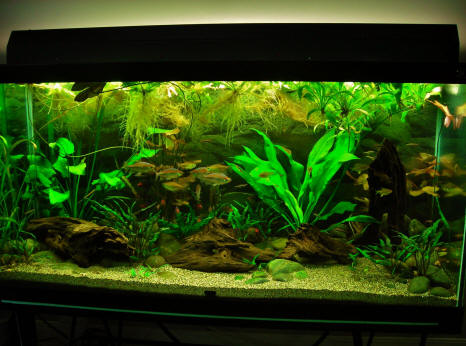
tanks have floating plants. I'll add a photo of the 90g taken just a moment ago
so you can see what it looks like; not a great photo, but may help.
<Lovely tank. Nothing obviously amiss.>
Byron.
<Cheers, Neale.>
|
Re: For Neale Monks 11/29/15
Now my problem is measuring the salt. I assume grams/litre is weight? Or is it
volume? I have no way to measure weight, nor volume except the
teaspoon/tablespoon which is what is stated on the package of aquarium salt.
I've never had to do solid measurements, only liquid, previously.
I've hunted online for conversions, but can't find anything I trust, as "grams"
is assumed to be weight, and "teaspoon" is assumed to be volume.
<Use kitchen scales for weighing out salt. Plenty accurate enough once you start
measuring out large amounts, say, 100 x 2 gram = 200 grams for 100 litres of
water. Going by volumes of salt is inaccurate. Salt absorbs moisture from the
air, so it becomes more bulky than it should be. So a teaspoon of salt from an
open package will actually contain less salt than
you'd think. Plus, getting the salt concentration wrong will stress the fish
and/or plants, so you really do want to be careful.>
I have 70 gallons of water, which is 265 litres, so 2 g/l means 530 grams of
salt.
<Do remember a 70 gallon tank is described that way in a nominal sort of way. By
the time you add substrate, rocks, etc you'd be lucky to have 90% that amount of
water, i.e., 63 gallons. Make sense?>
I worked this out to somewhere between 107 and 140 teaspoons, which seems an
awful lot of salt.
<Doesn't it? But only to people who don't understand how salty seawater is!
By way of a reminder, normal seawater contains 35 grams salt per litre of water.
So 265 litres of seawater would actually contain 265 x 35 = 17225 grams of salt,
i.e., about 17.2 kg, almost 40 pounds of salt! By contrast, to get a salinity of
2 gram/litre, you'd be adding 265 x 2 = 530 gram salt, about 1.1 pounds of salt.
Much, much less. Do also understand you're using salt to kill parasites by
drawing the water out of them. No point at all adding a trivial amount that
won't have that effect. You're using salt for a short term, a few days, not
adding it to the tank indefinitely. Plus, if the fish react badly, a simple
water change fixes it. No toxins are involved (unlike formalin) and nothing gets
absorbed by calcareous media (unlike copper).>
The package says 1 teaspoon per 2 gallons (8 litres), which would be 35
teaspoons for 70g. I realize this is for general purposes,
<Correct. World's most pointless use of salt, but salt is cheap and
inexperienced hobbyists still think adding salt at these trivial amounts does
something to help their fish. Which in fairness it might if nitrate and nitrite
levels are high. But beyond that... pshaw...>
not specific treatment,
<Indeed. That's a trivial amount. Allowing 1 teaspoon to be 6 grams, that's 6
grams per 8 litres, or 0.75 gram/litre, not nearly enough to kill Whitespot or
Velvet.>
but I do not want to risk it.
<DO read the use of salt/heat on WWM; provided you weigh out the salt carefully
and dissolve it into the water thoroughly before adding to the aquarium,
salt/heat is much safer than anything else you'd use. If you've added
copper-based medications to an aquarium before, that's FAR more risky.>
I will do the lesser amount today, and can increase it when I have your
comments, which I appreciate may not be for a couple days.
Byron.
<Have faith, young Padawan. Weigh your salt out carefully, 2 gram/litre, and do
a series of small additions (3 or 4 perhaps) of the salty water across a few
hours rather than trying to change all the water at once. That way you'll see if
your fish are reacting badly. Neale.>
|
Strange unidentified sickness 8/13/15
You guys are a fantastic resource for me! I was wondering if you could
help me with a very strange sickness running through two of my tanks.
I have a 75 gallon planted community tank with Denison barbs,
<A subtropical species; doesn't do well in tropical tanks indefinitely.>
Columbian tetras, skirt tetras, panda cories, pepper cories, and 3 various
Plecos.
<Apart from the Black Skirt Tetras and potentially some of the Plecs, the
Columbians do well in coolish water, and the Panda and Pepper Corydoras
certainly do, 22-25 C being optimal for them.>
Nitrites 0, nitrates ~20, ph somewhere around 6-7.
<How warm is this tank? A bit of a mishmash in terms of temperature
requirements, so presumably you have thought about the balance between
temperature and oxygen concentration?>
I have a very strange sickness(es?). I have lost a denisons barb and 2
Columbians with no visible symptoms. I have lost 3 skirts whose mouths turn
black before dying, I have lost three peppers with no visible symptoms aside
from a loss of motility. I have one dying in a net whose gills are still
working, but he can barely wiggle. Almost like a slow paralysis. None of my
pandas have died since this hit. They are actively breeding.
<Does sound environmental. Temperature is one thing unlikely to be correct for
all species. The pH range of 6-7 is far too big a range for a tank to experience
in the short term, so the question of how stable the pH might be (or not) has to
be asked. I'm guessing you're using soft water if your pH is below 7, but if
that's the case, how are you buffering the water? What method are you employing
to keep the pH steady between water changes. Sudden/erratic pH changes can cause
the symptoms you describe.>
I have dosed the tank with erythro from a local lfs. I'm not sure the dosages
used, but it was a 5 daily dose course. The lfs says there's a clostridium
strain hitting fish hard these days. A nécropsie on one of my fish showed a ton
of bubbles in their body cavity. Lfs said that's methane from the clostridium.
They also had severe organ breakdown. That's when they gave me the erythro
course.
<Hmm... random use of antibiotics is almost always pointless.>
My wife's 27 gallon is also showing similar symptoms. She's lost 4 peppers and 2
rainbows (but no pandas have died in her tank either). Her tank has been heavily
treated. Did the same eythro from the lfs. In addition, after the erythro we did
a full course of furan in her tank (a rainbow had an open wound with some sort
of filamentous growth - did not survive). Lfs suggested the furan because we ran
Kanamycin and metro even before the erythro and it didn't clear up the wounds.
Her tank has the same nitrite, nitrate, and ph readings as my 75.
<See above.>
Haven't had any deaths in her tank since the furan, but not real confident.
<Indeed.>
Could someone help me out here? I would love to identify what the heck is
killing my fish so I don't have to do some gigantic broad spectrum dosing on my
75. That gets real expensive real fast.
Thanks so much!
-Jonathan
<The fact a whole bunch of species are dying, and in two different tanks,
strongly suggests maintenance and/or set-up is amiss. Review the needs of your
species, and see how they match up to what's provided. Denison Barbs are
subtropical fish for example that do better around 18 C/64 F, and while loads of
shops sell them as tropicals, their lifespan in tropical tanks is pretty poor.
It also needs a lot of oxygen, fast current, and excellent water quality. Big
Plecs are biological machines designed to produce crappy water quality, so
without knowing what sort of Plecs you're keeping, I'm going to remind you that
a 75-gallon tank is barely adequate for one large Common Plec, let alone more.
On the other hand, a trio of Bristlenose Plecs wouldn't be a problem, and at,
say, 22 C might work okay with Denison Barbs in a riverine aquarium with lots of
water flow. Soft, acidic water is very difficult to keep stable (one reason
nobody should use softened water from domestic water softeners) and if you're
using RO water or have naturally soft water (i.e., don't use any sort of
softener) then you may well need to stabilise the pH using commercial Discus
Buffer or similar. So, that's where my thoughts are going. Make sense? Cheers,
Neale.>
Clowns, guppies, platies in 80 gal tank. CAE?
/RMF 12/17/14
Question. .
We have an 80 gallon tank and it's been up sense sept. We had 4 clowns
and some guppies and a Chinese algae eater in it.
<Mmm; this last can be, will become trouble in time. See WWM re
Gyrinocheilus aymonieri... Not an algae eater (and not from China either); but a
fish rider/eater>
LAST week we bought 6 platies
and a couple more guppies. The fish were fine. NOW.... ALL the
clowns
are dead and so is the adult female guppy we had in the tank. All sense
<since>
we
got the new fish. Any ideas what's causing this?
<Perhaps the CAE directly or something that 'came in' with it... can't tell more
w/ the information (lack of) supplied>
There are also baby
guppies in there from before and they seem fine. Please help. HATE losing
my fish with no ideas as to why.
Thanks!
Rhond
<Reading; more data please. Bob Fenner>
Clowns, guppies, platies in 80 gal tank. /Neale
12/18/14
Question. .
We have an 80 gallon tank and it's been up sense Sept. We had 4 clowns
and some guppies and a Chinese algae eater in it. LAST week we bought 6
platies and a couple more guppies. The fish were fine. NOW.... ALL the
clowns are dead and so is the adult female guppy we had in the tank. All
sense we got the new fish. Any ideas what's causing this? There are also
baby guppies in there from before and they seem fine. Please help. HATE
losing my fish with no ideas as to why.
Thanks!
Rhond
<Can't explain this one easily, I'm afraid. It's common for Clown
Loaches to get Whitespot after new (store-bought) fish have been
introduced. But to fall dead almost overnight is unusual. I'd definitely
keep an open mind: perhaps the Platies arriving and the Clowns departing
was a coincidence, and the cause of the Clowns demise was something
else. Airborne poisons?
Anything else added to the tank, e.g., copper or formalin-based
medication?
Do you have a copper test kit? Can you take a water sample to a retailer
to have the copper test done? Cheers, Neale.> Sudden fish deaths (RMF, any other ideas?)<<I concur>>
10/19/13
Hi WWM Crew!
I am at a loss at what is happening in my 55G freshwater tank. The
problems started six days ago when I did a water change (~10G) and
vacuumed
up the mulm. The next morning my three female rainbow furcata were dead.
The following day one Sterbai Cory and one mosquito Rasbora died.
Next
day my elderly Betta died. Yesterday I noticed an outbreak of Ich
and
started treating with API Super Ich Cure and just now one of my two
goldspot gobies died. I used 50% RO water remineralized with
Equilibrium
and SeaChem acid/alkaline buffers (1:2 ratio) and freshwater trace.
For
the other 50% I used tap water which I had treated AquaPlus. I've
been
testing for ammonia, nitrite and nitrate every day and get the same
results: ammonia and nitrite 0, nitrate 10ppm. The temperature is
79F and
the pH 7.2. I have been using primarily RO water remineralized in the
way I
described except for this one time when I didn't have enough RO water
and
mixed it with tap water. None of the fish who died showed any
signs of
illness until their sudden death usually overnight. None of
the fish who
died were 'new' I had them all at least 5-6 months, some nearly a year.
Thanks for your input. Margaret
<My guess would be that something you added to the tank, rather than
anything you removed or disturbed, is the cause of your troubles.
Definitely measure water chemistry in the tank, and use that to ensure
any
new water you add is fairly close to the current water chemistry. If no
more fish have died in the last 24 hours, I'd tend to do nothing more
than
observe the tank and its inhabitants. If the problem was a sudden water
chemistry change, then better to let things settle down as they are than
to
try and readjust conditions back to the "optimal" values for your fish.
After a few days, then yes, you could do a series of small, daily water
changes (say, 10%) that slowly change the hardness and pH back to where
they should be. I'd also drop the Whitespot medication and go with the
much
safer salt/heat method (2 g/l salt + 28-30 degrees C). Some Whitespot/Ick
cures contain copper and/or formalin and these can be more trouble than
they're worth. Hope this helps, Neale.>
|
Possible Black Spot disease? (Bob, second opinion?)<<Agree w/
Neale; this is some melanization alone>> 11/29/12
Hello Crew!!! You guys are amazing and hoping you could help me once again.
I think I could possibly have black spot disease going on in my tank;
however, I am not 100% convinced as the spots don't look raised.
Quick background:
* 15 gallon tank that has been established 1+ years
* Planted tank (micro sword, Christmas moss, java fern, red Cabomba)
* Additives: Green Leaf Ultimate GH booster (7 degrees GH) (kH is <1)
* Additives recently stopped until this is dealt with: Excell, Kno3, KH2P04
* 50% weekly water changes
* Water quality (tested with api master) consistently: 0 ppm on Ammonia,
Nitrites, Nitrates. Ph constant at 7.5 (might be too high for croaking
gourami's?.. I get mixed answers I can definitely bring it down via acid if
necessary ... I try not to use chemicals though)
* Decor: Manzanita wood, rocks, onyx sand / fluorite sand, buried pvc that
was sanded for additional hiding places.
* Tank inhabitants: 4 croaking gourami's, 1 African dwarf frog (who loves
flake food randomly), 6 Aura Blue Shrimp, 3 kinds of snails for algae
(mystery, rams, trumpet)
Attached are the pictures and hopefully you can see they have black "areas"
on their body's and fins. However the spots don't look all raised like all
of the pictures I see for black spot so I am not 100% sure, but I also
haven't read anything else it can be. I have one croaking gourami that I
bought at the same time as these 4 and moved to a different tank due to
compatibility. This one is not displaying the same markings.
So my questions:
1) Do my gourami's have black spot?
<Very unlikely; Black Spot Disease is a temporary symptom that occurs when
parasitic organisms in their larval stage burrow into the skin of fish.
When the organism matures and leaves the fish, the spot usually heals over.
Now, the thing about this parasite is that it doesn't normally occur in
aquaria. The parasites have a complex life cycle that involves birds and
either snails or copepods, and because of this, it's hard for the parasite
to complete its life cycle in aquaria. Even if fish are infected when you
buy them, the parasite eventually dies out because it can't complete its
life cycle. So true Black Spot Disease is simply something you let run its
course; assuming the fish are otherwise healthy, the parasite doesn't do any
serious harm.>
a. Or something else, I can't imagine it's ammonia burn since I have never
measured ammonia over 0 ppm since adding them. I know the kit is OK because
I measured the cycle on another tank.
<Well that's promising. Most of the suppose Black Spot Disease outbreaks are
more to do with ammonia than anything else.>
b. Could it be due to ph / bullying, but I don't think that explains the
black spots in tail / anal / dorsal fins.
<Perhaps, but my feeling is that this is either genetic or idiopathic; I
wouldn't worry so long as the fish is happy and eating.>
2) Additionally do you know what the white specks on the wood are?
<White specks on wood can be a variety of things. Off-grey threads are
usually fungus or bacteria. Nondescript specks more likely to be silt
trapped on a bacterial or algal film. Basically, remove the wood and see if
the white stuff rinses off. If it does, then chances are its silt, and if
you don't want this to happen again, improve mechanical filtration.>
Based on my understanding I think I might have black spot from some of the
snails I added to the tank.
<Snails can only carry Black Spot if they come from a pond where birds had
access. Assuming you live in a temperate part of the world, the only snails
that might have been outdoors would be Physa and Physella type things, and
even then, only if they came into the tank on plants that were grown
outdoors in your area, which basically limits it down to stuff like Elodea
and Hornwort.>
I am perfectly ok killing all the snails via copper to break the cycle
(those things grow like weeds)
<Personally, I feel using copper to kill snails is more dangerous than
whatever (slight) problems this fish might have. Do remember snails are part
of a balanced aquarium, and marine aquarists positively encourage "clean-up
crew" that circulates the substrate and breaks down organic waste into the
ammonia and other soluble compounds the biological filter can process. Too
many snails can mean your tank is improperly maintained, so best to nix any
issues in that direction first. Restrict feeding, remove uneaten food, trim
away dead/dying foliage, etc., and the snail population will die back to a
sensible level.>
and allow them to heal if it is black spot, however, I'll have to set up a
new home for the frog and shrimp while that is happening so I wanted to make
sure.
<Ah yes, copper will be quickly lethal to frogs and shrimps, not to mention
most/all fish at some level. Copper is the "nuclear option" in aquarium
maintenance.>
Which is why I wanted to ask an expert.
<Good call, which is why I'm asking Bob!>
Thanks and please let me know,
-Dave
<Cheers, Neale.>
|
.jpg)
.jpg) |
|
Re: Possible Black Spot disease? (Bob, second
opinion?) - 11/30/2012
Awesome you guys have always been a huge help!!!
I was doubtful for all the same reasons, but couldn't explain the
pictures so wanted some expert reviews.
<Glad we could help.>
All the plants came from my own grow tank (where I juice with DIY CO2,
high ferts, etc.. but no fish so I don't have to worry about PH
swings, high nitrates, iron, etc..), so there is no way it could have
gotten black spots from that (unless the snails in that tank all have
it, but again no fish for the cycle). Yes I didn't want to do the
"nuclear" copper trick .. I like snails (hence 3 types .. and I do keep
them in check via avail food), they help keep everything so clean .. way
better than any algae scrubber 8-), but if it was the problem I can
always regrow the population easily especially from grow tank.
<For sure.>
Is there anything than could affect the melanization / idiopathic? (no
understanding about it so .. currently reading up on it)
<Not really, beyond ensuring optimal health. Random growth of dark
patches of pigment -- melanisation -- can follow on from injury to the
underlying nerves, genetics, exposure to the wrong level of light
intensity for that species, something lacking in the diet, etc., etc.
The species you have here isn't demanding, beyond the requirement for
small, peaceful tankmates and the need for lots of floating plants, so
it's hard to imagine precisely what you might be doing wrong.
(Interestingly, the Moonlight Gourami develops a black band along its
flanks if the light intensity is low; this may not be relevant here, but
it is something to think about.) May be nothing at all, and simply
genetic. The best approach is to keep the Gourami happy, keep looking
out for any odd behavioural changes or signs of bullying and such, and
make sure the fish is feeding on a good range of things.>
Thanks for all the help!!!
-Dave
<Cheers, Neale.>
|
Sudden sickness? Panicking...
11/13/12
Dear Crew,
<Lorie>
I have a 10 gallon freshwater tank, 0 Ammonia, 0 Nitrite, 25 ppm
Nitrate.
<A little too high>
I have a Honey Gourami and 6 Corydoras (3 albinos, 3 peppered).
Today one of the Peppered Corys died and all the other fish are not
well. The rest of the Corys are listless (literally, they are not
moving) and one of the Corys has a split in its tail. I do not see
any signs of fungus though. The Gourami had stringy poop today
(its green), and she is hovering at the top like she is trying to
balance herself and take air, or she is sitting on the bottom (mostly
the bottom). I did a 50% water change and changed the filter media
(filter has a bio-wheel, which is left alone).
<Good moves... When/where in doubt...>
Temp is 78 F (heater is not adjustable).
I have Maracyn Two on hand, but I don't know if I should treat the tank
because I am unsure what is wrong.
<Ahh, I so wish all others had your reticence>
Plus, if it is fin rot (Cory has split in tail), I have seen Maracyn
recommended, which I don't understand, because I thought fin rot is
normally caused by bacteria, and Maracyn Two is for bacteria, while
Maracyn is fungal.
<Mmm, well... this Mardel product is Erythromycin... is an antibiotic...
for gram positive bacterial infections, fin and tail rot, PopEye, body
"fungus". Too much to state here, but most all "fungal" issues of
aquatics are bacterial>
When I did the water change today, I warmed the tank 4 degrees.
This is when I noticed the split in the Corys tail and all of the fish
seeming ill. I don't know if there is a connection (I do know
rapid changes in water temp are bad; I need to get another thermometer
for water changes. No excuse though, I know).
I noticed the Gourami acting jumpy and the Corydoras were not as active,
back in August, and upon testing the water, the nitrates were at
40 ppm
<Mmm, much too high... Likely related to the issue/cause here>
(my Nerite Snail died soon after). I have since brought down the
nitrates, but my fish have never totally bounced back to normal.
<Takes time>
The Gourami is still skittish and the Corys aren't as active. The
only other thing I can think of is that I soaked the decor in a bleach
solution for too long; I rinsed and rinsed, used de-chlorinator and left
to dry in the sun,
<Good protocol>
but the decor still smelled like bleach (my tap water has chlorine in it
anyway, so it's hard to tell when you've rinsed the decor free of
bleach). So I repeated the process and eventually all the decor
made it back into the aquarium as of 2 weeks ago. But then one
week ago I took most of it out, since the fish still weren't as active,
I thought maybe bleach was getting into the aquarium.
<No... would have had direct effect, immediately on exposure; not later>
As soon as I took out the decor, all the fish seemed more active (but
maybe it was just the change in the environment). All stayed
relatively the same until this morning.
Do you have anything you can recommend? I'm starting to panic; I
think the fish need medicine; I'm just not sure which one.
Thank you, Lorie
<I would go ahead w/ dosing w/ the Maracyn... and be careful re any
feeding at this point/juncture... and keep monitoring nitrogenous waste
accumulation. Bob Fenner>
Re: Sudden sickness? Panicking... 11/13/12
Dear Crew,
<Lor>
Here's an update. Since I didn't know which medicine to use, and I
wanted to act quickly given the circumstances, I treated with both
Maracyn and Maracyn Two (the directions said they could be used
concurrently).
<Can, yes... and often a good idea to use both>
I put the medicine in an hour and a half ago. Gourami is a little
more active; swimming a bit and going to the top for air. But I
noticed where her pectoral fins meet her body, it's red. The
catfish became active within a minute of putting the medicine in, and
are still swimming around now. I don't know how quickly the
medicine is supposed to work, so I'm not sure if these are good or bad
signs.
<Bad; indicative of some degree of (biological) irritation>
I also cleaned a bit inside the filter box and it had a lot of "sludge"
(OTB filter). The last time I thoroughly cleaned the inside of the
filter was July. In August, when the nitrates spiked, I also had a
lot of algae (after snail died) and the water smelled like a pond (this
is the point where everything seemed to go down hill; I hadn't put the
decor back in the tank yet, since i wasn't sure I wanted to use it, so
maybe the decor has nothing to do with it. When i say "down hill",
I mean, the nitrates spiked,
<You might... should read re, at least on WWM... and add
more/superfluous aerobic filtration. Start here:
http://www.wetwebmedia.com/FWSubWebIndex/fwnitrates.htm
the linked files above>
the snail died, and the Gourami and catfish weren't as active). It
was at that point I started to use the filter inserts with carbon, for
the smell (instead of just polyfiber) and I cleaned the glass and decor
(with plain water) more often to get rid of the algae. I don't
know if this has anything to do with anything; I'm just trying to give
all the information I have to figure out what is going on here.
<Mmm... well, I feel compelled to make mention... You and your livestock
would be much better off w/ a larger world... Bigger volumes are
inherently more stable/forgiving. Even just a 15 gallon would be a huge
improvement>
I forgot to mention before; I removed all the decor from the tank and
threw it away. I'm not sure if it has anything to do with it, but
I think I will always be weary using it.
<Better to store for now...>
In May, I had the Gourami, the snail, and 2 catfish. I then added
4 catfish and 1 guppy. In August, nitrates spiked, snail died, and
algae increased. In September I re-homed the guppy, and nitrates
for September and October were below 20 ppm. Now in November, 1
peppered Cory died and everyone else is sick. Nitrates 25 ppm.
Maybe I'm overstocked (Gourami and 6 catfish)?
<Just under-tanked>
Plus, if it's not the decor (possible bleach), would the Gourami act
jumpy with nitrates at 25 ppm?
<Could, yes>
I just don't understand what is going on.
Thanks-Lorie
<Welcome. BobF>
Re: Sudden sickness? Panicking... 11/13/12
One more note; I noticed in the beginning of September, a small piece of
the Gourami's tail fin was missing. She wasn't acting lethargic
and I wrote in to the site and was told it was probably physical damage.
The tail damage has not progressed, but the Gourami became increasingly
lethargic over the next two months. I wonder now if I should have
treated the tank when I first noticed the tail fin..... Would the
Gourami act jumpy if she were sick?
<Could be related or not>
Sorry for all the emails. Going over all my notes to try to piece
this together. -Lorie
<Understood... there may be "some subtle poisoning" source here... a
shell, rock... piece of decor that figures in... B>
Re: Sudden sickness? Panicking... 11/13/12
Thank you for your responses Bob.
<Welcome>
I fed the fish this morning (lightly) because I thought it may be an
indicator of their health, and everyone ate. I just came home
during my work break to check on them, and the albino Corys seem worse.
They are swimming, I believe frantically, and it looks like their
underbellies have a little protrusion, and it's black/grey in their
bellies. Yesterday when I added the medicine (it's a powder, I
just sprinkled directly into the tank),
<Better by far to mix it in, dissolve it w/ a bit of aquarium water
outside the tank, then pour this in>
all the catfish started to swim, which you stated was a bad sign. I
know catfish can be sensitive to medicine; do you think this new
development in the albino Corys is due to the medicine?
<Maybe, but still reads as some sort of metabolic poisoning... ammonia?
Perhaps a noxious algae... very common>
Also, the Gourami is still at the bottom of the tank; she seems neither
better or worse. The peppered Corys are like the Gourami;
somewhere in the middle of health I suppose (I know it takes time, just
stating where they are at).
I still have rocks in the tank, which are made for aquariums and have
never been bleached; I will remove them just in case.
<Good>
Besides that, the only other thing still is use from before is the bag
that has the filter media inside (fresh polyfiber in use though).
I am going to replace the bag tonight, because there still seems to be
some kind of adverse reaction to something in the tank.
<Oh?>
Also, I understand from what you said that there would be an immediate
reaction if bleach (chlorine) got into the tank, but I am wondering if
the long bleach soak damaged the integrity of the decor, maybe then
leaching plastic or resin into the tank?
<Doubtful>
I noticed that the one cave had a hole in it, and I thought I was
vacuuming some kind of tiny granules from the gravel other than
detritus, but I'm not sure. Either way, the only thing that will
be left in the tank at this point is the gravel.
When I wiped down the filter yesterday, I didn't do a final rinse.
When I hooked it back up, to my horror it spit out sludge into the tank.
I had just medicated the tank so there was nothing I could do.
Could the catfish have been reacting to the sludge?
<This also dubious>
I'm thinking no. I want to vacuum the gravel quickly tonight, to
try to get that sludge out of there (minimal water removal), then, if
you think it's ok, medicate again.
<Follow directions on the Mardel packaging>
Should I remove the albino catfish and just medicate the Gourami and
peppered Corys? Do you think the albino Corys need to be put out
of their misery (re: frantic swimming, bellies)?
<I'd leave all present, treat all... and not give up hope>
Thanks again for your help-Lorie
<Welcome. BobF>
Re: Sudden sickness? Panicking... 11/14/12
Hi Bob, Lorie again. The Albino Corys didn't start swimming
frantically until I added the medicine.
<Mmm, could "be nothing" here; at least nothing deleterious>
They are swimming like crazy as I write this. I tested the water
again tonight, and ammonia and nitrite are zero, nitrate 5 ppm (ammonia
and nitrite were zero yesterday; I haven't had a problem with these
since my tank cycled, almost 2 years ago).
<Mmm, well, sometimes nitrogenous cycling is lost... best to check>
I did another water change tonight to remove the sludge that spit out
from the filter, and then medicated again. I cleaned the filter
more thoroughly tonight and am wondering if I found the root of my
problem; the intake tube was FULL of sludge.
<Some "mulm" is beneficial... much more trouble are the aforementioned
toxic algal situations... in some ways related>
Although the filter had been working, I noticed the uptake had been
slower. It must have been like this for months, which would
contribute to the nitrate problem. Could the sludge inside the
tube become noxious, if it sat there long enough?
<Mmm, not much, really... as long as there is "some" water
movement/exposure... the mass doesn't "go anaerobic"...>
I tried researching noxious algae on the site but everything came up as
saltwater.
<These issues exist in freshwater settings as well. There are incidences
of poisoned ungulate stock animals from watering troughs even>
Since I removed all the decor, most of the algae was removed with it.
<Good>
There is a tiny bit on the heater, Anubias plant and walls.
As far as the black/grey in the Albino Corys bellies; I think this might
be normal?
<Yes; some sports of the few albinistic species... do have some grey,
black markings>
Seems more noticeable now though. I do notice a tiny bump
underneath...I'm not sure if that is part of the anatomy. Do you
feel it is safe to leave the Albino Corys in the main tank?
<Yes; this is what I would do. Unless you have another set-up that is
cycled to move all to, I'd leave in place>
They still haven't calmed down. There are 3 more days left to
complete the course of antibiotics. (Gourami and Peppered Corys
are still so so).
Thank you for your time and insights-Lorie
<Glad to share. B>
New filter, fish gasping /Neale
4/9/12
Dear crew -
<Celeste,>
Yesterday, I installed a Fluval 205 canister filter on my fish
tank.
<A good filter. For tanks up to around 30 gallons/110 litres if
lightly stocked. Like all canisters, removes oxygen from the water, so
if overworked -- i.e., given a LOT of ammonia to process, or else
clogged up with decomposing gunk -- it will have a negative impact on
oxygen availability.>
I used to have two Marineland Penguin 200 filters,
<These are effectively external filters exposed to air, so they
don't tend to draw oxygen from the water. While arguably less
effective than canister filters because they're unpressurised,
because they mix air with water as they work, they have the important
positive of ensuring good oxygen levels.>
but one of them froze up after years of service, and I decided to
replace them with the canister filter and I put the remaining
Marineland on another aquarium. Today, my fish are breathing very
quickly and not swimming around, and I don't know why.
<See above. Do suspect oxygen. Whether the canister is overworked,
or else your tank overstocked, either way, you aren't getting the
oxygen concentration the fish need. Adding turbulence helps: I always
use a spray bar with canister filters so there's plenty of
splashing to push out CO2 and encourage oxygen uptake by the water.
Also make sure the aquarium isn't overstocked to begin
with.>
I unconnected my DIY CO2 pop-bottle device that I refilled yesterday
and angled the output of the canister filter so that it moved the
surface water of the tank (I had set it up yesterday a few inches below
the water line). It's been two hours since I did that, and they are
still gasping.
<Hmm do also check the pH; if the pH level has changed suddenly
thanks to the removal of CO2 fertilisation, your fish can react by
gasping.>
My tank is a 36g tall freshwater planted aquarium with 5 black neons, 7
cardinal tetras, 9 Rummynose tetras, and a handful of cherry
shrimp.
<Doesn't sound overstocked to me.>
There is also a power head just above the gravel line. I have the CO2
connected to it usually. I changed the water out yesterday as well;
20%, replaced with 5 gallons of distilled water and half a gallon of
treated tap water. Temp is 73 degrees F. I change the water out weekly,
replace the CO2 DIY mixture, and add the Flourish line of plant
nutrients and such. The Fluval has carbon in one tray and the ceramic
rings in the other two (what it came with). I know that the Fluval
doesn't disrupt the surface water as much as the Marineland
filters, could this by my issue?
<Yes.>
Should I install another power head at the water level?
<Try lowering the water level a couple of inches for a few hours.
This often makes a huge difference. If the fish perk up, that's a
good clue oxygen is the problem.>
Also, since I'm writing to you anyway, I'm trying to figure out
the lighting in my aquarium. I've had 65 W dual daylight florescent
sunpaq lights on my aquarium for the last few years. There are two
bulbs. I replace one every 3 months as instructed by the
manufacturer.
<Somewhat excessive! Every 6 months should be fine, even 12 for good
brands.>
However, since my tank is a tall tank, I don't think I'm
getting enough light at the bottom.
<Possible.>
My plants that are supposed to be my bottom cover don't spread out,
they grow straight up.
<Etiolation.>
And my scarlet fire plants melt below a certain level. I'm studying
on lighting, but again, the tall tank is throwing off the measurements
most people use.
<Yes.>
I have a friend who's getting into LED lights for his aquarium and
really likes them, but he doesn't have near the plants I do, nor
the tall tank. Do you have recommendations for the wattage I should be
using? Should I switch from fluorescent to halide or LED?
<If you can afford it, LEDs are much better for deep tanks, with
lighting levels between 50-100% what's needed for reef tanks being
suitable. Some brands, like the TMC GroBeam, are specifically designed
for planted tanks. Failing that, double the number of fluorescent
tubes, and add reflectors behind them.>
Thank you very much for your time, from me and my fish (and plants).
You've helped us much in the past, both by questions and
website.
Sorry, ammonia 0, nitrite 0, nitrate 0. Sometimes I worry so much about
my grammar, I forget things like that.
-Celeste
<Hope this helps, Neale.>
New filter, fish gasping, /RMF 4/9/12
Dear crew -
<Cel>
Yesterday, I installed a Fluval 205 canister filter on my fish tank. I
used to have two Marineland Penguin 200 filters, but one of them froze
up after years of service, and I decided to replace them with the
canister filter and I put the remaining Marineland on another aquarium.
Today, my fish are breathing very quickly and not swimming around, and
I don't know why.
<First thing that comes to mind is poor dissolved oxygen (or
accumulated carbon dioxide)... I'd increase surface disruption,
turn over (circulation), stat.!>
I unconnected my DIY CO2 pop-bottle device that I refilled
yesterday
<Ahh!>
and angled the output of the canister filter so that it moved the
surface water of the tank (I had set it up yesterday a few inches below
the water line). It's been two hours since I did that, and they are
still gasping. My tank is a 36g tall freshwater planted aquarium with 5
black neons, 7 cardinal tetras, 9 Rummynose tetras, and a handful of
cherry shrimp. There is also a power head just above the gravel
line.
<Move this up right under the surface>
I have the CO2 connected to it usually. I changed the water out
yesterday as well; 20%, replaced with 5 gallons of distilled water and
half a gallon of treated tap water. Temp is 73 degrees F.
<Don't raise the temp.>
I change the water out weekly, replace the CO2 DIY mixture, and add the
Flourish line of plant nutrients and such. The Fluval has carbon in one
tray and the ceramic rings in the other two (what it came with). I know
that the Fluval doesn't disrupt the surface water as much as the
Marineland filters, could this by my issue?
<Could be... likely a combo. w/ the CO2 generator as well>
Should I install another power head at the water level?
<If you have it, yes; or a "bubbler" of some sort>
Also, since I'm writing to you anyway, I'm trying to figure out
the lighting in my aquarium. I've had 65 W dual daylight florescent
sunpaq lights on my aquarium for the last few years.
<Leave these turned on till the fish stop gasping>
There are two bulbs. I replace one every 3 months as instructed by the
manufacturer. However, since my tank is a tall tank, I don't think
I'm getting enough light at the bottom.
<May well be the case>
My plants that are supposed to be my bottom cover don't spread out,
they grow straight up. And my scarlet fire plants melt below a certain
level.
I'm studying on lighting, but again, the tall tank is throwing off
the measurements most people use. I have a friend who's getting
into LED lights for his aquarium and really likes them, but he
doesn't have near the plants I do, nor the tall tank. Do you have
recommendations for the wattage I should be using? Should I switch from
fluorescent to halide or LED?
<Not wattage alone as a measure... but PAR, PUR... simple to measure
w/ a borrowed meter. For your size/shape system I would not use MH...
LEDs of strength are a very good choice. Please read here:
http://www.wetwebmedia.com/PlantedTksSubWebIndex/lgtfixtags.htm
and the linked files above>
Thank you very much for your time, from me and my fish (and plants).
You've helped us much in the past, both by questions and
website.
-Celeste
<Welcome. Bob Fenner>
Re: New filter, fish gasping (plus understanding canister
filters) 4/11/12
Bob and Neale (since you both replied) - I lowered the water a few
inches as Neale suggested. I raised the power head to the surface as
Bob suggested. No CO2 being added to the system currently. They are
doing better. Not great, but better.
<Good.>
Lost a cherry shrimp today. They seem to be most sensitive to oxygen,
I've noticed.
<Yes. They come from places like Taiwan where the water isn't
tropical but subtropical, so they're actually at the limit of their
comfort zone in tropical aquaria. They need lots of oxygen to do
well.>
I plan on going to the pet store tomorrow evening and looking into
getting another power head or something to help with the surface
disruption. And here I thought I was moving to a better system with a
canister filter....
<Canister filters do have some important advantages. Because
they're pressurised, they force more water through ALL the media.
In an unpressurised system like a trickle filter or hang-on-the-back
filter, water can flow OVER the media and not necessarily through it
all, so biological filtration can be weaker. On the other hand,
canister filters depend entirely on oxygen from the aquarium, whereas
hang-on-the-back filters are exposed to the air, so they mix air with
water and aren't as dependent on oxygen from the aquarium. If the
tank is properly set-up and stocked, this shouldn't be an issue,
and canister filters are routinely used in tanks with oxygen-sensitive
fish, including marine fish. But if your tank is overstocked, too warm
for the fish it contains, or the canister filter is installed in such a
way water turnover and oxygenation aren't optimised, then you can
see problems. Rarely fatal ones, but you may notice fish gulping air,
swimming at the surface more often that usual, or becoming lethargic.
As/when this happens, review circulation. Install a spray bar or
venturi, and use these to aerate the water, which drives off CO2 and
allows oxygen into the water. Ensure there's plenty of movement in
the tank from top to bottom, and keep the filter media clean so
there's a good turnover. Configured correctly, canisters, whether
internal or external, can provide excellent water quality. But they are
slightly more difficult to use than hang-on-the-back filters or
undergravel filters.>
So far as the lights go, I've been doing some research on LEDs and
will continue to do so. They have some very nice looking LED fixtures
for aquariums. Now it's just a matter of figuring out the color and
wattage I need for my tank. Bugging all my photo friends about light
meters and such.
Thanks again, both of you.
- Cel
<Cheers, Neale.>
Disease question... Gambusia vector?
2/12/12
Hello!
<Salve,>
I have a question about the transmittance of disease in my two
aquariums. They are both 55 gallons, one has 6 African
butterfly fish, two blue rams, and four Pictus catfish, the other one
had two angelfish, a "Peruvian altum" and the other was a
standard scalare and a group of mosquito fish that were breeding like
crazy and providing some live food for the angels.
Two weeks ago I noticed that the angels were very ill, almost
overnight they were covered in white slime and their fins were
rotting. I checked the parameters of the tank, and was
surprised that the ammonia and nitrite and nitrate were
literally off the chart. I found this to be very odd, as
I do 50 percent weekly changes in the tank and usually the tank reads 0
for ammonia/nitrate and under 20 ppm nitrates. anyway, I did
nearly a complete change and treated the fish with Maracyn and Maracyn
2. After five days the fish were still very ill, so I checked the
water again...OFF THE CHARTS AGAIN! Needless to say I was
confused. Later while I was quietly reading in the room with this
tank, I noticed a faint sound of water running, looked up, and to my
horror, my cat was urinating in the hood, and the urine was dripping
into the tank! Needless to say, I tore down the tank and set it
back up, and the cat no longer is permitted in that room!
<Indeed!>
Anyway, to my question. Before I was aware that anything was
wrong with the angel tank, I had placed a few young mosquito fish into
the butterfly/Pictus tank, thinking that the catfish would eventually
eat them.
I just noticed that one of these Mosquitofish was swimming behind
the filter intake, and his tail was nearly rotting off. I
removed him.
Should I be worried about disease in the butterfly tank?
<Probably not. Usually Finrot-type infections are
potentially possible in any aquarium, and not "catchy" as
such. What matters is that the fish are healthy; if they are,
they fend off the Finrot bacteria without any effort on your
part.>
And is there anything I could do proactively to prevent an outbreak in
this tank?
<A sharp eye would be useful, so do check for any unusual behaviour
or evidence of damage to the skin or fins. You may want to use a
preventative such as Stress Coat or Melafix, but that's a personal
choice. Assuming the fish are healthy and water quality is good, they
shouldn't need any such medication.>
I figured the disease was initially caused by poor water quality, so I
have been doing 25 percent water changes on all my tanks every other
day, is this enough?
<Should be.>
Stats are: no ammonia/nitrite reading, and nitrates are around 5
ppm. pH is 7.0 and hardness is around 5 degrees dH general
hardness and 3.5 degrees KH carbonate hardness.>
<I edited your readings a bit as you can see, because they
didn't make sense. In any case, this water sounds good for the
African and South American species mentioned, but Mosquitofish may do
better in harder water, and that might explain some of the
problem.>
Temperature is kept at 82. I feed the butterflies almost
exclusively on crickets, the cats clean up the remains and I offer them
cichlid pellets as well. The tank has been running for almost two
years now, all the original inhabitants seem very healthy at this
point, except for a butterfly with some frayed fins (which I suspect is
from aggression).
<This species is territorial.>
Thanks for your help, and for taking the time to read my message,
I am getting very frustrated searching for good info on fish diseases
on the Internet, as there seems to be a great deal of contradictory
information!
Jon
<Glad to help. Cheers, Neale.>
Rainbowfish with curved spine
8/16/11
Hello, you keepers of fish wisdom. I have a question about an Irian red
rainbow that was given to me last week. He is one of half a dozen
random free fish I found on Craigslist, and the only one to have a
curved spine.
He almost looks like a normal adult male, with the typical humped back,
except his lower half doesn't have the same fullness, so it
accentuates the abnormal curve of his back. Also, his eyes seem larger
than my other rainbows (but not popeyed), but that might just be an
illusion due to the lack of lower-body fullness. Other than that he has
no other symptoms of any illness, he eats like a champ and is very
active. I don't know if his curved spine is due to an illness or is
genetic, or possibly from being in a cramped tank (it looked to be a 15
gallon tall). Either way, he's in a quarantine tank. My question is
this: if he is showing no new symptoms after 4 or 5 weeks of quarantine
would it be safe to add him to my main rainbowfish tank? I'd hate
to keep him isolated if he's not contagious, since they're
schooling fish, but I don't want to risk my other fish. I also
won't euthanize him, since he's kind of cute in a Quasimodo
kind of way. Can I safely assume it's genetic if he's
symptom-free after a month?
Thanks in advance,
Danielle
<Hello Danielle. This isn't uncommon, and no, his deformities
aren't "catchy". So provided you don't breed from
him, this fish isn't likely to cause you any problems. Deformities
are sometimes genetic, sometimes caused by poor diet or conditions when
the fish was young, and sometimes caused by physical injuries when the
fish was young. Nothing much you can do to help him, and so long as he
can feed and avoid trouble, by all means enjoy this fish in your
community tank. Cheers, Neale.>
Flashing
6/21/11
I just caught one of my male Endler's flashing.
Any reason not to use the Prazipro I have on the shelf left over from
the Camallanus episode?
Rick
<Don't medicate unless there's a reason to treat for a
particular disease with a particular medication. Flashing is more often
caused by non-zero ammonia and nitrite, Whitespot, and especially
velvet. But it's normal for fish to flash occasionally, just as a
dog scratching doesn't necessarily have fleas.
Cheers, Neale.>
Could this be whirling disease?
4/24/2010
Hi Crew, I hope you are well. I have an unusual situation on my
hands.
First, a bit of background (I apologize for the length).
<No worries>
I've got an unusual fish, sold to me as a Rummynose Rasbora. It
seems to be a shipment contaminant
<Happens w/ wild caught fishes, imports quite often>
- when it was younger (1" or so) it looked like a splash tetra,
but now that it's about a year old it is
distinctly different. It has a flat top side, silver body with a black
spot on his tail - sort of like a head and tail light tetra but with a
tail spot only. Normal sized eyes - not big, not small. (Taking a
picture of it is impossible, since it's faster than a zebra
Danio!)
Not wanting to euthanize a perfectly healthy fish but not wanting it in
my 10 gallon tank either, I put it in my 55 gallon tank with blue,
silver tip, bleeding heart, and diamond tetras.
It wasn't very interested in schooling, but it was hungry and FAST
- if I fed any live foods such as mosquito wrigglers or baby
earthworms, it was the first to get them. It always ate very eagerly
and was rather a bully in this respect. It always did well in this tank
- looked healthy, had a pretty silver sheen to it. It has grown quite
long, a little longer than the mature blue tetras but much more
slender.
Today I turn the tank lights on, and this fish is absolutely going
nuts! Spinning around like a pinwheel from a central point, without
being able to stop. It was seriously stressing the other fish. Since
the weather is nice, I have an aquarium outside in semi-shade where I
am cultivating algae rocks - it has plant clippings, a bunch of Physa
snails and every few days I siphon out (with a dropper) whatever tasty
worms or wrigglers have accumulated. The water is really warm, 80
degrees or so - no filtration.
Since it was sort of an emergency situation, I didn't acclimate the
fish - just dropped it in. It spun wildly for a minute or so, then
stopped to catch its breath, I guess. Now I am looking out the window
(it goes crazy if I look at it face to face) and I can see it is
swimming back and forth erratically - still not able to swim in a
straight line, but at least it isn't spinning like a pinwheel.
My question is: what could be affecting this fish?
<There are a few possibilities. Read here:
http://wetwebmedia.com/FWSubWebIndex/whirldisfaqs.htm
Everything I've read about "whirling disease" makes it
sound like it is a skeletal deformity.
<Can result in this, but not necessarily>
This fish seems to have a perfectly formed skeleton. It has been fine
and normal in every way up until today. All the other fish in the
aquarium seem fine. Some of the older diamond tetras are developing
black spots (seems to be a common ailment amongst elderly tetras, not
so much the torpedo shaped but more the disc shaped ones - is my
observation) and a couple of the bleeding hearts are recovering from
Lymphocystis (I didn't treat it with anything, just extra water
changes and HUFA fortified foods).
<Good>
More than anything, I am just so perplexed by this! I have never read
about nor encountered anything like this before. Any insight would be
appreciated.
Have a great weekend!
Nicole
<Mmm, really need to "sacrifice" the fish, look via a
microscope... Likely this is not "catching" here, an if
Myxosoma, if the one fish should die and you remove the body quickly.
Bob Fenner>
FW Parasite problems
(RMF?)<<>> -- 3/30/10
Dear Crew Member
<Hello,>
I have several niggling health/parasite problems in my freshwater
aquarium. I have done much reading, much sifting through the WWM FAQs
and related articles, but I fear that now the information I have
gathered is beginning to diverge rather than converge, and was hoping
that you might be able to provide guidance on my next steps.
<Okay.>
I would like to begin by defending the tank itself. It is a sumped,
280L (73 US Gal) planted tank with soil underlayers in both the display
and sump. The lights are timed so that when the main tank is dark, the
sump is lit. Plant growth is excellent, and no fertilisers are added
(as per Walstad doctrine). I have never (yes never) registered any
ammonia, nitrite or nitrate in this heavily planted tank, and pH is
steady at 7.5. General Hardness is 4, while KH is the only thing that
fluctuates a bit between 4 and 6. Apart from the problems that I will
list, the fish are vibrant and feed well. In fact I have never seen
them so 'happy'. But:
<Sounds a good tank so far.>
My main concern is an aged Bolivian ram. I acquired this fish when it
was fully grown a year ago. Its symptoms are flashing (focusing on the
gill area), darting, shimmying, and flecks on its eyes. Sometimes its
skin looks a little shredded -- white lines from the back of the head
along the flank, as if it has been cat-scratched. But then this last
symptom will suddenly disappear, the flashing will calm down and I am
tempted to think that it has got over whatever problems it has. Except
they return.
<Right. Now, ruling out water quality issues (by far the most common
reason for chronic, low-level health problems with nebulous symptoms)
the things to consider are toxins, diet, stress and some type of
non-lethal parasite. Toxins could be things like paint fumes. Not a
common problem, but possible if the tank is near a workshop or garage.
Diet is generally not a major cause of problems with small community
fish, but dried foods do lose their nutritional value once opened, so
some care needs to be taken here. Stress can include behavioural
interactions. For example, one time I kept some large freshwater gobies
and had no idea why they constantly exhibited sores on their flanks.
Then I noticed the Otocinclus feeding on the mucous on these fish. One
thing many aquarists don't know is that Otocinclus are
semi-parasitic and view large fish as moving buffets, and if hungry
will scratch away at such fish, causing inflammations and excess mucous
production. Finally, there are mystery parasites. Farmed fish generally
come with predictable parasites such as Ick and Camallanus worms that
are common in fish farms and in tropical fish shops. But wild fish can
and likely often do come with low-level infections of non-lethal
parasites that we don't notice and so don't treat.>
Concern number two is the five Corydoras sterbai in the tank. They will
flash against the substrate.
<Typically implies irritation of the gills, e.g., by ammonia or
velvet.>
These were new fish added in the second month of the tank. One of them
has always had a white dusting on each flank (which I didn't notice
in the shop), and a stumpy, Nemo-esque pectoral.
<Genetic.>
This dusting is not Ich, and does not seem to change or shift. But they
are all feeding and growing well and otherwise happy.
<Possible velvet; would at least treat assuming it was, since no
harm will be done. Salt works well here. See here:
http://www.wetwebmedia.com/FWSubWebIndex/SaltUseFWArtNeale.htm
>
Problem number three is a very old Otocinclus that occasionally
'furs-up'. Every two months or so it looks as if it is in the
last stages of a fatal illness -- and then the next day any sign of it
has completely gone. Perhaps some sort of mucous excretion here?
<If the "fur" is off-white to grey slime rather than
fluffy, then sure, could be mucous. Commonly caused by what we usually
call Costia, or Slime Disease.>
The other three Otocinclus are fine, fat and have grown very well.
<Good.>
Problem four is my shoal of cardinal tetras. They have been with me for
over two years now, but currently seem to have some sort of grey-white
bean-shaped (like a tiny grain of rice) parasite that sits vertically
on their flanks. They flash now and again, presumably to try and
dislodge whatever these things are. The suspected oldest fish of this
shoal is the worst affected.
<Without a photo, it's difficult to say. Could be a Fish
Pox/Lymphocystis type thing, and in itself not fatal but a sign of some
environmental stress.><<More likely embedded Microsporidean
colonies... common, not treatable as far as I know>>
(Might age be a theme here? The ram, the Oto, the original tetras -
could this point to dietary deficiency? I feed frozen, recently opened
flake food, and crushed algae and cichlid pellets.)
<Sounds good.>
It is a similar case with the marginatus Pencilfish that I acquired
(about the same time as the C. sterbai) -- the same tiny flattened
rice/bean on their flanks, almost as if they have swapped one of their
scales for a discoloured one. Could they have in fact lost scales for
some reason from an invisible parasite, rather than the mystery bean
shape being the parasite itself?
<Possibly.>
Other inhabitants that are unaffected are 2 glass blood-fin tetras, 10
Boraras brigittae and 1 female Apistogramma trifasciata. The tank is
also home to 2 Nerite snails, Malaysian trumpet snails, 'small pond
snails', Amano shrimp, cherry shrimp, and other unidentified
shrimp.
<All these invertebrates will likely be killed by copper-based
medications, so be careful how you treat the tank.>
I must point out that the ram, the cardinals and the blood-fins had a
similar parasite in a previous incarnation of this tank. When I added
the sump, I was able to isolate them, cook them at 30'C and treat
heavily with copper. Whatever it was appeared to clear completely.
<Good. However, do consider that moving them to another tank was the
cure, rather than the copper. If the Otocinclus are attacking other
fish, then separating them will help the victims heal. If there's a
toxin of some sort in the display tank, the hospital tank can provide
relief. In other words, be open minded.>
However, all plants were transferred to the new tank (despite sitting
in a bucket for a week with a double dose of copper treatment), as were
the shrimp, who spent time in a separate tank with the micro-Rasboras
(who appear completely immune to whatever this is). Perhaps this
parasite survived either via the plants, or the shrimp. Problems
started again before the micro-Rasboras were added, so they can be
excluded as the main cause.
<OK.>
I must state that I do not believe this to be a water quality or
husbandry fault (apart from a lack of quarantine on my part, mistakes
in transference etc). To repeat, I have never tested anything amiss in
this tank, and all species should be fine within the water parameters,
and with each other. There is no overt aggression in the tank. I think
I introduced new pathogens either by not quarantining new stock (which
I certainly will in future), or letting old ones ride in on the shrimp
(or in the shrimp).
<Shrimps won't carry parasites as such, but any wet object,
including shrimps, can carry the free-living stages for a period of
time, perhaps a day or so.>
So unfortunately these parasites are there now -- but can you help me
ascertain what they are and recommend a course of action? Already I
have raised the temperature to 29'C (84'F) and have added a UV
sterilizer, although this does not appear to have made a significant
impact.
<It won't. UV is good at reducing the prevalence of free-living
parasites, but by itself it's almost never the cure.>
From my research so far I'm thinking that it could be Costia,
Chilodinella, Icthyobodo or some sort of fluke, or a combination of
these -- but quite honestly I don't have a clue.
<Costia (= Icthyobodo) is a good guess for "slime disease"
type things.>
I have not yet added a treatment, as most of them look to be
shrimp-killers, and to be frank, apart from a bit of flashing, the fish
have been generally fine. But obviously I wish to eliminate the
pathogens from the system, and the ram's discomfort is evident
enough to now be worrying.
<Yes.>
In terms of stages I would like to 1) try temperature raising to
30'C and UV sterilization
<Warming the water can speed up the life cycle, but it can also
stress certain fish, so balance the two things.>
2) perhaps (although I'm not keen) try adding salt (would this help
if it were flukes? -- opinion seems divided)
<Salt is a low-risk approach for treating Velvet and Ick. To treat
Costia requires high salinity dips and a somewhat higher salinity in
the tank, so while low risk in itself, it has to be done properly. Salt
water dips can help treat flukes. Do read here:
http://www.wetwebmedia.com/FWSubWebIndex/SaltUseFWArtNeale.htm
>
3) trying a shrimp-friendly anti-parasite medication (Praziquantel --
if I can get hold of it here in the UK)
<Yes, you can get this from a vet. I would treat the fish in a
hospital tank and leave the tank fallow for a while. Alternatively,
keep at least some shrimps and snails in their own tank in case the
ones exposed don't survive.>
and finally the last resort of 4) resorting to a formalin and
copper-based medication.
<The nuclear option!><<I would NOT do this>>
Other options I have considered are moving the shrimp to a spare 40L
tank and treating the main tank. However, what would I do with the
shrimp then?
<Once isolated for a few days, shrimps shouldn't carry any
viable fish parasites at all, provided they really are isolated. That
means taking care not to mix nets, buckets or anything else that could
bring more free-living parasite stages into the shrimp tank. Do review
the literature here at WWM re: treating marine whitespot in reef tanks;
essentially you're doing the same thing here.>
How long would they have to be in isolation to be guaranteed parasite
free?
<In theory things like Ick can live without a fish host for a day or
two, but in practise you want to leave the tank fallow for a couple of
weeks at least. Again, refer to the marine articles on this
topic.>
Alternatively, do I cram all the fish (if I can catch them - Sheesh I
do not look forward to that afternoon) in the 40L, blitz them with
heavy meds and leave the main tank and shrimp fallow?
<Could work, though 40 litres would be a bit tight. Try using 5
gallon buckets with lids if you need extra "tanks". If you
add a heater and filter of some sort, these can work fine for a
week.>
Would this work or will the pathogens hide in the substrate?
<They can't hide indefinitely, and there really is an expiration
date of sorts on the free living stages of most parasites.>
This tank will one day become a reef tank, so avoidance of copper in it
would be preferable.
<Indeed.>
Any insight you can offer would be much appreciated.
<Hope this helps.>
I apologise for the length of this query. Let me finish by saying that
WWM is by far the number one web resource I know of for problem solving
- I have used it to research two unrelated issues already, with
excellent results. Your generosity with time and information is, quite
frankly, no less than a credit to humanity! So big thanks.
<Kind words indeed. Cheers, Neale.>
Yours
Joe
Re: Parasite problems (RMF?) -- 3/31/10
Hi Neale
<Hello Joe,>
Thank you for your excellent, attentive response. I am enlightened on
several issues, and corrected on my diseases! I hope you don't mind
me coming back at you with a couple of points/queries.
<Fire away.>
Firstly, I've read your article on salt use, and I will give it a
try, on the basis of treating velvet. For optimisation, I assume I keep
the UV sterilizer on at this stage?
<Can't hurt.>
Secondly, I did not know that Otos could go that way. I have not
observed this behaviour (despite occasionally observing the tank at
night with my rear bike-light), but will remain vigilant. When this
condition was previously 'cleared' the Otos were in the same
tank as everyone else - so I think they might have an alibi on this
one.
<Not saying the two things are connected, but I wouldn't trust
Otocinclus, period, and that's based on witnessing the havoc they
can cause.>
Thirdly, I am sorry to say that today I noticed that both the Apisto
and the blood-fins have now started flashing. I am certain that they
try and scratch their gills. All of them - they are all trying to
scratch their gills - it is gills, gills, gills - this I would strongly
bet on. So from what you wrote I would assume that you would think this
is indicative of either a) ammonia b) a toxin or c) velvet?
<You can't tell which of these. So has to be a process of
elimination. Test for ammonia; consider possible toxins; treat for
velvet.>
I feel confident I can discount ammonia - as soon as a problem arises
my tests kits get used - sometimes several times a day, sometimes late
at night. I use different test-kits, and have the water tested at
different fish shops. Never anything amiss.
<Good.>
Regarding toxins, I (and my family) are very careful around the tank,
concerning cleaning products etc. I would have thought that if there
was a toxin in there, all fish would be immediately irritated, rather
than this progression of irritation, that is currently leaving the
micro-Rasboras unaffected.
<Yes and no. For example, air-breathing fish (like Corydoras) are
going to be more sensitive to airborne pollutants than other types of
fish. Then again, some fish are intrinsically more resistant to poisons
than others.
To give a textbook example, among marine fish Opsanus tau is famous for
being able to live and breed in harbours where virtually everything
else has gone. So there are shades of grey here.>
When I added the fish back to the tank (after their stay in a holding
tank where they were treated) there was no sign of any flashing for a
few weeks - possibly even nothing before I added the C. sterbai. Is
there any other avenues I could pursue to discount a toxin being a
problem?
<Could be air, could be errant children (not to be ignored, this,
how I lost my first goldfish as a boy), and also things in the tap
water, e.g., chloramine if not treated for, or copper, if not treated
for.>
I worry there isn't. As a long shot, could smoking (in the garden)
and then feeding fish somehow put toxins into the water?
<Can't see how.>
But again I would expect a non-gradual progression of irritation -
blanket irritation if you will, rather than this flashing behaviour
moving slowly from fish to fish. What do you think on this
reasoning?
<Yes, it's what you'd expect. But the thing with biology --
as opposed to the other sciences -- is that there are always
exceptions.>
So I will try the salt approach at 2g/l. While I have you Neale - this
is probably a no-brainer, but do I go with cheap table salt, or should
I give them some Maldon?
<If using salt from the grocery store, then I would use, and have
used, rock sea salt or better still kosher salt (which doesn't have
any additives at all). But ideally, use aquarium/tonic salt -- not
marine salt mix. The cost difference will be trivial, and perhaps worth
it for peace of mind.>
Thanks again
<Pleasure.>
Yours
Joe
<Cheers, Neale.>
Freshwater aquarium disease or
stress? -- 03/20/10
Hi,
I have a 20 gallon freshwater tank planted with java ferns and java
moss that was set up as a guppy tank for the last year and a half.
The temperature is kept between 76 and 78 F and I do 20 - 25% water
changes
weekly. The water parameters are:
pH 7.8
ammonia 0
nitrate 0
nitrate 10ppm
<All looks good so far>
A couple months ago we added a few new guppies and contracted a nasty
case of ich which was treated with raising the temperature and using
Dr. Wellfish aquarium salt. The sickest of the fish died during the
treatment while the rest slowly became listless and passed on to that
big aquarium in the sky.
My daughter (it is her tank, she is 10) and I discussed her options and
decided to change directions and either add a small shoal of tetras or
a couple freshwater puffers.
<Yikes! Not the last...>
While deciding what fish she wanted to keep, I put three bloodfins from
my discus tank into hers to see how they did with the idea we would add
a few more to make a small shoal of 6 or 7 if she liked them. These
fish had been thriving in my aquarium for a year but I got tired of
pulling them out of my overflow and I was not replacing them.
(top swimmers + overflow = not a good mix when the lights go out!)
This was about a month ago, since then two are doing very poorly, one
has become dark and appears to have a bite taken out of is back.
<?>
It is being removed today. The other is lethargic and its fins are in
tatters. We expect the third to start showing the same symptoms any day
now as this fish was caught and transferred two weeks after the first
two. The only other fish in this tank are two Kuhli loaches who have
been doing very well throughout the whole illness and transition.
What could be going on in this tank?
<Nothing "jumps out"... from what you've listed... The
Bloodfins should tolerate the high/er pH, there "community
enough" to get along with all you've listed...>
Do you think the Bloodfin deaths are only stress related or could it be
that there is still something else going on?
<Don't know>
We would like to introduce some fish but are worried about any
lingering disease. Do you have any suggestions as to what is killing
the bloodfins?
They have been quite hardy until now.
Thanks for any help you can give!
Lin
<Are there other livestock here you haven't listed? Bob
Fenner>
Re: Freshwater aquarium disease
or stress? 3/20/10
There are only the two remaining bloodfins and two Kuhli loaches in the
tank at this time and I am not confident the bloodfins will be there
much longer.
The bite injury was, my best guess, from becoming weaker and getting
caught in the filter intake. (These fish had been in an aquarium with
an overflow previously.) My worry is that there may be something else
going on that we
should be treating.
<Mmm... this could be a long "explanation", guess... but
there are some "guppy maladies" that could be at play here.
Not to frighten, but do take a read with the term Columnaris, or
Chondrococcus. At any/all length/s, I would not try "shotgun"
treating this.>
I don't want to add any new fish to the system until I figure out
what has been going on. As far as the puffers go, she has gotten very
interested in the freshwater "pea" puffers and is hoping to
add a few of them for a puffer (and Kuhli) only tank. The bloodfins
would be re-homed if they recover their health.
<Mmm, these puffers may well bite the loaches. Do see WWM, elsewhere
re. BobF>
Re: Freshwater aquarium disease or stress?
3/21/10
I did have fin rot in the back of my mind while looking the tattered
finned Bloodfin but thought that was mostly a water quality problem and
had dismissed it. Now looking further into the causative bacteria, it
may well
be the problem.
<Could be>
I didn't want to do the "shotgun" approach - it
hasn't worked for me in the past much to my distress!
<Me neither>
I will try a single round of Metronidazole to see if this works then
re-home and re-stock.
Thank you for your wonderful website and advice!
Lin
<Thank you for being part of it as well. BobF>
Fish flashing and having spasms.
(RMF, any better ideas?) -- 11/03/09
Hi,
<Ave,>
I could use your help with a troubling situation.
<Oh?>
I have a 265 gallon African Cichlid tank that has been setup for
roughly nine months.
<Nice big tank!>
The basic parameters are as follows: Temp- 78F, pH- 7.5, ammonia and
nitrites=0 and nitrates are approximately 40. I realize that the ideal
pH would be in the 7.8 - 8.4 range but my tap is 7.5 and I would rather
keep the water at a stable level than have to constantly doctor it and
possibly cause more stress.
<A pH of 7.5 should be fine for most Malawian cichlids and the
hardier Tanganyikans. What matters rather more than the pH is the
carbonate hardness, because what all these Rift Valley cichlids dislike
is acidification. A high level of carbonate hardness prevents pH
dropping between weekly water changes, and gives you some peace of mind
if you have to leave the tank without water changes for a couple of
weeks. Here in Southern England the water has a very high carbonate
hardness because it comes out of a chalk aquifer, and Rift Valley
cichlids are consequently very easy to maintain. But if your water
doesn't have a high carbonate hardness, you may want to fix that.
Sodium bicarbonate (baking soda) is the thing for that, but rather than
adding it by itself, use a Rift Valley salt mix. There are commercial
ones, or you can use the old "home brew" recipe listed on
this page:
http://www.wetwebmedia.com/FWsubwebindex/fwh2oquality.htm
Either way, aim for medium to high carbonate hardness levels.>
I also realize that the nitrates are a little high and will step up my
water change routine to get it down to a more acceptable level.
<Indeed. While nitrate doesn't cause immediate death (it has a
very low toxicity) it does seem to stress many fish, particularly
cichlids, when they're exposed to high levels for long periods.
Nitrate also dissociates into nitric acid when in water, and that
lowers the pH. So there's a double whammy in Rift Valley
aquaria.>
Long story short, I believe I am dealing with a combination of internal
and external parasites and would like to know my best course of
treatment before I start dumping medications in.
<Before imagining this to be the cause, I'd strongly suggest
reviewing, and if necessary optimising, water chemistry. The old
"internal parasites" malarkey is often just a shorthand way
for aquarists (and some retailers, to be honest) to put a name on
something they don't understand. Unless you're a vet or a
microbiologist, you probably can't diagnose internal parasites,
with a very few exceptions (Camallanus worms and Hexamita Protozoans
spring to mind). Most fish, most of the time, get sick because of their
environment and/or their diet and/or the tankmates they're kept
with. Conversely, most wild fish carry a few parasites without getting
ill at all, because their immune systems minimise any damage. So the
key is this: once a fish is stressed, then any mild infections it
carries can become life threatening. But even then, it's probably
fair to say that most fish that die unexpectedly do so because of their
environment, because they're fed the wrong food, or because
they're kept with the wrong tankmates.>
My Red Shoulder Peacock has spasms that seemingly come out of nowhere.
They remind me of the behavior I witnessed years ago with an Oscar I
had that had Hole in the Head disease.
<Again, Hole-in-the-Head is caused by Hexamita but triggered by
environmental and dietary issues. Hexamita appears to be latent to all,
repeat ALL, cichlids, and it's only when we keep them badly do they
become sick. To take Oscars as an example, if someone was daft enough
to feed them on feeder fish (goldfish and minnows for example) then
over time the fat and especially the thiaminase would weaken their
physiology, allowing the Hexamita to graduate from a harmless passenger
in the gut to an actual source of disease. Hexamita infections also
seem to be commonest in fish exposed to high levels of nitrate (often a
problem with Oscars because of their size and greediness). Finally,
there's a tight link between Hexamita and diet, particularly a lack
of green foods, presumably because green foods supply vitamins. In the
wild even carnivores obtain greens through the guts of their prey;
that's why cats eat the guts of the birds and mice they eat, often
before they eat the "white meat" we assume would be better.
Something like an Oscar is eating green foods directly in the wild,
through things like algae and fruits, as well as herbivorous animals
they naturally consume (crabs, snails, crayfish are key parts of their
diet, and why they have such strong jaws). What I'm trying to make
clear is that while it's easy to blame Hexamita, at the same time
you have to realise that somewhere along the line you ALLOWED it do
gain the upper hand.>
The spasm looks like the fish is being electrocuted for a couple
seconds, then it swims wildly around the tank and hides for awhile.
<While this might sound like Whirling Disease (Myxobolus cerebralis)
that's a parasite that can only get into fish via infected Tubifex
worms (and similar worms). Since nobody in their right mind feeds live
Tubifex to pet fish, this shouldn't really be happening. It's
far more likely you're seeing simple poisoning of some sort, what I
describe with cichlids as "loopy" behaviour as they whirl
around, seemingly unable to control their orientation. A variety of
things can cause this, including acidification, poisons (paint fumes
for example), and cold water.>
This seems to have gotten worse over the past few weeks. The only time
I have seen any other fish behave like this is a couple of days ago
when I did a water change. While I was refilling the tank, my F.
Rostratus started jerking crazily with his mouth wide open.
<Again, if you see multiple species showing symptoms, it's a
good indication there's an issue with the environment.>
I haven't seen him have any other attacks since. I add water
straight from the tap and add dechlorinator to the tank as I'm
filling it and never had a problem before.
<You can play Russian Roulette a couple times without blowing your
brains out, but that doesn't make it safe. You should always add
dechlorinator to the buckets of water, and stir well, so that any
copper, chlorine, and chloramine is removed. While I understand this is
a chore for big tanks, I'm not a huge fan of doing
otherwise.>
I use Aquascience Ultimate water conditioner which also takes out
chloramines and ammonia. For what it's worth, the Red Shoulder was
having a spasm at the same time.
<I would try swapping to a different water conditioner, and I'd
check that yours removes copper. I'd also draw some water from the
tap, test the hardness, carbonate hardness, and pH, and then let the
water sit for a day. Then repeat the tests. Some water supplies seem to
contain various chemicals that alter water chemistry dramatically as
they break down, some are deliberately added, like flocculants, others
are a result of the aquifer or well from which the water is drawn.
I'm not a huge expert on this because it doesn't tend to be a
problem in the UK, but here at WWM we've had any number of messages
from people who are dealing with this issue. Do read here:
http://www.wetwebmedia.com/FWsubwebindex/fwh2oqualfaq4.htm
There's much to be said for overriding any fundamental water
chemistry issues by allowing water to stand for 24 hours, testing the
chemistry, and then added Rift Valley salt mix as required.>
My other concern is the flashing exhibited by most of the fish. The
cichlids seem to do this against the sand, usually once or twice a day
that I have noticed. My three clown loaches, however, repeatedly flash
their bellies against a filter intake and also flash against the
sand.
<You're keeping Clown Loaches with Malawi cichlids? You do
realise they have fundamentally different requirements in terms of
water chemistry, and to a degree temperature?>
I have not seen anything that would indicate Ich but most of the
cichlid's pectoral fins have some type of white spots on them. The
tank has been treated on two other occasions.
<Treated with what? Many off-the-shelf medications are based on
copper and formalin, and these are toxic to fish. Used carelessly, they
do more harm that good.>
When I received my initial group of five cichlids and eight Synodontis
Multipunctatus, the Red Shoulder and one or two of the other cichlids
were spitting their food. There weren't any other signs usually
associated with Bloat but after five or so days of the same behavior
and at the recommendation of the fish's supplier, I treated with
metronidazole. The fish were all eating normally after three or four
days of treatment. The second time I had to treat the tank was about
five months ago when I introduced the three clowns without quarantining
them.
<Yikes! Clown Loaches are notoriously sensitive to Ick.>
I learned my lesson from both instances and now have a quarantine tank
setup. I treated the tank with Rid-Ich from Kordon according to the
directions and the spots went away after a few days.
<You got lucky; often copper/formalin treatments simply kill
Loaches.>
I would like to also rule out any environmental problems before I start
to medicate.
<You can't.>
The substrate is a 50/50 mix of aragonite sand and play sand from Home
Depot. Could it be possible that the play sand is irritating the
fish?
<Certainly possible. Obviously aragonite sand isn't compatible
with Clown Loaches. It will raise the pH and carbonate hardness, and
that's something that will severely stress Clown Loaches in the
long term. You should only use "smooth" silica sand in
freshwater aquaria, possibly augmented with marine aquarium grade coral
sand in tanks where high carbonate hardness and pH are required. The
use of play sand and the like might seem cheap, but unless it says
"safe for aquaria" on the package, it's a fool's
economy. A bag of smooth silica sand (sometimes called smooth silver
sand) from a garden centre will be safe for fish, and costs very
little. Here in England it's around £4 for a 25 kg (over
50 lb) bag. Seems pointless to look for anything cheaper. Other types
of sands might contain traces of minerals that will alter water
chemistry (who knows!) and more seriously, might be "sharp"
rather than "smooth", and sharp sand can, will irritate and
damage fish (their gills and bellies especially).>
The only other decor is about 150 lbs of lace rock. The lace rock was
rinsed off but never sterilized. Could this be a problem?
<Unlikely.>
I have Maracide Concentrate from Mardel on hand. It says it's used
for Ich, Velvet and other external parasites. It's made up of
Aniline Green and Tris aminomethane.
<Unless you can positively identify the pathogen as one stated on
the packaging, don't use it. For a start, this "external
parasites" generalisation is misleading. While this medication
will probably kill many types of protozoan parasite, it'll have
little/no effect on other types of external parasite, such as flukes,
lice and worms. For these, you need very specific medications.>
Should I raise the temperature and use this medication or is there
something better you would recommend?
<Review environment, diet, and social behaviour first. Is there
anything going on that might be stressing the fish.>
Also, should I remove the Red Shoulder and treat him separately for
internal parasites or treat the whole tank?
<Likely pointless at this stage.>
All of the fish are very active with voracious appetites so hopefully I
will be able to treat them successfully. Thanks in advance for your
help, Jim
<Cheers, Neale.><<I don't have any better ideas... You
have done an admirable job of summing up possibilities, actions to
consider. But do want to state that there are other
"suitable" types of FW substrates other than silicates; and
often Silica sands are too sharp for many (e.g. Corydoras) use.
RMF>><<<Now I wish I had mentioned checking for stray
voltage... RMF>>>
Flashing
10/12/09
I have a 55 gal freshwater which is into its 4th week with fish.
Nitrite levels are extremely low and I have been keeping up with my
water changes and testing quality every 2 days. I know the tank is
still cycling because it isn't showing any appreciable level of
nitrate just yet- I have no live plants. For stock, I have 5 albino
Corys and 5 golden bar platies. I wanted to make sure the tank cycle
was stable before introducing more fish. I noticed several of the
platies flashing about two weeks ago. Other than this, they have no
signs of disease whatsoever. All fish are swimming, eating, and
behaving appropriately, other than the flashing.
<Flashing is a common behaviour when the water isn't "quite
right" -- be alert for ammonia and nitrite. Both of these will
cause fish to dart about or scratch against rocks. All the fish feel is
irritation (burning, perhaps?) on their most sensitive parts, their
gills. They can't know the difference between a parasite (which
they try to brush away, hence the flashing behaviour) or a chemical
"burn".>
Research led me to think gill flukes, since there are no signs of
ich.
<Pretty unlikely, to be honest. Never come across flukes in 25+
years of fishkeeping. They're more common among wild caught fish,
and particularly common among pond fish kept outdoors, but not really a
problem for most farmed tropical community fish.>
I would normally treat with salt, but I read that Corys are sensitive
to salt,
<Actually, copper/formalin as used in most Ick medications is *far
more* toxic to Corydoras than the low levels of salt needed to treat
Ick. Do remember that the whole issue with salt is osmotic stress. Some
hobbyists might say things like catfish are "allergic to
salt" but that's utter garbage. Indeed, there are various
catfish that live in the sea! So salt, in and of itself, isn't
toxic to them. If you routinely added too much salt, week in, week out,
that certainly will stress Corydoras and indeed any other fish from the
soft waters of the Amazon. But across the short term, and in small
amounts, it's harmless.>
so I have used Quick Cure for three days as directed on the packaging
(one drop per gallon- I only added 50 drops), doing a 25% water change
today. I know that treatment might take longer than this.
<Likely won't do anything either way. I somehow don't feel
this is a gill fluke problem. The fact your tank is just 4 weeks only
strongly implies variable/poor water quality, and I'd expect fish
kept in such a tank to "flash" from time to time. I'll
also mention here that carbon removes medications from the water. Some
inexperienced aquarists use carbon in their filters (usually without
understanding why, but rather because the retailer sold the stuff).
Always remove carbon when medicating the fish, or precisely nothing
will happen.>
I am concerned the Quick Cure may have totally destroyed my bacteria
base and the tank will need to cycle all over again.
<Non sequitur. QuickCure doesn't harm filter bacteria if used as
instructed.>
I have an established tank with a goldfish in it, and the levels there
are great. He's been in the tank for over a year. Perhaps I could
add some of his water to jump start the cycle once treatment is
complete?
<There are little/no filter bacteria in the water. By all means add
a cup or two of the gravel, or even better, some filter media. But
water...?
Pointless.>
Also, should I discontinue the Quick Cure or treat for a little longer,
doing water changes every third day? I have not seen any flashing
behavior today.
<Don't automatically assume "ergo propter
hoc".>
Sorry if this question has been asked before. I searched and searched
for info on nitrifying bacteria and quick cure, but I couldn't find
much definitive info.
Helen
<The correct explanation here is likely the simplest one. Do read,
understand cycling and be aware of the likely problems when you cycle
with fish. Cheers, Neale.>
Re: Flashing
10/13/09
Thanks a lot Neale!
<You are welcome.>
I feel much better about it now-the idea of gill flukes had me in a bit
of a panic. I checked the ammonia in the tank and the levels were under
recommended parameters.
<Not sure what you mean by "recommended parameters".
It's a common misconception that "low levels" are
acceptable. They are not. Any ammonia above zero is potentially
dangerous. A healthy aquarium has zero levels of ammonia and nitrite.
Anything above zero means your tank is overstocked, under-filtered,
overfed, or not yet fully cycled.>
I will do as you suggested and add some of the filter media from the
established tank, as well as continuing to monitor water quality in the
new tank and keep up with water changes.
<Very good.>
I did remove the filter pads, which have activated carbon in them, when
I started treating with the Quick Cure. I will discontinue the
treatment and just focus on the water from now on. Thanks again for
your advice- I very much appreciate it.
<Cheers, Neale.>
Fish system problem, FW...
diag. 8/31/09
Hello WWM,
I work at a pet store that sells a fair assortment of freshwater fish.
We are having incredible difficulty keeping our clown loaches and Bala
sharks alive.
<Mmmm>
The Bala sharks (we get 3 different sizes) come in a little stressed,
but look fine. We drip acclimate them and they act normal, but the
whole shipment usually dies in about 24 hours. They start swimming on
their sides and are very stressed. There are no outward signs of
disease or fungus. On rare occasions one makes it, and is always
hiding. The fish will take on a darker silver color with time. The
clown loaches will go 24 hours without any signs of problems, and then
they start breathing very heavily and die as well. We have other
sensitive fish in the system, including brown knives and angels that do
very well. We can't seem to figure out why the Balas and clowns
keep dying.?
<... Summat very wrong here... likely overtly environmental>
?The system itself is a 1,000 gallon Casco
<Ahh, am very familiar...>
Caribbean system with a fluidized bed, carbon, filter pads, UV
sterilizers, and bioballs. Tap water flows into the system at a
constant rate (although I am not sure what the rate is, possibly about
.1 gallons/minute), however I am relatively sure the water is good
(Near Seattle) since the local hobbyists have good luck with it. The
water is treated with sodium thiosulfate.
<Not likely an issue, but I'd upgrade to something besides, in
addition to "Hypo"... a conditioner w/ PVP (Novaqua, Amquel,
StressCoat...)>
We have about 76 individual tanks that are connected to the system,
each about 10-15 gallons. We also have two large 75 gallon tanks on the
same system. The clowns have been in that tank and the smaller tanks
both, and still die. (Trust me, if I had a choice as to how the system
was set up things would be much different).
<I would at least add aeration to the systems where you are losing
these fishes>
The water tests at great levels, with no ammonia or nitrite, 10-20 ppm
nitrate, pH about 7.2, Hardness 75, Alkalinity 120, and no chlorines or
chloramines. The system is relatively new, as it was started up in
February.
We do currently have an outbreak of Mycobacterium in our Oscar
population, so I am wondering if this could kill our Balas and clown
loaches in such a short amount of time.
<Not likely, but a small possibility. I suspect the root cause is
environmental... your system itself...>
I am also wondering if there is anything else we should be testing for
in our water, such as copper.
<A good idea... though other livestock might well show higher
mortality, other symptoms. Does new water go through any sort of
contactor processing?>
Any suggestions?
Thanks,
Virginia
<Yes; increase aeration in the Bala, Clown Loach systems... I
suspect low DO is malaffecting these fishes, and they do require high
DO... and do change the conditioner (one gallon and five gallon
car-boys are available; handy for store use). Bob Fenner>
fish... What? FW...
diag.? -- 08/26/09
Dear crew,
<Hello,>
Our ammonia nitrites, ph are fine, and I believe the tank has
cycled.
<Define "fine". For a mixed community tank with
livebearers, you need 0 ammonia, 0 nitrite, and a pH between 7 and 8.
The hardness should be somewhere in the "moderately hard" to
"hard" level, i.e., around 10-20 degrees dH.>
Although my Pleco has died and something is very wrong with our female
swordtail and our pink kissing Gourami.
<Review environmental conditions, as stated above. Almost always,
when lots of different species get ill, it's water quality and/or
water chemistry that are at fault. For the fish you have, you'd
need a tank around the 210 litre/55 gallon size equipped with a strong
filter rated at 4-6 times the volume of the tank in turnover per hour
(i.e., for a 210-litre tank, rated at 840 to 1260 litres per
hour).>
They do not have ick, I'll assure you of that. My brother and I
think it is a contamination in the water but we don't know
what.
<If the water is safe to drink, it's safe for your fish. Do not
use water from a domestic water softener, and don't use just
deionised water, rain water, or reverse-osmosis water by themselves.
These "pure" waters will
need to be mixed, typically 50/50, with tap water to be safe for
freshwater fish.>
Please contact us as soon as possible we need help so can save our
fish!!
J. Gulla
<Cheers, Neale.>
Black Phantom Tetra - Help
Needed 8/22/09
Hoping someone can shed some light on a problem I'm having with one
of my Black Phantom Tetras. I'm afraid I'm losing him.
Here's my set-up:
20 gallon aquarium, live plants
1 Farlowella
3 swords
7 cories
3 black phantom tetras
6 red phantom tetras
<Does prefer fairly cool conditions... not really a very good
community fish above 23 degrees C.>
I just tested my water levels:
Ammonia - 0
Nitrites - 0
Nitrates - 8
Temperature 78 degrees
<...>
I noticed a few days ago he was hiding underneath a plant and
wouldn't come out when I was feeding them. He seems to be resting
at first glance, but his black markings are fading and his top fin is a
little more limp than the other fish. I haven't seen him eat in a
few days. He seems to be able to swim fine if he is swimming along the
bottom, though I've only seen him swim a few inches at a time, and
not frequently.
About an hour ago I was watching him. He had emerged out from hiding
and was at the bottom, in the middle of the tank. He suddenly took off
like a shot upwards - I thought he was going after some food. But
instead of swimming in a straight line, his body was rolling and
tumbling at top speed as he swam upwards. It happened so fast that I
couldn't really tell quite what his body was doing. He is now back
at his resting spot under the plant.
<Variety of possibilities, but bullying is the one I'd think
about...
should be in groups of 6+, and in smaller groups, bullying will lead to
stress, and stress can cause the symptoms you're seeing.>
When he is resting his body appears normal, no "u' shape,
bloating, or moving in circles or going upside down.
<Stress, starvation, secondary infections all possibilities.>
Any idea what could be wrong? I was concerned about whirling but
I've never fed live food, and his back half is not darker, in fact
it is lighter since he's lost much of his black markings. I see no
lesions or anything else odd about him.
All other fish appear fine.
I do have a 10 gallon quarantine tank though it is not set up...should
I transfer some water from the larger tank so it will be cycled, and
then transfer him into that tank? Is there anything I can do to help
him?
<Maybe add a bunch more, and see what happens.>
Thanks so much for your time.
Chris
<Cheers, Neale.>
Black Phantom Tetra -Additional
Info 8/20/09
Hi again,
<Chris>
I've been reading up on Whirling, and I saw that it can be caused
by eating a dead fish (?). Just wanted to mention that I lost a fish
last week, and suspect that it had been dead a couple of days before I
found it (I usually do a daily head count but didn't for a couple
of days). It looked like the fins had been nibbled.
This was one of my red phantom tetras. Approx. 8 months ago it
developed a tiny black dot inside it's body and over the last many
months this growth has slowly spread. Right up until the end he was
schooling and eating and energetic, but I guess the growth/disease took
its toll. He did not show any symptoms that the black phantom is
showing.
Just thought I would mention that, in case it was relevant.
Also, in doing further reading, I came across Neon Tetra Disease,
and False Neon Tetra Disease. Does the black phantom's
condition sound like either of these, and if so, can you explain the
difference?
<Not likely Pleistophora... but quite likely a
Sporozoan/Microsporidean manifestation... common in wild-collected
Characoids of S. America... as small, discrete, black shiny dots,
raised against sides... Not usually fatal, unless other stressors are
at play>
I also read that one of the first symptoms is whitish patches, which I
don't see in my fish.
Thanks again!
Chris
<Welcome. Bob Fenner>
Re: Black Phantom Tetra
-Additional Info 8/22/09
Thanks, Bob.
<Welcome Chris>
This morning I saw a new symptom...periodically the fish is in a
vertical position, with nose to the gravel and tail skyward. He is not
doing well at all.
<Bad>
Could you please expand on your note below - if it is
Sporozoan/Microsporidean as you suggest it could be below, what do I
do? I assume he should be quarantined. Is there any medication that can
help?
Note that I haven't seen any black shiny dots on him at all, he is
very pale and his formerly black markings are now very light grey.
<There are no known medications for such...>
Is Sporozoan/Microsporidean the same as Neon Tetra disease?
<"All newts are salamanders... not vice versa"... NTD is
in the same organismal class...>
Should I be concerned for my other tetras?
<Only if they ingest the present afflicted one (i.e. if it
dies)>
If you could provide more info, or direct me to a link, that would be
most helpful.
Thank you so much for your time.
Chris
<BobF>
Sick Fish: Unknown species in an
unknown tank with unknown water quality: I love a puzzle.
7/23/2009
<Hi.>
I need help!
<I would be happy to help.>
My fish has been laying on its side with what appears to be a kink in
its lower back!
<Since you didn't tell me what kind of fish it is, I can only
generalize.
Kinked backs are the result of disease, poor water quality, old age, or
genetic defect.>
<I'm guessing that this is a fresh water system I suggest you
start reading here:
http://www.wetwebmedia.com/FWSubWebIndex/fwmaintindex.htm
and scroll down to the disease and water quality sections.>
It cannot get off the ground and I am worried about it starving!
<Not a good sign.>
But I am even more concerned about if it will live or not!
<A valid concern.>
Please help me I do not want my fish to die!
<Ok, to go by your email address, Rick, To even have a chance to
accurately help you, I need more information. The details you have
provided are no different than dropping your car off at a car repair
shop with a note "Car broken, fix it.">
<Send some more information so we can actually help you.>
<MikeV>
Sick Swordtail (Gill Disease/
Flukes) 7/9/09
I have a red Swordtail in a 30 gallon tank, which is lightly planted,
that has a white mucus coming from it's gills with quickened
breathing.
<Could be flukes, but perhaps other things too, such as Velvet, that
irritate the gills.>
The Swordtail still eats a little, but with a less ravenous appetite
than usual. He still swims around most the time yet in a more relax and
slower manner than usual, but also spends some time resting at both the
bottom and top of the tank. The tank is cycled and been running for
years with a stable pH of 7.6, zero ammonia/nitrite, and a temperature
of 76 degrees Fahrenheit. The other tank inhabitants include 2 female
Swordtails, 3 Flame tetras, 3 X-ray tetras, 5 Zebra Danios, 1
(temporary) baby Dojo Loach, 1 Amano shrimp, and 2 (1 1/2 in.) clams
which all show no signs of being sick.
<Doubt the clams will live long, to be honest; they take a long time
to die, but unless you're adding plankton for them to eat most days
of the week, then dying they are. Contrary to what pet stores might
say, they ARE NOT SCAVENGERS and there isn't enough stuff in the
water for them to survive. They're animals, they're not getting
anything to eat, therefore they are starving to death.>
Them most recent inhabitants are the clams and shrimp which were
introduced about 5-6 weeks ago and had been at an LFS for at least
several months before purchasing. The swordtail showed symptoms about 3
weeks ago and has been treated with a second round of Maracyn TC
evidently having no effect at eliminating the problem, but has
seemingly kept it from getting much worse than when it started.
<Interesting. What type of "clams" are these? If
they're the small Asian Freshwater Clam (Corbicula fluminea) then
these are relatively harmless, apart from when they die and pollute the
water. But the (usually coldwater) Swan Mussels, primarily species of
Unionidae, produce parasitic larvae that attach themselves to the gills
of fish. This allows the larvae to be carried away from wherever their
parents live. In the wild this seems to cause little harm, but within
the confines of an aquarium, such parasitic infestations may cause
problems, specifically by allowing secondary infections to set in via
damaged gill membranes.>
The swordtail was "adopted" at a Petco about 3-4 months ago
so I have no idea of its past exposure. I believed it to be gill
disease which is why I used the Maracyn TC as I thought parasites would
be unlikely, but I do not know how to tell between whether it is gill
flukes or a bacteria.
<You really can't tell without looking at the gills directly; if
sedating (e.g., with clove oil) and opening the gill covers is an
option, then you may wish to do so. Otherwise rotating through
different medications in a hospital tank could also be used. Don't
use anti-parasite medications in your community tank: these will kill
your snails, shrimps and clams.
Perhaps start with a fluke medication first, and then after a couple of
50% water changes across two days, an anti-velvet/ick
medication.>
The other thing I was unsure of is if it is gill disease is it gram
negative or gram positive because the TC works on gram negative. Any
help would be greatly appreciated and if more information is needed
just ask.
Sincerely, Mack
<Cheers, Neale.>
My little Angel (Community
tanks; stocking; mystery deaths) 4/22/09
I'm twelve years old and my parents bought me a 36 gallon fish
tank.
<A lovely present! Good for them!>
I did some research and found some fish that would live well together.
It's been a year or so and i only have 1 fish left from the
original fish that i put in the tank (it's a... shark? i can't
remember exactly but shark was in
the name.)
<Likely one of the following: Red-tail Shark (Epalzeorhynchos
bicolor); Silver Shark (Balantiocheilos melanopterus); Iridescent Shark
Catfish (Pangasius hypophthalmus); Rainbow Shark (Epalzeorhynchos
frenatum). Apart from the Rainbow Shark, which is fairly mild mannered
and only gets to about 12 cm/5 inches, the others are either too
aggression or too big for your aquarium. In the case of the Silver
Shark and the Iridescent Shark, they are much too big, Silver Sharks
getting to about 30 cm/12 inches, and
Iridescent Sharks at least twice that. Both are schooling fish too, and
so are only marginally useful in home aquaria, given the huge amounts
of space they need.>
recently i had two sharks (still can't remember) my HUGE angelfish,
1 large petstore sized goldfish, ( i know the goldfish probably
wasn't the best idea but my mom got it and i couldn't say no
once she came home) two algae eaters, and two small catfish.
<"Algae Eater" and "Catfish" covers a lot of
ground, some of it treacherous. Algae Eaters including in particular
Gyrinocheilus aymonieri, a 35-cm monster infamous for being highly
aggressive, as well as useless
algae-eater when matured; and Pterygoplichthys multiradiatus, a big,
filthy animal that is highly territorial towards it own kind (will kill
rivals!) and requires a massive (55+ gallons) tank with a huge filter.
By the way, I'm giving Latin names here so you can Google them and
check the pictures against the animals in your tank. Catfish range from
fish measuring an inch to over nine feet, so these could be anything!
Corydoras species are the commonest, but they're all schooling fish
that need to be kept in groups of 6+ specimens and in tanks that are
not too warm (22-24 C is ideal for almost all species, and certainly
all the cheap species).>
I did a science fair project on goldfish and had four tiny feeder
goldfish.
After the experiment i put them in the larger tank (i know this
wasn't a good idea either but i didn't want to kill them,
I'm an animal lover)
<Me too!>
and ever since then I've had a slow decline in population. First
went the feeder goldfish, then the larger one, then the larger of my
two sharks, (still can't remember) and the smaller one might be
dead (I'm on my
computer right now and the last I've checked he didn't look so
good) I have a real connection with my angelfish and i would be
devastated if he died (his name is Henry)
<When multiple species die within a short space of time, it's
almost always an environmental issue. If only a single species drops
off, one after the other, contagious disease is a factor, but such
diseases rarely strike
different species. So review in particular water quality and water
chemistry and temperature. For a tank containing Goldfish (which are
really subtropical fish) alongside standard community tropicals, you
want a low to middling temperature, certainly no higher than 25 C/77 F.
Water quality must be good, and because Goldfish are so messy, this is
a challenge. You need 0 ammonia, 0 nitrite, and preferably low levels
of nitrate, 50 mg/l or less. Goldfish hate acidic water, so you need to
be aiming for a pH of 7.5, and a hardness that is "moderately
hard" to "hard" on whatever test kits you're using
(10+ degrees dH). Such conditions should suit most other tropical fish
without major problems. Now, at least some of your fish are very
aggressive, if they are what I think they are. Gyrinocheilus for
example will harass other fish, and in doing so, stress them, and
potentially create wounds though which infections such as Finrot can
set in. So social behaviour is a factor you should consider.>
Here are the symptoms I've notice: The last shark is swimming with
a lot of effort, it's doing flips (which i am POSITIVE is not
normal) it just falls and rests minutes at a time, and it looks (um...)
well it's scales have
white spots on the end and it's fins are frayed (I've never
seen it in a fight)
<Fairly generic "I'm dying" behaviour, almost
certainly caused by environmental issues. Assuming you haven't
exposed these fish to some toxin, such as paint fumes, if you're
seeing fish go through this syndrome
repeatedly, my money would be water quality first, and water chemistry
second.>
My angelfish's left eye is kind of swollen and his fins are
extremely frayed (he HAS been in fights. I used to have gouramis...
long story short they're not around any more)
<Three-Spot Gouramis (Trichogaster trichopterus) by any chance? As
I've written about repeatedly here at WWM, males of this species
can be highly aggressive.>
I'm really worried about him and need help urgently. I know i
haven't made the smartest decisions in fishkeeping but i would do
just about anything to make sure Henry makes it. (sorry about the
fishtank life story but the more background and details the
better.)
<There's details, and then there's details. I do, very
specifically, need the following (at least): ammonia concentration, pH,
and the make/model of your filter.>
Please, Please, Please, Please help me out. ( i thought it wise to
mention that many of my fish i obtained when my mom came home from
Wal-Mart. Not my favorite fish supplier.) Thank you
A worried angel owner
<Hope this helps, Neale.>
|
Mysterious white spots... FW, need data,
pix 03/11/09
i have a 7 year old black shark (catfish),
<Mmm... curious... is this Arius? Morulius?...>
named Killer, who has always been extremely healthy. he recently
has developed translucent circles w/white
edges on his tail and his bottom fins, he doesn't seem as
active or hungry.
it's definitely not ich, we are familiar with those symptoms.
i also have 4 green terrors and a Cory cat in the tank, all seem
fine. My tank levels are good and the temp is about 76. its a 55
gallon tank. i searched your site and many others, I've also
tried the LFS, with no luck. If you could shed some light on the
situation i would appreciate it. thank you alecia
<Mmm, please send along a good photo or two... and your water
quality test results... and notes on your maintenance routine. It
may be that the Cichlids are worrying/bothering the
Catfish/Shark. Bob Fenner>
Re: mysterious white spots 3/11/09
in photo 229 you can see the sick cichlids tail w/ the spots
<I do see these and the mysterious white spots on the fins of
your Minnow Shark... BTW, do you know this fish gets very
large?
... up to 90 cm.:
http://fishbase.org/Summary/speciesSummary.php?ID=12102&genusname=Labeo&speciesname=chrysophekadion
It is my opinion that these marks, spots are not pathogenic in
origin but environmental... These fish need space and good care
in terms of water quality mostly. I would be checking on nitrate
accumulation in
particular... keeping these below 20 ppm... Oh... I see a msg.
below...>>>
The cichlids have been with the shark for a while but they all
got moved to the larger tank a couple months ago. they were in a
30 gal. hex. maybe that has been stressful for him. well, it was
hard to get a pic of the shark(he's fast) but i noticed the
same circles on the tail of one of my male cichlids. he is very
pale in color. the larger fish is a healthy male, while the
smaller is the cichlid with the spots. i sent both for
comparison. again the circles are translucent so they are very
hard to see. in the pics of the shark they look a little more
white than on the cichlid. the cichlid also has stringy clearish
poo and doesn't really eat much. i have to get more test
strips tonight, but maintenance-wise, we gravel vac every 2-3
weeks w/a 25% to 30% water change, we use 1 tbsp of aquarium salt
for every 5 gallons, filters are changed once a month unless the
tank is treated for something. my husband added a tiger Oscar a
couple weeks ago and he rapidly went downhill, his fins started
to disappear, he had some white spreading over his body(not
growing just moving). I treated the tank with lifeguard, a
medication that covers a broad spectrum. all my fish improved
except the Oscar. within a couple days my cichlids had ich. i
took the Oscar and water samples to the fish store, they said the
Oscar was definitely sick but didn't know what it was and
they said the nitrates and nitrites were a little high. I've
done two 30% water changes since then and got my
levels down, but my fish just still aren't quite right. i
will check the levels again and send later. thank you for your
help. We had a wonderful fish specialty store we used to go to
but he closed his shop and my local PetSmart doesn't seem all
that smart! sorry the pics are coming in a separate email.
<Ahh, no worries... again, keep an eye on the environment
here... and be aware that the Minnow Shark may need to be moved
sooner rather than later... Due to the Cichlids. BobF>
Re: mysterious white spots (Cichlids in a hexagonal
tank! Oscars in 30 gallons!) 3/11/09
The cichlids have been with the shark for a while but they all
got moved to the larger tank a couple months ago. they were in a
30 gal. hex. maybe that has been stressful for him. well,
<Almost without exception, hexagonal tanks are bad choices for
fishkeeping, and especially bad choices where territorial fish
like cichlids are being kept. Remember, what matters is surface
area. Depth is generally trivial, since the fish we tend to keep
come from shallow water, often very shallow water. Hexagonal
tanks may look neat, but they're really hopeless once you
start adding fish to them. Cichlids in particular expect
"real estate" and that means surface area along the
bottom. They don't measure tanks by gallons, but by square
inches of substrate. If there isn't enough space to go
around, they fight.>
it was hard to get a pic of the shark(he's fast) but i
noticed the same circles on the tail of one of my male cichlids.
he is very pale in color.
the larger fish is a healthy male,
while the smaller is the cichlid with the spots.
<What cichlids are these? There are 1800+ species, and they
range from tiny dwarfs to fish almost a metre in length. So I
need some context here.
Assuming some type of dwarf cichlid like a Kribensis given how
small this tank is, circular patches could easily be bite marks
or missing scales (on the flanks). Treat for Finrot as a
precaution using some type of trustworthy (i.e., not salt, not
tea-tree oil) medication.>
i sent both for comparison. again the circles are translucent so
they are very hard to see.
<Nothing arrived.>
in the pics of the shark they look a little more white than on
the cichlid.
the cichlid also has stringy clearish poo and doesn't really
eat much.
<Ah, that sounds like Hexamita. Treat with Metronidazole.
Nothing else works.
http://www.wetwebmedia.com/metranidazole.htm
Very common among cichlids maintained in poor conditions. By
"poor", the usual issue here is nitrate; cichlids
tolerate very little nitrate, and persistently being exposed to
levels above 20 mg/l leads, in my experience unfortunately, to
Hexamita-type infections.>
i have to get more test strips tonight, but maintenance-wise, we
gravel vac every 2-3 weeks w/a 25% to 30% water change, we use 1
tbsp of aquarium salt for every 5 gallons
<Why are you adding salt? Are there brackish water fish in
here? Seriously, the hobby has moved on from adding salt except
for treating specific problems. Constant exposure to salt can
cause some freshwater fish to become ill, notably Rift Valley
cichlids, a problem called Malawi Bloat.>
filters are changed once a month unless the tank is treated for
something.
my husband added a tiger Oscar a couple weeks ago and he rapidly
went downhill, his fins started to disappear, he had some white
spreading over his body(not growing just moving).
<Sorry... I misread something here. You added an OSCAR to a 30
gallon tank???? Please, put the checkbook down and pick up a book
on tropical fish instead. You just can't randomly add fish to
a tank as small as this. An Oscar cannot possibly be kept in a
tank this small, and nothing you do will maintain its
health.>
I treated the tank with lifeguard, a medication that covers a
broad spectrum. all my fish improved except the Oscar. within a
couple days my cichlids had ich. i took the Oscar and water
samples to the fish store, they said the Oscar was definitely
sick but didn't know what it was
<Did you tell them it's an hexagonal 30 gallon system? If
your retailers know anything about fish, that would ring some
alarm bells!>
and they said the nitrates and nitrites were a little high.
<Nitrites (with an "I") were a LITTLE high??? OK,
back to basics here.
Here's the safe levels of nitrite and ammonia: zero and zero.
Want to know the dangerous levels of these? The levels that
sicken, kill fish? For ammonia it's anything above zero, and
for nitrite, anything above zero. If you're detecting ANY
NITRITE AT ALL, you have a major problem. Cichlids are
notoriously sensitive to ammonia and nitrite, and quickly die
when exposed to these chemicals for any length of time. If you
have nitrite in the system, one of three things are happening,
and possibly two or more of them: (1) The tank is overstocked.
Given there's an Oscar in there, that's a 10-4 good buddy
on that right there. (2) The tank is under filtered. If your
hexagon tank is using the filter it came with, then this is
almost certainly true as well. Hexagon tanks are at best designed
to handle water and pebbles and plants. As soon as you add a
fish, the crummy filters these systems come with are overwhelmed.
I really can't stress too strongly how badly these tanks are
designed. Their target audience is exclusively people who've
never kept fish; anyone who has kept fish for any length of time
would say the same things as me. (3) You're overfeeding the
fish. With cichlids this is so easy to do because they always
seem ravenous.>
I've done two 30% water changes since then and got my levels
down, but my fish just still aren't quite right. i will check
the levels again and send later. thank you for your help. We had
a wonderful fish specialty store we used to go to but he closed
his shop and my local PetSmart doesn't seem all that
smart!
<Well, my gut feeling is that this tank is overstocked and
under filtered, and at least in part you've chosen fish that
shouldn't be in this tank. If you were keeping Guppies and
Cherry Shrimps, we could probably work around the limitations of
the tank and fix things good enough that the tank would operate
safely. But with cichlids, you have no chance at all as far as I
can see. Tell me precisely what fish you have, and I'll tell
you if they can stay or if they need to be taken back to the pet
store.>
sorry the pics are coming in a separate email.
<Nothing arrived. Cheers, Neale.>
|
 |
 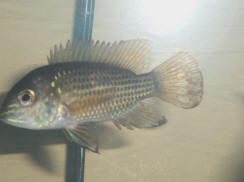 |
Re: mysterious white spots, Morulius sys.
3/11/09
BTW? what is this? the shark is already about 8 or 9 inches, the
cichlids(there are 4) are all about 2 to 3 inches. does the shark
need to be in a bigger tank than the 55gallon?
thanks Alecia
<Yes... do take care as this (and all minnow-sharks) are
notorious "jumpers"... IF yours is "spooked"
it will damage itself, perhaps end up on the floor. An animal of
this length really needs to be in a bigger world...
Bob Fenner>
Re: mysterious white spots (Cichlids in a hexagonal
tank! Oscars in 30 gallons!) 3/15/09
the 4 cichlids, black shark minnow and a small Cory cat are in a
rectangular 55 gallon tank. we only have guppies, a couple
snails, and some shrimp in our 30 gallon hex. my levels are back
down to zero with the
frequent water changes.
<Good.>
the translucent spots on my black shark are still present and he
now has what looks like a missing scale approx. 1 1/2 cm in
diameter on his side.
<Missing scales grow back in time.>
I haven't treated them yet, just got back to my email. will
treat with Metronidazole. thank u_alecia
<Happy to help. Feel free to use some capital letters next
time you write!
Good luck, Neale.>
we also no longer have the Oscar, he went back to the store a
couple weeks ago!!
<Probably wise. Cheers, Neale.>
|
FW Fish Deaths
2/23/09 Hello guys/gals! I wrote a few weeks ago concerning my
blue ram, Lymphocystis, and fish death ... You asked me for more info
so here it goes (sorry it took so long). 60gal ... Little over 1yr old.
2 whisper 60 filters, 3 air stones. My ammonia is o, nitrites o,
nitrates 40 or less. pH is 7.4, temp is 78/79f. I do a 50% wc once a
week. Fish stock(after deaths): 4 Angel fish (1in babies) 2 bamboo
shrimp 4 black neon tetras 3 cardinal tetras 1 dwarf Gourami 4 emperor
tetras 3 German blue rams 1 Mickey mouse platy 9 neon tetras 3
Otocinclus catfish 3 peacock gudgeons 2 sword tails And before you give
a lecture about the tetras they school within groups of the other
species. Anyways you asked what fish have died ... In the past month
I've lost 1 angelfish, 2 blue rams, 1 oto and 4 emperor tetras. I
thought it was the blue rams disease killing everything but this the
other day I could have swore I saw black algae growing on the fake
plants ... Its possible it could've been in there for MONTHS. So my
question is this ... Could OTS or the black algae have something to do
with the sudden deaths? I KNOW it's not my tank maintenance bc I
keep my tank clean and I have always kept a tight cleaning schedule.
Thx! Nick <Your nitrates are too high for many species. I usually
recommend to keep the nitrate levels at 20 ppm or less. This may not be
your fault. Check the nitrates of your tap water. In many agricultural
areas the nitrates may be as high as 50 ppm. This is because years of
fertilizer use have leached through the ground water into the aquifers
and now the nitrates are in the ground water. So how do you reduce the
nitrate levels when water changes won't work? Live plants will
help. This black algae is growing because of the nitrate problem. I
would recommend getting an R/O unit. These pretty much reduce
everything and leave you with mineral free water. Lots of articles on
using R/O on WWM. Initial cost may be high but well worth it in the
long run. Many for sale on eBay.-Chuck>
Re: Fish death FW Fish Deaths
II 2/23/09 Thx! That could possibly be the problem as my
tank does have live plants in it. I have recently moved and I have not
tested the new water. In terms of nitrates, its not always that high
its usually 20 or less but 40 is the max its ever gotten. 2 more
questions : If I test my tap water and it DOSN'T give me any kind
of reading what else could be the problem? (I keep my tank lights on
for 12hrs a day and I do not have any other algae growth in the tank,
and also its only growing on the plants hanging at the top of the
tank). < The water at your new place may be different in terms of
water chemistry (pH, hardness, etc...) and fish usually don't like
big changes. Combine that with the move and the fish could be stressed
by a combination of both factors. Test the new water and compare the
results with what you were getting at the old place.> If I do get a
high reading what other options do I have other than R/O water saying
as I really don't have the $ for that. Thx again. < With a R/O
unit you know exactly what you have in the water, nothing! This way you
can add the buffers to get the water where you want it and keep it
there. The other alternative is to match the fish up with the water you
have. Hard alkaline water is good for many fish but not so good for
others.-Chuck>
Deadly Diseases: Lymphocystis,
Glugea, and Henneguya. 02/09/09 Hello All! Just writing this
bc I had an important question and maybe something you don't deal
with often ... Before I start I have a 60 Gallon FW tank that has been
running for about a year. My ammonia/nitrites are always 0 and my
nitrates always 40ppm or less ... Anyways, about 1 month ago or so
(maybe a little longer) I noticed one of my blue rams which I've
had almost a year had white pimple looking bumps on the top of his head
... After researching I came to the conclusion that he had Lymphocystis
so I left him in the tank. It would spread around his face, reappearing
on a different spot on his head as another healed but never got any
worse than when I first noticed it (he is still alive btw). Now, my
question is this ... What is the chance that this isn't
Lymphocystis and is Glugea or Henneguya? (I never took him out of the
tank bc everything I've read said these diseases are even more rare
than Lympho.) The reason why I ask is bc over the past 3 - 4 days I
have lost 4 or 5 fish for unknown reasons ... And they all exhibit the
same signs: Loss of color. They were all eating and active except for
the color and it got to the point where I could look in the tank in the
morning and know which fish were going to be dead by the time I got
home from work based on the color. Glugea and Henneguya is the only
reason I could think of bc I have not done anything different to my
tank in a long time and I religiously keep my tank clean and
maintained. So what is your opinion bc I truly believe that my whole
tank will be dead in a month or less at this rate. (Which means I
convert my tank into a dart frog tank and forget fish forever lol).
Thanks for the insight. -Nick- <Nick, I think these are unrelated
issues. Lympho is by far the most common viral disease among cichlids;
or at least, the most common one aquarists can recognise. It isn't
fatal, and as you've noticed, it comes and goes. It's a
nuisance, but doesn't seem to harm the fish any, and eventually
goes away. If you're losing a bunch of fish -- of different types
-- in a short span of time, it's most probable there's an issue
with water quality or chemistry. Also consider reviewing diet,
temperature, and even the age of the fish. So: What are the fish? What
is the water chemistry? Cheers, Neale.>
Dying fish
1/18/09 Hello to whoever gets this. I have a 40 gallon
freshwater aquarium. with some driftwood and fake plants and Emperor
400 filter. I did a water change about 2 and half weeks ago after
noticing my Nitrates at about 20 or so on my test kit. Matched the
water to 1 degree difference and treated the new water in buckets with
Amquel Plus approx 1/4 teaspoon to each of (2) 4 gallon buckets.
<Mmm, best to let new water "set" for days to a
week...> My fish are (and were) as follows: 1-gold gourami,1 Opaline
gourami,4 leopard Cory's, 3 brilliant Rasboras and 3 guppy's. A
couple days after water change two of the guppy's died. I got those
out of the tank. About a week ago I noticed two of the leopard
Cory's gone but could not find any skeletal remains and this
morning I realized I can't find the third guppy or its skeletal
remains. So now my fish list is; the two Gourami, three Rasboras and
two Corys. None looked or acted normal and the dead and missing never
looked abnormal. This morning I did a test on water found Nitrate 0 and
Nitrite 0 but ammonia was between 0.5 and 1.0 (in the past my
parameters were always the norm amm.0 "nites0"trates had
traces. I assume the latest readings were probably because of the dead
fish? <I would guess this too> Did my cycling stall? <Mmm,
no... much more likely was just overwhelmed with the large infusion of
protein> if so on either reason what do I do? <Water changes,
less feeding... Reading:
http://wetwebmedia.com/FWSubWebIndex/fwammfaqs.htm and the linked files
above> I did a 25% water change right away tested water, ammonia is
at 0 "for the moment". Should I do another partial water
change NOW? Should I wait for a couple days? or should I resume normal
schedule when doing tank cleaning? <Read... the actual response that
might make most sense depends on information you have not given, but I
would NOT feed at all if you have more than half a ppm of NH3
present> thank you for the help and PLEASE I would appreciate any
thoughts or ideas of something I probably have not thought of. Thank
You Joe <I can't discern from the data presented what the actual
cause of initial deaths was... It might well be that one of the
Trichogaster gouramis is a killer... but I would likely add some
redundant filtration here (perhaps a small inside power filter) to
sustain biofiltration and more... should your Emperor lose it during
cleaning, what have you. Bob Fenner>
My poor fish... FW Losses,
investigating... - 12/06/08 Hi, About 6 months ago
I set up a new tropical aquarium. I did my best to do as much research
as I could about the types of fish that my daughters wanted (trying to
make sure that they would be good tank mates and making sure that the
fish would have a good environment in which to live in). <Good>
With that said, we put 6 platy's (4 female and 2 male) into a 20
gal. tank and then a couple of weeks later we put 3 male guppies and
one red tail shark <Yikes... these little minnows can be/come unholy
terrors with more peaceful fishes...> into the same tank. All of the
fish were roughly the same size and came from a what I considered a
good resource. I have maintained the water and it is of excellent
quality. Aprox. 2 weeks after adding the guppies one of our Platy's
clamped his tail fins up really tight. I looked him over as best I
could to check for any signs of illness and except for his tail fins he
showed none. At that time he also started hiding a lot. I did research
on the web and was unable to find any answers to what might be wrong. I
asked at the store where he was purchased and they asked for a sample
of the water which I gladly took to them and they tested both the water
quality and they tested the oxygen level in it. They said it was all
fine. That perhaps he just needs time. They said let him hide and do
his thing. I found him in the tank lying on the substrate dead two days
later. I took him to the store where I purchased him along with a
sample of the water. They looked him over and tested the water and
could not come up with any reason for his death other than perhaps he
was just a bad fish. <Mmm, this "does happen" with some
species, sources... including platies, other livebearers... Many are
raised under very challenging circumstances... historically have too
high consequential losses...> I said o.k. Consequently they did
replace the fish (I didn't ask them to.... they just offered). I
also went ahead and purchased two Plecos <Mmm, do try to find out
the species here... Most "Plecos" get way too large for a
twenty gallon volume ultimately> and two male swords for my tank on
the same day. A week later I noticed another male platy with the same
symptoms as the one that had died (not the new male platy, but the one
that was originally bought). Again, I did more research and still came
up empty handed as to what was wrong. He died with-in a couple of days.
2 weeks later it happened again.... this time one of my female platys.
After the female platy died (in Sept.) I did replace her with another
female platy which has since had baby's. O.K. it has been a while
now since she died and I (incorrectly) thought that (whatever
"it" was) it was over. One of our male swordtails died
yesterday... he displayed the exact same symptoms as the platy's
that had died.... Do you have any idea what is wrong? <Mmm, only can
guess, given the paucity of data here... but have much experience with
these "mysterious" losses...> The other fish all seem
fine. I did not remove the pregnant platy or her fry when they were
born. Since I am not a fish breeder I felt that I would just let nature
take it's course with them. I do have some plastic plants in the
aquarium and a cave that we made out of rocks. The temp. is at 75
degrees F. and the water tests come back really good. I also have a
bubble wand for the oxygen which does create some current in the back
of the tank where it is located. Any help that you can provide would be
appreciated. Thank You, Rebecca <The livebearer losses are likely
resultant as stated... from the vagaries of their production,
transport... "stress" from adapting to new circumstances...
The fish (other than the Cats) that you list, enjoy/need hard, alkaline
water, or not too high temperature... and a lack of accumulated
metabolite (e.g. ammonia, nitrite, nitrate et al.)... Please read here
re: http://wetwebmedia.com/FWSubWebIndex/platydisfaqs.htm and the
linked files above... for background, insight... Bob
Fenner>
Anchor Worm? 11/11/08
Good day again. You guys have been really helpful with my loaches and
frog, so I was wondering if you could possibly identify a parasite
I've seen on my fish. It's on a Juli Cory, and I've only
seen it on one of the five cories I bought from that tank. (They're
in a five gallon tank with a beta and a bronze Cory) <Far, far too
small for Corydoras, which at minimum should be kept in a 10-gallon
tank and realistically a 20-gallon tank. By the way, the Betta is not a
Beta (I think this misspelling comes from the way Americans
(mis-)pronounce the word, which is really more like "better"
than anything else).> They're on his fins, which are ripped up
pretty bad. I put some stress coat in there, since it helps ripped fins
heal faster as long as they aren't too deep. (It's worked on
guppies that have had most of their fins torn up) <The ripped up
fish could be either Finrot or physical damage. Corydoras are prone to
being nipped by some fish, and while I wouldn't predict a Betta
would do this, it isn't impossible. But more likely, poor quality
water is favoring the growth of opportunistic bacteria, and these are
eating away at the fin membranes.> The fish seems fine; he's
eating and foraging normally. I'm not sure if it's anchor
worm...It's very small; almost microscopic. At first I thought they
were the ragged edges of their fins, but then I realized that they were
worms. <How did you "realize" these were worms? On what
basis? If you saw white threads, these are more likely to be Fungi or
dead skin. Red patches are signs of inflammation. All these symptoms
are commonly associated with Finrot.> I'm planning on
dismantling the tank and treating it with potassium permanganate once
the preventative course of blue has been run, but I'm wondering if
I should do it sooner or if the blue will kill the worms. The only
thing I've seen like them were white little runners of algae on the
tank walls, but they weren't on the fish. Unless whatever this is
gets everywhere and I just haven't seen it on my fish yet. Iunno.
The only consolation I have now is that I put them in the quarantine
tank. <Please tell me this quarantine tank isn't even smaller
than the 5-gallon tank. That would be crazy.> P.S. This might sound
like a dumb question, but should I remove the beta? I've had a beta
with cories in a tank before and they were fine (I think said beta was
actually afraid of the cories), but this one keeps puffing his gills at
them and attacking them. He hasn't hurt them yet and usually just
swims away, but I'm worried he might kill them eventually. <In a
20-gallon tank, which is what you need, it is very unlikely the Betta
and the school of Corydoras would even interact, much less hurt one
another. There's no excuse for keeping these fish together in a
5-gallon tank, so I won't bother discussing that further.
There's no way to keep them all cooped up in such a small aquarium,
so end of discussion really.> They seem to have developed a system
of "drive bys" where they head-butt him and then hide,
but...Yeah. Thank you for any help you can offer! : D <You need to
upgrade the tank, check water quality, treat for Finrot/Fungus promptly
(and not with rubbish like Melafix/Pimafix). Cheers,
Neale.>
Problem Tank? 11-10-08
Hi guys, love your site, so informative! I have a 55 gallon freshwater
tank, 1 year established. I have lost 10 fish over 7 month's time.
Don't know why. Hoping for your help. Started with 4 mollies, 3
dwarf Gouramis, 3 Cory cats (if I recall correctly), 1 Pleco, 1 common
goldfish. I have since learned my LFS was in error to advise me on this
combo of fish. I have had the goldfish for 7 years, the Pleco for 3,
the others came in 1 year ago. Living conditions as followed: 55g
freshwater tank, marine land bio wheel 350 power filter, gravel bottom,
aeration stones, moderate (fake) plants and rock. Temp around 78
(goldfish is fine with it this warm), aquarium salt with tank changes
as per directions on box. Ammonia 0, Nitrate approx 20, nitrite 0,
hardness approx 50-70ppm, alkalinity 120, ph approx 7.5. food is
tropical flakes, salmon flakes, fresh veggies, krill, (changing it up)
algae tab for Pleco at night, I feed small amount once/day, sometimes
every other day, feeding is never an issue. <Great variation in the
food, keep it up! How much salt are you adding?> Natural light
during day, fluorescent night in evening, and no light overnight. Do a
20-25% water change every 8-10 days, 50-75% once/month, vacuum gravel
as needed (once/week usually). Other than these things I do not ever
make changes to the tank. I keep an established hospital tank with the
same parameters except warmer temp. depending on whose in there and
what I am treating, and always treat for disease only in quarantine as
to not effect the main tank. My local fish experts say my tank is
great, so the question is, why are my fish dying? In the last 7 months
I have seen popeye, fungus, columnaris, tumor, sudden death with no
apparent reason, velvet, something never diagnosed where the fish
developed a hole near its gill and started bubbling through it
(although not diagnosed as hole in head disease) and currently I am
losing my last molly to dropsy. I am assuming bacteria although did not
respond to any antibiotics. After this one goes I will be left with the
2 originals, the Pleco and goldfish. All of my fish have had different
symptoms, none concurrent with another. All tank mates seemed to get
along well, surroundings around the tank are peaceful (no kid hands or
pounding, flashes, etc.) I would think emotional stress would be non
issue. Why would all these problems be over the course of a year to
play out? If you can give me info on what I am doing wrong or should be
doing differently, I would so much appreciate it; I can't seem to
find real help anywhere! Sorry this is so long, wanted to give as much
info as possible. thanks! <Well, I would have to agree with you,
your tank sounds great. Your water chemistry is in great conditions and
your tank has adequate filtration. Have you ever asked if it wasn't
your tank but the LFS? Possibly they have unhealthy fish and you are
getting stuck with the care. All of the problems are bacterial and I
would bet that your LFS is the main cause. Here is a link on freshwater
disease that should help you.
http://www.wetwebmedia.com/FWSubWebIndex/fwdis3setsfactors.htm . You
are welcome! Merritt A.>
Dying fish problem
11/05/08 Hi <Hello,> I have had a 60litre Aqua art tetra
tank for 18 months, have had births deaths etc., not succeeded with
certain fish, but recently have lost a lot of fish for no apparent
reason. <Unlikely "no" reason. Almost always when multiple
fish of different species die the cause is simple: poor water quality
and/or variable water chemistry. Simple as that.> This week I have
lost 8 fish. I have checked parameters: Nitrite 0, Nitrate 10, Ammonia
0, ph 7.5. <Do check the ammonia and nitrite concentration across
one day, perhaps three or four times. In particular measure the
ammonia/nitrite 30 minutes or so after feeding, as this is when the
concentration can go up. Given the size of your tank (tiny) and the
number of fish in the tank, I simply DO NOT believe you can have good
water quality and stable water chemistry.> At the start of the week
I had: 7 Neons (4 of these where added last week), 3 Glowlight tetra, 2
rummy nose tetra, 4 penguin tetra, 3 guppy, 1 clown loach, 2 suckling
loach and 4 harlequin. I am left with 2 Neons, 3 Glowlight, 2
rummy, 1 penguin, 1 clown, 2 loach and 2 very poorly looking guppy.
<Do check your filter is working properly. Make sure no-one is using
anything toxic nearby the tank (e.g., paint fumes). Check the fish food
isn't past its "use by" date. You're losing lots of
fish in a short period, and this SCREAMS OUT LOUD that there is an
environmental issue of some kind. Diseases tend to kill one fish at a
time, and with obvious symptoms. Viruses tend to kill just one species.
When lots of different species die within a few days, then there's
something wrong with the tank.> The 2 guppy are in a keep net in the
same tank, 1 of them, (female) back end is limp but swims and eats ok,
the second a male is having spasms, (diving, swimming fast flipping
over in the water). To make things worse I have physically lost 2
Neons and a guppy in the tank (literally disappeared), I have removed
ornaments, removable plants and filter but cannot find them, can they
have been eaten? could this be causing the problem?, or is the spasm
like guppy causing the problem? Is there a solution to this problem?
<The missing fish would be eaten by the Clown Loach or Sucking
Loach. By the way, Clown Loaches are schooling fish and completely
unsuitable for your aquarium. They get very big (20-30 cm) eventually,
and really need to be kept in groups for them to be happy. The Sucking
Loach (Gyrinocheilus aymonieri) is an extremely nasty, territorial fish
when mature, and I wouldn't let one anyone near a community tank,
let alone one as small as yours.> Thanks Jason <Cheers,
Neale.>
Re: Dying fish problem
11/05/08 Hi Thanks for your quick response, brutal but honest!
<That's what we do!> I feed my fish once a day, fed at 7pm.
Have checked ammonia/nitrite as you recommended ammonia 0, nitrite 0.
<Sounds good.> I'll check 3/4 times a day for the rest of the
week, if there are spikes what should I do? <If you detect ammonia
and/or nitrite, then that's something stressing your fish. What
you're looking for is anything that might make your fish sick or
poisoned. Ammonia, nitrite, the wrong temperature, pH changes,
etc...> The carbon mesh has been in for 18 months without
deterioration, rinsed in tank water, the filter is a carbon filter that
is replaced every 4 weeks with a new one. <Not a big fan of carbon,
as its mostly useless in freshwater tanks, and among other things
removes medications from the water. So for example if you have to treat
Ick or Finrot, and then you add the medication, your fish still die
because the carbon removes the medications! That's a VERY common
mistake.> So therefore I feel that the filter is working ok.
<Cool.> But maybe I'm wrong. A 20% water change is done every
Sunday. <Should be ample, if the tank isn't too busy. I'd
recommend 25%, but what the heck.> Do you recommend the use of salt,
if so how much? <Not really, no.> would this help? <For very
specific things, salt helps. But it's best considered a medication
rather than something you add routinely (like dechlorinator).>
Thanks again Jason <Cheers, Neale.>
HELP! Numerous sudden fish
deaths
Sudden Fish Deaths, FW -- 10/10/08
Hello crew! I've had a problem with "sudden" fish deaths
as of lately and I can't find any answers from anyone so I'm
asking you bc you are the most knowledgeable source I know.
< Thank you for your kind words.>
I looked on your website and couldn't find the answer that I felt
pertained to my situation so if this has been answered previously I
apologize ahead of time.
< No problem.>
I have a 60 gallon freshwater tank with 2 whisper 60 filters and 3 air
pump/air stones, and a small MagDrive pump to provide a little current
for my bamboo shrimp. I also added 4 bags of "bio stars" to
the filters to help with bio filtration. I've had this tank running
great for about a year. I religiously keep my tank clean and do 30-40%
water changes every other week. My ammonia, nitrates, and nitrites are
always at 0 and my pH is 7.4 - 7.6. I keep my temp @ 77 F (based on
your recommendations) and I now only feed my fish once per day (per my
LFS). Now here's my problem: 3 months ago I had ich in my tank. I
used Maracide and it cleared up in about 3 days, I did my 50% water
change 2 days later. 1 week after that I had 2 swordtails die. 2 days
later a bamboo shrimp died, and the next day a sunburst platy died. My
LFS said it was probably a coincidence and it was their time to go. I
replaced the 2 swordtails and the sunburst a week later and everything
was fine after that. About 1 month ago I had another ich outbreak so I
purchased Aqua-Sol and dosed it at half the recommended dose due to my
bamboo shrimp. It cleared up in about 5 days and I continued treatment
for another 5 days and then did a 50% water change on the 11th day. 1
week later I added some emperor tetras and a couple cardinal tetras. I
also changed 2 of my 4 filters in the whispers, bought 2 new aqua-Glo
lights, removed all my dead plants and added 2 aqua ferns. I also added
a bottle of bacteria supplement to help with the new filters. Now 1
week ago I had a swordtail die. 3 days ago a cardinal tetra died and 2
snails died. Yesterday my male Betta and female Betta died, and this
morning my last female Betta died. My fish list now in the tank is as
follows:
2 Angelfish
3 Bamboo Shrimp
4 Black Neon Tetras
2 Cardinal Tetras
1 Dwarf Golden Puffer
8 Emperor Tetras
2 German Blue Rams
1 Mollyfish
1 Mystery Snails
8 Neon Tetras
2 Swordtails
2 Sunburst Platys
2 Tuxedo Fish.
Obviously not listing the fish that have recently passed. The fish
had/have no signs of disease, they were/are all active and eating. I do
not understand what is going with my tank at all. I do not use
chemicals like Windex or anything near my tank and my parameters were
the same this morning as previously stated. I am getting highly upset
and discouraged bc these deaths are very mysterious and sudden and
there seems to be no answer for anything. What do you think in your
opinion is happening and what can I do to prevent this from continuing?
Your help is very much appreciated and I feel you are my last hope.
Thanks! - Nick -
< Recommendation #1- Anytime you medicate an aquarium you run the
chance of modifying your biological filtration. Some medications say it
will not harm it, but I have always found that there is the potential
to modify or eliminate the good bacteria and wipe out your biological
filtration. With biological filtration gone the tank is prone to large
variable ammonia and nitrite spikes. When fish start to die the spikes
get even more severe. Ammonia and nitrites are very toxic to your fish
and other aquatic animals. If possible I usually recommend treating
sick fish in a hospital tank. I realize a tank full of fish infected
with ich makes this impractical but for an individual fish with an
ailment it is best top treat in a hospital tank.
Recommendation #2- Quarantine all fish for a minimum of two weeks
before placing them in the main aquarium. New fish always seem to be a
problem and it is best and cheaper to treat them in a smaller more
manageable hospital tank before they contaminant your entire tank that
you have worked so hard on and spent so much of your hard earned
money.
Recommendation #3- I have found only one bacterial additive that I have
found effective. It was called Bio-Spira from Marineland. It is no
longer being made and existing bottles are now too old to be effective.
The creator of Bio-Spira is Dr. Tim Hovanec. He now makes this product
under his own brand Dr Tim's Aquatics and it is called The One and
Only. It is difficult to find stores but can be purchased online at
Drsfostersmith.com.
Recommendation #4- For treating ich you simply could have increased the
water temp up to 82 F for a week or so. At the higher water temps there
is less dissolved oxygen in the water. You have lots of aeration so the
fish should not have had a problem. After they were cured you could
then lower the water temp back down to 77 F. Hope this helps understand
what went wrong.-Chuck>
|
Re: HELP! Numerous sudden fish deaths
10/12/08
Sudden Fish Deaths II
Thanks for the quick reply. Yesterday after writing you I came
home to find one of my emperor tetras had popeye. He passed last
night. So I went to my LFS and purchased a boxed of powdered
Maracyn thinking maybe I have some type of bacterial infection in
my water. Your explanation of QT new fish would help except for
the fact that all the fish that have died have been in my tank
for months.
<The QT tank is for all new fish before they are placed into
the main tank. After an outbreak of disease the tank could be
used for isolated cases of individual diseases and treatment. I
would have put the infected emperor tetra in the hospital tank
and treated with Nitrofuranace and Metronidazole.>
Now my problem is that my dwarf golden puffer has refused to eat
anything for the past couple of days. He's been hanging out
near the bottom of the tank near the plants. Is there anything I
can do to save him or is it too late? He doesn't have any
signs of disease. My LFS says that maybe my tank is overstocked
and that's why my fish are all dying off. They also stated
that bad water quality would kill my fish except that is ruled
out bc my bamboo shrimp are doing great and would have been the
first to go if wq was bad. So my question is 2 fold. #1 can I
save the puffer and #2 what is causing fish that have been in my
tank for months to die? (The Bettas that passed have been in my
tank for 6-7 months and were the "oldest" fish in the
tank besides my Neons) thx again
< You have now treated the main tank with another antibiotic
for a fish that has now passed on. You have probably affected the
biological filtration once again and are subjecting your tank to
probable ammonia and nitrite spikes. I would recommend checking
the ammonia, nitrite and pH at regular intervals and use those
results to direct your attentions instead of using the bamboo
shrimp as an indicator species. With all these fish deaths it is
hard to believe the nitrates are still zero. In your first email
you did say a bamboo shrimp had died. Next time you go to your
LFS, please ask them specifically how overcrowding may cause the
problems you are encountering.-Chuck>
Re: HELP! Numerous sudden fish deaths
Sudden Fish Deaths III
Ok. Now as I said before I do test my water but usually once per
week. If I am looking for spikes should I use the water closer to
the bottom of the tank or from the surface where I usually
collect my sample?
< You can collect the water from any source. Top or bottom
should make no difference. After the first fish died I would
recommend a water quality check right after the death was
noticed. If everything was still fine then I would start to look
at other issues.>
Also, the response the LFS game me was that my tank is
overcrowded possibly stressing out the fish making it easier for
them to become sick due to the "bad" bacteria that are
always present in the tank.
< Stress is definitely a factor in all fish diseases. It
lowers their immunity so "bad" bacteria and other
pathogens can attack and further stress your fish. I don't
really buy into that over crowding theory. Many fish are found in
large schools. If they were stressed and did not want to be in a
school then they would swim away. Yet they crowd together for
safety. You might be able to say you have incompatible species.
This means that some fish are picking on others and the ones
being picked on are obviously being stressed.>
You have seen my fish list. Do you feel/agree that my tank is
overcrowded? I personally do not believe so but then again
I'm not the expert, you are. Thanks again for your help.
< No, I don't think your tank is overcrowded. I do have
some concerns with some of your tank mates. Large angelfish will
eat smaller tetras and baby fish. Your angels may be OK for now
but adults will definitely go after the tetras. If they cannot
eat them outright then they will go for the eyes. The emperor
tetras need to be all females and one male. Males do not tolerate
other males and they will fight until one is killed. A 60 gallon
tank may be big enough for them to each male to find their own
territory. The cardinal tetras need to be in a school to be
happy. The livebearers and the puffer probably should have some
salt in the water. Most puffers come from brackish water. See if
a teaspoon or aquarium or rock salt per 10 gallons will perk him
up.>
Ps. so far my puffer is still alive but he hasn't eaten in
3days. I want to save him if I can. On a positive note I
haven't had any deaths since the last time I wrote you.
<Try the salt and look up your puffer to see if indeed it is
one of the brackish species. Many puffers can live in freshwater
as juveniles but migrate to total salt water as adults. Glad to
hear your tank is doing better.-Chuck>
Re: HELP! Numerous sudden fish deaths
Hello again! Ok after the 2 Betta deaths I tested the water and
came back the same as it always did ...0. So if that's the
case what else would/could it be?
<Tested what? Zero ammonia, zero nitrite, zero nitrate...?
"Zero" by itself covers a lot of different things. For
standard community tropicals, you're after 0 ammonia, 0
nitrite, and less than 50 mg/l nitrate.>
In terms of the angelfish if I was to buy a larger tank like say
90-125 gallon would that be large enough or will they still kill
the tetras?
<Depends on the tetras: Anything Neon-sized is Angelfish food.
It's what Angelfish eat in the wild, and while some Angelfish
behave themselves -- in the same way some dogs don't chase
cats -- banking on it is extremely imprudent.>
If so, is there a such thing as a "dwarf" angelfish?
...
<Yes, it's called Pterophyllum leopoldi and gets to a
maximum length of 10 cm, quite a bit smaller than the 15 cm
length of wild Pterophyllum scalare. Pterophyllum leopoldi is
only very rarely traded and invariable expensive. When sold here
in England, specimens are typically around £20 (around
$40) a piece. They require soft, acidic water and are every bit
as difficult to keep as Discus. Not suitable for community tanks.
All this said, the cheap hybrid Pterophyllum angelfish sold in
most pet stores rarely get much bigger than 10-12 cm in length,
so could be considered "dwarfs" by comparison with
their wild ancestors, Pterophyllum altum and Pterophyllum
scalare.>
I've never seen them attack other fish but they do pick on
each other every once in awhile but then other times they swim
around together. Either way I would hate to have to get rid of my
angelfish bc they add such beauty to my tank ... Same as my
tetras so if there is a smaller species I would love to know
about them.
<Angelfish will school in large tanks when kept in [a]
sufficient numbers and [b] sufficient space. However, stocking
the required 6 or more specimens will require a big tank and good
filtration. Moreover, during the breeding season pairs become
territorial, and so the tank needs to be big enough to allow each
pair a territory around 60 cm in diameter around their spawning
site.>
Before I purchased my golden dwarf puffer I did A LOT of research
and everything I read about them stated that they were one of the
few puffers that were true freshwater puffers.
<There are several puffers sold as "golden puffers"
of which at least one species is a brackish/marine fish,
Xenopterus naritus. Another is a marine species, Arothron
meleagris. While Arothron spp. are only rarely sold as freshwater
fish, Xenopterus naritus can be easily confused with Auriglobus
spp., the "bottle green" gold puffers. In any case,
since Auriglobus and Xenopterus spp. are incredibly nasty fish,
they need their own tanks so modifying water quality to suit them
won't cause problems. All are fin-biters and fish-eaters, and
they cannot EVER be kept in communities permanently. Dwarf
Puffers (Carinotetraodon spp.) are sometimes proposed as
community fish, but in the long term this rarely works out
because most species (possible exception: C. irrubesco) are
territorial and confirmed fin-biters.>
I've had him about 3-4 months and he is one of my fave fish
besides my blue rams. Up until the past few days he was eating
and "curious" like most puffers but now like I said he
kinda stays outta the way hidden in the plants and doesn't
eat when before he bumrushed any food he saw, and in terms of
salt, I always keep salt in my tank.
<You shouldn't add salt to tanks with freshwater fish, and
certainly not soft water fish. The reasons for this have been
amply discussed before. It's old school fishkeeping and
likely causes more harm than good in the long term.>
The cardinals school with the neon tetras and the black Neons
school with the emperors.
<OK.>
Now back to the deaths, if my WQ is good barring that my API
liquid test kit quits working properly then what else do u
<you...>
suggest could be causing sudden death? Or is it possible that all
the deaths in the past 3 or 4 months could be just
coincidental?
<One death is just something that happens... a whole series
implies a problem. Review water quality of course, and water
chemistry, but also water temperature (for example your Rams --
Mikrogeophagus ramirezi -- MUST HAVE much hotter water than Neons
tolerate in the long term). The abysmal survival rate of Rams is
in part due to them being kept too cold; they need something
around the 28-30 C mark, and that's lethally hot for Neons,
which prefer 22-25 C. Likewise Cardinals prefer warmish water,
around 26-28 C, and that's likely one reason why people often
have success with either Cardinals or Neons but rarely both in
the same tank. Also review diet and social behaviour (I find it
hard to believe your dwarf puffers are leaving the other fish
alone).>
What is the rule of thumb for the amount of time waited
in-between adding new fish to a tank?
<That's what your test kits are for. If the
ammonia/nitrite are zero, nitrate stays manageable, and pH is
stable, then your tank may have space for more fish.>
Thx
<Chz. Neale>
Re: HELP! Numerous sudden fish deaths
Hello. Hope you are not tired of hearing from me yet!
<Not at all! Fire away!>
When I said "0" I meant ammonia, 0 nitrites, 5ppm
nitrates. As I've said in the past I keep my temp @ 77F. The
only salt I added to my tank was the typical FW aquarium salt
that aids in gill function & health.
<And which qualified fish biologist told you "typical
salt" helps gill function and health? Please understand,
freshwater salt does nothing of the kind and the only people who
use freshwater salt are inexperienced fishkeepers who get tricked
into buying the stuff. Salt has several therapeutic functions,
but as with ANY medication, what is useful in the short term may
not be so useful in the long term. In this case, there are many
situations where certain freshwater fish react badly to prolonged
exposure to salt. Malawi Bloat in African cichlids is one famous
example. Certain freshwater fish admittedly do better in slightly
brackish water -- Guppies and Mollies for example -- but for
these, you're better off using proper marine mix because it
isn't just the salt they need but the buffering chemicals
such as bicarbonate salts. Unless you actually understand why
you're adding salt, my advice is not to use it. Much safer.
Please trust me on this -- among other things, I literally wrote
the book on adding salt to freshwater aquaria! (Brackish-Water
Fishes, published by TFH.)>
If I was to replace the 2 angelfish I have now ( they are both
3-4in each) with the smaller species would they still be a threat
to my Neons? Or is the only answer to not have any angelfish at
all?
<Pterophyllum leopoldi has extremely specific requirements. It
is suitable for either a single species aquarium, kept in groups
of 6, which is going to cost you £120 ($240), or else
in a very carefully designed community alongside other fish that
need warm, soft water. Even assuming you could find Pterophyllum
leopoldi in your local fish shops, I wouldn't recommend you
buy them before spending time researching their needs.
They're far from impossible to keep, but just like Discus,
many have tried and failed through lack of preparation.>
In terms of the puffer, in these 3-4 months I've had him he
has been quite docile. I observe my tank a lot and I've NEVER
seen him attack or chase other fish.
<Yet. Many puffers are crepuscular, that is, hunting at dusk
and dawn. So unless you were there at the appropriate time, you
might not see them doing anything naughty. To be fair, I keep two
Pufferfish species in my community tank, so I'm not 100%
against the idea. But without knowing specifically what species
you are keeping, the simple law of big numbers means the odds are
against you. Most species, and most specimens, are at least
sufficiently nippy they don't work out in community
tanks.>
The only things he has ever nipped at were my snails. But, going
back to my first question a few messages back, is there anything
I can do to save him/get him eating again before its too late and
he expires?
<Pufferfish have very specific palates: frozen molluscs, worms
and crustaceans, or live equivalents, are what they eat. If the
puffer is overwhelmed by competitors at feeding time, then you
have a problem, though my specimens at least seem to hold their
own just fine, especially when the food is "shelly",
for example krill. There is absolutely no point waiting for
puffers to eat flake, pellets, freeze dried foods, etc. Not going
to happen. Generally pufferfish are greedy when healthy and
offering things they wish to eat. When puffers turn their noses
up at food, it's either the wrong food or they're not
healthy. Do try and identify the puffer at hand: water chemistry
may be a factor.>
As I stated before in terms of social behavior the only
"bickering" that goes on in the tank is the 2 angels
goin back and forth with each other.
<This will get worse. Have seen angels kept as pairs, with one
biting the eyes off the other fish! These fish can be severe
bullies. Again: understand their social behaviour. They school
when young and sexually inactive; the rest of the time they are
territorial.>
All the other fish (including the puffer) get along great). In
terms of diet, I feed my fish Omega 1 super color once per day
and frozen blood worms every other day. (The puffer obviously
only eats the bloodworms).
<Normal.>
I have a powder I made for my bamboo shrimp consisting of algae
discs, freeze dried krill, tropical flake food/pellets that I
sprinkle in everyday. And occasionally some live brine as a
"treat".
<Can't see the puffer going for that, though it sounds
yummy enough for the other fish.>
Also, on a good note is this morning I awoke to find 1 of my
bamboo shrimp molted...making that 3 for 3 in terms of 1st molts
in my tank (yes I add iodide now) 1 drop for every 10 gallons.
But the puffer is still hanging on for dear life at the bottom of
my tank near the plants. Hope to hear from you soon. Thx
<Sounds like good news. Keep observing, reading, experimenting
with alternate foods. Cheers, Neale.>
Sent from my Verizon Wireless BlackBerry
<Sent from my MacBook Pro.>
Re: HELP! Numerous sudden fish deaths
Here is pictures of my angelfish and my puffer
<The Angels are standard issue hybrids; the puffer appears to
be Carinotetraodon travancoricus, though it is too blurry to rule
out the less often seen Carinotetraodon imitator. In either case,
neither of these two species is recommended for community tanks.
They are normally kept in groups on their own, under which
conditions they are reasonably hardy and easy to keep. Cheers,
Neale.>
|
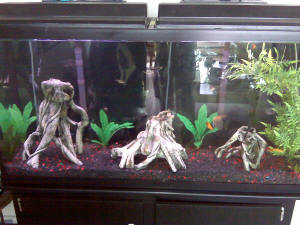 |
Re: HELP! Numerous sudden fish deaths
Pic of my tank
<Looks nice. Could do with a few floating plants (such as
Indian Fern) to help provide some shade and remove nitrate. But
other than that, should be fine for the species in mind. The
"tree trunks" especially will be welcomed by the
Angels, which in the wild stake territories around sunken trees.
Cheers, Neale.>
Re: HELP! Numerous sudden fish deaths
10/13/08 Ok ... In terms of the angelfish, what about
the other smaller species you mentioned that can easily be found
in the US ... Would it be feasible to add those into my tank
instead of the 2 I have now or is that still not an option with
the Neons in the tank? <Lots of people keep standard hybrid
Angelfish with Neons. Assuming the Angels don't get to the
full size of their wild relatives, and assuming your Neons are
tiny, you may be fine. It's just that there's no
guarantees. Angelfish of a certain size view small fish as food
-- pure and simple. In the wild small tetras are definitely
"on the menu"! If I were keeping Angels, I'd play
it safe and opt for a species slightly larger in size but with a
similar disposition, perhaps Lemon tetras or Pristella tetras.
Celebes Rainbowfish have the same shiny blue and work well with
Angels.> In regards to the salt ... I wasn't told this by
a "professional" ... Its simply printed on the box:
"natural fish tonic ... Adds essential electrolytes,
improves gill function, promotes disease recovery" ... So
are you saying never to use salt again? <I have tea that says
if I drink it, it will prevent heart disease and keep me thin.
You know what? It's marketing. Don't hold too much store
by it. The sheer fact they're repackaging cooking salt and
doubling the price should suggest that the whole freshwater salt
thing is a bit of a racket. "Tonic" is one of those
words like "wholesome" and "natural" that
marketers like -- sounds good, means nothing. Assuming your water
isn't distilled or de-ionised water, it'll have all the
electrolytes your fish needs. How can you measure
"improved" gill function? Gills either work or they
don't. Promotes disease recovery? So do clean water and good
food, and I have yet to hear of a fish that failed to recover
from Finrot or Whitespot because there wasn't tonic salt
added to the tank! If you're keeping brackish water fish or
livebearers, using marine salt mix; if you're keeping
standard community tropicals, don't use salt. It's a
simple as that.> In terms of the puffer...he's like
yours...he held his own when eating and always got his fill (his
belly would always be "plump" after eating) and would
take off like a bolt of lightning when he saw me put the worms in
the tank and now he looks at it and goes back to hiding. <All
sounds good and quite normal. He's a small fish in a big,
busy tank. Carinotetraodon are shy and somewhat nocturnal, or at
least crepuscular. I have Carinotetraodon irrubesco and they
basically "lurk" under plants or rocks until feeding
time.> I'm just confused as to what the problem is bc my
WQ isn't indicating a problem through my tests. My puffer is
a Carinotetraodon Travancoricus if that helps at all. <The
easiest thing to do is write a list of all your fish. Then dip
into a good aquarium book (or browse this site) and write down
the preferred hardness, pH, salinity (if relevant) and
temperature of each fish. Then check the conditions in your tank.
Compare and contrast: if the tank conditions match the desired
environment of your fish, you're fine; if there are
discrepancies, then that's a good place to start hunting for
problems. In any event, I'd recommend leaving the tank be for
a month or two to settle down. If fish stay healthy in that
period, it's likely inadequate filtration or pH stability
(for the original number of fish) were to blame; what often
happens is fish populations in tanks "die back" to
level at which the filter and pH buffering capacity can manage.
Cheers, Neale.>
Re: HELP! Numerous sudden fish deaths
10/13/08
Awesome! Thx for all your help. You've really helped me and I
thank you for your time. Ill get back to you future and keep you
updated as to what I do and how it turns out. Thanks Again!
<You're most welcome, and look forward to hearing how
things work out. Cheers, Neale.>
Re: HELP! Numerous sudden fish deaths
10/13/08
Well in response ... Ill have to get rid of the angelfish then
but I would like to replace them with a "smaller"
species if possible (as I stated I think the angels are beautiful
and my gf doesn't want to get rid of them so I'm trying
to find a middle ground if possible)
<There really isn't a "small" Angelfish in the
trade. The hybrids can get to anything from 7 cm to 15 cm in
length, and being hybrids, you have no idea what size they'll
be until they're mature! Pterophyllum leopoldi is in the
trade, but it's not cheap and it isn't easy. You could
try Black Widow tetras (Gymnocorymbus ternetzi). These certainly
have an Angelfish-like shape and colouration. But they are
(sometimes) nippy, so shouldn't be mixed with Guppies, Bettas
and the like. They're schooling fish, and get to about 6 cm
or so in length.>
and maybe add 1 or 2 more puffers. Would they fare better if
there were 2 or 3 in the tank? (Puffers).
<Dwarf Puffers certainly do seem to thrive in groups, though
they are mildly territorial. Allowing 3-5 gallons a piece seems
to work well.>
Thx again!
<Cheers, Neale.>
|
Losing fish
9/18/09
Hi I have had a tank for about 4 years. I recently changed the water
and the filter, which is normal. I had about 12 fish in a 55 gallon
tank. All but 1 fish is now dead. There is no sign of any distress to
the remaining single fish. The dead fish had no sign of any growth... I
have tested the water repeatedly everything is in check. Any ideas.
<Need data... What are the fish? When you say the water tests were
"in check" what precisely do you mean? When lots of different
fish die at once, then almost certainly the issue is water chemistry,
water quality, temperature, or poisons. Given the pattern, my guess
would be you did something careless with the filter, killing off most
of the bacteria, and you had a short-term ammonia spike. This killed
the fish. With just one fish left, the remaining bacteria are adequate
for good water quality, so all seems (and tests) well. But this is
speculation. Tell me what the fish were that died; what the survivor
is; what you did to the filter and aquarium through the clean; and what
the nitrite and pH tests were/are. Cheers, Neale.>
Re: losing fish
9/18/09
I lost 2 parrot fish, 2 angel fish, 2 black and silver flat fish about
2 inches long not sure of the name, 4 tetras, and I'm not sure what
the fish is that is left. I did a 10 gallon water change, rinsed and
changed the charcoal (rinsed the charcoal until the water ran clear),
cleaned off the decorations in the tank with water, added start right
to the fresh water. The test strips I have test nitrate, ph, nitrates,
hardness, ammonia. Thanks, Valerie
<Hi Valerie. Your tank sounds quite well stocked. So it's most
probable you over-cleaned the filter, or left it switched off for too
long. Here's the thing with biological filters: you should never
switch them off for more than 20 minutes, and you should never clean
the media in anything other than (old) water from the aquarium. The
bacteria in the filter media are quite easily killed, and when that
happens, you're stuck with a bunch of fish in a tank without a
fully functioning filter! Obviously a bad thing. I'm not a big fan
of charcoal, and by the way, rinsing it serves no purpose at all.
Charcoal -- actually activated carbon -- adsorbs organic compounds,
these things sticking to its surface at a molecular level. Rinsing the
stuff does nothing. It's "recharged" by baking in an
incredibly hot oven, and because that's not possible at home,
it's normal to throw the carbon out periodically. For carbon to
work as advertised, you need to replace it every 2-4 weeks. Seriously.
After that point, it's so covered with bacteria and detritus it
isn't adsorbing anything. Unless you have a specific need for
carbon -- and understand how to use it to that end -- you will be much
better off using plain vanilla biological media in the filter, such as
ceramic noodles or filter wool. Finally, always remember never to
replace too much biological media at once. The biological media will be
the ceramic noodles or sponges in the filter. At most, change up to 50%
of the stuff, but realistically you should hardly ever need to do this.
Simply squeezing out the sponges in a bucket of water taken from the
tank every couple of months will be fine. If you have ceramic noodles,
dump them in the bucket and give them a good sluice and rinse. And
that's it! In the meantime, assume your filter has crashed, and
build up the stocking slowly. Maybe add one or two new fish every month
or so. Cheers, Neale.>
Mysterious Fish Deaths,
FW 8/14//08 I had to move my fish home from work
for the summer. Ever since then they have been dying off one by one
over the summer. <When fish die like this, 99% of the time it's
environmental. Check the obvious, like water quality and pH stability,
but also check less obvious things like the use of paint in the house,
or pesticides.> One will die then usually a few weeks later another
one and so forth. I live in California, and I know heat is a factor,
but I don't suspect it's the cause. <Does depend on the
temperature! Neons, Danios and Corydoras for example are all
"cool" tropicals that won't do well above 25C/77F. The
further above that you go, the more delicate they become, and death can
easily happen if the oxygenation of the water isn't sufficient.>
California has had numerous days over 100 degrees Fahrenheit. <Do
try opening the tank hood and placing a fan nearby; evaporation will
remove some heat. Also use the old iceberg trick: get a big plastic
carton, fill with water, and freeze solid. Put into the tank (the whole
thing, not just the ice) and as it defrosts it will remove heat from
the tank. The fish will dart in and out the cold water current
underneath it, obviously happy. Make two or more of these plastic
cartons so you can cycle them as required. Cheap and effective.>
When the fish were moved I put them into their normal home, a 29 Gal
aquarium. It has an undergravel filter system only. The aquarium was
setup with tap water and the appropriate amount of water conditioner,
which also has some claim on the bottle stating it has beneficial
bacteria to help establish an aquarium. <Treat these claims with
some degree of skepticism.> The fish were inserted into the aquarium
the same day, after the water conditioner was used. The fish didn't
all die off immediately. Only one had serious problems reacclimating,
but with a lot of attention and care, it's actually still alive to
this day. The fish include mollies, platies, and swordtails. <Ah,
well if these are all livebearers, do consider adding some marine salt
mix, maybe 6 grammes per litre. It'll buffer the pH, preventing
acidosis, and it's raise the salinity, reducing nitrite/nitrate
toxicity. Note that "tonic salt" isn't a substitute. Has
to be marine salt mix, of the sort used in marine aquaria. Only marine
salt mix has the carbonate hardness needed to raise pH and keep it
there. Don't add salt to the water: add to buckets, stir well, and
add with each water change.> I'm down to about 10 of them.
Currently the temperature stays around 78 to 80 Fahrenheit. <Mollies
will thrive in very warm water, but Platies and Swordtails both like
things a little cooler, Platies especially.> The tank has not been
cleaned thoroughly because I've been trying to feed very little and
don't see much visible waste matter at the bottom of the aquarium.
<Very wise. Do remember these are ALL primarily algae eaters in the
wild, and putting in a slice of cucumber or a bit of Sushi Nori will
give them something to nibble without causing nitrite/ammonia
problems.> Only some typical maintenance has been done - scrubbing
off algae from the glass and adding more water. Also, I know this tank
will be moved again shortly, and upon that time, it will undergo major
changes anyway - probably 75% or more water change. The fish that are
found dead show no external signs of health problems - no rotting fins,
discolorations, or dots on their bodies. I'm just sick of watching
these fish die off slowly like this. I speculate that aside from heat I
could have an ammonia problem. I do not have a test kit, and the only
local petstore that tests water is Petco (Can I name them?) and they
have always told me no matter what that there's something wrong
with my water sample in hopes of me buying something from them.
<Well, for one thing buy a nitrite test kit. Along with the pH test
kit, these two are the ESSENTIAL test kits all aquarists should have at
hand. I happen to like the "dip strip" ones -- they're
cheap and easy to use. You may well have a nitrite problem because the
filter hasn't yet cycled properly; it will, but needs a bit of
time. Don't feed the fish, and do 25-50% water changes every one to
two days. Do add the salt: it will dramatically increase the health of
the fish through detoxifying the nitrite.> What do you think is the
problem? Thanks for reading. <Hope this helps, Neale.>
|
White scum/slime growth 7/22/08... FW dis. trbshtg.
I've had a problem with my new aquarium. Its about 20g with a
air pump, aqua clear filter and many decorations. At first I
started off with 2 mollies. One got swim bladder and died shortly
after and the other died the next night from unknown causes.
<Not "unknown causes" at all -- from poor water
quality.
http://www.wetwebmedia.com/FWsubwebindex/fwestcycling.htm A new
aquarium needs to be cycled first, and you are best doing this
WITHOUT fish. The simplest way is to grab some live filter media
from another aquarium and at least half-fill the new filter with
it. Failing that, there are products like Tetra Safe Start and
Bio-Spira that add bacteria to the system. Used properly, they
speed the cycle up so you can add a few small fish at once. If
you can't get those, then leave the tank devoid of fish, and
add pinches of food every couple of days for about 3-4 weeks.
This will give the bacteria something to "eat", so they
multiply in the filter. Keep testing with your nitrite test kit,
and when nitrite is zero, add some fish.> I tried again with 2
more mollies but after 3 days they became sluggish and slow and
just died. <No surprise at all. Mollies are extremely delicate
fish when kept in freshwater tanks. While bullet-proof in
brackish/marine conditions and often used to cycle tanks, they
cannot ever be used for this purpose in small freshwater systems.
See here: http://www.wetwebmedia.com/FWSubWebIndex/mollies.htm
> I checked my nitrates and ph and ammonia but all the levels
were extremely low. <No such thing as "extremely
low" with regard to ammonia and nitrite; these need to be
ZERO. As for pH, for Mollies this needs to be around 7.5-8, so
"extremely low" means nothing at all in this
context.> I tried again with two small angle fish but the same
thing happened to them as did with the mollies. <Angelfish
are, if anything, even worse for a new tank than Mollies. Please,
it's time to read about keeping fish and start making some
SENSIBLE choices. At the moment you are not only killing a bunch
of innocent animals needlessly, but also wasting money. At least
one, and preferably both, of these issues should concern you.>
I left for Peru for three weeks and decided to leave the tank
fishless and allow the beneficial bacteria to take over. <The
bacteria need food, and in a tank without fish (or the addition
of some protein source like flake food) no maturation will take
place. Use some logic. The bacteria break down ammonia and
nitrite, and these come from the break down of protein, either by
the metabolism of the fish or simple decay. Without ammonia and
nitrite, there's nothing for the "good bacteria" to
eat, so they won't multiply.> Coming back I put in a Pleco
to take care of the brown algae growth that occurred and two
guppies. <Oh the humanity... you do realise that Plecs get to
about 45 cm in length, and moreover are so heavily polluting that
in an non-cycled tank sticking one in a tiny 20 gallon aquarium
is practically a death sentence.> The pet store told me the
fish may have been sick at the time of purchase but if it were to
happen again to take and immediate water sample to them and the
dead fish for testing. <Hmm... Did you tell the pet store
people you were sticking fish into a tank without a mature
filter?> On closer inspection of the tank I saw a white film
growing in a mound on the bottom of the tank, it almost looks
like a old Kleenex in the water but its not. Any idea of what it
could be and is it harmful to my fish. <The white scum is
likely nothing more than opportunistic bacteria and fungi. In
themselves not harmful, but you don't see them in healthy
tanks, just really, REALLY unhealthy ones. The bit that is
harmful to the fish is YOU. Quite clearly, you have only the
vaguest idea of how fishkeeping works, so before buying any more
fish, please please PLEASE read a book. Specifically, about
cycling tanks and the nitrogen cycle. These are where you're
going tragically wrong.> Also I have another tank that runs of
the same water I used for my new tank. I keep a fantail goldfish
and a Pleco in it and they have not had any problems. What could
have caused my fish to die so quickly in that other tank?
<Non-cycled aquarium; ammonia/nitrite; overstocking; lack of
understanding.> Thanks for reading and any answer would be
appreciated, thanks, <Certainly done my best.> Dennis
<Cheers, Neale.>
Re: White scum/slime growth 7/22/08 That
makes a lot of sense. I haven't seen many of your mentioned
products here in Canada but we do have similar ones. I had added
cycle to the tank while I was gone, its dormant beneficial
bacteria and becomes active in the presence of oxygen.
<"Cycle" has a mixed reputation in the hobby, but
I'm sure its better than nothing.> I put several capfuls
in before I left and added several more when I got back. <Is
this what the instructions say? With these products it is
important to do precisely what is required.> I had a nitrate
and ammonia absorber pad in the filter media but have since
removed it, it was from Hagen, a common brand around here. My ph
is around 8 right out of the tap from our well. The bacteria had
some fish waste to live of while I was gone and some uneaten
food, and possibly some dead algae. <Doesn't necessarily
work this way; the bacteria grow in response to a regular
provision of ammonia. A big lump one day and then nothing for a
week won't necessarily work.> I had also added Waste
Control to the tank before and after my trip, its another
beneficial bacteria product. <Hmm...> The new fish seem to
be doing fine, just because I'm waiting to feed them for
24hrs after introducing them to the tank. The pet shop definitely
does not tell you all the information you need like what fish to
start your tank off with and the limit, they based it by size of
the fish, they said the smaller they are for instance mollies you
could start with 2 or 3 max but obviously not. <Before
spending money on fish, spend some of a book. This will be the
wisest money you will spend. There are two ways to keep fish: the
easy way and the hard way. The easy way involves buying a book,
reading it, understanding the basics, and then making informed
choices regarding fish species. The hard way is to buy a tank and
some random fish, throw them in, and try to fix the problems as
they occur. Expensive, dangerous for your fish, completely
unrewarding and ultimately likely to seem more of a chore than a
hobby.> If my Plecos get to big I know a nice home for them at
a local restaurant indoor pond. <Unless you have a 50 gallon
tank right now, don't waste your time with the Plec. If you
keep it properly, it will be too big for anything smaller within
6 months.> I also forgot to mention that the newer tank has
some aquarium salt in it but not enough to classify it as a
marine tank. <Aquarium salt is primarily a trick used by
retailers to extract money from the ignorant. You should never
need to add aquarium salt to a freshwater tank. It serves no
practical purpose. If you add enough salt to benefit brackish
water species (like Mollies) you should be using marine salt
anyway, which is a different product, and in the amounts required
to be beneficial will stress most freshwater fish. Again, put
your wallet away and put your reading glasses on!> I am doing
weekly water changes on both of my tanks of 25-30% of the water
with gravel vac. <This is a good water change routine to
maintain. You shouldn't need to clean the gravel weekly, but
if you want, go ahead. Will do no harm. Plants of course
don't like the gravel being shaken up though.> How long
should I wait before I can do Bi-weekly water changes and do I
ever need to do a complete tank cleaning like emptying everything
out and washing everything down, I know that would eliminate a
lot of the nitrifying bacteria and that would be bad for the
fish. <In a well run tank you should never really need to do
this, though some folks (like me!) enjoy doing this every couple
of years. Hope this helps, Neale>
Re: White scum/slime growth 7/22/08 Is
there any book in particular you would recommend for beginners?
<I happen to like 'Practical Guide to Setting Up Your
Tropical Freshwater Aquarium' by Gina Sandford (2000).>
Also because I have seen one of my fish get swim bladder in the
past, what can you do once a fish gets it, is there any
medication or certain foods to give them to reverse the condition
or once they get it are the goners? <"Swim Bladder"
isn't a disease. All fish have a swim bladder. Well, not all
of them. But most of them. Anyway, what you almost certainly mean
is your fish go sick, swelled up, and died. This almost never has
anything to do with the swim bladder. It is rather more likely
your fish got struck with a system bacterial infection, and that
almost always follows on from poor water conditions. While this
is hard for inexperienced fishkeepers dealing with problems to
accept, the fact is healthy fish in a properly run, properly
stocked aquarium hardly ever get sick. Seriously, if you do
things precisely "by the numbers" your fish won't
get ill, except perhaps from an (easily cured) case of whitespot
brought in by new fish that aren't quarantined properly. Do
read my article here on Livestock Selection, paying attention to
the "sickly species" as being exceptions to the rule.
http://www.wetwebmedia.com/FWSubWebIndex/fwlivestk.htm Otherwise
you can reliably expect your fish to do very well. I have a 16
year old catfish in my aquarium next to me here! Lots of people
keep fish that routinely live for 10+ years, even relatively
small things like Angelfish. Done right, this IS a low effort
hobby!!! Cheers, Neale.>
Re: White scum/slime growth 7/23/08 I did some
research on some recent symptoms of my guppy. Not long after
feeding she began swimming awkwardly and stayed near the bottom
of the tank. One cite said it was most likely caused by consuming
dry food to fast so my question would be what to do at feeding
times. <Sounds dubious.> Should I tear up the flakes
somewhat and soak them in a glass of water and then place them in
the tank, and the glass of water should I take the water from the
tank so that Im not putting in untreated water. <Waste of
time. But if you want to do this, go for it!> Also if this is
right how long should I soak the food, basically I think my fish
had indigestion because I'm testing my ammonia, nitrite and
phosphate and the ammonia and nitrite was 0ppm and the phosphate
was 1ppm. <If your fish keep getting sick, then the
environment is bad. It may be improving now (let's hope!) or
the problem may be about stability, with the water sometimes
being good and sometimes not so good.> I did a 30 percent
water change and gravel cleaning yesterday and this morning my
guppy was back to normal and swimming around with its friend.
<If you do a water change and then the fish behave better than
before, this is a VERY GOOD sign water quality is the
problem.> In my other tank I am sometimes having trouble with
green water, the phosphate reads zero and I do have a phosphate
absorbing pad in the filter but a few days after the water change
the water gets a green tint and slowly gets darker, I used
P-Clear to clump the particles and trap it in the filter and it
seems to work. Is there anything I can do to prevent it, I only
light the tank for 8 hrs a day and there are 3 live plants in
there. <What sort of 'live plants' are these? A lot of
less experienced aquarists get conned into buying terrestrial
plants under such dubious names as "wheat plants" and
"umbrella ferns". See here:
http://www.wetwebmedia.com/FWsubwebindex/keepoutfw.htm All these
do is gently rot, messing up the water quality. Other plants are
slow growing, like Java ferns and Java moss. These will have no
positive effect on water quality at all. Then you have plants
that aren't growing because the lighting isn't right.
Almost without exception, the default lights on most aquaria are
too weak to support things like Amazon Swords and Hygrophila;
these need at least 2 watts per gallon, and this is usually FOUR
tubes running across the top of the tank, not the usual one or
two. Again, all these things do is sit there, usually dying by
inches, messing up the water.> It doesn't get direct
sunlight and the goldfish consumes all the food I give him so
there isn't any waste but the Pleco doesn't always get to
his food right away, but it is a sinking tablet and it dissolves
and spreads across the gravel then he eats it. <Pretty normal.
In any case, you should be doing 50% water changes per week with
this combination of fish, and unless your tank is VERY big -- 55
gallons upwards -- you'll quickly reach a point where the
fish faeces just make a complete mess even if the filter somehow
keeps the water (technically) safe even if it is cloudy.
Remember, solid waste is unsightly, whereas invisible waste is
deadly. The job of the filter and water changes is to take care
of both issues.> Sometimes my piggy goldfish finds it first. I
only feed the Pleco every three days and only a third of a tablet
so that he still sucks up the brown algae growth in the tank.
<Starving the poor Catfish won't achieve much, so be
realistic. A juvenile Plec 5 cm long should be getting about
one-half algae tablet every other day. I'd augment that with
fresh vegetables, such as cucumber, tinned peas, sliced courgette
(zucchini) or sweet potato. I weigh these down with lead weight
of the type used to hold aquarium plants in bunches. Feed these
as much as you want: they have no effect on nitrite/ammonia being
protein-poor foods. Remove uneaten food when it starts to get
messy though.> Im going into town today do I will look for
that book you recommended. <Good luck, Neale.>
|
Jerking fish - but not swimming
oddly, FW Flush-a-rama 6/25/08 My tank is doing very well,
with lots of aquarium plants and a variety of fish. However, about 2
weeks ago, I noticed a guppy was jerking. Just it's back half
appeared to be moving back and forth oddly. This went on for 2 days. I
finally pulled her out and flushed her afraid she was ill and
didn't want to make others ill. Then, a platy started doing the
jerk last week. I pulled it and flushed. <...> Now today, a molly
is doing it. The tank is 70 gallons with only community fish in it,
algae eaters, <... Gyrinocheilus? Please read on WWM re> cats and
plats to keep the tank cleaned up between water changes. Although they
are jerking, they do swim quickly away when trying to catch them to
dispose of them. However, just as soon as I stopped trying to catch it,
it settles somewhere in the tank and jerks again. Unless I'm
chasing it or it's up eating, the fish just sit and jerk. I've
flushed 2 and hate to flush the molly next. Any advise? <... stop
flushing. Read re water quality, Whirling Disease, Mycobacteriosis...
on WWM, the Net, books... Bob Fenner> Issue with Bala sharks,
platy and zebra fish... little useful info. 5/5/08
Dear Crew, <Grace> You have always been a great help to me and
again I come to you with problems I am at a loss with. First and
foremost, I have 4 Bala sharks (all fairly small) in my 100 gallon
tank, the two smallest ones have been getting increasingly thin over
the last few weeks. I was having an issue with my ammonia about 3 weeks
ago but I resolved it within 3 days (it was reading between 0 and .25
and the thinness seemed to start prior to this) everything else has
been good. But in the last 48 hrs the same two have lost all of their
color around their face (one more than the other he even has a
colorless line across the back of his "head" area and his
fins seem to be eroding a bit at the edges). Lastly, it appears that
behind their gills are red. Besides these two problems they are acting
completely normal...I was trying to catch, at least the smaller sickly
looking-er one but he's too slick. They are eating and swimming
just fine. What on earth could this be? Should I be determined to QT
them (might they "infect" my other fish) or will leaving them
in there be okay? <Something amiss here. I would move these fish to
another system pronto. Something smaller would be easier to observe,
feed them in> My next problem is regarding my QT tank. I have had a
zebra Danio in there (he was laying on the bottom of the tank on his
side and darting occasionally but now he seems fine except he is
developing a "humpback") <Mmm, could be developmental
(genetically predisposed), but might be bacterial, perhaps protozoan in
origin. If you have other Brachydanio, I would sacrifice this one
(freeze it)> and a Mickey Platy. They were both real sick for a
while. But, they have been in there over a month now and one day they
seem perfectly healthy and the next the platy starts her spinning,
darting, hiding, and curving her tail and/or body (not her spine but
she will curve herself while floating on her side). The platy was
bought at Wal-mart (dumb i know) weeks ago and when I got her home I
noticed she had a bright red large hemorrhage behind her one gill (and
it even seemed opened) and she was swimming erratically and hiding. The
gill is healed now though. <... again, could be environmental
(ammonia poisoning resultant), could be "whirling
disease"...> I originally thought she had a worm of some sort
because before they started eating again (they have been eating for
about a week now) a pile of clear/light brown worm-like looking things
would show up on the bottom of the tank (there is no gravel or anything
in there) hours after putting quick cure <Oh! Formalin based... this
could be "it"... very toxic... even to you> or a jungle
parasite clear in - and it seems like they will do better around that
time but if I don't vacuum them out fast enough they will disappear
(there has to be 100s of them but they do not seem to move or anything)
and the symptoms will come back. I looked everywhere I could find at
the library and on-line and none of the parasites match their
description for looks and symptoms. I don't think platy has
whirling disease because my understanding is it only affects trout or
salmon family of fishes-plus there is not black tail (besides the
"Mickey" logo)...Do you have any idea what these fish could
have? Maybe how to help them. Thank you so very much for your time, I
am truly at a loss with these three. Very Respectfully Grace <...
Need more real data... water quality tests... photos... I'd move
the minnow-sharks... Bob Fenner>
A little help with deaths and what to
do please. FW troubleshooting/reading 4/1/08 Hey there!
I've had a 29 gallon setup for about 3 months now. I know I was
probably quick to add fish to it, but I filled about 20 of the 29
gallons with cycled water from my dads 75 gallon, and the other 9
gallons from my brothers cycled 20 gallon. <Good approach> I set
the filter up and let it run for a week, along with some Amazon swords
and java fern. The first fish that I introduced was a male/female
swordtail couple. They were very happy, so I went and got some more
fish about a week later. I got 2 dwarf Gouramis, <Colisa lalia...
please read on WWM re> 2 gold Gouramis, and 2 2" albino
Corydoras. No problems for a few months, every now and then adding
another fish or two. That brings me to where I am now. I currently (as
of 3 days ago) have 6 of these 1.5-2.5" albino Corydoras that I am
moving over to a 40 breeder soon to try to breed. I have 3 female and 1
male swordtail, 2 gold Gouramis, 2 dwarf Gouramis, 1 .25" albino
Pleco, <Tiny!> 1 3 inch albino Pleco, 1 8" Pleco, <Too
large for this system> and a 4" long silver Arowana <!>
that is only in this tank until I get my 125 gallon to cycle. I have
several small plants, nothing too big, and a large piece of driftwood
that's basically a sunken piece of firewood we found in a brook
next to my house. <Mmmm, how treated?> I keep the temperature at
about 79, to satisfy the silver Arowana along with the others. Not too
hot, not too cold. <Good point> I have a Whisper 30 Power Filter
on there, which my dad said was too small for the bio-load that I had
in my tank, <I agree> so I put a second one in. I also use my
Magnum 330 on it twice a week for 2 hours. I do 25% water changed
weekly as well. There is also a small Aqua Fizz Airstone in the back
corner. Out of nowhere, I lost 2 females and a male swordtail in the
same day. One of the females died directly after giving birth, and the
other two followed within the next few hours. The last swordtail has
what looks like stretch marks on it, and it has stopped eating and
rarely swims now. I transferred that over to my 10 gallon with some
cherry shrimps and 5 zebra Danios just to see if I could singly treat
it. 2 days later, I lost 2 of my 6 albino Corys, <Bad...> Just
checked my water for levels now, and my Nitrate is at about 50,
<Yikes!> which is bad I know, but probably due to the adding of 2
bleeding heart tetra and 4 pearl Danios out of my brothers tank that
has a bad leak. So I need to get that lowered somehow. <See WWM
re...> My nitrite is at 0, Hardness is about 120. Alkalinity is at
120, PH is at 7.6. Ammonia Detector shows safe levels. <Should be
zip... I'd test otherwise> Any idea why the sudden deaths?
<... Mmm, many possibilities... infectious, parasitic,
environmental...> The new fish didn't get added until after all
of the dying had taken place. Right now all of the fish in the tank
seem happy. Any idea what may have caused this and if I should be
worried about losing more? <I would. Yes. I'd move about half
the bio-mass here... read on WWM where I've made comments above>
If you want some pictures of the tank and the fish within, I'll be
glad to take some and send them over. Thank you! Justin Trask
<Reading. BobF>
Re: A little help with deaths and
what to do please 4/1/08 We took a lot of driftwood out of the
brook and put them in tanks that are unused for fish, but have the
combo of cycled water that I started my tank with, and we change the
water in those regularly to clear out fungus and parasites and other
grossnesses that may be present. <As a rule, you really
shouldn't use wood from "the wild" in aquaria. It takes
many months, if not years, for all the decaying stuff to be leached out
of the wood. As this stuff decays, it lowers the pH and consumes
oxygen, two things you don't want happening in an aquarium.
There's also the risk of bringing in toxins such as herbicides. Use
ready-cured bogwood instead. May be more expensive, but far, far
safer.> As of right now, I lost all 4 swordtails and 4 out of the 6
albino Corys, but nothing else seems to be affected as of right now. I
cut back on the feeding to once every other day. My 125 has a leak so
it'll be a while until I get the Arowana out of there, but I am
keeping a close eye on that fish because it's my most valuable in
my eyes. I just did a water test for ammonia because I didn't trust
the "ammonia detector", and my ammonia level is at 0.
<Most of the "Ammonia Detectors" I've seen have an
operating life of around 1 year, and even within that lifetime, their
accuracy is questionable. So while a fine supplement to having an
ammonia test kit, I wouldn't rely on one. In any case, what you
need to do now is remove the wood, and then do your best to ensure the
aquarium is stabilised. That means running it for at least a couple of
months without any new fish. In this time, check the pH is steady and
that there is no nitrite or ammonia. When lots of fish die at once,
it's almost always an environmental issue. So concentrate on the
water quality/conditions, and see how things go. Cheers,
Neale.>
|
please help -03/28/08 Hi
really having a problem with my fish Have increased salt
concentration, and also completed partial water changes. However,
one of the fish grows what looks like white lumps which
grow for a day and then fall off! Goldfish seems ok? We
have treated it with a parasite solution. My other fish
doesn't seem to be able to open its mouth? really hope you
can help mairi <Do need a photo here. "White lumps"
doesn't really help much. Are we talking white specks that
look like granulated sugar? That's Ick/Whitespot. If it's
fine powder with a slight golden hue and an appearance like
confectioner's sugar, that's Velvet. Dead grey-white
patches can be Finrot or perhaps Mouth Fungus (both bacterial
infections, despite the name). White fluffy threads like cotton
are Fungus. Then there's Fish Lice and Flukes, and even viral
infections like Fish Pox and Lymphocystis.
http://www.wetwebmedia.com/FWSubWebIndex/fwdistrbshtart.htm
http://www.wetwebmedia.com/FWSubWebIndex/fwfishmeds.htm Each
needs its own particular treatment. Do also provide some more
information about the aquarium: how big it is, what the water
chemistry is, what the nitrite concentration is. Are there other
fish in the aquarium? Do they show symptoms? Do always remember
most fish sickness comes down to poor water quality, so above all
else review environmental conditions. See here:
http://208.112.95.51/FWSubWebIndex/goldfish101art.htm Cheers,
Neale.>
Re: please help will take
a photo the next time, it kind of buds out of it and falls off,
maybe thought nematodes worms <Unlikely nematode worms. Photo
will help. Neale.>
|
|
150 gal freshwater needs help? Mis mix of
fishes, bunk test kit/s, mysterious losses
2/22/08 Hello. I have a 150 gal freshwater aquarium. Filtered
by 2 emperor 400's and 2 Marineland 360 canister filters. I
have 2 blue dolphin cichlids, 3 parrot cichlids, 3 Geophagus
jurapari's, 4 aul. peacock cichlids, 3 pleco's, 1 clown
loach and 1 angel fish. The tank has been set up for @ 8 months.
All fish were added at different times to help the
"cycle" of the tank. I currently am running the filter
media as suggested by Marineland. I add cichlid salt to the water
during water changes. <... I would not do this... the Angel,
Eartheaters don't like it, nor the nitrifying bacteria...>
Which I do every two weeks approx. I have lost 3 peacocks not
long after they were introduced in the tank. Their symptoms have
all been the same which is: All seem to "rub" on the
bottom substrate and act as if they are not interested in food.
<Mmmmm....> They seem to breath heavy even through their
mouths not just their gills. Their color seems to be good but the
sickness last about 2 weeks then they die. My blue dolphins also
"rub" on the substrate. Most of the fish seem to
"fidget" almost as if they are irritated on their body
or are swimming in place but not going anywhere. There are no
visual signs of anything on them. My water quality is as follows:
ph.8.0/ammonia. 0/ nitrate0/nitrite0/hardness 8.... <...
really? No nitrate period? I think your test kit is bunk... I
would have this checked... With the fishes, filtration mentioned
this is a highly unlikely scenario> Have you ever seen
anything like this. It seems as if several of the fish are having
problems but "it" attracts 1 fish until it dies then
moves to another until it dies.. etc.....I remove dead fish
immediately so it can't be that they are eating on or
anything like that... can you help is there something I'm
missing.. please help I'm almost at my wits end. I have asked
my LFS and can't seem to get any help. Can you help??? thanks
alot!!!!!! <... there's no such word as alot...> Tonya
Leeson <... You may well have a resident parasite problem...
from the imported cichlids... but you definitely have an
environmental, mis-mix of livestock issue. Please get out a piece
of paper, look up the life you list, write down the types of
water quality (pH, hardness/alkalinity, temperature,
salt-tolerance) wise you list... and Read on WWM re FW parasitic
disease... Then we'll chat. Bob Fenner>
Re: 150 gal freshwater needs help? En medea
res... 2/23/08 well, <Uhh, where's your
prev. corr.?> the only problem is the fish that I am having
problems with.. The haps and the peacocks.... all the water
parameters are perfect for them. So how can you say it is a water
problem, possibly, if the water is exactly as I have read the
haps and peacocks require.. The other fish have shown no signs of
any stress or sickness. And alot is a word in Oklahoma.. lol.
<... LOL? Please send along prev. corr.. Can't tell what
you're referring to... Follow directions here:
http://wetwebmedia.com/WWMAdminSubWebIndex/question_page.htm
BobF>
|
Slowly dying fish, FW
2/14/08 Dear Wet Web Media Crew: Thanks for your wonderful website,
I have had an aquarium for a little over a year now, and have found all
your information so useful! I have a 20 gallon freshwater aquarium,
with rather hard water, since I live in San Diego (I think Bob Fenner
lives a few blocks from me!) <Ahh! In Mira Mesa, on the Penasquitos
canyon...> The tank started as a cold water tank with a goldfish, 4
white cloud minnows, and an adult and some juvenile platies (brought in
from my half-barrel water garden). Last September when the goldfish
died, I raised the temp to 75ºF and added an angelfish and a
Gourami; the latter died after 2 weeks. LFS said that they were
difficult fish, and don't often survive. <?> In November I
added 2 more platies and 2 mollies. All was well until a few weeks ago
when one of the white cloud minnows developed a kink in his back,
became listless, thin, and died after a couple of days. A week later
one of the November adult platies became thin, hung out at the top of
the tank with fins waggling, or at the bottom. He ceased to eat and
died. The following week, the same happened to one of the juvenile
platies. I did a lot of reading on your site and concluded that they
must be infected by a parasite. <Possibly so> I took the carbon
filter from my hang-on-back filter unit and following the instructions,
dosed the tank twice with Jungle brand Parasite Clear tablets, which
contains Praziquantel, Diflubenzuron, Metronidazole, and acriflavine. I
am left with one angelfish, 2 mollies, 3 white cloud minnows and 3
platies (2 female, one male). Two days ago, the 7 month old female
platy, who used to be very fat and active, has slowed down, and wants
to hide a lot. The male platy, who used to chase her constantly, leaves
her alone now, and the angelfish tries to chase her when she comes to
the top of the tank. She "slept" with the platies and mollies
in a group last night, but is now hiding in the treasure chest or under
the bridge. As of yesterday she was still coming out to eat. When she
swims she is a little slower than usual. None of the fish had any
exterior signs of infestation. Do I still have a parasite problem, or
is the social mix of the tank changed so much that the little platy has
become a victim? <Mmm, could be either... perhaps just the
medication exposure> I have been keeping a close watch on the water
quality, and all seems well, except that the nitrates are a little up,
at 20ppm since the removal of the carbon filter (replaced after the
meds were finished). I try and change 25-30% of the water weekly or
bi-weekly. <Good> I do have a bit of an algae problem, but I
scrub it off weekly, although the 2 live plants look a little black. I
feed the fish a variety of foods, alternating between tropical fish
flakes, steamed vegetables and peas, and freeze-dried bloodworms. The
fish love it all, and I try not to overfeed them. Sorry for such a long
post, but I want to be thorough. I did not quarantine my September and
November fish purchases, and I suppose that was my mistake, but I
don't have a place to put new fish. Any ideas would be most
appreciated, as I really like these fish, and am getting a bit
discouraged by all the fishy funerals. Thanks, Allyson <I would look
about, be a bit more selective re your livestock sources... Aquatic
Whse. and Octopus' Garden (both in/about Kearny Mesa) are good
suppliers of generally healthy livestock. Otherwise, being patient with
what you have done here treatment wise is a good idea for now. Bob
Fenner>
Swollen bellies
2/5/08 Dear Sirs: I have a problem with my tropical fish, bellies
swelling and after a few days they die. What causes this and what can I
do to fix my problem? It does not seem to matter what breed fish it is.
Thank You Kevin <Hello Kevin. It's impossible to answer this
without some information. How big is the aquarium? What, at the very
least, is the pH and nitrite concentration? How warm is the water? How
often do you do water changes? How much food do you feed them? How did
you mature the aquarium before adding the fish? You should probably
invest in an aquarium book before buying any more fish. It is almost
certain your fish are dying because of poor water quality -- i.e., you
are putting too many fish into a tank that hasn't been matured. The
filter can't cope with the ammonia they produce, and the fish get
poisoned. Read this article for a quick primer:
http://www.wetwebmedia.com/FWSubWebIndex/fwset-up.htm And then have a
read of this summary of how and why we need to mature the filter in an
aquarium: http://www.wetwebmedia.com/FWSubWebIndex/fwestcycling.htm
Once you're sure you understand the theory, then you will be better
set to embark on the hobby. Buy at least two test kits, one for pH and
the other for nitrite (with in "I", as oppose to nitrate with
an "a"). You'll use these to monitor water quality.
Cheers, Neale.>
Mysterious Deaths 2/8/07 Hello
WWM Crew, <Hi> I am writing on behalf of my boyfriend - mostly
because it's my "fault" that he is now a fish
keeper. <A nice hobby to share.> We've recently been
experiencing some bizarre deaths in his tank. A bit of background info
first : he has a 55 gallon freshwater ( purchased around the
beginning of September of 06 - was cycled for about a month before
adding fish... I gave him the sponge and some water from my tank just
to help kick start things ). <Good> The water levels are all
normal - ammonia 0, nitrite 0 and nitrates at 10ppm. The
current temperature of the water is 76 degrees ( it was a constant 74
but I suggested he turn it up a little... ). He has a Penguin Bio-wheel
350 filter and three different air stones for aeration. No live plants
or any other aquatic life that we know of besides the fish. <Ok>
The only fish that are in the tank are platys - all of them the result
of the "fry explosion" in my tank. :) <Like rabbits I tell
you.> I didn't count how many small ones we
transferred but I will guess-timate around 30-35. Up until recently
everything was going very well. A couple did die in the first couple of
months - noticed as some of them grew their spines weren't straight
so I would assume that was the cause. <Most likely
genetic.> Lately though there have been at least three or
four dead each week over the past three weeks - we're
down to about 20 platys now. <Hmmm...> The only thing
that has really changed is the amount of time that he keeps the
aquarium light on - he had been leaving it on for 10 hours or more a
day but he's cut that back to approximately 6. <Should not be an
issue.> I did some research on the site but I didn't come across
anything that was similar to our situation. Is it possible that these
were fish that were simply "defective" and nature is taking
care of itself? <Yes, although after a few months the weak would
most likely be gone.> Is there something else we should be testing
for beyond the norm? <Not really.> I really don't know what
to do and to be honest I feel rather bad that all these little critters
keep dying. Any help or ideas are greatly appreciated. Thanks! Geri
<Are they all able to eat. Sometimes the smaller ones can
be bullied out of food and starve. Also need to watch for
signs of disease obviously. Beyond that I would most likely
chalk it up to genetic problems that are manifesting themselves
now.> <Chris>
Another disease question, FW,
troubleshooting -- 10/18/07 I have a 55 with 2 blood parrots,
2 clown loaches, a Cory cat and brown severum. 4 weeks ago, I lost a
parrot (did have 3) to a white protrusion just behind his left eye. I
treated him with tetracycline over a two week period but it obviously
didn't do any good. <Hmm... white protrusions don't kill
fish any more than people don't die from warts; it was more likely
the only visible symptom of an underlying problem, perhaps with water
quality or diet.> The tank is heavily filtered and aerated and I
change water every 4-6 week, cleaning the gravel and the lake. <Not
sure what the "lake" is in this instance. Anyway, 4-6 weeks
between water changes are NOT acceptable. You have a heavily stocked
aquarium: Clown loaches, Severums, and Blood Parrots are all big, messy
fish and you need to be doing 50% water changes each week. At
minimum!> Last night I notice my severum had a swollen lower lip.
Today, it has grown larger. He loves looking at us, so I had no problem
shining a flashlight into his mouth but didn't see anything. I will
probably take him out of the tank and do a more thorough inspection.
I'll bet he'll love us for that! <No. Unless you're a
vet, removing a fish for closer examination will likely produce no
tangible benefits while actually stressing the fish further. In
addition, netting and handling fish damages their scales and mucous
layer, making them more susceptible to secondary infections.> If I
find no obstructions, any thoughts on what I might be dealing with? I
wonder if his mouth problem might be related to the lose of the parrot
cichlid? <A swollen lower lip is most likely caused by an
opportunistic secondary infection. Possibly from rough handling (e.g.,
with a net); sharp gravel; fighting with another fish; or attempting to
eat something venomous or spiny, like another fish. If the skin on the
lip is intact but just swollen, then probably the best thing to do is
optimise water quality and keep an eye on things. If the lip shows
signs of being bloody or broken, or there is excess white mucous or
dead skin, then using an antibacterial (Finrot remedy) would be
adequate. These generally work well against the Aeromonas and
Pseudomonas bacteria that tend to cause infections on broken skin.
Randomly treating with antibiotics (such as tetracycline) doesn't
do any good unless you know specifically what bacterium you're
dealing with, since antibiotics are all limited to certain bacteria.
Finrot remedy is generally a useful first-call when you're dealing
with minor to mild secondary infections on the outside of the fish. As
ever, do a nitrite test and a pH test as well, so you can check the
water quality and water chemistry are where they should be. All
cichlids are VERY intolerant of nitrogenous waste; in other words,
nitrite and ammonia must be ZERO, and nitrate as low as is practical,
and certainly not more than 50 mg/l. Do also check diet; Severums are
herbivores, and one of the best ways to make a Severum sick is to feed
it nothing but flake and meaty foods. Would you keep sheep by letting
them eat steak? Of course not; and yet cichlid keepers routinely ignore
the fact that most cichlids are omnivores and many, including Severums,
feed primarily on algae and soft plants. Just like humans, without the
vitamins they need, they are more prone to disease.> Thanks Frank
<Cheers, Neale>
New Topic - Unexplained fish
distress!? -- 08/22/07 Hi to all the WWM Crew. It is
Victor here again. <<Hello, Victor. It's Tom again, as
well.>> I last wrote not too long ago regarding high Ammonia
levels and poor water conditions. With the help of Tom this issue was
finally resolved... or so I thought! <<Ammonia again,
Vic???>> Firstly, I have a heavily planted 50 gallon Freshwater
Aquarium. Livestock are 2 Golden Algae Eaters (they are mature and I
have had no compatibility issues yet despite their reputations),
<<Does happen from time to time, Vic. Count yourself very lucky
and enjoy'¦>> 18 Rasboras, mainly Harlequins but 2 are
Ghosts and 3 are Hengli, 8 mixed Platies with 5 Fry who are doing well,
<<Glad to hear this.>> 2 Angels, 1 male and 1 female (I
know this cause they recently bred). <<Pretty much a dead
giveaway and, likely, the only way in the world you'd ever know! :)
By the way, you've got a full house.>> Water conditions are:
Ammonia 0 <<Whew!!! Very glad to see this!>> Nitrite 0
Nitrates 0.50 PH 7.4 Temperature 27 C <<All looks good on paper,
Vic. Congratulations!>> I add 1 teaspoon of Aqualibrium Salt per
10 gallons, <<I confess ignorance regarding the effectiveness of
this product, Vic, not that you were necessarily looking for a
'yea' or 'nay' from me on its use.>> Water
conditioner and Plant supplement as directed on the instructions.
Recently 1 Rasbora was seen to be gaping mouth wide open staying at the
top of the tank and seemed very distressed, so I put it down using
Clove Oil. No other fish seemed affected. <<Sorry about the
Rasbora. Never an easy call'¦>> I assumed it may have
been long term gill damage revealing itself after my Ammonia Crisis.
<<A possibility.>> A few days later I noticed all fish
seemed to be breathing through their mouths heavily and not their gills
and as my water conditions (or at least the ones I test for seemed ok)
I commenced with water changes of 50% which seemed to alleviate the
problem for 24 hours. However the scenario would then repeat itself.
<<From a certain aspect, this is good. We know that the
'conditions' test good. Now we need to concentrate on the
'quality'. Two different animals.>> So I started more
aggressive changes of 85%, last one this morning. <<Excellent,
and when we get to your next question, I'll tell you why.>>
There seems to be no obvious reason for this mystery. Could decaying
plants harm fish? <<You bet they can! Plants absorb and hold, or
retain, bacteria. Or, at least as long as they're alive they do.
Dead plants release this bacteria back into the water. VERY important
that you prune/remove dead plant matter from the tank ASAP. In a
heavily planted tank, such as yours, this is even more
important.>> Maybe too much plant supplement? My tap and rain
water have all been tested and are untoxic. However I have only just
started adding rain water during water changes, could pollutants I
cannot test for be the cause? After all, I live in a big city... What
am I doing wrong? <<Wrong? Nothing, and I applaud your
conscientious efforts to preserve fresh water supplies. There is a
'hitch' to using rain water, though, which is that pollutants
can be problematic depending on your locale, prevailing winds,
manufacturing in your area, etc., etc. Though you had the wisdom to
have your rain water/tap water tested, I'd be inclined to look into
this first since your fish only recently started stressing. Stick with
tap water changes, only, for a while and see if the stress on the fish
is alleviated over a longer term. Would be a shame if the rain water
were the 'culprit' here because I like your thinking.>>
Any guidance would be appreciated. I am stressing myself out over this.
<<Don't stress out over this, Vic. You have a couple of
avenues to pursue. It's when the ideas run out that it's time
to 'stress'. There IS an answer to your problem. We just have
to find what it is.>> Have I got it wrong and fish breathing
through mouths instead of gills is normal as long as no other signs of
distress are present? <<First, the gills don't work
independently of the fishes' mouth, per se. Water taken in through
the mouth passes over the gill plates which extract oxygen into the
fishes' systems. In an 'oxygen rich' system, you probably
won't see a lot of 'gaping' mouths on the fish. The
occasional 'swallow' does it for them. Deprived of an
oxygen-rich environment, the fish will attempt to pass larger
quantities of water over their gills, which might account for the
gaping mouths. They will even resort to gasping at the surface air in
order to obtain oxygen'¦something you don't mention about
the remainder of the fish. So, the direct answer to you question is
that your fish don't breathe through their mouths (in this context)
as 'opposed' to breathing through their gills. They breathe in
conjunction with both their mouths (for water intake) and gills (for
oxygen uptake). Now, all that said, oxygen in a heavily planted tank
should not be an issue. If the plants, by and large, are thriving, I
would assume an oxygen-rich environment for your fish. Concentrate on
'aqua-gardening' to remove the dead plant matter. Go slowly
with any supplements. In fact, stick with the water conditioner during
(tap) water changes and eliminate the use of the other supplements for
the time being. Might be 'too much of a good thing'.>> I
hope I have given enough information and thank you in advance for any
advice given. Victor <<Plenty of good information, Vic. Wish we
weren't back at the 'trials and tribulations', though.
Please, keep me posted. Cheers. Tom>>
Many problems, please help! FW
maint., Dis. troubleshooting, env. 8/22/07
Hi there. I have had my tank established for about half a year now and
up until now, it has been doing rather well. I managed to eradicate a
serious white spot problem without any losses, and was feeling very
happy with the health of my fish and the water quality. I have a 120L
Juwel Rekord aquarium and about 30 fish, most of which are no bigger
than 5cm and some that are smaller. I recently had a serious outbreak
of hair algae, and so changed all of the water, got new plants and
completely cleaned the gravel and decorations. The tank looked
wonderful and clean, until I decided to change a few filter sponges,
and it soon became completely covered in dirt. I waited for the dirt to
settle and then did a thorough gravel clean and hoped that the filter
would suck it up again (which it did), Anyway... This seems to have all
culminated in a serious problem that I cannot solve. The water is now
full of floating particles that look like specks of cotton wool. They
get sucked into the filter and then seem to come straight back out
again. two of my neon tetras have weird, raised white patches on their
mouth and gills (I have 6 altogether) . Many of my fish are also acting
erratically, flicking themselves on the gravel and occasionally darting
about in zig zag motions. I treated with an anti fungal medication but
I haven't noticed any improvements. I know that this is usually a
sign of white spot, but I have not noticed a single speck (for now,
anyway...). I keep my airstone activated at all times to provide extra
oxygen as I may have overdosed on the med. When it is turn off, my
mountain minnows will often hang about at the surface, gasping. I have
been trying my hardest to keep the tank clean and do regular (about
once a week) water changes of 50%, and I am now at my wits end. I just
get the feeling that my fish are suffering. Many of them have red gills
and their behaviour is not what it was. I regularly test my water and
nitrites and nitrates are both almost 0, the PH is at about 7 and the
water is hard. I just don't know what to do. Could the illnesses be
related to the weird stuff floating about? and how on earth can I get
rid of it when I don't have a clue what it is? I am feeling so
frustrated. Any help will be appreciated so much as I love my fish and
just want the best for them. Thank you in advance for the wonderful
service you provide. Anna <First, clean out your filters. Take the
sponges from the filter box in the corner of the tank and give them a
thorough clean in a bucket or two of *aquarium water*. Do not run them
under the tap! What you want to do is wash away all the solid waste
while leaving the bacteria happy in the sponge. Replace the rather
pointless carbon and nitrate sponges with a couple of new regular
sponges, maybe one mechanical filter sponge and one biological filter
sponge. Your filter will now perform its job much more efficiently.
Now, remove about 50% of the water, and replace with new water
(dechlorinated, of course). While you're siphoning out the water,
stir up the gravel a bit so you can suck out any detritus. From the way
your fish are behaving there can be only one of three things going on:
[a] The temperature is too high; [b] The biological filter isn't
working; or [c] Something toxic has got into the aquarium, such as
insecticide or paint fumes. The white threads in the water are most
probably colonies of blue-green algae. These form slimy mats or bushes
on flat surfaces, but when disturbed the threads float about, often in
vast numbers. Dealing with blue-green algae is difficult, because
nothing much eats it. So you need to get back to basics, making sure
the conditions in the aquarium don't favour the blue-green algae.
High nitrate/phosphate levels, sunlight, overstocking, and decaying
organic matter all seem to promote blue-green algae. I sometimes find
it easier simply to take a tank apart, keep the fish and filter running
in a bucket, and then thoroughly clean the tank from top to bottom.
Otherwise, installing fast-growing plants like Hygrophila is a good way
to deal with algae, assuming you have enough light for them (the
default Rekord hood doesn't have enough lighting). Finally, I
suspect you will need to treat for whitespot, though in this case
stress is probably the immediate cause of the problem and will need to
be fixed as well. Hope this helps, Neale>
Re: Many problems, please
help! 8/22/07 Hi Neale, thank you very much for your
help. It's funny you should mention paint fumes, as we have been
doing some painting around the house recently so that could indeed be a
part of the problem. <Ah, the plot thinnens. Keep the door closed to
the "fish room" and open a window, so the air can freshen up.
Do big water changes to dilute the toxins.> I was just wondering if
you feel it would be okay to put fresh gravel in the tank, as whenever
it is disturbed, lots and lots of algae begins to float about the tank
and then settle right back down again. <Not only is it safe,
it's advisable, if you think the gravel is irredeemably dirty. The
exception here is if you use an undergravel filter. Assuming you do
not, then change the gravel if you want. This will have no effect on
biological filtration.> Would it be okay or should the current
gravel just be cleaned thoroughly, I'm not sure if getting rid of
it would upset the biological balance of the tank. <Unless you have
an undergravel filter, you can change the gravel once a week if you
want.> Also, would it be okay to change 100% of the water or would
this be very upsetting for the fish? <Treat as if you were
introducing the fish to a new aquarium: put fish in bucket of old
water. Replace 100% water in new tank. Make sure pH and hardness are
roughly the same as before (slight differences don't matter, but
going from pH 6 to pH 8 would be bad!). Now empty half the water from
the fish bucket. Every 5 minutes, add a litre or two of "new"
water from the aquarium into the bucket, so that over the next 30
minutes the bucket is filled up with half old water and half new water.
Empty out 50% of the bucket, and repeat the process. By the end of the
hour (which should be, say, 6 or 7 additions of water) your fish be
completely acclimated to the new water conditions. Catch them with a
net, and put into the aquarium. Don't put any old water from the
bucket into the aquarium. I've done this many, many times even with
delicate things like halfbeaks and never had problems. It's a
variation on what marine fishkeepers call "the drip method".
Freshwater fish are, almost by definition, able to tolerate quite
drastic water chemistry changes (e.g., droughts, heavy rainfall) but
still, you don't want to take advantage of it.> Thank you, Anna
<Cheers, Neale>
What's going on? FW env. issues,
dis. troubleshooting 8/6/07 Hello, <Ave,> Your
site is great. I have spent countless hours reading the articles and
FAQs and have gained much knowledge and have benefited greatly from the
advice. I have a couple of strange problems however that I am sure are
related, but have no clue how to resolve them both. <OK.> Problem
1) Is that my water has been cloudy for two months straight. <This
happens.> I have patiently waited and waited, but there is no sign
of it easing up. It is obviously a bacterial cloud, as you can see it
rolling by in tufts like smoke. <Non sequitur. You certainly
can't "see" bacterial clouds as obviously different to
clouds of silt. The latter are actually quite common in aquaria. If you
introduce too much gravel or sand that hasn't been washed of silt
properly, and then don't have enough mechanical filter media to
remove the said silt, you end up with cloudy water. Some fishes that
root about the substrate, such as goldfish, barbs, cichlids, etc. will
simply exacerbate the problem.> My water quality is perfect;
NH3=0ppm, NO2=0ppm, NO3=<10ppm, Ph=7.2, Alkalinity =1-3dKH,
GH=<1dKH, and the temp is 78f. What is strange about these readings
is the low nitrates. <The KH reading is a bit low, and GH reading
way too low. Unless you're keeping seriously soft water fishes like
Apistogramma, this is not really acceptable water chemistry. For
standard tropicals, you want about 6-18 degrees GH (German hardness) =
100 to 300 mg/l calcium carbonate, and around 5-10 degrees KH. Anything
much below these values lacks the water chemistry stability and
won't favour the development of biological filter bacteria. I have
kept fish for the past 30 years, and have always had massive algae
growth and every since I began testing for NO3, have always had high
readings over 80ppm despite all the water changes, cleanings, etc. Now
all of sudden I succeed in bringing the NO3 down and poof? the water
turns cloudy and it seems like the NO3 is keeping itself down!
<Admittedly seems odd, but I think part of it is the very soft
water, which algae (and bacteria) don't usually like.> These
water conditions have been stable since the cloud appeared which makes
me wonder if the cloud is not a mitigating factor. I have of course had
clouds before, caused by over cleaning, over feeding, polluting rocks,
wood, etc., but have always remedied the situation within a week or
two. Never before have I had perpetually cloudy water. There are 3
events that preceded the cloud that must be suspect, and they are 1) I
found a new home for my football sized Pacu. 2) I got a new filter
(Eheim Pro II) to replace the little Cascade and Tetra Tec filters. And
3) I added 2 new pieces of Malaysian drift wood to the tank. <OK.
Nothing there seems an obvious factor, except perhaps if you have
insufficient mechanical filter media in the new filter.> I got rid
of the Pacu for obvious reasons (size mainly), and replaced some of his
mass with 3 silver dollars, 3 Corys, and a Pleco. The filter change was
because the Tetra Tec made far too much noise and the combination of
the 2 filters were moving too much water and the currents had the new
smaller fish swimming for their lives just to stay stationary.
<Well, I'd disagree with your resolution here. Silver dollars
and Corydoras live in moving water with far more current than most
tanks, and plecs couldn't care less since they suck onto thing. You
almost can't have too much current in a tank. Certainly, around 6x
the volume of the tank in turnover per hour would be perfectly in order
for these fishes. I run one of my tanks at 10x turnover, and once they
get used to the exercise, the fish are fine.> Also, they had to aim
into the current which had them swimming toward the back of the tank
which only leaves their other side for viewing. Before leaving the
Eheim alone, I ran the Tetra Tec in parallel for 2 weeks while the new
filter cycled. Everything was still fine at that point. The added wood
came from a reputable aquatic dealer and I conditioned it for several
days before adding it to the tank, by alternately boiling and scrubbing
until the water stayed clear and the scrubbings resulted in no loose or
soft debris. <Could be fungal decay I suppose, but unlikely.> The
water was still fine after this until 2 weeks later when I did a
standard cleaning when I vacuum ½ the gravel with a 20%
water change. The tank clouded up a bit which it usually does, but
didn't clear. Instead it progressively got worse and is still in
full bloom. <Don't fixate on the cloudiness. Take a
belt-and-braces approach. First, assume its silt, and add "filter
aid" to help a freshly installed wad of filter floss suck it up.
I've done this, and it works very well, usually in 24 hours.
Second, now assume it is bacterial, and focus on the water chemistry.
The water chemistry could stand with a bit more hardness, and all else
being equal things should improve. I'd personally remove the fish
to buckets, remove the filters, do a 100% water change, fill up with
new water, acclimate the fish and filters back to the new water
chemistry *without putting any old water into the new tank* and then
see what happens.> Problem 2) Is that I cannot grow algae anymore. I
have successfully reduced the nitrates to less than 10ppm and probably
phosphates as well (I do not have a phosphate test kit), and now the
algae has gone from a runaway problem to extinction. <I suspect
because of the water chemistry.> What algae there was on the wood
and plastic plant leaves has died and turned a dark color. You might
wonder why this is a problem, and it is because I have 2 new bushy-nose
pleco's that have nothing to eat. <Put out some thinly sliced
cucumber, courgette, blanched lettuce, etc each night weighted down
with lead weight and let them graze happily.> I had one prior, that
died, I assume from starvation, but do not know for certain. I got 2
more that are very small, and I am worried that they will meet with the
same fate. I try to feed them algae wafers, but the glutinous silver
dollars eat every bit of everything that hits the water. <Silver
dollars are omnivores and need plant material in their diet. So use
algae in the day time for the silver dollars, but add some algae wafers
at night for the Ancistrus.> I even tried over feeding by
continuously putting algae wafer after algae wafer into the tank
thinking that the silver dollars would get full and leave some behind
for the other fish, but after 26 wafers were dropped in and devoured I
had to give up because I was afraid of the resulting pollution, and
believe me there was pollution. <I bet. Ancistrus are nocturnal;
silver dollars are not. Feed one with the lights out, the other during
the day. Easy peasey.> After that feeding episode there was a
pooping frenzy like I have never experienced. You know haw amazing it
is to change a babies diaper and find a pound of poop when you feed
them only a few ounces of milk? <No, I have no idea about this and
don't want to imagine it. Sounds horrid.> Well then you can
picture the substantial piles throughout the tank. It looked like a
completely new bed of substrate. Anyway, I would like to know how to
either grow some algae or otherwise feed my pleco's. <Feed
'em at night.> I actually want to know what is going on. I am
thinking that the cloud would go away if I removed the wood, but I am
not sure and therefore I don't want to throw the tank into another
direction of unbalance until I know why my NO3 is staying so low.
<Try it; remove the wood, see what happens.> Do I have anaerobic
bacteria eating it? <No.> If so, how can I use this to my benefit
and still produce some algae for the pleco's? <Don't
concentrate on algae for the Ancistrus. You'll never produce enough
of it for them to live on. Use vegetables and algae wafers, and let
them graze on algae as and when they want to.> Here are the specs on
the tank: * Size = 75 gallon * Type = FW * Occupants = one 5? silver
dollar, three 3? silver dollars, three 1? albino cats, two 1+? albino
bushy nosed pleco's, and one 1+? blue ram. * Lighting = 32w 4?
AllGlass tube (I think it is 6000K), on for 12 hours per day (on a
timer). Tank catches 2 tiny rays of sunlight through cracks in the
blinds at sunset for approx 15 minutes. * Substrate = epoxy coated in
good condition (black colored - it turns white when it wears out) *
Décor = 3 medium/large pieces of Malaysian drift wood, one
has been around a while and 2 are new. Several plastic and silk plants.
* Filter = Eheim Pro II canister (275GPH) w/ built in heater. On a
power backup so it will continue running during a power outage. *
Filter attachments = water surface skimmer (10% of the flow), 2 other
pickups very close to the gravel (90% of the flow), exhausted to a long
spray bar for soft flow on water surface, and one jet at mid-tank. *
Filter Media = 1L tube shaped porous ceramic-like things (called Bio
Max), 1? sponge, 3L cylindrical porous ceramic-like balls (looks like
bleached coco puffs)(called substrate pro), 2 bags Chemi-Pure, and a
fine mechanical pad. * Water = Reverse Osmosis reclaimed using RO Right
to 110TDS, Baking Soda to 3dKH, and Freshwater Essentials. * Water
conditions = Ammonia = 0, Nitrites = 0, Nitrates = <10, Ph = 7.2,
Alkalinity = between 1 and 3 dKH, General Hardness = less than 1dGH,
Temp = 78f * Maintenance = 20% water change weekly, clean filter each
new moon, vacuum ½ of the gravel 1 week after each new moon
* Food = Hikari Cichlid Staple, Hikari Micro Pellets, Tetra Algae
Wafers, Hikari Daphnia * Frequency of feeding = Usually once a day,
sometimes twice, sometimes I skip 1 to 2 days without feeding. Mostly
use the cichlid staple and micro pellets, and occasionally (1-2 times
per week feed the wafers), daphnia mostly goes down the skimmer, so I
don't try to feed with it very often. Sorry this is so long, and
thank you for taking the time to read it. Scott <Hope this helps,
Neale>
Strange disappearances of adult fish
in a swordtail + molly tank -- 07/24/07 Hello WWM, <Didi>
I've had some strange disappearances in my tank, and am wondering
if swordtails and mollies can eat each other in their fully grown
state. They have no teeth, and can eat babies only because they are
small, but a full grown fish......?? <Mmm, no... might pick at
carcasses though> Here's some background. I've had this
small dorm-room-friendly 3-gallon tank since February, with 3 fish in
it: a male molly, a female swordtail, and a male guppy. <Too small a
world...> They lived happily there and after a month the female gave
birth. At first, I wanted to keep just one of the babies, so I
separated it in another container. Disappearance #1 happened a couple
of weeks later when one day the baby disappeared from its container.
There were two inches between the water level and the edge of the
container, and the baby was so young it was still transparent (less
than 1/4 inch long), so it couldn't have jumped out. <Agreed>
I have no other animals, and nobody enters my room without my
knowledge. The container hadn't been knocked over or anything. I
just woke up one morning and the baby was gone, the shelf around the
container dry and everything... The container had no decorations and
nowhere for the baby to hide. It was just gone. <Perhaps stolen?>
So I decided to look through the tank with the mother for another
survivor, and found the last two babies still alive, hiding in the
rocks. I took both out and they grew up in that same haunted container,
until they were about half the size of the other fish - too big to be
eaten. Then I put them back in the tank with the others. They lived
there in peace until the larger of the two was almost as big as its
mother. Then, one night, disappearance #2 happened. I fed them before
going to bed, and everybody was there. I woke up the next morning, and
the bigger kid was gone! The tank has a closed lid, so it couldn't
have jumped. I took apart the filtration system - nothing; I took out
the decoration - nothing. No body, no body parts, nothing. It was
almost as big as the adults! <Mmmm> A couple of months passed and
I built a larger tank, 16 gallons. After the initial period of empty
cycling, I bought a test fish, another female swordtail adult, to put
in it to test the environment (and potential toxicity of glue
residues). I couldn't dump her right in that day, so I put her in
the smaller tank for the night. The other fish (initial trio plus the
now fully grown second baby) didn't chase her much, and by the time
I went to bed they were all at peace with each other, eating together.
The morning after, she was gone! Again, I took the tank apart and there
was no sign of the body whatsoever. Disappearance #3. <Mmm, does
someone have a cat in the dorm?> Maybe my fish want to keep a
certain number of roommates, and kill the extras? The day after, I got
yet another test fish, another female adult swordtail of the same color
and size. She has been in there for almost a week now, but nothing has
happened to her yet. The other fish seem to be okay as usual. I got a
bunch of zebras to test the big tank with, and they are in there
establishing the environment. Right now I'm more interested in
observing the dynamics of the small tank. <I understand> I know 3
gallons is not enough, that's why I made the big tank. The fish
have gotten used to the space in the small one though, and haven't
fought or chased each other at any point of time, so aggression
wouldn't explain the disappearances. They have never reacted
violently towards a newly introduced fish either, so they don't
seem to be aggressive. All the fish that disappeared behaved normally
until their (presumed) death. None were sick. What I would like to know
is if cannibalism can explain the mystery... because there's
nothing else I can think of other than alien abduction! I don't
believe it's cannibalism, since these fish have no teeth and
couldn't tear the body of another adult apart. Even if they could,
wouldn't at least the bony head remain as evidence? <Yes>
Also, when I was younger I had a 10 gallon tank with lots of
swordtails, mollies and guppies for 7+ years, and none ever disappeared
like that. I haven't heard of adult cannibalism either. Please help
me resolve this! I have no idea what's going on. I don't want
any more fish disappearing! Thanks, Didi <Predation from outside and
thievery are my two main guesses. Bob Fenner>
Re: Strange disappearances of adult
fish in a swordtail + molly tank -- 07/24/07 Hello again, <Hi
there> Just wanted to respond to your two guesses (predation from
outside and thievery) with a bit more information. Predation: animals
other than fish are not allowed in our dorms, so no cat or any other
animal has ever been in the same building (!) with my fish. Plus, even
if a cat were to live in the same very room, the tank has a heavy
plastic lid with built-in lights that snaps shut, so no cat could open
it unless it had opposable thumbs and the arm leverage of a human.
Thievery: our door locks, and my roommates and friends all love and
care for the fish, so nobody could have stolen them either. In fact,
the entire floor of my dorm has been shocked by the disappearances and
has been trying to help me resolve the mystery (by suggesting
explanations like alien abduction... I know, but still, they are on my
side here). So neither predation nor theft explain the disappearances.
At the time the last fish disappeared, I had already moved out of
college, but in my current apartment the chances of thievery and
predation are even smaller because it's a private house with locks
on every door and three adult residents including myself, with no pets
and no evil intentions. Any other guesses...? You can't believe how
confused I am :-S Thanks, Didi <Well... let's bring in the
second string/B guesses... Fishes can die, decompose in a surprisingly
quick way... and.. there is a jumping, and flipping a few feet away,
drying up "floor jerky" possibility as well... BobF>
Re: Strange disappearances of adult fish in a swordtail + molly
tank 7/25/07 Hello yet again, <And to you> Yeah,
that did cross my mind. But again there are a couple of problems with
these hypotheses. During my previous 7+ year experience with these
species of fish, I had some die, and I observed the decomposition
process. It can be quick, but never overnight, and all of the
disappearances have taken place overnight (as in, from evening to
morning). Also, whereas the fish that died before did so out of
sickness or weakness, the ones who disappeared were perfectly healthy
and active up until the moment of disappearance. Another thing that
happened once before (also back in the day) was a fish jump out and
flop its way across the room, but that's because my tank wasn't
covered. The current 3 gallon tank, from which fish have been
disappearing, has the snap-on heavy plastic lid with built-in lights.
There is no way a fish can get out of that thing. There is also no way
for a fish to get lodged into the filtration system, because it's a
simple pipe with 2mm-wide slits on the sucking end and an above-water
outgoing end with water cascading down from it. The filter itself is
raised above the water and enclosed in a plastic container.
<Okay> I know I'm not making things easier by refuting your
guesses, but I'm just trying to rule out the impossible. The
impossible seems to be: jumping, theft, predation, cannibalism/murder
by other fish, decomposition, filter accidents, spilling, and any kind
of breaking out on the side of the fish :-) Maybe I should accept it as
an irresolvable mystery. <... up to you> If you experience a
sudden revelation and think of something that hasn't been listed
and discussed already, please let me know. Otherwise, I wouldn't
want to keep bothering you with my riddle. Baffled, Didi <Maybe...
with the last of J.K. Rowling's Potter works out now... they've
disapparated? Cheers, BobF>
Help my fish is dying - I can't
help without more useful information! -- 6/12/07 I
have a Plecostomus floats on its side. <Not a good sign. How long
has this been going on?> The tail fin is either nipped off or
deteriorating off. <None of the fish you mention would below would
likely cause this sort of injury (although I'm not sure what a
"small ground feeder" is...); I'd be willing to bet this
is tail rot, a condition typically caused by poor water quality. Have
you used a quality liquid test kit (Aquarium Pharmaceuticals and Tetra
both make good products) to measure the levels of ammonia, nitrite and
nitrate in the water? The former should be at zero, while the latter
can safely be as high as 20 ppm (though lower is better). How large is
this tank and how often do you do water changes? What type of
filtration is running on the tank? I need lots of information to be
able to help you/your fish...> I have added three neon fish and a
dojo fish to my tank that all ready had come with the Plecostomus
another small ground feeder that has never changed sizes for the last
three years and another fish not sure what it is. I haven't had any
problems with them until I added this dojo and neons. What should I do?
<Test your water for starters. Most fish illnesses and diseases are
caused by poor water quality; remedying this underlying environmental
cause often times will solve the problems. However, I can't say for
certain without additional information; see questions posed above. In
the meantime, start reading: here's a good place to begin -
http://www.wetwebmedia.com/FWSubWebIndex/fwsetupindex.htm Best regards,
Jorie> Thanks Cassi
| Missing scales on cherry barb and
platy 6/5/07 Hello Crew, I have noticed a rather
strange problem starting to occur in my tank. The tank has been
established for about 1 year and is extensively planted. Currently
the water parameters are: pH: 7.5 NitrIte: 0 ppm NitrAte: 25 ppm
<Too high... a negative influence here> Temperature: 80 F The
tank is 160 liters (about 44 gallons) and is filtered with an
external canister filter. I also have a UV sterilizer that I run
for about 48 hours per week (after cleanings). <Interesting>
I'm pretty diligent with the maintenance and change 25-30% of
the water (with substrate vacuum) every week. Recently I have
noticed some strange developments with the scales of my fish. On
one of my cherry barbs, I have noticed several scales missing. I
have included this in a photo attached with this email. <I see
this> Another fish, a platy, has what (at first) appears to be
missing scales, but on a closer inspection it looks as though some
of the skin has been almost eaten away. The fish is eating and acts
normally. In the photos I have tried to take them so that you can
see that the white areas are almost indented into the fish. It is
not fungus, rather it appears to be a patch of skin that looks
almost "eaten away". I have not added anything to the
tank in ages, so I cannot pin this down to something I added.
Currently I have added some aquarium salt at a dose of about 1
teaspoon per 5 gallons. <Mmm, I would not do this
prophylactically> It's been in there for about 48 hours now
and I haven't seen any noticeable changes. Is there anything
you could possibly add to this to resolve this mystery? <Mmm...
does look like these fishes are being attacked by another... What
other species are present here?> I suppose some form of
diagnosis would help immensely as at the moment I am not sure what,
if anything, I should do. On another note, a couple of other fish
(swordtails) seem to be passing stringy white feces, but these fish
do not seem to be afflicted with missing scales. Thanks in advance!
<I would definitely do what is necessary to reduce the nitrate
concentration (see WWM here), and try leaving the UV off for a few
weeks... it may be that the vacillation in ReDox is at play here in
some capacity/degree. Bob Fenner> |
|
Re: Missing scales on cherry barb and platy
6/5/07 Hi Bob, <John> Thanks a lot for the reply.
I'll try to add a little bit to the email in the hopes that
it will add something useful. I typically run the UV sterilizer
for about 48 hours after cleanings. Why? My thinking was that the
vacuuming of the substrate stirs up the bottom muck and I use
this to kill any bacteria/organisms stirred up by this. I
certainly don't run it 24/7. I also have persistent algae
problems, so I use the UV unit to help kill free-floating algae.
Furthermore, my water clarity is vastly improved. <Yes... but
not to be mysterious here (or anywhere for that matter) and thank
you for prompting this further response/clarification, I am
concerned with the elevated DO and ReDox potential that is very
likely accompanying the turning on of this unit... and that this
maybe THE cause of the "missing scales" shown on your
fishes...> In regards to the nitrAte, the water I use to fill
the aquarium (from the tap) has a base level of about 12-15 ppm
nitrAtes. <Yikes... I am concerned here for your AND your
aquatic charges health... I would NOT consume such water
myself... Really. I strongly encourage your investigation into
this issue... And a solution to it... For ourselves, the
employment of an inexpensive home-use reverse osmosis (and
pressurized storage tank) device.> To get the nitrAte down to
this (baseline) level I would have to be changing the water about
twice per week or more I suspect. <Mmm, there are other means.
Posted: http://www.wetwebmedia.com/FWSubWebIndex/fwnitrates.htm
and the linked files above> The tank is planted, so the plants
help moderate the levels too. <Yes> Would you recommend a
nitrAte absorbing additive here? <One means... but about the
last I'd employ... Do give the above citation a read... and
consider the RO> As for the species, it is a community tank. I
have the cherry barbs (male and female), two female swords, a
female platy (the one affected in the photo), a single neon tetra
(a survivor from another tank) a male and female black molly (to
help control algae growth), a school of Corydoras and a small
plecostomus (adult size about 15 cm). There are a few shrimps
(about 4) and 3 apple snails. With the tank lights on, I do not
notice any real aggression between the fish - although some of
the cherry barbs are territorial at times. <Yes... for what
you list, there would have to be a "rogue"
individual... if anyone, the male sword... But you would surely
notice this aggression> I have noticed some flashing as of
late and am wondering if this is due to the increased summer
temperatures and/or possibly something in the water coming from
the municipal water supply... <Yes... this and/or the
UV...> I was wondering if hexamita could be the culprit in the
case of the platy? <Mmm, not likely, but a possibility... This
organism is almost omnipresent nowadays... Pathogenic under
"stressed", challenging, compromised situations> If
you don't favour the salt treatment, I will discontinue
adding it. <Good> It was my understanding that it would
increase the mucous layer and promote healing. <Mmm, no> Is
this incorrect? <Not worthwhile... the damage it can/does
(likely with the exception of the Mollies) to the renal systems,
osmotic imbalance issues...> I do not normally use salt and
have only added it after seeing the scale damage. <I am a fan
of such salt treatments as well... BUT only if called for, and
NOT with fishes that don't "appreciate" same...
Exempli gratia the Corydoras, Neon...> Thanks again - much
appreciated. Fantastic resource you have here. <A pleasure to
serve, share. Bob Fenner>
|
|
|
Re: Dropsy?#2, FW system prob.s...
Still... 5/30/07 Hi Bob, I would like to thank you for
your reply -- it was quite some time ago but I wanted to thank you!!!
'¦ and as your "No"s predicted - my hospital tank
was bad (not sure why, I need to do more research on it). I have lost
all the fish I put in there (Maracyn-two, original water, 5 gallon
tank, 8 head and tail lights and three Cory cats), except one Cory, but
she is still with us (She got the name of popsicle in memory of my
victims. Her fins are healed, but she has no whiskers (???).
<Happens> The missing info from my first e-mail:---We are using
straight CO2 from a cylinder through a regulator that is controlled
with a probe check.---The ph was 7.2 because that is what Chris set up
at the start. I asked him why, he said he didn't remember. I
checked again Fishbase and that ph should be ok for the discus, the
cardinal tetras should not like it'¦ but they are relatively
ok'¦ I changed the ph to 7.1'¦ ---I clean the bottom
and do water change (1/3) 2x/ week, use either RO water or tap water
for the water change mostly tap water'¦ did you recommend RO
water to make sure we are not putting in trace elements, chemicals with
the tap water, right? <To at least dilute these> (I am having
issues with Chris on this -- he says 'Vancouver water is great and
the fish were ok before, something else is wrong'¦'
((('¦ well'¦ he regularly lost fish before'¦
I didn't'¦ until I decided to kill them with my
'hospital' -- torture tank :-('¦ sorry for the
blabbing'¦))) Since my first e-mail: ---I cleaned the filter
as I noticed that the flow was a lot weaker. (tank temperature water
only) ---I keep a strict cleaning schedule ---cut down on food But I am
still in a mist... I don't know what could be the
problem'¦ ---whiskerless Cory cats??? -- could be that the
bottom is not good for them? <Very often the case or a contributing
factor, yes> ---my two discus girls are still having issues; I try
not to over worry, but'¦ both are a bit bloated and sometimes
have freckle looking brown spots on them. <Have you ever
"wormed" them? Should be done... See WWM re...> If I do a
thorough cleaning and at least 1/3 water change those seems to
disappear. If I do ¼ waterchanges only, the appear again.
Also: ---One is darkening <Bad sign> and is aggressive with the
other one time to time. ---The other one is getting lighter and the
tail rot is worse a bit, ---Now 2 of the cardinals have a white spot on
their back. Just above their tail fins. ---About the SAE/flying fox
(Crossocheilus siamensis or oblongus or Epalzeorhynchos kalopterus --
we got them as the last one): we got two of them 1.5 ago. One was
growing, had the stripe unless got stressed (((died about 6 month ago
after some weird time when I had to do emergency water change, because
all of them were gasping for air -- <? What is going on here re your
water quality, DO? Something is amiss> this was before we got the
discus girls and the new decoration and plants'¦))) but this
one just always looks stressed, yellowish color, does not grow, has
weird movements, and is restless, now getting skinnier and lighter
color and I can see something black inside him -- even a 'black
thing sticking out from the anus' (no, not poo, this thing is
always there'¦) could that be a parasite? (I did not research
it, but remember reading something like that'¦) Now getting
more quiet'¦ ---I still have blue algae although I think it is
not growing as fast as before'¦ ---I still have a thin layer
covering the top of the water that I have to remove after every day.
---Plants are still not growing well enough. <... I...> I know
that dropsy, pop-eye and the fin rot are symptoms only, '¦
(and will never panic again and try to use meds'¦ until I know
100% sure that it is bacteria and know how to set up a tank for it.)
but I am frustrated. I really like my little fishes, I can't even
dare to keep Cory cats anymore even though they used to be my
favorites, the discuses are so great as well as the cardinals and I
want to have a great home for them. Please let me know your
thoughts'¦any other good guesses are greatly appreciated.
:-)Thank you!!! Eva & Chris (Bo, Dory, Popsicle and the gang) <I
would have someone from the fish shops you trust, and/or someone from
the local fish club/s come out and look over your system, your MO for
maintenance... there is decidedly "wrenching in the works"
here. Bob Fenner>
Sick fish, FW --
05/21/07 <<Hello, Robert. Tom here.>> My daughter's
fish is sick but I can't find out what is wrong. He has black
smudges on his stomach and is swimming vertically with his head at the
bottom. Been like this for two days. What do I do? <<Robert,
unfortunately, you've given me very little to go on here.
Fortunately for you, that's never stopped me before. The 'black
smudges' sound like wounds that are in the process of healing.
(With fish, their skin/flesh turns black when they develop scabs on
wounds. Actually, this is a good sign. Most likely, the fish has been
scraping its stomach on the bottom of the tank.) It also sounds like
your fish has swim-bladder disease. Basically, this means that, in
simple terms, it's constipated. If your fish will eat, probably the
easiest thing to do would be to feed it peas with the shells removed.
Peas act like a laxative and will help the fish eliminate the food from
its intestines. Do not feed the fish its normal food. If it is eating,
this will only make things worse. Better not to feed at all. As a
'last ditch' effort, I would recommend two teaspoons of Epsom
Salts in a large bowl of tank water. Place the fish in the bowl for no
more than ten minutes. This, too, has a 'loosening' effect and
can aid in clearing the blockage. Without more information, this is the
best advice I can give you. Best of luck. Tom>>
FW fish illness troubleshooting
5/16/07 Hi, there. <<Hello, Simon. Tom
here.>> I have a 500 ltr tank complete with Fluval 303 and 302
external canister filter that I bought from a friend. Since stocking
the tank I have had nothing but problems with illness and I just
can't seem to get it under control. <<You don't offer any
history on the tank/filters here. The filters are of an older
generation so I assume that the equipment was used by your friend. Was
all of the equipment cleaned properly/thoroughly before you set it up
for operation? I think it a little unlikely that anyone would tear down
a completely pristine aquarium of this size so I'm going to assume,
once again, that the overall 'health' of the system may not
have been 100%. One thing to consider, anyway.>> I
have purchased an API pro test kit and test weekly. <<Good for
you on this one.>> My water doesn't usually change much.
<<In a properly cycled aquarium, it shouldn't change at all,
Simon. A very slight fluctuation in nitrates and/or pH might be
expected but a system as large as yours should remain very stable if
it's properly cycled/maintained.>> I do have a pH of 8 and I
can't get it down. <<Probably not the greatest of concerns
right now. There's a wide range of fish that will fit into an
environment with this pH level provided you took this into
consideration when you stocked the tank. Better to leave well enough
alone for the time being.>> I cleaned my aquarium three weeks ago
and found little white worms about 5-8mm long in the bucket. I thought
that this could be the cause of all my problems but when I treated the
tank with an anti- crustacean parasitic it killed about thirty percent
of my fish although my water is a bit unbalanced after this as it
killed the bacteria in my filter. <<I'm going to call this
one an 'honest mistake'. A common one, in fact. The worms you
found, possibly Planaria, were indicators of a problem but not
'the' problem. Invariably, the little creatures show up when
there are excess nutrients in the water, typically uneaten food.
Inadequate filtration, excessive feeding and lack of cleaning,
particularly DEEP into the substrate, are most often the cause(s) of
this condition. As an aside, when you test your parameters, keep a
close eye on nitrate levels. Regardless of what you've been led to
believe about the 'safe' levels of these, you want to strive to
keep nitrate levels below 20 mg/l (ppm) and, the closer to zero that
you can get them, the better.>> This is after just starting to
get back to normal. My situation still hasn't changed and my fish
are still ill although they seem to want to breed. <<First,
I'm going to strongly suggest that you don't treat a tank for
anything unless you're absolutely sure of what you're treating
for. There's no room for guesswork. Deep vacuuming and regular
water changes are going to be your 'best friends' for now.
Depending on what your test readings are, I would recommend water
changes in the range of 20%-30% per week until your readings come back
to zero for ammonia and nitrites and below 20 on nitrates. Keep in mind
that if you've got readable levels of either ammonia or nitrites,
you've got a problem that must be addressed with much larger water
changes, 50% or greater. One more thing I'd like you to consider
based on my personal opinion is upgrading your filters. I don't
feel that the filters you currently are using, especially based on
their ages, are adequate for a 500 litre (~132 gals. U.S.) tank. In
real-world terms, I doubt that you're getting much more than one
complete water exchange through these filters, combined, per hour.
That, in fact, may be optimistic. Additionally, there are 'schools
of thought' that canister filters aren't the optimal style of
filter for biological filtration. You might want to consider one
larger-capacity canister filter and one, perhaps two, HOB bio-wheel
styled filters. Just thinking out loud here, Simon, but I think
it's worth looking into.>> Can you please help me? Simon
<<There's little doubt in my mind that your problems are all
environmentally related here. Not a big stretch on my part, quite
honestly, since nearly all problems in our aquariums can be narrowed
down to poor water conditions of one sort or another. In the short run,
keep up on cleaning/water changes. Down the road, look into newer,
higher-capacity filtration. I'm willing to bet that your situation
will take a big turn for the better. Best of luck to you, Simon.
Tom>>
Sudden Death in my 15 gallon tank
4/12/07 Dear WWM crew, <Greetings!> I've been
reading a lot of information from your website and learned a lot too.
However, I have a mysterious death in my 15 gallon tank, which I hope
you could give me some opinions and suggestions. <Mysterious deaths
-- first of all water tests for nitrite, nitrate, and pH.> This 15
gallon tank has 7 neon tetras and 2 Cory catfish. They were very happy
in this tank until 2 days ago. When I fed Neons yesterday, they did not
come to eat. I did not think too hard at the time. Before turning off
the light, I gave some food for Corys. This morning I found the two
Corys did not eat either. I tried to feed Neons and see if they now got
appetite. They did not want to eat at all.. So I knew something went
wrong. <Hmmm... while Neons can be delicate (thanks to neon tetra
disease) Corydoras are generally pretty robust.> The water quality
has been very stable and the tank is cycled. I tested the water
regularly and couldn't see anything that could possibly go wrong.
<OK, what are the values here? What's the pH? What's the
nitrate?> All the 9 fish started to swim around in upper area of the
tank at noon. Corys swam crazily together on the glass. <When fish
do this, it usually means the water conditions are very bad, and
they're trying to swim to better waters somewhere. Rather like
humans in a smoke-filled room. At the very least, do a 50% water change
at once, and then repeat every day until you figure out what the
problem is. New water never does any harm, and diluting pollution
and/or toxins will always help.> Then every one of the Neons started
to be alone in the tank. By the time 4:00 pm I lost 3 Neons. later I
lost the other 4. All Neons died suddenly and Corys seem to be still
struggling. <Not good. Neons can't breathe air like the Corys
can, so tend to lose out when water conditions decline.> I
couldn't see what could cause the sudden death so fast. To make
sure my water quality is no problem, I had some water from the tank
tested by LFS in the evening. They said the quality was good, not toxic
at all. They think it could be the lack of Oxygen. Will this cause such
a sudden death in the whole tank? <Yes.> One neon might have neon
tetra disease, but I am not 100% sure. The red color is not very red.
If it is neon tetra disease, will it affect Corys too? <Neon tetra
disease generally has a very clear set of symptoms. First loss of
appetite and the infected fish swims by itself. Then it
loses colour. Then it dies. Neon tetra disease has been reported from a
variety of fish, as diverse as goldfish and cichlids. That said, it
doesn't commonly infect anything other than Neons, cardinals, and
perhaps a few closely related tetras.> The two Corys are still
listless in the tank. <Please do water changes. Those'll
help.> I really hope I know what the real cause is, so I could fix
it and save them. Could you please give me some suggestions? Thank you
for your time. <Impossible to know without doing the water tests.
Assume the worst. Replace the water in the aquarium, clean the gravel
to remove any decaying organic matter. Re-boot the bacteria with some
appropriate product (such as BioSpira Freshwater) or some mature filter
medium from another tank. Don't add any more fishes until
everything seems normal. Check the water chemistry every couple of
days, and don't overfeed the fishes. Almost all
"mysterious" fish deaths come from water quality/chemistry
problems.> CC <Cheers, Neale>
Death of Bottom-Feeders -
04/04/2007 Recently I added 4 sm. Cichlids (Malawi) and 2 lg.
Synodontis multipunctatus to a 55 gallon tank that had been semi-vacant
for about 3 months. The story on the tank: In
December I experienced a power outage that lasted 4 days (cold, cold
weather) which killed everything in the tank except the Pleco. (after a
7 year run and 1 tank born & raised cichlid) Since the
Pleco. was still going strong, I left the tank running (e.g. heater,
filter still running). Three weeks ago I decided to put some fish back
in the tank. So I serviced the bio-wheel filter and did a
15% water change; checked pH, ammonia, and nitrate
levels. Everything looked fine. <So far, so good.> So
I added the livestock mentioned above. All was well for the
first 2.5 weeks. The fish all appeared happy, healthy, and
active (eating well too). Then, I came home to a dead
Synodontis. The other Synodontis looked to be struggling
(i.e. acting sluggish, non active, etc.). The next day I
came home, the other Synodontis was dead as well. I also
noticed at this time that the Pleco. (whom had been in this tank for 7
years and survived the power outage) was acting out of
character. Pleco. pronounced dead about 6 hours later.
<Very odd. If it is only bottom feeders that died, there are two
obvious possibilities. One is something toxic only they were eating.
Not likely, but possible. Perhaps a batch of catfish food past the
sell-by date, or some bad seafood put in for them it. The more likely
possibility is lack of oxygen through poor water circulation, perhaps
coupled with anoxic decay somewhere in the substrate. Hydrogen sulphide
can develop in pockets where anoxic decay occurs, and the gas produced
is lethal to fish. But because it oxidizes very quickly to something
harmless, it is most dangerous at the bottom of the tank where it
hasn't had a chance to oxidize. Having said this, while I've
seen lots of anoxia in garden ponds and to some extent aquaria,
I've yet to see it cause fish deaths. I'm sure it happens, it
just isn't all that common. A third possibility is that it
isn't swimming position that matters, but taxonomy. Catfish are
(supposedly) more sensitive to copper than many other fish groups. Is
it possible that too much copper got into the water somehow?
Medications are one source, but usually the dosages are too low to
cause harm. But my thing here is that if this was the case, it would
have to be something you did around the time the Synodontis were
introduced, given the plec was fine before that. The fact the cichlids
are fine is decidedly odd; the one time I've seen a sudden
dying-off of fish because chemicals were accidentally spilled into an
aquarium, the cichlids were the first to go, and the catfish mostly
survived. So to be honest, I'm stumped.> Meanwhile all 4
cichlids appear completely normal. Again all relevant
parameters were measured and all is normal. I did a water
change and got down in the gravel with the siphon but am very confused
as to the death of the bottom-feeding livestock in tank. <That's
certainly what I would have done, thoroughly cleaned the entire tank.
In fact, my temptation would be to chuck away all the old substrate and
install something new, in case the coral sand or whatever you has is
polluted somehow. I can't think how exactly, but since coral sand
is cheap, it's a bit of no-brainer really.> I hope you can help
and thanks in advance for your time. <Sorry couldn't be of more
help. But so long as the tank is cleaned and the water is changes 100%,
you should be safe to have another go.> Lon Hoover <Cheers,
Neale>
2 sick fish, a crash on the horizon?
FW trbleshtg. -- 03/09/07 Dear Wet Web: <Michelle>
Thank you for your site, I have spend many hours on it and have avoided
many pitfalls... except perhaps the following.... I couldn't resist
and purchased a baby whale, perhaps going over my fish inch per gallon
quota. I've had him/her for a week and have been feeding
him farm-raised black worms from aquatic foods. <Irresistible to
Mormyrids> As of yesterday one of my otos won't leave the plant
or eat, he basically collapsed on the java fern, and a male honey
gourami who'll eat twice his body weight if you let him, is no
longer eating. What have I done? <Let's see> Tank:
38 gallon tank, 0 ammonia, 0 nitrite, <20 nitrate, <To
"set" this as the upper limit... every bit contributes to
mal-influence> ph 7; 2 Eheim filters ea. capable of servicing 35
gallons, 10% daily water change, bi-weekly carbon change; well planted.
Fish: 3 peppered Corys, 3 Sterbai Corys, 2 panda Corys, 3 otos, 1
betta, 2 golden wonder killies, 2 dwarf gouramis, 2 honey gouramis, 1
betta, 6 silvertip tetras, AND a baby whale. <Mmm, all should be
compatible here> The Corys and otos I've had for 3 years, with
the exception of the recent baby whale addition, the others have been
with me for 6 months to 1 year. What are your suggestions as to the
sick little Oto (they're such lovely little guys, all three usually
hang out on lily leaf) and the honey gourami, and on my overstocking?
<The stocking should be fine, as stated. The one Otocinclus may just
be "old"... this small catfish species only lives a few
years... the Colisa... perhaps filling with roe... From what you've
presented, I would not do something "overt" like apply a
"medicine" or tonic of some sort... The old standby of
increasing frequent partial water changes is advised>
The baby whale seems to be doing fine.
Hopefully, the Corys don't eat all the black worms (they slurp them
up like spaghetti). <Oh yes> Very gratefully yours, Michelle
<Again... these appearances, goings on, may be coincidental... I
would not panic if the rest of your livestock appear as you relate. Bob
Fenner>
Re: 2 sick fish, a crash on the
horizon? 3/11/07 Dear Wet Web & Mr. Fenner
<Mich> Hello again. Thank you for writing, I was quiet
excited to have a response... it takes days to hear back from my vet
sometimes (I have 5 dogs and 1 rabbit.... all rescue, including the
rabbit). <Neat... we have three such dogs...> Nothing
much has changed. The Oto and the honey gourami aren't
eating and the gourami is hiding. Regarding the Oto, he
looks like he has a hunched-back and his breathing is rapid. <Mmm,
patience here> The 'sick' honey gourami is a male.... do
males carry eggs? <Mmm, no> I was just about to dose with Maracyn
II, but will wait. The baby whale is still doing well, he made a
'home' under driftwood but comes out as soon as the lights are
turned off. <Typical> How often do you recommend
feeding the black worms. <If not too small or thin, every two
days> As of now I'm feeding them every other day, on the
alternate day I feed frozen brine shrimp (not sure if the baby whale
fancies frozen food) and wafers. <Meaty foods for sure> The
non-bottom feeders get a mix of pellets and all the above. I
don't feed 2 days out of the week. What happens to the
black worms that don't get slurped-up? <Live in the substrate...
till they do.> Regards, Michelle <BobF>
Re: 1 sick little Oto -
3/12/07 Dear Mr. Fenner & Crew, Regarding the sick Oto and
honey gourami. The gourami died but the Oto is still hanging
on... He's lost his round belly and is breathing
rapidly. I moved him into a hospital tank and set the temp
to 82. What medications do you suggest given that he's
not eating. On hand I have Maracyn, Maracyn 2, Maracyn Plus,
Maroxy, Methylene Blue, BiFrurane+. I'll use/buy
whatever you suggest. Regards, Michelle. <Mich... this is too much
guessing to suit me... If it were me, mine, I would not
"treat" this little catfish period... Just hope. Bob
Fenner> FW white spots, but no ich - 03/02/07 I have
two, 3" severums, 5, 3" convicts, 1, 3"
Nicaraguan cichlid in a 75 gallon tank. Water changes are 40% weekly.
<Good> I've had the severums since November '06. They had
been treated for ich before I bought them and were quarantined for 1
month after I brought them home. No signs of disease so I moved them to
the 75 gallon fully cycled tank. In mid January I noticed a couple of
white spots on one severums tail fin only. They were whitish and about
the size of the head of a pin. <Mmmm, could be "something
else"> I netted the fish for a closer look; firm, tiny whitish
lump under the skin along the rays. I've tried to find out what it
could be and have experimented a little: increased temp to
86F and added non-iodized salt to 1 TBSP/gal for two weeks. The
original spots have gone, but now there are more smaller ones and the
convicts are showing similar signs. <Interesting> Only the fins
are affected. Some of the convicts have what looks like a whitish
thickening along the fin rays and some just have one or two tiny spots.
The severum originally affected has approximately 7-10 tiny spots on
the tail fin. The Nic remains unaffected. They all eat normally and
I've offered a varied diet. I've been very diligent about
keeping the water very clean, but I think the problem is worsening. I
would appreciate any information you could give me as well as options
for treating it. I haven't attempted a picture because the spots
are so small as to be invisible on a photo. Thank you very much in
advance, Anna <Well... w/o sampling and microscopic examination all
this is speculative... could be that these "spots" are
encysted or not worms of a few sorts (likely monogenetic trematodes)...
could be protozoan... maybe a Microsporidean... Not likely the
Holociliate, FW Ich... though... am almost sure that this organism is
present in almost every system... "waiting" for opportune
circumstances. The reality of treatment here? I would likely do nothing
but keep up with good maintenance... There are anthelminthics, some
pretty general organophosphates (e.g. Fluke Tabs)... but the likelihood
of benefit from using such is not enough to attract me. Bob
Fenner>
Parasite or bacteria attacked my fish
;-( please, help... FW trblshtg. 2/24/07 Good day. This
is Anna. <Hello Anna> At first please accept my accolades for
maintaining such great free-source web site. I dag into all freshwater
sections and noticed that many aquarist, at a certain point,
experienced problems similar to mine. The suggestions you had given to
others helped me bring my tank to the equilibrium (after a month of a
desperate looking for help and answers). I got Bio-Spira and get rid of
ammonia in my tank. My pH is stable and my tank seems to be in cycle.
<Good> Now, my problem is parasite, or bacteria. <Oh?> My
10-gallon tank is filled with 3 callistus tetras, 2 neon tetras, 1
female red sword-tail and 1 butterflyfish. They get along pretty well
and I am really grateful that they accepted me and the environment I
provided ;-). However, ca. 5 days ago I noticed that my red sword fish
had a white spot on the right-side of its body and tiny white dots on
the caudal fin. I gradually increased the temperature till 85 degrees
and started treating my tank with Maracide and Maracyn Two.
<Good> The white spots on the sword fish's caudal fin
disappeared; yet a white 1-2mm string of I-do-not-know-what started
sticking up on its nape region. The fish is eating well and generally
behaves okay, but I noticed that sometimes it "seats" at the
bottom of aquarium (does it scratch itself?). <Yes... fishes do>
I am worried that my initial diagnosis was wrong. I am afraid that red
sword got bacteria or fungus, not necessarily ich. <Me neither...
however, your reaction/treatment was/is appropriate> I assume
switching medicine from one to another might harm my fish. What should
I do? <Mmm, perhaps wait and see for a few days to a week... Often
such observed phenomena as you relate are directly, indirectly
traceable to "treatments"... Not infectious or parasitic
disease> Should I get a hospital tank and put all fish there and do
the massive water change or should I rather keep fish in the main
display and continue treating it with another medicine (Maroxy or
Maracyn). I noticed you suggested some baths... Will that work for me?
How long can my fish by under medication? <I would leave all as
is... if you had a small microscope... I might encourage you to make a
body slime scraping... take a look... But I would hold off on any other
medicine exposure for now... If there proves to be more of the
manifestations on other fishes bodies... a strict treatment with an
organophosphate ("Fluke-Tabs"), might be my "next
guess" (I'd use the 'scope)... in treatment... For
trematodes.> Please help me and my fish... Anna, NYC <Bob
Fenner>
Re: Parasite or bacteria attacked my
fish ;-( please, help..., FW 2/25/07 Bob:
<Anna> Thanks much for a rapid response. It gave me a relief...
and I have to acknowledge that my little success was because of your
website :--) Literally I learned a lot and save all my fish! :--) <A
pleasure to serve> Well, if I saw your answer earlier I would have
hold off with moving my fish to a quarantine tank... Anyway, I moved
all fish to the hospital tank (bare bottom) and decided to let the
display flow without livestock for 4 weeks. <Okay> Hospitalized
(or maybe vacationing :--) fish seem to be happy - eat regular amount
of food and swim all over the place. I will keep my eyes on them and
will refrain from further using of Maracyn 2 & Maracide (the 6 day
treatment was completed) with exception to Copper Safe (I noticed the
full treatment should take a month). <Mmm, two weeks is about all
the exposure that will do any good here... and there is a corresponding
"ramp up" of likelihood of harm, toxicity, with further
exposure> Now, I am thinking of my butterfly fish that has a
different eating habit than my tetras and red sword. I guess with daily
siphoning of the bottom I might have to feed him with stick...otherwise
he might go hungry... <Yes... good to check on at least ammonia
accumulation as well> Thanks again for your web site and discussion
group and that you found time to answer my question.... <Welcome>
I will strongly recommend that great source of information to other
helpless aquarists... One point to highlight - not everyone is fluent
in English - would you consider having your web site available for
non-English speakers? <Absolutely. If this is indicated, or obvious
(from suffixes of email addresses for instance), we/I give wide
allowance... and the site is mirrored by others, in various stages of
completion, in seven other languages... to refer people to> Thanks
much. Anna P.S. I will visit your site for any future reference. <Be
chatting, Bob Fenner>
Re: Parasite relief (hopefully) + Bio
Wheel filter question 2/26/07 Bob:
<Anna> Thank you :--)
<Welcome my friend> Ahh that
marketing... I will follow your advice regarding CopperSafe (of course
the commercial instruction says 1 month... what's worse - the
manufacturer even encourages switching to another medicine - "try
other products" - he says - "if the present one does not
bring results."). <Ho buoy!> I
keep watching the hospital tank - fish is doing better. They swim
around, breath normally, eat well, etc. The red sword lost white spots.
I also see the quality of its excrement visibly improved (not stringy
white, rather short and brown). I keep the temperature high (83). Also,
I added 3rd "aeration stick" (to increase the level of
oxygen) and placed a vitamin pyramid. <All good
moves, observations> There is something I would like to
share with you (please, do not laugh) - I feel like I have better
relationship with my fish after all that we have been experiencing
together. I did not realized that fish can be such an amazing pet
(intelligent and very responsive). <Mmm, this is
all certainly the case...> Today, I did 30% water change
in the display tank and put back carbon to my filter (to help remove
medication). I washed all artificial plants and vacuumed gravel. In the
future I would like to add an Emperor 280 Bio-Wheel filter which, after
1 month of concurrent activity, would replace the "old"
filter. <Good> And here is my
question... Should I use that powerful Bio-Wheel filter in my 10-gallon
tank? The instruction says the filter will move ca. 280 gph of water...
that sounds to me like a whirl creator... <Try it
and see... not likely "too much"... there are many places in
the world where the water movement is much more vigorous>
Please, share your insights... P.S. - I help my
father with his 50 gallon tank.... Thanks to your web site I could
better explain to him the importance of partial water changes and
quarantine (he lost all 10 neons he bought last week :--((
<Ahh, a pleasure> Thanks much for
letting me be a part of your great network.
Anna <Thank you for your kind, encouraging words. Bob
Fenner>
Question: all new fish die (but not
old ones) 2/24/07 Hi <<Hello, Vito. Tom
here.>> Thank you for a most informative site, I've spent
many, many hours on it and learned a lot. <<Glad to hear
it.>> I'm having problems with my 3-month-old aquarium that I
haven't been able to solve either with information from any site or
my LFS help. In short, new fish die very rapidly when introduced into
my aquarium, within 1-3 days. Existing fish do just fine and show no
symptoms of stress. <<Interesting. Unfortunate for the new fish,
though.>> Set up: 50 gal freshwater, rather heavily planted tank
(for a new tank, at least). Lifeguard outside filters (including a
fluidized bed); 130 W lighting, 10 hours a day; carbon dioxide
fertilization (compressed gas), with pH controller. Water parameters:
Temperature 80 F, pH 7.1 (confirmed with a wet test kit), KH 4-5, GH 10
degrees. No measurable ammonia, nitrite or even nitrate (never saw a
cycling spike). Maintenance: 30% water change once a week, with some
vacuuming (just the most unsightly detritus), never skipped so far. I
hope I didn't forget any useful information for you here.
<<All sounds good to me, Vito. A commendable effort on your
part.>> Animals: 3 adult swordtails, about 15 fry of assorted
ages (in a breeder); 1 Siamese algae eater. A fair number of snails.
<<Well, you're certainly not overstocked for a 50-gallon
tank.>> Plants growing well, though I'm thinking of adding
some potassium nitrate, as older leaves tend to become yellow and die
off. Algae (green and hair kinds) within reason. It looks very bright,
but with plenty of hiding places, including a nice, dark cave.
<<Again, this sounds fine.>> I've had 2 algae eaters
die within 48 hours, though a third one did fine and is still in. Then
I introduced a couple of Kribs, and they also died in short order. Same
fate for 3 more algae eaters. I'm adding no more than 3 fish at a
time, at least a week apart. <<I'm going to assume that the
'algae eaters' are of the same type that you have, i.e. Siamese
Algae Eaters. The Otocinclus species of 'algae eater' is very
difficult to acclimate and notorious for having a high mortality rate
early on. I mention this both for information's sake and because
Siamese Algae Eaters aren't widely available, locally, in my neck
of the woods. If these are, in fact, SAE's, count me as a little
envious that your local LFS has such a ready supply of these neat
little fish.>> When I bring new fish in, I transfer them from the
bag into a plastic container. Then, over about 20-30 minutes I double
their water by adding cupfuls from the aquarium, to get them adjusted
gradually, and finally net them. <<Close to exactly the same
procedure I follow with my new additions, Vito.>> The fish appear
awfully stressed throughout the process (and who can blame them?), and
even while hiding in the tank they stand on the bottom in one spot
breathing very fast. Their behavior seems to normalize after a several
hours, and they come out normally. Yet later on they go into hiding
again and soon after they die (2 of them were never even found in spite
of a thorough search). <<You're confident that the plastic
container you initially use to acclimate the fish is free of any
contaminants?>> I had a few tanks years ago, but the new fish
never seemed so stressed as now. There's no major difference
between the water in my tank and the LFS. No harassing going on in the
tank. The LFS person suggested I keep the lights out for 1-2 days when
new fish are introduced, to reduce stress. It didn't really help.
<<A good suggestion from them even if it didn't help.>>
All fish (except the swordtails) come from the same store, which seems
quite professional to me. I watch fish carefully for a while when
buying, and they always seem to be doing OK. Also, I live in Florida,
so temperature shocks during transport etc. are not a concern.
<<Thanks for providing this information. Would have been one of
my suspicions.>> I read fish can adjust to high nitrate levels,
if given enough time. Do they perhaps need a while to adjust to very
low nitrate levels, as well? <<No, but a reasonable question
nonetheless.>> I thought perhaps of some water contamination from
the air in the house (cooking smoke, pesticides?), but should it not
harm the fish already in as well? Especially small fry, I think, should
be very vulnerable to poisoning, but they're growing fine.
<<I agree that the fry should serve much like 'canaries in a
coal mine' here. They'd be the first to show problems with
toxins in the water.>> I don't know what to look into any
more, but I'm to the point where I feel bad buying any new fish,
I'm dooming them. But I can't find a solution, as I don't
have problems without new fish. Any idea of what I may be overlooking?
<<I suspect there's something unseen going on in the display
tank that affects only the new, stressed fish. Measurable water
parameters/conditions seem virtually ideal and not far different from
the conditions that the fish were in at the LFS. After going over your
post, I think your problem lays with your plants, specifically the dead
or dying plants. Dead plants and/or foliage release the bacteria
they've absorbed back into the water particularly when they're
not removed quickly. Your older, unstressed fish, even the fry,
aren't adversely affected by these higher concentrations of
bacteria but the new additions may well be, fatally it seems. Make sure
you prune and/or remove any dead foliage/plants quickly. Before you add
any new fish, perform a large water change to assist in cutting down on
bacteria levels. Only add the new fish when you're confident that
all the plants are doing well and after doing the water change I've
suggested. If what I suspect is correct, you will have a much better
shot at success with your new fish.>> Your help would be very
appreciated. Thanks. Vito <<I won't mislead you with a
'guarantee' here, Vito, but among the more plausible
explanations I can offer to you, this one seems to be the one you can
easily address with a 'hands-on' approach. I would highly
recommend setting up a quarantine tank in the future, as well.
Everything else you're doing sounds pretty much 'textbook'
to me. Best of luck. Tom>>
Re: Question: all new fish die (but
not old ones) -- 2/26/07 Thank you for such a prompt
reply, Tom. <<Happy to do so, Vito.>> I will confirm the
algae eater is in fact a true Siamese algae eater (never found it
elsewhere I lived) and that it does its job wonderfully, i.e. the
effects of its feeding are quite noticeable. They show up in the LFS
only once in a while and I'm told they all sell very fast.
<<I can imagine!>> Thank you for your suggestions. I will
try pruning the occasional older dying leaf even sooner when it begins
to get yellow. Your hint about the intermediate transfer container may
also be useful, so I'll keep a watch on that. My concern with a
quarantine tank is that it's an extra change for fish that are
already stressed, through water conditions that are necessarily
different from the main tank. But I know there is a lot of wisdom in
the practice, especially considering the risks of getting the whole
display tank sick. <<I love it when someone has done his/her
homework.>> Whatever the cause of my current problem, it's
really reassuring to know it's not something I'm doing so
obviously wrong, and the fish are getting my best effort given my
current knowledge. <<Nothing in your procedures is wrong.
That's, in fact, why we have to look 'beyond'. Fish
don't die for 'no reason' and, given your practices, there
should be no reason for this to be occurring on this scale.>> I
will continue investigating the situation (perhaps an extra tank for
quarantine will help test different hypotheses), and if/when the cause
of the problem is found I will let you know, if it's something that
might help others as well. <<While moving fish is, as you've
suggested, stressful, they'll have had time to 'calm down'
and be relatively stress-free. This might come down to a 'good
news, bad news' type of situation. The QT might allow your new fish
to live and thrive when moved (good news) but we might not know what
causes 'stressed' fish to perish (bad news) in the display
tank. Let's preserve life first and concern ourselves with the
'why's' later.>> Best Vito <<And mine to you,
Vito. Tom>>
Need add'l info. to answer
this...first suggestion is to check water quality.
2/20/07 I have had my Bala sharks for some time now.
I noticed yesterday that the female shark has a red swollen eye.
I'm guessing that she was injured. What can I do for her eye?
<Hi Cheryl, Jorie here. A bit more info. would be helpful
in determining what's going on - how large is this tank, what other
fish are in it, what are the water parameters, etc. With the
small amount of info. you've given me, I'd guess that this is
either due to an injury, or the beginning of pop-eye, a disease usually
caused by poor water quality. First thing to do is test for
ammonia, nitrite, nitrate, pH, etc. - for any disease/abnormality,
that's the first thing to check. Once you've
determined (if you can determine) that the water quality is pristine,
then you can look further into possible injury, aggression from other
fish/livestock, etc. Hope this helps, Jorie> Cheryl
Brand new (1 wk old) tank with Ick? Mouth
fungus? 1/29/07 Hi there, I started a new 37
gallon tank last Saturday, bought 2 neon dwarf gouramis, 2 black
phantom tetras, and 2 black tetras. Noticed one phantom next
day had white spot on mouth, which I thought was mouth
fungus. Pet store gave me EM tablets to use. <... not
efficacious> Took out carbon out of penguin biofilter, and I did one
dose Thursday, one dose Friday, and went back to store to get
more. Store Manager told me to do meds every other day for
five treatment rather than four days in a row like instructions
state. So I skipped Saturdays dosing and waited to do it on
Sunday with 25% water change. Noticed on Sunday that my
gouramis and one black tetra now has white dots, which now I think is
Ick <Likely so> so I went back to store and they gave me Quick
Cure, <Too toxic... the formalin component will kill your
bio-filter...> but another manager there now tells me to wait till
tomorrow to start using this (half dose cuz of tetras) cuz I already
dosed today with EM and use EM tablets opposite days of ICK meds.
<...> My fish are now going crazy trying to rub up against things
and after reading posts on your website, I'm afraid to use the
quick cure tomorrow (first dose) cuz I'm not sure if it will kill
my fish rather than help them. <You are wise
here> Throughout all of this, nitrates are at zero, pH
is 7.2, and ammonia is .25 <Dangerous to have this
present> Is it safe to use two meds at one time (on
opposite days)? <Depends on what types... but in this
case, these cases... I would not use what you list... I would simply
elevate the temperature... as gone over on WWM> Years ago I remember
using aquarium salt but pet stores tell me not to cuz it will disrupt
cycling.. Help! Thanks. Judy <The salt will do less of
this than the antibiotic and formalin... Read my friend... and soon.
http://wetwebmedia.com/FWSubWebIndex/fwich.htm
and the linked files above. Bob Fenner> Dead FW
fishes 1/27/07 <<Hello, Marcelo. Tom
here.>> I have a flat back hex tank with 5 white clouds, 1 zebra
danio, 1 bushynose Pleco, 1 red tail shark, 1 platy, 5 hockey stick
tetra, 1 blue metallic guppy and 2 ghost glass fish. It is a
75 gallon tank. Two fishes died. One ghost glass, I think I know why.
Of the two that I had this one never went up to eat. The other, after a
few days, figured where the food was and went and goes up with the
rest. I think the other one starved itself to death. One of the hockey
sticks also died but I don't have a clue why. I tested the water
and all is good. The other hockey's seem to be doing fine. Any
ideas of what may have happened? <<Unfortunately, Marcelo, there
is truly no way of knowing with any certainty at all. You don't say
how long you've had the fish. If you've only had them a short
while, they might have been ill or badly stressed when you brought them
home. It's not always easy to tell at the store. There certainly is
no problem with your fish having enough living space. If there's
any suggestion that I might give you it would be to keep an eye on the
Red-Tailed Shark. Most resources, myself included, would tell you that
this is a fine fish in a community tank as long as there's only one
of these fish and no others similar to it in appearance such as the
Red-Finned Shark. (Even in a tank as large as yours, it would be a
gamble to try to mix the fish I just mentioned.) That said, I come
across a few sources from time to time that suggest that this fish can
be a 'terror' with other species of fish, particularly smaller
fish. Since this information comes from other hobbyists, I put some
value on their first-hand experiences. At least there's enough
credibility, for me, to bring your attention to the possibility of this
being the case in your tank.>> How long do you think I should
wait until I introduce new fishes? <<I would wait long enough to
be confident that whatever killed your fish wasn't a contagious
disease. Also, give yourself some time to observe the Shark's
behavior around the other fish as well. Sounds like you're anxious
to add more fish but I'd rather see you give this a little time. A
couple of weeks should do well.>> Thank you very much Marcelo
<<Happy to help, Marcelo. Feel free to ask if you have other
questions. Tom>>
Long Time No Don! Chemical Soup
11/30/05 Very glad to have found your webpage, great information,
thank-you! I have a 36G tank, pH kept at 7.0, temp at 80. Gouramis are
the primary inhabitants. I have 4 blues, 2 of which have been
exhibiting clamped pectoral fins. Eating fine, active, but nasty,
progressive clamping. Starts by turning reddish, then gradually clamps
up. I also have a dwarf blue gourami who has been fighting some sort of
parasitic invasion around the mouth for months. It's like a
teenager with zits. I treat with Maracide when it outbreaks. It pops up
again every few weeks. At the moment, I'm throwing everything
at it. <<Ugh.. poor fish. MH>> Salting
the tank, MelaFix, Maracyn, Maracyn 2, and Maracide. Everyone seems to
be doing a bit better, need to watch for a few days to really note any
progress. Based on your wealth of experience, is fin clamping in
gouramis usually bacterial, parasitical, or stress related? None of
them seem stressed. I use stress coat as my dechlorinator. Appreciate
any help you can offer, Thanks! Judy <You mention the fins turn red
before clamping. This could be a sign of a high amount of organic
matter in the water and gravel. Use a gravel vac to clean things up and
use no chemicals except dechlorinator. I would strongly suggest testing
the water for ammonia, nitrite, nitrate. I think the vast number of
chemicals you are using has killed off the beneficial bacteria needed
to control water quality. Read here on bio filtration: http://www.wetwebmedia.com/FWSubWebIndex/fwestcycling.htm.
Also consider doing more and larger water changes. If you have nuked
your bio filtration it will take about a month to get it reestablished.
Until then you may have to do daily partial water changes to control
ammonia and nitrite. You need to pick up a test kit to be sure and know
when the tank is cycled. Don>
Toxic Source Water? Maybe Oodinium/"Velvet"?
- 11/27/2005 Hi Guys, Specs of my 50g tank are, river sand (red),
live plants: Amazon sword, baby sword, water grass, one Tropi filter,
150 watt heater with thermostat, thermometer. This tank has been up
& running for two months now, 25% weekly water changes. Livestock
is two tiger sharks 3-4", <Uh, I am hoping this is a common
name for a minnow of some sort, as the only tiger sharks I'm
familiar with in the U.S. are huge marine cartilaginous animals with
lots of sharp teeth.> one shubunkin 3", <Not compatible with
warm water tropical fish. Needs cooler water.> two silver dollars
2.5" Approx. 20-11-2005 Added 2 tiger sharks 3-4", two
kissing gourami, two copper goldfish? <Again, incompatible
temperature requirements....> one red tail shark 1"... <This
is a rather large bioload for a 50 gallon tank.> Now I realize that
this was a very large addition at one time and new additions should
have been quarantined. <Uhh, you're telling me you didn't
quarantine? And you realize(d) the risks involved?> Due to this
large addition I was expecting an ammonia surge, detected it on
23-12-2005. Immediately changed 50% of water. Water used in water
pumped up from deep boring and as such no dechlorinator is added. Temp.
diff between water changed was around 2*C. Disaster struck next
morning. I have already Lost 2 gouramis, two silver sharks, and one
tiger shark. Rest of the fishes are sitting on bottom. Light colored
fishes have a deep reddish tinge on their whole body. This is not
bacterial infection, no open wounds. All fishes have seemed to be
dipped in red paint and it is very uniform coloration on closer
examination this color seems to come from inside the body. I don't
except any of the rest to survive. Can this be water poisoning?
<Yes, entirely possible. Was your source water the same as you
usually use?> All this happened within 24 hrs, too soon for
infection of any kind. <Mm, I certainly disagree there. I would
start researching "velvet"/Oodinium, if I were you.... This
very fast-acting parasitic infection can cause an almost
"rust-like" cast on the fish, and absolutely can kill very
quickly.> <<Anyone who knows anything about microbiology
would vehemently disagree, a matter of hours is quite possible for the
effects of infections agents to present. Marina>> Any
ideas? Sandeep Raghuvanshi <Just as above.... and investigate/test
your source water, especially if this is your source of
potable/drinking water - I'm more concerned for you now than your
fish. Do please take care of yourself. Wishing you well,
-Sabrina>
Toxic Source Water? Maybe Oodynium/"Velvet"?
- II - 11/28/2005 Hi Sabrina Thanks a lot. It seems that one of our
overhead tanks had sprung a leak and the plumber used a sort of sealant
to seal the tank. Can this be a possible reason? <Yes, entirely
possible. Find out, if you can, what sort of sealant was used. Many can
release byproducts as they "cure". Even the silicones used
for sealing fish tanks will release something (usually acetic acid) as
they cure, which will dramatically affect the pH. Some silicone
sealants release ammonia.> Drinking water comes from different
source and is heavily filtered. <Oh, very good. Thanks for
putting my mind at ease.> Now I have used this water in a bucket and
had transferred the stock in it. Seems five have survived <Whew!
I'll have my fingers crossed for them.> and by the way that
"Tiger shark" is an Iridescent Shark. I know it gets large
and will be transferred in due course. <They do get very, VERY
large.... Please see here:
Tiger Shark on fishbase.> Now I have emptied my tank of all
water. Now to set it up again do I just change 100% water or strip down
the whole tank. <In all honesty, I would clean everything in
good water.... a thorough rinsing at the least.> Regards, -S
Raghuvanshi <All the best to you and your survivors,
-Sabrina>
Health/Disease In Selectively Bred Fish -
11/07/2005 Hi there, <Hello.> I'm a beginner to keeping
fish, having started with a tropical 30L BiOrb (just 1 plastic plant
and 1 cave-esque decoration along with the provided media) in late June
this year. My first 3 fish were balloon mollies; one died from dropsy
<.... a comment, here; "dropsy" is not a disease, but a
set of symptoms.... what *causes* those symptoms is what you need to
explore. In some cases, it can be as simple as constipation. In others,
it can be a nearly-always fatal bacterial infection.... and there are
other causes, as well.> in a QT tank shortly after escaping the
boiling fate the other two shared thanks to what I've been assured
was a faulty heater. <Yikes!> My next fish were another balloon
molly and a guppy; to this pair I added a balloon molly and a
swordtail. The first molly died after being sucked through the siphon
tube (my fault - I now watch them like a hawk when siphoning) <I
have had a similar experience with a female Ameca splendens -
heart-stopping.... to me.... but the fish did fine.> and today the
other molly and the swordtail died from whirling disease in the QT
tank. <Oh, gosh, yikes!! Scary.> I spent some time watching all
three of the fish last night, and they all seemed fine - then this
morning the swordtail and the molly were clearly sick, the swordtail
very much so, so I quarantined them immediately. When I returned from
work some 7 hours later, both had died. The guppy is okay so far (as
far as I can tell) and I've performed a 50% water change. The
ammonia and nitrites had been 0 for over a week and were 0 this morning
when I quarantined the swordtail and molly. Nitrates are at about 25
ppm (my LFS tells me that due to being in a hard water area I'm
unlikely to get it any lower than this) and pH is usually around 7.8 -
8.0. I've chalked the dropsy incident up to my own inexperience (I
made some maintenance mistakes early on) but I don't know how my
fish got whirling disease, which in turn means I don't know how to
prevent it happening again. <Mm, difficult to impossible to prevent,
aside from maintaining optimal water quality.... These fish likely had
the disease prior to purchase.> I also don't know if there's
anything else I can do to try and make sure my remaining guppy
doesn't get it. I've read what I could find on your site and
Google about whirling disease, but I couldn't find any preventative
measures anywhere (my apologies if they're listed). <There are
none, really, aside from removing affected fish immediately, and
maintaining pristine water quality.... excellent, high-quality
foods.... in general, bolstering the health of your fish as best you
can.> Presuming my guppy remains healthy, how long should I wait
before adding companions for him? <A few weeks, at an absolute
minimum. And quarantine any newcomers if at all possible.> I've
noticed that it's the most selectively bred fish I've chosen (5
balloon mollies and a swordtail) are the ones that have died. Is there
really this much of a difference in susceptibility to disease?
<Yes, there really is. A decade or so ago, male bettas were expected
to live several years. Now, they're so inbred that even breeders of
"high-quality" bettas claim that a couple of years is all you
can hope for. In short, yes, any fish that is highly inbred or
line-bred or selectively bred is much more susceptible to disease,
genetic disorder, etc. Especially fish that are bred to be mal-formed,
in my opinion.> I'm sorry this e-mail is so long, but I wanted
you to have all the information you needed. <Thank you for your
attention to detail.> Thanks in advance for all your help - I love
keeping fish and I'm learning all I can, but things are still going
wrong and it's very upsetting. <It's a tough learning curve,
but you're getting things right - you'll get there, no
worries!> Regards, -Victoria <Wishing you well, -Sabrina>
DEAD FISH, NOW WHAT? Thank you for your swift
reply. I put in two new filter cartridges and did about a 40% water
change with no salt. I lowered the temps and all seemed well. I bought
some PimaFix to treat the knife. I woke up this morning and he was dead
so I guess too little too late. So far my casualties are: African
knife, 2 dwarf frogs, 1 clown loach and a danio. I haven't noticed
any more signs of disease on any of the other fish. My question is now
should I keep treating with PimaFix? Is there stuff in the water now
and do I need to keep adding it for 7 days? I am just wondering if the
bacterial infection is in the water. I am at a total loss now of what
to do next and when would be a good time to start adding some fish.
Thanks. < The PimaFix I would consider a tonic that may help and not
antibiotic that would cure. If the other fish are not showing any signs
of disease or stress then I would discontinue the PimaFix and get a
quarantine tank for new arrivals. New fish should be isolated for at
least 2 weeks before they are placed in an established
aquarium.-Chuck>
Mysterious deaths in the tank Hi there!
<Hello!> I was searching the web for some answers to our most
recent fish deaths and came across your site. Thanks ahead of time for
your assistance!! <Welcome> We bought a 30 gal. freshwater tank
kit in January and it is about 2 months old now. We first stocked it
with some live plants, driftwood, and rocks from the aquarium shop. It
sat for a week before we added the first fish. First fish were 2
longfin rosy barbs, 3 diamond tetras, 2 Cory cats, and 2 sunset platys.
We change the water every week - 10 gal each change. We added a starter
bacteria culture for the first few weeks. We now only add salt and tap
water treatment (for chlorine). <All sounds good but the salt...
shouldn't add this continuously> The pH is acidic, the temp
fluctuates from 76-82. Most days it is around 78 C, but if it is a very
cold night it may drop lower and if it is a warm day it sometimes gets
above 80. <You want to avoid shifts of more than a few (3-5) degrees
F.> Does this indicate that we may need another heater for the tank
- can you have 2? <Yes and yes... for this size tank you may need
150-200 watts total> I assume that a kit would offer a heater for
the capacity of the tank it was sold in, but maybe not. We don't
have a nitrate/nitrite/ammonia kit. We were told that if we keep the pH
low and make frequent changes we should be okay. <Yes... once
the system is cycled... and "there are no problems"> We
have been religious about changing the water! Is once a week too
much? <Nope... about ideal... this is my interval on my tanks>
The deaths.... last week we decided it was time to get our second fish.
We are starting to have brown algae spots on the glass and plants and
thought it would be good to get an algae eater. We splurged and bought
a Royal Farlowella. It was beautiful - we loved it!! He looked a little
shaken when we first got him home... but after a day he was all over
the tank eating like crazy. He was very active - hopping from the walls
to the rocks and back. The tank was starting to clean up. Six days
later we came home to him dead. The temperature of the tank when we
found him was around 81 C and he was next to the driftwood.
<Temp. okay and driftwood, fine... the only factor you've
mentioned thus far that might be at play... the salt additions... these
South American catfishes don't like salt> I had never seen him
on the driftwood - could it have had something toxic on it that killed
him? <Very unlikely> We do notice a slight greyish white film on
the wood - is this a bacterial bloom? Should we be concerned? <After
the fact and no> I've since read a few sites mentioning that
these fish like cooler water and are finicky about water conditions, so
we thought that maybe this was the reason for the death and decided
that we should wait to purchase another expensive fish till we are sure
our tank is stable. <Good idea> We had such good luck up
until this point! It has been about 6 more days and we have now had
another death. This one was strange! Can a fish overeat? <Yes>
Our male long fin rosy barb was eating away, happy and active as
ever.... an hour after being fed he started to swim funny, sunk to the
bottom and died! What could of happened? <Could be genetic,
developmental... possibly eating...> We did an emergency tank change
while he was on his way out, but it didn't revive him. Are we doing
something wrong? <Not that it shows thus far> We feed them once a
day with shredded flake food. <Mmm, I would supplement with
other foods, types> I forgot to mention that along with the
Farlowella we also purchased 3 pearl gouramis. We found that shredding
the flake food helped to spread the food around to all the fish so that
the gouramis had an easier time feeding in the frenzy of tetras and
barbs. The day that the rosy barb died we fed them fish brine shrimp
instead of flake food - we were told that it made for a healthy meal
every once in awhile (this was the second time we ever fed them the
shrimp - the first time was a week before). His color was beautiful -
he showed no signs of illness or disease, the only thing I can think
that happened was he eat himself to death. <Does "just
happen" at times> Please advise! Thank you again for your help.
Heather <There is nothing obvious... that is wrong. I would continue
to supplement the foods, do what you're doing... w/o the salt
additions. Bob Fenner>
Re: mysterious deaths in the tank Thanks for your
input/help!! The saga continues.... It is one day after the death of
the male long fin rosy barb and something strange has appeared on the
female. She has a single white bump on her side that is surrounded by
redness. She is eating and swimming without any signs of distress. All
the other fish are healthy and appear normal. Is this some type of
cancer or genetic problem? Should we treat it (and how?), or just leave
it? <I might add some salts (aquarium and Epsom) here... but
naught else. Bob Fenner>
Dying fish, lack of input Hello <Hi
there> I am relatively new to this fish keeping business and bought
a 50 litre tank for my two daughters, since purchase I have kept 6 fish
at any one time, 3 of whom have been perfectly happy and healthy
from the initial purchase. The three I purchased for my older daughter
have subsequently died, along with their replacements. They appear to
have the symptoms of dropsy, floating to the bottom, not moving, scales
and eyes protruding and very red gills. <Unusual... and
frightening> Our local pet shop from where I bought some of these
suggested an antibiotic treatment which has done no good whatsoever,
the fish have been purchased from two sources and so far I have now
lost 5 in total. I have tested the water all of which appears fine,
they have not been treated any differently from the other three, why
does this keep happening, any suggestions? Lynette <Need more
information Lynette... for one, what type/species of fishes are these?
What is the history of your actual set-up, the gear you're using,
any remarks/tests for water quality, what you're feeding... I take
it this is a freshwater system... Most likely what is at play here is
environmental, not pathogenic (not a biological disease). If nothing
else, I suggest you review our articles and FAQs on set-up and
maintenance starting (indexed) here: http://www.wetwebmedia.com/FWSubWebIndex/fwsubwebindex.htm
|
|

