|
FAQs on
Pelmatochromis/Pelvicachromis genus Cichlids
Related Articles:
Kribs & Their Cousins By
Neale Monks,
African Cichlids,
Cichlid
Fishes,
Related FAQs: Cichlid Systems, Cichlid Identification, Cichlid Behavior, Cichlid Compatibility, Cichlid Feeding, Cichlid Disease, Cichlid Reproduction, Cichlids in
General,
Dwarf South American
Cichlids, African Cichlids,
Oscar Selection, Angelfishes, Discus, Chromides, Neotropical Cichlids, Oscars, Flowerhorns,
|
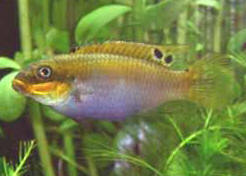
|
Kribensis and Camallanus 3/21/18
Both of my tanks, a 55 gallon and a 40 gallon are currently being treated for
Camallanus with Levamisole after I had a couple of suddenly ill and now dead
fish.
<Levamisole is a good choice here: relatively safe, and should not, in itself,
cause stress or harm to your fish, assuming it's used as directed.>
I noticed my Kribensis in the 40 with typical red bristle-looking worms
protruding from her vent.
<Sounds like Camallanus!>
So far, both tanks are doing fine, but this particular Kribensis has made a 180.
She’s social now, eats voraciously and doesn’t hide between the filter and tank
anymore.
<Nice!>
I thought she was just an antisocial fish. However, without exaggerating, she
has had a 2-3 inch, maybe longer, poo coming out of her for the last 4 days.
<Quite normal when de-worming. Sometimes the gut becomes irritated, whether by
the worms or the medication, and produces a lot of mucous. Such mucous will form
off-white to clear strings that contain little faecal material, hence the lack
of colour. If this persists for too long, say a week, you might think about
Hexamita infection, which is extremely common in cichlids, and also causes
white, stringy faeces (largely for the same reason, irritation of the bowel by
the parasites). In this case, Metronidazole is the treatment.>
I have seen nothing that looks like a warm, just regular poo. And it’s not the
same poo, but generally, if you look at her, it’s there. Occasionally she darts
quickly and it finally breaks free. After treatment, her very pale body
developed some color, but apparently any plumpness she had is gone. Is this
continuous bowel movement normal after a dosing?
<Can be.>
Was she just severely constipated?
<Could certainly be a factor, yes. If the cichlid is otherwise behaving
normally, nice colours, feeding well, socialising, and displaying no unusual
sores or pits on the lateral line or head (which often happens with Hexamita
infections) then all should be well. Finish the treatment as/when instructed, do
a decent water change, 25-50%, and see how things go!>
Thank you for any information!!
Kimberley
<You're welcome. Neale.>
Kribensis and Camallanus 3/21/18
<Oh, and by way of a timely post scriptum, Bob has just published a piece of
mine on identifying and treating 'worm' parasites that might well be useful:
http://www.wetwebmedia.com/FW%20Worm%20Art%20Neale.htm
Cheers, Neale.>
Re: Kribensis and Camallanus 3/27/18
Hello Crew!
I inquired a few days ago re: Kribensis with Camallanus worms treated with
Levamisole. The Krib had done a total about face after dosing, much more
energetic, eating voraciously, suddenly social etc.
<Good to hear.>
However, there was the issue of her continuous, long, and ever-present poop.
Neale suggested that if this continued for a week, then possibly need to treat
for Hexamita.
<Yes; ideally alongside an antibiotic such as Nitrofurazone that offers the best
"one-two" punch against a range of common ciliates and bacterial pathogens.>
Well, she's still winning the world record here with the long, seemingly
continuous poops. Going on 2 weeks now.
<Do also try Epsom salt (helps with constipation) and high-fibre foods (cooked
peas if she'll take them; brine shrimps and daphnia if she won't).
These are both harmless to the healthy fish, so feel free to treat in the tank,
alongside the Metronidazole and Nitrofurazone.>
She even fasted as couple of days, and still... So, I plan on finishing the
Levamisole treatment this week, and then start with Metroplex and Focus
(Flagyl/Metronidazole as medicated food). Does this sound like a plan?
<Absolutely.>
She is still quite pale and skinny, but still behaving much much better than
before the treatment for Camallanus.
<Good.>
Thanks for any advice in advance...and your help over the years has been like
solid ground for me when things get shaky!
<Glad to help. Cheers, Neale.>
Kribensis still pooing constantly
4/29/18
Hello crew! I really hate troubling you all so often!!
<Not a problem.>
Short history (which is documented among these pages because I had asked for
advice from the beginning). Treated tanks for Callamanus worms with Levamisole.
My once antisocial female Kribensis did a 180 and is doing wonderfully....very
social, sweet, gaining her color back, etc.
<Cool.>
I mentioned previously that she was defecating pretty much non stop and Neale
suggested that she may possibly have Hexamita and to treat once Levamisole
treatment was finished.
<Yes.>
I treated her with a round of Metroplex and Focus mixed with frozen food, fed at
least twice daily. She ate willingly . However, it’s now been over a week since
the Metro tx and she is STILL pooing a nonstop string of poo!
<Normal; expected. As I understand it, Levamisole and many of the other
anti-wormers work by causing muscles in the worms to spasm or become paralysed,
and this in turn can irritate the gut wall as the worms twitch loose. The gut
responds by producing extra mucous, and this is the copious faeces we see. Of
course there's also extra mucous produced as a normal reaction to worm
infections, so seeing stringy, pale faeces doesn't automatically imply the worms
are being evacuated from the guts. That's why it's often recommended to run the
course of meds a second or even a third time.>
It’s become a part of her by now, lol! It looks normal mostly (color of her
food). Sometimes it’s thin and dark. It just depends on when you look at her :)
<Now, dark faeces are mostly food, but bear in mind that these cichlids are
consumers of organic detritus, so if there's silt in the tank, they'll sift that
for tiny bits of food and algae that they can digest. Cleaning the tank more
thoroughly could help here, but if the fish is otherwise healthy, I'd not be
overly concerned. Possibly a bit more fibre might be tried to see if there's
some constipation going on -- brine shrimp and daphnia are good for this, as are
cooked peas and spinach if your fish will eat them.>
Did I not treat w Metro long enough? I did a 6 or 7 day regimen (cannot recall
exactly). Should I repeat? For longer? Except for the unsightly trail behind
her, she seems very well.
<I'd wait a week or so, offering some high-fibre food, and only repeat the
medication if you can if there's no sign of improvement.>
She’s eating fine and she really is a completely different fish then when she
had the worms.
<Good to know.>
Thanks so much for your guidance!
Kim
<Most welcome! Neale.>
Kribensis coloration 9/27/17
I wrote you all a couple days ago regarding some questions I had about
Kribs. I placed my order and they came in just about an hour ago. I am
in the process of acclimating them and they seem feisty. However,
is it common
for young juvenile Kribs to not be colorful?
<Oh yes... only really color up when sexually mature, of size, well-fed,
in good quality water. And of course are still stressed from being
moved>
I did not order albino, and these do not look albino. They're more of a
gray color. Naturally, the pictures on the website show the beautiful
rainbow colorations. I can't find much on this particular topic so I was
wondering if any of you guys have any idea if they will grow into their
colors? I do believe I have a pair, so I expect perhaps babies in the
future? I would love to see some color in my tank!!
Thanks for your help and for all you guys do!
Kimberley Mitchel
<I urge patience here. Bob Fenner>
Re: Kribensis coloration 9/27/17
Thanks, Bob
You're the best!
<Welcome Kim. BobF>
Kribensis; gen. husbandry - 09/22/17
I have a 55 gallon community tank (not much of a community yet, though).
I've always wanted a pair of Kribs. I understand that they are
relatively easy to take care of and have a more mild temperament than
other cichlids, except when spawning. Not much more info to be found
here. Any advice or need-to-know before I purchase my pair?
<Mmm, a few things come to mind. Kribensis prefer water that is
moderately soft (8-12 GH as a high) and acidic (6.5) and not too warm
(mid 70's F.); though this one species of Pelvivachromis has been
cultured for so long
that water in reasonable quality will do. They prefer to not have hectic
tankmates and do better in systems with subdued lighting and live
plantings. Caves and wood and dark substrate are preferred habitat.
Foods should include a high quality pellet (Hikari, Spectrum) that
sinks, as well as periodic frozen/defrosted meaty fare.>
I'm used to keeping mollies in hard water (and then saltwater, where
they flourished!!). Going to have to break those habits I suppose, as
Kribs parameters don't call for such hardness! Appreciate all you guys
do!!
Thanks,
Kim
<Welcome Kim! Please do share your experiences with us. Bob Fenner>
Lusty Kribensis and the fate of the fry
4/11/17
Hello wonderful WWM folks,
<Hello Linda,>
I have a lovely pair of P. Pulcher that are some of my favorite fish —
the problem is that they appear to be determined to populate the entire
planet (or at least my fish room) with their offspring.
<Correct; though from a strictly scientific point of view, *all*
organisms want to do this. It's only limiting factors that prevent them.
Darwin did a famous thought experiment with elephants that argued
(something like) there'd be millions after a few hundred years if all
the offspring survived. In the wild cichlids have to be good parents
because their fry face an enormous range of threats, both abiotic ones
(floods washing them away or their rivers drying up) and biotic ones
(predators, parasites and disease, as well as competition from other
fish for the same foods and hiding places).>
They bred for the first time in a 10g quarantine tank within a week of
purchase, and have doggedly been cranking out scores of kribabies ever
since.
<Which they will, for several years assuming normal fertility. If you
just want to enjoy Kribs, I'd argue keeping either one or a group of
females will work most easily.>
I realize that the most logical thing to do is separate them, but 1) I
don’t really have a suitable place to re-home one of the pair at the
moment; most of my setups are species tanks with very specific water
parameters or have large cichlids that would likely be aggressive toward
the Kribs, and 2) I hate to break up the pair, as I really enjoy
watching them interact. I’ve tried removing the cave they used to breed
in, but my crafty Mama Krib just moved her nursery to my volcano bubbler
(no, really!), and will probably just dig a pit under the driftwood or a
plant root if I remove that. After all, they first spawned in a
bare-bottom QT tank! Is there anything ELSE I can do to keep them from
bonking like rabbits?
<Contraception for fish isn't really a thing, unfortunately. You can
lower the water temperature a bit, as cichlids will breed more quickly
at higher temperatures, and may not even breed at all if they're too
cool. But that said, I wouldn't keep them below 22 C/72 F because Kribs
won't be healthy kept too cold.>
My next question regards what to do with all the fry I already have. The
results of their first spawn — 70 or so 3/4 inch kriblets — are
currently in a 20 gallon grow-out tank, and frankly I’m not sure what to
do with them. They’re too small for LFS to accept, and there are too
many of them to reasonably grow out in that space to a size at which
they could be surrendered or sold.
<Understood. Fish shops usually take Kribs without bother, provided you
have equal numbers of males and females. Kribs are popular and sell
well. Unfortunately, unless you fix the pH at 7, you won't have even
numbers of males and females. From about pH 6.5 and down you'll get
mostly females, and above 7.5-ish mostly males. This is a known problem
with Pelvicachromis species generally.
http://www.wetwebmedia.com/fwsubwebindex/pelmatochromis.htm
Nothing moderating water hardness and/or using commercial pH buffer
can't fix.>
The only piscivorous fish I own are Hemichromis sp., but I don’t feed
them live food because I’ve heard it could make them more aggressive,
and I don’t want them to start terrorizing their more peaceful tank
mates. That being said, one of my LFS specializes in the procurement of
‘monster fish’ and could probably take the fry as feeders, assuming they
are safe to use in that capacity. From what I understand, Kribs are not
a cold water species like goldfish, so does that mean that their
Thiaminase content would be similar to livebearers?
<Cichlids are safe (tilapia fillet for example is a good Thiaminase-free
food for piscivores generally) but the spines on larger cichlids can
cause problems for predators unused to them. Fry-sized cichlids should
be fine though. Alternatively, get in touch with your local aquarium
club, if you have one. They may be able to rehome/rehouse surplus fry
periodically.>
Thanks for your help,
Linda
<Welcome. Neale.>
One final thought... FW, something re Krib stkg.
11/12/13
Would a harem be "better" than multiple pairs? Regards, Hank.
<Is the Pelvicachromis spp? Then yes, these can work well in
harems.
Females hold territories about 10-12 inches radius from their cave,
while males will hold bigger territories encompassing several females.
Under aquarium conditions they work perfectly well as pairs though, and
pairs are often obvious in dealer's tanks so easy to select. I wouldn't
risk more than one pair in 55 gallons. Cheers, Neale.>
|
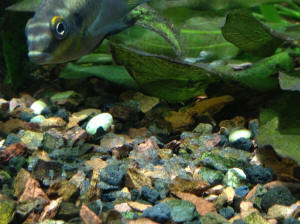
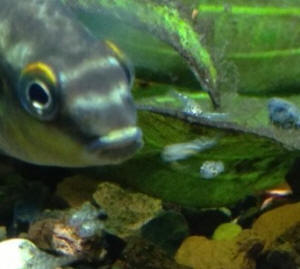
Identify baby fish 3/24/13
I need help identifying the fry I have in my tank. I can get better
quality pictures tomorrow if needed. And what do I do with them? Thank
you in advance!!
Picture 1 - http://i.imgur.com/QT5isdL.jpg
Picture 2 - http://i.imgur.com/a8N1QFk.jpg
Celeste
Can't get these pix to come up. Can you just send them as attachments?
BobF
Re: Identify baby fish 3/24/13
I need help identifying the fry I have in my tank. I can get better
quality pictures tomorrow if needed. And what do I do with them? Thank
you in advance!!
<These are Kribs with their fry… quite easy to rear, and will likely
rear themselves without much input in terms of special feeding. Do read
here:
http://www.wetwebmedia.com/fwsubwebindex/pelmatochromis.htm
The big problem with Kribs is that if you don't have a pH between 6.5
and 7, you'll likely end up with all males (pH 7+) or all females (pH
6.5-). That can be awkward when selling the fry on. Cheers, Neale.>
|
 |
|
Re: Identify baby fish
3/25/13
Thanks for the reply, Neale! I have a hard time with pH, and it hovers
around 7.4 even though I use mostly distilled water in my tank. However,
I am waiting on the last piece to arrive for a DIY co2 kit, an upgrade
from pop bottle, and that should help. Quick questions regarding the
fry. I will be moving in a month, and will be breaking down this 30
gallon tank to do so. Any special consideration for the fry?
<Nope. Providing the fry are mobile and feeding (rather than eggs or
wrigglers) Krib fry are phenomenally durable. I'd scoop them up with a
plastic pot rather than a net, but other than that, they're easy to move
about.>
Thank you again!!
- Celeste
<Cheers, Neale.>
|
Mysterious Congo Tetra Losses, pred.
3/20/13
Hi,
<Jon>
I have a planted 72 gallon tank stocked with 6 x
S. nigriventris
(1.5-2"), 4 x M. fasciolatum
<What genus is this? Microctenopoma?>
(2 x 2" females, 2 x 3" males), 2 x P. pulcher (2.5"),
and 5 x P. interruptus (2 x 1.5-2", 3 x 2-2.5"). I have had the Congos
in the tank for a couple months but over the past two weeks I have lost
three of them, two of the smaller size and one of the larger size.
<Mmm... not the Mochokids... my bet is on one of the African Cichlid
species, individuals>
They have all died overnight and have had their eyes and fins eaten off
when I found them stuck to the intake, but no obvious signs of disease
that I could see.
<Mmm; no. Predated>
My water parameters are stable and nothing seems out of place (7.4 pH, 0
ammonia, 0 nitrites, <5 nitrates). Given the irregular nature and timing
of the losses, the fact that none of the fish seem in distress when I
observe them and all are eating, my guess is predation, which seems to
point towards the M. fasciolatum. This doesn't really mesh with what I
have read of those fish so is there something else that I am missing or
should be looking for? Should I separate the Congos until they are a bit
bigger and then reintroduce them to the tank? I would appreciate your
help on this issue. Thank you.
--
Jon Mathews
<Time to do the separation move... Bob Fenner>
Re: Mysterious Congo Tetra Losses 3/20/13
Bob,
<Jon>
Thank you for the reply. First, yes the genus is Microctenopoma. Second,
I am surprised that it would be the Kribensis because they don't seem to
care about the Congos when I have watched them during the day.
<It's the nights... but could be your other fishes. At any length, I'd
remove the Phenacogrammus>
They seem far more concerned about the catfish and the Microctenopomas.
How big should the Congos be before I reintroduce them?
<Perhaps full size>
The bigger male is already about the size of the kribs, so wait until
the others are as well before moving them back? Thank you.
Jon Mathews
<Likely so. BobF>
Re: Mysterious Congo Tetra Losses 3/24/13
Bob,
<Jon>
So yesterday morning I looked at the fish and while none of the Congos
were dead, I noticed that most of them had wounds of some sort and were
huddled in the corner.
<Mmmm>
So I transferred them into a 29 gal that I had available (a bit small, but
it's temporary). I also noticed that some of the Microctenopoma had
white abrasions on their sides as well, so I am assuming
that the Kribensis are the fish at fault here. I have some questions
about how to proceed though.
<Ok>
1. A couple of the Congos have big white, raised bumps that appear to
have scabbed over and most of the rest appear to have some sort of blood
around their fins. Is there any medicine or anything that I need to put
in the water to help with the healing, or is this just a waiting period?
<I'd leave off w/ direct med. addn.s... Perhaps add supplements
(vitamins, HUFAs) to the foods>
2. Even today, a day after transferring, the Congos are not eating very
much. I have seen two of the five pick at the food (flake yesterday,
brine shrimp today) but the rest aren't acting interested. I assume that
this is a function of the stress and the wounds, but I am wondering if
there is anything I can do to encourage them to eat or it's a matter of
time and recovery?
<Raise the temperature a bit... 82, 83 F>
3. At this point, I am planning on getting rid of the pair of Kribensis.
I made the tank to be a West African biotope and the kribs were the
splash of color for the tank, at least until the Congos got bigger or
the Microctenopoma got bluer. Can you recommend another colorful fish
from West
Africa that would go with the Congos, Microctenopoma, and USD cats?
<I'd peruse Fishbase.org with the countries involved... w/ the selector
for
http://www.fishbase.org/search.php
Information by Country/Island
Aquarium Trade>
These tankmates are most often associated with butterfly fish, but I am
not interested in getting one for a variety of reasons. Would any of the
Krib cousins (P. taeniatus maybe?) be more nicer to their tankmates (or
would not getting a M/F pair make a difference)?
<Not likely much difference here; but I'd look for tank bred/reared vs.
wild-collected specimens>
Also, is there an African algae-eater?
<Mmm, yes>
I have not been able to find one, as the normal fish are SA or SE Asia.
Thank you very much for your help.
Jon Mathews
<Enjoy the search... there are other tools... that come to mind, but I'd
use Fishbase first. Bob Fenner>
|
If I were to set up my 20 gallon instead of the 90. Kribensis
breeding 2/9/13
I was told by staff (I live in a group home) that I cant move my dresser
to the porch so unless I can move it to another spot in the house I'll
probably be stuck with the 20 gallon I already have
<Okay. A fine size aquarium; just be realistic when stocking.>
My ph is 7.
<Less important than hardness. Can we assume you have neither very hard
nor very soft water? Something like 5-15 degrees dH. Find out if you
don't know.>
and I was thinking of an attractive fish to keep that wouldn't outgrow a
20 gallon system?
<Many.>
Would Manacapuru angels outgrow a standard 20 gallon?
<A singleton or a mated pair would be fine. A random assortment will
very likely fight until you end up with a singleton or mated pair, plus
a few dead or at least battered specimens that hide away all the time.
Basically, what you'd expect from any cichlid.>
I was thinking Kribs but to breed and do well I was told they need water
that's 6 to 6.8.
<Kribs breed at any pH between 6 and 8, but you get an ideal balance of
females to males at 6.5 to 7.>
My concern is that wild angels would outgrow the smaller tank plus the
water quality would be harder to maintain in a smaller tank. Is there
any dwarf cichlid that would do well in such a tank. I was thinking of
using a sponge filter from Angels plus so if they breed I don't have to
worry about filter dangers.
<Your basic choice is between Angels (plus a school of catfish like
Corydoras sterbai) or else a reasonably diverse mixture of fish. In 20
US gallons even a pair of Angels would be too messy, polluting the tank
and likely eating any small fish (like Neons). If you want a diverse
mixture of small (up to 5 cm/2 inch) fish, write back with your water
chemistry and we can discuss further. Cheers, Neale.>
Keeping Giant Kribs 9/18/12
HI, Its Alex again, Assuming I cannot get the 55 gallon for the
Angelfish community idea you gave me, I have a 20 gallon sitting empty
upstairs. I was wondering if just a pair of wild caught giant Kribs(
Have a guy, Dave, that could get me a pair for around 30 bucks). would
do well in that tank size, with a neutral ph assuming I give them a cave
to spawn/hide in, plants and substrate.. .
<20 gallons could work for any Pelvivachromis species, unless of course
one or other fish "goes rogue" and attacks the other. Certainly, a
"long" 20 gallon tank is what you're after, at least 60 cm/2 ft in
length. A "tall" tank would be a poor choice. Be sure to install lots of
caves and plants.
Cheers, Neale.>
Re: Keeping/spawning Kribs- more questions/ about different
species/filters for breeding tanks/etc. etc. . 9/20/12
HI its Alex again. I was wondering more Krib Questions
<Fire away.>
sense regular Kribs are very common in the hobby if there is a species
in this genus that is either quite rare, colorful, and as such would be
in higher profit demand should i be able to spawn/rear and sell the
young.
<Kribs are about the first cichlids most aquarists spawn, at least here
in England. They are incredibly easy to breed, and they are such
excellent parents even a total beginner can end up with dozens of fry.
Unfortunately, Kribs usually end up producing either all male or all
female fry unless the pH is exactly 7. Given that most people either
have acidic water or alkaline water, they tend to bring in batches of
fry all of one sex. Not much good to retailers, hence minimal, if any
value. There is more demand for balanced broods, and even more so if you
have a non-standard species, e.g., Pelvicachromis taeniatus, and even
more so if that variety is pure-bred (e.g., Pelvicachromis taeniatus
"Nigerian Red") or a relatively rare species (e.g., Pelvicachromis
subocellatus).>
Most stores I know of will only use them as feeders.
<Not the case here, but yes, you would be lucky to get any money.>
My idea is to rear fish to sell at my local Aquarium society (
www.Aquarium.mn).
<Ah yes, I know them well. Have spoken to them a couple years back. Nice
people. On the whole you don't tend to make much money even at fish club
auctions, especially after you've sold on the first batch of fry. But
you might make a couple of bucks.>
My ph as you know is 7, so it would have to be a type that isn't extreme
in ph spawning requirements. as a whole I know Kribs are easy fish to
breed.
<Hmm… do review the genus; most Pelvicachromis actually spawn best
(balanced male/female fry) with slightly acidic pH levels.>
Also I know power filters are out in breeding tanks as the fry would be
sucked up, what filters should I be using?
<An air-powered sponge or box filter will be fine. Cheers, Neale.>
Re: Keeping/spawning Kribs- more questions 9/20/12
i was up late last night looking at the genus Pelvicachromis and i found
a few great varieties to try i wanted your input.
Pelvicachromis taeniatus Lokundje, Nigeria red and Nigeria yellow.
<All nice fish. Have kept, bred Nigerian Reds -- do see my article on
WWM re:
http://www.wetwebmedia.com/fwsubwebindex/pelmatochromis.htm
Nigerian Reds in particular are quite common here in England. Inbreeding
hasn't done much to improve them, but they're nice fish with a (slight)
premium in terms of price, salability.>
I found them at a website called Aquarium Glaser GmBh, rare fish
specialist. I have yet to email them for pricing info I just want to
know how much, I'm not looking at buying yet.
<In England at least, you would expect to pay around £10-15 for a pair
of Nigerian Reds, which is about twice what you'd pay for common Kribs.>
I'm wondering what water conditions would produce 50/50 sex ratio on
fry.
<Soft to medium hard, neutral water is a good starting point; ~5-10
degrees dH, pH 6.5-7. Going slightly acidic may mean slightly more
females than males in the brood, but that's a good thing. What you don't
want is too many males (usually all males once pH rises above 7.5).>
give me an introduction to the habitats of each form.
<West African cichlids like these come from rainforest streams and
ponds. Lots of bogwood, lots of shade, lots of mud.>
I like the Nigeria yellow male but also like the Nigeria red the
lonkundje looks neat too. I heard they are German bred and imported
fish, are these types easier to keep then wild caught ones.
<To be honest, the wild-caught ones are pretty adaptable. These are
good, robust fish for any aquarist with some experience of dwarf
cichlids. Cheers, Neale.>
|
Kribensis Cichlid and Rainbow Shark?
in/comp. 2/17/12
Hello, I have 2 pairs of Kribensis Cichlids in a
3ft heavily planted tank with lot's of bogwood and
caves.
<Small for what you propose.>
The two species of Kribensis I have are Pelvivachromis
subocellatus Matadi and Pelvivachromis taeniatus
'Nigerian Red', would a Rainbow Shark be OK
to go in here with them?
<Could do in a bigger aquarium (55+ gallons) and with
the usual warning about Epalzeorhynchos spp. Such fish are
territorial and don't "share" caves nicely.
Rainbows are a bit less aggressive than Red-Tail Black
Sharks, but neither is peaceful.>
If not, what Shark/Catfish would you recommend in here?
<On the whole I follow Paul Loiselle in not recommending
Shark-Minnows in cichlid tanks because they tend to want
the same things. Botia almorhae and Botia striata are the
two most reliable loaches, but you will need 5+ specimens,
and that's a tight squeeze in less than 55
gallons.>
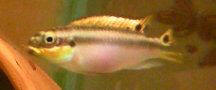
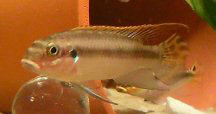
To answer any questions, yes both pairs are breeding pairs.
They are still young with the male Taeniatus only being
about 1-1 1/2" long and the female a bit smaller. I
have added a picture of the Taeniatus' to show just how
young they are, the Matadi's are younger than the
Taeniatus. The picture was taken when they were in a 15
gallon before I got the Matadi's.
<Nice fish.>
Thanks,
Alecia.
<Cheers, Neale.>
|
|
|
Re P. pulcher biffo
debrief and now a parasite! 2/20/12
Thanks a lot Neale,
<Ah, someone who can still spell "a
lot"! Seems to be increasingly rare these
days>
You confirmed most of my suspicions about what may
have been going on re: the Kribs acting like Mr. and
Mrs. Smith, plus its interesting to know that Kribs
operate effectively as harem spawners in the
wild.
<Quite so. Was a surprise to me when I learned
about this. Do try and find books such as "The
Cichlid Aquarium" for more.>
My pair split parental duties for the first set of
fry amicably, with the female taking the lead. So far
this time around it's definitely a female-only
affair, with the male hiding in another cave and
pretty much keeping out of the way while his wounds
heal. He is getting better though. Hopefully he's
learnt his lesson to stay away for next time -
amazing how the female really beat up on him, even
though he's half as big again as she is.
<"The female of the species is more deadly
than the male...">
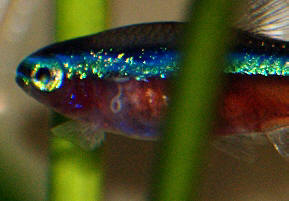
Another issue falling into the category of
never-seen-before has cropped up in my 15 gallon tank
recently. Inhabitants are 13 Cardinal tetra and 3
Amano shrimp, parameters NH3 - 0, NO2 - 0, NO3 -
10-15 ppm, pH 7.2, KH 3, 28 deg C. From consulting
your dichotomous key, I suspect one of the cardinals
to have a parasitic worm/fluke/fish louse attached to
it (see picture). Being white, not red, leads me to
believe it's not an anchor worm.
<I agree. A worm of some sort. Looks like
a roundworm (nematode).>
Regarding treatment, I'm thinking a 35g/L salt
bath (as per your article on the subject of salt use)
OR some kind of commercial medicine.
<Hmm, would try a seawater dip first, as you say.
Usually these worms can't reinfect fish in
aquaria because of a missing host. Some exceptions,
like Camallanus, but worth a shot.>
Can you recommend a course of action? Does the whole
tank need treating or just the individual fish?
<Individual fish in terms of dips; otherwise, a
standard anti-helminth like Praziquantel or
Levamisole for the whole tank.>
Thanks a heap crew.
All the best,
Duncan.
<Cheers, Neale.>
|
|
|
|
Filter bacteria and P. pulcher biffo
2/16.12
Hi crew,
Phew what a day. Was wondering if you could enlighten me on a few
things - I've had one of those "anything that could
happen, did happen" days.
<I see.>
I have a 240L, 120cm X 45cm X 45cm moderately
planted community tank (NH3 - 0, NO2 - 0, NO3 - 10 ppm,
pH 7.2, KH 3, 28 deg C). Filtration is via an Eheim 2215 classic
at 600 L/hr, with a cheap 520 L/hr powerhead (through a rain-bar)
providing extra circulation. The powerhead has a small sponge
covering the intake (6cm X 6cm X 2cm approx) that guards against
fish blending and provides a tiny bit extra mech./biol
filtration.
Inhabitants:
8x Hyphessobrycon pulchripinnis (adults)
5x Crossocheilus siamensis (juveniles)
2x Colisa fasciata (juveniles)
2x Ctenopoma acutirostre (currently only about 2")
2x Pelvivachromis pulcher (breeding, young adult pair)
2x Melanotaenia praecox (1m, 1f - aware that they should be in a
school of 6+, but these are the last survivors of a group of 7,
male is almost moon-shaped!)
<Yes, male Rainbows can look remarkably hunchbacked.>
The P. pulcher are tending their second batch of fry (only 2.5
weeks after the 1st batch of fry!!!),
<Indeed.>
which have been free-swimming since Tuesday (it's now
Thursday). The 1st batch of fry went well, except that they
slowly died off as I didn't try to rear them intensively and
the other fish, even the SAEs (!) picked them off slowly. This
starvation/predation was factored in when I included the kribs as
part of the community set-up, so no worries on my end.
<Quite so.>
This morning, I walked in on Foreman vs. Ali ruble in the
jungle part 2. The male and female Krib were going at it, neither
backing down. I haven't seen this from them up until
now.
<Ah, yes. Females tolerate males, and in the wild, the male
would actually divide his time visiting more than one female in
his overall territory. You see, Kribs aren't true
pair-formers like, say, Discus. Rather, they are
somewhat harem spawners, more like Apistogramma. In the wild the
male would hold a single big territory within which would be
multiple small female territories. The female does most of the
brood care, with the male being tolerated up to a point, in my
experience usually some days after the fry have hatched. One good
way to know Kribs have spawned is when the female vanishes from
view but the male seems to be "at a loose end" just
ambling about. Eventually the brood become too much work for the
female, and she'll accept the male and he'll chip in and
help her. But this doesn't always happen, and isn't
necessary for success. In my experience, female Kribs are much
more aggressive and territorial than the males, and sometimes the
male is at the receiving end.>
After 2-3 min.s of this, the male (who is half as big again as
the female) ceded, with some visible oedema around the caudal
peduncle and superficial skin loss around the mouth. The female
(with no visible injuries) went back to guarding the young fry,
while the male went and hid in the thick stand of Vallisneria
spiralis that takes up the back-right quarter of the tank for the
rest of the day, presumably nursing injuries and wounded
pride.
<Pretty much.>
Question 1: What do you think was going on here? I.e. what caused
this biffo, especially when the first fry batch passed without
incident?
<See above.>
Question 2: Also (sorry), I managed to leave the canister filter
off (sealed, not open) for 3 hours today by accident. Will
some/all of the bacteria have died in this time?
<No; should be fine. The bacteria will have gone dormant and
some may well have died off, but enough will be in a resting
phase. Go easy with the food for the next few days, and maybe do
a nitrite test after 24 hours to see if all is going
well.>
Thanks a heap crew - no clue without you.
Cheers,
Duncan.
<Glad to help.>
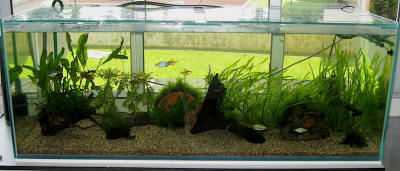
P.S. This is the naturally-lit (no light fixtures) tank Neale
helped me out with - I've included 2 photos of it, one when
first set up and one 4 months later (about a month ago). The
watersprite struggled and died off slowly (both rooted and
floating),
<Odd.>
but everything else has grown steadily, with the Val really
taking off since the addition of weekly half-dosages of Seachem
Flourish Comprehensive.
<Yes. Vallisneria is one of my favourite plants. Always good
value, and fish seem to welcome the shade produced by the long
leaves. Black Brush Algae can be a pest, but so long as you have
lots of daughter plants, you can dig up and dispose of any
tatty-looking plants.>
It received about 2 hours direct sun per day, but the sun has
changed course slightly and I'm only getting about 20 min.s
direct sun per day now.
No visible oxygen bubbling from plants now and everything's
looking a bit sad, so I think a light fixture is called for until
the sun comes back!
<Does depend on the season of course, but some plants
won't mind.
Vallisneria for example will often experience a shady season in
the subtropical and warm-temperate parts of its range. Of course
the plants will go dormant during this time, and may well stop
growing, but even in winter, I've got some "Elodea"
in my windowsill tank that's thriving on indirect winter
sunlight for barely 8 hours a day and water temperatures down to
10 C or less. Not many fish in there though, just a couple of
Florida Flagfish fry and some Cherry Shrimps.>
Thanks again Neale for all your help and advice in setting this
tank up!
<Most welcome. Neale.>
|

 |
unruly Krib 11/19/11
I have a female Krib in my 20 gal community tank and things aren't
getting any better. she harasses the cherry barbs and they aren't
very happy and mostly hates the thick lipped Gourami she nipped its fin
bad.
<Unusual for them to attack dissimilar fish. Does she have suitable
caves at the bottom of the tank? Are the Cherry Barbs kept in a group
of 6+ specimens? Are there plants at the top of the tank for the
Gourami to occupy?>
sooo instead of just getting rid of the Krib I was thinking of starting
up a 10 gallon tank just for the Krib with the addition of getting a
male Krib. I have read how rewarding it is to watch these fish breed
and care for their babies.
<Correct. But constant breeding results in a lot of fry, so think
about what you'll do with them. Kribs can, will breed every 6-8
weeks given the chance, and you can end up with thousands of fry a
year!>
my question is do you think it would work to add a male Krib with the
female in a 10 gallon?
<Doable, but small.>
or would she be aggressive to him.
<Females can be more aggressive than the males, yes. Provide
multiple caves, so each has its own hiding place.>
I have read that if they aren't already a breeding pair it may not
work out and they may not necessarily like each other.
<Correct.>
any other suggestions? maybe if I add them to the new tank at the same
time?
<Can help. Do read:
http://www.wetwebmedia.com/fwsubwebindex/pelmatochromis.htm
>
thanks!
<Cheers, Neale.>
Re: unruly Krib 11/19/11
It is a well planted tank with caves...now the caves have 2 entrances,
I don't know if that matters.
<Yes; more difficult for a single fish to defend against a
bully.>
There are lots of floating hornwort and wisteria. The Gourami likes to
scavenge in them but she doesn't hang out there, she likes to
scavenge the whole tank including the bottom and doesn't care to be
constantly chased away by the Krib. The Krib doesn't defend any one
cave, just likes to chase anyone away that is near it.
<As I say, female Kribs can be surprisingly territorial.>
I have 3 cherry barbs 2 female and 1 male. They were happy and mating
all the time before the Krib came.
<Curious.>
-Lauren
<No magic solution here, unfortunately. Do read, and the
links above:
http://www.wetwebmedia.com/fwsubwebindex/pelmatochromis.htm
Cheers, Neale.>
Pelvicachromis Pulcher or Apistogramma agassizii in
community tank? 11/13/11
Hi crew,
After much reading on WWM and more than a few emails, my 4ft,
220L community tank is starting to come together. Thanks for
all you've done to make it happen.
I've got the choice to add either Pelvicachromis pulcher or
Apistogramma agassizii to the following water parameters/stock - does
one suit better than another? I'm going for a breeding pair if
possible.
Water:
- 28 deg Celsius.
- pH 7.2 (afternoon) - 7.6 (morning).
- ammonia 0 ppm
- nitrite 0 ppm
- nitrate 10 ppm
- GH 4 deg
- KH 3 deg
- 20% water change and gravel vac every 1.5 weeks
Stock:
- 5x Melanotaenia praecox (1m, 4f)
- 1x Aplocheilus Lineatus
- 9x Hyphessobrycon pulchripinnis
- 5x Crossocheilus siamensis (juveniles at the moment)
- 4x Colisa fasciata (juveniles, out of quarantine and into main tank
tomorrow)
To add:
- 2x Ctenopoma acutirostre (2" juveniles)
- A pair of either Pelvicachromis Pulcher or Apistogramma agassizii
I realise any fry I get from the cichlids may well be eaten by
Aplocheilus Lineatus or Ctenopoma acutirostre after the parents give up
parental care.
I have no issue with this - should I?
<No, not really.>
So what do you think? Please critique any other parts of my set up as
you see fit.
<I'd go with the Apistogramma. Fewer fry, and generally a less
boisterous species. But with this said, very small specimens might be
just about big enough for your Ctenopoma to view as prey, so introduce
specimens of similar size to the climbing perch.>
Thanks a lot crew, as always,
Duncan.
<Cheers, Neale.>
Krib compatibility 10/26/11
Hello, as I have found more fish stores, my options have grown! I have
a 20 gallon high, well planted with artificial and some live plants and
lots of floating live plants. consistent pH8-8.2 dh10 kh5 temp 76-77F.
I have 2 platy, 3 cherry barbs and will be getting 5 x-ray tetra,
either a honey Gourami or sunset thicklip Gourami for the top of the
tank, and a female Krib for the bottom of the tank. my question was if
I can also add either a Bolivian ram, a dwarf cockatoo chiclid, or a
paradise fish?
<Mmm, I would not. Better to stick w/ the stocking plan, stop w/ the
Krib>
can I keep one by itself without a mate?
<The Paradisefish fish you could sub for the Thick Lip... the Krib
for one of the other Cichlids>
if so is male or female a better option? which would be better for
getting along with the Krib, and other fish? is one better for the
water chemistry?
<The Krib is more tolerant>
is a 20 gal ok for these fish, or am I better off not adding any of
them? thanks so much for your time!
<Welcome. Bob Fenner>
Kribensis female - pale body, bright fins; juvenile sexing;
tank preference question 9/24/11
Hello, crew.
<Salve!>
I will probably ramble (again), so feel free to nip and tuck as needed
for posting.
<Oh.>
I've written before regarding plants, and I'm glad to report
that I have a lovely variety, now (including java moss, a neglected and
dying Windelov java fern,
<Never had much luck with this variety, either!>
some e. tenellus rather than vals, a Ludwigia repens x arctuata hybrid
(growing FANTASTICALLY; keeping as much as possible in the tanks, will
worry about cuttings looking silly when I get quantity),
<A wise approach; try a variety of plants, see what does well, and
then pull out the rubbish and stick with the successful
species.>
some (frankly, waterlogged and bad at floating with anything resembling
filter water drop-off to submerge it) Asian water moss, some dwarf
water lettuce that I'm pleased with - and so are my tanks, and a
lifetime supply of ever-multiplying, ever-present,
ever-on-your-arms-if-you-reach-in-the-tank duckweed). Those are for the
most part going well, and they're not why I'm writing today.
:)
<Indeed.>
My questions primarily revolve around the pair of Kribs I picked up
recently. One is definitely a female, as she has the curved pelvic
fins, red/purple stomach marking, and gorgeously colored
"pointed" (but actually squared off with clear finnage)
dorsal fin. She is, however, strangely drab in the body. (
http://i752.photobucket.com/albums/xx163/felinux/Fish/femalekrib.png -
to save you email space!)
<Is a female, but bear in mind farmed Kribs are extremely variable
but rarely as brilliantly coloured as the wild ones.>
My pH is impossible to pin down, as it always has been, because
it's between 7.2 and 7.8, given the impossible-to-read API liquid
test kits.
<Does need to be as close to 7 as you can get it if you want to
breed these fish properly.>
It has always been like this, which is strange to me, but eh. My
nitrates are, unbelievably, zero.
<Good. Healthy plants remove nitrate, especially floating plants,
which grow so fast they scrape up the nitrate faster than the fish can
produce it!>
Seriously, I've tested twice, the second time practically turning
the nitrate #2 bottle to froth shaking it and banging it to dislodge
any potential precipitation. Perturbed, I checked ammonia, which is
also zero. The kits are not expired per API's explanation of their
lot dating.
<'¦>
The tank is probably not "heavily" planted by any stretch of
the imagination - a handful of stems of l. repens x arctuata, one e.
tenellus, a good bit of java moss, some floundering water moss, the
aforementioned tiny Windelov, a small amount of duckweed, some
hornwort, a handful of dwarf water lettuce and a couple of stems of an
unidentified stem plant. It is a ten gallon tank that probably holds
nine and a half when fully filled - I managed to crack it near the top
of a pane when removing it from the frame to reseal it (never. again.),
filtered by an Aquatech 10-20 filter with filter floss in it, as well
as an old (carbon-dead, but rinsed and re-used) Aquatech 5-15 cartridge
in the compartment. I have been until recently using a sponge since I
had shrimp in this tank (I appear to murder any shrimp I get), and have
since replaced it with some blue filter foam instead, just wrapped
around the intake to keep from sucking up a fry. Other (seemingly
arbitrary) stock in this sand-bottomed tank is the last c.
atropersonatus I have from the 6 I bought when they wandered into the
LFS (:( I haven't seen any cories I liked there since, so the poor
guy's lonely), two Kuhli loaches (that were in the other tank, but
I put them in here because of the sand; one of their compatriots went
carpet surfing - mummified Kuhli is disturbing-looking), and, added
with the Kribs (and coming from the tank they came from), a largish
Japanese trapdoor snail. Also in this tank is what appears to be a
juvenile krib (
http://i752.photobucket.com/albums/xx163/felinux/Fish/juvie.png - it
doesn't like pictures?) that I picked up at the same time, same
tank.
<Looks like a young male to me, but not sure.>
All that aside, my questions are threefold: 1) Is there something wrong
with the female, or is she just uncertain of her surroundings, since
she just came home with me yesterday? I originally had her in another
tank, but the male thicklipped Gourami decided he didn't like her
looking so much like him, and so she and the juvie were moved to the
sand tank, as I call it. Her fins are SO BRIGHT that I'm not
certain if she's just stressed or still slightly a subadult
juvenile rather than a full adult.
<She's a girl, but may colour up with age, diet, shady tank,
darker substrate, male attention'¦ or may not change colour
much at all.>
2) I have tried through hell and high water to sex this juvenile in the
hopes that it is a male and these two will get on swimmingly, despite
their size difference. The juvie has red tips to the dorsal fin, but
all juvenile pictures I have seen have this as well; it won't flare
its pelvic fins long enough to decide if they're straight enough to
be called straight or curved enough to be called curved like a
female's. Its stripes are MUCH darker, and his yellow cheek darker
than the female's, which is the main reason I am concerned with the
female. Are there any tips that I am missing regarding this, or is this
just the waiting game I think it is? 3) I understand that a ten gallon
is a bad choice for keeping a pair of Kribs in, especially a
male/female pair as I'm hoping these are. Would the juvie be better
off hiding in the 10 gallon gravel tank that is more heavily planted
with the Gourami, or is it safe enough to keep the Kribs together, as
long as I watch everyone and my maintenance?
<Do think this is a male by the length of its body and the pointy
ends of the anal and dorsal fins, but it isn't quite clear in the
photo.>
I'm also happy to report that my "honey" Gourami I
mentioned in the other email appear to be thicklip Gourami (c. labiosa)
instead, just a honey/sunset morph, and I've managed to spawn them
(well, they spawned, I watched) several times. I got fry once, and
didn't remove them to another tank, so dad ate them. The two I did
manage to rescue I put in another tank and now I have one fry that I
didn't expect to live, in the sand tank.
http://i752.photobucket.com/albums/xx163/felinux/Fish/fry-9-20.png
<Gorgeous!>
Tiny adorable little pelvic fins, huh? He's currently in a floating
breeding trap because the Kribs seem to think that he's something
worth fighting over/attempting to eat. To sneak in another question,
how big do you think it'll have to get before the Kribs give up on
it?
<In theory, anything bigger than a half-inch should be safe, but be
cautious. He'll be fine in the trap for 2-3 months.>
I know they're not true piscivores, so I'm hoping that's
sooner rather than later. I'm so attached to the poor little guy
since he managed to survive a month without any specific feedings! Talk
about dumb luck!
Thanks again for your time and putting up with all my questions -
you're a lovely help. :)
Emily S.
<Hope this helps, Neale.>
comment on Neale's Krib article
3/26/10
Neale:
hope all is well. Doing some research on Pelvivachromis pulcher, I
stumbled on what seems to be an inconsistency in your Krib article.
While I believe that Pelvivachromis pulcher are not normally pair
forming (a point that you also make repeatedly - see bottom of email),
the article appears to state the opposite:
Unlike many other dwarf cichlids (such as Apistogramma spp.) form
stable pairs. In fact, Kribs seem to "mate for life" and stay
loyal to one another even in the presence of alternative potential
mates.
Just an FYI. Thanks for everything.
John
<John, you're quite right. That's some clumsy writing! What
I meant to say is that while they're polygamous in the wild, they
seem to form stable, life-long pairs in captivity. But if one male is
kept with multiple females, he'll be polygamous, though the females
will have their own (smaller) territories and may be a bit hard on one
another. I'll go back and look at the piece, and ask Bob to make a
change or two. Thanks for writing! Cheers, Neale.>
I was interested to know if a school of female kribensis can
be kept? 1/6/2010
<Yes, though they don't form schools. Instead each female will
maintain its own small territory around a cave.>
I am not interested in a male because I know they can become extremely
territorial and hostile when breeding.
<Actually, this isn't precisely correct. The females initiate
spawning and defend the brood, while the male defends a territory
within which may be more than one female (they don't form pairs in
the wild, but harems). So it's six of one, half a dozen of the
other in terms of behaviour.
http://www.wetwebmedia.com/fwsubwebindex/pelmatochromis.htm
If either a male or female Krib finds its chosen nest threatened, it
will be territorial. On the whole midwater fish are ignored, indeed,
welcomed.
But bottom dwellers can be viewed with hostility. Choose robust
catfish, or leave them out altogether.>
Can, lets say, 3 females be kept in a 35 gallon tank?
<Sure.>
Other tank mates are 1 juvenile Blood Parrot Cichlid, 3 pearl gouramis,
and 5 skunk cories.
<The Corydoras will likely be harassed in a tank this small. Dwarf
Cichlids have been known to blind Corydoras catfish (see for example
Loiselle's "Cichlid Aquarium") and Corydoras are
singularly stupid animals that cannot
understand territorial boundaries. Better catfish are things like
Ancistrus or Synodontis nigriventris. Cheers, Neale.>
Spawning Kribs 11/20/09
I would like to set up my 35 US gallon tank, with dimensions 24"
length X 16" width X 21" height, for Kribs. Is this large
enough for one or two pairs of Kribs? - also, are there any fish that
would make decent companions and would pose little threat to the
spawn?
< Go with one pair instead of two. Any group of small schooling fish
would be fine. Stay away from barbs. Bottom fish like catfish are
considered a threat to the spawn by the parents.-Chuck>
Kribs in Quarantine- Quarantine New Cichlids
05/27/09
Dear Crew, I have 5 Pelvicachromis sp. approximately 1.5 -2 inches in
length in a 10 gallon quarantine tank. Ammonia and Nitrite are 0,
Nitrates are 5 ppm and pH about 8, temperature 78F. They have several
PVC "caves" and some fake floating plants for cover. My
questions:
1) Is it better to remove the hiding places so that I can observe them
while in QT? Currently they hide about 99% of the time in or between
the PVC pipes. I don't want to stress them out by removing their
sanctuaries.
< You need to be able to see them to determine any problems. I
understand your concern by stressing them out, so try at least once a
day to remove the caves so they can be evaluated.>
2) I have had the fish for 3 days and they have not yet eaten. I have
offered several food items, small bits of floating Cichlid sticks,
freeze-dried bloodworms and thawed bloodworms. They have not come out
of hiding for any of these. Do I need to provide a sinking pellet for
these Cichlids?
< If you look at their mouths you can see that they are slightly
downturned. A sinking food would probably be eaten.>
3) One of the 5 has very dark coloring, I understand that this is a
sign of stress. The other 4 show normal coloration. Is it better to go
ahead and add these fish to the main tank or keep them in QT for
observation?
Currently it is very difficult to determine if the fish in question has
any physical damage or infection because of Question 1 above.
<You do not mention the species. If these are wild fish then you
could have more than one species and that would account for the darker
color. Look for other symptoms like clamped fins or white
spots.>
Mostly I'm concerned that they hide constantly and haven't
eaten. I know they can go maybe a week safely without eating but
they've got me worried.
Thank you for your help, Evan
< Dwarf cichlids are very shy by their nature. It will take them
awhile to become use to their new surroundings. You are doing the right
thing by isolating them. They will eat when they get hungry. Try
and find out something about these fish from where you purchased them.
Wild fish may take some time to get adjusted.-Chuck>
Kribs Behavior 10/6/08
Hello, Neale.
<Mark,>
I have a question regarding my Kribs behavior.
<Oh?>
I have 20 gallon hexagon planted aquarium with 8 harlequin Rasboras and
10 cardinal tetras. I think these fish look very good in small tank,
but I wanted to have some characters.
<Ah, do be careful with "hexagon" tanks. While the
capacity sounds good on paper, benthic fish like dwarf cichlids measure
their worlds by surface area, specifically the bottom of the tank. So
anything other than a long, rectangular tank will feel small to them,
even if on paper it sounds fine to you.>
So I decided to stock it with rams. Everything was perfect except I
could keep them alive for not more than 2-3 months. After 2-3 months
all of them had hole in the head and died within 2-3 days. I made 3
trials, got fish from different stores with same result: hole in the
head and death.
<As I've said repeatedly here, Mikrogeophagus ramirezi is not a
community fish. This species needs warm (28-30 C) of high quality
(near-zero nitrate), low hardness (<5 degrees dH) and low pH (5-6).
In anything other than these conditions it is next to impossible to
maintain, and much commercial stock is poor quality anyway, and
"juiced up" on antibiotics by the breeder to keep them
looking good at the retailer, but not likely to stay healthy much
beyond that.>
I start to think about something easier... Kribs. I went to LFS and
bought a pair: male and female. Male killed female right away. I
thought it is an accident and bought another female. It was killed
right away. Very quickly and mercifully.
<Tank is too small... neither fish can define a safe territory.
Despite reports to the contrary in the fishkeeping press, wild fish are
harem spawners, with males holding big territories, within which they
tolerate the territories of mature females who mate with them. Put a
random female into a random male's territory, and you're asking
for trouble if the two fish can't set up distinct territories away
from each other.>
I decided to trade my aggressive male and obtain breeding pair. I went
to the store and I found a beautiful female. I could not resist and
bought it again... They pair off. I got fry after few weeks.
<OK.>
The problem is that I never had a fry after that (about 6 months).
Why?
<Could be any number of reasons, but most probably one or other of
the fish isn't healthy.>
Few days ago I noticed that my male attacking my female. She completely
lost her color and was very pale. Her fins and tail were damaged and
she was hiding at very top of the tank, behind the heater. What
happened?
<Have seen this with Pelvivachromis spp. generally, and seems
related to infections, such as Hexamita, brought on more than likely by
water quality issues. Do review in particular nitrate concentration.
All cichlids are prone to nitrate poisoning, and honestly anything
above 20 mg/l is bad for them. May also be dietary, social behaviour...
a range of things are possible.>
I start to think about rehoming my Kribs, but after 3-4 days female got
her color back, and both Kribs swimming together again and chasing my
other fish.
How could you explain this kind of attitude? Should I continue to worry
about my male Krib aggression?
<I wouldn't "worry" as such, but I would observe,
review diet, water chemistry, water quality -- basically look for
anything sub-optimal.>
I apologize for my grammar. English is my second language.
<And pretty darn good at it you are!>
Thank you,
Mark
<Most welcome, Neale.>
Breeding Pelvivachromis Pulcher (A.K.A. Kribs)
6/10/08 Hey again crew. I was just lying in bed last night when I
decided that I'd like to do something I haven't tried yet and
have a go with trying to breed fish. I thought I'd kill to birds
with one stone and try both breeding and a fish I've never kept
before, the Kribensis after finding out that it was a good beginning
breeder fish and an all around hardy fish. The breeding equipment would
consist of a 10 gallon aquarium with a half inch of gravel, numerous
plastic plants, a 10 gallon tetra power filter with a sponge filter
cover on the intake pump, and a quarter coconut shell as a breeding
site. My questions are: I read on your site that the Krib breeds
readily, but the pH dictates the ratio of sex in a brood. If I am only
looking for a successful brood, is pH important? < This depends on
your definition of successful. Kribs will spawn between a pH of 6 to 8
and be able to raise all the fry. The closer the pH is to 7, the better
the chances of getting a 50/50 sex ratio.> Second is my filtration
adequate? < AS long as it is regularly cleaned it should be
fine.> Third, are lights a necessity? < The fish need to see each
other or else they can't spawn. Besides, what fun is it to have
your fish spawn if you can't see what's going on?> I have
read that Kribs need a planted tank for breeding. Lastly, how does one
go about conditioning the fish? I plan to use either frozen brine or
bloodworms, and the tank is stocked with guppy fry. < I would
recommend regular water changes and keep the water around 80 F. Frozen
brine doesn't have much nutritional value. Kribs are very poor
piscivores so the baby guppies are a waste of space. I would recommend
a high quality pellet food with occasional feedings of
bloodworms.-Chuck.> Thanks guys!
A few Kribensis questions 4/22/08 Good afternoon. My
son's Kribs have become parents, and the fry have been swimming
freely now for about a week. The parents and fry are in a well planted
14 gallon tank by themselves and the parents seem to be doing a great
job herding them around and leading them to food (and not eating them).
<Very good! Do check the pH though: if you have a pH above 7,
you'll get mostly males; if the pH is below 7, mostly females.
Tropical fish shops -- for obvious reasons -- only want equal numbers
of males and females, so establish the pH and then decide whether
raising the fry is worth it. Remember, surplus fry in the community
tank will eventually get attacked by the parents as they prepare to
breed again, and that's when things become chaotic (and
bloody).> The stand on which the 14 gal aquarium is on is rather
large, and he was recently given a 30 long (with lighting, filter,
heater!) that he would like to eventually set there, but I was not sure
what the reaction would be of the Krib parents if they partially
drained their tank to move it with the Kribs in it to a smaller
surface, or netted them all to a temporary container/tank then moved
the tank and put them back if the fry might be endangered by the
parents. <Parents will likely eat the eggs/fry, and then spawn a
couple of weeks later.> If they do need to wait, what is the safest
time/age of the fry to move the tank. The 30 might be their eventual
home after it has been properly cycled in a month or two, which is also
why they would like to be able to move it sooner than later to allow
time for that. <You can't move parents and fry, and then expect
the "bond" between them to be stable. Rather, you wait until
one batch of fry is mature enough to rear yourself (which you could do
right now, but is easier after 2-3 weeks) and then remove all the fry.
Then move the parents, and let them start over.> Also, I have a tank
with Kribs of my own and was wondering about salts. <Kribs do not
need salt. What they ideally want is soft to moderately hard water at
pH 7. Anything other than that is less than ideal, and causes problems
with sex ratio in the brood.> I noticed that marine salt and cichlid
salt has a lot of other trace minerals that a lot that plants actually
like quite a bit compared to aquarium salt which is just sodium
chloride, namely potassium, calcium and magnesium. <No relation
here: the minerals in marine salt aren't the ones plants use. So
one doesn't remove the need for another. The *elements* like
potassium may be the same, but the minerals (*compounds*) are
completely different. Similar to the fact we need oxygen to breathe,
but can't "breathe" carbon dioxide, despite the fact that
gas contains oxygen.> Are any of these salts safe using or
beneficial in a community Krib tank (with barbs, glassfish) that also
has an S.A.E. and Otos. <Glassfish are quite happy with salt, but
none of your other fish want/tolerate salt.> If not, and hopefully
not a dumb question, what are the non-salt tolerant fish non tolerant
of specifically that are in these different types of salts? Sodium in
any form? <It's complicated, and to do with pH, carbonate
hardness, general hardness, and salinity -- all different ways of
describing different aspects of the mineral composition of water. Every
environment is different, and fish evolved to work in one set of
conditions may not work in another. The best thing with community fish
is to aim for soft to moderate hard, zero salinity, neutral pH water.
Apart from livebearers, most community fish will be very happy with
that. Cheers, Neale.>
Kribs and company 4/15/08 Hello, I have a 20
gallon moderately planted aquarium that has aragonite sand, mostly to
buffer our very "unbufferable" city water, but the reason I
am mentioning it is to give you my tank conditions in which I keeping
my Kribs. I know they will adapt to a range of conditions, but I must
keep them in a tank where the Ph is consistently 7.5-7.6.
<Pelvivachromis will live at 5-25 degrees dH, pH 6-8. The main
problem is that pH affects sex ratios in their broods: pH above 7,
mostly male fry; pH below 7, mostly female fry. If you aren't
breeding them and don't want to sell the fry, then don't worry
about the water chemistry too much.> I was adding marine salt to
give it a SG of 1.002 because I had a few livebearers in there, but
they now have their own tank, so I don't keep it at the SG anymore,
although I do add a teaspoon per 5 gallons when I do water changes.
<At this dose, likely doesn't do any harm nor much good!> I
currently have the Krib pair, 3 x-ray tetras and a couple of ghost
shrimp. My question is this: is a 30" aquarium a long enough tank
to house two pairs of Kribs or another small cichlid pair(s)...
<Most likely not; Kribs are very territorial and aggressive when
spawning, and the females especially seem to be very pugnacious. Best
stick with one pair of Kribs.> ... and if not, what other fish
(other than livebearers) can live comfortable in the more
alkaline/harder water that I have that would be able to co-exist with
my current tanks fish. <Most barbs and rainbowfish thrive in hard
water, and some barbs in fact are even found in brackish water (e.g.,
Ticto Barbs). Most tetras should do well, though they don't really
like salt, though funnily enough the X-Ray Tetra is one exception being
found in slightly brackish waters. You might also consider midwater
catfish such as the Glass Catfish and the African Glass Catfish, both
of which are rather adaptable and active fish. Indian Glassfish and
Halfbeaks would both make interesting oddballs, Halfbeaks especially
being not only feisty and therefore fun to watch, but also
breedable.> Keith <Cheers, Neale.>
| Kribensis with popeye, hole in the head, a proto
or fluke spike protruding from between two scales &
ich..... 2/21/08 Sorry for the length of this submission-
But, this is a complicated matter- I have a Kribensis with popeye,
hole in the head, a proto or fluke spike protruding from between
two scales & ich..... A crazy combination that I would think
all stems from poor conditions. This however is not the case. He
came out of a healthy 55 gallon community tank with a balanced load
of fish (including other Kribi's), under gravel filtration
& a more than sufficient canister filter. The #'s are
0(ish) Ammonia, 0(ish) Nitrites & 8.2-8.4ph. Water changes are
frequent. Diet is varied and high quality. The other fish did not
pick on him. In all, it is a healthy, stress-free tank.... My first
suspicions of cause(s) were based on the fish being a recent
addition: The fish was only in the tank for 14 days- He came from a
planted display tank at a good LFS, he had been there 6+ months,
had always looked healthy & had recently spawned- (his mate
came home with us too.) After 14 days the popeye developed. Again,
I thought stress of transport & netting. Other possible causes
/ stressors may have been: New (well rinsed) carbon (could have
contributed to the HITH too?)- And / Or, new beads in the filter-
Or, a new plastic spray bar on the filter contributing toxins that
the fish is sensitive too.....? No other fish showed, or have shown
(5 days later now), signs of any illness. I moved the sick fish to
a quarantine tank and began medicating / treating with Maracyn Plus
(replaced % after water changes), adding Aquarium salt at 1tblsp
per 10 gal (replaced % after water changes), 20% daily water
changes and a temperature of 82 degrees F. The fish has now
developed hole in the head (some scarring indicates it might have
been effected before) that also extends to the gill plates, a spike
near the tail that looks like a fluke / proto & ich flecks in 3
areas...... This little guy is a hot zone. The last part of this
whole confusing ordeal is that he is fighting so well- The fish
stays mid tank at the bottom, upright, fins up / out, eyes are
clear, colors are bright as ever, is attentive and eats (though
challenged by impaired vision through 'popped' eyes...)
Aside from all the measures being taken, can you make additional
suggestions as to the cause(s) and / or treatment? I am considering
augmenting the current treatment(s) with copper for the ich as it
is acceptable to use in conjunction with Maracyn. Any insight or
info is appreciated. Thank You- Matt <Hello Matt. Dwarf Cichlids
across the board are sensitive to dissolved metabolites. Your fish
certainly has HITH/HLLE. There are few reliable cures
(Metronidazole is most recommended), so it is one of those things
you try to avoid that fix. http://www.wetwebmedia.com/hllefaqs.htm
In any case, once fish are infected, even if you cure the symptoms,
the disease often comes back again. It is widely believed that
there are a combination of factors involved, but water quality is
the trigger even if there is a specific pathogenic organism that
does the harm. In other words, it's a lot like Finrot. The best
I can recommend is treating the fish with Metronidazole, ideally in
its own aquarium. But I haven't seen small cichlids with this
amount of damage recover, so can't offer much hope in the long
term. Do please remember carbon removes medications from the water,
so if you treat a fish, remove the carbon. The addition of salt is
probably not necessary either; contrary to myth, Kribs aren't
especially associated with brackish water, and long term exposure
to salt can damage freshwater fish. Cheers, Neale.> |
|
.JPG) .JPG)
|
Kribensis pair fighting Breeding Aggressive Krib
Parents 11/19/07 Hi, thanks for the great site. I bought a breeding
pair of albino Kribs about a month ago and put them in a 15 gallon,
lightly planted tank with 2 cardinal tetras. I noticed when I brought
them home that the female was quite bloated and red around the belly,
and sure enough she laid her eggs in a cave 2 days later. The eggs
hatched, but after a few days the babies had all disappeared. I assumed
it was because they had been in the tank for such a short time. About
two weeks later the female laid eggs again in her cave, everything was
going fine and the pair was taking the fry around the tank, but 3 days
after the fry came out of the cave the female started to show
aggression towards her mate, nothing too serious until one morning when
I found the male being chased around the tank relentlessly with most of
his tail and lower fins bitten off. I removed the male for fear of him
being killed by the female. My question is this: why would the female
suddenly try to kill her mate? I have re-introduced the male twice in
the past few days but the female continues to attack him. Thanks
<These fish are probably young and are not very comfortable with
each other during the breeding process. If you are interested in
raising the fry, I would recommend that you remove the fry as soon as
they are free swimming. They are actually quite large and can be easily
raised on baby brine and crushed flake food. I would also remove the
male at this time too. She may think that he ate the first batch of fry
and he will do it again so she is being very protective. Next time they
spawn try feeding them a couple of times each day so they parents
won't get hungry. As the parents grow the male will become much
larger and have an easier time defending himself. remove the fry and
reintroduce the male as soo as he is healed from his wounds. She should
be ready to breed again.-Chuck>
Is my Kribensis sick? Female Kribensis Laying
Eggs 11/1/07 Hi, I have a pink female Kribensis and I've
noticed that she's gotten REALLY bloated over the past few days. I
believed she was pregnant as she was flirting with the male molly and
dwarf Gourami. She was also darker in colour and had a very pink tummy,
but now she seems paler in colour. She has constantly been hiding in
the log over the past few days, and every time I feed the fish (with
fish flakes), she never comes out so I don't think she's been
eating anything lately. I am wondering if she just looks bloated
because she still has all the eggs inside her, or if Kribensis can
still lay eggs even though there are no other male Kribensis in the
tank? I have read other articles about Kribensis being bloated and
having bulgy eyes, but her eyes seem normal and I'm not sure
whether she's sick or not? The water was changed the other day, and
I checked that the pH level was fine (7.2 -- 7.4), and all the other
fish seem to be good. Can you please advise me what is wrong with her
or what I should do? Thanks heaps! < Under ideal conditions your
female albino Krib could have laid eggs without the benefit of a male.
If she has laid some eggs they will probably be infertile and die in a
couple of days. She should then return to her normal self. If she is
sick then she could have an internal infection that has blocked her
intestines. If she is blocked up then I would recommend placing her in
a hospital tank and treating her with a combination of Metronidazole
and Nitrofurazone. Kribs are usually cave spawners. If she is chasing
the other fish then she has laid eggs.-Chuck>
| Now sexing Krib 8/22/07
THANKS TO YOU ALL...The white spot is now gone. Can i ask if by
looking at the attached pic, what sex you think my krib is, sold to
me as a male. I think she is a she. Very territorial when she was
in the company of other Kribs who are now deceased. I think poss.
they were all females? i would love to get a partner for her?
thanks again Lesley <Hello Lesley. That's a female. The
dumpy shape, rounded tail fin, and violet patch on the belly is the
give-away. Male Kribs are longer and thinner, have rhomboid tail
fins that taper to a point, and are basically less colourful.
Female Kribs (in fact, females of all Pelvicachromis) are more
territorial than the generally rather laid back males. This
reflects the division of labour at breeding time: females initiate
pairing and spawning, and when the eggs are laid, the female guards
them alone and only after the fry are swimming for a few days does
she let the male guard them at times. Mostly, his job is to
"secure the perimeter", keeping the territory safe. In
the wild, one male may actually maintain a territory with multiple
brooding females (in other words, a harem, as seen with many other
cichlids). If you do introduce a male to the aquarium, keep an eye
out for aggression. Cichlids sometimes prove to be a bit testy when
adults suddenly meet up in the confines of an aquarium. Moving the
rocks and things about to break up the territories can help a great
deal, so that each fish thinks it's somewhere new, rather than
one of them being the stranger and the other the territory holder.
Cheers, Neale> |
|
|
| Breeding Kribs, aggressive/sick barb 4/26/06
Greetings Staff- FYI - I have a 54 gallon tank with UGF (I'm
old school), AquaClear 300, and a Penguin BioWheel 200
(I might be old school, but I love redundancy). Temp 78, water
conditions good - Tap water her in Portland, Oregon is great for
our fish - they LOVE IT! <Ah, good.>
General community tank with tetras, loaches, a pair of angelfish,
and some white clouds, etc. I vacuum once a week and clean out one
of the two hang-on filters once a week (oh yeah, and change 10 -15%
per week). It's planted with Anubias, amazons, Bacopa (for the
fish to eat), and Cabomba (I LOVE saying that:
CA-BOMB-A). <Heh!> 1. I have a pair of
Pelvicachromis pulcher who were a 'mating pair' when we
bought them. I don't know if they successfully bred
at the LFS; but they were clearly pair bonded. After an ich
outbreak last fall their pair bond deteriorated. I am sure 16 days
in quarantine was not romantic. We think the ich was due to a dip
in tank temps one day we had the window next to the tank open and
it got chilled; I am now really careful about opening the window
when it is not warm enough. The female still displays for the male,
but he seems uninterested in her shameless flirting. We
provided several 'condos' for them to select for their
boudoir. Would adding another female excite the male? <Possibly,
yes.> If a new girl was added would we have to remove the
other? Could they just work it out with
time? I am not really looking set up a breeding tank;
just to see them restored to their original state. Sure
it would be cool if they raised a few fry; but I am not trying to
go nutso or anything. <Once the pair is bonded, the
"leftover" female would likely have to be removed.> 2.
I had a very naughty male rosy barb ( http://www.fishbase.org/Eschmeyer/EschPiscesSummary.cfm?ID=4714
) who harassed one of his girlfriends into her grave (we had a set
of three females and one male). After she died he became
the bully of the tank - taking off one of the rays of an angelfish
and scales off of anyone who got too close to him. We
went to our LFS and asked them for a larger female who might help
calm him down. We came home with Brunhilda, named at the
LFS because of her size (a hefty 3.5 inches nose to tail!) <Holy
mackinaw!> and because she was a favorite of the
staff. She, to put it lightly (hah!), is
huge. She definitely seemed to school the male - yes
another bad pun (although he still always wears his full mating
regalia) and things have been peaceful for several weeks. <Ah,
good.> Overnight she developed a large (7 mm square) wound on
one flank just above the tale - I have some OK pictures of it - it
looks larger and scarier in real life.
<Yeeee-ikes! I am given to think you didn't
quarantine her prior to adding her to the tank??> It was
initially bloody and swollen. I also discovered that
another of the harem had a similar (though much smaller) wound near
her anal-genital area - photos also included. I have set
up a QT, out as yet both seem healthy and happy aside from their
wounds. Other than keeping water quality as perfect as possible and
keeping a weather eye on them, is there anything else I can do?
<I would consider medicating this.... it's pretty
significant. If you cannot remove the injured animals to
a quarantine system for treatment, please consider a food medicated
with Oxytetracycline rather than medicating your main tank; an
online store called "Florida Guppies Plus" (Google that)
sells one such product.> Would adding additional females diffuse
his aggression or give him more targets? <Possibly.... but no
guarantee. He doesn't read the books,
y'know.> Our QT would be a bucket with a small BioWheel,
heater, and some shelter. I do not want to medicate, or
traumatize them by netting and QTing them unless
necessary. <Either risk it, or obtain a medicated
flake food for them.> Could it be that Mr. Rosy Barb (his common
name in our house is unprintable) <HAH!!> got up his gumption
and made a run at these two females <Possibly, though it is also
possible that Brunhilda brought a bacterial infection with her and
shared it with the other damaged female.> that resulted in some
rough sex - was it rape??!!? <Likely not, no worries.> Should
I report his randy behavior to the authorities? <CSI
Aquarium?> Photo of Brunhilda's and other female wounds
attached and I am also including my photobucket link: http://s33.photobucket.com/albums/d98/leahfranceswade/Brunhildas%20trauma/
<Good, clear images. Thank you for sharing these.>
(I included one pic of my krib female (I think she's a kinke,
she's so pretty). <Pretty indeed.> PS the
female rosy barbs have been decimating the Black Beard Algae
(Audouinella?) that grows in our tank in the winter (lower sun
angle = more direct sunlight on the tank. They keep it
totally in check. <Excellent!> Thanks and keep up the good
work. <And thank you for your kind words.> And I
forgot to say, "Long time reader, first time emailer."
<Glad to hear from you.> Sincerely, Leah Frances Wade
<Wishing you well, -Sabrina> |
|
Breeding Kribs, Aggressive/Sick Barbs - II -
04/27/2006 Sabrina + Staff - thanks for the advice - and quick
response. <Glad to be of service. Sorry this
reply wasn't quite as quick!> As to the Kribs - I will hope the
romance will rekindle between our original pair. What's
the equivalent of oysters for fish? <Good frozen foods, like those
by Hikari - bloodworms are great. Even better would be live
bloodworms or live mosquito larvae.> My dear husband reminded me we
have a 20 long in storage - I will bring it out to set up a QT for the
ladies. What medication (other than the medicated food) do
you recommend? Is one brand better than another? <As for brands, no
real significant difference.... if you medicate the water in
the quarantine tank, I would recommend using Kanamycin or
Nitrofurazone.> No, we didn't quarantine Brunhilda - she LOOKED
fine when we got her...that's good enough right?
<Mm, no.... Please read on WWM's FW livestock page
regarding quarantine of livestock.> Sincerely, Leah Frances Wade
<Wishing you, Brunhilda and her sisters
well, -Sabrina> Kribs Or Discus? -
08/21/2005 Hello! <Ahoy thar, matey!> Out of pure curiosity,
would it be better to have Kribs in a 30 gal. tank or could you put in
a couple of Discus? <I would go for Kribs, myself.... A
much better fit.> How many of each? <I would STRONGLY recommend a
single pair - one male, one female - and if you do Kribs, some peaceful
dithers like danios or something. More than a pair is going
to be asking for trouble when (not if) they decide to
breed. You *could* do a pair of discus, but they get quite
large and would likely do best as the only fish in the tank.> If you
chose could you put both in? <I would urge against
it. Wishing you well, -Sabrina> Kribensis
Companions Hi, I was wondering if it would be possible to keep some
Kribs, maybe a mated pair, in a 10 gallon tank? < A pair of
Pelvicachromis pulcher would do well .> So far this tank has held
(1) 4" Red Tiger Oscar, (1) 3.5" Jack Dempsey, and a
4.5" Pleco. I am going to move these guys to a larger 55 gallon
tank and would like to replace them with some smaller cichlids that can
fit into a 10 gal. tank. < Good idea.> I was also thinking of
including an African Butterfly fish with the Kribs if possible. <
Your butterfly fish likes to hang out at the surface and eat insects
that have fallen into the water. When your Kribs spawn they will guard
the fry and attack any fish that comes near their fry.> Oh, also, I
have a lone Peppered Cory that I enjoy watching in the 10 gal. Would
he/she work with the Kribs and Butterfly fish or just get eaten? <
Everybody would get along until the cichlids
spawned.-Chuck>
Finding Krib Cichlids I need help finding a pair of Kribs. I
am looking for a mated pair that I can buy for a reasonable price, I
looked over the internet but could not find any good sites. I
appreciated your quick response last time. Thanks! Christine <
Captive bred Kribensis from Asia are actually very common here on the
west coast. I would call around the stores in your area first. They can
usually get them if they try. If that doesn't work then there is
always the internet but shipping is very expensive. Look at
aquabid.com. It is like eBay for fish. I know mainlycichlids.com can
get them at a reasonable price, once again shipping is a real costly
issue.-Chuck>
Getting a Pair Of Pelvicachromis Pulcher "Kribs" If
I get only one Krib for my 10 gal tank, can I get another of the
opposite sex later and will they pair up? < It is worth a try. The
best way is to get six and let them pair off naturally but it has
happen with only two so it depends.> I ask this because there does
not seem to be a lot of people selling Kribs and it is semi-unlikely
that I will be able to get a mated pair. Another quick question, can I
also have a mated pair of African Butterfly cichlids, too, or only one?
<Anomalochromis thomasi is a great little cichlid that is very easy
to spawn and not very aggressive at all. If your tank is set up right
and the fish aren't too big then you could try spawning both of
them in the same tank.-Chuck>
|
|

