|
FAQs on Phony Freshwater Medications... there
are... several
Related Articles: Choose Your
Weapon: Freshwater Fish Disease Treatment Options
by Neale Monks, FW Disease Troubleshooting,
Freshwater Diseases, Nutritional Disease, Ich/White Spot Disease, Methylene Blue, Metronidazole/Flagyl,
Formalin/Formaldehyde, Malachite Green, Organophosphate Use,
Related FAQs: Freshwater Medications, Quarantine/Treatment Tanks, Treatments, Salt/Use, FW
Antibiotic Use, Aquarium
Maintenance, Ich/White Spot
Disease, African Cichlid Disease
1, Cichlid Disease,
|
.jpg)
Should've used a real medicine,
gasp!
|
Dead fish after 25% water change. More Melafix deaths
10/1/14
I just found your site and wondering if you can help me. Yesterday I had
MelaFix
<Mmm; am decidedly not a fan of this API product... it's a sham, a
scam... of no use medically... and implicated in disrupting
nitrification, causing troubles>
in my tank so last night I did a 25% water change. Rinsed my filter,
vacuumed my gravel and squirted flourish with a syringe on my plants. I
have had aquariums for years with no issues and have followed this same
procedure. As I was doing the cleaning I had fresh water in my bucket
that I had already added Aqua plus and cycle to. I finished the cleaning
added a pillow to the filter and refilled the tank with the new treated
water. 30 min later the fish started dying.
<Ahh, another non-"Fix" data point>
They looked like they were at the surface gasping for air. I have since
lost 11 fish. Some of the remaining ones now have ragged fins or appear
to be still struggling. I am not sure what to do now as the procedure I
followed I have done so many times before. This particular tank has been
running for four months with no issues and is 37 gallons Also I test my
water regularly and the water appeared to be in line even after the
water change. Any suggestions what to do next will be appreciated.
Thanks
C.
<Write API and ask for replacement of your livestock. Am hoping for
removal of this worse than placebo. SHAME on the folks that sell this
bunk product.
Bob Fenner>
Injured goldfish 9/12/13
Hi-
I have two Goldfish, we have had them for 6 years next month. They
are in a 30 gallon tank with 2 filters running.
<Good to have redundancy>
On Monday morning one of our dining room chairs fell back ( less than a
foot) and bumped the tank, not too hard but hard enough. It scared
my orange fish so badly. She started flailing all over the tank so
fast ,swimming as fast as she could, slamming into the walls, rocks from
the bottom were flying all over the filter lid flew off... it was awful!
It was only for maybe 5 seconds, but seemed like forever. Right
after she went sideway, and belly up. Slowly but surely she
recovered, but her breathing remained extremely high for hours.
She scraped some of her scales and now both of her eyes have a clear
bubble on them.
<Physical damage>
She isn't moving about the tank much and doesn’t seem to be eating, even
the other fish doesn’t seem to be eating I immediately
added Melafix
<Worthless... see WWM re>
to the water for her scales, and I hope this was ok to do. The
tank seems to smell really weird now ??
<Yes; the API "tea"... may interrupt nitrification (do check for
ammonia, nitrite), poisoning your fish>
I am having trouble finding info about this eye condition,
<Do read here:
http://www.wetwebmedia.com/FWSubWebIndex/GFEyeTroubleF.htm
I keep finding bubble eye goldfish with a condition. Is there
anything I can do to help?
<Yes; patience and good care... optimal, stable water quality (change
water a few times now to remove the "tea"), and nutrition>
Does this mean she is blind?
<Doubtful; no>
I thought I found something about adding Epson Salt to the tank to draw
out the liquid??
<Salts can be of use... see Neale's work on WWM re>
Is there anything I can do to help???
<As stated... I'd have you review as much of what is posted on WWM re GF
as possible... You list nothing re foods, feeding, nor water quality...
so could only guess here. Read>
Any info is greatly appreciated. Thank you so much~
Michelle
>Welcome, Bob Fenner>
|
Is it Columnaris? Likely NO3, Melafix poisoning
4/25/13
Hi all, I need your help/reassurance please. I have a 250 litre planted
tank with 11 danios, 7 penguin tetras, 6 platys (+handful of fry), 2
Opaline gouramis, 2 gold gouramis, 2 Bristlenose Plecos (juvenile) and
an assortment of hitch hiking snails. Yesterday I saw one of the danios
had a huge fluffy white patch on its back. Immediately I removed him
into a tub and checked the water. After many weeks of pristine water, I
found my nitrates were through the roof (red on the api master
test kit so between 40-80). Changed 50% of the water, dosed with prime,
and MelaFix
<This product can be much more trouble than anything of value. See WWM
re>
which was the only medication I had to hand. Poor Danio didn't make it.
Today, one of my platys has the same 'fuzz' growing on one eyeball. It
completely covers the eye surface. Another 2 danios are behaving
strangely, swimming erratically and have 'floppy' torn fins (one seems
to tend to use the pectoral fin only on one side and has trouble
remaining upright - tends to roll sideways or tail down if she stops
moving). I tested the water today and my ph has dropped some
(from 7.6 to 7.2 - from meds?),
<Could be... the tea... leaf extract>
and my nitrates are much better - 10-20). Did a further 25% water change
and redosed the MelaFix. Is this Columnaris? A fungus?
Something else?
<Can't tell from the images alone... but you're right to be worried. I'd
change the water out again now and tomorrow and leave off w/ the phony
API product>
I include a photo of the Danio who died and the platy with the fuzzy
eye.
Any help would be massively appreciated.
Thank you in advance!
<Welcome. Bob Fenner>
|
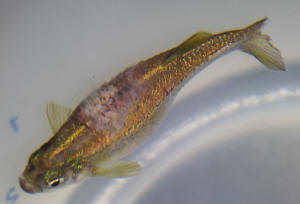
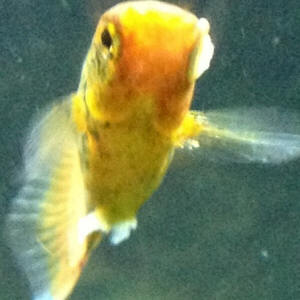
Great pix! |
Re: Question 10/6/11
Have another question for you guys,
What do you guys think of melafix
<... not a fan. Read here: actually; just put the word in WWM's
search tool... on every page... and read. B>
my small female has two sores on belly that are from I am guessing an
injury from the male they started off red and sore and now they seem to
be getting better but still not healing right she didn't seem to
want to eat this am which is not like her so I figured I have used
melafix in the passed before and put one dose in tank. I can not do a
water change because our water is being treated. I am outta of ideas of
what todo or what I can do
Maria
RE: Question
<Please run your writing through a spell/grammar checker before
sending it to us. B>
is one treatment gonna kill the fish?....they tank got a haze in it and
I checked the ph it was 7.6 so I put in a ph buffer adjuster and now
the tank is so cloudly I cant see anything what should I do?..I was
thinking of doing a 25% water change and then just leav the tank and ad
back the charcal filter pads
Using Melafix with Oriental Firebellied
Toads 9/29/11
Hello,
<Amber>
I have an Oriental fire bellied toad that has what appears to be an eye
infection. The eye itself is slightly cloudy. The lower rim of its eye
appears somewhat gooey for lack of a better descriptive. Yesterday it
was keeping its eyes closed but today they are open more often than
closed.
The tank got a complete tear down and clean up about 10 days ago - no
chemicals, everything just rinsed really well. We used bottle spring
water
<Mmm, not really suitable depending on make-up... May have too much
mineral content or not enough... What is pH, alkalinity? Is this system
cycled?>
and not tap.
We have a submersible sponge filter- no carbon. I have been reading the
archived answers on your site for other fire bellies with eye problems
and it seems that Melafix is the most often suggested treatment.
<Not by me, no>
I have a bottle but no idea how to actually administer it. It seemed
from the previous posts that I am to apply the Melafix directly to the
eye and not to the water?
Please advise.
Thank you for your time!!
Amber
<I'd place nothing here. Your frog will very likely cure on its
own w/ the system maturing. I would add a modicum (like half) of tap
water to the bottled. Bob Fenner>
Angelfish with cloudy eyes 4/8/11
I bought an Angelfish a week or two ago. It seemed fine when I bought
it.
The last few days I have noticed it's eyes both look cloudy. They
are not bulging or anything. I had my water tested at my local fish
shop and they said everything looked good. I am treating my tank with
Melafix as I have a Lyretail Swordtail with tail rot. It got it after a
bout with Ich.
All of my other fish look fine. The Angelfish does not swim around much
and doesn't really seem to be eating much either. The past couple
of days he seems to hide more than anything. I have searched the net
and not really found any helpful results. Any help you can provide
would be greatly appreciated.
Thanks, Ray
<Hello Ray. Cloudy eyes that appear overnight usually imply physical
damage (especially if just one eye is cloudy) or poor environmental
conditions (the usual explanation if both eyes are cloudy). It's
absolutely crucial you review the situation here. While it's
possible the fish was damaged in transit, be open minded to the idea
your tank isn't perfect. Just to recap, a single Angelfish needs at
least 75 litres/20 gallons of water, excellent water quality (0 ammonia
and 0 nitrite), middling to high water temperature (24-28 C/75-82 C),
and very peaceful tankmates. Things like loaches, Otocinclus catfish,
and some of the barbs like Tiger Barbs will frighten and/or damage
Angelfish and thus make poor tankmates. Because you've got
Swordtails, which need cool, hard water (22-24 C/72-75 F; hardness 10+
degrees dH; pH 7.5) it's unlikely you have good conditions for both
Swordtails and Angels, so one or other species will likely be
stressed.
Review, and act accordingly. Cloudy eyes in cichlids very quickly turns
into Pop-eye, and that's difficult to treat. Melafix is a poor
medication for situations like this, and I doubt it'll help with
Finrot anyway, so not sure I'd bother. Instead, find an
antibacterial or antibiotic medication that's safe and reliable.
Here in the UK, I usually recommend eSHa 2000, but in other countries
you'll have other options. Cheers, Neale.>
Re: Angelfish with cloudy eyes 4/8/11
Hey Neale,
<Ray,>
Thanks for the quick response. I wish I had found this site and talked
to you all before I bought this some what expensive medication.
<Glad to help.>
The gentlemen at my LFS sold this as some sort of miracle drug that
will cure about anything from fin rot to tooth decay.
<Uh'¦ no.>
I spoke with him just this morning about the cloudy eyes and he
informed me to keep treating with the Melafix.
<I bet.>
He said it would treat the cloudy eyes and prevent Pop-eye.
<Pop-eye is treatable, but accordingly to Bob just requires simply
good conditions'¦ see here:
http://www.wetwebmedia.com/fwsubwebindex/fwpopeyefaqs.htm
Must admit, that's never been my experience, and you may prefer to
get out the Roto-Rooter grade antibiotics.>
Seems I need to find a more reputable fish shop which is kind of hard
to do in the area in which I live.
<May well be the case.>
Aside from a couple of small pet shops, about all we have is Wal-Mart
and Meijer. I am new to keeping an aquarium so I am still in my
learning curve.
<Books!>
I have a 29 gallon tank. In this tank I have Mollies, Platys,
Swordtails, Angelfish, a Gold Mystery Snail, an upside down cat and a
Striped Raphael in which my LFS said would all do fine in this tank
together. So are these not good tank mates for each other?
<Well, kinda-sort. Apple Snails rarely last long in tropical fish
tanks period, so accept that chap's disposable and remove at the
first sign of death. Both catfish are social species that would be
happier in groups, and I'd be very surprised if you see either of
them swimming about during the day. But yeah, they're both pretty
good species, even if the Raphael gets pretty big and potentially
predatory on Neon-sized fish. Synodontis are not beyond nibbling on
Angelfish fins. The three livebearers need hard water, which the Angel
and the two catfish don't particularly enjoy, and of these fish,
the Platies and Swords do prefer cooler water, 22-24 C/72-75 F. So no,
they're not an ideal mix, but in moderately hard, slightly basic
(10-15 degrees dH, pH 7.5) water kept at, say, 25 C/77 F, I'd
expect them to get along okay.>
They all seem to be doing pretty good aside from the cloudy eyes in my
Angelfish that I just noticed over the last couple of days. I bought
some of those test strips (which I was recently informed were
un-reliable)
<Perhaps, but better than nothing. They're the ones I use, for
what it's worth.>
and according to the strips the nitrates and nitrites are 0, the
hardness (GH) is around 150 ppm,
<Medium general hardness.>
the alkalinity (KH) is 180 ppm
<Medium carbonate hardness.>
and the ph is about 7.8.
<Moderately basic.>
I keep the water temp around 79 F.
<Bit warm for the Platies and Swords.>
Any suggestions you could offer as to What fish would do good with
these water parameters would be greatly appreciated.
<You're pretty well stocked already, my friend! If this were me,
I'd prefer to keep 2-3 species really well (in terms of population
size and water chemistry/temperature) rather than a mish-mash of six,
seven or more species.>
It is nice to know that there are people out there who care enough to
take the time to put up a site that is filled with so much valuable
information. Thanks for all the help and keep up the good work.
Ray
<Thanks for the kind words. Cheers, Neale.>
Re: Angelfish with cloudy eyes 4/8/11
Neale,
Thanks for the advise.
<Glad to help.>
I will look into getting some of those books. I wasn't planning on
adding anymore fish but rather returning some of the ones that were not
suitable for my tank.
<I see.>
I hate that I have to do that because I really like all my fish.
<Well, if their fate is likely to be sold to a poor fishkeeper, then
by all means hang onto them. Angels and the Cats should be fine in your
water.
It's just not perfect for them.>
Especially my two Marble Veiled Angelfish. I have to do what's best
for the fish though. It's a lot like raising kids. LOL! You are
right about the two Catfish. I don't see them much during the day.
I rarely see my Raphael even at night. He stays hidden inside a log. He
found him a hole in there so I can't see him at all.
<Typical of the species, genus, family.>
I have had him for a couple of weeks and I have only seen him once at
night. I check on him once in a while to make sure he is still alive. I
have done a lot of reading online and it seems a lot of people
experience the same with this Catfish.
<Yes, but they're often keeping them singly. But even in groups,
virtually all of the Doradidae are very nocturnal. The Synodontis
species are rather better aquarium fish. I have three Synodontis
nigriventris, the Dwarf Upside-Down Catfish, and they swim about during
the day quite a bit. Kept singly, you almost never see this species
during the day.>
Really nice looking fish though. Thanks again for the advise.
Ray
<You're welcome. Cheers, Neale.>
Re: Angelfish with cloudy eyes (RMF, can Melafix cause cloudy
eyes?)<<In a word, yes. RMF>> 4/8/11
Just one more question. Since I have already started the treatment with
the Melafix, should I continue the treatment for the duration it
recommended or should I stop it now and return my carbon filter to the
tank.
<A good rule for most situations is to finish the course of
medications as instructed on the packaging. Bob may have an alternative
opinion though.>
I started the treatment two days ago and the water seems to be getting
cloudy. It says to treat for seven days. I don't know if it has
anything to do with it or not but I just noticed that when I started
the Melafix treatment is about the same time I noticed the cloudy eyes
in the one Angelfish. I read the cap wrong on the first dose and put
more than I was supposed to.
<Ah, I see.>
Could this have anything to do with the cloudy eyes?
<I'd imagine *any* irritant in the water could cause damage to
the outside of the eyes.>
Ray
<Cheers, Neale.>
Re: Angelfish with cloudy eyes (RMF, can Melafix cause cloudy
eyes?) 4/8/11
Neale,
Thanks again for the advise. You been a great help. Take care and
thanks again for the site.
Ray
<Thanks for the kind words. Cheers, Neale.>
Miracle Cure or Snake Oil? Mira/Mela-fix... Eye maladies
f' as well, FW 8/13/2009
Good day, I am a 2 month fish owner and I have a specific problem but
also a more general question.
<Fire away.>
I have a 2 inch black moor and 2 inch fantail in a 20 gallon tank, and
the black moor has pop-eye I can't seem to get rid of (good
nitrate, nitrite, ammonia levels, Ph 7.5, 65 degree tank), and a day
after adding a golden apple snail one of its popped eyes got cloudy
(not sure if related to snail intro).
<Unlikely to be related to the snail. Pop-eye is typically
associated with either water quality issues or physical damage, e.g.,
careless handling of the fish, or the use of coarse rather than soft
netting. Do see here:
http://www.wetwebmedia.com/FWsubwebindex/fwpopeyefaqs.htm
In terms of water quality, if you don't have 0 ammonia and 0
nitrite, then that's likely the problem right there. Your tank
should be big enough for juvenile Goldfish, but I will make the
observation that adult Goldfish need 30 gallons upwards.>
Being relatively new to this, I consulted several pet stores and online
forums and some recommended salt, and some Mirafix.
<Do you mean Melafix?>
I have tried both, and this has not seemed to do much other than upset
the snail who is now doing poorly, but has not helped the eye on the
moor. I am wondering if the snail is more of an added stress on the
tank than the helper I was led to believe he would be in cleaning the
tank.
<Melafix shouldn't harm invertebrates, but then, there's
little testing either way. Apple snails do poorly with Goldfish for a
variety of reasons, and the most common is that the Goldfish peck at
them, thinking their
tentacles are edible. Eventually, the Apple snail is so stressed and
unable to feed normally it dies.>
I am concerned I am not doing the right treatment however, because it
seems that for so many problems the answer I get is to do a salt bath
and or use Mirafix, no matter what the problem is. It is like if I went
to my doctor and he gave me the same pill to treat the 10 different
things I had wrong with me. Are these really good products (especially
for fresh water goldfish), or are these the equivalent of the pet store
placebo that earns them a little money but does no harm (or help).
<We get a lot of messages from people who have used Melafix, but
without any improvements. It is, at best, a mild antiseptic that may
well help prevent secondary infections. But as a cure for established
disease, it's so unreliable as to be worthless compared to the
other products on the market.>
I am also confused, because some prefer sea salt and some prefer Epsom
salt, but can not tell me why or what the difference is, and in any
case it seems like a LOT of salt by dosage for a fresh water fish.
<Now, salt (sodium chloride) and Epsom salt (Magnesium sulphate) are
different things and used for different diseases. Salt is used to
combat certain external parasites, particularly whitespot; at the low
doses
recommended for treatment, it is sufficient saline in the aquarium that
the free-living stages of the parasite cannot survive. Salt can also be
used to treat velvet, flukes and lice. Epsom salt is used sometimes as
a laxative, a muscle relaxant, and to reduce swelling. It's usually
used when fish are bloated or have pop-eye. So, you pick one or the
other depending on the situation.>
Also, I see that the Mirafix is listed by the State of CA as a
carcinogen.
Is this just the case if ingested, or if it comes in contact with skin?
I am always bare handing it when it comes to the tank after washing my
hands first, and my young daughter helps, so I don't want to take
chances.
<Do you drive? You're more likely to die in a motor accident
than to get cancer from a bottle of Melafix. It's tea-tree oil, and
on the scale of things, pretty harmless. I mention the driving thing
because humans are
just hopeless at measuring risk. People worry about trivial risks while
happily eating meat rather than vegetables, skipping exercise, smoking,
drinking liquor, and any number of things that clearly and obviously
reduce health. We're a funny species.>
In short, are salt and/or Mirafix helpful for cloudy eye,
<Likely not.>
and in general how do you think they are most beneficial (as opposed to
the pet stores who claim the salt will cure my baldness and the Mirafix
will help my liver).
<As ever, for medical advice, consult your doctor. The best I can
offer here is advice about your fish.>
Thank you, Tessy
<Cheers, Neale.>
Re: Miracle Cure or Snake Oil? 8/13/2009
Thank-you, this is helpful. A couple follow-ups if I may, because I
feel like I am trapped in several catch-22s.
<Ok.>
If the popeye is caused by the water quality or stress, I seemed a
little darned if do and darned if I don't in several cases. For
example, you suggest Epsom salt (not the aquarium salt my pet guy
recommended!) could help with pop eye, but the guy also said that the
salt in general, and the Melafix could also kill the good bacteria in
my filter (which will result in poor water).
<The pet shop guy is clearly ignorant. For a start, bacteria are
obviously fine in marine tanks, so salt in itself clearly doesn't
kill them. Yes, it's true you shouldn't make dramatic changes,
but adding a small amount won't harm the bacteria at all.
There's no such thing as "salt in general".
Potassium cyanide is a salt, but clearly deadly poisonous. Sodium
chloride is another salt, but one we can safely eat each day. A salt is
merely a kind of chemical; what matters is which salt, and how much.
Sodium chloride in small amounts is a useful nutrient and enhances the
taste of food; sodium chloride in massive amounts will kill you very
quickly. Again, as I said, you use different chemicals depending on the
situation. There's no reason at all you should be using sodium
chloride. But magnesium sulphate (Epsom salt), at a dose of around 1
teaspoon per 5 to 10 gallons, will relieve swelling and bloating, and
this may help, in conjunction with antibiotics, the Pop-eye you're
dealing with.>
How do I use these products without having to recycle the tank?
<See above.>
How much will they increase my nitrates, or do I just do a lot of water
changes at the same time, knowing I am getting rid of product I just
paid to put into the tank?
<Why would magnesium sulphate increase nitrate? There's no
nitrate in the chemical. Just do your usual water changes, adding the
right amount of magnesium sulphate per bucket of water to replace what
you've taken out. If you remove a 3 gallon bucket of old water from
the aquarium, then make sure each 3 gallon bucket of new water you draw
from the tap has about half a teaspoon of Epsom salt in it.>
Another one, the same guy who sold me the big filter said the stress of
the popeye may be caused by the current in the tank being too rapid for
these little guys (2 inchers at most including tail, 20 gallon tank,
mechanical filter is a Stage 3 size Fluval). Even when I have it on the
lowest flow setting, and try to dig out a hollow in the gravel to
settle in, they seem to find a hard time finding a spot to truly
rest.
<Use a spray bar to spread out the water current. If necessary,
angle the spray bar at the glass, so water pressure is diffused against
the glass.>
My solution was to turn the filter off at night, to give them a true
rest, but I was told this will kill all the good bacteria in the filter
and send the nitrates through the roof.
<Turning the filter off at night is crazy. Yes, the bacteria will
die.
Nitrate would be the least of your problems! Ammonia and nitrite will
rapidly rise because the filter bacteria aren't getting a constant
flow of water to clean.>
Is this true? I think the constant swimming is probably the most likely
cause of stress for the pop eye.
<Unlikely.>
Will putting the filter on the ground and shoot it straight up, as
opposed to on the side and across the tank, be helpful?
<Can help, but a spray bar is better.>
Or can I just turn it off at night like I have been?
<No.>
Based on what you wrote, I think maybe my netting caused one of his pop
eyes to 'pop' or get abraded, making it cloudy (for three weeks
now). I thought I had bough the best net they had at the store, but I
could see how pop eyes are fragile things. Is there a specific super
safe most gentle net you can recommend?
<The safest is a plastic carton, like an old ice cream carton. Use
the net or your hands to drive the fish into the carton, and lift out.
Otherwise, if you want a net, look for the finest ones you can buy,
typically white nylon, rather than the coarser ones, often green
nylon.>
One last newbie question, I do seem to have a testing quirk no one can
answer. I sometimes have a situation with 0 ammonia, some nitrites
(very low), but 0 nitrate (I laugh at this, because the strips have
color ranges from say 0 to .125 to .25 to .50, etc., and most readings
are never at exactly the exact color as pictured), but you have
mentioned that ANY nitrite level is bad.
<Correct. My guess would be that the filter "dies back" at
night, so you detect high levels of ammonia and nitrite, and then
"recovers" somewhat during the day, and you detect lower
levels of ammonia and nitrite.>
Well, I have never been able to get to total zero nitrite, it is always
above a little light blue, but never gets truly purplish in any way,
but my nitrates do appear to be true zero.
<Test kits can be faulty, and to be honest, I wouldn't worry
about nitrate anyway. Nitrate is more of an issue with marines and
certain freshwater fish like cichlids. Goldfish are largely indifferent
to it. But ammonia and nitrite are issues.>
Some have said what I am saying is impossible, as you get nitrates from
converting all the nitrites, and that they only convert back to
nitrites when the nitrate level gets super high. Even my worst nitrate
reading is still mostly yellow. So long story short, how can you still
have any nitrite in your tank (long term) when you have no nitrates
(long term).
<Nitrate can be consumed by things like plants, and anaerobic
bacteria in a deep bed of gravel will also use some of it up. But as I
say, I wouldn't worry too much.>
And if that is possible, but any level of nitrite is bad, how do I get
rid of that nitrite if the normal cycling process does not seem to want
to convert that list little bit?
<If you constantly detect trace levels of nitrite, it either means
your filter is overwhelmed by the amount of fish being kept, or the
fish are being overfed, or the filter hasn't cycled completely. All
three could be issues in your case, so be open-minded. Review filter
maintenance. In short, you don't need carbon in your type of tank,
but you do need biological filtration. Make sure your filter contains
lots of biological media (typically sponges and/or ceramic noodles).
Wash the media once every 4-6 weeks in buckets of aquarium water, never
under a hot tap. Never switch the filter off. Don't replace more
than 50% of the biological media at any one time.>
Oh, and if the cloudy eye can not be helped by salt or Mirafix, what is
the next attempt? Patience?
<No, use something like (in the US) Maracyn or (in the UK) eSHa
2000. Some medication designed for Finrot and bacterial infections.
Don't expect a rapid recovery.>
Is cloudy eye painful, or does it really blind them?
<Painful? Difficult to say. Does it blind them? Yes, eventually. But
the problem is that Pop-eye isn't a disease of the eye, but a sign
fluid has built up behind the eyeball. This means there's a
systemic bacterial infection. It's a step away from septicaemia,
and yes, that kills pretty quickly.>
Or is it more a cosmetic thing that bothers us?
<No.>
Thanks again
<Cheers, Neale.>
Re: Miracle Cure or Snake Oil?-- 08/14/09
Wow, amazingly helpful. The only comment for what it is worth is that
the pet store guy said the salt would kill the fresh water
"good" bacteria, and replace them with salt water
"good" bacteria,
<This in only true if you raise the salinity above a certain
point.
Freshwater contains 0 grammes/litre marine salt mix, whereas seawater
contains 35 g/l marine salt mix. Freshwater bacteria are fine up to
about 9 g/l. Since I'm suggesting you add much lower doses than
that when treating whitespot (typically less than 3 g/l) and for
Dropsy/Pop-eye you aren't using marine salt mix but Epsom salt,
none of this matters.>
which helped tropical fish but not fresh water fish as much,
particularly when Melafix is getting used at the same time as the
salt.
<Melafix may work, but it just isn't reliable. If you have some,
and the disease isn't life-threatening, then feel free to use it.
But if you're shopping for a medication now, or your fish is
clearly in distress (as is the case with Pop-eye) then you want to be
using something much more reliable.>
At this point however I am more likely to trust your judgment on all
this, this seems to be very good advice from your site overall, very
helpful.
Not having to be anal about monitoring nitrate with goldfish saves me a
lot of money alone!
<Indeed.>
Changing only one of the sponges in the filter at one time is also
brilliant.
<Likely mentioned this in the instruction booklet that came with the
filter, so can't really claim brilliance on this ones!>
Thanks again.
<Happy to help. Cheers, Neale.>
| List of Shame: "Fixes" that aren't:
Melafix, Pimafix... leaf extracts... that if anything have minimal
antimicrobial activity (so does bleach, vinegar, water...)... and
worse, work to kill off your bio-filter, and worst, give people
some sense of false hope that they're doing something
worthwhile instead of actually doing something worthwhile. |
GF Qs 08/02/09
> Bob, Neale- As I'm going through the GF disease FAQs
("summarizing" and sorting), I have few questions... 1) a lot
of the early crew members frequently recommend Melafix. Does this work
for goldfish?
<Marginally in some types of circumstances (my best attempt at a
fair assessment)... Really, more a hindrance, obstacle to folks further
investigating, seeking real cures in many more percentage cases>
> 2) There seems to be some disagreement over the use of
"freshwater" salt to ease water quality issues and stress on
the fish. What is the > logic behind the use of this salt? ...and do
you two recommend it?
<The change in osmotic pressure is more easily tolerated than some
ext. complaints... and the placebo effect, granted... getting folks to
not do more harm>
3) Is it not a "myth" that goldfish will only grow as large
as their home will provide?
<Sigh... absolutely>
...do they just grow very slowly in small containers?
<They stunt, suffer and die prematurely... Thank you for asking.
BobF, who would include this corr... so he's going to.>
> Thanks,
> Sara M.
Re: GF Qs 08/02/09
> Hi Sara,
> I tend to agree with Bob the Melafix is of little to no value.
It's an antiseptic at best, and consequently best considered a
preventative, to keep minor wounds from becoming infected. I'd
never recommend it as something to use once fish have obvious signs of
Finrot or fungus.
> Sodium chloride is known to reduce the toxicity of nitrite and
nitrate. As such, it can be used at low doses (1-3 grammes/litre) to
help fish tolerate periods of poor water quality. Sodium chloride can
also be used to treat a variety of external parasites including
whitespot (ick) and leeches. On the other hand, what sodium chloride
won't do is raise pH or increase hardness. It's therefore of no
value in aquaria where the main problems are to do with water
chemistry.
> Goldfish have a very high tolerance for brackish water, so the use
of salt at low doses on a continual basis won't do any harm, but on
the flip side, it won't do any good either, if other issues,
particularly water chemistry, aren't fixed first.
> Carp, including goldfish, are known to stunt in the wild as well
as in captivity. I disagree with Bob with regard to the potential for
harm; there's no clear evidence that stunting causes any problems
at all.
> However, having said that, keeping fish in tanks that are too
small for them -- and thereby causing stunting -- also tends to imply
the fish is being exposed to poor water quality, unstable water
chemistry, and low levels of dissolved oxygen. All of these things are
liable to reduce overall health and disease resistance. So while
stunting _per se_ probably doesn't cause problems, the conditions
that promote stunting almost certainly do.
> It's worth mentioning fish grow their entire lives, as you
probably know, and once a stunted fish is removed to bigger quarters,
it will begin growing again. Of course, the rate of growth decreases
with age, so a fish that was stunted when young will not get
dramatically larger if moved into a big tank as an adult.
> Cheers, Neale
|
Sick Oscar (Astronotus; another sick fish
"treated" with Melafix) 2/15/09 Hello~ Your
website is very informative and great except I cannot find any
emails that match all my Oscars symptoms. Hopefully you can help
me. I have called a couple of local fish stores and even went to
a Oscar website in which I was criticized for letting my Oscar
get this way. My Oscar's name is Dorothy (not really sure of
the sex but that is what my boys named her.) I have owned Dorothy
for 5 years she is 10 inches. I had her and a Sunfish, (that I
saved from the frying pan)who was about half the size of Dorothy,
in a 55 gallon aquarium. No decorations other than some large
rocks. No gravel or sand. Made it easier to clean. Last year we
had to move into my parents house because we bought a farmhouse
that needed to be remodeled from top to bottom. I had to move
Dorothy and the Sunfish into a 30 gallon aquarium. I have a 55
plus gallon Whisper pump hooked up and a suction cup bubble wand
to help the air flow. I rinse the filters every week and after 2
weeks I change them completely. I keep the temperature of the
tank at about 80 degrees. About 2 months ago, the Sunfish died
suddenly. The night before he was eating and the next morning I
found him dead. Instantly I was concerned as to what happened. I
pulled the pump out cleaned it from top to bottom. Changed about
25% of the water. I did not want to do more because Dorothy
became melancholy/depressed. She stayed in the corner and would
not eat or swim around. For a couple of days I thought that she
was being moody because she no longer had a tank mate. After
about the third day of not eating I really examined her. I
noticed that she had what looked like fungus. I treated her with
fungus medication followed the instructions with that. She
bounced back for about a week. Then she started hanging in the
corner again. This time she had her nose pointed down and her
tail pointed to that top of the tank. I tried to get her to swim
around by seeing if she would follow my finger along the front of
the glass, a game we played when she was a baby, but she would
not move. I also noted that her stomach looked bloated. This is
when I emailed into a Oscar website after trying to find some
reason why this happened and how I should treat it. After feeling
like a very bad parent I was told that she had a Urinary Tract
infection? and was told that there is no real cure for this try
some aquarium salt. I bought the aquarium salt gave the correct
dosage and hoped for some type of reaction from Dorothy. Nothing.
Next I called a local Aquarium shop and talked to the owner who
told me that it sounded like she may have Dropsy. I have never
heard of this before and he told me to treat her with Melafix for
7 days then do a 25 % water change. I started treating her and by
the end of the week she was now laying on the bottom of the tank
and her stomach looked less swollen. I did the 25% water changed
and started week 2. Now when I go in to sit by her tank she comes
over to the front of the tank close to me. I noticed that she has
a mark on the bottom of her chin/jaw. What is this called?
Someone mentioned it in a prior email on your website and said it
was chin sink? I couldn't find any more information on this
and how to treat this? I have sent a picture. She did not have
this during the prior treatment. I have now treated her for 2 1/2
weeks with the Melafix and the aquarium salt. The water has
turned really cloudy, the medicine bottle said that was normal. I
tried to entice her with worm pieces and she tried to eat but it
looked like she was having a hard time swimming normally, it is
almost like she is having spasms when she swims, and then when
she did get positioned in front of the worm she couldn't
scoop it up in her mouth. After a few attempts she went back to
the corner of her tank. I took a spoon and pushed it towards her
and she kind of sucked it in. It was a short lived victory for me
because that was the first thing she has eaten in a month. It has
been 4 days since then and things have not changed. I don't
know what else to do. If you can help me out by maybe coming up
with whatever is actually wrong with her or maybe a different
treatment? Thank you for your time. ~Shannon <Shannon I
can't tell from the image anything useful, it's just too
blurry! But please, let me say this: both salt and Melafix are
useless. Assuming that this a bacterial infection, use an
antibiotic such as Maracyn (or, if that doesn't work, Maracyn
2). Make sure to run the full dose, for all the require days,
removing carbon from the filter during the process. Bacterial
infections typically look like sores, ulcers and so on, while
Fungal infections are very obviously bundles of fluffy white
threads. They often occur together, and mostly in tanks with poor
water quality. So review conditions in the tank. Cichlids are
sensitive to ammonia and nitrite, but also nitrate causes
problems about 20 mg/l. Alternatively, external bacterial
infections can be caused by violent tankmates or rough handling
on the part of the keeper. Cichlids typically fight by wrestling
"mouth to mouth" and in the process can damage
themselves. Oscars are actually peaceful fish, and shouldn't
be combined with species notably more aggressive. Since this fish
is an Oscar, I'll also mention the use of feeder fish as one
of the best ways to make a healthy fish sick. You should never,
ever feed an Oscar feeder fish. They need a varied diet based on
good quality cichlid pellets such as Hikari brand pellets,
augmented with various invertebrates (they love earthworms!) and
green foods such as tinned peas. Cheers, Neale.>
|
 |
| I think we need a crusade against Melafix. It
seems that every sick fish we get photos of has already been
treated with stuff, and remained sick. How did it ever get onto the
market? Who endorsed it? Neale <... and I've just seen in a
Brit mar. mag.... there's now a saltwater version! Gahhhh! BobF
I think we need a big banner or something on the "Before You
Write" page that says: "If you've treated your fish
with Melafix, Bettafix or Pimafix, and it's still sick, then
try using a PROPER antibiotic, antibacterial or anti-fungal."
<I agree... and have tried to intimate this...> Or words to
that effect, anyway! Did you hear that Australian fish magazine
Sara and I had written for appears to be closing down? Shame.
<Had heard> Cheers, Neale <Sign of the times...
BobF> |
|
HELP! beloved fish sick!! 7/24/08 Neale, <Cassie,> I
have a huge, beautiful, white female pond fish (not koi) that
belonged to my husband's great-grandfather (he bred them). He
was VERY fond of her and talked about how she was his favorite.
He loved her silvery-white coloring and her blue eyes. When he
had to go away to a retirement home 4-5 years ago, he asked me to
take care of his fish. I took most of the pond fish he had, found
other homes for most of them (I know a couple of wonderful
pond-keepers), and I kept my favorites. He passed away last fall,
so (I know it seems silly) this fish is extremely special to my
husband and me'¦ She reminds us of him. <I can see
that this fish would be of great worth to you. I am curious as to
what he might be though; most of the white pond fish I've
seen are Koi, though very pale, practically albino Goldfish do
exist. Given the age of this fish, and the fact it's been
bred in captivity, I'm pretty sure it's one or other of
these species. It's quite easy to tell Koi and Goldfish
apart: Koi have short whiskers around the mouth, but Goldfish do
not.> My husband's great-grandfather gave this big female
fish to me at least 4 or 5 years ago. There's no telling how
old she is, though. She was already about 10 inches long back
then, and she doesn't seem to have grown much. She and my
other pond fish were kept in a small 75 gallon pond until last
summer. I was pregnant with my daughter at the time, and in June
2007 we moved them to a large aquarium in our living room because
we didn't think an open body of water was a good thing to
have around with our baby'¦ I should add that the tank
is a 90 gal. Eclipse (though they don't call it eclipse
anymore... it's Marineland, I suppose). GREAT tank... moves
600-gallons-per-hour. We LOVE it. They also have a 14 inch long
air-stone run by a 100-gal air pump. <Sounds nice. But I will
make the point that Koi simply never do that well indoors, in my
opinion (of course lots of people will now write in and say their
Koi are perfectly happy indoors!).> The June 2007 move went
fine, and all the fish survived. They have all been doing
WONDERFULLY for the past year. '¦all swimming happily,
eating well, dorsal fins up and perky'¦ All was well.
The tank has been up and running for over a year now, though
I've had the pond fish for many, many years before that. I
got my first small batch of them around 10-12 years ago, and 3 of
those are still going strong, so I guess I must be doing
SOMETHING right. All of my pond fish are AT LEAST 5 years old and
I have had them their whole lives'¦ There is a 5-yr-old
Pleco, too, who gets along great with the pond fish. They have
all been very happy and very healthy their whole lives'¦
until very recently. <OK...?> June 13th (last month), she
developed a bad case of pop-eye in her right eye. It was very
grotesque-looking, but it didn't seem to bother her much. I
immediately did a partial water change and treated with Melafix.
The swelling in her eye went down immediately, and her eye was
completely normal just a couple of days later. She seemed
completely normal for the past month. <Pop-eye is almost
always caused either by water quality problems or physical
damage; if just one eye becomes inflamed, then chances are it was
physical damage. I'd check the tank for any rough ornaments,
as well as review things like netting procedures or even whether
one or other fish might be aggressive. Plecs for example have
been known to suck onto big fish, seemingly to feed on mucous.
It's rare, but it does happen. In any event, as you've
seen Pop-eye will get better by itself under good conditions, and
is rarely life-threatening in itself.> This morning, when I
woke up and checked on the fish as normal, I noticed her sitting
on the bottom of the tank. This is very unusual for her. However,
as soon as she saw me, she quickly began swimming and looking for
food as normal. I didn't think much of it. As the day
progressed, she spent less and less time swimming, and more and
more time 'resting' on the bottom. Her breathing became
very labored. <This is quite alarming with most fish. My
instinct when I see this is two-fold: do water tests, and then do
a 50% (or bigger) water change. If the fish immediately peps up
after a big water change, I can narrow down the range of problems
to environmental issues. Sometimes even things like water
temperature can stress coldwater fish sufficiently that they
behave erratically.> I tested the water. I have a color-coded
test kit which tests nitrate, nitrite, hardness, alkalinity, and
pH. All levels tested 'acceptable' or 'ideal'
except for the nitrite level. The color turned up very strange --
a color that is not on the chart. I took this as a bad sign, so I
did about a 30%-40% water change at around lunchtime. I treated
the water with Melafix. She perked up a bit. <The perkiness is
almost certainly the water change, not the Melafix (which I'm
not a big fan of). In any case, if you have nitrite, then either
your tank is overstocked or you're under-filtered or
you're overfeeding. If you haven't added any fish, and
they haven't grown much, and you aren't adding much
different food, then concentrate on filtration. Biological
filters need cleaning, but not too much cleaning. Check the
filter is working properly. They don't last forever. Even at
a simple level, things like the impeller (to spinning thing) can
get clogged. So dismantle the filter, give all the hardware a
good clean (including the hoses!) and rinse the biological media
in a bucket of aquarium water, squeezing the sponges or sluicing
the ceramic noodles. Clean or replace mechanical media. I'm
not a fan of chemical media in standard freshwater tanks, and
I'd heartily recommend replacing carbon and/or Zeolite with
more good quality biological media.> However, she took a turn
for the worst last night. HELP!! She is sitting on the bottom
full-time now. Her mouth is running a mile-a-minute'¦
she's GASPING! The other fish are totally fine. They seem to
be happy and perky in their cleaner, fresher, newly treated
water. I am very upset and concerned for my poor white fish!
<She may be more sensitive because of her age or species. If
the other fish are Goldfish, but she's a Koi (as I suspect)
she will be MUCH more sensitive to nitrite than the other fish.
Short term, stop feeding the fish altogether, and do 50% water
changes daily. Keep using the nitrite test kit every day or two
to see that the nitrite level is going downwards.> I don't
want to lose her! '¦does ANYONE know of anything else I
can do for her as an emergency rescue? '¦anything I can
do now, at home? I have read about feeding them peas to help
their swim-bladder to get them up off the bottom'¦ does
anyone know anything about this? I am afraid she may not make it
through the night. I am so worried! I know this seems
silly'¦ I know it's 'just a fish,' but like
I said, she is very special to my family and me'¦ <I
honestly don't think she's ill; I think these symptoms
are environmental. Both Koi and Goldfish can live a long time.
Goldfish easily last 20 years if cared for properly, and the
record is over 30 years. Koi should easily live many decades,
with at least one Koi, Hanako, known to have lived for 215 years!
In other words, I'd not to be too worried she's on her
way out just yet.> Thank you for your time... <Hope this
helps, Neale.>
HELP! beloved fish sick!! Large comets in too small,
damaged a world... "Fix" again RMF 7/24/08 I need
your help!!! I just posted this on Yahoo Answers, but I don't
always trust that. We'll see how that goes. MUCH-loved
POND FISH appears to be dying'¦ HELP!!? I have a
huge, beautiful, white female pond fish (not koi) <Likely a
large comet goldfish...> in a large 90 gallon aquarium with a
fantastic top-of-tank 600-gal.-per-hour filtering system with a
few other pond fish. The rest are all AT LEAST 5 years old (some
pushing 10). I've had them their whole lives '¦all
very healthy until recently. <Mmm, water quality tests? Very
common to have cycling, waste accumulation issues with such
fishes in small volumes... 90 gallons is small> June 13th
(last month), she developed a case of pop-eye in her right eye. I
immediately did a partial water change and treated with Melafix.
<Worthless... worse than... likely killed your
bio-filter...> The swelling in her eye went right down - she
seemed normal for past month. This morning, she was sitting on
the bottom (unusual), but as soon as she saw me, she began
swimming around as normal. Later, she spent less time swimming,
and more time 'resting' on the bottom. I tested water
with a color-coded test kit (nitrate, nitrite, hardness,
alkalinity, pH). All came up 'acceptable' except for the
nitrite level. That turned up an odd color, so I did about a
30%-40% water change at around noon. I treated with Melafix. She
perked up, but... <Uhh... diluting the nitrite won't
work... the "Fix" will kill the beneficial
microbes...> 15 minutes ago - 3 days left to answer.
Additional Details 14 minutes ago <?> after the water
change and the Melafix treatment, she perked up a bit, but she
taken a turn for the worst in the last couple of hours. HELP!!
She is sitting on the bottom GASPING now! Other fish are totally
fine'¦ seem to be happy in their clean water. I am very
worried for my poor white fish! I don't want to lose her!
Does ANYONE know of anything else I can do now at home for her as
an emergency rescue? <Do you have a system that is cycled you
can move all to?> I have read about feeding them peas to help
their swim-bladder to get them up off the bottom'¦
<Not a/the cause... which you need to treat... Which is the
environment... now poisoned with the API product... Need to get
these fish into a cycled system of size> does anyone know
anything about this? I am afraid she may not make it through the
night. I am so worried! '¦please, serious responses
only'¦ I know it's 'just a fish,' but like I
said, she is very special to my family and me'¦ I should
add that the tank is 90 gal. eclipse (though they don't call
it eclipse anymore... it's Marineland, I suppose). GREAT
tank... 600-gallons-per-hour. LOVE it. It's been up and
running for over a year now, though I've had the pond fish
for many, many years before that. I got my first small batch of
them around 10-12 years ago, and 3 of those are still going
strong, so I guess I must be doing SOMETHING right. There is a
5-yr-old Pleco, too, who gets along great with the pond fish.
Please help! I don't want to lose her! -Cassie- <Please
use the search tool and/or indices on WWM re Melafix... Goldfish
systems... Read, and soon, starting here:
http://wetwebmedia.com/FWSubWebIndex/gldfshsystems.htm and the
linked files above. Move these fish, don't feed anything if
there is any detectable ammonia or nitrite... Bob Fenner>
|
|
Goldfish-Resistant Fin Rot? Mela-not-fix... getting to...
identifying an treating root cause/s, not symptoms 7/13/08 Hi
Crew, <Jennifer> Thank you in advance for your help! I have
a beautiful 4-inch (body + tail) Shubunkin goldfish living in a
27-gal tank with a 40-gal Power filter and a large air stone. He
is the only fish in the tank and it has been established for over
6 months. About 6 weeks ago, I noticed the beginning stages of
what I think is fin rot on both caudal tail tips. I hate to admit
it, but I'm afraid we neglected his tank cleaning a bit and I
suspect the slight ammonia increase (0.25ppm when I first tested
it after noticing the frayed fins) made his susceptible to
infection. <Mmm, maybe... there should not be any ammonia
present. Perhaps some other/redundant biological filtration>
First, I tried vacuuming gravel along with 50% water change and
adding Amquel+ in the recommended dose to detoxify any remaining
ammonia. After about a week, the rot continued to get worse, so I
tried what I thought would be a "gentle" approach and
added Melafix <...> for the recommended 7-day treatment.
This did absolutely nothing <What it does> and the rot only
got worse because it became red along the frayed edges. I
performed a 25% water change and replaced the activated carbon to
get rid of the medication. <Not really a medication> I did
nothing except monitor water quality for a few days. Ammonia
fluctuated between 0 and 0.25ppm, Nitrite was always 0, and
Nitrates stayed around 10-15ppm. As I said, this was a
well-established tank, but the fact that I could not get the
ammonia to stabilize at 0 made me think the Melafix destroyed by
biological filtration. <Does this as well> It is important
to mention that I was having to add a standard dose of Amquel+
every evening to keep the water quality at the levels I just
mentioned. At this point, a fish-hobbyist friend told me to try
Maracyn since the redness had not gone away and the rot was
progressing. I followed the 5-day treatment and the redness was
reduced, but not eliminated and the fins did not start growing
back. <The environment...> Again, I did a 25% water change,
replaced the carbon for a day, then started a treatment of
Maracyn-Two. I thought maybe the bacterial infection was gram-
rather than gram+. <Rather rare actually> After this 5-day
treatment, there was no improvement at all, and all the while
I'm having to still add Amquel+ every other day to keep the
aforementioned levels. (I added a dose of Cycle <This Hagen
product rarely works...> at the start of the Maracyn-Two
treatment, which is I think why I was able to get away with less
frequent doses of Amquel+.) At this point, I was really alarmed
at the fin rot progression and resistance, so I went back to the
only treatment that showed any signs of improvement, which was
the Maracyn. On the advice of my friend, I treated with Maracyn
concurrently with Maroxy, as he started to wonder if this was a
fungal fin rot. <Not per accidens... not the immediate
cause... the environment> I am currently on my third day of
treatment with these medications, but I haven't seen much, if
any, improvement. I will say it doesn't seem to be getting
any worse at the moment. Today was the first day that the Nitrite
level went above 0 to 0.25ppm, and the ammonia was zero. Perhaps
this is my tank starting to re-cycle? <Seems so> I am just
so upset that I've tried everything I can think of to help my
fish, but nothing is really working. The only comfort I have is
that he is behaving 100% normally and eating with a very healthy
appetite. I am also purposely trying to feed less and vacuum his
tank every other day. I test water quality 2 times per day. Whew!
That was an earful, I know, but I wanted to make sure you had all
the info. Do you think there is anything else going on with my
poor fish instead of/in addition to the bacterial fin rot? <I
don't think this is the actual problem here... "It"
is the env.> The frays are now about 1/2 an inch long on his
tail. What should I do once the Maracyn/Maroxy combo treatment is
over in two more days? I have a bad feeling the infection will
still be active. Is this at all normal? I'm desperate to stop
the rot from reaching his body, because I've read that will
at the very least mean his fin won't grow back and at the
worst will kill him! Thank you, again, for you patience with a
worried Mom. Sincerely, Jennifer <Again; some simple
additional filtration that incorporates a mechanical media...
that will act along with the hang on power filter... Perhaps a
sponge filter, an inside power filter, some live plant
material... even a simple small undergravel filter plate... The
nitrogenous trouble was the real root cause here... All the
treatments were attempts at treating symptoms, not the cause. Fix
the environment, fix this fish. Bob Fenner>
Re: Goldfish-Resistant Fin Rot? - 07/13/08 Thank
you for your advice, Bob. Honestly, I searched your site for many
hours looking for specific info on resistant fin rot, <Mmm,
likely because... there really isn't such a thing...
Really> and although I didn't find much (perhaps I
wasn't looking in the right spots), I did read a lot of info
on goldfish systems and environment, which was very helpful.
Tonight is the last dose of the Maracyn/Maroxy combo. I was
thinking of vacuuming gravel and doing a 50% water change while
replacing the carbon filter to clean the water. <Don't
vacuum the bottom... too likely to impair the biological
filter> Also, I have a spare hang-on filter I could add to the
tank, as well. <Ah, great!> I was wondering what you
thought about continuing with another round of Maracyn/Maroxy
(the box says a second round of treatment is okay to use).
<Not worthwhile. Good products, but don't address the real
issue here> I understand completely that fixing the
environment is a must, but until the tank is finished re-cycling,
all I know to do is control the water chemistry with water
changes, vacuuming and Amquel+. <I would stop using the Amquel
as well... this fine Novalek product contains other chemicals
you'd do best avoiding...> In the meantime, should I
continue to treat my fish's symptoms with medication?
<No> I'm afraid if I stop medication and the infection
is still present with redness and everything, that the bacteria
will become resistant and render further medication useless. My
friend suggested, as a last resort, to dab some iodine solution
directly on the fin damage without letting it get in the water or
the fish's eyes. <Not worthwhile either> Have you heard
of this being successful, or is it more of a gamble? My gut tells
me just to keep doing water changes until the tank stabilizes,
but I'm by no means any kind of expert and I would hate to
think that my inaction will make my fish worse. I know you are
very busy, and I really do appreciate your help. And I know my
poor fish does, too! Sincerely, Jennifer <Best to just monitor
ammonia, nitrite, not feed period if these are detectable...
RMF> Re: Goldfish-Resistant Fin Rot? - 07/14/08
Once, again, thank you for your help. I actually just have one
last question, not specifically related to the fin rot issue, but
important none-the-less. Maybe other relatively new fish
hobbyists like myself will also find it helpful. In all my fish
tanks, I have always used a specific brand of natural spring
water that I've found through chemical testing to have ideal
water chemistry for my goldfish. <Interesting... most tap
waters are fine for goldfish... provided they don't have too
much sanitizer. I simply vac, drain about a quarter of my
goldfish systems every week and replace with straight outdoor
hose tap (nothing else)... perhaps with a pickle bucket (four or
so gallons) of heated indoor water about the same time every
week> It is also very convenient not to have to pre-treat the
water other than letting the temperature equalize with that of
the tank water. However, after this round of trouble with my
Shubunkin, this method is becoming very expensive to keep up
water changes! <Is there some aspect of your source/house
water that you think/consider problematical?> I tested my tap
water, and all water chemistry is very similar to the spring
water (pH especially), but it contains 1.0 ppm of ammonia <!?
Surprising> (and chlorine which I would obviously let
evaporate). <This last "takes" about a week
nowadays... chloramine, not chlorine> Is the only way to
"condition" the water for use in my tank a product like
Amquel+? <Mmm, no... the simplest is to let the water set for
the duration interval twixt change-outs... or "take a/the
risk" as I do, and only change part...> In the previous
email, you mentioned I should discontinue use of this product,
<Correct. I would NOT use daily... for the purpose of
arresting ammonia presence... see WWM, elsewhere re... will
forestall the establishment of nitrification (does this make
sense?) among other things it is best to avoid while the fish is
weakened> so I'm worried I shouldn't use it to
condition the tap water. I should mention I also have API's
Stress Coat on hand. <A very similar product. I also would not
use daily> Would this be a better alternative, or would I
encounter the same problem of extra unwanted chemicals?
<Yes...> Hopefully this will be the last time I have to bug
you so you can do your wonderful work with others in need. Thank
you! Sincerely, Jennifer <I do hope I am being clear,
complete-enough here Jennifer. You are an exemplary aquarist...
conscientious beyond fault. I realize there is much conflicting
information to be had via the Net, stores, even in-print books...
Best to read good sources, like Goldfish Connection, WWM, and
determine what is factual, useful for your situation yourself.
Bob Fenner>
|
Re: swim bladder disease... Melafix 4/16/08 I am
shocked by this response. I asked for a recommendation of a general
antibiotic. Was not giving one. Chose one on my own. It appeared to
work quite well, the fish is cured. And then I am told that I made a
bad choice. Confused. <Hello Richard. The problem with Melafix is
that it *isn't* an antibiotic and it certainly won't cure
internal problems such as any of the various things called "Swim
Bladder Disorder". While some people have found Melafix useful,
many of us here at WWM consider it to be at best unreliable, and at
worst useless. What Melafix can (perhaps) do is help prevent, and
possibly cure, certain external infections. But not all of them, and
certainly not consistently enough to be the "drug of choice".
In any event, there are inexpensive, safe, much more consistently
useful antibacterial and antibiotic drugs out there, so the advantages
of Melafix are difficult for some of us to fathom. Anyway, that your
fish got better likely has little or nothing to do with the Melafix.
Most swim bladder problems come down to either dietary issues such as
constipation or simply opportunistic bacterial infections. Improving
diet and water conditions can help the fish recover under its own
steam. Likely your fish is healthy once more because of your
fishkeeping skills rather than the Melafix. Cheers, Neale.>
<<Thank you Neale... my "principal gripe" with such
so-called remedies is that they are totally untested... and for the
most part, at best, worthless placebos... at worse, as the case here,
detrimental often in mal-influencing water quality, damaging
nitrification... and what passes for "non-critical thinking"
results in folks believing they're doing some good... Instead of
more thoroughly investigating... discerning that what passes for
"advice" often at stores, the Net is homespun nonsense.
BobF>>
|
High Nitrates after use of
Melafix -- 03/20/08 Hello, <Hi there> First, let me say
thank you for your wonderful site, which I return to every chance
I get. You have been kind enough in the past to help me; and I am
hoping for your assistance again. <Will try...> I have a 36
gallon freshwater tank, lightly stocked with 10 fish. When my
tank was new (15 months ago) it always had an alkaline PH of
about 7.2. <... Mmm, not "that" alkaline... In fact,
some good reasons to have a slightly elevated pH... NealeM has a
nice article re:
http://wetwebmedia.com/FWSubWebIndex/fwhardness.htm and the
linked files above> As my tank matured, I was told that it
would probably become more acidic, which it did. It has been
around 6.6 for the past few months now. However, 2 weeks ago, my
Boesemani rainbowfish got injured in a castle ornament (which I
have since removed) incurring significant scale damage. I added
Melafix <...> to the tank because I had heard great things
about it speeding up healing. Well, it worked. He was completely
healed within a week. <Might've taken seven days (or less)
w/o...> I was performing modest 10% water changes every other
day for the length of the 7-day treatment in an attempt to keep
the water pristine. During the course of the treatment I only
tested for ammonia and nitrite to ensure that my bio filter was
not being affected. Ammonia and Nitrite always tested at zero and
continue to do so to date. After treatment ended, I put carbon in
the filter (Eheim canister) and performed a 25% water change. I
tested my water parameters a few hours later and was very
surprised to find high nitrate levels of at least 40ppm, but
could possibly have been higher. It is very hard to differentiate
on my test kit at any level higher than 20ppm since the shades of
red are almost identical. <Mmm, often diluting samples by half
(by adding "clean" water of the same approximate
volume...) can/will bring readings back "on scale">
My nitrates never exceeded 20ppm before this, as I religiously
perform 25% water changes every two weeks with a complete gravel
vacuuming. I theorized that the Melafix must have been
responsible since it is a plant derivative and probably
contributed to the dissolved organics in the water. Could this be
the reason? Also, as I feared, my PH level has dropped to the
lowest range on my test kit (6.0-6.3). <All are possible
interactions, yes> I have been doing daily 15% water changes
since this occurred and the nitrates seem to be dropping (hard to
tell once in the "red" range on the test kit) and my PH
did go up temporarily last evening to 6.4, but had dropped again
by this morning. I don't wish to stress my fish, who all
appear fine at the moment, so I hesitate to do large water
changes for fear of the PH rising too quickly. <You are wise
here> Should I proceed with the daily 15% water changes, or do
you feel that this is insufficient to correct this issue in a
more timely manner. <I would continue as you are> Is there
anything I could have missed (besides the obvious of not using
Melafix in my display tank anymore). I thank you in advance for
your assistance. Michele <Mmm, I think you're doing fine.
I am NOT a fan of the "fix" products by API, but there
are folks here (WWM) who are a bit more charitable. Am a bigger
promoter of the use of real medicines. Bob Fenner>
Follow-up on High Nitrates/low
PH after Melafix use Hello again, <Michele> I wrote to
WWM earlier in the week regarding experiencing high nitrates and
subsequent low PH in my tank after using Melafix to treat a
injured fish. <I recall> For your reference, I have
included my original correspondence which Bob Fenner answered and
was kind enough to assist me with. I have been doing daily modest
water changes to bring down the nitrate levels, which has vastly
improved (currently reading in the 20ppm range) but of course
I'm still working on getting it even lower. However, in
tandem with the high nitrates, my PH level dropped from 6.6 to
the lowest range on my test kit (6.0-6.3). Water changes have
resulted in the PH rising to 6.4, but this effect has been
temporary, usually dropping back down within 24 hours. <I
would bolster the alkalinity here with at least a few teaspoons
of baking soda... or a commercial prep.... Covered on WWM> I
realize that larger water changes would yield quicker nitrate
reduction, but I don't want to stress the fish in case the PH
does increase too rapidly so I'm proceeding cautiously.
<You are wise here> But despite the nitrates being reduced,
the PH is not climbing back up as of yet and stabilizing as I had
hoped. I was somewhat puzzled about this, so I went to your site
and researched some possibilities as to why. In doing so, I
realized that I did not know what the KH or GH of my source water
was, so I purchased a KH/GH test kit to find out. <Ahh!> I
live in New York, and we have very soft water, which has almost
no KH/GH, which I confirmed with the test (only 1 drop yielded a
slight tinge of color). I know now that this is not ideal, and
that PH drops can occur without enough buffering; <Yes>
however I am very leery of adding any chemicals to the tank for
fear of rapid and/or wide PH fluctuations which can be much worse
than a stable but low PH. <Best to make all such changes
gradually, through/by way of the change out water... modify it
and add it to the system> My father has been using the same
source water for 30 years, and has successfully kept tropical
fish without the use of any chemicals to alter PH or hardness.
His philosophy is to keep fish that will adapt to your conditions
and thinks I am overly concerned about this. <A valid concern;
particularly if only keeping livestock that "enjoys"
softer/acidic water...> I tend to agree with his philosophy
but my real concern is the low PH hindering the nitrifying
bacteria. <Also a valid concern> I have read that at lower
PH levels, the bio filter does not work as efficiently. <This
is so> Is this true, or does PH have to much more acidic for
this to occur? <Slightly alkaline is better... the forward
reactions/nitrification are reductive in nature... drive pH
down... so having some biomineral in place...> If I continue
with the daily water changes and get the nitrates down to about
5-10ppm and keep them there with a more frequent maintenance
regimen (perhaps a weekly water change instead of bi-weekly),
will the PH increase to where it was a few weeks ago, or without
sufficient KH will it remain low no matter how many water changes
I do? <If there is no addition of alkaline material (esp.
carbonate, bicarbonate) from somewhere, the GH, KH will not
change... If reductive processes continue, the pH will
drop...> Forgive me if this has been explained somewhere on
your site. <An, no worries> Be assured that I have been
reading, but I find this issue of hardness somewhat confusing and
wanted to check with someone from the crew before deciding on a
course of action. Also, please note that prior to adding the
Melafix a few weeks ago, I did not have excess nitrates nor any
problems with a sudden PH drop so I am hoping that just keeping
the nitrate level extremely low will get my tank back to where it
was a few weeks ago. I had also read Neale's suggestions to
some people about using crushed coral in the filter to raise KH,
but I don't want my PH to rise by very much. <Depending on
how much, how soluble, this addition is very safe... will not
raise pH much, very quickly at all> Since my source water is
on the acidic side (6.6-6.8), my goal is to get the tank PH as
close as possible to my source water. Is it possible to use the
coral and only increase the KH and PH slightly rather than to the
basic side of the PH scale? <Yes... could be placed in a
filter, bag... in a container with your make-up water... allowed
to "soak" for a few days...> I'm somewhat
confused because I have been hearing/reading conflicting
information about their use. How do you suggest I achieve my goal
of increasing my PH to about 6.6 - 6.8 and stabilizing it?
<Mmm, the water changes you're doing... with the addition
of a bit of sodium bicarbonate (very safe) or a modicum of
commercial aquarium pH buffering product> Once again, your
advice is greatly appreciated and invaluable. Michele
<Let's keep chatting this over till you feel comfortable
with your understanding of the underlying principle/s here...
This aspect of water quality (pH, alkalinity/acidity...
"hardness") is too wordy in English unfortunately...
But once you grasp it... Cheers, BobF>
Re: Follow-up on Discovery of
Low KH after High Nitrates/low PH w/Melafix use 3/26/08 Hello
Mr. Fenner, <Just Bob please Michele> Thank you so much for
all of your assistance in explaining how KH factors into
maintaining PH. I have been doing some more reading and if I am
understanding correctly, the baking soda method needs to be
replenished with each water change (outside of the system in the
new water) . <Yes, this is best> Since I'm not great at
chemistry, and thus would be experimenting with the amount to use
to reach my goal, I fear that this leaves a lot of room for human
error. <Actually, not much error possible. This practice, with
Baking Soda is quite safe> So I think I feel more comfortable
with a slow soluble carbonate substance such as crushed coral or
even crushed oyster shells and will experiment with a small
amount in the filter as a first corrective step to increase KH.
The only crushed coral I have been able to find however has
aragonite mixed in as well. If I understand correctly, this makes
it more soluble, so is this still acceptable for my purposes or
would this make the tank too alkaline? <No, not likely> If
not recommended for my purposes, I have also been able to locate
crushed oyster shells packaged as a "bird feed".
<Ahh! This material... usually some type of Dolomite
("Tapa Shell)... a compound of calcium and magnesium
carbonates CAN be very soluble... and a mess to handle/deal
with... too "cloudy" in preparation/use> In the
meanwhile I will continue with my water changes to further
decrease the nitrates and proceed from there. Thanks for the
offer/opportunity to continue chatting until I get a better grasp
of the subject matter. I'm honored that you would take
additional time from your busy schedule to assist me. Michele
<Am out in Malaysia currently... where am dreading the Net
slow-down. Cheers! BobF>
Re: Follow-up on Discovery of
Low KH after High Nitrates/low PH w/Melafix use 3/30/08 Good
evening Bob, <Mich> I hope your trip to Malaysia is going
well. <Yes... but the Net is slow... and intermittent> I
did purchase the crushed coral and added a very small amount to
the filter on Tuesday. I figured I could always add more if
needed. Since my nitrates are now in 10ppm range, I've
stopped the daily water changes and will continue as necessary to
keep them low. The PH was holding steady at 6.4 for a couple of
days without dropping. Today it has increased to 6.6, so it seems
that the coral is working. My KH test kit still is reading very
low (1 degree), but I'll give it some more time since I seem
to be making some progress. And speaking of progress, I actually
managed to talk my father into adding some coral to his filter as
well. <Ahh!> I referred him to your site and our
discussions; and I guess he realized that no matter how long
you've been in this hobby, there's always something to
learn. <Is so for me... and I am indeed an old timer in the
trade, science and hobby> Thanks again for your help. I have
been enjoying chatting with you. I will keep you posted on the
progress of my tank, but I'm confident that the coral will
serve the purpose. Michele <Bob Fenner>
|
About my goldfish, dis. & homeopathics...
avoiding non "fixes" 10/23/07 My two new goldfish have
recently been developing small white spots on their back fins and I was
wondering if that might be Ich and if there is a homeopathy remedy that
can cure that? If not what else would you suggest? Thanks for your
help! Concerned Fish owner <Sounds like whitespot/Ick. No
homeopathic remedy that I know of. Various tea-tree derivatives
(Melafix, Pimafix, etc.) are on the market but they don't really
work reliably. Avoid them. Don't mess about with this, because Ick
is a killer. Go straight for medications that work. Your local retailer
will have a variety based on copper and/or formalin. Do also review
aquarium conditions -- fish get sick because of the aquarium, nine
times out of ten. Review our articles on goldfish care. Cheers,
Neale>
Melafix 9/27/07 Greetings all! <Neale> I
answered a message today that included a comment along the lines of
"Wet Web Media recommends Melafix for treating finrot".
I'm very skeptical about Melafix. My experience of the stuff is
that while it's a fine antiseptic for use preventatively, it
isn't very reliable for treating infections once they've set
in. Do others agree or disagree? What's the balance of opinion
here? <Mmm, well... it seems that only Jeni is very gung-ho re this
Melaleuca tea... Others here will give some mention to this products
weak antimicrobial/germicidal effects... I am decidedly NOT a fan...
Sensing that westerners are too quick to seize on simple solutions...
too often deem such "remedies" as being (sure) cures... and
too often losing livestock consequently... Really... if you or your
loved ones were sick... would you serve them tea and be done w/ real
medicine?> I'm not trying to push for a resolution one way or
the other. I'm just curious to know if my opinion is in the
minority, in which case I'll sit down and shut up! Yours etc.,
Neale <I look forward to a time when products in our interest will
have to face real scrutiny... This and Pima- will surely be banned. Bob
Fenner>
Methylene Blue 7/2/07 Dear WWM Crew, My
Betta has been lethargic for a couple weeks with no outward signs of
disease. I started treating him with daily doses of Pimafix and
Melafix. I have also now noticed a couple of white specs on the side of
his head. I am planning to give him a dip bath in Methylene Blue. Is it
safe to do this while I am treating him with Pimafix and Melafix? Jean
<Hello Jean. I'm a bit Old School about Pimafix and Melafix. I
think they're massively overrated, and have heard far too many
stories of people using them *instead* of traditional medications and
their fish still getting sick. While they may well be excellent general
purpose antiseptics that help keep external wounds clean, I can't
see how they can treat internal problems. Whitespot, for example, lives
under the skin and is isolated from any medications, which is why most
treatments kill the free-living "baby" whitespot parasites
rather than the adults you see on the fish. So my recommendation would
be to go ahead and add some standard Methylene Blue to the Betta
aquarium to fix the whitespot (as this sounds like what you have). Stop
with the Pimafix and Melafix while treating the aquarium (mixing
medications is somewhat unpredictable). Once the whitespot is fixed,
you can go back to doing your Pimafix and Melafix routine, though to be
honest you should need either if the aquarium has a proper filter, good
water quality, etc. Using Pimafix and Melafix as a standard addition to
an aquarium is essentially admitting the water quality in the tank is
so bad its filled with pathogenic bacteria. Think of it this way: it
would be as if you let your house fill with garbage and filth, but
sprayed it with antiseptic so it'd be safe to live in. If you just
cleaned the house and installed plumbing, you wouldn't need the
antiseptic! This is one reason I abhor those horrid "betta
bowls" you see sometimes, with 1 gallon of water and no space for
a filter. These force people to keep Bettas on what's basically a
live-support level maintenance regime of constant water changes and
additions of antiseptics and other supplements like salt. If people
just treated Bettas properly and gave them a nice 5 gallon tank with an
air-powered sponge filter, problem solved: nice, robust, easy to keep
fish. The irony is any money saved on a betta bowl compared to a
sensible aquarium is more than frittered away over the long term on all
those silly additives! Cheers, Neale.>
| Blue Ahli - Sad Story. Electric Blue Treated With
Melafix -- 06/15/07 I had the pleasure of stumbling onto your
site after trying to do some research for something that was
affecting my Blue Ahli. (Like that past-tense...?) Unfortunately, I
wasn't able to find any medication that could help the little
guy out, and after 4 days of care the little guy passed on. But, I
wanted to pass this information on in case you guys might have a
solution and someone finds their fish are affected by a similar
problem. I apologize for the large pictures, but I wanted some
detail for myself, and didn't have Photoshop installed to
reduce the quality/size for you. Nonetheless, here's my story:
I put my 80 gallon tank back together (it's been dry for 2
years) about 2 weeks ago and purchased a couple of small Jack
Dempseys, two small Green Terrors, and two small Firemouths to
start the tank. I also purchased a ProClear 120 Wet/Dry filter to
replace my old Emperor filter that I had on there. To start the
tank of with some bacteria my local aquatics store offers what they
call GO-Juice... it's essentially just the crud they squeeze
out of a used fish filter sponge. Works quite well and I've
used it before to start this tank off several years ago. Well, the
six fish were doing fine, but after about 1 week, I went back to
the store and noticed several Africans which caught my eye. Since
the store owner and I have known each other for quite some time, I
asked if I could trade in my juvenile South American Cichlids and
get 4 Africans. "No problem, just get the pH up, and you
should be fine." Well, this last Saturday, I traded in my
Amazonians and bought two Venustus, one Bleekeri, and a Blue Ahli.
In order to get them used to the difference in pH, I performed a
drip over a 5 hour period into a 5 gallon bucket that they were in.
The pH in Florida is kind of high anyways, from the tap it sits at
around 7.8 and the tank was probably at 7.4, so I performed a 15%
water change to the tank to increase the pH a bit more during the
drip. When I was finished with the drip, (that included taking out
50% of the water after it filled the bucket, and running the drip
some more) I put them into the tank and they appeared to do well
and seemed to get accustomed to the tank quite well. To aid in
waste removal, and since the filter at this point still really
hadn't built up the ability to remove ammonia or nitrites, I
decided to also add 4 plants; two Amazonian Swords, and two other
freshwater plants that have an onion like bulb at the bottom and
are long and leafy. It seems on Sunday all seemed to be doing well,
and I was quite sure everything was going to be alright. On Monday,
I got up in the morning to look at the fish, and I noticed that the
Blue Ahli had a white "mark" near the top of his right
gill (see attached pic 1) and he didn't eat any of the Cichlid
pellets. I didn't think much of it and I went back to the store
and asked the folks there what they thought I should do since the
fish weren't so happy about the hard Cichlid pellets, so I
picked up some Super Soft Frozen Food Alternative by HBH and I also
picked up some Brine Shrimp. When I got back to the house, I
noticed the Ahli just wasn't going after the new soft tasty
looking pellets. Heck... he was not even interested in the Brine
shrimp... not one bit! I immediately took one of my 5-gallon
buckets and prepared it with a double dose of salt and
dechlorinator. I put an airstone in there and then put the poor sap
in the bucket. Well, I went back to work for a couple of hours, and
then decided to go back to the aquatics store and get their opinion
the situation and one of the clerks hands me some Maracyn.
Thinking, wow that's pretty stringent, I decided to stop at a
PetSmart on my way back home, and listened what the aquatics folks
there had to say. They recommended a bottle of Melafix made by API
Aquarium Pharmaceuticals. Apparently this stuff is all natural and
the aquatics clerk told me, it's what they use when they have
problems with their fish. So, I decided to give this Melaleuca
based (extracted from Tea Trees) stuff a try first. (Boy... it sure
makes the water smell better... let's hope it works as well on
the fish) After I put the Blue Ahli in the bucket, he seemed to pep
up a bit and swim quite a bit more, so I thought this stuff should
work quite nicely then. Tuesday... The Blue seems to be a lot more
active, but no improvement in the physical condition. The white
area now appears to have some redness in it, it's getting a bit
fuzzy, and a patch of it seems to have developed near the poor
guy's mouth. Well, I did a 10% water change to the water (since
there wasn't a filter attached to the bucket), and re-dosed it
with the Melafix and Lake Salt early in the morning. I figured that
since he hadn't eaten in 2 days that the level of waste
shouldn't be too bad, and I tested the water at 7.8, zilch on
ammonia and nitrites... good to go I thought. Maybe this is just a
part of the disease's stages... At lunch that Tuesday, I
checked the Ahli... nope... seems to be little worse. Still active,
but the infection seems to be spreading. I put in a 1/2 dose of the
Melafix and a full dose of the Maracyn. I immediately busted out
that old Emperor filter, cleaned it thoroughly and was looking
around for something to put it on since I don't have an extra
tank laying around. So, I found a 69 quart Rubbermaid plastic
filing bin. I cleaned it thoroughly and set it up with some bagged
aquarium sand I had sitting around (which I washed until the water
came up clear) all in a two and half hour lunch period (I'm on
Salary ok?!! :-) ). I also decided to stop by at the Aquatics store
that evening and get the owners opinion about the Rubbermaid
container vs. the Bucket. Well, he wasn't too happy about the
fish's condition and he said that I was to use a half dose of
this green and yellow capsule. He said the water will turn yellow
which is a normal process. Keep the fish in the bucket, keep
aerating it as I've been doing, don't change the water,
salt it every morning with a normal dose, and bring him water
samples. Well, that evening kept a close eye on the water. The temp
was staying at around 80 - 81F and the chemicals hadn't changed
either... 7.8, 0, 0. Lets see what the poor guy looks like
Wednesday morning... Wednesday morning came around... not looking
good for the poor guy... quite active, not darting aimlessly, just
more active than when he was in the 80 gallon tank. But, the whole
right side of his head was now affected! So, I changed 10% water,
dechlorinated the added water, added a little salt... not much, and
put in another dose of Maracyn. Lunch-time... no change, he seemed
to be breathing in and out some skin from his lips now and along
with his eye getting a little cloudy from the infection... looked
quite sad really. Didn't make me feel good either. Even the
water's edge on the bucket had a reddish tinged buildup on
it... like his flesh was just liquefying and floating to the top.
That evening... not much better. Checked water temp, chemicals...
normal. I then had enough and popped in 1/2 of that green/yellow
capsule, no more Melafix! Let's see if there's improvement
the next morning. Today... Thursday. Woke up... checked the fish.
Yellow water, reddish residue/buildup near the water level. Man...
I'm not feeling good about today. I called the aquatics store
and asked if the owner was around because I wanted to get his
opinion about putting the fish down and out of his misery... well
he wasn't there and the clerk advised me that he didn't
think that the owner would want me to put him down just yet.
"Call back in an hour or so... he should be back from
lunch." So, I went home for lunch myself... as I was sitting
at the computer, I hear splashing from the bucket every now and
then. Didn't think much of it... maybe he's just getting
restless in that bucket. A half hour later... more splashing. I got
up and checked the bucket... he was darting about upside down
before I got close to the bucket, and when I stood over it, he
stopped. Lifeless. I got a net, pulled him out of the bucket, took
my last few pictures (also attached) and was quite amazed with the
speed of which this "disease" hit... and the fact that
his anal region looked ulcerated...? I'm thinking Mouth Rot
that progressed to the insides? I'm not quite sure... The other
fish in the 80 gallon... watching them like hawks and they seem to
be doing just fine. I make sure not to overfeed them, just trying
to prevent The Bloat and excess waste. I feed them once a day now,
ever since the Blue got affected by the disease... I was feeding
once in the morning, once at lunch, and then at night... small
doses. Now, just enough for each fish, like 1 - 2 pellets each. The
Venustus are about two inches each, the Bleekeri is about 3 inches
long and they are a joy to watch and feed. Just too bad the Ahli
didn't have the same success these guys did... Anyways,
there's my book and I'm sticking to it. Maybe this story
will help some other individuals with a similar issue and hopefully
this'll provide a better outcome for them. Do you guys have any
insight on this situation? < Your Sciaenochromis ahli is an open
water fish predator from Lake Malawi. I suspect that during a fight
or being chased he injured himself on something in the tank. The
wound got infected and a secondary fungus infection set in. These
fish are actually quite delicate as far as these cichlids go. The
stress from his injury and the high water temps caused him to
probably bloat up. So now you had two problems. An internal and
external infection. Although some people swear by it, I have heard
that Melafix works better as a general tonic then as an actual cure
for most diseases. I would of recommended placing the fish in a
hospital tank with clean water at 75-77 F. Treat with both
Metronidazole for the internal infection and treat the external
infection with a full dose of Nitrofuranace.-Chuck> Other than
that... you guys provide a great resource and you've helped me
be more aware of treatment methods and medications. Regards,
Mark |
|
 No tea please.
|
Melafix, and Re: ongoing Af. cichlid prob. --
06/19/07 Hello WetWebMedia, <Mmm, well just one person...> I
recently had a question that was answered by Chuck and I thank you for
the input. I have a question about Melafix by API Aquarium
Pharmaceuticals. Mainly, what have you heard about Melafix, do you
recommend the use of it, and how would you use it, if at all? <There
are some of us here who endorse this Melaleuca extract for various
purposes, in some situations... I am NOT one of them though> The
reason being that recently I had a Blue Ahli in my 80 gallon display
tank that unfortunately may have had mouth rot, or as Chuck stated some
type of secondary fungal infection. When I first spotted a whitish spot
on the fish I immediately separated the fish from the main tank and
tried treating him with aquarium salt, 15% regular water changes, 80F
water temperature, Melafix, Maracyn and another antibiotic. (I had him
in a bucket because that's all I had). Unfortunately the Blue Ahli
did not make it. Here's my concern: The remaining fish in my 80
gallon tank, a Bleekeri and two Venustus, seemed to be doing fine
during this whole Ahli ordeal. But, I was monitoring one of the
Venustus for frequent scratching on some flat rocks that I had in the
tank. Over a period of 3 days, the scratching became quite frequent. I
watched the chemicals in the main tank and the bucket religiously to
monitor for 8 pH, zero NO2 and Ammonia. I did have a little bit of a
spike in ammonia in the big tank, but I resolved this with a 15% water
change. )I believe that there weren't enough nitrifying bacteria in
the tank) Well, the one Venustus continued to scratch himself, and
I've finally resolved myself to separating him from the group also.
This time he's in a 69 quart Rubbermaid container with some sand
and rocks, a filter, and a heater. I have resolved myself to start
treating him with a light dose Maracyn over then next week. As far as
the main tank is concerned, should I use Melafix just to keep the tank
in good condition or prevent possible infection? I have perform 10%
water changes on the tank every night so far. The tank looks clear, the
chemicals appear fine. Do you have any suggestions for the separated
Venustus and/or the Bleekeri and Venustus in the main tank? (They
appear healthy and quite happy). Thanks again for all your input, I
would just hate to lose the Bleekeri since he/she is such a charming
fish. Mark Wolf <I really only have two comments to make. If you
were ill yourself, would you first or even treat yourself with a leaf
extract (of no known therapeutic value)? And secondly, have you read
here: http://www.wetwebmedia.com/FWSubWebIndex/afcichdisfaqs.htm
|
|

