|
FAQs on
South American/Amazon
River Biotopes
Related Articles:
Biotopes - Part 1 by Alesia Benedict,
Biotopic Set-Ups,
Aquascaping for Beginners; Twenty Tips for Realistic Aquaria by Neale Monks,
Aquascaping,
Adventures in Aquascaping by Timothy S. Gross
pH, alkalinity, acidity,
Treating Tap Water,
Freshwater Aquarium Water Quality,
Freshwater Maintenance,
Related FAQs: FW
Biotopic Presentations, Freshwater
Community, N. American
Natives, & Treating Tap
Water for Aquarium Use, pH,
Alkalinity, Acidity, Freshwater
Algae Control, Algae Control,
Foods, Feeding, Aquatic Nutrition,
Disease,
|
 |
Re: Best filtration for floating plants in Amazon blackwater
10/29/19
Hi Neale,
I have a quick question regarding water in my Amazon tank.
<Sure thing.>
I’ve heard a few people on social media talk about using rooibos (red
bush) tea to get that stained water look.
<Never heard of that before!>
Sounds like a great low maintenance idea to me as long as it doesn’t
hurt the fish or affect the water chemistry.
<Indeed.>
Do you have an opinion on this?
<Go cautiously. A variety of leaves have been used in aquaria for this
sort of job, famously Indian Almond leaves, but also things like Beech
and Oak leaves. Given Rooibos (or Redbush) tea is distinctly non-toxic,
it'd be worth a shot! I'd suggest using a small quantity at first,
perhaps a small handful, ideally in a suitable nylon media bag that can
be easily removed if necessary. Observe the fish, and check the pH after
a day or two, just to see what's happening. Generally these tannin
sources slightly acidify the water if the alkalinity (carbonate
hardness) is low, but otherwise have minimal impact.>
Couldn’t find anything in the faqs.
<Indeed not. Never heard of this method!>
Thanks once again!
Christine
<Cheers, Neale.>
Re: Best filtration for floating plants in Amazon blackwater,
H2O qual. 10/30/19
Thanks, Neale,
<Welcome.>
The recommendation I read was to brew a weak tea and add it to the water
change. If I find it, I’ll forward to you.
<Cool.>
Yes, I will take it very slowly. My tap water is already acidic. I get
readings of 6.4.
<Yikes! That's pretty low for general community tanks. I'd not go below
6.5, and realistically, 7, for general communities.>
I hate using buffers, as my hardness levels zoom up.
<Shouldn't do it you're using a phosphoric acid buffer (i.e., typical
Discus buffer products). Rift Valley salt mix will, of course, raise the
carbonate hardness and general hardness, but remember, pH is secondary
in importance to hardness, so provided the Rift Valley salt mix is used
in small amounts to provided pH stability, it doesn't matter if the pH
hits 7.5 even. It's not like South American tetras will care, provided
the general hardness is 10-12 degrees dH or below.>
There are no fish in the tank yet, but for the first time ever, I have
happy Frogbit!
<Yay!>
Want to make sure the water is stable before I add fish, even though I’m
chomping at the bit.
<So if you have soft, acidic tap water, some understanding of buffering,
and a willingness to stabilise the pH will be important. The easiest
approach is take the tap water as it is, don't add anything, but limit
stocking level and do many, small water changes to ameliorate any
changes. If that's not the way you want to work, and prefer higher
stocking levels and/or doing larger water changes every 2-3 weeks, then
some sort of buffering will be needed.>
Best, Christine
<Cheers, Neale.>
Re: Best filtration for floating plants in Amazon blackwater
10/30/19
Hi Neale,
Here is the post I found on Facebook from a woman in Ottawa, Canada,
which I’m guessing has harder water than Vancouver where I am.
“I steep 2 bags of pure rooibos tea in about 8 cups of hot tap water for
several hours. When it is cooled, I add prime and then add it to my fish
tank, which has been temp matched. Instant tannins.”
She also has leaf litter and Mopani wood. I have a large chunk of
purchased Malaysian driftwood in my tank, no leaf litter.
I was looking at Seachem’s Neutral Regulator and thought that might be
appropriate?
<If your tap water is already soft, then yes, this sort of product would
indeed be appropriate. The trouble with these products is where the
water is hard, and people (misguidedly) use them to try and 'soften' or
at least acidify their tap water.>
But first I am going to take a water sample to my LFS and get them to
test, to make sure my low readings are correct. I am also in the habit
of using Prime and Stabilizer with water changes, although I haven’t
used either while cycling this new tank. No other plants than Frogbit;
livestock will be schools of 8-10 silver Hatchetfish, Rummynose tetras,
and sterbai or Pygmy Corydoras. I know I’m going to be tempted to add a
school of cardinals too. Will that be overstocking a 26 gal. tank with
Eheim 250 external canister?
<The filter will cope, the classic Eheim 250 being a veritable bucket
when it comes to stuffing with biological media. Silver Hatchets are a
great choice, but do get quite large; however, your absence of plants
beyond floating species should work out well. Hatchets seem to be greedy
feeders, and might be a bit picky at first. But once settled Silver
Hatchets at least are quite hardy.>
Thanks again for this awesome service you guys provide.
Christine
<Glad to help. Cheers, Neale.>
Best filtration for floating plants in Amazon blackwater
9/24/19
Hi there,
<Hey Christine!>
My tank is approx. 100 litre tall bow front. I have just broken it down
for a year of travel, but already I want to set it up again, correcting
some of my mistakes. For the last couple of years I had a pretty healthy
tank with only 3 sterbai Corydoras and a beautiful healthy wild-caught
angel. I felt so bad that the angel was alone so I took all four fish
back to my LFS. I am lucky to have soft slightly acidic water straight
from the tap (Vancouver, Canada). When I set the tank up again next
year, I want a low maintenance tank with no plants other than floating.
My plan is:
a fine sand substrate with only bogwood and a few rounded river stones,
OptiBright 24"" LED 15VDC, 0.5A max. lighting possibly some cosmetic
water colouring rather than trying to maintain a true biotope
<I'd use some "real" colouring... as in tannins, flavins from either
adding extract (e.g. Black Tonic Water) or leaves for same... in the
tank itself... or in the filter>
6-7 cardinal tetras
6-7 sterbai Corydoras
6-7 Otocinclus (possibly)
Frogbit and (possibly) water lettuce
I’d like to leave a couple of inches of air at the top of the water
column
<Yes; especially needed if you're going to try Water Lettuce... DO use a
less bright LED fixture... or one that the intensity can be dialed down>
So my questions are:
Do you recommend ditching the idea of the Otos? I’m worried about not
being able to provide the huge schools they form in nature, and about
keeping them fed.
<If you can secure some "full bodied" (i.e. not skinny) specimens, I
would try three at first... After this system has been up, running for a
month or more>
What filtration would work best for this set-up?
<In my opinion, canister filtration would suit all best here. Am a huge
fan of Eheim personally... quiet, dependable... and you don't want
splash, spray on the floating plants. I'd have the discharge along one
side of the tank, right below water level.>
I don’t like the noise of the waterfall from the HOB filters and I
wonder if it was part of my bad luck with Frogbit. I’d like to go with
the old-fashioned undergravel filter, but would it matter if (because of
the bow front) it would not cover the entire bottom of the tank?
<Not a problem that all the bottom isn't involved; no>
Also, would it provide the high quality water the cardinals need?
<The canister would be much better... you could run both>
What about a sponge filter? Is a canister filter overkill?
<Ahh, it is not>
I’ve found keeping the bioload low helps enormously in keeping the fish
healthy.
<Umm, yes!>
Thanks so much in advance.
Christine
<Thank you for sharing. Bob Fenner>
Re: Best filtration for floating plants in Amazon blackwater
9/24/19
Thank you, Bob! Just the answers I needed.
Christine
<Oh! Welcome. And I'm asking Neale Monks here to respond to you as well.
BobF>
Re: Best filtration for floating plants in Amazon blackwater
Neale's further input/ 9/24/19
<<To add to Bob's comments. Firstly, Otocinclus prefer cool, fast-moving
water (rather like Corydoras, say) so make poor choices for a sluggish
blackwater stream with floating plants! There are other alternative
catfish you could investigate, Tatia perugiae for example, but
essentially choose species that (a) don't need fresh green algae, since
that won't grow in a dimly lit blackwater tank; and (b) aren't dependent
on high oxygen levels.
So far as the floating plants go, most, likely all, such plants inhabit
habitats with little/no water movement. While that isn't really
practical in an aquarium, air-powered box and other such filters do
provide good
levels of filtration without generating strong currents. Plain vanilla
under gravels are good too, if connected to air-stones. Air is ideal
because while it moves the water up quite well, it doesn't create much
current going sideways, so you end up with the sluggish sort of water
movement you're aiming for. The downside to air is that slower water
flow means water pressure through the media is reduced, so you have to
ensure generous amounts of media to compensate. Undergravels handle this
effectively using fine gravel by providing a vast surface area, but
can't be used with sand, which would be the ideal substrate for most
Amazon-style set-ups. Box filters and sponges are less good,
particularly with regard to mechanical filtration, but they're okay with
small fish under moderate stocking levels. With that said, canister
filters of any sort can be used, just ensure the outgoing flow of water
is spread out using a spray bar to ensure turbulence is minimised. More
than likely the plants will still end up shoved into one end of the
tank, but they won't at least be constantly splashed with water, which
tends to cause their leaves to rot. Hope this helps. Cheers, Neale.>>
Re: Best filtration for floating plants in Amazon blackwater
9/25/19
Oh man, even trying to go as simple as possible is complicated!
<Ah, but what we do is complex! Zoos stick one species into one
enclosure.
Aquarists try (and often succeed) at keeping in a single tank a range of
species from entirely different parts of the world.>
I have never seen Tatia perugiae sold in any shop in Vancouver; in fact
it appears most shipments come from Asia, whether because of cost or
more direct shipment, I have no idea.
<Nor I.>
This is why I chose the Corydoras sterbai, the "warm water Cory" (plus
it's really cute); it is readily available here.
<An excellent choice for life with Angels.>
They did well with my angel, so if I can't find Tatia perugiae, I will
probably go with them again. I'm very lucky that my local fish seller is
one of the best and most ethical in the city. He tells me not to buy if
he knows the stock is not good.
As for filtration, I guess under gravel is out if I want a sandy bottom
for my cats, so canister with spray bar seems to be the way to go.
<Likely so.>
I must say, there seems to be considerable contradiction in the home
aquarium literature.
<Often times, yes, does seem so. There are some excellent websites
though.
This one, obviously! But my personal favourites are SeriouslyFish and
PlanetCatfish, both of which are rigorous in their attention to detail.
Some other websites tend to either regurgitate stuff from older books,
or else rely on personal experiences that may or may not be misleading.>
Thanks for your time, Neale; you are a gem of information!
Christine
<And thanks for the kind words. Neale.>
Re: Best filtration for floating plants in Amazon blackwater /Red Alder
Cone use 9/25/19
Hi guys,
I just have one more question, as I've been doing some online research
on blackwater tanks. I see that red alder cones are beneficial both for
the tannins and for anti-fungal, anti-bacterial functions. Where I live
red alder is very common and I could easily access them in forests well
away from pesticides and pollutants. Would you recommend this for my
tank? I know you are a bit skeptical about adding locally found
driftwood and I don't think I will try that again; I'll buy it, but
since I have a good local source of collecting alder cones, I just
wondered what your feelings are.
Thanks again!
Christine
<Alder has been used in aquaria, and the cones in particular are traded
as such. However, I'd suggest using them sparingly at first to see how
the fish react. If all seems well after a couple weeks, then maybe try
some more. But initially, try out just a few twigs or cones, and look
very carefully at your fish to see they're still happy. Decaying organic
material will also reduce the pH quite quickly if the water has low
levels of carbonate hardness, so again, another reason to start
carefully, monitor pH every few days, and if needed (very likely so if
KH is less than 5 degrees) use a commercial pH buffer of the sort sold
for Discus tanks to steady the pH at 6.5 or 7. Cheers, Neale.>
Re: Best filtration for floating plants in Amazon blackwater
10/10/19
Hi again,
<Hello,>
My tank is just about ready for cycling; just need to install and start
the Eheim Classic 250. I've searched high and low on WWM, but can't find
the answer to my question; ok two questions. Just a reminder, my tank is
a bow front approx.100 litres and it will house schools of cardinal
tetras and Corydoras sterbai with Amazon Frogbit only. Local water is
soft and slightly acidic. Water column is 16" deep, though I'd like to
keep 2-3" clear at the top.
<Sounds good, and I agree, reducing the depth would be a good idea, if
only in places (such as a deeper bed of sand at one end, shallower at
the other). Corydoras naturally come from very shallow streams, often
barely covering their backs, and may struggle to swim to the surface if
the water is very deep.>
1. Is it better for the cardinals to expand the size of the shoal than
to mix half cardinals and half rummy nose tetras? I love them both and
I've read on WWM that they will school together.
<They do cohabit extremely well. Not necessarily school, but certainly
largish groups of each will ignore one another while requiring similar
conditions and tankmates. Cardinals, like Neons, tend to hang around
towards the bottom, whereas Rummynoses are more active in the midwater,
even relatively open areas. As an aside, a third species that gets on
well are Silver Hatchetfish, which school at the top but are just as
mellow.
I've seen Discus set-ups with these three species, plus Corydoras
sterbai, that were spectacular.>
2. To keep the water circulation mellow and minimize pushing the roots
of the Frogbit around, how low should I set the spraybar, and would
there be any advantage to positioning the spraybar vertically?
<Tough one to answer. Positioning the spray bar vertically would not
create an equal "vertical" stream of water because water pressure lower
down would slow down the rate at which water emerges from the holes
lower down the spray bar. There's nothing intrinsically wrong with
floating plants moving, so long as their roots don't get tangled up and
torn, but conversely, this tends to happen anyway in the confines of an
aquarium, and best remedied by "cropping back" excess plants so you
leave just the best specimens in place. Amazon Frogbit multiplies
dramatically under favourable conditions, and once the leaves get wedged
into corners and damp, those surplus plants will tend to rot. In this
sense floating plants are quite high maintenance, but remember, you're
physically removing nitrate and phosphate in the process, which keeps
the water quality good. Sometimes the better approach is to reduce the
flow of water by turning the taps on the filter hoses, but
realistically, the trade-off isn't necessarily worth it if water quality
and/or oxygenation suffer. In any case, replacing the spray bar with a
simple return pipe, such as the Eheim Classic 250 2213 Outlet Pipe,
reduces the turbulence without compromising on filter turnover rate.
Directing the outflow at a vertical rock or bogwood root can further
diffuse current, reducing water movement.>
Guess I snuck in a third question there.
Thank you!
Christine
<Welcome, Neale.>
South American tetra tank (stkg. mostly)
12/29/16
Hi,
I have a few questions about making some changes to my tank. My current set-up:
My tank is about 10 months old. It is a US 29 gal.(approx. 100 litre?)
tall bow front. I want it to be primarily for small tetras. I am lucky
to have soft slightly acidic water straight from the tap. The substrate is a
layer of organic soil (3") with a 1" cap of smooth sand. However, my plants
(mostly Anubias) have not done well. I douse them every second day with
Flourish Excel, but this causes more algae growth than plant growth, although I
do see new leaves coming.
<You do not need to 'feed' Anubias. Certainly not every second day! Anubias grow
extremely slowly, and nine times out of ten they'll get all the minerals they
need from the tap water and fish wastes. Possibly add a bit of plant food if you
get one or two yellow leaves. But if growth is all green, don't feed! Simple as
that. As you observe, any plant food you add
will be used by algae. Also note that Anubias need shading from overhead light,
or their leaves get covered by algae. They don't seem as good at resisting algae
as most true aquatic plants (Anubias naturally occur in bogs and marshes rather
than underwater).>
The lighting is OptiBright 24"" LED 15VDC, 0.5A max. My water temperature is
minimum 78 F. My fish consist of
the following:
4 emperor tetras
9 neon tetras
3 checkerboard Corydoras (each about 3.5") <? RMF>
3 yoyo loaches (each about 3.5", and brought in to control an outbreak of pond
snails)
The loaches and cories don't seem to bother each other; there are lots of
hiding places created by terra cotta pots and driftwood, but the cories hide in
daylight. I've lost a couple of dwarf rams, dwarf gouramis, and a school of
rummy nose tetras mostly from an outbreak of Ick.
Much as I love the dwarf rams, I now I just want to concentrate on peaceful
schools of tetras.
<Understood.>
My questions:
1. Are my loaches and cories too big for this tank?
<Borderline. While they're unlikely to overload the filter, Yo-yo loaches in
particular are boisterous and active, so I'd certainly be keeping an eye on
them. I'd also want to add a few more Corydoras, because the loaches might push
them about a bit otherwise.>
2. Is my school of emperors too small; would they be happier with another four?
<Yes.>
3. Can I mix Neons and cardinals, or am I better to double the school of Neons?
<They actually prefer/need different conditions. Neons are from cooler areas, so
their correct water temperature range is 22-24 C/72-75 F.
Cardinals are hothouse flowers, and really are happier around 26-28 C/79-82 F.
While you might split the difference and keep them both at 25 C/77 F, I suspect
you'll find Neons rather shorter lived than you would like.
Cardinals are generally less plagued by disease than Neons these days, and tend
to live longer, assuming you have soft water and keep them reasonably warm.>
4. I'd like to reintroduce a school of rummy nose tetras. Are these four species
of tetras compatible, and would you recommend as the total maximum load for this
tank?
<I think you'd be pushing your luck a bit with these. They're highly social, and
you really need at least a dozen for them to school properly, and they're also
very sensitive to poor water quality. They seem to do better in spacious tanks
where they can swim about freely. I'd be looking at either X-Ray Tetras or
'False' Penguin Tetras (actually the default Penguin Tetra of the trade) if you
wanted something stripy and easy to keep. Both of these species are tough and
undemanding.>
I don't think I'll pursue any more submerged plants; just keep those I can keep
alive, increase the bog wood, and possibly add a floating plant, though I don't
want anything that takes over.
<Amazon Frogbit would be ideal.>
Thanks so much for your advice.
Christine
<Most welcome. Neale.>
Re: South American tetra tank 12/29/16
Thanks so much, Neale! What a great service you provide!
<As volunteers, we're always pleased to know our help is useful and welcome. So
cheers, indeed! Neale.>
|
Asian river and Amazon 6/11/14
Hi guys,
<Phill>
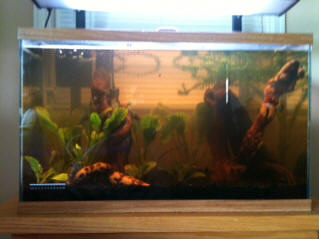
Just wanted to share with you my final setups for my 40 gallon Amazon
and my son's 20 gallon Asian river. Some of the plants still need some
growing and are recent adds but you get the general idea. Thank you to
Neale
<Sent to him>
especially for making this a very enjoyable hobby for my son and I!! I
tried to make the tanks as pure as possible but some of the plants were
admittedly disputed as to area of origin but hey....can't take all the
fun out of it can I :)
Asian river
Cryptocoryne Wendtii
Blyxa japonica
Heteranthera zosterofolia
Nymphaea Zenkeri
Betta splendens (Betta)
Kryptopterus minor (Ghost Catfish)
Trigonostigma heteromorpha (Harlequin Rasbora)
Stiphodon semoni (Cobalt Blue Goby)
Pangio semicintus (Black Kuhli Loach)
Amazon
Vallisneria Americana Gigantea
Sagittaria Subulata
Echinodorus 'ozelot'
Cleithracara maronii (Keyhole Cichlid)
Pterophyllum scalare (Angelfish)
Hyphessobrycon columbianus (Blue/red Columbian Tetra)
Gasteropelecus sternicla (Common Hatchetfish)
Mikrogeophagus altispinosus (Bolivian Ram)
Ancistrus cirrhosus (Bristlenose Pleco)
Phill
<Ah, very nice. Bob Fenner>
Re: Asian river and Amazon 6/11/14
I'm not sure how I forgot but thank you as well Bob! I've definitely
gotten your help more than a couple times.
Phill Shubert
<Ah, cheers. BobF>
|
|
Amazon tank and Lotus plant question
1/24/15
Hi Crew!!
<Phill,>
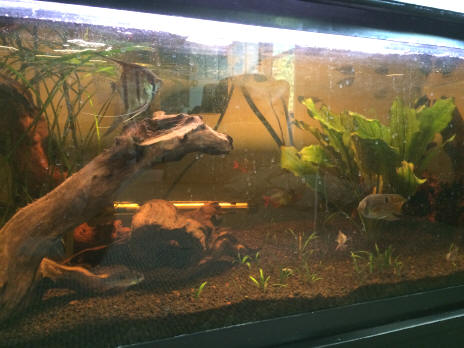
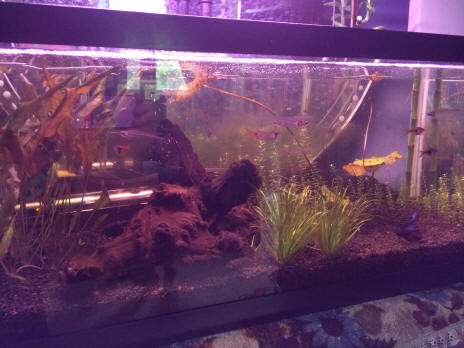
Hope you are all well and relaxed. Just reaching out to you with a
thought on my never ending Amazon plant issue lol. As you can see my 7
year old's S.E. Asian tank is thriving.
<Indeed!>
Nothing dies in that tank and everything lives at least a year past
expectancy. Including the beautiful Chocolate Gourami that he picked
out. I have actually removed the filter and am just running on a
powerhead to circulate with regular water monitoring and it has
performed beautifully.
<The sign of a "balanced" tank. Effectively the top layer of substrate
is home to the bacteria, and presumably very low stocking means that
this is sufficient to remove ammonia as produced. Comparable to the use
of live rock in marine tanks, but rarely achieved in freshwater systems
because we tend to more heavily stock such tanks.>
My Amazon tank still struggles with the plants (I know...shocking right
lol) which my son likes to point out and tease me over. Thus I am
replicating his setup. I have removed the dual T5HO 24" lamp for a
single 36" T5HO lamp with a smaller reflector. I am going with my gut
that the light is causing the plants to grow at such a rate that they
are out-competing each other for nutrients and the older leaves are
showing nitrate deficiency.
<Possibly, though iron is more commonly limiting. Either way, use of
root tablets can work wonders.>
I have also ripped out everything aside from 2 swords (Ozelot and
Bleheri compacta) and added a ton more driftwood for a more natural and
authentic SA river look. I'm even considering hanging some branches from
the above framework into the water for a "tree root" look. I've added
some water lettuce just to balance the system with the absence of the
other plants and monitoring frequently. Any thoughts on my pathway??
<Sounds good to me. Floating plants are the most authentic additions to
most aquaria -- rooted plants are more often than not marginals or even
amphibious plants that wouldn't normally be submerged 12 months of the
year. I'm hugely fond of using floating Indian fern plus Anubias below
the waterline. For a more South American feel, Ceratophyllum and
Vallisneria
are probably the two most authentic genera of true aquatics (Echinodorus
being amphibious bog plants, not true aquatics, even though we treat
them as such in aquaria). Alternatively, an open topped tank stocked
with Water Hyacinth could work, or for that matter, a suitable Lily Pad
species (the biggest lily pad in the world being South American, I
believe). If you can
find it, Amazon Frogbit is amazingly easy to grow, and its long feathery
roots provide a lovely deep green canopy below the waterline. Weirdly
enough there's a Java Moss (a Vesicularia species, perhaps Vesicularia
montagnei) called Christmas Moss from Brazil, so that's an option too.>
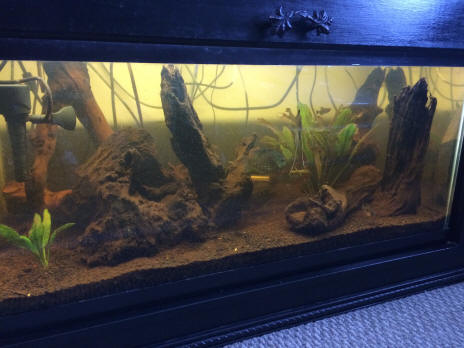
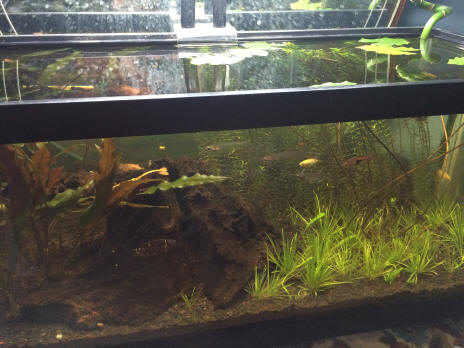
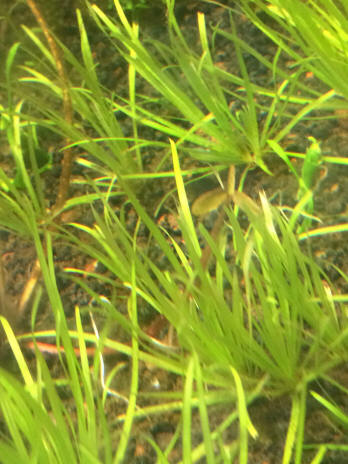
The Lotus picture I have attached is of my son's Nymphaea zenriki. I
have allowed the leaves to reach the surface for awhile now which has
eliminated the plant from putting up submerged leaves. Now it has sent
out this red stem as opposed to the normal brown variety. This stem has
white roots which you can see in the picture and what appears to be many
tiny leaves coming off it. Any idea if this is a runner and new plant or
the Lotus flower I have been hoping to see?
<Likely a daughter plant. Resist trying to wedge it down into the ground
until the roots are a decent length, otherwise what happens is the
runner snaps and the immature plant ends up being washed around the tank
on the water current. Once settled, Nymphaea tend to produce daughter
plants quite freely. Cheers, Neale.> |
 |
|
|
Asian river and Amazon 6/11.5/14
Hi guys,
<Phill,>
Just wanted to share with you my final setups for my 40 gallon Amazon and my
son's 20 gallon Asian river.
<Looks good! A wipe of the front glass might be a plus before taking photos,
though! Squirt the window cleaner onto a paper towel (not at the tank!) then
wipe.>
Some of the plants still need some growing and are recent adds but you get
the general idea.
<Indeed. Abacus aquatics in Sidcup recently got some Vallisneria nana. Like
all Vallisneria it's relatively easy to grow, and spreads well once settled.
It's an easier alternative to Hairgrass type things, having the
usual Vallisneria tolerance providing you DO NOT bury the white crown under
the substrate.>
Thank you to Neale especially for making this a very enjoyable hobby for my
son and I!! I tried to make the tanks as pure as possible but some of the
plants were admittedly disputed as to area of origin but hey....can't take
all the fun out of it can I :)
<Pretty much the idea.>
***Asian river***
Cryptocoryne Wendtii
Blyxa japonica
Heteranthera
Nymphaea Zenkeri
Betta splendens (Betta)
Kryptopterus minor (Ghost Catfish)
Trigonostigma heteromorpha (Harlequin Rasbora)
Stiphodon semoni (Cobalt Blue Goby)
Pangio semicintus (Black Kuhli Loach)
***Amazon***
Vallisneria Americana Gigantea
Sagittaria Subulata
Echinodorus 'ozelot'
Cleithracara maronii (Keyhole Cichlid)
Pterophyllum scalare (Angelfish)
Hyphessobrycon columbianus (Blue/red Columbian Tetra)
Gasteropelecus sternicla (Common Hatchetfish)
Mikrogeophagus altispinosus (Bolivian Ram)
Ancistrus cirrhosus (Bristlenose Pleco)
Phill
<Well done. Neale.>
|
Re: Asian river and Amazon 6/13/14
Lol good call. I was excited after adding my driftwood and didn't notice
the spots. I'll get you a better one. I feel after all your input you're
essentially part creator of these anyway.
<Kind of you to say so! Neale.>
Phill
Re: Asian river and Amazon
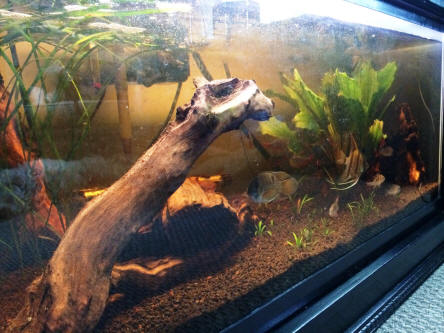
Hi Neale,
As promised...sans water marks.
<Ah yes, "clearly" superior! Cheers, Neale.>
|
 |
|
marine-to-fresh; S. Am. biotope 11/8/2013
Hello,
<James>
I currently have a 72" 165 gallon tank with a single overflow
<Wish there were two>
with two drains & returns, that's connected to an Eshopps 3 section
wet/dry filter, with crushed live rock, mechanical
filtration and the protein skimmer. I would like to try a fresh water
system now which would mimic a slow moving Amazonian river.
<Do take out the crushed carbonate substrate>
My question is can I use this tank for that purpose?
<Sure>
I was thinking of using pond filters in the wet/dry and of course change
the lighting. Any advice you can give me with this setup would be
appreciated.
cheers
<Perhaps a read here:
http://www.wetwebmedia.com/FWSubWebIndex/s_am_biotopefaqs.htm
Bob Fenner>
|
Biotope build outs, ex.s 1/16/13
Hi guys,
I wanted to thank you for your input and send you some updates as to how the
Asian and South American biotopes are coming. I have attached pictures of
both.
<Phill... hundreds of Kbytes, not Megs of pix/files please>
The Asian tank is a 20 long with the following:
Betta
Harlequin Rasbora
Celestial Pearl Danio
Red Cherry Shrimp
Christmas Moss
Cryptocoryne Wendtii
Hygrophila Sunset
I have 1 T5HO 24W bulb about 10" above tank and dose with Seachem
comprehensive, Excel, and Nitrogen. Very pleased with this tank so far.
<Looks nice>
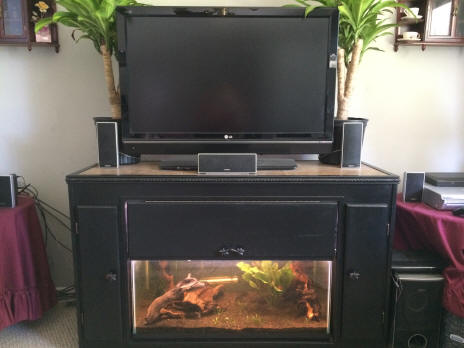
The South American tank will be going into the attached
build which I thank you for all your input. The doors are going on tonight.
The T5HO dual 48W will hang in that open space above tank 10" above. There
will be a door hiding the light and filter. I will send an updated picture
when it is done. It will contain:
Blue Acara
Bolivian Rams
Emperor Tetras
Bristlenose Pleco
Ozelot swords
Dwarf swords (parviflorus)
Dwarf Hairgrass
I just really wanted to thank Bob, Neale, and the rest of the crew who
helped me with this. My family and I are truly enjoying this experience and
it would not have happened without your aid. Truly appreciate your site and
what you guys do for us hobbyists.
Sincerely,
Phill
<Thank you for sharing. Bob Fenner>
|
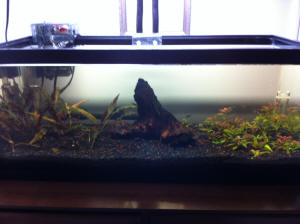
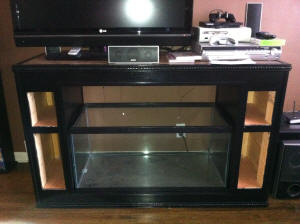
Biotope build outs 1/17/13
Hi guys,
I wanted to thank you for your input and send you some updates as to how the
Asian and South American biotopes are coming. I have attached pictures of
both.
The Asian tank is a 20 long with the following:
Betta
Harlequin Rasbora
Celestial Pearl Danio
Red Cherry Shrimp
Christmas Moss
Cryptocoryne wendtii
Hygrophila Sunset
I have 1 T5HO 24W bulb about 10" above tank and dose with Seachem
comprehensive, Excel, and Nitrogen. Very pleased with this tank so far.
<Indeed, looking good. Do wonder about the Hygrophila though; looks a bit
leggy and while it's nice to see the red colour on the leaves, pale green to
red plants are often very light-hungry. Would expect them to look bigger and
bushier if they've been there a couple months or more.>
The South American tank will be going into the attached build which I thank
you for all your input. The doors are going on tonight. The T5HO dual 48W
will hang in that open space above tank 10" above. There will be a door
hiding the light and filter. I will send an updated picture when it is done.
It will contain:
Blue Acara
Bolivian Rams
Emperor Tetras
Bristlenose Pleco
Ozelot swords
<A nice plant.>
Dwarf swords (parviflorus)
<Never had much luck with this…>
Dwarf Hairgrass
<…or this! Both need more light than I've ever provided, I think.>
I just really wanted to thank Bob, Neale, and the rest of the crew who
helped me with this. My family and I are truly enjoying this experience and
it would not have happened without your aid. Truly appreciate your site and
what you guys do for us hobbyists.
Sincerely,
Phill
<Sounds like you're having fun; we're glad to help. Cheers, Neale.>
|
Amazon Basin, share
3/30/12
Bob, Neale and crew,
<Rick,>
Anyone who keeps South American fish from the Amazon basin and has
never been there should probably take a look at this to get a feel for
the environment their fish come from.
http://googleblog.blogspot.com/2012/03/visit-amazon-on-world-forest-day-with.html
Click the square in the upper right corner of the image to expand to
full screen.
<Real good. Would be even better if we could travel *under* the
waterline!
Cheers, Neale.>
|
Amazon tank
1/14/12
Hi Neale,
Hope you had an enjoyable and pleasant holiday season! This is a
quick preference question. I am in the middle of setting up that
aforementioned 29 gallon Amazon tank (cockatoo Cichlid, keyhole,
black phantom tetras). I am either planning sand with some dwarf
sag and crypts or small pebbles with sag and Val.s. In either case
I will have plenty of driftwood and floating Anacharis. Which of
these is a better setup in terms of the fishes needs.
Thanks again Neale for all your help.
Phill
<Greetings! Yes, Christmas was nice and the New Year started
off well.
Let's hope it lasts. Anyway, to answer your question, all the
plants should work. To be honest, I think you'll find
standard Vallisneria spiralis may get a bit big for your
aquarium, so do look out for the dwarf variety of Vallisneria
americana. For some reason, aquarists have reported that
Vallisneria and Sagittaria don't grow well together. Never
tried this out myself, so can't comment, but you may want to
research this apparent allelopathy and choose one genus over the
other. Either way, I'd definitely include Cryptocoryne
wendtii or something similar in this tank -- it provides lots of
low-level shade that dwarf cichlids really appreciate.
Cheers, Neale.>
Re: Amazon tank 1/14/12
Thanks very much Neale. Do you think this tank and its
inhabitants would thrive better with pebbles or sand.
<Six of one, half a dozen of the other. Apistogramma are
sand-sifters and appreciate soft substrates. Keyholes
couldn't care less. Apistogramma like caves and will do small
amounts of digging around coconut shells and the like, so again,
sand helps. Gravel is easier to buy in darker shades, and this
helps enhance cichlid colours. It's also easier to keep out
of filter inlets, and the cichlids can't uproot plants so
easily. In short, either substrate will work, and both have
benefits. FWIW, I use sand by default.>
My apologies. I wrote that very awkwardly in my previous
email.
Phill
<Cheers, Neale.>
Re Amazon tank 1/21/12
Hi Neale,
<Phill,>
Wrapping up purchasing what i need for my tank and I have a
rather specific and hard to research question. 29 gallon Amazon
tank.
1 cockatoo Cichlid
1 keyhole Cichlid
12 black phantom tetra
1 Bristlenose Pleco
2 Ozelot Amazon swords
Some sparsely planted Pygmy chain swords (unsure if this will be
included)
Anacharis (either planted or floating)
I will be using plain pea gravel with natural dark colors and
nothing painted or fake.
Would you recommend laterite?
<Have used it, and it can work extremely well. But far from
essential.
Nowadays I use much cheaper garden pond soil mixed with gravel or
sand to stabilise it, and then top it off (not essential) with a
plastic mesh and then a layer of gravel or sand.>
If I use a 40 watts full spec bulb how many hours would you leave
this on per day to mimic the flora and fauna's natural
biotope?
<10-12 hours is usually adequate. Some folks fine 6 hours on,
2 hours off, 6 hours on works well at preventing algae.>
Thanks Neale. You guys are extremely generous to provide this
advice for the rest of us to learn from and I want you to know
that it's greatly appreciated by myself, my children, and
especially my fish! All the best Neale.
<Most welcome, Neale.>
Phill
<Do consider visiting the WWM Forum; that's the best place
to chat about stocking and planting, and showing off the progress
you make. It'd be nice to see a few photos of your tank
there.
http://wetwebmediaforum.com/forum.php
Cheers, Neale.>
Lighting 2/1/12
Hi Neale,
<Phill,>
Hope you are well. Just wondering if you had any input on
lighting. I know the Amazon River is not
littered with plants
<Understatement!>
but I'd like to have a few.
<Okay.>
I plan on doing Eco-Complete mixed with Silica Sand. Keeping some
swords in there and maybe some pygmy chain (though I am afraid it
will take off and cover the whole floor with the light and
Eco-complete).
<I have always found this quite a demanding species.>
My aquarium is ~20 inches in height.
<So quite a deep tank.>
Would a dual T5 fixture be sufficient?
<Would be very surprised if this was sufficient. You're
probably after about 2.5 watts/gallon for this species to do well
in a tank this deep, if not more. I have never found Pygmy Amazon
Swords "easy". Given ordinary levels of lighting the
plants sort of sit there, sending out the odd daughter plant, but
not really doing much otherwise. They need strong lighting to
form that thick green "turf" effect people see in
aquarium books. By all means try it out, and you may be okay. But
don't be surprised if it doesn't work out.>
I will not be using CO2 so will the plant leaves get burned?
<Echinodorus tenellus is one of those species that really
benefits from both nutrient feeding through the roots and CO2
fertilisation.>
Will I see increased algae production?
<Probably. If you up the lighting level, but don't have
fast-growing plants to use up that lighting, algae tends to fill
the gap.>
Do you guys recommend Malaysian Trumpet Snails to aerate the soil
and prevent pockets?
<I think they're useful, but not essential. Some people
object to them very strongly and it's true they breed
extremely quickly. Once introduced, they can become a pest if not
somehow managed. I think Clea helena is a better bet; it burrows,
but breeds slowly. Otherwise, don't worry about the substrate
too much; catfish and shrimps will do almost as good a job
keeping not clean. Whiptails in particular are effective
burrowers.>
Thanks again Neale. I'll be sure to get some pictures up on
the website once I get it done. I hoping it will look amazing
with all the input I have from your team.
Phill
<Cheers, Neale.>
Re: Amazon Tank (Hmm… Bob might call this chatting before too
long!)<<Heeee!>>
2/23/12
Hi Neale,
<Hello Phill,>
Thank you again for your advice with my new Amazon endeavor. I
know I have bugged you more than what is acceptable but I am
trying to be perfect on the first shot here. I've been going
back and forth and I think the more "pure" approach
would be much more enjoyable for me.
<Pure in what sense? Amazonian rainforest habitats are
normally plant-free!
But there are some South American habitats that do have plants,
like the Llanos habitats from whence come Ram Cichlids.>
With that said I am sticking with the Amazon swords with a ton of
driftwood for my 29 gallon (specifically Pygmy chain, Ozelot, and
Rosette "Tropica" planted in Eco-complete). I will have
more plants then what one would see in the Amazon river basin but
I really enjoy the look of a carpet of pygmy chain and I
don't really see myself creating a foot deep pile of dead
leaves in the tank.
<Surely, though Indian almond leaves plus bogwood can recreate
fascinating habitats, especially with blackwater extract to tint
the water. Glowlights, Neons, Lemon Tetras and Apistogramma would
be a revelation in this sort of dark, gloomy habitat.>
The bigger change is the stocking which is now as follows:
8 Marbled Hatchetfish (I will have floating Amazon Frogbit)
8 X-ray tetras
1 clown Pleco
1 or 2 Cockatoo Apistos.
<Okay.>
Now here is where I would like some direction. I would love to
set up 2 bottom level cichlids. Would it be better to have a pair
of cockatoos or 2 individual species. I would rather do the
male/female pair but I want to be ethical in handling the fry. I
don't want to depend on local stores to purchase them and I
will not bring life into the tank that I can't be responsible
for handling once it arrives. What are my options?
<Add a predator? Seriously, if you crank out fry, then keeping
another fish that eats those fry can be one solution.>
If not the breeding pair then what would be an acceptable
tankmate for the cockatoo? I was going to go with a Bolivian as
mentioned prior but have heard they can be feisty. Any other mild
Apistos or medium sized cichlids that can room with the
dwarf?
<Laetacara curviceps would be an obvious choice, or Keyhole
cichlids.
Checkerboard cichlids are lovely, but might be bullied by the
Apistogramma.
Nannacara anomala is a beautiful little cichlid, much under
appreciated. Last but not least, one of the rarer Angels could
work, such as Dwarf Angelfish (Pterophyllum leopoldi) if
you're space-limited.>
Also are my 2 schools ok or would I be better served to have 16
of 1 species instead of the 8 of 2 separate groups?
<One big school of tetras is always better than two smaller
schools, but you have sensible numbers of both, and frankly,
upping either to 10 shouldn't much affect water quality in a
tank this size, if filtration is robust.>
My LFS has re-checked my water now that I am cycling the tank.
They have changed their previous assessment of my water to 7.6 pH
and hardness of 150ppm. I suspect this should not affect my
choice in fish.....am I correct with this thinking?
<Most South American species should adapt to this, even if not
as soft and acidic as would be ideal.>
Thanks Neale and hope you are well.
<Quite so.>
Phill
<Cheers,
Neale.>
Fwd: final setup 3/14/12
Hi Neale,
<Phill,>
No reply needed on this one buddy. Just sending you a photo of
the final setup.
<Looks nice.>
Thanks for all your advice and input. Apisto agassizi pair have
already made a condo out of driftwood on left which is completely
hollow with entry hole at bottom, middle, and top.
<Real good.>
Also in tank are 1 cobalt blue angel and 9 black phantom
tetra.
Ammonia/nitrite/nitrate all at 0. Ph 7.4 with 150 ppm
hardness.
Eco-complete substrate. Will be adding Frogbit and Pygmy chain
sword soon.
Dual T5HO 6" above top. Thanks Neale. You've been
great!
<Most welcome.>
Phill
<Cheers, Neale.>
|
|
|
Tetras for South American Cichlid tank
1/2/12
I am wondering if there are any suitable tetras for my South American
Cichlid tank.
<Many.>
I currently have some Silver Dollars but kind of like the idea of a
large school of tetras instead.
<There are quite a nice variety of Silver Dollar-type things. Have
you looked at Myleus schomburgkii? This is a schooling species with
nice colours and a maximum size of about 12 cm/5 inches.>
My current setup is a 120 gallon tank stocked with 6 Severum, 8
Eartheater cichlids, 6 Pictus catfish and 1 Rhino Pleco. I was
thinking of Buenos Aires tetras but reading thru the FAQ I seen they
can be fin nippers.
<And subtropical, too.>
Could you suggest a schooling fish that won't fin nip and is big
enough to exist with my cichlids. Thank you for the wonderful site!
<Congo Tetras and Bleeding Heart Tetras are two others that would
work and are widely traded. Cheers, Neale.>
Setting up a south American cichlid tank
9/26/11
Hi All,
<Hello Andrew,>
I hope you're well and thank you for the education and support you
all provide. It's fair to say I've spent a good few hours
reading on this site.
<Thanks for these kind words.>
My question is this: I've been back in the hobby for about six
months and have two (140 litre and 120 litre) tanks with community fish
which are going well after a few early deaths and cycling issues
(Mainly my own lack
of knowledge which this site has been invaluable at rectifying). I am
about to purchase a 240 litre tank and would like to dedicate it to
breeding two types of south American cichlid.
<Okay.>
Would I be able to keep a pair of Apistogramma Apache
<More widely called Apistogramma sp. "Masken".>
with a pair of Blue Acara (Aequidens Pulcher?)
<Potentially, but do bear in mind that this cichlid is fairly large
and somewhat more aggressive.>
or would you suggest a different combination with the priority on the
Apache.
<Yes; Apistogramma are most easily bred in small tanks with lots of
plants and middling temperatures. Very soft water is often essential,
as are low pH levels, potentially 5-6 in the case of some species, and
at best no higher than 7 with things like A. cacatuoides. By contrast,
Blue Acaras are boisterous fish that do better at low to middling
temperatures and aren't fussy about water chemistry but do best in
neutral water conditions.
They're more omnivorous, and can uproot some plants while foraging
for food. Again, whereas Apistogramma often benefit from maintenance
alongside small surface-swimming dither fish such as Hatchetfish, Blue
Acaras are best bred as pairs in their own aquarium in the same manner
as things like Angels.>
I have the opportunity to get these fish wild caught which means they
will be pure fish but also very sensitive.
<Yes; again, the low pH level means biological filtration will be
operating at very low efficiency, so an understocked tank is an
advantage, potentially with more reliance on floating plants for
ammonia removal than filtration alone.>
Which leads me to my next question. From my research on this site I
believe these fish will be extremely sensitive and will require superb
water quality with a hardness of around 5. Is this correct?
<Yes. Very few Apistogramma do well above 10 degrees dH, pH 7, and
most will want 1-5 degrees dH, pH 5.0-6.5 depending on the
species.>
Also is mixing 4 parts rainwater to 1 part tap water (My tap water is
precisely Ph 7) and adding conditioner the correct way to achieve
this?
<Potentially, but you may find using rainwater with Discus Buffer
easier, though a 4/1 mix may work if you also use a pH-down buffer and
keep a close eye on pH stability.>
(Not necessarily the right ratio as I can research the exact ratio on
this site as long as I have the correct hardness). The setup will
contain lots of rock caves and slate.
<Don't underestimate the value of floating plants with
Apistogramma; they appreciate the shade. But otherwise yes, their
habitat is mostly leaf litter and sunken wood rather than
plants.>
Finally, as I've only been back in the hobby a short time do you
feel this project may be beyond me at this stage.
<You may want to try A. cacatuoides before anything more
challenging. That species is almost certainly the "easiest"
Apisto thanks to its tolerance for hard water and community aquarium
life. Apistogramma borellii is another good species that isn't too
picky about water chemistry or tankmates. Apistogramma agassizii is a
bit more challenging in the sense of being fussier about water
chemistry, but is otherwise reliable. All three are widely traded and
inexpensive. But with all this said, if you have a reasonably large
aquarium for your Apistos, can control water chemistry as per the
species requirements, and understand how to maintain low nitrate levels
as well as zero nitrite/ammonia, none are insanely
"difficult" fish per se.>
The last thing I want to do is purchase wild caught fish and condemn
them to a brief unhappy life.
Many thanks for your help, hopefully in this matter but also for all
the other things I've learned and will continue to learn.
Andy
<Hope this helps. Cheers, Neale.>
Re: Setting up a south American cichlid tank
12/3/11
Hi Neale,
Thanks for your reply and advice. I've finished cycling the tank
and was hoping to be ready to start stocking but unfortunately the pH
and hardness are (I believe) a bit too high for Apistogramma (7.7 and
14 degrees respectively).
<Not really too high on either count. Remember, pH is largely
irrelevant, so unless wildly high, 8 or above, don't worry about
it, and certainly don't try and change it directly. Fish don't
"feel" pH is any meaningful sense, though pH does have
impacts on things like bacteria levels in the water and whether some
fish eggs mature or hatch properly. So adjusting pH tends to be an
issue only when keeping blackwater fish (e.g., Ram Cichlids, where a pH
between 4.5 and 6.5 is required) and where sex ratios or hatching rates
are proving problematic. Now, hardness can be an issue, but for the
hardier Apistogramma, like A. cacatuoides, a hardness of 14 degrees dH
is acceptable, if not ideal.>
I've researched a remedy for this and would just like your
advice/opinion.
I have six panda Cory in another tank at pH 7.0 which I would like to
move to my south American tank. I plan to use peat balls to lower the
pH to 6.5 in the new tank along with a couple of almond leaves however
I know this could require some experimentation to get right but I
believe a slow and steady approach with frequent measuring would be the
best way.
<I'm very worried by your talking about pH rather than hardness
here.>
Is it best to introduce the panda Corys once the pH drops to 7 or
should I wait until its down lower and move them from pH 7.0 to 6.5 in
one go?
<Forget the pH. Unstable pH levels have killed many more fish than
pH levels that aren't textbook values! If you have a hardness of 14
degrees dH in your tap water, then the ideal thing would be to lower
that to about 7 (i.e., by mixing 50/50 tap water with rain or RO water)
or, if that is too expensive, 10-11 degrees dH (i.e., about two parts
tap water to one part rainwater or RO water). You can keep most, if not
quite all, South American fish extremely well at 10 degrees dH, pH
7.5.>
I hope to stock this tank with a school of 15-20 tetras (Not sure on
type yet, recommendations welcome!)
<Select according to water temperature. Neons prefer cooler water,
Cardinals warmer water, for example. Lemon Tetras are excellent
all-rounders if the water isn't too hard and there's subdued
lighting.
X-Ray Tetras are very hardy tetras and good choices if you want
trouble-free fish you can add and then forget about. Hatchetfish are
excellent dither fish, but shy and easily bullied, and sensitive to
poor water quality. Various other options too. Peruse Baensch's
Aquarium Atlas for some ideas.>
and up to 12 panda Corys
<Remember these don't like being kept above 25 C/77 F; if you
must keep the temperature higher, then go with C. sterbai.>
to go with the Apistogramma cacatuoides (2 of) as well as an L177 gold
nugget Pleco. The tank has a small piece of bogwood and will soon have
some floating Indian fern to create (I hope) a nice dark Amazonian
atmosphere to bring out the best colours in the fish. Am I heading in
the right direction to achieving this?
<Yes. But do remember the Amazon largely lacks "planted
aquarium" type biotopes. Mostly, it's leaf litter on silica
sand, with lots of tree trunks. Overhead shade may very well be
provided by floating plants, such as the excellent Amazon Frogbit. The
Amazon water level goes up and down with the seasons, so much of the
year it's a sunken forest with terrestrial plants partly submerged.
Despite their name, Amazon Swords aren't especially characteristic
of the rainforest.>
Many thanks,
Andy
<Cheers, Neale.>
Re: Setting up a south American cichlid tank
12/4/11
Hi Neale,
Thanks for the swift reply. Don't be too worried about my talk of
pH. I have some knowledge of chemistry (not used for a few years
though)
<Real good.>
and I believe I understand how it all fits together in the aquarium
(after much reading).
<Cool.>
My concern was that lowering the carbonate hardness via rain water will
cause the pH to become unstable which as you mentioned below has killed
many a fish!
<Indeed.>
I believe the peat balls will provide a buffering ability to stabilise
the pH at 6.5 with the right dosage.
<Sort of, but I would trust them. Use a Discus buffer instead. Peat
is extremely unpredictable.>
Will the Corydoras be better off moving to similar water conditions
(Chemically) at which point I would begin to lower the hardness via
water changes over a couple of weeks using the peat balls as a buffer,
or would it be better to do the adjustments before moving them and then
move them in to a tank with different water conditions?
<Ideally, introduce the fish to the tank with whatever water
chemistry the fish have experienced up to now, and then slowly change
the water chemistry over the following weeks.>
I hope this makes sense.
Thanks for your help.
Andy
<Cheers, Neale.>
SA or W African River tank 10/19/11
Hi Crew,
I hope you are all well! This is more of a compatibility/best
experience question. I have tried to research this to the best of my
ability before coming to you.
I want to put together a 20-30 gallon aquarium. My water has pH of 6.8
and 100 ppm straight out of the faucet. I would like to do some
combination of the following:
Either 1 keyhole Cichlid with 1 cockatoo Cichlid or 1 African butterfly
Cichlid with 1 Kribensis
With either 6-8 flame tetras or 6-8 black phantom tetras Later: 1
Bristlenose Pleco and a couple Otocinclus.
Maybe 1 bamboo shrimp depending on stocking and bio-load.
In your experience do you see any negatives here? Any cool ideas you
have are also greatly appreciated. Thanks guys for all your help. Your
experience and guidance are amazing.
Phill
<These combinations sound workable. The cichlids are the jokers in
the pack; while singletons shouldn't cause problems alongside
catfish and tetras, two cichlids of different species might have
problems cohabiting in a relatively small tank. Of the two options, the
South American one seems the most likely to work, neither of those
species being particularly aggressive. The West African options are
more interesting in some ways, with some nice colours and more outgoing
personalities. Anomalochromis thomasi is very peaceful, but Kribs can
sometimes throw their weight around, so do watch them. I think worth a
gamble, but keep an eye on them.
Small, schooling fish for African communities can be difficult to
find.
Nannaethiops unitaeniatus is a lovely fish, but not often sold, and
tends to hide away a lot. African Glass Cats might be a good
alternative. There are some lovely African barbs, notably Barbus
fasciolatus as perhaps the most widely traded and a lovely little fish.
Do also look for Ladigesia roloffi, the "Jellybean Tetra",
and the superb Butterfly Barb, Barbus hulstaerti. Cheers, Neale.>
Re: SA or W African River tank 11/22/11
Hi Neale,
I hope you are well and thank you for you insight and advice. I have
decided to go with the south American tank. I will use
the black phantom tetra as the schooling fish. Would 3 small SA
cichlids be too much ( keyhole, cockatoo, Bolivian ram)?
<Given space, sure. Pairs tend to cause more problems than
singletons. But still, I'd allow 10 gallons per cichlid.>
If not which 2 would you recommend.
<The Keyhole and the Apistogramma are both shy, retiring fish. The
Bolivian Ram is quite pushy and outgoing. I think I'd perhaps go
with the Apistogramma and the Keyhole, provided the tank was well
planted, and that there were other midwater fish to add action.
They'd be sufficiently mellow they'd get along without
requiring exactly the same hiding places, so they'd not
compete.>
I've tried diligently to search for advice on these combos with no
luck.
Some say do not mix any cichlids in anything less than 40 gallons while
others say three 3 are fine due to their relatively calm
personality.
<The problem is about guarantees. While dissimilar cichlids should
get along, the more space, the more certain things become.>
Thus I came to the experts. On a side note I enjoyed Bob's Q&A
article in December issue Tropical Fish magazine about the salt water
nano. I've been looking at nano tanks and it was a good read.
Thanks guys.
Phill
<Thanks for the kind words. Cheers, Neale.><<Ditto,
RMF>>
Reef to Amazon Biotope/Discus
Conversion 7/13/11
Greetings Wet Web Media Crew,
<Bart>
After many years enjoying my 120 gal. reef, I've decided to move on
to a new challenge. I've always wanted to try out a Discus tank and
after many hours of reading on your site I am pleased to find that my
home source water parameters are well suited to them, both soft and
slightly acidic. I have cleaned all calcium deposits from the tank and
filtration system (sump and wet/dry) and am interested in your thoughts
on my stock selections. Tank temp will be targeted at 82 degrees
Fahrenheit My goal is to populate the top, middle and bottom of the
tank while still allowing the Discus the ability to compete for food
successfully. I would start my stocking with 15 Black "Neon"
Tetras which my research shows like the top of the tank.
Next come 15 Rummynose Tetras, which may prefer the lower to middle
portions of the tank. I'm sure that these rules are more like
guidelines and my fish may not stay in the zones indicated, but do you
think the Rummynose will school with the Black Neons or will they stay
separate?
<Likely a bit of both... more separately at first>
Next I would like to add 7 Bleeding Heart Tetras, 7 Hatchet Fish and 7
Corydoras Sterbai, with at least 7 juvenile Discus to be added last.
The tank would have no plants in the substrate, but instead would be
filled with driftwood and bogwood, with a cover of Amazon Frogbit
floating on the top. I have already purchased 3M Colorquartz
fine-grained substrate in black, which is very smooth and should work
great with the Cory's.
Eventually I may add a Bristlenose catfish or two to help me scrape
algae.
<I would add a few Ancistrus to this sized volume>
Filtration on the tank will be a wet/dry filter with two 1" supply
lines draining from the Mega Flow overflows installed in the display.
The wet/dry is located in the basement under the tank and will drain
into a 29 or 40 gal sump, whichever I can find. I have two options for
my return pump, I can run up to 1100 gph total from my Iwaki MD70 but I
do not like to run any drain this close to capacity, which should be
around 1200 total.
I would throttle this down to about 800gph I think. I could also run
about 240 gph with a Pan World 50px-x, obviously a much gentler flow
but I am concerned that I would not be turning the tank water enough at
this rate. Do you have a recommendation here?
<To use the "throttle" as you suggest, gauge from the
behavior of the Discus whether this is okay>
Do you think the stocking load is too heavy or could I add more
Discus?
<I think you're right about right numbers-wise... IF/should two
pair off you may need to move them elsewhere>
Will any of the Tetras mentioned school or shoal together or will they
stay in their own distinct groups?
<Mostly the latter>
Finally, will the Discus be able to get fed with this many other
species in the same tank?
<Yes; their food items will be larger in time>
I anxiously await your thoughts on the above and offer my gratitude for
the countless hours of discovery provided by your website.
Best Regards,
Bart V
<And you, Bob Fenner>
Book Release: Amazon Below Water, Oliver Lucanus
3/12/10
> > HI All,
> > My book is finally out, can be ordered from the website,
> > Best Wishes,
> > Oliver Lucanus
> > Montreal, Canada
> > Web: http://www.belowwater.com
> > Book: http://www.amazon-below-water.com
> > Blog: http://belowwaterfish.blogspot.com/
Congrats Oliver. Will post on WWM. BobF
Re: Book Release
> Great, thanks. Sorry I have been absent, with the book coming out
the last 2 years every free minute have been taken up.
<Certainly understandable>
> Will try to be back and more helpful the moment I can. If there is
any questions I can answer by email let me know.
<Ah, I thank you>
> Thanks,
> Oliver
<Cheers, BobF>
Planning an Amazon setup; some questions --
10/22/09
Hi Crew,
<Hello,>
Finally setting up a tank again after about 5 years with no fish.
It's good to be on WWM again --- I've missed your excellent
resources. I'm in the planning stages for an Amazon habitat focused
on small tetras. I'm also trying to use the gear I have to minimize
buying new stuff.
<Fair enough.>
I have a choice between a 55 gallon "tall" tank with 576 sq.
inches of surface area or a 46 gallon tank with 720 sq. inches surface
area. More water vs. more surface area. Of course I want more fish; but
which tank
would serve small tetras better?
<There's really not much in it either way. "Tall"
tanks can't hold as many fish as "wide" tanks of the same
volume, but the extra volume of water in the 55 gallon tank means water
chemistry and water quality issues will be less. So it's six of
one, half a dozen of the other. If this was me, I'd get the 55
gallon tank assuming cost was the same, but would simply be careful
about how many fish I added to the tank.>
I'm planning to build the environment around a school of Cardinal
Tetras (love them; have done well with them in the past.) The advice
with Cardinals is always "lots of plants" but the actual
Amazon seems to be a little light on the plants according to Neale.
<Something like that, yes. A lot of the Amazon is either seasonally
under water (flooded forest habitat, with marsh rather than truly
aquatic plants)
or else simply open sand with no plants of just floating plants. So
things like Amazon swords actually spend half the time above the
waterline, in marshy ground, only being covered with water for a few
months.>
Do Cardinals really do well with subdued light and rocks/driftwood?
<Yes.>
I was planning to do only low-light plants if any, because I only have
about 80 watts of light with my current equipment.
<Try this: lots of bogwood for sure, dark substrate or silica sand
(this latter is actually 100% authentic), and then floating plants for
shade.
Lilies for example look fabulous, and make good use of limited lighting
because their leaves are at the surface. Floating Amazon Frogbit would
be another great addition, if you wanted some greenery. They have long,
long
roots that form a wonderful midwater habitat for tetras, and many
tetras actually spend their entire lives under the roots of floating
plants.>
I've done well maintaining an undergravel filter in the past,
planning to use it again. (Obviously I'll be potting any plants.)
How is reverse undergravel for South American fish?
<Just fine.>
My first choice of substrate is some fine black gravel, which worked
with traditional- flow UG in the past. (Can't remember if I bought
this stuff from Tideline, but it looks just like it.) I love the dark
background, but also have some silica sand (too fine for UG) and some
"natural" color fine gravel that looks like this, if those
are better choices.
<Sounds cool. Floating plants obviously couldn't care less about
UG or Reverse-UG filters; lilies are a bit more finicky, but in pots,
they should be happy *if* you stick a fertiliser pellet into the root
ball every month or two.>
UG then will be my main biofilter and I'll leave a cheesy Top Fin
60 HOB running for a little additional filtering and for specialty
media if needed. For weekly maintenance I do 10% water changes and stir
1/3 of the gravel bed with a Magnum 350 running to clean up the gunk.
Would I be better off just using the Magnum as the main filter?
I've always thought of them as vacuum cleaners more than permanent
bio filters. For that matter should I just set up a couple sponge
filters and put them behind a rock?
<If you wanted. A properly maintained UG should be fine
though.>
Those have worked well for me also, but I've only used them in
small tanks.
<They can work well in big tanks.>
In addition to a dozen (or more?) Cardinals I'm considering
Pristella tetras, Rummynose, Black Phantoms, and especially Emperor
Tetras. (All subject to space available and healthy inventory at the
LFS, of course.)
<All excellent fish, but do review their temperature requirements.
Black Phantom Tetras for example prefer somewhat cool water.
They're great companions for most Corydoras, which also like cool
water. But they'd be
bad companions for Cardinals, which need very warm water. You
wouldn't keep Corydoras with most Cardinals, but Corydoras sterbai
-- the "warm water Cory" -- would be a good choice.>
Assuming a good fully-cycled filter bed, hopefully some plants, and
allowing breathing room, what's a good stocking level? I do want
multiple species, but probably better off with fewer species/more of
each. I'd love some Corydoras sp. also, but wouldn't that black
gravel be too rough for them?
<Depends on the gravel. They certainly prefer smooth silica sand,
and they're a lot of fun to watch when kept with it. But black
sand, such as Tahitian Moon Sand, is too sharp for them. Smooth pea
gravel is fine, but heavy gravel or sharp gravel wouldn't be so
nice.>
Obviously I have some options here. It's a pleasant process! Thanks
in advance for all your help, and meantime I will keep reading.
Thanks, CK =)
<Hope this helps, Neale.>
Re: Planning an Amazon setup; some questions --
10/22/09
Hello Neale,
Thanks so much for the speedy reply!
<My pleasure.>
It pays to do a little math. I knew that a "55 gallon" fish
tank is nominal, like lumber, but imagine my surprise when I carefully
measured the *inside* of each tank and re-calculated. Turns out they
hold almost exactly the same volume of water (fraction of a gallon
difference) but the broader tank offers over 100 square inches more
surface area. I was going to use the tall tank on your very sensible
recommendation re: water *volume*, but since that's the same... the
broad tank is a no-brainer!
<Indeed. I'm actually surprised that they hold the same amount
of water.
While you're right, tank sizes are somewhat nominal, that a 55
gallon tank would hold the same as a 46 gallon tank sounds
extraordinary.>
I've decided to go with the black sand and some of those lovely
plants you suggested. And I promise to check my fish specs carefully to
get some truly compatible species.
<Cool.>
Off to make room for setup. Thanks again!
CK =)
<Happy to help. Good luck, Neale.>
Re: A host of things: substrates, water parameters, stocking
options 8/22/09
Alright Neale,
<Joey,>
Your response got me thinking about a lot of different options. I may
go for the Amazonian set-up as planned, swapping out M. ramirezi for M.
altispinosus.
<A good idea. Since these cichlids, plus many tetras and most South
American catfish thrive in both soft and moderately hard water,
it's easy to create an Amazonian set-up without the expense of
creating soft water.
With moderately hard water, pH stability is easy to ensure, and your
filter bacteria will operate optimally, since these prefer hard, basic
water.>
I'm starting to be drawn more to doing either a hard water or
low-salinity brackish set-up (around SG 1.003). Then, I can still take
advantage of a live plant set-up, while using my area's water
chemistry more easily, and also keeping some very interesting species.
That all being said, I have a few more questions, based on our previous
discussion, as well as other articles I've read on the WetWebMedia
site:
<OK.>
1) The CO2/CO3 issue: I've read about hard water plants that can
utilize carbonate salts as their carbon source rather than CO2. Would
it still be beneficial to supplement these plants with CO2?
<Yes; while such plants can use carbonate, if given CO2, they
photosynthesise that bit better. Equally, the removal of carbonate
allows pH to change, creating variable pH conditions when day is
compared to night. Note that in places like ponds and lakes, such pH
changes happen and animals adapt to them, so in themselves, pH rises
and falls on a daily, cyclical basis are not intrinsically
lethal.>
It seems to me that adding carbon dioxide would simply use up the
water's carbonate buffer reserve more quickly, making the desired
hard water less hard. Thus, to add CO2 to any useful effect in an
aquarium with high KH would unacceptably change water chemistry. Is
that how it tends to work, or is it not that simple?
<It's complicated, but has been thoroughly worked out now. Do
see here:
http://www.thekrib.com/Plants/Tech/golden-rules.html
I'm not an expert on CO2 fertilisation -- have never used it -- but
would direct you to those good folks at The Krib who really know about
this stuff.>
2) I've got a few different ideas for stocking arrangements for
fish for the hard water set-up, one of which I'd like to run by
you: a school of *Melanotaenia *praecox, two Kribensis (probably
female, to decrease territoriality and prevent breeding--desired for
the time being), perhaps one other which I would carefully
research/choose, and lastly, *Colomesus* asellus. That's the
particularly question-mark fish of the group, of course. I'd really
like to keep about three of them. I know that it is debated whether a
puffer even as peaceful as this one should be kept with other fish,
whether it would be a healthy fit in general. I read the article you
wrote, "The Nice Puffer," and you offered a few words about
this topic. I'm wondering if you can tell me a little bit more of
your opinion on the matter.
<Will depend on the size of the tank: my SAPs are largely well
behaved in a 180-litre system with rocks and floating plants to provide
cover. In smaller tanks, your degree of success may well be
less.>
With the Kribensis, my reasoning is that the SAP won't be as
demanding of the caves as other puffers might be, and thus won't
compete with the Kribensis, and that the cichlids can defend themselves
against nipping.
<Have kept SAPs with a different Pelvicachromis species, P.
taeniatus, and they worked pretty well except for the occasional nipped
dorsal fin.>
I'm hoping the M. *praecox *are active and fast enough to evade
harassment by the puffers?
<Might be, but again, will depend on the amount of swimming space.
Some Rainbowfish species tend to sit about in midwater rather than
actively patrol the tank, so think about that when shopping. Big groups
and strong water currents should tilt the odds in favour of the
rainbows.>
Also, are there other fish that would fit into this arrangement
well?
<Pretty much what's written in that article! Have subsequently
found Ameca splendens works well with them, and by extension, you might
consider other feisty Goodeids, such as Xenotoca eiseni.>
I don't know about the puffers. I'm really interested in having
one of the interesting hardwater/brackish oddball groups for the
variety they provide, and I'm very drawn to these SAPs.
<They are great fish. However, Carinotetraodon irrubesco is perhaps
that bit easier to slot into community tanks, and with floating plants
available, spends much time in the open and at the top of the tank,
begging for food.>
Let me know what you think.
Once more, thanks for your help,
Joey E.
<Cheers, Neale.>
Amazon tank compatibility check and substrate question
05/21/09
Hey crew,
first of all, I'd just like to compliment you on your
well-designed, innovative, and extremely useful website.
<Thanks.>
Now to get down to business: I've got some moderate experience in
fresh and saltwater tanks, including my current 20 gallon S.E. Asian
tank and 29 gallon nano-reef. I recently purchased and refurbished an
older 55 gallon (200-odd liters?) tank with a brand new AquaClear 300
filter, rated at 270 gallons per hour or so realistically. I originally
had this tank planned as a Mbuna community environment, but have become
love struck with a beautiful gold/ light brown angel my local fish
store has agreed to reserve for me until I get my tank cycled. I plan
on using some established sponge media and water from my 20 gallon, as
the water parameters for it and the Amazon biotope tank I am interested
in are obviously similar. I'll most likely add some blackwater
extract to lower the ph. I've had some small experience with live
plants in the past and am planning the 55 as a heavily planted tank
(swords, Java fern, Java moss, possibly Anubias and various crypt
species).I will most likely use the DIY yeast method for co2, along
with some sort of diffuser (recommendation?)
<Swords are the only ones here that really need CO2; none of the
other plants grow quickly, and hence get by fine on ambient CO2 levels,
though Crypts certainly will prosper uncommonly well given CO2.>
My first question is one of substrate: I happened upon some
high-quality, but relatively large, pebbles from a southern tributary
of the Brazilian Amazon (got to love those adventurous friends). I'd
love to use these in my tank, probably under some sort of plastic
webbing. What, however, should I put on top of this?
<If burrowing fish such as Corydoras and dwarf cichlids, then you
can't go wrong with plain smooth silica sand; this also happens to
be exactly what you find along the bottom of the Amazon.>
I'm looking at laterite, which would be especially nice for the
plants, mixed with peat and possibly a small amount of silica sand. Now
for the all-important stock list: besides the plants, I'd like to
run this by you all:
The angel and a mate for her/him (Scooby, as I've named it, is
about 3 inches in diameter).
<Fine, provided they actually are a pair; you can't sex them,
and males will be aggressive.>
6 cories, most likely aeneus variety.
6 (?) marbled hatchets as dither fish/ surface dwellers
<Delicate; approach with caution, and certainly keep more than
6.>
8 or so cardinal tetras, or black Neons if I can get my hands on them.
I'm guessing that if they are semi-adults when the angels are
juveniles and they grow up together, there will not be an issue of
aggression.
<Fine.>
5 or so black widow tetras.
<Fin-nippers.>
Possibly a discus once the tank is established and cost-permitting.
<Don't mix Discus and Angels for various behavioural and
healthcare issues.>
Possibly a dwarf Pleco.
Possibly transparent shrimp (not sure of the species).
<Angelfish food, if too small... also, do bear in mind shrimps tend
to prefer neutral to alkaline conditions.>
Possibly the clown loach from my 20 gallon. He is very peaceful.
<Not really authentic, but Clown Loaches (plural!) work well with
Discus or Angels.>
A breedable pair of natural-looking (not neon-orange!) but mildly
colorful livebearers. Suggestions?
<Wouldn't; for a start, Poeciliids need different water
chemistry, but mixing stupidly colourful fish with a subdued planted
tank will really create a mash that doesn't look like one thing or
the other. Have a plan, and stick with it.>
The aquascape will be of the "Shore Slice" genre, consisting
of a drastic slope on the right-hand third of the tank, inhabited by
the Echinodorus.
The center third will consist of tank-safe rocks as hiding places and
the Anubias and Cryptocorynes. The left-hand third will be draped over
with bog roots and be planted with the Java ferns and mosses.
<Done this, can look very good.>
Overall, this is a very loose plan, and I'd appreciate any advice
or criticism. Also, 3 T12 tubes of 40 watts each should be fine for
lighting, as well as some indirect sunlight, correct?
<Not sure about "T12"; only used T5 and T8 tubes, in which
case 2.5-3 watts per gallon will be need for Echinodorus, which like
most amphibious plants, are fussy about light quality. Does vary with
species though; certainly aim for "high" light
intensity.>
Thanks,
Will N.
<Cheers, Neale.>
Re: Amazon tank compatibility check and substrate question
05/21/09
Thanks for the advice! But to clear up a few misunderstandings, I meant
"dye-ing" fish, not ones close to death.
<Ah, the importance of spelling! Dyed fish I don't like. As well
as being cruel and stressful (whatever the retailer might suggest about
anaesthesia, which isn't used, and fish not feeling pain, which
isn't true) dyeing reduces the health of the fish. Glassfish, for
example, have been demonstrated to be much more vulnerable to
Lymphocystis when dyed compared to in their undyed condition.>
And I wasn't planning on keeping rams with the Apistos, it's an
either/ or scenario. And would a larger shoal of black widows reduce
their fin nipping, as it does with tiger barbs?
<Wouldn't bank on either species being reduced to 0% chance of
nipping, though I do understand that this is often the case with Tiger
Barbs. As for Gymnocorymbus ternetzi, it isn't a species I'd
personally combine with Angels, Gouramis, etc. Perhaps not so nippy as
Serpae tetras, but still a species that does misbehave with some
regularity.>
And on a happier note, my tigers spawned for the first time
yesterday.
<Cool! Have fun rearing the babies!>
Will N.
<Cheers, Neale.>
Tank mates - numbers, sex and Compatibility for South
American Tank 3/25/2009
Hi - looking at Sth American tank (4ft/280 litres)
<Ave,>
Proposed stock -
3 peppermint Bristlenose catfish (already have 2 - 1M/1F)
5 Sterbai Corydoras
<Add one more; Corydoras are schooling fish, hence 6+ specimens
recommended/required.>
6 Angel fish
<Suspect you'll end up with one dominant pair and four others
eventually. But by all means see how things go.>
10 Endler's guppies
<Angelfish food.>
3 Apistogramma - either agassizi or cacatuoides &/or3 Bolivian
butterflies
<Bolivian Rams (Mikrogeophagus altispinosus) would be the species of
choice here for many reasons: hardiness; lack of aggression
(Apistogramma have been known to bite the eyes off Corydoras); and
outgoing behaviour.>
From what I have read they all seem to share a preference for slightly
acidic, soft water @26 degrees.
<Not the Endler's, they do best in hard, basic water. Would skip
them anyway since they'll be eaten. But otherwise, yes, soft to
moderately hard, slightly acidic to slightly basic, moderately warm
water will suit Ancistrus, Corydoras, Angels, Bolivian Rams
well.>
I have read here that Apistos eat the eyes out of Corys - which
concerns me greatly.
<Indeed.>
Is there enough room for all?
<Yes.>
I dearly love all these fish - but prefer them with their eyes!
<So would they.>
I plan a fairly complex tank - planted driftwood, rocks, latex
"shelf" rock with lots of ledges to try to provide
territory's
<Angelfish only use VERTICAL territories, so caves and whatnot are
irrelevant. Instead look for things like tall bogwood roots, upright
slates, and other such things. In the wild, they lay their eggs on tree
trunks. The Mikrogeophagus will use all kinds of things for shelter,
but they are open spawners that use flat rocks or sandy pits. A mix of
caves, water worn pebbles, silica sand, and plants would suit them
well.>
Some Amazons, crypts, Anubias with sand substrate.
<Nice. But do add some floating plants such as Amazon Frogbit to
moderate light and use up nutrients. None of these fish likes bright
light, so the shade offered by the floating plants will make them feel
more secure. Because floating plants tend to grow rapidly, they absorb
nitrate, improving conditions for nitrate-sensitive species like
cichlids.>
Please advise on Compatibility, numbers, sex and any other stock
suggestions
<Would swap out the Guppies for surface dwelling dither fish.
Hatchetfish would be ideal, but you could also go with a
surface-swimming tetra such as the Splashing Tetra (Colella arnoldi).
Ideally, avoid tetras that swim in middle or lower levels because these
won't act as dither fish. Dither fish encourage cichlids to swim
about in the open -- what you want!>
Many thanks
Melissa
<Cheers, Neale.>
Invertebrates for a loose Central/South American biotope
3/2/09 Hello Crew, I hope you can offer me a bit of advise.
I'm planning on setting up a loose Central and northern South
American biotope using some hardy species in a 50 l. <Fifty litres?
That's not a lot of space. At best, we're talking a harem of
Apistogramma and perhaps a few surface swimming Carnegiella hatchets or
Heterandria formosa.> The problem is I can't seem to find any
invertebrates from the region other than the apple snail which, I
believe, will add too much bioload. <Correct. In addition, Pomacea
snails need alternating cold and warm seasons to last for more than a
year. In the wild they go dormant for some months, and without being
cooled down, they effectively "burn up".> Do you know of
any suitable species in the trade, preferable hardy ones? <Would
perhaps look to Asian shrimps; while the families of shrimps in South
America may be different, to the eye one transparent shrimp looks much
like another. So by all means use Amano shrimps if they're
available. Melanoides snails are now firmly resident around the tropics
including the Americas, so they can be added as well. Nerites are an
option too; as with the shrimps, the species in the Americas are
different, but they're all from the same family and extremely
similar in appearance.> I'm planning on stocking with 4 red wag
tail platies (I know they're not exactly a wild breed..), 6
Endler's livebearers, and 6 Corydoras habrosus with relatively
heavy planting with low-light plants from the region, swords, narrow
leaf arrowhead etc. <Platies will be far too large for this tank.
Your other fish should be fine though. Besides, if you're doing a
biotope aquarium, why bother using bright red artificial varieties of
anything? Furthermore, all the Platies and Swords in the trade are
hybrids, further diminishing their value in a true biotope aquarium.
There are true dwarf Xiphophorus species, for example Xiphophorus
pygmaeus (to 4 cm) and Xiphophorus xiphidium (to 4 cm), that would be
better suited to a smaller aquarium. While not commonly "in
stock" at pet shops, they can be ordered from decent aquarium
shops or obtained via fish clubs and your national livebearer
association.> At PlanetCatfish
(http://www.planetcatfish.com/catelog/species.php?species_id=482) it
recommends using fine sand and oak leaves for the Corys. Is this good
advise? <The leaves are optional, but the sand is, in my opinion and
experience, essential. Only in sandy tanks do Corydoras behave
normally, and their whiskers tend to grow much longer as well.
Definitely worth doing.> I realise it could affect pH though I have
a pH of 7.8 and hardness of 15.9 so I assume a high KH (I haven't
tested). <Smooth silica sand from a garden centre will have no
effect on pH or hardness; silica is chemically inert. Do not use coral
sand! Do not use any sand designed for planted tanks (e.g., Tahitian
Moon Sand or Eco Complete) unless the packaging or manufacturer
explicitly states it is safe to use with burrowing fish. The two named
are not safe with burrowing fish. Retailers may know, but often their
information is vague at best, so visit the manufacturers web site
before spending the money. Smooth silica sand is extremely inexpensive
and works well; here in England, a 25 kilo (55 lb) bag costs about
£3 ($5).> Does this sound like a good set up? <Apart
from the Platies, sure. Given the size of the tank, choose your
livestock extremely carefully. Consider territorial requirements in
particular; if you get dwarf cichlids, these can (and will) attack
Corydoras, and in a small tank the results can be very unfortunate for
the catfish (Apistogramma for example bite the eyes out of Corydoras).
A 55-litre tank isn't much space to work with, so stock lightly and
use a competent level of filtration.> Any advise greatly
appreciated. Cheers, Sam <Cheers, Neale.>
Re: Invertebrates for a loose Central/South American biotope
3-4-09 Thanks for your help with this Neale, <Happy to
help.> I should have mentioned the reason for the platies is that I
currently have 1 female adult and 7 fry (the mother died unfortunately)
that I didn't want to sell. Now you mention it, the platies would
definitely look out of place! I like the look of X. xiphidium. Do you
think Xiphophorus clemenciae is a viable option in 50L? <Would be a
squeeze; swordtails are active swimmers, and appreciate space.> I
can't seem to find much info on either species. <Essentially
identical to Platies or Swordtails, depending on the species. Clean,
hard water with a decent current; moderate temperature (ideally
23-24C); algae-based diet.> As for inverts, I am thinking of going
with Neocaridina heteropoda, the wild red cherry shrimp, if I can get
them as they appear to be a more forgiving in my London water and they
might reproduce. <"Might" reproduce??? Seriously, if
Cherries are happy, you'll have lots and lots of babies. Most get
eaten by the fish, but if you have non-predatory fish like small
livebearers and small Corydoras, enough babies survive that you get a
healthy, self-maintaining population within a few months. It's
quite amazing. I give batches of shrimps away regularly, and pet shops
are always happy to buy surplus specimens.> I'm also in England:
where do you get smooth silica sand that cheaply!? <Garden centres.
Look in the section where they sell things like gravel and vermiculite.
Make sure to get 'smooth' not 'sharp' silica sand.
It's sometimes called 'smooth' silver sand.> One last
thing, how do Bacopa monnerii, Ceratophyllum demersum, Eleocharis
parvulus, Echinodorus latifolius, Echinodorus paniculatus, Hydrocotyle
leucocephala and Riccia fluitans sound for low light (15 watts in 50l)
plants in this set up? <They sound like bad choices. Bacopa and
Hydrocotyle especially become etiolated and then die under poor light.
Hairgrass is a bit hit and miss under low light, but usually fails.
Swordplants are adaptable, but down to about "medium" light.
Under low light, concentrate on Cryptocoryne species, Anubias, Java
ferns, Java moss, etc. The potted Cryptocoryne species and hybrids sold
in pet shops for £3-5 are outstanding value because they do
very well at around 1.5 watts per gallon, which is what you've got.
They live for many years, and once settled propagate themselves
happily, covering the substrate in new plants. Java ferns and Anubias
can be bought on pieces of wood and arranged as required.> Cheers,
Sam <Cheers, Neale.>
|
Amazon setup 6/22/08 Hi there First things
first great site, this is the first place I stop when I need to
find out anything with regards to my favourite hobby. <Glad to
hear it!> Next I have a question, regarding a dwarf south
American cichlid setup that I would like to start, I have a 45 by
45 by 50cm tank, which is pretty small which I'm lookin to
setup, with a pair of dwarf cichlids. <This *is* a small tank,
no question. While perfectly viable for small Apistogramma
species, do bear in mind that (almost) all cichlids are
territorial, and even if you buy a "pair" from the
shop, there's no certainty they will remain a pair once put
in another tank. In other words, the male could turn aggressive
and kill the female. So, proceed with caution.> I'm am
interest in Apistogramma sp. And possible Microgeophagus although
I know they don't appreciate the same water conditions.
<Broadly speaking, Apistogramma want soft/acid water. But some
are less fussy than others; Apistogramma cacatuoides being
famously adaptable and often recommended as the best species for
beginners. Mikrogeophagus ramirezi wants similar water, but much
warmer, 28C rather than 24-26C, so the two genera can't be
mixed. Mikrogeophagus altispinosus likes "normal" water
temperatures (24-26 C) but prefers neutral, even slightly hard,
water. So: research the species you want carefully.> My first
question is could you recommend a species I could try, I have
heard that cuckoo Apisto are a good place to start.
<Absolutely! Apistogramma cacatuoides, the Cockatoo Cichlid,
is an excellent species to start with.> I would also like to
make it as authentic a Amazonian setup as possible so if you
could recommend, some suitable plant, besides the usual Amazon
swords which I could use. <Here's the thing: the Amazon
River is not thick with plants. There certainly are patches with
plants like Amazon Swords, but these are seasonal swamps, with
the Echinodorus plants usually spending part of the year with
their leaves above the waterline and their roots in swampy mud
rather than flowing water. For a river as big as the Amazon, it
is hard to make generalisations (after all, the river is more
than twice as long as Europe is wide, and the drainage area of
the Amazon Basin is only a little smaller than the entire surface
area of Europe). But "classic" Amazon habitat is
dominated by wood -- rotting wood or the trunks of live trees.
The substrate is typically sand (hence the lack of hardness in
the water) often covered with dead leaves. The best Amazon tanks
reflect this: lots of wood, sand at the bottom, and things like
Indian Almond leaves to create a non-toxic leaf litter. Minimal
light, blackwater extract to tint the water, and a moderate water
current complete the scene. And yes, Apistogramma thrive in such
tanks! If you MUST use plants, then go with low-light species
such as Anubias or Cryptocorynes; your cichlids will be much
happier in a relatively gloomy tank.> I have lots of wood
which I can use. I have neutral water but, I have two discus
tanks which I use peat to lower the ph to around 6, so
maintaining water quality conditions is second nature. <Very
good.> this is still in the planning stages so everything is a
blank page, so if you could point me in the right direction I
would appreciate it. <I happen to like 'The Complete
Aquarium' by Peter Scott as a starting point for themed,
biotope aquaria, but there are various other titles out there as
well.> yasi <Hope this helps! Neale.>
Re: Amazon setup. 6/25/08 Hi Neale Thanks for the quick
reply, I'm in the process of getting the component of my
system together. I am going to use to hang on filters, the larger
one will be set up to maximise biological filtration while the
other smaller filter will have active carbon insert and an
ammonia inserts, do you think this would work? <Yep, should
work fine. Not a big fan of carbon myself; I'd sooner do more
water changes to remove the "dissolved organics", and
then leave the space in the filter for more biological media. But
each to their own. Ammonia remover is a waste of money/time
*except* in specific circumstances, e.g., hospital tanks where
there isn't time to set up a biological filter. Ammonia
remove is also good in low pH systems (below pH 6) because the
filter bacteria aren't happy in strongly acidic water.> My
second question is to do with possible tank mates for the two
possible species I've selected. I intend to get either A.
Borelli or A. cacatuoides, depend on which i can get as i live in
Capetown and we don't get much down here. <Both excellent
species.> (if any body can help?) I'm thinking about
getting a school of cardinals for the mid water area and a school
of marble hatchet fish for the upper levels. <Cardinals
don't really move about at the top of the tank, so their
value as "dither fish" is minimal. What you want is
something bold (good eaters!), active (but not nippy), and not so
predatory they would overwhelm the Apistogramma. Hatchets can
work, but they're quite delicate and nervous. Small Danio
species (like Danio choprai) and minnows (such as Tanichthys
albonubes) would be good. Depending on the water chemistry, some
of the livebearers are excellent dither fish, including
Heterandria formosa and Endler's Guppies. African killifish (e.g.,
Aphyosemion spp.) can work well too. If you have the inclination,
a bit of time researching South American characins could reveal
some authentic alternatives though, e.g., Splashing Tetra,
Copella arnoldi.> I was also think of adding one of my
Bristlenoses from my discus tanks as these guys have character.
Do you think this mix would be ok? Ancistrus are great companions
for Apistogramma, being much more robust than Corydoras, which
often get bullied. Cheers, Neale.>
Re: Amazon setup - 6/30/08 Hi Neale Me again! I have
managed to find a Petshop which stocks Apistogramma, and i have
settled on A. cacatuoides. Although the tank is not yet cycled I
wanted to do more research to avoid any problems when it is
ready. I was wondering about stocking numbers, how many should i
get? These are cichlids and they will have a social structure and
pecking order, right? so here is my question how many should i
get to prevent them from fighting with each other. I'm hoping
to get juveniles and grow them it too colourful adults. should i
get a group? or should i just start with two? I have noticed with
my discus that buying a group of five individuals works well in
reducing intergroup bullying and was wondering if this would work
with the Apistos? My second question is to due with what's on
the menu for these guys? I have read that live foods are the way
to go as they really appreciate this. Thanks Yasi <Hello Yasi.
Most Apistogramma are polygamous, with the males holding
territories within which the females protect their eggs (without
much help, if any, from the male). While often kept as pairs,
this isn't what they do in the wild. So the ideal is a tank
around a metre long with nesting sites for three or more females
alongside the one resident male. That will give you the best
opportunity to watch their social behaviour. Unless the tank you
have in mind is very large, don't bother with more than one
male unless you are able to house at least three males alongside
at least ten females. Apistogramma cacatuoides is fairly
aggressive towards other fish too, and can/will damage
"dither fish" that swim near the bottom of the tank
(e.g., Neons); instead use fast surface dwellers such as Danios.
Apistogramma cacatuoides is also a bit hard on catfish, but since
you're wanting to breed them (presumably) catfish aren't
a good idea anyway. Diet is easy enough: go with wet-frozen (as
opposed to freeze-dried) insect larvae (bloodworms for example)
as a staple, perhaps with a good quality pellet food if they will
accept it (many won't). Once at sexual maturity, yes, live
foods will help condition the fish prior to spawning. Not
essential by any means though. With Apistogramma, a varied diet,
in small amounts, several times per day is the key, coupled with
scrupulous care re: water quality. Cheers, Neale.>
Re:
Amazon setup - 6/30/08 Hi Neale Thanks for the information,
it I'm getting a better picture of what these guys need. back
to the drawing board i have two setup up a bigger tank for these
guys then i had planned in a previous mail. This thankfully can
be done as i was still in the process of cycling the other. Phew,
doing some work ahead of time saves you time, energy and fish in
the long run. I have read that these fish are typically black
water residents, so would eventually putting them with my discus
be out of the question? as a maintain my discus tanks under black
water conditions as my discus love this. I plan to kept water
quality by keeping to a similar schedule as i do with my discus
tanks, so i will be doing fairly large water changes twice weekly
or more if need be. Cheers Yasi <Hello again! Quite right:
time spent on research now will save you hours and hours of
building and re-building your aquarium, rehoming fish, etc. Some
Apistogramma can mix very well with Discus; but not all
Apistogramma are blackwater fish, and not all like 'hot'
water conditions. In other words, if you maintain your Discus at
28 C, 1 degree dH, and pH 5.5, then you wouldn't want to keep
Apistogramma cacatuoides in there, because A. cacatuoides likes
neutral water (pH 7, ~5-10 degrees dH) and moderate temperature
(25 C is ideal). But Mikrogeophagus ramirezi, on the other hand,
would thrive in soft, strongly acidic, very hot Discus
conditions. So choose species carefully. We often treat a genus
as meaning that all species are kept the same way. But think
about this: the genus Canis includes species as diverse as Canis
aureus, the Desert Jackal, and Canis lupus, the Wolf; these
clearly have very, VERY different environmental tolerances! Just
so with Apistogramma; there are species adapted to a variety of
habitats, though it is true MOST prefer soft, slightly acidic,
moderate temperature conditions. You also have the problem that
in a too-small tank, aggressive Apistogramma species can/will
bully the larger but more nervous Discus. Hope this helps,
Neale.>
|
Setting Up A 20 Gallon South American Tank
5/10/07 Hello Crew, I am setting up my second planted
aquarium, and would love to have some input from you
guys. It is a 20 gallon long and I would like it to be a
South American biotope and the temperature is 80 F. Doing a 50% mix of
Southern California tap water and RO water my pH is 7.6 and dKH 5 or
89.5 ppm HH. I am going to buy a GH test online, I can't
get one at any store. Is there a freshwater test kit for
Alkalinity, I've looked online and at the stores and don't see
any. < Get a test for carbonate hardness, it is the same as
alkalinity. Lots of info on the website covering this subject
already.> The lighting is two fluorescent strips and is 2 watts per
gallon. My substrate is a mixture of natural gravel the LFS
recommended for plants and Fluorite. I have two 200
Aquaclear filters. Are there any South American plants that would do
well in my 20 gallon tank? < There are lots of different species and
cultivars of Echinodorus, Amazon sword plant, that would do well in
your situation.> and still be I've read and read, but I'm
not really sure if anything is suitable. Are there any Cory cats that
would do well in the higher temperature? < Most Cory species do well
at 80 F, but check Planetcatfish.com for details about a specific
species.> I would like to stock with either Cardinal
Tetras/Corys/Otos and possibly Rams. Is my tank large enough
for both Corys and Rams, and if so how many Corys should I get? <
Rams are territorial little cichlids that don't usually like to
share the bottom of the tank with anybody else. They will drive the
cats away but they are pretty well armored and can handle a little
pushing around.> Also, are Cardinal Tetras omnivores, or carnivores?
< Carnivores.> I'm wondering how much plant material should
be in their diet. < Not much, they eat little
invertebrates.-Chuck> Thanks a bunch for this website and all your
help! Michelle
Re: 20 Gallon Long South American Tank. Plants For A South
American Tank 5/11/07 Thanks a bunch for your
answer! From my reading I thought Echinodorus, Amazon sword
plant became too large for a 20 gallon long and needed more than 2
watts per gallon. Are there any specific ones I should look
at? Thanks again, Michelle < Lots of smaller varieties like E.
quadricostas ( Broad Leaf Chain Sword), E. tenellus (Narrow Leaf Chain
Sword). Might try Lilaeopsis brasiliensis (Microsword).-Chuck>
Amazon River Basin 5/10/07 I've set up
a 90g Amazon River Biotope using 1) Drift wood (4 relatively large
pieces) 2) Rounded river boulders and stones 3) Plants: Java Fern,
Amazons, Java Moss, Riccia 4) Substrate: Super Naturals white and black
sand - totally inert. <Sounds nice, but plants aren't really
part of the Amazon biotope. It's mostly rocks, water, bare sand,
and tree trunks. Amazon Swordplants, ironically enough, aren't that
common in the Amazon River proper. The species sold in the aquarium
trade are mostly amphibious plants found in marshes. Few (if any) live
permanently submerged. Obviously Java ferns/moss aren't from South
America at all. All this said, these are nice plants and will look the
part if nothing else!> Equipment: Eheim wet/dry filter (I know you
guys are not fans) Rena canister filter (I know you guys are not fans)
Powerheads UV Filter Aqua Medic 150w MH 10,000k bulb White Lunar Lights
<Sounds fine. Do be careful with water flow though; while some
species will appreciate a strong current, like the Chalceus, others,
like the Satanoperca jurupari, are more fish of swamps and pools.>
Stock: 5 Geophagus jurupari 3 Pink Tail Chalceus 1 Black Ghost
Knifefish 1 Fire Eel 8 Red Eyed Tetras 8 Cardinal Tetras 2 Redfin
Prochilodus <This mix of fish is what English politicians term
"courageous", i.e., suicidal. The Chalceus (presumably
Chalceus macrolepidotus), the Fire Eel, and the Knifefish are all very
accomplished predators and will simply view the two species of tetra as
live food. These are also rather large: the Chalceus to at least 20 cm,
the Fire Eel to around 90 cm, and the Knifefish up to 50 cm. The Redfin
Prochilodus (presumably Semiprochilodus taeniurus) is a large (25 cm)
and very territorial omnivore that eats plants as well as mud and small
fishes given the chance. Two in a tank may fight. Satanoperca jurupari
are lovely fish, but dig constantly and need large areas of sand. While
established Amazon Swords and Java ferns will be fine, anything much
smaller is likely to be uprooted or covered in sand.> And 10 snails
to eat that damned Algae <Irrelevant. In a tank with good (fast)
plant growth there won't be much algae. Manual removal from the
glass will be fine. Amazon Swords might not be quite fast enough on
their own, so the addition of some cheap floating plant that you can
crop weekly might help. Limnobium or Salvinia would be ideal.> All
is fine, all systems a go for 4 months no problems so far and I'm
sure that will change soon or later. My question is would changing the
10k bulb to a 6,700k bulb make the tank appear more yellow than white
AND the most important question, how can I make the water more
'murky' that look like there are Tannins in the water - do I
add unwashed wood, is there a safe additive to create that murkiness?
<Lights around 5500-6500K are optimal for plant growth and give a
nice warm colour. There's no reason the change right now, but after
6-12 months of use when the tubes are ready to be swapped anyway, then
by all means replace with 6700K tubes. Don't bother making the
water murky if you want good plant growth. The two things are mutually
exclusive. So what I'm saying next is for interest's sake. To
make the water dark, blackwater extract can be added directly or you
can put peat granulate in the filter or allow bogwood to leach tannins
out naturally. All these things work well, but monitor the pH
constantly because in soft water the pH can crash downwards rapidly.
None of your fish needs very acidic water, so aim for pH 6.5-7, and
only slightly soft water, around 5-10 dH. Some Amazon Swords,
incidentally, tend not to do well in acid water, so choose the species
carefully. Anyway, don't bother with darkening the water if you
want good plant growth. Remember, only bits of the Amazon region are
"blackwater rivers"; most of it is either
"whitewater" (silty, coffee-au-lait colour) or "clear
water" (i.e., clear and uncoloured). Most of the fishes are from
the non-blackwater regions, the fish like discus that live in
blackwater streams are extreme specialists evolved for very harsh
environments. They are to the Amazon fish fauna what those weird deep
sea fish are marine fishes.> Thanks, Aydan <Cheers, Neale>
Re: Amazon River Basin 5/10/07 Thank you
Neale for your help. <Hello Aydan, and you're welcome.> 1.
I've had an incredibly difficult time in getting info on the Amazon
River Basin - in terms of environment - live stock was easy, but
getting photos of plants and caves and such have been scarce, if you
have any book or DVD that you could suggest that would be very much
appreciated. <There is a book called "The Flooded Forest"
by Michael Goulding that covers the Amazon habitat and includes a lot
about the fish. While mostly text, there are lots of colour photos,
including some underwater shots. There was also a BBC documentary
series on which the book was based, and it had lots of great underwater
footage. But I haven't seen it on sale for years and it doesn't
seem to be on DVD. A more recent BBC series on marine biology,
"Blue Planet", came with an Amazon special on the DVD set and
while not brilliant in terms of underwater footage, it was at least
inspiring. You may have luck looking over Animal Planet and National
Geographic catalogues for their DVDs. While sometimes a bit inane in
terms of commentary, the video footage these two channels use is often
very good. It is difficult to generalise about the Amazon region
because it is so diverse, and that's one nice thing about the
"The Flooded Forest" book. So to some extent you can decorate
the tank as you want, and then tweak the fish collection
accordingly.> 2. Taking your advice and will be getting the
Semiprochilodus taeniurus out of tank and slowly moving the tetras
elsewhere. <Cool.> 3. No Black Water - I'll leave that for a
Discus tank in the future. <Good call. Plants are difficult enough
as it is without making things more difficult.> 4. I've been
thinking about introducing a teacup stingray. Any thoughts?
<There's no such thing as a teacup stingray. All that name means
is a baby stingray. They all get very large. You want a tank at least
twice as broad as the stingray is long, and since most stingrays get to
*at least* 12-18" in disc diameter, that means a big tank.
They're basically incompatible with plants because you want minimal
substrate (many experienced keepers house them in tanks with no
substrate at all). They also need masses of "floor space" so
open not planted tanks are best. So while rays can make excellent pets
for advanced aquarists able to provide them with a suitable tank, in
general I don't consider them especially good aquarium fish.> 5.
I've thought of using a thin tube siphon with a mesh or pantyhose
something fine enough to stop the sand bed from being filtered out
while getting gaseous waste out of the sandy substrate any idea if this
approach is a smart one? <How deep is the substrate? Realistically,
an Eartheater cichlid and a fire eel are both going to keep the
substrate thoroughly turned over. Plants also oxygenated the substrate,
and actually grow best when the soil is very slightly anaerobic
(basically the mineral ions are in the chemical state the plants want,
and the roots carry down oxygen for the root tissues to survive without
needed oxygen from the soil). That's why plants grow so well in
ponds with icky, smelly mud at the bottom. I've used sand in tanks
many times, and while gases sometimes do get trapped in very deep beds,
I've yet to see any sign of actual harm. My assumption is that H2S,
while toxic, also oxidizes almost at once as and when it happens to get
into the aquarium. Other gases may develop down there, such as
nitrogen, and these are harmless (and in fact the nitrate to nitrogen
reaction is a good one from the aquarist's point of view. In other
words, while you certainly should endeavour to keep the sand clean by
having fish, plants, and yourself do their bits, don't get paranoid
about it.> Again Thanks for your help. Adayn <Cheers,
Neale>
South American Nano Cube Set Up -- 04/16/07 Hi
everyone, I was wondering if it would be possible to create a South
American Amazon Biotope in a 24 gallon nano cube aquarium? < Sure no
problem.> If so would this set up be ok?: the structure would be
EcoComplete substrate, and driftwood. < So far so good.> The
plants would be Anubias Nana, Brazilian Sword, Java Fern And Java Moss.
< Slow growing fairly hardy plants that do well in medium to low
light. Only the Brazilian Sword comes from South America and is not
really a true aquatic. Look into an Amazon sword as a long term
alternative.> Finally the fish would be Congo tetra, < Gets too
big (6 ").> Rams, Angels, and Cory Cats ( how many of each
could I safely put into the tank?). This will be the aquarium they will
be in all there life since I don't plan on upgrading to a larger
aquarium. Thanks <The rams are a little dwarf cichlid that likes
high water temps and guards a territory from other fish like the Corys.
two or three of each would be fine. You should get a school of tetras
like rosy tetras that don't have a long slim body shape. About 6
will make a nice school.-Chuck>
South American Nano Cube II -- 04/16/07 So the Angels,
Rams and Corys are ok together in this size aquarium, or would the tank
do better without any angels? < The angels will be Ok since they
hang out in the middle of the tank. The Cory's and Rams will be
sticking to the bottom. If you don't have the angels then a school
of fish will be needed to fill the void in the center of the
tank.-Chuck>
Plants for Discus and Angel Fish -- 4/10/07 I
have a 60gal freshwater aquarium with 2 Discus and 2 Angel fish in it I
would like to know if I should use artificial plants or real plants...
<Aquatic plants aren't part of the normal discus (or angelfish)
habitat: these fish live in the "flooded forest" where
nutrient poor waters wash around sunken wood and the trunks of huge
trees. The fish live hidden among the wood, and when pairing off, guard
bits of wood on which they lay their eggs. So by all means use real or
plastic plants if you wish, but the fish don't care. They'd
sooner have nice tall bits of real/artificial wood that they can
explore, guard, or school around. Also bear in mind not all common
aquarium plants enjoy soft/acid water. Vallisneria spiralis and the
common Amazon sword Echinodorus bleheri for example both like neutral
to basic, moderately hard water.> ...also if it is a good idea
to use volcanic rock in it as decor. <Volcanic rock -- if
you mean artificial lava rock rather than actual pumice -- does acidify
the water. This is the porous, reddish-brown "rock", right?
While harmless enough in a tank with a basic pH and lots of hardness,
in a soft water discus tank I'd personally be vary wary of using
it. At least, not without trying a little first, and monitoring the pH
for a few weeks before buying any more.> I do not want the fish to
get hurt on the rock. <They shouldn't.> I would also like to
know how many of these fish I can put in it if I was to add other fish
and what kind of fish I can add with them and how many. <Discus, and
to a slightly lesser degree angels, need good water quality.
Understocking is the easiest way to get this. Also, once they mature,
angels especially become very territorial, and will hold an area about
60-90 cm in diameter, vigorously pushing away any conspecifics. So
while you can probably house half a dozen of either fish in a 60 gallon
tank, the question is whether you want to and whether the fish will put
up with that once mature. As for tankmates, both angels and discus
appreciate slightly higher than average temperatures. Lace gouramis and
moonlight gouramis can work well though both are a bit large. Clown
loaches also work well, but again, rather large. Small tetras (e.g.
Neons) become angelfish food so not recommended. Bleeding heart tetras,
silver Hatchetfish, African Glowlight tetras, and other non-nippy
characins of this size would work well. Warm-water catfish include
Brochis spp., Bristlenose Plecs, and non-subtropical Corydoras (i.e.,
not bronze or peppered Corys). Very small Suckermouth cats, like
Otocinclus spp., can attack the sides of these slow moving fish to eat
the mucus, so avoid. Likewise aggressive loaches and cichlids will
often terrorize them. All this said, discus are perhaps best kept
alone, simply because it makes maintaining water quality good so much
easier.> George <Cheers, Neale>
Water Parameters for South American Biotope
4/1/07 I am planning on keeping cardinals and also some dwarf
cichlids (Rams, Apistos) in a 75 gallon tank. My tap water
is pretty hard (TDS 300+) , so I've been playing around with
mixtures of tap water and RO water. <I'm stuck with much the
same sort of water here in southern England, though I use rainwater
instead of RO, and Sera peat granulate instead of peat.> I have
mixed the RO and tap, aerated it for a day, measured and got the
following results: 8:1 pH--7.6
kH--3 degrees
GH--2-3 degrees
4:1 pH--8.0
kH--5 degrees
GH--2-3 degrees I
am concerned that the pH of these mixtures is relatively
high. I am thinking about getting some peat to try to lower
the pH, but I am leery about the low KH and the possibility of
introducing dramatic pH swings to the tank. The kH of 5
degrees would be better, but the pH is obviously higher.
Would you recommend: --Using the 8:1 ratio
(with no peat)--is the KH too low to be "safe"?
--Using the 4:1 ratio (with no peat) --Using
the 8:1 ratio in conjunction with peat (and weekly monitoring of the pH
of the tank...) --Using the 4:1 ratio with peat and
testing... <It's very difficult to make predications with soft
water aquaria because they tend to be volatile systems. My own personal
experience is that the chosen ratio of hard to softened water
doesn't matter nearly so much as [a] regular water testing and [b]
regular, substantial water changes. If you're changing 50% of the
water every week in a lightly-stocked, properly buffered aquarium, you
shouldn't have any problems. Doing a pH test every couple of days
for the first few weeks should help you get a "feel" for any
pH swings, and once you have that data, you can plan remedial actions
as required.> Or is there some better option I should be
considering? <Definitely investigate using pH stabilizing
(buffering) products that will "fix" the pH where you want
it. These remove a lot of the headache. A lot also depends on the
species being kept. An 8:1 ratio should be safe enough for most species
-- BUT I'd only add peat after you've had the system running
6-8 weeks and satisfied yourself that you can maintain adequate water
chemistry stability. Peat is a difficult to predict variable
because each peat or peat product behaves differently. Definitely try a
little first, and then add more after a few weeks once you're happy
with the results. One other thought: unless you are planning on
breeding the fish, you may not need to soften the water too much. For
simple community tank care, a ratio of 4:1 or 6:1 with blackwater
extract instead of peat might be absolutely fine for cardinals and
Apistogramma, depending on the species in question.> Thanks for your
help. Nate Terry <Cheers, Neale>
Stocking a 15 Gallon FW Plant Tank 3/21/07 Hello,
I have a 15 gallon eclipse system tank, that has been cycled since
late August. The inhabitants I currently have are 3 marbled
hatchets, 3 nanus neon cories, and 1 German blue Ram. There
are also 2 different Amazon swords, one is ground level that grew
a stem and leaves to reach the surface, emergents I am
guessing? Also, the second is a large sword, with large broader
leaves that stretch to the top of the tank. These have been
in my tank since Early November or late October. Temperature is at
78 degrees and pH is about 6.4 ( slowly bringing it down to
6, it used to be 7) I have a couple of questions. My blue ram is very
shy. He has been in my tank since October, the last fish added,
and since then he has been very frightened of me. He eats and
explores the tank, but only when I am not in the room. I
would have to hide and watch as he scouts around the tank. When I
walk by, he hides, and does not come out at all. Is there a
way for me to get my trust in him and so he gets to know who
I am better? He won't even come out to feed when I am standing
there, I would have to go hide. Up until this day, he has not had
any diseases or such and has been quite healthy. I don't even
feed him the bloodworms because it doesn't go to his belly but
to my tanks nitrates. Any advice? < Rams are normal very
shy fish to begin with. Having other fish in the tank creates some
activity and helps these fish get over their shyness. They are referred
to as dither fish.> Second, is my stocking complete? I have the
three small nanus cories, at the moment not bigger than an
inch, the 3 marbled hatchets about 1.5 inches long each. And the
ram who is about two inches. I understand that the inch per
gallon is just a general idea to help you stock, but it
doesn't necessarily give you the exact stocking level.
The tank is 10 width, 20 length, and about 18-20 height
depending on how high the water level is. Can I add anything else to
the tank? Maybe a mate for the ram or a small group of
tetras? < Check the nitrates. If you can keep them below 20 ppm
between water changes then you can add some additional fish. A small
group of tetras would work just fine for your dither fish problem
too.-Chuck> I am fixing up the tank, adding some real driftwood,
more live plants, upgraded lighting to the least 30 watts,
and better fertilizing gravel for the plants. The lighting
is the only problem, because of the eclipse hood. Thanks, Joe
South American Tank 1/21/07 Hi,
<Hi, Pufferpunk here> I am planning on setting up a South
American type tank. My tank is a 75gallon (48x18x18
inches). I would like have the following
fish: two pairs of rams, two pairs of Apistogrammas, a small
shoal of Cory cats (maybe 6). I would also like a few Otos
(maybe 3) and a school of cardinals. How many would be a
good number-20 or 30?. <Since discus are sensitive to
nitrates, I'd go with 20, to keep the bioload down.> I would
also like three discus. Several questions: First,
I am overstocking? <No, sounds like a nice plan.>
Second-I only plan on doing weekly (or knowing me, every other week)
water changes of 10-20 gallons a week. Does this
"disqualify" me for trying discus? <Definitely would,
IMO. I do weekly 90% water changes on my discus
tank. Discus breeders to 100% daily! ~PP>
Thanks, Nate Terry
South American Tank 9/25/06 Hi <Hi
Nate, Pufferpunk here.> I have a 75 gallon tank (48 x 18
x 18 inches) which I wish to turn into a South American
tank. Here are the proposed inhabitants: 2 pairs
of Rams, two pairs of Apistogramma, 6 Cory cats, 3 Otos, a school of
cardinals (20-30). I would also like to keep 3 discus.
Questions: I am planning on doing 15-20 gallon water changes
weekly (or knowing me, more like once a week). Is this
enough for Discus? If not, I'll go without
Discus. I'd like to keep a promise to do more water
changes, but it just won't happen. <I'd forget about discus
then. Discus breeders do 100% WC daily. I do 80%
weekly.> Oxygenation: Do I need some
air pumps to oxygenate the water? How many air pumps would you
recommend? What size air pumps? <I don't use
pumps/airstones. The water flowing back into the tank,
should agitate the surface enough for O2 exchange.>
Flow: I will have two whisper 60 filters on the tank for
filtration. Should I add additional powerheads to give the
fish some kind of current? <No, not necessary for these
fish. I add a canister to any tank over 50g, like an
Eheim. ~PP> Thanks, Nate Terry
Re: Setting Up A South American Tank Hi sorry about all the
questions but I want to set this tank up right the first time. My
question is about water parameters. I wanted to know what the ideal
water parameters we're for a tank containing 2 freshwater angels, 2
blue rams and 9 Rummynose tetras. As far as ppm total hardness, ppm
total alkalinity/buffering capacity, pH and anything else important.
Thanks for answering all my questions, I hope I'm not a pest.
--Sbatiste < In the wild these fish come from warm soft acidic
water. The pH should be between 6 and 7 with the total hardness less
than 100 ppm. Get these right and the others things will take care of
themselves. All these fish are available in domestic form. These can
take a much wider range of water parameters than their wild counter
parts.-Chuck>
|
|

