|
FAQs on the Swordtail
Disease/Health
Related Articles: Swordtails & Poeciliids: Guppies, Platies, Swordtails,
Mollies by Neale Monks, Livebearing
Fishes by Bob Fenner,
Related FAQs: Swordtails 1, Swordtails 2, Swordtail
Identification, Swordtail Behavior, Swordtail Compatibility, Swordtail Selection, Swordtail Systems, Swordtail Feeding, Swordtail Reproduction, Livebearers, Guppies, Platies,
Mollies,
|
|
|
Freshwater - New Fish - Missing Mouth?
6/27/16
Good evening guys,
<Hell Dave,>
I have a 30 gallon fresh water tank. I have 2 Julie and 2 Albino Cory
catfish, 2 White Skirt Tetras,
<These are aggressive and nippy if you don't keep them in large enough
groups.>
a female Guppy, and 2 Painted Glass fish.
<Please don't buy painted fish. It's an extremely cruel process that
should have been banned years ago. Indeed, it's died out completely in
the UK, but in some countries it still goes on. Please don't create
demand for this!
Not only cruel, demonstrably shortens the lives of the fish.>
I have a large castle, a smaller castle, and numerous fake plants for
cover. I used to have a Beta for 3yrs until I think it over ate on some
Guppy babies about six months ago and died.
<Not sure about the cause-and-effect here! Three years is a reasonable
age for a Betta (which rhymes with "better", not "beater") so more
likely you'd kept this chap quite well and he simply died from old age.>
Anyhow, my kids have been bugging me for some new fish, and I took a
trip to the local store and acquired some more.
<Good to see they enjoy the hobby. But please do temper their enthusiasm
with some reading on your part!>
2 female Guppies (one died the first night after introduction)
1 male Swordtail (bright orange and black, full tail)
<Can be aggressive.>
2 female Swordtails (what they told me, but I think one of them is
actually an Orange Molly)
1 small Beta
<Not suitable for this community tank. Good chance it'll get nipped by
the
White Skirt Tetras (also known as Black Widows or Petticoat Tetras, or
more properly, Gymnocorymbus ternetzi). Failing that, the Swordtail will
go for it. Do also understand that whereas Swordtails need cool
(22-25C/72-77F)
water and fairly strong currents, Bettas require warmer water
(24-28C/75-82 F) and hate strong currents. So not much overlap between
them, and unlikely to thrive in the same tank. Now, I know this sounds a
bit tiresome, but a lot of fish health problems are best avoided
by careful stocking.
Treatment, as we shall see, isn't always easy.>
I introduced the new fish Tuesday night with the lights off, and kept
the lights off all of Wednesday. I did turn the light on late Wednesday
night for a little bit of light and to feed them - all looks normal.
Thursday when I got home from work at dinner time, I noticed my male
Swordtail was either shedding some of his orange scales or being picked
at (didn't
witness this) so now he has a lot of white/gray patches where he's
missing his bright orange. His sword tail is also about 1/3 shorter than
what it was. I've spent a few hours now combined watching these fish,
and there is no fighting.
<But clearly something happened. This chap has certainly been turned on
and harassed. Hard to say by whom, but both the White Skirt Tetras and
the Swordtails have track records for being nippy and/or aggressive. To
be clear, I would not keep White Skirt Tetras alongside anything
delicate, and would only keep them in large groups (so they don't get
bored, which leads to nippiness) and with active midwater or bottom
swimming fish like loaches (which can keep out of trouble). Swordtails
are a mixed bag, females generally peaceful enough if pushy, but males
can vary from quite easy
going all the way through to extremely aggressive and spiteful.
Swordtails are generally fine with dissimilar fish (loaches, catfish,
cichlids) but less trustworthy with other livebearers (Guppies, Platies
and Mollies) which seem to elicit aggressive tendencies from males who
view them as rivals or potential mates.>
They all appear to be getting along.
<Hmm...>
Today is Friday, and my original Guppy and the male Swordtail seem to
have had the tips of their mouths ripped off and both are swimming at
the surface. My guppy's fins are fine, it's just the white blunt end of
his mouth (what's left of it).
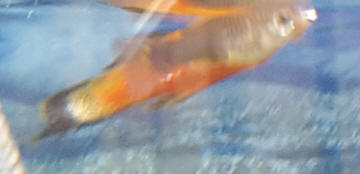
<Indeed. I'm a bit worried by the clamped fins on the orange fish (some
sort of Molly?) as well as the white mess around the mouth of the grey
fish (a female Guppy) though your photo isn't terribly sharp so I can't
be 100% sure what I'm looking at. In any case, clamped fins indicate
stress, and the first thing to do is check the water chemistry and
quality. Both these species need hard, alkaline water. So 10-25 degrees
dH hardness, and a pH somewhere between 7 and 8. Neither handles poor
water quality well. So zero nitrite and ammonia, and Mollies also
tolerate nitrate badly, so nitrate should be below 40 mg/l and ideally
below 20 mg/l. At the very least be sure you own a pH test kit and a
nitrite (with an "i") test kit. These two will tell your the most useful
stats. Forget about asking your shop to do water tests if they simply
tell you something qualitatively, like "your water is fine" because this
is very unhelpful. For a start, what's good for White Skirt Tetras isn't
good for Mollies! One is a soft water fish, the other a hard water fish.
So what we need are the actual numbers. Some good pet shops will give
you the numbers, often the mom-and-pop places run by
enthusiasts. The big box stores, the PetCos and whatnot, tend to be
staffed by people who mean well but don't really have any expertise in
the field, and are primarily motivated by the desire to sell you stuff.
>
Looking at my tank, it's my Painted Glass fish that are the biggest,
quickest, and sometimes they go a little nuts.
<Glassfish are certainly fast and definitely predatory (I've seen them
take down Neons!) but don't usually harass other fish, though again,
I've always kept this species in big groups, six or more, and like all
schooling fish, if you keep just two or three, well, all bets are off
about how well they'll behave. Nice species, and being tolerant of
slightly brackish
water, excellent companions for Mollies and other livebearers. Provided
you don't want to breed those Mollies, because Glassfish will eat any
baby fish they see!>
I would think that given they've been in the tank for years with that
same Guppy, that perhaps it wasn't them.
<Agreed. But here's the thing. Animals, including fish, tend to ignore
other animals they've been raised alongside. They see them almost as
scenery. But add another fish, even something similar to the fish
already in the tank, and those newcomers are viewed in a different way.
As a threat, as a rival, as food, even as a playmate. So just because
one Guppy has been fine with your Glassfish doesn't mean another Guppy
added today would be treated just as well. Make sense?>
What I'm calling the female Swordtails, the smallest is really docile
and at the moment he's acting a little strange on the bottom of the
tank.
<If rocking from side to side, and with her fins clamped to her side,
indicates stress; called the Shimmies, and never a good sign with
livebearers. Usually means something wrong with water quality or water
chemistry.>
The bigger one that I think is an Orange Molly is a fair size (equal
size to the male Swordtail) and seems to be doing quite fine. The Beta
sleeps in the small castle, and comes out from time to time... doesn't
seem to bother anyone. If anything, I'd think the other fish would
bother him. The Beta isn't big enough to tackle these wounded fish in my
opinion.
<Agreed, and Bettas rarely harass dissimilar fish. Like Swordtails,
their aggression is directed towards their own kind, i.e., other male
Bettas.
Sometimes they go for very similar fish, such as small Gouramis. But
rarely do they go for other fish.>
Thoughts? Given the history of the tank, I think perhaps the bigger
female/Orange Molly/Swordtail? If this is the case, isn't it odd that
he'd pick on a big Guppy and a Swordtail his size?
Dave
<Hope the above helps. I'd be checking water quality and chemistry;
upping the numbers of the more social species; and medicating as per
Finrot (not using Melafix or anything like that, but a proper
antibiotic) because Finrot and probably Mouth "Fungus"
(Columnaris) are what you're dealing with so far as symptoms go.
Cheers, Neale.>
|
 |
|
Re: Freshwater - New Fish - Missing Mouth?
8/28/16
Thanks for your note. Yes, I hadn't realized these glass fish were injected
at the time of purchase, as I recall having seen some sort of neon striped
glass fish that are naturally colored.
<Unfortunately not. All the ones in the trade are artificially coloured.
Please understand that pet shops routinely lie about this. They insist that
the Glassfish traded are naturally coloured, or that it's done harmlessly.
All lies. There are some photos kicking about of Filament Glassfish
displaying traces of white or blue on their fins, but these fish are
extremely rare in the hobby, and not sold by mainstream pet stores.>
In any event, I wasn't impressed with my purchase - hey, at least I avoided
the jellybean frogs.
<Yikes!>
This mouth fungus you speak of, can that suddenly occur within two days and
kill a fish?
<Definitely. Columnaris is a bacterial infection, despite the "mouth fungus"
name, and can kill fish very quickly.>
It's now Saturday morning... the Guppy and the male Swordtail are dead, as
is the female Swordtail. Everyone else doing fine. I'm aware of the
temperature preferences and keep the tank right at the 24/25 range to
accommodate both preferences.
<Understood.>
My water test shows no signs of nitrates/nitrites/ammonia.
<Now this is VERY fishy. Check your test kits. While zero ammonia and
nitrite are possible, zero nitrate is practically impossible. It would imply
no animals in the aquarium, no biological filtration, and no bacterial
decay. Seems unlikely, no? So, go back and use your kits again, and see if
you're using them correctly. Something is VERY amiss if you're
getting zero nitrate.>
pH checks out as well.
<Meaning what? What's the pH value? The right pH for tetras is around 6.5 to
7, whereas for a Molly would be between 7.5 and 8, so "checks out as well"
means nothing in an aquarium with both species. Do please understand
the quality of the help I can offer depends on the quality of the
information supplies, and that means numbers, not interpretations. Make
sense?>
Given the sudden 'missing mouths' I think this was some sort of attack. I
hear you about the White Skirt Tetras, but these fish seem to be the most
timid fish in the tank.
<Understood.>
Current stock now includes
The 4 Corys
Beta
<Betta, from a Thai word, "Bettah".>
1 new Guppy
1 female Sword or Orange Molly?
2 White Skirt Tetras
2 Painted Glass Fish
I was thinking that I should keep an eye on water for two weeks, and then
acquire 1 or 2 White Skirt Tetras to keep their numbers up.
<Certainly a half dozen or more is what you/they want.>
Possibly 1 each of the Julie and Albino Cory's so they're in 3's each.
<Sensible move.>
2 or 3 Guppies so that I don't just have one.
<Guppies are not social, so this isn't a big issue. Singleton males or
females can do perfectly well.>
Question is, what to do with the Orange Molly - could she have been the
problem biting off the mouths of an equal sized Swordtail and a slightly
smaller Guppy?
<Unlikely; female Mollies are generally pretty easy going.>
Dave
<Cheers, Neale.>
|
Pink spot female swordtail; no data, no reading, sans.... all
12/15/15
Hello. I've had my tank over a year, so I've dealt with a lot already.
But swordtails just haven't been my forte.
<Used to be, Xiphophorus (helleri et al.) were very tough.... nowayears...
mainly imports... not so much. Need SPACE, hard, alkaline water of not too high
a temp.... All gone over/archived on WWM>
I managed to keep a male, so when my favorite molly died, I decided he might
like a couple girlfriends. I bought them at the only pet store I haven't had bad
luck in.
<What is it about your statements that makes me lament? "Managed", "only"...
"luck".>
When I got the second one (they accidentally gave me a boy and I had to switch
him for another female) I noticed she had a weird pink spot on her side. Her
behavior is a little spastic, but she settled down once was out of the bag.
Since I haven't had much luck with the females, I'm worried this might infect my
other fish. What is wrong with her?
<This is the totality of your information? A "pink spot"?
Likely resultant from a physical trauma.... Bob Fenner>
Re: Pink spot female swordtail; complaint, still no info. of use...
12/16/15
Thanks for the help. Although you could've come off I bit less snobbish.
<?.... Have you read on WWM re Sword disease? DO SO>
I was worried it might have been a fungus of some sort after Googling it.
<... Data.... a vague desc. helps no one. BobF>
Is there other cause for male swordtail to scratch besides
ick?
4/14/15
Hi guys, I'm at a loss here. I have a 55 gall tank with a male
African cichlid electric blue, with a male red swordtail platy, and a
large Pleco.
The cichlid is 17+ years old so he doesn't harass the male. I've been
treating the tank for 5 days now for ick, because my swordtail was
scratching on the blue cup. I'm using jungle ick guard, 3 doses of salt
with the water changes, and heat treatment. The 3rd day I raised it to
85, on the days before it was in the 80s. Today and yesterday the temp
has been
at 86, and the fish seem okay, but the swordtail has still been itching.
I haven't seen any spots on any of them, nor do I see anything else
external.
The nitrates in the tank has been really high lately, I adopted the tank
from my mom, who stopped cleaning it, with only the cichlid in it. I
just got the nitrates down to about 5 or 10, after months of work. Could
the water change be making him itchy? I've been using tetra easy balance
plus with conditioner.
Any advice would help and be greatly thanked!
<Short answer is that fish will "flash" or scratch against solid
objects anytime they feel their skin or gills getting irritated.
So while Whitespot and Velvet are two common reasons (Velvet in
particular often affects the gills long before you see it on the body)
they're not the only ones. Sudden changes in pH in either direction,
non-zero ammonia and nitrite levels, and high levels of silt in the
water column are all other possibilities.
Certain medications can irritate their gills as well. Do bear in mind
Swordtails are fairly specific in their requirements. They need hard
water and relatively low temperatures (22-25 C/72-77 F) as befits
stream-dwelling fish from upland parts of Mexico. Review, and act
accordingly. Cheers, Neale.>
Swordtails 2/28/14
Hello,
One of my male swordtails has a hook at the end of his tail.
Is this normal or is he injured?
<Could be a deformity or an injury review aquarium size and stocking and
act accordingly.>
The other male in the tank chases him around whenever he gets close to
one of the females.
<Swordtail males are mutually aggressive and this species needs space; I
would not keep them in tanks smaller than, say, 90 cm/3 feet in length,
and keeping more than 1 male will only work if the tank is large enough
for them both.>
Should I have two more females to balance out the males?
<Depends on the size of the tank, but with all livebearers, if you're
mixing males and females, you need AT LEAST twice as many females as
males, otherwise the males harass the females, trying to mate with them
all the time.>
Thank you,
Jennifer
<Cheers, Neale.>
Pregnant sword has something stuck in her vent
2/15/14
Hello Crew!
I've had two swordtails for awhile now and the female has been preggo
looking for nigh on two months. A couple days ago she started looking
really fat and square so naturally I thought she was about to pop and
redoubled my vigilance to catch any fry. Then I saw something orange
(same shade as her body) poking out of her vent. I thought it was a fry
but it's grown a bit over several days and has become covered in fuzzy
white fungus, which I wiped off her yesterday with my finger cause it
scared me. She's pooping and eating normally but looking stressed (she's
always been a 'fraidy fish and the male isn't helping). I wanted her to
pop so I could have another female...but... All my other fish are fine.
I tried pulling it out with tweezers but it's stuck well and good! Help
please! I have no quarantine tank!
<Hello Gabby. Could this perhaps be an infection of Camallanus worms? Do
look at some pictures online, and treat accordingly with some sort of
dewormer (like Prazi Pro). Alternatively, if you scroll down this page a
little, you'll see some photos of a female Halfbeak of mine that may
have developed a uterine blockage of some sort:
http://www.wetwebmedia.com/FWSubWebIndex/halfbeakfaqs.htm
In this case, it was fatal, a decaying batch of fry that blocked its
vent.
So two possible ideas here. I wouldn't pull at anything though: the risk
of damaging the fish is too great. Cheers, Neale.>
Re: Pregnant sword has something stuck in her vent
2/15/14
Hi Dr. Monks, thank you :)
<Most welcome.>
It's definitely not a worm, it's a fleshy orange blob... Looks sort of
like the halfbeak, I was thinking it may be birth canal prolapse. If it
is how can I save them all?
<Unaware of any practical method. Antibiotics should clear bacterial
infections (a common cause in cichlids, at least) and you might use
Epsom salt as a muscle relaxant, laxative. But beyond that, it's up to
Mother Nature, which usually translates as either the fish shows clear
signs of recovery or else you humane destroy a fish if it clearly isn't
recovering and/or is suffering.>
My priority is the fry...the good of the many outweighs the good of the
one...
<Indeed.>
Thanks again!
<Cheers, Neale.>
? Sick female swordtail 2/10/14
Hi! I could really use some expert advice. Briefly, here's some
information
about my tank:
12 gallon FW
Fluval Edge filter
2 cardinal tetras
1 Cory cat
1 female swordtail
2 black skirt tetras
1 apple snail
Temp: 78 degrees (Fahrenheit)
pH: 7.0
Ammonia: 0 ppm
Nitrite: 0 ppm
Nitrate: 5 ppm
The swordtail is the fish I'm worried about. We recently lost a platy to
an unidentified illness (weight loss, curved spine) and now the
swordtail is looking ill. Her swimming is a bit off (maybe a shimmy?),
her breathing is a bit fast/labored and her appetite is a bit off. I
think she may have some white patches on either side of her head (behind
her eyes). I can only see them in certain light. They're not speckles
like Ich and are definitely white and confluent (not velvet?).
I'm at a loss of where to begin. Our tap water is acidic (pH
5.5), so I buffer it with some sodium bicarbonate with water changes to
keep the pH neutral. I do water changes and gravel vacuuming
1-2x week, about 20% each time. Is there anything else I should do? She
used to school with the platy but has been stressed since he died last
week. Her tank mates are all behaving normally.
I appreciate any help you can give.
Jeff
<Hello Jeff. The exact problem is hard to say. You may be unlucky and
have a Swordtail with a TB-like bacterial disease, sometimes called
"Wasting Disease", that's far from rare among farmed livebearers,
especially Guppies. But you do have a number of other worrying factors.
12 gallons is much too small for Swordtails (and Black Skirt Tetras, for
that matter).
Bear in mind that Swordtails are quite big (up to 8 cm/3 inches for
females) and come from cool, flowing stream habitats, so need swimming
space, cool water (22-25 C/72-75 F) and a decent water current that
provides lots of oxygen. Water chemistry needs to be at least moderately
hard; 10-25 degrees dH, pH 7-8. In soft water fungal infections are
extremely common on livebearers such as Swordtails, which could explain
the white patches. Because you have just two Black Skirt Tetras, this
species (Gymnocorymbus ternetzi) is likely to become "nippy", causing
damage, and making fungal infections (as well as Finrot and Columnaris)
much more likely. Finally, while irrelevant to the health of your
Swordtail, Corydoras and Cardinals are both social fish, the former
needing at least groups of three, and the latter six or more specimens.
Since Cardinals and Swordtails have fundamentally different
environmental requirements, they're unlikely to do well in the same
aquarium. You may find this article useful:
http://www.wetwebmedia.com/ca/volume_5/volume_5_3/stocking.htm
Cheers, Neale.>
Re: ? Sick female swordtail 2/12/14
*Sigh* Thanks for the reply, Neale.
<Most welcome, Jeff.>
Looks like I received some bad information from my LFS.
<Seems so.>
What would you suggest I do at this point? Is there anything I should
treat this presumed fungal infection with?
<Fungal infections are usually easy to treat if caught early. Provided
you avoid the Melafix-type products (which are more preventatives than
cure) most of the standard preparations work well. Here in the UK, I use
something called eSHa 2000. But elsewhere your range of options may be
different. Something like Seachem ParaGuard or NeoPlex might be useful
because these treat fungal and (some) bacterial infections.>
Should I move them all into a bigger tank?
<Long term, yes; a reasonably large aquarium, say, 25-30 gallons, would
provide space for groups of six Cardinals, Black Skirts and Corydoras
catfish. Aim for water chemistry around 10 degrees dH, pH 7-7.5, and you
should be okay in terms of water chemistry issues with these three
species together with Swordtails (if you don't have Swordtails, just the
South
American species, then soft, acidic water would be just fine). Keep the
temperature around 25 C/77 F, which should be acceptable for all of the
fish, if not ideal.>
Best,
Jeff
<Cheers, Neale.>
Injured male swordtail tail, plus ADF hlth.
1/3/14
My male swordtail, Charlie, has two slits that extend into the skin of
the tail. I removed the other male, of course. I'm worried that he
is in pain and if there is anything that I can do to help him to heal.
<Good water quality and nutrition, and time going by>
He is over a year old, two inches long in body, with a manly sword that is
another inch or so that seems heavy for him now that his tail is torn,
so he'll have to rest on the sandy bottom occasionally. He is
still very interested on eating and uninterested in being captured,
though I tried half-heartedly because your website crew has spoken
against this.
<Yes>
I'm not sure what to do. Because the sword is heavy,
can that be trimmed like a finger nail, or would that cause pain for
him? What about a liquid bandage?
<Perhaps a modicum of aquarium salt. Search WWM re Neale's article re
salts and their medicinal use with freshwater systems>
Also, if an African Dwarf Frog has a pregnant look to him/
her do you think that is a tumor?
<Not necessarily; no>
She has a rounded belly, but a slim neck and bone- thin arms and legs
and has to work hard just to surface. The back bone jutting from
her back worries me. The other ADF is in perfect condition.
And yes, I put her in the little trap from time to time so she can rest.
I adore your advice and go by every word that Drs Bob and Neil
write, however I hope that mercy killing won't be the suggestion for
either of these two cases!
Christina
<Patience here Christina. Bob Fenner>
Two Day Old Fry Flashing - 1/25/13
Dear WWM Crew,
<Hi Stephanie, Rick here>
I have been reading as many pages as I've found on your amazing website,
but unfortunately couldn't find a definite answer to my question. It is
surely there, but I may have missed it. I bought 2 male
swordtails about a year ago and kept them in a 10gl. tank.
About 5 months ago I set up a 55gl. freshwater tank for my red tailed
shark and to put the male swordtails in.
I did this, and decided to get the males some female companions. I
bought 6 fat healthy looking females', acclimated them and all went
well.
<No quarantine period, I'm guessing, since you said you no longer have
the 10 gallon tank.>
After a lot of starring and researching, I noticed a few of the females
appeared pregnant, which really did not surprise me at all.
<Happens a lot with livebearers.>
So I've been waiting anxiously for the birthing. I had to get rid of my
10gl, it was my ex's and even though he doesn't want to use the tank, he
wanted it back so I don't have anything to put the fry in.
<Might want to pick one up. They're useful to have on hand.>
I figured I would deal with that issue once I saw fry swimming around.
Yesterday morning, around 10am I went to my room and as I usually do,
checked on my fish. I then noticed 8 tiny little fry swimming around at
the top of the tank in one corner near the heater. I was extremely
excited and immediately knew they needed a better hiding spot, so I
yanked up a couple of the fake plants I have in there and made a little
haven for them in the corner and blocked it off using my glass scrapers
so only the fry can get back in there. Today I noticed the female who
had given birth is not eating and she flashed a few times against the
live sword plant.
<Probably brought whatever it is into the tank with her. Thus, the
suggested quarantine period.>
Then as I watched the fry very closely, I saw two of them "flashing"
against the leaves of the fake plants I used to help hide them!
<Probably got it from Mom.>
The only fish that are in the tank are 2 Male Swordtail's, 6 Females, 1
Medium size Red Tailed Shark, 1 Pleco and 10 medium size Apple Snails. I
do water changes every weekend and check my parameters regularly and
they are:
Ammonia 0 Nitrite & Nitrate 0 and PH 8.2, Temperature stays at 72°F. I
had read on your site that Ich has several life stages and that it's
very possible for your fish to be in the beginning stages of infestation
and them not be showing the notorious 'white spots'. I have turned my
heater up and will be adding another small heater to help boost the
temperature up to 85°F, gradually. My LFS owner said to buy fresh garlic
and cut very very thin slices and put it in during evening feeding,
saying that fish with Ich will search out the garlic. Is it possible
that my fish have ich and through birthing gave it to the fry? If so
will the fry survive the ich?
I've never had ich before in my 3yrs. of working with Saltwater &
Freshwater tanks so I am a bit naive. I really don't want to use any
copper treatments because I am afraid as delicate as fry are, it would
severely injure or kill them. Any advice and help is greatly appreciated
guys.
Thanks so much!
<First, you don't know for sure that you have ich. You have flashing,
and they do that when their skin is itchy. Could be ich, could be
something else.
I would seriously consider getting a 10-gallon tank, and maybe a 2-1/2
gallon tank also, so you can isolate
the affected fish and keep the fry separate from the adults. Used
tanks from Goodwill would be fine for this as long as you can keep them
warm enough and aerated. I urge you to do this because
treating your entire display tank is excessive, exposes the healthy
residents to meds unnecessarily, and gets expensive since you have to
treat all the water.
Look for other symptoms like ich spots (the prime suspect), but also
slimy or cloudy skin, red areas on the skin, and so on. Occasional
flashing is normal, I mean, you get itchy sometimes too, but frequent
flashing does mean something is wrong. Better to try to identify
what than to start shotgunning meds blindly. You can read through
this article by Bob Fenner for some general disease clues:
http://www.wetwebmedia.com/FWSubWebIndex/SolnChartFWDisArt.htm
Here's the article on freshwater ich:
http://www.wetwebmedia.com/FWSubWebIndex/fwich.htm
Some FAQs on Ich mostly answered by Neale::
http://www.wetwebmedia.com/FWSubWebIndex/fwichcausdiag.htm >
Cheers
Stephanie L.
<Hope it helps. - Rick>
need advise on swordtail fish; hlth.
12/23/12
Hi,
I am wondering if you can give me advise. My swordtail are dying
one at a time. They start to have white patches or cloud like
color on their body.
I have use Aquarisol with Maracyn, Methylene blue with Nitrofurazone on
other tank. Yet I don't have any luck. What kind of disease
does my swordtail fish have. Thank you in advance.
Joseph
<Need some information about your aquarium. How big is it? What is the
water chemistry? What is the water quality? What is the temperature?
Let's recap: Swordtails need a fairly big aquarium (no less than 60
cm/24 inches in length) because they are active swimmers. The water must
be hard and alkaline (aim for 10+ degrees dH, pH 7-8). Water quality
should be good
(zero ammonia and nitrite). Water temperature should be relatively cool
(22-25 C/72-77 F). What you describe above sounds like a bacterial
infection, but these tend to be opportunistic, so randomly adding
medications won't help if the aquarium conditions are wrong. Cheers,
Neale.>
Re: need advise on swordtail fish 12/24/12
Thank you for the reply. what medication should I use? Now since
the swordtail are sick, I put them in 10 gallon tank. But on
regular basis, they are on the 55gallon. Wondering why this
disease only affect swordtail not my guppies.
<Guppies come from warmer, stiller water conditions. Swordtails need
cooler, fast-flowing water with much more oxygen. Review conditions in
your aquarium and act accordingly.>
I have 3- 55 gallon and 40 plus 10gallon tank. My fish are RREA guppies
and albino swordtail only. Please help. (wiping out my entire swordtail
stock)
<If just one species of fish is stressed and dying, likely conditions
are the issue, though it's possible you have bought poor quality
(genetically inbred for example, or previously exposed to Mycobacteria
spp.) fish that are pretty much doomed anyway. Medicating without
knowing what the problems is/are won't be wise. A combination of Maracyn
1 and 2 would be as good as any, but ultimately a shot in the dark. As I
say, review aquarium conditions understanding what it is that Swordtails
need to do well.
Cheers, Neale.>
|
Red sore on swordtail 9/20/12
Greetings,
<Tim>
A few days ago i had noticed the newest addition to my tank (after now
residing there for about a month), a female Swordtail, laying on the
bottom and not doing much of anything. I would come back a few hours
later and she will have swam to a different place, but still laying on
the bottom.
<Mmm, poor behavior for livebearers>
Today, I go through my normal morning routine of turning the lights on
and feeding them their breakfast, I noticed that she had begun to swim
normally and has been normally social (if that's what you could call it)
with her tank mates (another female and a male, four danios, and a lone
guppy in 60 gal).
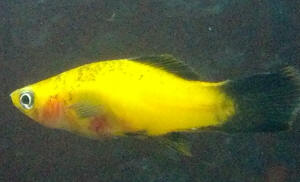
I also noticed that on both sides below and behind her pectoral fins,
she has red sores that look a lot like the last time I popped a blood
vessel in my eye (I apologise if the attached picture isn't too clear-
today she wouldn't stay still long enough) . I have never seen anything
quite like it in my time (especially with the lethargy and then suddenly
springing back to life)
When I checked yesterday, pH is about 7.6; ammonia, nitrates, and
nitrites all virtually zero.
<Nitrates I take it are measurable, and no NH3 nor NO3>
I'm not sure if there is cause for concern or if I should just let her
be for now.
<I would let this fish be... as there's not much to be done, and
catching, moving it will likely only hurt... these marks may show some
sort of pathogenic involvement, but I suspect their origin is from other
cause (physical trauma).>
Thank you,
Tim
P.S. the last few days, the danios have been spawning like crazy. Every
time I look, I see four or five more eggs drifting from wherever towards
the surface. Not sure if this has any effect on anything, but it sure is
fun watching the danios chase each other around.
<Ah yes, but not indicative of cause of trouble w/ the Sword. If
anything, their spawning behavior shows that conditions in this system
are favourable. Bob Fenner>
|
 |
|
Re: Red sore on swordtails
9/23/12
I wanted to thank you for your help
<Welcome Tim>
The aforementioned female sward turned up dead this morning... I'm thinking
that the lone male guppy may have put extra stress on her even though she
was becoming more and more active and appeared to have healed some (though
he is the low man on my tank's totem pole, I saw him picking on her as an
injured fish).
<Mmm>
I'm thinking that there is a problem with my tank's hierarchy as this isn't
the first time I've lost a female sward (this will have been the fourth
female I've lost in the last 6 months).
<Something's up here>
I had previously chocked it up to poor water chemistry (the male and female
remaining swards somehow survived back when i started up... I've slowly
brought the pH down from around 10
<Yikes!>
to the current 7.6 through water changes rather than using a half gallon
of pH down). This is the first time I've had ideal water chemistry for more
than a month.
I never noticed anything strange about the social dynamics... the four
danios mostly keep to themselves, the guppy is mostly indifferent to the
other fish... but the swards I could never get a read on. To me they most
seem like the grumpy old war veterans (once living in a pH of 10, surviving
Ich two times in the last four months... yet both are beautiful and healthy
fish). Could this be a case of the fish equivalent of old men sitting on the
porch yelling at the neighborhood kids (not liking any newcomer swards)? If
so, is there anything I can do to reset the social dynamic so that I can
eventually add more female swards?
<Remove the existing fishes to a plastic floating colander for a week while
the new Xiphophorus get familiar w/ the system>
Just look at me. I'm talking about fish as if they are people. I need to
find a new hobby, something a little more mindless, like breeding guppies.
Thank you for your help,
Tim
<Again, welcome. BobF>
|
|
My swordtail being harassed 8/23/12
Hi
Could you please advise me. I changed my gravel to play sand from the sand
box or otherwise known as river sand here is south Africa I left all my fish
in a small tank(my plants tank over night ) because of the new water change
and sand change and setup I added 7 new plants rocks driftwood etc etc ..
After putting my fish in there newly setup tank noticed my female swordtails
left eye popped n white and didn't know what's the course....
<One-sided, unilateral "pop eye" is generally due to a physical injury...
but the system being so "new", likely uncycled, accumulation metabolites...
may well be the contributing cause here>
I then red few of your articles and when I returned to my tank I noticed
the white was gone but I've tried seeing if the eye is fine but it seems as
if its blind in 1 eye. I then noticed my small lil tiger barb
<Nippy... need to be kept in a group... in a large enough setting... See
WWM re this species>
biting the same eye of that fish.... And on the gills of it ..
These 2fish lived happily for the past month Don't know why its harassing
the poor female now only so I took the barb and put it in my plant
tank...... I also read to add Epsom salt I added 4/5 pinches to my 20L tank
... I have 4mollies 8 guppies 2black widows an algae eater 2neons 2other
orange fish think a diff neon and a male and female swordtail.....
First question is the salt I added enough??
<Might help a bit... need to be careful re dosing too much salt/s w/ the
Characins>
Second can I put the tiger barb back in after a while?
<I wouldn't, no>
Or should I give it back to my pet store? Is this a bacterial disease due
to changed sand or was it bitten?
<... could be either, both... and/or the cycling issue... I'd be measuring
for NH3, NO2, NO3>
Thanks a million
<Welcome. Bob Fenner>
|
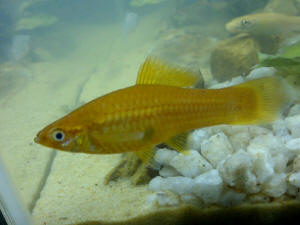
 cloudy...
 |
swordtail problem; no data, rdg.
7/24/12
I noticed a large bumpy black area on the side of our fish.( The fish
has dark black spots with its normal coloring, so I failed to see this
until it grew quite large) I don't see anything like this in my
fish diseases chart.
<... need to review the make up of the system and more. Read here:
http://www.wetwebmedia.com/FWSubWebIndex/sworddisfaqs.htm
and the linked files above. Bob Fenner>
Swordtail, Epsom Salts and Pop-eye 6/23/12
Hi folks, first of all what a fantastic site. I've found bits of
answers to my question, but not an overall solution, so I'm hoping for
some clarification.
<Okay>
The problem: A female swordtail who has developed pop-eye
in both eyes.
<Mmm, but no other fish/es I take it>
Feeding and swimming as normal. Usually an aggressive little lady,
definitely the alpha in her group.
The tank: 240 litres. Bogwood, heavily planted around the
edges and on the wood, clear space for swimming in the centre. Ph
of 7. Temp 26.5 deg Celsius.
Nitrites, Nitrates, Ammonia at 0. 10% water changes weekly; gravel
vacuum each week (partial - not the whole tank at once). Fluval
204 canister filtration with carbon, noodles, and balls as media.
No noticeably sharp objects to cause injury, and I'm aware that water
quality is a common cause of this issue - the only thing I can think of
in that regard is that I have insufficient filtration.
Tank running for over 2 years.
Occupants: 8 neon tetras; 4 female swordtails; 1 male
swordtail; 6 rummy nose tetras; 5 female platies; 2 male platies; 2
peppered cats (Corydoras) - I know this is less than
recommended; had a couple of deaths a while back and have not yet added
any more.
Food: Cooked, shelled, crushed peas in the morning. Frozen
brine shrimp or daphnia in the evenings, alternated with frozen
bloodworms about once per week.
A couple of algae wafers after lights out for the cats (who also like
the peas).
The dilemma: How to treat the swordtail. My quarantine tank
(40 litres) is currently doing time as my fry-tank, as the platy I had
recently been given was in quarantine - and helpfully had babies.
Q1: I have read that Epsom salts can be used to treat this problem - as
long as the cause of the problem is identified and remedied - is this
broadly true?
If so, how? e.g. recommended dose, duration of treatment, water
change regime during treatment, addition of further salt at water
change...
<Epsom can/could be used; but I wouldn't here... The small tetras don't
like extra salt/s>
Q2: Ideally I'd isolate her, but I suspect that my psychologist
husband will start looking at me as a prospective client if I set up yet
another tank.
<Heeee!>
Can I treat her in the main tank? Obviously concerned here about
the effect on the other tank residents. And would I need to remove
the carbon from the filter for the duration?
<Again... I suspect the cause of the pop eye here is mechanical
injury... from the one fish bumping into objects... Will resolve on its
own in time just as well as by treating>
Q3: Actually, I don't think I have another question. I just have
an overwhelming need for some concise, informed, definitive advice :)
<!>
Apologies for the length of this - I've tried to give as much pertinent
information as possible but it's turned into a bit of a book. My
grateful thanks in advance for any help you can offer.
Kind regards
Catherine
<Mmm, yes; most cases of bilateral exophthalima are due to bacterial et
al. environmental issues... but your other fishes are non-affected...
I'd just wait here, be patient. Bob Fenner>
Sick swordtail
3/30/12
Hello,
<Tracey,>
Ok I have a sick fish on my hands. Now I know it is partially my fault
as my tank went without a water change for too long, had issues with my
vacuum. Then I found my filter was not running properly. I've since
solved the filter issue & have changed the water etc.... Water
perimeters all test fine & I took a sample to a local store to have
tested. Water fine.
<Please tell me the values, not your interpretation of them.
"Fine" really means nothing. So let's recap what
Swordtails need. They must have cool, well-oxygenated water; 22-25
C/72-77 F. Medium to strong water current essential. Water quality must
be good, zero ammonia and nitrite. Water chemistry must be hard and
alkaline, 10+ degrees dH, pH 7-8.>
My young male seems sick, he's "floating" instead of
swimming, seems he can't control himself with the current. He
actually goes tail end over head, swims and kind of tips over. He swims
to and eats food but has little control while swimming. He floats
around & looks like he's going to die.
<Does sound like poisoning, which could easily be environmental,
especially if this is a mature fish that's lived a few years
happily enough up until now.>
I've had my tank for years. I do have a common Pleco who is too big
for the tank.
<Looks like you already know the score here.>
We are in the process of setting up a larger tank (55 gal) to move
everyone to. I also have a nursery tank. I know my tank is crowded
hence setting up the 55 gal.
<Do be aware that an adult Plec will heavily load a 55-gallon
system. You'll be going from bad to moderate, rather than bad to
good. If you can fit 75, 90, 100 gallons in the same space, budget --
then do that. Else trade in the Plec for something smaller/better, like
a Bristlenose Plec (Ancistrus sp.).>
My question is: is there anything I can do to save this fish or should
I remove & euthanize now before my other fish end up sick? All fish
are swordtails. Thanks so much for your time!
Tracey:)
<Do read:
http://wetwebmedia.com/euthanasia.htm
http://www.wetwebmedia.com/fwsubwebindex/poeciliids.htm
…and the FAQ articles linked therein. Cheers, Neale.>
Re: Sick swordtail 3/30/12
Thanks so much Neale, I did ask a local small pet shop I trust to take
my Pleco and I did speak with them about him as well, his size &
housing him. We cant go any bigger than 55 gal so he's off to a New
home soon. We've had him for close to 10 years.
<I see. So about middle age for this species, which can, does get to
ages of 20-30 years if cared for properly.>
Now our challenge is transporting him. He's huge. About 8-10 inches
long & I'm sure u know he's big and beefy!
<Indeed.>
The sick swordtail is young. We had a batch of fry about 6 months ago.
He's one of the fry, long and looks mature but is just beginning to
sprout his sword, both parents are gone, gave away the male & the
female died last month, she was old & had had several batches of
fry. I wrote to you about it because I had no clue what to do back then
about the fry. I do not know the cause of death. One day fine the next
I couldn't find her. Which is odd because she was a candy & all
the rest of my swordtails are red velvets & blood reds. I did
finally find her dead in the log at the bottom. Oh my, I always forget
because we rarely see it, we have a bumble bee catfish whom we've
also had for about 10 years.
<I see.>
My water is zero ammonia and nitrites. There is some nitrate but
it's in the "safe" level, I've been unsuccessful at
getting that to zero.
<May be impossible if your tap water has non-zero nitrate levels --
you can't get any lower than the nitrate level in your tap water.
For most community fish, 40-50 mg/l is fine, but some sensitive
species, such as Mollies and most cichlids, you need less than 20
mg/l.>
My water is hard and the temp is between 70-72 never goes above 72.
<Hmm… may be a trifle cool at 70, but 72 F is fine.>
The PH & alkalinity all register in the ideal level according to
the test strips & my local pet store.
<What's "ideal"?>
If by chance my sick swordtail has been poisoned, any idea what to
do?
<Water changes, ideally a series of them, a few hours apart. New
carbon can be useful too, and thrown out after 24-48 hours.>
The rest of my fish are all fine, seem healthy, eating well. I feed
them a range of food: regular tropical fish flakes, Spirulina (sorry
about the spelling) flakes & seaweed (packaged for fish). They
gobble it all up. Which after reading the containers I see is not
enough fiber for them. I used to give them bloodworms but read
that they're herbivores so they haven't had bloodworms in a few
months. The Pleco eats everything the fish are fed and algae wafers
which the fish also eat. My sick one is still hanging in there. He gets
bumped around during feeding time & still holds his own. There is
another male who is a few years old. I did not know this sick one was
male until recently when his sword began to sprout. Still not totally
sure its a male, looks to be sprouting a sword but...Looking closely
today and I think there might be another male just sprouting. Which
throws off my female to male ratio big time. 2 males was already too
much, I asked the pet store if they'd take my swords and they said
as soon as they're big enough to sell they would. But now I
can't give them possibly sick fish. I'm really stumped here.
I'm going to read the links you sent. I just wanted to reply and
answer your questions on the water. Thanks again!
Tracey:)
<Real good. Good luck, Neale.>
Re: Sick swordtail 3/30/12
Ok I got a real close look at my sick one. Still not sure if it's
male but he looks more male than female. Anyhow, upon a real close
inspection he has this weird whitish spot under his mouth, looks
cottony?
<Hmm… yes, could be… review both plain vanilla fungus and
"mouth fungus", a bacterial infection despite its name, and
also known as Columnaris.>
Real small & seems to sway when the fish swims. Looks like a teeny
piece of cotton attached under the mouth. The tail fin now looks a bit
frayed as well. I'm very worried about this & the rest of my
fish. I'll be "studying" them periodically throughout the
days. He seems to be worse today. My other fish seem ok. Swimming well,
eating well. Upon closer inspection another young small swordtail seems
to be swimming a little weird and there's a very faint whitish not
a bright white (barely noticeable) spot on the side of the body.
I'm very worried and don't know what to do for my fishes. I
know they need oxygen rich water and there is a bubbler in the tank.
Don't know how to test Oxygen levels.
<Under stock the tank, keep cool, ensure good water circulation,
position outlet from pump/filter so there's plenty of splashing.
All useful for promoting good oxygen levels. Testing requires a kit…
rarely necessary in freshwater situations.>
Any advise is greatly appreciated. Thanks so much for your
time.
Tracey:)
<Glad to help. Cheers, Neale.>
Re: Sick swordtail 3/31/12
I just wanted to thank you so much for your advise. I do believe you
are correct and my fishes have Columnaris. I also contacted my trusted
local pet shop and they had a medication that they themselves use when
necessary.
Thankfully it was not very costly.
<Good to hear.>
They also advised me to leave the very sick fish and treat him/her as
well.
Hopefully it will recoup. So treatment has begun and now we pray to the
fishy gods. My fish are precious to me.
<All hail the fish gods!>
One thing I'm perplexed about is my huge Pleco shows no signs of
sickness at all. Nor does the bumblebee catfish.
<Both are tough, hardy animals. For one thing, they don't move
about much, so their oxygen demands are low.>
I got a good look at it last night with a flashlight. It wasn't
happy about the light but seems fine and looks fine. Are these two
immune? Or perhaps more tolerant?
<The latter.>
Oh the "ideal" levels: hardness 150ppm
Chlorine 0, KH 120,
pH between 7.2-7.8
<All sounds good.>
I thank you again for your invaluable advise along with your wonderful
web site. Have a great day!
<You too.>
Tracey:)
<Cheers, Neale.>
Re: Sick swordtail 3/31/12
Hello again,
Thanks so much for all your help.
<Welcome.>
I have one more question for you;
Now we've begun medication yesterday and my fish seem to be
responding.
<Good.>
One thing I found curious, today 2 of my females have swollen
bellies?
Pregnant possibly? Does it happen that fast?
<Not usually, no. A clue is whether the scales are lifted up from
the body (so above the fish looks like a pine cone) or else there's
an unusually fuzziness to the body. Both of these are symptoms of
bloating or dropsy.
Pregnant livebearers generally look normal and healthy, and should
certainly be swimming about happily.>
They weren't swollen yesterday & today, very bloated looking.
And my other tank that we're medicating as well are a few with
swollen bellies? Pregnant or possible side effect of the med or
constipation?
<Impossible to say from where I'm sitting. But assume the worst,
and observe carefully for the next few days. Used correctly medications
shouldn't cause problems to most fish (with loaches and catfish
being the species most likely to react poorly among community tank
species). Be sure to increase aeration or circulation while medicating,
because medicines are
toxic at some level and do stress fish even if they don't kill
them. Do also remember to remove carbon from the filter, if used,
otherwise the medicine will be absorbed by the carbon and do nothing
useful.>
I did notice on my large female (swordtail) that her anus has white
either around it or coming out? Hard to tell.
<Doesn't sound promising.>
All my fish are swordtails except the Pleco & catfish.
<I see.>
Ok two questions, my 55 gal is set up & cycling. When my fish are
healthy & the new tank is ready is it safe to use the ornaments,
lava rock & driftwood that are in my current tank being medicated
in my new tank? Or should I replace everything?
<Well, you should be able to reuse everything. But giving bogwood
and rocks a good scrub is a brilliant idea, and ideally, you'd
leave them out in the sunshine for a few days to air dry. That'll
kill off most parasites and snails. Same with the gravel, or else
replace the gravel if you can (gravel is cheap, and I use unwanted or
old aquarium gravel in the garden or in
flower pots to add drainage). Alternatively, you can use hydrogen
peroxide (or products such as JBL Desinfekt) to sterilise things like
gravel and rocks, and after thorough rinsing, they can be put back in
the aquarium.
The one thing you can't sterilise is filter media, so all you can
do with that is gently rinse in a bucket of aquarium water or under a
luke-warm tap (the same temperature as the aquarium) until the filter
media is clean. You can then add this mature media to the filter
that'll be connected to the new aquarium, and your new aquarium
will be instantly cycled, ready to
accept the fish. If you're cleaning the gravel and rocks, and so
have them outside the tank for a while, keep the lights off on the new
aquarium so your fish won't be spooked. It's fine for them to
live in a bare, glass-bottomed tank for a few days. In fact, that's
the best way to medicate them because there are fewer places for the
germs to "hide" (or put scientifically, it's easier for
medication to get all around the tank).>
And the medication I'm using & that my local pet shop
recommended is: tetra fungus guard. Active ingredients: Nitrofurazone,
Furazolidone & potassium dichromate.
<Broad range of antibiotic and antibacterial medications
here.>
Thanks again!
Tracey:)
<Cheers, Neale.>
Re: Sick swordtail 4/1/12
So sorry to bother you again. I'm really lost on the filter media.
I do not want to use the carbon cartridges and I cannot find any
biological media or perhaps I just do not know what I'm looking
for!
<The latter. Biological media is the stuff with bacteria in it --
sponges, ceramic noodles, etc. All standard filters will have some sort
of biological media, even if you didn't call it that!!!>
I sent my husband to the pet store for new plants etc.. And he also
cannot find or does not know what to look for as well. I only have (in
the new tank, no fish in there yet) the bio wheel spinning and I put a
few of the new empty sponge pockets that hold the carbon (for my old
filter) into the new filter chamber to trap any debris and what not. If
possible could you give me a few examples or brand names of biological
media I could use in my Marineland 350 filter?
<See above.>
My Top Fin filter sold filter media that you assembled yourself so I
just used the sponges & ditched the carbon unless I needed it after
a round of medication or what not. With this new filter (Marineland
350) I've only been able to find the cartridges fully assembled
with the premium black diamond activated carbon (as per the label). So
obviously here I'm going to have to improvise but with what is
where I'm stuck. Going to keep surfing your site, such a wealth of
info, thank you! But again, any recommendations
you have would be more than greatly appreciated! Thanks so much
again!
Tracey:)
<Thanks for the kind words. Cheers, Neale.>
Re: Sick swordtail
Oh my! Thanks so much! I've seen the ceramic noodles. Now I have an
idea what to do. Thank you! You guys are fantastic!
<We are?>
Still trying to figure out what to do with my huge Pleco, can't
find a shop to take him, I've asked all the local & chain
shops, declined. Any chance I could house him in with my baby
turtle?
<Isn't ideal. Even if the turtle doesn't harm the Plec,
turtles produce MASSES of waste, and so create water conditions that
quickly become stressful to most fish. Does depend on the size of the
tank, of course:
I've seen turtles and fish coexist in tanks couple hundred gallons
in size.
But regular tanks? Not a great idea.>
The turtle, we found outside while on a walking school field trip that
my husband was chaperoning last year, he almost stepped on it, one of
my daughters saw it & saved it from being squashed & we
inherited a new pet!
It's prob not much more than a year old, eastern painted. It's
small between 4-5 inches from head to tail. Or is that a bad idea?
<Not the best idea, no.>
I'm reaching here I know. So my search for a new home for him
continues. If you have any suggestions please feel free. Thanks again
so much!
Tracey:)
<Do try and find out local (or local-ish) aquarium club. Cheers,
Neale.>
Re: Sick swordtail 4/1/12
Thanks again Neale, I didn't know there even were such clubs,
I'll definitely look into that.
<Oh yes, and in US especially, they are often very vibrant and
worthwhile places to visit.>
I didn't think putting turtle & Plec together was a good idea.
Thanks for confirming. On a sad note, my swordtails seem to be taking a
turn for the worse. I fear I may lose them all. There's 1 that
seems unaffected. He's the alpha male and older by a few months of
the other male. Took a long time to find him when I began my swordtail
hunt over a year ago. Very beautiful fish. He's still very frisky,
chasing the females and really shows no signs of sickness. He does look
a little raggedy but he always kind of did. He even has a bent sword,
near the end it's bent downward. Has always been that way, not sure
why. He's a beautiful red velvet and has a sort of silvery belly.
Always that color. Will let u know what happens. Going to stay
the course and hope for the best but they aren't looking good,
worse actually. So sad. Thanks again for everything!
<Hmm… have you tried adding a bit of aquarium salt? While this
isn't something I'd recommend casually, it can have a tonic
effect on livebearers. Don't add much, because your catfish
won't be thrilled, but somewhere between 2-5 grammes/litre should
be safe.>
I'm beginning to wonder if I bought a sick fish months ago (had a
spot i assumed was an injury from the net as the guy at the store
wasn't very gentle!) and this has just been a downward spiral as
I've treated for what I thought was ick a few times over the last
year. (Advice from a pet shop.) We will see. Hoping for the best.
Thanks again!
Tracey:)
<Most welcome. Cheers, Neale.>
Re: Sick swordtail 4/1/12
Thanks so much. I haven't found any clubs yet but still searching.
I do use aquarium salt at the dosage you listed. I last put some in 5
days ago. The day before we began medicating we did a 50% water change
and added the aquarium salt.
<Okay. Was worth a shot!>
Today we are to do another 50% change and another round of meds. I
tested the water this morning and there are nitrates present, a little
higher than what they normally are. There are always some, I've
never been able to get them to zero.
<Nitrates are safe so long as below 40, 50 mg/l.>
There are also a bit of nitrites which weren't there yesterday.
<Nitrites more serious, and while no nitrite level above zero is
safe, if the level is above 0.5 mg/l, then there's a good chance
health problems will follow.>
Sorry I don't know the exact values, I threw away the test strips.
So I'm assuming my fish are stressed from that. Although they seem
a bit more active than yesterday and all eating well, even the real
sick one, It's still "floating" and darting around then
flipping over. Still not much improvement on that one. Still hoping
it'll come around. Thanks again!
Great day to you!
Tracey:)
<If fish perk up for a day or two after a water change, then go back
to being morose afterwards, it's a good sign water quality is at
fault.
Perhaps inadequate filtration, perhaps insufficient water changes,
perhaps not enough oxygen, perhaps pH drops below a suitable value
between water changes. Review, and act accordingly. Cheers,
Neale.>
Re: Sick swordtail 4/3/12
Thanks so much again Neale, I greatly appreciate all of your
advise.
Tracey:)
<Most welcome. Cheers, Neale.>
Re: Sick swordtail
Hi Neale,
I have a question about water hardness. Now I have hard water
it tests at 150 (hard). Then after a few days in the new aquarium (no
fish) and my existing it goes to 300 (very hard) is that ok for
swordtails & mollies?
<Try filling a glass with some water from the tap, doing a hardness
and pH test on it at once, and then trying again 24 and 48 hours later.
If the water chemistry stays the same across all three tests, then
there's something in the aquarium that's altering water
chemistry. But if the tap water changes just sitting there in a glass,
then there's something else going on. Some types of tap water are
"funky" for want of a better word, either because they
contain a lot of gases (such as CO2) or unstable minerals that change
when the water is exposed to air (this seems most common with water
from wells rather than municipal supplies). Either way, so long as you
do small, regular water changes, there isn't any great risk, and
adding marine aquarium salt mix can be very beneficial if all
you're keeping is livebearers and salt-tolerant fish (such as
Rainbowfish). If you have other sorts of fish that aren't
salt-tolerant, then things become more tricky; but still, if you switch
to doing 10-15% water changes, perhaps every 4-5 days rather than 20%
every week, you should find things are tolerable for your fish.>
How do I keep it at just hard?
<Let's cross that bridge when we get to it. Life is a lot easier
for casual aquarists to not change water chemistry.>
I don't know what is causing it to change. The aquarium salt?
<Plain vanilla aquarium salt should have little/no impact on
hardness and pH; marine salt mix, by contrast, will slightly raise pH
and hardness.>
Chemicals I use to treat water:
Cycle by Nutrafin (use as directed)
Aqua safe by tetra to condition tap water
Occasionally (maybe once a month to every 6 weeks) add easy balance
with Nitraban also by tetra
And if my pH is off: neutral regulator by SeaChem
<I would not use this product. Leave the pH at 7.5-8 if keeping
livebearers. In any event, trying to change the pH without
understanding water chemistry can cause MAJOR problems.>
I've also used stress coat by API but not recently. And my water
hardness always changes. It's at hard when we do changes then by
the end of the day it's at very hard.
<Do the water experiment, then get back to me with the
results.>
Been trying to figure this out for a while now and I'm
stumped. Thanks so much again!
Tracey:)
<Welcome. Neale.>
Re: Sick swordtail
Hi Neale,
Sorry to bother u again! I just wanted to let you know after much more
research I found my answer on how to reduce hardness.
<I would not alter water chemistry just yet.>
I'm still stumped as to why it rises but I'm sure I'll
figure it out eventually. I thank you so much for all of your
assistance. My sick fishes are still hanging in there. Seem to be ok
for now. Going through a second dose of meds now we wait. Thanks again
so much! Great day to you!
Tracey:)
<Real good. Cheers, Neale.>
Re: Sick swordtail 4/3/12
Thank you Neale!
<Most welcome.>
I'll do the experiment and let you know. For my new tank I was just
going to add some distilled bottled water but I'll leave it for
now. My sick tank was seeming to improve. Fish all seem very active,
eating well. All come over to me (to say hi) as usual but I noticed
(just now) a new spot on my large mature female on her side nearish the
gills. And a spot on another fishes side. My fish are all red
velvets and blood reds so seeing any spots is fairly easy. Except for
the now weird color of the water from the medication.
<Normal.>
We did remove the very sick one. It seemed worse and I was afraid it
was suffering so I did what I thought was best and removed it and took
care of it. They'll be a burial later today.
<Oh dear.>
It looked stiff while darting almost twitching around to swim. It
looked almost like a bobber bobbing around but no wiggly fishy swim
movements just stiff and bobbing/floating and darting around the tank.
Also it wasn't eating like it used to. Upon very close inspection
after removal, it was in fact female. So the rest seem ok but a few
have a spot here or there. This is day two of round two of the
medication. So it's been a total of 6 days of treatment and two 50%
water changes one before medication began, one yesterday before round
two.
Great day to you!
<And to you.>
Tracey:)
<Cheers, Neale.>
Re: Sick swordtail 4/4/12
Oh boy Neale,
<Tracey,>
I have a situation I'm not sure what to do. In my sick tank my very
large female is in fact pregnant.
<Almost always the case with livebearers. Don't worry about it
too much.>
Today she looks very "square" and quite large. She's been
growing larger by the day. Today is day two of round two of the meds.
She is showing possible signs of giving birth soon. Besides the fact
she's got the squarish belly look she looks as if she's trying
to find a space to drop the fry. Chasing other fish away. I'm
keeping a close eye on her but in the medicated tank how harmful will
it be to the fry?
<Not harmful.>
Will they even survive?
<Likely so. Often they do better than the adults in tanks where
there are problems!>
Last batch of fry were a surprise & we just scooped them out into a
nursery tank as we found them. Will the fry be sick as well?
<Can catch Whitespot and Velvet, for sure, but bacterial infections
tend not to be "catchy" as such.>
I'm not even sure this female is sick. She has shown no signs of
illness at least none I can see. No spots, swimming fine, eating
fine. She's the one I mentioned in an earlier email that has the
white on or coming out of her anus. Which now I think is probably
because she's going to deliver soon.
Any advise on what to do to save the fry would be
great. They'll be fry from a blood red male and a
red velvet female, real pretty combo. Thanks so much!
<Cheers, Neale.>
Re: Sick swordtail
Hi again Neale! Just wanted to let you know I found a local club
that actually meets right in my town, close by! Very excited,
bought a family membership as now my hubby and kids (3 girls, 1 toddler
boy) are interested!
<Real good. The guys and gals at these places can be
super-helpful.>
We removed the mama fish to a nursery tank. And low and behold it was
just in time! This morning we spotted one fry! Yes only one so far.
This is her first pregnancy. She doesn't seem sick at all. My last
female that had babies (several times) never delivered them all at one
time, she had them over the course of a few days. Then a few weeks
later all of a sudden more new fry would appear. We just scooped them
out as we found them. We are just going to leave the mama in the
nursery tank for now.
<Que Sera, Sera.>
She's not as big as yesterday and doesn't have that squareish
shape to her anymore but I don't want to return her to the
medicated sick tank as she also seems to be the only one not sick. But
I'm not certain on that so I don't want to chance putting her
in the new 55 gal, there's now 2 young mollies happily inhabiting
it! And 3 very young red velvet swordtails, all doing very well. All
bought at the only shop I trust, a local mom & pop type of store
that's been there for close to 20 years, also very helpful
gentlemen!
<Good to hear.>
I'm really hoping we spot more than just one fry. I've kept her
well fed on a variety of flake, bloodworms and daphnia. I read as long
as she's well fed she should leave the fry alone, I'm hoping
that's true, just spotted a second fry! And the mama seems a
bit aggressive and did go after the fry, we chased her away. Now
I'm not sure what to do with her. Return her to the medicated tank
or chance putting her in my new tank or just leave her and pray she
doesn't eat all the fry! Yikes, what to do, what to do???
<Wouldn't let the fry be a factor either way. You'll have a
gazillion over the lifespan of a given Molly or Swordtail, so you can
afford to bide your time. Put the mother first. If you want to rescue
fry and pop them into a breeding trap, then go ahead. They're fine
in there for weeks. You can set them loose after 3-4 weeks and
they'll be fine with their parents.>
Thanks again Neale for everything! Have a great day!
Tracey:)
<Most welcome and happy to help. Neale.>
Re: Sick swordtail
Thanks so much Neale!
<Welcome.>
The mama fish seemed really stressed in the nursery tank. It's only
a 5.5 gal so we returned her to the 20 gal medicated tank. She's
fine now.
<Yes.>
This is day 3 of round 2 of the medication and all seemed fine until I
got a good look at my Plecos belly. He's got a white spot up near
his top left fin that wasn't there before. And one of his other
lower fins is damaged, could be an injury as he freaked during the last
water change a few days ago. Also noticed his bristles on his
"wing" fins (sorry don't know what they're called)
are all standing up near the ends. I really don't know what's
going on with this tank. There's my 10 inch Plec, a small bumblebee
cat, 1 young male swordtail (sword just sprouting), 2 large mature
female swordtails and 1 young smaller female swordtail.
<I see. At 2-3 g/l, your catfish should tolerate the salt just fine.
But I wouldn't go higher with the Bumblebee Cat (Plecs are in fact
somewhat salt-tolerant if their distribution around Florida is anything
to go by).>
Who all seem fine other than what I mentioned about the Plec, and 1
large female has a weird whitish spot behind her eye, the young female
has a similar spot on the side of her body but very faint, nothing
noticeable on the large recent mama but her anus is whitish and
she's become a bit aggressive lately. Young male has whitish on the
bottom of his body right where his gills meet but that could be just
his coloring. Weird. And the very sick female that passed was the
only one who had the cottony patch under the mouth and the weird
floating, bobbing and stiff body. Perhaps nothing is wrong with
the fish at this point. So tomorrow is day 4 of round 2 of the meds.
I'm going to continue to do what's necessary to maintain
optimal environmental conditions and watch for anything weird or
unusual.
I'm sure from here on things will continue to improve. 3 fry (that
we can see) survived and the mother seems just fine and much happier to
be back in her home but still a bit aggressive. We've also
increased the bubbles (and current), tomorrow will use carbon and water
change to get the medicine out then switch to ceramic noodles and just
sponge no carbon. Also the temp is steady at 75 degrees. I do test
daily to make sure everything is at the right levels. And I'm still
doing the water experiment, I went and bought the liquid master test
kit instead of the quick strips so I began the experiment today to see
if the hardness changes on its own. I'll let you know what results
in a couple days. I want to thank you again for all of your incredibly
helpful advise! Have a wonderful day!
Tracey:)
<Best of luck, Neale (who's signing off tomorrow for the Easter
weekend taking a trip to the countryside away from the
Internet!)>
Re: Sick swordtail 4/4/12
Have a wonderful holiday!!!
Tracey:)
<Thanks! Neale.>
Re: Swordtail Bloating (also: book
buying) 1/30/12
Hi Neal,
Sorry for late reply, thanks for all the book recommendations.
<Glad to help.>
Quick update regarding Firemouth coloration change: I added a couple
clumps of water sprite, floating on the top. It's growing
quite well, I like it.
The reddish colour of the one Firemouths came back somewhat after a few
days.
<Good.>
Swordtails: I had 3 females / 1 male. Unfortunately 1
female died. For about 24 hrs. she was floating at the top taking
shelter within the water sprite. Her belly was very
bloated. At the time, I was rather excited that perhaps she was
pregnant and getting ready to give birth. No, she was on her side
in the morning, dead as a door nail.
<Too bad. These fish are not especially delicate, but misuse in the
aquarium trade (excessive heat, lack of oxygen, monotonous diet) as
well as the usual problems from inbreeding and bacterial infections
likely do take their toll. I wouldn't be too disheartened, but if
you can, try to hunt down some hobbyist-bred specimens, e.g., through a
fish club. Better yet, "wild-type" Swordtails, especially
other species like Xiphophorus alvarezi, should be tougher, healthier.
On the average, it's the farmed, fancy varieties that tend to have
the most problems.>
Diet consisted of NLS flakes, Omega One flakes & pellets,
frozen bloodworms / Mysis shrimp, freeze dried blood worms. Oh
and spinach leaves/zucchini for the Bristlenose plecostomus, which the
swordtails relished as well.
<All sounds good.>
I know it's hard to diagnose, but I'm wondering if she got a
little too much meaty foods and/or pellets that expanded in her
tummy?
<Possibly, but Swordtails aren't usually that sensitive; at
least, not in the same way as, say, Tropheus or Mbuna.>
cheers,
Mike
<Cheers, Neale.>
Swordtail Questions. sys., beh.,
hlth. 12/10/11
Hello,
<Hello Craig,>
About a year ago I bought a pair of red swordtails from a local pet
store. A year later I have 5 swordtails 3 female and 2 male. They
grew up in my 25 gallon tank along with a Pleco
<This will need a huge aquarium within 1-2 years, 55 gallons
upwards.
Unless you're keeping a Bristlenose Plec, Ancistrus sp., which
would be fine. The Common Plec sold in American aquarium shops is
Pterygoplichthys sp., which gets to 45 cm/18 inches within 1-2 years.
It's a giant of a fish, and despite its reputation, creates more
problems than it solves.>
and 2 zebra diamos.
<Now, do understand that Swordtails aren't sociable. There is
certainly no such thing as a pair, and while females may get along,
males are very intolerant of one another. Swordtails are fish for big
tanks. Look at their shape -- they're streamlined and built for
speed! Keep them in a small aquarium and they'll be frustrated and
unable to get out of one another's space. Net result,
aggression.>
Of course the females will be pregnant. I bought a 10 gallon tank
to transfer the females into once they start getting closer. The
10 gallon is perfectly set up been up and running with a few more
zebras in it and another baby Pleco.
<May be a well set-up tank, but 10 gallons is too small for Zebra
Danios to be honest, let alone Swordtails. All you're doing is
creating problems.>
My question is: 2 of my females seem to be hanging in a corner of
the tank where it is more dimly lit with one male (the bigger one) just
kind of hanging around and 'lightly' harassing them.
<What happens with these fish. See above.>
Should I transfer them now?
<Again? To which tank? You need 30+ gallons for Swordtails, end of
story.
If your tank isn't a good 90 cm/3 ft long, it isn't big enough
for these quite big and obviously streamlined and fast-moving
fish.>
I look for the large belly and gravid spot but I'm really not sure
what I'm looking at.
<There's no reliable "gravid spot" on Swordtails.
Remember, the gravid spot isn't a magical patch of colour that
appears to say a female livebearer is pregnant. All it is is the uterus
pushing against the muscle and skin around the back end of the abdomen.
On very small species like Guppies, the dark uterus can be seen as a
dark patch because the muscle and skin are quite thin. But the bigger
the fish, the more skin and muscle, and the less clear the uterus
becomes. On Swordtails and Mollies, it's usually not clear at all.
Instead, you can safely assume any female kept with a male will be
pregnant, and batches of fry will normally be about 4-6 weeks apart.
Since Swordtails are cool climate tropical fish, you should be keeping
them at between 22-24 C/72-75 F, which means they produce young
slightly more slowly than high-end tropicals like Guppies.>
I was wondering if this behavior is normal.
<Yes.>
The 'runt' male and female still are going about their normal
business.
However when I study the fish closer looking for signs I noticed that
there is a whitish coloring around the gills converging under the chin
of all of the swordtails.
<Hmm, doesn't sound good.>
Is this normal?
<No.>
I read stuff on gill flukes and keeping clean water, which I make a 25%
water change weekly. Could this be normal swordtail coloring?
<No.>
Or do I have to take drastic measures?
<Depends. Could be mucous from irritation of the gills (e.g., but
Whitespot or Velvet); could be dead skin or mucous from physical
damage; could be a bacterial infection like Mycobacteria that is
unfortunately very common among livebearers when they aren't kept
properly (and, to be honest, hardly rare among cheap farmed livebearers
either).>
pH is 6.8-7.0,
<You water is clearly much too soft. You need to be adding about
0.5-1 tablespoon of Epsom salt per 5 US gallons, and 0.5-1 teaspoon of
sodium bicarbonate (baking soda) per 5 US gallons. Note that I have not
said anything about adding generic aquarium salt -- ordinary salt does
not raise hardness.>
Ammonia is >.25ppm,
<Much too high, and likely close to the problem here. The only safe
level of ammonia is zero. Anything above that, and you're doing
something wrong, and your fish are at risk.>
Nitrite is 0 ppm, and Nitrate is around 2-3 ppm.
<These both sound find. That your ammonia is high suggests your
filter isn't adequate to the task, or you're overfeeding, or,
possibly, there's chloramine in the tap water you're using.
Make sure you use a water conditioner that removes chlorine,
chloramine, ammonia (tap water, not from the fish!), and
copper.>
Thanks!
<You're welcome. Cheers, Neale.>
Swordtail head discolouration/fungus,
Nitrate 11/26/11
Hi WWM,
my Odessa barb population has stabilised well after I euthanised the
swollen female. I've now ten Odessas swarming around my 180 litre
tank, a lovely species, curious and outgoing. They are probably 4
months old, the males have not yet developed very strong red
stripes.
<Sounds great.>
Three weeks after the latest Odessa health problem I thought it safe to
add four young Red Swordtails to the tank. I now worry I might have
been rushing it, and there's some problem left in the tank.
<Indeed. I always recommend waiting at least a month before adding
new or replacement fish. Ideally, wait six weeks. It takes several
weeks for some diseases to "germinate" so the longer you
wait, the better.>
The swordtails, one male and three females, are all swimming around,
eating well and generally appearing in good spirit, but two of the
females have developed a gray/white discolouration on the head (right
between the eyes on the top side). Possibly a little fungus-like in
texture, kind of rough.
<My guess would be Columnaris, primarily because this problem is so
common among livebearers generally. Antibiotic and anti-bacterial
medications can work extremely well here, but you do need to be
quick.>
Hard to tell but I think it's slowly getting worse. The smallest of
them has also become paler in colour, and her fins are a wee bit
frayed. She is eating and swimming around, but stays near the bottom if
she's not up chasing food.
<>
The male and the biggest female appear totally healthy. Have not seen
any aggressive behaviour.
<>
I upgraded to my Rio 180 mid-September, used the water and gravel from
my old 60 l, had a Nitrite spike the first week. Added the Odessas
about three weeks later, after the Nitrite had settled at 0. My current
water parameters are 25ºC, pH 8, GH 180, KH 240, Ammonia 0, Nitrite
0, Nitrate consistently 40. Doing weekly 30% water
changes, adding JBL Ferropol plant fertiliser and a little aquarium
salt.
What could be wrong with my Swordtails? Could there be some residual
problem left from my first batch of six Odessas (four of which died
with swollen stomachs) some parasite, fungal or bacterial problem?
<If you can, medicate with something that treats Finrot and
Columnaris, e.g., in the UK and Europe, eSHa 2000.>
Any tips on treatment of the Swordtails?
<Nothing specific, except to note that they dislike oxygen-poor
water, so when you add medications, be prepared to increase aeration
and/or circulation to compensate.>
Also, why isn't my Nitrate value coming down?
<It won't. Nitrate is lowered through water changes. Nitrate
accumulates between water changes as the end product of biological
filtration. Unless you have masses of rapid plant growth, there's
nothing to use up that nitrate. So, if you have 40 mg/l at the end of
the week, and replace half the water with tap water that has zero mg/l,
you'll still end up with 20 mg/l. Realistically, much tap water
contains much higher levels of nitrate -- in London for example, 40-50
mg/l in the tap water isn't uncommon.>
I've cut my feedings down to once a day six days a week. Have got
1350 l/h filtration. Is my tank overstocked (2 x Elliotis, 10 x
Juvenile Odessas, 4 x juvenile swordtails, 2 x bumblebee gobies, 1 x
Bristlenose Pleco)?
Have bought some API StressCoat, not sure whether to use it.
<Doesn't have much use either way. It's useful when shipping
fish, and perhaps if a fish has been roughed up a little but not
seriously damaged.>
As always, many thanks for your care and help!
Fredrik
<Cheers, Neale.>
Re: Swordtail head discolouration/fungus, Nitrate
11/27/11
Thank you Neale,
I have started a course of eSHa2000 now. Will keep a close eye on those
Swordtails.
<Sounds like a plan.>
Will be more patient next time I re-stock after disease, I just got too
impatient!
<Quite so.>
Checked my tap water for Nitrates too, it's showing 25 mg/l,
consistent with the report I got from my local council. So at least I
know it's never going to go below that as you so rightly pointed
out.
Have a good weekend,
Fredrik
<Likewise, and good luck. Cheers, Neale.>
Swordtail troubles 8/23/11
Hi,
I am hoping you can help me. I am pretty new to aquariums but I have a
female swordtail and today I noticed she has a Sac or bubble if you
will near her anus. Does this mean she is about to give birth? Or do I
have a sick fish?
Thanks
John
<I fear the latter. I've seen this on a halfbeak once, and the
female subsequently died. There's a picture of the female in
question over at FishChannel, here:
http://www.fishchannel.com/fish-health/disease-prevention/dropsy-malawi-bloat.aspx
All you can really do is pray to the Fish Gods! Treatment with Epsom
Salt as per constipation might loosen things up a bit, and certainly
won't do any harm.
http://www.wetwebmedia.com/FWSubWebindex/EpsomSaltUseF.htm
Do we aware that these birthing problems are likely linked to stress,
for example, keeping equal numbers of males and females in the tank
(you should have at least twice as many females). Cheers,
Neale.>
My pregnant Swordtail is sick,
env. 7/1/11
Hello, I have recently discovered a new pregnancy in my 10 gallon tank
which houses a single Killifish, a Golden Gourami, a common Pleco,
<Both these last two need more room than this>
and a male and female swordtail.
<And these>
the Swordtail became pregnant, and, now, 3 weeks later, appears to be
prepared to have her babies. All is going as planned I presume, except:
I noticed about a week ago, that her gills started to turn pink, and
her fins appear to be rotting off.
<... environmental>
I began treating the tank with anti-fungal formulas. Am I approaching
the problem correctly? Can I expect healthy babies?
<No and no>
thanks
~Elijah
<Please read on WWM (or elsewhere) re the needs of the species you
list... the issue here is the world (too small) these fishes are living
in. No medication will/can solve this. They need more room, better
water quality. Use the search tool or indices: http://wetwebmedia.com/
Bob Fenner>
Female Swordtail Illness or
Disease 6/12/11
Hello, I have spent hours attempting to research disease and illness in
swordtails today without actually being able to effectively diagnose
what is wrong with my female swordtail and treat it. I have a community
tank with twelve guppies, six black neon tetras and a couple of female
swordtails.
<Mmm, I should mention that the livebearers and tetras really
"like" quite different water conditions; aren't all that
compatible; and that the Swords get too large, "outgoing" to
be kept with guppies>
Both of my female swordtails were pregnant when they were given to me
and the one who appears to be sick has recently given birth. I have set
up a nursery tank for both guppy and swordtail fry as the guppies also
birthed.
After separating the fry from the community tank and isolating them in
a nursery tank I noticed a couple of my female guppies had chunks
missing from their tails. I was concerned about fin and tail rot
although I suspect they may have been attacked by other fish whilst
birthing primarily because there was no whiteness and the wounds seemed
clean.
<How large is this system?>
However I have not been able to confirm this as I have not witnessed
any of the fish behaving aggressively towards one another. As a
preventative measure against fin and tail rot I did a full water
change, boiled the gravel & treated my tank with Melafix for a
week.
<?! This is drastic... likely killed off your bio-filter>
then did a quarter water change. This was just a couple of days ago. I
have not continued the treatment as the guppies tails appeared to be
growing back fine. A few days ago I noticed my red swordtail was not
swimming around the tank but staying in one place near the bottom of
the tank hiding in the plants and appeared to be gulping or gasping. I
have kept a close eye on her and she seemed to picking up, feeding and
swimming around normally however yesterday just a couple of days after
adding new plants I noticed she has a white growth on her body just
before her top fin. I have isolated her as I was worried that it could
be contagious and spread to my other fish, however the container is not
big enough for her as my other tank is being used as a nursery I had to
make do and I'm concerned the lack of space for her to swim in may
be causing her further stress. Initially I thought it may be something
called white spot but upon researching this have decided that is not
what is wrong as this is a single white circular growth and not many
tiny white spots. What has me so confused is how this could possibly be
a bacterial infection after the tank having been treated with Melafix
for a week.
<Worthless and toxic>
I have been researching fungal and parasitic infections but as
swordtails are generally fairly hardy I don't seem to be able to
get all that much information on potential diseases or infections.
<The issue here is almost assuredly environmental; not
pathogenic>
Nothing I have found online has helped me to form a confident
diagnosis.
This is the first time I've kept or bred tropical fish and have
only had my tank set up for just over a year, the swordtails were a
more recent addition 3 months ago so I am very much learning as I go
here. I don't want to lose my swordtail and at the moment she
appears to be the only sick fish in the community tank, she is now in a
basin but sitting in the community tank as I have nowhere else to put
her. The two injured guppies are making an impressive recovery and seem
well on the mend after the Melafix treatment. I can only assume that
this white growth a few of mm in size perhaps slightly smaller is
resistant to the Melafix treatment. I still don't know how to treat
her
<... fix the environment>
as I can't make a positive diagnosis and therefore judge which
treatment to start her on or whether I'm dealing with a contagion
that may mean treating the whole tank or something that is specific to
her alone. I will continue to monitor the other fish in the community
tank for symptoms of disease or infection but at the moment I am at a
complete loss of how to proceed. Please if you can offer any advice or
make a diagnosis on the information I have given let me know. I really
don't want to lose any of my fish. Many Thanks. Denise.
<Read here: http://wetwebmedia.com/FWSubWebIndex/sworddisfaqs.htm
and the linked files above. Also search on WWM re API Mela(not)fix. Bob
Fenner>
Re: Female Swordtail Illness or Disease
6/13/2011
Thank you very much for your prompt response, I had looked at the
swordtail disease faq's on your site and have realised that the
community tank is too small for them from what I have read.
<Ahh; as I asked>
I intend to get a 200L tank for them alone as soon as I am able and
will throw the Melafix in the bin.
<Good>
I also appreciate that you don't believe my current mix of species
is compatible but in all honesty they were just what were available and
had been bred locally by other fish keepers.
<I see>
When I get another tank that will give me three, so as soon as the
current fry are big enough I can separate them into their own species
and create environments unique to each of them. I have had fair success
in breeding them however and despite what must be cramped conditions
for them I haven't lost any fish due to disease or ailment and
would like to do my best to keep it that way. Thanks again Denise
<Thank you for this follow-up Denise. Cheers, BobF>
Sick swordtail 3/24/11
Hi WWM crew,
<Hello Matilda,>
I find your website an invaluable tool. Particularly when I was setting
up my tank, the articles were incredibly informative and reassuring for
a noob like myself.
<Cool.>
My 40L freshwater tank has been chugging along fairly happily since I
set it up last September.
<Forty litres? That's really much, MUCH too small for what you
have here. Do read here:
http://www.wetwebmedia.com/ca/volume_5/volume_5_3/stocking.htm
Your aquarium would be 10 gallons in US units, and should be stocked
accordingly. Half a dozen Kuhli Loaches and some small tetras would be
appropriate, perhaps 6-8 Glowlights or Cardinals. But Swordtails need
far more space than this. Look at how streamlined they are --
they're fast-moving stream-dwelling fish that shouldn't be kept
in tanks less than 60 cm long and really do better given 90 cm or more.
BBGs debatably need brackish water, and should certainly be kept only
alongside those species that will tolerate slightly brackish if needs
be: Guppies, Halfbeaks, Dwarf Rainbowfish, etc.>
It currently houses two female and one male Swordtails, two Bumblebee
Gobies, five White Cloud Minnows and a Glowlight Tetra. I know this is
quite packed for a little tank, so I am rigourous with weekly water
tests and I do half water changes whenever nitrates are above 15 or so,
or every 2-3 weeks, which ever happens sooner.
<Good, but keeping track of water quality won't offset
"psychological" issues caused by cramped housing, any more
than feeding a dog well means you can keep it locked up in the
basement.>
We originally had another minnow and a Corydoras Julii but the minnow
was a victim to Australia's hot hot summer (we had three weeks of
over 35C and it still hasn't cooled down much even though it's
now March) and the Cory found our house move extremely stressful and
died a couple of days after the move.
<Corydoras sterbai is the warm water Cory, and would be appropriate
in tanks 75 litres/15 gallons upwards.>
We also had a bout of what I suspect was fin rot in December last year-
one of the BBGs and all but one of the minnows developed raggy fins. My
LFS suggested I dip all fish in a 35g/L solution of salt water until
the fish tipped onto its side. This fixed up the minnows (the worst
affected lost a lot of weight and was the one who died a month or so
later) but the BBG has remained raggy of fin despite five saline dips.
I assumed his fins would grow back in time and let him have a break
from the salt water, the experience was no fun for either of us- he is
devilishly hard to catch. He is also paler around the face then he used
to be. Not in an Ich/white fluff/ other discernible skin disease way,
just slightly blotchy black rather than the solid black he was
before.
<Again, water chemistry may be an issue, but housing or diet may
also be underlying causes. I have kept BBGs in freshwater over long
periods, i.e., several years, but they do need good conditions and
above all a rich diet. They are NOT community fish and WILL NOT eat
flake food. They need regular (i.e., 5-6 times/week) offerings of live
foods such as Daphnia and/or their substitutes, e.g., wet-frozen
bloodworms. BBGs may also eat very small chunks of white fish fillet,
shrimp, etc. Because they are so slow at feeding, in community tanks
they frequently, i.e., almost always, starve. Funnily enough, Australia
has some outstanding Goby species ideally suited to aquaria. My own
favourite is the Desert Goby (Chlamydogobius eremius), a species that
is easy to keep and breed.>
All going well until a couple of weeks ago I noticed one of the minnows
loosing weight and the male swordtail had a slightly raggy dorsal fin.
I dipped them at the same time as I did the weekly water test (all
good- 0 Ammonia, 0 Nitrite, ~10 Nitrate). On Tuesday this night this
week when I tested the water again the Nitrates were up a little higher
so I did a water change and re-dipped the minnow and the Swordtail,
both of whom seemed to be a little worse than they had been. Not
behaviour-wise, just the state of their fins. The Swordtail didn't
like the dip and hung out at the bottom of the tank for the next day
then bounced back to his usual self.
<Surely a problem with the size of the tank.>
This morning though the Swordtail was curled into a lateral C shape and
was struggling to stay upright- he'd float onto his side and then
roll over completely to right himself.
<When fish develop kinked spines, it may be a dietary issue, but
I've also seen it with my juvenile Halfbeaks when I keep them in an
aquarium too small for them. Again, Halfbeaks are livebearers like your
Swordtails, and I wouldn't be at all surprised that cramped housing
is the issue.>
He was also lurking on the bottom behind some plants (Java Fern) and
occasionally flashing on the bottom. I fed him some mashed peas with
the usual frozen bloodworms and this seemed to sort him out for the
most part. The fish usually get bloodworms 4-5 times per week with some
flakes or Nori and a starve day for the other two.
<Fine.>
The Swordtail, while unkinked and swimming about, is now less active
than usual and swimming with his tail held lower in the water rather
than his usual (fairly) horizontal position. My questions are: does it
sound to you like the Swordtail is still sick, if so can you suggest a
remedy? Is there anything I could do to prevent this from happening
again? Is the fin rot (if that is what it is) symptomatic of a bigger
problem and if so what should I do about it. I'm none too keen on
antibiotics unless there is a very good reason to use them. Any
suggestions on why the BBG hasn't recovered and what to do about
it?
<See above.>
Also, slightly unrelated but do you have any tips for keeping tanks
cool in summer? We keep the hood light and heater off and take the hood
off entirely on very hot days but the water still sometimes gets to
29C- the minnows are such troopers for getting through that! (I know
they prefer cooler climes).
<Floating a block of ice can work, whether loose or inside a plastic
carton that you can refreeze as required. Otherwise opening the top of
the tank and placing a fan nearby will cool the water by evaporation,
but many fish jump out of open tanks, including Swordtails,
BBGs.>
Sorry for the long email, I was trying to be thorough.
Thanks,
Matilda
<Glad to help. Hope this is useful, Neale.>
Re: Suggested tankmates for swordtails... hlth.
03/20/11
Hi again, thanks for all your help WWM! After the death of my
Swordtail, I've been keeping a really close eye on my tank.
I've noticed that most of my Swordtails have white stringy poop.
After doing a lot of research, it seems like it could be an indicator
of a number of things (e.g., parasites, stress, lack of fiber). Because
they all seem to be active and healthy, I'm not sure what to make
of this. I'm feeding them Hikari wafers -- is this enough fiber?
Also, there doesn't seem to be any information on the etiology of
white stringy poop. Why is it a sign of something wrong?
Thanks,
Ivan
<When the gut is irritated it produces extra mucous, and in the case
of fish this results in faeces that are paler and stringier than
before. Among cichlids it is one of the indicators of Hexamita
infections, but by itself the white, stringy faeces don't prove
anything. For example, Swordtails are herbivores in the wild, so yes,
they do produce more faeces than carnivores such as tetras. Such faeces
do tend to be more solid coloured though because they contain particles
of plant material and algae, rather than off-white mucous. On the whole
Swordtails are a hardy bunch, but they are stressed by excessively high
temperatures and the slow, sluggish water conditions in the average
community tank. Remember, they come from fast-flowing streams and need
lots of water current, plenty of swimming space (lack of exercise
promotes constipation), and relatively low temperatures, 22-24 C being
optimal. Cheers, Neale.>
Re: Problems with my Dalmatian mollies (and I think maybe
more that one problem?) 1/16/11
Hi Neale
<Salve,>
Sorry to bother you again. I'm having some slightly different
problems now with the sword tails in my tank.
I have changed the water conditions to those you suggested below
suitable for the mollies. They seem really happy and healthy now and
actually quite plump. The sword tails on the other hand are showing
signs of stress.
<Swordtails and Mollies require quite different conditions.
Swordtails don't like warm water -- their top temperature for
comfort is about 24 C/75 F, whereas Mollies prefer somewhat warmer
conditions, at least the farmed Mollies do (wild-type Mollies may be
less fussy). As for salt, Mollies have a far higher tolerance for salt
than Swordtails. If you're using salt, make sure you haven't
added to much, and don't dramatically change the salinity in one
go. Spread any changes out across a day or two. Swordtails naturally
come from fast-flowing streams and need lots of oxygen. Mollies, by
contrast, come from swamps and are able to breathe air -- they
"gulp" water at the surface across their gills, extracting
oxygen other fish can't get at. So there are three different
environmental parameters to review, and if necessary, change
accordingly. Start by lowering the thermostat on your heater and
increasing water circulation by turning up your filter and/or air pump.
Use a hydrometer if you have one, and make sure the salinity isn't
above, say, 3-5 grammes per litre, about SG 1.001-2 at 24 degrees
C.>
They are lying on the bottom with rapid gill and fin movements, or
floating near the top or trying to hide in my ornaments. I do not
notice them eating much either. I am keeping a close eye on the water
conditions and doing a 25% water change weekly. Once a week the fish
get peas too to help supplement their diet and their flakes are the
type that contain algae etc.
This change in behaviour has only happened since I added the instant
ocean.
Any suggestions?
Thanks
Sarah
<Cheers, Neale.>
Re: Problems with my Dalmatian mollies (and I think maybe more that one
problem?) 1/16/11
Neale,
Thank you ever so much for the quick response. You and your team really
are life savers.
I have dropped the temperature by 1oC. It was only at 25 so hopefully
not a big change to the Mollies either. I'll check the SG in the
morning at 24oC and do the required water change to bring the salinity
down a bit if required.
I did add the salt over a couple of weeks so hopefully the water change
tomorrow will do the trick as there doesn't seem to be any physical
changes to any of the fish just behavioural. I have an air filter and
added an air pump with just and air stone at the end a couple of weeks
ago so hopefully there is sufficient aeration in the tank. Its amazing
how difficult keeping tropical fish is. Many don't appreciate this.
I know I didn't. I'm learning a lot.....fast.... On the bright
side I've not lost any more fish since I've changed the
environment as you suggested and my Mollies are really thriving.
They really do look health and active.
Thank you again
Sarah
<Glad to help Sarah. Let me know if they don't improve. Cheers,
Neale.>
Re: Problems with my Dalmatian mollies (and I think maybe more that one
problem?) 1/18/11
Hi Neale,
Sorry to say that my only male Sword Tail died today. He spent the last
few days swimming near the surface hidden among the plants. I popped
out this afternoon for less that one hour and came back to find him at
the bottom, not moving or breathing. I am not going to entertain
replacing him until the others pick up. There is no change as yet in
their behaviour though I wasn't expecting an instant improvement. I
had a close look at him out of the water and couldn't see anything
obvious at all. His colour was good.
His scales and fins were all in tack and looked fine, his eyes were not
cloudy or anything, so nothing obvious.
Mollies and the 5 baby mollies still all doing fine.
Thanks
Sarah
<Sorry about the bad news. You're very wise to hold off
replacing dead fish for a while. I'd argue you want to wait at
least a month. And because Mollies require quite specific conditions,
concentrate your reading on the needs of Mollies and the sorts of fish
that get along best with them. In slightly brackish water for example,
things like Knight Gobies, Orange Chromides, and Brown Hoplo Catfish
make good choices. Cheers, Neale.>
Swordtail parasite of some sort
1/15/11
Hi guys. Sorry, I posted this on the forum, but was provided this email
by one of the forum members and thought Id take a chance and ask you
directly. You can view the topic here:
http://bb.wetwebmedia.com/viewtopic.php?f=4&t=3391&p=34997#p34997
Any ideas, help would be greatly appreciated. Ill also post your
response in the forum in case anyone has a similar issue in the
future.
Thanks in advance for taking the time to read this. Your site really is
a great source of information. Glad its there.
Sasha
<Hello Sasha. It isn't immediately obvious to me what this
parasite might be. I'd certainly be doing daily seawater dips in
this case, for up to 20 minutes at a time, as this is a good way to
weaken any external parasites intolerant of salt. Swordtails are highly
salt-tolerant, so this shouldn't cause any serious harm, though do
remember to remove the fish if it rolls onto its side or otherwise
shows signs of severe distress. Treating with a general anti-worming
medication may also help, something like Prazi-Pro, but it's worth
mentioning that many of the so-called "worms" that parasitise
fish from the outside are in fact crustaceans, and treating these can
be hard without recourse to organophosphates such as those used to
treat Anchor Worm. If the Swordtail is basically healthy, you could try
physical removal of the parasite after weakening it with a seawater
dip, afterwards dabbing with ordinary medicine cabinet iodine to clean
any wound. Hope this helps. Cheers, Neale.>
Re: swordtail parasite of some sort 1/17/11
Neale, thank you for taking some time to respond to me. I really
appreciate it. I'll take what you've said into consideration
but from my research this does not sound like an anchor worm. Firstly,
the cist (worm) formed over a period of 2 days, during which time it
grew enormously. Then it burrowed its way out. The problem is, as the
fish flashed against gravel and rocks, the worm broke in half before it
had a chance to remove itself completely and remaining half inside the
fish stayed inside and moved around. I could literally see its path.
Quite disturbing. In any case, at this point there are no external
signs of a parasite. Nothing is hanging off it. The half that stayed
inside, has moved to an area that I can no longer see or has found
another exit because I can no longer find it. The fish isn't
looking very good but I have to tell you, I admire its tenacity.
He's a real fighter. I'd be happy to treat him, but I just need
to know what it is first and no online research has turned up anything
resembling what I've experienced, so I'm at a loss. What
I'm afraid is that perhaps when the worm burrowed out, it releases
eggs into the water before I quarantined the Swordtail, which might end
up infecting my other fish. In any case, if you don't have a
solution, there's no need to spend any more time responding, but in
case there was a misunderstanding concerning the nature of the parasite
internal vs. external, I thought I should clarify in the hopes it might
make things clearer.
Thanks again Neale.
Sasha
<Hello Sasha. The thing is that what you're describing isn't
anything obvious to me, and outside of a fish pathology lab or your
local veterinary surgery, it's going to be hard to pin this thing
down. If you can, call your vet, and find out if they can offer you any
help or point you in the general direction of someone who might help.
As it is, my gut feeling is that this won't be "catchy"
and the use of an anti-worming medication and anti-Anchor worm
medication should kill off the two most likely pathogens, true worms
and worm-like crustaceans. Strongly brackish water, up to SG 1.005 at
25 C/77 F, should also be stressful for the parasite, though not
harmful to your Swordtail. Cheers, Neale.>
swordtail illness 1/13/11
Hello Crew,
I have a male swordtail in obvious distress. It is in a 20 gallon long
aquarium with 2 other swordtails,
<What sex/es are these Swords? Is this pertinent?>
6 zebra Danios, 3 zebra Nerite snails and about 8 red cherry shrimp.
Temp is kept at 72 degrees. The tank has been up and running for about
2 years with very good regular care, 25% weekly water changes etc. It
has a bio-wheel filter and is filled with a variety of low light
plants.
I have had this swordtail for 1 1/2 years. From my reading, I think
this fish has a melanosarcoma. In the middle of the caudal fin, on both
sides, there is an irregular shaped, raised, black area that measures
about 1/4 inch on all sides. The fish is lethargic and stays under a
plant leaf or hidden behind a rock all day. It hovers in place, moving
very little.
Could this possibly be a melanosarcoma?
<Yes;
http://www.google.com/search?sourceid=navclient&ie=UTF-8&rlz=1T4ADFA_enUS393
US393&q=melanosarcoma+in+fishes
the fifth citation>
Can this be treated?
<Not as far as I'm aware>
I have an interest in biology - could I take a scraping and possibly
learn something about this condition by looking at it through a
microscope?
<Possibly... Do you have access to Ed Noga's 2d ed. of Fish
Disease, Diagnosis and Treatment?>
How would you recommend I proceed?
<Mmm, just observe for now... Euthanize this fish if it appears to
be suffering: http://wetwebmedia.com/euthanasia.htm
Thank you for your advice.
Janet
<Welcome. Bob Fenner>
Re: swordtail illness 1/14/11
Bob,
Thanks for your kind reply and suggestions. The other two swordtails
are females.
<I see>
Through my library system I have ordered a 1996 version of the text you
recommended. This is the only edition available in my state and I can
borrow it from a local university.
<Ah good. I have both... very useful>
I'll have to wait a bit before I splurge
on the cost of the latest edition - a good item for my birthday wish
list!
Thanks again.
Janet
<Please do follow up w/ your observations, an account of your
actions. BobF>
Re: swordtail illness 1/14/11
Not to bother you again, but I found the following (from
cancerres.aacrjournals.org) interesting.
"The platy fish, Platypoecilus maculatus, and swordtail,
Xiphophorus helleri, do not hybridize in their native rivers of Mexico,
but do so readily in aquaria. Among the hybrids, the black or spotted
fish often develop melanomas, whereas the nonspotted siblings are free
of tumors. The genetics of this neoplasm has been extensively
investigated by Gordon (32). It is the species-specific tumor of these
hybrids."
I will definitely follow-up and thank you for the learning
experience.
<Interesting. Thank you for sending this along Janet. BobF, who says
"so much for general statements re hybrid-vigor">
swordtail, dropsical? 6/7/10
Hi
<Ave,
Please help. Your site is great.
<Thanks.>
I have a male swordtail about 2.5yrs old appears to have dropsy?
<Certainly possible, and livebearers are perhaps a bit more prone to
dropsy than some other fish.>
He looks fine no fungus etc but he is a bit swollen and his scales are
standing out. 2 others in the tank are fine. He is presently in a fry
net.
<Sounds like Dropsy.>
What can I do for him?
<Not much. Do read here:
http://www.wetwebmedia.com/fwsubwebindex/dropsyfaqs.htm
Bob has seen fish recover and has some recommendations for treatment;
for my part, I usually euthanise fish that exhibit these symptoms.
http://www.wetwebmedia.com/euthanasia.htm
>
Also do you have any advice re swordtails breeding. Should I separate
male and females?
<Ideally, yes.>
Have 3 males in one tank and they are fine, 2 are very friendly, 1 less
so but ok.
<He's the dominant one, I'd wager.>
Have a 40 gallon tank with 1 male and 4 females and fish look pregnant
most of the time but I never see any babies despite searching hard and
often.
<Do you have floating plants? Indian Fern makes a huge difference.
Provides both shelter for the females -- which reduces the risk of
stress-induced miscarriages -- and also cover for newborn fry --
reducing the risk of cannibalism. Most problems with breeding
livebearers come down to these two issues.>
Also have Danios.
<Will eat baby Swordtails.>
Are babies being born and eaten?
<Probably.>
Thanks
Pam
<Cheers, Neale.>
Re: swordtail, dropsy 6/7/10
Hi
Wow, thanks for quick reply.
<No problem.>
So do you think I should isolate him and what should I put in the
water. I have read the page suggested but dont recognise the
medication. (UK).
<As I say, Dropsy is one of those diseases that I've never seen
a fish recover from, but Bob has. Take that advice for what it's
worth. If you do choose to medicate, obviously you need a separate
aquarium, minimum 8 gallons/30 litres with a heater and filter. Epsom
salt can be used alongside the Metronidazole and/or Nitrofuranace, but
it isn't a substitute. I've never, ever seen the "Anti
Internal Bacteria" medications sold in the UK cure anything at
all. I If you need an antibiotic such as Metronidazole or
Nitrofuranace, you are going to need to visit a vet, not a pet store.
These are NOT sold in pet stores, and anything sold in the UK in pet
stores WON'T treat Dropsy, whatever the advertising on the box
might suggest. This is why I argue in favour of [a] prevention and [b]
euthanasia.>
Should I do a water change and what should I add to the water?
<The vet will tell you what dosage to add to the hospital tank.
Treating the display aquarium is possible, but isolating a sick fish as
large as a Swordtail in a breeding trap will simply stress him,
reducing the risk of recovery even further.>
Tested water on weekend, nitrate and nitrite at 0. Mostly I feed food
crisps but also frozen selection, is this ok?
<Yes. Swordtails are typically stressed by over-heating and social
interactions, the males being highly aggressive.>
Cant destroy him, my favourite, called Spot!
<Sometimes humane destruction is the kindest thing to do.>
Have seen a pond fish make a remarkable recovery last year, not dropsy.
Now he is the first up to me in the morning.
Thanks
Pam
<Good luck! Cheers, Neale.>
Re: swordtail [Bob, feel free to chime in here re: Dropsy]
6/7/10
Had a sick goldfish last year, about 11" long. 2 vets refused to
see him or medicate.
<Can be a problem sometimes. Do visit the Fish Veterinary Society;
they have a listing of vets who treat fish.
http://www.fishvetsociety.org.uk/
>
Thanks for reply, really appreciated.
Pam
<Happy to help. Cheers, Neale.>
Death of a swordtail 4/15/10
Dear WWM crew member,
At the outset, I would like to thank you for your profound help in the
past.
<You are welcome.>
And today I need your help again to find out the reason for the death
of my swordtail last night. Well everything seemed normal for last 3
months in the tank, but last night I found a dead female swordtail. I
have attached a photo of it which shows discolouration on left side of
body, and swollen abdomen.
<Doesn't show obvious signs of anything much.>
I simply cant find out the cause of this problem but here are some
recent changes in aquarium which might help you to find the cause
<OK.>
1. Its very hot now-a-days here, nearly 42 degree Celsius outside. I
cant tell the water temperature as the thermometer is broken and I am
yet to buy a new one.
<Swordtails are NOT tolerant of water this warm; indeed, few fish
are. But even above 25 Celsius they get stressed, and above 30 Celsius
will kill them quickly. Swordtails come from cool, fast-flowing streams
with LOTS of oxygen. Just look at their streamlined shape! And the way
they swim so fast! These are NOT fish for still or sluggish water. They
are not like catfish or gouramis that can breathe air if needs be. Keep
the water temperature between 22-24 C for best results. Increase
evaporation or add cold water -- even a small block of ice! -- if the
water gets too hot. A one litre block of ice in a 100-200 litre
aquarium would be a good start.>
2. I am facing little problem with a slimy light brown algae. It needs
scraping twice a week to keep the glass clean. I am using snails to
check these algae. So please let me know how to prevent more loss of
fish this summer and also how to control these slimy algae.
<Algae is best controlled using fast-growing plants under reasonably
bright lights. Floating Indian Fern, Ceratopteris thalictroides, is
ideal. Do also read here:
http://www.wetwebmedia.com/FWsubwebindex/fwalgcontrol.htm
http://www.wetwebmedia.com/ca/volume_6/volume_6_3/fwalgae.html
>
I read about using copper sulphate but isnt it harmful for fish?
<Yes it is. Don't use it.>
Thanking you
--
Deeptam
<Cheers, Neale.>
Pregnant Swordtails, red gills, and two clueless tank owners
02/22/10
Hello. For my birthday this year, January 9th, my husband decided to
get me an aquarium tank.
<Cool.>
After four hours at Wal-mart (you don't even have to say it), we
walked out with a 10 gallon tank, Whisper filter, bubble stone, a few
deco items, fake plants, food, test kits, chemical adjusters, and our
fish: 2 Swordtails (2 female, a pineapple and a black tail), 1 Pleco, 1
African Albino Clawed Frog, and a Kissing Gourami (all young).
<You do realise almost none of these animals will survive in a 10
gallon tank. Actually, the plastic plant is the only thing that will be
happy.
Swordtails are up to 12 cm/4 inches long, and as their shape should
immediately suggest, very fast swimmers. They need tanks at least 90
cm/3 feet long to feel at home. The Plec will get to 45 cm/18 inches
within a year or so, while the Kissing Gourami is a big food fish that
becomes a slab of meat up to 25 cm/10 inches long at maturity. The
frog, Xenopus laevis, might be okay, but it's a coldwater animal
that doesn't belong in a tropical aquaria, and frogs and fish
rarely mix successfully. I'd suggest you take back everything, and
read here:
http://www.wetwebmedia.com/ca/volume_5/volume_5_3/stocking.htm
>
My husband set up the tank, chemical adjusters and all, and we released
the hounds a few hours later.
<What are these "chemical adjusters"? Almost always,
beginners shouldn't touch bottles of any potions *other* than water
conditioner. Beginners kill more fish using pH buffers than they ever
help.>
However, we lost the Kissing Gourami before it even got to the tank,
and the AACF didn't make it past a week.
<Indeed.>
So, we returned the Gourami and exchanged it for a Red Male
Swordtail.
<Males are extremely aggressive.>
We gave the frog a proper flushial (burial) and purchased another
frog.
<Hold on... why are you buying more animals when you don't know
why the ones you had just died?>
A few weeks later our Red Swordtail died.
<Dismal.>
On Valentines Day, we lost our Pleco with no sign of sickness or
ailing, except that he hardly ever touched his Algae wafers and just
sucked on whatever else he could (malnourished?)
<No, he was killed through careless maintenance.>
We've been struggling to keep good bacteria in the tank and Ammonia
out.
<I bet.>
After extensive research, we've come to the conclusion that we
shouldn't have bought fish the same day as the tank.
<Indeed.>
Last week, we went to a pet store and bought 2 more Plecos and another
Swordtail (male).
<Stop! Stop!>
The next day, one of the Plecos was dead.
<Oh, for the love of God! What are you doing here? Are you trying to
make me cry? This is sheer insanity! For gosh sakes, take all the fish
back, and go buy a book about keeping an aquarium. Clearly you have all
kinds of money, since you're happy spending it on fish that die
overnight. So choose a book on fishkeeping for beginners, and read the
darn thing.>
Last week our Frog's toe was twitching for a few hours, so we
changed the water and he stopped after a while. Could that be the
Ammonia?
<Yes.>
My husband has been changing the tank a few days a week. Mostly doing
full tank changes. We just bought Stress Coat & Stress Zyme, API is
the brand.
<Look, all the potions in the world won't help UNLESS you know
what's going on. For a start, you have too many fish, and none of
them belong in this tank. Take them all back. If I was feeling cranky,
I'd say you should keep pet rocks or something, but I'll try
and be constructive this time around.
Your tank needs cycling. Do that without fish. Set the tank up, run the
filter and the heater, and then add a tiny pinch of flake once every
other day for the next three weeks. During that time, replace 25% of
the water once a week. After the end of the third week, check your
water. You should find ammonia is zero and nitrite is close to zero.
Carry on doing this, and when both are zero, you're good to go. Buy
a few small fish suitable for this aquarium. I'd suggest either six
Neons (if you have soft water) or one male and two female Endler
Guppies (if you have hard water). Let them swim about for a couple of
weeks and see what happens. If all is good, and nitrite and ammonia
stay at zero, you can slowly add more small fish every couple of weeks.
Broadly speaking, if you stick with small, Neon-sized fish, you can
allow about one inch of fish (i.e., one Neon or Endler Guppy) per
gallon of water. If you add bigger fish, then you can't add so
many.>
He's been adding those and is now doing 20% water changes but there
doesn't seem to be an improvement.
<I bet.>
Here's the kicker;
<Only now comes the kicker?>
I have noticed a black stripe straight through the black tail Swordfish
and just figured it was her color. Well, this weekend, we went away
overnight to my in-laws and when we came home Sunday we found a few
tiny little unfamiliar moving objects inside the tank. Low and behold
they were fry...19 fry. The black tail Sword no longer has that black
stripe going through her body but now has a redness under her belly
(probably where she gave birth?) and a black sack looking thing near
her gills.
<Very sick.>
This led to us noticing a sort of redness on her gills and a redness on
our other two Swords gills. We also noticed our pineapple Sword has a
black pouch under her tummy as well, and has been there for a weeks
now. Could she be pregnant?
<Likely.>
If so, what should we do?
<Well, I'm weeping for the poor little souls. This is really not
an aquarium for Swordtails.>
They are all acting fine for the most part.
<"Most part"? Half the fish you've bought are dead,
and some of the surviving ones are sick...>
So, our questions are, how can we fix our aquariums eco system properly
without getting rid of our fish and doing it from scratch?
<Illogical question. You can't keep the fish you have in this
aquarium.
It's rather like me asking you "How do I get a ripped body and
lose all my flab without eating less and doing any exercise at
all?" You have a too-small aquarium that hasn't been cycled
and is filled with fish that don't belong there.>
What happened to the black line through our Swordtail and why does she
have a black sack near her gills?
<No idea without a photo.>
What do red gills on the swordtails mean?
<Inflammation. Same thing as red patches on humans.>
How should we take care of the Fry, where should we put them?
<Least of your problems right now.>
Any idea how to get our Pleco to suck on something other than an
inanimate object?
<Take it back to the shop. It doesn't belong here.>
Thanks a bunch,
<Indeed.>
Tina
<Not sure you're going to be pleased with my reply, but I did my
best. Good luck to you all! Cheers, Neale.>
Treating Fish in Display Tank to Prevent Columnaris
1/29/10
Hello,
<Hello Lisa,>
I've noted over the last few days that my male red swordtail was
not as evident in the tank as he had usually been.
<Oh?>
Tonight I made a close search through the plants and finally located
him sitting low under a piece of driftwood. He had clear signs of
Columnaris, with the saddleback discoloration, discoloured patches on
his body and a mouth full of cotton. I immediately removed him to a
hospital tank and will treat him with appropriate medications and
fingers crossed!
<Do remember a small hospital tank with poor water quality offers no
benefit at all; oftentimes it's better to treat the whole tank if
that means avoiding some 2.5 gallon death trap. I wouldn't keep a
Swordtail in a hospital tank much smaller than 10 gallons.>
Meanwhile, I now have a 30 gallon display tank and a number of fish who
have all been exposed to this. Included in my tank are two angels, a
Farlowella gracilis, a Corydoras,
<It's Corydoras; like "sheep", both the plural and the
singular are the same.>
three Oto cats, two female swords, a school of six rummy nose tetras
and one rock shrimp.
<Do be aware many medications will kill shrimps; copper in
particular is highly toxic to them.>
Ammonia is 0, pH 7.2, KH 180 ppm, GH 150 ppm, nitrite 0, nitrate 5.
<Fine.>
At this point I don't see any other fish exhibiting signs of
illness. What is the risk to the rest of the occupants in this tank? I
have to assume that the male sword does not have the most virulent form
of Columnaris because he's clearly been hiding for a few days with
this.
<Perhaps.>
Should I go ahead and treat the rest of the tank on a preventative
basis?
<No.>
And if so, what treatment would you recommend for a tank stocked with
five catfish and a shrimp!
<Nothing with copper in. Because Columnaris and Finrot are latent in
all tanks, "prevention" is meaningless. If the fish are
healthy, they'll resist those bacteria just fine. If the fish are
weakened somehow, then they'll get sick.>
Any help you can offer would be greatly appreciated.
Thanks,
Lisa
<Good luck, Neale.>
Re: Treating Fish in Display Tank to Prevent
Columnaris 1/31/2010
Thanks for your quick reply Neale.
<My pleasure.>
My swordtail is currently swimming by himself in a cycled, lightly
planted tank, so not too worried about stress from him feeling crowded.
Just crossing my fingers he's not too far gone.
<I hope so too.>
If I need to treat the display tank at some point if others get sick I
can put my shrimp in with the swordtail (assuming he survives
this).
In a worst case scenario like that, what treatment would you recommend,
given all my various catfish...
<I don't know what medications are sold in your part of the
world. Here in England, I've found eSHa 2000, which contains
Rivanol, copper, and methyl orange, work safely with my catfish and
pufferfish. It treats Finrot, Columnaris and Fungus. In general though,
catfish keepers try to avoid copper and formalin if at all possible, so
try to find medications that don't contain either of these
ingredients. If you have no choice but to use something with copper or
formalin, at least use them carefully, and observe your catfish for
signs of negative reaction: gasping at the surface, laboured breathing,
and so on.>
I know a lot of meds need to be dosed at half strength with cats in the
tank...just wondering what would be safest and still likely to do the
job?
<I'm not a big fan of the "half dose" approach; many
of these medications work reliably only at the stated dose on the
package, and I certainly don't have the training in veterinarian
science to be confident about changing doses. Half doses can create
problems by knocking back an infection without actually curing it, so
the disease comes back a few weeks later.
Alternatively, a half dose might not even work at all, so you end up
with a dead fish. I'd sooner choose medications that are safe for
use around catfish, and use them at the full dose, i.e., ones that
don't contain copper or formalin; Methylene blue for example has
been widely used for treating catfish affected by fungus, and of course
salt works very well against whitespot. It's important to be clear
that catfish aren't uniquely sensitive to medications than any
other fish. Indeed, there are lots of other fish groups at least as
sensitive, or a good deal more sensitive.
Loaches, Mormyrids, stingrays, pufferfish and moray eels are all
examples of fish equally or more sensitive to copper and formalin. On
the other hand, other fish aren't magically immune to copper and
formalin.
Livebearers, barbs, tetras and so on happen to be a bit less sensitive
than, say, catfish, but slightly higher doses will kill them just as
quickly. So it's all about getting the right amount of
antibacterial medication to kill the infection while not killing the
fish. Compared with antibiotics, which target just bacteria,
antibacterial medications (copper, formalin, organic dyes) kill
everything they touch, we just try to minimise the harm done to the
fish by getting just the right dose into the aquarium.
If you have fish that may react badly to antibacterial medications,
then antibiotics are the safest and best way forward. On the plus side,
antibacterial medications are cheap, don't need a prescription, and
generally reliable without being complicated by the gram-positive,
gram-negative issue that makes choosing the right antibiotic
difficult.>
Thanks again in advance,
Lisa
<Cheers, Neale.>
Sick Swordtail Cont'd, admonition re stkg. FW
Clams, 08/04/09
Hi Again,
<Hello,>
First off I'd like to thank you for your quick and informative
response the first time. Sorry for the delayed response, but it took
awhile to complete the several treatments on the swordtail.
<We're continuing on from 'Sick Swordtail (Gill Disease/
Flukes) 7/9/09':
http://www.wetwebmedia.com/FWSubWebIndex/fwmystdisfaqs.htm
>
I have rotated through several parasitic treatments as recommended and
one bacterial medication including: "Life Bearer" for gill
flukes for 48 hours as the package said, Formalin & quinine
hydrochloride mix from Tetra for 10
days w/ water change and re-dose after five, and NeoPlex for six days
so far. None of these have done anything to help the swordtail. From
the previous response I assure it is definitely the safe clams and they
are being specially fed. There is still no other fish that are affected
and he hasn't gotten any worse.
<You haven't told me what type of clams you have in this
aquarium, so we can't dismiss pseudo-parasitic clam larvae on the
gills. As I've mentioned multiple times, NO FRESHWATER CLAM does
well in aquaria, so adding them is POINTLESS. At best, the clam starves
to death over a number of months, before dying and then mucking up
water quality. At worst, you have a type of clam (the Freshwater
Mussels) that produce glochidia that attach
themselves to the gill filaments of fish. While in themselves fairly
harmless, the glochidia can, will damage the skin tissue of the
filaments, allowing secondary infections to develop. Never, ever add
clams to a freshwater aquarium. They are difficult to maintain, always
die prematurely, and invariably cause some sort of problem, whether
water quality issues or healthcare issues.>
The swordtail still has quickened breathing w/ the slightly gaped gills
and kind of "red swollen appearance" on them, I say kind of
because his body is already a bright red coloration making it hard to
tell, but he eats normal again (out of the blue) and there are no other
signs of stress from him. The "white mucus" for better
description look like a small piece of cotton behind the gills which
doesn't protrude too far out from them staying more compact than
really loose and can really only be seen when looking above and behind
the fish.
<Could be a fish "louse" of some sort, such as Fish Lice
or Anchor Worms, and while these usually don't affect aquarium fish
they might do under some circumstances. Typical treatment is either
manual removal (not really possible in this case) or the use of an
organophosphate insecticide (e.g., metriphonate/Trichlorfon) normally
sold for pond fish. Dosage varies with pH and temperature, but is
typically around 1 mg per gallon for seven days.
Another medication used for this is Diflubenzuron.>
This has gone on for so long at least a month an half to two w/ no
change from any of the meds it makes me think that maybe their is
natural reason for this or his immune system is keeping it from getting
serious, but I don't really know. Thanks again in advance for any
help.
Sincerely, Mack
<Mack, please give me the information I asked for. What type of
clams are these? Furthermore, any medication likely to kill external
parasites effectively will kill the shrimps and clams you have. If the
clams and shrimps are fine, then the medication wasn't particularly
effective! Always remember to remove carbon when treating, otherwise
nothing will work. I really do need the information requested plus a
photo. The description you give isn't really specific enough, and
while it might be some type of fluke or fish louse, it might be
something else, too. Cheers, Neale.>
Re: Sick Swordtail Cont'd
8/5/09
Here is the information you requested.
<Thanks!>
My clams are Corbicula fluminea.
<Ah, I see. Well, this species doesn't have parasitic larvae, so
on that point you're fine. On the other hand, it doesn't live
long in aquaria, at least not tropical aquaria, being a coldwater
species that feeds on plankton. So unless this clam is in an unheated
tank and being regularly fed filter-feeder food (as for marine clams,
oysters, etc.) it's starving to death. It *will* die, and it *will*
pollute the aquarium. There are no freshwater clams that make good, or
even viable, aquarium additions, and anyone who tells you they're
"scavengers" or "they clean algae from the water"
is taking advantage of your ignorance. Don't listen to
them!>
All the invertebrates were moved to another tank when I first started
the treatments and the carbon has been removed during the whole
process.
<Good.>
I did my best to get some pictures that have detail because getting a
shot close enough to the gills to really see anything is hard, so I
don't know how useful they'll be.
<Not very helpful, to be honest. Unless an image is actually in
focus, there's really data not much that can be extracted from it.
Try photographing the fish in the aquarium.>
I posted a link to each one at the bottom. I also recapped the two
parasite medications I used to show what they "cover".
According to the package Life Bearer kills gill flukes, body flukes,
and fish lice using the active
ingredients of dimethyl, hydroxy, and trichlotomethyl phosphate, Tetra
Pond Fish Treatment (Desafin) according to its label kills Ich, Costia,
Trichodina, and other external parasites using the active ingredients
of
Formaldehyde and quinine hydrochloride.
<Quite the mix of medications.>
http://s204.photobucket.com/albums/bb129/mackattack1023/?action=view¤t=052.jpg
http://s204.photobucket.com/albums/bb129/mackattack1023/?action=view¤t=053.jpg
http://s204.photobucket.com/albums/bb129/mackattack1023/?action=view¤t=062.jpg
http://s204.photobucket.com/albums/bb129/mackattack1023/?action=view¤t=063.jpg
<Well, the photos are, unfortunately, useless. So, for the time
being, can you precisely answer these questions. [1] Does the white
stuff come out through the gill slit, as if attached to something
inside the gill chamber, or is it on the gill cover, or simply on the
skin around the gill area? [2] Is the white stuff pure white or white
with red or off-white areas? [3] How long is the white stuff? Like a
short tuft, or more like a piece of thread?
From what you've described hitherto, there's nothing at all
obvious that springs to mind. A sharp photo would help me, or Bob, or
someone else on the crew narrow down the possibilities. In the
meantime, if the fish is feeding normally and doesn't seem to have
problems breathing, I'd do a nice big water change (50% if
possible) to flush out any medications, and then I'd just run the
tank normally for a while and see what happens. If things don't get
any worse, the fish's own immune system may well fix the problem
for you -- assuming of course all the usual factors are correct. As you
know, Swordtails need cool (around 22-24 C) water with lots of oxygen,
a high hardness (10+ degrees dH), and a basic pH (around 7.5 to 8).
They
don't need salt, but they'll tolerate a low amount very well,
and at SG 1.002-1.003, you might have sufficient salinity to knock off
a wide variety of external parasites. Marine salt mix would be the
ideal, but tonic salt would do if you already have hard, basic water.
Salt has a mildly therapeutic effect when fish are weakened, so while
redundant as a standard addition to the Swordtail aquarium, in the
short term, it might help and won't do any harm. Obviously, this
depends on your other livestock tolerating such conditions. Shrimps,
snails and clams generally tolerate slightly saline conditions just
fine, but most fish are finicky, so review your tankmates first. Other
livebearers will be fine, but tetras, catfish, etc. can be stressed.
Cheers, Neale.>
Re: Sick Swordtail Cont'd
8/5/09
Yes, I was afraid the shots would be useless. See he has white
coloration around the gills which makes it extra hard to photograph and
just looking at him on his side you can only tell his gills look a
little extra red and swollen and until you look above him during
feeding you find the "white stuff" which barely protrudes
from gill slits.
<Does the white stuff go in and out when the fish feeds? Because of
the way the fish "throat" works, food can sometimes pass into
the areas with the gill filaments on each side of this cavity. As
Microsoft would say, "this isn't a bug, but a feature",
but occasionally loose material can get wedged in the gill filaments
that should have been swallowed or expelled. If this is the case, when
the fish feeds, the white stuff would flip in and out
with the water current. Eventually, the gills should clear themselves,
and the danger is more irritation than anything else. Because the gills
are so delicate, you shouldn't try and pull the material
out.>
So getting a photograph from the side will probably prove just a bad,
but I will provide one anyway from inside the tank.
<Very good.>
1. The white stuff comes out from the gills and appears to be attached
in the gill chamber. The protrude part seems very loose though small
moving when his gills move, but the part in the gills is more firm and
doesn't act like the protruding part.
<I see; sounds as if the gill-ward end is attached or wedged, while
the protruding part is loose and flapping about.>
2. It's hard to say the white stuff is "pretty white",
but I'd say it has some "clearness" to it when you look
closer if that makes sense.
<Yes, does make sense.>
3. The white stuff is definitely more of a short tuft and not like a
thread, it protrudes only about 3mm give or take a little.
<Well, fungal threads look like short, white fibres, and are often
likened to cotton wool. Dead tissue looks, well, dead, i.e., off-white
to grey.>
My tank has a temperature of about 78 degrees Fahrenheit right now
because its the summer here, but the temp. was more around 73 when this
started.
The general hardness is about 9-11 dKH and pH 7.6.
<A summertime high of 78 won't do any harm to Swordtails
provided there's plenty of water movement. Water chemistry sounds
good.>
There are small tetras in the tank x-ray and flame that can't be
moved so I don't now about the salt.
<X-ray tetras (Pristella maxillaris) actually tolerate slightly
brackish water in the wild, so 3-4 grammes/litre (~SG 1.001 at 25 C)
would do them no harm, and might well help Mr. Swordtail. But Flame
tetras are, like most South American characins, somewhat intolerant of
salt, so if you did add some salt, you'd want to watch them very
carefully for signs of distress.
Salt isn't a poison, but over the long term, freshwater fish can be
stressed by exposure to saline conditions.>
Hope this helps and I'll try to get better pics!
<A picture really would help! Cheers, Neale.>
Re: Sick Swordtail Cont'd
8/5/09
The swordtail is being quite skittish when I approach the tank going
back and forth at the back of it making pictures hard to get. Since he
was far back that meant I had to use the zoom to actually get a picture
close enough to see the gills. There are some glaring pictures mainly
because of the zoom. If I have to try again I can though I doubt it
will look any better. Also I have noticed that when he eats a massive
amount of bubbles come out at a rather large size compared to the
gills, I know this can sometimes happen with fish but its new since the
"white stuff" appeared. I don't believe it goes in and
out rather side to side, but I can't confirm that until tomorrow
when I feed him.
Here are the best picture I could get after about 30 min., though I
still can't get much out of them but who knows maybe they'll
give you a little insight.
http://s204.photobucket.com/albums/bb129/mackattack1023/?action=view¤t=064.jpg
http://s204.photobucket.com/albums/bb129/mackattack1023/?action=view¤t=065.jpg
http://s204.photobucket.com/albums/bb129/mackattack1023/?action=view¤t=066.jpg
http://s204.photobucket.com/albums/bb129/mackattack1023/?action=view¤t=067.jpg
http://s204.photobucket.com/albums/bb129/mackattack1023/?action=view¤t=068.jpg
http://s204..photobucket.com/albums/bb129/mackattack1023/?action=view¤t=069.jpg
http://s204.photobucket.com/albums/bb129/mackattack1023/?action=view¤t=070.jpg
http://s204.photobucket.com/albums/bb129/mackattack1023/?action=view¤t=071.jpg
<Photos not dramatically better, so can't actually see the
problem. So going on instinct here! Suspect the problem is physical
damage and/or something trapped inside the gill cavity. Would directly
treat the water.
Would instead give the Swordtail daily saltwater dips to prevent
secondary infections and speed up healing. Dips are simple. Put one
litre of water from the aquarium in a container. Add 35 grammes of
non-iodised salt.
Aquarium salt is good, but so are equivalent cooking salts, such as
kosher salt. You don't want marine salt mix for this, because that
would change the pH and hardness as well as salinity. It's plain
vanilla sodium chloride we're after here! Now, dissolve the salt
thoroughly. When it's all dissolved, net the fish gently, and then
place in the salty water tub until the fish shows signs of severe
distress (classically, it rolls over, but thrashing about wildly would
be a good sign too). You should be able to dip this type of fish, a
salt-tolerant livebearer, for at least 2 minutes, and anything up to 20
minutes will be safe, assuming it hasn't rolled over first. Lift up
the fish, place the net in the aquarium, let the fish recover, and once
it looks happy again, release it. You can repeat this on a daily basis
if necessary. The idea here is that "blitzing" bacteria and
fungal colonies on the outside of the fish with salty water draws out
the water from their cells, killing them. It also shocks external
freshwater parasites such as lice and anchor worms. It has no effect on
parasites and bacteria inside the fish, which is why it doesn't
help with whitespot, if you're wondering. I find saltwater dips
quite helpful for mystery diseases, and you might too! Good luck,
Neale.>
Swordtails: Health\Disease 7/23/2009
Hello,
<Hi>
My male red wag swordtail seems to be pooping red, and none of my other
fish have been doing this ether.
<Provided the fish appears to be in good health, and in the absence
of any other symptoms or water quality issues, I wouldn't worry too
much. White, stringy feces is a sign of ill health.>
Thank you
<MikeV>
|
Xiphophorus hlth. 07/28/08 Hello, I have a question
about female Swordtails. Two out of my 4 females have died. The
last one gave birth, only two fry survived. A few days after the
birth she started gasping for air, like the one before her.
<Sounds environmental. Swordtails are fish from fast-flowing
streams and need lots of water movement (look at their
streamlined shape!) and excellent water quality. The water must
be hard and alkaline -- I'd recommend 15+ degrees dH, and a
pH around 7.5-8.0. While they're somewhat adaptable, pregnant
moms are more sensitive than otherwise. Do also remember that
males can harass them, so females are best isolated -- but not in
a breeding trap! Breeding traps are the kiss of death for
Swordtails.> I tried everything, cleaned the tank, treated for
fungus, parasites and the water was perfect. This went on for 3
weeks and finally her color went from Orange to Reddish Orange.
She finally died. Now I have a Pineapple female that gave birth
and is doing the exact thing. So please tell me what I can do. I
don't want to loose another. The fourth female I think gave
birth.. not really sure and she seems fine. All my other fish are
doing just fine. <Without knowing more about the tank
can't say anything helpful. What you're describing is
very unusual when livebearers are kept in healthy conditions, but
entirely in keeping with livebearers kept in the
"wrong" way. So please give me information on the size
of the tank (must be at least 60 cm long), water chemistry and
water quality.> Thanks for your help Kristine <Cheers,
Neale.>
Re: Swordtails; repro., health 07/28/08
Thanks for the response... <My pleasure.> the tank is 55
gal. I have two different filters, one undergravel and one above
that is a double. I have two air stones, large ones so
there's lots of current. There is one male that I would like
to rid of, he's the bully, smaller and with black markings
and I think he's the father of most of the fry. Some are
starting to look like him. He's a fast swimmer and noses the
females a lot. <This can be pretty stressful for the females.
Floating plants help, providing cover for the females (as well as
the fry).> I didn't do breeding traps but did divide the
tank and the last batch of fry were able to escape to the safe
part of the tank. I only have about 15 and that's enough for
me. <Ok.> I tested and these were the results. ph 7.8
alkalinity 180-300 hardness 150 hard nitrate 20-40 and 0-.05
chlorine safe ammonia 0 <All seems fine.> Thanks again for
your response. <It's difficult to say precisely what's
going on here. I've never seen anything like this with
Swordtails. Given the water quality and chemistry are good,
I'd tend towards removing the bullying male and see if that
helps, though I suspect another male might 'fill his
shoes' and become the bully soon afterwards.> Kristine
<Sorry can't offer any better advice, Neale.>
|
|
Sick Dojo Loach and Swordtail with Tumor 03/10/08 Dear WWM
Crew, <Angela> I currently have a 10 gallon tropical
aquarium, with a dojo loach and a swordtail. The tank has been
running for several years now and the water quality has always
been good, but nitrate levels have gone up in the past two weeks
after my dojo loach got sick. <Interesting... is this all that
changed?> I've been changing the water weekly to try to
keep things clean. <Mmmm, hopefully not too much at a time>
The dojo loach is usually very lively and eats a lot, but about
two weeks ago I noticed that she wasn't eating as much as
usual. The problem has gotten worse, and I haven't seen her
eat anything in the last week. Within the last week, her anus has
become abnormally large with a swollen protrusion (I've
attached a photo for your convenience). <I see this> She
also continually goes up to the surface for air and floats there,
only coming down again after farting. In addition, I noticed that
around the same time she first started showing signs of illness,
she developed two shallow holes in her head. There is one under
her eye, and one closer to her nostril. They are only on one side
of her head. I'm not sure if these are related to the rest of
her symptoms. <I do think all is inter-related> I've
tried treating her with Maracyn and Maracyn II, but they
don't seem to have had any effect. I'm planning on giving
her a treatment of Epsom salt - do you think this will help?
<Mmmm, maybe...> Also, I've noticed that my swordtail
has been growing a white, fleshy protrusion on his side. I'm
thinking it is probably a tumor, but I'm not quite sure.
He's about 4 years old, and the area the tumor is growing
from has been missing a few scales for around a year. It
doesn't seem to bother him, but is there anything I can do
about it? <This, and the pits on the Loach's head and
possibly the other anal complaint of the loach are possibly
pathogenic, infectious... bacterial... but what triggered,
brought in this complaint? Live food, some newly purchased
livestock? That the fine two gram positive and negative Mardel
products didn't cure this is not too surprising... No mix or
single antibiotic/anti-microbial can do... But perhaps the use of
a Furan compound will help here... and not further disturb your
biofiltration. I would try this with the Epsom... Please read
here: http://wetwebmedia.com/FWSubWebIndex/fwantibiofaqs.htm Bob
Fenner> Thank you very much for your time! Angela
Re: Sick Dojo Loach and Swordtail with
Tumor 3/17/08 Dear WWM Crew, <Angela>
I'm not sure what triggered the illness. The tank has been
running as usual, no new kinds of food or new livestock. I feed
them a combination of shrimp pellets and flake food. <I
see> We have been trying the Furan treatment as prescribed,
but it seems like it hasn't helped. The loach has become much
worse - in the past week, she's developed ulcers all over her
body, mostly on her belly. She's gotten very skinny and
spends most of her time floating on her side now. I don't
know how long she has left, but is there anything I could try to
save her? <Sometimes Epsom Salt addition seems to have a
cathartic effect here... Read:
http://wetwebmedia.com/FWSubWebIndex/saltusefaqs.htm> Thanks
for your help, Angela <Welcome. BobF>
|
|
 .JPG)
.JPG)
|
Xiphophorus hlth. 1/15/08 Hello, I really
need help. <Oh...?> I have two swordtails in a ten gallon tank
and I just got them. <Too small! Too small! Swordtails are BIG,
ACTIVE fish that need a "long" 20 gallon tank, minimum. In
small tanks they tend to jump out, become aggressive, eat their babies,
and frankly don't do well.> I just set up a new aquarium and I
waited 4 days before putting the swordtails in. <The
"waiting" was a nice thought, but didn't do anything.
Tanks are cycled only when there's a source of ammonia for the
filter bacteria to eat. That can be a few hardy fish, or it can be a
few dribbles of ammonia from a bottle. Either way, that's what
matures the tank. So adding live fish into an immature tank (what you
did here) exposes the fish to ammonia and nitrite while the filter
grows into being. The whole process takes about 6 weeks, during which
time you need to measure the nitrite levels in the tank, and be
prepared to do water changes as often as every day. OTHERWISE, the fish
will sicken and die!> At first they were fine. However, on the ninth
day, my swordtails started to look very sick. <I bet. How many water
changes? How many water quality tests?> They have very cloudy skin
and they look like they have "worms" hanging from their body.
The "worms" are white as well as some of the skin. <Likely
Fungus and/or Finrot. Treat quickly unless you want the fish to die.
There are medications that treat both at once, such as Maracyn (in the
US) and eSHa 2000 (in Europe). Use them! Don't use herbal stuff
like Melafix/Pimafix; they're just not all that effective.>
Sorry I don't have a picture, my camera broke. What disease is
this? I treated it with Mardel CopperSafe. Here is a picture of it.
http://www.virbacpets.com/modules/getimage.php?prodID=190&size=235.
<Not what you need here. Coppersafe is for treating
Ick/Whitespot.> I have not tried salt yet but I will be doing this
soon. <Salt isn't a cure-all, and shouldn't be treated as
such, regardless of what the guy in the store says (mostly, he wants to
sell you very expensive boxes of what is basically cooking salt).>
Is it safe to use this medication with salt? <Possibly, but I
wouldn't bother.> I have also raised the temperature up to about
80 degrees. Is there anything I am missing? <Yes: you haven't
tested the water quality, have you? I bet you'd find the nitrite
levels are VERY HIGH. You have a problem here because the
ammonia/nitrite in the water will be killing the fish every bit as
effectively as the Finrot/Fungus. So, you need to do three things.
First stop feeding the fish. No food. At all. None. Nada. Secondly, do
a big water change, 50% at least. Then add the medication as
instructed. This may require several doses across 2 days or more. When
the course is finished, you do the third thing: 25-50% water changes
EVERY DAY until your nitrite test kit registers zero nitrite in the
water. When that happens, slap yourself on the back and say well done,
because you tank will not be mature. You can then SLOWLY add more fish,
one or two every week or so.> Please help. I don't want my two
swordtails to die. Thank you bob and crew. <Cheers, Neale.>
Mollies & Velvet Swordtails - please help...
hlth. 1/9/08 Hello, <Hail!> First time
I'm submitting a question. I chose your site, because you seem to
consistently have well-rounded information. I wish I'd discovered
your site sooner. I have quite an emergency that I sincerely hope you
can help with. The following is quite long, but I noticed postings on
your site that are challenging to respond to, or time is wasted with
you having to extract more details, so I hope the following does the
trick. This is chronological, with the recent emergency towards the
end. <OK.> I've appreciated aquariums for years, had my own
system a few years ago and have recently taken up the hobby again.
I've spent literally hours researching online, in three different
LPS (local pet shop) and a few 'beginner' books. <All
good.> I wish I found your site when I was researching which fish to
buy. Despite combing through the mountains of research, I'm not
sure I have the ideal combination. <Oh?> I also have an entirely
new appreciation for your site's consistent advice on keeping
mollies in marine/brackish water. <Indeed. While you *can* keep
Mollies in freshwater, the simple fact is they are much easier to keep
in brackish water. This needn't be very saline: SG 1.003 is a good
start, and well within the tolerances of most other livebearers.>
Knowing all of this now, I'm still hoping for your advice. I
apologize this the following may be lengthy, but I sincerely hope it
yields some accurate direction so I may help my fishies and become a
better aquarist. I originally purchased my setup from a hobbyist who
was moving, so he generously provided me with aquarium-safe decor and
tips to start. Here goes: Description of equipment being used: 30
gallon tank heater (temp. maintained between 76 - 79 degrees F) hood
filter (uses a combination blue 'floss' and carbon filter)
<Lose the carbon, and replace with some type of biological media.
Carbon was useful back in the old says when people didn't like
doing water changes, imagining "old" water was better. Carbon
removed dissolved organic compounds, stopping old water turning yellow.
In a modern system where we do 25-50% water changes per week, carbon
doesn't do anything useful. Indeed, it can be unhelpful, because it
removes medication.> under gravel filter: one 'tube' is
powered by external pump. This 'tube' has an airstone and
carbon filter. The other tube has a separate in-water pump a
'bubble wall stick' (incidentally - fish seem to really like
'playing/riding' the bubble wall) <Many fish come from
flowing rather than still water, and bubbles provide water movement,
and the fish like that.> hood light (recently replaced with new 20
watt) - turned on daily by a timer from 8:00 am - midnight <Quite a
lot of light; the fish won't care, but if you try growing live
plants, you'll need to change that to 12 hours on, 12 hours
off.> Average water change: 3x/week, 2.5 gallons each time with
vacuuming. Use Aquaclear water conditioner. Also regulate pH with
Jungle brand aquarium salt (inherited with initial tank purchase - your
site advises marine salt - would love more information regarding this)
<Tonic salt is plain vanilla sodium chloride; marine salt is a more
complex blend of salts that not only raises salinity but also
dramatically improves carbonate hardness. All livebearers like
carbonate hardness, so this makes a big difference. If your water has
less than 7 degrees KH (as opposed to general hardness, the dH scale)
you should do something to raise carbonate hardness. Adding marine salt
is one way that works effectively with salt-tolerant livebearers, i.e.,
Guppies and Mollies. For non-brackish water species, i.e., Platies and
Swordtails, you're better off using a Malawi Salt mix. You can make
you own from cheap ingredients like Epsom salt, Baking soda and cooking
salt, or buy it ready made from an aquarium store.> Oct. 20 tank
cleaned and setup. Aside from gravel, decor (rocks, castle, bridge,
artificial plants), only things placed that were living were 2 plants:
Anubias nana (that I wired to live driftwood which I soaked and boiled
first to reduce water colouration) and an Echinodorus bleheri.
<Boiling driftwood has minimal long term effect: it will still make
the water brown. It will also acidify the water, so check you have
sufficient carbonate hardness to steady the pH at 7.5 or so.> Oct.
23 with the 'thumbs up' from LPS, added 3 velvet swords (1
male, 2 females) and 3 all-black mollies (1 male, 2 females). Carefully
monitored water quality with ammonia, nitrite and pH test kits.
Monitored behaviours, as was paranoid of that ever-delicate initial
cycling phase. Other than swapping a few fish based on bullying, struck
a balance and fish swam a lot, ate well...cautiously optimistic
conditions <Good.> Diet: 2 varieties of frozen bloodworms (one
containing vegetables) and dried: Nutrafin Basix Staple Food <When
the basic flake has finished, buy vegetarian flake instead. Often
called Spirulina flake or Livebearer flake. Far better for these
fish.> Have since maintained the following water test results:
ammonia: "ideal" "0" or "safe"
"0.25" reading (Jungle quick dip test strips) <Hmm... no
such thing as "safe" amounts of Ammonia other than ZERO! If
you detect any, you have the potential for problem.> pH: 7.5 or 8
(TetraTest) nitrite: since beginning of November, consistently
'clear' water readouts (presumably below the lowest readout of
0.1) (Hagen) <You're aiming for ZERO.> Have also taken
samples to LPS about 1/month (Oct, Nov, Dec) to ensure home testing is
accurate, which they've confirmed. <Good.> Enjoying
discovering the 'personalities' for the two fish types: mollies
are fearless, swimming in between my fingers during feedings and always
curious when you visit the tank. Velvet swords like to swim and play,
but are a little more people shy <Agreed.> Nov 15 spied 3 snails
- learned they hitchhiked from the plants. LPS thinks their apple
snails. <Which are fine enough animals. But Apple Snails rarely
become "strays" on plants or whatever. They just don't
breed quickly enough. More likely Physa spp., which are round but a bit
elongated, so they are about the same size and shape as a Rice Crispy
puff. Apple Snails are round and almost spherical, and have distinctly
long "feelers" (antennae) at the front that they wave about.
Physa snails have very short feelers, barely triangular buds.> Once
I learned that they help clean the tank, became more fascinated with
and now enjoy them. (note: they are breading a lot. At any given time,
I can see 10...which I'm guessing means there are more).
<Sounding more and more like Physa! In small numbers, harmless, but
can damage plants when excessively numerous.> Noticed ~4 velvet
sword babies and ~4 black molly babies. They hung around the plants and
castle but within ~ 7-10 days had all 'disappeared' (didn't
see if they were gobbled or otherwise expired). <Likely eaten.
Floating plants are helpful, but for the first few weeks it's a
good idea to confine baby fish to a breeding net, or better still,
another aquarium.> First sign of a problem: ~ Nov 22 - noticed a
very small white dot that wasn't flush with the skin (sometimes had
a water bubble on it) on the mouth of the male velvet sword. Wasn't
sure if it was a small injury. In a day or two, noticed a tiny bit more
white (cottony?) on his mouth. On advice of LPS, added salt and
monitored to ensure water didn't get higher than 8 pH. Slowly
increased water temp. to 79-80 for about 2 weeks. 'Spot' seemed
to reduce back to original, smaller dot, but never went away. Behaviour
was unchanged. Increased water conditioner by a capful in hopes of
protecting healthy fish and monitored. <Does sound like "Mouth
Fungus" but could equally easily be Finrot or Fungus. Treat with
anti-Fungus/Finrot medication (but not Melafix/Pimafix, these
aren't reliable).> Female black molly preferring to hang around
the heater or near the submersed pump (in the top corner of the
aquarium). Otherwise, eating well, swimming normally. Watching to see
if she's not feeling well or if perhaps she's pregnant. Since
the mollies are peculiar and there aren't any other signs on her,
wondering if this is just a weird preference. <One of the problems
with Mollies to look for is "the Shimmies", a neurological
disorder. Characterised by odd swimming behaviour, as if the fish were
treading water or rocking from side to side.> Dec 16 watched molly
birth - WOW!!!! ~6 alive, ~ 6 still born. What a fascinating
experience!!!! <Indeed.> Dec. 17 noticed velvet swords were
hiding behind the castle more than usual (came out for feedings) -
turns out they, too had babies Dec. 22 baby count: 5 velvet swordtails,
4 mollies. Find this amazing, but truly don't wish to breed. Am
putting the word out for takers, as I'd love to give the fishies to
a good home (except for maybe one or two). Q: if I wanted another
female black molly to keep the male entertained (so my females
don't get stressed with his 'courtship persistence') would
I need to be concerned about in-breeding if I raise one of the babies?
<Inbreeding is a problem with Livebearers, and a reason why so many
livebearer broods containing fry with deformities, conjoined twins,
belly-sliders, etc. Best to keep the parents but export the fry. Stores
will often buy excess fry once a reasonable size, at least 2.5
cm/1" long.> Also, any advice on a healthy way to control
births?? <Not really. Predation usually removes the fry quite
quickly though, so unlikely to get mountains of babies.> Christmas
season: due to vacation, given only dried food through an auto feeder.
Besides the Nutrafin Basix Staple Food, added TetraColor Tropical
Granules. Ground up both varieties in blender so there was a variety of
sizes for babies and adults in my absence. <Good.> Returned Fri.
Jan. 4 Tank didn't go longer than 1 week without a 2.5 gallon water
change (and right before that change, wanting to ensure there
weren't any spikes during my absence, performed 3 water tests -
same as indicated earlier - and all levels were the same as written
earlier). <Should be doing bigger water changes. Not less than 25%
per week, and ideally 50%. No aspect of fish care has as big an impact
on their health than this.> Was REALLY concerned to see my molly
with a whitish/greyish colouration on her bottom half. This is almost
like a 'coat' from her tail to halfway up her body. Although
she's swimming normally and eating, she's obviously fighting
something. I call the LPS and immediately pick up Pimafix. Carbon
filter on undergravel filter is removed, but there's still carbon
in the combination floss/carbon filter of the hood filtration. I
mention this to LPS, but they didn't think that amount of carbon
would matter. They think the male velvet sword has cotton mouth and the
molly likely has the same. <Pimafix is overrated and largely a waste
of time. Kick into gear and use something industrial strength!> I
was hoping to introduce an algae eater to the tank. LMS thinks it
should be ok and I proceed (in hindsight - would have held off)
<Forget it. Few algae eaters in the hobby tolerate brackish water.
Neither do algae eaters actually remove much algae. The more fish =>
more nitrate and phosphate in the water => the happier the algae.
Best to remove algae by hand from the front of the tank and let it grow
everywhere else. Livebearers eat algae, so they'd prefer a tank
that was knee-deep in the stuff; removing algae is more about the
aquarist than the fish. So I say, keep the front of the glass clean and
otherwise let the algae be. If you really want some algae removers for
brackish water, then Nerite snails and Florida Flagfish are good
choices.> BTW - noticed very small clear eggs on the glass, which
molly ate - any idea who's eggs these are? <Snail, likely Physa
spp. if they looked like jelly blobs.> Constantly monitoring and
increasingly concerned about my sick molly. Research online, as I'm
paranoid that I'm not treating for the right disease (do the red
velvet male and the female molly have the same affliction, even though
their symptoms are different?). Also call LPS to ensure tmt course.
<Likely different, but possibly the same. In both cases, brought on
by poor water quality (the ammonia and nitrite) and in the case of the
Molly exacerbated by the lack of salinity.> Sat. Jan. 5: 2.5 gallon
water change Sun. Jan 6: 2 more black molly babies Tues. Jan. 7: 2.5
gallon water change. white sick dots/ 'coat' on molly has
increased to 2/3rds of her body (starting from tail). Also notice a few
tiny dots on other female molly's back and side. This is NOT good!
I do more online research and call the LPS - wise advice to rip open
the hood filter and dump out the carbon (then I return the filter with
floss-only to ensure good bacteria wasn't removed from the
aquarium). Previous medicine might not have even had a chance to
work(!) <Indeed.> By evening, sickest molly is preferring to hang
out at the bottom of the tank. She changes location occasionally.
I'm really, really worried and wholeheartedly hope you can help me
help her (and my other fishies). I'm so stressed that I have some
awful illness attacking my fish! Please, please help. <Start by
dipping this molly once or twice a day in full strength seawater for
2-20 minutes (as long as she can stand without rolling over). Treat
aquarium using a combination Finrot/Fungus medication such as Maracyn
or eSHa 2000. Add marine salt mix to the aquarium at not less than 6
grammes per litre (SG 1.003) and ideally 9 grammes per litre (SG
1.005). Raise the salinity over the course of the week. The Algae Eater
(presumably Gyrinocheilus aymonieri) cannot tolerate brackish water and
will need to be removed. It's a HORRIBLE fish anyway, so no loss.
Any store selling them is exploiting the ignorance of their customers
actually. Gyrinocheilus aymonieri gets big and is EXTREMELY aggressive,
and once over half-size, stops eating algae almost entirely. If the
fish is a Plec catfish (usually Pterygoplichthys spp.) then this will
tolerate SG 1.003 fine, but cannot be kept in a 30 gallon tank, so will
need to be rehomed long before it reaches its adult size of 45
cm/18".> Newest recruit (the algae eater) remains in the
castle. I can usually see him a few times/day. I was told to let him
eat the algae first, then consider giving an occasional food puck. Hope
this is correct? <More or less.> Baby count: 5 velvet swords and
2 black mollies from the original batch and 2 black mollies from a few
days ago Snails - likely too many to count - at least 10. If there is
any vital information that I've missed, please let me know and
I'll respond asap. I sincerely hope you're able to process all
of the above and deliver timely advice. <Done my best.> So
appreciated, Wendy in Winnipeg (I'm assuming my email address will
not be visible if you post this on your website. Please ensure this is
true). <Cheers, Neale.>
Re: Mollies & Velvet Swordtails - please help
1/9/08 Hi Neale, THANK YOU!!!! <You're welcome.> I so
appreciate your quick and detailed responses. If I may please trouble
you for more bits of information, as I'm SO worried about my molly
I'd be even more grateful. She's now at the bottom and barely
moving and I'm desperate to help her if it's even still
possible. <Ok.> Within the hour when the stores open I'm
running to get the Malawi salt mix (or as close to as they sell) and
the Maracyn. I've obviously never done a treatment bath. Do I use
half aquarium water and half fresh? <Nope. Put one litre of water
from the tank into a plastic tub (an old ice cream carton is idea).
Stir in 35 grammes of plain cooking salt. Stir well, and when fully
dissolved (may take several minutes) dip the fish by netting the fish
and dunking it into the saltwater bath. Watch the fish carefully. The
first couple minutes should be fine, but as time passes, you may notice
the fish lose its balance. If it rolls over, remove at once, and return
to the aquarium (I like to float them in the net first, and release
after a couple minutes). The object of the exercise is to use the salt
water to completely dehydrate the bacteria/fungi, while not fully
dehydrating the fish.> If I use my 2.5 gallon pail, how much salt to
I add? <Don't bother. Use what I describe above; smaller and
easier to control.> She's really not looking good and I fear
it's too late, but I need to try this. <Yes you do!> I've
included additional info and questions below, as I really appreciate
your advice and want to avoid making further mistakes. To assist you in
sifting through all of the info, I've preceded my questions with
"Q" within the copy below... (THANKS, Neale!!!!!
Sincerely!!!!) <Cheers, Neale.> Q (this one may seem silly -
please have patience as I'm eager to learn and do this right) how
do I measure SG? Is this a separate test kit? <Not a test kit, but a
device. A floating hydrometer can be used. This is a glass,
thermometer-like thing you float in a sample of water. I use a pickle
jar for this, as it's deep enough to let the hydrometer bob up and
down safely. Anyway, a basic floating glass hydrometer will cost about
$5 and lasts a lifetime. There are more fancy ones at higher price
points that are a bit easier to use, as well as refractometers, which
are most expensive and in theory at least more accurate. For brackish,
"guesstimating" by weighing the salt, and then checking with
a floating glass hydrometer is fine.> COMMENT: hah! Thanks for your
frankness - will do! <We are purveyors of fine frankness here at
WWM.> Q: will do! Thought I could help promote algae growth for my
mollies with more light. Plants are growing, but do get occasional
brown spots. On leaves that this grows, I pinch off at the stem base
(has only happened with the Echinodorus bleheri). <Plants want a
certain intensity of light, and extending the length of illumination
WILL NOT compensate. Think of it this way -- to get photosynthesising
adequately, a certain "pressure" of light is required to
"force" the molecules along the system. If the intensity of
light is too low, it doesn't matter how long you leave that
pressure going, it'll never start the chain of molecular processes.
While Anubias will do well at a mere 1.5 Watts per gallon, Echinodorus
will not, and needs at least 2 Watts per gallon. If your system
doesn't provide that, your Echinodorus will slowly die. May take
months, but die it will...> NEW TEST INFORMATION: In my
'inherited' aquarium equipment that I bought used, I discovered
a Carbonate and General Hardness test (Hagen). I performed this for the
first time this morning with the following results: GH: after adding
the initial drop of GH, it took only 2 other drops to turn the water
sample from pink to blue. Multiplying this number by 20 provides me
with a GH of 40 (very soft according to the kit info) <Not good for
Livebearers. You're aiming for "moderately hard"
(minimum) for Platies/Swordtails, and "very hard" for
Mollies.> Carbonate Hardness (KH): after adding the initial drop,
which turned the water blue as per the instructions, it took 3
additional drops to achieve the yellow colouration. Multiplying this by
10 as per the instructions results in 30 ppm. Q: the results evaluation
starts at 105-125 mg/L...so I'm not sure how to assess these
results. Any help/advice? <Do see here:
http://www.wetwebmedia.com/FWSubWebIndex/fwh2oquality.htm One degree on
the KH scale is 17.9 mg/l calcium carbonate, so in your sample you have
something like 1.5 or so degrees KH -- a very low amount. You live in a
"soft water" area, apparently. Low KH is problematical for
all sorts of reasons, and is best avoided for general freshwater
fishkeeping.> COMMENT: please see if "NEW TEST INFO" above
is sufficient <Low KH means your water has minimal ability to buffer
pH changes. Aim for raising the KH to COMMENT: will do - thanks!
<Good.> Q: haven't noticed this, but will keep an eye out.
They are so playful, I don't want to jump to conclusions but will
be mindful of this behavior. Is there any cure /treatment if I do
detect "the Shimmies"? <No, no cure as such other than
moving afflicted fish to better environmental conditions.> Q: if I
wanted another female black molly to keep the male entertained (so my
females don't get stressed with his 'courtship
persistence') would I need to be concerned about in-breeding if I
raise one of the babies? <Realistically, no, since you're not
out to breed your fish, just have fun. But over the long term, it's
a good idea to swap out offspring for new livestock periodically, just
to keep the gene pool fresh.> Q: any natural predator suggestions
that will go with my mix? BTW I LOVE my mollies and am willing to give
away my velvet swordtails to achieve a harmonious environment with
ideal conditions. Am entirely open to opinions and advice here. <If
you can find Wrestling Halfbeaks in your neighbourhood, they are VERY
good at eating livebearer fry, and are just the right size to do well
with adult livebearers of all types. They tolerate salt well. Glassfish
are another option. Small gobies would work very well, even Bumblebee
gobies are astonishingly good at eating baby fish. Larger sleeper
gobies, like the "Crazy Fish" Butis butis will eat fry of all
sizes. Orange Chromides are nicely coloured and basically easy fish,
and they will also eat fry. Really, pretty much anything big enough to
eat fry *will* eat fry.> Q: Happy to! Thought I was being diligent!
How many gallons do you suggest changing a week? Was I mistaken that
7.5 gallons (2.5 three times a week) is ideal? Not looking for any
shortcuts here - all part of the hobby! <It's a 30 gallon tank,
right? Do change at least 25% per week, and 50% per week is the ideal,
especially if you find nitrate levels go up and pH is unstable.
Doesn't really matter how you slice the water changes... once a
week, twice, whatever. I'm lazy, so do a big water change on a
Sunday.> COMMENT - hah! Caught the LPS again, didn't you? Thanks
for the advice. I will return the algae eater. <Probably wise. You
REALLY don't need an algae-eater.> BTW - noticed very small
clear eggs on the glass, which molly ate - any idea who's eggs
these are? <Snail, likely Physa spp. if they looked like jelly
blobs.> COMMENT: that's EXACTLY the description! Funny that you
can nail the snail type with only descriptions and knowledge, yet the
LPS didn't even know what was in their own tank (ugh!) <Only
because I have these little snails in my pond and tanks. They're
harmless enough, and probably won't last long in brackish water
anyway. Scrape the eggs off when you see them, and squish excess snails
if you want. They won't harm Anubias, so are good with those
plants.> After all of this, I have to say I'm very disappointed
in the LPSs that I've put my trust into. My only goal is to provide
a healthy aquarium environment. When I took my water in to get
tested by them, why didn't they advise me on hardness? Why let me
buy an algae-eater? I'm an entrepreneur so I appreciate sales, but
I always operate in a trusting manner, where the advice is ideal for
the customer. Ugh! Is a $15 algae-eater worth losing a lifetime of
purchases and trust in the LFS? Hard to understand. < It's a bit
more complex than this. Sometimes it's mere ignorance. The guys in
the LFS may be expert on one type of fish, say, African cichlids, but
less expert on others, such as livebearers. Some fish are simply so
unusual that the LFS guys (unless they read a lot) will be as in the
dark as their customers. LFS also have to make a profit, so they tend
towards selling fish that leave their tanks quickly. As much as I might
rail against Mollies and Goldfish and Common Plecs and Algae-eaters and
Dwarf Gouramis as being poor choices for the average aquarium, the
simple fact is people keep buying them. A store that only sold small,
hardy fish could well go out of business!> Please wish me luck!
Wendy <Wishing you luck, Neale.>
All male swordtails in community tank
12/11/07 Hello, <Hello Aileen,> I have a mixed community 110g
tank...... Boesemann's Rainbows Dwarf Neon Rainbows Yoyo loaches
Bristlenose Pleco Diamond tetras Some swordtails and a few platys Yes,
this is a Neale guided community from my past inquiries. <Hah!>
This is a two part question. <Fire away...> I have lost some
females recently. All very pregnant or swollen with eggs. The last to
go was a diamond tetra. I think what is happening is the respective
female begins to give birth or spawn as the case may be, and in the
feeding frenzy the follows that said female is getting injured. I am
almost certain this is what I witnessed the other night and I think it
was a Boesemann's rainbow that dealt the fatal blow. <Very odd.
Never, ever heard of this. Fish don't normally swell up with eggs
outside of being given breeding stimuli. They don't have a
menstrual cycle comparable to that of humans, for example. Almost
always swelling is more to do with other factors, such as diet
(constipation) or health (oedema). The addition of salt can sometimes
cause bloating in fish not adapted to saline conditions (problems with
osmoregulation, such as 'Malawi Bloat').> I have watched the
tank for several hours and otherwise have witnessed no aggression.
Though initially I was tempted to pin the blame on the yo-yos there
really does not seem to be an issue with them. Does this sound feasible
to you? <I can't rule it out, but I have to honestly say
I've never heard of anything comparable to this. While it is true
community fish will eat eggs and fry given the chance, fish generally
don't relate this to "pregnancy" or being ripe with eggs.
I have Corydoras that spawn every week in my community tank, and within
hours the eggs are all gone thanks to the Pufferfish in particular
eating them up. But there's no sign the Puffers know what is
happening and follow the catfish about. There are predatory fish that,
for example, ram mouthbrooding fish to get them to spit out their
babies, but as far as I know there aren't any fish that recognise
the signs of ripeness/pregnancy.> I have planned on more swordtails
but in light of the recent deaths have considered an alternative
stocking plan. I was considering removing all the female swords and
platys and stocking the main tank with just males of these fish. Is
this a good plan? <Many people keep livebearers this way. Male
Swordtails can be (often are) exceptionally aggressive though, and
wouldn't be my choice for this.> As always A grateful and loyal
reader Aileen <Cheers, Neale.>
Re: all male swordtails in community
tank 12/11/07 O.K. Neale, <Aileen,> I will plan
on stocking according to the 2/1 ratio. My thinking was the lack of
females would prevent their disappearance and calm the males, but I
guess this is not so for all species. <In the wild male Swordtails
fight to monopolise access to females. So in a given patch of water
(easily larger than the average aquarium!) there will be one dominant
male, multiple females, and dead/scared males lower down the pecking
order.> Perhaps I am wrong and it is merely coincidence. I did see a
flurry of activity around the tetra and I did see her take a hit and
then behave "out of sorts" and the next morning she was gone.
I did not see the same for the female platy and large female swordtail
that disappeared without a trace, though the fact that they were
consumed by their tankmates means nothing. I just know they were gone
and I noticed nothing peculiar about their behaviour prior to this.
<Can't comment on this really... Robert or others here may know
more. But I've yet to see anything comparable to this.> There is
no salt in the water other then those naturally occurring and I do now
use conditioner with all water changes. <Very good.> Perhaps it
is simply a matter of where there is life there is death and one cannot
always determine the cause. Everybody seems healthy and active this
morning......and they are all accounted for. <Indeed so. The
lifespan of things like Swordtails should be around 3-5 years in
captivity, and about the same for most small tetras.> I will
investigate the other issues you mentioned <Good.> Thanks Neale
Aileen <Cheers, Neale.>
Swordtail die-off; not seeing on FAQ
12/9/07 Hi Crew, <Greetings,> I tried doing research and
couldn't find my problem specifically. Your advice was spot on when
I was having some trouble with ich back in the early days of my
aquarium and problem was solved (without losing any fish I'll add),
so I turn to you again if you have the time. I'll let you know up
front that I'm diligent with maintenance and change water about
every 2 weeks (25% in the 37 gallon and 50% in the 10 gallon) on
average, have well planted tanks, and keep a pretty close eye on them.
<All sounds good.> I have a 37 gallon corner tank, and a 10
gallon tank (both freshwater) that have been trouble free and thriving
for about 1.5 years now. In the 37 gallon I have 3 angels, 4 Corys, and
about 4 swords. Both are well planted tanks - the big one has thriving
sword plants that need trimmed on occasion; the small one java fern is
dominant (non intentional) and needs to be thinned, and it wasn't
the original plant but it's taken over. <Java fern does indeed
do this when happy! You have to be ruthless, but sharing Java ferns is
never hard, as it's the perfect plant for just about every
freshwater and brackish water aquarium.> The swordtail populations
have fluctuated over time - the 10 gallon tank was originally set up to
be a hospital tank for stocking the big one, but the angels have been
successful in the big tank, and over time the 10 gallon became a
"nursery tank" for the swords that bred in the big one. At
most, the 10 gallon tank has had about 7 juvenile swords and one neon
tetra, that is a leftover from a school I had when I first started
(that single tetra is now quite big and doing great). Long story short,
everything went great for a good year plus - swords got pregnant now
and then, I kept some, angels got most, but nice balance - put a small
few in the 10 gal. tank to keep the line alive. Biggest concentration I
had in the 10 gallon was about 7 swords over this year; but now all of
sudden, my swords are dying off quickly. <Odd. Can we assume these
are not all the first generation of fish becoming "life
expired"?> The symptoms of the sickly swordtails is that they
just seem to wither away - their bodies, especially near the tail, get
super thin, and they start sitting near the bottom. There are no
visible blemishes or growths, they just get real skinny towards their
posterior side, and start looking like heads with paper thin tails
attached. (Almost like they're starving, but I try to feed at least
once a day in small amounts as I always have, and these sickly fish do
seem to be eager to feed.) <Very odd.> As far as diseases go,
I'm puzzled because I literally have not added any stock to any of
these tanks in over a year. I've checked water parameters and
conditions and they are all normal as they've always been (no
ammonia or nitrites, and nitrates are well under safe levels- 10ppm).
The only thing I could think is that the luck of the draw is that
almost all the swords in the small tank turned out to be males in the
last round and maybe it was a result of fighting due to gender
imbalance. I don't buy that though - these fish lived for months
with mostly males at a juvenile size with no problems until the last
month or two. <Hmm... sounds like some sort of 'wasting
disease'. Can be caused by a variety of factors, some genetic, some
pathogenic, some environmental. Difficult to cure. Generally the best
approach is to isolate or painlessly destroy infected fish to prevent
potential infection of other fish.> What scares me is that I noticed
one full grown sword in the big tank is MIA, and one small one
(that's been in there healthily for months) now has these wasting
symptoms, yet I don't share equipment across tanks. <Presumably
genetic and/or environmental issues are at the root cause.> That
would lead me to think it's a water problem, but you'd think
the angels would be the canary in the coal mine so to speak and they
seem fine. <Oddly perhaps, not all fish have equal susceptibility to
diseases. Cichlids for example are more prone to Hole-in-the-Head,
loaches to Ick, gouramis to viral infections, perciform fish to
Lymphocystis, and so on... In the case of livebearers, wasting diseases
do tends to be more common. But regardless, if genetics are at work,
then you wouldn't expect the Angels to get the disease.> I
don't want to make this too long so I'm wondering if you have
any ideas about this condition or what might be going on. I'll be
glad to provide more details if what I describe isn't
common/obvious. <Do review the water chemistry: Swordtails obviously
prefer hard, alkaline water conditions, and in soft water while Angels
and Corydoras will thrive; Swords will not. Anything less than pH 7.5
and ~15 degrees dH is below optimal and will aggravate any latent or
genetic sensitivities these fish have. If the problem is genetic,
bringing in some "new blood" will make a world of difference.
Destroy the sick fish, and then trade some of the healthy fish for some
new fish bought elsewhere.> Thanks, Jason <Hope this helps,
Neale.>
Swordtail
bubbly tail 12/2/07 Hello, <Hello Lauren,> First
I wanted to thank you for a previous question you answered, and now I
have a new one for you. I have a 10 gallon tank of 4 swordtail, all
born from another female I have. They're about 4 months old now and
have been healthy all along. I noticed a short time ago though that 3
seemed to have bumps, bubble looking at the ends of their body, right
where the tail begins, mostly right on the ventral side just nearest
the tail. I thought it was a trick of the light at first, because the
bumps are the same color as the fish (black) and when they were small
they looked potentially natural. They are now obviously not natural.
They are not interfering with the fish at all, but on the one the bumps
have grown so much that they are stretching the skin to the point of
translucency at one point. This does give it a whitish area in the one
spot, but every where else is black. Nothing obvious hanging off.
Gills, fins, scales look fine. <Hmm... some sort of fungal or Finrot
infection perhaps. Difficult to say without a photo. Not normal,
certainly.> I try to change 10-15% of water at least once a week
(water is from the kitchen sink and comes through a Brita filter -
don't if this is helpful or not) and do frequent filter changes.
<Pointless. What you need are bigger water changes for a start. 50%
per week would be my recommendation in such a small tank. Add new water
taken from the tank and treated with a good quality dechlorinator.>
The tank is getting heavy in algae, outgrowing their grazing habits, so
I was considering adding a snail to help them out at some point, but
I'd like to get this cleared up first. <The algae is fine.
Livebearers love the stuff (assuming not blue-green algae, which they
won't eat). Adding a snail is one more thing to worry about, and
won't have much impact. And, when you add Finrot/fungus infection
(which you need to do) the snail will die.> Levels are: GH = 30 KH =
40 pH = 6.5 NO2 = 0-0.5 NO3 = 0-20 <Nitrites way too high.
That's your problem right there. The tank is either
overstocked/underfiltered/overfed. Or all three.> I would really
love any help you could give me. Thanks! Lauren <Hope this helps,
Neale.>
Re: Swordtail bubbly tail 12/9/07 Hey Neale,
<Lauren,> Thanks for the helpful comments on my bubbly-tailed
fish. I wasn't able to get a picture (stupid camera) but I did
photo shop a picture so you'd at least know the region I was
talking about. Two of the three bumpy fish are now bump free and the
third (the worst of the group) has at least not gained any more in
number or size. <If it was attached to this missive, a photograph of
said fish didn't come through!> I'm trying to step up the
number of water changings, and I've done a water check and found
nitrites at zero, so yeah! <Good-oh.> Now I've got a new
concern. All four have begun to go to the surface together and
kiss/gulp air, shortly after the light comes on in the morning and at
night before the light goes out and for some time after. <Does sound
either a temperature issue (too warm) or an aeration issue (not
enough). Cool the tank down slightly, by reducing the thermostat on the
heater to, say, 24C/75F. Adjust the filter if you can to improve
circulation. Could also be a water quality issue. If the nitrites are
zero, do also check the ammonia if you can. Alternatively, replace 50%
of the water and see what happens. If they seem happy and normal, but
then become odd a few hours later, then it is entirely possible water
quality is at work.> I have cut down on their food a bit, and so
they've stopped being lazy and waiting for the filter to push it
down to them and have figured out to go to the top for it. Could this
have turned into a behavioral thing? <Not really very likely.> It
does seem to be around the times they eat, but it occurs infrequently
at other times. <Ah, the plot thinnens... when you feed fish,
ammonia/nitrite go up, and a few hours later go down again. Do check
your filter, and make sure your tank isn't
overfed/overstocked/under-filtered.> In testing my water, I also
found that my pH is now at 6.0 from 6.5. How concerned should I be?
Could this cause this behavior? <Quite possibly. Another clue maybe:
ammonia raises the pH.> Thanks for all your help! - Lauren <Hope
this helps, Neale.>
|
Sickly swordtails..... 09/22/07 Hello again,
<Hello,> So glad you "guys" are here. I took your
recommendations once and am ever so glad I did. I hope you can
point me in the right direction again. <OK.> I bought a mix
of swordtails. Immediately I could see two were struggling (
inactive, clamped fins) One died first night. Though I had been
monitoring the water quality this fast death prompted me to test
again and the water was perfect 0, 0 and about 10 nitrate. So, I
did a little reading here and elsewhere and decided the it was a
fish with bad genes. <Unlikely. When new fish suddenly sicken
and die all at the same time, it is almost always either [a] you
added too many fish to an immature aquarium; or [b] the water
chemistry in your tank was so different to that in the
retailer's tanks that the fish died from water chemistry
shock. Nothing else that I can think of will cause what you
observed, so pick and choose from them.> The deaths continued
sporadically over the next 4 days, the next being a marigold
mentioned above. I examined the dead fish but could see no signs
of anything. I was still thinking weak fish. <Nope.>
Somewhere along the line, I increased the temp to 80 and added
salt, my reasoning being to prevent ich or other fungus from
developing. <Hmm... wouldn't be my first move. Admittedly,
salt doesn't do any harm to swordtails in small amounts, but
if they're already stressed from some osmoregulation issue
because of water chemistry differences, adding salt could make
things even worse.> Then I saw a male rubbing and decided to
treat for parasites with Maracide. <Why? This would be like
you feeling sick and then doing a "lucky dip" at the
pharmacy, pulling out any old drug that came to hand and using
that. Until you are sure you have identified the problem,
don't treat. Your doctor won't treat you without
identifying the sickness, and your vet won't treat your dog
without identifying the sickness. Seeing a pattern here...?>
Then a female red came down with this invisible malady, but
occasionally showed signs of recovery.....and then the males. The
male lyretail showed the whiting of the tail fin and his
"trailers". I then discovered it on the female red
mention earlier though she could have shown it first......
<Too many fish too quickly to be "bad genes".>
Fin and tail rot was my diagnosis and I treated as such with
tetracycline in a separate treatment tank, the female red and
male lyretail. <Arghh! Put the medications down, and start
looking at the tank. Check ammonia, nitrite, pH, general hardness
and carbonate hardness. Do you, for example, use a domestic water
softener? Lots of inexperienced fishkeepers do. But you
mustn't! Apart from creating entirely screwy water chemistry
conditions, the shock of going from the local hard water into the
saline-but-soft water from a domestic water softener is extremely
bad for fish.> The female died. In the meantime the marigold
male was showing signs of illness so in he went.....I think you
get the picture. <Yes.> I am down to 4 out of nine
swordtails in less then a week. Two never got sick, one began to
show signs (clamped fins and hanging occasionally) but since has
completely recovered on her own (the salt?) and one who is doing
well but still in treatment and isolation. <Hmm.> So, not
impressed I went into the store today and sure enough, the tanks
of swordtails all look ill! I told the manager what was going on,
including that his own tanks were not well and he is being
dismissive although I never directly demanded compensation. I
told him my approach and he said it was columnaris and I needed
to treat the whole tank or when i put my fellow back in he would
get sick again. He wanted to know what the lyretail was
"on" before he recommended anything. I called when I
got home and told him and that the male was spunky and eating. He
then suggested I not treat the "tank" just keep on eye
on it. He was hesitant in his own recommendations and I think
questioning himself too but never revealed his thinking to me.
Just a "keep on eye on the tank and call if things
change...." <Doesn't sound like Columnaris to me.
Columnaris is "mouth fungus". It is very, very common
on livebearers kept in water that is too soft. Mollies are the
archetypal fish when it comes to Columnaris infections. Anyway,
the cure is two-fold. Firstly, use an appropriate medication.
Many finrot/fungus medications will fix Columnaris, such as
Interpet #8 Anti Fungus & Finrot; otherwise, Erythromycin-
and Furan-based antibiotics should work well too. Secondly,
adjust the water chemistry. Livebearers, with few exceptions,
want as much carbonate hardness as possible. Certainly, not less
than 10 degrees KH and ideally 20 degrees KH or more. Please note
that adding "aquarium salt" is NOT a substitute for
carbonate hardness, contrary to the myth. Salt has no effect on
the buffering capacity of the water, which is what's at issue
here. To some degree marine salt mix can work, but it also raises
salinity. While guppies and mollies don't mind (being able to
live in seawater) platies and swordtails are not so keen on
salt.> All this has me more worried then I was. Have I treated
for the wrong thing? <If you've treated a tank without a
diagnosis, then the odds are good you've done the wrong
thing.> Do I need to treat the whole tank? If so with what? I
guess I need to know what I should have on hand..... <As
stated above. Once the fish are healthy and the water chemistry
is stable, Columnaris shouldn't be a problem. It is one of
those diseases (like Finrot) that has practically a one-to-one
relationship with poor/wrong water conditions.> Also, when
reading up on columnaris I learned it was another one of those
bacteria always lurking, safely held a bay by the immune system.
This makes sense in light in the above circumstances, but why
then would I treat a tank for it and not the individuals
succumbing to it? <The opportunistic bacteria and fungi that
cause these sorts of infections are everywhere. They aren't
"contagious" in the sense of sick fish infecting
healthy ones (as, for example is the case with Neon Tetra
Disease). What happens is that once fish are stressed, they whole
community of them succumbs to the ambient pathogens in the
aquarium. Healthy fish in a stable tank aren't at risk
though. Once they become a problem you have to treat them, yes,
but once healed they should remain healthy, unless of course you
mess up somehow and the fish are stressed again.> Why did I
also read that it is highly contagious and the all equipment
needs to be sterilized or other tanks will be re/infected?
<Sterilising nets and such between tanks is good practise and
certainly does not harm. But this isn't really a factor here,
because the fish have become sick almost certainly from
environmental issues.> As I am sure you have realized by now I
am concerned and worst of all, confused. Cheers Aileen <Hope
this helps, Neale>
Re: sickly swordtails..... 09/22/07 Thanks so
much for your quick reply, I was waiting for it posed to run back
into town this morning..... <Happy to help.> You are right
about the water softener, partially. I have it only on the hot
water, the cold water bypasses the water softener. <Be sure
and check this: it is common here in the UK for water softener
output to be connected to all taps *except* the kitchen drinking
water tap.> To match up the temps I do run a little hot water
but only minimal as the hot water is really hot, you cannot put
your hands in it. Still, could be an issue I guess, though I have
not experienced this with other fish, which include the zebra
danio, gold fish, diamond tetras and a dwarf gourami. <Only
one way to test: use test kits, and measure the GH and KH. Then
you'll know. Guessing your water chemistry is usually not a
good idea.> My thoughts are that they are thriving so the
water should not effect the swordtails so badly. <Hmm...
ain't necessarily so. Gouramis and Danios and Tetras are soft
water fish. Goldfish and Swordtails are hardwater fish. So what
suits one won't suit the other, and in fact the ideal
conditions for a community of these fish MUST favour the hard
water fish for physiological reasons (in a nutshell, soft water
fish can adapt to a surfeit of mineral ions better than hardwater
fish can tolerate a dearth of them). To minimize the shock do I
drip slower, over what time period would you suggest? <In
practise, 30-60 minutes works well, at which point you remove the
fish from the bucket and add it to the aquarium. You avoid mixing
water from the bucket with water from the aquarium. However, if
there are dramatically different water conditions at home and in
the tropical fish store, you might not be able to adapt your fish
easily at all. It's possibly, but you need to go slowly, and
ideally use a quarantine tank to adjust the fish over several
days. This is why messing about with water chemistry is such a
VERY BAD IDEA. Find out what sort of water your retailer has
(probably local tap water) and keep your aquarium at that. Once
you understand water chemistry and have soft water tanks for
tetras, hardwater tanks for livebearers, and brackish water tanks
for brackish water fish, then you are ready to mix and match fish
to the water conditions that best suit them. But until that
point, it's ALWAYS best to "go local" as far as
water chemistry goes, and let your retailer get through the risky
stage of acclimating the fish instead of you.> I can only
leave them in minimal water for only so long. Or do I only use
the cold water and change only what I can contain in buckets per
week? Daily? How will I handle maintenance? <Adding up to 25%
cold water to a tropical tank should cause no problems at all. I
routinely do 50% water changes using water from the cold tap. A
temperature drop from, say, 25C to 18C will not harm your fish at
all. They experience this sort of thing in the wild, for example
during heavy rain (of which there's a lot in the tropics!).
Compared with the sea, where temperature is remarkably constant,
freshwater habitats are characterised by fluctuations in
temperature with season, rainfall, and time of day.>
Especially as it applies to the 125 g tank? I read somewhere that
water was cured in a bathtub, but then I would worry about
contaminants, we use ours. <No, you can't "cure"
water. You put water into a bucket, and add dechlorinator, and
stir well. That's it. Repeat as required. Do check if your
local water supplier uses chloramine; if they do, select a
dechlorinator that eliminates this as well.> As far as
susceptibility of the stock I do have to wonder. Why are the
tanks in the store all sick too? Did he make the same mistake?
<No idea. Generally retailers are pretty good at keeping
"bread and butter" tropicals alive, because their
profitability depends on it. But bad stuff happens to the best of
us. Maybe they got a bad batch of fish, that wasn't packaged
properly or something. Who knows?> I do not know much about
city treated water but I would assume being on the Canadian
Shield that we all have hard water. <100% perfect for
swordtails. Just let them have this "liquid rock" as
well call in in England. Livebearers will thrive in it, as will
goldfish. Diamond tetras generally do well with it too, and
danios couldn't care less. Dwarf gouramis are sickly, weedy
things riddled with disease that die prematurely anyway, so who
cares?> To add to this mystery, the other fish place in town
lost a tank full of swordtails too. I knew they had a new
shipment two weeks ago and I knew they were treating the tank
last week. From what I could see yesterday they had lost the vast
majority of them but didn't want to talk about it. <I
bet.> I thought the evidence pointed to something that came
with the fish. They treated with Maracide and something else I do
not remember what a sale girl told me last week. <OK.> And
about treating without diagnosing the issue. <Yes...?> I
did read, and look for symptoms and follow the suggestions. The
addition of salt is all over the web as a cure to help with all
fungal infections is it not? Some people keep salt at low doses
continually. Many, at the first sign of illness suggest salt at
the rate of 1 tablespoon/ten gallons. <And I object to this
greatly. Adding salt is Old School fishkeeping. Back in the day,
people didn't do water changes. They thought water changes
were bad. By adding a small amount of salt, you detoxified (to
some degree) the nitrate, and also (to a less degree) reduced the
toxicity of ammonia and nitrite left over from inefficient
filtration systems. In out brighter, brainier days we instead use
proper filters and do big (50%) water changes once a week. So
salt (like activated carbon) is obsolete. Indeed, salt isn't
part of the natural environment for most freshwater fish, and can
potentially place a stress on their osmoregulation systems. While
tiny amounts of salt (like the teaspoon-per-gallon type things)
probably do no harm, they don't do much good either, so are
at best a waste of money. Finally, compared with real
antibacterial and antifungal medications, salt just isn't all
that effective by itself. It has its uses to be sure, but no vet
or professional fishkeeper I know of suggests using it as a
permanent addition to the freshwater aquarium. It's just a
hangover from the past.> Like you, I do not agree that it was
columnaris according to what I have read. Although I am aware
that the columnaris and tail and fin rot share the symptom of
frayed, whitened edges, I did not see any other symptoms of
columnaris. <Agreed, and this is why I favour medications such
as eSHa 2000 that treat finrot, fungus, and Columnaris equally
well. No fuss, no muss.> And I do not see how he glimpsed in
his tanks and diagnosed it either, for I saw no evidence of it in
his tanks but then he is in the fish business and perhaps he was
already aware the tanks were sick and did not want to tell me. In
fact I saw no evidence of illness regarding growths or rot of any
kind, his fish were listless and fin clamped. If not diagnosing
the problem by what you see, how is it to be done? <Diagnosing
many fish diseases is more about the situation than the symptoms.
If a newbie fishkeeper tells me they just bought a goldfish and
now it has white slime, I know finrot or fungus are likely
problems, simply because those two diseases are incredibly common
in tanks with poor water quality. Likewise when someone says
their goldfish or cichlid has "swim bladder disease",
experienced fishkeepers will say, "No, they have
constipation", because we know inexperienced aquarists
rarely give goldfish or cichlids the plant foods they need. A lot
of aquarists bounce buzzwords about like "internal
bacterial" or "gut parasites" without having even
the vaguest clue about how to identify these things. In your
situation, I have no precise idea what is causing the deaths, but
I do know what sorts of things kill off newly-bought livebearers
within a short space of time. Water chemistry and water quality
are the top two things, so checking them is always a good
idea.> Ahh, the parasite treatment.....that was one of the
"fish experts" in the "other" store in
regards to the information I gave him regarding the rubbing by
one fish. I must learn to follow through by what I know and not
what they tell me in the store. <Indeed.> I have to learn
that the fish experts are me and those I trust...... confidence
building that I will work on as I delve deeper into this hobby.
Still, when you are experiencing a die off, what are the steps
you would take? How would you handle this? <Easy. Firstly,
ALWAYS check nitrite. Nitrite gives you a snapshot of how well
the filter is working. It's better than ammonia or nitrate,
both of which can be misleading (ammonia because it reflects only
"half" the filter bacteria, as well as ammonia in your
tap water, and nitrate because it's likely to be in your tap
water anyway, regardless of how well your filter bacteria are
working). Next up, check the pH. Again, this is a snapshot of
water chemistry. Fish don't actually care about pH, they are
far more sensitive to the hardness, but a sudden change in pH is
easy to spot and indicates at once that water chemistry has gone
screwy. Once I'd done the nitrite and pH, I might then break
out the general hardness test kit. This gives you nice overview
of the water chemistry. Right, if all these check out, I'd
look at the filter and the heater. Are they working properly?
I'd also look around the house to see if there are any
extrinsic factors. Bug spray, solvents from things like paint,
and small children are common factors (children drop things into
tanks...). I'd also review any changes I'd made. Have I
added any new wood or plants? Bogwood that hasn't been cured
properly, for example, can change the pH quite rapidly. Have I
added new fish? These are a potential (probable) source of
infection, especially opportunistic things like whitespot.
Finally, I'd check social behaviour. Are any fish suddenly
aggressive? Have I added potential fin-nippers? Cichlids for
example can be mild as milk most of the time, but if they decide
to breed, they may systematically wipe out their tankmates. A lot
of so-called community fish nip fins. Tiger barbs, Serpae tetras,
black widow (petticoat) tetras, and Synodontis nigriventris are
classic examples. Factoring out these things eliminates 99% of
the likely sources of problems.> So, the next steps, expand my
water testing kit. I only have ammonia, nitrite, nitrate, ammonia
and ph (7.8). Do not treat the tank. Finish what I started with
the last sick fish,? Then reintroduce him and watch? <Always
always always finish courses of medication. When you're done,
then let the tank sit for a few weeks. With luck, the fish will
recover. Absolutely do not add any new fish. I personally ALWAYS
treat fish in the tank, and only remove them to a hospital tank
if the injury is so severe the fish cannot feed or is likely to
be bullied. Moving fish about is very stressful to them, not
least of all because they are away from the school mates and
suddenly have to adapt to a new set of water conditions.>
Sorry, hate to be a pest but I am concerned and want to learn how
to handle my tanks, water and fish. I promise I will function
more independently in this regard at some point in the future.
<Very good! The main thing is to read, experiment, record what
you're doing, and make sensible choices afterwards. Sometimes
you'll discover you have no luck with one particular species,
no matter what. For me, that's Neon tetras. Your local water
conditions, the quality of the available stock, the existing
residents in your community tank, and your own fishkeeping skills
are all factors here. So cross those species of your list and
move on. Other times, you may simply find one retailer just
doesn't sell good quality fish. I have a quiz somewhere here
at WWM all about how to judge your local retailer, but basically
look in the tanks. If the fish are all healthy and well fed,
that's good; if the tanks are dirty, the fish all look scared
or sickly, and you spot lots of dead fish, then that's not
such a good store. In which case move on, and patronise another
retailer.> thanks so much Aileen <Phew! Hope this helps,
Neale>
Re: sickly swordtails..... 09/22/07 Hi, Just
home and read your email. I would never have dreamt in a million
years that I could do a water change with cold water but you are
right, water layers (stratification I think it is called) and
therefore there are hot spots and cold spots all through standing
waters. So you make perfect sense. But that is not what this
email is about. I just wanted to say thank-you for the guidance.
I know you have given my fish and myself a lot of your time and I
want you to know I really appreciate it. Aileen <Happy to
help. Obviously, you can't dump freezing cold water into a
tropical tank. I've done that (by accident) and the fish go
loopy, losing their balance and keeling over. They recover as the
tank warms up, but it's scary! But adding room temperature or
slightly cooler water, like that from a regular cold tap, is
generally fine. A water temperature difference of a few degrees C
won't do any harm at all, and many fish, like danios and
Corydoras, positively enjoy it. And yes, the distribution of
water at different temperatures is called vertical
stratification. It's a very important phenomenon,
particularly in the sea. A lot of fish have a preferred water
temperature range, and will move up and down the water column to
find the temperature they want. There's even some evidence
sick fish will move into warmer water than they normally prefer
so they can effectively "run a fever" to get through an
infection! Cheers, Neale>
Re: Sick Swordtails 9/27/07 Hi
Neale, This is one of the sick swords that died this morning. In
one of the pictures you can see the evidence of fin rot. I know I
should send these with our previous discussion but I am not sure
how small these need to be so that they are received by you. This
is one of the batch of fish that have become sick in the store.
Can you tell me what may have killed this fish? Thanks Aileen
<Hello Aileen -- I can't see anything obvious to blame
here. Just looks like a dead swordtail to me! Can't really
expand on what I said before. Cheers, Neale.>
Re: Emailing: dead fish 001, dead fish
001right side, dead fish 002left side, dead fish 003 top
9/27/07 Thanks, just worried about the others.....it is no
wonder everybody is giving fish tanks away.... <Honestly,
keeping fish is remarkably easy once you understand and implement
the basics. People do sometimes fail when they start, and then
give up. But truly, it's like riding a bike. You have to
learn from your mistakes, and once you've done that, it's
really an easy hobby, at least as far as basic community
freshwater fish go.> I ordered the meds you recommended and
the tests kits, but it was held up and will not be here until
tomorrow. In the meantime I found a bypass on the water softener
and so disconnected it (actually, I was not sure and so
disconnected a lot of things) and then did tons of laundry.
<The domestic water softener exists to provide water that
doesn't dump lime scale inside pipes, washing machines,
dishwashers, etc. What domestic water softeners don't do is
produce "real" soft water of the sort fish need. All
they do is replace lime scale salts (carbonates and bicarbonates)
for non-lime scale forming salts (mostly chlorides). It's
questionable whether domestic softeners even make water that is
good for humans to drink, let alone pets or for fish tanks.>
What I have discovered with your prompting, is the well
water's (unsoftened) ability to increase in ph. I know to a
certain degree what I will find with those tests. It also means
that water changes will have to be handled with care. <In an
aquarium stocked with hardwater fish -- things like livebearers,
including swordtails -- hard water is a GOOD THING. Livebearers
love "liquid rock", as do many other types of fish,
including certain cichlids, Australian rainbows, goldfish, and
brackish water fish. Assuming you have an aquarium stocked with
livebearers, then don't worry about the rise in pH. Even pH
8, 20 degrees dH, will be a slice of paradise for them!> There
are so many variables here that could have contributed to this
fiasco. <Indeed. But as I say repeatedly to aquarists having
trouble -- the key is to find out what your local, raw water is.
Then select fish that like that kind of water. It's like a
guy setting up a zoo in Alaska. If he chooses to keep penguins,
seals, and reindeer, he'll find his job easy. But if he
decides to keep camels, elephants, and crocodiles, you know
he's going to have to do a lot more work.> Aileen
<Cheers, Neale>
Re: sickly swordtails..... 09/29/07 OK.
Sorry to bother you again but I think the problem is water
changes. Despite the popular recommendation to water change etc.
I think it can become problematic in and of itself. <Water
changes should never cause problems. Assuming you're doing
them right, and have fish suited to the water you're putting
into the tank, the bigger the water changes, and the more
frequently you do them, the better!> Would you please confirm
what I am thinking..... <I'll try.> My water has a very
high KH and GH. <Define "high"? Don't tell me
what you think the scores are on the test kit in relative
terms... give me NUMBERS! A general hardness of 20 degrees dH
would be high for a Rasbora, but perfect for a swordtail. So it
all depends on the fish, you see.> Apparently it is great for
brackish systems..lol. <A reminder: choose fish according to
your water, and all will be well. If you have "liquid
rock", then livebearers, goldfish, certain killifish, many
cichlids, Australian rainbows, fresh and brackish water gobies,
pufferfish, etc are the way to go. There are even tetras that are
adapted to very hard water, for example the cave tetra and the
x-ray tetra (this latter, Pristella maxillaris, is even found in
brackish water and does well at up to 35 degrees dH!). Barbs and
catfish also tend to be rather indifferent to water hardness,
especially the riverine rather than blackwater species. So simply
accepting you have hard water and picking livestock according to
that is in no way a handicap.> The water softener is still off
and so this is straight well water. <You should only ever use
"raw" water in the aquarium, never water that's
gone through a domestic water softener. Domestic water softeners
don't soften the water -- they simply change the mineral
content from one your test kits measure (temporary hardness,
i.e., carbonate and bicarbonate) to one you test kits cannot
measure (salinity, i.e., chloride salts).> I have tested it
and when aerated the pH climbs and levels at about 8.0 which I am
seeing maintained. <A perfectly acceptable pH for hard water
fish. Assuming this is concomitant with a high level of hardness,
and not, for example, coming from ammonia, there is nothing to
worry about. The pH range for Corydoras catfish for example is
6-8 according to Fishbase, and Corydoras certainly do well in the
London tap water around 20+ degrees dH.> The 100g has lots of
driftwood but it was well "conditioned" and besides,
with those readings one would expect it to have little effect on
water with such a high buffering capacity, Yes? <Broadly
speaking, yes, in water with a high carbonate hardness (degrees
KH, rather than degrees dH) pH fluctuations should be very
slight. That's the big advantage of having a high KH, and why
marine aquarists and African cichlid keepers focus on KH to such
a high degree.> I have gotten the same reading on water
straight from the kitchen tap and in a bucket of standing water
that had been drawn two days prior, and from the outdoor tap; the
7.4 that is. <Not sure what this sentence means. Where did 7.4
come from? Are you saying it is pH 7.4 out of the tap, but when
aerated it the pH climbs to 8.0? That doesn't really make
much sense. Aeration drives off carbonic acid but that really
shouldn't make a big difference in hard water because the
carbonic acid will be pretty well neutralised anyway. Have you
tested for ammonia? Often, if there is chloramine in the water,
adding standard dechlorinator to the water splits the chloramine
into ammonia and chlorine, the first of which elevates the
pH.> The reading of 8.0 was from an aerated bucket, the 110g
the 20g, the 10g and the 5.5 g. <OK.> This is explained by
the high hardness or the carbonate to carbonic acid... and this
change according to what I have read is enough to stress fish.
<Not convinced by either of these statements.> Of course, I
cannot bend my mind around the chemistry yet to figure out what
this would all mean when the water is softened in the house water
conditioner. <In terms of aquarium keeping - nothing! Do not
use domestically softened water in an aquarium. Period. End of
story.> The carbonate would be replaced by sodium, so would be
removed but the buffering capacity of the water would also
removed so? <Yes, and also the chloride salts stress the
fish.> Is there a ratio that could be combined to offset the
disadvantages of both? <Not as such, no. Just determine
accurately what your raw water supply pH, general hardness, and
carbonate hardness are -- and choose fish accordingly. Your life
will be 1,000,000 times easier.> For now, this means that I
can change no more water then I can aerate in buckets prior to
the change. Well probably a small portion direct from the well
wouldn't hurt but it cannot be enough to effect the pH.
<Broadly, yes, this approach is sensible. But I can't see
why aerating water should dramatically change the water
chemistry. There's no chemical reaction. As I say, check the
ammonia, or at least, make sure you are using a dechlorinator
that removes chloramine as well as chlorine.> And I must be
particularity careful when dealing with fish demonstrating signs
of duress. <All the fish care about is that the water going
into the tank has approximately the same water chemistry as the
water that was taken out. All freshwater fish have some tolerance
for changes in water chemistry, so you don't need to be
paranoid. They all live in environments where things like heavy
rain and droughts can suddenly change the water conditions. So,
let's start by establishing what the water chemistry of
"raw" water is -- pH, dH, and KH. Then add
dechlorinator, stir well. Test the pH, dH, and KH again. Next,
aerate for a couple of hours. Test the pH, dH, and KH again.
Finally, test the pH, dH, and KH of the aquarium one week after
the last water change. Give me ALL FOUR sets of numbers. From
these, we can probably work out what's going on, and
MOREOVER, whether there's anything here likely to put your
fish at risk.> I have had a small tank in the living room for
years without any problems or real knowledge or attention to the
details. In fact the goldfish in there has been with me for a
long time, six or seven years. <Goldfish love hard water, so
if you're giving them hard water, they'll live
forever!> But, I think I often set out a bucket the night
before or only topped up the tank. With all the reading and
tanks, I started doing more water changes and using the handy
tool that came with the big tank. It both siphons and then adds
water to the tank......... <It adds water direct from the tap?
How do you dechlorinate the water?> I still believe these
swordtails were not up to snuff as there are a number of factors
pointing in that direction. But it seems that the more I tried to
help them, the more I may have been adding to whatever ailed
them. Other species have survived and in fact flourished over the
past 2 months. Just in the past couple days, some of the diamond
tetras have matured and now I see the lovely, violet coloured
fins I have read about. They're nice fish.> Hopefully
these guys will be ok in my liquid rock. <Yes, kept them thus
and they're fine.> Though I know I am pushing the limits
as far as they go. But they are shimmering beauties. But back to
the point, they have not been undergoing treatment and large
water changes and daily water changes and....... <Indeed.>
In the meantime, the last of the swords has today developed the
obvious systems of ich, though I know it could be other things
according to the pages of WWM, they are all treated in the same
way, again from the above mentioned pages. I suspect with all
this mucking around that I have infected my 100g, though I am
certain the others are o.k. I know you would prefer I not treat
the 100 until signs of ich are there. Now, is that true or is
there some preventive steps I could take. <I'd treat the
tank at the first sign of scratching, but perhaps not before.
Whitespot doesn't tend to kill fish quickly, so you *do* have
a breathing space to diagnose and then treat the problem.> I
am exhausted from nursing the swords and would prefer to head it
off if that is possible. Besides my kids and dogs are starting to
show signs of jealousy, the cat of course loves all the action,
the pony is full of burdock and the lizard needs his sand
cleaned......and oh boy, will water changes on that 100g be
fun.... <Sounds like you have your hands full.> How
'bout that Maracide???? <For what? Whitespot? Never used
it. But it is sold as a whitespot treatment, so presumably
works.> Thanks Aileen <Cheers, Neale>
Re: sickly swordtails..... 9/29/07 Hi
Neale, <Aileen,> One last thing before I carry out your
instructions. <Yes?> Are you aware that I am on a well?
<Nope.> It is 100+ year old, hand dug and lined with stone.
<OK.> My water is not from a municipal water supply, it is
out of the ground. <Ah, in that case testing the water
chemistry becomes even more important.> Something is indeed
increasing the pH with aeration. I have tested this numerous
times in different circumstances and the factor does seem to be
adding oxygen. <No idea why.> Even a standing bucket does
not increase in pH, though I should check that again too; I still
have one that has now been standing in the dark for 4 or 5 days
with no agitation of any kind. It is not due to ammonia which
reads 0 out of the tap. <Very good.> I can still get some
water conditioner and see if this has any effect. <Always
worthwhile. A good dechlorinator will deal with things like
ammonia from agricultural run-off, copper from the pipes,
etc.> I think there be a test kit or two I have not bought yet
too. <Nitrite, pH, and general hardness are the key ones,
carbonate hardness and nitrate are useful. The others are all
optional extras. In my opinion, anyway! There are some nice
dip-stick type things that test all of these at the same time.
Good value if you slice them vertically to get two tests per
strip.> Phosphates? <Not normally a problem in freshwater
tanks. I'd sooner have the pet store do this test, if they
will, for a $1 or whatever than buy a test kit specially.>
They cause lots of problems in excess but could they be
contributing to pH issues? <Can't see why.> And by the
way, I have read and in fact printed your article on hard-water
fish...... <Hope it'll help! Assuming your other fish are
fine, and your swordtails eventually settle down, I'd tend to
step back and let things progress a while.> Thanks With much
gratitude Aileen <Let me know what those water chemistry stats
are right out the tap and again after aeration, and then I might
be able to help further. Cheers, Neale> Re: sickly
swordtails..... 10/3/07 Hi have some water specs. for you to
look at. <Hello Aileen,> By the way only one swordtail
survived. He has never shown any signs of illness (touch wood)
and it will have been 3 weeks this Friday. I have not gone into
town lately to see what the loses were at the first shop, the one
where I got the swords but I suspect they were high. So
sad.....and not a particularly pleasant experience. <Too
bad.> Some of these parameters were checked twice, if the
results seemed a little odd, I did it again. <OK.> Fresh
from outdoor tap: KH degrees 15, 268.5ppm GH degrees 25, 447.5ppm
PH 7.4 <Perfect for swordtails.> Aerated 12 hours: KH
degrees 15, 268.5ppm GH degrees 23, 411.7ppm pH 7.8 <Still
good for swordtails. No idea why the GH has changed though.>
Standing bucket (week): KH degrees 14, 250.6ppm GH degrees 23,
411.7ppm pH 7.8 <So no change here.> Bare tank: KH degrees
12, 214.8 GH degrees 15, 268.5 pH 8.2 <Still fine for
swordtails.> This 10g tank received a water change last night
and so it is a mix of "fresh" aged water and older,
cycled water. It was there so I tested it. This of course
explains the increase in pH, the GH is making a significant
decline over time and the KH is also declining although in a less
dramatic manner. <Aeration and "sitting around"
shouldn't -- can't -- change the GH. Something else is at
work here. GH is a measurement of dissolved minerals, and
aeration can't drive minerals into the atmosphere! I simply
don't understand what is going on here.> Clearly aeration
speeds up the process. <Can't see what process though.
Doesn't make any sense at all.> I am sure if I test the
buckets tonight (and I will) the pH will have increased and the
other parameters with have decreased. <Oh.> Any ideas?
<None at all.> I have not yet gotten the water conditioner
although this will be something I will try. Thanks Aileen <My
only thought is that your well water contains minerals or
pollutants that register on the test kits as general hardness or
cause the pH to register at some level, but aeration and/or time
and/or temperature cause these chemicals to change in some way
the hardness and pH readings change. Normally, hard water is
chemically very stable. Nothing aeration does can change that. It
is possible I suppose that the water from the well contains a lot
of carbonic acid (dissolved CO2) and aeration drives that off,
raising the pH. But it's certainly something like that going
on. But I've never heard of this situation before, and
honestly can't offer anything sensible as an explanation. In
terms of aquarium husbandry, the answer is simpler: do small,
regular water changes. Perhaps 20-25% weekly. Take great care not
to overfeed the fish. Provided the water changes are small, any
background fluctuations in water chemistry will be moderated by
the other 80-75% of the water in the tank. Further, all the water
chemistry readings are "hard and alkaline", so provided
you pick species that enjoy such conditions, like livebearers,
there's no real problem about what precisely the pH and dH
and KH values are at any given time. Sorry can't offer any
deeper wisdom! Neale> Re: sickly swordtails.....
10/3/07 Thanks Neale, <Hello Aileen,> I think you are
right about the dissolved CO2. Yes, I have been reading.....
<Very good.> I do appreciate you getting me to take a
closer look at the water though, it is something that is often
dismissed, other then the "big three" I have worked out
a system for water changes erroring on the side of caution,
though it has never hurt the healthy fish, at least in no ways
that were obvious to me visually. <Small water chemistry
changes shouldn't do any harm at all, so this approach is
sound.> The buckets are being aerated 24 hrs, two buckets
every 2 days. This is a system I can handle. <Sounds a lot of
work to me. I'd put the water straight into the tank (after
dechlorinating) and see what happens. Try 10%, say. The
differences between the "before" and "after"
values you sent me are so small as to be irrelevant. If the water
pH was going from 8 down to 6, that would be different.> I may
have to increase that at some point as the numbers increase but
right now that keeps the 0, 0 less then 20 numbers stable.
Actually the nitrates have been at 10 for over a month.
<Good.> That over feeding thing you mention will take
enormous self control. Ha, ha. It is just so much fun to feed
fish! <One trick is switch to more green foods. Many fish will
thrive on a low protein, high greenery diet. Or you could switch
from high protein flake to low protein frozen food. Bloodworms
for example are only 5% protein, compared with flake at around
40% protein. It isn't the volume of food that matters, but
the amount of protein, since it is protein that metabolises to
ammonia.> I am going to let everything settle another week and
then take a look at those rainbow fish... Swordtails are still on
my list but I think it best to wait a few months on those.
<Agreed. Maybe shop around, or even see if you can buy online
from a serious swordtail breeder. The wild-type fish are nice and
generally hardier than the fancy sort, so bear that in mind
too.> Thanks again for all your guidance I suspect you have
made me a more conscience fish keeper for it Aileen <Good
luck, Neale>
Re:
sickly swordtails..... 10/3/07 Hi have some water specs. for
you to look at. <Hello Aileen,> By the way only one
swordtail survived. He has never shown any signs of illness
(touch wood) and it will have been 3 weeks this Friday. I have
not gone into town lately to see what the loses were at the first
shop, the one where I got the swords but I suspect they were
high. So sad.....and not a particularly pleasant experience.
<Too bad.> Some of these parameters were checked twice, if
the results seemed a little odd, I did it again. <OK.>
Fresh from outdoor tap: KH degrees 15, 268.5ppm GH degrees 25,
447.5ppm PH 7.4 <Perfect for swordtails.> Aerated 12 hours:
KH degrees 15, 268.5ppm GH degrees 23, 411.7ppm pH 7.8 <Still
good for swordtails. No idea why the GH has changed though.>
Standing bucket (week): KH degrees 14, 250.6ppm GH degrees 23,
411.7ppm pH 7.8 <So no change here.> Bare tank: KH degrees
12, 214.8 GH degrees 15, 268.5 pH 8.2 <Still fine for
swordtails.> This 10g tank received a water change last night
and so it is a mix of "fresh" aged water and older,
cycled water. It was there so I tested it. This of course
explains the increase in pH, the GH is making a significant
decline over time and the KH is also declining although in a less
dramatic manner. <Aeration and "sitting around"
shouldn't -- can't -- change the GH. Something else is at
work here. GH is a measurement of dissolved minerals, and
aeration can't drive minerals into the atmosphere! I simply
don't understand what is going on here.> Clearly aeration
speeds up the process. <Can't see what process though.
Doesn't make any sense at all.> I am sure if I test the
buckets tonight (and I will) the pH will have increased and the
other parameters with have decreased. <Oh.> Any ideas?
<None at all.> I have not yet gotten the water conditioner
although this will be something I will try. Thanks Aileen <My
only thought is that your well water contains minerals or
pollutants that register on the test kits as general hardness or
cause the pH to register at some level, but aeration and/or time
and/or temperature cause these chemicals to change in some way
the hardness and pH readings change. Normally, hard water is
chemically very stable. Nothing aeration does can change that. It
is possible I suppose that the water from the well contains a lot
of carbonic acid (dissolved CO2) and aeration drives that off,
raising the pH. But it's certainly something like that going
on. But I've never heard of this situation before, and
honestly can't offer anything sensible as an explanation. In
terms of aquarium husbandry, the answer is simpler: do small,
regular water changes. Perhaps 20-25% weekly. Take great care not
to overfeed the fish. Provided the water changes are small, any
background fluctuations in water chemistry will be moderated by
the other 80-75% of the water in the tank. Further, all the water
chemistry readings are "hard and alkaline", so provided
you pick species that enjoy such conditions, like livebearers,
there's no real problem about what precisely the pH and dH
and KH values are at any given time. Sorry can't offer any
deeper wisdom! Neale> Re: sickly swordtails.....
10/3/07 Thanks Neale, <Hello Aileen,> I think you are
right about the dissolved CO2. Yes, I have been reading.....
<Very good.> I do appreciate you getting me to take a
closer look at the water though, it is something that is often
dismissed, other then the "big three" I have worked out
a system for water changes erroring on the side of caution,
though it has never hurt the healthy fish, at least in no ways
that were obvious to me visually. <Small water chemistry
changes shouldn't do any harm at all, so this approach is
sound.> The buckets are being aerated 24 hrs, two buckets
every 2 days. This is a system I can handle. <Sounds a lot of
work to me. I'd put the water straight into the tank (after
dechlorinating) and see what happens. Try 10%, say. The
differences between the "before" and "after"
values you sent me are so small as to be irrelevant. If the water
pH was going from 8 down to 6, that would be different.> I may
have to increase that at some point as the numbers increase but
right now that keeps the 0, 0 less then 20 numbers stable.
Actually the nitrates have been at 10 for over a month.
<Good.> That over feeding thing you mention will take
enormous self control. Ha, ha. It is just so much fun to feed
fish! <One trick is switch to more green foods. Many fish will
thrive on a low protein, high greenery diet. Or you could switch
from high protein flake to low protein frozen food. Bloodworms
for example are only 5% protein, compared with flake at around
40% protein. It isn't the volume of food that matters, but
the amount of protein, since it is protein that metabolises to
ammonia.> I am going to let everything settle another week and
then take a look at those rainbow fish... Swordtails are still on
my list but I think it best to wait a few months on those.
<Agreed. Maybe shop around, or even see if you can buy online
from a serious swordtail breeder. The wild-type fish are nice and
generally hardier than the fancy sort, so bear that in mind
too.> Thanks again for all your guidance I suspect you have
made me a more conscience fish keeper for it Aileen <Good
luck, Neale>
Attention Neale: Re: sickly swordtails
10/3/07 Hi Neale, <Amanda,> I hope you don't mind
me butting in here, but I may have some information that could
help with Aileen's situation. Well help is probably not the
appropriate word because I can't tell you how to stop it from
happening, but it may help shed some light on the subject. From
my understanding she uses well water, which is where all of this
starts. <Indeed... so what do you think is happening...?> I
know I am a bit late with this one, I got a bit behind on the
reading of the daily FAQ, but hopefully it will help someone.
<Let's hope!> Groundwater. When a well is dug it taps
into underground aquifers (I can hear you already, I know,
it's basic, I'm getting there, a person has to set the
scene you know). Now there is a big difference between subsurface
water and surface water. Surface water picks up lovely things
from storm water runoff like excess nitrates, phosphorus, gross
pollutants, hydrocarbons, that sort of thing. Which is treated
for in our water treatment plants, so when we get water out of
the tap we drink lovely things like chlorine and
chloramines......mmmmm chemicals. <I even have the Homer
Simpson visual to go with that last comment...> Now well water
is a whole different ball game. It's natural, and more or
less tends to be unpolluted by anthropogenic causes. This,
however, doesn't mean that it doesn't contain
contaminants, or analytes for a better term as they are naturally
occurring. The make up of ground water is often determined by the
chemical make up of the rocks surrounding it and what sort of
rock, or ground it needs to percolate through to reach the
subsurface aquifer. <Indeed.> Now things like granites can
contain high levels of heavy metals, minerals and other various
analytes which get dissolved into the water as it moves through
the rock. Now some of these chemicals which are dissolved into
the water while in the aquifer are inert as there is nothing
there for them to react to. When this water is pumped up from the
well into the air it is now exposed to things which it was never
exposed to while in the aquifer. There is fresh air, and lots of
it. Air contains things like oxygen, and nitrogen, and carbon
dioxide and the like. Now this could cause chemical reactions
depending on what analytes are dissolved in the water. <Makes
sense.> The things in the water could combine with things in
the air which they were never exposed to and it could cause them
to precipitate out of solution. Similar to what occurs when you
have unbalanced calcium and alkalinity levels in a SW tank and
get the infamous 'snow storm' effect. <Yep, sounds
plausible.> Something to look for, which would indicate that
this indeed is what is happening, is a film on the
bucket/container in which the water is in. If there is a film or
precipitate there that wasn't before the water was aerated,
it's very likely that she does have some analyte in her water
which is reacting to something in the atmosphere which is causing
it to precipitate out of solution which could be causing her
rapid decline in GH and KH. <Ah, I see. Not something I have
ever experienced, but your logic is flawless.> So no, aerating
the water isn't pushing dissolved minerals into the
atmosphere, so much as it is allowing the dissolved minerals to
react with something in the atmosphere and precipitate out into
the bucket. <Yes, agreed.> I tend to get a bit long winded
and wordy. Sorry if that doesn't make sense, I don't
often explain myself well. Just a thought. Not sure if it helps
you any or not. <Helps a great deal, and I hope it helps
Aileen too.> Thanks for your time and I hope I didn't step
on any toes with this one. Amanda <No, not at all. Thanks so
much for writing and better yet presenting your thoughts in such
a clear and scientific way. Much appreciated! Cheers,
Neale>
Neale
Monks. The case of the ever dying swordtails..... 10/25/07 Hi
Neale, Remember me? The case of the ever dying swordtails.....
<Indeed. Hello again, Aileen!> Well, I wanted to let you
know that some new denizens of the deep joined my tank after a
couple of weeks quarantine. I have attached a picture for your
perusal. Thanks for steering me in their direction. <Hmm... no
attachment arrived!> In the meantime, I am looking for some
stocking guidelines as I plan the final additions over the next
couple of months. My nitrates have not moved above 10 so I would
think even with the addition of the five rainbows that I am o.k.
to proceed? <Indeed. Nitrate is a very good guideline, though
nitrite also tells you whether or not the filter is coping with
the bio-load, so keep tabs on them both. Generally though, a
decent biological filter will handle a significant bio-load
*provided* it is given time to adapt.> It is a 110 g tank
rather heavily decorated along the back and open in the front.
5ft long, 18 inches wide and 2 ft. tall. Two Emperor 400s
maintain the filtration. With a old fashioned box filter helping
things along but actually for emergency tank set-ups, it only
contains floss. <Sounds good.> Further statistics necessary
include, hard water with a high pH... The present inhabitants
include: 3 swordtails 1:2 3 platys 1:2 9 diamond tetras 5
boesemanni rainbowfish 12 zebra danios (I think, they are most
difficult to count....) 1 Bristlenose cat 2 loaches (yoyo)
<All good choices for hardwater aquaria. However, loaches in
general shouldn't be kept singly, and the Yoyo Loach (Botia
almorhae) is no exception. For best results (and minimal
aggression towards the other fish) get at least 6 specimens. The
loaches will be out in the open more, and they'll direct all
their energy towards their pecking order, instead of harassing
the other fish (something loaches are wont to do). Think of Tiger
Barbs and how they become nippy when kept in 2s and 3s, and these
loaches aren't far off.> I am considering adding: 6
swordtails, 2 male and 4 females 7 neon rainbowfish (Melanotaenia
praecox) <Also excellent fish.> And wondered about
threadfins (Iriatherina werneri) and Corydoras (Corydoras
sterbai). I am not sure what an over-stocked, bottom dweller
equation is. <Threadfins are hardy and superb community fish
-- but they are a target for nippy or aggressive fish. I
wouldn't trust Swordtails around them. Swordtail males
especially are very intolerant of anything in the upper level of
the tank they prefer. In a 110 gallon you might be fine --
there's just no guarantee.> Your opinion on this would be
greatly appreciated and any other suggestions that you may have.
<I'd perhaps skip the Threadfins and leave them for their
own aquarium at another time, perhaps mixed with gobies or
Corydoras. You might try keeping multiple Bristlenose cats --
they are *relatively* easy to spawn, and the baby catfish are not
in the least difficult to rear. They're not quite as easy as,
say, guppies, but they're not far off. The
"kittens" (as baby catfish are known) are adorable. I
have a soft spot for Halfbeaks as well. These make a great
alternative to livebearers, and while they are a challenge to
breed in some ways, once the fry actually arrive they're easy
to rear and remarkably big.> Aileen <Some ideas for you to
play with. Good luck! Neale>
|
|
|
Swordtail Fry with Ich. HELP!!! 9/3/07 Hi,
recently i purchased a trio of Swordtails from Petco (bad idea i
know... but they were on sale for a buck each, i couldn't resist!)
anyway i put them into a 10 gallon QT, after the second day the females
started showing signs of Ich, i dosed the QT with an herbal anti-ich
medication <These don't work...> i have had success with in
the past, and performed 50% water changes every other day for 4 days.
after the 5th day of treatment i noticed a few little orange specs
hiding around the heater, it seems one of the females had given me
about a half dozen babies. i immediately added some java moss from the
display tank to the QT for the babies to hide in, and after two more
days the parents were showing no more signs of ich, so i moved them to
the display tank, i didn't want the babies to become snacks after
all... anyway the fry seemed to get all the food they needed out of the
java moss for the first few days, after which they started taking
Hikari micro pellets, they have been eating well and growing fast for
about 10 days now, but two days ago i noticed some signs of Ich of
three of them, two had just one spot each, but one (the smallest, and
the one with the least color) has at least 6 spots, i stopped adding
the ich medication in with the water changes after i removed the
parents. i have been slowly bumping the temperature up for the last 3
days, it is at 84 now, <Good technique> and the fry all seem to
be hanging out within a few inches of the heater, although the
increased heat doesn't seem to have done anything except stop the
ich from spreading further. are the fry too young to put in water dosed
with ich medication? <Mmm, depends on the make-up of such... I would
use only half doses of anything with metal or Malachite Green
content... and raise the temp. up to 86 F> what can i do to make
sure i don't lose my babies??? Thanks. ~Bryan <And you have read
here: http://www.wetwebmedia.com/FWSubWebIndex/fwich.htm and the linked
files above? And the FAQs on Swordtail Disease? Bob Fenner>
Swordtails, not reading... "Fix",
not! 8/2/07 Hi, there! A few weeks ago, I sent you an
e-mail about my swordtails, asking for advice. My female swordtail gave
birth, but I've noticed some changes in her. (She gave birth around
July 20) For starters, she doesn't seem to eat. When I feed the
fish, she just hangs around the water line, but never eats. She spends
most of the time under the filter tube. (I have a 1-3 gallon Tetra
filter, and a tube extends out into the aquarium to suck up the water.)
Maybe she doesn't have enough air...? <Doubtful... the other
fishes would show the same...> She has also lost her color, for she
used to be a bright peachy color with dark chocolate fins, but now
she's all pale. Her fins have also gotten thin, so thin you can see
each bone individually. The thing that's the weirdest is that she
has no visible sign of parasites, Ick, exc. I found this medication
called MELAFIX. <Worthless... Please... read before writing us...
the search tool, indices on WWM...> API Aquarium Pharmaceuticals
MELAFIX ANTIBACTERIAL FISH REMEDY All Natural botanical extract of Tea
Tree Rapidly repairs damaged fins, ulcers and open wounds. Promotes
regrowth of damaged tissue and fins. BENEFITS: A safe, all natural way
to treat bacterial fish infections. MELAFIX treats: Open red sores, fin
and tail rot, eye cloud, pop eye, body slime, mouth fungus, and open
body wounds. <Is a "tea" made from Melaleuca leaves... of
dubious to no use> WHEN ADDING NEW FISH: Dose daily for three days.
Maybe I should put this in, just in case? Do you know this disease?
Maybe it's just a stage after giving birth? Please give me your
advice. I thank you, Oksana <Please... read here:
http://wetwebmedia.com/FWSubWebIndex/sworddisfaqs.htm and on WWM re
this "fix"... Your problem is very likely environmental... Do
you have water quality test kits? How much nitrogenous material is
present? Bob Fenner>
Swordtail fish, beh.
7/19/07 Hi, my name is Mélida. I just started my first 10 gallon
tank. This morning I was cleaning the tank, and when I went to put my
fish back in the thank the net was broken so I grab each one with my
hands, but when I put the swordtail male in, he looks like and S. Is he
going to die? Or his going to get better? I feel so guilty of his
condition and I dont Know what to do. Sorry about my spelling. Im from
Panamá I dont know how to write in English. <Hello Mélida!
When fish are alarmed they automatically bend into an S shape, and then
open up again rapidly. It's called the "Mauthner Reflex"
and allows them to quickly swim away from danger without
"thinking" about it. It is similar to our reflex, when we
pull our hand from something hot or painful. Anyway, if the S shape
doesn't change, and the fish stays bent, this is more serious. It
can be caused by physical damage. Fish are very "soft" and
easily damaged. If your net is broken, then use a glass jar or
something similar instead (in fact a glass jar is better for spiny
fishes like catfish). Sometimes a fish will go into strange body
positions when it is severely stressed. It may recover if left alone.
So at the moment, wait and see what happens. Cheers, Neale>
Re: Swordtail fish
7/19/07 Hi Neale . Thanks for your help. My swordtail fish is doing
great I'm so happy that his ok. And this morning I found a bunch of
fries in the tank. (45). Gracias for your help and god bless you
<Thanks for the kind wishes, and likewise, I wish you and your new
baby fishes good luck! Neale>
Re: swordtail fish... hlth.? Sys. 8/7/07
Hi Neale: GRACIAS, for the info. I kept the fries in the same place.
Know I have another question. I have a seashell in my 10g tank. and one
of the angel fish (zebra) goes in there to hide for a long time. in two
occasion I had to take out the shell to check if he is dead, but he
comes out swimming. Should I take the shell out of the tank for good or
his just hanging there. Grace, Mercy, and peace will be with you from
good. Love, Mely. <Hello Melida! If your fish likes the sea shell,
leave it in there. Sea shells will raise the pH and hardness of an
aquarium -- so be careful of having too many in one tank. But otherwise
they are fine. Once in a while, clean the shell out because dirt can
get stuck inside them. Also, I have lost a Corydoras catfish to a sea
shell. It got stuck in there, and its spines prevented it from coming
back out. But a danio should be fine. All the best, Neale>
Male Swordtail Mouth Disease? 07/03/07 Hi WWM
Crew, I have an established 30 gallon tank with 3 swordtails (1 male
and 2 females), a queen arabesque Pleco and a pearl Gourami. All
appears well in the tank with Ammonia and Nitrite at zero and Nitrites
below 10. I perform regular weekly 20-25% water changes. Recently some
swordtail fry were born and to save as many as possible I put the male
swordtail into a 8" by 5" breeder net as he was chasing after
them while I got the fry out and to safety in a second net. He
wasn't too happy in there to begin with but soon settled. I needed
to move most of the décor/weeds around to get the little guys out
and although I tried to minimize disruption, this must have been
temporarily stressful for all the adult fish. I rescued all 4 fry that
I saw and released the male swordtail a few hours after he went into
the net after the mother has stopped giving birth. All fish seem fine
and are eating well and the male is pursuing the females as usual but
he now has a white lump on his 'lip' about one third the size
of his mouth. As soon as I saw this I treated it with
'Myxazin', a broad spectrum bacterial medicine made by
Waterlife, raising the temp to 80 degrees and increasing the oxygen
flow. Although the lump has decreased slightly after 3 days, I am a
little concerned whether I am treating the problem correctly. I assume
the stress caused when collecting the fry may have brought on this
problem <Maybe... but could be this and/or just rubbing its
"face" on the netting in the breeding trap> but I want to
be sure to treat it correctly and swiftly. No other fish are showing
similar symptoms and all have been quarantined for 2 weeks when bought
before being released into the main tank so I do not think this problem
was introduced by another fish. My questions are:- 1) Can you please
confirm what this disease is and that I am treating it correctly as a
bacterial infection?? <Cannot... would require microscopic
examination, culture... but your system reads as fine, and I would have
done about what you have under these circumstances> 2) The fry are
currently in the QT in a breeder net but should I treat them too before
putting them back into the tank (inside the net for safety)?? If so
should I use a lower dose?? There are no instructions re fry dosage on
the medicine bottle. I do not want to re infect the tank when I put
them back Any advice you have will be gratefully received. I try to
keep this tank pristine and am quite disappointed to be experiencing
problems with disease, often associated with bad maintenance. Many
thanks Brian <I would not treat the young, nor continue to treat the
system. I fully suspect that the condition is more
"environmental" at root than pathogenic... Time going by,
your good maintenance, adequate nutrition should cure the one fish,
prevent troubles for the others. Bob Fenner>
Help with possible parasites 5/25/07
Good Morning, <Its good evening here in Merrie Olde Englande.> I
have a question regarding one of my female neon
swordtails. She is a full grown adult that I have had
approx. 6 months. First of all tank parameters: Ammonia - 0
Nitrites - 0 pH - 7.4 Nitrates - 25 Tanks size - 55gal, tankmates are
platies, guppies, other swordtails, and one Pleco. <All sounds
fine.> I noticed a strange growth inside the fish about 1/4"
from her tail. It appears to be circular. The
fish swam next to the light and I could see through the tail and
that's the only reason I saw it. She has been acting
very healthy and normal. Eating very well, in fact just
dropped about 15 fry. You can start to see the lump on the
outside if you look very carefully, however, nothing is protruding
outside the scales. The other fish in the tank are doing very well and
also the many fry are doing fine. <If the swelling is inside the
fish and in muscle tissue (rather than the abdomen) then almost
certainly a benign cyst or tumour. Quite common in fish. No real cure,
but no real threat to your fish either. But without a picture,
impossible to say for sure quite what this is.> I have done
considerable research to see what this may be and the only thing I can
come up with is a digenetic fluke. <Rather unlikely, because of the
complex life cycle most of these flukes have. Pond fish sometimes get
them, but indoor fish almost never.> Any suggestions will be
appreciated. I understand that if it is a fluke the life
cycle requires an intermediate host such as a snail. I do
have a few snails in the tank. <Indeed, but usually very specific
snails. The chances of you having a worm that worked in both the fishes
and the snails in your aquarium have to pretty small.> Doesn't
look like there are many reliable cures for this other than removing
the fish and the intermediate host. Can I expect to have a
major problem from this or is this something that healthy fish can live
with or overcome. Thanks in advance. <Since it's
almost certainly just a cyst or benign tumour, there's not much to
be done. Provided the fish can swim properly and the internal organs
are impacted in any way by the cyst, the fish should remain healthy.
Cheers, Neale>
Red sword and Levamisole Phosphate, use of
anthelminthics, FW 5/21/07 Hello fellow crew
member, This is Anna. We exchanged few e-mails a couple of months ago.
Just to give you a recap - so far my tank is doing well; I got
some plants that keep growing nicely; fish seems to be happy
there.. in few words - "almost perfect." There is one
issue I am not sure about. I presume my female red sword is doing
well. It is first at the feeder, eating with no problems; it does
not display abnormal behavior (except for the time when it
hides under plants to "visit the bathroom") - it is well
integrated within community. Yet, when I observe its feces I see
something that other fish does not performs. Basically, the red
sword is "on the toilet" :--) all the time, producing
quite large amount of feces, mostly dark green (chewing my plants
??) or black, with some sort of whitish segments in between. After
studying the book of Drs. Untergasser and Axelrod I concluded that
my sword might be affected by tapeworm. The books says it is okay
not to take any action if fish is doing fine (my is doing
well). Yet, I feel sorry for that fish having toilet
problem all day long and would like to help it - if possible. My
colleague at another fish community suggested I use
LEVAMISOLE Phosphate (injectable solution). I got one (13.65), but
before using it I would like to make sure it is: - safe for fish -
manageable - with min. side effect. <Mmm, I would not use this
format of Levamisole... nor inject this small fish... If you were to
use "L", look for the HCl (Hydrochloride) radical... to be
used in foods... Or better, look to an anthelminthic that can be simply
applied to the water... my choice? Praziquantel...> Would you
recommended that I use that medicine? How should I proceed with
using it? <Please see WWM, the Net, Ed Noga's works...> As
for my aquarium condition - ammonia is at zero; pH is between
6.6 - 6.8. I also trace phosphate (current level around between
0.5 and 1.0). I do partial water changes every day to help keep
the fish healthy. Do you think there is anything I can do for my red
sword with or without LEVAMISOLE? <Perhaps...> Please,
help... Thanks much. Anna P.S. - I attached some pictures of my red
sword to help you see what I can see ;--) <Mime... not
useful> <Ah good... The Prazi... Bob Fenner>
Re: Red sword and Levamisole Phosphate
5/22/07 Hello Bob-- <Anna> Thanks much for the reply. For
some reason I am not able to see your response on my Yahoo! address,
yet I can pick it up from my GMAIL account. <This is an ongoing
issue... some sort of conflict twixt software...> Yesterday I
studied people's cases on tapeworm posted on WWM and found some
useful info about Praziquantel. If you do not mind I will notify you
:--) about after-treatment results. The longer I look at my red sword
the more I am convinced it is affected by tapeworms. Thanks for your
time and help. Anna <The response has cycled through our system to
this point in the FW Daily FAQs: http://www.wetwebmedia.com/FWSubWebIndex/fwdailyfaqs.htm
The second one down. BobF>
Swordtails Stressed to death? -
5/18/07 <<Hello there. Tom with you.>> My mom just
bought a 55 gallon tank that had been established, but neglected to the
point that the owners didn't even know what lived in it (two
beautiful adult angel fish and two adult common Plecos).
<<Okay.>> We rinsed everything in tap water (I told mom not
to, that is could/would kill the bacteria). But, she is insistent and I
am only 17. What do I know about aquariums, anyway? <<On this
count, youre right on the money. (Sorry, Mom, but this was a big
boo-boo.)>> So, then she buys 2 Dalmatian mollies, 4 swordtails,
two rainbow sharks, another Pleco (small) ((she got rid of one of the
big ones to a family friend)) 2 silver dollars, 2 hatchet fish, a
catfish. I told her not to start out with so many so soon (the tank was
2 hours old at our house) but again, she "knows a lot more about
it than me" and could "get anything she wanted".
<<You might have added that Mollies are brackish water fish, not
freshwater and, no more than one Rainbow Shark should be kept in a tank
as they arent tolerant of conspecifics (a fancy term for the same
species). The Pleco and catfish arent going to be tolerant of salt and
certainly wont tolerate it at the level that the Mollies prefer. None
of the others need salt, either. Nuff said. Now, in fairness to your
mother, you were only partially correct about not adding so many fish
at once to an uncycled tank. In fact, NONE should have been added to an
uncycled tank. None. No ifs or buts about it. (With all credit to Mr.
Abraham Lincoln, when I hear about people arguing in favor of cycling
an aquarium with fish I feel a strong impulse to see it tried on them
personally.)>> So, we drive maybe an hour and a half away to the
nearest PetSmart-type store and get the fish and drive them and hour
and a half back, float them for 15 minutes and wish them luck.
<<There isnt that much luck to be had, my friend!>> The
sharks immediately begin chasing the swordtails, but we didn't
think much of it because the pet store woman said they would settle
down in a big tank like we have. <<The same woman who sold you
the fish weve already discussed? Someone else needs to do some
homework.>> Well, they didn't and kept chasing them. Now two
swordtails are dead and the others are dying. <<What are the
odds? (Not trying to seem sarcastic but this was preventable.)>>
We got rid of the sharks (to the same friends) day before yesterday.
<<Okay, but now theyve got the same issue as Ive
addressed.>> My question is did all this stress kill them?
<<It certainly didnt help matters. Transportation is very
stressful. Introduction to a new environment is very stressful. Moving
into a tank with questionable water parameters speaks for itself. Under
these circumstances, even normally compatible tank mates can/will pick
at one another. Again, this could have been prevented with better
planning/more knowledge.>> The other fish are doing great. In
fact, I think one of the mollies is pregnant. <<She likely mated
before coming home. Im happy for you but this doesnt mean that
everything is A-OKyet. Keep your fingers crossed.>> The
temperature in the tank is at about 75-78. <<Good!>> There
is aquarium salt in the tank too, but only half the recommended dose
for a 55g and the swordtails seemed to be clean of disease and stuff
when we got them. <<First, schools out on the efficacy of
aquarium salt for FW fish. I wont, personally, dismiss its use out of
hand but I dont feel its necessary in the vast majority of cases. Your
Mollies present a different case, of course. I hate to seem a wet
blanket here but you cant split the difference and expect all of your
fish to thrive. Something is going to give unless all of the fish are
placed in a proper environment. You simply cant keep brackish water
fish with freshwater fish any more than youd expect to keep saltwater
fish in your freshwater tank. Just wont work. Continue your research.
Encourage your mom to do the same. Best of luck to you.
Tom.>>
Baby Livebearer Changing Color 04/29/07
Hello WWM, I have a very peculiar problem. I have a tank with a couple
of fish - a guppy, an orange swordtail and a black molly, with two of
the surviving babies of the swordtail and the molly. One of the babies
is orange, and the other is orange with big black patches on its tail.
They are about two weeks old, and a little less than 2cm long. Now, I
noticed that sometimes the black patches on the tail of the mulatto
baby fade until they are almost gone, and the orange gets almost
transparent! Then when I come back and look at them again, say, 10min
later, the black is back and the orange is rich and bright again. The
other baby is smaller and not very intensely orange yet as it is, so I
can't tell if there's a difference, and the adult fish seem to
be okay. I think the guppy fades too, but maybe I'm just paranoid.
This has happened twice now, once just after I turned their light on in
the morning (black was faded, but came back after light was on for a
couple minutes), and the second time I can't remember, I think
again after turning the light on. It doesn't happen every time I
turn the light on after a night of darkness, just occasionally lately.
Is this normal? Are they just trying to hide in the dark? I'm
confused. They seem very happy otherwise; I haven't had any other
problems. Please help. Thanks, Didi < The color changes are the
result of mood swings. A confident little fish will be showing off. A
shy, timid fish that is afraid it will be eaten, will try and blend
into its surroundings by dulling its
coloration.-Chuck.
Swordtail With Fading Spot 04/30/07 Hi again,
Thanks for the response. I don't think that's the problem
though. Of the two babies, the one with the fading color is the
dominant one. It's about twice the size of the other one, even
though they are of the same littler, and always eats with the big fish,
as opposed to the little one which swims around the bottom and eats
falling food bits. The small one hides more, too, while the big one
swims around wherever it wants to. I didn't think mood mattered, so
I didn't mention these details in my first email. So, assuming the
fading baby is not shy and it's not mood swings, is there anything
else that could be going on? Thanks, Didi <Still think its mood and
here is why. The dominant baby is only dominant to the other, smaller
fry. Not to the other adults. So in order to mingle with the adults it
shows its submissive dull colors. If it showed its dominant coloration
it would be chased by the other adults.-Chuck.>
Re:
Swordtail Baby Changes Markings When The light Is On
5/2/07 But... but... but it changes back to intense colors when I
turn the light on too feed them, a.k.a. the time when it mingles with
the adults the most, to get food! When it's eating alongside them
by the surface, its colors are bright. Dark black. Always. And it swims
nosily around the big fish like that, unlike the smaller one which
stays away. The only thing I can link discoloration to, from my
observation, is lack of light in the tank. Maybe it loses color when it
sleeps at night and is more vulnerable, to blend in? Sorry for emailing
you again... :-D Didi < There are definitely color changes when the
lighting is changed. Many fish communicate using their markings and
colors. When it is dark, most fish try to blend in to their natural
surroundings so not to attract a predator they cannot see. When the
light is on and they feel safe, they will show off to the other fish.
Your swordtail may be a male and be thinking about spawning or at least
attracting a female. This may account for some of your observations. It
doesn't sound like any disease problems.-Chuck>
Male Marigold Swordtail
3/28/07 Hello There, <Mary> I am very sad because I think
that my beautiful male may be dying. He has been
acting different for about a week - not swimming
around as much - not chasing the females - not being
the first to come to the top to grab the food. <Bad signs...
perhaps just a temporary funk...> Now, since last night, he is
staying at the bottom of my tank (36 gallon with 2 adult female
marigold swords, many little, tiny, tiny babies [ he has kept
himself very busy] 4 Cory pandas and two small gold algae
eaters) or hiding in the castle. He will
move around on the bottom - it seems to get away from the
other fish- but is not eating and breathing
rapidly. Everyone else in the tank is doing fine -
well, the females, who are both pregnant again, seem to be trying
to watch over and protect him - but are eating and swimming. I
don't know how old he was when I bought him in
October. I read that swordtails only have a life
expectancy of approximately two years. <Yes...
quite often> With as active as he has been constantly getting my
two females pregnant, I fear he may have exhausted himself and be
at the end of his life cycle. My two females are always
pregnant and giving birth. I have given away baby
swords and even have another 10 gallon tank with his little ones.
<Neat!> I keep a very clean tank and constantly watch all of
my levels and everything is great in the tank
right now. I have (knock on wood) been having a very
nice run with fish health until my male now acting ill. I am
contemplating setting up a hospital tank with water from the main
tank, but don't want to stress him out even more by chasing
him around with the net and moving him. It is an extra
3 gallon tank that was my goldfish's first home - but has
since been cleaned and put in storage. I have also read
about euthanizing sick fish so they don't have to
suffer. I do not want him to suffer, but am
not absolutely positive that there is not something that I can do
for him to get him well. <Mmm, I share your concern/s here... I
would leave this male in place, and hope for a spontaneous recovery...
does happen> I know that it is extremely difficult, if not
impossible to diagnose through email, but any advise or words of
wisdom will be greatly appreciated. You are always so
helpful! Thank you for anything you can tell me.
Sincerely, Mary Huddleston Waxman <Considering your report of the
good health of the other fish of the same species, their reproduction,
your diligence in providing good care, I do suspect that simple
"old age", senescence may be at play here. However, I assure
you this fish is not suffering... and I would do as stated at this
point. Bob Fenner>
Re: Male Marigold
Swordtail 3/29/07 Dear Bob, <Mary> Thank you for
your advise! <Advice> The male very rapidly came up to the top of
the tank this morning when I turned on the tank light, and then
went right back down to the bottom again and wedged himself
between some of the arms of my anemone. <?> As
soon as I put the food in the tank he came up rapidly again,
grabbed a piece of food <Good> and then went right back to the
bottom and into the opening at the bottom of the
castle. This is the first time I have seen him eat in
two days. He seems to be trying to live, so I will
leave him where and hope for the best. Again thank you so very much for
your advise and wisdom!! Sincerely, Mary Huddleston Waxman <Welcome
my friend. Bob Fenner>
Swordtail Missing Scales 2/3/07 Good
evening Mr. Fenner, <Linda> My husband and I set up a 50g tank a
couple of weeks ago. Apparently the test strips we were
using weren't accurate, <Mmm, no, these are not>
because when I bought the API reagents test kit, my levels were totally
different. Our ammonia was over 1ppm after a 30% water
change. <Toxic...> The dealer suggested we do a 70% water change
and replace the gravel. <... why didn't this same dealer
dissuade you from placing life in this too-new system?> We
did. This entire process occurred last weekend, and stressed
out my fish. My male swordtail jumped out. He is now
swimming like nothing happened. Except for the fact that
part of his swordtail fell off. <...> We have 4 Zebra Danios, 3
Swordtails (1m/2F), 5 Red minor tetra. Everyone except for
the Red female Swordtail has been doing well. She has a spot on her
side that looks discolored (whitish) and broken scales. I have seen her
hiding but not rubbing. The dealer told me to treat with
Maracyn Two. I started treatment on Monday and I am not seeing any
changes. My water levels are 7.2 pH, Ammonia .25, Nitrates
O. My dealer suggested treating with Maracide. <... why?> I would
appreciate any suggestions. I am still learning the signs
and symptoms of fish illness. Have you written books on
freshwater aquariums that might help us? <None that are in print...
thank you for asking. But sections of the equivalent works are posted
as "articles" on WWM for all's perusal> My
husband thinks that I am trying to "apply my new nursing
skills" to the fish. He thinks I am over reacting.
<I don't think you are over-reacting, and am very glad to
realize you have such skills and are applying them> Thank you for
your time. Sincerely, Linda Davis <At this juncture I would
dis-continue the use of the Minocycline, all "medicines" and
simply do your best to maintain stable, ideal conditions... No more
livestock and sparse feeding till your system totally cycles (no
discernible ammonia). Bob Fenner>
Dead Lyretail Swordtail 1/15/07
Hello WWM Crew. <<Hello, Chris. Tom here.>> Sadly, I just
lost a battle against an unknown assailant on one of my two lyretail
swordtails. <<Sorry to hear this, Chris.>> I have a 20
gallon tank that has been setup for approximately 2 months. First, the
specs: Nitrates : <10ppm Nitrites : <1ppm <<Nitrites need
to be undetectable, Chris. Shoot for 0 ppm as with the ammonia.>>
Ammonia : 0 PH :
6.9 Temp : 78.7 As I am fairly new to
this. I am unsure what other specs you may need. According to the water
test I had done at the LFS, my water is pretty soft. Anyways, onto the
problem. The tank currently houses 1 Rainbow Shark, 5 Bala Sharks, 8
Zebra Danios, 2 Whiptail Catfish, and was home to 2 lyretail swordtails
(1 now deceased). The tank is running an Aquaclear 70
filter http://www.animalworldnetwork.com/aq3pofi110v.html
a 150w heater, and a power jet with the air valve on it for O2
saturation. <<Chris, the Danios, Catfish and Swordtails can
probably get along pretty well in a 20-gallon tank. The Rainbow Shark
might get a bit territorial/aggressive in a smallish tank like this or,
it might leave its tank mates be. (A little finger-crossing might be in
order.) The Bala Sharks, however, require a tank much larger than the
size of the one you have. Their adult size is 12+ inches and, as you
might guess, they require plenty of swimming space.>> I came home
this afternoon to see one of the lyretails floating on the bottom with
a white mouth that looks almost like cotton. I immediately removed
him/her from the tank into quarantine, using water from the aquarium it
had been in, to prevent stressing the fish (it was coming up on time
for a partial water change anyways). Some research on this site brought
me to believe it was "Columnaris, Fungus | Mouth Fungus; appears
as white or gray fluff on the mouth | Improved water quality,
malachite, formalin, sulfa drugs" so I treated it with malachite
at a mix of 0.07 ppm. <<From what youve described, Columnaris was
the right call. Highly contagious, however, so youll need to keep a
very close eye on the others.>> The fish seemed like it was
stable, so I left it as it was and waited to see if things improved. 30
minutes later, I realized it's gills had stopped moving, so I went
to scoop it out of the quarantine, and it swam away. 45 minutes later,
it was pronounced dead and put into a test tube for a post-humous
inspection by someone who knows whats going on. In the meantime, I
figured I'd see if any of you highly skilled folks have any
opinions. <<Other than already confirming your suspicions Id add
that this may have been brought on by one, or more, issues. First, you
may have had a male/female pair of Swordtails in which case the male
may have stressed the female with his advances. Always better with
livebearers to keep the ratio at one male per three-four females.
Spreads out the often unwanted attention. Second, regardless of the
current sizes of your fish, you still have too many fish in a 20-gallon
tank. 18 fish in a 20-gallon is simply too many to house with any
margin of safety for all concerned. Last, I would return to the Rainbow
Shark who might already have been displaying aggressive or territorial
behavior toward the lost fish. Difficult to know with any degree of
certainty but something stressed your Swordtail and brought on the
infection. (As you now know, Columnaris is a bacterial rather than
fungal infection, a primary infection, if you will. Fungal infections
are almost always secondary in nature, i.e. they follow some type of
trauma to the fish whether from disease or injury.)>> I was
checking the other fish to see if it might have spread, and none of the
other fish show signs, but one of the zebra danios looks like it's
tail is kind of shredded, and the rear 1/3 of it is almost white. Is
this a symptom of the same thing? <<Almost certainly not, Chris.
Sounds like some fin-nipping going on to me. Should heal up on its own
with good water conditions but keep an eye on this to make sure the
condition doesnt worsen.>> Any assistance is appreciated. WWM is
now one of my first responders for my aquarium issues/advice.
<<Glad to know were there for you, Chris.>> Keep up the
good work, Chris <<As always, well do our best. Ill keep my own
fingers crossed that this is the end of your problems. (Keep an upgrade
in tank size for the Balas in mind, too.) Best regards.
Tom>>
Possible Sick Swordtail 12/4/07 Hi
<Hello> About a month ago I had gotten A red-orange
hi-fin swordtail, and it was always fine swimming and
eating, now today when I had just added some very nice show
guppies. <Ok> I had noticed on it's back fin two
very small white dots, but they were not well like how ich is usually
like a white pimple they are just these fine white little
dots. <On the sword or guppy, either way not good.>
and I have also noticed she goes up to the side of the tank and goes up
and down almost like it is rubbing against the glass. <Not an
uncommon behavior.> Now it eats though and everything.
<Good> Now I do not know if this is ich if it is well
I do not know, because I have way too many nice fish for
them to die over one fish. <Sounds like it very well could be ich,
but tough to say for sure. If so the rest of the tank is
already infected. Need to watch closely, and be ready to
treat. In the future QT your fish to avoid this
situation.> Thanks Louis~ <Chris>
White patches on Red Lyretail Swords -
12/12/06 I have a question. I am somewhat of a newbie.. <Geez...
I guess I'm coming to consider myself somewhat of an
"oldbie"> We have a 48 gal community tank. (our first) We
have 2 Red Lyretail Swords, (1 large, 1 small, so am thinking 1 each
sex) 1 Gourami (had another, but it died...) 2 Tiger Barbs, 2 algae
eaters, 2 Corys, 2 danios, 2 'scissors', and 4 platies. We
recently lost 1 Gourami. After reading up, it seemed that we
lost it to an Internal Bacterial Infection. <Very common> It lost
all of its color on the dorsal side, then finally bloated up and died.
Now, I've noticed on the larger lyretail that its starting the same
thing. Its dorsal fin is clamped, and I've noticed a whitish patch
forming a little on the dorsal fin, and underneath it. (It
doesn't seem to be ich, its seems more like a slimy look than
actual dots that ich would look like) I'm getting worried. <Me
too...> This fish used to be a little aggressive, but now its lost
the aggression... it seems to be darting a little more than normal...
but that could just be me not realizing what the fish has done before.
Also, I've started so see this same 'slimy white discoloration
patch' now starting on the side of the other sword. <Oh....>
We checked with the local shop - to no avail. They mentioned to try
some MelaFix <... no> along with some aquarium salt. <The
Corydoras don't like much salt...> Also, We raised the temp up
to 80 Tested the water, and everything seems to be fine. They're
all eating just fine. (Tetra flakes along with minikrill as a treat
every so often) I've also heard of scraping out the inside of a pea
- and use this as a laxative every so often - I plan on trying this
soon. What could this sword have? (The wife is getting stressed out -
from the sick fish!) Thanks Jason <I strongly suspect you have a
case of "Columnaris" disease... brought in with the
Gourami/s... Please see WWM, the Net... Quick! And prepare to treat the
system aggressively with an antibiotic and/or copper compound... Bob
Fenner>
Swordtails ... dis.? Beh.
11/28/06 Hi, I love your site. Anyways I got some swordtails from
my LFS and I got 2 males and 3 females. Anyways they seem to have been
settling in good, (for the past 3 hours I've had them) and I've
noticed that one of the females is just sitting by the bottom. It is
mostly black so I cannot tell if it is pregnant by looking for the
fry's eyes. Are there any other signs? <See WWM re> Its fins
towards its head (kind of look like arms) are moving pretty fast.
Another question, all of my swordtails are staying towards the bottom
of the tank, <This from likely just being new... recovering from
transport, new surroundings... acclimation> I have a Gourami that
likes to stay near the top, could it be the Gourami pushing them down?
<Possibly, but doubtful> Also I have 2 yo-yo loaches
patrolling the bottom, could those get aggressive towards the
swordtails too? <Good question/s... but not likely here either>
Thanks in advance, Tommy <Welcome. Bob Fenner>
Injured Swordtail 11/24/06 Hello there,
your website is very helpful indeed. Thank you for running such
site. <Thanks for using it.> I have 1 male swordtail,
6 female swordtails, 1 male molly and 2 female mollies in a 20 g water
tank. I have one question regarding my smallest (1.2 inches) female
swordtail who got an injury on her head when she got stuck between the
water tank wall and breeding net. What shall I do with her? Shall I
isolate her? How can I cure her injury? Thanks in advance Best, Tsogt
<If she is getting picked on, not eating, or otherwise in poor
health I would separate her to another tank where a broad based
antibiotic can be administered if she begins to show signed of
infection. Otherwise just keep her feed and the water
quality high and hopefully she will recover.>
<Chris>
Injured Swordtail Part II 11/24/06 Thank you for your
answer. Unfortunately, the poor sword died tonight (in Ulaanbaatar,
Mongolia). <Sorry to hear.> Anyway, she was living in
misery under constant harassment by other bigger swords. May her live a
peaceful and happy second life. I have several other questions. 1. Can
I feed my swords and mollies with "freeze dryness shrimps"
(after grinding them with my fingers)? <Can be used along
with other quality foods, variety is the key.> 2. One of my swords
and one of my mollies gave birth one month ago. I managed to have more
than 50 sword fry and 3 molly fry. But after three weeks my baby swords
started to die one by one (only weak ones have been dying). I have lost
18 of them so far. Is it normal to lose one third of one batch within
one month? It is the first birth the female sword
gave. <Not uncommon.> 3. One of the 3 molly fry
started swimming backward and can't reach the surface (the fry are
kept in a 8 g tank). So, I separated him/her in a small 1 g tank with
shallow water to make it easier for him/her to feed. What else shall I
do? <Not much else, sounds like it could be a genetic
problem which would not be treatable.> Thank you in advance and best
wishes. Tsogt <Chris>
Weird lumps on a
swordtail under the scales 9/15/06 Hello, I'd just like
to say in advance how much your site has helped me, I've spent
hours some days reading through other's emails. <Glad this has
helped> I've tried searching around for this problem but the
search terms are kind of vague and I get hundreds of thousands of
results. I bought a new velvet wag swordtail the other day who looked
very healthy at the LFS, the past few weeks weren't good ones for
their sword shipments. <Oh for the days when "local folks"
used to supply most all such livebearers... the "product"
from overseas (most now come from the Far East) are too often
"forced" to produce more apparent males... in poor health,
parasitized... and die easily> So I got her home and put her in my
isolation tank (5gallon eclipse) and immediately put a dose of Maracyn
two and MelaFix in the water to stave off any fin rot which every fish
I buy seems to get, even with brand new equipment. A few hours later
she had a lump under her scales which caused about 3 rows of scales to
protrude dropsy style. She had no other signs of illness, she's
very active and eats and passes the food on a regular basis, no clamped
fins and no hanging at the surface. A few days later the scales started
to subside but now she has one on the right side of her head, same
deal, 3 or 4 rows of scales protruding dropsy style but now she's
starting to sit around with her fins clamped. She's not hanging at
the surface but she is remaining stationary for long periods of time
near the surface and she's not trying to hide or anything. Any
ideas what this could be? Thanks! <Could be a few things... but from
the description of raised scales and timing... I fully suspect
"Anchorworm" (Lernaea)... or the beginnings of same. This
(and happily quite a few other parasites) can be treated with
organophosphate-containing remedies. Please search the Net/WWM with
these terms. Bob Fenner> New to Fishkeeping and having some
problems... Swordtail systems, health, Electric Catfish...
generally 6/24/06 Hi there... While I've been
around fish of and on all my life (I'm 24 now.. heh), this is my
first fishtank and I'm struggling a bit. I've done a LOT of
reading here online and am continuing to do so. I've heard a lot of
conflicting information however and well... I'm confused. <Soon
to be less so> My tank is a 20g. Long. I use a Penguin 150 BioWheel
for filtration at one end and have one medium sized airstone at the
opposite end of tank. My ammonia and Nitrite is <are> at 0.
I'm uncertain what my Nitrate is at as I don't have a test for
it. I have a automatic ammonia monitor in the tank at all times.
<These are notoriously inaccurate> PH is at approx. 7.6 . I say
approx. 7.6 as the only PH test I have at the moment is a low level
test. My tap water is naturally hard. When tested with the low level PH
test, my tap water turns a color far darker than the color shown for
7.6 (the max. shown on the table). I added salt to my tank after it
finished cycling...1 TBSP per Gallon however I haven't added
anymore salt since then. I fishless cycled for two weeks with the use
of Cycle and fish food to aid bacteria growth. My tank has had fish in
for nearly 2 months now. This tank is for swordtails only so I
wasn't sure they needed the salt. <Mmm, can tolerate a moderate
amount. Don't need per se... but most Xiphophorus species do better
in hard, alkaline water> I use only artificial plants as I don't
have a green thumb and am afraid of messing with live plants...lol. I
do a 25% water change EVERY week and DeChlor the replacement water with
2 drops per gallon of instant DeChlor. I also use Cycle in my filter
once a week. Water temperature is right at approx. 78 degrees
Fahrenheit . I feed a combination of food at the moment. I feed the
following: *Pro-Balance Tropical Color Flakes *Tetra Color Flakes
*Tetra Min Flakes *Tetra Spirulina Flakes *Bio Blend Color Enhancing
sinking pellets After my existing food supply is diminished I will be
feeding only the three Tetra products. I do have questions about a new
food my LFS just got in stock however. My first fish in this tank were
three red velvet females and a red velvet male. They were doing great
for the first couple weeks and then trouble struck. Well I can't
really say they were doing great as they flicked off the heater from
Day 1. The male also flicked against a pot I have in the tank for them
to hide in. There were no signs of ick however...no white specks. One
of the females became somewhat bloated. She was pregnant so it made her
look very very pregnant. She did not have any pineconing so I doubt it
was dropsy. Her eyes were a bit bugged out and towards the end she
began whirling. By whirling I mean she swam in circles aimlessly..
bumping into everything. Up until the time she began whirling she ate
great. She never clamped her fins at all either, at all. She had her
fins up even while I was putting her down. Shortly after she died I
noticed that both other females and the male had thin white stringy
feces. <Mmm, likely internal parasites...> One of the other
females died before I could treat the tank for parasites (which I
assumed them had). I just found her dead one morning. The last female
died during treatment and the male died shortly after treatment ended.
The last female had spent her last couple days with clamped fins,
refusing to eat and laying at the bottom of the tank. The male was a
surprise as he had been acting okay other than continuing to flick off
of the pot. I had used Jungle Brand Parasite Clear Tank Buddies. I also
noticed a growth of brownish algae on some of my plants and on the pot.
<Evidence of complete cycling> After all of my first fish passed
away I got a new trio. A brick red female, a red velvet female and a
red wag male. These three came from a different LFS then my first did.
I've had them for approx. 3 weeks or so now. All three of these
fish exhibited the same thin, white, stringy feces as my first fish did
so I made the decision to treat the tank again. <The tank/system
itself is parasitized...> I used the tank buddies again. <Brand
name... need the active ingredients listed> I did two doses over the
course of four days with a 25% water change in between and a 25% water
change afterwards. The brick red female went off feed during the second
dose and continued refusing to eat afterwards. She did a lot of sulking
at the bottom of the tank or up at the corner of the tank with her fins
clamped. Her last day she was covered in a thick white film of what I
assume was mucus...this film lasted a couple hours and then
disappeared. Later on that evening I found her dead near one of the
plants in the tank. This was approx. 1 week ago. Today I noticed my red
velvet female is doing a lot of hiding at the bottom of her tank. The
area between her eyes is slightly raised up...she looks like she's
trying to become a rhino.....kinda. She also has some strange
'growth' or 'flakiness' to her left side of her face.
It's almost like the scales are kinda lifted or
something...it's hard to explain. I have seen her scrape herself on
the pot and gravel a couple times over the past two weeks but its so
infrequent that I attributed it to her pregnancy. Both male and female
still have thin, white, stringy feces. Both are still eating extremely
well. The male is still swimming around very active with fins up. The
female also has her fins up but recently has begun swimming around with
them somewhat clamped which is out of character. She does
have her fins up while she's 'resting' at the bottom of the
tank however. which is out of character for her. Both male
and female have still been flicking on the pot on infrequent occasion.
Still no signs of ick however. The last week or so the male
has been heavily harassing her trying to breed with her. Soon as payday
comes I intend to get a few more females so he'll knock it off
deeming the tank doesn't have anything infectious in it.. I also
plan on getting some more plants for the girls and inevitable fry to
hide in. Anyhow.. my questions... 1)Whats up with my fish? What's
causing the white, stringy feces? <Lack of quarantine, bunk initial
quality, parasites, parasitized system> 2)Do you know anything about
New Life fish foods? <Yes. The owner, Pablo Tepoot is an old
friend... have visited with him re for many hours> I thought of
using their Tropical Fish pellets and Thera-A flakes <Wouldn't
hurt> 3)Is my PH too high for my swords? Could that be the problem?
<Not too high, not a problem> 4)Should my swordtails have salt in
the tank? How much? <No more than what you've placed> 5)Are
my fish getting an inadequate diet? Could that be causing my problems?
<Could be a factor... need more "greens", fresh foods>
6)Is it possible the my tanks still cycling and this is new tank
syndrome even despite my lack of ammonia? <Yes... likely the
"Cycle" did little, is doing little... until the appearance
of the "brown algae", likely the tank was not cycled> 7)If
this is an illness what are some natural cures that could be used to
treat them? Colloidal Silver, Salt, PimaFix/MelaFix, Garlic,
etc. Would any of those have an effect. <None I would
use/seek> I'm leery of commercial medications. 8)Any
suggestions, comments or concerns please...I want to do good by my
remaining fish. <... Please read WWM re FW Fish Disease...> I
also have a three to four inch female electric catfish. <!? Not in
the same tank?> She's currently eating frozen beef heart
produced by AquaYums. She also eats Ghost Shrimp. I know a 10g.
<Oh...> is not adequate for her... <Malapterurus... grow to
how many feet in length?> she'll be upgrading soon. As with my
swordtail tank her water parameters are normal. She too gets
weekly 25% water changes. She has a corner sponge filter
that stated it was capable of filtering either a 20 or
25g. Anyhow.. is her diet adequate? <No> She's
been getting fed every other day. Should she be fed more frequently?
Less frequently? <Every other day is fine> Information on
Electric cats dietary needs here on the net is pretty vague thus
far. Also...this gal's got sand as a substrate.
Frequently she'll have crumbs left behind from her meals and
won't clean them up. Normally I just siphon them
out if she's due for a water change. Any tips on
keeping the sand cleaned? This is the first time I've
had sand as a substrate. Thanks greatly for any advice you can give me.
Sincerely, Heather <Where to really start here... Nowadays many
Swordtails are imported from outside the U.S. (not too many decades
ago, most were raised in Florida, even by local hobbyists through-out
the U.S.)... These imported livebearers often have real troubles (as
you've found)... and would be best treated by their respective
importers, wholesale distributors before being sent further (this is
exceedingly rare). Your system should now be treated with
Metronidazole/Flagyl (see WWM re)... The Electric Cat, please see
Fishbase.org re as well as the scant coverage on WWM. Lastly, do read
the "Swordtail FAQs" files archived on WWM... Bob
Fenner> Swordtails in bad shape 3/25/06
Good Friday everyone, <Am behind a day... already!> I have
recently returned from Spring Break, only to find that my tank is in
bad shape. I have a 29 gallon tank that I cycled with Bio-Spira a few
weeks ago and had been keeping six zebra danios as cycling fish. A week
before Spring Break, I decided to buy six Pineapple Swordtails, 2
males, 1 female. Within a few days of purchasing the swordtails, one of
the females had died, although I'm not at all certain what the
cause was, as all of my chemical levels were normal. After removing the
dead fish, I continued to monitor ammonia, nitrite, and nitrate; the
first two were at 0 ppm, while the third was around 20 ppm. I went on
vacation for a week, putting in a vacation feeder tablet from Top Fin,
and had performed a 25 percent change to bring down the nitrates before
I left. <Sounds good> I had thought I had done everything
properly, but imagine my horror when I returned to find the remains of
the tail-ends of two of the swordtail females. I checked the nitrate
levels, and they were in the 20-40 ppm range (unfortunately, the test
kit isn't any more specific than that). I was going to do a water
change the next day when I noticed that the three remaining swordtails
had all developed ich! I was going to go out to the local fish store to
get some ich medication, but I got snowed in for two days during that
freakish winter weather we had in Nebraska this week, so I had to wait
until this Wednesday. <Could raise temperature, add salt/s in the
meanwhile...> I purchased CopperSafe and some aquarium salt, did a
50 percent (15 gallon) water change, and then added the medication and
the salt. I normally keep my tank around 79 or 80 degrees Fahrenheit. I
tested the chemical levels of the tank a couple of hours after the
change, and the levels were .50 ppm ammonia, .25 ppm nitrite, and 5 ppm
nitrate. As of today, the levels have changed to 0 ppm ammonia, less
than .25 ppm nitrite (again, the kit isn't any more specific
because it goes from 0 to .25), and between 5 and 10 ppm nitrate.
<Might be time for better test kits...> The danios are all acting
normally and do not show any outward signs of an ich infection. The
swordtails, however, still have the white spores all over. Since I did
the water change, they have either been at the surface in a corner, or
resting down at the bottom, occasionally breathing rapidly. Is this a
side effect of the medication? <Easily so. BTW, I'd treat these
fishes for ich with Malachite Green, not copper-based med.s> And why
did the levels of ammonia and nitrite go up after the water change,
only to drop so quickly once more? <Temporarily sub-tended
nitrification> In an ideal situation, I would have taken care of
this immediately, but there was no way for me to get to a store to get
the medication. This is the very first tank that I've ever owned,
and I'm rather disappointed that it spiraled out of control so
quickly, but I'm sure there's something I could have done.
<Mmm... lesson learned or perhaps to be solidified in your conscious
here... To quarantine new purchased livestock... and/or only buy when
you can/will be about to carefully observe...> Because only those
small sections of the fish that died over the vacation were left, I
have no idea what killed them. Is it possible that I just got a bad
batch of fish from PetSmart? <Yes... this is highly likely the
larger/est cause here> How long should I wait before purchasing more
fish to replace those that I lost? <A few weeks> Any help that
you could offer on these matters would be most welcome, as I'd
really like to be able to prevent these problems in the future. One
thing I've learned, people aren't kidding when they say you
should set up a quarantine tank, <Ahh!> but living in a dorm on
campus doesn't make that an ideal situation. I'll just have to
figure out some way to do it to prevent a tank-wide outbreak. <A
small tank in a corner will do here...> Thanks in advance, Ivan St.
John <Robert M. Fenner> Red Female Sword Tail -
03/05/06 Greetings from Jacksonville, NC to the WWM Crew,
I have been an Aquarithusiast now for about two years or
so. I have dealt with several fish illnesses and deaths,
sometimes to no avail. I have a Female Red Sword Tail that I
received for Valentine's day from my family. She came
with another female (died within days was skinned when I found her) and
two small frogs. I have about 79 young Guppy Fry, 3 Adult
Male Guppies and 2 Female Adult Guppies. One 5 to 7 inch
Plecostomus, 1 Male Red Sword Tail, a Blue Tetra, and two Pink
Tetra's. 21 Gal. Tank, Monthly water changes at 50% or
more often when water tests show signs of need. <Better
by far to make smaller changes weekly...> This has kept my tank
healthy for the better part of two years. Yesterday my new
Female Red Swordtail (FRS) started swimming in spirals. I
immediately placed her in a small tank with a minimal amount of water
to isolate her as I do not have a hospital tank set up. I
have searched for the definition of "whirling disease" to no
avail. She is able to move all of her fins, she seems to be
eating when I give her flake food. Her body seems to be
frozen in a curved position to the right side of her
body. NO2 = 0, NO3 = 160 <This is your problem... the
fish/es are being poisoned> (bad, doing water change and adding
NitraZorb to filter), pH = 8.3 and NH3/NH4 = 0. Don't
think that Nitrate issue is FRS issue. <Is> What does
WWM think and should I keep FRS quarantined until symptoms subside?
Thanks, Wayne <Nope. Fix your water quality. See WWM re nitrates...
Bob Fenner>
Re: Red Female Sword Tail 03/07/06 Thanks for
your response, <Welcome> I made a blunder in my
terminology and stated that I was adding Nitrazorb to the
filter. What I was adding was Carbon and Zeolite
granules" without mentioning any specific brands. I
apologize for the inaccurate terminology. <No worries. I
understood/stand> My nitrates have dropped down to below 10
ppm. My FRS is only getting worse it seems. <Mmm, such
"challenges" take a "while" (weeks) to resolve,
post fixing the environment> She is now lying on her side and just
barely moving her fins. I am afraid that I am going to lose
her. I just found a very informative site that gave me the
symptoms of Whirling Disease i.e....(Symptoms: Loss of
equilibrium, Swims in a whirling motion, Bodily deformations, Nodules
and boils appear on body, Dark coloration on posterior third of
fish). This is obviously not what my FRS has, however,
getting the Nitrates down does not seem to be helping either.
<Takes... time> I believe that it may be time to Euthanasia her,
I sure hate to, but she just seems to be in dire striates at this
point. Thanks for your assistance and such a great site. I
use it for research regularly. Wayne <Uhh, don't be so hasty...
Bob Fenner>
Re: Red Female Sword Tail 3/24/06 Just an
update, FRS is now back to full health. She has
been removed from the nursing tank and is doing fine. I will
be getting her some friends soon enough. I appreciate all
your help and motivation to keep FRS and not to Euthanize
her. You all are awesome. <Welcome> Took the
Tetra's that attacked the two Male Sword tails back to the fish
store and used the credit to buy Hermit crab food for my daughter's
buddy "Hermie". Thanks, Wayne <Congratulations on your
success, life lessons. Bob Fenner> Swordtail and whirling disease
- 2/28/2006 I just bought a swordtail about a week ago only to
discover that she was pregnant. She had the fry last night
and most of today I have noticed that she has been acting
strange. She has been swimming as if she is chasing her tail
or like she is spinning. Her tail had turned black by this
point. She eventually died a couple of hours
later. The fry are still in the same tank. Do I
need to treat them or will they eventually come down with the whirling
disease also? <Mmm, depends on the cause mainly. Impossible to state
from here> Is there anyway to clean the tank to prevent further
spread to future fish? <If indeed the root cause is/was bacterial,
perhaps... I would not "jump" to this conclusion> It is a
10 gallon tank that it happened in and the only fish in it is the fry
and the swordtail. Any help is appreciated. Steph
<I would raise the young as if "nothing had happened"
here. Bob Fenner>
Dying Sword Fry (Sorry if I just sent you the beginning of an
email. I had an 18 month old helping...lol.) OK, lets try this again. I
have 1 male and 1 female red velvet swordtails. (along with mollies,
platies, barbs, killies, danios and 1 albino rainbow shark) I've
had the tank (33g) up and running for about 3 months. The female
swordtail had babies about 3 weeks after we got the pair. I separated
the mom after seeing her give birth to a few fry. She had 6 more in the
v-breeder (one of which she ate before it dropped to safety). That left
us with 5 adorable little ones. Anyway, They were all fine for a few
weeks in the v-breeder. Mom had been moved back to the community and
the (v) had been removed from the breeder. I didn't feel there was
enough water flow in the breeder so I purchased a net breeder and
placed the fry in that. After about 2/3 weeks 2 fry died within a
couple days of each other. They were approx. 5-6 weeks old at the time
and seemed happy and healthy. Then everything seemed fine for a couple
of weeks. As of last week, at approx 8/9 weeks of age, I've lost 2
more a day apart from each other. I'm left with one lonely little
baby. What could be going on? <Perhaps "just" weak
young... the first few batches often have trouble> I'm feeding
finely ground flakes. I don't want my last one to die but I
don't know what happened to the others. I also have found stray fry
swimming around my tank and have put them in other breeders and
don't want them to meet the same fate. They aren't swordtails
though. They seem to be 4 platies and 1 Dalmatian molly. Can you help
save my babies? Thanks so much! Kristy <Be careful re moving
too-pregnant females... do make just small (ten percent or so) water
changes in the fry tank... and keep otherwise doing what you are and
you'll be fine. Bob Fenner>
Unexplained Swordtail Deaths 10/18/05 Hi there.
<Hey, Mike G here.> I am a 4th grade teacher, and my classroom
has just set up an aquarium. <Wonderful educational tool!>
We have the proper filtration, heat (about 80 degrees) <A bit high -
aim for 76-78F.> PH balance- everything. We started with 3
swordtails (2 females and a male), and in just six days the two females
have died. <Harassment?> The male seems okay, though he is
sticking to one area in the aquarium near the heater. <Never a
good sign.> Any ideas about what might be causing this?
<Not without more info re: tank parameters, maintenance regimen, how
long the tank's been established, etc. If I were to hazard a guess,
it would be that your nitrogenous waste content is too high - do check
your ammonia, nitrite, nitrate. Ideal ranges are 0, 0, 0 (ppm), but
<20ppm is acceptable for the nitrates. Good luck!> I am afraid to
get more fish, but I just can't figure out what might be wrong with
the tank. Sarah Brown <Mike G>
Re: Unexplained Swordtail Deaths 10/19/05 It's a 29
gallon tank, it's been set up for 8 days- 2 days without fish, six
days with. <I'm tempted to stay with my original
guess of high ammonia/nitrite...> All my levels are 0.
<...but apparently, I guessed wrong.> I am following a book (the
simple guide to freshwater aquariums by David Boruchowitz) and cycling
the tank with just those three fish. <Sounds good so
far.> They didn't seem to be harassed at all. I did
have the heat at around 76, but because the one lone fish was hanging
out by the heater I thought he might want it
warmer. I'll turn it back down. <I
believe it could be ich or another similar parasitic disease that took
advantage of the stressed fish (from the journey, to new tank,
fluctuating levels) and got 'em that way.> There's not much
to say about maintenance regimen since we just set up the
tank. Thanks for your quick response! <You're
welcome. Wish I could help more, most I can do with the info provided
is take an educated guess. Best of luck! Mike G> Swordtail's
tail damaged 11/14/05 Hello, <Hi there> I have a ten
gallon tank with 3 red eye tetras, 2 danios, 1 Pleco and 1 Gourami.
Several times I tried to add a swordtail 'couple' to my tank
and the same thing happens each time: the female fish dies first,
within 1 - 2 weeks. The male starts loosing its tail (the tip seems to
'die' and then falls off) and eventually the male fish dies as
well. <Mmm, might be due to aggression (in part) from the Gourami...
could be just poor initial quality of the Swords... perhaps water
quality... they like hard, alkaline water of not too high
temperature.> This has happened to me about three times. Meanwhile,
my other fish are doing fine. I don't see any signs of aggression
of the other fish towards the swordtails. Any suggestions? Thanks.
<I would try another source for the Swordtails... and make sure
they've had them on hand a week or more. Newly arrived livebearers
are often "touchy". Bob Fenner>
Mysterious swordtail disease 1/10/06 Robert,
I assume that's your name based upon your e-mail
address... I would greatly appreciate if you would be able
shed some light upon my mysterious death of dozens of swordtail
fish. About a month ago, I added three catfish and a fresh
water snail to a stable aquarium. It seems as if they
introduced some sort of disease that paralyses the fish. <Could
be> Their backs seem to start severely arching until the
point they can no longer effectively swim. I'm assuming
this is some sort of paralysis... I have a 30 gallon tank
which had roughly 40 swordtail fish (orange & gold). The
fish began dying unexplainably and rapidly increased... I
noticed some sort of fungus growing on the aquarium rocks. I
assumed the two were connected and the fish were dying off
quickly. Thus, I started all over. I replaced the
rocks and soaked all remaining items in a 10:1 water to bleach
solution. Things seemed to be fine after two
weeks. However, I just noticed the fungus is returning, and
we lost 2 fish in the last 6 days... Any idea what is
causing this, and what could remedy it? Thanks a million for
any input you could provide. Thanks again, Martin <There are some
microbial infections that can produce the twisting backs, death
(Myxosoma cerebralis is one)... likely the "fungus" growth is
only secondarily related (nutrient from dead, dying fishes). There are
antibiotic/antimicrobial remedies that can be tried... Nitrofuranace
would be my first choice/try here... A bit late for this situation, I
do encourage you to isolate/quarantine new livestock ahead of placing
in ongoing systems. Much of this is covered on our site:
WetWebMedia.com Bob Fenner> Salt Compatibility Hi crew
<Greetings> I have some questions to ask...I have a female velvet
swordtail and the coloration on her mouth alone is
white. Since the rest of her is a very rich dark orange
color, it is very easy to spot this white patch. It also
looks a little flaky. I also observed that a long almost
transparent piece of stuff was coming out of her backside. Normally
their feces is the color of the food they eat, so this looked quite
strange. She is fatter than usual, so I assume she might be
pregnant. Is this transparent stuff the beginning of her
delivery possibly? And what is the stuff around her mouth. <She most
likely is pregnant but the transparent feces and the white mouth are
symptoms of a disease. Please read http://www/wetwebmedia.com/FWSubWebIndex/fwfshparasites.htm
for more info.> My last question involves the use of aquarium
salt. I have a little Pleco, a Pimelodelid catfish, a Betta,
2 swordtails, 2 guppies, 2 Corys, and 3 zebra Danios who all get along
peacefully. Are all these fish salt compatible? <Youll
need to do some research on these fish to find out their compatibility
with salt. Do a search for each fish at http://www.wetwebmedia.com.
http://www.fishbase.org also has a ton of info. You can also use your
favorite search engine to search the web.> Thanks for your time.
J.P. Luque <You're welcome. Ronni> Dying Female
swords Hi! I'm from Illinois. I've had 4 very
pregnant neon swordtails die with out giving birth. They were in
different community tanks at different times, so I can't blame one
tank. I have eight more that pregnant swords, am I doing something
wrong. They weren't in breeding cages. Thank You, Pat
<<Hello Pat; yes, there are things you can do to help your
swordtails. First is always to make sure the water quality is good.
Good meaning low nitrate levels, zero ammonia and nitrites. If you
don't own test kits, I recommend you buy some at your LFS. Test
your water and keep logs of each weekly reading. Each tank is probably
stocked a bit differently, so you will need to keep track of each tank
separately in order to figure out which tank needs how many water
changes per month/week. Next is to make sure you are feeding your fish
proper nutrition. Do not overfeed! Females should have a high protein
diet, supplemented with algae based foods. In other words, a balanced
diet. Buy high quality foods, and feed interchangeably. They should be
getting a good flake or pellet as a staple, with a protein content of
50%. Read the labels! Tetra Colorbits are a good choice. Also, get a
good Spirulina based flake (make sure Spirulina is the first ingredient
listed) and a few times a week you can also give frozen bloodworms,
brine shrimp, glassworms, etc etc.. Last by not least, make sure the
females outnumber the males, three to one is good odds. They should
have places to hide so the males cannot constantly harass the exhausted
females. A heavily planted tank works well, either real or fake plants
will do. Good luck! -Gwen>>
Dying Female Swords II Thanks for your reply Gwen,
Thanks for all your suggestions. I have always checked everything you
mentioned. The only thing is I probably didn't have enough females
at those times. I had a batch of a lot of males and then some late
developers into males. Thank You, Pat <<Hey Pat; good to
hear. The problem with too many males is they tend to run the females
literally to the point of exhaustion. Adding some more females will
help. And yes, make sure you are not adding more juvenile males
:P -Gwen>>
A female swordtail with dropsy Hey Bob, I have a female
orange swordtail that got pregnant. But then she came down with a case
of dropsy, she's bloated and her scales are sticking out. I'm
kinda new to these fish, but I did a little bit of research using your
site (very helpful by the way) to find out that I need Furan compounds
to cure her, but when I got to the pet store sites, I can't figure
out where to get it. Can you please give me a suggestion? Thanks a
bunch. Oh and also, another pineapple swordtail in the same tank got
pregnant also and gave birth very successfully about two weeks ago, she
had about sixty of them and so far the death toll has only been five!
Thanks again! < Dropsy or bloat is caused by stress.
Water too hot, too cold, too dirty etc... Do a 30%v water change and
clean the filter. I would recommend treating with Metronidazole and try
that first. Look at the ingredients for the medications sold at the
stores. They may have it under some commercial name. Nitrofurazone is
sold under a few different names just check the ingredients once
again.-Chuck. A female swordtail with dropsy Hey, I have another
question regarding a large 80 gallon freshwater tank that was sold to
me full of fish for $100 because they couldn't afford it anymore.
It has a 17 and a half inch long red belly pacu, two Bala sharks (one
nine inches and the other six) four five inch silver dollars, a couple
of 2.5 inch Cory cats, a full grown giant Gourami, a full grown
Plecostomus, and an 8 inch Jack Dempsey. There were some
injuries during the move that were unavoidable, the worst of witch
happened to the silver dollars. We had them in a five gallon bucket and
under all the stress they just beat the crap out of each other. They
have flesh missing on their heads, fins missing here and there, and
their eyes were injured and look like they have cataracts on them also,
I think they may have hole in the head disease due to some large gaps
above their eyes. I didn't know they could be that aggressive and
to tell you the truth it wasn't my idea to put them in the bucket.
I've been treating them with wide spectrum antibiotics to avoid any
diseases, but I think one of them still got infected slightly. Is there
anything I can really do about it? < Keep the water clean and use a
water conditioner that contains additives for wound control.>
Perhaps a more specific medicine, or a dose of Epsom salt? < Fishes
from South America such as your Corys , Plecos and silver dollars
really don't like any salt added to the water. If you see specific
infections the I prefer to treat with Nitrofurazone drugs.> 's
the most effective way to get rid of the hole in the head disease?
They're beautiful fish, and they are still active and feeding.
Please help! < Characins such as your silver dollars don't get
hole in the head. That disease really likes to pick on cichlids. I
suspect that what you are seeing is actually wounds from the rough
transport so treat as if they were wounds.-Chuck> Strange
Swordtail Behavior -Old or Sick? Hi there, Sorry to bother you but
I am hoping you can help. We have a mixed 15gal tank
including some swordtails tetras and two clown
loaches. Recently the oldest of the swordtail females - (we
have had her over a year and she is at least three inches long &
full grown when we got her) - She has started acting very strangely and
stopped eating. All the other fish in the tank look fine and eat and
swim normally. This one swims "frantically" around
near the surface of the water with the top of her head just barely
brushing the surface. I have not seen her eat anything for at least a
week. She has gotten very thin, but continues to swim
despite apparent exhaustion which occasionally has her drift to the
bottom for a "rest" period. She then returns to the surface
and sticks her nose toward the air again. We have both an
internal Eheim filter (we live in the Netherlands so you may not know
these brands) as well as some extra aeration via a bubble wand since
the internal filter doesn't aerate. We have done two 25%-30% water
changes in the last two weeks in case it was a water quality
issue. We have also tried treating with a locally available
"broad spectrum" product "Exit" that claimed (in
Dutch) to cure "most common fish ailments. So if this
is not simply old age. apparently it is an Uncommon ailment. I would
like to know if this sounds like anything remotely curable. She just
keeps getting skinnier and skinnier and she was so strong to last this
long, but she is simply getting worse not better, but doesn't seem
to want to die of old age....Any ideas? Thanks for any input! Laura
< It sounds like an internal bacterial infection that may have been
drought on by advanced age. In a clean warm quarantine tank I would try
Metronidazole or a heavy dose of Furanace. You fish has been ill/weak
for a while so it may not be strong enough for a triple dose of
Furanace. So try a single dose and see if there is any
effect.-Chuck>
(Not) Pregnant Swordtail Sorry if this has
already been answered, but I have a swordtail who appears to be
pregnant, and the scales are all standing out. Happened overnight - is
this normal? Thanks so much, appreciate your help as always! Pat
<Not normal, not pregnant... Your Sword has a condition termed
"dropsy". Please put this term in the search tool on
www.WetWebMedia.com and read the links. Bob Fenner>
Swordtail with Single Spot I have a 55 gallon
tank including a bunch of swordtails (started with 2 or 3 and they
bred). Some of them are finally starting to develop swords. One in
particular I noticed had a white spot where its sword was beginning to
form. I immediately thought it might be Ick, but didn't remove it
right away. The next day, the spot was almost completely gone. I
wasn't sure what to think but didn't want to expose this fish
to the shock of a isolation tank if there was nothing wrong with it, so
I left him. A day or two later, I noticed the spot had returned. Once
again, a day later it was gone. During this time, the tail has been
growing steadily. Other than this spot, I have noticed nothing wrong
with the fish. Its fins are not clamped, it swims around energetically
with everyone else, there are no other spots anywhere on him, and there
are no spots on any of my other fish. I'm wondering if this
isn't just a normal thing that some swordtails do when they begin
to develop their swords. Of course, if it is a problem, I need to get
him out of there quick so I appreciate your opinion. Thank you. David
<Might have been an injury or a little dead tissue. A single spot
may or may not be Ick. Are the fish "flashing" against the
bottom or rocks? If yes, or if you see any more spots, you need to
treat before it gets out of control. Use salt. It's cheap, less
stressful on the fish and 100% effective. Read here on it's proper
use to kill Ick. http://www.aquariumadvice.com/showquestion.php?faq=2&fldAuto=32
Take note of the life cycle and treat for two weeks after the last spot
drops. But I would hold off any treatment if that one spot is all you
see. Pick up a test kit if you treat. Watch for ammonia spikes and do
water changes to correct. Don>
Swordtail died...unsure why, carbon use Ok so about a month
and a half ago I got a horrible flagellate (spelling) infestation in my
tank. Along with some fungal infection. <Mmm, might I ask how
you could tell it was these organism groups?> I used both Maracyn 1
and 2 and Coppersafe. All by Mardel, all safe to use together. That got
rid of the fungus but not the flagellates. So I went on to using Bowl
Buddies Parasite Clear. That seemed to finally do it. I followed all
the directions and continued the treatment for as long as it said
to. Three days ago I look in my tank and my female swordtail had
egg infested poop. It was white with 1 to 2 millimeter grayish black
eggs. I thought, crap now I have to go out and get the medication
again. When I got home from my LFS I noticed that this orangey reddish
lump about 7 millimeters in diameter and 5 or 6 long with this 12 or so
millimeter thread like thing on it. I had no have no idea what it was.
Before I added the medication I went to consult my copy of Fish
Diseases (the German translated one). Mine is really old like a first
edition and didn't have anything that I could find on it. I looked
through my other books and even called the specialty fish store 2 hours
away consulting them. I found no solution. When I went back
upstairs to the tank to pondering what I should do I noticed the thing
what ever it was, was gone. It wasn't on the bottom of the tank and
wasn't anywhere. My only thought was, whatever it was its back
inside of her. I wound up just adding some salt and waited to see if
any other symptoms showed up. <This is what I would have done as
well> None and this morning I found her dead. She was never stressed
never any loss of color none of it. My three thoughts on it were:
abortion, intestines, or her anus (to tough of a poop). I was hoping
you could help me figure out what it was/ is. I was also wondering what
are the chances it has spread to my other tanks since I use the some
nets and siphons in all my tanks. <No clue... perhaps a biopsy,
histological work-up might reveal something...> This is an unrelated
question, but what does the charcoal do in the filters. When I add the
charcoal to them I get pH and ammonia spikes even weeks to months
later. When I just have the batting everything is fine. Is it a
necessity that I add it to the filters? I've also never had
problems with charcoal in the filters before and I have no idea what to
do about it. <Carbons are variously effective as semi-selective
filters (absorbents) for metals, some other cations, some organic
molecules... as you state, they can significantly (and deleteriously)
affect water quality... hence they should be used in small
volumes/amounts and on a regular, though not too frequent time frame.
Bob Fenner>
Help! My Swordtail is sick! Hey, guys - We need some help -
my daughters' Swordtail, Beyonce, seems to be sick, and I'm not
sure what to do with her... We've had her for about 2 months. She
had babies about 2 weeks ago, and has been acting and looking fine
since then. However, this morning, she was lying at the bottom, near
the filter intake, not moving... I nudged her, and she did move, to
hide behind another item at the bottom of the tank. I put her in the
breeding net we used for her last time, so I could get a better look at
her - she seems to have lots of small, black spots on her back, as if
she were dirty. She's alive, but really lethargic... <Good
descriptions, action> Can you give me some direction? By the way,
the rest of our fish (about 20, including 2 other Swordtails)
seem to be fine, no changes. Water temp is about 75, pH 7.2,
negligible ammonia and nitrates... Thanks for any advice. <It
may well be that this Swordtail is "just old"... the
lethargy, spots point to this... But I would try to help it by adding a
bit of Epsom salt to the tank's water (a level teaspoon per ten
gallons) and not give up hope. Bob Fenner>
Swordtails, Bacterial Infections, Betta Fin Deterioration -
10/12/2005 Hi, I have 5 swordtails, 3 male and 2 female....I know,
bad ratio...they were a gift, I didn't pick the sexes. One of the
female swordtails has two large patches one on top her head and the
other on the side of her head. When I look close at these areas, it
looks as though the scales aren't there anymore, it looks
fluffy. <Sounds like a bacterial infection.... possibly
Columnaris.> She also has one fin whose edge is white, I first
thought fin rot, but am not sure. <Likely related to the other
problem(s) present on her.> So far I haven't seen any signs in
my other swords. I also have a Betta and a Chinese butterfly sucker.
The Betta has been a long time habitant of my tank, but I am noticing
his tailfin is tattering on the ends, I was wondering if it was fin rot
or aggressive swordtails? <Perhaps either/or. Observe the
swords for any aggression toward the Betta, but I fear this may be
bacterial as well, related to the same problem as the female sword.>
The swordtails are new and swim vigorously around the aquarium, so that
is why I thought maybe they were picking at his fins. Thank you for any
help you can give!! Tara <On top of this, be testing/maintaining
water quality - keep ammonia and nitrite at ZERO, nitrate less than
20ppm, with water changes. Wishing you well, -Sabrina>
Lumpy Swordtail - 09/21/2005 I have a male swordtail in a 20
gal tank. I noticed a lump on his top of his body near the
end of the top fin, and it appears to be getting bigger. I almost looks
like a pimple that needs squeezed. I have 2 platy's, 2 female
swordtails and another male swordtail in this tank as well. What is
this? <Many possibilities, here; there's just not enough
information to go off. I would recommend that you look up
information on lymphocystis, Columnaris, and mycobacteriosis for
starters.> How can I treat it, and should I remove him from the
community tank? <Well, without knowing exactly what you're
looking at, my first caution to you is to test your water quality;
maintain ammonia and nitrite at ZERO, and nitrate at less than 20ppm,
with water changes. From there, see if the fish improves,
and again, look into those diseases above.> I would appreciate your
help. Thank You, -Kim Coursin <Wishing you
well, -Sabrina>
|
|

