|
FAQs About Turtle Identification 1
Related Articles: Turtles, Shell
Rot in Turtles, Amphibians, Red Eared Slider Care,
FAQs on: Turtle ID 2, Turtle ID
3, Turtle ID 4,
Related FAQs: Turtles 1,
Turtles 2, Red Ear Sliders, Turtle Behavior, Turtle Compatibility, Turtle Selection, Turtle Systems, Turtle Feeding, Turtle Disease, Shell Rot, Turtle Reproduction, & by Species:
Musk/Mud Turtles, Softshells, Snapping Turtles, Mata Matas, Tortoises, & Amphibians, Other Reptiles,
|
|
 |
Aquatic Gardens
Ponds, Streams, Waterfalls & Fountains:
Volume 1. Design & Construction
Volume 2. Maintenance, Stocking, Examples
V. 1
Print and
eBook on Amazon
V. 2
Print and
eBook on Amazon
by Robert (Bob) Fenner |
 |
|
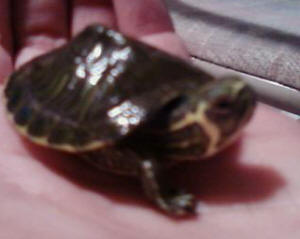
Baby Turtle Identification -- 01/22/09 Hello
Crew, <Hiya Brittany, Darrel here tonight> I live in Myrtle
Beach, South Carolina and I found a baby turtle inside the
automotive shop where I work. I took the cute little thing home
with me and it has done incredibly well thus far. I want to be
sure I'm giving it the proper care though, and I haven't
been able to figure out exactly what type of turtle it is.
<That's a nice picture, Brittany. If you'll select
Google Images and put in "Pseudemys" in the search bar,
you'll come up with many pictures of the family -- of which
the Red Eared Slider (p scripta elegans) is only one group. Many
of the Cooters and Plain turtles are native to South Carolina as
well.> I'd also like to know if it is male or female.
<There are no visual difference at that size, Brittany,
Turtles attain sexual maturity with SIZE, not age, so until
Fabian gets larger none of the sexual differences will be
visible. The GOOD news is that they don't seem to care,
either. I have a female Florida Cooter named Albert and she seems
to be just fine with that name.> I've had it in a tank
with water and a place where it can climb up and a light, etc.
Generally, he stays at the bottom unless he is eating and he
likes to dig in his rocks and when I take him out of his tank to
clean it he generally winds up burrowing himself in the folds of
a towel. From what I can find on the Internet, he looks a lot
like a red eared slider by his shell, but does not have red ears
at all, so I'm confused. If you could help me determine what
type of turtle I have and offer some tips on the best care and
feeding it would be greatly appreciated. I've grown rather
attached to the little guy. Welcome to my world, Brittany!
They're fun and personable animals that, trust me, will grow
on you and become a part of your family. Here are some pics of my
family:> <http://www.xupstart.com/wwm> I've attached
the only photo I have of him at the moment, please let me know if
you need more/better photos. <Do the research Brittany, and
after you make a more specific identification, write back with a
pic of the two of you!> <As for care, it's Identical to
the Red Eared Slider and here is THE BEST care sheet you'll
ever need>
<http://www.wetwebmedia.com/FWSubWebIndex/RESCareBarton.htm>
Thanks! Brittany <You're welcome!>
|
 |
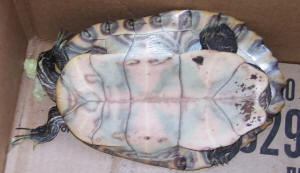
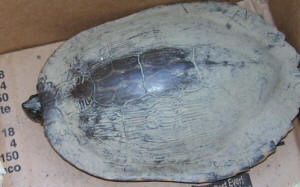
2 part question about turtles and
identification 8/26/08
Dear Crew,
<Hiya -- Darrel here>
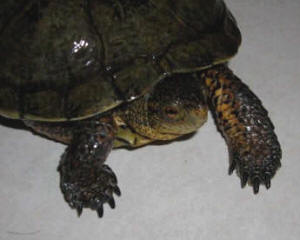
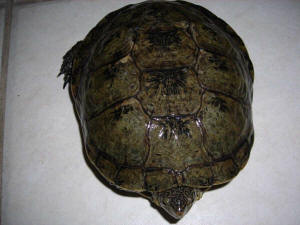
Ok, so this is a two part question, first what kind of turtle is
this??
<Oh dear .. if I'd known there was going to be a test
I'd have studied!!>
<When I first looked at the pictures my sense was that it was a
Rhinoclemys (a South American Wood Turtle). When young their
carapace (top shell) is fairly flat and somewhat resembling an
Pseudemys (the slider families) and as they mature it becomes more
domed like a Box Turtle (Terrapene). In this case, Google is your
friend. Try Rhinoclemys T Terrapene and reeves turtle and see
what you think>
I got him from a lady who was not taking care of her and she gave
her to me. After cleaning her up I put her in my 100gal tank with
my RES who is a male (very long claws) who I have had for about a
year, and is just a little smaller then the new turtle.
<Not sure the new kid on the block is an aquatic turtle though
-- from most aspects it appears to be semi-aquatic at best and
needs more dry land. Your identification from more comparison
photos will tell all.>
The other day I noticed my RES vibrating his legs in her face, so
he wants to mate with her, so if you know what kind of turtle this
is, are they close enough for them to mate or is he barking up the
wrong tree?
<Yes, in this case my guess is that you're shaving the wrong
beard, to make a different metaphor>
thanks for your help!
<I'm also passing your pictures along to a more learned
colleague for his opinion. Neale?> |
  |
|
2 part question... Turtle ID,
cross-breeding? -08/27/08 Ok, so this is a
two part question, first what kind of turtle is this?? <I have
absolutely no idea. The fact the shell is domed rather than flat
implies its either an amphibious or fully terrestrial species
rather than a truly aquatic species. The front feet appear to
lack webbing, but the back feed are webbed, so again, I'd
tend to go with some type of amphibious rather than truly aquatic
species. I would be keeping this species in an enclosure with
equal amounts of water and land, and I'd also make sure the
water wasn't too deep. But I really think you need to get in
touch with a dedicated Chelonian support/rehoming site such as
Turtle Homes: http://www.turtlehomes.org/ They have contacts and
resources for identifying "mystery" Chelonians.> I
got him from a lady who was not taking care of her and she gave
her to me. After cleaning her up I put her in my 100gal tank with
my RES who is a male (very long claws) who I have had for about a
year, and is just a little smaller then the new turtle. the other
day I noticed my RES vibrating his legs in her face, so he wants
to mate with her, so if you know what kind of turtle this is, are
they close enough for them to mate or is he barking up the wrong
tree? thanks for your help! <They are absolutely not the same
species! Male Red-ear Sliders will attempt to mate with anything.
So long as he isn't harassing her, I wouldn't worry too
much. Cheers, Neale.>
|
| Turtle identification request - 6/20/08 Dear
Crew, <Hiya Colin, Darrel here today> Any info you can
provide is appreciated.............I've been through many
websites and can't seem to find a good match. he was found in a
lake in central Illinois. he has a distinct ridge down the center
of his shell (does this rule out mud turtle?) has small yellow
dot-like marks around the 'skirt' of his shell edge that
you can see from the top bottom of shell has yellow splotch towards
center, darker perimeter yellow line markings on his neck and
limbs, subtle Thanks! Cj <Your pictures are large and well
lighted, but focus is a bit of an issue. It might be better if you
pulled back a bit and allowed the autofocus a bit more room to work
... but with that said it looks like the common mud turtle
(Kinosternon subrubrum) to me. Take a look at this link, down near
the bottom is a 2 yr old Mud Turtle (retracted, sorry to say) but
compare this to yours and see if we nailed it>
<http://www.xupstart.com/wwm/> |
|
.JPG) .JPG)
|
| turtle identification request -
6/21/08 Any info you can provide is
appreciated.............I've been through many websites and
can't seem to find a good match. he was found in a lake in
central Illinois he has a distinct ridge down the center of his
shell (does this rule out mud turtle?) <Mmm, no... this looks
like a Kinosternon subrubrum to me...> has small yellow dot-like
marks around the 'skirt' of his shell edge that you can see
from the top bottom of shell has yellow splotch towards center,
darker perimeter yellow line markings on his neck and limbs, subtle
Thanks! Cj <Is one of these:
http://www.chicagoherp.org/herps/species.htm#turtles Bob
Fenner> |
|
What Kind of Turtle Is This? -- 5/3/08 I found this
terrapin (or turtle) in my garage. He was literally hitting the
door. When I first looked out I didn't see anyone but the
next time I went out the front door and into the garage and this
is what I found. Please identify. What does he eat. I plan to let
him go. He's got inch long finger nails and the back feet are
kinda webbed. Mary in Arkansas <Hello Mary. It's difficult
to ID this beast without seeing the head more clearly, but
I'm fairly sure that it is either the Yellow Bellied Slider
(Trachemys scripta scripta) or the Red Eared Slider (Trachemys
scripta elegans). As their names suggest, the difference between
them is that one has red flashes on the sides of the head, and
the other doesn't. Basic care is identical. Nice pets, but if
you're not up to homing the terrapin in question, then get in
touch with your local Fish & Wildlife department or Humane
Society for information. Red eared Sliders are at least native to
your state, in which case the Fish & Wildlife department may
be able to tell you where to safely release the animal back into
the wild (if that's the species in question). The Arkansas
Herpetological Society may also be able to help.
http://www.snakesofarkansas.com/Main/Turtle Cheers, Neale.>
Re: What Kind of Turtle Is This? -- 5/3/08 Thanks Neale, I
just wanted to be sure this wasn't an endangered species. I
live out in the country and will probably just let it go in my
woods. There is a creek about 200 yards away. Maybe I can get a
better picture of the head. I'm anxious to let him go.
It's probably ready to catch some bugs, or whatever it eats.
Mary in AR <Hi Mary. Please confirm with your Fish &
Wildlife department before releasing the animal. While it may be
a wild animal, it could equally easily be an escaped pet from a
nearby home. Pet animals can carry diseases that seriously harm
wildlife, and they can also cause problems by disrupting natural
ecosystems. Pet animals may be less adept at finding food and
escaping from predators, so that's another issue. Putting the
turtle in a box with a shallow bowl of water for drinking is
really all it needs for a few days. Starvation isn't an
issue, so don't worry about that. (It eats mostly plants, as
it happens, rather than bugs.) While I'm fairly sure your
beastie is merely a wild animal that took a wrong turn on its
travels, you can't be too careful, so check before letting it
go. Cheers, Neale.>
Re: What Kind of Turtle Is This? -- 5/3/08 Thanks
Neale, I have sent pictures to the address you sent -
http://www.snakesofarkansas.com/Main/Turtle Waiting for a reply.
Mary in AR <Cool. Good luck, Neale.>
|
|
|
Baby turtle identification & care -- 07/24/07
Hello, <Hi there -- Darrel here> Well my aunt got me a turtle
while going fishing. <I'll take that to mean she brought BACK a
turtle from her fishing trip> It's very small. I think it's
a baby or that's just how there species look, but to the point it
just started eating its food today and it's been having this clear
floating stuff on it, and it wont come off. <Sounds like it might be
a fungus, but 'clear floating stuff' is a little vague. Is it
soft, like dead skin or hard, like a film on the shell? Please write
back with a more detailed description> And what type of items am I
suppose to put in there with it? I just don't know what to do.
<Try this link to get an idea of basic care: http://www.wetwebmedia.com/FWSubWebIndex/RESCareBarton.htm
and try this link to see if you can identify what it looks like:
http://www.xupstart.com/wwm/
Hope this helps>
What kind of turtle is this? 6/5/07
Hi, <Hi right back!) My son found a turtle in our front yard. How
can I tell what kind of turtle it is and if it is male/female? I
brought it to my vet ( I was on my way there anyway) and they
weren't sure what kind it is. <Well, there's our first
problem. If a veterinarian who has seen the turtle can't tell you
then we here at the Media aren't going to be able to help you
without seeing it.> I've been trying to find pictures on line of
different kinds of turtle, but can't find any. <Well, let's
keep at it, OK? Can you send us a picture taken with a digital camera
or cell phone cam? That would give us a place to start. Here's
another: http://www.xupstart.com/wwm any of those look familiar? Help
us to help you and we'll get there together!> I found info about
care though. <Let's hold up on that, shall we? If we don't
know if it's a turtle, terrapin or tortoise, we may not have the
right care instructions. For now .... dry & warm, OK?> Thanks!
Cathy <you're welcome - Darrel!>
Re: What kind of turtle is this?
6/5/07 Hi, <Hi Again!> I sent a note last night and now
I'm sending some pictures of a turtle my son found. <Note to
readers: Cathy sent a link to a private site containing pictures, so we
can't share the pics with you. Nothing personal.> Can you tell
me what kind of turtle this is? <Sure -- that is a Box Turtle!
Possibly an "Ornate Box Turtle" Terrapene ornata> We'd
like to keep it as a pet, but want to make sure we are giving it the
proper care. <Cathy - you've found one of the absolute coolest
and most fun turtles to have! They are intelligent, personable little
guys with distinct and individual personalities and preferences and
they're one of the lowest maintenance pets a person can have.
He'll be very tolerant of any mistakes you might make and there are
very few dangers with Box Turtles.> I found info on line but need to
know what kind it is so that we are doing the right thing. <First,
he's a land turtle. He likes water but he doesn't swim very
well or even often, so all he needs is a shallow pan of clean water
where he can drink and lounge. He's very tolerant of temperatures
and can live happily in almost an temperature that humans like. He can
have a hanging light bulb over a portion of his box or even a heating
pad in one area. He'll eat a wide variety of foods from flower
petals to succulent fruits & berries to earthworms -- and this is
the only thing you really have to watch for: They can very easily get
"hooked" on something like melon or strawberry or such and
refuse all other foods, so make sure you feed him a constant variety.
Don't feed him dog or cat food, crickets or any kind of mealworms -
these are all foods he'll love, that are NOT good for him but can
cause him to refuse other food... and trust me, he can refuse food a
LOT longer than you could stand to see him not eat.> Thanks so much!
<I'm glad we got to the bottom of this!> Cathy <Darrel>
Re: That's a Box Turtle! 6/5/07 Thanks Crew!
<No problem> I'm so glad we found out what kind of turtle he
or she is. <It makes like easier for the turtle, too! One
possibility is that it's an Eastern Box Turtle (Terrapene carolina)
in which case the lack of red or orange eyes would indicate she's a
girl.> Should I feed him any kind of meat? I got a turtle book and
they mentioned raw beef or dog food (like a chicken variety). Should I
do this? <No. When I wrote "no dog or cat food" that would
include all flavors of dog food.> I knew about the fruits but what
about vegetable? <The key to a happy Box turtle is variation in
diet. Melon or banana today, then perhaps collard or chard on Thursday
and then maybe ONE earthworm (night crawler - available at most pet
stores) on Saturday. Feed her no more than three times a week, in the
morning. Feed her HALF as much as you think she needs and remove all
uneaten food at the end of the day.> Thanks so much! <Di nada>
Cathy
A Mystery turtle and some turtle help, fdg. young
5/24/07 Hello, I'm
Jessie. <Nice to meet you Jessie, I'm Darrel> Recently, my
mother found a baby turtle roaming around while at work. So she brought
it home (mainly because our family has a need to care for animals...
and it was cute). It's a bit larger than a quarter and has
intricate yellow markings. These markings include 2 swirls near the
back of its shell and black spots on the underside of the shell (these
are just main markings I'm trying to point out it has yellow
stripes everywhere). The spots are on the underside of the rim of the
shell, other than that it has an all yellow underbelly. Oh, an it has
this little ridge on its back. Now I've been doing research, and I
think that it is a baby River Cooter. <That what I was thinking,
too.> She found this turtle kind of out of its area. You see, it
says that this turtle lives in the northern part of Florida, but we
live in Sarasota. I'd be happy to send pictures of it...
when my dad comes home with the camera. <many different Cooters live
in Florida, Jessie and I'd guess this one lives in your
area. You don't have to send pictures> I HAVE been
trying to find out what I could about Florida turtles and about baby
river Cooters. Unfortunately, I find myself in a very difficult
situation. 1. I don't know how old it is so I don't know if its
still using the yolk for food. <I doubt that it is, so it's time
to start feeding it> 2. I am lacking the foods that the sites I have
visited suggest feeding to this turtle (cut up minnows or lettuce)
<a small cotter would like Koi pellets that are available cheaply at
your local pet store> 3. I'm not completely sure if this turtle
will be a permanent pet. Seeing a show it's a baby, it's cute,
we love animals, and my Dad seems to have taken an interest in it,
I'm guessing it will be. <let's hope so! They
make fun and interesting pets> Can anyone help me? And or does
anyone have suggestions? <first, make sure it has a place to get wet
and a place to get dry and warm and is safe from any other animals like
dogs or cats. They like sunshine, but direct Florida
sunshine can get that little guy overheated quickly, so never leave him
alone out under the sun. Here is a link to a care sheet that
will tell you a lot more http://www.wetwebmedia.com/FWSubWebIndex/redearsliders.htm Good
luck to you, Jessie, and thank you for writing us!> Turtle ID
Needed 9/6/06 Hi. I live in PA and recently found a
turtle which I am planning to release, but I would like to know what
kind it is first to find the proper location site. I have searched and
have had no luck! The turtle has a black or dark green shell with no
spots. It has a orangish belly with yellow stripes on the neck and red
spotted/stripped legs! See what I mean she is complicated. Could you
please help me? I want to do what is best for her. P.S she has a flat
belly so I assumed she was a female! your help would be much
appreciated thank you. < Do a Google search on Eastern or Midland
Painted Turtle. Both are found in your area. Once you find a picture
then you can determine which one you have.-Chuck>
Sexing An Unknown Turtle Species
8/19/06 HI. I have 2 Gammarus turtles and I want to know if they
are boy or girl can you help me? Ana < Don't know what a
Gammarus turtle is? Gammarus is a shrimp often used as food for turtles
and fish. A good photo might help with the ID.-Chuck>
Re: Turning
A Turtle Loose In A Pond 8/21/06 Ok Thank you. Do
you think the turtle I already released is still alive or
not? < Adult turtles are pretty tough and have few predators.
Smaller turtles are preyed on by just about everything. If your turtle
was released early in the year, close to being an adult size and in
good health, then I think he probably made it if the winter was not too
severe.> I don't have a picture of the turtle but I
was told its a Cooter or something like that. < Lots of turtles go
under the name of Cooters or sliders.> Also, I do want my turtle. I
just think it would be better off with other turtles then in
my little pond. It is about 2 feet deep and 6 feet long and
3 feet wide. It is actually a kiddie pool and I have fish in
there with it and it kills them all the time and also bugs
so I think it could survive in the pond but I'm worried
about if it could survive there in the winter. Thank you
for your answers and help. < Many people think that
turtles get lonely and need other turtles to be around. Other turtle
are looked at as competition. If your pond has a mud bottom and your
winters are not too bad then your turtle may be OK outdoors. In the
northern part of the country where winters are pretty long and winter
temps are pretty severe they do not overwinter well.-Chuck>
ID A Poor Swimming Turtle 07/02/06 Hi, For
about a year we've had two semi-aquatic turtles bought as babies
from someone that did not know what type they were. We first ID'd
them as Reeve's Turtles because they seemed to have 3 keels on
their shells, long tails, and were very poor swimmers. (In fact they
can't cope at all with water deeper than their heads; if they
can't reach a pellet, they will "jump" rather than swim
up to it, and generally speaking their hind legs never leave the
bottom. I even tried giving them some supervised "swimming
lessons" in case the shallow water had just made them lazy, but
they're hopeless.) The few pictures we could find of young
Reeve's were not a perfect match for ours, but didn't seem to
rule it out. We have recently discovered them mating at night, leading
us to conclude that one is male and one female. They have a pretty
violent mating habit in which the male reaches down with his very long
neck and bites the female's neck. He has actually caused her
wounds. By looking up that habit, we came across a S. American species,
Geoffroy's Side-Necked Turtle, the images of which seemed to be a
much closer match for our two. But the description of
Geoffroy's is wrong in two ways: they don't retract their heads
"sideways" in the way the Side-Neck's name implies, and
they are definitely not "excellent swimmers." They have
seemed happy and healthy being treated more or less the same as our RES
but with shallower water, but we're still curious as to what they
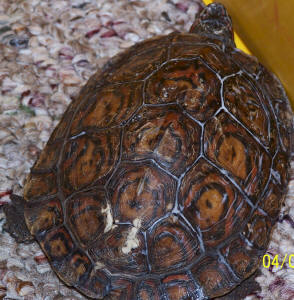
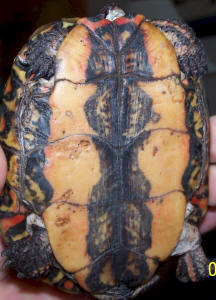
are. Any ideas? Thanks! Phil & Diya <Look at the American Wood
turtle (Clemmys insculpta ). This may be an outdated name, but you
should find plenty of info by Googling the common name. Very cool
turtle and may also be rare depending on the subspecies.-Chuck>
[Images attached, including one showing them as
babies. Hope the files aren't too big.] <<Nope,
just unfortunately not saved... RMF>>
|
Identification Issue, turtle -
4/11/2006 Dear Crew: <Brandon> Greetings and
Salutations. As a general rule I keep snakes; however,
I managed to acquire a
"turtle." This was more of an animal
surrender as he was not being fed well, possibly was dehydrated,
and just didn't seem to be in optimum health. It
is my goal to remedy that unfortunate situation, Besides, my
daughter immediately fell in love with him. Here is my
question, what type of turtle is it? I have been on
the search for information and just cannot seem to definitively
identify the little guy. For the time being he is in a
20 gallon tank, nice hide spot, new UV lighting, and a dish of
water that he can submerge his entire body while still being able
to get out of it. He is very active, likes to climb,
and has spent some time soaking in his water
bowl. After his soak I had to clean his carapace and
noticed that he does have color. I really think it is
a painted turtle. The person who surrendered it
thought it was a "woodland" turtle from
Canada? I am not sure where she received her
information. He has been a pet for 15 years, and I
believe he has not been kept in a truly 50-50 aquatic
situation. I am sending pictures ( I pray they are not
too large). I am hoping that you can help me identify
this little guy; I want to be able to provide the best possible
environment for him. <Mmm, looks like a color-variant (due to
upbringing) of an Eastern Painted Turtle to me (Chrysemys
picta)... have never heard of or seen such a thing as a
"Canadian Woodland" turtle> Again I apologize if I
broke the picture rules. Any help you may be able to
offer would be appreciated. Brandon C. Heuyard
|
|
Turtle ID FAQ on 4/10/06 Dear Fearless
Leader, I was unable to open the picture sent for the following
question so I sent it back to the freshwater section. After
seeing it today on the main website it definitely looks like a
semi-aquatic wood turtle in the genus Clemmys. It actually may be
a very endangered Clemmys muhlenberg. See ya in a couple of
weeks.-Chuck <Yikes... will amend. Danke. BobF>
|
|
|
What Kind of Turtle is it? 8/23/05 My friend just
found a small turtle, but cannot find out what type it
is. It is either dark green or black with yellow-green
stripes all over its body and shell. Also it has a flat yellow-orange
stomach. It has three triangular bumps on its shell. It has
a tail and webbed feet with claws. If you know what it
is, please tell me what it eats. Also, the place where she
found it is under construction. Where would you suggest she
release it? < Sounds like you have a map turtle. They are an aquatic
species that live on invertebrates, fish, plants and just about
anything else. It could be released in a stream , river or creek away
from human habitations.-Chuck>
Box Turtle Lost In Washington State 8/20/05
I'm in Spokane, Wa. and I was driving home when I found a turtle
sitting in the middle of the road. That's really odd, due to the
fact that I, personally, am about 5 miles from the nearest water source
other than a hose spigot. I'm not sure what type or what
to do about it. It's about 6" long, dark brown shell, with
yellow markings. This may sound really stupid, but I know absolutely
nothing about turtles, but the skin is rough and has small red
"flecks", if you will. His shell, (if it is a he),
is about 3.5" high. I really don't know what else to tell
you, but I also want to know how to care for it and so forth. I'm
really worried that some poor kid is probably worried sick
that their pet turtle is missing. Any advice at all
is welcome. Thanks for your time, Katlin and
"Bogart" < Sounds like a little box turtle lost his way.
Keep him in an aquarium /terrarium setup of about 40 gallon size (3Ft).
They must have water that they can get in and out of. They need a
basking spot on land with a good heat/sun lamp. They love snails but
will eat many fruits and vegetables. They live for a very, very long
time with proper care. Do a Google search on box turtles and you will
be busy reading for hours.-Chuck>
Red Eared Slider? 2/24/04
<Hi, Pufferpunk here> I have a turtle and I don't know what
kind it is. <1st of all, I must insist you write in sentences &
use capital letters when necessary. All the questions sent
to us are posted on our website & I have to take a lot of time to
correct this, before I can send it on to the site. This
takes time away from answering other questions.> I need to find out
because I have a project that I have to do. <What kind of
project?> It is about the size of a half dollar and it has kind of
diamond shapes in the middle of its shell. It has like brownish red by
its ears. It is green and yellow do you know what kind it is? <It
sounds like a red-eared slider. Is this your turtle?
http://www.tpwd.state.tx.us/nature/wild/reptiles/slider.htm>
I could really use some help! <I'm surprised you were able to
purchase this turtle at that size. It is illegal to purchase
aquatic turtles under 5", due to their carrying salmonella
bacteria. Good luck with your project. I hope it
is not harmful to the turtle in any way. These turtles need
clean filtered water. They need a lot of swimming room,
& a piece of land to bask on, with a heat lamp
above. Small strips of fish, krill, shrimp, crickets &
worms are what they like to eat. They also need a source of
minerals for their shell, by vitamins & a sulfa rock in the
water. ~PP>
A Red Ear is a Terrapin is a RES! >Hi there, >I
didn't see anything that would help me on the postings. I have two
RES's and they came from the same tank which was much small than
the 55 gallon that I have put them in. One is about 5 inches
and the other is >3 inches in length. I have notices that
the bigger one is attacking the smaller one biting at its head and feet
and tail. I am not sure what to do or if I can stop it?
>thanks, >Adaniel >***I'm sorry, what exactly
is a RES? >Jim*** > <Hey Amanda, you've confused us
all. What is a RES? If you could give us a little
more information I hope we can help you. Thanks MacL>
>HUH? >>>Hello, Having finally been enlightened as to what
"RES" means (you gratuitous abbreviator you) I can make sense
of your post. I'm actually quite a reptile geek, but my experience
is mostly with monitor lizards, other lizards and various snakes. I
suggest you post your question on a herp site such as Kingsnake.com.
Or, call East Bay Vivarium in Berkeley Ca. Best of luck.
Jim<<<
South American Wood Turtle I am having trouble finding
anything on the Suriname wood turtle. Is it the same as the North
American turtle? <No, totally different species.> And also what
type of habitat, food they need to have for a long healthy live. thank
you for your time < Your semi-aquatic (Rhinoclemys punctularia) will
need an area that is partial aquarium and partial terrarium. They can
be kept like regular wood turtles except that they need to be kept
between 75 and 85 degrees. North American turtles are sometimes cooled
down for hibernation. Do a Google search on the scientific name or
South American Wood Turtle and you will find lots of info on your
turtle.-Chuck>
Small turtle my cat brought home Hi <Hi, MikeD here> I
was wondering if you could help? First my cat brought home a very small
turtle slightly bigger than a quarter amazingly it was and is still
alive. I have tried to find out it's type. we are in Maine, the
small critter has an almost rounded dark shell, with an orangey/yellow
bottom shell. the back legs have red stripes and the front legs as well
as the throat area has yellow stripes and nothing on top but two small
yellow dots on either side of its head.
< Most likely it's an Eastern Painted turtle (Chrysemys
picta>
there are several ponds miles down the dirt road. I am sure the bass
one of which I caught (4lbs) would enjoy this little critter as a
snack.
<They would!>
I have decided to try and keep it as I love turtles and am willing to
spend what it needs for its care. The way I see it I already have 18
pets what's one more! Do you have an idea as to what kind it could
be?<See above, Eastern Painted turtle>any special care tips?
<To do it right you need a small aquarium,50%water/50% land and a
good herp light. Herp vitamins/calcium help too>
thank you for your help my e-mail address is XXXX@aol.com if you
would be kind enough to respond there. thanks again
<You're welcome. Hope it helps a little> Marcee
Is It a Chicken, or a Turtle? No! It's the Eastern Chicken
Turtle Hi I've just recently brought an eastern long neck
turtle. It's about 2 years old. I was just wondering
how much food and what food is the best to feed him. < You probably
are referring to an Eastern Chicken turtle. This is an aquatic turtle
that does well on meal worms, earthworms, crickets, king worms, trout
chow, fish and commercially available turtle food. A varied diet is
best. Feed him once a day so that most of it is gone after a couple
minutes. As the weather warms up then his metabolism will increase and
he will need to be fed a little more and maybe a couple times a
day.-Chuck>
|
|
Aquatic Gardens
Ponds, Streams, Waterfalls & Fountains:
Volume 1. Design & Construction
Volume 2. Maintenance, Stocking, Examples
V. 1
Print and
eBook on Amazon
V. 2
Print and
eBook on Amazon
by Robert (Bob) Fenner |
|
|
|

