|
FAQs About Turtle Stocking/Selection
Related Articles:
Turtles,
Amphibians,
Red Eared Slider Care,
Related FAQs:
Turtles 1,
Turtles 2,
Red Ear Sliders,
Turtle Identification,
Turtle Behavior, Turtle Compatibility, Turtle Systems, Turtle Feeding, Turtle Disease, Turtle Reproduction, Amphibians, Other Reptiles,
|
|
 |
Aquatic Gardens
Ponds, Streams, Waterfalls & Fountains:
Volume 1. Design & Construction
Volume 2. Maintenance, Stocking, Examples
V. 1
Print and
eBook on Amazon
V. 2
Print and
eBook on Amazon
by Robert (Bob) Fenner |
 |
"Found" turtle; not eating, wheezing?
5/23/17
hi I found at turtle on the side of the road and it was not moving
scared that it was going to be hit I took it home where I found out that
it was a midland painted turtle but now it isn't eating and it is making
a weird grunt noise what does this mean.
<The best thing to do with wild reptiles is to leave them where they
are.
This has to be close to a safe, turtle-friendly body of water already
inhabit by the species in question. Just dumping a turtle in "the woods"
or a backyard isn't acceptable because there's no knowing if the turtle
will
find the food and shelter it needs. Your local herpetology club or
natural history society may be able to help here. The next best option
is to contact your local animal rescue charity or agency. Wild animals
can be acclimated to captive life, but there may be legal issues here
(many reptiles are protected at city, state or national level) and on
top of that wild animals can come with parasites and other issues that
need to be taken into account. If you want to keep this animal as a pet,
then please write back and we'll offer up some help. Cheers, Neale.>
Semi aquatic animals...? 2 gal. bowl in a FW tank...
stkg... confusion/confused 9/2/2013
Hi,
<Hello,>
I have a 30 gallon tank, heavily planted, with a
rainbow fish,
<"A" rainbowfish? Should really be in groups of 6+ specimens, if we're
talking about Melanotaenia and other such species..>
small albino Pleco, and a botasia catfish (not sure if that's accurate,
looks like a 3 inch bullhead, is full grown)
<Have absolutely no idea what a "botasia catfish" is, and Google offers
up "basa catfish", which is another name for the Iridescent Catfish
which definitely isn't full grown at three inches. Three feet... maybe!>
I have recently installed a slanted Betta bowl at the bottom of
my tank, I have plants and an airline in it, creating an underwater air
bubble. I have seen this be done before, and it allows you to house some
semi aquatic animals that need land/air.
<Sounds nightmarish! Abnormal air pressure, minimal space to move
around, oxygen concentration extremely dependent on efficiency of air
pump... yikes!>
I would like to get something that would normally need land so I can
keep it and not need another special tank for it. I figure I could get a
crabs, amphibians of some sort, or maybe a turtle. I would forward to
hearing your impute.
<Would not do this. The theory sounds cool, I admit, like a
science-fiction story with an underwater city or something. But then if
you think about why those don't work in real life, even with modern
engineering, you'll realise that trying to achieve with a cheap air pump
and a glass bowl is a little optimistic. The space would be too small (a
few gallons of volume at most, and land area of a square foot, tops) for
most animals to be happy, so why bother? Plenty of fully aquatic fish
choices for a tank this size and the livestock you already have.
Obviously anything amphibious (in the sense of using both water and
land) would move in and out of the bubble, and turtles are 100%
incompatible with fish, so they're right out. Virtually all amphibians
are bad choices, apart from African Dwarf Frogs, and your existing fish
are too large for those. Crabs are almost always brackish water animals,
so incompatible in that regard. Basically, virtually all of these "mix
land animals with water animals" set-ups don't work, and the lifespan of
the animals kept this way is invariably less than when kept properly.>
Thanks
<Hope this helps! Cheers, Neale.>
RE: Semi aquatic animals 9/2/2013
I am well aware that this is not ideal, but I always see newts, frogs,
and other various semi-aquatics in tanks with no land at all, rotting
away in a pet store in fact, nearly all my pets have been adopted or
were the rejects at a pet store. This design at least gives them
something.
<Unfortunately, while your intention is good, the result is bad. By
buying animals from pet stores who don't care for them properly, the pet
store makes a sale and is encouraged to buy some more. Logically, the
best approach is to leave badly cared for animals in the store; ideally,
you'd pass on your concerns to your local government (who license pet
stores one way or another) and you could also contact an animal welfare
channel.
Writing to the store manage could be worthwhile, too. Regardless, if the
animals languish in the pet store, the retailer won't buy any more.>
This also allows Bettas to live as they require close air, African
clawed frogs require air access so deep tanks are not ideal (although I
have heard that they go on land),
<Only exceptionally, likely when the ground is waterlogged following
heavy rain. Ordinarily, if they crawl out of the water, something is
extremely wrong with the aquarium. It is true they like basking within
floating plants though, even with their heads poking out. Do bear in
mind Xenopus spp get quite big, and are essentially incompatible with
small fish.>
some crayfish species require oxygen, a bull frog tadpole could use that
to grow up in (but be released or relocated when full grown),
<Releasing a bullfrog from an aquarium into the wild would be very
wrong, likely illegal in your area. I'm assuming you're in the US, and
you may think that bullfrogs are native so what's the harm. In fact
bullfrogs are not found in every waterway in the US, so you could put
them somewhere they don't belong, and there may be genetic variation
from region to region, and the pet ones sold may carry distinct genes
from the ones in your area, and releasing a pet bullfrog allows those
non-local genes into your local gene pool. Finally, the big no-no, and
likely the legal issue, is pet bullfrogs have been exposed to bacteria,
viruses and parasites endemic in the pet industry, and releasing a
bullfrog will allow those into your local waterways.>
I could perhaps use it to breed killifish, and most pet store newts have
little land anyway, so this is not as foolish as you think.
<Trust me, it's a terrible idea.>
Not to mention that the Betta bowl is a two gallon one, note one of
those light bulb sized things, the air line is not cheap at all and I
did my best to make the land part cozy.
<Assuming you didn't pay tens of thousands on having an industrial
engineer create something that ensures a steady air pressure and
balances oxygen and CO2 concentrations properly, the set up you design
is simply a bowl with an air pump connected to it. So my reference to
"cheap" wasn't a concern about the quality of the products used, which
I'm sure are excellent.>
And as for my rainbow fish, it was called a Madagascar rainbow fish yet
looks NOTHING like one, I do not know the scientific name and still
cannot find another that looks quite like it.
<By all means send a photo and I'll help.>
He was adopted, I've had him for years, and had a mate for him (but he
killed her, always was a bit over aggressive) he does not like the
company of other rainbow fish or gouramies and the catfish was at a pet
store, they said he was full grown and that he is pretty shy.
<Again, a photo would help.>
Other than that most of my fish are still shrouded in mystery.
All-in-all you may hate this idea, but who knows, this thing may be
worth it after all.
<If you're looking for an expert fishkeeper like me to say, sure, sounds
great, that isn't going to happen. You sound like a really sensible,
ethical aquarist, and I'd urge you to stick to that path. All this Betta
bowl idea does is take swimming space away from your aquarium while
creating a sub-optimal habitat for animals that need more than 2-gallons
space. Just don't see an up side here at all. Cheers, Neale.>
Slider 4-6 years old ... giving away 1/24/12
We have heard that it is a bad idea to release the turtles into natural
areas,
<It is>
but we have been considering it.
<Please don't>
This turtle is rather large, we live near the Tennessee river in North
Alabama where there are many places along the river with inlets and
such to release her far away from any type of traffic areas and
neighborhoods. Is there anyone, or would you know if this is a bad
idea, if it isn't when would the best time of year be to do this?
She is familiar with eating plants and fish, although of course
it's within the environment of her tank.
Thanks again for your input.
<Did she do something wrong? Why is she being
banished?>
<There are a lot of reasons to NOT let her out in the
wild. For one, compared to a wild animal, she's not
afraid - or not AS afraid. She will be more approachable by
people on the shore, in boats, canoes, etc. who may intend on doing her
harm. She also may be familiar with eating, but she's had no
experience with being EATEN and the world you are contemplating for her
is full of them.>
<Last, in spite of every possible contingency, she may be carrying
some latent disease or pathogen that is harmless to her but lethal to
the local turtle colony.>
<In any case, find a Turtle & Tortoise club near you and tell
them that you have a Slider that you would like to give up for
adoption.>
Hi,
<Hiya - Darrel here>
Turtle compatibility question.
<OK>
I'm a new owner.
<Of ?? New owner of a 40 gallon tank? Of turtles?>
40 gallon tank. My original idea was for a common Musk and a
Mississippi Map.
<Ummm>
I called the guys at turtlesale.com and they said they would be fine in
that size and as far as getting along he said "usually".
<How many fatalities are there in 'usually'?>
I chose these two because I like the way they look and their size and
they are in my price range. I plan on keeping these a long while and I
don't want to see either injured or have to separate them. I read
Musk turtles are pretty aggressive.
<Yep - in their way, they're worse than a Personal Injury
Lawyer>
So anyway I need a small size turtle (male) that can remain compatible.
Even same species or different species. Yes I did search Google
can't really find any exact answers I know it depends on
personality.
<If you have a patient personality you'll fine more answers on
Google>
<Oh, wait, you meant the turtles, right?>
I'm open to two Maps, a Map and Musk, two Painted or
anything.
<"Anything" is a wide open category, Jeff.>
Would like an energetic swimmer that remains below 5 inches.
<Well, they ALL have to come up for air eventually, keeping them
below 5 inches would require some breathing apparatus>
<Wait . Unless you meant their SIZE?>
Any ideas or facts?
<Facts? Did you know that the comedy movie AIRPLANE! was based on a
script from a DRAMA back in the 1950's called "Zero
Hour!"? Even the dialog "The fate of everyone on board
depends not only on finding someone who can fly this plane, but who
didn't have fish for dinner!" is all in a movie entitled Zero
Hour! Starring Dana Andrews as a man named Ted Stryker.>
<Oh wait you meant TURTLE facts? Hmmm>
And I'm fine with feeding two different kinds of food.
<Jeff - the Mud, Musk et al, are often lumped together (in care
sheets, etc.) with the snapping turtles (the Chelydridae) because of
similar habits, diets and temperament. A Mud turtle can live peaceably
with a Map turtle as long as the mud (or musk) is very small and the
tank is very large. Even so keepers of these mixed animals will find
the occasional chunk out of a leg. I have kept both (those actual two,
by the way) in a 55 gallon show tank, but I did so with a Plexiglas
divider. I wouldn't allow them to mix.>
<Another mistake is to keep a softshell turtle with any other.
Actually even another softshell can be "iffy">
<The Maps, Painteds, Cooters, Sliders all get along
fine. Slight altercations happen between individuals but as
long as they have room to get away from each other they seem to be able
to work it out>
<On a separate note, Map turtles are quite a bit more skittish and
private than the rest. They are more aquatic too, which means that they
don't have the tolerance for poor water conditions that don't
seem to bother the rest of the water turtles.>
<MY suggestion: 1 Painted, 1 Red Belly and 1 Cooter will give you
nice mixes in color and personality yet all are active swimmers and
engaging personalities>
Thank you,
Jeff
<Yer welcome!>
Turtle question. SW avail.... Oh, and shark sel.f' as well 2/28/10
Hello,
<Hiya - Darrel here>
I just bought a new tank for my living room/game room (pool table, bar,
darts, etc.). The tank is 8'x3'x3', 538 gal.
<VERY cool and a lot of us here are now officially jealous of
you>
I have a 100 gal. sump, and I am currently in the process of replumbing
it. I need a new, bigger pump than the one that came with it. It's
gonna be a saltwater tank, FOWLR. I already have a 90 gal reef tank, a
45 gal. FOWLR, and a 35 gal tank that I will probably turn into a
quarantine tank (all saltwater of course).
<At that size, please also give serious consideration to water
changes. Permanent plumbing to a drain, a safe, warm place to have a
minimum of 75 gallons of new water ready for changing (538 gal +
100 gal sump plus 35 gal quarantine tank) plus a method to get to the
various tanks. It seems obvious but you'd be surprised how many
people don't think of that until after those 5 gallon jugs from the
local fish store just don't cut it when you need 15 of them per
week><<Excellent. B>>
My question is this. I am very interested in getting a turtle for it.
Is there anywhere that I can buy one?
<No>
Is it even legal?
<No>
I've been looking over the internet, and I can't find anything
so far. I am trying to make a list of what I can stock this tank with,
and I think a turtle, among other rare exotic fish would be so
cool.
<A turtle would be cool. So would a Marine Iguana from the
Galapagos. So would a dinosaur but the first two are illegal and the
last one is impossible><<But, I seen it on TeeBee>>
<Seriously even if virtually every species of sea turtle in the
world was not listed as CITES protected species it simply isn't
possible to provide a health environment for them -- and even if you
could (which you can't) you can't provide the proper
diet.>
I am open to any suggestions if you have any.
<On the off chance that I haven't made myself crystal clear --
there is no legal way to acquire one and even if you could, the cost of
care would be astronomical and the end result would be a dead sea
turtle. You'd be better off AND happier to amass a laundry basket
full of $20 bills and toss them down a storm sewer. The net effect will
be the same and it would be over sooner.><<& less
frustrating and time-consuming>>
I am looking into a couple of sharks as well, if it is legal.
<Certain sharks are legal, yes.>
I'm not sure.
<For many years, not more than 45 miles from where you live, I
raised and housed 4 alligators. When friends and neighbors would look
at me and ask "why Alligators???" I' reply, perfectly
honestly "because sharks are too darned delicate!">
<The problem, as I see it, is that the thing that comes to mind when
someone wants to keep a shark is Bruce (the shark from
"Jaws") also known as Carcharodon carcharias, The Great White
Shark - right? Or a Bull shark or at least even a Hammer Head? All the
really GOOD sharks are the pelagics - the open-ocean types or else
their in-shore cousins the White Tip, Gray Reef, etc. but without
exception those can't be kept in a closed system, even as
sophisticated as yours. They need, at best - tens of thousands of
gallons per foot of shark, constant keeper and veterinarian attention
and all the attendant expense that go with that. So what we're left
with are Bamboo sharks, Horned Sharks and a few other members of the
family I call "The Boring, lazy, non-menacing Sharks">
<Please read: http://www.wetwebmedia.com/sharks.htm>
[Editors Note: On behalf of WWM we would like to apologize to any and
all Bamboo sharks, Horned sharks, their families, relatives and
dependents as well as their faithful fans, keepers, breeders, resellers
and importers for that unwarranted insult. Moreover, having met Mr.
Barton on several occasions he has no room to be calling anyone else
Boring, Lazy or Non-menacing that was the quintessential case of the
pot calling the kettle.]
As you can imagine, with a tank of this size, I want to have some of
the best
livestock in it.
<I have an opinion that my colleagues may not share, so take it with
a grain of salt (that may be been a pun - grain of salt!): Consider
resisting the urge to put as many different species in that tank as
possible and instead see how many of the SAME species you can
accommodate. What I mean is this, the behavior and appearance of the
Yellow Tang (Zebrasoma flavescens) is absolutely AWESOME in large
groups/schools to the point of almost taking your breath away.
Unfortunately, most of us mortals simply don't have enough
"tank" to be able to house more than one or two. You do. If
you apply some different logic (think outside the tank, to make a pun)
you could end up with something unique. "The most impressive
collection of {something} west of the Mississippi" or something
like that.>
I plan on documenting the whole process, and as I go I will send pics
if your interested.
<We are very interested -- along with a narrative of the process and
the decisions that went into it!>
Right now its empty. but just the size of it alone sitting in my room
is pretty awesome. I always come to WWM, and you guys have really
helped me over the years.
<Yeah, but that was before *I* joined the staff. I've brought
the team average down a few points since then>
This is the first time I've actually asked a question,
<And maybe learned your lesson?>
and I am sure you can give me some great advice like always.
<A lot of the team give good advice. Most give GREAT advice.
Unfortunately, this time you got ME!>
Thank you in advance.
Rudy, Chino Ca.
<Seriously Rudy -- take lots and lots of pictures and send them to
us periodically.>
Re Turtle question. SW avail.... Oh, and shark sel. f' as well 3/2/10
Dear Crew,
<Here we are!!!>
Regarding the keeping of sea turtles and wasting money .... Please note
that amassing laundry basket full of $20 bills and toss them down a
storm sewer is illegal in some jurisdictions. Here in Charlotte, NC the
city actually charges us for the water that falls on our yards from the
sky.
Basically they charge for what we use and for rain that we don't
use. Please don't give them other ideas.
<"No man's life, liberty or property is safe while the
legislature is in session" -- unknown>
I suggest he use the PayPal donate button on the site instead
:')
<Thanks Greg! .... your letter gives me an opportunity to remind
people that WWM does in fact have a "Donate" button on the
home page and should anyone be tempted to toss money down a sewer ...
that money could be put to much better use here, with us. Donations
help us keep this free site up & running, purchase articles for the
Conscientious Aquarist Magazine and the occasional hush-money to local
officials willing to help us in our quest
for the ultimate domination of the world!><<Amen.
B>>
|
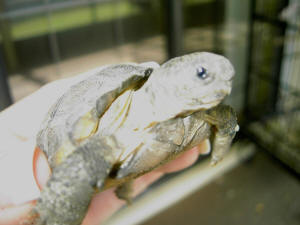
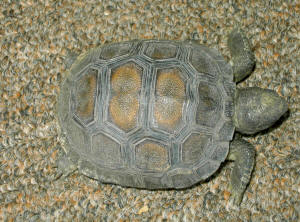
Turtle identification 10/10/09
Hello :)
<Hello,>
A friend of my daughter's found this turtle in the woods. I
already scolded him for taking it from its habitat, but now
I'm not sure what to do with it.
<Generally best to release it where found, as soon as
possible. Ideally, contact your local Fish & Wildlife
department to see if a park ranger can take you to an optimal
release site away from things like busy roads.>
I am wondering if I should take it to the pet store even though
my daughter wants to keep it.
<Certainly shouldn't take it to a pet store. For one
thing, wild animals can catch diseases from pet animals, and
_vice versa_. On the other hand, staff at a good reptile and
amphibian store may well know something about the reptiles local
to your bit of the world.>
He is rather small (about as big as the palm of my hand) and the
bottom of his shell is a bit soft.
<Appears to be an Eastern Box Turtle, Terrapene carolina. This
is a highly variable species, but the dome-like shell, brown
colour, and hooked beak are characteristic. The front of the
lower shell is hinged, so when the head is pulled back, a
trapdoor closes off that part of the shell. Males have red eyes,
females brown. I'm assuming you're in the United States
somewhere, where this is species is _by far_ the most common
terrestrial turtle (what here in England we'd call a
tortoise).>
He has a short neck, dark eyes and the bit of yellow colorings
that I can see. seem to be much darker at times and DO appear
much brighter in photos.
<If the eyes are brown, and this is Terrapene carolina, then
"he" is a she.>
He is currently in a large bird cage which we have attempted to
convert for his needs. (Frisbee filled with water, dirt for
burrowing, half of a potters pot for shelter and
"hiding" etc.
<Wild-caught specimens don't especially well in captivity,
though you have covered the key things, particularly water. They
like to bathe, but the water shouldn't be so deep (or the
bowl so steep around the edges) it cannot get out easily. If it
gets through the first few weeks, and eats and drinks normally,
the species can last a long time in captivity. High humidity is
important. Bear this in mind if you decide to keep this animal;
kept properly, it'll outlive you! The record for a wild
specimen is 138 years, and between 50-100 years seems fairly
common. In captivity you can expect upwards of 30 year lifespans,
and up to 60 years has been reported.
Like all reptiles, you need to provide a heat source of some sort
if you do not plan to hibernate the animal. Generally,
hibernating reptiles is tricky unless you have fattened them up
carefully beforehand, and I'd recommend against it, at least
for the first year. The heat source of choice is a lamp, and it
should be one that produces UV-B as well as heat, because they
need UV-B to synthesise Vitamin B1 and convert calcium into bone
and shell.
In short: they need a big vivarium, a bathing pool, a source of
heat, and a source of UV-B. This will be fairly expensive to pull
together, and while there's no rush, you will need to have
all these bits and pieces before it starts getting too cold. In
the wild your Box Turtle would be looking for a resting place to
hibernate, somewhere cool, dry, secure from predators and safe
from flooding. If you want to keep your turtle, you're going
to have to provide a warm, humid alternative.>
He moves very quickly and seems to be quite smart lol. (He found
a way out of the cage within a few minutes of putting him in it
and we were thankful we were there to see it or we never would
have believed it - it's fixed now. - and he already prefers
one shelter corner over the other!).
<Shelter is indeed very important. It's also critical to
make sure predators, particularly pet dogs, can't get into
the cage. Even a "playful" dog could wound or kill a
Box Turtle.>
I have attached some photos and am very curious to know what kind
of turtle he is, how old, gender etc. and most importantly what
he should be eating and what I should do with him.
<As I said, likely Terrapene carolina, probably female if the
eyes are brown rather than red. Age difficult to say; seems to be
full grown, so could be anything from 10 to 100 years!>
we've tried many types of food (lettuce, bugs, cooked eggs,
cooked pork, fruit etc. - so far he seems to prefer the eggs and
pork but only ate each of those once along with a small bit of
cucumber. He seems to eat one day but not the next.
<Avoid "meat", i.e., anything from a warm blooded
animal. The fats in these foods coagulate inside the turtle,
causing problems. Instead opt for mostly greens, romaine lettuce
and curly lettuce being ideal. Augment with soft fruit (melon,
tomato, berries) and offer small amounts of things like
earthworms, mealworms, and white fish. Very occasionally you can
offer them cooked chicken bones, which seem to go down well, but
not too often.>
Thanks in advance for your help.
Brenda
<If you plan to keep this animal, do spend some time reading
up on keeping Eastern Box Turtles in captivity. There are some
excellent reptile books available for pet owners, and one of
those would be a sound investment.
Keeping reptiles in captivity isn't easy, and not something
to do on a whim. It's a shame to capture an animal that can
live for 100 years in the wild, and then kill it after a few
months through neglect. So, make your choice: buy all the stuff
it needs to thrive, or else return the animal from whence it
came, ideally after calling the local wildlife bureau in your
neighbourhood. Hope this helps. Cheers, Neale.>
|
  |
Re:
turtle identification 10/10/09
Thank you so much for a speedy reply.
<My pleasure.>
Based on your information, we have decided it would be most fair to
this little lady if we called our local wildlife bureau and let her
have her chance to live to a ripe old age.
<Good move.>
You have been most helpful.
PS - we Live in Florida, USA. Although we are a very warm and humid
state, we do have our cold days in winter so she would still need
much care.
<Air temperature all year around should be fine if this animal
was kept indoors in a room that wasn't air conditioned. The
main thing is to avoid extremes of heat and coldness; anything
between 15-30 C should be fine, assuming it has access to water (to
keep cool) and a basking lamp (to warm up). But there's no
getting around the fact reptiles are all expensive pets in terms of
setting up their habitat, even though compared to cats and dogs
their long term costs are low (they don't eat much; kept
properly, rarely get sick; and don't need such procedures as
neutering). Still, they're not pets for everyone. Cheers,
Neale.> |
Re: out door pond turtles, sel.
8/25/09
Thanks for your advice. I got the barrier issue taken care of. I have
abt 10 acres here so finding room for the little guys and gals over the
winter will be easy and all ready to go. I have been checking online
abt the
Pseudemys (Cooters, Red Belly turtles, but have not been able to locate
any that are for sale. My local pet store does not carry any other type
of turtle but land turtles and that is not for me. Any ideas on where
to
locate any?
Thanks Again.
<Don't know where your pet store buys it's animals but many
wholesalers like my friends at Cal Zoo or Strictly Reptiles or Glades
Herp -- all of whom only sell to pet stores ... would be glad to ship
some to your local store if they ordered. Give those names to your
local pet shop manager and see what he or she will do for you
D>
Home for
2 turtles 06/29/08
We purchased 2 yellow-bellied turtles last
summer in Hilton Head. Female is now about 5" and male 7".
It's more work than I thought and would like to find a home for
them. TY, sw <Greetings. Wet Web Media can't provide personal
services of this type. For one thing, I have no idea at all where
Hilton Head is! Certainly isn't anywhere near me here in
Hertfordshire, England. You essentially have two options. The first is
to contact an animal rescue in your locality. Do bear in mind that they
are literally inundated with pet turtles "donated" by people
who bought them before doing any research. So you might not get much
help from them; at least, not without making a more useful donation
alongside the turtles in the form of money they can use to help the
animals in their care. The second option you have is to contact local
pet stores. There is a market (albeit a small one) for large rather
than small pet turtles. Telephone around. The one option YOU DO NOT
have is to let them loose in the backyard or a stream near your house.
While this is almost certainly breaking some sort of law, it is also
cruel on your animals that now have no idea of how to feed themselves,
defend themselves from predators, or find shelter from the elements.
Hope this helps, Neale.>
College
Student Wants A Turtle 1/4/07
I want to get a turtle,
the only problem is I live at my college during the week but come home
many weekends. Would a turtle be alright over the weekend if
I cleaned the cage before hand and left it some food? Or
would it be better to bring it back and forth? Also are
there certain turtles that would deal better with either of these than
others? If it will hurt my turtle I will just not get
one. Thank you. < If you have the time to take proper
care of him he would be fine over a weekend while you are at home. I
know college can be hectic. In a year he may be 4+ inches and need a 40
gallon tank. Bigger turtle means bigger messes to clean up. Not that
easy to break down a turtle and move it around. I would really
recommend that you finish college, get a job and get settled in before
getting any animal.-Chuck>
Wise Parent Needs Turtle Knowledge 12/17/06
I want to buy a turtle for my daughter. However I want one
that will stay fairly small. Are there any breeds that make fairly good
pets and stay under 6 inches at full growth? Also what supplies will I
need to purchase up front to provide good care for a turtle? Thanks
Abby Michl < First let me compliment you on checking in BEFORE you
buy the turtle. Too many times we get questions on turtle after they
buy them. Check out painted turtles. They don't get as big as red
eared sliders, and only get about 7 inches long. Red eared turtles get
aggressive too. A painted turtle will go well in a 40 gallon aquarium
that is half filled with water. They need to come out of the water and
bask to get the proper lighting and warmth to digest their food and
develop vitamins. They do well on a diet of commercial aquatic turtle
pellets, insects ,worms and green vegetables. Here is the check list:
1) 40 gallon aquarium for one adult turtle 2) Hood/Top with fluorescent
fixture to keep critters out. 3) Porcelain Clamp light fixture to
provide a heated basking spot 4) UVB fluorescent light to light up the
aquarium and provide the right light wave lengths 5) Basking Spot Lamp
to provide heat for the basking site. Needs to be at least 85 F. 6)
Water conditioner to remove chlorine from the water. 7) Water filter to
keep the aquarium water clean 8) Basking site 9) Thermometer 10)
Aquatic turtle food 11) Hand sanitizers Turtles can carry bacteria that
is harmful to humans. It is very important to wash your hands and or
sanitize them after handling turtles or cleaning the cage. If this
sounds like a lot of money and equipment just think that this turtle
may live for another 20 to 30 years! There is a very good book on water
turtles titled " The Proper Care and Maintenance of Water
Turtles" by Phillipe De Vosjoli. ZooMed distributes this book
along with almost all of the items you will need.-Chuck>
Re:
Turning A Turtle Loose In A Pond 8/21/06 Ok Thank you.
Do you think the turtle I already released is still alive or
not? < Adult turtles are pretty tough and have few predators.
Smaller turtles are preyed on by just about everything. If your turtle
was released early in the year, close to being an adult size and in
good health, then I think he probably made it if the winter was not too
severe.> I don't have a picture of the turtle but I
was told its a Cooter or something like that. < Lots of turtles go
under the name of cooters or sliders.> Also, I do want my turtle. I
just think it would be better off with other turtles then in
my little pond. It is about 2 feet deep and 6 feet long and
3 feet wide. It is actually a kiddie pool and I have fish in
there with it and it kills them all the time and also bugs
so I think it could survive in the pond but I'm worried
about if it could survive there in the winter. Thank you
for your answers and help. < Many people think that
turtles get lonely and need other turtles to be around. Other turtle
are looked at as competition. If your pond has a mud bottom and your
winters are not too bad then your turtle may be OK outdoors. In the
northern part of the country where winters are pretty long and winter
temps are pretty severe they do not overwinter
well.-Chuck>
Getting
a Turtle 6/27/06
HELLO! My name is Andrew and since I
can remember I've always loved turtles but never was aloud to get
one. Now I am 13 and my parents said that as long as I do my
research and promise that I will not spend all of my time with the
turtle but also with my dog, clean my 10 gallon aquarium and friends
and family time matters too (yes I do have all of these pets for me to
take care of, I just LOVE any thing that's living, am also a
gardener...). Anyway I've finally proven to her that turtling
(turtle-ing or turtle caring for ness stuff, I don't no what you
call keeping a turtle as a pet, sorry) but there's only
three more obstacles: 1. what are all of the required items needed
to keep a pet turtle (preferably a red-eared slider?) <There is a
great little inexpensive book out by Zoo Med called "Proper Care
and Maintenance of Water Turtles". In this book you will find all
in information of all the items you need to keep a turtle.> And how
much will they cost? (in Canadian dollars please) < Once you see
what you need you can shop around. Check out the local pet shops as
well as online stores too.> And how many can I put in a tank? <I
would recommend a single turtle. They don't need friend or
companions.> How often do I have to feed them? <Dietary
requirements are covered in the book.> What should I do with my
turtles when I go away on trips? < A turtle can go for about a week
without being fed. After that they should be fed by someone.> My
neighbours who usually take care of my pets and garden (they are so
reliable and such dear friends) are moving away and my closest and most
reliable friends/family are at least a 15-2 and a half hour drive
away from my house, will it be ok if I leave them alone for a week with
an automatic feeder or is it ok to drive them to my friends house or
will they get car sick? < They won't get car sick. A short hop
to your friend's house will be fine.> Keep in mind that I want
to have a minimum and maximum of two turtles and I can only afford a
20g tank since I am only 13..., will this be a problem? < Get the
book and price out all the items you will need. In a 20 gallon tank you
will be very busy changing water because turtles are very messy and
foul the water very quickly.> How big will they grow? < A large
female RES may get up to a foot over many years.> Thank you soo much
for your time. any help is very much appreciated. Andrew.
<Keep in mind that turtles can live for over twenty years in
captivity. This is a long term commitment. As you grow you
will be busy with school, friends, work, girls, sports, cars etc..
Turtles are great little pets but still need some
attention.-Chuck>
Buying A Turtle 5/14/06
I would like to buy an
easy to care for water turtle and live in NJ where it is illegal to
sell them at pet stores. Can you recommend some place to purchase
healthy turtles? Thanks! DGL < Go to Kingsnake.com. It is like eBay
for reptiles. Lots of turtles for sale from dealers all over the
country. Try and find one that is captive bred and is at least 4
inches. Larger turtles are much easier to take care of than new
hatchlings.-Chuck>
Buying a New Turtle - 1/6/06
After giving him much attention and care my little buddy died this
afternoon right after I came home from school. Darn pet shop
didn't have enough care for animals. (sorry for the rant) What can
I do next time so I can avoid buying a sick baby turtle? Thanks. <
In many states turtles need to be at least 4 inches (shell length)
before they can be sold. Look for turtles that are very active and
alert. Ask questions and see if the shop knows what they are taking
about. Stay away from those with sick sedentary turtles and
don't know how to properly care for them. There are inexpensive
books out there that can help you prepare and care for your turtle
through its long life span.-Chuck>
Baby Turtle Questions
<Hi, MikeD here>
We bought two little turtles at a flea market about a week
ago. Their shells are about 1" - 1½" in
diameter.<It's that time of year> The guy who sold
them to us had them in a tiny little plastic aquarium with barely any
water. Anyway, when we got home I searched the internet to
find out how to take care of them, and found out it's illegal to
sell them that small.<Yes and no. As pets yes, with many using the
loophole "for educational purposes only> We think
they are red eared sliders, because of the spot behind their eyes.
It's not really red though, more like peach. Does the
shade indicate their health, or does it get more red as they get
older?<The amount of red varies, actually being pink or yellow in
some cases, with there being several closely related
sliders> We got them a glass aquarium, filter, heat lamp,
floating island, and turtle food from the pet store. The
aquarium is like a regular sized fish tank, 20 gallons I
guess. How long will it be before they need a bigger
tank?<That depends on how much you feed them, what you feed them,
etc.> Also, I have only seen one of the turtles eat, and
am worried that the other is not eating.<It may not be feeding. They
often get "soft shell" from not being able to get out of the
water enough, as well as fungus and other ailments as
well> I've read the long lists on the internet of
foods you are supposed to get for your turtle, are the
instructions/recommendations any different for turtles this small?
<Just make sure they can easily get out of the water and that you
have a full spectrum "daylight" herp bulb. Feeding meaty
foods can be helpful as well, but use caution as this is why it's
technically illegal to sell them, as salmonella bacteria flourish in
the water> The turtle that I saw eat seems a lot more
active and even smarter than the other one. Do turtles have
different "personalities" or is the second turtle not as
healthy?<This could be either or both. If #2 isn't eating,
it's likely ill> Should we report the guy who sold
them to us? Who would we report him too? You can file a
complaint with your local state's fish and wildlife dept. and/or
the better business bureau if you wish> Thank you, Rebekah
Endangered or Not?
I'm confused about the
endangered species list. Is and EASTERN RED BELLIED turtle considered a
PLYMOUTH RED BELLIED TURTLE? because the Plymouth ribs on the
endangered list and is a sub species of the eastern rb. can you please
set me straight I'm confused. >> This has been in our inbox
for a few days, so I think none of us are so sure. There is an easy way
to find out. You can call your local USFW (US Fish and Wildlife
Service) office, and they should be able to help you with your query.
They have a website, but I am not sure what state you are in to find
you the local number. Good Luck, Oliver
|
|

