|
Related FAQs: Poritids, Poritid Identification, Poritid Behavior, Poritid Compatibility, Poritid Selection, Poritid Systems, Poritid Feeding, Poritid Reproduction/Propagation,
Stony Coral Behavior, Stony/True Coral, Coral System Set-Up, Coral System Lighting, Stony Coral Identification, Stony Coral Selection, Coral Placement, Foods/Feeding/Nutrition, Disease/Health, Propagation, Growing Reef Corals, Stony Coral Behavior, SPS Identification, SPS Behavior, SPS
Compatibility, SPS Selection,
SPS Systems, SPS Feeding, SPS
Disease, SPS Reproduction,
Related Articles: Poritid Corals, Stony or True Corals, Order
Scleractinia
Genera Coverage: Goniopora, Porites
/The Best Livestock For Your Reef Aquarium:
Genus Alveopora, Family
Poritidae
|
|
|
By Bob Fenner
|
|
Alveopora spp. Tubular polyps with twelve tentacles per
polyp. Massive or branching colonies. Skeletal structural is overall
light, made of interconnecting rods and spines. Corallites made up of
lattice-like walls and septa, making up a "columellae tangle"
(after Veron 2000).
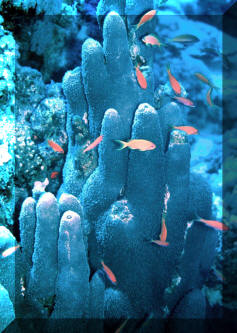
| Alveopora daedalea (Forsskal 1775). Colonies
as thick plates or columns (up to a meter tall). Corallites with
alternating short, long septa. Tentacles appear squared off, six
each tall, short in number. Red Sea image. |
|
| Alveopora gigas Veron 1985. Blunt-ended irregular
corallite structure. Polyps up to 100mm long by 20mm diameter when extended.
Brown to greenish in color. Common in Southeast Australian turbid waters,
rare elsewhere. |
|
| Alveopora japonica Eguchi 1968. Southern Japan over
to China. Small colonies (less than 40mm across), hemispherical to
encrusting. Septa short with short, fine spines which seldom connect (from
Veron 2000). Usually dark green in color with stripe on their knob-like
tentacle tips. |
|
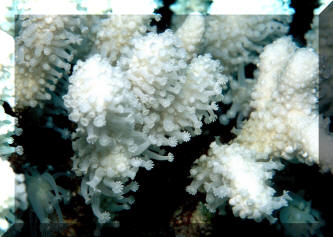
| Alveopora sp. White, branching, at least
arborose colony. Queensland, Australia. |
|
help with Alveopora /RMF
4/18/11
greetings crew of WWM. Kudos for your amazing site and copious help.
I'm hoping this questions isn't redundant as that I have not
found the answer in your archives.
<Me too>
I have a Alveopora (Daisy coral) that had been doing quite well until a
few days ago. I noticed that over the last 72 hours it has failed to
fully open (the colony consists of 2 bulbs, with the rear bulb
appearing less afflicted), and one portion seems to show receding
tissue and dead 'honeycomb' cells. I didn't notice the dead
tissue until later in the day, leading me to believe that it was not
there in the morning, but presented itself around 3pm. By 6pm I have
noticed little to no change.
About the tank: I have a very full 55 gallon with a 30 gallon sump (3
chambers) running a Coralife protein skimmer (which has been off for
the last 48 hours due to foaming in reaction to some putty application
for coral movement).
<Turn this back on>
I have 3 power heads running, all a medium flow, 2 of which are set to
10 second pulses from a wave box. Lighting consists of 6 54 watt
T5HO's, 3 10,000k Daylight and 3 Actinic Blue (48" Nova
Extreme Pro fixture). Also, retrofit with 4 LED moonlights, 2 white and
2 blue.
Conditions: PH 8.1, Alkalinity 3.5mEq/L, Nitrate ~10, Nitrite under
.2,
<... has to be zero. Zero. Trouble here>
Ammonia 0, Calcium 500ppm,
<Too high... and Mg conc.?>
and Salinity 1.025
Alveopora is in the lower front center of the tank, above an open brain
and to the right of pulsing xenia. All other fish and corals appear
healthy and happy, including a Red Goniopora (former in tank for 4
months; latter in tank for 6)
<... and this Poritid may well be mal-affecting it>
I sure hope you can help!
Best,
Eric
<See WWM re NO2, Cnidarian allelopathy. Bob Fenner>
Help With Alveopora/Poritidae Health 4/19/2011
/James
Greetings crew of WWM. Kudos for your amazing site and copious
help.
<Hello Eric, and you're welcome.>
I'm hoping this questions isn't redundant as that I have not
found the answer in your archives.
I have a Alveopora (Daisy coral) that had been doing quite well until a
few days ago. I noticed that over the last 72 hours it has failed to
fully open (the colony consists of 2 bulbs, with the rear bulb
appearing less afflicted), and one portion seems to show receding
tissue and dead 'honeycomb' cells. I didn't notice the dead
tissue until later in the day, leading me to believe that it was not
there in the morning, but presented itself around 3pm. By 6pm I have
noticed little to no change.
About the tank: I have a very full 55 gallon with a 30 gallon sump (3
chambers) running a Coralife protein skimmer (which has been off for
the last 48 hours due to foaming in reaction to some putty application
for coral movement).
I have 3 power heads running, all a medium flow, 2 of which are set to
10 second pulses from a wave box. Lighting consists of 6 54 watt
T5HO's, 3 10,000k Daylight and 3 Actinic Blue (48" Nova
Extreme Pro fixture). Also, retrofit with 4 LED moonlights, 2 white and
2 blue.
Conditions: PH 8.1, Alkalinity 3.5mEq/L, Nitrate ~10, Nitrite under .2,
Ammonia 0, Calcium 500ppm,
<A little high.>
and Salinity 1.025
<How about magnesium, just as important as calcium.>
Alveopora is in the lower front center of the tank, above an open brain
and to the right of pulsing xenia. All other fish and corals appear
healthy and happy, including a Red Goniopora (former in tank for 4
months; latter in tank for 6)
I sure hope you can help!
<Alveopora catalai colonies tend to waste away slowly in captivity,
much like the related Goniopora corals and are not likely to survive in
most home aquariums.
Low water flow and low to medium lighting with a higher nutrient load
seems to work best for these corals. Daily feedings of phytoplankton
are recommended and live phyto such as DT's is preferred over
prepared formulas.>
Best,
<Ditto. James (Salty Dog)>
Eric
|
Coral ID 06/29/09
Hello!
I started marine reef keeping back in December of last year and
your site has helped avert a few disasters and relieve chronic
curiosity! Thanks for your hard work.
I have a hitchhiking coral on my Blue Star Polyp frag I was
hoping to get an ID on. I've posted the photos on a number of
boards already and the best suggestions coming back seem to be
Alveopora sp. but I'm not
convinced. Your opinions would be much appreciated.
<I also think it's Alveopora sp.>
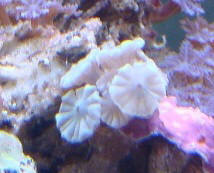
In the attached photo, it is the whitish disk shaped polyps I was
hoping to have identified. When I first got this frag they were
quite small and I thought they were clove polyps that hadn't
opened up. This is of course
not how clove polyps grow and after a month and a half these
disks have grown as large as the biggest clove polyp and more
seem to be coming up underneath them. The polyp stalk is thin and
the entire polyp retracts into the rockwork at night or if
disturbed. The really attractive thing about them, I think, are
the creases on polyp face which divide it up into 12 segments. I
am told these 12 segments are characteristic of Alveopora but I
have not been able to find photos of Alveopora that match my
specimen.
<Check this one out:
http://www.asira.org/alveopora.jpg/
(photo taken by Gene Schwartz)
To me, looks just like yours. What do you think?>
Any info you could provide would be great and let me start
researching the requirements of this little fellow. All the
best,
Mark
<Cheers,
Sara M.>
|
 |
Re: Coral ID 09/29/09
Yeah that is looking right. Apparently the requirements are quite
difficult to meet but I will try my best with it. Thank you very
much for your help!
<Yes, they tend to be... but if this is a hitchhiker, I would
take that as a sign that it's a little hardier than
usual.>
Mark
<Best,
Sara M.> |
|
|

