|
FAQs about Poritid Coral
Feeding/Nutrition
Related Articles: Poritid
Corals,
Related FAQs: Poritids 1, Poritids 2, Poritids 3, Poritid Identification, Poritid Behavior, Poritid Compatibility, Poritid Selection, Poritid Systems, Poritid Health, Poritid Reproduction/Propagation,
Stony/True Coral, Coral System Set-Up, Coral System Lighting, Stony Coral Identification, Stony Coral Selection, Coral Placement, Foods/Feeding/Nutrition, Disease/Health, Propagation, Growing Reef Corals, Stony Coral Behavior,
Got to make sure each polyp is individually fed...
Yikes!
|
|
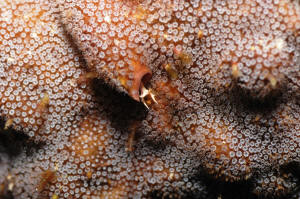
Re: Porites trouble, and fdg.
2/26/11
Thanks Bob for the quick response. My mg is at 1250. A little low but
just enough to keep my parameters where I try to keep them.
<Is fine>
Since I have no fish in the tank I have been feeding my tank a
combination of Brightwell Phytochrome and rotifers twice a week.
<Mmm, not really useful>
Now that I think of it I fed the tank the day before the coral
closed?
<Perhaps...>
Wonder it the food caused the coral closed. Kinda of like a full
belly?
<Kind of like toxic. BobF>
coral help... Goniopora fdg. 04/27/09
Hello,
I am hoping to get some help with coral.
I recently came across WWM, and also found Sara Mavinkurve's
website ASIRA.
On her site, Sara lists the Goniopora, and says recent breakthroughs
make it possible to keep them in captivity. She then goes on to provide
a link to a webpage that defines the feeding methods require. The
problem is that this page is no longer active.
<Oh geez, I'm so sorry... that the link is bunk, but even more
so that such a great site no longer exists.>
I recently lost 2 of Goniopora. They were sold to me with assurances of
how easy they were to care for. I feel terrible about losing them and
am desperate to learn how to care for them.
So, I am wondering if Sara is still a member of WWM, and if so, if she
would be able to provide me the feeding info that was discovered, which
is not listed on her website.
<Indeed, I am! And I will help you as much as I can. What are you
doing currently for target feeding? I suggest you start hatching brine
shrimp asap. Fresh, live, baby brine is a great food for them. In the
mean time you could start with frozen baby brine shrimp from your LFS.
Rotifers, oyster eggs, and other small, meaty foods are also good. But
putting these in the tank is usually not enough. You will have to feed
the corals under a "dome" of some sort or another (creature
keepers work well). Also, I hope you have a DSB and/or refugium and
feed DT's phytoplankton. This will increase your invert
populations... these critters, in term, produce larvae and such that
can also feed the corals.>
Or is there anyone at WWM who knows and could answer this question for
me?
I do want to have them in my aquarium but I am determined not to risk
them without specific knowledge.
<Very wise, much appreciated...>
Please advise.
Thanks.
William Hernandez
<Thank you for writing, I will have to remove that link, provide
more specific information on the site,
Sara M.>
Re: coral help 4/27/09
Thank you, Sara.
Currently I'm not doing anything, as the 2 I had died (very
depressing).
<If it eases your pain at all, they are relatively abundant and fast
growing in the wild...>
I used to do targeted feeding, but only with phytofeest
<Oh no... that wouldn't work. Phytofeast, despite what it says
on the bottle is not really "live" phytoplankton (it might be
live at the time it is bottled and it might have a few live cells, but
not so significant). Thus, it might help somewhat with your invert
populations, though not as much as with DTs (IMO/experience)... but the
coral almost always need more than this. I say "almost
always" because there is this one LFS owner/manager here in Fresno
who has kept Goniopora alive and growing for years. It baffles me that
he does not target feed the corals at all. When asked, he says he
believes it's because he read somewhere that if you "cut open
a Goniopora" all you find is phytoplankton. So he doses DTs with a
heavy hand. I know, this is starting to sound like a commercial for
DT's, but I am a big believer in it and I don't see anything
else this guy does that's so different than other aquarists who
fail with these corals.>
and with the normal tank flow. I see now that the poor things probably
starved. I'd been told by my LFS that normal tanking feeding was
enough (not true).
<It's very rare for aquarists to keep these corals alive without
forget feeding them. Again, the only cases I know of, where people kept
them alive without target feeding, is in systems where live
phytoplankton is added quite generously.>
I won't be getting one immediately, but as soon as I'm ready to
get one I'll let you know how it goes.
<Thanks.>
Thanks for the advise, and the website. It's good to have that
information out there.
Will.
<De nada,
Sara M.>
Goniopora gut contents 1/8/08 Dear Bob, I
came up with your name through Googling Goniopora. I would like to know
how long ingested zooplankton stays in Goniopora's gut after
feeding. <Mmm, depending... on hunger, temperature, the type of
food... a few days... 2,3,4> If you know the answer, could you
please let me know? Thanks, Sofia <Please read here:
http://wetwebmedia.com/poritidfdgfaqs.htm Bob Fenner>
|
Re: Condylactis passiflora, intra species
contention?, and now Goniopora ID, feeding, sys.
7/13/07 Thanks very much for your enlightening response ;-)
Have actually spent literally years reading WetWebMedia FAQs and
articles, was merely struggling a bit with this one, in any case
have re-tackled the Alkalinity/Hardness/Ca issue and think
I'm pretty much across the concepts (if I'm not , then I
suspect I never will be). Have tested my water (PH 8.2, Salinity
1.025, Nitrates >60ppm, no Nitrites or Ammonia, Temp 24C, Ca
340ppm, dKH 12.5), and doesn't seem too bad. Regarding the
possible Condy contention below , should I move one of them out
if I can get the chance ( if they come out of the holes they have
burrowed into to)? <Yes, I would> Confession Time: The
background here is that a not so "funny thing happened the
other day", Bear in mind , I haven't devoted a lot of
time to the hobby over the last year, and my memory isn't so
good, as a result I have made a rather disastrous mistake: I was
in the LFS to buy a Sarcophyton I have had my eye on for a few
weeks, and while I was there they had a beautiful large Goniopora
(WAIT!, WAIT! please, stay with me.....just a bit longer) and
they only wanted $55 AUD for it . I said to the
"Expert" in charge of their marine section
"Isn't that the one that has the really dismal survival
rate in captivity?", ." Oh no, says Expert, these are
quite easy and this one has been doing really well " .
<Mmm, not so... this Genus IS the most used historically...
but also has the survival value adverb you suggest> I wander
the shop some more with my two year old son distracting me
heavily thinking "....or is that the other one beginning
with" Go", gogi.., gopi..something...?, and suddenly
remember "That's it! Gorgonian!, the Sea fan, it must be
that one that I was thinking of that I decided never to own.
<Mmm, well, some of those/these hexacorals are not
aquarium-hardy at all either...> Bought said victim, took home
looked at notes/bookmarks again , placed head in hands and came
to realisation that am probably developing Alzheimer's. <I
can't seem to remember...> After sobbing a bit decided to
do right thing and return it for a credit note, but ....LFS
won't take it back, and don't have any friends that do
Marine. I feel like such an idiot! I only didn't mention this
before because it's so embarrassing, Now I am stuck with it,
and desperately don't want to be responsible for killing it,
it is a beautifully healthy specimen. Have spent a full week of
hours per day researching ways to keep it alive (hampered by the
fact that I can't decide if it is a stokesi, columna or
lobata (Even though I majored in Animal Ecology at Uni 17 years
ago ... <See my cursory review of "The World Trade in
Coral" posted on WWM... species, even higher tax. ID's
of Scleractinia are not easy> like I said, my brain appears to
have fallen out). It is Hemispherical Colony on a single coned
shaped column (looks like they skeleton has basically grown out
and up in a circular fashion), Polyps are long and brown with
green tipped tentacles (attached pictures, - the leather is has
now been moved away from the Goni and I will keep a close eye on
the Condy's although they don't seem inclined to move
again, clown hasn't approached it) What do you think it might
be? <Am looking... Columns too long for the first... tentacles
not shaped like the second... I make this out to be the most
common aquarium species, G. stokesi> Now if you are still
reading , here's my questions : I have a bag of Seachem
Oolitic Aragonite , that I bought for several reasons , one
because my Nitrates keep creeping too fast (about 20-40ppm per
week in 100 litre tank) <The high/er NO3 is actually of use,
advised for this genus...> to be explained by my tiny stock
(two small/medium fish) and stingy feeding rates and frequent
(weekly) water changes, that I suspect that the 3 year old
crushed shell substrate may be harbouring to much bound organic
matter (even though I vacuum it vigorously) so I want to replace
it. <I would NOT do this... but possibly add to...> Two
because I was originally thinking to use it to help stabilise
Alkalinity and add Ca , and Three because I am hoping/Praying I
can foster some microfauna to help feed the Goni (do these 3
arguments sound plausible?). <Is, though a much larger system,
and really a separate, tied-in refugium with DSB, lighting... is
STRONGLY advised> Given that the water parameters above
don't seem too bad for Ca and KH considering that I have
never measured or attempted to alter either in 3 years , should I
leave the Aragonite out in case it messes with the balance? (no..
I can't fit a refugium to this tank (wife/children etc) ).
<I would leave in for the very organic component you
mention...> In terms of Feeding it , I am attempting a mix of
Hikari rotifer, baby shrimp and algae glass scraping, and
recently purchased some frozen blocks of Spirulina, octopus,
mussel, and shrimp mush to try as well (having trouble getting
Cyclop-eeze, do you think the freeze dried would be ok or should
I only go for the frozen if I can get it?). <All are suitable
if small enough to fit into individual polyps... I would develop
a routine of "covering" the colony temporarily,
immersing the polyps with food... while having mechanical
filtration suspended during these minutes... to assure each are
fed...> If I can impose on your patience just a little
longer... some Goni questions that I have read conflicting
arguments on : 1. Do they tolerate nitrate well or not, have read
conflicting assertions, I am guessing my typical reading of
around 40ppm may still be a bit high for it? <This genus lives
in quite "polluted" waters... including VERY high NO3
concentration> 2. Are baby shrimp small enough/suitable for
it? (these look about the same size as a rotifer), should I try
and culture some green water (phytoplankton) maybe? <Mmm,
don't eat phytoplankton to any appreciable degree... meaty
food items need to be "mouth size"... or smaller> 3.
Is it abnormal for it to close into a swollen ball for about 4
hours after the lights go out, it only seems to look really happy
during the day ( have read they should be out day and night), it
is only under 2 x 18W at the moment and seems quite happy and I
am about to add 75W 6500K for it, do you think it might actually
not like the brighter light ( it WAS under Halides in the shop)
<Not atypical behavior in both cases> 4. The LFS was
feeding it JBL Koralle Fluid and claims it loves it, all the
stock I can find on Melbourne shelves is out of date by a least 6
months!, most of the Red sea and Seachem alternatives I can find
here all list about 0.0003mg/g of copper in them, <Not to
worry re this preservative trace> (except for Red Sea Coral
Trace that I can't get any specs on at all and Marine trace
that just says the elements but no concentrations) and I am
worried this may accumulate and hurt my feather dusters and
corals, even though it isn't much, do you think Seachem Reef
Trace(0.0003mg/g Cu) or Reef Plus(0.001Mg.g Cu) might be a good
product for my Goni even with the copper? <Yes... no worries.
Some small amount of copper is actually necessary... a
"micro-nutrient"> I have to keep this guy alive in
this tank for around 10 months somehow until I can get my new 5
foot reef system up and running (house being built at the moment)
with refugium, Thalassia etc. <I'd move it last...> I
will keep researching , but would appreciate any pearls of wisdom
you could impart (besides " Research before you buy"
and."... keep reading" already know those ones ;-) )
Cheers,
Rama
<Heeee! BobF>
|
|
|
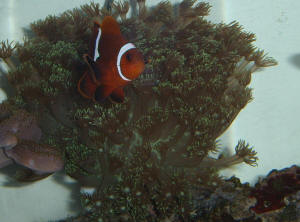
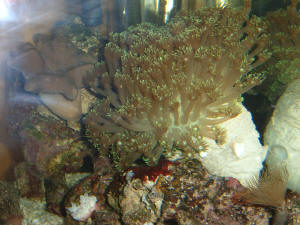
Living Overseas And Searching For Good
'Non-Refrigerated' Coral Foods -- 06/28/07 I have somewhat
run into a problem with feeding the coral. <<Oh? What
genera/species?>> I am currently living in S. Korea, and quality
items are few and far between. <<I see>> This being my
first SW set-up outside the US, I've had to order equipment from
the States. <<Lucky we have the Internet these days,
eh?'¦wish it had been around during 'my' overseas
tours>> I have been reading on your site continuously with no
avail. <<Okay>> My question for you: Is there any dry coral
food that is actually good? <<There is'¦and I will
elaborate shortly>> All the reviews from everyone make dry
invert/coral food a bad idea. <<Opinions differ>> Since I
cannot get shipped "live" items, makes this even more
difficult. So my choices are finding a quality dry food,
un-refrigerated liquid (which from what I read is a bottle of crap),
<<For the most part, yes, I agree>> or trying to find
something on the Korean market (fingers crossed). Currently all I have
now is a few small feather dusters on the LR, and a medium size piece
of Alveopora (Branch) Coral (along with two small clowns). What
suggestions for food do you have, and what path should I take?
<<Well John, there are a few manufactured products I think can be
useful/will fit your criteria and I will go over these in a moment. But
what you need here is an in-line plankton-generating refugium. This
would be your best and most economic source of 'coral
food''¦along with the other benefits such a system
provides (lots of info re to be found here and among the links in blue:
http://www.wetwebmedia.com/refugium.htm). There are several refugium
methodologies you could employ, but I think a reverse-daylight
vegetable refugium with DSB would work just dandy here. As for
dry/non-refrigerated packaged products'¦ I like and use Polyp
Lab Reef-Roids. This is a 'fine dry powder' product that seems
to illicit good feeding responses in my SPS dominated reef system. You
can find this product here
(http://www.aquariumspecialty.com/catalog/product_info.php?products_id=783&osCsid=b5a1cb93cf978ad7d489575f88b0d8f1)'¦the
owner of the site (Scott) is a friend of mine, you can tell him I
referred you if you like. For corals AND fishes requiring larger food
items, the saltwater variety of Sweetwater Zooplankton is a good
choice. This is a very good vacuum-packed 'wet' product that
does not require refrigeration until opened. A third item that will
benefit both fishes and corals is freeze-dried Cyclop-Eeze. The use of
these products in unison should give you pretty good
'coverage''¦especially if you employ the refugium as
well. And if you should ever find yourself with animals that
need/require Phytoplankton, the ESV spray-dried product would suit your
circumstance>> Thanks! John <<Ah, one last
thought'¦I have found that placing a few 'shrimp
pellets' in some tank water and waiting a few minutes to let them
crumble/dissolve also provides some nourishment/may fill another niche
in the reef food chain. Good luck with your search. Eric
Russell>>
| Flower pot coral Dear Crew, <cheers, my
friend> I have a 80 gallon traditional with 90 lbs of Fiji
LR., 1 inch crushed coral <please be careful with coarse
gravel at this depth... can be dangerous in time if neglected.
Finer sand would be better and deeper here (over 3" if you
want denitrification), or any sand at 1/2 or less would be safer.
At 1" coarse, you should siphon or stir a couple times
monthly. Be faithful and employ very strong water flow in the tank
too> Lighting is P.C. at 4 watts per gallon(12
Hrs). Filtration is a Fluval 304 and
bio-wheel (300 gph). (2) power heads Water
temp fluctuates between 79-80 degrees. nitrite/nitrates
0.0 ph 8.4 salinity
1.022-23. Current occupants (1) large yellow tang, (1)
Coral beauty (1) red lipped Blenny. Various cleaner and
peppermint shrimp, coral banded, etc 40-50 hermits (blue and red)
25 Astrea snails... Phew, sorry to bore you with that but I was
afraid leaving anything out would provide to many variables for you
to accurately answer my question. <Very good and all fine...>
My flower pot (Goniopora lobata ) ( the green one not the purple)
is mid level with medium to light flow. <this
species (G. stokesii) is a free-living coral and really must be
kept on a fine sand bottom. Most will die if kept on rock> It
has been in my tank for 6 months. It has recently only
"deployed" the tentacles on the upper half of the
"dome" never fully deploying as it used to.
<alas... yours is right on time for a starving
Goniopora...typical> I am feeding Phytoplex 3 times a week (1
Tablespoon). Do you know what it could be? <the polyp
cycles on/near hard rock haven't helped... but your animal is
simply starving. Most studies say that bottled phyto is not even
remotely small enough for phyto feeders such as this Gonio. And
that is assuming that you whisk every portion fed in an electric
blender before feeding to reduce particle size. Product also needs
to be less than 6 months old (with a born on date... not a bogus
expiration date). The bottled phyto also needs to be bought and
kept refrigerated the entire time. Most people fail o the electric
blender part. Phyto straight from a bottle without this protocol is
about as useless as a rotting hamburger in the tank. Both will grow
copepods and neither will keep your Gonio alive. My best advice is
to get this coral into a macro dense fie sand refugium. They can
fare very well here. I had a colony of almost a dozen of these
Gonios in such a display for about 5 years and they produced buds
for many years on a monthly basis. I used seagrasses for natural
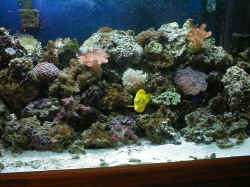
plankton and epiphytic material> I'll send a 61 kb photo so
you don't have to use your imagination :) I love
your site! Thank you. Steve <best regards, Anthony
Calfo> |
|
|
Flower Pot Coral II Dear Crew, As you remember, I wrote
concerning my G. Stokesii (thanks for the correction). I wrote Kent and
awaited a response. The response is in and I value your opinion as much
and possibly more (your helping the amateurs, he is selling a product).
Please do not take offense to my quotation of expert as I am unfamiliar
with your staffs qualifications. <No problem. If you are interested,
there is a page on the crew, who we are, what we look like, what we do,
etc. http://www.wetwebmedia.com/WWMAdminSubWebIndex/wwmcrew.htm>
I simply didn't want some smug response from them saying "who
this guy, we are the pro's" <No, I am the Pro, Steven Pro
to be exact. :)> You seem to overqualified to say the least and I am
interested in your response. By the way, they asked If I am skimming. I
said yes 4 hours per day venturi style. Effective today I have 3 inches
of aragonite live sand and the stokesii are on the bottom. Thanks
Steve- HERE IS THE OFFICIAL RESPONSE FROM KENT Hello, Thanks very much
for your inquiry; I'll do my best to try and clear up some
confusion. Goniopora, in general, has a poor track record for survival
in captivity, and the reasons for this aren't very clear to even
the most experienced hobbyists and professionals in the industry. There
are many factors, however, that are often observed and/or theorized to
have an influence on the survival rate. Certainly, water temperature,
nitrogenous waste concentrations, light characteristics, water flow,
dissolved oxygen concentration, nutrient input, and presence of toxins
excreted by nearby corals and other cnidarians play roles in the
relative survival rate of Goniopora. I will, at this point, say that I
am not aware that any specific studies have been performed on
"bottled phytoplankton" and the size of the species included
as they pertain to the feeding habits of Goniopora. Our product,
Phytoplex, contains three species of phytoplankton in a size range of
2-15 microns, and our ChromaPlex contains two species with a size range
of 5-25 microns. The recognized lower limit on size of phytoplankton as
noted by Marine Biologists and Oceanographers is 2 microns; therefore I
find it difficult to believe that Goniopora, which feed not only on
phytoplankton (all 2 microns and larger), but also on zooplankton (also
2 microns and larger) are not able to feed on organisms present in our
products. In other words, the insinuation or claim that the
phytoplankton in Phytoplex are too large for Goniopora doesn't hold
water. Corals and other organisms that feed on the smallest classes of
plankton, femto- and picoplankton, at 0.02-0.2 microns and 0.2-2.0
microns, respectively, often use a visible mucous to aid in the capture
of such small particles; Goniopora do not display that characteristic.
Note that the femtoplankton class is composed wholly of virioplankton
(virus'), and picoplankton is composed of bacterioplankton. Again,
I believe that an individual would be hard-pressed to locate a study
performed on Goniopora citing their feeding schemes, but perhaps
I'm just not reading enough these days. Now, allow me to say that
if the coral isn't getting the amount of nutrients it needs (i.e.
the coral is simply not capturing enough of the plankton to meet its
nutritional requirements) in order to survive and thrive, that's
another matter, more easily solved. You didn't mention that you
have a protein skimmer on this aquarium, did you omit that information
or is the tank skimmer-less? Kindest regards, Cris Brightwell Marine
Scientist Kent Marine, Inc. www.kentmarine.com <While I know of no
studies involving Phytoplankton and Goniopora, Dr. Rob Toonen did
perform a study on bottled Phytoplankton products. You should be able
to easily find this on the net. The basics are what Anthony gave you in
the last email. To be useful, it must be fresh, refrigerated, and
whisked to ensure proper particle size. While their live Phytoplankton
is probably of the sizes he quoted, Dr. Toonen's study showed that
all of these products have a tendency to clump, making them worthless.
They must be used up in less than six months, refrigerated the entire
time (wholesale, retail, and your home), and need to be blended for a
few minutes to minimize clumping. Do read the article for yourself,
though. -Steven Pro>
The Scoop on Poop- corals feeding directly on nitrogenous
matter I was recently researching things over on RC and found this:
http://www.reefcentral.com/vbulletin/archive/84/2002/11/1/99557
for the abstract: An aquarist has found that Goniopora greedily devour
tang fecal matter as well as goo left on an algae clip from a piece of
Nori. he's going to experiment with target feeding it waste from
his skimmer (disgusting, but given what he's observed so far...),
just a drop or two. Given how notoriously difficult these corals are to
keep, I thought someone out there might be able to use this info. PF
<Michael, thank you my friend... once again you have demonstrated
that you really know your Sh*t. Best regards, Anthony>
Goniopora coral Anthony, Thank you so much for responding. I
can't believe you respond to so many people! I hope it all comes
back to you. <its a labor of love, my friend> What is your book
called, and where can I buy it? <My last book is called "Book
of Coral Propagation" (can get direct from readingtrees.com,
Amazon.com or here on wetwebmedia.com by following link on the home
page for our new book "Reef Invertebrates" (BOCP1
box is on the same order form)> I'm going to do everything
possible to save and keep my Goniopora. <that is awesome to hear! It
truly is a beautiful coral. Do consider keeping it in a colony in a
Seagrass refugium or dedicated display. That will work best IMO> I
am >monitoring my water quality constantly, and it all seems
perfect. My concern now if feeding it. Can you please just inform me
what I should get, and how to make sure it is being fed. <as
mentioned in the last message, there is little or not organismal
feeding. No catch up to be played with this coral. They need deep sand
beds and refugiums that are old and mature> Also all the supplements
that will help him? <none are known to work although the bottled
phyto folks would like you to believe otherwise. If anything, try the
bottled phyto or better yet, start your own live phyto reactor and 24/7
drip> If you lived near Boston I would have taken the Goniopora to
you to save it.:-) <dude... I was just in Boston 3 weeks ago giving
a lecture for the Boston Reefers Club meeting at a U. Mass hall. Do
seek support/advice from local reefers in the club. Attend their
meetings too... a great club with some sweet tanks :)! See their forum
here:
http://www.reefcentral.com/forums/forumdisplay.php?s=869e765f2b7a6c35acbc35c11092eb1c&forumid=116 >
Thanks! Martin PS: I can offer you website development if you ever need
a favor back. <thanks kindly. Be chatting soon. Anthony>
|
|

