|
|
| Home | Marine Aquariums |
Freshwater Aquariums |
Planted Aquariums |
Brackish Systems |
Ponds,
lakes & fountains |
Turtles & Amphibians |
Aquatic Business |
Aquatic Science |
Ask the WWM Crew a Question |
| Please visit our Sponsors | ||||
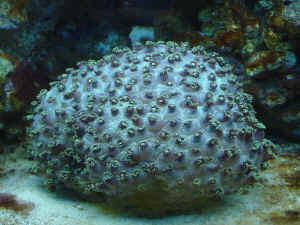
Goniopora coral 1/6/04 Dear Crew, I was lead to believe that a Goniopora coral was easy to care for. I have since learned that is not, but I cannot find any information on how to care for it. <Sadly, this is all too common. Dealers either don't know any better or don't care. There is no reliable info on Goniopora care because even among those that are successful and report their tank conditions, no one consistent "magic bullet" can be identified.> Any suggestions would be appreciated. There was some initial die off but for the last 2 weeks there hasn't been any. I have a 29gal mini reef with Mushroom corals, tongue coral, xenia and the Goniopora. I have 15 blue legged hermit crabs, 2 peppermint shrimp (for Aiptasia control), 1 emerald crab, 1 brittle star, 1 scooter blenny, a feather duster and 20lbs of live rock. <In such a small tank, you will have to be careful that all corals (particularly the Goni) have enough room to expand without physically touching each other. As the mushrooms grow, they may be a problem in terms of chemical competition with the Goni. Please do keep an eye on your crabs.. Hermits for killing snails and each other for shells, and the emerald for eating corals (esp. xenia.)> I have a 3 inch sand base and run an Amiracle skimmer and an AquaClear 200. It has 24inch Coralife compact light with 2-65wt bulbs, 1 actinic and 1 regular with 2 fans. The PH is 8.3, the salinity is 1.025, NO2 is 0ppm, NO3 is 15ppm, NH3/4 is 0ppm, Ca is 350ppm (I am adjusting this to reach 450ppm). I use Seachem Reef Builder, Reef Advantage Plus and Reef Plus for supplements. I do a 30% water change once a month using distilled water as a base. <If you have found out that Goniopora is difficult, you probably also have heard that deep sand beds and light skimming are beneficial, so your system sounds ideal. Just make sure you have seeded your sand bed with plenty of living critters (pods, worms, etc.). You did not report an alkalinity measurement. IMO, after the cycle, Alk is the most important parameter to test regularly.> This is my first attempt at a mini reef so any suggestions are welcomed. I would like to obtain seahorses from Ocean Rider in the future. I would also like to add other corals, any suggestions? <In terms of other corals, just be careful to leave enough space for expansion and growth. Some softies can double in size in just a few months. As for sea horses... They really need their own tank. Reef tanks are inappropriate in so many ways. Sea horses need very gentle current, cannot get enough food in the presence of most fish, will be stung or even eaten by many corals, and prefer deeper, taller tanks. If you do pursue seahorses, please do read up here and visit www.seahorses.org .> Thank you, Caryn Heffner <Always glad to! Adam> Algae Woes? III + a Goniopora Question >Hi Marina, >>Hello again. >Thanks for your reply. If you love Seafood Hong Kong is the place. >>So I hear. My youngest sister lived on one of the nearby islands for several years, unfortunately seafood is NOT her thing. >We have several markets that display fish/Shellfish/crabs/sea cucumbers whatever... that you then pick (sentence to death) and they cook them for you. Well at least you will enjoy teasing your palate.. >>And here I am hungry. >Any way I had asked "the coral guru" at WWM about the compatibility between different mushroom genera and I would appreciate very much if you could at your convenience get someone respond to that. >>I'll take a look around, I'm going to assume you mean Anthony. >Last evening I picked up a type of Goniopora coral. Bright Lemon in colour, very eye-catching to the point of looking dubious, do you by any chance happen to know if it is possible to dye a coral? (could it possibly be done with say organic material like turmeric?) and if indeed there is a bright lemon coloured Goniopora? >>I know for a fact that many anemones are dyed, though with what substance I couldn't tell you. Based on that, I don't see why a coral couldn't be dyed as well. I, personally, have never seen any color other than green in Goniopora, but I am not the coral expert. However, in perusing my book, "Corals: A Quick Reference Guide", by Julian Sprung, I see pictured (on pages 36-37) brown Goniopora, A branched Goniopora from Indonesia that is a lovely dark purple with whitish centers, a red species from Bali, and from the Solomon Islands a light, lemony yellow Goniopora. It is on the pale side, but distinctly yellow. >In Hong Kong they dye some freshwater fish (it has no effect on the fish) namely the Indian Glass fish with fluorescent colors, the colours then fade away within a few weeks. >>FYI, those fish are not dyed in the classic sense, they are injected with dye. >A few years ago I recall a guy that told me that they do this in Hong Kong. >>Yes. >Still waiting for the Damn Bubbles to stop. Will get some abalone after they are done with my algae, maybe I will eat them myself...just kidding ;). >>I've never had abalone myself, but I'm certainly willing to give it a try! Marina >Regards, Jorell
Porites / Xmas worms Good evening crew, <Whassup?> I have just bought a Porites head encrusted with Xmas tree worms. <hmmm... these are categorically some of the most demanding corals to keep alive. They need extremely high current and nearly as high light. If your tank has any/many soft corals or LPS in it, somebody is going to suffer in the long run. For advanced aquarists and stony SPS tanks most only> I have a few questions: Will this rock need "curing"? <Not sure I follow? You bought this as/with live rock? Is the tissue healthy, brown or green with tiny polyps extended? If so, it is simply live coral. No curing here> If it does, will it kill the Porites? <if you cure this coral with fouling live rock, yes possibly> My quarantine only has fluor lights (I have halides on my main tank), will this low light for a few weeks kill the Porites as well? <yes... no worries. And acclimate the Porites after the 4 week QT period slowly as you would if it skipped QT> I have searched your pages for feeding references for Xmas tree worms (Serpulid fanworms) but can't find much, do you have any references for me. Yep... AKA Koko Worm Rock: http://www.wetwebmedia.com/featherfaqs.htm and http://www.wetwebmedia.com/poritidfaqs.htm > Is there a symbiotic relationship between worms and Porites? <current thinking is no... simply commensal> Many thanks, Michael Peters <best regards, Anthony> Goniopora and Carpet Anemones Hello Bob and Crew! <cheers, mate> I purchased a flower pot at my LFS with polyps retracted. <Doh!!!> The sales clerk assured me it would open fine. <Steeeeeee......rike, one!> By the 5th day of half polyp extension in my tank, I grew weary. Upon closer inspection, using a magnifying glass I noticed between the polyps on the hexagonal walls very slight browning or tissue decay. <very common... the way of most Goniopora soon after import> Without hesitation I removed the GONI into the QT where currently a small school of green Chromis sit in wait. Didn't want even a slight chance of spreading bacteria. <hmmm... a good move for the tank, but a bad move for the GONI... I suspect that you know already that the GONI should have gone through your QT first. For the benefit of others reading the post, the dilemma here is that a now clearly stressed and infected coral must now accept the burden of adapting to at least the fourth water quality in two weeks (wholesaler to pet store to display to QT). The change in lighting alone is extremely stressful and 4 such changes in a healthy coral can sometimes be fatal. Still... I do agree with the extraction to prevent the spread of infection> I proceeded to read your FAQs on flower pots. Basically don't buy flower pots! <true for most my friend... although for anyone interested in keeping these beautiful corals in a species tank, please browse I recent post that I proffered to an Australian message board on Gonios: http://ozreef.org/rtaw/ubb/ultimatebb.php?ubb=get_topic;f=1;t=003878 > But what should I do with this specimen? <leave it in place for at least 4 weeks if it survives... spike the tank with small daily doses of Iodine (variations on Iodine dips can be found in Eric Bs Aquarium Corals book and my Book of Coral Propagation). Also, small frequent water changes and the safe use of ozone can be very helpful> Its not doing that bad because to be honest I couldn't really see the decay without the magnifying glass. <gently siphon that decay out if possible... it is highly infectious> There is no light on the QT and I have an Asfur Angel arriving tomorrow that will be placed in the QT also. Can they both be in QT? <the Asfur may pick on the coral... but the coral will not bother the Asfur Angel> Maybe the Asfur will find the Flower Pot quite the "welcome to your new home" feast. <sure..., "Welcome to your new home...here, have a rotting coral to much on!" :) > I will be removing the Chromis' to the main tank today. Moreover, what interested me while reading the FAQs was your warning against having carpet anemones specifically "blue." I have had my blue carpet which is from Tonga for approximately 10 months now. <glad to hear it but you need to understand that some such animals take more than a year to starve to death when the net daily deficit in "food" translocation of carbon from photosynthesis or from organismal feeding) is only a few percent. 10 months is really not much of a feat yet. Still... with weekly if not daily feedings and very bright reef light you can indeed have this anemone for many years. They live for decades in the wild and are suspected of lacking a defined senescence (old age). Read more about coral/anemone feeding/starving here: http://www.wetwebmedia.com/fdreefinverts.htm and here: http://www.wetwebmedia.com/growingcorals.htm> Its perfect and I noticed its sting to be a little more "painful" then its green counterpart, which both are shared among 3 Maldives clowns. I don't think the blue carpet was the reason for the flower pot demise.... <heehee...hahahha...hehehhehe.....ahhh, well... if you say so :)> but maybe....The blue carpet likes to wonder around but I have it trapped between live rock walls so it basically crawls up and down and side to side moving a lot but getting nowhere. Are there any future consequences to my SPS's and other inverts outside of direct contact? <yes... and literature abounds on this subject. Mist chemical warfare among cnidarians occurs without touching (shed nematocysts and the like). Even a 50% water change every day still leaves 50% of the concentrated noxious elements behind and no one can say that carbon or skimming pull out enough. This is why unnatural mixed of SPS, anemones, soft corals, etc are not recommended. Better to keep like animals together for their increased familiarity and tolerance> What can I do to avoid these problems sans removing the carpet completely. <remove the other corals/cnidarians and leave the carpet...heehee> I don't think the Clowns would like that too much. One last thing...do I need to freshwater dip the Chromis again before placing in main tank? <if they have been through a full QT (4 weeks) no need> I had some deaths when I first got them but these last 10 have survived almost 2 weeks without any apparent signs of disease. <it would be better to go for the full 4 weeks especially because of those deaths... no guarantee that they aren't still carrying and something pathogenic won't flare up for the stress of the move> Thanks Again! Dennis <best of luck, Anthony> A Matter of Depth & Porites How much of the sand should I put in the 30g and how much in the 5.5g? <I would recommend 4" in each.> Time for a bag of Southdown, then. When I switch over to the 30g, do I put the Southdown on the bottom and existing LS on top, or sandwich the Southdown between layers of LS? <<Place the new, dead sand on the bottom with the old, live sand on top.> <Porites are very high light corals and don't always encrust.> That's what I thought. Some of the info I found was a bit misleading. <<Both Borneman's and Anthony's books are excellent references.>> <There are many soft corals that would encrust, but many can become weeds; your Green Star Polyps, encrusting Briareum, Erythropodium, etc.> I think I might try the encrusting gorgonians. How would I get them to encrust onto a bare coral skeleton? Just put the skeleton next to or under whatever the colony is already encrusting on? <<Or even remove the colony from whatever they are on and wrap them around what you wish to encrust and cover over stitching with clean fishing line to hold in place.>> <I would go with the 2-96 watt PC daylight lamps with 2-30 watt NO actinics.> The 2x 30w NO fixture I have is too wide to put another double-bulb fixture on the top of the tank at the same time. I'm going to have to wait until I get the new hood built before I can do the transfer, I think. <<Or you could DIY with end caps so you can squeeze a lot of lamps inside your hood.>> Thanks, Ananda <You are welcome. Have a nice weekend. -Steven Pro> Alveopora Worm? Hi Bob, <Anthony Calfo in your service> I have an Alveopora that I bought about 15 months ago. For a year it was doing fantastic. Then suddenly it started to fade. <commonly from excessive light and more often from inadequate dissolved organics (source of nitrogen)> I was trying to determine why. I read a very odd thing on a different site where someone noticed that there was a worm that would live on the same rock as the Alveopora. Several people commented that they saw the same thing. I am sure I saw one as well. Well, about 3 months ago, I moved, and I believe that during the move this worm died, as I haven't seen it in a long time. Now, the Alveopora is fading. <if it is "fading" in the sense that its color is paling the worm absolutely had nothing to do with it. Impossible. Changes in pigmentation are caused by many things... but never a worm. Temperature and salinity stress easily, but again... usually excessive light (NEVER direct MH or PC light for Alveopora) or lack of nutrients in a well skimmed tank> I also read that if people kept several of them in a clump, they tended to do better, <yes... seems to be some truth to this> I would assume that has something to do with the worms that live or die sharing responsibilities across the rocks, or something like that. <the dynamic is not yet clear> I just wanted to get your thoughts on the theory, and see if there is anything that can be done for a receding Alveopora. <if your nitrates have been near zero for the last few months, your coral is simply starving. This animal is not strongly photosynthetic but cannot feed organismally (particles of food). It simply needs dissolved nutrients. See Knop's recommendation for making a nitrate solution to feed clams and invertebrates in his Giant Clam book. > Thanks, Steve <best regards, Anthony> Help! Has my Goniopora sp contaminated my tank Hello Bob <Anthony Calfo here sending cheers from across the pond!> I have kept a 5ft FOWLR tank (approx 65 gals actual water content, loads of LR) for the past 16 months . I then decided to set up another 5 ft (approx 80 gals, less LR but still a good amount for now) tank for inverts and a few small fish, 5 in all. The params that I check are Ammonia 0, Nitrite 0, Nitrate under 20 pH 8.4 or just above. <yes... all very well> I intend to check calcium and phosphate when I get the kits but I do treat the tank with calcium, iodine, strontium and invert food all according to bottle instructions. <hmmm... you add calcium but what about buffer? Calcifying organisms need a supply of Calcium and Carbonate (ALK/buffer) to form aragonite/calcium carbonate skeletons> Here comes the familiar bit (I've been reading your web site ). I bought a Goniopora sp , a green one and did everything wrong I now think. i.e. I moved it about to find a spot it liked and then after I sorted that and it started opening about 3 inches in length (It looked lovely) I decided maybe it might like more light so I added two reflectors one on the HO fluorescent nearest to it and one on the actinic blue. The other HO which makes up my lighting I left alone. The next day, the flower pot started emitting this strange brown grungy stuff that floated and swirled around it , I brushed it gently away but it came back with a vengeance through the night. <AKA brown jelly... a common necrotic condition with Goniopora among other scleractinian> My LFS said it was either expelling its mucus which they apparently do or it was dying. <Goniopora do not expel visible mucus... the animal was clearly dying> I gave it a fresh water dip as they suggested and put it back in its place in the tank. <no qualms here... it is a virulent condition that must be addressed swiftly. Iodine baths too may help in the future> I noticed that it looked like all the little flower tentacle places were empty like a white honeycomb , only a small part of the top was still green. This happened in two day's would you believe! <I have seen it many times... a highly infectious condition. Even the basting or blasting away of tissue in the tank is dangerous... if/when the infected tissue drifts and settles on another coral it can spread the infection. Tends to run its course fast though. Sick corals and fish should always be quarantined in a proper hospital tank for 4 weeks to prevent this very thing. You may very well learn a very hard lesson here, I'm afraid. Adding fish to any display without QT is a game of Russian roulette with living creatures. Please take heed and make your next investment in a simple QT tank instead. Do browse the FAQs here for plentiful tips on hardware and husbandry (crash course: bare glass bottom, conditioned sponge filter running and waiting in main display, plastic pipe or other sterlizable ornament, glass cover yes... but light dim perhaps, etc> I then saw that the rest of the tank was looking sickly to. My Leather Coral which had looked lovely is now unrecognizable and has whitish brown 'bad' places appearing on it <carve these necrotic areas out ASAP with a razor or scissors if there is to be any hope of salvaging pieces or the parent. Tank needs strong water flow, small frequent doses of iodine, aggressive skimming and extra water changes> and my mushroom corals and mushroom anemones also look sad. <not much to do with corallimorphs... must run its course short of above improved husbandry> Also my carpet anemone is screwed up most of the time but it still ate it's frozen (thawed out) fish two days ago. I have had this anemone for approx 6 weeks ,I now know you will say it is dyed because it is blue but one of my fish books say's you can sometimes get blue so I'm hoping this is it's real colour. <I agree that some natural blues occur... but my bigger concern is that it has absolutely no place in a reef tank. The size of this animal as it grows and more importantly the severity of its "invisible" warfare (allelopathy) on corals cannot be understated. This animal will likely plague you until it gets put into an appropriate species tank alone. Else, I fear you will go the way of hundreds of aquarists I have seen through the years... the tank may appear to fare well for 1 or even 2 years with it in residence... before the tank reaches a critical mass (concentrated noxious compounds or any one of a number of other complications). The tank will "crash" again> I'm afraid as the Goniopora was again smothered in this gunk I disposed of it like the LFS advised. <QT tank next time to try so save these living and precious resources... spare the animal and the display with good husbandry> Is my entire tank doomed, <not at all for the Goniopora reason... the infection will run its course within 2 weeks... likely sooner> what can I do to save the rest of the inhabitants which consist of 2 clowns,1 gramma,1 firefly and 1 red hawk fish, I also have 6 red legs,3 sally Lightfoots 1 cleaner shrimp and 6 turbo snails in this tank. I Know how fond you are of skimmers and I have them on both tanks, but don't ask what type is on the invert tank! <any type that produces a full cup of dark skimmate daily is a fine skimmer to me. Especially with the anemone you are keeping... critical> I hope it's o.k. to mail you from England but we don't have anything like your webpage here. <it is a great pleasure to hear from friends like you from all over the world!> I have discovered how little I know from you. Any help you could offer will be greatly appreciated. <no worries, my friend... we all learn in time. You will only be faulted for ignoring or not learning from your experience/mistakes> Many thanks for your help in advance. Jenny p.s. I'm mailing from work, I don't have my own e-mail set up yet and I had problems using netscapes e-mail facility, hope this is o.k. with you. <our pleasure... best regards in your endeavors. Please do continue to help yourself by researching animals before you buy them with an intelligent consensus from several sources... not just one/LFS. Kindly, Anthony Calfo> Jenny Nunley Re: Help! Has my Goniopora sp contaminated my tank Hello again ! Thank you so much for your prompt reply to my e-mail below. I wasn't in work yesterday and so have only just got your reply. I will be a lot more careful what I buy in future, I feel so guilty now! <alas...we all make these mistakes... no worries. Just resolve not to repeat them as such <smile>> The Leather coral seems to have made quite a dramatic recovery, it has perked right up and has all it's (polyps?) extended. Should I still cut out the 'bad' bits or see what happens? i.e. it seems to have formed a scab on one of the places and that is almost coming off , Do they heal by themselves sometimes? <good symptoms indeed (especially the polyp extension), but once a coral has a necrotic infection, it usually does some damage. Do explore without touching the coral: take a turkey baster and blast water at the wounds to see if soft tissue is still dying. If so, then do cut out the bad parts. Else, baste with blasts of water daily for several days to help the healing process. Some people even take a soft toothbrush and gently scrub into good tissue to remove decay> All your comments were much appreciated and I will act on them ASAP. I have a 2ft tank in the garage, is that big enough for the carpet Anemone? <probably for a while... and do give nice bright reef quality light. And just as importantly, do feed it several times weekly. Feeding is critical with these large aggressive anemones. Their adult size is several feet across in the wild but they live many decades (this may be an understatement... some have postulated that they have no defined lifespan and than many large species in the wild are over 100 years old... this is part of the reason why so many folks discourage the taking of this animal from reefs for casual aquarium captivity as opposed to fewer numbers for study. Long life and slow recovery from collection in the wild).> Can he still have his 2 clown fish for company, they seem to love him to bits! <that sounds very fine... it will make a lovely species-specific display. Its great to see your willingness and empathy to provide well for this animal. It sounds like you might need and enjoy some book recommendations. There are a couple of good books on anemone and clownfish (a Tetra book on Host Anemones and Their Clownfish, as well as a great book by Joyce Wilkerson on raising clownfish. For your coral... please do consider Eric Borneman's excellent Aquarium Corals and for easy reading reef aquarium husbandry and coral care/culture, my Book of Coral Propagation.> Thanks again Jenny <best regards, Anthony Calfo> Chelmon rostratus & Christmas Tree Worm Hi Robert! <Steven Pro in today. Bob is in Arizona making a pitch to one of their local clubs.> Always Herv?the French aquarist owning the flounder ;-) I'd like you to confirm what I'm thinking : I have a Chelmon rostratus in my tank and someone would like to give me his Porites with "Christmas tree worms" but I'm afraid that the worms could become a great meal for my Chelmon! What do you think about that? <Yes, definitely would become food. The Porites and Christmas Tree Worms are popular, but fare rather poorly in captivity. The Porites are generally VERY bright light corals and the worms are difficult to feed. -Steven Pro> Chemical warfare Hello, will my Goniopora (flower pot) and my anemone wage chemical warfare on each other? <yep... and I'd bet good money on the Goniopora losing the war in the long run> Because it seems that when the flower pot is open and happy the anemone is upset and retracted and vice versa. <very good of you to notice...seriously> Sorry I know these are two specimens that you don't advocate buying, but hind site is always 20/20! <no worries... I have already FedExed a dead snail to your location for someone to place into your locked car on a very warm day with instructions to roll up the windows> My tank is 135 gallon with 40 gallon refugium 180 lbs LR, 5 inches LS assorted corals and community fish and inverts all parameters are perfect (sorry don't have them with me or I would pass them along). <just knowing they are "perfect" is enough without those bothersome numbers...hehe> If this is the case (warfare) will they learn to get along or will one have to become store credit? <ehhh... most all cnidarians will wage some sort of warfare. Some are worse then others. Most are intolerable in the big picture without aggressive protein skimming. chemical filtration and water changes. My advise beyond that is keep them far away from each other, conduct more frequent water changes and carbon changes and continue to observe> Thanks again in advance: Joe who wishes he could snorkel in his tank <Always welcome: Anthony, who does (snorkel in his own tank... not Joe's> Re: Chemical warfare Anthony thanks again, now should I run a skimmer also? <I would strongly recommend a skimmer for most marine aquaria. While skimmer less systems are having a slight surge in popularity... most aquarists that I speak to cannot explain how they are able to succeed without such a critical vehicle for nutrient export or what system dynamic has replaced it. It sure isn't Caulerpa as one methodology purports. Caulerpa alone puts Into the water a significant amount of antibiotic, discolorants and noxious compounds that inhibit some coral. I do not personally believe Caulerpa alone without skimming serves the greater good. So yes, I most likely would recommend a skimmer. For aquarists that fear or suspect that I do not subscribe to skimmer less systems and that's why I do not recommend them... I would say that my current reef is skimmer less and my favorite reef in the past ten years was skimmer less. But I keep animals known to feed most only by absorption and/or I compensated to the lack of such efficient nutrient export by weekly water changes or more ten. Food for thought> my tank does so well with my refugium, But I suppose that all that caluerpa,rock,24 hour lighting and "good bugs" are not the best chemical warfare filtrant. <exactly, my friend... they have other merits> I was under the impression that if possible "the refugium" is the best way to go because a skimmer will take out all the plankton and other good stuff as well! <wow...so many misunderstanding and mistruths out there about so many things. Specifically... skimmers do not extract much or any zooplankton at all. They take out far more bad elements than good. For that matter, corals take out plankton and vitamins from the water too... but we're not removing them from our reefs <smile>. If negative impact were the only factor for inclusion in aquaria... Caulerpa would never be allowed in. Unnatural with most/many coral in the wild state, competes with them for nutrients, can directly retard their growth... don't et me started on Caulerpa...hehe. In small portions it is wonderful... as a vegetable filter, there are much better choices like the seagrasses.> I also run an Emperor 400 with carbon ,and I change carbon biweekly! hhuummm what's your thoughts? <very nice schedule on the carbon. Small frequent changes are quite good/better. Do consider PolyFilters too... very helpful too. If tempering allelopathy (Chemical warfare) is your primary goal, you may want to look at ozone and a RedOx controller...very good for oxidizing the nasties> Joe <kindly, Anthony> Unhappy Flowerpot (I know, I know!) Hi Bob, <Anthony Calfo in your service> First off I want to say what a fantastic site you have. Being fairly new to the hobby, I have crammed so much information into my brain that I am even dreaming about it. My kids are sure that I have lost my mind! I read your "Tips on Asking Questions" so first I will give you a run down on the tank. 150 gal All Glass w/ 25 gal sump. 200 lbs. LR and 4" LS base. Protein Skimmer (which we made), Lights are all Power Compacts ( 2 - 96W 10,000K, 2 - 96W 6,700K, 2 Actinics). Salinity 1.021, Temp 82, pH 8.2, Calcium 405, Ammonia 0, Nitrate 10, Nitrite 0, Alkalinity & Phosphate I don't have tests for. <overall sounds like a very nice setup... do get an Alk. kit soon though and keep an eye on it> Tank is 7 years old, but moved from office to home 1 year ago. Therefore, it has become my hobby rather than my husbands. (Don't think he ever thought that he would be buying me corals for gifts!!!) We have had just a few fish and the original cleaner crew for about 8 months because the lighting needed to be upgraded. Since then the current occupants are toadstool leather, finger leather, rose leather, plate coral, pearl bubble, open brain, several species of mushrooms and the flowerpot ( ugh! ... not my choice, but now my problem!) Fishies are Naso Tang, Yellow Tang, Percula Clown, Snowflake eel and 3 wretched damsels. All very happy, other than the flowerpot. We have had it for about 2 months and it is most certainly dying. The skeleton is turning dark brown and it has never looked like it did at the LFS. My question is what do I do with it? <hmmm... is the color change one of pigmentation (which could be a tolerable or even favorable photo adaptation) or are you noticing a bit of necrotic infection (brown gelatinous tissue sloughing away)?> I read in another post that it can be poisoning everything else. It is just cruel and to take it out, but I don't have a QT tank to switch it to. <although there is a bunch of tissue that could rot or spread an infection... lets first determine the nature of the color change> Any suggestions would be really helpful. <long term success is going to involve a refugium with some Seagrass...perhaps phytoplankton feeding...more for you to read/learn> WOW, sorry for the long message ... us mom's who stay at home tent to get carried away when chatting with an adult! Thanks for the help! Beckie <best regards, Anthony> Re: Goniopora Anthony, Thanks for the input. Here's some more questions.... <fire away my salty brethren!> I'm picturing my 30g tall hex. <<and I'm picturing a beach full of beautiful women who just love short men... I guess that means I win the visualization contest!>> My sump is too small, and has been on 'the list.' <<sooner rather than later>> <in a perfect world: yank the Caulerpa, establish Thalassia sp Seagrass > I just checked FFExpress, and they don't have it. Is Thalassia available on the market? <<yes... most any Atlantic collector can get Seagrass species. Start by asking the LFS if they have a dedicated Atlantic supplier. diver that can get it... else do a keyword search on the net with the genus name for a local supplier. I only know of overpriced retailers and strict wholesale only divers <wink>.>> <put bright daylight (and some window light if possible) colored lamps (6500-10K but no higher)> Window light is easy for me here in the valley of the sun. <hmmm... that rules out Seattle or Pittsburgh>> Since the depth of the hex, what type of wattage do you recommend? With the grass, I assume I can't 'cheat' like I can with just the coral - putting it high in the tank. <exactly... high light all the way. given the pricing options on various PC and VHO options and the tall nature of the tank... a single 150watt 6500K Iwasaki halide would do the trick. The bulb will last 3-5 years too most likely!!!> For the Goni itself, when searching your website, most of what I have read is basically "it's already dead, it just doesn't know it yet" and not much info on lighting and water movement - answers I'm sure I'll find in your book. <<yes...dangerously favorable towards encouraging the keeping of this most challenging species>> <and you might even experiment judiciously with DT's phytoplankton (more about proper dosing if you do),> Will keep the horse in front of the cart for now, but will plan on researching this once I get things set up. <<very wise my friend>> < very deep fine bed of sand (needed for microfauna and Seagrass... around 5-6" sugar fine aragonite> Ahh, finally something I know I can take care of! <if you care to, mention my book and website to your LFS to peruse the dealer list or order from me directly. Do us both a favor <smile>> I'm not going to walk into that place quite yet. I'm a little angry at the misguiding.... <<understood, but you can get good and bad advice anywhere... that's why it pays to be an educated consumer>> am actually considering using FFExpress for future purchases, but have a hard time with the idea buying site unseen. <<I am very much of this same opinion>> When I eventually swallow and go in there, I will definitely recommend your book and site. I'll try not to say "This is the expert that said you sold me a poorly suited specimen." <<I suspect that will help with my book sales in this venue <wink>... and perhaps one of the owners or employees might do us all a favor and read it...hehe>> <the first 200 pages of the book are fundamental reefkeeping in plain language...no Latin or coral propagating until the last 250 pages <wink>> It's not the Latin I fear, just an introduction that goes something like: "....and now that you've successfully kept corals for years, and understand much about their individual needs....." I will definitely be purchasing your book... right after payday. <<hehe...after reading the intro to my book, you'll realize how hilarious your last question was... something about a cousin Guido and cabbage Popsicles in that intro...seriously <VBG>>> Thanks. <<kind regards, Anthony>> What is up with my little flower pot? My Goniopora has been captive in my system for 7 months and very happy might I say opens very full everyday, And grows like a weed! <Did you actually see an increase in calcification (skeleton) or merely bigger polyp extension?> My question is last 3 days he is closed shut and I see little flower heads lying on the sand bed? Is my FP sowing his seeds or kicking the bucket? <Sounds more like the latter.> I have looked for the answer to no avail. <Any of the books by Sprung, Delbeek, or Borneman discusses this coral and its typical pattern of dying in a system after six months to a year in captivity. Our own FAQ file on LPS has several Q&A's about Goniopora and there historically dismal track record. All on needs to do is a Google search of WWM at the bottom of the main page to find what you are looking for. -Steven Pro> Thanks again in advance almighty gurus!!! Bisma rock (AKA Koko worm rock... a Porites species) hello, <Cheers... reefer Anthony Calfo in your service> I was wondering about purchasing some Bisma rock but I have gotten a lot of different responses some people say fish won't eat them and others say that they will leave them alone, <my heavens... that really depends on the fish species!> they also told me the rock they are in is actually coral and if it dies the worms die also. <half true...the rock is live coral (Porites species) but it does not die when the worms die. However.. this is one of the most demanding coral species (and fanworms) to keep alive. It needs extremely !!! high light (Metal halides almost without exception) and extraordinary water movement that will bother most fishes> I was wondering if you could give your opinion on the situation. I have a 3"red sea Sohal tang, 3"clown trigger, 3" Miniatus grouper, 6"Adult emperor angelfish, hermit crabs, snails, xenia, mushrooms, 100lb LR in a 100 gallon tank w/ reef sun lighting. thank you <the trigger and angel are both likely to make this addition a sacrifice and waste of money. Save part of the reef and don't buy it, my friend. Anthony Calfo> Ian Behnk Goniopora and Bob Covert Anthony, <Hello, in your service again now that Bob has left on a secret international mission of military reconnaissance disguised innocuously as a fun-loving, beer-swilling, SCUBA diving aquarist. The part was really a stretch for him... but he is a professional. I have faith that he will play the role well> Thanks so much from my fish. The inconvenience of maintaining a quarantine for a month has definitely paid off. <yes, do spread the word...not enough aquarists heed this life-saving advice. Glad to hear it> My tang has been ich-less all this time, and has acclimated well back into his home, as has the clown and lion. You the man! <thank you, my friend> A little side note - and mostly encouragement to keep the education crusade going. I was looking for my first coral, having decided to add it while the fishies were off in their qt. I was thinking of a leather or mushroom. <both excellent choices!> Well, I went to a LFS that I've been testing out, and have been a little more comfortable with than the other one in town... Somehow, this idiot (1st person) was talked into a better beginner coral. A beautiful specimen it is, and probably will be for another month or two. Yes, you guessed it, Goniopora. <you're right... you are an idiot. And I mean that with all due respect> I just wish I wouldn't have trusted this shop owner - killing animals is a fine hobby for other people - I just want a reef. A valuable lesson learned - follow my instincts and don't let someone change my mind who has immediate financial interest in my choices. Hmm, I thought I learned that one 30 years ago?? <one of the reasons why shop owners promote these corals is that they are so plentiful that they can be acquired for as little as $6 wholesale with regularity. Yet they are so beautiful. And given to choose between selling a $45 coral to an aquarist that cost them $18-25, or selling a Goniopora flowerpot that cost $6-10, some make the narrow minded choice and don't think about cultivating a happy long-term customer (forget about the moral ramifications). I will say that I have had very good success with Goniopora over the years and have had them produce continuous daughter colonies for over three years. But I would never recommend them to a casual aquarist just looking for a nice garden reef tank. My colony was in a very mature system set up with parameters conducive to their success (2-3 foot tall Seagrass in a dense refugium, natural sunlight, 500 gallon system...blah, blah, blah). Can you at least tell if it is G. stokesii or G. lobata (green colored would be reassuring of a better chance that it is stokesii)> I grew up in Reading, Pa. We weren't neighbors, were we? <In the same ballpark... both of us eating 'pasghetti and cheering for Terry Bradshaw and the "Piksburg Stillers". I'm near Monroeville/Pittsburgh PA.> Daron <do follow up if you need advice on the Gonio... I've written quite a bit on them. Best success with stokesii is in a Seagrass bed with at least one other individual touching them (interesting but true IMO)... perhaps a refugium for you? Kindly, Anthony> Re: Goniopora Anthony, Over the weekend, the Goni showed a moderate decline. When I got home from work last night, my tank smelled like death. all my snails and my starfish were dead. The Goni had died, and apparently taken a bunch with it. <very sorry to hear it... save a dead snail carcass for the salesclerk that sold you the Gonio > Of course I removed all the dead stuff immediately, prying snails from my hermit crabs. I tested ammonia and nitrites. The nitrites were at about 2.0, and the ammonia test kit had gone bad. I dumped the quart of skimmate that was produced in a day, and dusted off my 2 cheapo-skimmers and set them up. I also added about 8 oz carbon to the system. <all excellent moves!> Then, over the next few hours, I began noticing more death on my LR. 8" worms that I had never seen before hanging out of their holes dead. <Houston...we have a problem> I didn't see any of my 'pods moving, so I stirred up the substrate, to see many, many dead inverts floating around - some the size of small dogs. I was up till the wee hours cleaning filters, et al. My tang showed serious signs of stress, swimming erratically and inadvertently scratching his side pretty good during his conniption fit. <simply corrupt water chemistry at this point> I didn't have salt water ready to go, so I mixed up 20 gallons and will change that tonight. Overnight, the 3 skimmers produced about 16 oz of thick, chunky slime. <yummy> This morning the fishiest seemed surprisingly normal. <they are stoned on ammonia...heheh> Any suggestions on what to do to help stabilize? <simply water changes and the good skimming/carbon that you have been. It will correct very soon and the LR will bounce back. Again...sorry to hear it> Thanks, Daron <kind regards, Anthony> Re: Goniopora Hi Anthony, <Cheers again!> I got another kit and tested my ammonia last night, 'only' 2.0. I changed 20g and 2 of my 3 skimmers are slowing in production - wow, I can really tell the difference in quality between them. <it is amazing...folks often assume that if a skimmer isn't producing that it means there is little to skim... sometimes it is just the skimmer. Glad to hear you've got a good one at least> It's sad. I spent the last month worrying about calcium and buffering getting ready for my first coral... all of a sudden I'm back to a cycling tank... <disappointing bit a temporary delay. A learning experience at that> My Caulerpa seems fine. I'm a concerned that it will die as did all my green microalgae. I'm keeping a close eye on it. The main reason for this email is my p. volitans. I don't know if this injury is environmental or as a result of him wigging out and swimming into something, I assume the latter. His nose looks like someone cut it open with a scalpel. It's split open and swollen. Also, he only ate 1 small krill last night, and spit it out a few minutes later. <can and may go without food for a while...no worries. They are tough> I fear that if it is a physical injury, that the noxious water will do much damage to his immune system, and he won't be able to stave off infection. <a valid concern...hence the importance of having a quarantine tank> I WAS building a reef, but I recently acquired a FO tank... heheh. <do consider removing the lion to a quite little hospital tank with broad spectrum antibiotics if necessary> Thanks so much for your help. If it wasn't for you WWM guys, I wouldn't know what to do. This is the most depressing thing I've done to myself since I walked down the aisle. Daron <I most likely would have advised you to do that too... a beautiful thing. Anthony> Re: Goniopora II Actually, yes - I plan to do my best with keeping this poor thing, so anything that is within my recently-divorced budget, I will try. I could set up a refugium - right now, I have a sump with Caulerpa and live sand. It is green (the coral, not the sand). <excellent... just in time for St Patrick's day. Let it have a pint of Guinness on me> To get a picture of what I might be getting myself into, How big, how much water movement, and how much light would I need in this refugium? What "other individuals" would I place there? <in a perfect world: yank the Caulerpa, establish Thalassia sp Seagrass (no problems with going vegetative or inhibiting coral growth like Caulerpa), put bright daylight (and some window light if possible) colored lamps (6500-10K but no higher) and you might even experiment judiciously with DT's phytoplankton (more about proper dosing if you do), and keep on a very deep fine bed of sand (needed for microfauna and Seagrass... around 5-6" sugar fine aragonite> I do plan on eventually 'graduating' into your coral propagation book - I have been looking in stores for a copy to thumb through, but now that I think about it - asking you might be a little more 'to the point.' Is it a good resource for coral beginners, also? <if I may say so...yes. In fact, the first 200 pages of the book are fundamental reef keeping in plain language...no Latin or coral propagating until the last 250 pages <wink>> Thanks. And thanks for reminding me of that autographed Terry Bradshaw poster I had in my bedroom when I was a kid! <yes... back when the man had pride. Now look at him...those cheesy commercials are even too tacky for me, and I am a tacky guy! Hehe... kindly, Anthony> Goniopora Flower Pot Problem I have had both a green short tentacle flower pot and a large long tentacle flower pot coral for about 4 months now. They have been doing great up until 2 days ago. They have recently begun to shrink and are not opening fully. I have not noticed any recession in the tissue from the skeleton but they just are not expanding like they used to. All of my water parameters are fine except my nitrates which are extremely high (80+ ppm) which I am trying to bring down slowly with water changes and the addition of Caulerpa algae. I believe the nitrate spike occurred when I replace the filter media in my wet/dry. I am assuming that the algae that was growing on this was also using up some of the nitrates. The thing that concerns me is that my other corals are all fine and thriving (Xenia, Huge Leather, many types of star polyps, button polyps, gorgonian, small green anchor coral, cabbage coral, and some corals encrusted to my live rock). From your site I have gathered that the flower pots need less that normal conditions with high nutrient which I believe my tank has with the high nitrates. I currently only dose with Kalkwasser and no other additives. I feed about once every two weeks with a spray of plankton across the whole tank. My lighting is 3+ watts per gallon in my 55 gallon tank. Any ideas or additives that might help. Thanks <Nothing much for me to say or for you to do at this point. Goniopora have a well established history of perishing in captivity. I would suggest you stay away from this coral for the time being until its captive husbandry requirements are discovered. -Steven Pro> Goniopora Coral Hello does my flower pot coral need to in the sand or on rock? <Best on the sand, but not a hardy coral either way. Most die within a year. -Steven Pro> Alveopora <<Hello, JasonC here.>> Hi, my Alveopora have been shut for a while, I thought they would be easier to keep than Gonioporas. <<unfortunately not.>> What do they really need? more nitrates to feed on, more movement, more light, higher salinity? I've been using Marine Delux regularly. <<turbid, lagoon type conditions which are not easily reproduced. Probably best in a healthy refugium. Not really to familiar with Marine Delux, but as you've already observed, is not going to help.>> can you enlighten me on this. thanks. Stefi/London <<There is some really good reading and FAQs on this very topic residing on WWM. Here's a good place to start: http://www.wetwebmedia.com/poritidae.htm Cheers, J -- >> Porites Acclimation Bob or Anthony, <Greetings fellow reefer... that is to say, one who favors reefs and not "reefer" per se...hehehe. Anthony> I really do appreciate what you guys are doing for the hobby. I had a quick question, I recently bought a yellow Porites, I had read that Porites did better under brighter light, such as halide, than under dimmer lit situations. <True for most, yes...but not all. Also dependant on condition of import. Shallow species under duress will still need to begin acclimation on tank bottom or like subdued lighting before full on halides. Colored Porites such as your yellow one are indeed likely to favor extremes of light AND water movement> I placed it under power compacts and VHO part of the tank, the tips began to get a little brown or green growth (algae, even though I have no algae what so ever in the tank), I moved the Porites under the halide, and it became even more pronounced. Should I try the very bottom corner of the tank? <yes, simply a stressed animal. And it may take some time to recover. Don't worry about likely color changes (to brown or green)... we'll recover them later. Let's stabilize tissue first> My water parameters are all in line (I lost xenia, tips of hands turned white, then the whole arm vanished (I have a Singapore angel?)), <that will do it <smile>> I dose the tank the GARF way, across, clams, Turbinaria, Montipora all doing well. I have read that Porites may suffer some loss, but its not like an Acro where you lose the whole animal. <agreed> Thanks, Tom <quite welcome, sir. Have faith. Anthony> Clownfish & Goniopora Doing Poorly Hello Robert, <You reached Steven Pro working his shift today. Anthony Calfo and I are filling in for Bob for the time being.> Whenever I have a problem that I cannot figure out I know who to ask, your the man. My female clown has been sick on/off for about a year, mostly off, but when she does get sick it's always the same physical signs. Common features include split tail, discolored spots around body, white mucus around gills. Not all signs appear at the same time, but one or two together are common. I have researched your website, and have found the best thing to do is to wait to see how she reacts and wait, so that's what I do, but how long can she go through bouts of sickness and remain alive in my tank. Also, she is paired with a male and they both share a home together (long tentacle anemone) and I have never noticed the male with any signs of disease, nor the 6 other fish in my reef tank. What does she have? What should I do? <This sounds more like an environmental factor or some reaction to aggression, than an infectious disease. I would look for changes in water quality that correspond with the symptoms showing up.> Last question. My two flower pot corals have both been closed, sometimes showing signs of opening, but they never open to their full capability that they showed the first month or two when introduced in my tank. I have moved them away from the light, but their isn't much room in my 40 gallon. What do you suggest? <I have no suggestion for you. Your corals will be dead shortly. Goniopora are one of the most commonly imported corals into America and they almost always die, 99% mortality in less than one year. They live long enough for the hobbyists' to falsely believe they are doing OK before they taper off. I do not mean to seem so callous, but it is a commonly known fact with this coral. One suggestion I have for you is to go get and read Eric Borneman's "Aquarium Corals". This should help educate you for your future purchases. -Steven Pro> Thanks again, Jason Aggression as the Cause of Mysterious Ailments Thanks for the coral advice, I figured something was up. I think the aggression might be the cause of the Clowns physical behavior, whenever I move anything in the tank or the anemone moves to a new spot she gets sick. <Also, do make your hands are clean and free from soap, hand creams, after shave, etc.> Thanks for figuring it out. You guys are good. I need to get some got reference books to learn more. Jason Sailfin Tang and Flowerpot Coral Hi Robert, Hope this finds you enjoying the holiday season! <Yes my friend, thank you> I have a question about my Red Sea Sailfin Tang. He is about 5 in. and has a voracious appetite. He will eat just about anything I feed to the inhabitants, and immediately consumes all of whatever I place into his lettuce clip. But lately I have noticed from a distance that he appears to be nipping at the green Goniopora (flowerpot coral). When I go up to the tank he will swim away, so I am not really sure if he is doing this or not. However I discovered some of the tips of this coral appear to be missing. The other tank inhabitants are 2 Ocellaris, some turbo snails, a few red-leg hermits, 1 Lysmata wurdemanni, 1 Lysmata amboinensis, some (rapidly spreading!) pulsing Xenia, and a Bubble-tip anemone. Do these Sailfin tangs eat flowerpot corals??? <They can> And if so, will this harm him? <If sufficiently nibbled, sure> One day he did not look very well, He was swimming strangely and appeared to be excreting tons of white flaky stuff, almost as if his insides were falling out, or as if he just ate a whole fish or some snails (which he didn't). There were also what looked like lumps protruding from his stomach. <Very likely what you so accurately describe was bits of substrate ingested, egested... normal> Since I never saw a fish excrete this type or amount (constantly for a couple of hours), I was very alarmed. I was not sure whether to remove him to quarantine or wait and see what happens. I decided to wait, and wanted to see if he still had his appetite. He would not eat right away, but after some time, he did eat the seaweed sheet that was in the clip. The next day he was back to normal. This is very confusing. Have you ever seen or heard of anything like that? Could the flowerpot coral have gotten him sick if he did eat some? <Could be the Goniopora involved... in the wild acanthurids consume, defecate surprisingly large amounts of material. Perhaps give the Surgeonfish sections and FAQs a read on WetWebMedia.com for other input. Bob Fenner> Thanks in advance for your always helpful advice! Laura Quick Question Hello Bob! My most recent fish purchase a Skunk Clown (Amphiprion sandaracinos) has taken to my Branching Flower Pot coral (Alveopora gigas) as if it were a anemone. <This happens> Will this harm/irritate/kill my Branching Flower Pot coral? If so, what would you suggest (besides adding an anemone)? Thanks again for your wonderful web site and help! <Thank you for writing... In all likelihood the interaction of the species of Skunk Clown will actually improve the health, your chances of keeping the Flowerpot Coral... the Clowns will keep it clean... help feed it. Bob Fenner> Adios, Curvin York, PA USA Fireworms and coral Good Evening, Mr. Fenner. I e- mailed you yesterday regarding Fireworms in my aquarium. I'm sorry I should have been more descriptive. I read in your book that they can attack corals. <Some species, yes... most mainly only if very hungry> I have noticed recently that a flowerpot coral that I been having for about a year and half has dwindled down to almost a shell. Just a few polyps seem to open. Could this firework be the culprit? <Possibly but not likely. This genus of corals, Goniopora do generally "melt away"... not an easy group to keep, despite their popularity and commonness> If so what would you do to get rid of it? <Please read: http://wetwebmedia.com/bristlewrmfaqs.htm> My others corals seem fine for right now. I have tried to get him out but this seems to be a hide and go seek contest between us. Whatever advice you give would be greatly appreciated. I would like to personally thank you for all of the great advice you have giving to me and other aquarist alike. Not to mention a great set of books!! Thank you for your time. Ryan H. <Thank you for your input and involvement. Bob Fenner> Christmas tree "rock" Hello - In December I purchased a Porites <Porites> with 14 Christmas worms on the side of the coral it look like a brown purple round ball about one inch in size which has different size holes (resembling craters) in it they seem to change in size from time to time. Also there are hairs resembling peach fuzz. <Other life, no problem> Thanks !! <Okay... Bob Fenner> Goniopora Bob--the flowerpot that I recently moved away from the finger leather is not doing well. If you recall, about a month ago I mentioned that it had a small "hole" on top, that I discovered when I used a turkey baster to wash away what I thought was just detritus on top of it. Since that email and your response, I have left it alone and not "basted" it or anything. The only change is that it's been moved away from the finger leather and up a few inches in the water column. <What? I must have said to "leave it on the bottom"...> It's now got a bald spot about 2" in diameter on top and is shedding its polyps. It was already starting to shed the polyps on top at the time that I moved it. It's located on top of a rock about 6" below the water's surface. I'm running 4 110W VHOs. Water parameters are NH3/4 0, nitrite/nitrate 0, PO4 0, temp is 79.5 and SG is 1.024. Ca has come up to 360 and alk is 4.2 meq/L since all the water changes last week (still trying to get the alk down a little and Ca up around 400. . .) <...> Is this one a goner? If there is something I can do to try and turn it around, then I'll take the responsibility to do so, since I'm the reason it's here and I never should have supported the market in this species in the first place. <maybe... yes...> I scoured the WWM site for some ideas, however, most of the FAQs discuss the fact that these are inappropriate specimens and don't survive for any length of time in captive systems. <You can appreciate the position of placing "information" in such a forum... on the Net... better/best at this junction to say "no"...> Unfortunately, I didn't know that when I bought it, and like most people who enter this hobby, it was one of my first coral additions to the tank. It was added on 2/11, according to my log. It has always extended the polyps on the sides 3-5 inches, however, the polyps on top have never extended more than 1/2 to 1 inch. <Very typical scenario...> (That crazy maroon clown that took up residence in the plate coral that didn't make it through the calcium crash, just took up residence in the polyps on the side of the Goniopora today, believe it or not. . . If the Goniopora doesn't make it, the clown will deserve an anemone or something else to live in--but only after thorough research and patience waiting for the best species and specimen to come available. . .) Thanks for your thoughts. --James D, who is resolved to thoroughly research every future addition before adding it to the system due to past inappropriate and incompatible additions. . . <Ah, steps toward improvement... Press on my friend. Bob Fenner> Re: Goniopora To clarify--it previously was not on the bottom of the tank, but about halfway up on some LR. My mention of moving it up a few inches in the water column meant that the piece of LR it's sitting on now is a little higher up than its previous location. What I meant in my statement about leaving it alone is that I had been trying to use a turkey baster to clean off whatever food or other stuff was falling on it and getting trapped between its polyps. You mentioned in response to an email that these species live in dirty conditions in the wild. I took that to mean that food or other detritus falling/collecting on it should not cause it to decline, and that I should leave it alone, so I quit trying to clean stuff off of it since its natural habitat would be more "dirty" conditions. So no, don't worry--you definitely didn't say to leave it on the bottom--in fact, one of your FAQs specifically says that these species don't live in the sand. My prior email just wasn't entirely clear, and in typing it, I forgot to take into account that you have received and responded to hundreds of emails since that exchange! --James D <Ahh, no worries. Let me try to be clearer though: I would place this specimen on the bottom, irregardless of how they are found in the wild, and not be fastidious about "keeping its area clean". Bob Fenner> Goniopora Hi Bob, I have a quick question, I have received a donated Goniopora from a distraught hobbyist because they were misinformed and purchased a beautiful red specimen, who is still doing reasonably I guess. They don't want to be responsible for the seemingly inevitable death. <In your care... not inevitable in the short term> Last night he retracted his top tentacles and began to puff up at the base of the tentacles shortly after I fed my buttons a distance away. Was he eating passing food or reacting to something else? In moving him etc the only reaction was to retract but not puff up. <Reacting to the other stinging-celled life> Thanks for your time Bob One of your many fans! Rob <Hmm, can I join? Do situate other Gonioporas near this specimen if you can/have them... and not be too fastidious about cleaning up around, near this colony. Bob Fenner, who says, "Flowerpots need not be doomed".> Goniopora Follow-Up As a follow-up to my email last night--the hammer looked better this morning--I think it was just going through a "waste purge" from eating such a large piece of krill. I'll know for sure when I go home this afternoon. On the Goniopora--the hole I've observed is right on top, and is small--about the size of a pencil eraser. The polyps within about 1/2 inch of the hole don't extend much, but all the other polyps on the animal still extend fully. So it's not in distress at the moment--thought I'd clarify the current situation on this one. I did test the water again last night for ammonia, and it is still zero. <Good... these animals can/do regenerate under good care...> Is it possible that this situation is caused by pieces of krill or brine shrimp settling down between the polyps of the Goniopora and staying there? <Unlikely> Sometimes when I feed the tank, pieces of meaty food will fall down between its polyps--there is moderate circulation there, but not enough to blow away anything that falls into it because the polyps almost always stay fully extended, and are partially extended at night. <Have seen huge colonies of this genus in very poor water quality situations in the wild... some with enormous amounts of sedimentation...> I have in the past used a turkey baster to direct water at it to make the polyps retract so I can wash away anything that has fallen in there. That's what I was doing last night when I noticed the hole, in fact, and what I thought was leftover food most likely was dead tissue on the animal, that washed away to reveal the hole. Would this assumed "dead" tissue instead be a healing process, like human scabs, that I should leave alone? <I would> Thanks again. James A. Deets |
|

|
Features: |
|
| Featured Sponsors: |