|
|
| Home | Marine Aquariums |
Freshwater Aquariums |
Planted Aquariums |
Brackish Systems |
Ponds,
lakes & fountains |
Turtles & Amphibians |
Aquatic Business |
Aquatic Science |
Ask the WWM Crew a Question |
| Please visit our Sponsors | ||||
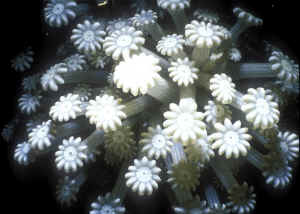
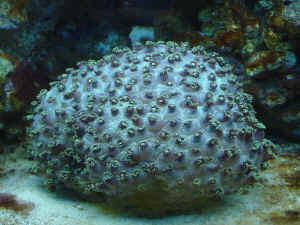
Are featherdusters tasty? Hello <Hi> I saw a 7"x3" piece of rock which had about 20 small 1cm blue featherdusters? present. I would love to add it to my reef setup but before I shell out $60 I thought that I would research their possible predators. I have red scarlet hermits, blue legged hermits, orange Linckia star, turbo and Astrea snails, purple tilefish, pair maroon clowns, Lemonpeel angel, citrus clown, yellow watchman goby, small conch, pistol shrimp, two fire shrimp, two cleaner shrimp, two peppermint shrimp, a rose bubble tip anemone, and various corals. tank has been running for 8 months with minimal problems (the most mysterious being the unexplained death of the bicolor blenny last seen happily swimming about his small cave , later that evening to be found deceased in a shallow rift of live rock, no apparent disease but some possible trauma to his midsection, I suspect the purple tilefish which had been just released into the neighborhood ,but he swears he was with the cleaner shrimps all night. The case has gone cold and no other mortalities have been reported!) Thanks for your expertise and time. Mr. S. Holmes <Well, the good news is that nothing in your tank will nip or bother the worms (besides the lemon peel angel which has a chance for nipping at the coral and feather dusters, although I wouldn't be too worried unless the angel has been previously nipping at other invertebrates or coral). Because you mentioned "Blue feather dusters," this makes me think that you're referring to Christmas tree worms. The worms are found in a small polyped scleractinian (SPS) coral which is in the genus Porites. This coral that the worms host in will require intense amounts of lighting, preferably metal halides. If you do not either have intense amounts of fluorescent lighting (T-5, VHO or Power Compacts) or metal halides, I would not recommend this coral/worms. If you do decide to buy the coral, first make sure that you have proper water quality and proper amounts of current. Because the host coral (which the feather dusters are in) is an SPS, it will require generally strong amounts of current. Water quality should be great, which means no phosphate, no nitrite, no ammonia, little amounts of nitrate, pH of around 8.2, Salinity of around 1.025, and a steady temperature. Because this host coral is calcium carbonate based, it will require a calcium of around 450ppm and an alkalinity of around 8-14dKH. The coral can be delicate to keep, but in the proper environment this can be a stunning addition! Good luck, Graham.> Alveopora? or not? Count the tentacles 2/18/04 Hi Crew, I was wondering how I could tell the differences between a red Alveopora and a red Goniopora <Alveopora has 12 tentacles per polyp... Goniopora has 24> because a LFS has a coral marked as a red Alveopora but I think its a red Goniopora because I have never seen a red Alveopora before. <heehee... that's an odd sort of logic? It doesn't exist because you've never seen one before :p You're killing me here!> I don't want to be trick into getting a difficult coral to care for. <neither is easy... and Alveopora still requires an advanced/specialized care... perhaps do resist. Maybe buy a good book instead... seriously, to help you get better informed and prepared for such corals in the future. Do consider Eric Borneman's "Aquarium Corals" - he describes the difference between these corals in there too ;)> Also if it could be an Alveopora is there any special requirements for it while it is in QT <careful acclimation to light as with all corals... and preparedness to use/employ a refugium to provide food. Else do not buy the coral IMO. Anthony> Flower Pot Worries (1/23/04) Hello, <Hi, Steve Allen tonight> For Christmas Santa brought my 12 year old daughter a 90 gallon Reef ready tank set with all the pumps and stuff. <What sort of stuff?> I'm so worried now that we've started to add the fish and stuff, the pet store might take him back. <Take who back?> I currently have the following: 1-Lawnmower Blenny 2-Emerald Crabs 5-Scarlet Crabs This stuff is so beautiful and expensive. <Yes. The expense is relative. Some fish can cost over a hundred dollars.> We're just not sure what can go together. Asking the Pet store staff is really no help, I'm getting different answers from different stores. <You need to find someone honest who is not just after your money.> I just bought a my daughter a clownfish that was living with a large Flower Pot Coral. So I bought them both. But, now after reading some things on the web I'm worried about this very expensive coral. <I'd take it back and insist on a full refund. You have zero chance of keeping this alive as a beginner. An honest business would have told you this.> Should I just get rid of the Starfish he was only $9.99?? <If it eats well and seems fine, they're nice to have. How long have you had it?> I think 25-Turbo snails 1-Chocolate Chip Starfish 2-Tank Raised Clown fish 1-Yellow Tang 1-Med to Large Flower Pot Coral 90lbs of cured live rock. Thank you, Susan (A worried Mother) <Sit back and take a deep, patient breath. Give some time without adding anything new. Go buy The New Marine Aquarium" by Michael Paletta and read every word. Then you can finish stocking the tank with a good plan. Learn about and practice proper quarantining of new livestock or you will be sorry to the point of considering quitting. If you plan on having corals, make certain you have the right lighting.> Encrusting Goniopora 1/15/04 Hi, I have a couple of questions about my Goniopora. I bought a brownish red one a couple of days ago. I knew they were difficult before I bought it. It was not the ball shape kind. It seems to be an encrusting form. That is partially the reason that I bought it. <The verdict is still out on these morphs of Goniopora. Some reports indicate that they are more hardy, while other do not.> I noticed it had feather dusters, and other filter feeding organisms on it. I guess that that would hint that it lived in a nutrient rich area. <Keep two things in mind... Nutrient rich in the wild is still low nutrients by aquarium standards. Also, most of the nutrients in aquariums are dissolved and on the reef there is a lot of particulate. Therefore, despite being "Nutrient rich", aquaria often fail to provide the kind of food such animals need.> I had it on the bottom of the tank in a relatively open area un-shaded area. The polyps didn't seem to be opening too much. So I moved it to a partially shaded area, and the polyps opened up a lot more. The tentacles on the actual polyps don't seem to out all of the way. The actual waving arms only extend about one inch. Is this normal for this species? <These morphs do have much shorter polyp extension than other morphs, so it sounds like your specimen is fine. Reddish corals are often from deeper water, which explains why you coral seems better expanded in lower light.> Then I read an article at advanced aquarist online magazine about these corals and Alveopora. It said that Iron and Magnesium can drastically improve the corals health and polyp extension. What do you think? Thanks, Adam! M. <It was Iron and Manganese (not magnesium, which is the second most abundant cation to sodium in sea water), and while interesting and encouraging, this idea has not been supported. There are probably other benefits to dosing Iron, but manganese is questionable. If you do decide to dose, please do so conservatively and test for these elements. Best regards! Adam> Goniopora Care Question - 11/22/03 I spoke with Anthony a while back regarding the hardiness of Goniopora at which time he stated they were very hardy given the proper conditions <to be sure... they can be long-lived with a the right care (many years), but it would not be fair to call them "hardy". My apologies if I was unclear on this> such as keeping them in multiples (within touching distance) on the substrate etc. <correct... one very deep sand beds (6"+) that have been established and fishless for 1 year or more, to provide micro nutrients... and with established sea grasses which provide epiphytic material. Long-term planning needed here> My question is regarding water flow & how much to provide them. I would say average... 10-20X tank turnover per hour> Any other care facts you could offer would be greatly appreciated. <do be sure to seek only the free-living species, G. stokesii... not the common flowerpot G. lobata that is chiseled from rock and hard to keep alive. The red Indo species shows good promise too though> Thank you in advance for your help. Penny Harkins - Owner AquaCorals <best of luck my friend... Anthony> Goniopora Care Question II Hi Anthony, <Hi Penny> Thank you for your response. It was my mistake in quoting Gonioporas were "very hardy". I also should have been more clear regarding flow. I was looking for how much direct current should we give them? Just enough to make the polyps flow, no current or? <ahh... good question. No direct flow at all (harmful)... we need random turbulent flow here... and actually of moderate strength (not too weak at all). Those polyps should be moving well back and forth. Having at least 10X turnover is our goal here> Thanks again! BTW, we will be ordering more of the Reef Invertebrates book soon... at the proper e-mail address too! ;) <much thanks, my friend!> Penny- www.aquacorals.com <be chatting soon :) Anthony> Goniopora Hi! <hello> I purchased a Flower Pot Coral (Goniopora, Green when it's closed, green ends on beige tentacles when it's open) about 2 weeks ago. It took 3 days to acclimate and has since opened fully during the day and so far seems to be doing well. I have it located toward the top of my 120G tank and in mild water flow. I add Seachem supplements as well as Phytoplankton but have not directly fed this coral. I know it has a poor reputation for survival in captivity and will learn from the experience. <I would not purchase this animal again. Only in rare cases does this coral survive in captivity. they seem to do great at first, but slowly the tentacles keep getting smaller and smaller until it no longer opens> Recently, the last two days, I have noticed what appears like little wisps of smoke coming off a number of the polyps. The wisps separate from the polyp and float to the top of my tank and get carried off to the sump and I assume are caught by the pre-filter in the sump. These wisps don't appear to be a problem for the fish or the other corals in the tank. Can you help with any information on what these wisps are? < It sounds like mucus because of the smoke color) building up. Then the coral is shedding it. MikeH> I have posted the question on the forum but have not as yet received a good answer. Your help would be appreciated. Many thanks. Goniopora Regrowth Question >Will flowerpot corals rebuild themselves when damaged in certain areas? >>Actually, I'm not certain, but I would surmise that in nature this would certainly be possible, so it should also be in the aquarium. One of the things that we've learned with them is that they most definitely need to be directly fed, this will go a long way towards helping them rebuild/regrow/regenerate. If this is due to bacterial infection, then there are other issues that need to be addressed, but I do know that many invertebrates are treated with broad spectrum antibiotics (specifically Spectrogram) at the Long Beach Aquarium of the Pacific. Marina - X-mas Worms - Any suggestions on how to keep a Christmas Tree rock alive and happy? I add a basic Kent A&B as well as iron and a phytoplankton diet to the tank. Anything else I should include? What about light needs (time wise). Just want to keep them healthy and happy. <Unfortunately, all too often the needs of the Porites (the coral that forms the "rock" that the tube worms live in) is neglected, which slowly dies. Porites is considered a SPS coral, and needs good water flow, high and stable calcium and alkalinity levels, and high light levels (preferably metal halide). The worms derive some health benefit from the Porites (they often die should the Porites die) and will be quite content to live on phytoplankton that you add, as well as naturally occurring microscopic floating goodies. That said, the duration of the lighting should not be taken into account with individual corals, but rather with the whole tank in mind (don't exceed 12 hours, I keep mine at 10 hours). I hope this helps! -Kevin> Thanks Reef Tumbleweeds - 9/23/03 Hello WWM FragMaster: <yes... grasshopper> I have a softball sized and shaped Porites (probably a jeweled finger) that seems to have no up or down. I can't even tell where it was fragged from. <yes... this is common with some Porites and several other genera of coral (Siderastrea in the Atlantic). They live in very (!) high flow areas of a reef and live like reef tumbleweeds> Will it matter in terms of placement in my tank? <nope... it will adapt/settle> The polyps on the current upper-most side (little guys the size of a pencil dot) are out but the ones on the bottom are not...and, this may seem like a dumb question, but how do the guys that will end up in the shade survive, given that some will have to end up that way (unless I sink lights in the tank and point them upwards ??) Thanks so much, SLC <the deprived tissue/polyps will wane indeed. Your only other option is to grow the coral in suspension. I have written an article about this that is archived on Reefkeeping Magazine (online from reefcentral.com). Best regards, Anthony> Porites Upside-down II? 9/24/03 Thanks...this does lead me to believe that this frag was raised in suspension, as it has polyps everywhere. <hmmm... I assumed that you bought a wild harvested coral. And I can assure you that they commonly are imported this way (a few species/genera)> I feel bad shading the guys on the bottom into oblivion. Perhaps I should re-suspend them ASAP. <either that or frag it if you like. These topics are covered at length in my Book of Coral Propagation if you care for such a read.> PS - You don't literally mean like a tumbleweed, I hope ... although it kind of looks like one, I'm not sure my powerheads are that strong. Thanks, SLC <they do literally occur that way... from very strong water movement on a reef. Siderastrea (star/starlet coral is the most prevalent example of this... but I have seen Porites often enough this way. Kind regards, Anthony> Sunflower Pot Hi Everyone, Nice to be back again, and have quick question. I think there's something wrong with my sunflower pot, it hasn't come out fully extended this past week. <If this is a Goniopora sp., it was pretty much doomed from the get-go. Most of the species collected rarely survive past 8-10 months.> This morning, there's this film covering it (like it is inside this bubble). What is this slimy film covering my flower pot? Will this kill it? <Sounds like it's already dead. Pick it up out of the water (carefully, the tissue may start pouring off) and give it a sniff. If it stinks, toss it. If by now it's really gross looking, you should siphon off all the spooge before handling it. It would also be good measure to do a water change.> Shall I remove it? Help! Water parameters: Am=0, rite=0, rate=20 and pH=8.2. <Water's fine, although you should work on the nitrate. No where near toxic at this level> Regards and Thank you, <Good luck! -Kevin> Felix Goniopora newbie 5/3/03 HELLO ALL, WAS HOPING YOU COULD GIVE ME SOME ADVICE ON CARING FOR A GONIOPORA CORAL. I HAVE ONLY HAD IT A SHORT WHILE, ABOUT A MONTH, BUT SEEMS TO BE FAILING.. WOULD REALLY LOVE TO HELP IT IF POSSIBLE IN ANY WAY. WATER CHEMISTRY SEEMS GOOD, ALSO SINCE REEF SYSTEM IS NEW TO ME, WAS WONDERING ABOUT ADVICE ON RECOMMENDED SUPPLEMENTS OR THINGS THAT SHOULD BE ADDED TO REEF SYSTEM REGALLY. MAY SEEM LIKE A DUMB QUESTION, BUT, I HAVE LEARNED EACH TIME I GO TO A SEMINAR OR READ A BOOK I HEAR SOMETHING DIFFERENT AND AM NOT AT ALL SURE NOW <cheers, my friend. Thanks for writing in. Alas... the problems with you or anybody keeping Goniopora cannot be summarized in the short breadth of an e-mail... at least not for attempts at keeping them successfully. The truth of the matter is that they are very difficult to keep alive, and very few people should buy them if the intent is to be a conscientious aquarist. It really is shameful that merchants sell these/any corals/animals to aquarists without any information or guidance. Yet some would say (I would!) that the responsibility really is upon you/the consumer to gather information and be educated about an animals needs before bringing it home. It boggles my mind that anyone could bring an animal into their care without knowing its needs or if they can even meet them! My advice to you presently for this coral is to begin with the basics... read about Goniopora in Eric Borneman's Aquarium Corals book... or my Book of Coral Propagation... and of course, you can/should do some keyword searches on an engine like www.google.com with phrases including "Goniopora" "lobata" Stokesii" "care" "aquarium" combinations. The truth of the matter is that yours will likely die within weeks/months like most imported. The trade/hobby does not even know clearly what it is they eat or how we can keep them successfully long-term yet. I wish I had better news to share with you. FWIW... success with keeping Goniopora has been tied to maintenance in aquarium with very deep live sand beds (6" or more) that are over one year old. Best regards, Anthony> Goniopora? - 3/28/03 Hi WWM experts! <Hi. Paul here> I have been reading many of your articles, and they are absolutely helpful and useful! <Thank you very much. So many hard at work for our readership, it's nice to be recognized> But I do have one simple question, I recently bought this coral...<Uh oh.......looks like someone needs to look a little before buying a coral, eh? =) Also an even better idea, seriously though, is to purchase a book to help with identification and self education. (never know when you will be asked about a coral) I like Eric Borneman's books and Anthony Calfo's book very much. Do a search on Amazon and look into purchasing them. Anyway, the coral looks to be a Goniopora. See here: http://www.wetwebmedia.com/gonioporapix.htm> but I have no idea what it is? <See previous statement. A good policy is to look before leaping not only for your pocket book's sake but also the life you hold in your care. I had to say this to you, please don't take it personally. I am just doing my duty as a Conscientious Marine Aquarist. >Thanks in advance! <My pleasure, I do appreciate you coming to this forum for help and hope you will continue to do so. Knowledge is half the battle, my friend. You are well on your way. Cheers, Paul>
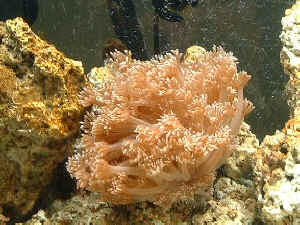
Goniopora coral Anthony, Thank you so much for responding. I can't believe you respond to so many people! I hope it all comes back to you. <its a labor of love, my friend> What is your book called, and where can I buy it? <My last book is called "Book of Coral Propagation" (can get direct from readingtrees.com, Amazon.com or here on wetwebmedia.com by following link on the home page for our new book "Reef Invertebrates" (BOCP1 box is on the same order form)> I'm going to do everything possible to save and keep my Goniopora. <that is awesome to hear! It truly is a beautiful coral. Do consider keeping it in a colony in a Seagrass refugium or dedicated display. That will work best IMO> I am >monitoring my water quality constantly, and it all seems perfect. My concern now if feeding it. Can you please just inform me what I should get, and how to make sure it is being fed. <as mentioned in the last message, there is little or not organismal feeding. No catch up to be played with this coral. They need deep sand beds and refugiums that are old and mature> Also all the supplements that will help him? <none are known to work although the bottled phyto folks would like you to believe otherwise. If anything, try the bottled phyto or better yet, start your own live phyto reactor and 24/7 drip> If you lived near Boston I would have taken the Goniopora to you to save it.:-) <dude... I was just in Boston 3 weeks ago giving a lecture for the Boston Reefers Club meeting at a U. Mass hall. Do seek support/advice from local reefers in the club. Attend their meetings too... a great club with some sweet tanks :)! See their forum here: http://www.reefcentral.com/forums/forumdisplay.php?s=869e765f2b7a6c35acbc35c11092eb1c&forumid=116 > Thanks! Martin PS: I can offer you website development if you ever need a favor back. <thanks kindly. Be chatting soon. Anthony> Hard Lessons on Coral Keeping: Look before you leap, please! Dear WWM Crew, <cheers, mate> Can you please take a look at the attached picture of my new tankmate. <thanks kindly. It is clearly a Goniopora species. Very difficult if possible for any beginner to keep. Actually, its extremely difficult for advanced aquarists to keep too. Most die within weeks of import. This one will almost certainly not live to see a year captive at any rate unless you make rapid changes in system design or get it to someone that has a better shot at keeping it. Shame on your dealer for selling it to you without advising you of its needs, and quite frankly bud... you need to shoulder the same blame for buying a living creature without knowing its needs and if you could meet them first. It will likely cost this animal its life> I am trying to identify him and to get more info on habits, lighting, feeding, etc. to keep him happy. <please use the genus name "Goniopora" to do a keyword search in our wetwebmedia.com archives (use the Google search tool on the home page). There are many FAQs regarding this creature. I will also say that the animal CAN indeed be kept... but not likely the way you want to keep it. It needs deep sand bed systems (perhaps 6" plus) that are mature and have been established for some time to generate natural plankton. Seagrasses kept in-line in a fishless refugium may also be extremely helpful for producing phyto and epiphytic matter. It will benefit by being kept on the sand bottom in a colony with others of its kind... but will likely suffer in time in a mixed "reef aquarium" packed with a variety of species conducting silent chemical warfare on each other (allelopathy). You are going to learn a hard lesson on this coral most likely and I do hope that you will be sure to not only research an animals need before you bring it home... but also be sure to quarantine it. Again, please browse our archives where there are many thousands of pages that should interest you (like QT articles by Fellman). Be mindful too of infection with this coral. The brown jelly infection that commonly afflicts Goniopora as they begin to die can wipe out many/any of your other healthy corals in the display> Also, maybe how it breeds, <I have had this coral propagate naturally by issuing daughter satellites in modified tentacles that form an incused calcareous nodule which tears away from the parent to become free-living in time. Reproduction by fragmentation or sexually produced planulae is unlikely here> and if it is a risk to any other type of animal. Most importantly what should I feed him? <this coral cannot eat anything prepared (from a bottle, bag, pack, etc) that you can offer it... needs natural nanoplankton from a fishless refugium in aquaristics. Research refugium methodologies too. Dude... you really could not have picked a worse coral to buy on impulse... I regret to say. I do wish the best of luck to you though.> Thank you in advance! Martin <Anthony> Re: Goniopora Hi Guys hope you are well, greetings again from sunny South Africa . Yesterday I purchased a small piece of Goniopora and would like to know some more information about this coral i.e. lighting, feeding etc I have searched your site but haven't managed to find any info. Please could you help? Kind Regards Werner Schoeman <Mmm, try here: http://www.wetwebmedia.com/gonioporapix.htm and the FAQs (linked, in blue, at top). Bob Fenner> Porites Hi all, I have a Porites head with plenty of xmas tree worms - really nice. My LFS told me to expect the coral to die, which is not great advice (although it probably does die for many customers. This coral can be kept quite successfully on the condition of STRONG currents and BRIGHT (MH) lighting. I can provide this environment in my display. <agreed> The thing is, while this piece has been in my quarantine, under 30w of fluorescent lighting with minimal current, excellent water quality, the Porites is re-growing to cover original die off and is usually well extended (makes the rock look "hairy"). <very good> By my normal reading of coral health, a coral that is growing, well extended and looking normal, is happy?? <healthy... not sure about happy <G>> Am I in for some sudden surprise if I keep this coral in my quarantine? <not sure I follow the question? It is expected to leave QT in some weeks, yes? Then acclimate slowly to MH on bottom of tank or with screen method (see archives)?> Why would this coral be doing well under almost opposite conditions to those recommended? Have I stumbled onto some "blind squirrel" coral!!? <good question... but the coral is not an exception. Most all coral can adapt to much low light if food/DOC compensates. The reverse is not true though (extra light will NOT cover lack of food)> Best, MP <best regards, Anthony> Porites coral Dear All have just bought a Porites coral. I was wondering what information you could give me to help its survival in my tank. I have the following system specs <Porites require strong water movement (not linear though), and most require moderate to very bright light (re-acclimate from wild imported stressed condition slowly if necessary)> 130 gallons, profusion of live rock. Lighting is with 3 marine whites (arcadia 9500k's) and 1 actinic 03, all with reflectors. <hmmm... what kind of lamps (style? PC, normal output etc)? If these are any kind of fluorescent lamps then your Porites will need to be right under the surface of the water at best... and if they are specifically normal output lamps (40watt each)... then you may not be able to keep Porites at all here> A calcium reactor is due to be added to the tank soon to stabilize alkalinity and calcium levels. <very nice> The coral is placed mid way across the tank (directly facing my pump) and high up (6 ins from the water surface) <in front of a powerhead is dangerous for almost any coral... (never apply linear flow except for planar corals like Sea fans). > there is 4 powerheads on a timed cycle at various locations in the tank. <Timers (wavemakers) are a waste IMO... instead, keep all pumps full time converging in random turbulent flow is much better for coals and more bang for your buck> I currently have a pyjama wrasse that has took an interest in the coral as soon as it was acclimatized. He will be removed forthwith. <very strange... are you sure its eating coral flesh?> Reading your FAQ's I see Porites has had a very varied survival rate in aquaria (Julian Sprung's coral reference guide gives it 7 on the success scale). They are hardy of given proper light and water flow... you'll need to modify both to succeed here> My water levels are up to snuff and I have the following fish stock. 1 flame angel 1 Banggai cardinal 1 regal tang 1 pyjama wrasse 1 Midas blenny 1 maroon clown 1 sand sifter goby Coral stock is mushrooms, two leather corals (Sinularia and finger type) with Euphyllia and trumpet coral also. Various polyps in too (green star and yellow), plus a large colony of xenia. I do water changes every week of 14 to 7 gallons and add strontium and iodine weekly. I also feed marine snow every other day, and 3 times weekly with mussel/Mysis and plankton to the corals. Is there anything I should be doing more for this wondrous little coral? <I have serious doubts about the practical benefits of marine snow... and your Porites cannot feed organismally from anything prepared or from a bottle (polyps are too small). You would be much better served here by an upstream fishless refugium that produces fine plankton> The species bought is light brown in colour, with Christmas tree worms, <reference Porites lobata> and tiny commensal crabs in also. Is my lighting up to snuff? <not sure... need mention of wattage and type. Anything awry you can see from the above? Your comments are appreciated. Jim Griffin <best regards, Anthony> Re: Porites coral Each light is 58W (colour temp 9500K) with reflectors as stated the coral is right up close top he top of the tank. <excellent placement under fluorescents. Very necessary even with VHO, T5 and PC fluorescents with high light specie like some Porites (cylindricus for example). Fluorescents are very fine lights but limited in penetration of water at depth> You seem to think this coral is not a very good aquarium species. <hmmm... I did not mean to convey that sentiment. Many Porites are kept in inappropriate conditions and struggle captively for it. With high water movement and limited competition, they can often be kept well- displaying growth for many years. Too many, however, end up under fluorescents at depth with moderate to weak water flow (or laminar flow) and in mixed garden reef tanks. This will likely be a greater challenge than any for you... long term allelopathic stress to this often weakly aggressive coral in the presence of an indiscriminate mix of coral (unnatural LPS, SPS, octocorals, corallimorphs, etc) all together. No worries though... some temperance to be had by aggressive carbon filtration, efficient protein skimming and weekly water changes> Do you think I should remove it? <no, my friend... I suspect that you can enjoy this specimen nicely where it is with a modification of your water flow to full time random turbulent from the current intermittent laminar (wave timer). If the fish and other corals in the tank are fed several times weekly or better, you may not have to even target feed this creature. Do consider a fishless refugium for plankton production for the benefit of all of your filter feeders too. Best regards, Anthony> The Scoop on Poop- corals feeding directly on nitrogenous matter I was recently researching things over on RC and found this: http://www.reefcentral.com/vbulletin/archive/84/2002/11/1/99557 for the abstract: An aquarist has found that Goniopora greedily devour tang fecal matter as well as goo left on an algae clip from a piece of Nori. he's going to experiment with target feeding it waste from his skimmer (disgusting, but given what he's observed so far...), just a drop or two. Given how notoriously difficult these corals are to keep, I thought someone out there might be able to use this info. PF <Michael, thank you my friend... once again you have demonstrated that you really know your Sh*t. Best regards, Anthony> Brown Jelly infection on Gonio I think that my Goni might have brown jelly disease, there is a kind of orange film developing on some of the polyps, how do I get rid of this infectious disease and save my Gonio? <this secondary barrage of infectious pathogens known as "Brown Jelly" is highly infectious and so virulent that odds are not good at all of saving the specimen. You will be lucky if it doesn't kill other corals in the tank too (healthy established ones too!). This is just one of the many reasons why it is so critical to quarantine all livestock for a full 4 weeks before adding them to a display. Besides having a better chance to save the new guy, there is always the risk of infecting some/all of the established animals. My advice is to capture this coral underwater with a large plastic bowl and lid (the coral is to be moved slowly and sealed in the bowl underwater) to reduce the chance of drifting infected tissue through the water. If any pieces do float away... siphon them out promptly... it is highly infectious to other corals. Treatments to date are highly experimental with antibiotics, FW dips and iodine spikes. I honestly don't think the coral will be alive 48 hours from now, I hate to say, but do consult Eric Borneman's Aquarium Corals book for an extensive range of options. My advice is a 60 second shower under cold tap water (seriously) before placing it in QT. Maintain vigorous circulation and aeration in QT as well. Best regards, Anthony> Goniopora and brown jelly (protozoan) infection? Hey Anthony, The good thing is that I don't have any other corals in my tank, <a good thing> I was coaxed into buying this Goni as my first coral by my local LFS. <wow... if they are receptive, willing to learn... please suggest that they browse and use our free resource/database for themselves and their customers. Promoting success in the hobby is out mutual goal. Also suggest that they buy either of Eric Borneman's coral books for a quick reference to not make such a terrible mistake again> My coral doesn't have much brown jelly on it and I am thinking that it might just be decay of the slowly dying coral. <agreed... simply decay. "Brown Jelly" is wickedly virulent... you can literally watch flesh fall away over a period of hours.> Thanks for all the help involving my Goni. <best regards, Anthony> Goniopora health, feeding Merry Christmas Eve Crew, <and to you as well my friend> I have a few questions that I am having problems with. 1)I feed my Goniopora phytoplankton but I was wondering what else I should feed it to ensure its survival for more than a year, <placement on a deep sand bed or in a refugium with a deep sand be has proven to be invaluable! Also, some seagrasses in the system for natural phyto and epiphytic matter seems to be helpful> 2)My three spot damsel is trying to make the Goniopora its home but I don't want it to because when it rubs against the coral, it retracts, is there anything I can do to discourage this behavior? <no clowns or damsels in the display at all with the Gonio... it will kill the coral within months likely> 3)I brought it in pretty bad condition (i.e. exposed skeleton), what can I do to try and help the coral or is it too late? <definitely not too late... but will be slow to heal. No worries... good water quality is enough. The fishless refugium and deep sand bed are also crucial> 4)Does it need to be near macroalgae, if so, where can I find some? Thank You, Lucky Ly <not any/all macroalgae... some like Caulerpa and perhaps Sargassum may be noxious or harmful. Look for Gracilaria, Chaetomorpha and calcareous species like Halimeda & Udotea... better yet seagrasses if you have a deep sand bed (Thalassia or Syringodium). Numerous places on the web sell these plants. What big city are you near? Perhaps there is a local club you can trade samples from (look at our links and the lists on message boards like reefcentral.com for aquarium society listings). If nothing else... look up www.ipsf.com for Gracilaria algae. Best regards, Anthony>
Flower Pot Coral II Dear Crew, As you remember, I wrote concerning my G. Stokesii (thanks for the correction). I wrote Kent and awaited a response. The response is in and I value your opinion as much and possibly more (your helping the amateurs, he is selling a product). Please do not take offense to my quotation of expert as I am unfamiliar with your staffs qualifications. <No problem. If you are interested, there is a page on the crew, who we are, what we look like, what we do, etc. http://www.wetwebmedia.com/WWMAdminSubWebIndex/wwmcrew.htm> I simply didn't want some smug response from them saying "who this guy, we are the pro's" <No, I am the Pro, Steven Pro to be exact. :)> You seem to overqualified to say the least and I am interested in your response. By the way, they asked If I am skimming. I said yes 4 hours per day venturi style. Effective today I have 3 inches of aragonite live sand and the stokesii are on the bottom. Thanks Steve- HERE IS THE OFFICIAL RESPONSE FROM KENT Hello, Thanks very much for your inquiry; I'll do my best to try and clear up some confusion. Goniopora, in general, has a poor track record for survival in captivity, and the reasons for this aren't very clear to even the most experienced hobbyists and professionals in the industry. There are many factors, however, that are often observed and/or theorized to have an influence on the survival rate. Certainly, water temperature, nitrogenous waste concentrations, light characteristics, water flow, dissolved oxygen concentration, nutrient input, and presence of toxins excreted by nearby corals and other cnidarians play roles in the relative survival rate of Goniopora. I will, at this point, say that I am not aware that any specific studies have been performed on "bottled phytoplankton" and the size of the species included as they pertain to the feeding habits of Goniopora. Our product, Phytoplex, contains three species of phytoplankton in a size range of 2-15 microns, and our ChromaPlex contains two species with a size range of 5-25 microns. The recognized lower limit on size of phytoplankton as noted by Marine Biologists and Oceanographers is 2 microns; therefore I find it difficult to believe that Goniopora, which feed not only on phytoplankton (all 2 microns and larger), but also on zooplankton (also 2 microns and larger) are not able to feed on organisms present in our products. In other words, the insinuation or claim that the phytoplankton in Phytoplex are too large for Goniopora doesn't hold water. Corals and other organisms that feed on the smallest classes of plankton, femto- and picoplankton, at 0.02-0.2 microns and 0.2-2.0 microns, respectively, often use a visible mucous to aid in the capture of such small particles; Goniopora do not display that characteristic. Note that the femtoplankton class is composed wholly of virioplankton (virus'), and picoplankton is composed of bacterioplankton. Again, I believe that an individual would be hard-pressed to locate a study performed on Goniopora citing their feeding schemes, but perhaps I'm just not reading enough these days. Now, allow me to say that if the coral isn't getting the amount of nutrients it needs (i.e. the coral is simply not capturing enough of the plankton to meet its nutritional requirements) in order to survive and thrive, that's another matter, more easily solved. You didn't mention that you have a protein skimmer on this aquarium, did you omit that information or is the tank skimmer-less? Kindest regards, Cris Brightwell Marine Scientist Kent Marine, Inc. www.kentmarine.com <While I know of no studies involving Phytoplankton and Goniopora, Dr. Rob Toonen did perform a study on bottled Phytoplankton products. You should be able to easily find this on the net. The basics are what Anthony gave you in the last email. To be useful, it must be fresh, refrigerated, and whisked to ensure proper particle size. While their live Phytoplankton is probably of the sizes he quoted, Dr. Toonen's study showed that all of these products have a tendency to clump, making them worthless. They must be used up in less than six months, refrigerated the entire time (wholesale, retail, and your home), and need to be blended for a few minutes to minimize clumping. Do read the article for yourself, though. -Steven Pro>
Goniopora I have recently (about a week and some) brought a Goniopora. (I learned a little too late that it is one of the hardest corals to raise and me being a novice, didn't know how hard it was to raise.) <do be sure not to repeat the mistake... please buy a good reference book before you buy another coral. Eric Borneman's Aquarium Corals is an excellent reference> It has been opening about a half a inch then retracting again. Is there something wrong with it? <normal polyp cycles... corals do not extend polyps at all times> and if so what can I do to help it open? Thank You <too much to cover here in the media of e-mail. Know that this coral needs to be kept on a bed of fine sand (never on rock! it will die in time there). It also needs to be kept in a fishless refugium with seagrasses or heavy macroalgae IMO. Please research so much more about this coral in our WetWebMedia.com archives and beyond. Best regards, Anthony> Re: x-mass tree worms and purple tang Hello again gents. I have a Porites coral with xmas tree worms all over it and was wondering if I get a purple tang will it try to eat the xmas tree worms? <Your Porites with Xmas Tree worms is likely safe from a Purple Tang, but still not likely to live long term. These are known for dying in captivity. Their secret has eluded the hobby. We are not even sure what the worms eat.> Also do the purple tangs bother open brain corals and hammer, anchor etc.? <No, Tangs in general do not bother corals.> Thanks! <You are welcome. -Steven Pro> Alveopora Anthony: I have a few questions about the daisy coral (Alveopora). 1 what to feed and how often? <it needs substantial food/matter to survive but most is by absorption. You cannot target feed this coral. An inline fishless refugium (perhaps with grasses for epiphytic material) is recommended for fine natural plankton instead> 2 placement in tank how far from surface, tank has 384 watts of PC lighting? <a low light species that shocks under bright light. In this tank, place between 12 and 20 inches> 3 Any good links on this site that has a lot of info on the Alveopora sp. Thank you very much. Pat <alas... not much is known/published on this species in aquaria. They are too commonly misidentified or lumped in with Goniopora. Nonetheless... this beautiful coral to me seems to be hardier than Goniopora once established. As with all LPS species... a species specific display is best. No SPS corals and very few if any soft corals in the same tank or it may easily suffer and die in time (1-2 years) from the mix. Low to med light, moderate current only, heavy feedings of fishes and other corals in the tank will lend dissolved organics beneficially to Alveopora. Best regards, Anthony> Light, Porites Hi all, Do you think a bright yellow Porites coral gets adequate lighting if approx. 10 inches straight below a 150W AquaLine HQI bulb? <likely yes... close if not. Very shallow is necessary for this species... and very strong random turbulent water flow too. The color will be the indicator... they turn golden brown if they do not get enough light> That's about 3-4 inches below water surface (total tank 100gal has 300W, using an Aquastarlight fixture). I had read that Porites were abundant in nature, hardy and moderate in lighting demands so I bought it a few days ago. <no way dude... literally ankle deep water in the tropics!!! Equatorial sun> Then I searched your site only to find that the yellow is a particularly demanding type of Porites when it comes to lighting. <actually... just in color rendition. They are adaptable and will survive lower light... they just wont stay yellow> I'm not sure what this means, but I assume it implies a 250-400W metal halide fixture range. <no way! 400 watt halides are rarely necessary. Perhaps the 250s though if you have a deeper tank and want the coral deeper> Given that all other water conditions are good (high movement, good skimming, quality RO, etc.) does it stand a chance or do you think that I should give it away before I kill it? <I believe it will be fine> Thanks so much, Adam <best regards, Anthony> Koko worm rock and Porites Coral Hello Wet Web Crew! Hope all is well for you. As you by now know I am very new at this hobby. I'm not sure if the questions will ever end! <I should hope not... keep learning!> Recently I purchased a rock with about 15 Christmas tree worms from my LFS. The worms are growing on/in what I believe to be Porites coral. <agreed... AKA "Koko or Bisma worm rock". Porites (lobata) with fanworms incused> When I purchased the rock the coral was a reddish brown color but it's now rapidly changing to green. <if you still see the Porites polyps, it may simply be a color change. Please know that this symbiotic pair needs massive random turbulent water flow. That is key to success in keeping them both alive> The pet store told me it was some sort of sponge... do you believe that??? <alas... I am not surprised. I'm just glad they don't run an orphanage> (sort of my fault I should have researched before purchasing) Anyways, I'm concerned the coral may be dying and I'm not sure how to help. If the coral dies will the worms die also? <its an old legend... the worms can live (although they are very difficult to keep) without the coral. You will need to have a fishless refugium inline on the tank for natural plankton else your worms will almost certainly die in less than 2 years> What to do?? Also can you tell me how Christmas tree worms reproduce? <just like anybody else... a little too much wine, a beautiful starlit evening and Barry White/Luther Vandross music playing softly in the background. They can also spawn sexually in concerted broadcast spawns on the reef with pelagic larvae settling en masse. Does not occur in small captive aquaria> Thanks in advance for the brilliant and witty answer I am bound to receive! <thanks for the easy segue <G>> Cheers! Melinda |
|

|
Features: |
|
| Featured Sponsors: |