A Plan
Ideally, you will be able and willing to study up ahead
concerning the aquarium hobby to where you knowledgeably choose
both the system and the livestock you intend to keep,
instead of "ending up" with a tank of certain size/shape,
filtration/aeration/circulation gear, lighting et al... that
impinge on your ability to choose and suit the life you intend to
keep. In this ideal circumstance, you would know the quality of
the part of the water world you
intend to mimic... and the livestock's' needs specifically.
System information:
• The size/shape of the tank needed... how much it
weighs, where you'd place it.
• What sort of stand/support you're going to need/want...
• The type of gravel for the fishes, invertebrates,
and possibly plants... what color,
make-up chemically, physically... the depth/amount...
• What sorts of lighting; brightness, quality... timers
to aid in creating a steady light/
dark cycle.
• Filtration and circulation...
And for the proposed livestock:
• Best initial purchase size range, growth rate, likely
maximum size.
• Water quality preferences and ranges... e.g.
temperature, pH, water hardness, water
movement, light brightness
• Foods and feeding.
• Temperament; likelihood of bullying, predation.
• Habits of swimming/location, space needs.
Another Approach: Centerpieces
Most folks will be finding themselves already in a "fixed"
position of having a set-up in hand, or at least the principal
components. Given this perspective, or starting point, you can
work out what you might want to keep in a few ways...
My favorite approach involves building a collection around a
"must have" organism...Something that I really want to
keep... and working from there in making sure the conditions
that my "number one" piece of livestock enjoys are amenable
to my secondary et al. choices.
As an example, let's say I have a 29 gallon aquarium...
nominally 30 wide, 12 deep front to back and 18 inches tall. For
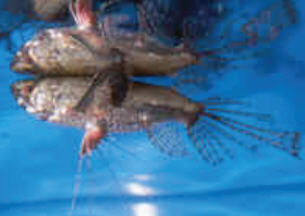
my must have centerpiece I want to keep an African Butterflyfish,
Pantodon buchholzi. Doing a bit of looking up I have an idea of
its likely purchase size... about 3-4 inches, it's maximum size,
without the tail, is about four inches...And what sorts of water
conditions this fish likes: Softer, acidic, tropical... and not
too much light as it lives near the surface, nor current... Oh,
and a completely covered top... so it doesn't leap out of the
tank!
Note that you really don't need to be overly concerned with
"how" hard or soft your water
is, nor usually with whether it's tropical or cold water...
Just the general matter of whether this is so for the species
you intend to keep. Similarly,
some freshwater fishes will tolerate some salt content in
their water, but by and large, it is
best to keep freshwater systems fresh, brackish as so, and
marines in turn as full-strength saltwater.Now, as to the issue of
the other livestock... obviously, with that trap-door like mouth,
any small fishes will likely become food... Likewise, this fish
doesn't care to share the surface area... so top-dwelling
tankmates are out... as are too fast-moving ones that would spook
it badly (e.g. tinfoil barbs or silver dollars)...What sorts of
fishes might be good choices then? One way of figuring this out is
to consider what other fishes et al. are found (and collected)
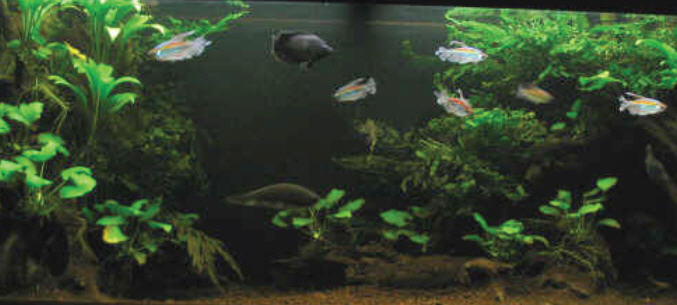
from the area where Pantodon makes its life... Some definite good
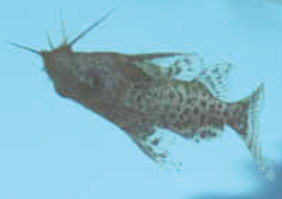
choices here are the Mormyrids, like the Elephantnose and Baby
Whale; the African Knifefish; and the Mochokid Catfish (the
"squeakers" mainly of the genus Synodontis). Some "mid-size"
tetras you might like are the Congo, and the genus Alestes.
Plants
As previously stated, the African Butterflyfish doesn't like
too-bright lighting, and you want to keep it feeling safe and
secure to discount it jumping and injuring itself... Live plants
do all sorts of good things for freshwater systems. Some good
"biotopic" selections include slow-growers of the genus Anubias,
fast-growing Crinums, and Bolbitis heudelotii.
Another excellent choice and personal all-time favorite
aquarium plant choice is the "Indian Fern" (it is found in
Africa), Ceratopteris thalictroides, or the congener C. cornuta.
African butterflyfish love the shade this genus supplies (grown
floating... it can be rooted as well), and they do very well in
low-current settings.The Value of Lists
I can't state emphatically enough just how important
list-making as a tool can be... There is no better way for you to
gather and absorb useful information than applying your mind,
hand, pen and paper... A table of the qualities you're looking
for, species to mix can be easily constructed and the "boxes"
filled in with simple (and fun!) searching. Believe me, finding
out all this before spending good money on life
that may not be compatible... is the way to go.
Finding Out About All This?
Resources abound for a curious mind... the Net has a myriad of
sites, BB's... and there are a plethora of in-print books and
magazines... that are easy to search with a little help from a
librarian. Again, I urge you to take good (written) notes re
what you want and its specific needs... and to record the
sources of this information. Unfortunately, a good deal of what
is posted on the Net is a bit "noisy"... not often in total
agreement. It is best to take all you encounter with "a grain of
salt", and remain speculative re single source, personal
accounts.
How can you find out what comes from the same area? Use the
Net! Put search words like "Plants from Africa to use in
aquariums" in your engine... and go!
Cloze
A hodge-podge approach to stocking ones aquarium system is to
be guarded against... These "garden variety" mixes of supposed
"community" organisms rarely work out satisfactorily... With
unneeded tension, extra maintenance and poor showing, growth and
behavior of specimens as
consequence of slipshod, inadequate investigation ahead of
their acquisition. Do be a conscientious consumer and look into
the needs and compatibility of the life you intend to keep
before buying it. To the extent that you know what you're doing,
so much more will be your enjoyment and understanding of your
aquarium world.
|





.jpg)
.jpg)