|
|
| Home | Marine Aquariums |
Freshwater Aquariums |
Planted Aquariums |
Brackish Systems |
Ponds,
lakes & fountains |
Turtles & Amphibians |
Aquatic Business |
Aquatic Science |
Ask the WWM Crew a Question |
| Please visit our Sponsors | ||||
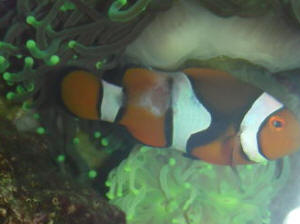
Aggressive Tendencies Hello Everybody <Hey Travis, JustinN with you today.> I have been reviewing the site for a while and I just have to say that you all do a great job. <Thank you for this> I recently came into a dilemma. I have had a pair of Ocellaris clowns for about 4 months now and they have been getting along great. Two days ago the male has started getting attached to the long tentacle anemone that I have in my tank. <Wonderful! This is such a pleasurable association to witness, especially in your own home!> He is constantly in and out of it spending most of the day in it. The female on the other end did not want anything to do with the long tentacle. That was until today. <*in a menacing tone* Dun dun dun!> The female now has taken over "control" of the anemone and whenever the male even looks at it the female darts out and nips him on the side. Is this normal for one Ocellaris to take over the anemone and not let the original one into it. <Absolutely> I assume that it boils down to a dominance thing. <You are correct here.> However when neither of them are in the anemone they are inseparable and swim around together. <All is fine here, just part of typical mated pair behavior here. Give it time, and she may allow him access to the anemone more readily. though this may take an extended period as the clowns inhabiting the anemone did.> Another question I have is about my Cleaner Shrimp. He (presumably) grew from around 1" inch to the now current size of about 3" 1/2 inches (body length) in about 3 months. He tends to hang out in the back corner of the tank and when a fish swims by he darts at them aggressively. <Not so much aggressive as instinctual. This is the job of these shrimp on the reef.> He has no problem and cleans my yellow tang on a regular basis. He gets a good amount of food because whenever I feed flake to the aquarium he skims the top and grabs some for himself. I am just curious if this is common to be this aggressive. Thanks for all your help. Travis <I wouldn't consider the shrimp to be outwardly aggressive, just eager to clean. Consider it a testament to your good husbandry skills. All your creatures as you describe, read to be living in a happy and comfortable home under your care. Good job, Travis. Hope this helps you! -JustinN> Anemone/Clownfish Hosting -- 01/09/07 I have had a pair of False Percs about a year now. Around 3 months ago I added a good sized GBTA to my tanks and things have been going well. The anemone split about a month ago and both specimens look healthy and behave normally. <<Excellent>> The clowns have not even noticed either anemone. <<Sometimes goes that way...>> That is until last night, the female clown is hosting in the larger of the anemones. <<Cool!>> I am totally excited and happy about this. <<I'll bet!>> My question is will the male join her at some point? <<Hmm...>> I know it's not an exact science here, <<Indeed>> but has anyone had a similar experience? <<My experience has been that the males generally spends most of their time patrolling the "perimeter" of the host anemone, only spending time "in" the anemone at night or when a threat approaches...unless of course that "threat" is the hobbyist's hand...then the little peckerwoods come right over and draw a little blood!...but I digress...>> I would be a little upset if he didn't because although they weren't hosting they were paired well and relatively inseparable. <<And will likely remain so>> Conventional wisdom tells me he will join her soon but I was hoping to hear that from someone who has experienced it first hand. <<The larger the anemone the better the chances/sooner this will happen in my estimation>> Thanks for your thoughts and experiences. Brian Reddy <<Happy to share, Eric Russell>> Clarkii/Carpet 1/7/07 Hi crew <Hi> For 2 1/2 yrs my Clarkii (OJ) (Named OJ because we suspect him of terminating two other Clarkii when first purchased!) and Green carpet anemone (Colin) have been inseparable. I have just 2 mths ago upgraded and introduced everyone to a new system ( bigger and brighter) which has been settled for a few weeks now. Lately Colin has not been looking too good and has shrunk quite a bit and has been floating around a lot. <How is your water quality?>. Also not eating and the Bicolour angel has started to nip at it! This makes me think it could be dying and although it has not yet started to dissolve I have removed it to my refugium so if it does I can easily remove it from the system. <Not a good sign.> Has Colin reached old age? <No, they don't really age like we do, sort of immortal, but not really. Can reach hundreds if years old.> Now OJ has starting fanning it's tail like crazy and stirs up large patches of sand! Is this in response to Colin's removal? <Normal behavior for a clown.> Should Colin die would you recommend another or different anemone, or none at all? <None, I don't really think they are appropriate for aquariums because of their potential life spans.> I have a 2500 litre system so have loads of room and at present no other anemones. The only irritant to OJ is a much smaller cinnamon clown which has to date managed to survive OJ's attentions but I fear mainly due to Colin's presence. <As it grows may attract attention from OJ.> Thanks for the wonderful service you guys offer this hobby of ours. I certainly hope that you are on a retainer from the LFS's!! <Thanks for the complement. And while a retainer would be nice we prefer our independence.> Kind regards Ian <Chris> Clowns + BTA, maybe not 12/31/06 Hi, <Hello
Mark, Mich here.> Just a quick question, I
have a large BTA and 2 tank raised clowns. They have been together for
approximately 3 weeks and the clowns don't seem interested in the
BTA at all. Is this just a case of time or might not ever happen? <A
couple of things here. Not all clowns and anemones are
compatible. Also, captive raised clown fish may not have
ever been exposed to anemones, which may reduce the likelihood of
association. Please read here: http://www.wetwebmedia.com/ca/volume_3/cav3i1/Clown_anemone/Clown_anemone.htm
There are several more related articles at the bottom of this link
highlighted in blue. Reading through these may help you
better understand the animals in your care.> Many thanks
Mark. <Welcome! -Mich> Maroon Clown Hosting to a Toadstool? 12/12/06 <Greetings! Mich with you this evening.> Is this possible? I guess anything is possible, but I don't know if my clown is trying to host or just being annoying. <Yes, tis possible.> The clown previously hosted in a Condi at the LFS, that is what I was told when I bought him. I brought him home and he is first one in the tank (70gal SW Reef w/100lbs LR and 80lbs LS and CC). He was in there by himself for about a month then we added a lawnmower blenny and a dragon goby, he did fine with them. Then we added a yellow tang and a Sailfin tang. <The Yellow Tang (Zebrasoma flavescens) should be OK in your tank, but the long term the Sailfin (Zebrasoma veliferum) can get over a foot long.> Everybody was happy for about 2 weeks and then now the clown is getting in the middle of the toadstool (while it is open) and shaking his tail in there like crazy, of course then the toadstool is closing up. Since yesterday the clown seemed to be guarding the outside of the toadstool but didn't go in it, just shaking his tail in the sand near it. Is this hosting behavior and do we need to see how the Toadstool takes it or get one of them out of there quick? <Yes this is hosting behavior. Keep an eye on the Toadstool, and see how it does. It may accept the behavior with time. But if it stops opening all together or starts withering away, it is time to take action. In the meantime, enjoy the process.> Please help, thanks. GG <Hope that helps. -Mich> Clownfish And Bubble Coral...Often Not A Good Mix - 12/04/06 We are having trouble with a bubble coral. We have had him about 3 months and he seemed great at first, but the last two weeks he has been completely closed both at night and during the day. <<Not good>> The tank is as follows: 95 gallon with 100 pounds live rock, pH: 8.2, Nitrates/nitrites/ammonia: 0, SG: 1.024, temperature: 79-80 F. The bubble shares the tank with 2 Sebae clowns, <<A clue here>> a yellow tang, assorted crabs, frog spawn coral, torch coral, hammer coral, and a hairy mushroom. All other corals "seem" to be doing ok. We have tried target feeding and moving him to areas of less light and less current, but he remains closed. He is at least 8 inches away from any other coral. Around the time he started to close, we noticed one of the clowns persistently trying to host him. <<Ah yes...>> We don't know if that was part of the problem or just a coincidence. <<It is very likely this is the problem. Some corals do fine with the "attentions" of clownfish, but the large vesicles of Plerogyra species are easily irritated/damaged by the sharp septa of the skeleton>> Any suggestions? <<Separate the bubble coral from the clownfish>> Thanks! Michele <<A pleasure to assist. EricR>> Clown fish Q -- 11/15/06 Hi, I have a 40 gallon tank with 100 pounds of sand 200 lbs. of live rock a sally light foot crab and a 2 claw shrimp. < Greetings, and WOW! I have that much live rock and sand in my 215g. Is there any room for fish to swim or water to flow? :) > I also have 2 damsels. I just added 5 False Percula clowns to the system will the pecking order take longer because there are 5 clowns? < Ouch. Too many fish in too small of a tank. Introducing multiple clowns requires mated pairs and/or a huge tank. > Because they're all split into different areas of the tank ex: 3 in left corner and 1 in middle and 2 on right side. < Turf war soon to ensue? > I don't know what to do, and what type of anemone should I look to get for them? < With 200 lbs of LR in a 40 I can't imagine enough room for an anemone. Otherwise, picking an anemone for a specific clown is somewhat easy as long they have a host relationship in the wild and you have a suitable tank. WWM has a wealth of info on what clowns may host in what anemones. Please read up on the articles/FAQs regarding anemones. Anemones are usually best kept in tanks built around them. Lots of reading to do. > Is it better to keep them in smaller groups? < A mated pair at most with your tank size. Please do send a pic of the tank if possible. > Thanks, < Most welcome -- Emerson > Morgan Clownfish Hosting - 11/07/06 WWM crew, <<Matt>> I hope all is well in your world. <<Hmm, let's see...I'm on the Big Island of Hawaii...just finished having supper with Bob and my wife, now having a drink and answering queries amid some light banter...and we're off to do some shore diving in the morning...yes, all is well in my world <grin> >> I was hoping you all could help me with something. <<I'll give it a try>> I have a fairly large featherduster (Sabellid species) in a nano tank. I also have a pair of false Perculas that are the only fish in the tank. They seem to be trying to find a host and first attempted with the xenia in the tank. They now seem to be attempting the host the feather duster. <<Not unusual...though they will be fine without a host>> The larger female seems to continue to brush up on it, which it quickly pulls back into its tube. <<Indeed...and unlikely to ever accept these attentions from the clownfish>> I fear for the health of the feather duster. <<Me too...it can't feed if it can't extend from the tube without attracting the fish's attention...coupled with the stress re>> Is this common? <<On both species parts, yes>> The FD rarely comes out anymore. <<Not good>> Is there anything I can do short of getting rid of either one? <<Perhaps introduce a substitute host such as a long-tentacle torch coral. It's no guarantee, but these corals will "sometimes" learn to accept the clownfish's presence>> Thank you very much and thanks for the great website. Matt Hymes <<Quite welcome, EricR>> Maroon clown and an Anemone 11/5/06 I purchased a malu Anemone a while ago and had perculas in the tank already, they were tank bred but still used the malu straight away, unfortunately they died for one reason or another so I waited for a while to make sure the tank was ok then introduced a maroon clown, I have had it about a month now and it has not been anywhere near the malu at all. Is there anything I can do? thanks Dawn <... using your grammar, spell-checkers... I's, not i's... Reading on WWM re Clownfishes and Anemone Symbionts: http://www.wetwebmedia.com/clnfshanemfaqs.htm and the linked files above. Bob Fenner> Carpet Clown - 10/22/2006 This is a great site. <Thank you.> I have owned a green carpet anemone for almost two years now. I have a Tomato clown in the tank that never touches this anemone. I realize that they are not naturally associated together. I started a second tank and I am going to move the Tomato. I was wondering which is a better choice for my carpet: a clarkii or saddleback? I know saddleback is another name for this anemone. I actually like the looks of saddleback clowns better than clarkiis. Since the carpet is called a saddleback anemone, am I correct to assume that the saddleback clown is naturally associated with it? If so, are saddlebacks currently captive-bred, and does this make them less likely to associate with the anemone? Finally, will it matter whether I choose a brown, black, or red saddleback? Thanks for any information and having a great website. <I think you'll find this link very helpful for anemone and fish compatibility. http://www.wetwebmedia.com/ca/volume_3/cav3i1/Clown_anemone/Clown_anemone.htm Good luck, MacL> Anemones 10/5/06 Hello <Hi> First me and my fish thank you as you have been a great help. I've read almost everything you have on anemones (I know you don't recommend them) but I would really like one for my false perculas even though they aren't necessary. Here are my specs 30 Gallon 36" Power Compact Coralife brand new 30 Lbs live rock 2 False Perculas 1" 1 Flame angel (2") He will be going back due to concerns of overstocking but I want to wait at least 3 months before I move him I like him and do not want him to die from moving too soon I've had him for 2 weeks. 1 green chromis <1" Prism Protein skimmer 75 gph Aqualife powerhead 330 Power Filter Bubble coral, Open Brain, Frogspawn, Fungia plate, various polyps, xenias, mushrooms, something that looks like a bright green pickle (that is the scientific name right?) <Works for me.> 2 fire shrimp 1 skunk cleaner 1 peppermint shrimp I've learned through your website I am going to have chemical warfare issues and plan on a bigger tank 75 or 90 next year with a 30 gallon refugium. <Would still be a problem.> What would be the hardiest anemone that I could get and that has a chance that the clownfish would host with? <None with corals, all will either have problems or cause them.> Should I just forget the anemone? <I would.> I really want one but I do not want to kill one needlessly and will defer to your expertise. <Premature death would be the most likely outcome.> I do regular 5 gallon water changes every week with salt water from a very, very reputable LFS. <Good> They, by the way, will not sell me one as they say my tank is too small. <True> They refuse to sell me certain fish, like the flame angel (bought from a different store) which is why I respect them, but I really want one. <Listen to them, sounds like you have a good store there, lucky.> They will sell me one based on your answer. <Sorry, I side with them. Not a good idea> Thanks Paul <Chris> Hello, I have a 26g bowfront tank that I wish to set up as an anemone/clown system. - 09/22/06 For lighting I have a 130w orbit pc fixture. For water movement I will be using an AquaClear 110 power filter and a MaxiJet 600 powerhead. I also have 30lbs of CaribSea Aragamax sand. I will be using about 26lbs of premium Fiji LR as well. I have a 24g reef and it has been running great for 6 months, and I have had reefs in the past, so I wanted to do something new. I'm pretty sure the only anemone I would be able to keep would be a BTA, but if possible I would like to try and LTA because I really wanted to do a pair of Orange Skunk clowns. if not, I will more than likely do the BTA with a single maroon clown. My question are, will I be able to keep an LTA under my lighting, and would any other anemones be possible? someone said I could try a carpet as well? if so how often and what should I feed it? There will be no corals in this tank, just the anemone. also, would I be able to do a few of those colorful rock/flower anemones( Epicystis crucifer) in there as well? if I happen to do the BTA, would I be able to do a pair of gold stripe maroons or would I just have to do a single? I know they get big. <<Jordan: I have a LTA in about 5" of sand under 400W MH SE lighting. The anemone seems to be thriving and is about 18 inches in diameter. LTA's need a sand bed several inches deep in order to bury their foot. Since you have never kept an anemone, I suggest looking for a clone of the Bubble Tip Anemone. They are much easier to keep, can live under less powerful lighting, and because they are clones, they weren't pulled out of the ocean. Most species of clowns will easily host in them. I had a pink skunk clown that hosted in my BTA (until he found a way to jump out of the tank). Best of luck, Roy> JB Ocellaris Fight? Oh, yes... can indeed 9/4/06 Hello. <Greetings> Today I bought a Bubble tip anemone for my two baby ocellaris clowns. They got along fine until the anemone was introduced. They just finished a huge jaw locking and sparring match, in which one remained in the anemone, while the other has been banished to the back of the tank. <Dominance...> They are both the same size, and the tank is a 24 gallon nano cube. <This tank size may be real trouble here> What happened? Are they hooking up? Are they over each other? <As you state, speculate, are coming of age, "deciding" which will be the female... driving the other out... in the wild, likely to its doom... in such small confines, too likely the same> Do they need to be separated? <Yes, I would... at least in a floating colander, breeding net/trap arrangement... for a few weeks...> Any advice would be much appreciated. Regards, Jennifer <Then, with you present, the "loser" released for careful observation... Hopefully acceptance as the sub-dominant male of this pair. Bob Fenner> Black Percula introduction to new BTA 8/28/06 Hello Crew: <Chris> Thanks so much for the incredible database. I have managed to write only twice in the last couple of years, as I have been able to find the answers to the most detailed or scientific questions. Cheers for that. To that point I have also contributed to your funds. You should really market that more. I think you would find more folks willing to pitch a few bucks in exchange for the help your team provides. <Heeee! Some day...> Aquarium parameters- (I know you guys like/need to see this part) The hardware: Display tank: 200 USG; refugium and sump: 90 USG; AquaC EV 240 Skimmer with a Mag 12 pump; 250W x 3 MH; 96W x 4 Dual 50/50 Actinic; 4.5" layer of oolitic aragonite sand; 300 pounds of mixed-harvest LR (Florida, Fiji, etc.); Turnover: 2200 GPH via two Iwaki mag-drive pumps The chemistry: SG: 1.022; <Mmm, would raise this to 1.025> Ca: 380; pH: 8.2; dKH: 11; Temp: 79F; Zeros across the nitrite, nitrate, and ammonia. The system is two years old and stable with monthly water changes of approximately 50 gallons. The livestock: 5" Purple Tang (Z. xanthurum), 3" Flame Angel (C. loricula), 2" x 5 Three-striped Damsels, 1.5" Pygmy Angel (C. argi), and a handful of inverts lead by a monster 4" Banded Coral Shrimp, <"The leader of the pack, vrrooommmm"> a few Peppermint Shrimp (yes, the L. wurdemanni), two large hermits, and some various snails, the largest being a 2" Fighting Conch. I have a small colony of star polyps and a 4" wide colony of Pulsing Xenia. All are harmonious on a varied diet of fresh store-bought seafoods, various dried seaweeds, two quality flakes, and the frozen emerald entree, brine shrimp, marine cuisine and squid produced by San Francisco Bay Brand. <Very nice> I have had a pair of "mated" Black Percula Clowns (color morph of the A. percula) for two months now. The apparent female is 3" and the male stretches to almost 2". After a 30 day quarantine, I introduced them to the display. They have settled in nicely for over a month. Now I have introduced to the display tank a Bubble Tip Anemone (E. quadricolor) of about 8" fully expanded. After only a week, the anemone is expanding, affixed to the LR and accepting meaty chunks. The story, as it too often goes, is that the clowns and the anemone might as well be in different zip codes. Is there a method, old wives tale, suggestion or voodoo dance that I can do to heat up the attraction between this trio? <Mmm, nope... sometimes do, sometimes don't... these "pairings" take time... the Shark Bay Australian Perculas are tank bred, reared... not "familiar" with symbiotic relations with actinarians... but can/do find such generally in time. Bob Fenner> Thanks again for the site and for the wealth of information. Best regards, Chris Love at First Bite: Crazy Clowns with a PVC fixation 8/21/06 Dear Crew, <Russell> I have a pair of crazy clowns who have fallen in love with a section of 4 inch PVC pipe; and won't let go! <Happens> The story goes like this. Two months ago I purchased a pair of tank raised "true Percs" and placed them in my QT. To settle their nerves, I gave them a chunk of PVC to hang out in. Everything went great until I transferred them to the main tank, leaving the PVC behind. The main tank has a torch coral, a hammer coral and a large Sarcophyton mushroom leather; each one a perfect clownfish condo. But no, the fish ignored the corals, stopped eating and just swam nervously against the current. So, to once again "settle their nerves," I threw the PVC pipe into the main tank. They immediately pounced on it, hunkered down and started eating again. A week later I removed the PVC pipe (figuring they were used to the tank by now) but once again they went "Bonzo" and just nervously swam against the current and lost interest in feeding. Last night I gave up and dumped the unsightly PVC back into the main tank. They love the thing darn thing; how can I say no? <I wouldn't> Question: Any ideas for a more "sightly" host? I considered getting an Anemone. Maybe I am mistaken, but I've read they don't do well in captivity... plus I only like to buy aquacultured specimens? I know clownfish breeders use square ceramic tiles...might this work, and look marginally better? Thanks. Russell in KY <Mmm, you can try another, perhaps acceptable Cnidarian host... See WWM re symbiotic anemones... But I'd stick with the PVC myself... could/can be hidden/disguised a bit. Bob Fenner> Clown Fish not eating... anemone interaction? 8/2/06 Dear Wet Web Media, <Peter> I have two clown fish who have strangely decided to stop eating. <A bad sign> This has been going on for the past six weeks. Their mouths are constantly open <Something awry with the environment... toxicity, a lack of dissolved oxygen, abundance of CO2...> and they are both getting very thin in the face and lethargic. The following describes my tank's environment. * Temperature 27C * Specific gravity 1.021 / water changed 1/4 per fortnight <I'd keep this NSW strength, 1.025> * Negligible levels of ammonia / nitrate present * Ph normal * Other fish: bicolour angel, two small humbugs (no fighting) <Oh! And these are not mal-affected?> * three bubble tip anemones <These are clones I hope/trust> * 15kg live rock / 120L tank / good lighting * Fluval 304 filtration * Protein skimmer * Food: OSI flake, brine shrimp, marine green flake What do you think? Regards, Peter Johnson <The only "thing" that sticks out are the Entacmaea anemones... these might well have stung/poisoned the clowns. If there were something delimiting in the environment or toxic, it would have shown in the other damsels, Centropyge... Please read here: http://wetwebmedia.com/btacompfaqs.htm and the linked files above. Bob Fenner> True Percs won't use any Amen's
7/31/06 Hi, I have a 75G reef tank which currently has about 150lb
of live rock, several corals (non and semi aggressive) and two small
bubble tip Amen's and one medium size bubble
tip. There are also a half dozen small true perc
clowns in the tank. The anems and fish are all
healthy, but the clowns will have nothing to do with the
anems. Is there any way to entice a 'relationship'
here? They've all been in the tank together for months
now. Thanks James Hamel <<James: I once had clowns that took
several months (about 6 to 8) to host in my anemones. One
day, one of them started to check it out, then within a few days, they
all were in them and have never left. I know in my case, the
other clowns quickly learned from the one that was
adventurous. You could either continue to be patient; or,
perhaps look for a clown that was either raised with anemones (some
breeders do this), or lived in an anemone in another
tank. Hopefully, the new clown would host and the others
would follow. Best of luck, Roy>> Not Clowning Around! (Starting a New Marine Tank With Clownfish) - 07/27/06 Crew: <Hi there! Scott F. with you today!> It's Paula again. This time, I did my homework. <That's always a good thing!> I am trying to remodel my old 55 gallon fishtank into a marine aquarium. I have always loved looking at the wonderfully vivid colors of the various fish and coral. <An addiction that we all share!> My first question is about how to convert my tank. I have seen different sea salts, reef mixtures, and even actual saltwater from the ocean. I want to eventually build up my tank so I can have a vivid, colorful display of the sea. I am, however, concerned about the effects on the fish I plan to have. Have you heard of any of these methods of conversion and is one better than another? <Well, there really is no one method that is better than any other. The bottom line is that you need to follow some basic husbandry techniques. I highly recommend consulting one of the really good books on starting marine aquariums, such as "The New Marine Aquarium" by Mike Paletta, or Bob's "Conscientious Marine Aquarium". Both of these books will give you way more information than I can provide in this column.> My next question is about Clownfish and anemones (I hope I spelled that right). I understand that they have a mutual agreement with each other and that the clownfish live in anemones. <Called a "symbiotic relationship, BTW> How many Clownfish can an anemone comfortably support? <Well, it depends on the size of the anemone and the size of the Clownfish that you intend to keep. I do need to digress a bit and discourage you from the casual keeping of anemones in an aquarium. They require diligent care and a high level of environmental control. The survival rate of anemones is real low in captivity...dismally so. Please refrain from keeping anemones until you have gained a lot of experience in marine aquarium husbandry. Even then, don't even think of keeping an anemone unless you can provide for their demanding needs. Also, please note that keeping Clownfish absolutely does NOT require an anemone. They will do just fine without an anemone. In fact, we get tons of emails from frustrated hobbyists who cannot figure out why their Clownfishes don't go into the anemone they just purchased! Many captive bred Clownfishes have never even seen an anemone! Bottom line- don't get an anemone, at least not yet!> Thanks for all the help. Paula <My pleasure, Paula. Bottom line is study up, and learn all that you can! Don't get discouraged...get educated! Best of luck to you! Regards, Scott F.> Cyano & Corals/Anemone? 7/25/06 Thank you for all the valuable advice over the past few years. < Bob and the crew are great! > Just a quick question. With reference to previous notes... and to sum it all up since I'm not attaching those notes... basically, I have a little bit of a Cyanobacteria problem. < Being one of the first forms of life on the planet, it can be a bit resilient and pesky. > I'm using 40watt fluorescent, 16x water flow, and I think I might actually be underfeeding? < What is the spectrum of the fluorescent? If it has too much red and/or yellow spectrum, this could be contributing to the Cyano. Are you feeding frozen foods? If you are not rinsing the frozen foods well, the juices contribute heavy amounts of phosphates. Also, check to see if your prepared foods have fish meal in the first five ingredients. This too can encourage phosphate levels to rise. The phosphates encourage the growth of Cyanobacteria. > Anyhow, I have a new sump with a refugium and I plan on using some Miracle Mud and some Caulerpa. Actually, you guys keep recommending something else which I will use instead of Caulerpa... but the scientific name of it has slipped my tongue for now, I'm sure I have the email somewhere. < My favorite is Chaetomorpha. It never goes sexual, and is less likely to leach or crash. > Anyhow, if I upgrade to power compact/metal halide lighting and introduce an anemone or a soft coral... one at a time over months... Will this assist in competing for nutrients to eventually starve out the Cyano??? This would be in addition to the Caulerpa algae. < It should at least retard the Cyano's growth. But you would be wise to correct the nutrient problem before switching to higher powered lighting. > If/when I am introducing a soft coral and or anemone, should I ensure that the Cyano problem is completely solved??? < As much as can be, yes. > Will Cyano in my tank harm new additions with respect to corals? Or will they help in the fight against Cyano? < Slow growing corals, or ones in inadequate water flow may suffer from the encroachment of the Cyano. The rapidly growing corals may help somewhat, but generally speaking, they do not utilize the same nutrients the Cyanobacteria crave. > I'm looking for an easy to keep soft coral as my first one. < Investigate the Sinularia species, they are very hardy and make great "starter" corals. > I'd also be interested in knowing what type of anemone my false percula clowns would most likely enjoy. < They would most likely prefer a carpet or ritteri anemone, but these are not always the easiest to keep in captivity. Even though it is not a natural choice for the clowns, I would investigate a long tentacle or possibly even a bubble tip anemone instead. The latter two are much hardier than the former two. > If it makes a difference, I'm assuming that my clowns are wild and not captive bred... as they are quite territorial < A clown by any other name would smell the same! Good luck! RichardB > Regards, Dave Brynlund NanoCube and Anemone 7/17/06 Hi, Darius Boscarino here. <Hi Darius> First time writer, long time reader. I recently bought my son a 12 gal dx nano cube. He wants a "Nemo" thanks to that one movie I try to forget about. I'll be doing all the maintenance, but with a clownfish I would like an anemone. I've never done anything with anemones before, but I have read endlessly on your great site about caring for them. So, my questions are, Are any anemones small enough to stay put in a 12 gal that will host an anemone? And, Can too much light be a problem? On nanotuners.com there are custom canopy upgrades that I want to purchase for the tank. Now there are 2 24 watt PCs. They have canopies with 3 24 watt lights and also one with 4. I want the one with 4 to be absolutely sure there is plenty of light. That will be 96 watts for 12 gallons and the tank is only about 12" deep. Which brings me to my next questions. Which canopy would be suitable? And then what mixture of lighting would be best for the health of the anemone and zooxanthellae? Btw, there will be one clownfish, probably a true or false percula, an anemone, and inverts. Also, the stock pump in the nanocubes is weak, so I upgraded from the 106 gph pump to a 230 gph with a y shaped powerhead for better current adjustment. Your help will be greatly appreciated. <Either of those clownfish would do very well substituting any of the soft finger type leathers for an anemone'¦.. like a colt coral perhaps. IMO an anemone would not be suitable for a 12g tank. Just a suggestion'¦ if you are not considering any other fish, a pair of either one of those clownfish might be more interesting than a single fish. I would go with the 2 24w pc.s that gives you 4 w/g which would be fine for most of what would be appropriate in that size tank. If you over do the lighting you risk over heating the tank as well as problems with nuisance algae.> Thank you. Your friend, Darius. <Your most welcome, Leslie> Not a question, but perhaps a Clownfish hosting tip... 4/6/06 I am writing to you for two reasons, the first of which concerns clownfish. I have read in many places that ocellaris do not usually choose the bubble tip as a host anemone and I found that to be true myself. I had a pair of them in my tank for a few months and they never showed any interest in my anemones. This was very frustrating to me, but I got an idea one day and much to my surprise it worked. If people can be trained, why not fish. I read in many places that clarkii clowns accepted a wide variety of anemones as hosts. <This is so> So what I did was went out and bought a clarkii clown a little smaller than my ocellaris and put him in my tank. Within minutes he discovered one of my three anemones. After a few days of watching him, the ocellaris gave the anemone a try. Boy was I excited! <Ahh!> The problem of turf then arose. The ocellaris were bigger so they pushed the clarkii around a little but never really harmed him. He did had done his job, so I was going to return him to my LFS, since I had already told them of my hopes and they were curious to see what would happen (The owner is a good friend of mine). When the time came, I just didn't have the heart. He now is bigger then both ocellaris and hosts two anemones and the ocellaris have one on the other side of the tank. <Note this other readers... need a distance, good-sized volume to house both Amphiprion species> They now seem to cohabitate with very minimal bickering. I question whether getting the clarkii a smaller friend to pair off with would eliminate all conflict, but it really is minimal. I hope all stays well. I have not read anywhere of this being done before, so perhaps you could post it on your site as a tip to help others who dream of Nemo enjoying one of the easier to care for and captive bred anemones instead of killing the expensive one taken from the wild. <Yes> If this is going to be tried I do strongly encourage anyone to watch their fish closely and separate them if fighting becomes to extreme, but my fish never even left nip marks in each others fins and I don't have a huge tank for them to hide in. I have a 40 long so it's not real roomy. <Mmm, well might be in time... A six foot span would be much better> Sorry for writing such a long email, but maybe my experience can help others. I would also like to thank you guys for this extremely useful resource. I have been using this site as a basis for info since I have started in this hobby and it has been EXTREMELY helpful. I can't thank you enough! <Thank you for sharing, sending this along. Bob Fenner> Clarkiis and a long tentacle anemone - 03/05/06 Hi. I have two clarkii clownfish and a long tentacle anemone that I was hoping they'd host. I have been assuming that my clarkiis are mated because they don't fight and one is significantly larger than the other, which I assumed was the female. The weird thing is that the male stays in the anemone but the female doesn't ever go in it. I had heard that female clownfish will go into the anemone first and not let the male in for a while but not the other way around. Is this normal? Thanks in advance. Jimmy <Happens... some times one, the other just isn't interested in such a relationship, other times the other is excluded by the one hosting. Bob Fenner> Several questions about clownfish, Kalkwasser, human pregnancy - 03/05/06 Hello wise wet pet peeps, <Okay> I sent in a question about 6 months ago but I don't know how to find the answer. <We respond directly to all, post most all> I searched using a bunch of keywords but didn't find anything. So I guess my pre-question is if my question(s) are answered how do I find them on the WetWebMedia website? <Mmm, I'd search (Google on WWM) by key terms> How do I know if they are answered at all? <If we get it, we respond... Have had troubles with incoming however off and on> But here are my current questions. Question 1 is about a clownfish. I have been thinking about an anemone for about 6 months but every time I do research I realize it is not a wise thing to do so I have given up on that dream. One day I will set up an anemone tank. Something to look forward to. I have a 90 gallon tank with metal halides and power compacts, a very good protein skimmer, good current, and great water quality. I do a 5 to 10 gallon water change twice a week. Everything in my tank seems very consistently happy (although I have had a bit of bubble algae since almost day one) (I have a couple tangs, couple clowns, royal Gramma, shrimp, snails, hermits, red and green brain, hammerhead, mushrooms, polyps, cabbage, trumpet, leather, clam). The tank is a year and a half old. I have 2 ocellaris clowns that are tank bred. The female tried to host in a flowerpot that was thriving for about a year. After about 2 months the constant kamikaze dives by the female clownfish killed it. Now the clown is going after two other corals in my tank. A green brain and a pagoda. The brain doesn't seem to mind it too much but the pagoda is not a happy camper. I moved the pagoda but the clown found it quickly. I have a 2nd similar tank at my office and the clownfish there tries to use a green brain as well. I'm wondering will the brains survive? <Perhaps> Is there any other coral that will withstand the clown's hosting attempts better that I can put in my tanks? <Likely a/nother Euphylliid> Question 2 is about Kalkwasser. I drip this every other day or so and on the alternate days I use the A/B combo mix. I've read about the dangers of KW on human lungs and I'm wondering if there is an alternative? <...?> Why doesn't someone develop a sort of Alka seltzer like dissolving tablet that can be dropped in the dripper so there is no powder "smoke" to be inhaled? <Good idea> It is quite hilarious that all of us reef nerds have learned to hold our breath long enough to prepare a KW drip! Question 3 is about human pregnancy and a reef tank. I have had 3 miscarriages in the last year and a half and I am wondering if there are any areas of reef keeping that have been linked with prenatal problems. <... not as far as I'm aware> I've done research and can't find anything on this topic. I have been wearing gloves (FYI). I am also wondering about the dangers of Kalkwasser pertaining to this subject? <I hope not> I appreciate your response on the 3 questions above. Sorry for the lengthy prose! Regards. <Bob Fenner> Clarki clownfish/Anemone Compatibility Issues 3/2/06 Good Afternoon! <Good morning Sarah.> I have 2 Clarkii's that I bought from LFS and at the time of purchase was told that they were an established pair. I brought them home and put them into my 30 gallon tank were they coexisted peacefully for 3 weeks. I decided to buy them a BTA which after only 15minutes in the tank they found and darted in and out in what seemed like jubilant glee. Then things changed, the female chased the male away and he stayed at the other end of the tank for three days and when I came home the other day the roles seemed to have reversed, the male was in the anemone and the female had a busted lip and nipped fins. Yesterday I noticed them swimming together but would seem to occasionally have a head to head stand off with no physical contact and then seem to stand on their head and shimmy close to one another. At this point they seem to pay very little attention to the anemone and haven't gone after my coral beauty (the only other fish I in the tank) when it swims by it. Can adding an anemone bring out aggression or is this typical courtship behavior. This makes me wonder if they were even an established pair to begin with! Some advise please! "Your website is a wealth of Knowledge that I will return to again and again!" <Sarah, what you're seeing is typical. A pecking order is being established. It should subside in a few days. James (Salty Dog)> Thanks <You're welcome.> Sarah Re Keeping Clownfish: Anemone Not Required! - 3/1/2006 Hello there crew! Just an update. A while back my school and I wrote to you regarding a fake anemone. Well I placed it in the aquarium and for the first three weeks the clownfish did not seem interested. So I had an idea I had been reading about breeding this magnificent fish and found out they were attracted to light when juvenile. I though maybe they still would be so I took a nightlight and put a parabolic reflector on it aimed at the fake anemone. In just two days of having the night light on the anemone after main lights were off they now host it and have ever since. Thanks for all the great info once again you have been extremely helpful in our quest. Thanks Brent and Lindsay Place High School marine biology department. <Interesting. Thank you for sending this along. Bob Fenner>
|
|

|
Features: |
|
| Featured Sponsors: |