 |
|
| Home | Marine Aquariums |
Freshwater Aquariums |
Planted Aquariums |
Brackish Systems |
Ponds,
lakes & fountains |
Turtles & Amphibians |
Aquatic Business |
Aquatic Science |
Ask the WWM Crew a Question |
| Please visit our Sponsors | ||||
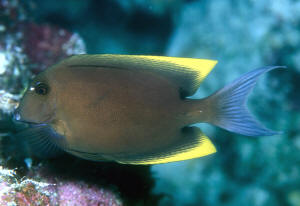
Bristletooth Tangs 5/1/15 Ctenochaetus tangs in a 168 gallon, stkg./sel. & comp.
9/7/12
More questions for you good people, Tang sel. for a 56 gal.,
Ctenochaetus sel. 6/13/10
Re: Ick Remedy, Ctenochaetus sel. - 7/2/08 As an update, I still have not used the ParaGuard, so alas, I cannot give you any feedback. We seemed to have reached the symbiotic relationship in the tank with the ick and the fish... I have seen a cyst or two once in a while, but has been what, a week now? We've had no major outbreaks and seemingly no concerns. I have been feeding with Garlic Extreme and a vitamin supplement, and they seem to be doing very well. <Good... is a place... perhaps not the ideal one... that I'd hoped for you> My questions now turn to Tangs, and I saw a tang at a major chain store which really caught my eye. I did not purchase the tang, as I don't like to purchase livestock from these stores due to the frequent ick sightings in their tanks... however this fish was very gorgeous and I know it was there by mistake. It's something I'd like to try in the future if I can get one from another vendor. I've done some research on the fish, as best I can... it's called a Flame Fin Tomini Tang. <A very nice Ctenochaetus species appearance wise and for aquarium use> My reading so far consists of your book and perusing the FAQ here, and there's not a whole lot of data. Mainly I am looking for resilience and compatibility info, so bear with me. The two tangs I have now, the yellow and the Atlantic Blue, are of different genus, which is what I attribute to their compatibility which is very good. The Passer angel causes more flak between them, which is nothing more than a tail flick here or there. This fish, the Tomini Tang, is from a third genus altogether, and if I'm not mistaken, a different geographical range. Your book mentions the other two species in the genus, mainly the Kole Tang, and most of the FAQ has to do with the Kole Tang. I've found a few references to the Tomini in FAQ, but nothing specific. I was wondering if you might take a few lines to tell me your thoughts on this fish and it's compatibility and it's durability. <Is a sturdy member of a tough genus... readily accepts foods, aquarium conditions. However, I hasten to add that this fish, likely any addition of members of the entire suborder Acanthuroidei, are not for you here... Your tank is already "tang-ed out"... with the two you have, and unfortunately the addition of another is too likely to bring about too strong/virulent a comeback in the Crypt> It is quite the gorgeous fish, not sure if I'd even add it at all, but something I might consider now or sometime in the future. <In another system> Once again, we all appreciate your time spent and thoughts on our various needs, questions, and issues. Thanks so much, Thomas Roach <Thank you for this update Thomas. BobF> 2 tangs in a 75 gallon aquarium? 11/18/07 Hello crew, <Hello Tony.> I have a question regarding the addition of another fish to my reef aquarium. The aquarium is 75 gallons with a 75 gallon wet dry sump (30-40 gallons of which are partitioned into a refugium growing Chaeto and Gracilaria) and well over 100 lbs of live rock. The water parameters are as follows: Spg: 1.024 Ph: 8.2 Nitrates: 0 Nitrites 0 Ammonia: 0 The only current inhabitants of the tank are a 2" yellow tang and some cleaner shrimp. I have waited one month since the acquisition of the yellow tang and am now ready to add another fish. I have read a lot about tangs on your site and can't seem to understand what the general consensus is as far as how many tangs one can have in a tank this size. <It is about territoriality and the need Tangs have for swimming space. In some instances Tangs survive in smaller systems, it is just not what is best for the fish. The small quarters stress the fish and make them susceptible to all sorts of maladies.> Some seem to think that a 75 gallon isn't even sufficient in the long run, while others have 4-5 tangs in 100-125 gallon systems. I would like to add a Kole tang to my tank as my next fish but wanted to know your thoughts on this. I will be living in my current house for another 2 years or so and don't see myself upgrading to a bigger tank before then. The only other fish that I would definitely like to add are a mated pair of clowns and an anemone. Would a 75 gallon be sufficient for this? Thanks ahead of time for all your help and the wealth of knowledge that is available to aquarists because of your site. Tony <The Kole would be a better choice for your tank, but I would just wait until you can upgrade to the bigger tank. I understand there are many conflicting and confusing accounts on tank size for Tangs. It is much like keeping a Mandarin in a 30 gal tank that has survived for six months. Just because it works for a while doesn't necessarily entail that everything going ok. Could you imagine five full grown Tangs in a 100 gallon tank? Yikes! Your tank would be big enough for appropriate anemones and clowns. I hope this helps you, thank you for all the kind words, Scott V.> Ctenochaetus flavicauda avail./use - 8/9/2006 Hello
there, Congratulations (again) on your site and work. Just a couple of
questions as regards Ctenochaetus flavicauda: I've
rarely seen any info on this fish, not even in your website. <Is
now... thanks to your prompting: http://www.wetwebmedia.com/ctenocha.htm> Is it
because it's not found in the trade? <Mmm, yes... restricted to
areas that aren't generally collected from:
http://fishbase.sinica.edu.tw/Summary/speciesSummary.php?ID=59589&genusname=Ctenochaetus&speciesname=flavicauda
Chip Boyle is "about it" in Roratonga... the
French-"protected" islands are too expensive...> Is the
collection forbidden? If not, do you if this particular fish has any
specific particularities as regards the other members of the family ?
<None that I'm aware of... I would say all Ctenochaetus have
similar husbandry> I want a Ctenochaetus for the importance of its
feeding habits in a reef tank and this one could be THE piece of
jewelry for my 210G tank ( if impossible to get, I'll
have either a strigosus or a hawaiiensis). Thanks in advance for the
reply Best, João Monteiro <Have never seen it offered in
captivity. Chip fishes for only about three species... high dollar,
deep water... Bob Fenner> Brooklynella from Brooklyn, Ctenochaetus tangs 3/18/06 Dear wonderful WWM crew First off let me thank you guys the best (and most time consuming) website in the world. <I'll say!> Unfortunately I found it a year in to the hobby, and it cost me literally hundreds of dollars worth of "stuff" and a big box full of that same "stuff". <Most all of us have these... I've got a few...> Anyway, back to my questions. I recently made 3 purchases from my local retailer. The first I made was a juvenile 3-4" blonde Naso tang. After visiting it in the store for 3 weeks, I took it home and acclimated it. A little nervous at first but now 3 weeks later bold and an absolute pig! MY next purchase was a 3" tomato clown. Once again after 3 weeks at the retailer I brought him home and he was great for about 24 hours. Then I noticed him not interested in for and his eyes were cloudy. <... a wild-caught fish...> So I turned to your website for advice. Boom, 10 minute freshwater bath with Quick Cure (formalin and malachite) then re-introduced in the main tank. ( no means for quarantine) After that he still looked bad on one side of his body, so the next day I got a 10 gallon tank for QT/hospital. <Yay!> This morning I did another 10 minute bath with the formalin and got great results body slime was gone but his breathing was still incredibly rapid and was not interested in food, so back to the hospital and treatment to be continued. How long should I continue the treatment until I try another one just in case this doesn't work? <I'd try to hold off until the breathing rate is more "normal"... fishes have real trouble with loss of packed cell volume (hematocrit)... Can/often die from the result of "not being able to breath"... secondary effect from... many influences> I am also concerned he has not eaten in 2 days, so I have been adding some Selcon directly to the water. How can I get him to even be remotely interested in food? <... posted... on WWM> Next question, how long does it usually take Brooklynella to "appear"?. <A day to a few> The reason why I ask this is because I want to know if it was in the fish form the store, or in my tank from a clownfish death about a year ago. <Should be gone from a previous infestation if this long w/o a host> None of my other fish are affected at all (2 tangs, diamond goby, and damsels). <Oh! The damsels could act as reservoir hosts> One more question before I go, If another fish came up with the same sickness , say a Pomacanthus angel, can they be in the same QT together? <Yes> Can I use the same FW bath water? <Almost always, yes... aerate it though> Just one more comment, I bought a very juvenile Tomini tang (Ctenochaetus tominiensis) about one inch in length <Wow! Tiny!> and is now about 6 inches and I have to say this fish is absolutely the best algae eating machine in the world, that is on top of its beauty and want to "tell the world" about this rare beauty, everyone should have one. <You have done so> Sorry about my rambling on and on, and thank you in advance for your response and advice. Thanks, Dino from Brooklyn <BobF in HI> Ctenochaetus strigosus - 12/08/05 Hello! <<Howdy>> I am relatively new to the aquarium hobby (about four years) and as such was so grateful to discover Wet Web Media several weeks ago. <<Glad you found us...Welcome!>> Relative to the needs of the aquatic life entrusted to our care, WWM has been an indispensable, comprehensive reference of proper husbandry. <<Thank you>> Currently we have a 55 gallon saltwater tank with a crushed coral substrate. It contains approximately 35 pounds of live rock, 1 Yellowtail Blue Damsel and 1 Fiji Devil Damsel. The damsels have been in residence here for two years. Now that time constraints are a thing of the past (I have recently become a "stay-at-home-wife") my husband and I would like to more fully develop the potential of this and 12 freshwater tanks. <<Ah! Real fish 'nerds' eh?>> Weeks of voraciously reading WWM archives has given us fantastic insight on how to develop our hobby. After reading all postings related to the Ctenochaetus genus and most of those concerning the family Acanthuridae I am considering the adoption of a Kole Tang. <<An excellent choice.>> I have been viewing a single specimen of this species at our LFS for 1 week. It is approximately 3" in length, the mouth appears undamaged, the body doesn't appear thin or emaciated and I have been assured that it is eating. <<Assured?...ask to see it feed...if they decline, don't buy the fish.>> It is extremely shy and the dorsal fin appears somewhat clamped when this fish makes an appearance. <<All the more reason to see it feed.>> It does appear to be easily frightened and therefore I would assume this semi-clamped fin is the natural physiological result of such stress. <<Possibly, but after a week it should be a bit more relaxed...unless stressed by less than optimum water conditions, aggressive/improper tankmates, etc..>> Would this assumption be correct or is it more likely to be illness? <<No way to say for sure.>> Is this something to be concerned about or will it pass with acclimation to our home? <<If water conditions/tankmates, yes, likely will improve...but ask to see it feed...>> I've asked the LFS owner to hold this specimen so that 1) I could observe its behavior, 2) I could be assured that it would eat, 3) I could see if an illness developed and 4) learn more about this species so we could be assured that it is a proper choice for our aquarium. <<Excellent, I commend you on your patience/good judgment. This fish is a very good choice in my opinion. Much more suitable than so many of the tang species placed in a 55 gallon tank. But do continue/complete your research re this fish.>> Although we've never experienced an algae bloom several weeks ago we experienced our first diatom bloom. Water parameters have been consistent for 2 years, ammonia 0, nitrite 0, nitrate 20, specific gravity of our h2o is 1.021. <<I would bring this up to 1.025>> The only variance from our normal maintenance procedure was the use of a different salt, Reef Crystals instead of Instant Ocean. <<Mmm...>> Reef Crystals appear to have a higher concentration of silicates, according to the chemical analysis. <<Well there ya go!>> Could this be it? <<Yes...or maybe it's time to change that RO membrane...>> Weekly water changes of 40% have not made a difference. <<If the salt mix...will only make worse.>> Our protein skimmer, Prizm Pro, was given to us. Understandably so, as it doesn't seem to be incredibly effective. <<Agreed>> The upgrade of our skimmer and the addition of a refugium are in our near future. <<Outstanding! All will be better for it.>> I have read the archives relevant to brown diatoms and hope the aforementioned actions will solve this problem if the silica content of Reef Crystals is not an issue. I understand that the Kole Tang will feed on diatoms and it appears that our tank is currently an optimal source of this particular microorganism. <<They will yes...some more than others. Don't expect the fish to provide the cure...best to determine the source of the silicates and eliminate.>> This being said do we have a suitable habitat to house a Kole Tang for the next year? Perusal of the archives indicate that we probably would. <<I think very likely you do.>> This would be the third and final fish for this particular tank. <<Wow...now that's restraint...very good!>> By next fall we would like to have the Kole inhabit a 92 gallon corner reef tank. I would like this fish to be comfortably housed both now and in the future. If the current set up (in transition to the Berlin Method) and the future set up previously indicated are inadequate please advise, we will not buy this fish if we cannot properly care for it. <<I think it will be fine.>> Unfortunately, and despite my best efforts, I cannot seem to write a letter or email that doesn't develop into an epic novel. <<Thank you for writing so well.>> Thank you for "hanging in there" and I appreciate the time you take to answer these questions. I only seek to verify what I've read so that I may avoid any mistakes that may cost this animal its life. Best Regards, Christina <<No worries mate, EricR>> Bristle-Tooth Surgeon Fishes Hello from sunny Fla! I just recently saw a reference/link to a page you wrote on WWM about The "Bristle-Tooth" Surgeon Fishes.... I saw that you wrote that the Tomini is the most difficult to keep. What makes you say this? <Just the current sense, sample size of specimens... I rate all the Ctenochaetus highly for survivability, adaptability to captive conditions in general> I have one that I had sent from Utah about 4 months ago.. he is doing fabulous.. eats well.. and is a model citizen, except for a little occasional picking on my lawnmower blenny. <Typical... these fishes, groups do some such interaction in the wild... eat the same foods...> I think this is because they share an interest in algae, and algae based food. It's never violent.. just a few pushes, which the blenny just sits there, turns his head to the side, and takes it. Thank you so much, if you have time to respond to this, Carole. <Thank you for your input. Bob Fenner> Bryopsis Eater I know there's a good number of people who suffer from Bryopsis (wiry, dark green hair algae) plagues, including myself. I've heard they usually crash over time, but I've yet to see it happen in real life. Any cures (biological or otherwise) you can suggest would be greatly appreciated. I'd soon pull out my own hair then my Bryopsis again! <<Leonard, I still am pumping for the Tang genus Ctenochaetus to munch this algal genus control-wise. Look into the couple of species generally offered for sale out of Hawai'i: C. strigosus (the Kole or Yellow-eye) or C. hawaiiensis (the Chevy)...Bob Fenner>> Re: Chevron Tang P.S. I have checked out your website. It is excellent. The best one I have seen, and I have passed it on to others. <Outstanding, thank you for your kind, encouraging words> And I also meant to tell you in your last communication to me that I appreciated the thought, honesty and detail you put into your answers. <Ah, you humble me> I ended up getting that Chevron Tang. He seems to be quite happy at the moment, and my cleaner wrasse has never been so happy! If I feel that he becomes too big for my 46-gal bow front, then I will have to make some decisions (get a larger tank or find him a new home.) I promise not to become a bother, but I am sure glad I found you. Thanks, again. <Thank you my friend. Bob Fenner> Kole Tang Beautiful pic on the updates page--didn't
mention it earlier because we had other business. I read the entries
for this one on WWM--would make a beautiful centerpiece fish if I could
get a good healthy one. . . <Yes, thank you, and these are generally
very hardy fish on arrival from most any/all collection points... do
look for ones that have only been "on hand" for a few days to
weeks. Bob Fenner> Chevron Tang Hello, I'm hoping you can help me. I have a very successful 46-gal. bow front reef tank. It is 6 months old and thriving. I have more than enough filtration (a wet/dry, a canister, and an AquaClear that hangs over the back). I also have a U.V sterilizer and a protein skimmer. My fish include: 5 Percula clowns, 6 bar gobies, 4 Mexican red-headed gobies, 1 yellow headed Jawfish, 1 neon Dottyback, and 1 cleaner wrasse. I have the opportunity to purchase a chevron tang. I hesitated a lot because of the size of my tank. <You do have a bunch of smaller fishes in it already, and a forty six gallon is smallish for a Ctenochaetus sp. tang...> The store owner knows my tank and feels that this tang will be fine in it. <Likely yes... this is a very good species for aquarium use. Oh, our coverage of this and all other Surgeonfish can be found on the site: www.WetWebMedia.com> My questions are: what is the life expectancy in a well-maintained tank; <A few years> will it be aggressive towards any of the fish I have; <Not really... some "jousting" to be expected... but no real competition for types of foods, habitat... that might occur with other species> am I doing the fish an injustice because of the size of my tank? <Hmm, these ethical questions are tough... "Not really" to a "semi-yes" are my feelings/thoughts here... a larger system would definitely be better (like most all aquatic life the "living area" in the wild for one of these fish is much larger than almost all aquariums... but a forty six gallon bow-front is (barely) adequate for one... we have these genera of tangs in smaller systems here at our facility/test tanks... that are healthy, apparently "happy"> If not the chevron, I was thinking of the yellow tang because it is a little smaller and beautiful. <Both about equal choices all the way around> The store owner said, however, that he has seen them tear up a reef and they don't live long. <Hmm, do disagree with the gist of this stmt... > I would love to hear from you.....before I make a big mistake. Laurie from Connecticut <Please read through the WWM site on these issues... I would go forward with your plans as stated with the hawaiiensis... especially if you see a larger system in your future... or a Zebrasoma Tang species. Bob Fenner> Chevron Tang Bob, thank you for writing your book. It is a bible to me. My question is on Chevron Tang. I want to get it, but I have heard they don't last long. From my LFS, the owner said they last maybe a year. He said they need to be in higher water pressure to do well. What do you think on this issue? Jackie <All in all a very hardy species. Here is my ongoing opinion on the members of the genus Ctenochaetus: http://www.wetwebmedia.com/ctenocha.htm Though found, collected in deeper water, this is a very sturdy aquarium species both as juveniles and adults. Bob Fenner>
|
|

|
Features: |
|
| Featured Sponsors: |

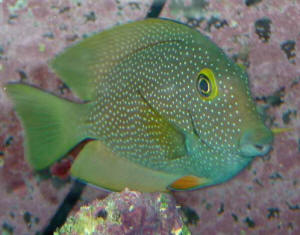 cf. strigosus. RMF