 |
|
| Home | Marine Aquariums |
Freshwater Aquariums |
Planted Aquariums |
Brackish Systems |
Ponds,
lakes & fountains |
Turtles & Amphibians |
Aquatic Business |
Aquatic Science |
Ask the WWM Crew a Question |
| Please visit our Sponsors | ||||
More questions for you good people, Tang
sel. for a 56 gal., Ctenochaetus sel.
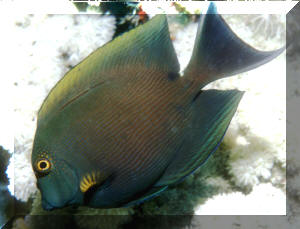
6/13/10 Re: Orange Spotted Diamond Goby afraid of new Two Spot Bristletooth Tang, the latter, sys. 12/10/08 Dear WWM Crew, <Hello again Laura!> Bob F. has been unbelievably helpful in responding to my attached email concerning my tank. I am reattaching it because I do have one more question (that I am almost afraid to ask) so you can see all tank water parameters/history/occupants. Here is the question... When I bought my last and final fish for the tank 10 days ago, the Two Spot Bristletooth Tang, I had done quite a bit of research prior to the purchase. I researched compatibility, appropriate tank size (most resources said 75 gallon minimum), diet, and water quality needed to keep this fish happy and healthy. I honestly feel I made the purchase with the health and welfare of this fish in mind, along with my desire to enjoy it. However, I am so confused about the tank size issue for a Tang that I am second guessing myself. After reading further, simply going by the number of gallons in the tank was misleading. Many resources also stipulated a minimum of 4 feet in length was required to house a Tang. <Indeed, the bigger the better for these wide-ranging fishes... they often tussle with animals that utilize the same sorts of environment> My tank is an 85 gallon reef. It is loaded with live rock, hiding places, live sand, and houses 8 additional small to medium size fish (at adult size). However, my tank is NOT 4 feet long. It is 3 feet long, 18 inches wide, and it IS 85 gallons. I have observed the Tang and she seems to utilize the height, length, and width of the tank. <Well-stated> She is eating beautifully and just a lovely specimen to my eyes. Aside from her adjustment to 8 established residents (and theirs to her), I have not seen any real issues other than what I have previously written about, and there have been no outbreaks of disease at this point. I do not want to stress any of these fish out, I want to give them a healthy environment to try to ensure they live as long as they are capable of in captivity. Just how important is the extra 12" in length to this fish? <Mmm, overall volume, habitat is more important...> I purposely got a Ctenochaetus due to the smaller potential size of the fish as compared with other tangs. From research I have done, it should reach 5-6 inches in captivity. I really need your expertise on this. In fact, your opinion is the last and final one that will resolve this dilemma for me! Can this fish be kept successfully in this size tank? <Yes> As a final note (especially to Bob F.) my Diamond Watchman Goby was out most of the day. She is eating, and although her guard is up to the new Tang, I see gradual daily improvement in their relationship. Thank you Bob! <Ah, most welcome> Very best, Laura Garmizo <Bob Fenner> Tang families (sic, genera) and tank size 2/19/08 Mr. Fenner, I would first like to note that I have read several of your online publications recently and found the detail to be of great value. Thank you for your efforts in relaying information to marine hobbyists such as myself. <A pleasure to share; a hope to relate information of worth> I have a question about the various families of tangs in relation to their suitable home aquarium size. I read through your documentation on wetwebmedia.com and there are only a few noted tank volumes recommended as a minimum for the families; <Ah, genera> the Acanthurus, Ctenochaetus, and Zebrasoma all note a guideline size starting at 50 gallons. I was wondering if the data is current, <Mmm, not really is likely a reasonable response. Having been a content provider in the trade and hobby for... is it really more than forty years?... much of my in-print work is woefully dated... and worse... extant w/o this note> and if perhaps you had some additional recommendations or adjusted recommendations for tank size for any of the 5 major families on the site? <Well... for most small species of Acanthurus, all the Bristlemouth and Sailfin species, really a fifty gallon volume that is otherwise not crowded... will suffice... that is, with otherwise good maintenance, nutrition... keep these species alive, healthy for something like a "normal" average maximum life span... However... Some Acanthurus get quite large (saw an absolutely gorgeous group of five A. blochii yesterday diving off Crescent Bay/Manta Ray Cove here on HI's Big Island... I do hope my video of them came out... and I do wish I knew enough re editing, placing such on this/these devices that I could immediately (if not sooner) share this with you... But these were all more than a foot long body length (more with their caudals)... These would need hundreds of gallons... Naso and Prionurus species likewise need hundreds of gallons... systems of at least a couple metres/six foot "run"/length to be happy, grow, survive for any real period of time... Oh, and Paracanthurus... should not be kept in anything smaller than a 75... It should go w/o saying, but am always aware that many less-sophisticated folk may read this... that "bigger is better" for sure... behaviorally and physiologically with these and all other fish groups.> There are several message boards that I frequent, of which they all have a group of people who state that the minimum tank size for most tangs would be something with a 6' length, and nothing smaller than a 75 or even 90 gallon for Zebrasomas or Ctenochaetus. Is there any data that supports specific sizes for these tangs? <Mmm, anecdotal experience mostly... There are historical, institutional longevity records for some species... but these are almost always kept in vastly larger systems... But I've kept, personally can account for the most popular species care in the stated volumes by our and other service companies...> I only ask out of curiosity, personally, I have a 180g tank and have been in the hobby for a couple years, but would much prefer to gather all the data that I can as a reference. Thank you for your time, it is much appreciated. Alex Liffick <Thank you for your interest, asking. I do ask in turn that when you have confidence, time, that you consider joining our WWM Crew in aiding others. Cheers, Bob Fenner> Kole Tang Run in with
Tunze'¦.once an accident, twice a mistake, but more get a
clue? 7/25/06 Hi there: <Hello> My Kole Tang has
been a super tough guy since I got him in December or so. Always big
and fat and eating. But on day 2 for reasons unknown I had to free him
from the overflow intake. Hmmm... Then in January, he twice
was stuck to the intake of a Tunze 6060 rotating on Sea-Swirls.<Poor
guy> That was odd indeed. Second time he was on it for a
while, seriously tattooed on one side. <Hmmm I probably would have
done something creative to keep the fish from the intake and overflow
the first time there was a problem. Perhaps the pumps are to strong or
the fish weak for some unknown reason.> Recovered from that though
too. <Lucky fish>I target fed to make sure he ate well and
frequently, at least 3x a day. Starting maybe in March, I'd say
every couple weeks I'd arrive home to see that the scales were
missing in a splotch on one side, almost always on his left
side. In fact, I think always'¦.that is the side he
was stuck on that last time on the Tunze. <I wish you were kidding
but I have a feeling you're not. Seriously you need to do something
to keep that poor fish off the intake of that pump. 4 months every 2
weeks'¦. so the poor fish has been injured at least 8 times in
the last 4 months, not including his original 3 injuries. How many
times does it have to happen before you do something about it?>
Anyway, I'd always target feed and he'd always eat and it would
always clear up within a couple of days. <Very resilient. It's
great that you are taking such good care of him after he is injured but
some prevention would go much further. One of these days the poor fish
will not be so lucky.> I'm thinking, tough guy. <Perhaps
initially but every time he gets hurt he is probably getting weaker,
with a good chance of some permanent damage to that left side.> Now
I am not so sure. Tonight he is deep within the rockwork, not breathing
hard, but hiding. I can see that the scales are missing
between his eyes right on his head, and a bit on the side of his mouth.
Hard to tell much else as it's dark in there, even when the lights
are blasting away! Not a chance of getting a picture. Most
worrisome is he didn't come out when he saw me or when I fed the
tank and that is an absolute first. <Indeed, not a good sign.>
That has me concerned in the morning he'll be gone. <As you
should be, there is a good chance he could be. I would try turning the
lights off and doing a water change.> When I say the scales are
missing is I see white flesh. I figured wounds somehow against the
rocks or maybe he picked a bad fight, though with whom given my stock I
haven't a clue. He should be the boss. <Hard to say
given you have not listed the tankmates. Less dominant fish will often
pick on injured or weakened fish.> Anyway, white flesh is apparent
now on his head similar to in the past when always on his body.
<Perhaps this was his last run in with the power head intake. If not
and he survives you need to do something with that Tunze intake> Any
ideas what this could be or what I could do??? <Sounds to me like he
had yet another run in with the Tunze. If you can gently get him out of
the tank, you could try putting him in another tank to
recover'¦.. a hospital tank where he is safe from the Tunze
and other fish. Set it up similarly to a quarantine tank with hiding
places. Keep the lights off and water quality good. If he survives
PLEASE do the poor fish a favor and do something with that pump intake.
Build a mesh basket around it or place a sponge over it. We do this all
the time in seahorse tanks. It's really not a big deal. It may not
be esthetically pleasing and the sponge will need to be removed
frequently to be cleaned, but at least the fish will be protected from
further trauma. This may sound harsh, but needs to be said'¦
once an accident, twice a mistake but really 3 and on up times is
irresponsible to say the least. You really should have done something a
long time ago. It is your responsibility to protect the creatures in
your care from harm as best you
can. Leslie.> Kole tang and suitable aquarium! 10/25/05 Hello crew, hope all is well. <Everything is fine here> I have a couple of quick questions. First, is 4' long x 2' wide an acceptable size system to house a Kole tang (Ctenochaetus strigosus) long term? <Yea it should be fine> Fishbase lists the max. size at around 6", but I know that most tangs like a lot of room to roam. I was planning on buying a 60x24x24 tank, but another reefer in the area has a 48x24x30 tank at a good price. <The bigger the aquarium the better in my opinion...if you can afford the larger one I would definitely get it> This brings up my next question. The tank has holes drilled in the bottom pane of glass for a closed loop system. I was planning on getting a pair of Tunze Streams (3175 gph @ 45 watts!), and would probably not use the closed loop. If I were to buy the tank, would it be safe to simply cap off the bulkheads with pvc cap fittings, or do you think that could cause pressure around the holes and cause the bottom of the tank to break? <I don't think you will have a problem with that but a drilled aquarium can sit flush against the wall...while one with a prefilter box can be a real pain...especially if the power goes out!!!> Hoping to get the benefit of your experience, rather than leave it to chance. Thanks in advance. <Good luck, IanB> Stocking question 9/17/05 Hi, <Hello Kim> Today at the LFS I came across a Kole Tang and fell in love. I'm not sure if I have the room for it, so please help me out. I have a 120 gallon tank (4x2x2') with a 25 gallon sump/fuge, Euroreef 6-2+, over 100 lbs live rock, live sand, miracle mud in the fuge, water flow about 25x/hour. In the tank are purple tang (4"), foxface(4"), 2 coral beauty angelfish (3 & 4"), 5 green Chromis (2") and one maroon clown (3"). I do 5-10% water changes every 7-10 days. There are also 3 clams and some LPS. What do you think? Any chance of fitting a Kole in? <No. Kim, if the purple tang is doing all right, leave things alone. Your tank is too small (length especially) to add a Kole. Aggression will take place between the Purple and the Kole with the Purple winning the battle. Your tank is at it's stocking limit as it is. Sorry, James (Salty Dog)> Thanks so much for all your help, <You're welcome> Questions - Yellow-eye Tangs (5/15/2004) We've recently started a 50 gallon saltwater aquarium and have a variety of marine life living quite happily-We just lost 2 yellow-eyed tangs, <Sorry to hear it. I assume you mean the tang Ctenochaetus strigosus. More than 1 in a 50 gallon aquarium would overcrowding them> the third is doing fine, we have a butterfly fish, <What species? Most butterfly fish have very specific diets and can be hard to feed in captivity> a crab, a starfish, a cleaner shrimp and a bunch of snails and little hermits. We have a never-ending battle with red, stringy algae growing all over everything. <Most likely Cyanobacteria, technically not an algae> The ammonia, nitrite, and ph are all good (according to our supplier and to our own tests) but we don't know what happened with the tangs or why we have the algae. <What are your nitrates\phosphates? What do you mean by an "Ok" reading? Numbers would be helpful :) Cyanobacteria is often caused by excessive dissolved organics, nitrates, and phosphates. Try doing weekly or bi-weekly partial water changes with a water source that is known to be free of phosphates and nitrates. Use a chemical media such as Seachem's SeaGel or Poly-Bio-Marine's PolyFilter to remove any excess DOCs, as well as phosphates and nitrates. Do you have a protein skimmer? If not, I highly recommend you obtain one. Definitely do a search of our FAQs regarding Cyanobacteria removal) If you have any recommendations, we'd love to hear them. <I wouldn't add any more fish to your aquarium, as your tang will reach 6-8 inches by itself. M. Maddox> Ctenochaetus strigosus Bob - Please comment on one Yellow-eyed/Kole Tang and two Percula Clownfish [with anemone] in a 25Lx19Dx21H tank. These would be the only three fish housed in this 37gal system with 50lbs / LR & LS substrate. My concern is that the Kole will grow too large for my almost "cube" shaped set up. How fast will a juvenile [3-4"] specimen grow to an adult [5-6"] fish? <Slowly> Are any in the Tang group known to mature smaller in size than the others? <Yes, certainly... this is the "soonest"... with Prionurus, Acanthurus, Paracanthurus, Zebrasoma... all growing larger before maturity> Thanks for your help - TS, Dallas <You're welcome... Bob Fenner> Questions on a Kole Tang Hi Bob, I wrote you earlier about this and I am ready to get that tang. I have been looking at the various tang and am now narrowing in on a Kole. I saw one at a nearby LFS and found it more interesting in behavior than a Yellow Tang, but unfortunately I think it wasn't especially healthy. However I read your FAQs and it looks like you have some reservations. <To where? When? Let's go! Oh, yes, I see> I am a relative newbie, with the forty gallon breeder going since December (though I think it cycled twice or even thrice??). It has 40 lbs of live rock and about 40 sand (half aragonite and half LPS). Water quality is good with ammonia, nitrites and nitrates at zero; ph 8.2; SG 1.024; Ca 405; Alk 3.5; Temp 79. I have 3 cleaner shrimp; 3 ? peppermint shrimp; 5 turbo snails and a Sally lt foot and a number of hermits (?). I just lost a Midas blenny due to a daredevil trick of his when the tank top was off. :-( <Very common...> I plan to buy it at a LFS that quarantines it's marine fish two weeks. They do not routinely use copper (I think something else though like malachite green??). I think the quarantine tanks are lower SG. He doesn't overstock his regular tanks. He never uses nets to catch fish. In other words, I believe the possibility of getting a healthy fish is better. <Very commendable> Now for the questions: (I am going thru your FAQ). 1. Is my tank too small for one? You don't recommend small ones, and I wouldn't even know where to get one. Eventually I would want another Midas (and I'll keep the top on all the time!!) and a couple False Percs. I am thinking I may have to find another home when it gets to adulthood. <Not too small by a smidgen... and the rest of these fishes ought to go "with a shoehorn..."> 2. Is my tank "established" enough. I can't remember where I thought you wrote that... I read thru much of the Tang stuff. <Yes, likely...> 3. Do I have enough circulation? I use the Ecosystems 40 and I recently put in a MaxiJet 1000 facing opposite of the outtake pump on the Ecosystems. It is really pumping the water around, in fact am seeing more debris, little white flecks, etc. I have another pump but was wondering as this seems to move so much water around. (I got a couple for $5 each, I know they are a discontinued pump. They seem in excellent condition). The Ecosystems has a Rio 600 in the sump. <I understand, and yes> 4. Diet: I was going to feed it brine shrimp that has added vit.s. Also I got a fish vitamin with added vitamins and iodine. This along with tank algae. I thought I would follow your advice on the feeding method. (Lacing the tank algae.) 5. Anything else I should look for? <Hmm, not necessarily> Thanks. Btw I look forward to reading everybody's comments and your answers. You have a very encouraging and helpful attitude. It seems like I have known you and a number of the writers for years. :-) <Ahh, thank you for this...> Btw I bought your book "A Fishwatcher's Guide to the Salt water Aquarium Fishes of the World" (book one). Very neat. <My first effort at "doing all" self-publishing wise... harrowing> --Jane <Be chatting my friend. Bob Fenner> Kole Tang, snail poop, and film Hi Bob Fenner, Your live rock is doing just beautiful in my tank still. I have a few questions: 1. How big does a Kole Tang get and where is he from? <Three to four inches overall is best. Most Ctenochaetus strigosus come to the trade in the United States from Hawai'i.> (so far I have all Indo-Pacific habitants and I really want a Kole tang - I guess we'll see.) How about a chevron tang, he stays pretty small, right? <Please read here: http://wetwebmedia.com/ctenocha.htm> My main tank is only 55 gallons and I don't want to crowd whichever type of tang I get. 2. About two weeks ago I got 12 Astrea snails and the algae sure is under control, but the snail poop at the bottom of the tank is a mess. I have really fine sand down there and cleaning it up without sucking up all the sand is a difficult feat. Do you know of any fish or such that will eat their mess,...literally? (I also have a scarlet cleaner shrimp so a crab would be out of the question.) <Best to siphon out into a bucket, let settle... decant/pour the water back into your system... Going forward, do make sure you have enough water movement, particulate filtration to remove such material> 3. I saw "Microbes to Mantas" at the Natural History Museum last week and it was very interesting. It covers the Sea of Cortez and how it is a unique abundance of life for all forms of marine animals. The filming is incredible and the movie screen is huge !! You should definitely go see it when you get time. And the museum looks great since it's face lift. They still need to fill up a few more floors with artifacts, but their collection now is really nice. For $5.00 you can't beat this entire package ! <Thank you for this. Will try to get out to Balboa Park before this show moves on. Bob Fenner> Talk to you later, Jana Kole Tang Placement, Care Mr. Fenner, I love your CMA and have learned more from it than from any other single source. I'm new to the hobby, and have had my 55 gallon running for ~10 weeks. It's F/O, with a medium Kole, a medium Pacific Blue, a small Gold-Striped Maroon Clown, a blue damsel, and a common cleaner shrimp. T=79-80F, SG=1.021, NH3=0, NO2- =0, NO3- = 10-15. My Kole was my second fish, so has been here for 5-6 weeks. About a week ago he put his barbs out, and I have not seen them retracted since. He swims frantically, and spends a lot of time sideswiping the glass. I can hear his barbs clink outside the aquarium, but he shows no aggression towards other fish. This started about 10 days after the arrival of the clownfish, but what worries me is that he has recently damaged his face, and now he looks somewhat like a burn victim. Is this a fish that has had enough of captivity? <Hmm, perhaps this specimen has... the species itself are excellent generally. A couple of things re Ctenochaetus: http://wetwebmedia.com/ctenocha.htm I would place the genus later in new systems... only after a system has been running a few to several months... and do you have live rock in this system? I would definitely place this to improve water quality and provide sufficient forage for your Kole: http://wetwebmedia.com/liverock1.htm> Is there anything I can do? Thanks VERY much, John Sanders <Please do read through our site, place the live rock, and try to be patient. Bob Fenner>
|
|

|
Features: |
|
| Featured Sponsors: |