|
Related FAQs: Flying Gurnards,
Related Articles:
Lionfish & Their Relatives,
the subfamily
Choridactylinae (Inimicinae), Family Platycephalidae, the Crocodilefishes
or Flatheads, Subfamily Synanceinae, the
Stonefishes, Subfamily
Tetraroginae, Sailback Scorpionfishes or Wasp Fishes,
Family Triglidae,
the Searobins or Gurnards,
/A Diversity of Aquatic Life
The Flying
Gurnards, Family
Dactylopteridae
|
%20MD.jpg)
|
|
By Bob Fenner
|
Dactyloptena orientalis
|
Scorpionfishes:
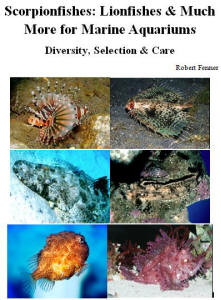
Lionfishes & Much More for Marine Aquariums
Diversity, Selection & Care
New eBook on Amazon: Available
here
New Print Book on Create Space: Available
here
by Robert (Bob) Fenner |
 |
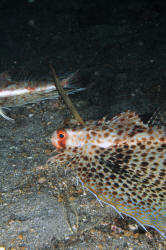
Family Info: Two genera, seven species. Distributed in the
tropical Atlantic and Indo-Pacific. Walk on the bottom, where they hunt
invertebrate food. Make noise by stridulating their hyomandibular
bones. Seen more and more as aquarium specimens. Some to 50 cm. in
length.
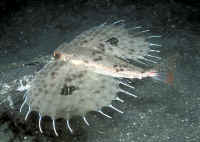
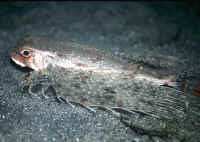
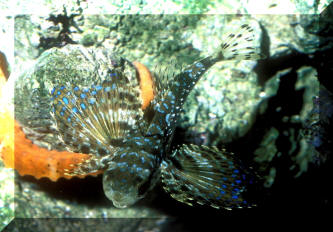
| Dactyloptena orientalis (Cuvier 1829), the
Oriental Flying Gurnard. Indo-Pacific; Red Sea, East Africa to
Hawai'i, Tuamotus, Marquesas. To 40 cm. Demersal; lives on
shallow sandy bottoms. Only member of genus found on oceanic
islands. N. Sulawesi images. |
|
Bigger PIX:
The images in this table are
linked to large (desktop size) copies. Click on "framed"
images to go to the larger size. |
%20MD.JPG) |
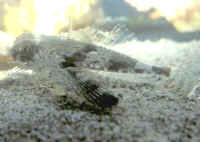
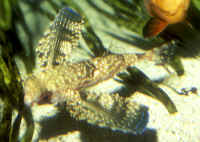
| Dactylopterus volitans (Linnaeus 1758), the
Flying Gurnard. Eastern and western Atlantic coasts. To
ninety cm. total length (most much smaller). Feeds primarily on
benthic crustaceans, especially crabs, clams and small fishes.
Aquarium images. |
|
Bigger PIX:
The images in this table are linked
to large (desktop size) copies. Click on "framed" images
to go to the larger size. |
|
|
Scorpionfishes:
Lionfishes & Much More for Marine Aquariums
Diversity, Selection & Care
New eBook on Amazon: Available
here
New Print Book on Create Space: Available
here
by Robert (Bob) Fenner |
|
|
|


.jpg)