|
FAQs about Dwarf Lionfish
Identification
Related Articles: Dwarf Lionfishes, Lionfish & Their Relatives,
Keeping
Lionfishes and their Scorpaeniform Kin Part 1, Part 2, by
Anthony Calfo and Robert Fenner,
Related FAQs: Dwarf Lionfishes, Dwarf Lions 2, & by Species: Fu Man Chu Lions (D. biocellatus),
Fuzzy Lions (D. brachypterus),
Green Lions (D. barberi), Hawaiian Lions (Pterois sphex), Zebra Lions (D. zebra), & Dwarf Lion Behavior, Dwarf Lion Compatibility, Dwarf Lion Selection, Dwarf Lion Systems, Dwarf Lion Feeding, Dwarf Lion Disease, Dwarf Lion Reproduction,
Lions
1, Lions
2, Lions 3, Lions 4, Lionfish
Selection, Lionfish
Compatibility, Lionfish
Behavior, Lionfish
Feeding, Lionfish
Disease,
|
%20MD.JPG)
|
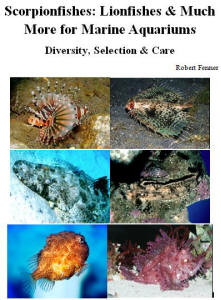
Scorpionfishes:
Lionfishes & Much More for Marine Aquariums
Diversity, Selection & Care
New eBook on Amazon: Available
here
New Print Book on Create Space: Available
here
by Robert (Bob) Fenner |
 |
Lionfish taxonomy Dear crew: I have perused everything on
this site that I can find, and Dr. Marini's articles on
reefkeeper.com, and I remain baffled, hoping you can shed some
light. I'm trying to identify a fish by species, and
having difficulty. I am sorry that I can't forward digital
pictures, and am hoping that a gross physical description might be a
purposeful place to start. <Not likely> A local fish store has a
variant of dwarf lion that seems not to fit with what I can find in
descriptions of species. When asked, employees could only
report that it had been taken in trade, and had been in the store for
some time. Anecdotally, one of them thought it might have
originally come from Florida, though that could just as easily have
been the locus of the collector/aquarist. When queried about the
species, they generalized it to be a fuzzy dwarf. <There are many
scorpaenoid fishes called "dwarf lions", not all are
Pteroines...> The critter in question most generally seems to be
brachypterus, but not quite. The pectoral fins have the
characteristic shape reminiscent of the sail on a Chinese junk, and are
webbed almost to the end of the spines. Body shape [about 4"],
coloration, and fin profile are generally consistent, but there are a
few significant departures. It lacks the
"moustache" protuberances at the corners of the mouth, and
has no noticeable "horns" above the eyes. There
are bumps of tissue along the lateral line, again consistent with
brachypterus, but most noticeably there are no "flags" of
tissue at the ends of the dorsal spines as both of my Fuzzies
have. Finally, while every fuzzy I have seen has blue eyes,
the eyes of this fish have a bright orange outer circle, with a center
that is a deep green/black [like a Tahitian black pearl]. My best guess
is that it's actually a barberi. Can you suggest any
definitive characteristics that I can look for to identify it more
definitively? Am I overlooking the obvious, and can you tell
me what I should have figured out on my own? <Mmm, you
might peruse the linked references for these species, genera on
fishbase.org or make a trip to a large college library for a computer
searched bibliography... There is variation in the Brachypterus
mentioned... color and appendages-wise... Bob Fenner> Looking
forward to your suggestions, Rick Walters
Scorpionfishes:
Lionfishes & Much More for Marine Aquariums
Diversity, Selection & Care
New eBook on Amazon: Available
here
New Print Book on Create Space: Available
here
by Robert (Bob) Fenner |
|
|
|

